




Abstract
The case study explores Madhya Pradesh Tourism’s promotional strategy aimed at attracting domestic tourists. The major challenge was to come up with a unique selling proposition for a destination that lacked the allure of popular tourist hotspots like Goa and Kerala in India. Madhya Pradesh Tourism faced the obstacle of not having a distinctive feature. This case study demonstrates how Madhya Pradesh Tourism successfully positioned itself as a family entertainment as a proposition to boost tourism. It serves as an excellent example for analysing the development process of a state’s tourism campaign and highlights the hurdles of strategic communication in different stages of the campaign. Additionally, it offers a reference point and context for communication objectives in a competitive tourism industry.
Learning Outcomes
Understand the role of campaigns in creating a destination brand
Develop an understanding of marketing initiatives and their role in destination development
Discuss various stages in the development of the communication strategy of tourism destination brands
Chart the progression of campaign development and the contribution of stakeholders towards achieving success.
Background
India’s tourism sector offers immense growth opportunities, thanks to the country’s rich cultural and religious heritage and diverse natural attractions. According to the Ministry of Tourism, Government of India, from 2000 to 2018, tourism in the country increased nine-fold, from 220 million visits to around 1.8 billion visits, a substantial proportion of which constituted visits for religious tourism (Ministry of Tourism, Government of India, 2020). Although foreign tourists spend more than domestic tourists, the latter’s significant volume underscores its substantial contribution to the industry. The annual growth rate of domestic tourist visits was 25.3% in 2019, which was more than double that of the previous year (Ministry of Tourism, Government of India, 2021a, b). As per the Tourism Statistics 2021 report, in 2021, domestic tourist visits in India increased by 11.05% over 2020, while foreign tourist visits decreased by −85.29% over the same period, reflecting the impact of the pandemic on tourism (Ministry of Tourism, Government of India, 2022). Overall, the data suggests that India’s tourism sector has strong potential for growth, particularly in domestic tourism, and the industry’s development could lead to significant economic benefits for the country.
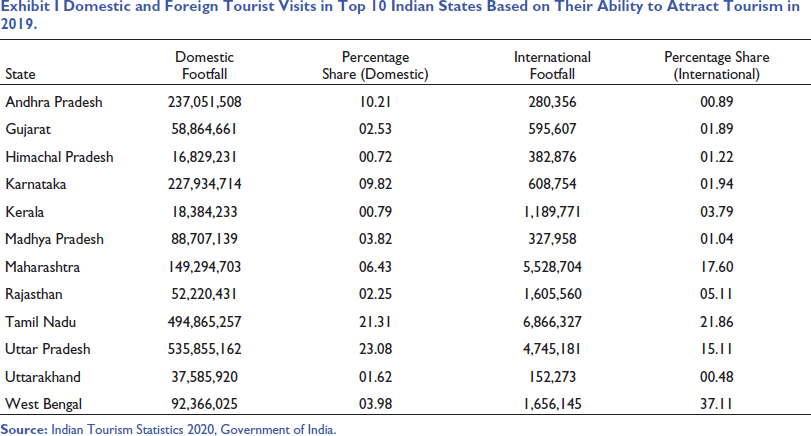
Madhya Pradesh (MP), a state in the heart of India, has achieved unprecedented growth in domestic tourism and registered 88 million domestic tourist footfalls (Ministry of Tourism, Government of India, 2020). Although the state was ranked among the top 10 domestic tourist arrivals, it recorded a compound annual growth rate of 381% in 2012. In 2016, MP was ranked third among the top 10 states/union territories, contributing to the 15.5% growth in domestic tourist visits. A few years back, the scenario was not similar when domestic tourism footfall in MP registered a mere 5% growth while the industry grew at 15%. As the industry was growing, the tourism department wanted to encourage domestic tourism with a point of differentiation that can help tourists prefer MP over other destinations. The stakeholders were pondering a few questions as to how a state like MP will create a unique distinction in the mind of domestic travellers. How will the existing targeted audience be sustained with changing consumer preferences? What are the various strategies to be adopted by MP as a destination to increase tourist footfall in the state?
MP Tourism: Introduction
Madhya Pradesh has positioned itself as an appealing tourist destination by promoting its rich culture and heritage. The state has seen a significant increase in both foreign and domestic tourism, with a 39.1% increase in foreign footfalls and a remarkable 543.3% increase in domestic footfalls from 2007 to 2019 (Ministry of Tourism, 2021a). MP has also been recognized for its tourism efforts, winning the Best Tourism State National Award for three consecutive years, from 2015 to 2017. The state government established the Madhya Pradesh Tourism Board (MPTB) in 2017 with an aim to advance tourism to next level. The MPTB focuses on promoting sustainable tourism practices, skill development, identifying and developing tourist destinations and infrastructure, and promoting and marketing destinations using various advertising mixes for domestic and international tourists.
Madhya Pradesh State Tourism Development Corporation (MPSTDC) has implemented marketing initiatives, tourism infrastructure development, and tourism product development to attract domestic tourists. MPSTDC’s tourism campaign, “Heart of Incredible India,” promoted MP as a destination with diversified offerings and was awarded for its efforts. MP’s central location allowed it to position itself as the “Heart of Incredible India.” In 2011, MP tourism experienced significant growth of 42.8%, surpassing India’s overall tourism industry growth (Market Research Division of Union Tourism Industry, 2011). MPSTDC has also focused on unexplored places and provided opportunities for entrepreneurship in the tourism sector. The developed and emerging states in tourism form a competitive landscape for MP to establish itself as a unique destination (Vasavada & Kour, 2016).
MP: The Great Family Entertainer
The growing urge for destinations to create unique images accentuates the need to position. The idea of the position was uniquely triggered by the travel experiences of Indian families where someone from the family had to compromise on experience during family travel. This triggered the idea of creating differentiation by using strategic advertising campaigns geared towards the locational advantage of the state. MP tourism created a focused communication strategy to offer something that has multiple offerings to reduce the traveller’s dissonance. MP offered all kinds of experiences unlike other Indian tourist destinations that were unidimensional (beaches, mountains or monuments). The campaign emphasized MP’s locational advantage and positioned the state as a “True Family Entertainer” with a variety of experiences for all.
Phases of Campaign Development
In 2005–2006, domestic tourists in India were found to be less experimental and adventurous in comparison to the present scenario (Batra, 2002; Edensor, 2000; Tilson, 2005). The popular destinations of the time were hill resorts in Himachal Pradesh, the Taj Mahal in Agra, and the temple town of Tirupati in Andhra Pradesh. Madhya Pradesh did not have a unique feature or a value proposition that could set it apart from other destinations like the beaches in Goa and the backwaters in Kerala. The challenge was to identify a unique offering that could cater to the diverse needs of different types of tourists. Thus, the turning point for Madhya Pradesh as a powerful destination brand was its positioning as a True Family Entertainer, which had something for everyone, including religious places for the elderly, wildlife sanctuaries and national parks for kids and nature lovers, heritage sites for the artistically inclined, and places of natural beauty for the young (Vasavada & Kour, 2016).
2007–2008– Phase I of the MP tourism campaign was initiated to generate interest among potential tourists by highlighting the various attractions of the state. The campaign utilized a visual mnemonic with an energetic jingle, ‘Hindustan ka Dil Dekho’ which translates to ‘See the heart of India’. The aim was to invite people to visit Madhya Pradesh and showcase the significant tourist spots that they could explore during their visit.
2009–2010—Phase II was a sightseeing experience through the tourists’ eyes. Music was central to the plot, and the commercial uniquely captured the state’s diversity.
2011–2012—Phase III focused on unique things only in MP, from a palace that looked like a ship to a gigantic chandelier that required 10 royal elephants to check the palace roof’s strength. An old art form, that is, the hand shadow technique, was used to tell these unique stories.
2012–2013—Phase IV focused on the effect of the destinations in MP on tourists; MP tourism offers a vivid experience for the tourists, which takes them into a deep internal trance. The theme song ‘har rooh Malang hai’ means every soul who comes to MP has bought the feeling alive in its individual trance experience. It used destinations with forts, famous sculptures and spiritual places to make them more meaningful.
2016–2017—Phase V focused on the visitors’ experience through a child’s lens; the focus was on the surprise and curiosity of a child that makes one explore more. Therefore, the metaphor of using toys was integrated with a social media angle into the campaign.
Creative Strategy
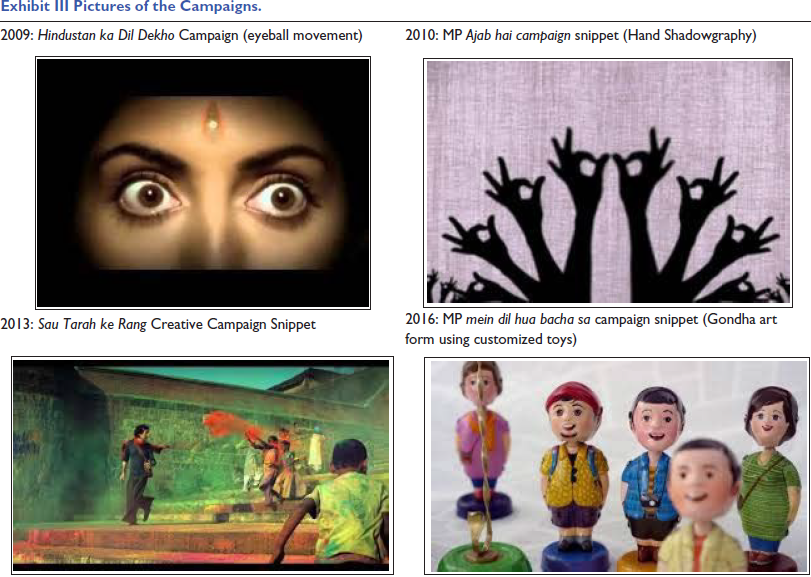
Madhya Pradesh Tourism aimed to position the state as an exclusive destination with immense potential and create a connection with the audience. To achieve this, they developed their first campaign in 2006 called the Bioscope creative. The advertising agency Ogilvy and Mather created impressive advertisements for Madhya Pradesh Tourism, using the tagline “The Heart of Incredible India.” The campaign showcased the state’s tourist attractions viewed through a bioscope, captivating the audience at first sight. The tagline “Hindustan ka Dil Dekho” (meaning “see the incredible heart of India”) was an exciting concept to position MP. The advertisement invited travellers to visit the state and enjoy a soothing sightseeing experience as it boasts the most significant wildlife sanctuary in Asia, ancient cave paintings, and a Buddhist stupa (Exhibit III).
In 2009, Madhya Pradesh Tourism launched a new campaign that utilized eyes as a unique and innovative medium to showcase the enriching experience that one could expect from the state. The creative concept aimed to capture the beautiful landmarks of the state through eyeballs, complemented by a poetic background song. The advertisement included visuals of the convolutions of the Sanchi stupa, antelopes, and train wheels. This creative approach was perceived as an eloquent manifestation of MP’s integral picture in the eyes and the narratives played in the background. It connected with the spiritual, emotional, and physical beings, including the eyes of the viewers (Exhibit III).
In the third campaign, “M.P. Ajab hai, sabse gajab hain” (meaning MP is strange and amazing), Madhya Pradesh Tourism targeted various historical sites, such as Sanchi Stupa and Mandu Palace, using the art of shadowgraphy. Shadowgraphy is a traditional art form of the state that utilizes hand shadows to create images and tell a story. This approach is a perfect representation of the lifelines of the destination, with unique tourist attractions that match the rustic aura of MP. The creative takes the viewer on a journey that touches hearts and souls, making it a unique and compelling campaign (Exhibit III).
In the fourth campaign, Madhya Pradesh Tourism drew inspiration from India’s traditional way of welcoming guests during the Holi festival, where people throw colors on each other. The campaign aimed to mesmerize tourists with vibrant colors that highlight the state’s key tourist destinations, evoking an emotional response. Each color in the campaign symbolizes a force in life, and the shades of these colors portray various emotions. The creative uses these colors to form images of famous destinations in MP, touching different chords in the viewers’ hearts and making a lasting impression on MP as a place to visit.
Marketing Initiatives
MP Tourism also launched the ’Aas Paas Tourism’ campaign (aas paas means local) to cater to the changing tourist needs of short-haul visits connecting MP’s tourist destinations with neighbouring states, such as Maharashtra, Gujarat, Uttar Pradesh, Chhattisgarh and Rajasthan, in 2014. Madhya Pradesh Tourism began to explore Rural Tourism and Rural Destinations more in 2015. MP launched the Intezaar Aapka campaign (means waiting for you) after the atomic strike to strike the heart of the tourists and encourage them to visit tourist destinations in MP. Madhya Pradesh Tourism launched a campaign in August 2020 called ‘Intezaar Khatam Hua’ (which means that it ends the long wait). This campaign aims to increase confidence and trust among tourists travelling to the state. The idea is to attract travellers to their major monsoon tourist attractions, such as Amarkantak, Panchmarhi, Mandu, Orchha, Tamia, Bhedaghat and several national parks, in MP.
In January 2021, Madhya Pradesh Tourism planned to adopt Kerala’s Responsible Tourism Model. It is a triple-bottom-line mission that comprises economic, social and environmental responsibilities and aims to make tourism a tool for developing village and local communities, eradicating poverty and emphasizing women’s empowerment. The mission aspires to provide additional income and a better livelihood to farmers, traditional artisans and marginalized people and create a social and environmental equilibrium. The Memorandum of Understanding consists of a 16-point programme to create a master plan, develop and train human resources for the purpose, locate sustainable tourism projects and formulate social and economic security measures.
Events and Festivals
The MP Tourism Board has recently organized several events that have captured the attention and interest of domestic and foreign tourists. Some popular events include Go Heritage Run organized in Panchmarhi, Mandu, Gwalior, Pench, Khajuraho, Omkar Mahotsav, Tansen Samaroh, Jal Mahotsav, Mandu Utsav, Khajuraho Dance Festival, Lokrang Samaroh, Malwa Festival and Panchmarhi Festival. These events are perfectly designed to showcase the richness of culture, art, music, adventure, heritage, ecology and glory of MP and promote various forms of tourism in the state. Madhya Pradesh Travel Mart has been organized every year since 2014. The Madhya Pradesh Travel Mart is set on a B2B platform with 200 registered buyers and media from over 15 countries exploring business opportunities for discerning travel and tourism products, which will make the event one of the most sought-after travel events in the country. The ‘City Walk Festival’ is an effort of collaboration of Madhya Pradesh Tourism with India City Walk, released in 2018. This festival took place in 11 cities in MP. The City Walk Festival was organized in Bhopal, Indore, Ujjain, Gwalior, Panna, Vidisha, Khajuraho, Chanderi, Jabalpur, Burhanpur and Orchha. More than 100 city walks were organized on various subjects such as art, culture, heritage and food. The first edition of the Mandu Festival kicked off at Mandu, the picturesque fort city, in 2019. It allows you to witness various cultural and folk activities by eminent artists. In 2019, the inaugural Mandu Festival took place in Mandu, the beautiful fortress city. This event provided an opportunity to witness a variety of cultural and folk activities by renowned artists. The festival included heritage walks, cycling tours, photo contests, yoga workshops, naturopathy sessions, and many other unique experiences.
Madhya Pradesh Tourism has also collaborated with the Department of Culture and the Department of Tourism to organize The Great Indian Film and Literature Festival, Central India’s largest film and literature festival, in Bhopal, in 2016, 2017 and 2018. The festival included great musical performances by young and well-regarded performers. The three-day cultural festival ‘Namaste Orchha’ was held in March 2020. The MPTB hosted this new cultural festival in Orchha, which was recently recognized as the ‘Best Heritage City’ at National Tourism Awards, 2019. This festival is a new initiative by MPTB. In a bid to promote the state and draw tourists’ attention to the city of Orchha in particular, the state tourism board launched its new initiative titled ’Namaste Orchha’ in the year 2020. The three-day festival showcased the cultural landscape through various activities such as art, music, dance performances, guided history tours, photography tours and much more.
Madhya Pradesh Tourism also organizes an annual food festival named Royal Cuisine Food Festival to show the rich, cultural and vibrant delicacies of MP. It allows tourists to connect with the culture of the state through food. Another flagship event of MPTB includes Madhya Pradesh Tourism Quiz Competition, which was designed to spread awareness and develop the school students’ interest in tourism in 2016. Madhya Pradesh Tourism organized virtual roadshows during COVID to connect with tourists and attract them to tourist destinations. In MP, Tourism 2016 introduced water tourism in the state. Therefore, Madhya Pradesh Tourism hosted the first edition of Jal Mahotsav in 2016. Jal Mahotsav is a festival of food, art and nature that attracts adventure and seeks to be the largest water carnival in India. The Jal Mahotsav takes place at Hanuwantiya, on the banks of the Indira Sagar Dam. Madhya Pradesh Tourism introduced water tourism in the state in 2016. To promote this, they hosted the first edition of Jal Mahotsav, a festival of food, art, and nature, which aims to be the largest water carnival in India. This festival takes place at Hanuwantiya, located on the banks of the Indira Sagar Dam. The event offers various water activities and seeks to promote Madhya Pradesh as a hub for water tourism, showcasing the state’s different water destinations.
Social Media Marketing
In 2018, Madhya Pradesh Tourism Board (MPTB) achieved remarkable success on its social media platform. Its Facebook page reached one million followers, making it one of the most active tourism organizations in the country. MPTB’s Twitter handle is also active and has a significant number of followers. The tourism board has shared its previous campaigns and TV commercials on social media handles with relevant hashtags. This demonstrates Madhya Pradesh Tourism’s awareness of current generations and trends. In 2020, the campaign #SabKuchJoDilChahe was launched with a digital film released by popular travel and lifestyle influencers like Prakriti Varshney, Dev, and Radhika Sharma. Crayons Advertising conceptualized and executed the digital campaign to promote exclusive trips to Madhya Pradesh, showcasing the tourism board’s embrace of digital and influencer marketing.
Changing Consumer Preferences
Over the past few decades, the tourism industry in India has witnessed a significant shift in preferences among travelers. This shift can be attributed to various factors such as the influence of the western culture, the advent of the World Wide Web and social media platforms, and many others. With millennials forming a major chunk of the tourist population, it has become evident that they travel differently from their predecessors, having different expectations and purposes for their visits. One of the latest trends in tourism preferences is the increase in weekend trips. This has opened new avenues for the industry and led to the development of more tourist destinations near urban areas. Moreover, the availability of hassle-free online sources has made it easier for people to plan their trips and book their tickets. In fact, as much as 82% of all tourist bookings are executed online. Solid online marketing has also contributed to the growth of the industry, making tourists more aware of what they can expect from a destination. As the industry continues to evolve rapidly, it is essential to plan and seek opportunities to launch new initiatives that appeal to the ever-changing group of consumers.
Way Forward
Unlike many other emerging tourist destinations in India, Madhya Pradesh (MP) has adopted a well-planned tourism campaign that caters to a broad range of tourists, especially families. The state has recently emerged as a fast-growing destination for domestic tourists and is making continuous efforts to improve its infrastructure, digital presence, and stakeholder engagement. The destination brand has been built on creative campaigns, and the future plans to focus on responsible tourism and trust building. To build trust, the state has taken several initiatives, such as promoting hygiene and upgrading the staff’s effectiveness. The state has also launched travel advisories to guide people and overcome doubts regarding varying state norms. The focus is on sustainable tourism, and MP is enhancing its green covers, boutique hotels, green patches, and nature to align with this orientation. Additionally, videos of hotels maintaining hygiene standards are being shared on social media platforms to attract more tourists.
In the past, the tourism campaign in MP aimed to attract family travelers by creating awareness and excitement about the state’s diverse offerings. The use of visual imagery, such as the tin and painted toys (Gondha), provided a unique perspective, and the campaign ads were designed with simplicity and youthfulness in mind. However, with changing times, there is a need to shift the focus towards niche destination branding and communication. The vision now is to promote sustainable tourism that can generate job opportunities for the communities while protecting the environment. This involves prioritizing the pro-environmental activities and supporting the community through avenues like campsites and homestays. Nowadays, people prefer to visit places that prioritize nature over mass tourism. Therefore, stakeholders, private players and local communities need to work together to provide a platform for marketing activities that promote responsible tourism.
Discussion Questions
What are the strategic communication challenges of tourist destinations as a brand?
Discuss the campaign planning process with an emphasis on various stages in the campaign development.
What, according to you, are the key parameters to consider while creating the value proposition for a successful campaign?
Describe the role of a content and media strategy while designing a campaign.
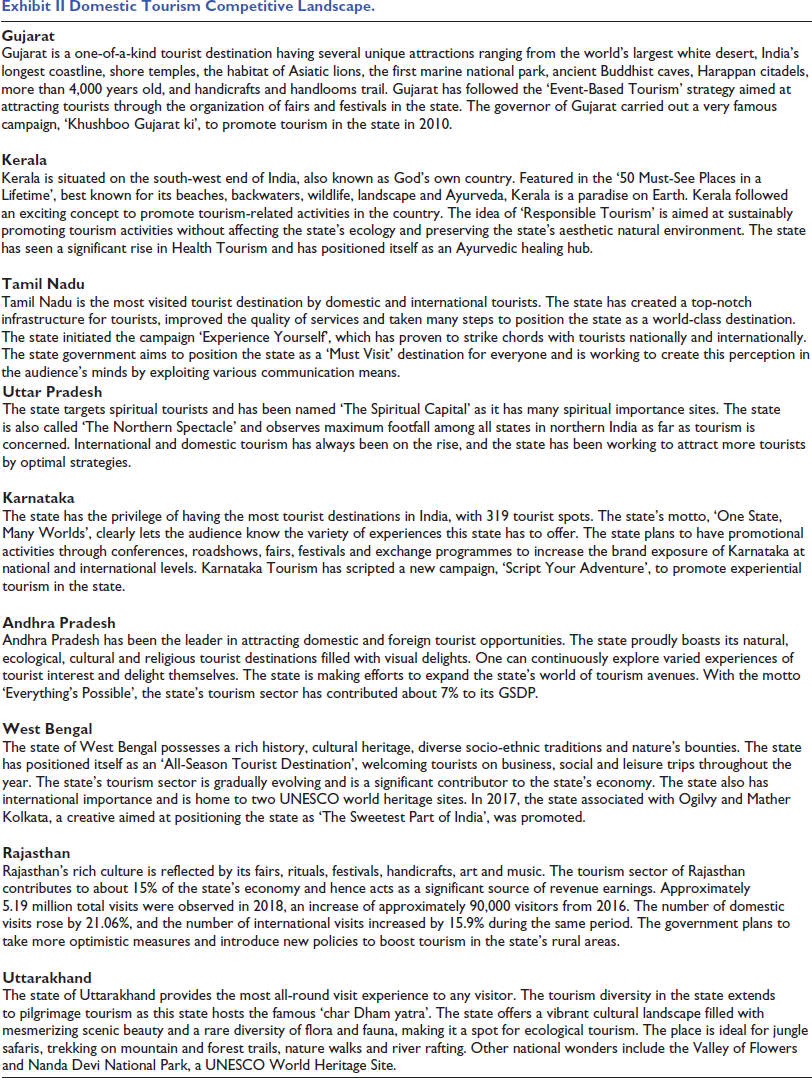
Illustrate the competitive landscape of the tourism sector in India and how various marketing initiatives can help build destinations.
Reflect on the changing travel preferences of visitors and the future of tourism in India.
Appendix
Domestic and Foreign Tourist Visits in Top 10 Indian States Based on Their Ability to Attract Tourism in 2019.
Domestic Tourism Competitive Landscape.
Pictures of the Campaigns.
Footnotes
Declaration of Conflicting Interests
The author declared no potential conflicts of interest with respect to the research, authorship and/or publication of this article.
Funding
The author received no financial support for the research, authorship and/or publication of this article.
