




Abstract
The case study reflects various leadership traits by taking inspiration from the character of Sivagami in the movie series - Baahubali. In this case, the leadership characteristics exhibited by Sivagami are discussed, followed by an understanding of the specific aspects of women’s leadership behaviors. Sivagami’s practice of leadership styles had positive impact on the followers of the Mahishmati kingdom. Through her increased support and leadership capabilities, she shouldered the guardian role for the throne and saved Mahishmati from traitors. She made strategic decisions at various stages and rose to power and respect, excellence, and admiration as the Rajamatha of the kingdom. The case configures some relevant occurrences from the movie series to bring out the nuances to understand the requisite skills and traits for women leadership.
Background 2
The Baahubali 3 film series released to tumultuous responses at the box office worldwide. The magic of both the movies—Baahubali: The Beginning and The Conclusion—was robust that gained momentum among the audience. Baahubali: The Beginning, released on 20 July 2015, refused the euphoria to die down. The movie crossed ₹1,000 crores at the box office collections, making it the first-ever Indian film to do so. Baahubali: The Conclusion, released on 28 April 2017, crawled at the box office collections (Ali & Khan, 2018). It established several records in terms of the highest booking ever, the highest opening day occupancy ever, the highest opening day in 2017, the highest opening day gross ever, the highest opening day collection by a Hindi dubbed film, the highest collections through the Tamil, Telugu and Malayalam versions (different Indian languages) on day one and day two collections. The movie had the most significant screen count on opening day occupancy in 2017, the quickest Indian movie to enter the 100 crore movie club, the first Indian movie to top Thursday night preview charts in the United States of America, and the biggest day two collections in 2017. 4 SS Rajamouli, the renowned Indian film-maker, made the Baahubali film series in an attempt to portray his childhood comic books Amar Chitra Katha 5 (ACK) and a few broad strokes from the Indian mythological epics of the Ramayana and the Mahabharata. He, in fact, spoke of his fascination for ACK comics (see Exhibit 1).
The movies series starred popular Indian film actors such as Prabhas as Amarendra Baahubali and Mahendra Baahubali (dual roles), Rana Daggubati as Bhallaladeva, Ramya Krishnan as Sivagami, Sathyaraj as Kattappa, Anushka Shetty as Devasena, Nasser as Bijjaladeva and Rakesh Varre as Sethupati (see Exhibit 2).
Drawing inspirations from epics and ACK, SS Rajamouli crafted perfect woman leadership traits through Sivagami character. The movie portrayed her as the wise ruler of Mahishmati, being clever at strategy making, strong and clear in her views, fair in ensuring success and also being very strong-headed most of the times. She did not succumb to nepotism or allowed her son Bhallaladeva to become the king. She wanted Amarendra Baabhubali (her nephew) to become the king (as compared to her own son) as he was more meritorious, more deserving, more valorous, had more wisdom and was popular among the people. 6 As an authentic and unbiased leader, she taught both (her son and nephew) politics and ethics to run the kingdom (Figure 1 captures the family structure of the empire).
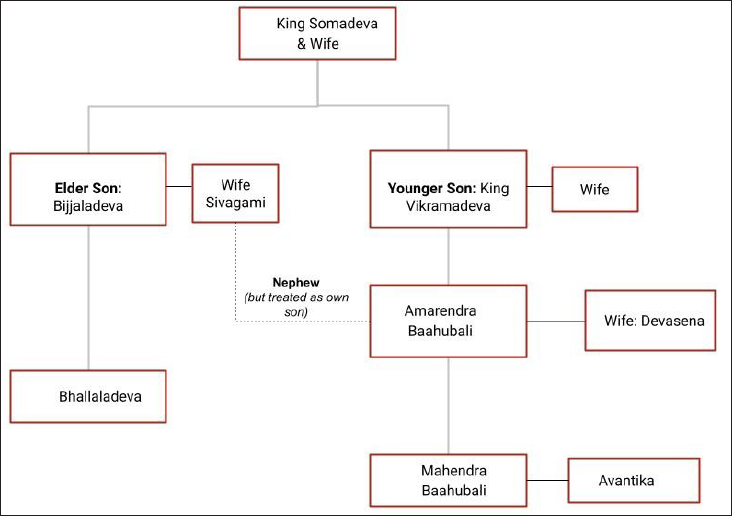
This case revolves and focuses on the leadership role played by Sivagami as depicted in the movie series. The case illustrates some instances from the film Baahubali—The Beginning and The Conclusion, which depict the women’s leadership traits in Sivagami. The case also demonstrates how women’s leadership characteristics are relevant in contemporary times and enhance the organizational benefits through competitive advantages.
Sivagami: A Powerful Character
Sivagami looked after Amarendra Baabhubali as a foster mother after the death of the Queen of Mahishmati. She acted as the custodian of the princes and was guardian to both till they reach the age for ruling the kingdom. She raised her own son Bhallaladeva and her nephew Amarendra as well with an aim to make both as eligible heirs of the kingdom. Later, when the decision was to be made, she should be able to select one of them as king.
She was a competent fighter, a true leader and a woman of power. She treated both her sons equally, which reflects integrity and morale in her approaches. She played a powerful character in the movie series where she was instrumental in saving the kingdom from the opponents. She was a robust-headed leader and always stood up for what she believed in. She was a fiery warrior to be reckoned with. She exercised power that was overwhelming and unmatchable.
Sivagami: Exhibiting Women’s Leadership Traits
Sivagami’s character exhibits various leadership traits as being caring, a role model, motivational, and encouraging person. Further, she is characterized by an array of leadership qualities, including teamwork, building relationships among others. Thus, it is evident that women adapt to a more collaborative, supportive and democratic leadership style that plays a central and crucial role in women to portray influential leadership. Women have unique qualities to create and make synergies work and bring everyone together across different segments in society such as family, work, friends and communities (The CREW Network Report, 2013).
Characteristics in women’s leadership include: ‘Decisiveness, diplomacy, expertise, achiever- oriented, individualist, strategist, alchemist, empathetic, patient, collaborative, intuitiveness, and composure-oriented’ (Salih & Dulaimi, 2017). These traits were commonly observed and practised by Sivagami in the movie series.
One of the essential characteristics of a great leader is to be able to take rational decisions. A great leader is open-minded and considers others’ ideas and viewpoints before taking final decisions. When Sivagami came to know that Amarendra Baahubali loves Devasena, and she too adores him, Sivagami was taken aback because she had promised her son Bhallaladeva to fulfil his wish of marrying Devasena. She in fact issued orders for Devasena to marry Bhallaladeva. However, Devasena refused to accept this proposal. This moment highlights not only the decisive nature of Sivagami but also of another strong leader (in the making), that is, Devasena, who is also strong-headed and independently takes her own decisions. Sivagami should have been more considerate and supportive of Devasena’s opinion and right to choose her husband (Movie Occurrence: Baahubali—The Conclusion).
One of the essences of diplomatic leaders is to understand the world around them. Diplomats always avoid conflicts and misunderstandings among people. Such leaders earn high respect, endurance and acceptance and impact others by performing their roles and responsibilities. Diplomatic leaders focus on collaboration, cooperation, fairness and resolving conflicts. The highlighted benefits of such a leadership approach are connecting people, free flow of ideas, increased morale, better values, trust and belief, creativity and calm environment. In the movie, Sivagami was discussing with Bijjaladeva about the future king of Mahishmati. She stated that both her son and nephew (Bhallaladeva and Amarendra Baahubali) have a right to the throne. The one with more valour compassion and wisdom will be crowned the king of Mahishmati. This mirrors her diplomatic leadership style, which reflects the best interests of the Mahishmati kingdom (Movie Occurrence: Baahubali—The Beginning).
Another aspect of women’s leadership quality is expert control with a perfect knowledge base. Expert leaders have an outstanding contribution in terms of efficiency and perfection. They are invariably focused on the continuous improvement and completion of tasks within deadlines. They rule by logic and seek rational efficiency. 7 At the time of war with Kalakeyas, as a strategy, it was proposed by Bijjaladeva, Bhallaladeva’s father, that the prince who shall kill Kalakeyas Chief will ascend the throne of Mahishmati. Amarendra Baahubali fought with bravery in the war and was about to kill the Chief, but, in the meanwhile, Bhallaladeva tricked and killed the Chief from behind. Now, as per the agreed terms and conditions, Bijjaladeva demanded to make his son the king of Mahishmati. Sivagami, an expert in her judgement, proclaimed Bhallaladeva as the Commander of the armed forces of Mahishmati and declared Amarendra Baahubali as the king of Mahishmati. She explained very intellectually to her followers, ‘The merits of a king are evaluated not by the number of enemies he has killed but by the number of people he has saved during the war.’ She further stated that Bhallaladeva focused only on defeating the enemy during the battle, whereas Amarendra Baahubali, while killing the enemy, also managed to save his soldiers. That is the difference between a soldier and a king. This truly reflects the expertise and leadership skill of Sivagami (Movie Occurrence: Baahubali—The Beginning).
Women leaders provide a unifying force to collaborate in the team efforts to achieve group goals. They secure a balanced approach between positivity and environment, focusing on outcomes and consequences. They seek feedback and are ready for open discussions to reduce differences and resistances. Achievers can lead a team to achieve goals strategically, balancing immediate and long-term objectives. Goal setting is one of the pieces of works that make achiever leader valuable to organizations. Achievers follow self-discipline which is essential to accomplish the goals. Some of the key characteristics of such leadership are goal clarity, strategic approach towards vision and mission, influence and motivate others, people management, highly competitive and focused. Sivagami managed to save the life of Amarendra Baahubali’s son Mahendra Baahubali from the enemies. She prayed to Lord Shiva to save his son’s life and if death was the only redemption then take her life instead as his mother was waiting for him; he should live to ascend the throne of Mahishmati. This depicts the achiever characteristics of Sivagami (Movie Occurrence: Baahubali—The Beginning).
A leader with individualistic characteristic creates an effective structure to bridge the gap between approach and performance. Individual leaders take responsibility for all aspects of their lives and for their organizations. They possess strong personal leadership skills such as system thinking, result-based performance, communication, relationship building and leading continuous improvements. Such leaders identify goals, prepare activities to reach the set goals, implement action plans and track their performances. When the Sivagami’s associate informed her about the princess of Patliputra being eligible as a life partner for Amarendra Baahubali, Sivagami, upon sighting her picture reacted negatively and asserted that the princess lacked leadership vision (essential for the future Queen of the kingdom) in her eyes, and she was not fit for Amarendra Baabhubali because whoever married Amarendra Baahubali would also be the future Queen of the Mahishmati kingdom. This showcases the individualist behaviour of leadership in Sivagami. However, as a strong leader, she should also appreciate leadership qualities in other leaders as well (Movie Occurrence: Baahubali—The Conclusion).
Strategists better handle people’s instinctive resistance to change. They are highly effective change agents in external and internal environments. Strategists develop three meaningful relationships: personal, organizational and social development. The strategists build action plans and formulate strategies to leverage the opportunities effectively. During the war, strategies were discussed with Sivagami. Kalakeyas had 100,000 soldiers as his armed forces; whereas Sivagami had a strong understanding of her vision to defend her kingdom and attack enemies simultaneously. She also sought expert advice on military strategy. Amarendra Baahubali explained her various defensive plans to win the war. To help achieve the kingdom’s goal, Sivagami regimented the implementation of military strategy during the war. This exhibits strategist leadership quality in her (Movie Occurrence: Baahubali—The Beginning).
The ability to reinvent, transform and renew the organizational approach to perform better is the crucial attribute of an alchemist leader. The alchemist can, at multiple levels, deal with both kings and commoners simultaneously under many situations. They promote trust and honesty and specifically appear to be humble and silent about their accomplishments. They focus on truth and honesty and most importantly, they can catch unique moments in the history of the organization, creating an example to people’s hearts and minds. 8 When Kattappa killed Amarendra Baahubali as per the orders of Sivagami, she did not lose her patience. Kattappa informed her about the strategies made by Bijjaladeva and his son to kill Baahubali. Knowing this, she was astonished and declared Mahendra Baahubali, son of Amarendra Baahubali, as the next king rather than Bhallaladeva. In this decision, she had exact clarity and was away from the dilemma that she was struggling to find an answer to. This occurrence advocates the alchemist leadership traits in Sivagami (Movie Occurrence: Baahubali—The Conclusion).
Women leaders deal with their followers very effectively and efficiently, which help women leaders build unique strength and leadership qualities. Talking and listening to colleagues’ problems and connecting with own feelings are crucial strategies women leaders’ exercise. They ensure endurance, self-possession under stress, guiding as mentor, rational and sensible in given situations. They are known to have a deeper understanding of circumstances beyond the norms and to represent leadership in the spirit of patience (The Caliper Report, 2015). One day, Bhallaladeva was interrogated by Sivagami about his absence during breakfast and in the Mantrisabha meeting. Bhallaladeva told Sivagami that he forgot attending these as he was thinking of Devasena, the Kuntaladesh 9 princess with whom he wanted to get married. She was pleased and promised that she will ensure that Devasena marries him. This imitates the empathy, patience and endurance in Sivagami and connect with her son’s feelings and emotions (Movie Occurrence: Baahubali—The Conclusion).
Women leaders organize people and resource towards the effective and efficient pursuit of predetermined objectives. They collaborate with others to achieve group goals through an established vision and objectives in mind. This also helps to stimulate the group towards the realization of dreams. Such leaders consult their subordinates and consider their suggestions in decision-making processes. This attribute helps to associate with the internal locus of control. Bijjaladeva insisted and succeeded in brainwashing Sivagami to provide justice as Amarendra Baahubali tried to kill Bhallaladeva. Sivagami collaborated and supported Bijjaladeva and planned to kill Baahubali at the hands of Bhallaladeva. However, she also ensured that Bhallaladeva should not be seen as the culprit of the murder as he was her own son and the to-be king. So, to converge on these thoughts and under influence of her husband, she ordered Kattappa to kill Amarendra Baahubali. This shows how a strong leader under a collaborative approach can display grey shades of leadership (Movie Occurrence: Baahubali—The Conclusion).
Intuitive leaders are more ethical, responsive and incredibly strict. They are quicker, smarter, wiser, experienced and more determined. Intuitive leadership is a skill of evaluating a given situation quickly and draws a firm conclusion. Intuitive leaders possess traits such as clear vision, shared responsibilities, skills improvement, competencies development, inquisitive, self-criticism and resistance to inner critic. During the commencement of the war, when Kalakeyas declared that he would conquer the kingdom and his newborn son would be the king of the throne, Sivagami, in response, ordered to catch him alive even if his arms and legs were cut off, and vultures plucked his eyes out. She could not tolerate her own insult and of her kingdom. This displays a high level of intuitive intelligence and willpower in Sivagami as a leader (Movie Occurrence: Baahubali—The Beginning).
Women leaders possess characteristics of ‘composure’ and give specific guidance to subordinates for performance clarity in tasks. The leaders also help schedule performances when there is a lack of task clarity, the environment is ambiguous and dynamic, followers are not found to be more capable, and followers have an external locus of control. Amarendra Baahubali informed Sivagami that he had promised Devasena protection from all the evils, and he shall stick to those promises. Sivagami, being self-controlled and self-commanded, put two options before Baahubali—either be the king of Mahishmati or marry Devasena. This advocates the self-possession, composure behaviour of Sivagami as she had earlier promised Devasena’s marriage to her own son, and hence, she laid this condition before Baabhubali (Movie Occurrence: Baahubali—The Conclusion).
How Do Women Leaders Lead in Real-world Situations?
Today, women symbolize unity and cooperation in every sphere. We are now experiencing gender equality at home and at the workplace too. This quality of diverse minds is a desirable feature of a successful woman’s leadership. Previous research has claimed that women are armed with better relationship-building skills. They are competent enough to compete with men in all ranks (Murugami, 2018). There is a need for society and business–environment nexus to develop a women-friendly culture. Some key leadership traits, such as task-focused, cooperation, collaboration, ambition, self-dependences and positiveness, are also present in women without compromising gender biases (The KPMG Report, 2015).
Emotional intelligence level is also found to be higher in women leaders. Throughout history, many Indian women leaders have made a significant contribution to their field. Female leaders from India like Mother Teresa, Indira Gandhi, Sonia Gandhi, Phoolan Devi, Priyanka Gandhi, Pratibha Patil, Mamta Banerjee, Kalpana Chawla, Shikha Sharma, Chanda Kochhar, Nita Ambani and others, have proved both their positive and negative leadership skills and performed well in their field of politics, arts, science, law and entertainment.
In this case, the role played by Sivagami truly reflects the female leadership traits both positive and negative in nature. The leadership style of Sivagami is transformational in the movie series. The traits are common in today’s women leaders in real-life organizations, such as understanding situations, sense of dedication, collaborative work style, crisis management skills, sensitivity in a relationship, respect of ideas, loyalty and commitment, also existed in Sivagami. In addition, she also exhibited concerns of conflict of interests and had her own dilemma moments highlighting her priorities in life and for the kingdom. So, the question here is ‘If you were in a similar situation, what will you do and why?’
Appendix
Exhibit 1: A Gist of the Movie Series - Baahubali: The Beginning and The Conclusion
‘The savior is more potent than the destroyer.’
The above proverb is true in the case of Baahubali. Sivagami was the former regent of the Mahishmati kingdom. She married Bijjaladeva, and they had a son named Bhallaladeva. Being a mighty queen and skilled fighter, she accepted to be the guardian of the throne. She was the custodian of the princes and played a guardian role until they became capable to rule the kingdom. She raised Amarendra (her nephew) and her own son Bhallaladeva to become the true heirs of the kingdom. Later, when the time shall arrive, she shall select one of them as a king to the throne.
Having two sons and one empire, Sivagami had to choose one of them to be appointed as a king of Mahishmati. When the war with Kalakeyas concluded, she proclaimed Amarendra Baahubali as the new king of Mahishmati since he saved many lives with his strategic wisdom. Later on, she was manipulated and politically victimized by her husband, Bijjaladeva, and their son Bahllaldeva. Thereafter, she ordered Kattappa, the loyal servant of Mahishmati, to kill Amarendra Baahubali.
Lead Roles and Characters in the Movies
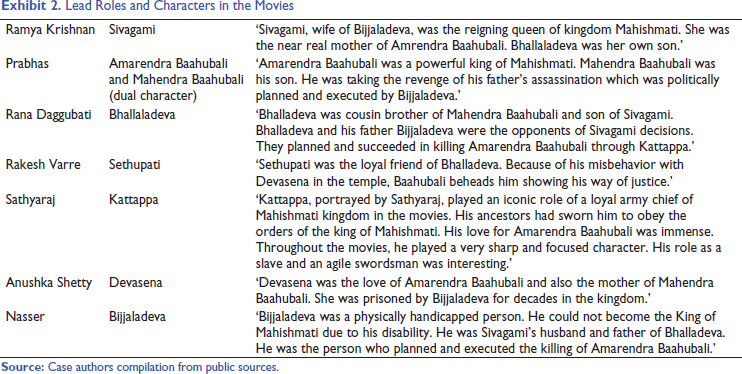
With time, she realized that she was politically used to kill the innocent Amrendra Baahubali. To redeem the wrongdoings, she sacrificed her whole life to safeguard the life of Mahendra Baahubali, (Amrendra Baabhubali’s son).
Mahendra Baahubali, an orphan, was the successor of the kingdom Mahishmati. But unfortunately, he was the victim of various political conspiracies. Fortunately, he was saved by Sivagami. Later on, he was brought up by the tribe of the nearby hills of Mahishmati. When Mahendra grew up, he fought against the atrocities of the kingdom ruled by Bhallaladeva then. Kattappa played a key role in helping and supporting Mahendra Babhubali in killing lakhs of antagonists during the war.
Footnotes
Declaration of Conflicting Interests
The authors declared no potential conflicts of interest with respect to the research, authorship and/or publication of this article.
Funding
The authors received no financial support for the research, authorship and/or publication of this article.
