




Abstract
In 2021, Sebamed’s campaign appealed to consumers that ‘Do not listen to Film stars, Listen to Science’ (Film stars kee Nahi, science kee suno—in Hindi). The campaign intended to persuade consumers to make more informed choices when they buy personal care products and to compare Sebamed’s attributes (pH) with its competitors—Dove and Lux (Hindustan Unilever—HUL). Sebamed highlighted the pH as an attribute and how soap’s high pH value (7 and more) can be harmful to the skin. The campaign was comparing the pH value of Sebamed with HUL’s Dove and Lux. HUL reacted to this campaign and highlighted the research, development and testing process adopted for its different products. HUL also did a counter-campaign highlighting that water also has a pH of 7 and suggested that consumers use common sense when buying soaps. Even though the campaign by Sebamed was interesting it did not have any significant impact on the sales of HUL brands—Dove and Lux. The interesting question is: what should be the focus of campaigns in a hypercompetitive market?
In January 2021, the German personal care brand—Sebamed—made a revelation in India that Film stars kee Nahi, science kee suno (Meaning: Do not listen to Film stars, Listen to Science). The campaign was intended to persuade consumers to make more informed choices based on scientific principles/aspects of the product instead of the words of the celebrities who endorse the product. Sebamed soap, which was the focal point of the campaign, was compared with the major competitors like Hindustan Unilever (HUL’s) Lux and Dove. pH was the highlight of the campaign, and Sebamed compared its pH (5.5) with Dove’s pH (7). Sebamed conveyed that a higher pH value of 7 is harmful to very sensitive skin. Mr Konark Gaur, Head of Marketing of Sebamed stated that
Consumers today are re-evaluating their brand choices and are looking for brands that deliver on their promise. Sebamed, a brand that stands for honesty and authenticity wants to empower the consumers with the right information so that they can choose the best. We believe that product is always the hero and days of gimmicky advertising are counted.
India’s biggest fast-moving consumer goods (FMCG) company HUL reacted to this campaign and responded that ‘Our products and claims are backed by strong technology and underpinning science, clinical evidence, and decades of expert and consumer-backed testing, enjoying strong brand loyalty’. The aftermath of the campaign can be an ensuing legal battle between these two FMCG giants or a decline in the market share of HUL and other players. Whatever may be the case, this soap opera posed an exciting question in consumers, advertising minds and FMCG companies—is it pH that is prime for the consumers or words of the endorser or something else?
Soap Without Soap: The Sebamed Story
Sebamed is a leading German skincare brand with a rich legacy of 50 years and a preferred brand in 85 countries. Sebapharma GmbH & Co. KG, founded in 1983, owns the Sebamat GmbH, Herzpunkt Pharma GmbH and Maurer Pharma GmbH. Sebamed, Tensimed, Testamed and Nevamed are the popular brands owned by Sebamat GmbH. The history of the company can be traced back to the 1950s when Dr Heinz Maurer at the University Dermatology Clinic in Bonn took the initiative to create a cleansing product that had a pH value compatible with sensitive human skin. The product trials occurred between 1953 (first trial) and 1957. Sebamat GmbH was formed in 1967, and they launched their first product—Sebamed cleansing bar. The product proved to be a panacea for people with sensitive skin, and the ban on using soaps for cleaning dermatological patients was lifted in Germany. The year 1983 marked the new era for Sebamat with the formation of Sebapharma GmbH & Co. KG, which became the parent company. From 1983 to 2006, the company launched 70 Sebamed products, which are exported to more than 70 countries. For his path-breaking effort, Mr Maurer was awarded the ‘Bundesverdienstkreuz’—German Federal Republic Cross of Merit in 1992 and the Jubilee Medal of the Order of Malta in 2005. The global revenue of the company is estimated to be US$97.68 million by Dun & Bradstreet. Sebamed India reported an annual turnover of US$54 million in 2021 (The Economic Times [ET], 2021).
About Sebapharma Brands
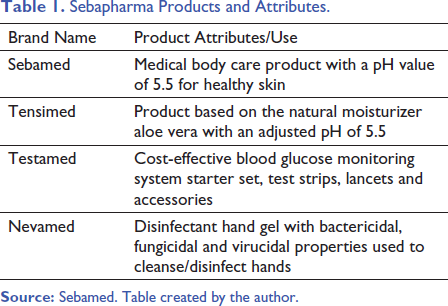
Sebapharma’ s popular brands include Sebamed, Tensimed, Testamed and Nevamed. Each brand tries to differentiate itself on functional benefits.
Sebapharma Products and Attributes.
The HUL Story
HUL: HUL is a subsidiary of the Anglo-Dutch company Unilever. It is the largest FMCG company in India with a portfolio of brands in categories such as home care, food, refreshments, beauty and personal care (BPC), and water purifiers. The brands under HUL are Lux, Lifebuoy, Surf Excel, Rin, Wheel, Fair & Lovely, Ponds, Vaseline, Lakmé, Dove, Clinic Plus, Sunsilk, Pepsodent, Closeup, Axe, Brooke Bond, Bru, Knorr, Kissan, Kwality Wall’s and Pureit. HUL has an employee base of 21,000 and a sales turnover of approximately US$5.1 billion (₹38,273 crores) in 2019.
pH and Its Effect on Skin: The Truth and Lies
Let us quickly go back to our Chemistry classes for a moment to understand what this pH is all about? pH (power of hydrogen) is a scale used to measure the acidity or basicity of an aqueous solution. The value of pH ranging from 0 to 14. 7 is considered neutral, a value of less than 7 is considered as acidic and a value greater than 7 is considered as alkaline or basic.
Then, what is the association between pH and skin? Soaps with high pH value (7 and more) have a dehydrative effect and alter the bacterial flora in the skin (Tarun et al., 2014). Blaak and Staib (2018) found that pH has a crucial role in the maintenance of skin healthiness. Enhanced skin surface pH has a detrimental effect on epidermal barrier function and skin microflora. They concluded that neutral-to-alkaline product pH is harmful to skin microflora and antimicrobial defence mechanisms. On the contrary, some dermatologists have questioned these arguments. Cheryl Karcher, a global expert in aesthetic medicine and dermatology, stated that
The reason why we don’t put too much thought into it is that the skin-care scientists have already done that. They’re very smart people, these PhDs making these skin-care products. They know that you have to have something close to the pH of the skin or else it’s not going to be cosmetically appealing — it’s going to burn.
She said that ‘If your pH balance is off and it’s too alkaline, your skin is going to look flaky and red. If it is too acidic, you’ll increase your chances of inflammatory skin conditions like eczema and acne’. Adding to it, she believes that pH is one of the myriad components that keep the skin healthy, but not the primary or only one. Ms Charlotte Cho, the founder of Soko Glam (a US-based online beauty retailer, which sells Korean beauty products) found that keeping your pH at an ideal level may help to get rid of some common skin complaints. From the arguments and counterarguments, one can conclude that beauty products need to be chosen based on multiple factors, not just pH only.
A Glimpse of Indian Soap Market: Arena of the Current Controversy
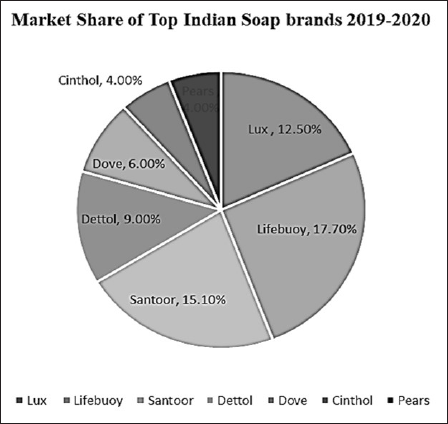
The soap category accounted for more than 50% of the consumer goods (NPCS, 2019). Bar soaps shared 88% of the category followed by body/liquid wash (5%). The remaining share of the category was taken up by hand washes and other products (Phillip capital, 2020). According to the Bureau of Indian Standards (BIS), toilet soap holds 85% of the market, and the beauty soap’s share is 15% in the Indian soap market as of 2020. But FMCG companies categorized them as freshness and beauty soaps with a share of 50%, health soaps (share of 25%), Skin protection (share of 15%) and natural soaps (share of 10%). The industry that includes soap, body wash and shower gel products is estimated at US$15 trillion as of 2020 and growing at a rate of 7% (Bonafide Research, 2020). The market is segmented based on brands Lux, Dove, Pears, Lifebuoy (HUL brands), Santoor (Wipro Enterprises), Vivel (ITC) etc. The Indian companies’ report (Raveendran, 2021) suggests that HUL brands like Lux (12.5 %) and Lifebuoy (17.7%) and Wipro’s Santoor (15.1%), Dettol (9%) Dove (6%), Pears (4%) and Cinthol (4%) are the top soap brands in India.
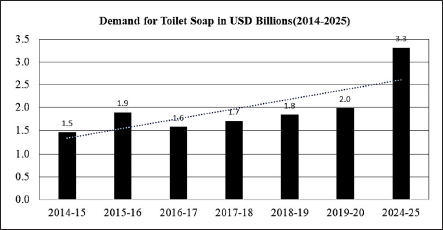
The toilet soap demand is expected to be US$3.3 billion by 2025 (NPCS, 2019), which makes it an attractive category for all the major FMCG companies in India.
Sebamed’s Soap Opera and Its Impact
Sebamed released a new campaign in January 2021 which highlighted the benefits of its cleansing bar compared with the market leaders—HUL’s Lux and Dove. The very purpose of the campaign was to highlight the superior attributes Sebamed soaps possessed when compared with the market leader and to persuade consumers to make more informed choices. pH was the key point that was echoed in this campaign, which was strikingly different from the usual soap opera advertisements. YouTube viewership for the campaign was 2,554,564 (2.5 million views). India’s FMCG giant HUL responded to this preposterous campaign with a statement that ‘It will take “suitable action” against the German maker of personal care products branded Sebamed for making scathing claims against the Indian company’s mainstay soap brands Lux, Dove and Pears in a series of advertisements across mainstream and social media over the weekend’. They are even exploring the option of a legal battle against Sebamed. One of the possible aftermaths of this campaign should be a reduction in the market share of HUL soap brands. On the contrary, HUL brands still held a 40% market share of the Indian soap market in 2021 (Tandon, 2021). Edelweiss asserted that “We do not see any significant long-term impact of Sebamed’s recent aggression on HUL’s soaps in general and Dove in particular. As per our discussion with other industry players, including GCPL, the recent pH issue will not have any significant impact on the industry. FMCG needs sustained advertising, not just a few bursts and takes many years to create a brand pull”. They also observed that “Soap brands lacking optimal pH level is unlikely to have a long-term impact on the HUL’s soaps portfolio as high-entry barriers in distribution and sustained advertising over a long term is key to building the soaps portfolio in India”. So, now the intriguing question is if these campaigns are not going to make an immediate impact on the brands, then what should be the focus of the future campaigns for these brands (Is it pH or something else)?
Appendix
Sebamed Campaign on YouTube
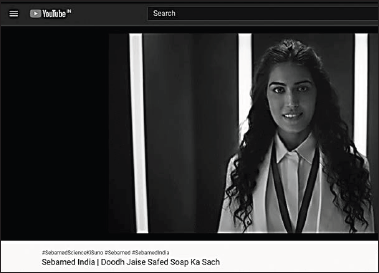
a) Doodh Jaise Safed Soap Ka Sach (
Advertisement Storyline
The protagonist (female model) is comparing and enquiring about the pH between popular brands of HUL with Sebamed. The other lady character reveals that Sebamed’s pH is perfect 5.5, which is good for sensitive skin. The advertisement concludes by saying that ‘do not listen to film stars, listen to science’.
HUL Counter-campaign on YouTube
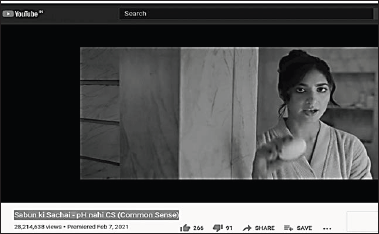
a) Sabun ki Sachai – pH nahi CS (
Advertisement Storyline
The protagonist (female model) is comparing the pH of beauty products such as Multani soil, milk, water and then says that all of these have high pH of more than 5.5. She makes a statement that the pH of water is 7, then whether you will stop taking bath after knowing this. The advertisement concludes by saying that when buying soaps, you should use common sense, not pH.
About Other Major Players in the Bath Soap Segment
Wipro: Santoor is the flagship soap brand of the conglomerate Wipro Enterprises (P) Ltd. Wipro Consumer Care and Lighting is among the fastest-growing FMCG businesses with operations in Asia, the Middle East and Africa, with a revenue of US$1 billion (₹7,700 crores) in 2020. The popular brands of Wipro include Santoor, Chandrika (an ayurvedic toilet soap brand), Enchanteur (a female toiletry brand), Bio-Essence (a skincare brand), Yardley (a luxury toiletry brand), Carrie (a kids and baby toiletry brand), Pahnli (a household care brand) and Garnet (a light-emitting diode—LED lighting brand). They acquired Splash Corporation of Philippines in 2019, which owns brands such as Hygienix, SkinWhite, MaxiPeel and Vitress. It also acquired Canway Corporation—a South African personal care company whose brands include So Heavenly, Iwori and IQ.
Reckitt Benckiser: Dettol is the brand owned by the British company Reckitt Benckiser PLC. Dettol antiseptic was first launched in 1933. In 1979, Dettol diversified into products such as soap, disinfectant sprays and sanitizers. The annual revenue of the company was US$19 billion in 2020.
Godrej Consumer Products Limited: Godrej Consumer Products Limited (GCPL), which is part of the 123-year-old Godrej Group (India) developed the personal care brand ‘Cinthol’. In 1952, it was India’s first deodorant and complexion soap brand. GCPL had an annual revenue of US$0.7 billion in 2020.
Footnotes
Declaration of Conflicting Interests
The author declared no potential conflicts of interest with respect to the research, authorship and/or publication of this article.
Funding
The author received no financial support for the research, authorship and/or publication of this article.

Website References