




Abstract
By October 2017, the East African Community’s (EAC) largest retailer was declared bankrupt. All stores within and outside Kenya, namely Rwanda, Uganda, and Tanzania were closed. Many suppliers in EAC took the retail company to court after having suffered huge losses. Some few suppliers looted the stores with the aim of compensating themselves for the incurred losses. Simply put, Nakumatt’s reputation was in the mire and the company headed for a total collapse.
Everyone in the region was asking himself/herself, what might have gone wrong to Nakumatt supermarket. In general, the current case is a lesson that sheds light on the rise and collapse of one of the largest household names of retail stores in EAC.
Background
With the emergence of East African Community (EAC) market, which is estimated to have 177 million citizens and more than 22% of its population living in the urban areas (
The individual behind this success is Mr Atulkumar Maganlal Shah who was an ambitious entrepreneur. He believed that he could exploit the growing market of EAC by expanding his business to other member countries. Mr Shah inherited the mattress business from his father and managed to develop a strong household brand in the region. Originally, the then household name of the supermarket was Nakuru Mattress, but after some years of success, the store changed its name from Nakuru Mattress to Nakumatt with an elephant in blue colour as the store’s logo.
By February 2017, Nakumatt supermarket had 65 stores and was operating in four of EAC members countries’ markets, namely Kenya (46 stores), Uganda (9 stores), Rwanda (3 stores), Burundi (1 store) and Tanzania (5 stores) with a space floor of 20,000,000 m2. The leading retailer was estimated to have 6,500 employees, annual sales of US$620 million, and more than 20,000 items in their stores with more than 6,500 employees in the region (Omondi, 2017, Primrose Management Limited v Nakumatt Holding Limited and anothers, 2018).
By October 2017, EAC’s largest retailer was declared bankrupt. All the stores within and outside Kenya including Rwanda, Uganda, and Tanzania were closed. Suppliers took the retail company to court after having suffered huge losses following the closure of the retailer. Few of these suppliers looted the stores with the hope of redeeming the incurred losses. Simply put, Nakumatt’s prestige was in the mire, as the company headed for a total collapse.
Everyone in the region was asking himself/herself, what has gone wrong with Nakumatt supermarket.? In general, the current case is a lesson that sheds light on the rise and collapse of one of the greatest household names of family stores in EAC.
Atul Shah’s Dream
Having studied in the USA and with an experience of working in the retail store during his stay in the USA, Mr Shah had a dream of changing the manner in which East Africans shop for products, including groceries, furniture and electronics appliances operated. Traditionally, retail business in the region was not organized and was controlled by wet market. It is estimated that more than 90% of the retail businesses were controlled by informal retailers, and Mr Shah had a dream of changing this situation.
Mr Atul Shah’s aimed at making life easier for modern consumers in big cities of East African market such as Nairobi, Kampala, Dar es Salaam, and Kigali. Because consumers perceive traditional retailers as selling fresh products, the retailer had to use different techniques to attract consumers, especially in the middle-class group, to buy fresh products in their stores. Learning the fact that middle-class consumers in Africa work more than 8 h per day, the Nakumatt supermarket introduced readymade food for sit-in and take away. Furthermore, he introduced 24 h services, which were not possible at the wet market. This was a huge relief to many urban consumers in large cities where Nakumatt operated.
In view of all these, the family retailer gained huge influence as among the most preferred by middle-class consumers, and the business attracted many urban dwellers. However, in East Africa, the wet market controls more than 90% of grocery business. To change the demand of young urban consumers, more had to be done in terms of innovation and promotion of the new forms of retail business.
In this regard, the Nakumatt supermarkets introduced benefits such as bonus packages for those who used royalty cards which recorded credit points whenever a customer bought items from Nakumatt supermarkets. This attracted many consumers from all works of life to visit Nakumatt stores to purchase commodities with the expectation of gaining credit points, which were often redeemed upon certain reasonable point accumulation (Nandonde, 2016). Furthermore, the family retail business introduced online retail payment and joined with different online platforms to facilitate distribution of its services.
In general, Atul Shah’s dream was to see everyone in East Africa to shop in the Nakumatt stores. To achieve this, Atul introduced own brand on many food items labelled ‘blue mart’. Items under the blue mart brand were bread, sugar, and cereals of different kinds. Despite the fact that Nakumatt targeted middle-class consumers, the retailer managed to attract consumers from different lifestyles who purchased blue mart brand. One particular reason on why the blue mart labelled products attracted many consumers was the fact that the items were sold at relatively cheaper prices as compared to the prices operating in other business outlets for the same commodities.
The family retailer allocated US$2.3 million for own brand products that targeted repackaging of the products into smaller packages for affordability and portability (Mungai, 2013). This again was a long-time dream of Mr Shah of making sure that every individual in Africa has access to the products at affordable prices and in a good and hygienic environment. In general, Atul Shah believed that high-quality products do not have to be highly priced.
With a dream of attracting buyers who preferred fresh products, Mr Shah introduced fresh vegetables sections and a built-in butcher counter. The built-in butcher was selling fresh meat and fish. Furthermore, the retailer introduced a segment of fresh selling vegetables, which were sourced from the local markets. With increasing health awareness, vegetables that were sold in the modern retail stores were highly preferred by urban consumers because they were perceived as organically healthy.
Business Philosophy
With a desire of conquering modern consumers in the East African market, the Nakumatt supermarket business philosophy was to link the host country suppliers with the market where the retailer operates and to buy goods from local entrepreneurs. Mr Shah believed that increasing the number of goods bought from host country entrepreneurs and connecting them with other markets where the retailer operates would increase the retailer’s legitimacy among consumers and political leaders. In that regard, Nakumatt supermarket business philosophy seemed more of promoting host country entrepreneurs to reach a class of elite consumers in the East African market. He once said:
We are restructuring business to continue playing a pivotal role in the regional retail space by providing a market platform across the region for local produce. (The New Times, 2016)
This made Nakumatt one of the preferred retailers in the region by consumers and policymakers because the owner used to stock products produced by local entrepreneurs in the host country and opened more markets for goods from other countries within the region to be sold in the stores.
In general, Atul’s dream was to link producers with the consumers in different markets and countries where the Nakumatt supermarket operated, as shown in Figure 1. However, achieving this dream was not possible, and the family retail business faced many barriers that extinguished their dreams. In practice, each country in EAC has a policy of protecting their local markets and producers. This goes with the setting and imposing of levies and even increasing taxes (Nandonde, 2019).
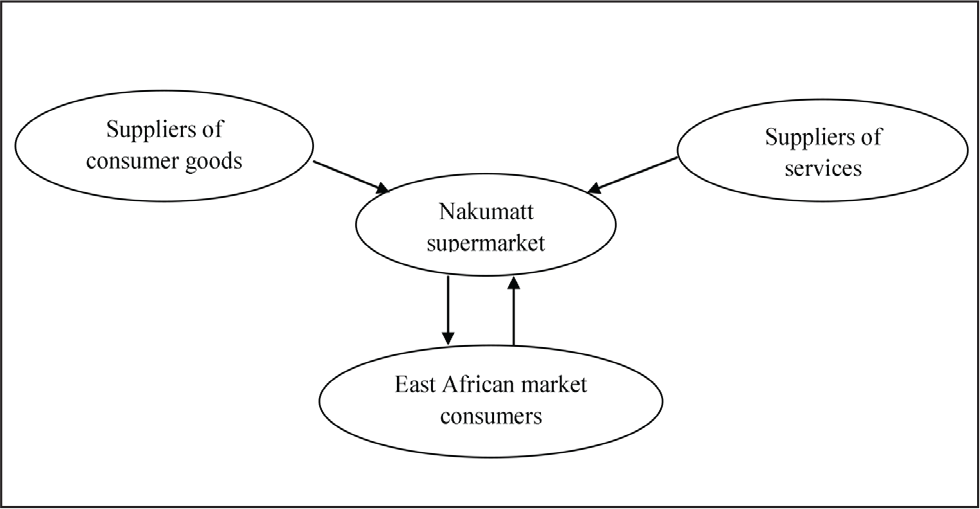
Source: The author.
In that regard, the Nakumatt business philosophy passed through many challenges, which later led to the failure of the company to connect manufacturers with the consumers in other countries.
Uppsala Model and Nakumatt’s Internationalization in East African Community Market
Although this model was developed in relation to the manufacturing industry, it can also be used in understanding retail internationalization in Africa. The model holds that for any successful internationalization, a firm has to pay attention to three issues, namely marketing knowledge, resources commitment to new market overseas, and marketing commitment (Johanson & Vahlne, 1977), as shown in Figure 2. In general, the model emphasizes the importance of gaining marketing knowledge to operate in the foreign market. In other words, before a firm decides to commit human and capital resources, attention has to be on accumulating adequate marketing knowledge. The firm has to do that by expanding to the nearby countries with similarities in culture and consumer behaviour. The model sees internationalization of the firm to be gradual, but a firm has to commit resources further to that market.
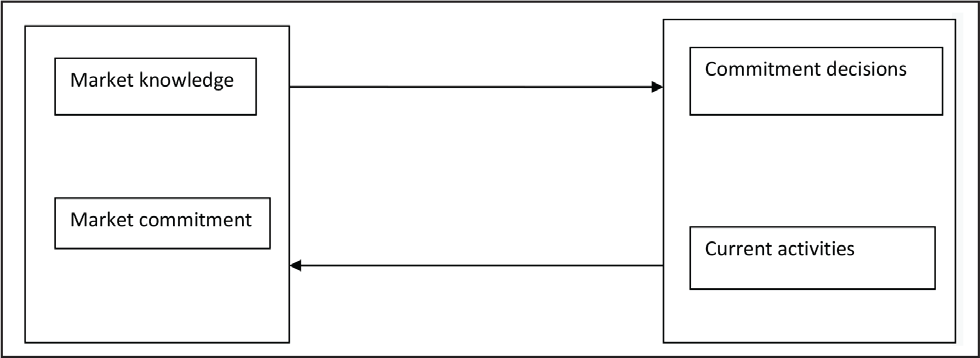
Source: Johanson and Vahlne (1977).
We agree with Uppsala model that retail internationalization involves learning and acquiring knowledge pertaining to many issues in the foreign market; for example, in Africa, it is well articulated that enforcement of law is very difficult. We understand that, while operating in foreign markets, building of relationship and networking among actors is very important. We know that retailers in developing economies have to work with small producers, due to this, it can be very difficult to enforce contract. Furthermore, small producers face financial constraints that limit their engagement with retailers because modern retailers buy on credit (Nandonde, 2016, Nandonde & Kuada, 2016). This implies that few suppliers will be linked to supermarket business in Africa. In this regard, building relationships among actors is vital, and managers need to learn about the attributes that may influence building of relationships among actors in developing economies. This means having adequate marketing knowledge in a particular market such as Tanzania is very important, so that retailers would manage to have sophisticated suppliers who can work under supermarkets’ new terms of doing business, which are not prevailing in the wet market.
The model indicates that having knowledge on foreign business is very important for actors. Suggested foreign knowledge is on opportunities/problems from firms experience to operate in that market. This knowledge can be on understanding issues such as competition, supply and future demand and payment conditions. For payment conditions, retailers prefer to do business by terms of credit, which in turn limits a number of suppliers of goods and services due to lack of funds. In that regard, it is very important to understand the level of resources entrepreneurs in the host country have. However, retailers who migrate to Africa seem to pay attention only to opportunities available and focus less on the need of building knowledge on establishing the relationship with local suppliers, as suggested by the model.
With respect to knowledge and, in particular, knowledge related to marketing issues in the host country, it is advised to employ people who have both knowledge of the company and marketing in the new market. However, many retailers in Africa prefer to come with their managers from home country; for example, for all its operations overseas, Nakumatt used Kenyan managers, and even in 2017, the retailer employed Mr Andrew Dixon, a former Tesco’s executive director, as the chief marketing manager to help the family company (The EastAfrican, 2017). We understand that Tesco and those Kenyan managers have the experience of conducting supermarket business in the UK and in Kenya but not in Tanzania. We have the view that the retailer had to learn by using locals.
Another important factor is market commitment whereby the firm has to inject funds for foreign market to make sure that the internationalization process is smooth. In general, commitment can be in the form of locating employees with knowledge, experiences, and capital injection to support. The issue of locating employees with knowledge on East African business environment was not paid attention to by the retailer; instead, the family business focused on funds injections to support its growth within the region.
The Uppsala model argues that internationalization is a gradual process and takes time (Johanson & Vahalne, 1977). In spite of the fact that the model has not managed to indicate how long a firm can take, it is obvious that internationalization has to be sequential from exporting to wholly owned operation. This is very important to enable managers acquire implicit knowledge that may allow them to operate in a new market overseas. The firm has to provide time to acquire knowledge on marketing activities and develop relationship with other important actors in the market.
For the retailer, the firm was expected to start with franchising, licensing operations in overseas compared with other entry modes such as sole ownership. In general, the model pays attention to understanding other hidden issues in the foreign market.
Nakumatt Expansion Strategy
To reach EAC market consumers, the family retailer had to rely on the expansion strategy. Nakumatt supermarkets used a mixer of expansion strategies to conquer the EAC market. In general, its expansion strategies were characterized by wholly owned subsidiaries and acquisition of the existing firms at both domestic and foreign markets; for example, Table 1 shows that, in Tanzania, Nakumatt used different expansion strategies such as wholly owned subsidiary by opening its first store in Moshi in 2014, a tourist town whose estimated cost was US$4 million. Similarly, the retailer expanded in Tanzania by acquiring four Shoprite’s Supermarkets (A South African retailer) outlets in Dar es Salaam for about TShs 76 billion. In Rwanda, the owner acquired Rwandan City in 2008 and in Uganda, the owner opened a fully owned store.
Nakumatt Supermarket Expansion Strategy.
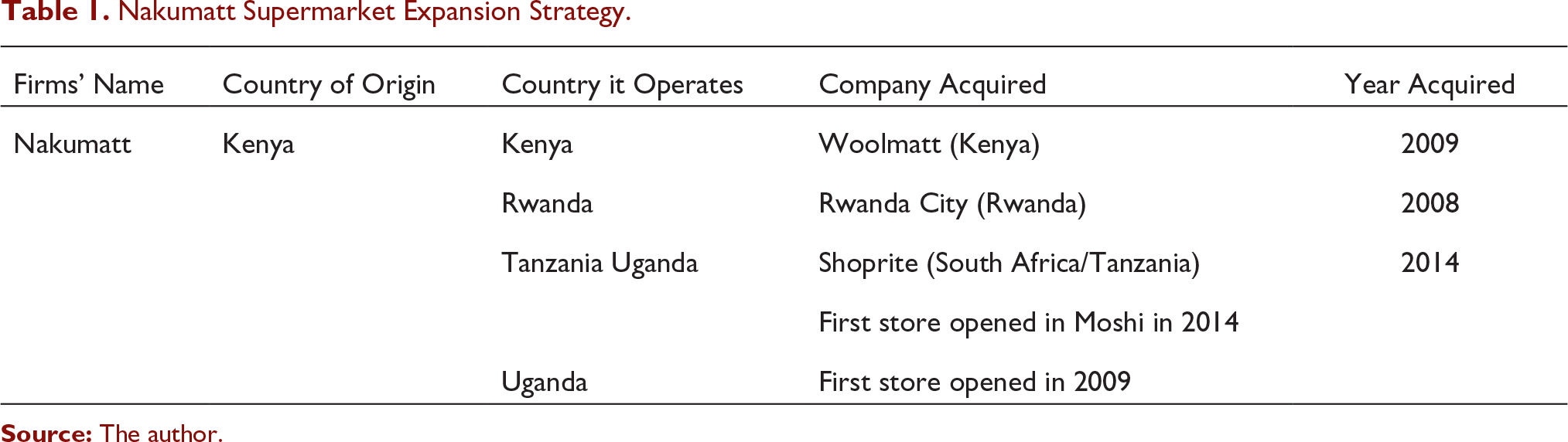
Source: The author.
Nakumatt’s management sees expansions of supermarket business is East Africa as accelerated by four major reasons, namely an increase in the number of middle-income consumers in the regions, lifestyle changes, urbanizations that may lead to an increase of populations, and an increase in income. These factors made many international retailers such as Shoprite and Game both South African retailers penetrate the East African market.
Swelling of the middle class in East African market and an income increase were expected to accelerate consumers’ shift in buying goods from the wet market to supermarkets in the region; for example, in Tanzania, the middle class is estimated to comprise12% of the entire population. This means that, establishing stores in the cities would attract consumers with ample income.
However, despite the higher income, many Africans have more responsibilities that limit them form spending more money for consumer goods. Instead, they channel their money to taking care of the extended families. In this respect, despite their higher income, many consumers would not buy such goods or visit supermarkets. In this respect, such consumers would prefer to buy goods from wet markets because of budget constraints and of the knowledge that supermarkets in developing economies sell goods at relatively higher prices as compared with the wet markets, thus restricting them from shifting to modern retail stores.
An increase in population influenced the retailers into expansion within the region. In general, the East African market is estimated to have about 177 million people, and it was seen as a potential market by the retailer. Furthermore, the fact that people were migrating to urban areas and would be accessible easily was expected to make the supermarket business flourish. Once Mr Ramamurthy who is the head of strategy and operations for Nakumatt said:
The focus is to widen our growth path by opening more outlets both at home and in the regional markets and increase our revenue. Dar es Salaam is a lucrative market given its population and ist shopping trends. (The EastAfrican, 2015)
However, in practice, these potential consumers were not reliable because they are characterized with low income and unemployment. In general, a large population of consumers within the region do not have ample income.
In Rwanda, Nakumatt Supermarket used different strategies to penetrate the Rwanda market; for example, in 2008, the retailer acquired Rwanda City Supermarket for US$6 million. Further, the retailer opened fully owned retail stores. In Uganda, the retailer opened its first store in Kampala in 2009 as a wholly owned subsidiary store, which further increased to nine. With its 24-h services, which made the retailer’s stores famous among urban middle-class consumers, the supermarket employed 600 employees in Uganda in the verge of its collapse in 2017.
However, in 2016, the retail store started to close some of its stores in Kampala due to a number of reasons including low sales and poor location. This was followed with another blow where some suppliers refused to supply products to the retailers due to payment delay and decided to take the matter to the court of law. In Uganda, the situation was worse after the Uganda Tax Authority (URA) closed Nakumatt stores due to the failure of paying taxes. In 2017, Nakumatt proved that the East African market, particularly in Uganda, was a difficult market for a foreign retailer to crack; hence, the closure of its stores. During the closure of operations, Nakumatt owed UGX5.4 billion to suppliers and the Tax Authority.
When entering the Tanzania’s market in 2014, the retail store opened its first store in Moshi, a tourist town in the country. Later on, Nakumatt expanded to Dar es Salaam after acquiring Shoprite Supermarket, the South African retailer who failed to operate in Tanzania. This expansion not only made Nakumatt a giant leading retailer in EAC market but a leader in terms of revenue and number of stores.
The decision of Nakumatt supermarket to acquire stores owned by Shoprite in Tanzania in 2014 was a poor move because the retailer was in difficult situation financially and had less knowledge of Tanzanian market. One of the reasons for Shoprite’s exits from Tanzania market is protection of local producers, which was also faced by Nakumatt supermarket. This suggests that the expansion plan of the retailer was ill conceived, and it was too early for the retailer to have nine stores in Kampala or even five stores in Tanzania, the market where Game (A South African retailer) had operated for 14 years with one store only in Dar es Salaam.
In its expansion, the retailer did not seem to take into consideration the assumption explained in Uppsala model; for example, the expansion of the supermarkets did not take into account the aspect of learning the marketing practices at the foreign market. In general, Nakumatt expansion was extremely fast, and this prevented it from gaining knowledge about the marketing issues in the host country.
Uppsala model of firms’ internationalization holds that a firm starts to internationalize on a market close to the home market and gradually enters a market further away (Johanson & Valhne, 1977). The model has three basic assumptions, namely lack of knowledge, incremental process of decisions and implementation and knowledge that is highly embedded on individual. The pace at which Nakumatt supermarket invested in other countries made it obvious that the retailer was not learning any good practices from any of these countries in the EAC market. This suggests that the retailer assumed that uncertainty in the foreign market would be the same as the one in the domestic market.
In general, retailers who are expanding within the region do not seem to pay attention to searching for marketing knowledge, as suggested by the model, before they penetrate any market, but they start to think of marketing information once they are in; for example, a Tuskys supermarket (A Kenyan retailer) entered Uganda in 2010, and their country manager said:
We are looking forward to branding which we will do in the next two months and after that we will learn about the market… (The Observer, 2010)
Some Factors That Led to the End of the Era of the Nakumatt Supermarket
Expansion Was Not Manageable
In general, one of the most interesting aspects was that, despite all the losses in the home market in 2009, the family retail company expanded to Uganda and Rwanda (see Table 1). This suggests that Nakumatt was highly indebted to lenders in both countries. In Rwanda, Nakumatt acquired City Supermarket through external financing. This resulted in the failure in paying suppliers of the services in both markets soon after the expansion. As Forsgren (2002) argues, even though a firm can expand in the country with which it is familiar, they still have to implement the expansion strategy gradually so that they can gain information that is more practical. This suggests that the desire for expansion was not well calculated by the retailer’s management. This led into the retailer’s collapse in the market, which is close to the home market.
Furthermore, in 2013, Global Credit Rate named Nakumatt as a high-risk firm to be liable for loan. That means, Nakumatt Supermarket was not stable financially, although the retailer used a technique of acquiring other stores to portray that they were financially strong. This is due to the reason that in all the three countries, the retail firm was experiencing difficult economic situation, and some suppliers took the company to court for failure of paying for the services rendered to the store. The retailer’s experience of managing overseas operation was poor, as it did not take time to learn business environment in the foreign market but focused on increasing the number of stores.
In Kenya (home market), Nakumatt lost good locations to competitors. In general, there were some measures, which were not supposed to be taken by the retailer including, for example, buying four shops of Tie stores in Tanzania; instead, the retailer should have concentrated on the home market and carried out gradual expansion in Tanzania.
Infrastructure Challenges
Another parameter worth mentioning here is the shortage of infrastructure that hampers retail internationalization in East Africa. Most of the incidents that caused losses to the modern retailing firms in the region could have been avoided if there were proper infrastructure; for instance, the leading East African retailer Nakumatt faced a series of accidents attributed to poor electricity installations, causing one of its stores in Nairobi to be reduced to ashes. Furthermore, power blackout is very common in the regions causing many traders to rely on standby generators. As a result, the cost of operations increased, and in some cases, it was revealed that the generators were a source of fire accidents as was the case with the above-cited example of Nakumatt’ in Nairobi store.
Some of the incidences that occurred to the family retailer company paved the way for its collapse. Chronologically, the fall of the family business started in 2008 when one of the retail stores was demolished because it was built on the road reserve. When the family business was in need of capital injection to finance its expansion after many crises in 2009, the deal with Satya Capital an equity financier based in London, went sour (Manson, 2013).
Political Instability and Terrorist Attacks
Political instability and terrorist attacks became a limiting factor in retail internationalization in the EAC market. The leading retailer in East Africa had earmarked the capital of South Sudan, Juba as the strategic area for investment. However, this plan seemed unattainable and would have taken a long time for them to implement because South Sudan political climate was and (still is) not stable following tribal wars. Furthermore, Uganda and Kenya were affected by terrorist attacks that threatened the expansion of the sector in the region; for instance, after a 2012 terror attack in Kampala which claimed 75 lives and Kenya’ Westgate attacks which claimed 67 lives in September 2013, people have been avoiding visiting shopping malls.
Katrina (2013), in The Financial Times, quoted Mr Shah, managing director of the Nakumatt saying:
The sell fell by 30 per cent since the Westgate attacks.
Suppliers’ Refusal to Do Business with Nakumatt
By October 2016, many suppliers refused to work with Nakumatt supermarkets due to payment delay. The situation became worse in Uganda after some of the suppliers were reported to loot the stores and appropriate some of the items as reparation of some of the costs of their services delivered to the stores. In general, one of the reasons leading to the emergence of modern retail in African and East African market in particular is the acceptance of suppliers in the host country to supply goods to retailers on credit (Nandonde & Kuada, 2016). Therefore, delay in payment that characterized Nakumatt made it to be delisted by many sophisticated suppliers with enough capital. These suppliers can be categorized into suppliers of goods and services.
Suppliers of services such as property owners confiscated Nakumatt’s goods, and in some countries, property owners sought for court order to confiscate the retailer’s items. Some property owners obtained court order to evict Nakumatt from their property, making the retailer suffer huge losses resulting from either theft or damage of the items. Following payment delay, suppliers in different markets refused to supply products to Nakumatt supermarkets. This made the retailer experience challenging times in the foreign and home markets; for example, some of its stores in Uganda had empty shelves after the suppliers refused to work with the retailer.
The East African market reported the following remark from the owner of Nakumatt supermarket,
The past few months have seen us engaged directly with various suppliers. Such engagements are geared at first reassuring them of our commitments to meet obligation when they fall due, despite the obvious cash floor challenges faced due to a mix of factors. (The EastAfrican, 2016)
In general, when host country’s suppliers refuse doing business with a foreign firm, the firm is likely to collapse because one of the reasons to the rapid growth of retail business in EAC is the readiness of the local suppliers to be subjected to delay in payment and continue doing business with the retailers. This made it easy for the retailer to have access to the community, which in turn enabled them to attract consumers. In this regard, the failure of Nakumatt to attract suppliers in the foreign market made it difficult for them to exist in the foreign market, and this led to their quick collapse in many foreign markets.
Limitation of Free Movement of Goods in the Region
One of the challenges the family firm faced within the EAC market is the limitation of the flow of goods due to protectionism policies introduced by member countries. Thus, it is very important for any actor to understand the market uncertainty; just knowing the data of the market would not enable any firm to overcome uncertainty (Forsgren, 2002). The failure of Nakumatt shows that the retailer did not take time to learn the process of internationalization. This is evident from the desire to open stores in different countries within a short time. As Forsgren (2002) argues, a firm can start and continue to invest in just one country or in few neighbouring countries instead of investing in several countries.
Nakumatt’s management desire was to connect entrepreneurs from different countries with buyers in the region; in practice however, this dream could not be realized. The retailer faced challenges of free movement of goods due to restriction policies in different countries within the region; for example, in 2017, the Kenyan government banned the importation of wheat and liquefied gas from Tanzania, and later, the Tanzania government retaliated by restricting the importation of ice cream, unprocessed foods, and milk products from Kenya (Mburu, 2020). This limited the retailer’s plan of connecting producers within the region and, hence, limiting the growth of the company.
Similarly, there is a growing tension between Uganda and Kenya on milk, sugar, and poultry business. Kenya banned the importation of milk, sugar, and poultry, which led to the ban of similar goods from Kenya to Uganda; for example, Dairy Top Milk that exports 80,000 litres of UHT milk per day to Kenya was denied access to the Kenyan market (Nakaweesi, 2020). In response, Uganda restricted goods from Kenya, which in the end limited goods that reached the retailer in the region. The Kenya Poultry Farmers Association quoted by the Monitor Newspaper made this observation:
We hereby urge the government to consider the plight of Kenyan farmers, employees, and the economy as a whole by restricting chicken imports from Uganda as this is going to destabilize the industry. (The Monitor, 2020)
Since the retailer was buying on credit, and it delayed paying suppliers it was highly likely that suppliers with meagre income in the host country would not have preferred doing business with Nakumatt. As a result, Nakumatt had to turn back to long-time suppliers in Kenya to supply for overseas operations. However, this became an unachievable dream because the host countries believed that the trend was changing them into markets of Kenyan goods.
Marching Forwards Towards the Future
By February 2017, Mr Atul Shah believed that the Nakumatt would regain its lost glory by introducing different techniques. However, the measures came in too late. The suppliers had lost trust to work with Nakumatt supermarket due to payment delays, which led to the retailer’s poor performance. As Vahlne and Johanson (2013) suggest, relationship is very important for a firm’s internationalization in the neighbouring countries. In Africa, open market pays in cash; it is obvious that the failure of paying suppliers in time was like committing suicide to any retailers. This led to the deterioration of the situation to the retailer, as many suppliers refused working with Nakumatt in both foreign and home markets.
Furthermore, the expansion decision in Tanzania was a miscalculation because the Dar es Salaam market seemed too difficult to penetrate; for example, Game Supermarket has been in Tanzania for more than 11 years, but it had only one store in Dar es Salaam. In that regard, having many stores in Tanzania was not a good option for the retailer. In practice, the expansion strategy within the region was supposed to have been implemented organically instead of exponentially by acquiring the existing firms.
Up to February 2017, the retailer had 62 stores in East Africa, but by November 2018, the company had only 6 stores with a debt of KSh 35.8 billion from suppliers and creditors. This was a difficult situation faced by a leading household name retailer in the EAC market. The large share of the debt, which was estimated at KSh 18 billion, was by suppliers.
Some of the strategies, which were introduced by the Nakumatt’s management, included the reduction of the number of stores, layoff of the employees, and searching for potential investors. However, these strategies failed to attract suppliers to work with Nakumatt.
Some of the questions that need answers even from home markets in Kenya, especially from suppliers include, how can Nakumatt rebuild its relationship with suppliers. Which mode of doing business should be used when doing business outside Kenya?
This case has indicated that despite the fact that East African market is one of the interesting markets, there is a need for retailers to take into consideration some factors explained by the Uppsala model. In general, everyone would expect that by expanding to Uganda, Rwanda, and Tanzania, which are neighbouring countries, Kenyan retailers would not collapse within few years like, as was the case with Nakumatt. This shows that there is a need of taking internationalization slowly focusing on learning and accumulating implicit knowledge that might enable managers to survive in the foreign market.
In spite of the fact that Kenyan firms managed to operate overseas compared to other countries within the region, food business, which is one of the major items sold by retailers in the region, is highly delicate and politicized. In this respect, a firm should focus on generating marketing knowledge. The case shows that there other factors that need to be taken care of by retailers who want to invest in East Africa region. There are some variables explained in Uppsala model such as having marketing knowledge and market commitment. It has been observed that retailers who are expanding in Africa have to pay attention to acquiring marketing knowledge.
Marketing knowledge such as consumer’s preference, fragile business policies, factors that affect consumption patterns and building of relationship with local suppliers would enable foreign supermarkets to navigate through the region. Furthermore, it is important to understand that sometimes it can be appropriate to use other forms of market entry such as franchising and licensing to facilitate internationalization in the investment in these markets.
In general, this case study shows that retailers who would like to expand within East Africa must pay attention to many factors including understanding of the marketing environment, which is very important. This entails that the best approach for internationalization is to have franchising and licensing rather than fully owned retail format. This may help retailers to learn marketing practices suggested by Uppsala model. Furthermore, the study shows that to be successful in the region, commitment of physical resources should be done slowly after the retailer has gained knowledge on marketing practices. In general, marketing practices are very fragile in the regions and restrictions of goods are very common among partners’ states. Therefore, managers should learn how to do business with local suppliers who have the experience of doing business with open market.
Footnotes
Declaration of Conflicting Interests
Funding
The author received no financial support for the research, authorship and/or publication of this article.