




Abstract
This case study describes the macro-environmental factors responsible for the growth of coaching classes in India with particular reference to IIT JEE preparation. The case chronicles the explosive growth in the coaching classes industry fuelled by big dollar packages promised to IIT graduates. Consumer behaviour related to selecting a coaching class is analysed with particular reference to dissonance-reducing buyer behaviour that parents strive to achieve. The role of advertising appeals and sales promotion through admission and scholarship examinations in influencing consumer behaviour can be debated and analysed. The case study opens up a discussion on the effect of National Education Policy 2020 on the industry.
Learning Outcomes
By the end of this case study, a student should be able to:
Understand the influence of macro-environmental factors in the growth of the service industry, like coaching classes Analyse the advertising and sales promotion measures undertaken by coaching classes with particular reference to admission and scholarship examinations Evaluate the consumer decision-making process concerning the Indian coaching industry. Map the PESTEL analysis for the coaching classes industry Discuss possible implications of NEP 2020 (Ministry of Human Resource Development, 2020) on the coaching industry.
Mrs Reena ended her call with the counsellor from a popular coaching institute with whom she was in talks for her 10th-grade son’s IIT JEE coaching. She had to decide whether she would be availing the coaching institute’s scholarship offered to her son based on the selection exam he had taken last week. It was not only the question of a significant expense but also the decision that could have a greater impact on her child’s daily routine for the next three years. She wondered if it was worth going ahead, given that the chance of making it to the premier IITs was minuscule. She wished she could have more detailed counselling for her son before they had to take the decision. She had many questions regarding the course delivery mechanism and feedback on the child’s performance. Though most of the coaching classes that she had enquired in the last few months projected their technology-enabled student-centric, user-friendly dashboards backed by complex analytics, she could not get a customized answer. Technology-enabled customization was available but sans the human element. An open discussion with her son also did not help much as he was keen on joining the coaching class that most of his friends had opted. Most teenagers, pushed by peer pressure, join classes without much knowledge about the ecosystem of coaching classes and the efforts and abilities required to forge ahead. What could be a possible solution to this ill-informed hurried decision many take? There were other reasons also for this mad rush. Parents experience a compulsive need to engage their teenage children and explore options for integrating their higher education dreams with weekend engagements through coaching classes and competitive examinations.
Introduction
Students’ academic gain and learning performance are affected by numerous factors, including gender, age, teaching faculty, students schooling, the social-economic status of the father/guardian, the residential area of students, the medium of instruction in schools, tuition trend, daily study hour and accommodation as hosteller or day scholar (Ballatine, 1993; Blevins, 2009; Parri, 2006).
According to the proximal development zone concept, often abbreviated as zone of proximal development (ZPD, 2009), introduced by psychologist Lev Vygotsky, there are two different development levels that a student can be associated with—the actual level of development and the potential level. The actual refers to the problem-solving that a child can do alone versus the potential development that occurs when the child solves a problem under adult guidance or with more capable peers. From the constructivist psychology perspective, the learning environment plays a vital role in guiding a child’s development and is also influenced by the collaborative learning and peer interactions facilitated at the place of learning. Hence the level of coaching is going to have an impact on a student’s performance. This led to the concept of coaching for competitive examinations, particularly the most popular IIT JEE. This case study explores the multiple dimensions of this industry with particular reference to marketing communication and its influence on the students and society.
According to the NSSO report, No. 575 (Ministry of statistics and Programme, 2014) on education in India, 26% of students (27% of males and 24% of females) were taking private coaching. Incidence of taking private coaching was maximum at secondary and higher secondary levels combined (38% of male students and 35% of female students). The same report also observes that 89% of the students took private coaching to augment primary education while 1.5% of students took coaching to prepare for exams.
As India’s knowledge economy spearheaded with IT dream jobs and foreign assignments started making its way into the homes of ordinary middle-class Indian families, the competition in the entrance examinations conducted after the 12th grade of students to enter into some of the premier institutes intensified. Post-1991, the government tried to intervene by bringing about changes in the pattern of selection. Still, the ambiguity prevailed as the weightage given to the board and entrance exam marks kept changing in regular frequency. This dynamically changing exam pattern led to psychological fear amongst students and parents that they cannot trend this road alone. The fear of the unknown, coupled with their anxiety to perform well, makes the student and parents make an ill-formed choice.
While students who opt for commerce or arts stream in their junior college also write entrance exam to join the prestigious law school and allied fields, the dependence on the entrance exam to make it to the top college is more pronounced in the case of students opting for the science stream at the junior college level. Joint Entrance Examination (JEE) is an engineering entrance examination conducted for admission to various engineering colleges in India (National Testing Agency, 2020). It is made up of two different examinations—JEE Main and the JEE Advanced. On average, 1.2 million students appear for the preliminary level examination called the JEE mains, and to get a seat in a top-rated IIT, a student needs a rank below 10000 in the final level called the JEE advanced. Thus, the typical chance of a student making it is 0.8 percentage.
Background
Education plays an important role in an individual’s overall growth, but it is looked upon as a passport to a better living standard in a developing country like India. Indian education system is growing as the government tries to improve the gross enrolment ratio, which is also leading to growing awareness among the masses about the value of education. According to McKinsey’s forecast for India, the education and recreation industry share will increase from 5% in 2015 to 9% in 2025. One of the vital driving factors behind this trend could be the growth forecasted for the middle-income group (whose annual income is in the range of rupees 200,000 to 1,000,000). Their number is likely to go up from 13.3 million in 2005 to about 128 million in 2025 (McKinsey Global Institute, 2007)
Indian coaching industry plays a significant part in this journey. The Indian classroom coaching industry is further segmented into two different sectors based on the purpose it serves—the private tutorial industry, which acts as a complement to the mainstream education and entrance exam preparation-oriented classes. The former attracts students from classes 5 to 12 who require additional coaching for their school and boards. While the latter, entrance test preparation industry focuses on coaching for various entrance examinations like IIT JEE Advanced, NEET and CAT exam levels. This industry witness fierce competition with various established market players operating and competing with differentiated strategies. This industry has grown because of increasing competition for various competitive exams. Changing demographic profile combined with a growing aspirational middle-class where the parents themselves aspired for a career in engineering or medicine two decades back boosted the coaching class industry. The ratio of aspirants to the actual number of students who crack these highly competitive examinations is minuscule; still, the opportunity seems too big to overlook. Everybody wants to give it a shot.
The era of organized classroom coaching started in the 1990s with Allen (1988), Pace (1988), Aakash (1988), Vidyamandir (1989), Bansal Classes (1991), FIITJEE (1992) and Narayana (1999). Few others joined the business in the 2000’s such as Resonance (2001), Sri Chaitanya (2006). Over the past three decades, many new entrants could not make it big, but some like Allen, Pace, FIITJEE made it big in big cities like Mumbai and Delhi. Most of these institutions had a simple, humble beginning with a popular teacher giving home tuitions or conducting classes in small batches. Post-1991, the Indian diaspora community abroad started booming as more IT companies set up operations in a foreign land and send Indian professionals on deputation. Encouraged by this trend, many middle-class families dreamed about their child cracking the toughest entrance exams to secure this path to a foreign land. Capitalizing on this need, the coaching classes grew in size, numbers and offerings. National players expanded very fast through the franchise route. Ex-IITians started joining coaching classes as faculty for a huge pay package (Kumar T, 2019).
The reasons for the multi-fold explosion of the coaching industry are many. First amongst them is the fear of missing out (FOMO), which makes many students join coaching classes for the competitive examination and high school studies. Second, the syllabus is curated to meet the students’ needs to score well in the board exams and competitive exams. Finally, the avalanche of marketing communications by the coaching classes forces the students and their parents to consider coaching.
Backed by the expertise of big advertising agencies, the national players do not leave any stone unturned in impressing the middle-class parents that their ‘Sonu’ (pet name for any child in a typical Indian household) has all the potential to become the next Sunder Pichai (CEO of Google). The humble beginning of the latter resonates with the thoughts of many middle-class parents. The pinnacle of battle using communication strategies is staged using the toppers in the coveted examinations. The top spot competition is not between the brilliant students from different institutes but the different institutes themselves. Different levels of ambush marketing also take place. After the announcement of results, different coaching institutes will stake a claim for having produced the topper. Ambush marketing happens when a brand tries to associate with a major event without being the official sponsor. In this case, the event is topping the coveted entrance examination. Each coaching institute tries to associate itself with the topper (Mitra, 2020). No one bothers to check their credentials, and the aspiring student believes in them. Other ways of claiming supremacy are seen. If an institute fails to produce a topper, their marketing communication starts focusing on historical achievements as they collate their achievements over the years. Another approach shows that their institute has produced toppers in different exams conducted by private universities like the BITS, VIT, and so on. Yet another way is to pick up toppers from various categories like toppers amongst girls, toppers from a particular state or city or category. They also start selling dreams, as shown in the exhibits.
The effective manner in which the coaching classes use integrated marketing communication (IMC) to sell the IIT dream is also noteworthy. According to Kotler (2014), IMC is the concept under which a company carefully integrates and coordinates its many communications to deliver a clear, consistent message about the organization and its products. Almost all coaching classes through their website, billboards and newspaper ads position themselves consistently as the must-attend classes to realize any kid’s educational aspirations in middle school. The concept of aspirational marketing is utilized in these IMC efforts where it is made clear that coaching classes are the panacea for all educational needs and opens the door to big-dollar packages. The advertising appeals used to invoke the aspirations are very strong. Some of the words used by the big players are (Exhibit 1)
Dekho apne success story…(visualize your success story)
Sapno ki planning (Planning your dreams)
You have a dream … We will walk with you to realize it.

Source: Promotional handouts from coaching classes.
YouTube video interviews of the toppers representing different coaching classes, giant billboards with the photographs and perfect or near-perfect percentile of the toppers from various classes, pamphlets distributed with details of the excellent results of their students, highly paid, good English speaking as well as knowledgeable counsellors dolling out a customized package to parents, educational portals ranking the top IITs and their cut-off all are part of the great Indian education festival. All these lead to mass selling of the IIT dream (even to those who have no chance).
Perennially, the national dailies were booked permanently for two types of melas—one the great Indian shopping festival between the rivals or the great Indian scholarship exam between the competing coaching classes. If the former was a celebration with instant gratification, the latter was a glorified gratification worth a wait across generations.
100% scholarship 100% tuition fee waiver Cash prizes 12.5 million … Scholarship up to 90% Fortunate 40 scholarship test.
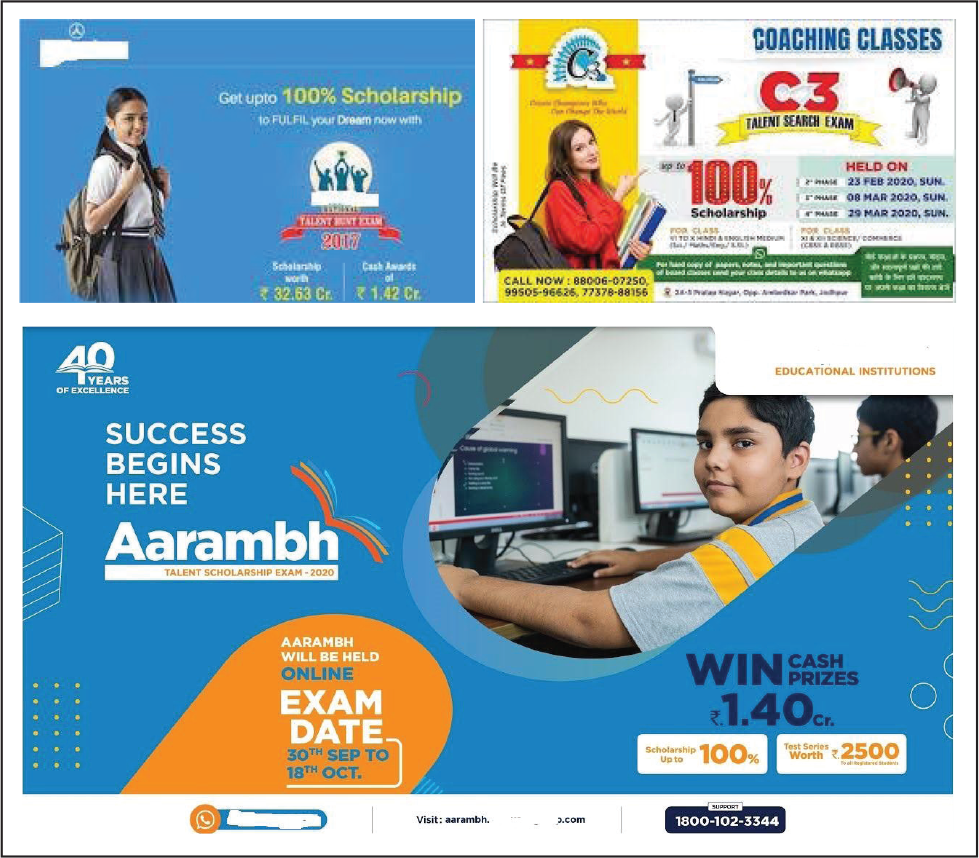
Source: Promotional handouts by coaching institute.
Most of these examinations are conducted for students from class 5 onwards. Overzealous parents initially take it as a casual Sunday outing if the child is in lower classes like 5th or 6th standard. Parents of older students look upon this as a serious opportunity to reduce the family’s financial burden. Post examination, the results are announced within a week, and depending upon the student’s relative performance, scholarship amounting to different percentage fee waivers in different categories is offered to the students. They are also given a time of 15–30 days to utilize the scholarship offered. Most of the students take 3–4 such examinations in a month, and the family sits down with the complex calculation of which coaching class offers the best deal. (Exhibit 3 & 3A)
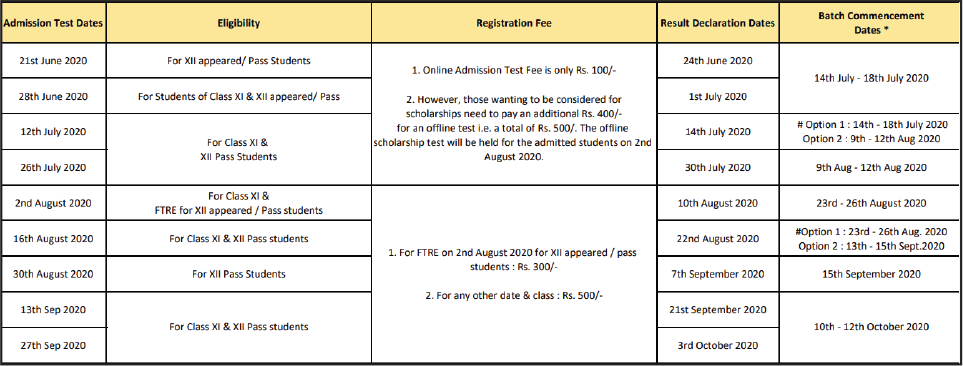
Source: Promotional handbook of coaching class.
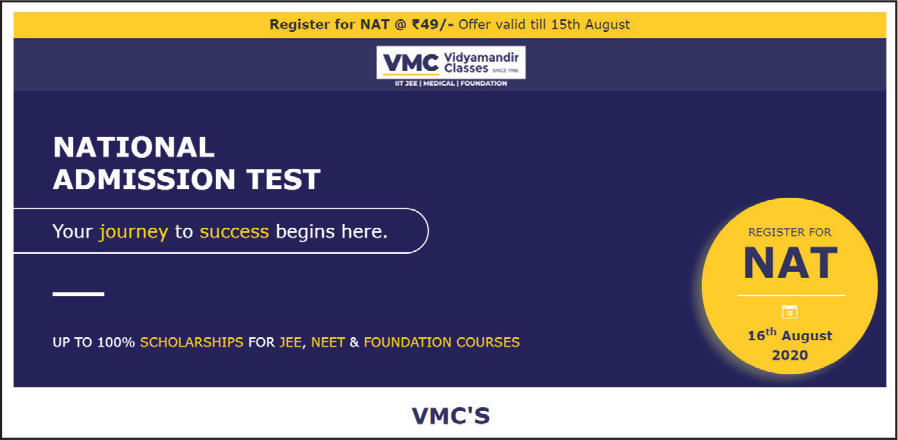
Source: Promotional handouts by coaching institutes.

Source: Promotional handbook of coaching institute.
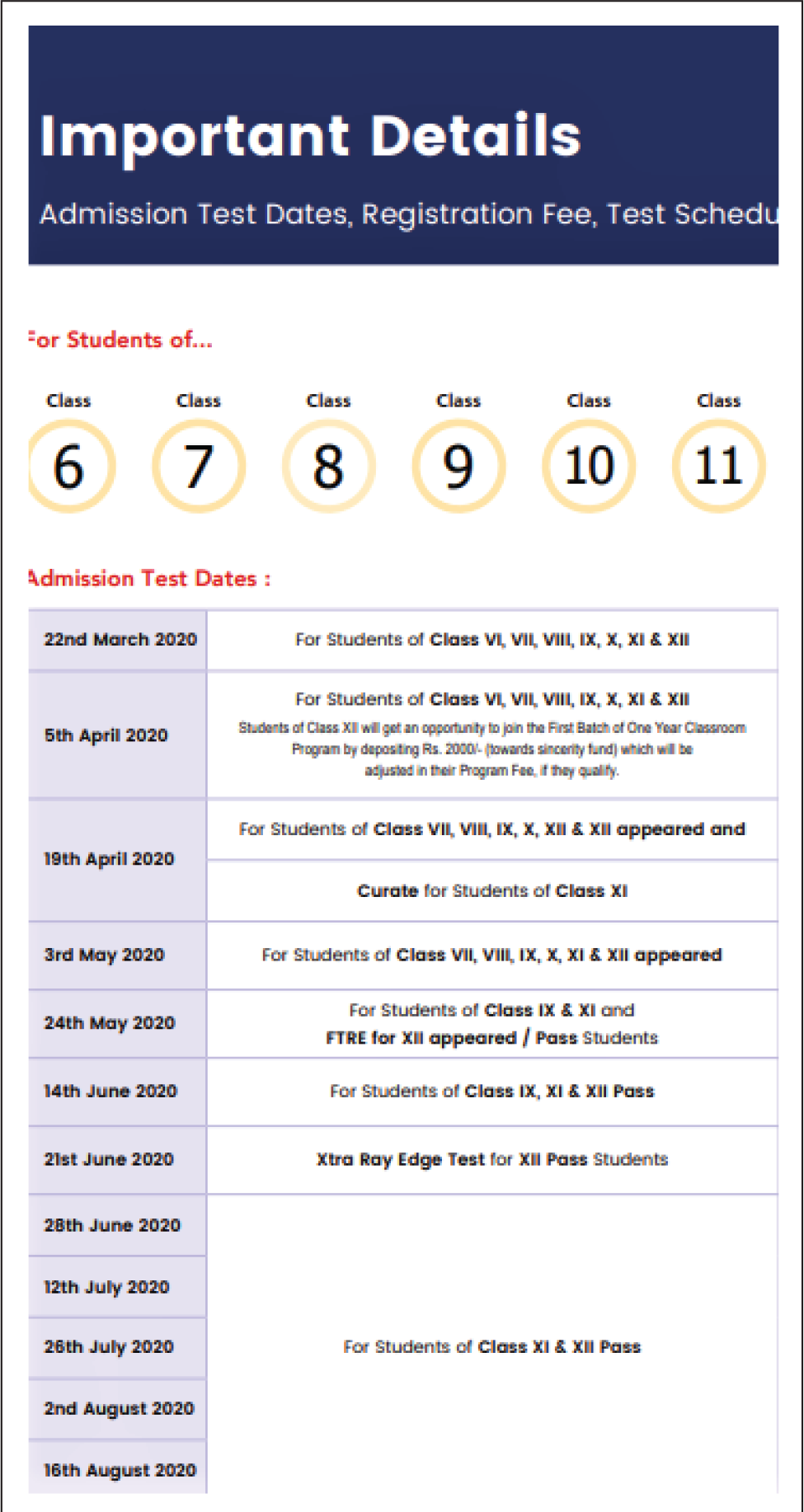
Source: Student handbook of a coaching class.
The behavioural decision theory also supports this behaviour of Indian parents. Selected behavioural decision theory findings:
Consumers who think about the possibility that their purchase decision will be wrong are more likely to choose better-known brands.
Consumers for whom the possible feeling of regret about missing an opportunity have been made more relevant are more likely to choose a product currently on sale than wait for a better sale or buy a high-priced product.
Dan Ariely (2008) in his book Predictably Irrational propagates that a host of mental forces and unconscious cognitive biases conspire to result in seemingly irrational decision-making in many different settings. Ariely believes that irrational decisions are not random but are systematic and predictable. Some of the research insights given by him which is relevant to this case study are:
Consumers find the lure of ‘free’ almost irresistible. The scholarship offers with limited time period to avail the same forces the Indian parent to take an irrational decision. The ‘Optimism Bias’ or the ‘positive illusion’ is a pervasive effect that transcends age, nationality and education level. Hence, he says people tend to overestimate their chances of experiencing a good outcome but underestimate their chances of experiencing a bad outcome. Even though parents are aware of the miniscule ratio of those who making it to the top they believe their child will be one of them.
What a parent misses in the entire ecosystem is whether the offerings from the best coaching institute are palatable to their child. The parent needs to seek the best fit instead of the best available. Hence most of them fail in their thirst to achieve dissonance-reducing buying behaviour. Each child has a different style of reading, comprehending, accepting, questioning and relating to things. Not all competitive exams judge or measure the varied multitude of understanding, nor the coaching classes style their offering in such away. So, the toppers are the ones who had found their best-fit coaching, and the style of examination they opted for measured their style of learning. Not many realize this early on and hence because of the fear of missing out the great Indian dream journey join coaching classes by taking the scholarship exams. But there are parents like Reena who want to make a more informed choice.
The students who join these coaching classes can be categorized into three categories. Students who join early on are coached for different test like Homi Babha science talent examination, NSO, NCO, different Olympiads, and each examination has different levels and the child progresses through these during his/her teen years. The other talents of the child are usually given a back seat if the child has to appear for some national or international level examination. Some of them acquire the skill of cracking these exams early on and continue to become rank holders in the coveted JEE examinations. Others get exhausted by the long run and change course midway. Some others leave because, with the progression in time, they realize that their aptitude and interest lie elsewhere and with accommodative help of their parents pursue that course. The middle players start when they are in the 9th grade and are the most troubled lot along with the late adopters, the ones who join the coaching for these big exams in the 11th grade. Experience and data from students suggest that most of the big coaching classes have a rollover of concepts and methodology that are interlinked, and hence a student needs to at least start from the 9th grade to get accustomed to the tune of the system and knowledge flow. The professor in the class may draw reference to a particular way of explaining things taught in 9th grade, specifically in that coaching class and the student who had joined the coaching in class 11 is left behind while the majority are in unison with the professor.
One of the proven methods of delivering results is segmenting and focused coaching based on capabilities. Institutes have technology-enabled training programs which offer the entire spectrum of deliverables from mock test of various premier institutes to micro-level analysis of results. The test analysis software can compare a child’s performance with the toppers, average students, and projects the rank that the student can get in the actual IIT JEE examination after 2–3 years based on his current performance. This focused and customized level of training makes many parents believe that their child will make it big in the competitive examinations with such coaching.
The above-listed marketing strategies of coaching classes have been successful because of the consumer behaviour exhibited by parents and students—FOMO and overlooking personal capability while trying to achieve dissonance-reducing buying behaviour. As humans, we feel the need to belong and fit in. If we see other people doing something, we want to do it too. In the case of urban parents, the need to provide the best training to their children pushes the parents to engage in coaching classes. Most of the packages offered by the national players are 2–4 years packages where the child is locked to a coaching institute for that period. During this period, the coaching class promises to make the child ready for a plethora of national-level Olympiads or quiz competitions. These examinations happen over the weekends, and overzealous parents keep talking about it to other parents. The other parents fear that by not going to a coaching class, their child will be left behind and hence decide to leap. Having analysed the multiple factors responsible for this industry’s growth let us try to put them together in the PESTEL framework.
PESTEL Analysis
If the coaching class industry survived and grew in the above PESTEL macro-environmental factors in India, the year 2020 saw the introduction of NEP bringing about a drastic change in the educational sector. The National education policy 2020 was approved by the cabinet on 29 July 2020. Will the far-reaching vision and exhaustive framework put forth to act as a deterrent to such rampant growth of alternative coaching? Some of the key areas under NEP 2020 are:
Education will be compulsory for children between the age of 3 and 18 years. A shift from a decades-old 10+2 format to a 5+3+3+4 system, keeping in mind a child’s development and capabilities, is proposed. The NEP has recommended the mother tongue as a medium of instruction, though it has not been made compulsory. Universalization of early childhood care education (ECCE) No rigid separation between Science, Arts and Commerce streams. Coding to be compulsorily introduced from class 6. Internships and vocational education to be offered from class 6. Focus on attaining foundational literacy and numeracy. Board exams to have low stakes. Common entrance examination. Reduction in the curriculum to core concepts. Provision for education of gifted children
Board exams for Grades 10 and 12 will be ‘redesigned’ and a new National Assessment Centre, Parakh (Performance Assessment, Review, and Analysis of Knowledge for Holistic Development), will be set up as a standard-setting body. The changes in the board structure, which seek to make the exams a test of ‘core competencies’ will be implemented from the 2021 academic session.
The policy states that curricular content will be reduced to enhance essential learning and critical thinking, and greater focus will be on experiential learning.
Key Implications for Coaching Classes will be:
Students from an early age onwards will understand and appreciate their interest in various fields. Coaching classes who had used technology to dissect the performance of a student as given in the exhibits can no longer depend on this strategy. The specialized training given to crack some of the coveted examination through mock and preparatory exam series and the use of technology to predict the performance of the student will no longer have many takers.
The current system of appreciating the memory-based skills will be replaced by assessing skill through experiential learning. Comparison of test marks as depicted in the Exhibit 5A and 5B above will no longer be a training strategy. The method of over emphasis on test performance analysis will have to give way to more emphasis on competency assessment.
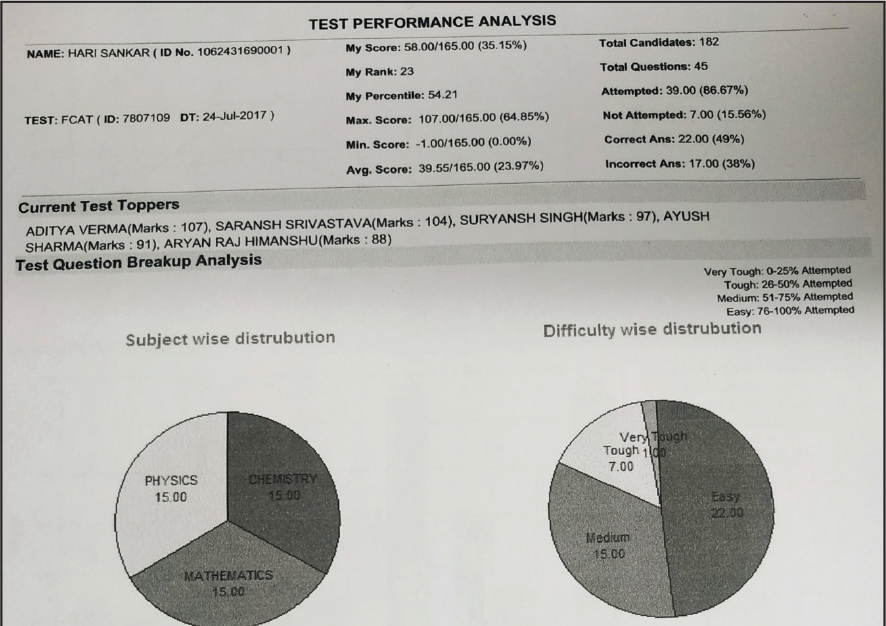
Source: Personal score card given by coaching institute.
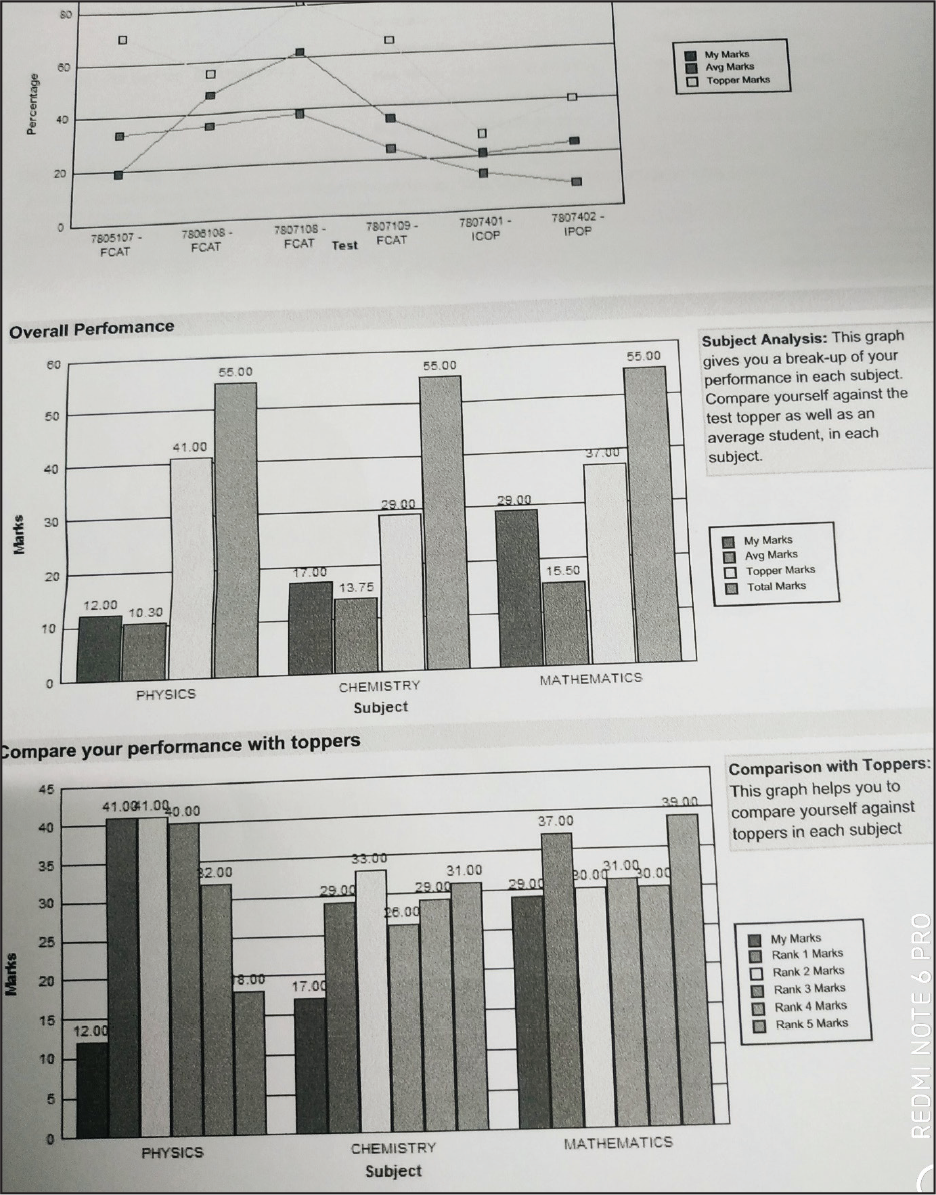
Source: Personal score card given by a coaching institute.
There will not be a few dream professions that will be highly competitive, but many students will be able to convert their passion, interest and aptitude into their dream profession.
The coaching classes’ role will be redefined to one of the facilitators who can expose students to multiple options available.
There has to be a strong public–private partnership. The current coaching classes can take up the private partner role in order to provide expertise in a wide area of subjects to the students.
Technological intervention will help in cutting cost, effort and time in delivering a wide spectrum of subjects to a wide range of students.
Infrastructure required for technological disruption needs to be set up. The role of coaching classes is crucial for this.
Curriculum in multiple languages, format for multiple disciplines needs to be developed. The role of coaching classes is crucial for this.
Discussion Questions
As a parent, list out the decision-making criteria on which you are likely to base your decision regarding the choice of coaching class for your child.
Discuss the role of advertising appeals and sales promotion incentives used by different coaching classes and understand the target audience it addresses.
Examine the role of macro-environment factors in the growth of coaching classes.
Do you think using FOMO as a marketing strategy is an ethical choice particularly when it involves students?
Debate on the role NEP is likely to play in redefining the coaching class space.
