



Abstract
Shoppers Stop had a significant presence on social media platforms—LinkedIn, Facebook, Twitter and YouTube. However, a large number of Shoppers Stop’s customers posted complaints about deficiency in customer service on these social media platforms, mainly on Facebook. The complaints and ratings were also seen by other stakeholders such as potential employees who form a perception about the company’s employer brand based on these ratings. While Shoppers Stop promptly responded to disgruntled customers on Facebook to redress their complaints, Shoppers Stop was uncertain about the possible adverse impact of these customer reviews on the company’s employer brand. Further, Shoppers Stop wanted to leverage its presence on various social media platforms to promote and manage its employer brand.
This case was prepared on the basis of published sources only. Consequently, the interpretations and perspectives presented in this case are not necessarily those of Shoppers Stop and any of its employees.
Social Media Presence
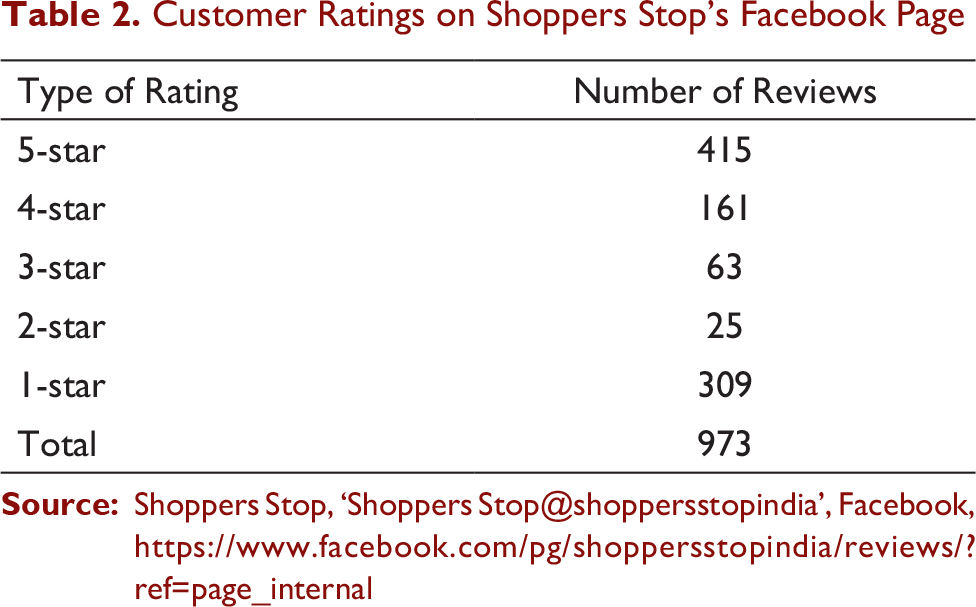
Customer Ratings on Shoppers Stop’s Facebook Page
The company also used social media platforms to promote its employer brand to prospective job seekers; for instance, Shoppers Stop used LinkedIn to reach out to job seekers by posting vacancies. 2 Customer reviews were seen by other stakeholders such as current and potential employees, members of placement committees of various B-schools and professional placement consultants. Research studies indicated that a company’s customer brand influences job seekers’ behaviour and their intention to apply (Kim et al., 2011).
Shoppers Stop’s Financial Highlights
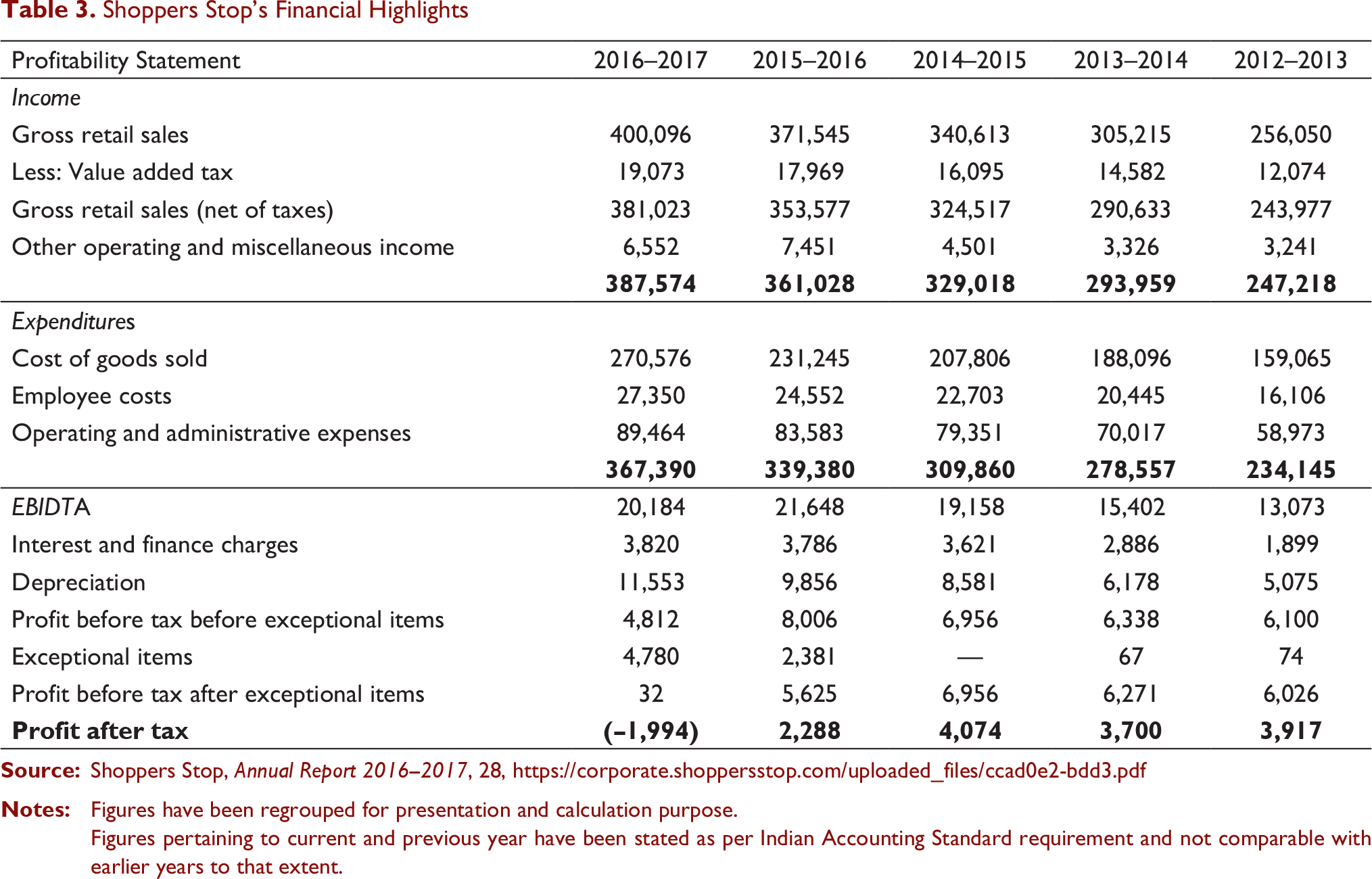
Figures pertaining to current and previous year have been stated as per Indian Accounting Standard requirement and not comparable with earlier years to that extent.
Major Fashion Retailers in India
About Shoppers Stop
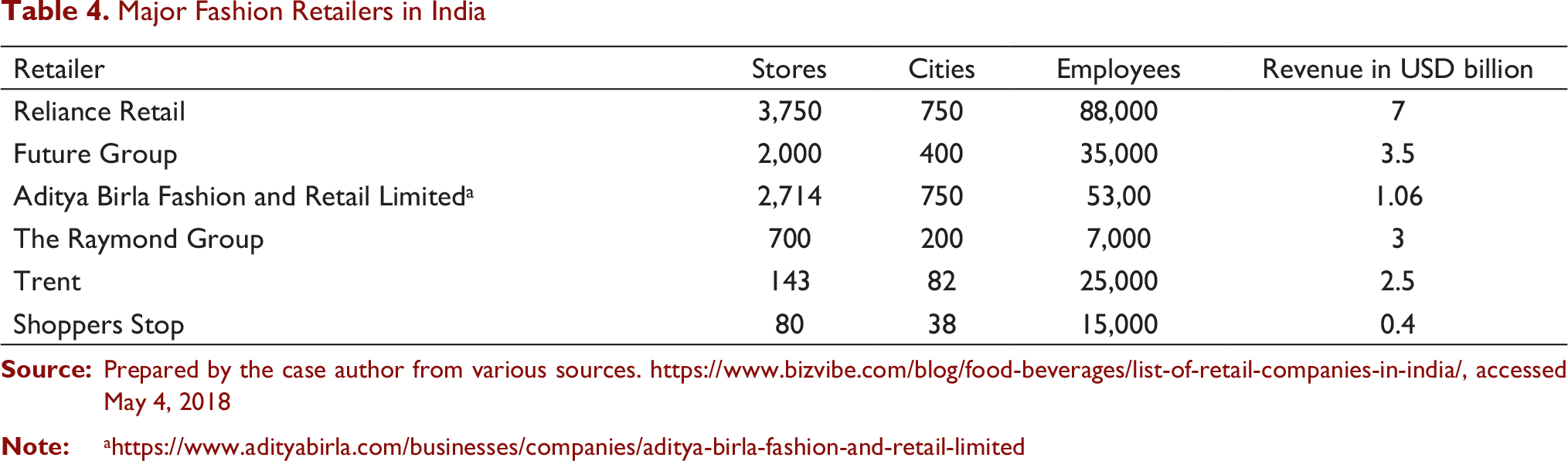
Shoppers Stop, India’s largest retail chain, was established in 1991 by K Raheja Corp Group. Shoppers Stop started its first modern retail store at Andheri, a suburb in Mumbai, and sold only men’s wear. 3 Since its inception, it witnessed immense growth, leading to an increase in the number of outlets as well as its total workforce. In 2017, Shoppers Stop had 80 stores in 38 cities. 4 Initially, Shoppers Stop focused on a single format, which contributed to operational metrics and higher profitability. Later, Shoppers Stop adopted new formats such as hypermarkets and specialty stores, with each new format planned as a separate business unit (SBU). The company had gross retail sales value of about ₹40 billion 5 in the year 2016–2017 with overall employee cost of about 7 per cent 6 (see Table 3 for detailed financial highlights). However, at the same time, the company had to compete with several other players in the fashion retailing. Table 4 provides the information about major fashion retailers in India. It can be noted that there are several fashion retailers with a significantly higher retail presence than Shoppers Stop.
Shoppers Stop was recognized for its superior quality products, services and for providing a complete shopping experience. In fact, Shoppers Stop was considered as a benchmark for the Indian retail industry due to its increased focus on expertise and quality. 7 Shoppers Stop was positioned as a premium lifestyle departmental store and sold a variety of products in both apparel (for men, women and children) and non-apparel segments (personal accessories, perfumes, cosmetics, watches, etc.). 8 Shoppers Stop’s vision was: ‘To be an inspirational and trusted brand, transforming customer’s lives through fashion and delightful shopping experience every time’. 9 The vision statement had a distinct meaning for different stakeholders such as customers, employees, shareholders, society, etc. ‘For customers, Shoppers Stop aspired to be the customer’s favorite shopping destination. A brand the customer can trust’. 10 Shoppers Stop designated every employee across the company as a Customer Care Associate (CCA) to emphasize that every employee was dedicated to serving customers. 11
Use of Social Media in Influencing Consumer Purchase
Empirical research (Mai et al., 2016) shows that social media information’s quantity, quality and credibility positively influence the perceived usefulness of an information source and intention to use it in future. Apparel retail companies employ social media platforms, especially Facebook, to communicate and interact with their customers, and enhance their relationship with them. However, the appropriateness of a particular social media channel depends on the customer’s age. For example, Rahul Jain, co-founder of eCraftIndia, says that ‘For our brand we found Facebook to be more influential but for many brands Instagram has been giving better results. It all depends on product segment brand is targeting. For young crowd, aged between 14 and 30 years, Instagram has become much popular then Facebook. For our brand where we are targeting people above 25 years of age, specially married people, we are getting better results from Facebook’ (Kazi, 2020). Further, social media communication may have a greater impact on customer satisfaction than other forms of communications. For example, a recent study found that customers experience a higher level of satisfaction when communicating via social media versus by phone. 12
The Sprout Social Survey data (Barnhart, 2019) reveal the significance of social media in recommending a brand to customers’ networks. According to the survey, 78 per cent customers discuss a particular brand with friends and family, and the same percentage of customers recommend that particular brand to friend and family. Echoing with this, Alisha Malik, VP marketing Metro Shoes says that ‘Instagram has become the most influential platforms for us. We have grown significantly in the past 2 years. Influencers on Instagram are very popular. This has started to give us good organic conversions as well’ (Kazi, 2020). Further, nearly 53 per cent customers engage with brands on social media, as per the Sprout Social Survey data (Barnhart, 2019).
Customer service concerns are one of the major reasons that consumers engage with retailers on social media and companies can gain significantly by equipping themselves to handle such concerns. Effective social media strategy for retail means listening and responding to customer complaints with care, including personalized replies, in a timely manner. This requires dedicating time for providing customer service on social media with ‘one-size-fits-one’ approach. For example, 60 per cent customers expect a personalized response within an hour (Barnhart, 2019).
While about 47 per cent and 40 per cent customers reach out to brands on social media when they have a question related to product or service and when they have a bad experience, respectively (Barnhart, 2019), customer service goes beyond addressing questions and complaints and it also includes highlighting customers’ positive experiences on social media. Any customer review less than 5 stars is undesirable and a well-rounded social media strategy for retail can convert that negative review into a positive one. Thus, social media for retail can be useful in both addressing the complaints of existing customers and discovering new customers. Also, for an effective social media strategy, omnichannel social presence is recommended.
Talent Management Philosophy and Human Resource Initiatives
As on January 2018, Shoppers Stop’s employee strength was about 14,000 and more than 80 per cent of its employees were at the front-end roles (Choudhury, 2015). The company’s talent management philosophy was based on the principles of development and inspiration. This resulted in employees developing a deep sense of belongingness and loyalty (Choudhury, 2015). Shoppers Stop’s vision for employees was: ‘For employees (i.e., ‘Customer Care Associates’), a great place to work where associates feel respected and inspired to contribute their best’. 13 While Shoppers Stop had no formal employee value proposition (EVP) which explicitly focused on job seekers, its career page mentioned: ‘Welcome to Shoppers Stop! A world full of challenges, learning, excitement and fun’. 14 Shoppers Stop promised growth and development to its employees and focused on hiring people who were passionate, adaptable, self-motivated, team players and reflected the Shoppers Stop’s mission statement—‘Nothing but the best’ 15 (see Shoppers Stop’s career page). Shoppers Stop’s compensation structure was relatively better than other fashion retailers operating in India. For instance, at Shoppers Stop, the annual salary for a department manager was ₹383,491 16 while Future Group 17 offered an annual salary of about ₹333,780 18 for the same position. Average salary figures at different employee levels at Shoppers Stop are given in Table 5.
Shoppers Stop had a campus programme called ‘Campus Guru Challenge’, in which students from leading colleges were invited to compete on relevant and contemporary business case studies and present their recommendations to a panel of retail experts. 19 Shoppers Stop aimed to be a ‘desired employer’ for students and thus build a talent pool for the future. In the recruitment process, potential candidates were assessed on aspects such as their cultural fit, functional capabilities and career goals. 20 Shoppers Stop austerely looked for a right match between the organization’s mission, vision and values on the one hand and the personality dimensions, professional orientation and growth expectations of prospective employees on the other. This was done to avoid employee dissatisfaction and disengagement and to improve employee retention and achieve superior performance and higher organizational citizenship behaviour. The company had a very strong referral policy that formed nearly 60 per cent of its overall hiring. 21 To facilitate better communication with employees, Shoppers Stop created an in-house intranet platform named Spandhan 22 through which the senior management and HR personnel regularly interacted with teams across the country. The company’s quarterly publication titled ‘Re-Tale’ recognized outperformers and highlighted key initiatives and future plans. Through the BindasBol 23 initiative, front-end staff were encouraged to freely share their complaints, concerns, feedback and suggestions on how the company could improve its processes. 24
Productivity Metrics and Employee Satisfaction
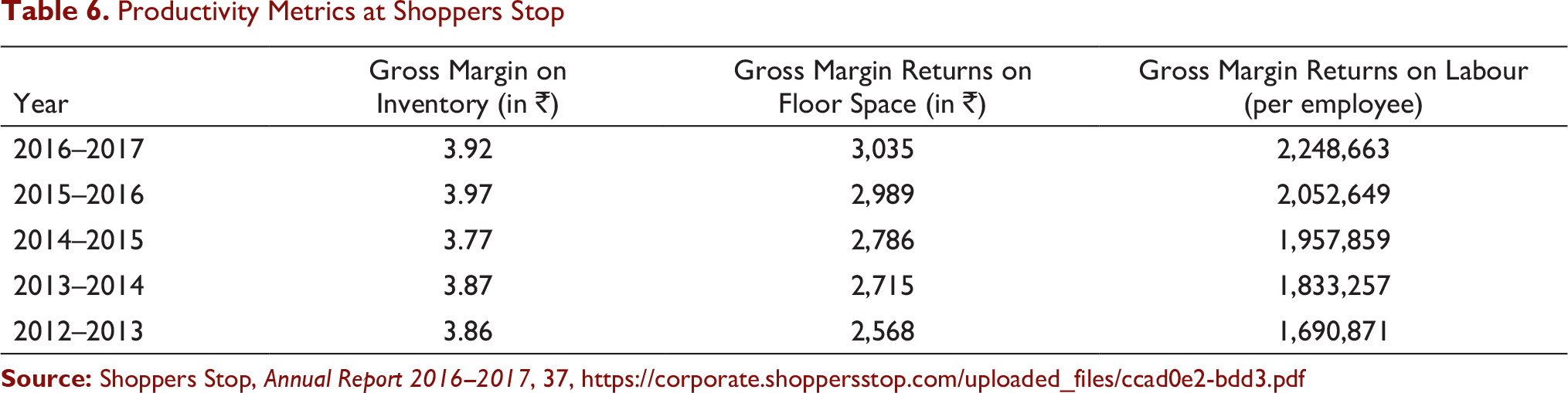
Shoppers Stop used three indicators to measure the efficiency of its operations which focused on space, inventory and labour. First was ‘gross margin on inventory’ (GMROI) that helped in optimizing inventory levels; second was ‘gross margin returns’ on floor space (GMROF) that helped in maximizing the cash margins; and third was ‘gross margin returns on labor’ (GMROL) that assisted in increasing labour productivity 25 (Table 6 presents the 5-year trend on these three metrics). Shoppers Stop monitored associates’ satisfaction level with their job and work through the associates satisfaction index (ASI) survey which was conducted annually through the online medium. 26 Overall, the index steadily increased from 4.12 in 2012 to 4.21 in 2014 and 4.40 in 2016. Shoppers Stop organized 25,386 hours of training in 2016–2017 for its associates compared to 23,050 training hours in 2015–2016. 27
Shoppers Stop’s Employer Brand
Using the company’s presence in ‘best employer’ survey ranks as a measure for its employer brand strength, Shoppers Stop had a good employer brand. However, deeper examination revealed that Shoppers Shop had done relatively better on employees’ perception-based survey ranks than in ranks based on job seekers’ perception; for instance, the company was listed as one of India’s Best Companies to Work For in 2014 (rank 27th out of 100) and 2015 (rank 42nd out of 100) by the ‘Great Place to Work’ (GPTW) Institute. 28 The GPTW Survey (an annual release) measured companies on two important aspects: trust and culture. The ‘trust’ aspect covered credibility, respect, fairness, pride and camaraderie, which were measured through 57 statements. The ‘culture’ aspect covered organizational culture and people practices. 29 The GPTW survey invited companies to participate and employees of the selected companies participated in the survey. In comparison, Shoppers Stop was ranked 74th (out of 100) in 2017 and 83rd (out of 100) in 2016 in Universum’s ‘India’s Most Attractive Employers by Business and Commerce students’. 30 Universum Survey 31 was based on job seekers’ perception about their ideal employer. For ranking companies, Universum asked a series of questions to prospective job applicants following the funnel approach (i.e., awareness, consideration, desire and application). Some questions were, ‘Are you aware of the employers in your interest areas?’ ‘For which of the employers would you consider working?’ ‘Choose the five employers you most want to work for’ and ‘Have you applied or will you apply to these employers?’ 32
Average Salaries’ at Shoppers Stop

Productivity Metrics at Shoppers Stop
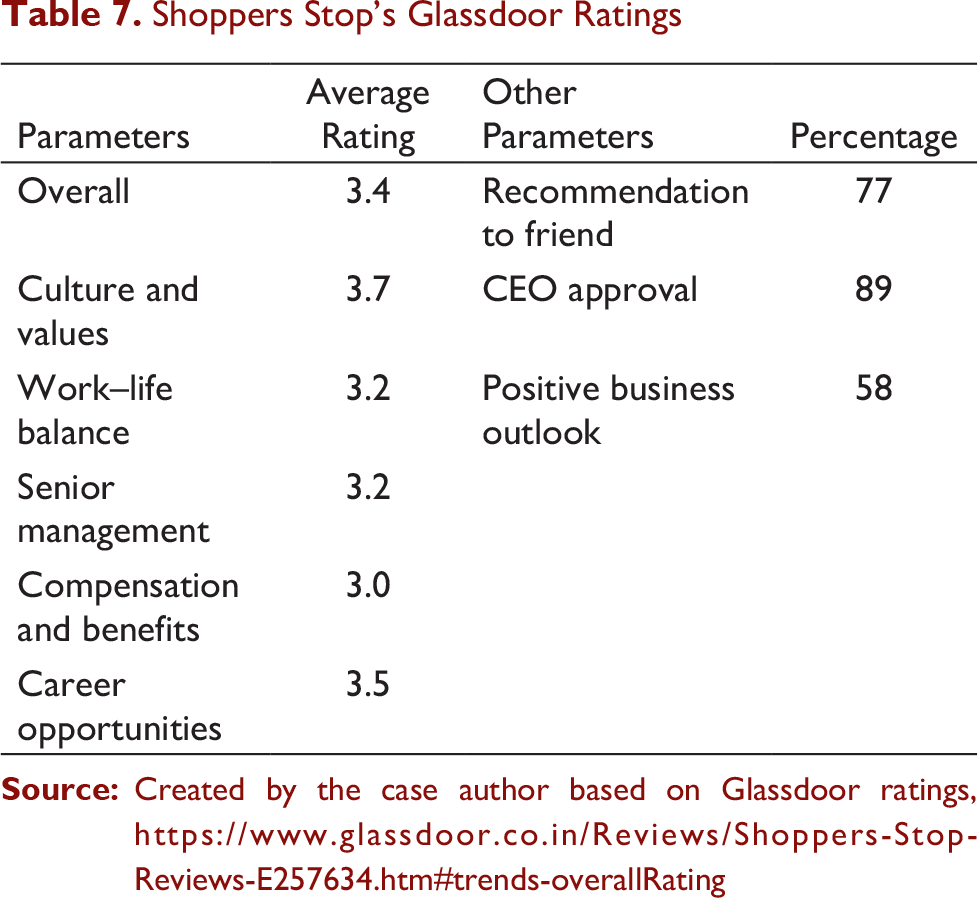
Shoppers Stop’s Glassdoor Ratings
Social Media Presence and Customer Brand Perception
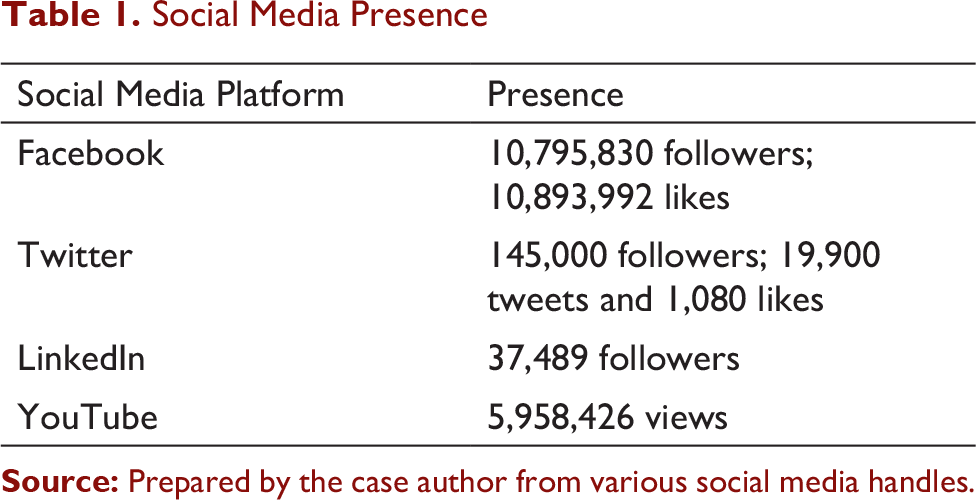
Shoppers Stop had a significant presence on various social media platforms. As on 4 May 2018, Shoppers Stop had 37,489 followers on LinkedIn, 41 145,000 followers on Twitter (19,900 tweets and 1,080 likes), 10,795,830 followers (10,893,992 likes 42 ) on Facebook 43 (the largest among Indian retailers) and 5,958,426 views on YouTube. 44 On Facebook, Shoppers Stop was rated 3.3 stars out of 5 stars based on 973 reviews. A majority of these reviews were posted by Shoppers Stop’s customers. Out of the total reviews, 415 reviewers rated Shoppers Stop 5 stars followed by 309 customers rating the company 1 star. 45
Shoppers Stop used social media for both customers and job seekers. Customers were unhappy with the company’s services and posted complaints on various social media channels, mainly Facebook. Shoppers Stop had accumulated a sizable number of negative comments from unhappy customers; for instance, a customer reflected on his shopping experience at Shoppers Stop as follows:
I had the worst shopping experience with Shoppers Stop through the online medium. My suggestion is that ‘Your Brand’ is not ready for online yet as compared to other e-commerce sites. My shopping experience with Shoppers Stop was the worst and I will never recommend Shoppers Stop to anyone.
46
Shoppers Stop responded:
We regret the inconvenience caused and thank you for the feedback. We shall look into the matter.
47
A customer shared his experience of very poor customer services provided by Shoppers Stop as follows:
I purchased a watch from Shoppers Stop. When I approached the company for after-sales services, the executive told me that it will take 25 days to repair the watch. Very poor customer service. I am not the only one who has had this bad experience. There were 3 other customers who faced the same situation. We regret having made our purchases from Shoppers Stop.
48
Shoppers Stop responded:
Dear {customer name}, apologies for the inconvenience caused. Kindly share the store details and your contact details so that we can assist you better. Thank you for your patience.
49
Another customer commented on the difficulties faced in returning the product purchased from Shoppers Stop:
First Shoppers Stop delivered the wrong product and then took 20 days to arrange a return pickup {because the courier refused to pick up the wrong product thrice}. The return pickup was arranged in the 4th attempt, but no replacement or refund was initiated for nearly 20 days {order number xxxxxxxxx}. If I find the time to visit the company’s Saket Store, I am going to make sure someone is fired.
50
Shoppers Stop responded:
We regret the inconvenience caused. However, we are pleased to inform you that the refund of your returned product has been processed.
The Social Media Challenge
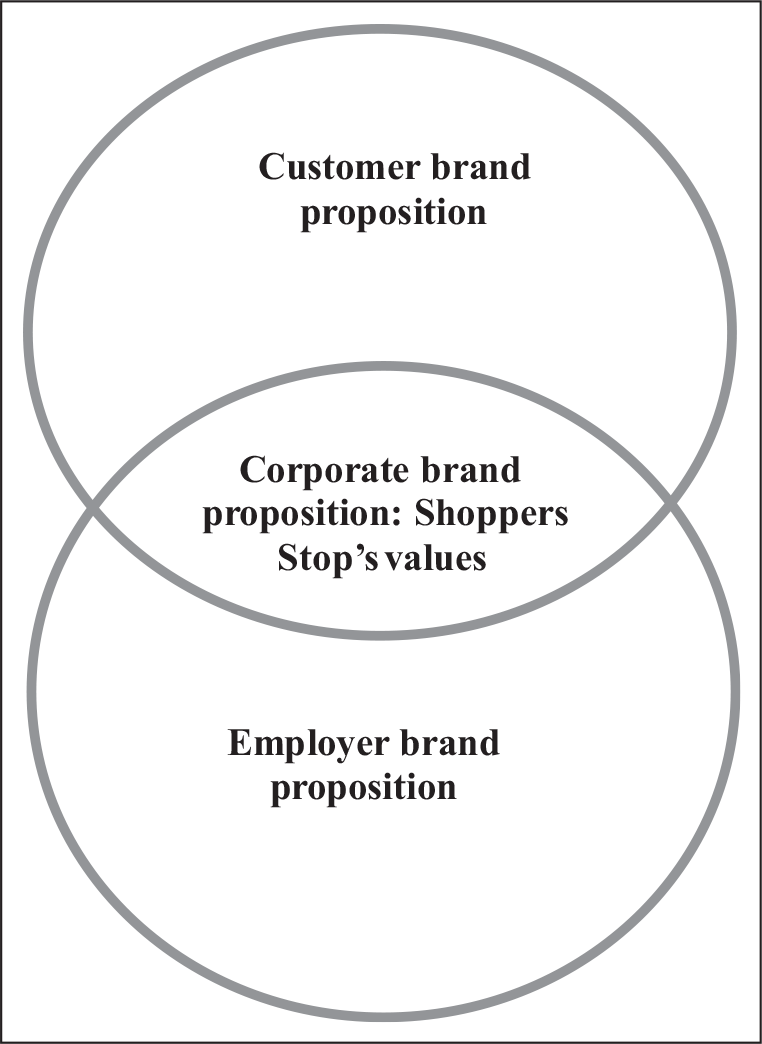
Research studies indicated that a company’s customer brand influences its employer brand, and both customer brand and employer brand should be aligned with the company’s corporate brand (Mosley, 2007) (see Figure 1). An alignment between the customer brand and employer brand can contribute up to 36 per cent higher growth in shareholder value over a 5-year period. On the other hand, misalignment between the two can lead to decrease in shareholder value by about 8 per cent in the same time period (Marshall et al., 2016).
In April 2017, Shoppers Stop launched a new campaign ‘Start Something New’ to increase its focus on the joy of the shopping experience. 52 With this campaign, the company wanted to connect with customers even more strongly. 53 While the success of this campaign was yet to be seen, the company received several complaints on Facebook about its customer services till May 2017. Although the company regularly responded to customers’ complaints, Shoppers Stop was uncertain about the possible negative effects of its customer brand on its employer brand as customers’ comments were also seen by job seekers. A few important questions that needed immediate attention were: First, what were the negative consequences of underperformance of its customer brand on its employer brand? Second, how should the company address the negative spill-over effects of its customer brand on its employer brand? Third, how should Shoppers Stop leverage its presence on various social media platforms to promote and manage its employer brand? Finally, how should Shoppers Stop align its employer brand with its customer brand, and vice-versa?
Footnotes
Declaration of Conflicting Interests
The author declared no potential conflicts of interest with respect to the research, authorship and/or publication of this article.
Funding
The author received no financial support for the research, authorship and/or publication of this article.