



Abstract
Abstract
Dailyhunt’s road to the number one regional language news aggregator in India had been a long and momentous one. Virendra Gupta, CEO and founder of Dailyhunt had seen the landscape undergo multiple changes and had to adapt his company to these changes through the use of analytics and strategic partnerships with content publishers. With the rapid penetration of internet usage in India, the new users of the internet were largely expected to be individuals who would be more comfortable consuming digital content in their native language. The potential this segment held was immense and Dailyhunt was in the driver’s seat in terms of providing a personalized content stream and the large existing user base on its platform. However, with foreign investment pouring in for various new start-ups and the entry of several companies in to the segment, the challenges were set to increase, and Virendra Gupta had to decide what future strategies could help his company stand strong amidst the competition.
Introduction
Virendra Gupta, founder and CEO of Dailyhunt, was thinking the future course of action of the company. With only two months left for the board meeting, he was working on the proposal on the strategic direction of the company. He had asked his team to come up with strategies of what Dailyhunt could do next. They after careful evaluation had provided him with multiple options on what Dailyhunt can do in the future.
Virendra’s journey from Verse Innovation Private Limited to acquiring NewsHunt to now Dailyhunt had been a challenging one. He had tried to keep the technology platform up to date with the current times. After the successful rebranding campaign of NewsHunt to Dailyhunt, all he now wanted was to lead Dailyhunt in such a way that it would soon surpass the expectations of its current users and offer services that were both relevant and necessary.
The Indic Language Digital Media Space
Over the years, there have been many hurdles in the regional language segment. The whole landscape of the content industry evolved fast due to growing penetration of internet in the country, 1
with even news consumption itself starting to move online (KPMG & Google, 2017). Slow and patchy internet connections, along with limited phone memory, were initial obstacles to this segment. In 2008, Rediff mail started offering a selection of 22 Indian languages for its email and other internet services. The year 2009 marked Google’s entry into this space with the option for Hindi. Facebook too decided to include Hindi, Kannada, Malayalam, Tamil and Telugu 2 as some of the languages on offer, on their platform.This segment was attractive because Indic language internet users grew at a compounded annual growth rate (CAGR) of 41 per cent between 2011 and 2015 (KPMG & Google, 2017). By 2016, regional language users had surpassed English language users. The growth momentum was likely to continue with the estimated CAGR of Indic language users at 18 per cent making the segment touch 536 million users by 2021. In comparison, English language users were expected to grow at 3 per cent with 199 million users only by 2021 (KPMG & Google, 2017).
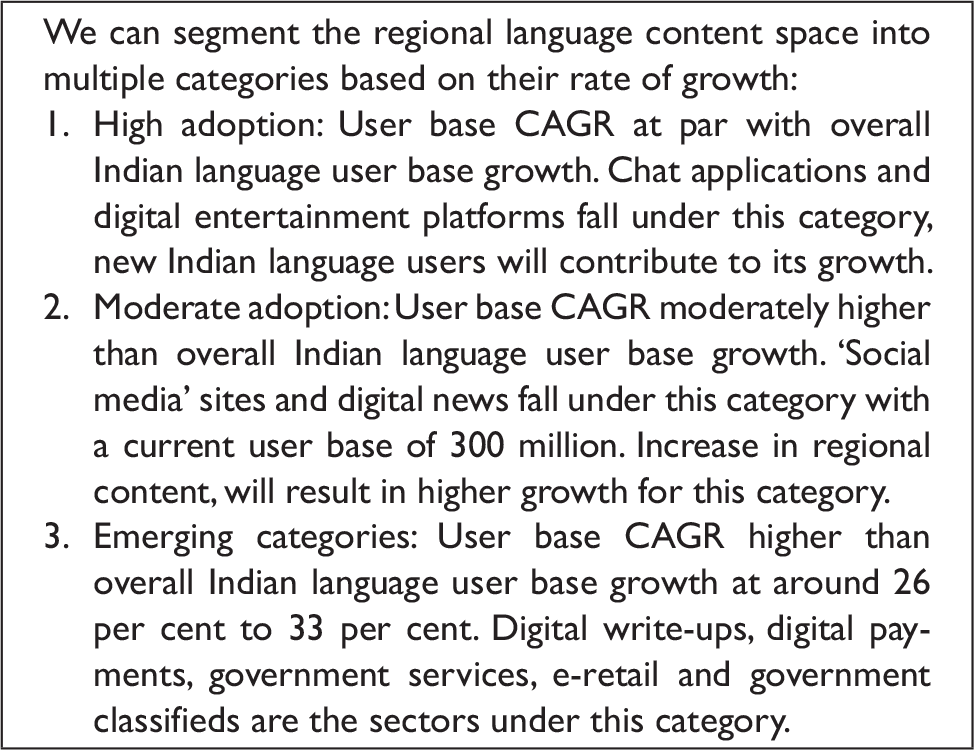
The growing user base was aptly complemented by the increasing penetration of devices capable of using the internet, availability of high-speed data connection, steadily improving digital literacy and the enablement of the whole ecosystem to process Indic languages, bringing in and engaging more regional language users online. Hindi along with Marathi and Bengali would drive the segment growth by volume while Tamil, Kannada and Telugu users were expected to be the most digitally engaged from 2016 to 2021. Local language digital content was expected to find more acceptance by Indian language users, as they would find content delivered in a language of their choice more reliable than English language content (refer to Box 1; KPMG & Google, 2017). The challenge for the organization is how to handle this emerging phenomenon which is changing the news consumption. The need to have the vernacular news content is increasing.
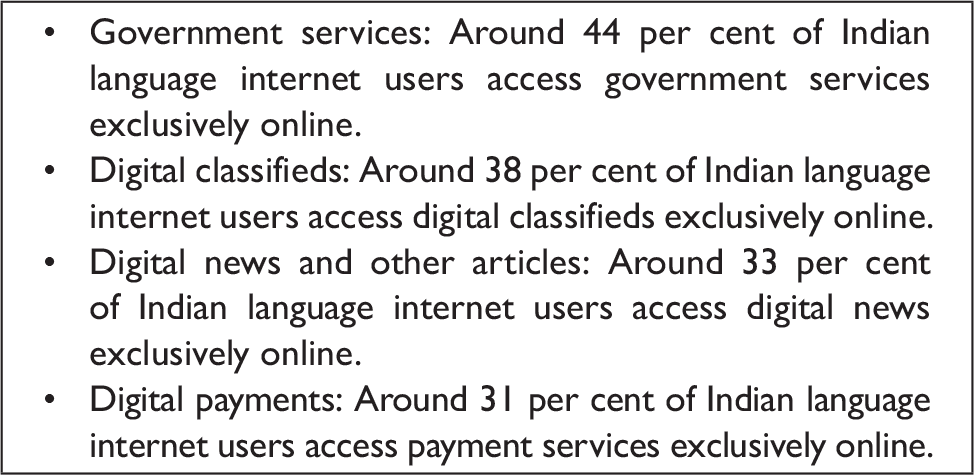
Speaking in terms of Indian language news consumption, in terms of the eight most spoken languages (Hindi, Marathi, Bengali, Telugu, Tamil, Malayalam, Gujarati and Kannada), the total user base would exceed the English user base by 85 million, by 2021. In 2016, 32 million Indic language users consumed new content digitally, which was 1/3 of the user base for regional digital news (refer to Box 2; KPMG & Google, 2017).
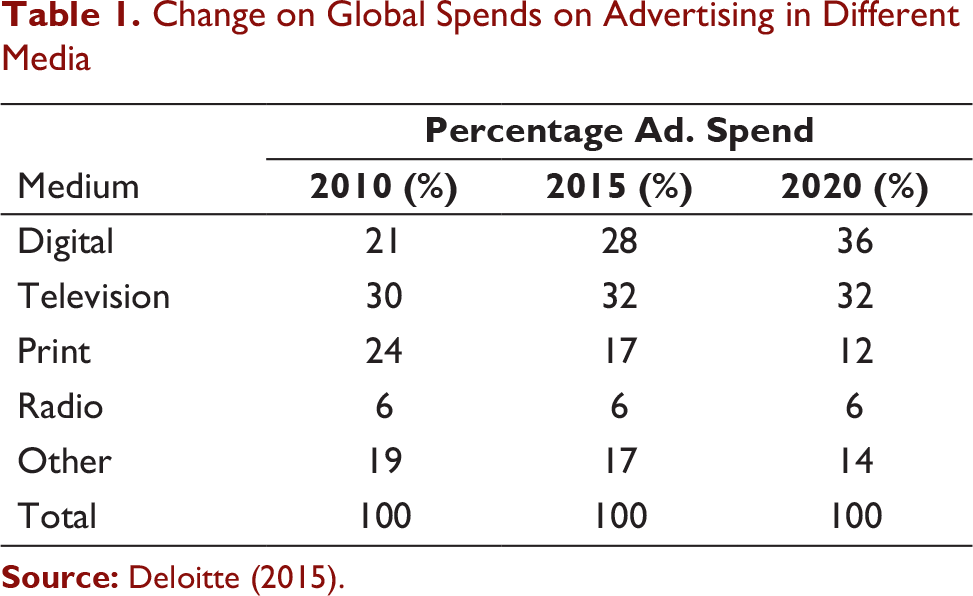
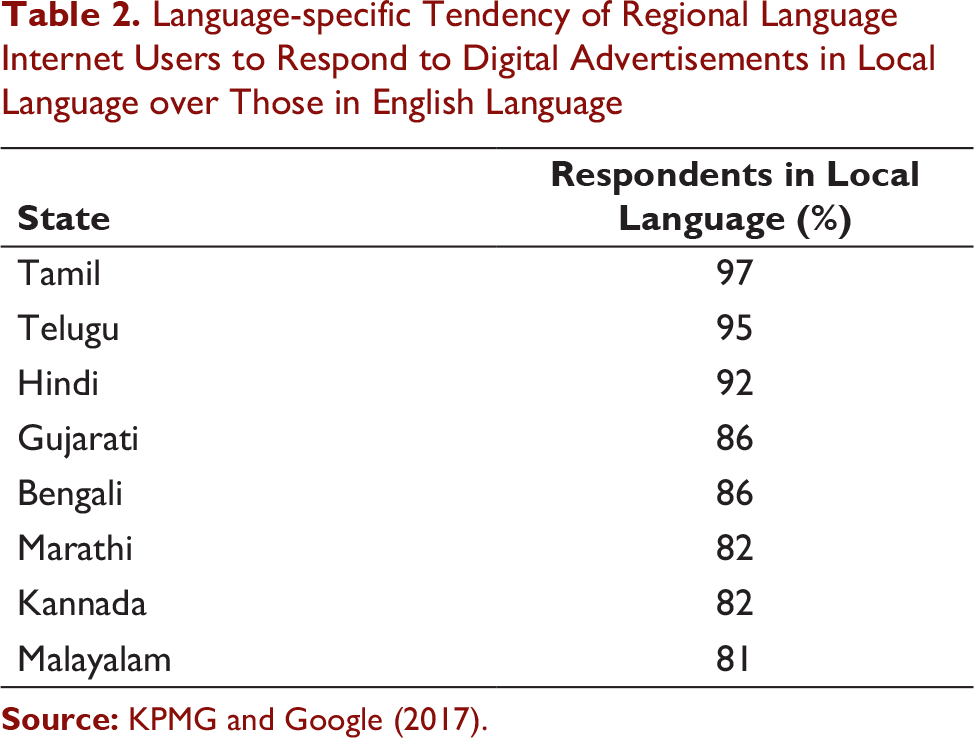
In addition to this, we can see that globally, the advertisement spends on digital media is growing, while that for TV and radio remains steady and for print is in decline (Deloitte, 2015), while 88 per cent of regional language users of the internet showed greater willingness to respond to an advertisement in their local language, as compared to English (refer to Tables 1 and 2; KPMG & Google, 2017).
Change on Global Spends on Advertising in Different Media
Language-specific Tendency of Regional Language Internet Users to Respond to Digital Advertisements in Local Language over Those in English Language
Verse Innovation
Verse Innovation was founded in 2007 by Virendra Gupta. Initially, they tied up with top network providers, to send job classifieds through text messages, during a time where mobile broadband was not accessible to most users in India. They functioned as a value-added service (VAS) for mobile phones, operating through Short Message Service (SMS) and Unstructured Supplementary Service Data (USSD), to provide content such as ringtones, music and pictures to consumers. Revenue was shared with the network providers as per download. 3
Refer to Note 2.
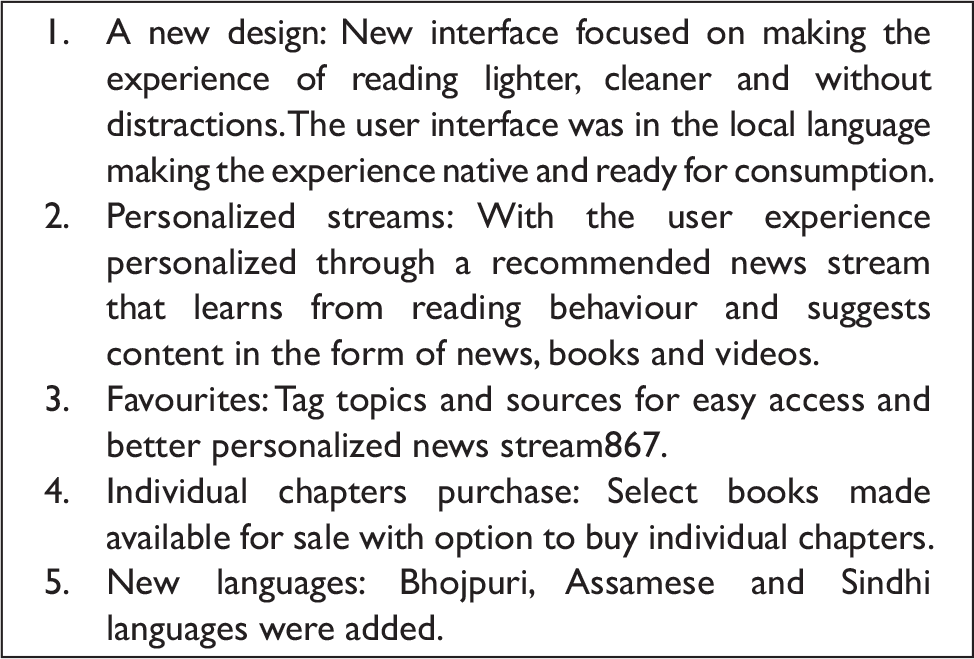
However, pre-empting a collapse in the VAS ecosystem, owing to regulatory concerns regarding the spread of spam messages and the rapid rise of high-speed mobile internet, Virendra and his team implemented a strategic shift in 2012, with the acquisition of news aggregation application, NewsHunt. 4
The company, therefore, moved from using SMS and USSD to an application-based ecosystem for delivering content.The team had noted that with internet usage in India gaining popularity, most new users would be based out of rural India 5
Refer to Note 1.
Refer to Note 2.
NewsHunt
NewsHunt was founded in 2009 by Umesh Kulkarni and Chandreshekar Sohoni. Initially, it was developed on the Symbian platform as both the founders had worked for Nokia, the application functioned as a news aggregator for its users. The android version of the same app was launched in 2011. Virendra Gupta led Verse Innovations acquired the application in 2012, prior to which NewsHunt had already forayed into regional languages. Over the years, the application saw several changes which made it offer content in different formats. 9
Refer to Note 2.
In words of Mr Vishal Anand who was the chief product officer at Verse Innovations, ‘What started with solving technology problem for local language news has grown into solutions for e-books, magazines and comics’. 10
As of February 2018, it provided content from 650 news publishers across 14 languages including Hindi, Tamil, Malayalam and Marathi. 11Refer to Note 2.
Refer to Note 2.
Building Competencies from 2012 to 2015
As the company shifted from classified advertisements to regional language news aggregation, this implied that they were no longer working in a B2B environment. Virendra in an interview said,
In B2C, as you know, you are directly impacted by the customer. Customer gives you direct feedback. You have a lot more analytics, a lot more information, lot more ability to impact the product design using analytics. You can make changes to your product without going through a guideline given by someone else, instead you can simply rely on user feedback to make changes.
13
Refer to Note 2.
To address these issues, Verse acquired BuyT.in (along with parent company rocket science innovations), in 2015. 14
BuyT.in, which was a discovery and recommendation tool, was used to develop a mobile advertising and monetization platform. 15Refer to Note 2.
Refer to Note 7.
NewsHunt to Dailyhunt Rebranding
Vishal Anand said:
We changed our name to represent what we are planning for our future while also standing for our current state of being the largest local language news and e-books application. The name helps us expand our mission: To make it easier for people to enjoy best content, products and services in their language, on any device.
17
To communicate about the rebranding exercise, the company followed the ad campaign—‘Aur Kya Chal Raha Hai’, which took place in a barber shop, with the customer asking the barber repeated questions about local news, which were all answered by another person using the Dailyhunt application. 18
The campaign ran on digital media, social media and on the television. 19Refer to Note 18.
Refer to Note 18.
Accompanying the ad campaign was a sustained ‘social media’ campaign, which was in the form of a contest, where they posted a series of questions in regional languages, via video clips and the target audience were encouraged to provide the correct answers on the ‘social media’ account of Dailyhunt. 21
In both cases, the communication was designed to reinforce the positioning of Dailyhunt as a reliable, regional information provider.Efforts Post Rebranding
The rebranding exercise proved to be a success. The new application provided a seamless experience to the user, by using direct feedback from the customer, applying analytics and designing a stream that personally catered to the interests of the user based on his previous activity. 22
Refer to Note 2.
Refer to Note 2.
Commenting on the changes, Virendra Gupta stated in an interview,
I think there was a drastic shift in the mindset of the company (after moving from VAS market to mobile apps). But so far, the core fundamentals of the company was about building a product for a mass market. The understanding of the business changed in terms of the key performance indicators (KPIs) we use, as well as how we saw user engagement.
With the technology driving the application put in place, the company needed to address the changing trends of content consumption, which were shifting towards personalization (EY India) and hyper localisation (KPMG & Google, 2017). In addition, there were ever numerous formats of content which were being consumed by users, such as video, audio and GIFs. Expanding into a variety of formats was also a point of interest for Mr Gupta. 25
Refer to Note 2.
In keeping with their expansion plans, Dailyhunt made a series of strategic tie-ups and acquisitions. In July 2016, Dailyunt acquired a minority stake in its existing content partner, Oneindia—a local language news portal—enabling the company to generate multimedia content in the form of short videos and audio for its platform. 26
The year 2017 saw a partnership with Viu, the premium on demand service by Vuclip and PCCW, delivering high-quality original content in Hindi and Telugu, across its platform. 27 December 2017 marked Dailyhunt’s launch of a new live TV business through a tie-up with the online streaming platform Yupp TV, providing the application 130 channels, across multiple genres. This came in addition to the existing Live TV content from partners such as Republic TV, BBC News and ABP News. 28 In January 2018, Dailyhunt launched an app targeting newsreaders with severe time constraints; the news-in-brief application called Newzly was published by OneIndia. 29 It follows a minimalistic design to allow users to quickly sift through the headlines. This action put the company in a direct competition to applications such as Inshorts, PIPES and Newsbyte. 30The Competition
Virendra Gupta deemed the shift to online consumption of content as inevitable 31
Refer to Note 2.
To retain viewership, offline content publishers are also focusing on social media. One example of this would be BloombergQuint launching its WhatsApp-based subscription service, which in itself has not been monetized but serves to direct readers to the parent site, and can be easily opted out of. 33
Launched towards the end of 2017, the service saw its subscriber count organically grow to a 100,000 subscribers within the first few weeks of its launch. 34Major players such as Facebook and Twitter are the biggest destinations for publishers who want to reach out to the vast user base. As per a Pew Research study conducted in 2016, 66 per cent Facebook users surveyed got their news on the site itself, while 59 per cent of Twitter users surveyed consumed news on Twitter itself. 35
Refer to Note 2.
Refer to Note 2.
According to Mr Gupta, Dailyhunt solves this problem by functioning as solely a distribution medium, thereby not directly impacting a publishing house’s expenditure. In addition to this, unlike ‘social media’ which does not share information regarding the analytics and what the readers like to read, Dailyhunt works in close proximity with its partners to provide an idea about the most viewed content. 37
Refer to Note 2.
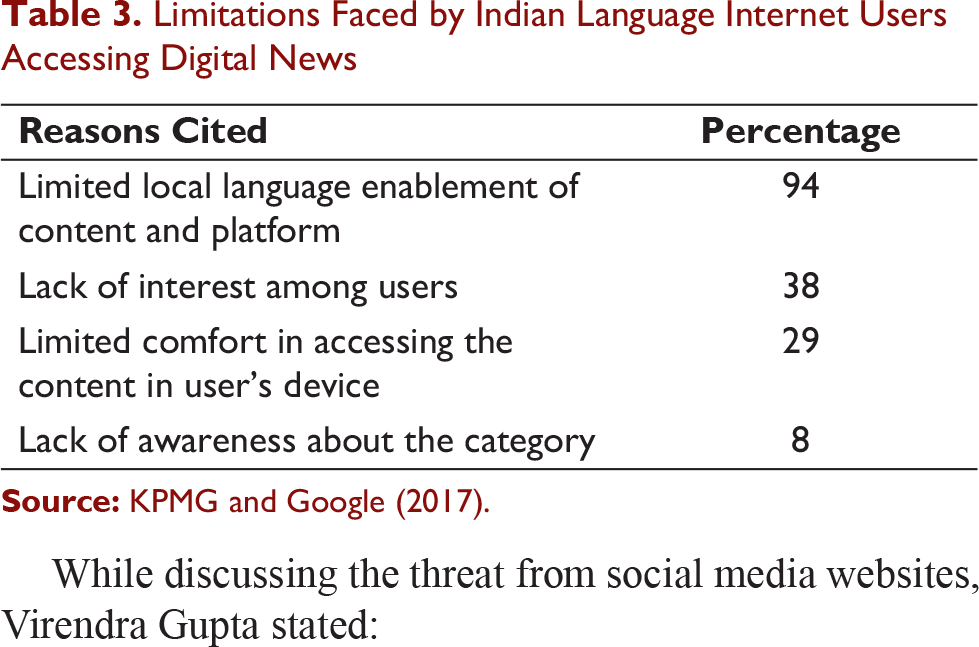
Limitations Faced by Indian Language Internet Users Accessing Digital News
While discussing the threat from social media websites, Virendra Gupta stated:
Social media is a black box for the media companies, and in our case, we do direct partnerships with the publishers, we generate traffic and we share revenue with publishers out of it. So, the amount of analytical data and information that we pass on to the publishers is much higher than what social media conveys.
The Road Ahead
Mr Gupta was proud with what they had achieved as a company so far. However, he knew that the road ahead was most difficult. He understood that the Indian regional language speaking audience faced certain limitations to reading news content online (refer to Table 3). With the Indian regional content space heating up, he would have to work proactively to maintain their leadership in this segment. But he had to be sure that the strategies in place would be forward thinking.
The segment was sure to attract foreign investment and with it, increased competition. But to compete with all this, should he be looking at other technologies that he can harness, or should he use his investors’ money in going on an aggressive acquisition spree, to ensure their control over the regional content segment remains intact for the future. With the board meeting approaching, he had to decide as soon as possible.
Footnotes
Declaration of Conflicting Interests
The authors declared no potential conflicts of interest with respect to the research, authorship and/or publication of this article.
Funding
The authors received no financial support for the research, authorship and/or publication of this article.
