



Abstract
This qualitative study discusses recordkeeping practices of community organisations (COs) in rural Bangladesh. Although recordkeeping plays a key role in this process, the academic literature has hardly looked at the role recordkeeping plays in the organisational development of COs. The analysis showed the presence of proactive and reactive recordkeeping practices within these organisations. Organisations that are performing better demonstrate proactive recordkeeping practices influenced by leadership vision, digital practices and a strong urge for independent identity. The research has implications for CO development through recordkeeping practices as well as for the non-government organisations and government departments that are supporting COs in developing countries such as Bangladesh.
Introduction
Community organisations (COs) in Bangladesh have become essential in tackling community-level challenges, particularly in areas such as poverty alleviation, health, education and disaster resilience. These organisations provide critical services and support, often filling gaps left by government programmes and enhancing the capacity of local communities to sustain their development efforts (Abegunde, 2009; Agnimitra & Jha, 2021). Although they frequently begin as informal, grassroots initiatives, many COs in Bangladesh eventually seek formal government registration. This step not only legitimises their operations but also enables them to access funding opportunities, initiate income-generating activities and increase their organisational stability (International Center for Not-for-Profit Law (ICNL), 2019; Shahidullah & Haque, 2016).
In this context, recordkeeping emerges as a fundamental component in the journey of COs from informal groups to registered entities. Recordkeeping involves maintaining detailed documentation of meetings, financial transactions, membership lists, project plans and other operational activities. As defined by the International Organization for Standardization (ISO), records management comprises the creation, receipt and maintenance of records as evidence of an organisation’s activities, ensuring accuracy, reliability and completeness (International Organization for Standardization (ISO), 2016). For COs, these records are essential not only for meeting registration and legal requirements but also for enhancing transparency, accountability and operational resilience. These attributes are crucial as COs transition from dependency on external support to self-sustaining, community-driven entities capable of long-term service delivery and development impact.
Academic literature has long highlighted recordkeeping as critical to the organisational development of formal entities, underscoring its role in ensuring transparency, regulatory compliance and organisational memory (Klareld, 2018; Press & Arnould, 2014). For instance, effective recordkeeping practices have been associated with improved decision-making, enhanced stakeholder trust and strengthened organisational identity (Ivanov, 2017). However, research on recordkeeping practices within COs in developing regions, including Bangladesh, remains limited. Instead, studies on COs have largely focused on their contributions to community development, with topics ranging from social inclusion to service delivery and advocacy (Benini, 2007; Datta, 2007; Mathbor, 1997; Newaz & Rahman, 2019; Sakib, 2022). This gap in the literature underscores a missed opportunity to understand how recordkeeping can serve as a mechanism for enhancing CO effectiveness, accountability and sustainability.
In Bangladesh, COs must meet specific documentation standards for registration, often requiring them to present organised records such as meeting minutes, financial statements and activity reports (International Center for Not-for-Profit Law (ICNL), 2019). Meeting these requirements is challenging for many COs, which lack the resources, capacity or formal training in recordkeeping. Yet, those that develop consistent recordkeeping practices demonstrate a stronger capacity to respond to community needs, manage resources responsibly and maintain accountability with stakeholders, including government agencies and NGOs. Recordkeeping thus becomes more than a compliance requirement; it serves as a vehicle for building CO credibility, improving internal governance and fostering transparency with external partners (Standards Australia, 1996; Upward, 1996). The ability to produce accurate records allows COs to provide evidence of their impact and reliability, reinforcing their role as trusted community representatives and reliable partners.
Despite its importance, the role of recordkeeping in the growth and sustainability of COs remains underexplored, particularly in developing contexts where COs operate with limited resources. Studies that examine recordkeeping in formal organisational settings suggest that systematic recordkeeping supports both external and internal legitimacy by enabling organisations to document and communicate their activities to various stakeholders (Klareld, 2018; Quattrone, 2015). However, much of this research pertains to larger, resource-rich organisations in developed countries, leaving a significant gap in understanding how grassroots organisations in low-resource settings such as Bangladesh navigate the challenges of recordkeeping. Addressing this gap is essential for recognising how effective recordkeeping can enable COs to sustain their contributions to community welfare, improve governance practices and develop resilience in the face of external pressures.
In addition to meeting compliance and regulatory needs, recordkeeping can facilitate COs’ involvement in social audits, an accountability mechanism where community members review and assess an organisation’s activities and finances (Courville, 2003). Social audits are vital in contexts where community members may lack formal recourse to challenge organisational practices (Owen et al., 2000). Effective recordkeeping enables COs to maintain transparency, making it easier for stakeholders to verify that resources are used responsibly and that decisions align with the community’s interests. For COs, this transparency can build trust and foster a positive reputation within the community, creating an environment of mutual accountability.
The overarching aim of the study is to position recordkeeping as a strategic tool in CO development, recognising that COs in Bangladesh face unique challenges related to capacity, resource limitations and community expectations. Through a nuanced examination of recordkeeping practices, the study aspires to contribute to the literature on COs and organisational development by highlighting the often-overlooked role of records in promoting accountability, transparency and resilience. Ultimately, this research may inform policies and practices that enable COs to leverage recordkeeping as a means of strengthening their impact on community welfare and long-term sustainability.
Literature Review
The academic literature on recordkeeping and organisational development underscores the significance of structured documentation in promoting transparency, accountability and long-term viability. Research suggests that recordkeeping is fundamental to both public and private organisations, as it preserves institutional knowledge, supports legal compliance and facilitates organisational learning (Klareld, 2018; McKemmish et al., 2009).
In formal organisations, recordkeeping practices are often driven by regulatory frameworks, which mandate accurate and comprehensive documentation of financial and operational activities (Ivanov, 2017). These practices ensure that organisations can provide verifiable evidence of their actions, which is crucial for maintaining credibility with stakeholders. Ismail and Jamaluddin (2009) also mentioned that the organisations’ need to preserve evidence of their decisions and transactions (often to meet the requirements of legal and statutory regulations) influences recordkeeping practices, and that these practices develop when there is a strong emphasis on completeness, reliability, and accuracy to preserve the evidential value of records. Similarly, COs that maintain organised records can demonstrate accountability, thereby gaining credibility and legitimacy in the eyes of their communities and external supporters (Klareld, 2018). For instance, Klareld’s (2018) study on recordkeeping in Swedish public agencies highlights that structured documentation practices enable organisations to meet transparency requirements, build trust and improve sectoral leadership by demonstrating accountability.
Opare (2007) provides one of the few studies addressing recordkeeping within COs, examining how Ghanaian COs handle documentation to improve accountability and transparency. Although Opare’s findings are relevant, the study does not address the specific challenges that COs in low-resource settings, such as Bangladesh, encounter in establishing systematic recordkeeping practices.
Research has also highlighted the role of recordkeeping in supporting organisational resilience by providing a framework for documenting past experiences and learning from them (Press & Arnould, 2014; Vendelø, 1998). Organisations that keep detailed records can build a repository of knowledge, enabling them to adapt to changing circumstances, transfer knowledge across personnel and maintain continuity during leadership transitions. For COs, which often face high turnover and shifting resource availability, recordkeeping offers a way to institutionalise practices, preserve organisational memory and enhance decision-making capabilities. By documenting financial transactions, project outcomes and governance decisions, COs can reinforce accountability and maintain a reliable record of their achievements, which is valuable when seeking funding or community support.
Furthermore, theoretical models such as the Records Continuum Model (Upward, 1996) and Practice Theory (Ivanov, 2017) provide insights into how recordkeeping operates as both a functional and symbolic component of organisations. According to Practice Theory, recordkeeping serves as a manifestation of an organisation’s values, shaping its identity and establishing a shared sense of purpose among members. The Records Continuum Model suggests that recordkeeping practices transcend mere documentation and become embedded in the organisation’s culture, supporting accountability, transparency and ethical decision-making. Although these frameworks have been applied to formal organisations, they can be adapted to study COs, offering a lens to understand how grassroots organisations approach documentation and the challenges they encounter.
In terms of identifying external and internal factors that may influence the recordkeeping practices of COs, no categorisation of those factors in the recordkeeping literature was found. Therefore, the push–pull–mooring theory was adopted, proposed initially in migration studies by Lee (1966) and subsequently expanded by Moon (1995) as the theory was adopted in different organisational studies (such as Nimako & Ntim, 2013; Zhu et al., 2023) to discuss the shift in organisational practices. Lee (1966) argued that physical migration from a physical place of origin to another physical place of destination is due to the push factors at the origin beyond the control of a person (such as insecurity and lack of economic opportunities) and the attracting pull factors at the destination (such as better climate and income opportunities). While the push–pull model is largely focused on the push effects and pull effects of origin and destination that are largely external and beyond someone’s control, Moon (1995) attempted to look internally by suggesting that personal and sociocultural values create mooring effects that influence people to make their migration decisions. Other organisation studies (such as Nimako & Ntim, 2013; Zhu et al., 2023) have indicated that organisations change their strategy due to numerous push, pull and mooring factors such as changes in consumer preferences, organisational values and alteration in the government’s ways of working. Since recordkeeping studies on grassroots COs are scarce, discussions on their recordkeeping practices, highlighting apparent push, pull and mooring factors influencing those practices, will be useful in the context of this study.
The organisation studies, however, primarily focus on larger organisations and rarely address COs, particularly those in resource-limited settings. Consequently, there is limited empirical evidence on how COs manage recordkeeping and the implications for their development, especially in developing countries where COs serve critical roles in service delivery, advocacy and community mobilisation. Moreover, most studies on COs in Bangladesh emphasise organisational sustainability, social mobilisation and capacity building (Sakib, 2022; Thompson, 2013) but neglect the underlying documentation processes that support these outcomes. This gap points to a need for research that examines recordkeeping as a central element of CO development, specifically in contexts where limited capacity and external constraints hinder consistent documentation practices.
Objectives and Research Questions
Recognising these research gaps and the above discussed theoretical insights, this study aims to examine how recordkeeping contributes to organisational sustainability and accountability of COs in Bangladesh. By situating recordkeeping within the broader discourse on CO development, the study seeks to elucidate the implicit role that documentation practices play in shaping CO operations, accountability and resilience in resource-constrained environments.
Focusing on both compliance-driven and growth-oriented practices, the study specifically addresses the following research questions:
What are the existing recordkeeping practices of COs in Bangladesh? This question aims to map out the current documentation methods used by COs, including the types of records they keep, the systems they use and the challenges they face. Understanding these practices will provide insights into the operational constraints that COs encounter and the extent to which their recordkeeping practices support organisational transparency and accountability. What factors influence the recordkeeping practices of COs in Bangladesh? This question examines the external and internal influences that shape COs’ recordkeeping practices. External influences include regulatory requirements, funding conditions and NGO support, while internal influences involve organisational values, leadership commitment and community expectations. By exploring these factors, the study seeks to identify the drivers of reactive versus proactive recordkeeping practices and assess how these practices align with COs’ development goals.
Research Method
Bangladesh was chosen for the research since a large number of COs have been formed for community development work in the country. For the purpose of the research, COs were selected from two different parts of Bangladesh to understand any variations related to socio-economic and geographical factors. By developing a research collaboration with an international NGO, namely BD-INGO, in Bangladesh, purposively, 16 COs supported by BD-INGO were selected. Of the 16 COs, four each from Nilphamari and Rangpur districts from North-Western Bangladesh (floodplain area) and four each from Satkhira and Barishal districts from South-Western Bangladesh (coastal area) were identified based on the information on COs provided by BD-INGO, including their registration status. For the purpose of anonymising the COs in presenting the data, the four COs from Satkhira district were renamed as SCO-1, -2, -3 and -4. Similarly, COs from Barishal, Nilphamari and Rangpur were also renamed as BCO-1 to BCO-4, NCO-1 to NCO-4 and RCO-1 to RCO-4, respectively.
From each of the four districts, purposively, a local NGO partnering with BD-INGO and closely working with the selected COs in the respective districts was identified. The four NGOs were referred to as SNGO, BNGO, NNGO and RNGO, respectively, from Satkhira, Barishal, Nilphamari and Rangpur districts. Two staff from each of the local NGO, totalling eight, were interviewed. With the help of local NGOs and COs in each selected district, by using snowballing sampling technique (Biernacki & Waldorf, 1981), three interviewees from local government elected representatives and officers from the Department of Youth Development (responsible for the registration of youth-led COs) or the Department of Cooperatives (responsible for the registration of COs as cooperatives) were identified to conduct 12 semi-structured interviews. In addition, an official from the Department of Cooperatives at the national level and two employees of BD-INGO who had worked with the programmes that supported the COs were interviewed. In total, 23 semi-structured interviews were conducted.
The first set of primary data came from focus groups conducted from May to August 2022 with members of COs, including the leaders of the organisations. Focus groups were conducted to capture the collective opinion with the facilitation of a semi-structured group interviewing approach to get systematic and simultaneous responses from several respondents from the same CO (Boateng, 2012). During the focus groups with COs, the discussion was divided into two major parts. The first part involved questions about the history, major activities, structure and registration process of a particular CO to set the scene for the second part, which focused on understanding the existing recordkeeping practices of the CO, the influencing factors behind those practices and their understanding of the role of recordkeeping in their organisational development. Further, the records preserved by the COs, such as meeting minutes, passbooks of financial transactions, organisational constitutions, planning documents, activity images and reports, were examined. While in most cases, records were physically preserved, a small number of organisations demonstrated an emerging trend of digital record preservation. The records of the COs were reviewed to understand what records the organisations consider to be of value to them and what practices they follow in keeping the records. The main purpose was to look at the records to verify the primary data coming from focus group discussions (FGDs) with COs, and not to analyse the content of the records thoroughly as data sources. As mentioned above, the second set of primary data came from face-to-face semi-structured interviews conducted with the representatives of government departments responsible for the registration of COs, NGOs working with and supporting the COs and local government representatives of the localities where the COs were active. During the stakeholder interviews, the interviewees’ opinions were explored regarding the registration process, the activities of the COs, their current recordkeeping practices and how they contribute to organisational development.
To analyse the data, a coding structure was developed and all the qualitative data were manually interpreted and thematically analysed according to the coding structure. A deductive approach to generate themes or codes from the raw data was followed. Recordkeeping practices, recordkeeping capacities and the factors influencing recordkeeping were identified as three primary themes. In line with the research focus, the three primary cross-themes were related to the pre-registration, time of registration and post-registration status of the COs. This coding structure helped capture changes in organisational recordkeeping practices and relate those practices to factors that influenced them over time. What follows are the results of this analysis.
Results
Based on the overall findings, Table 1 provides a brief overview of recordkeeping practices and the factors influencing those practices in the 16 COs in the study.
Recordkeeping Practices of Community Organisations (COs) and Associated Influencing Factors.
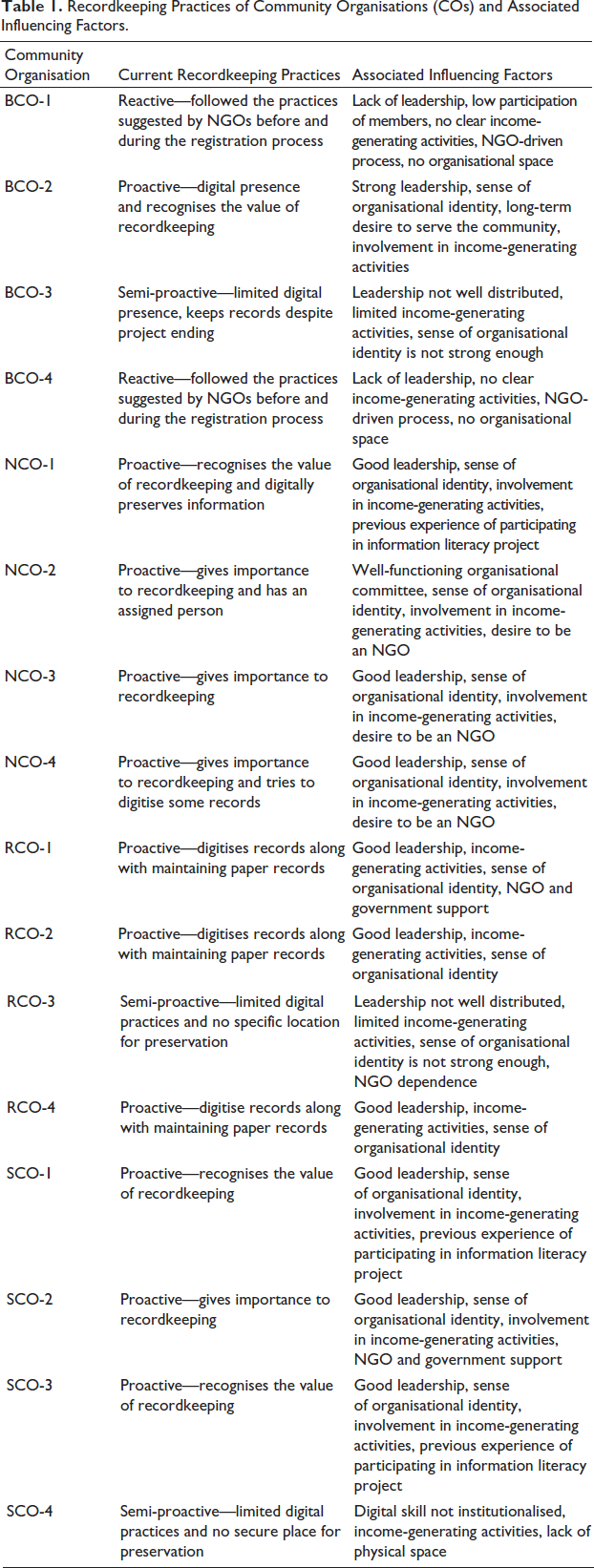
In relation to the research questions, it was found that prior to their registration, most of the COs were following reactive recordkeeping practices largely due to some push factors. However, after their registration, most of the COs followed proactive recordkeeping practices due to some mooring and pull factors. These push, pull and mooring influencing factors are highlighted in Table 1 in summarised form while showing their associated linkages with proactive, semi-proactive and reactive recordkeeping practices. However, none of the recordkeeping practices of the COs was deliberate or initiated by them in the first instance. Initially, to ensure the project’s accountability, BD-INGO, with support from their implementing local NGO partners, guided the COs to keep meeting minutes. In this regard, one of the NCO-1 members mentioned:
When the (NNGO) Project started, they taught us everything. At first, we didn’t understand why we had to keep all these records. They told us to write everything down. If someone comes and asks, you have to be able to show them. So, we started keeping resolution notebooks, savings books, loan books. Now we do it ourselves.
The COs predominantly used a register book, locally termed ‘register khata’ in Bangladesh, a notebook-type locally-made material, to record the minutes of meetings, including the names of the members attending a particular meeting. BD-INGO and local NGOs used to inspect this register book during their monitoring visits to the COs and kept asking them to record meeting minutes to indicate their activities and their planning. In general, COs did not have any dedicated person to write the meeting minutes, and they rotated the responsibility among the members present at the meetings. In this regard, one of the members of BCO-3 mentioned:
About the recordkeeping process, we do it with pen and paper. There is no dedicated person to record the resolutions; so, we do it by ourselves. We write about the problems and the potential solutions of the problems we can work on in the resolution.
COs found it useful to keep meeting minutes when they started to prepare for their registration process, as those are part of the required documents that they had to present. However, some COs could not routinise the practice of keeping meeting minutes due to the lack of institutionalisation of systematic recordkeeping. One of the representatives from the government highlighted that many COs only learnt about keeping certain records, including meeting minutes, at the time of applying for their registration. Some of them then prepared meeting minutes retrospectively and presented them as records, mainly to get the registration. Another government representative from Rangpur also talked about the inability of the government departments to provide adequate guidance to COs due to the existing weak support system:
Actually, they don’t come to us prior to the registration. We have very limited manpower. It is not possible for us to go door to door. When we go for an event or informal training, we inspire them that an organisation can be established this way.
As some of the COs were operating as savings and credit groups; they were keeping records of the financial transactions relating to disbursing loans to their members and collecting the loan amount back with interest. With the support from local NGOs, these records were kept by COs in deposit registers, loan registers, cash books and so on, mostly in the same register book or register khata. Some CO members (BCO-1 and -4) also claimed that very often they preserved small financial transactions through memorisation by individual group members, then later added them to the register. Although the COs operating as savings and credit groups did not keep track of their transactions deliberately in formal records as they did for the meeting minutes; they found those records useful during the registration process because the registering government organisations required them for registration.
In the case of NCO-1, -2, -3 and -4, the organisations were implementing an activity called ‘developing and maintaining a food bank’ that worked on the principle of depositing non-perishable food during periods of availability and enabling food loans during times of food shortages. A special register book on food deposits and loans was maintained by NCO-3. NCO-3 kept records of food deposited and the food loans given in the register book. This activity and the recordkeeping associated with it were driven by the BD-INGO. In this regard, one of the NCO-3 members highlighted:
We have the savings notebook, the resolution notebook, a notebook for loan application and another for loan distribution and the transactional notebook for our earnings and spending. We keep the Mushti Chaal (a handful of rice) records. In this record, at the beginning of every month on a Friday morning, we arrange a meeting. In the meeting we take 50 Taka from each and buy rice for distribution.
Another unconventional practice of keeping records adopted by all COs, but mostly the ones from Nilphamari and Satkhira, was the practice of writing down information on brown paper after receiving it from different sources, including NGOs, to preserve that information. The COs were creating and writing important information on these brown paper sheets, such as community resource maps, annual workplans, agricultural advice from government departments, information related to water, sanitation and hygiene, as well as phone numbers and contact details of relevant stakeholders, including representatives from government departments.
The registration process of COs was found to be NGO-driven since the BD-INGO was eager to demonstrate the higher number of registered COs as a positive outcome of their projects. However, due to mooring factors such as organisational vision and leadership drive highlighted in Table 1, some COs took the registration process as a key milestone for their organisation’s identity and development and actively participated in the NGO-driven registration process. In this regard, one of the members of BCO-2 mentioned:
We have been registered since 2018 and we do not face any problems because our recordkeeping is all in place. All the books and registers are updated regularly. We do this not only because the government told us to, but because we want to continue for a long time. Maybe the current members will change, but the next ones will find everything in order.
Some COs that did not previously have a memorandum of association/constitution with a stamp on each page in the prescribed format and signed by the organisation’s president and general secretary created one for the registration process. They also started to keep records of the personal details of their executive committee members, attested photos and copies of the national identity cards (NID) of the organisation’s president and general secretary, annual financial reports and bank account statements.
Overall, reactive and often unconscious recordkeeping practices played an important role in the registration and in the development of the COs into formally recognised organisations. This was through the combination of business-as-usual practices being part of the NGO project prior to the formalisation of the COs and the new recordkeeping practices that they were compelled to adopt during the formalisation process. The stakeholders and CO members indicated that almost all the COs participating in NGO projects were pushed by the NGOs to adopt recordkeeping practices to ensure project accountability and demonstrate project achievements. During and after the registration process, their recordkeeping practices were also influenced by the government departments that administered the registration process, since they needed to maintain required records to keep their registration intact. In this regard, a member of RCO-2 highlighted their engagement with the government department by saying:
Yes [the government] comes every 6 months and checks the records. If they find a mistake, we visit the office with our documents and they show us where the problem was and we correct it. They haven’t told us the registration will be cancelled or anything like that.
Although reactive recordkeeping practices were dominant among the COs prior to registration, most of the COs regularised those practices despite the ending of the NGO projects during which the practices had started. After the end of the projects, government regulations and requirements no longer remained as the major influencing factors to formalise recordkeeping practices, but organisational values became the influencing mooring factor. However, some COs could not regularise their recordkeeping practices after registration, mainly due to a lack of interest and time from the leaders and members to continue the organisational activities in the absence of a project. Due to the project closure, the earlier pressure from the NGOs to keep records as an accountability mechanism disappeared for them. These COs were not worried about their registration getting cancelled due to not regularising their recordkeeping practices. They appeared to be on the course of disappearing as organisations in the near future.
In most of the COs, recordkeeping practices continued as business-as-usual after they got registered and the projects supported by the NGOs ended. In this regard, the BNGO representative mentioned:
It is obvious that they will get matured as the days pass… The more days pass, the more an organisation gets matured and their records get enriched.
However, some COs also started adopting proactive recordkeeping practices. Several proactive recordkeeping practices and future plans related to recordkeeping were identified in several COs such as BCO-2 and SCO-4, which were not linked to any external influence but could be attributed to mooring effects emanating from organisational values and drive from the leaders. Among these practices, keeping records digitally or planning to keep records digitally was prominent among COs, especially within the youth-led COs that frequently use digital technologies and social platforms. In this regard, BCO-2 highlighted that they regularly post activity details and pictures of their activities on their Facebook public page. They find it useful to preserve information about their activities over a period of time. They also use their private Facebook group page to preserve some of the internal information such as organisational constitution and a list of executive members. Along with keeping paper-based records at the office, they also scan the records and keep those on USB flash drives and on the hard drive of the computer that they received from the BD-INGO. They also assigned one of their organisational members with good information technology skills to perform the role of maintaining and digitising records. One of the BCO-2 members highlighted:
We keep some things in notebooks, but we also take photos of important records on our phones. If someone needs to check something later, we can just show the photo. It’s easier that way, especially if we’re not at the office or if the notebook is with someone else. Sometimes we even send the photo to members who couldn’t come to the meeting.
These proactive practices of BCO-2 indicated in Table 1 were neither suggested by the NGOs that worked with them nor imposed on them by the registering government department. Despite the absence of any outside influence, organisational leaders and members of the organisation had a stronger sense of independence and identity after registration and felt that better recordkeeping practices would strengthen the organisational activities without having received any explicit advice on the issue. During the FGD, one of the leaders of BCO-2 mentioned the benefits of recordkeeping that they identified:
We can find and use these records even after 10 or 15 years. We can look into these records and realise what we have done well to go that far. Other organisations can also get assistance from us for forming their organisation by utilising our records. Our new members can use the records if we store them properly.
Other COs such as SCO-4 and RCO-4, with strong organisational leadership, were also adopting digital recordkeeping practices proactively and placed a strong importance on keeping records. For most of the registered COs, an important pull factor for proactive recordkeeping practices was the opportunity to receive funding from the government by presenting records as an indicator of their organisational strength. As they get investment from their members and funding from the government departments to engage in income-generating activities, ensuring accountable financial transactions motivates them to proactively improve their recordkeeping practices, mainly around financial transactions, to be able to properly report internally and externally.
Discussion
The findings indicate that COs having proactive recordkeeping practices in Bangladesh also have stronger organisational development than those COs that have reactive recordkeeping practices. However, there is a chain of actions needed to make organisational development happen in COs through recordkeeping practices. The transition from reactive to proactive practices is based on several push, pull and mooring factors in accordance with changes in organisational practices as discussed by Nimako and Ntim (2013) and Zhu et al. (2023).
In Figure 1, the chain of actions needed to ensure community organisational development through recordkeeping practices is presented based on the analysed data of the study. It illustrates the interplay of push, pull and mooring factors that influence the recordkeeping practices of COs in Bangladesh and their subsequent organisational development. Initially, COs primarily engage in reactive recordkeeping practices due to ‘push factors’ such as NGO accountability mechanisms. A ‘regularisation through formalisation process’, often driven by the formal registration of the COs, facilitates a shift towards proactive recordkeeping practices. These proactive practices are further influenced by ‘mooring factors’ such as a stronger sense of organisational identity, leadership and culture, and ‘pull factors’ such as opportunities for external investment and funding, and income-generating activities aimed at sustaining the organisation. As indicated in Figure 1, both reactive and proactive recordkeeping practices contribute to the overall organisational development of the COs.
Push, Pull and Mooring Factors for Recordkeeping Practices for the Development of Community Organisations (COs).
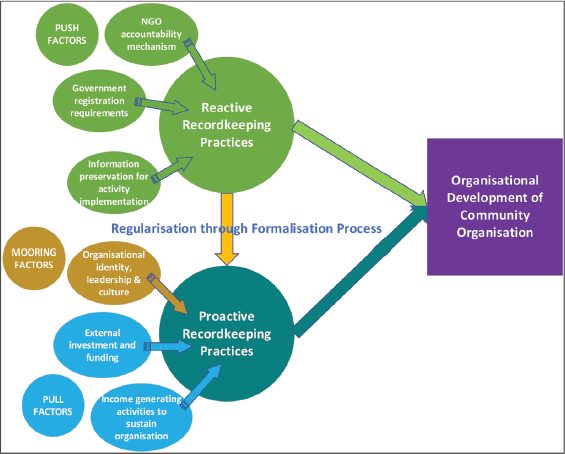
For COs to transition from reactive to proactive recordkeeping practices, being formalised or registered by government departments is the most important push factor in the case of the COs in this research. This is in line with the study of Ismail and Jamaluddin (2009), who indicated that organisations’ recordkeeping practices are guided by the requirements of legal and statutory regulations. In most cases, the formal status creates a mooring effect in the COs as they have a stronger sense of organisational identity. The COs acknowledge that they need to have proactive and improved recordkeeping practices to sustain and develop their organisations after achieving the milestone of registration. Income-generating activities associated with organisational sustainability-thinking further influence them to keep records proactively to demonstrate, internally and externally, transparency and accountability in financial transactions. Numerous studies (e.g., Ivanov, 2017; Klareld, 2018) have highlighted this role of records as a key indicator of transparent and accountable organisational activities. The mooring factors, such as visionary leaders and distributed leadership, stimulate proactive recordkeeping practices as they like to externally showcase their activities, and this requires keeping records of these activities.
Despite not deliberately linking recordkeeping practices to the organisational development of the COs, the accountability mechanism imposed by NGOs to keep a minimum of records was the most important push factor for initial reactive recordkeeping practices in COs. As they became used to keeping some records, it was not a major challenge for advanced-level COs to shift towards proactive recordkeeping by regularising their practices. Although the requirement of presenting different records imposed by the registering government departments was another major push factor for COs’ recordkeeping practices, those government departments did not play a significant role in building a general recordkeeping awareness among registration-aspiring COs. In some instances, COs got support from employees of the registering government departments when they applied for registration. However, after registration, the government departments did not play a notable role in influencing the recordkeeping practices of the COs.
The most advanced COs acknowledge the positive contribution of recordkeeping to their organisational development and try to adapt recordkeeping requirements to their operating context. Since most of the COs in this study regularly face natural disasters such as floods and cyclones, digital recordkeeping practices are not only important for the advanced COs to easily access records, but also to adapt to the risks of natural disasters destroying paper-based records. Specific digital skills and training, including training in social media promotion activities to keep digital records, also assist the organisational development of COs. However, low digital skills, limited resources to access digital technology and weak mobile networks remain major challenges for digital recordkeeping. Moreover, some COs realise the need for a dedicated records manager to manage their records, but they consider that it will only be feasible when their organisation is able to secure a sustained income, which will require more records to be kept.
Conclusion
This qualitative study is the first academic attempt to explore the recordkeeping practices of COs in Bangladesh. It contributes to the academic literature on recordkeeping, COs and organisational development. Based on the findings about the different recordkeeping practices adopted by the COs and the factors that influence them, it is recommended to make recordkeeping practices part of a deliberate strategy for building COs from the beginning of their formation by NGOs. Registering government organisations should not limit themselves to imposing recordkeeping requirements at the time of encouraging registration (near the end of the projects), but should also orient the COs about the importance of records and recordkeeping practices at the nascent stage of the projects. External factors such as natural disasters, as well as the lack of physical, financial and human capital, may restrict recordkeeping capacities in COs in the short- and long-run. However, the development of COs should not be only on the basis of their social capital and community-level social activities. Their economic sustainability, based on sustaining income-generating activities, needs to be prioritised as it can support them to build digital and financial capabilities and the sustainable recordkeeping practices that underpin organisational development.
This study sets the foundation for a more generalisable inquiry regarding recordkeeping in COs, as it did not cover COs that are not supported by any NGO. If this limitation of the study is addressed, additional insights will come from COs that independently get government registration and develop their recordkeeping practices. Suggestions were received from the CO members and stakeholders interviewed regarding developing and implementing digital recordkeeping practices, as well as developing and delivering training on recordkeeping for COs through a pilot project. This study is significant for COs aiming to identify areas for improvement in recordkeeping for their organisational development. NGOs that support COs can get useful insights from this study since improved recordkeeping of COs will strengthen the long-term development impacts of their projects. Finally, government departments offering registration can also get useful insights from this study to support organisational development of COs through better initiatives around capacity development supported by recordkeeping practices.
Footnotes
Declaration of Conflicting Interests
The authors declared no potential conflicts of interest with respect to the research, authorship and/or publication of this article.
Funding
The authors received no financial support for the research, authorship and/or publication of this article.
