



Abstract
This article discusses the concept, extent, causes and consequences of digital divide, and suggests connected strategies to bridge the divide. Drawing on secondary data, it delineates the concept of digital divide in terms of technological, sociocultural and normative aspects. The extent of digital divide greatly varies depending upon the regions, developed and developed countries, gender and rural–urban areas. It argues that structural and individual factors contribute to digital divide and exclude and disempower people, leading to further inequalities. It recommends connected solutions and quick action to address the ongoing digital divide.
Keywords
Introduction
‘Digital divide’ has become a buzzword in today’s everyday life. Various actors and agencies, including but not limited to academics, researchers, policymakers, governments and bilateral and multilateral organisations, highlight the term ‘digital divide’ as a significant barrier for the global society for its just and sustainable transformation in the future. Recognising the need to address the digital divide, Sangbu Kim—the Vice President, Digital Transformation, the World Bank—in his opening remarks at the 2025 Global Digital Summit: Digital Pathways for All said:
digital technology can open doors, create jobs and opportunities, and transform lives…. lack of access [to it] can leave people behind. (Kim, 2025)
Historically, the term ‘digital divide’ was first used in the United States of America (USA). On the eve of 1900, a government agency of the USA—the National Telecommunications and Information Administration—conducted a series of surveys under the title ‘Falling Through the Net’. This survey aimed to assess people’s access to information and communication technologies such as to telephone, computer and the internet (Acharya, 2017). The findings revealed progress in American people’s access to information and communication technologies than earlier; nonetheless, it also noted a significant gap between ‘information-haves’ and ‘information-have-nots’ (Acharya, 2017). This gap of ‘haves’ and ‘have-nots’ in information communication technology was later termed and popularised as ‘digital divide’ (Raveesh, 2013; Rowsell et al., 2017; Sidney Howland, 1998).
Since then, the issue of digital divide has spread to the rest of the world. And now, the discussion on digital divide is widely visible in almost all societal and scholarly agendas. Worth to note here, although the term digital divide became popular in the public domain at the end of 1900, the idea of such divide was explored and discussed since as early as the 1960s. A number of scholars reported on the information gap and its impacts on education, well-being and economy between the 1960s and 1990s (Acharya, 2017; Katz & Aspden, 1997). Likewise, with the introduction of ‘email’ technology in 1969 and the availability of personal computers to the public since the 1970s, various terms such as ‘information divide’, ‘knowledge gap’, ‘information-rich and information-poor’, ‘information-haves and information-have-nots’ and ‘universal access to information’ began to surface, which eventually contributed to what we today know as ‘digital divide’ (Anderson et al., 1997; Compaine, 2001).
That is, the phenomenon of digital divide has been surfacing around us for almost the past six decades. And yet, there is no collective agreement on the term digital divide. It evokes various understandings and meanings; and likewise, its forms, types and solutions have been reported in multifarious ways. To this, van Dijk argued that:
[t]he term digital divide probably has caused more confusion than clarification … it is a deeply ambiguous term in the sharp dichotomy it refers to (van Dijk, 2006, p. 222) … It has produced so many definitions, controversies and misunderstanding that several people were in favour of disregarding it after a few years. (van Dijk, 2020, p. 1)
In the first section, the conceptualisation of the term digital divide shows that a range of factors such as technological, sociocultural, nominative, complex nature of the issue and governance influence the understanding and operationalisation of digital divide. Second, it discusses the extent of digital divide across the globe. The third section explores the causes and consequences of digital divide. And, finally, it proposes a constructive and connected solution to the digital divide. We hope it contributes to the commitments to be made at the Second World Summit for Social Development that aims to accelerate the progress of the Sustainable Development Goals (SDGs).
Conceptualising Digital Divide
Instead of privileging a particular view, this section assesses broad perspectives of the digital divide; and, in doing so, it aims to espouse a holistic view of it by categorising it into: (a) technological determinism, linear and binary view, (b) revisited, reconceptualised—social determinism view, (c) normative view, (d) digital divide as a grand challenge view, and (e) digital divide as an ungovernable view. Rather than viewing these categories as exhaustive, one should approach these as existing concepts informing the idea of digital divide.
The technological determinism, linear and binary view of digital divide can be understood as the simplistic view of the digital divide that rests on the premise that ‘… technology … [is] the primary driver of social evolution’ (Anshari et al., 2025, p. 107), but such a technology-led evolution will depend upon to the what extent people have access to; and, use it in their daily lives. Influenced by economic rationality, this view explains the digital divide as a dichotomy between ‘information-poor’ and ‘information-rich’ and ‘information-haves’ and ‘information-have-nots’ (Tsatsou, 2011). Furthermore, it ensures that growth in accessibility and usage of digital technologies, reducing the digital divides, in other words, will lead towards a utopian society. Nonetheless, this view evokes several criticisms as explained under revisited, reconceptualised social determinism view.
Contrary to the technological determinism that limits the idea of digital divide to merely as the issues of ‘accesses’ and ‘usages’, the revisited, reconceptualised social determinism views the digital divide as complex and dynamic processes. Drawing on the theory of social construction of technology (Bijker, 1997; Pinch & Bijker, 1984), the digital divide from this viewpoint is inextricably intertwined and interlinked with the particular social context of the people (Kretchmer, 2017). Humans’ actions are crucial in increasing or bridging digital divides from the point of view of social determinism. Humans may define and use technologies in their own ways. They may accept or reject technologies. They may show a willingness to participate in technological development, process and engagements. Their cultural contexts may influence the interpretations of emerging technologies. They find their social, cultural, economic and political interests being served under technology. Some may find themselves sufficiently competent to interact and engage with new technologies.
Disparities and differences amongst demographics, age and generation (such as traditionalist, baby boomers, Gen X, millennial and Gen Z), genders, geographical locations, and races, castes, ethnicities and tribal groups may also contribute to the digital divide. The social determinism view of digital divide is also concerned with the power dynamics such as who is developing new technologies for whose benefits; and in the meantime, whether the languages, designs and interfaces of these technologies are friendly to the users. Most digital technologies use the English language, as well as these require the users to have basic skills to engage with. Sadly, only 1.5 billion people speak English worldwide (Statista, 2025b), and progress in enhancing digital competencies of people across the world remains challenging till now.
The normative view postulates that the digital divide is the issue of human rights, justice, equality and inclusion. Embedded mainly in the 1948 Universal Declaration of Human Rights and several other international, regional and national charters and conventions (see for instance, the International Convention on Civil and Political Rights, the European Convention on Human Rights, the American Declaration of the Rights and Duties of Man, and the African Charter of Human Rights and Peoples’ Rights) (Peacock, 2019), the normative view of digital divide has continued to evolve. Its more recent insertion is also observed in the SDGs. At least SDGs’ 16 subgoals directly or indirectly concern about the digital divide and its furthermore impacts on equalities and inclusions. Of these, target 5.b specifically emphasises to address the digital divide to promote women’s rights and empowerment; and likewise, targets 9.c and 17.7 mandate that minimising the digital divide is essential to reduce gaps between the developed and developing nations.
In an information age, digital access is the main resource for survival and meantime necessary aspect to ensure a better quality of life by maximising and creating just and fair access for people to education, economics and citizen participation. Denial of this, that is, maintaining the status quo of digital divide, might aggravate inequalities, injustices and exclusions. To this, Sanders and Scanlon (2021, p. 135) argued that:
[Digital access] … the resources necessary for survival and the development of human potential should be available to all as a right based upon our common humanity. In this view, resources must be distributed broadly within a framework that sees such a dispersal of social goods and resources as necessary for equitable human development and the social inclusion necessary for the development of democratic institutions …. Given the central role that the Internet plays in today’s digital age in gaining access to resources, jobs, health care, and education among others, universal access to broadband clearly falls within the realm of human rights.
The digital divide is a complex issue because of its diverse understandings and interpretations (see above), measurements and consequences (see below). It also requires multifaceted solutions and strategies. Despite significant efforts to reduce the digital divide in recent years, it continues to affect the global society. Hence, for this reason, the concept of digital divide as a grand challenge is being considered. A grand challenge view furthermore terms the digital divide ‘… as a special form of social exclusion … complicated concept … [that cannot] … be bridged simply by providing computers or connecting people to the internet’ (Zdjelar & Hrustek, 2021, p. 602). It requires genuine collaborative efforts at all levels of national and international apparatuses.
The digital divide as an ungovernable view has been ignored, and thus, it has not been well established and documented. In his work, van Dijk (2020) scantly explains the digital divide as an issue through which the government loses its control over its citizens. From this view, citizens without digital connections are perceived as a security risk since the government cannot surveil them. Hence, those in the security policy sector emphasise that ‘[b]etter a connection for all than no connection at all’ (van Dijk, 2020, p. 6).
The Extent of Digital Divide
Despite acclaimed progress in minimising the digital divide in recent years, there remains a significant digital divide across the world. The examination of digital divide in relation to regions and nations, males and females, and urban and rural areas suggests that much is yet to be achieved in bridging digital divide.
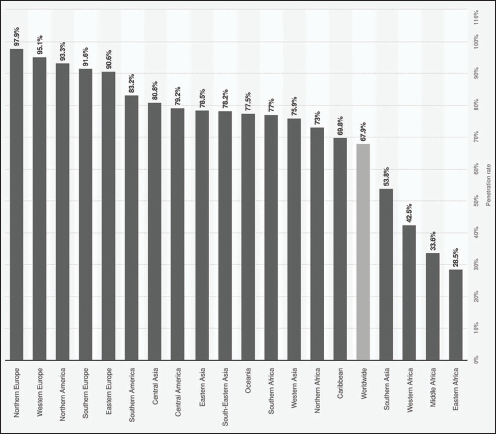
Only 67.9% of the total world’s population, that is, around 5.44 billion people, have access to the internet. Of them, as shown in Figure 1, most of the internet users come from economically advanced or advancing regions such as Europe, Northern and Southern America and Central and East Asia. The internet penetration rate in most underdeveloped regions such as Southern Asia and Western, Middle and Eastern Africa is below the worldwide penetration rate.
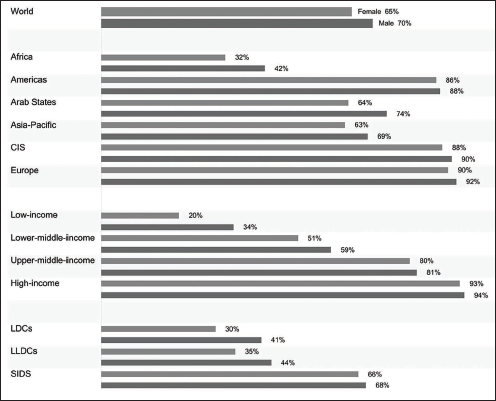
Digital gender parity amongst developing and underdeveloped nations, low- and lower-middle-income countries, and least- and landlocked developing countries remains wide. While 70% of males and 65% of females worldwide are digitally connected, the same in low-income and lower-middle-income have remained 20% and 51% for females and 34% and 59% for males, respectively (International Telecommunication Union, 2023). The proportion of females and males connected to digital technologies in the least and landlocked developing countries shows a similar digital gender parity trend (see Figure 2).
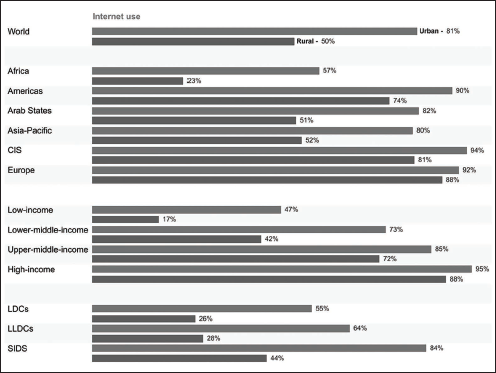
And likewise, a visible digital rural and urban divide persists (see Figure 3). Worldwide, approximately 81% of urban populations use the internet whereas only 50% of rural populations have access to the internet. In the low-income, lower-middle-income, least developed nations and landlocked developing nations, this divide is even more severe (International Telecommunication Union, 2023), needing immediate attention to address existing digital inequalities.
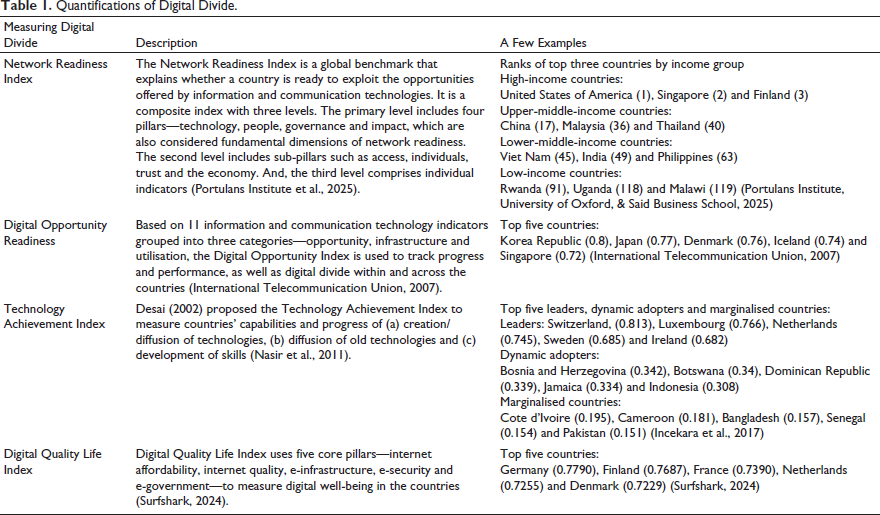
As shown in Table 1, various indices have been developed to measure digital divide. The inclusion of multidimensional aspects is the key strength of these indices. For example, the Network Readiness Index emphasises three levels—primary (technology, people, governance and impact), second (access, individuals, trust and economy), and third (individual indicators)—to measure digital divide. Likewise, the Digital Quality Life Index uses internet affordability, internet quality, e-infrastructure, e-security and e-government to determine the extent of digital divide. The Technological Achievement Index provides information on which nations are leaders, dynamic adopters and marginalised countries by analysing their digital progress. Despite these indices’ varied nature and focus, they are useful in identifying gaps and barriers to digital inclusion, designing targeted policies and interventions, and tracking the progress and impacts of digital inclusion programs. Although the data presented in Table 1 is not up to date, the available information confirms the extent of digital divide presented in Figures 1 and 2, and that a significant digital divide exists between developed and developing nations. The causes and consequences of such digital divide are discussed in the next section.
Quantifications of Digital Divide.
Causes and Consequences of Digital Divide
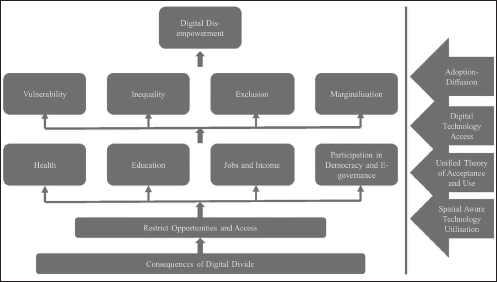
Drawing on Pick and Sarkar’s (2016) work, four theories of digital divide—Adoption–Diffusion Theory, Model of Digital Technology Access, Unified Theory of Acceptance and Use of Technology and Spatial Aware Technology Utilisation Model—are employed to explain the causes of digital divide. Also, considering health, education, employment and economy, and democracy and governance as vital to individuals’ ability to thrive and meaningfully participate in society, this section outlines the consequences of digital divide surrounding these areas (see Figure 4).
Causes and Consequences of Digital Divide.
Causes
Adoption and Diffusion Theory concerns how an innovation is adopted and diffused. Pick and Sarkar (2016, p. 3889) defined it as ‘… the process of adopting an innovation for use and diffusing its use within a population of potential users over time’. Adoption and diffusion rest on key five attributes—relative advantage, compatibility, complexity, trialability and observability—that if positively considered by the users may increase the adoption of new technologies. If not, the users may reject the new technologies, also contributing to the digital divide.
Attributed to van Dijk (2005), the Model of Digital Technology Access explains the causes of digital divide resulting from peoples’ personal positions and backgrounds. Peoples’ unequal personal positions and backgrounds in society yield inequalities of access and thereby limit their participation in digital space. This lack of access and participation, in turn, contributes to their unequal positionalities and backgrounds; thus forms a feedback loop for people, which restricts their involvement in the digital space.
The Unified Theory of Acceptance and Use of Technology is another important aspect that explains the causes of digital divide. From this perspective, individuals’ participation in digital space rests on their behavioural intentions. That is, whether individuals wish to use digital technology depends on their expected performance, efforts and their social influences. And finally, the Spatial Aware Technology Utilisation Model explains that differences and disparities amongst demographics and socio-economic groups determine access to and utilisation of digital technologies. The demographics and socio-economic factors include, but are not limited to, ethnicity, race, age, gender, income level, education, cost of digital facilities and policy (Pick & Sarkar, 2016).
Consequences
Individuals’ unwillingness to adopt and diffuse (Adoption and Diffusion Theory), and likewise, their behaviours that reject digital technologies (Unified Theory of Acceptance and Use) may contribute to the digital divide. Similarly, structural barriers that individuals face (Model of Digital Technology Access) and differences amongst them in terms of demographics and socio-economic factors (Spatial Aware Technology Utilisation Model) may restrict their participation in the digital spaces furthermore causing the digital divide. When this happens, that is, when individuals fail to participate or utilise digital spaces due to one or combined factors as described by the above theories, they may face consequences as shown in Figure 4. Such consequences restrict their opportunities and access to digital health services, education, jobs and income and democracy and e-governance. Eventually, people end up in a state of digital disempowerment.
Digital Health
Digital health has become a part of everyday life, such that there have been increased uses of eHealth (electronic system of health services) and mHealth (mobile apps-based health services) across the world (Giansanti & Veltro, 2021). The World Health Organization has promoted digital health through the 71st World Health Organization World Health Assembly. The assembly adopted a resolution on digital health emphasising that,
… the transfer of technology and knowledge on mutually agreed terms, as well as technical cooperation, aligned with Sustainable Development Goal 17 (strengthen the means of implementation and revitalize the global partnership for sustainable development), are important in promoting digital health. (World Health Organization, 2018, p. 1)
But, without taking into consideration the existing digital divide, such a resolution is going to make no difference. As presented above, a significant proportion of the world continues to be without the reach of basic digital technology, and consequently, they cannot reap the benefits of digital health.
Education
Education across the world is transitioning to online platforms. The COVID period accelerated online education not only in developed but also in developing nations. But, at the same period, as the United Nations Educational, Scientific, and Cultural Organization (2020) reported, nearly 826 million students were out of the classrooms since their households had no computers. In underdeveloped nations, the situation of students seeking to participate in online education gets worse when combined with other factors such as low income of the family and lack of digital literacy, electricity and the internet (Livingston et al., 2023).
Jobs and Income
Digital divide also impacts jobs and income sectors. Jobs and income sectors are radically being digitalised, which requires labourers or workers to be highly competent in digital knowledge and skills. Those who have been left out in digital progress and the causes could be one or more as explained above, find themselves in difficult situations. From searching and applying for jobs using online platforms to adopting technologies at the workplace present challenges to many labourers and workers in a digitalised economy. For instance, the International Labour Organization (2024) estimates that approximately 26%–38% of jobs are going to be exposed to generative artificial intelligence (AI) in Latin America and the Caribbean. Existing digital divides and gaps in digital infrastructure augment challenges for workers in this region. Also, the World Bank (2021) country-level studies show how enhanced digital inclusion may result in a positive outcome for labour force participation and wage increment. The World Bank (2021) reports that increased access to digital space via the internet and sophisticated digital technologies have led people to better job experiences in Nigeria, Senegal and Tanzania.
Democracy and E-governance
Digital space is now also seen as central to democracy and e-governance since these equip people with freedom of expression and in the meantime allow them to debate and discuss political and policy issues that matter to them most. Min (2010, p. 25) argued that digital technologies ‘… contribute[ed] to democracy and [e-governance] by bonding people, regardless of territory, and by creating public spheres and new social movements’. Nonetheless, as Norris (2001) has argued, differential engagement and participation of people with digital resources for democracy and e-governance purposes may further create a democratic divide. Those unable to participate may fall behind in the digital era. To this, Shelley et al. (2008, p. 351) stated that,
By permitting some citizens to conduct their routine business with the government more easily, information technology appears to be widening the gap between the IT literate and those without basic navigation skills. As society becomes increasingly dependent on e-government, social barriers will be compounded if non-electronic voices are marginalized from political participation.
Digital Disempowerment
Digital divide perniciously impacts the existing world, creating a class of ‘digital-haves’ and ‘digital-have-nots’ (Acharya, 2017; Raveesh, 2013). As shown in Figure 4, first and foremost, it restricts opportunities for, and likewise, access to health services, education opportunities, jobs and income likelihoods and meaningful participation in democracy and e-governance. Those without such opportunities and accesses then may face further vulnerability, inequalities, exclusions and marginalisation. These together impact their overall ‘digital empowerment’. To this end, worth to note, that lacking infrastructure, effective plans and policies, individuals’ skills and capabilities exacerbate digital disempowerment. Internet unaffordability is another reason for many people in developing nations that force them towards digital disempowerment.
Constructive and Connected Solution to Bridge Digital Divide
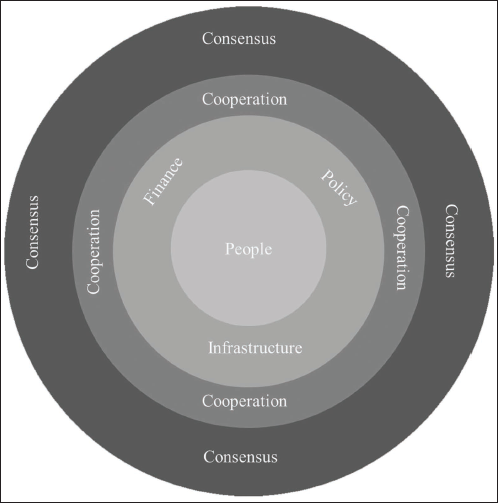
The above-discussed scale and consequences of digital divide in terms of extreme social exclusion and digital disempowerment necessitate quantum jump strategies to bridge the gap. This section proposes a constructive and connected solution to address digital divide. As shown in Figure 5, it comprises: (a) Consensus on the understanding of digital divide, (b) cooperation at all levels, (c) strengthening pillars of digital inclusion—digital infrastructures, digital finances and digital policies, and (e) building capacity and empowering people.
Constructive and Coordinated Solution to Digital Divide.
Consensus on Digital Divide and Inclusion
As the discussion above showed, divergence, not convergence, informs the idea of digital divide. The problem of this approach in conceptualising digital divide has led to confusion, as well as complexities in addressing digital divide. More than solving digital divide, as Farooqi et al. (2022) and James (2008) have pointed out, such an approach has wasted effort, energy and economy. So, as a first step to address digital divide, what is required is that there must be consensus on what is digital divide amongst those concerned about it. Worth to note here, such consensus building does not intend to homogenise the concept of digital divide; neither it should aim to privilege the ‘one-size-fits-all’ approach. Rather, the rationality behind building consensus on digital divide is to limit the boundary of digital divide in a given particular period so that its aims and activities can be objectively defined, and thus achievements in digital inclusion can be really realised.
Solidarity, Cooperation and Partnership
Once a global consensus on the conceptualisation of digital divide is reached, then, efforts should be made to establish digital cooperation and partnership by involving various actors and agencies at the global, regional and national levels. At the global level, an emphasis should be on building partnerships amongst the United Nations’s agencies, multilateral and bilateral organisations, and international non-government development organisations. By ‘combining the principles of diplomacy, cooperation, and technological innovation’ (World Economic Forum, 2023, n.p.), digital multilateralism, bilateralism and digital international development need to be established to address the existing digital divide at the global level. Amongst others, the focus at this level should be on framing appropriate policies and programmes of action that promote the developed nations to share and support technology transfer to the developing nations with no condition. Considering debt distress that significantly impacts the developing nations, such cooperation and partnership should reduce the risk of debt distress and, in the meantime, should promote affordable long-term digital financing policies for the developing nations in their pursuit of digital development (United Nations, 2024a).
Regional levels should be encouraged and supported to do the same. At national levels, under the direct leadership of the government, cooperation and partnership should be formed by involving various government and non-government organisations, as well as civil societies and private sectors should be encouraged to take part in addressing digital divide. The government can work well in tandem with civic society and business sectors such that the civic society points out the existing digital divide and exclusion in society, the business sector innovates and develops infrastructure, and the government supports them through policy and funding.
The key aim of such cooperation and partnership should be to clearly set ‘… the roles and responsibilities of the public, private and civic sectors …. [and make sure] benefits of digital technologies are widely enjoyed, while risks are also mitigated’ (Alhashimi, 2021, p. 84). Such cooperation and partnership will furthermore contribute to digital solidarity, creating a defensible and resilient digital ecosystem effective to address digital divide at all levels (United States Department of State, 2024).
Finance, Infrastructure and Policy
Strengthening pillars of digital inclusion, mainly digital infrastructures, digital finances and pro-digital-inclusion policies, is crucial in minimising digital divides. The world’s most digitally disadvantaged populations live in developing nations. Compared to economically advanced nations, many of these underdeveloped nations suffer not only due to their weak economy but also because their overall infrastructures are of poor quality. The implications and implementations of policy in many of these underdeveloped nations remain pessimistic (Ahrens, 2002; Garcia-Zamor, 2001). Therefore, systematic efforts are necessary axial to developing and strengthening digital infrastructures, digital finances and digital policies to minimise digital divide. In particular, policy actions should emphasise improving connectivity in underserved areas, making internet packages and devices affordable for those who are vulnerable to digital divide, and fostering digital empowerment and literacy who have been left out in digital development. All these—digital infrastructures, digital finances and digital policies—should aim for sustainable and universal digital access for people (James, 2003).
Building Capacity and Empowering People
At the core of this integrated model is digitally disconnected people. Connecting these already disconnected people requires appropriate education, training and capacity-building programmes. The goal of such programmes, on the one hand, should be targeted to motivate people to participate in digital spaces. And, on the other hand, these programmes should be designed to improve their digital literacy, skills and competencies. Also, the need is to take socio-cultural-economic-political intersectionality into consideration to effectively educate and train people for digital space.
For example, there will be 230 million digital jobs available in sub-Saharan Africa by 2030, which will generate about $120 billion in revenue. This will require at least 650 million training opportunities (United Nations, 2020). While global level initiatives such as ‘Working Together for Digital Capacity Development’ by the United Nations Development Programme and the International Telecommunication Union have already been launched, what is required is their local, contextual and need-based translation. Further capacity-building processes and programmes have to be tailored to individuals at the national and community levels through policy options. Rather than the one-size-fits-all approach, based on local evidence and diverse political, economic and sociocultural contexts, it is critical to foster digital capacity.
Without its execution at the operational and strategic levels, the proposed solution might merely remain an idea. Therefore, the next step is to rapidly translate the proposed solution at both strategic and operational levels. The SDGs 4 (quality of education), 8 (decent work and economic growth, 9 (industry, innovation and infrastructure), 10 (reduced inequalities) and 17 (partnerships for goals) refer to the digital divide issue and the necessity of digital access and utilisation to make further progress. The SDG target 17.8 states that:
Fully operationalize the technology bank and science, technology and innovation capacity-building mechanism for least developed countries by 2017 and enhance the use of enabling technology, in particular information and communications technology.
One measurable indicator under this is the proportion of individuals using the internet.
Strategically, a dedicated global agency needs to be established immediately to address the digital divide issue. The Second World Summit for Social Development provides a pertinent platform to establish such an agency, and re-examine relevant SDGs and targets and recommit necessary resources, including financial, to address the growing digital divide and consequent inequalities. Global consensus is needed not only in understanding the digital divide issue but also specific on actional plans to address it. SDG progress report (United Nations, 2024b) shows slow progress in digitisation. Thus, multi-lateral and multisector partnerships and cooperation among government and non-government organisations, civil societies and private sectors are needed to accelerate digitisation in developing countries. The Second World Summit for Social Development may act as an enabler and advocate to translate these ideas into action.
Way Forward
Irrespective of its connotations and causes from different perspectives—technological, sociocultural, normative, individual and structural—the issue of digital divide is dynamic, complex and challenging. About one-third of the world, mostly developing, is yet to have access to the internet. Access to digital technologies is important to enable people to live comfortable and better quality lives. Enhanced global internet access may aid at least 7% of the world’s population to get rid of absolute poverty. It may also contribute to an increase in economic production by $6.7 trillion (Filipenco, 2024). Global digital divide remains a key challenge to realise this potential. If this gap is not timely and rapidly addressed, it will exacerbate further vulnerabilities, injustices and inequalities within and between nation-states. Considering this, the article recommends the following constructive and connected solutions to address the digital divide. These are:
Global consensus to build digitally inclusive societies Fostering solidarity, cooperation and partnership to enhance social inclusion Building digital infrastructure and policies by placing people at the centre Digital capacity building, including digital finance Technology transfer
The next task after this knowledge production is to translate the idea contained herein into actionable strategies. Such action will come from a broad partnership formalised amongst various stakeholders and their genuine commitment to connect those not connected. We hope the commitments to be made at the Second World Summit for Social Development will help to translate these policies and strategies to reduce the digital divide and to build an inclusive world.
Footnotes
Declaration of Conflicting Interests
The authors declared no potential conflicts of interest with respect to the research, authorship and/or publication of this article.
Funding
The authors received no financial support for the research, authorship and/or publication of this article.
