



Abstract
Immigrants and refugees resettling in the United States face persistent challenges to integration which are often filled by community-based ethnic organisations (CBEOs) and their leaders, who are often immigrants and refugees themselves. There is a dearth of research on how these CBEO leaders make meaning of their leadership role based on their lived experiences and intersecting identities. Seven purposively selected immigrant and refugee CBEO leaders were interviewed to expand our understanding of the impact of immigrant and refugee positionalities on philosophies of leadership, contextual human services conditions that impact diverse perspectives and construction of leadership diversity in the human services environment. Four salient themes emerged: (a) leadership on our terms: building bridges through collective action and empowerment; (b) the honour of serving immigrant and refugees communities; (c) intersection of multisystem challenges on immigrant and refugee leadership functioning and (d) reimagining CBEOs: aspirations of immigrant and refugee leadership. The analysis has implications for the functioning of human services organisations and their leaders.
Keywords
Cultivation of immigrant and refugee leadership in resettlement spaces promotes civic engagement and catalyses processes for their inclusion. Leadership development helps immigrants and refugees to establish a sense of belonging and connection to their new communities, to gain agency over their lives and to build the knowledge and skills to become active community members and changemakers (Unbound Philanthropy, 2021). As immigrants and refugees resettle in new spaces, they face a myriad of individual and structural barriers, including but not limited to language and cultural barriers (Al Shamsi et al., 2020), gaps in culturally responsive health and human services (Im & Swan, 2021), discrimination (Saksena & McMorrow, 2021), gaps in leadership opportunities (Hunter & Mileski, 2013) and weak political investment in human capital that impedes the socioeconomic integration process across immigrant and refugee communities (Singer, 2012).
Integration is a complex process that needs continual investment in human capital beyond the fulfilment of basic needs. Under the current US refugee resettlement programme, organisations that resettle or serve refugees under federal contracts are limited to providing basic needs such as food, health care, schooling, job training and language education for the first 90 days after refugees arrive in the United States, creating large gaps in continued empowerment of this population (Brown & Scribner, 2014). The unique vulnerabilities experienced by immigrant and refugee communities are further exacerbated by weak philanthropic responsiveness in local communities. According to the National Committee for Responsive Philanthropy, pro-immigrant and refugee non-profits are proportionally underfunded by state-based Grantmakers when compared to the demographic reality on the ground. Although immigrants and refugees represent 14% of the nation’s population, the share of local philanthropic investment received in immigrant and refugee communities was just 1% for service organisations and 0.4% for advocacy and organising work between 2017 and 2018 (National Committee for Responsive Philanthropy, n.d.). In the human services environment, this vacuum of long-term support for immigrants and refugees beyond basic needs is being continually filled, silently yet fiercely, by community-based ethnic organisations (CBEOs; Unbound Philanthropy, 2021).
CBEOs are non-profit organisations, often led by immigrants and/or refugees (Newland et al., 2007), and represent a vital force in the human services system. CBEOs under the leadership of immigrants and refugees have been instrumental in serving the needs of immigrant and refugee communities and providing crucial services through culturally appropriate mechanisms (Griffiths et al., 2005; Newland et al., 2007; Pimental Walker et al., 2021; Verbunt, 2008). During the COVID-19 pandemic, CBEOs were often the default providers of assistance and mutual aid, despite inadequate support from funders or mainstream human service organisations (Betts et al., 2021; Kirsch, Haran et al., 2023). Through the work of CBEOs, immigrant and refugee leaders are not only filling human services gaps (Kirsch, Raut et al., 2023; Maleku et al., 2020) but also diversifying and reconceptualising leadership and amplifying what it means to be an immigrant justice advocate.
Leadership among immigrants and refugees is likely grounded in their lived experiences as an immigrant and/or refugee and their multiple intersecting identities (Alawee & Higashi, 2021). However, their leadership potential based on these diverse experiences remains largely untapped when they begin their lives in new spaces. In recent years, a growing number of organisations, in both long-standing and newer refugee destinations, have developed trainings and programmes to help refugees gain a sense of belonging, to naturalise and vote and to become active participants and changemakers in their communities (Unbound Philanthropy, 2021). There is a growing need to equip emerging immigrant and refugee leaders with skills to generate, utilise and maintain social capital and to cultivate leadership opportunities, particularly in the human services context, to maintain and protect the well-being of all communities.
Further, there are persistent gaps in research that explore the diverse leadership experiences of these new members of US society. Although an emerging body of work has examined the crucial role of CBEOs on immigrant and refugee services in the United States (Gonzalez Benson, 2021; Kirsch, Raut et al., 2023; Maleku et al., 2020), studies that examine the phenomenon of immigrant and refugee leadership in the CBEO context remain largely anecdotal. There is a dearth of research on how immigrant and refugee leaders of CBEOs negotiate their roles in the larger human services space and how they make meaning of their leadership role based on their lived experiences and intersecting identities. Our study draws upon the voices of immigrant and refugee leaders of CBEOs in a Midwestern US region to expand our understanding of the impact of immigrant and refugee positionalities on philosophies of leadership, contextual human services conditions that impact diverse perspectives and construction of leadership diversity in the human services environment.
Leadership Diversity and Human Services
The lack of diversity in corporate leadership has come under continual scrutiny in the United States. Although human services, particularly the non-profit sector, including foundations, have received little public criticism around the lack of leadership diversity, the field is not exempt from this issue. In an analysis of leadership teams of the largest foundations and non-profits in the United States, findings reveal that less than 15% of leadership positions in the non-profit sector are currently held by leaders from racially diverse backgrounds (Medina & Partner, 2017). Although 42% of these non-profit organisations were headed by women as executive directors or presidents, 87% of these leaders identified as White, 6% as African American, 4% as Hispanic and 3% as Asian. This lack of representation can become a vicious cycle in which diverse individuals are not considered for leadership positions, further limiting representation and advocacy for the interests and needs of minoritised communities (Flores & Matkin, 2014).
Additionally, the lack of diverse leadership in non-profit organisations can translate to biased knowledge, in which leadership theories and models only reflect the experiences of White, heterosexual men (Chin, 2013). Studies on leadership often either privilege certain aspects of identity or view leadership from an essentialist perspective, focusing on a particular aspect of identity (Fitzgerald, 2003; Kezar & Lester, 2010). These narrowed descriptions of leadership reflect gaps in leadership research that hinder our understanding of the complexity of diversity and leadership representation (Kezar & Lester, 2010), with ripple effects in culturally responsive service provision and delivery.
Leadership of non-profit organisations, including administrators and governing boards, that reflects the racial and ethnic diversity of the communities they serve has been found to gain more community trust and are more likely to develop innovative strategies to address community needs (Dorsey et al., 2020; Mumford, 2022). Concomitantly, lived experiences based on an individual’s affiliation with diverse groups and membership can influence their perceptions of leadership and behaviour. Studies affirm that leadership styles of leaders from diverse cultural and ethnic backgrounds reflected collaborative leadership and emphasised humane, self-protective and participatory domains (Chin, 2013). In a study with 15 diverse leaders from non-profit and for-profit sectors, Chin et al. (2016) examined perceptions of leadership through focus group discussions. Findings showed four competencies to be crucial to leading increasingly diverse organisations: leveraging one’s identities, employing a global mind set, leveraging community and organisational contexts and promoting an inclusive organisational climate.
Common experiences of individuals from diverse backgrounds include discrimination, racism, acculturation and biculturalism, which can shape their worldview, values, perceptions and goals. Leaders from minoritised groups were more likely to report facing both individual and structural barriers, such as the pressure to conform to stereotypes and to continually prove their ability to lead (Chin, 2013). They also encountered unique structural and institutional barriers, such as funding challenges that can affect their leadership. For instance, non-profit organisations located in neighbourhoods with a greater proportion of communities of colour in poverty are less likely to receive government funding (Garrow, 2014) and are more likely to dissolve due to funding challenges (Garrow, 2015).
While research on diverse leaders highlights many individual and structural barriers, it also has begun to elucidate the positive impacts leadership diversity can have on both leaders themselves and the wider communities they serve. For instance, community engagement and advocacy efforts among the LGBTQ+ community have been shown to increase resilience at both the individual and community levels (Frost et al., 2019; Scheadler et al., 2022). While similar knowledge could be gleaned from immigrant and refugee leadership, this knowledge has remained largely anecdotal. Thus, expanding our understanding of immigrant and refugee leadership in human services, particularly through CBEOs, will help to inform strategies that could be implemented to support leadership diversity and representation of these new members of US society (Flores & Matkin, 2014).
Immigrant and Refugee Leadership in the CBEO Context
Although CBEOs are a vital force in the human services arena, they are often siloed from mainstream human service providers and face many challenges of survival and sustainability, largely due to questions around their legitimacy and barriers related to accessing skills and resources in the human services environment (Kirsch, Raut et al., 2023; Maleku et al., 2021). As such, studies that examine the experiences of refugee and immigrant leadership in the CBEO context are extremely sparse and fragmented. Nonetheless, studies that have begun to examine the experiences of leaders from diverse backgrounds reveal a fertile field of inquiry that warrants scholarly attention. In a study by Hunter and Mileski (2013) that examined community needs based on focus groups with immigrant and refugee leaders of CBEOs, findings highlighted the need for training on effective communication and case management initiatives.
Further, leaders of refugee community organisations revealed that they faced significant barriers to inclusion in local governance (Gonzalez Benson & Pimental Walker, 2021). Similarly, Flores and Matkin (2014) conducted in-depth interviews with three diverse executive directors of CBEOs in the Midwest to examine how they overcame barriers and challenges as leaders, finding that leaders encountered unique challenges, including pressure to conform to racial/ethnic stereotypes, discrimination, double standards and constant scepticism about their competence and leadership abilities. However, these CBEO leaders stayed above the fray by not taking criticism personally and by staying hopeful and focused on their mission to uplift their own communities.
The leadership motivation of immigrant and refugee leaders seems to revolve around their shared immigrant and refugee experiences and collective identity. For instance, Appe and Oreg (2020) examined the motivations of refugee leaders from South Sudan and confirmed that these leaders acknowledged a perceived sense of obligation to create a positive impact in their communities and aspired to co-construct meaning from their shared loss and refugee experience. Community building provided collective spaces apart from the ‘closed-door culture’ and isolation experienced by Bhutanese refugees in US society, which not only prevented their seamless integration but also exacerbated their collective trauma from displacement in Bhutan and their refugee camp experience in Nepal (Salinas & Salinas, 2021).
The unique experiences of liminal spaces, where immigrants and refugees are caught between various cultural spaces and continue to struggle for their collective identity, can have ripple effects into their resettlement and integration experiences. Feelings of ‘spiritual homelessness’—the perceived sense of both belonging and not belonging in home or host places—contribute to mental distress and disempowerment of migrant populations (Maleku et al., 2022). Similar code switching may be apparent among diverse CBEO leaders, based on their unique positionalities and the target population they serve. This is particularly true when they must navigate a human services system that functions within Western cultural norms that dignify individualism and capitalism, which is paradoxical to the leaders’ collectivist cultural norms that value altruism, community and unity. Because cultural norms affect self-concept, the inevitable nuances of diverse migration experiences and identities that impact the meaning and role of leadership warrant scholarly attention.
Conceptual Framework: Positionality Theory and Diversity Leadership
As mentioned, cultural experiences emerging from unique identities based on race, class, nationality, gender and sexual orientation can result in varying beliefs about leadership (Kezar & Lester, 2010). Identities, however, are complex and fluid, and the focus on a singular aspect of identity can severely limit our understanding of complex social phenomena such as leadership (Kezar, 2002). Thus, additional scholarly attention should focus on the intersections of identities to understand how leadership can be conceptualised based on different cultural and social contexts (Kezar & Lester, 2010). In order to develop a conceptual framework for a holistic understanding of immigrant and refugee leadership in the human services context, we used positionality theory (Kezar & Lester, 2010) as an overarching framework, while also incorporating ideas of diversity leadership throughout (Chin, 2013; Chin at al., 2016).
Emerging from postmodern feminist theory, positionality theory postulates that individuals have a position that impacts how they construct the world. More specifically, the position of an individual is informed by various aspects of identity, such as race, class and gender, and this position shapes leadership perspectives (Collins, 1986; Haraway, 1991). The fluid and dynamic nature of identity is often affected by historical and social changes (Baumeister & Muraven, 1996). It is therefore crucial to acknowledge diverse leadership beliefs based on positionalities to create an inclusive organisational environment (Kezar & Lester, 2010), particularly in the human services environment that is the context of our study.
The attention to social identities and the larger sociocultural context fosters a human services environment for ‘diversity leadership’ (Chin, 2013, p. 9). Immigrant and refugee leaders from non-Western countries of origin may often position themselves within collective cultures that focus on collective values and achievements, shared migration experiences and community rights. Yet they navigate their leadership within a human service space that is incongruent with collectivist values and adheres to an individualist culture in which individual achievements and rights are given precedence. Arguably, this complex interaction of immigrant and refugee positionalities and lived experiences with a predominantly White culture impacts their leadership perception, views about leadership roles and modes of navigating the human service environment, which may greatly alter their leadership beliefs. Thus, acknowledgment of immigrant and refugee positionalities and experiences within leadership scholarship will open pathways to a holistic understanding of leadership and leadership diversity (Eagly & Chin, 2010)
Objectives
Centring the voices of CBEO leaders from immigrant and refugee backgrounds, our study intends to expand our understanding of the impact of immigrant and refugee positionalities on philosophies of leadership in the human services environment. The purpose of our study is to understand the phenomenon of immigrant and refugee leadership in the CBEO context. We do so by exploring how immigrant and refugee leaders negotiate their roles in the larger human services landscape and how immigrant and refugee leaders construct leadership philosophies based on their positionalities.
The setting of our study is a Midwestern region in the United States that is one of the top refugee resettlement sites in the country (Refugee Processing Center, 2022). Given secondary migration from other states, this region is currently home to vibrant refugee populations, including the second-largest Somali population and the largest Bhutanese population in the country (Cheng, 2021). It is also home to an increasingly large Latinx population, as these communities continue to move to the Midwest to find work in non-agricultural jobs (Cohen & Chavez, 2013). The region is also expected to receive immigrant and refugee populations displaced from several ongoing crises, including the end of the war in Afghanistan (Batalova, 2021) and the continuing war in Ukraine (Stoia, 2022).
Methods
Sample and Data Collection
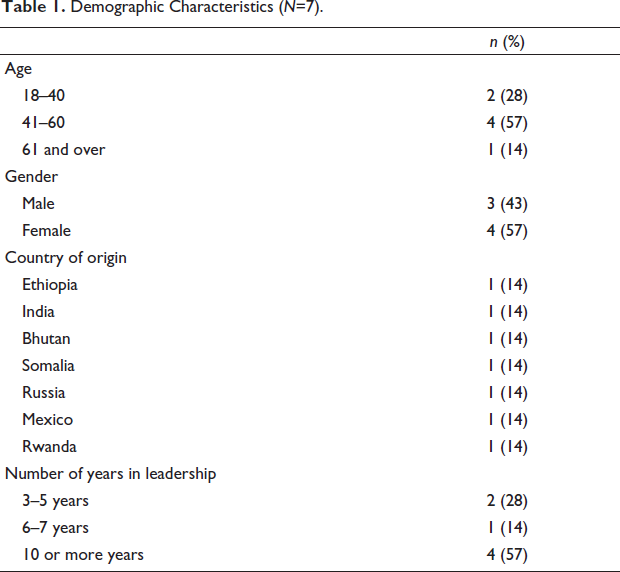
Purposive sampling—a technique widely used in qualitative research for the identification and selection of information-rich cases with reference to the phenomenon of interest (Patton, 2002)—was used to recruit immigrant and refugee CBEO leaders in a Midwestern city. Participants were recruited through the first author’s network of organisational leaders in the area built from years of work in the field. Ten immigrant and refugee CEBO leaders were initially invited to participate in the study, out of which seven agreed to participate. Seven research participants represented seven countries of origin: Bhutan, Ethiopia, India, Mexico, Russia, Rwanda and Somalia (Table 1). More than half of the participants identified as female (57%), and all participants had lived in the United States for at least 10 years and were naturalised US citizens. Most participants had at least 10 years of leadership experience (57%), with all leaders having at least 3 years of experience.
Demographic Characteristics (N=7).
Through in-depth interviews, we captured lived experiences of diverse CBEO leaders. The systematic data collection and analysis process using grounded theory techniques to represent authentic immigrant and refugee voices, as well as researcher reflexivity strategies, strengthened the rigor of our study. In leadership research, in-depth narratives that garner information on the complexity of identity and illustrate how power, context and experience impact leadership beliefs have been found to be useful (Kezar, 2002; Nash, 2004). These methods also amplify unique identities and prevent easy stereotyping or generalising (Kezar & Lester, 2010).
Data collection occurred between February 2020 and February 2021. The first two interviews were conducted in person and the remaining five interviews were conducted over the secure Zoom platform, due to the onset of the COVID-19 pandemic. Interviews were conducted in English and lasted for 90 minutes each. Interview questions centred around perceptions of leadership as a refugee or an immigrant, leadership experience and the role of CBEOs within the larger human service landscape. The first two in-person interviews were audio-recorded and transcribed verbatim. Virtual interviews were recorded and transcribed using Zoom transcription. The first author reviewed all Zoom transcriptions manually to ensure accuracy. The study was approved by the Institutional Review Board at the study site. All participants provided informed consent prior to the interviews.
Data Analysis
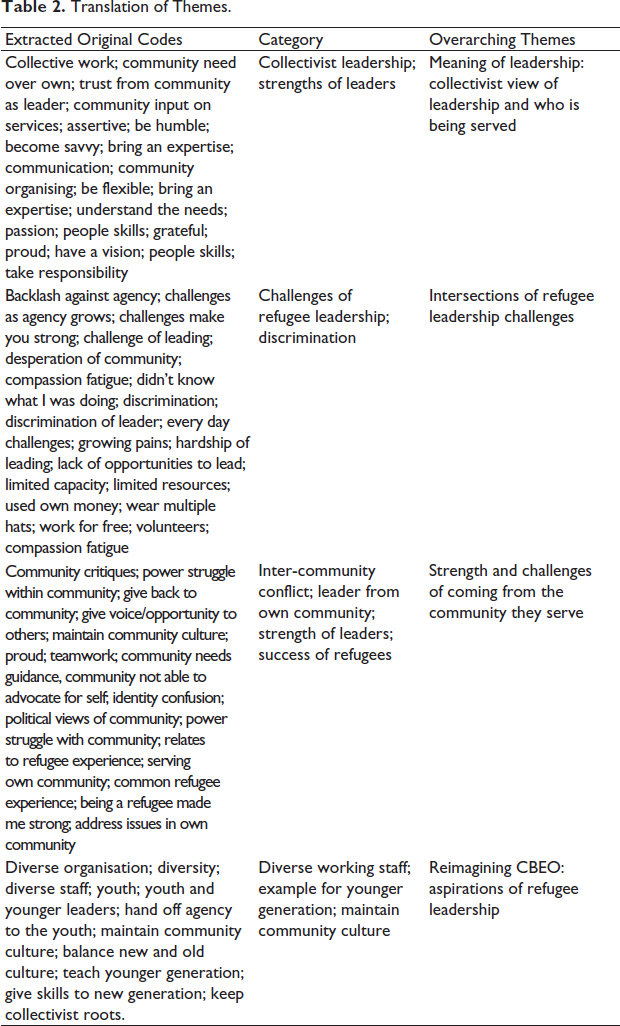
Data analysis was guided by a grounded theory approach to systematically synthesise, analyse and conceptualise the data (Charmaz, 2008; Strauss & Corbin, 1997). This is an appropriate methodology to construct an explanatory theory grounded in the data, especially when little is known about the topic (Strauss & Corbin, 1997). Data was initially coded independently by two authors using Atlas.ti or NVivo software. Coders first gained familiarity with the data by listening to all interviews and reading the transcripts multiple times. The first round of initial coding used line-by-line coding to ensure all components of the data were incorporated in the analysis, and it included in vivo coding to highlight participants’ voices (Strauss & Corbin, 1997). The two authors then met to discuss their findings, resolve any discrepancies and agree on initial codes. The same authors then completed a second round of axial coding techniques to draw emerging relationships among the codes (Strauss & Corbin, 1997). At the third step of the analysis process, the authors brought in an additional author to discuss their findings and help resolve any discrepancies. This process helped the authors to select salient thematic patterns from categories, identify overarching themes and finalise the translation of themes table (Table 2; Charmaz, 2008). These strategies of constant comparison, iterative coding and reflexivity through interactive team approaches deployed throughout the data analysis process helped the researchers ensure data saturation, provide accurate reflection of participants’ voices and bolster the rigor of data analysis (Padgett, 2017).
Translation of Themes.
Results
Four salient overarching themes emerged from the data related to participants’ experiences as immigrant and refugee leaders. The themes are (a) leadership on our terms: building bridges through collective action and empowerment; (b) the honour of serving immigrant and refugees communities; (c) intersection of multisystem challenges on immigrant and refugee leadership functioning; and (d) reimagining CBEOs: aspirations of immigrant and refugee leadership.
Theme 1: Leadership on Our Terms: Building Bridges Through Collective Action and Empowerment
CBEO leaders perceived their role as bridging the gap between immigrant and refugee communities and mainstream human services. This was crucial due to challenges these communities faced in accessing services, stemming from structural barriers, funding constraints and exclusion from mainstream service providers. Leadership means to me like being a shepherd, being a connector. You can be a shepherd. You can be a bridge, you can be like a parent. So to me it means to lead other people and to advocate for them (Participant 6).
CBEO leaders also framed leadership in terms of advocacy and ensuring that the voices of their communities were brought to the attention of stakeholders and into decision-making spaces. Leaders stated how their role often provided a voice to the community when community members were not able to express their needs or concerns. A crucial part of their leadership role was advocacy for community needs and representing their community, so members felt empowered to self-advocate in the face of inequitable treatment. One CBEO leader described their role as ‘fighting for the justice and having a voice for our clients so that they can be empowered enough to know what their rights are’ (Participant 1).
The collectivist cultural values from which immigrant and refugees often come guided CBEO leadership philosophy and leaders’ approach to their organisational leadership. They stated feeling the need for the community to ‘stick together’ (2) and often referred to the community and/or the organisation they led as a family or team. And for me leadership is [about being] a team player. Almost like managing a family. Whoever comes here, I treat them as family. My staff, their needs besides what they do at work, if they have other challenges, you know that could be family challenges (Participant 3).
The desire to put the mission and vision of their organisation and their community above their own needs was grounded in collective cultural values. CBEO leaders reiterated that lifting the voices of their communities and advocating for their community well-being continually inspired them to become good leaders. A CBEO leader stated, ‘To me, being a good leader is putting your mission before everything and helping people the way that you would love to be helped’ (Participant 7).
Theme 2: The Honour of Serving Immigrant and Refugee Communities
CBEO leaders shared the unique experience of identifying as an immigrant or refugee along with their clientele. They had a holistic understanding of both forced migration and the challenges and opportunities of resettlement in a new country. It was important to start this organisation to not just fill in the gaps and not because other organisations were not doing a good job, but because we wanted to deliver services from the perspective of someone who understands the journey (Participant 1).
Given this shared understanding, CBEO leaders viewed their leadership position as a privilege, a way to give back to their own communities. Serving their own communities was referred to as a matter of great pride and honour by the CBEO leaders. Well because I have similar experience, I understand them. I understand not only history and culture but also trauma, and the behaviour that we see in the community, that a noncommunity member cannot understand. I can understand that easily. I understand the structure of the community and I had a privilege to [be a leader] (Participant 2).
They also discussed serving their own communities as one of the prominent motivators for starting or leading a CBEO. Being woven into the social fabric of the community and intimately understanding people’s lived experiences were discussed as assets for community outreach and trust building. This lived experience also provided the CBEO leaders with the ability to connect with their community and navigate collective hardships. CBEO leaders identified their immigrant and refugee backgrounds as a source of their resilience. Forming and leading were not only about filling service gaps but also providing culturally appropriate services, grounded in migration experiences in the most competent manner. One leader stated that their goal was to ‘make sure that the people who are decision makers are the ones with the actual experience and understanding [of being a refugee]’ (Participant 1). Many leaders also stated that they felt it was a privilege and honour to have the opportunity to support members of their community. They described the resilience that they have from going through the migration experience and feeling like they can give back to their community by leading a CBEO. Being [a] refugee, having that refugee experience, I think made me who am I, right? Sometimes people think, Oh, you have been in refugee camp. So horrible that is. Sometimes I think it made me strong. It made me, you know, be that thrifty person, optimizing the resources, able to bring people together, work even in the tough time, convince people because, we are not at the worst; we are at the best right now. And we should do the best. That all comes from my refugee background (Participant 2).
Theme 3: Intersection of Multisystem Challenges on Immigrant and Refugee Leadership Functioning
While CBEO leadership offered opportunities to serve their communities, CBEO leaders also highlighted personal and structural challenges in operating their CBEOs and navigating the human services system. The leaders highlighted the lack of formal training or education in non-profit leadership as a prominent challenge. [There] is not really much known about nonprofit(s) in the part of the world that I come from. Here it is well developed, but there, no one is really running a nonprofit organization. I could use the training to be taught how to do this from the people here who understand (Participant 3).
These challenges deprive them of opportunities to acquire funding and organisational resources. Challenges with funding and resources often leave them with no other option than to utilise their own personal resources to help their communities. We have just very little funding. Because of that the challenges of having skilled people and then knowing where the resources are, knowing where the funds are, have really challenged me. Because you work twenty-four hours and at the end of the day you find that you need to be paid and no one’s paying you. You don’t have someone who writes a proposal, you don’t have someone who can even show you how to do things. So you were just on your own. That’s . . . that’s been my biggest challenge (Participant 6).
Funding constraints have far-reaching effects and impact service delivery at multiple levels, including hampering the ability to hire staff in response to increasing service demands and to secure needed resources for continued expansion and sustainability of needed programmes and services. These challenges not only jeopardise the existence of the organisation but also place an additional personal burden on the leader of an agency and make them vulnerable to mental distress. All I was doing was seeing somebody that’s in need, asking Google what to do, and helping that person, and that led me to become a nonprofit organization. I do not have the experience and skills. I had the passion, but it was not an easy road to go. I brought my time, my money and my energy, and I was not getting anything [tangible] out of it. Yes, I was getting a lot of good things, like making a sad person smile. I had so many people come to my office crying and walking away smiling (Participant 5).
CBEO leaders discussed working multiple jobs to sustain their organisation, continual compassion fatigue from working with a disadvantaged population and the need to take on myriad roles, and they noted that these aspects of the role both hindered agency functioning and caused a negative impact on their own mental health. Three CBEO leaders, all of whom identified as female, voiced that they do not get paid for their full-time position running the CBEO, with one stating ‘[the position is] just a volunteer position, and I’ve been working like three jobs just to sustain myself and then help the community’ (Participant 4).
Though leaders felt that their experiences leading their own communities were largely a benefit to their community, they also expressed challenges in fulfilling community expectations. Leaders discussed conflicts with ‘some critic[s], within our own community, of how the organization is run’ (Participant 2) and the blurring of lines due to professional relationships with community members who also were friends and family of the leader. The collectivist culture of the communities sometimes caused tension when it came to one individual being deemed the formal ‘leader’ of the organisation. The intersection of high expectations from community members and a lack of available resources often left CBEO leaders feeling unable to satisfy the needs of all community members, causing additional strain on the leaders. Some of them [board members from the community] were upset because they felt I was taking over their power. Some of them wanted me to be fired because [they believed] I was taking all the power to myself, but they didn’t understand. [A] nonprofit doesn’t work that way. But also it made me tired. I was worn out. I was really to the point of saying, Okay, I am done. I have to get out, get away from here. (Partcipant 2)
Further, at the macro level, navigating the human service environment as an immigrant or a refugee leader amid the prevalent anti-immigrant fervour, xenophobia and systematic discrimination has its own complexities. CBEO leaders discussed their leadership positions not being taken seriously. As a leader of the agency, I’ve been feeling really kind of like an angry sensation. When you’re walking into a meeting and then you realize that nobody really wants to deal with or talk about the Latino community issues. Because here is inconvenience to them, because it is not political right now, because the topic is not too hot. So that’s extremely difficult to really advocate for Latinos’ issues, specifically for the undocumented community. That’s kind of one of the topics that everybody wants to avoid, or nobody wants to recognize that we have a large community of undocumented Latinos. It is almost impossible to do anything. The worst part is that they don’t want to listen. They are sitting with you and everything, but they just don’t listen (Participant 7).
Leaders continually faced challenges to convince mainstream stakeholders about the unique challenges faced by immigrant and refugee communities. Leaders highlighted prevalent racism, discrimination and racial stereotypes faced by immigrant and refugee communities, with one leader stating, ‘As an immigrant, you know, even if you do all the things right, because you are an immigrant and a refugee, people do not think that you have the competent skills’ (Participant 3). As representatives and advocates of these communities, CBEO leaders voiced their experiences of racism, discrimination and minoritised status from the broader human services network as perpetual barriers that prevent them from making their voices heard and continue to make them structurally vulnerable. Sometimes you must assert yourself as a leader, as a person who is as smart or smarter than everyone else in the room. And making sure that people understand that just because we speak with an accent does not mean we think with an accent. And that in no way is it a sign of us being less educated or not as smart (Participant 1).
This leader highlights the persistent challenges they face as a leader of an organisation when they themselves also have an intersectional immigrant identity. They discuss feeling that they must show they have even greater skills than other non-profit leaders in order to be taken seriously.
Theme 4: Reimagining CBEOs: Aspirations for Immigrant and Refugee Leadership
Leaders recognised their strengths and privileges despite the many challenges. Many stressed the importance of having a clear vision and mission for their agency to guide the direction of their agency. Well, leadership is really, from my experience, developing a vision and sharing that vision with your team. To understand what a general picture is and then bring the team around him/her so that you are implementing with passion and commitment and education, which brings changes in the community. (Participant 7)
Moreover, leaders recognised the importance of diversifying their workforce and the leadership within their organisation to ensure they could serve multiple communities. Many stated that having a diverse workforce at their organisation was important in order to expand services to serve other refugee and immigrant groups in the area. What makes me [interested] to expand the services to all refugees and immigrants is when I was hired by [organization name]. We have the same common problem: the language, the access, lack of cultural appropriate services, and the desire to work. The values that refugees and immigrants brought to this country—they are talented, hardworking people. They have all gone through the hardships as refugees, of course. So, the commonality is more than our differences (Participant 1).
CBEO leaders also stressed the desire to begin to create pathways for future generations to step into leadership positions more easily than they themselves were able to. This was done by hiring youth into positions and providing them with the opportunity to learn about the work of CBEOs and advance into leadership roles in the future. We have a lot of youngsters who really follow our footsteps. They come, get hired, and work proudly just because they have an organization who has an immigrant name and immigrant leaders. Building and bringing different people around the world that looks like a United Nations. In my organization, people are from all part of the world. About thirty-five languages are spoken in my agency alone (Participant 3).
Discussion and Implications
By listening to diverse voices of immigrant and refugee leaders leading CBEOs, we attempted to understand the phenomenon of immigrant and refugee leadership in the human services context. Our findings reveal how immigrant and refugee leaders negotiate their roles in the larger human services space and how they construct their leadership philosophies based on their unique positionalities. The findings reiterate that immigrant and refugee leadership philosophies are deeply rooted in their collective cultural perspectives. CBEO leaders believed in collective community achievements and were inclined to make culturally informed decisions and build a community of trust.
Our study highlights how the collectivist cultural norms of leaders expand into the human services that immigrants and refugees utilise and how this cultural strength should be leveraged to improve the services provided to these communities. The shared immigrant and refugee experience between leaders and their communities created empathetic understanding of needs and opportunities for immigrant and refugee well-being. As cross-cultural leaders, CBEO leaders envisioned their role as that of a liaison and an advocate for their communities. While their leadership philosophy and ideology were grounded in their cultural perspectives, CBEO leaders also faced challenges in navigating and meeting the expectations of the human services environment that is often incongruent with immigrant and refugee values and experiences. This evident conflict can alter leadership beliefs among CBEO leaders. Our study findings revealed that CBEO leaders often find themselves at the intersection of multiple minoritised statuses, leading them to be constantly fighting for space to get their voices heard. Prior studies assert that although CBEOs provide culturally responsive services to immigrant and refugee communities in the most efficient way and have a broader outreach with their communities, they remain isolated from mainstream human service providers (Maleku et al., 2020). The competitive human services environment creates additional barriers to CBEOs, as their legitimacy as human service providers continually comes into question (Kirsch, Raut et al., 2023). The complexities of immigrant refugee identity, the complex context of the human services environment and the power disadvantage experienced by CBEO leaders creates a dynamic picture of how positionality affects immigrant and refugee leadership beliefs and practices.
The collectivist cultural understanding of immigrants and refugees and the organisations serving them highlights the need for more interventions within the community that go beyond the individual level. Refugees themselves desire more group and organisational-level interventions (Mitschke et al., 2017; Kirsch et al., 2024). CBEOs themselves can be viewed as an ‘intervention’ through which immigrant and refugee leaders are able to increase their capacity to self-advocate for the internal needs of their community and to develop solutions in a culturally grounded way. Grassroots advocacy and activism for oneself and the community has itself been shown to increase the well-being of individuals from persecuted populations, which may result in post-traumatic growth (Klar & Kasser, 2009).
The increased demand for non-profit services has led to a crisis in filling leadership positions (Hopkins et al., 2014). Immigrant and refugee communities are also at an increased need for services due to recent crises like COVID-19 and ongoing anti-immigrant sentiment that was bolstered during the Trump presidency but remains ubiquitous in migration policy and rhetoric. CBEO organisations need increased capacity to meet the current needs of these populations (Kirsch, Raut et al., 2023). During the COVID-19 pandemic, non-profit agencies with increased diversity in leadership and board positions were found to have decreased access to financial resources while also doing more for minority populations, indicating that diversity in leadership enhances agencies’ responses to the needs of minoritised communities (Kirsch, Haran et al., 2023; Mumford, 2022). Leaders expressed the need for increased training and capacity to assist them in becoming better leaders and improve their ability to carry out their vision for their organisation and community. Diverse leaders in human services organisations need increased support so that leadership reflects the demographics of the populations they serve.
Our study highlights the voices of minoritised leaders working within the CBEO human services sector. A lack of diverse voices within the human services sector creates missed opportunities to lift the voices of community members who are best positioned to serve their communities. Acknowledging and understanding ‘white saviourism’ that often exists within the non-profit sector at large (Nickels & Leach, 2021) and within refugee resettlement more specifically is critical to meeting the needs of these communities. Further, philanthropic investment in immigrant and refugee leadership in the CBEO context can invigorate the inclusion of immigrant and refugee communities, increase civic participation and improve democracy as a whole (Alawi & Higashi, 2021).
Limitations
Our study has several limitations. Given the small number of participants, any generalisations on study findings outside of the Midwestern United States context should be exercised with caution. While our sample participants were a diverse pool of leaders, exploring differences based on sociodemographic attributes such as gender, race and migration history was out of the scope of the study. We also included immigrants and refugees in our sample. Future research could benefit from exploring demographic differences between leaders, including differing experiences between immigrants and refugees. It is also important to acknowledge that all leaders represented formal, tax-exempt non-profit CBEOs. Thus, our study may have missed differing perspectives from leaders in informal organisations within immigrant and refugee communities. Finally, all the interviews were conducted in English. Though all participants were fluent in English, this might have prevented them from articulating specific opinions in linguistically and culturally specific ways. Despite these limitations, our study contributes to a holistic understanding of immigrant and refugee leadership within the human services context.
Conclusion
As the US population continues to become more diverse, the makeup of those in leadership positions must also reflect the diversity of US communities. Our study highlights unique immigrant and refugee perspectives on leadership and contributes to knowledge on leadership diversity. It adds further evidence that increased diversity among leaders in the non-profit sector, especially leaders who have similar minoritised statuses as the community they serve, has positive impacts on both the organisation and the community served. The human services system, as well as local providers more broadly, must work with immigrant- and refugee-run CBEOs to increase the diversity of leadership. By intentionally increasing the number of diverse individuals in leadership positions, the needs of diverse communities themselves can be better served by human services organisations. To our knowledge, the present study is among the first to investigate the phenomenon of immigrant and refugee leadership in the specific context of CBEOs and the human services environment. We hope our study will ignite additional research and investments to better understand this unique group of leaders. We also hope this study will help garner targeted advocacy for grassroots leadership, leadership diversity and empowerment of CBEOs towards an inclusive human services system.
Footnotes
Acknowledgements
The authors would like to acknowledge and thank the CBEO leaders who shared their time and thoughts with us as participants in this study.
Declaration of Conflicting Interests
The authors declared no potential conflicts of interest with respect to research, authorship and/or publication of this article.
Funding
The authors received no financial support for the research, authorship and/or publication of this article.
