



Abstract
The primary aim of spiritual or religious intentional communities is that their members live their lives based on spiritual or religious principles and precepts. This article presents a case study of Sisa Asoke in Thailand as a contemporary example of a Buddhism-based intentional community. The article tracks down how Sisa Asoke has evolved into an ecovillage, which was not its primary intention. This study employs ethnographic methods, including participant observations, to gain insights into the community’s day-to-day activities, and interviews to provide an understanding of the community from the community’s perspective. The study categorises observation and interview data into the cultural, ecological, social and economic dimensions of sustainability, aligning with the definition of an ecovillage. The study finds that Sisa Asoke has collectively committed to organic agriculture, relying on local resources. Daily activities at Sisa Asoke are interrelated, showcasing the holistic integration of the four dimensions of sustainability. Furthermore, this study concludes that their shared belief in and practice of the Buddha’s teachings have catalysed the development of regenerative social and natural environments. Therefore, it can be inferred that Sisa Asoke has come very close to being classified as an ecovillage.
Introduction
An ecovillage is defined as ‘an intentional, traditional, or urban community that is consciously designed through locally owned, participatory processes to holistically integrate ecological, economic, social, and cultural dimensions of sustainability in order to regenerate social and natural environments’ (GEN, 2023). According to this definition, the necessary and sufficient conditions for being an ecovillage are (a) consciously designed through locally owned, participatory processes; (b) aiming to holistically integrate the four dimensions of sustainability and (c) regenerating social and natural environments. The question arises of whether a community can be labelled an ecovillage only because its primary aim is to integrate the four dimensions of sustainability. Conversely, can a community not be considered an ecovillage if it did not originally intend to integrate the four dimensions of sustainability?
There are spiritual or religious intentional communities that did not initially plan to become ecovillages, as defined above, but have actually worked towards fulfilling the criteria for being an ecovillage. For instance, Auroville prefers to be identified as a spiritual community or a universal township rather than an ecovillage (Litfin, 2014). The Findhorn Foundation began as a spiritual community and has transformed into an ecovillage with influences from permaculture design principles (Findhorn Community, 2008). The Asoke communities in Thailand are considered Buddhism-based intentional communities (Essen, 2004) but are not commonly referred to as ecovillages. Nevertheless, the Asoke communities have made substantial efforts to shape their communities to be ecologically, socially and economically sustainable based on the teachings of the Buddha.
Spiritual or religious intentional communities share two principal elements with ecovillages. First, both are communities deliberately designed through locally owned, participatory processes. Second, both have emerged in pursuit of an alternative economy as opposed to the growth-oriented market economy (Clarence-Smith & Monticelli, 2022; Ku & Yeo, 2010). The Asoke communities were founded with the intention of creating an alternative community that eschews profit-maximation businesses and materialistic pursuits and instead seeks a simple lifestyle following the Buddha’s teachings (Shi, 2018).
Several studies (e.g., Essen, 2004, 2010; Heikkilä-Horn, 1997, 2010; Kaewthep, 2007; Mackenzie, 2007; Sangsehanat, 2004) delved into the history and politics of the Asoke movement. These studies also explored the intersection of Buddhist ethics and economics that sustain Asoke communities, presenting them as real-world examples of alternatives to the capitalistic economy. However, limited attention has been given to the impacts of Buddhist ethics and economics on the overall sustainability of Asoke communities.
This article specifically centres on Sisa Asoke, one of the active Asoke communities. The study documents Sisa Asoke’s efforts as a spiritual community and analyses how the community has evolved to be an ecovillage. The article highlights the distinctive features of the alternative economy that Sisa Asoke practises on a daily basis. Furthermore, the article identifies the factors that have contributed to the comprehensive sustainability of Sisa Asoke, with the aim of drawing insightful implications for local and global initiatives to shift away from growth-oriented capitalism and the prevailing market economy.
The Asoke Communities in Thailand: Buddhism-based Intentional Communities
Theravada Buddhism made its initial introduction to Thailand in the third century, while Mahayana Buddhism was later propagated in the fifth century (Singkam & Wanichapichart, 2013). Although Theravada Buddhism, often referred to as Southern Buddhism, being recognised as the predominant Buddhist tradition in Thailand, the influence of Mahayana Buddhism, also known as Northern Buddhism, still persists in the country (Cassaniti, 2019). Within Theravada Buddhism, individuals bear the responsibility of seeking a path to nirvana through wisdom, which they believe can be achieved through the study of Buddhist scripts.
According to the doctrine of Mahayana Buddhism, the Buddha is perceived as an omnipresent, timeless and spaceless being. In this context, aspiring to become a bodhisattva is acknowledged as the ultimate goal of one’s journey in Buddhism. The term bodhisattva is translated into English to signify ‘Buddha-to-be’ (Conze, 1957), ‘one bound for awakening’ (Claxton, 1990) or ‘one on the path to enlightenment’ (Brazier, 2001). It is believed that a bodhisattva lives with compassion and remains in the world with all other sentient beings until they all attain enlightenment. In Mahayana Buddhism, the worship of images of the historical Buddha is allowed, and there is a belief that one can find a path to enlightenment through faith rather than exclusively through the study of ancient Buddhist scriptures (Simpkins & Simpkins, 2021).
The Asoke group was established in accordance with Fundamental Buddhism (Heikkilä-Horn, 1997; Kaodara & Kaodara, 2020). In this study, ‘Fundamental Buddhism’ refers to the core concepts and teachings from the Buddha, which can be distilled to the Four Noble Truths (Batchelor, 1997; Conze, 1957; Sangharakshita, 2007; Simpkins & Simpkins, 2021; Smith, 2004). The Four Noble Truths, which are a fundamental principle shared by all schools of Buddhism, include: (a) the acknowledgement that life is characterised by duhkha in Sanskrit, which can be translated into affliction, imperfection, anxiety, dissatisfaction or suffering in English; (b) the understanding that the reality of duhkha arises from craving for perfection and from the illusion that there is enduring, unchanging ‘self’; (c) the recognition that one can attain liberation from duhkha through the cessation of craving for perfect and everlasting ‘self’ and (d) the acknowledgement that the Noble Eightfold Path, comprising Right View, Right Thought, Right Speech, Right Action, Right Livelihood, Right Effort, Right Mindfulness and Right Concentration, leads to the cessation of duhkha. The term ‘Right’ often denotes the ‘Middle’ path, which can be interpreted as the state of optimum or balance.
The doctrine of the Noble Eightfold Path forms the foundation of practical Buddhist ethics. In the Asoke communities, all members are expected to diligently engage in Right Livelihood. Right Livelihood entails pursuing one’s preferred activities with full concentration, for the betterment of oneself and society as a whole (Brazier, 2001; Kaewthep, 2007). The Sanskrit word ‘samadhi’ in ‘samma samadhi’ (Right Concentration) translates to ‘meditation’ in English. In Buddhism, concentration on one’s work, whether it be physical or mental, is considered a form of meditation (Essen, 2009, 2011). In this context, wholeheartedly dedicating oneself to their chosen tasks transforms everyday work into a form of meditation.
The Thai word ‘Asoke’ or ‘Ashoka’ literally translates into ‘liberation from duhkha’ (Kaewthep, 2007). Buddhism, originating in India, influenced the Thai language, incorporating both Sanskrit and Pali elements (Cassaniti, 2019; Heikkilä-Horn, 1997). The Pali language is closely linked with Theravada Buddhist traditions, whereas Sanskrit is associated with Mahayana Buddhist schools (Cassaniti, 2019). Although Sanskrit and Pali not belonging to the same language family, they share many words with common roots.
The founder of the Asoke group, Rak Rakphong, was born in 1934 in Sisaket, a north-eastern province of Thailand. After completing his tertiary education in 1958, Rak pursued a career with a Bangkok TV station. He gained fame as a song composer and TV programmer. However, he abruptly resigned from his worldly occupation and joined the Buddhist Society. In 1970, Rak was ordained as a monk. Upon ordination, he received the Pali monastic name ‘Bodhirak’ (MacKenzie, 2007). 1
Bodhirak denounced the Thai mainstream Buddhist group for being occult Buddhism and capitalistic Buddhism (Schedneck, 2019; Swearer, 2009). Bodhirak and his followers established the Asoke group in the early 1970s, which is known as an anti-mainstream Buddhist group in Thailand. The Bhodirak group criticised the Thai state Buddhist organisation for being disconnected from society and critiqued the materialistic consumerism pervasive in Thai society (Essen, 2004; Kaewthep, 2007). On the other hand, the Asoke group rejects the worship of Buddha images and places emphasis on living Buddhism based on the Buddha’s original teachings rather than blind faith in them (Essen, 2010, 2011). Bhodirak stressed that he was not trying to cause a religious rift but only attempting to join the positive aspects of both Theravada Buddhism and Mahayana Buddhism ‘by going back to ancient times when there was only one Buddhism’ (Heikkilä-Horn, 1997; Sangsehanat, 2004).
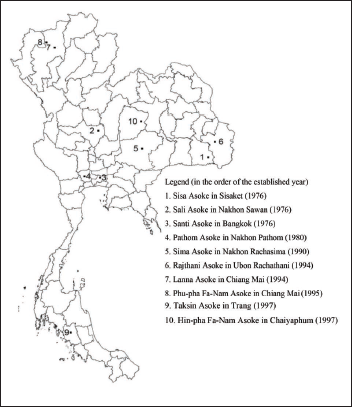
The Asoke group is also known as the ‘bunniyom’ network, consisting of approximately 30 Asoke centres dispersed across Thailand (Heikkilä-Horn, 2010; Kaewthep, 2007; Sangsehanat, 2004). Among them are 10 active Asoke communities established at the village level as of 2023, as presented in Figure 1. Some of these Asoke communities operate not-for-profit vegetarian restaurants or supermarkets. Additionally, there are roughly 10 other vegetarian restaurants located throughout Thailand that have yet to develop into village-level Asoke communities. The size of these Asoke communities varies in area. The Asoke group comprises approximately 100 monks in Thailand, in contrast to the 300,000 monks in the mainstream Thai Buddhist sect (Dubus, 2017).
Locations of the 10 Active Asoke Communities in Thailand.
The Thai word ‘bun-niyom’ (meritism), as opposed to thun-niyom (capitalism), is succinctly defined as ‘giving as much as possible while taking as little as possible’ (Heikkilä-Horn, 2010). 2 From the bunniyom perspective, the act of giving (dana) is considered an ideal means of accumulating one’s merits (Essen, 2011). 3 Meritism places significant emphasis on ‘compassion’, a fundamental concept in Mahayana Buddhism (Speece, 2019). Compassionate attitudes towards fellow humans and sentient beings emerge from a profound understanding of the Noble Truths that any life is marked by dissatisfaction and a desire to be liberated from it. Moreover, meritism holds that being virtuous and performing good deeds for others will carry over to their next life (Heikkilä-Horn, 1997).
Asoke communities distinguish themselves from traditional Buddhist monasteries where only monks reside. In an Asoke community, both Buddhist monks and laypersons live together, with the monks serving as the spiritual leaders, while the laypersons oversee various community activities, including farming, education, food processing and other manufacturing businesses (Essen, 2004; Speece, 2019). Senior adult members are responsible for proposing community development plans and seeking approval from the ‘monks’ committee.
Research Methods
This article focuses on Sisa Asoke, situated in Sisaket, 4 a north-eastern province of Thailand. Sisa Asoke is one of the first three Asoke communities founded in 1976. It encompasses an extensive area of 66 ha situated in a rural district in Thailand (Essen, 2010, 2018; Kaewthep, 2007). The land on which Sisa Asoke was established was an abandoned community cemetery with soil of poor quality (Singkam & Wanichapichart, 2013). Initially, due to insufficient crops and products, Sisa Asoke had to rely on donations or offerings from sources outside the community. After several years of land preparation and soil fertility restoration, the community started growing the food they needed. The Main Hall located at the heart of the village functions as the venue for community meetings and regular sermons. Adjacent to the Mail Hall, one can find the Communal Kitchen. These central facilities are surrounded by residential blocks, schools, woodlands and patches of dryland farms. Factories and rice paddies are located in more distant zones, while temples and basic residential huts for monks, novices and aspirants can be found within the woodlands near the Main Hall.
At the time of the author’s visit, Sisa Asoke had about 150 residents, which included 6 monks, about 100 students and about 50 adult residents. It took about a decade for the community to evolve into a village and an additional 10 years to establish educational institutions within Sisa Asoke (personal communication with an anonymous senior member of Sisa Asoke, 2022). Sisa Asoke is home to about 100 students distributed across a primary school, a middle school, a high school and a vocational college. The kindergarten children are typically the offspring of parents who work for Sisa Asoke.
To accomplish the primary research objective, the author visited Sisa Asoke from 19 December 2022 to 4 January 2023. During this time, the author temporarily resided in the community and actively engaged in various daily activities. The author’s typical day began at 6:30 am, when he joined one of the vegetable gardening groups, often working alongside a small group of other temporary visitors. On occasion, volunteer workers were joined by a group of high school students. Working outdoor when sun was high was avoided due to health issues such as dehydration and fatigue. The author took on the role of selling a variety of products at Asoke’s New Year’s Market, which took place from 28 December 2022 to 2 January 2023 in Ubon Rachathani Province. The author also participated in the Rice Harvest Celebration held in late December 2023, singing a folk song for fellow participants. Throughout the author’s stay in the community, Sisa Asoke organised three induction classes for the temporary visitors. Each class lasted about 2 hours and covered the following topics: a general overview of the community, an introduction to Buddhism and bunniyom and an exploration of social enterprises initiated by the community.
This study utilises ethnographic research methods complemented by grounded theory techniques. Under the ethnographic approach, the study conducts participant observations and informal interviews to gain a comprehensive understanding of the community from the community’s perspective. Formal interviews were not pursued for a couple of reasons. First, key informants within the community were aware that the author was both a volunteer worker and a researcher affiliated with an overseas tertiary educational institution. Second, the Sisa Asoke leaders provided short-term visitors with the aforementioned induction sessions. Each of these sessions included a questioning-and-answering component, akin to a semi-structured interview. This format allowed the author ample opportunities to ask the same questions that might have been posed in a formal interview. Consequently, organising separate formal interviews was deemed unnecessary since the interview questions were already addressed during the induction sessions. In constructing a grounded theory, this study codes the insights derived from participant observations into four sustainability dimensions in line with the definition of an ecovillage cited in the introductory section of this article.
Findings
Bunniyom, which is embedded in the teachings of the Buddha, underscores the interconnectedness of all elements within ecosystems including humans. This perspective has actively been reflected in the operation of Sisa Asoke. The day-to-day applications of bunniyom are manifested in organic farming, mindful consumption, communal production and consumption and the use of local resources to meet local needs. This study categorises participant observations and informal interview data into the cultural, ecological, social and economic dimensions of sustainability.
Cultural Sustainability: Living Buddhism
The majority of Sisa Asoke members, both students and adults, exhibited a strong understanding of the Five Precepts and the concept of bunniyom. One of the Five Precepts (namely no killing, no stealing, no sexual misconduct, no lying and no addictive substance) mandates vegetarianism. The precept of not killing living creatures is of paramount importance, based in the belief that all sentient beings including humans aspire to be free from harm. One member of Sisa Asoke stated that ‘Buddhism teaches us that we should not harm animals, even insects. Therefore, we refrain from using toxic pesticides. For this reason, the community does not raise any livestock, and meat products are not consumed.
The author observed that a few lay residents were studying the Pali Canon, also known as tripitaka (the three divisions of Buddhism scripts): namely sutra pitaka (doctrinal teachings from the historical Buddha), vinaya pitaka (the codes of conduct for Buddhist monastic life) and abhidharma pitaka (discourses of the Buddha’s teachings). It is worth noting that the basic codes of conduct, including the previously mentioned Five Precepts, are derived from vinaya. However, a majority of the other residents do not prioritise extensive reading of tripitaka because they believe they can grasp key concepts such as anatman (not-self) or sunyata (emptiness) without delving deeply into the scriptures. As one member of Sisa Asoke put it, ‘I don’t find it necessary to read the scriptures to understand that every human is imperfect and hence subject to imperfection’.
The lay residents acknowledge that humans inherently seek happiness. However, they hold the belief that moments of happiness in one’s life are transient: ‘Happiness comes and goes, and unhappiness comes and goes. Both are inherent aspects of life’ (personal communication with an anonymous adult member of Sisa Asoke, 2022). In this context of living in accordance with Buddhism, Sisa Asoke is sceptical of the value of a profit-maximising and growth-oriented capitalistic mindset, where the more one possesses, the more one desires. While the satisfaction level is high when basic needs are met, any additional satisfaction gained through consumption beyond those basic needs tends to diminish. Moreover, there is the risk of falling into a cycle of experiencing more dissatisfaction than satisfaction. Hence, Sisa Asoke stresses the importance of living a simple lifestyle with minimal material possession.
Similar to the practices of the Buddha and his followers about 2,500 years ago, the monks at Sisa Asoke collect food from the community’s residents in the morning, referred to as pujana (offering). 5 In exchange for the food offering, the Buddhist monks provide spiritual guidance and leadership to the community. Sisa Asoke convenes the Sisa Asoke Assembly meeting on a monthly basis to deliberate community matters. During the assembly meeting held in late December 2022, 3 monks and about 30 adults were in attendance. Various community affairs, including those related to school education and social enterprises, were discussed. The monks either approved or provided guidance on the matters discussed through the assembly.
Ecological Sustainability: A Circular Economy
Driven by compassion and a deep concern for the wellbeing of planet Earth, community members at Sisa Asoke are dedicated to cultivating regenerative soils and engaging in organic farming. All the food produced in Sisa Asoke is grown organically in one form or another. In the early stages of Sisa Asoke’s development, Bodhirak and his followers strived to enhance soil quality by utilising natural fertilizers including cow dung. They applied the principles of ‘natural farming’ (Fukuoka, 1978) as needed (Singkam & Wanichapichart, 2013). The adoption of organic farming at Sisa Asoke is inseparable from the concept of karma. The belief is that harming or excessively exploiting the land ultimately harms human beings themselves as everything in the interconnected web of life is interdependent.
A circular economy can be defined as a multi-level resource utilisation system characterised by the complete closure of all resource loops and the optimisation of resource flows (Figge et al., 2023; Friant et al., 2020; Valencia et al., 2023). Figge et al. (2023) acknowledged that achieving perfect adherence to all the conditions of a circular economy is unlikely due to the constraints imposed by the second law of thermodynamics (i.e., the entropy law), which limits the possibilities for substituting different forms of energy. Thus, it may be a necessity to import resources from outside the closed-loop system and utilise virgin resources.
In the case of Sisa Asoke, it does not achieve a completely closed-loop system for resource recycling. For example, Sisa Asoke needs to source a portion of its firewood from outside the village for cooking purposes. Nonetheless, it is evident that Sisa Asoke comes remarkably close to meeting the criteria for operating as a circular economy. At the farm level, Sisa Asoke cultivates a variety of vegetables, fruits and cereals, with a commitment to minimising waste throughout the agricultural process. Most organic matters are recycled and returned to the land in the form of natural fertilizers. On a larger village scale, with the expansion of organic farms over the past decades, Sisa Asoke has ventured into the production of herbal medicines or eco-friendly cleansing products such as soap and shampoo.
Regarding fertilizers, Sisa Asoke does not rely on external imports. Instead, surplus natural fertilizers are sold to neighbouring villages as they garner significant recognition, particularly among individuals who prioritise personal health. This symbiotic interaction between Sisa Asoke and nearby villages contributes to the broader-scale circularity of resources beyond Sisa Asoke. An anonymous adult member of Sisa Asoke expressed:
Our natural fertilizers were known for their great quality and were in high demand from outside Sisa Asoke. In response, we initiated the production of fertilizers for sale. Our motivation was not driven by profit but rather by a commitment to assist neighbouring villages in their efforts to grow food organically as extensively as possible.
Social Sustainability: A Sharing Economy
All members of the community actively participate in communal work to produce what they need, according to their interests and skills where applicable. Communal work at Sisa Asoke is not monetarily compensated. Nevertheless, participant workers receive essential provisions including food and accommodation along with free educational opportunities for their children. The community members collaboratively contribute their labour towards the production of food and the operation of various social enterprises. Both adult members and middle- to high-school students partake in a range of farming activities. To enhance efficiency, a division of labour is often employed. For example, one group of workers may be involved in spreading natural fertilizers, while another simultaneously plants broccoli sidings in the same farm area. At a higher level of labour division, one working group may be responsible for meal preparation, while another focuses on farming or the preparation of natural fertilizers. 6 Additionally, some elders are occupied with weaving baskets using plant materials, which are then displayed for sale on the shelves of bunniyom supermarkets.
Community members gather for meals at the Communal Kitchen, where each individual is responsible for washing and rinsing their own plate after eating. Regular communal meals are common practice in numerous intentional communities across Asia and Europe. At Sisa Asoke, communal meals are a daily occurrence, underscoring the significance of shared dining experiences within the community. Adult members have two meals per day, with a few exceptions, as a way to maintain mental and physical health, following the teachings from the Buddha.
The spirit of collective production and consumption at Sisa Asoke was beautifully exemplified during the Rice Harvest Celebration, an annual cultural festivity that involved a majority of the community members in its preparations. Much like on regular days, food was prepared and enjoyed collectively. In addition, students showcased their talents by performing in concerts, playing both traditional and Western musical instruments, many of which they practised during their school classes.
Sisa Asoke actively takes advantage of bartering, a form of sharing (Davies & Legg, 2018), albeit in a more extended and long-distance mode. Sisa Asoke warmly welcomes short-term visitors to become part of their community, provided these visitors are willing to participate in daily community activities. At any given time, there may be 5 to 10 temporary visitors. All temporary residents are expected to contribute to the production of the community’s necessities, such as working on vegetable gardens. In return, they are provided with essential needs including shelter and food. This practice shares similarities with the global network known as World Wide Opportunities on Organic Farms (WWOOF), where WWOOFers can gain experience in rural life and organic food production (McIntosh & Bonnemann, 2006). 7
Economic Sustainability: A Localised Economy
Schumacher (1973) advocated that a localised economy represents the most rational approach to economic life through the lens of Buddhist economics. In alignment with this perspective, Norberg-Hodge (2019) stressed that localising the production and consumption of food and energy resources serves as a means to address and rectify global environmental pollution and degradation. Furthermore, a localised economy can also provide holistic solutions to the pressing question of how the world can collectively mitigate contemporary environmental challenges (Akuppa, 2002).
Sisa Asoke operates a largely self-sufficient economy, primarily due to their strict vegetarian dietary practices. The food, including rice, vegetables and fruits, cultivated on their farms is abundant enough to sustain the entire community. This is a contrast to other spiritual intentional communities such as Findhorn and Auroville (Suh, 2018). They face limitations in terms of access to farmland or available labour force, making self-sufficiency more challenging to achieve. 8
Localisation does not entail isolating a local area from interactions with other localities. Rather, a localised economy can flourish and be sustained when local areas interact with one another (Norberg-Hodge, 2019). In the case of Sisa Asoke, it is not isolated but actively interacts with other villages within its region. Sisa Asoke has interacted with other rural villages in the same province. By making use of their agricultural produce, the village has diversified into secondary and tertiary industries. This diversification includes the production of herbal cleansing products, herbal medicine, fermented beverages and agro-bio products, such as natural fertilizers, to meet local needs. Sisa Asoke utilises local resources, including labour sourced from nearby villages. At Sisa Asoke, about 25% of the labour required for food production and social enterprises is outsourced, which can be regarded a form of contribution to the regional economy as it generates employment opportunities.
Sisa Asoke offers its products at affordable and competitive prices through the Sisa Asoke Supermarket, aiming to make healthy products accessible to a wider audience. Sisa Asoke has been a supplier of organic food and eco-friendly products to local villages, thereby promoting mindful consumption in the region. In a compassionate gesture, a portion of the profits generated from their social enterprises is generously donated to support impoverished individuals in the region or households affected by natural disasters such as typhoons and floods.
Discussion: Towards Regenerative Social and Natural Environments
Sisa Asoke, like other Asoke communities, is a Buddhism-based intentional community (Essen, 2004). All residents including volunteer workers are expected to embody and follow the Buddha’s teachings. This does not require them to be or become Buddhists or adhere to Buddhism with blind faith. While some may question whether Early Buddhism places emphasis on nature and society, it is apparent in the case of Sisa Asoke that the community has demonstrated how contemporary Buddhism can address environmental crisis, social decay and economic marginalisation in the region.
Sisa Asoke is primarily an agricultural village that has been dedicated to organic farming and polyculture. Their farming practices do not involve mechanisation or animal draft power. Instead, they rely on intensive manual labour. Therefore, collective and collaborative work among the village members is of utmost importance. Sisa Asoke traditionally shares labour, knowledge, wealth and meals all together among the members of the community. Moreover, their belief in the spirit of giving as a means of merit-making explains their commitment to sharing with a wider community.
Bunniyom calls for carrying out the principle of ‘our loss is our gain’, which is another expression for ‘giving away is merit-making’. In other words, bunniyom strongly advocates a ‘sharing economy’. At Sisa Asoke, a wide spectrum of sharing (Davies & Legg, 2018) has been practised both in production and in consumption. First of all, labour sharing is a norm in Sisa Asoke, where residents work together in various daily activities such as cooking, farming and manufacturing. For instance, a group of students prepares meals for the whole community while other students are working on farms. Second, their products are either given away or sold for profit or not-for-profit purposes. When profits are generated, they are reinvested in children’s education or donated to charitable causes.
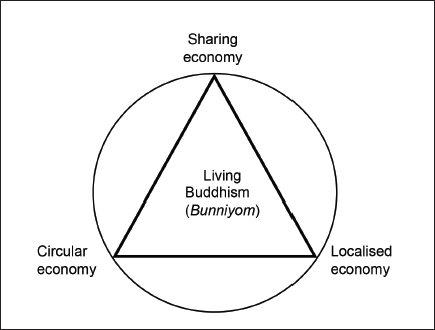
The Buddhist economy implemented at Sisa Asoke reflects a local yet global concept. The Buddhist economy, as exemplified by Sisa Asoke, can be characterised as a circular economy (focused on organic food production and mindful consumption), a sharing economy (emphasising communal production and consumption) and a localised economy (centred on production from local resources to meet local needs). As depicted in Figure 2, the Buddhist economy encompasses not only localism or minimal consumption and right livelihood but also elements of a circular economy and a sharing economy. Sisa Asoke has practised organic farming and resource recycling in a communal manner. Their motivation is rooted in living a Buddhist way of life that values simplicity and compassion, which, in turn, leads to environmental conservation and communal living. The figure also illustrates that people can live together in the same intentional community while upholding ecological, social and economic sustainability based on the Buddha’s teachings.
Operationalisation of the Buddhist Economy.
The concept of a ‘sharing economy’ is often associated with commercial platform businesses such as Airbnb (Belk, 2010). Botsman and Rogers (2010) identified four principles of commercial yet collaborative consumption: namely critical mass, the existence of idle capacity, belief in the commons and trust between strangers. Even though Sisa Asoke has little to do with a platform economy, these principles apply to their collaborative production. Mutual trust among community members, combined with a belief in Buddhism-based communalism, has solidified the sharing economy at Sisa Asoke.
In the context of Sisa Asoke, the concepts of a circular economy, a sharing economy and a localised economy are interrelated and not separate economic systems. For instance, the community grows organic food collectively, which is then consumed communally. Excess natural fertilizers are sold to local villages, not for profit, to support their efforts in growing healthy food. These practices demonstrate how circular economy principles can foster sharing and localisation.
Sisa Asoke’s alternative economic system is not only sustainable but also regenerative, partially owing to the demographic sustainability of the community. The community benefits from the continuity of its membership. The elderly members of Sisa Asoke who have lived in the community since its inception act as advisors to the current labour force of the community. Middle-aged adults assume administrative, educational and managerial responsibilities. The intergenerational cooperation helps maintain and regenerate the economic and social fabric of Sisa Asoke.
Education plays a pivotal role in regenerating Asoke communities, as evident in the case study of Sisa Asoke. The educational curriculum at Sisa Asoke is intentionally designed to be broad and balanced with a strong focus on practical and experiential learning. The Sisa Asoke schools aim to equip students with skills for simple and sustainable living, rather than preparing them for entrance exams. The learning subjects and activities include organic farming, cooking, wood crafting, natural science, computer science, English, herbal medicine production, movie watching, traditional Thai healthcare techniques and music. Much emphasis is placed on food education at Sisa Asoke. For example, students are fully engaged in farming exercises on Tuesdays. Farms are used as outdoor classrooms to teach chemistry, biology and agriculture. High school students, in particular, receive hands-on lessons that demonstrate how to create organic matters and cultivate indigenous microorganisms. These educational experiences extend beyond agricultural science. They promote an agrarian worldview, fostering an understanding of the importance of producing and consuming healthy food.
Some middle- or high-school students come from outside the community. Their parents have chosen to send them to Asoke community schools because they appreciate the Buddhism-based alternative way of teaching and value the community’s principles. Through their education, all students learn to embrace a simple way of life with compassion by actively participating in organic farming and community activities. As these students grow and learn about the Asoke community, they gain a unique perspective on the differences between mainstream Thai society and Asoke communities. Some may pursue higher education at universities, while others might choose to remain in the village after graduating, becoming adult members of the community. Alternatively, they may seek employment outside the community for a while and then return to the village. One way or another, these students become the leaders or supporters of the next generation of Sisa Asoke, contributing to the ongoing sustainability and regeneration of the community.
Conclusion
Sisa Asoke closely follows Fundamental Buddhism, living in accordance with the Buddha’s teachings. Living Buddhism is tantamount to harmonising with both the social and natural environments. Bunniyom has been entrenched in the everyday operation of the Asoke community. The bunniyom philosophy posits that one’s economic loss translates into spiritual enrichment. The overarching spiritual and practical essence of bunniyom is encapsulated by compassion, which is the underlying ethos of a circular economy, a sharing economy and a localised economy.
This article argues that implementing these alternative economies is a necessary condition for the sustainability of an intentional community. Living Buddhism, as exemplified by Sisa Asoke, can contribute to meeting this condition. However, it should be noted that living Buddhism may not be the exclusive path to building a sustainable community. Other religious or spiritual beliefs and values can also serve as pathways.
Whether it is Buddhism or the Buddhist economy that underpins the sustainability of an intentional community, this case study puts forward two key propositions. First, sustainability is an ongoing process rather than a final goal. The community has comprehensively integrated all four dimensions of sustainability as it primarily follows the Buddha’s teachings. Second, the interconnected nature of a circular economy, a sharing economy and a localised economy is evident in Sisa Asoke, where activities from each of these alternative economies are interwoven to create a regenerative economy.
These research findings offer valuable insights for guiding the future development of place-making and ecovillage movements worldwide. This article does not claim that Sisa Asoke is a utopian community without limitations or imperfections. Notwithstanding that it is not the scope of this article, further study is warranted for an in-depth comparative analysis across diverse intentional rural communities across the globe.
Footnotes
Declaration of Conflicting Interests
The author declared no potential conflicts of interest with respect to the research, authorship and/or publication of this article.
Funding
The author received no financial support for the research, authorship and/or publication of this article.
