



Abstract
This article aims to discuss Lal Sakhi—The Women’s Voice Foundation’s (a non-government organisation in India), contribution to sustainable development and its innovative approaches to empower women, and how it faces challenges in that process. Drawing on the narratives of the Lal Sakhi founder and the secondary data, it discusses the origin of the organisation and motivations and vision of the founder. The analysis suggests that in a short period, Lal Sakhi has contributed to sustainable development by reducing the consumption of plastic and by enhancing hygienic practice among women. It directly contributes to achieving the sustainable development goals relating to health, hygiene and environment. The founder’s ‘Change Agents Movement’ is gradually growing, impacting the lives of thousands of women and girls. While appreciating the innovative and critical approaches of the organisation, it looks at some of the challenges and the potential for scaling up. In view of its programs, activities and creative approaches, and impact, we argue that the story of Lal Sakhi—The Women’s Voice Foundation is infectiously inspiring. Thus, we call people from all walks of life to contribute to this noble cause.
Keywords
Introduction
Most of the nongovernment organisations (NGOs), named differently as trusts, foundations, institutions, voluntary agencies, faith-based organisations, charity organisations and civil society organisations, along with government organisations (GOs), play a critical role in the development of society (Cordonnery & Kriwoken, 2015; Desai, 2014; Vogel et al., 2012; Werker & Ahmed, 2007). They complement the work of GOs and are often better at reaching out to people and communities at the grassroots levels. According to Korten (1995, p. 98):
Their (NGOs) small size, independence and focused value commitments give them a capacity for social and institutional innovation seldom found in either government or business. They serve as forums for the definition, testing and propagation of ideas and values in ways that are difficult or impossible for the other two sectors. Their commitment to integrative values, over political or economic values, gives them a natural orientation to the perceived needs of politically and economically disenfranchised elements of the population that are not met through the normal political processes of government or the economic process of the market.
This article aims to introduce one such NGO in India, namely, Lal Sakhi—The Women’s Voice Foundation and its innovative work. It is organised into five parts. First, it presents the details of Lal Sakhi and its aims and objectives and areas of work. Second, it discusses the rational for its work. Third, its innovative approach/framework to work with women and communities is discussed. Fourth, it provides details of current reach out, geographic areas covered, outputs/outcomes achieved and potential for scaling up. Finally, it concludes with some of the challenges and limitations faced in the field, and Lal Sakhi’s vision.
As stated in the last section, although there are several similar organisations, Lal Sakhi—The Women’s Voice Foundation was purposively chosen for the qualitative study (Liamputtong, 2013) as it was founded by a professionally trained social worker, who is a second author of this article and her initiatives in the field appeared novel and innovative, and in a short period it has initiated a change agent movement and appeared to have made a difference to the quality of life of menstrual cup users. In addition, a social work student, who is a third author, completed an online placement in the foundation, and she was supervised by both of us. Often good work of practitioners remains unrecorded and unreported and thereby remains unavailable for analysis and others. Writing about practice is a method of systematic reflection and exploring ways of enhancing practice (Rolfe et al., 2011; Jasper, 2011). This is also an example of how researchers and practitioners can collaborate to write and publish. The sources of data for the article included website of the organisation (lalsakhi.com), supervisory discussion sessions, presentation at a conference, written narratives and statements of the founder, our reflections and other secondary sources (Pawar, 2004). The main questions that aided our analysis and documentation were as follows: What is the philosophical foundation of Lal Sakhi? What is Lal Sakhi’s practice approach/framework in the field? What are the achievements of Lal Sakhi so far? What are the Challenges for Lal Sakhi? What follows is our analysis and responses to these questions.
Lal Sakhi—The Women’s Voice Foundation
The Lal Sakhi—The Women’s Voice Foundation is a not-for-profit organisation based in India. It is registered under the Societies Act 1860 in Bhopal, Madhya Pradesh, India, in January 2020, and Section 8 of the Companies Act, 2013, New Delhi, in December 2021. It is founded by the co-author, Ms Preeti Jangra, who is its current director and as well as a professional social worker and development practitioner. The foundation has twin aims of empowering women and achieving environmental sustainability. Towards achieving these aims, it focuses on the following objectives: Raise awareness relating to women’s reproductive healthcare, sanitation and hygiene, particularly about menstrual health. Provide education and training for Degradable Hygiene management And Recycling Training Initiative (DHARTI) and thereby increase the adoption of menstrual cups and confidence of women. Facilitate better participation of women in sociocultural and economic activities and educational programs (schools and colleges/universities). By engaging people and communities, and volunteers, build ‘Change Agents’ movement to achieve the above 1, 2 and 3. By increasing the use of menstrual cups and by reducing the consumption of plastic products, contribute to environmental sustainability and relevant sustainable development goals.
By engaging community members and by developing and employing innovative approaches, a series of awareness-raising, education and training activities are conducted in both rural, tribal and urban areas, local government institutions, schools and colleges and communities in ten states of India and the National Capital Territory of Delhi. Menstrual cups are provided with follow-up support to end period poverty, reduce adolescent girls’ dropout rates and to reduce plastic waste. Lal Sakhi welcomes volunteers in its pursuits. Details of these activities are presented in a later section.
Philosophical Foundations of Lal Sakhi’s Work
As reflected in its aims, Lal Sakhi’s work is founded on two critical tenets. Empowerment of women is necessary to address injustices, discrimination and exploitation experienced by most women. In all our actions and inactions, environmental sustainability should be taken into consideration as human actions are causing greenhouse gas emissions, global warming and the consequent climate change, that is threatening the survival of ecological systems, including human beings. These two tenets drive Lal Sakhi’s actions that are linked to addressing the following problems.
Most women have experienced injustices, discrimination, exploitation and inequality from a range of perspectives, including, social, cultural, economic, political, gender, family and patriarchy. All the sources of injustices must be addressed. One such sources of injustice and discrimination is practices relating to menstrual health management, which some call ‘period poverty’ (Briggs, 2021; Rossouw & Ross, 2021). The issue of women’s menstrual health is deeply personal, sociocultural hidden with taboo or stigma attached to it and thus, less spoken about. Some women undergo untold suffering due to sociocultural practices, blind beliefs and rituals that result in isolation, restraint on moments, temporary halt in usual activities, sense of shame and doubt, psychological and emotional discomfort for no fault of their own. Some conventional practices such as the use of used cotton clothes, ash, and so on, with poor hygiene may lead to health issues. Menstrual issues such as lack of access to suitable products, leakage, as stated above, sociocultural restrictions and mental health may hinder participation of women and girls in usual sociocultural, economic/work and educational activities.
To some extent, market and economy have played an important role by bringing out a range of products such as sanitary napkins, pads, tampons to help women manage their menstrual health (Nonfoux et al., 2018; van Eijk et al., 2021). When basic products such as these are overpriced and overtaxed, there is an element of ‘capital’ exploiting women. Apart from this, there are two important problems associated with this. First, these modern products of menstrual management are not accessible and not affordable for a large number of women and girls living in rural and remote and indigenous/tribal areas, and for some in urban areas too (Jagdale & Jagdale, 2018). They are forced to resort to unhealthy practices due to poverty and or lack of knowledge in most of the cases as pointed above. But as discussed below, there are solutions to overcome this problem and help empower women by themselves.
Second, most of these modern menstrual management products have significant plastic components in them. Sanitary pads with 90% plastic in them add 9,000 tons of waste every year (Garikipati & Boudot, 2017). This adds more than eight thousand tons of plastic waste to the humongous 3.3 million metric tons of plastic waste generated in India. It has been estimated that a woman on an average uses 16,000 plastic-based sanitary napkins in her life. And it takes around 500 to 800 years for one napkin to get disposed of and degrade completely in the soil (Sharma & Harit, 2002). This needs to be viewed in the broader waste management context. For example, in his study of 3.37 billion people, Zaman (2016) found that they produce a total of 1.47 billion tons of municipal solid waste globally each year.
Although 84% of this waste is collected, only 15% of this is recycled and the rest all lands into the landfills. Out of this, more than 300 million metric tons is plastic waste (Singh & Sharma, 2016). A large proportion of this untreated waste gets dumped into landfills indiscriminately, block drains and sewerage systems. Apart from harming the sanitation infrastructure, it becomes a huge breeding ground for a number of viruses and bacteria. This generates a number of deadly diseases.
Government of India’s (2023) seven ministries contribute to the menstrual hygiene programme. Draft National Menstrual Hygiene Policy 2023 (Government of India, 2023, p. 9) states that:
The Ministry of Health and Family Welfare initiated the Menstrual Hygiene Scheme in 2011, which focussed on the distribution of low cost sanitary napkins in communities through ASHAs (Accredited Social Health Activists). The Ministry of Jal Shakti (erstwhile Ministry of Drinking Water and Sanitation -MDWS), included menstrual hygiene management in the Swachh Bharat Mission - Gramin initiatives in 2014 and along with the Ministry of Education (MoE) launched the National Guidelines for Menstrual Hygiene Management (MHM) in 2015 with action plans. These National guidelines provided a valuable blueprint for all the States to intensify work on the issue of menstrual hygiene management.
However, one of the solutions found to dispose used sanitary pads is unsatisfactory as it causes health and environmental hazards. For example, the Indian government was encouraging the use of mini-incinerators in schools and women’s sanitary complexes to burn sanitary pads in a hurry to deal with menstrual waste (Ministry of Drinking Water and Sanitation, 2015). The Nirmal Bharat Abhiyan (NBA) released guidelines to this effect in December 2013. The principal design of the more recent Swachh Bharat Swachh Vidyalaya mission involves at least one incinerator in the girl’s bathroom. Regrettably, there are no plans in place to monitor the pollution from these incinerators. There are also no credible peer-reviewed reports claiming that emissions from these incinerators have no negative impact on public health (Bremmer, 2013; Cogels, 2021).
The Use of Menstrual Cup as a Solution
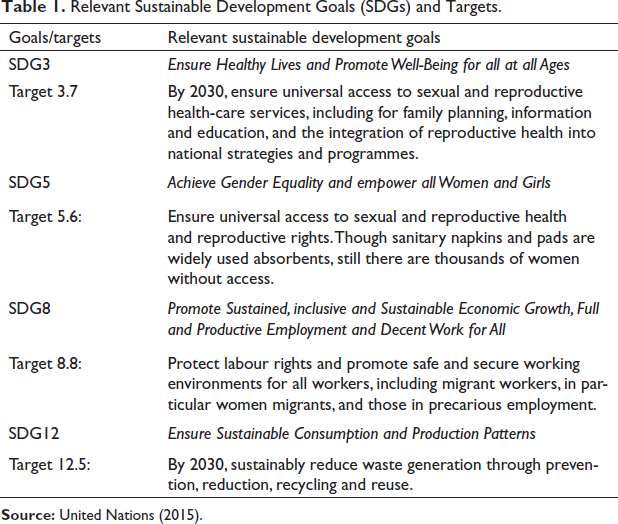
To prevent such environmental hazards, the use of menstrual cup is recommended. Research and reviews consider it as the safe and relatively economical menstrual management method so far (Babagoli et al., 2022; Bowman & Thwaites, 2023; Howard et al., 2011; Pokhrel et al., 2021; Sica et al., 2022; van Eijk et al., 2019). The menstrual cup is a non-absorbent bell-shaped device that is inserted into the vagina to collect menstrual flow. A cup is almost 5 cm and a normal vagina is about 12–15 cm. When a cup is inserted, it creates a seal and is held in place by the walls of the vagina. It is typically made of medical-grade silicone. It collects three times more blood than pads or tampons and needs to be emptied every 6–12 hours, after which it is rinsed and reinserted. After each menstrual cycle, the cup must be boiled for 5–10 minutes to sterilise it. Most manufacturers offer at least two sizes. Cups are reusable for 5–10 years (UNICEF, 2019, p. 30). It is relatively easily adoptable with initial awareness-raising, training (Gölbaşı Koç et al., 2023), affordable and sustainable. As discussed below, Lal Sakhi’s experience and approach shows that positive adoption of menstrual cups empowers women and contributes to environmental sustainability, and specifically to the following sustainable development goals (SDGs) and targets (see Table 1).
Relevant Sustainable Development Goals (SDGs) and Targets.
Lal Sakhi’s Practice Approach/Framework
Lal Sakhi’s practice approach/framework is evolving through building its interconnected ‘Change Agents’ Movement’ with the Degradable Hygiene management And Recycling Training Initiative (DHARTI). Field activities under each one of them reinforce the other. Not only ‘DHARTI’ is an abbreviation, but it is also a Sanskrit term, meaning Earth. As discussed under the philosophical foundations—empowering women and environmental sustainability—symbolically and literally the framework has a spirit of fighting for Mother Earth and fighting for women through building ‘Change Agents’ Movement’ and actively engaging women and girls and other supporters in the DHARATI. Lal Sakhi’s practice framework consists of seven steps as discussed below. These are approaching, awareness-raising, acceptability, availability, affordability, adaptability and follow-up.
Step 1: Approaching
This is an initial important step in which Lal Sakhi purposively and proactively identifies target groups and or communities based on familiarity, professional judgement of disadvantage and need of the community, the change agent’s views, likely response or referral by reliable stakeholders. Government and nongovernment organisations, local governments, community groups, philanthropies may also approach Lal Sakhi to initiate DHARTI in their area. Initial meetings are held to clarify expectations and discuss what is involved and confirm their interest and commitment to go ahead with DHARTI.
Step 2: Awareness Raising
Awareness of menstrual cups enhances its usage (Varghese et al., 2023). Awareness-raising with individuals, families, groups, communities and institutions is a beginning step to discuss the concept of DHARTI and its benefits for menstrual health and comparative advantage. Change agents raise awareness with empathy, understanding initial reticence and inhibitions, careful listening and time for questions and clarifying doubts. After building initial rapport with the target audience, change agents draw on Lal Sakhi’s Information Education and Communication (IEC) materials in group awareness sessions. It also includes awareness of a range of alternative practices (Plastic based sanitary napkins, Bamboo/banana fibre based sanitary napkins, layered used clothes, cloth pad, hay ashes and leaves, Tampons and disposal period panty) and the existing product, menstrual cup, as a proposed solution. Where necessary, individual consultation sessions with women beneficiaries, sometimes even with their family members like husband, father, mother are conducted. Cost of menstrual cups, comparative advantage and financial provisions are discussed as they can access a menstrual cup by paying 5% of its cost initially. Lal Sakhi’s policy is not to distribute menstrual cups freely except for women in institutions, sex work and with disability.
This policy helps women appreciate the value of the product and DHARTI, and participate in it by contributing to it. The idea behind purposeful awareness-raising is to motivate them and take informed decision as to whether to use the menstrual cup or not. ‘Deep brain sharing method is followed to demonstrate comparative merit of the proposed solution and its benefits in terms of comfort, less cost and participation in work and schools. After sharing the necessary information about the use of menstrual cups and maintenance, it is important to allow adequate time to digest the information, reflect on their menstrual health situation and pros and cons of using menstrual cups. As there are other alternatives, it is important to respect their choices and decisions, whatever it is, and support them. Awareness-raising phase and time required to do so depends upon the field situation and the nature of target groups.
Step 3: Acceptability
Acceptability includes providing practical guidance. After reflecting on information received in the awareness stage, when women and girls decide to use menstrual cups for managing their menstrual cycles, acceptability step begins. Depending upon the need and suggestion, it includes individual, family, group and community counselling sessions. By employing the materials developed in DHARTI, training is provided to women and girls as to how to use menstrual cups, dispose waste, clean and sterilise and reuse. As each individual’s situation is different, where possible individual attention is given and information is repeated to the satisfaction of the cup users. It is also important to understand and appreciate initial anxieties and concerns and genuinely support them.
Step 4: Availability
This is a critical step because after becoming aware of the use of menstrual cups and reaching a mental state to accept them, if menstrual cups are not available, it can frustrate and disappoint women and girls. Thus, under this step, change agents should ensure that menstrual cups are available in villages and towns where women have accepted to use them. This step is a question of managing demand and supply without disruption. Information and communication are crucial as users need to know the place of collection or details of delivery to their homes.
Step 5: Affordability
This is a critical question and concern, particularly in rural areas where women have not incurred any expenses in managing menstrual cycles as they have mostly managed with conventional methods such as the use of clothes, paper, ash, etc. Now, it is going to cost them and can they afford it? As discussed under awareness-raising, change agents will clearly explain the cost of a menstrual cup and financial provisions to access it. Users may purchase it by 100% of its subsidised cost of I200 (US$1= I82) or just pay 5% of it, that is I10, with an agreement to pay the remaining cost in monthly instalments over 19 months (Indian Express, 2022). It is claimed that Lal Sakhi is the first NGO in India to organise financing of menstrual cups at low cost and make them available in rural and tribal areas so that women below poverty can afford it. When necessary, it also involves explaining reduced cost in comparison to modern and environmentally risky menstrual products.
Step 6: Adoptability and Adaptability
Under this step, change agents focus on translating the accepted idea into practice. Using diagrams and pictures, and the cup, detailed steps of using the cup are discussed, including cleaning, sterilising and storage. It also involves counselling of women individually and in smaller groups with the aim to understand their hesitations and fear (if any) and encouraging them to use menstrual cups. Both adopting to use the cup and adapting to it are discussed.
Step 7: Follow-up
This step is crucial to ensure that follow-up support is available. Change agents monthly connect with users as a cadence to check if they are facing any issues with the usage or if they have any queries. Regular home visits in rural areas are crucial at least in the first 3 months to check that women and girls are able to use it with ease and additional support and guidance is provided if they need it.
Training Change Agents and Forming Self-help Groups
Along with this practice framework, Lal Sakhi follows two important mechanisms to implement the framework. First, it uses the train-the-trainer approach and selects a group of change agents, who are systematically trained to understand and implement the framework in the field. This also helps to build the Change Agents’ Movement.
Second, drawing on the ideas of self-help groups, change agents engage in forming self-help groups of menstrual cup users to reinforce relevant steps of the framework and also share experiences of the use of menstrual cups and support each other. This initiative has occurred on pilot basis and has the potential to expand it.
Lal Sakhi’s Implementation Areas and Achievements
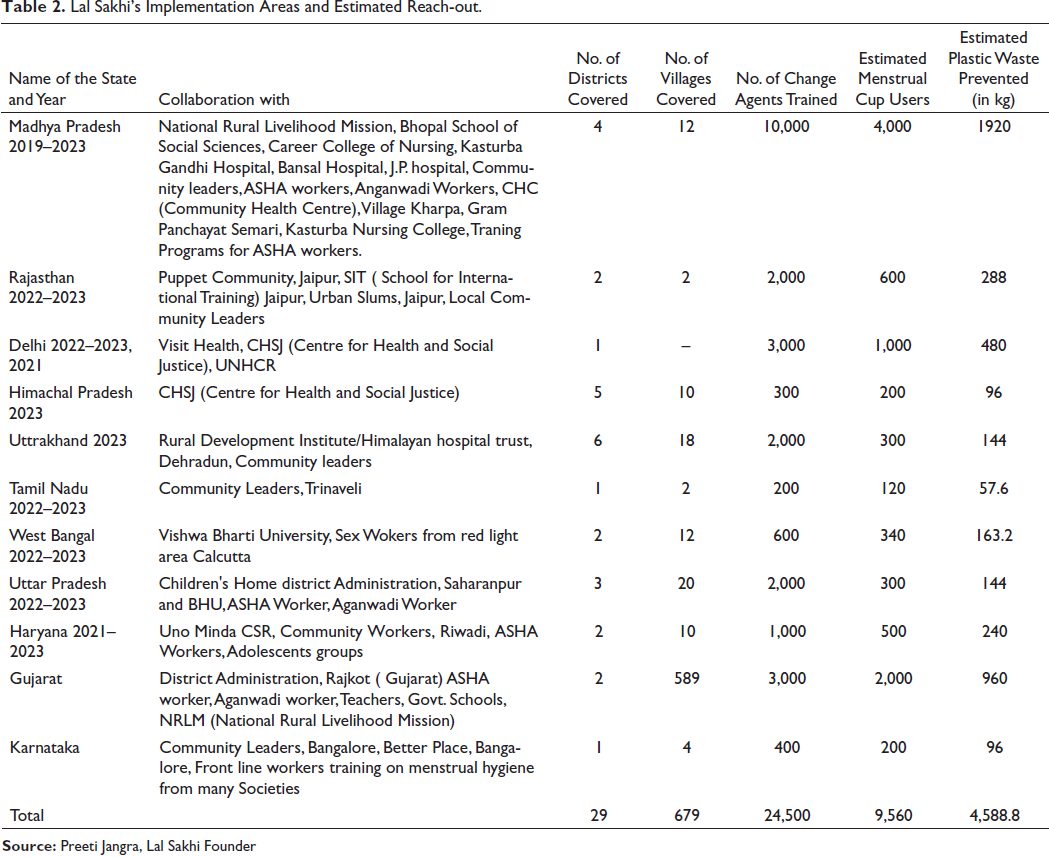
Table 2 shows that as of July 2023, Lal Sakhi is working in 10 states of India and the National Capital Territory of Delhi by collaborating with government and nongovernment organisations, and communities. Further, it may be seen from Table 2 that Lal Sakhi is operating in 29 districts, reaching out to 679 villages. It has trained 24,500 change agents and that work has resulted in 9,560 cup users, who have prevented nearly 4,600 kilograms of plastic waste. This is a significant contribution to achieving the relevant sustainable development goals (see Table 1) to reduce global warming and protect our environment. The number of change agents and cup users suggest that to prepare one cup user, more than two change agents are needed. Why this is so needs to be further explored.
Lal Sakhi’s Implementation Areas and Estimated Reach-out.
Internship/Placement Opportunities
Lal Sakhi has also provided opportunities for a number of students from multidisciplinary professional backgrounds such as social work, medicine, law, health, media, agriculture, Public Health, Health Administration, Business School, Humanities, Home Science, Gender Studies and management from several educational institutions to apply their knowledge and skills in the field so as to prepare personnel for professional practice. For example, students from leading educational institutions such as the Tata Institute of Social Sciences, India, Delhi University, Banaras Hindu University, Indian Institute of Foreign Trade, Calcutta, India, Rush University Medical Centre, Chicago, US and Charles Sturt University, Australia have approached Lal Sakhi to provide placement opportunities for students. This article is an outcome of one such placement arranged by Charles Sturt University. Since 2020, 193 students from 31 universities across the world have been interned with Lal Sakhi—The Women’s Voice Foundation.
Value for Money
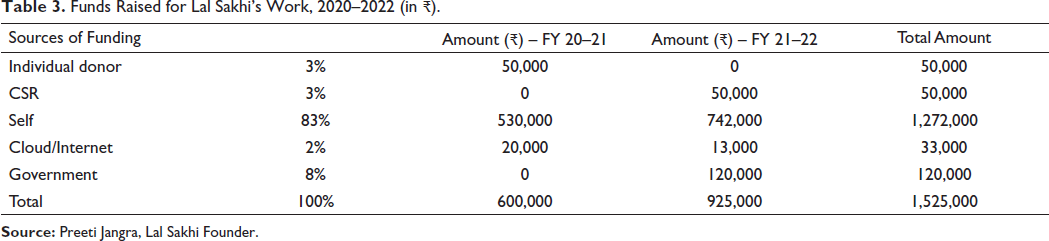
‘Value for money’ connotes ‘reducing the cost of resources used for an activity without compromising the quality (economy), increasing the output for a given input (efficiency), successfully achieving the intended outcome from an activity (effectiveness) and reaching out to different disadvantaged groups (equity)’ (Jackson, 2012, p. 1). Table 3 shows that over a period of two years, 2020–2021 and 2021–2022, from different sources Lal Sakhi has raised D1,525,000 (D82 = US$1). Before discussing the value for money, two observations are noteworthy: First, contributions from the government, corporate social responsibility and Cloud/Internet only constitute 13% of total funds raised. The Lal Sakhi founder and the co-author of this article is contributing her own funds (83%) to the work. I (first author) was surprised to see these figures, and wondered, why should the founder contribute her own income to the extent of 83% of total funds raised. While this shows the founder’s value orientation, generosity and commitment to the cause, this funding pattern may not be sustainable.
Funds Raised for Lal Sakhi’s Work, 2020–2022 (in ₹).
It is certainly inspiring for others to do more. Particularly, governments and the corporate sector, which announces profits year-over-year and need to contribute more.
In Lal Sakhi’s work, it is difficult to estimate value for money. A rudimentary calculation (dividing the total funds raised by total beneficiaries) suggests that the cost of per cup user is D160, less than US$2, and the cost of preventing per kilogram of plastic waste is D332, less than US$4. Please note that these are not accurate calculations as they overlap. In addition, there are social, awareness and long-term environmental benefits, which may be estimated by using appropriate models. Reaching out to women and girls in rural and remote areas and indigenous populations helps them to increase their workhours and attendance in schools. Thus, from economy, efficiency, effectiveness and equity perspectives, our elementary informed view suggests that Lal Sakhi’s work offers value for money. Further systematic research is recommended to confirm these initial findings.
Challenges
Lal Sakhi faces two types of challenges in its work. As mentioned earlier, the first one relates to the lack of awareness and beliefs, attitudes, cultural taboos, myths, untouchability and inhibitions related to menstrual management, and difficulty in opening the sensitive topic in some cultural contexts (Jagdale & Jagdale, 2018). Similar issues were identified by Pokhrel et al., (2021) in their pilot study in Nepal. Many women and girls are subjected to restrictions because of menstruation. For example, some of the major taboos include: Menstruation and menstrual blood is dirty and should be hidden; not allowed to enter the prayer room and or the kitchen; belief in its impurity and thus any food they prepare is not clean; shame and embarrassment associated with evil spirits; burying clothes used during the menstrual cycle so as to not get contaminated; and not allowed to leave the house and should remain indoors.
Although there is some educational material available, Lal Sakhi’s work suggests that there appears to be a disconnect between parents’ and teachers’ expectations regarding who will introduce these topics to adolescents due to cultural reasons discussed above. Second relates to administrative matters of managing a new NGO, Lal Sakhi. Working in rural/tribal areas is cost and time intensive in terms of time and travel involved in reaching to rural and remote areas. Raising adequate funds to meet the cost of expanding work is an ongoing challenge. As pointed out earlier, it may not be appropriate for the founder to contribute bulk of her income for this cause. Instead, governments and corporates need to do give more. While it is a good approach to partner and collaborate with a range of agencies, working with government departments sometimes involves a long wait and requires patience.
Conclusion
As per the plan, this article has presented the profile of Lal Sakhi in terms of its aims and objectives, philosophical foundations, approach/framework followed in the field, implementation, reach-out, achievements and challenges. The article is mostly descriptive, but not analytical, and that is not its purpose, though it may provide a basis for such work in the future. There are also similar organisations such as Aakar Innovations (
Lal Sakhi’s flexible approach/framework is in its initial stages of experimentation and it needs to be further tested, proved and improved depending upon the field contexts. Once women and girls in rural/tribal areas accept the idea, and are trained, they are able to adopt menstrual cups in place of conventional methods. But those who are used to modern menstrual management products, it is somewhat challenging to change their mindsets to adopt menstrual cups. This issue requires further exploration.
About three years of existence of an organisation is relatively a very short time to gauge and claim the impact of the work. Yet, based on facts, Lal Sakhi can claim the impact it is making in the lives of women by providing a choice of using menstrual cups and thereby contributing to reduction in plastic consumption and disposal, and to gender and environmental justice. It is also building the movement of change agents. Its initial innovative work has attracted credible media attention
1
from the Indian Express (an Indian leading Newspaper) and the BBC (British Broadcasting Corporation). Its work is unique and innovative because it is:
Building a Movement of Change Agents The first NGO in India to finance menstrual cups to enhance access to it by women and girls in rural and tribal areas. Partnering with government projects to enhance menstrual health of women. Initiating to form self-help groups of menstrual cup users.
The nature of innovative work in the field and the initial impact suggest that Lal Sakhi has great potential for making a difference in the lives of women and girls, and contributing to environmental sustainability and the SDGs. By the end of 2023, Lal Sakhi aims to mobilise one million menstrual cup users. But careful follow-up and scaling up requires significant commitment of resources by GOs, NGOs and the corporate sector. This is the challenge its founding director and the co-author of this article, Ms Preeti Jangra, addresses on a daily basis and hopes that these agencies will come forward to make their resource commitments to support the noble cause, empowerment of women and environmental sustainability.
Footnotes
Acknowledgements
An earlier version of this article was presented at the 9th ICSD Asia Pacific Biennial Conference on Sustainable Development Efforts in Times of Crises organised by the School of Global Studies, Thammasat University, Thailand, 29 November – 1 December 2022.
Declaration of Conflicting Interests
The authors declared no potential conflicts of interest with respect to the research, authorship and/or publication of this article.
Funding
The authors received no financial support for the research, authorship and/or publication of this article.
