



Abstract
Prior to the election of the Labor Government in May 2022, consecutive Australian Liberal–National Coalition Governments argued that local community leaders and organisations endorsed the introduction of the restrictive cashless debit card (CDC) in multiple trial sites. As a result, the CDC policy was presented as a meritorious example of a co-designed policy model based on collaboration with local communities. This article explores this assertion by examining the views presented by local community groups via written and oral submissions to six parliamentary inquiries into the CDC from 2015 to 2020. Our findings suggest major divisions across community groups within the CDC locations. In four of the six inquiries, most community group submissions opposed the introduction or expansion of the CDC. However, these views received cursory recognition in the inquiry reports, with little influence on policy. This article concludes that the CDC policy is more accurately conceptualised as a centralised policy imposed by the government on local communities without considering local views.
Introduction
Parliamentary inquiries are frequently established by Australian governments to address contentious policy issues. However, there has been only minimal analysis of their impact on policy debates and their influence on resulting legislation. Studies suggest that governments are more likely to endorse some of the majority recommendations rather than the minority recommendations of inquiry reports, but in most cases even the majority views seem to have limited formal influence on subsequent policies (Mackay & McCahon, 2019; Mendes & McCurd, 2020; Monk, 2012). In Australia, there has been limited exploration of the specific influence of public submissions to inquiries on report recommendations and subsequent policy outcomes. With this in mind, this article interrogates the opinions expressed by local community groups (reflecting views from specific local CDC sites or the wider state or territory in which the site was based or from multiple sites) via written and oral submissions to the six Australian parliamentary inquiries into the cashless debit card (CDC) from 2015 to 2020. The CDC is one of a number of compulsory income management (CIM) measures introduced by Australian governments since 2007 as part of a broader welfare conditionality agenda (Curchin et al., 2021). CIM refers to the quarantining of a fixed percentage of social security payments, usually somewhere between 50% and 80%, via a debit card (initially called the BasicsCard) in order to discourage spending on drugs, alcohol and gambling and reduce associated violence and social harm.
CIM was initially introduced by the centre–right Liberal–National Coalition government as part of the Northern Territory Emergency Response in 2007, a Federal Government policy intervention designed to address disproportionate levels of violence and social disadvantage in Indigenous communities and then extended by the succeeding centre–left Labor government to a number of new locations across Australia (Mendes, 2018, 2019). An additional type of CIM known as the Cape York Welfare Reform (CYWR) initiative was also introduced in partnership with Indigenous community leaders in the Cape York Region of Queensland (Scott et al., 2021).
Based on the findings of an inquiry into Indigenous employment and training programmes, the CDC underwent a trial in the locations of the Ceduna region in South Australia and the East Kimberley in Western Australia (WA). Subsequent legislation broadened the CDC trial to the Goldfields region in Western Australia (WA), the Hinkler region in Queensland and later Cape York in Queensland and the Northern Territory (NT). Differing from previous types of CIM, the CDC typically quarantines a higher percentage (80% compared to 50%–70%) of social security payments; however, this has varied across the CIM locations of Cape York and the NT. A key difference between the earlier-introduced BasicsCard and the CDC is that it does not restrict the purchase of pornography or tobacco (Department of Social Services [DSS], 2021).
As of June 2022, there were 17,382 CDC participants across the six sites, of whom approximately 50% were Indigenous Australians, including a sizeable majority in Ceduna, East Kimberley, Cape York and across the entire Northern Territory (DSS, 2022).
Continuing political and ideological contention has surrounded the CDC since its introduction, broadly reflecting individual versus structural interpretations of disadvantage (O’Keeffe & Papadopoulos, 2022) within and beyond the programme locations. There are widely varied views on the extent to which the CDC has achieved its core objectives and whether the official government evaluations have been effective in measuring outcomes (Hunt, 2020); the degree to which the social costs pertaining to shame and stigma outweigh stated benefits such as reduced substance abuse (Roche et al., 2021); if the major funding commitments of the CDC are justified or if money would be better spent on more holistic and less punitive social service programmes; whether the disproportionate impact on Indigenous Australians and their communities constitutes racial discrimination (Bielefeld, 2021; Klein, 2020); and finally if the measures have been introduced via a genuine partnership with local community leaders and organisations or alternatively involve a centralised paternalistic process imposed on communities, including particularly CDC participants (Mendes, 2018, 2019).
Top–down paternalistic approaches that seek to legitimise government agendas and control rather than prioritising participation by service users at all levels of policy and practice development, decision making and implementation have been widely criticised as restricting agency and likely to result in poor quality outcomes (Harris, 2018). Those approaches utilise a deficit-based model, which arguably pathologises disadvantaged groups by targeting changes in individual character and behaviour rather than addressing wider systemic and structural causes of inequality (Beresford & Carr, 2018).
In contrast, bottom–up ‘participatory and democratic’ approaches that utilise the lived experience knowledge of service users can arguably enable more equitable and effective policy and service planning outcomes (Beresford & Carr, 2018, p. 1). For example, co-design, which is sometimes called co-production, designates a bottom–up policy development process whereby policymakers partner as equals with often-marginalised groups such as social security recipients. Their experiential knowledge and capabilities are utilised via a process of mutual education to define a social problem, identify needs and objectives to be met, plan and then implement a service and evaluate the outcome. Co-design processes highlight the importance of enabling participation by diverse groups, ensuring access for all who want to participate. Overall, the result of a co-design process should be subject to democratic negotiation with participating stakeholders and cannot be predetermined by government authorities (Carr, 2018; Yeates & Amaya, 2018).
The former Australian government consistently insisted that the CDC was introduced via a mutually respectful co-design process in partnership with community leaders and other key stakeholder groups in each site and enjoyed strong local community support (DSS, 2016; Fletcher, 2019). In December 2020, the then Minister for Social Services, Senator Ruston, tabled a statement signed by community leaders from the four trial CDC sites highlighting the effectiveness of the CDC, demanding that it becomes a permanent programme (Ruston, 2020).
But the opposition parties such as the Labor Party (now elected to government in May 2022) and the Greens and welfare advocacy groups such as the Australian Council of Social Service (ACOSS) argued that communities were sharply divided on the merits of the CDC and that government consultations have failed to engage many community members, including particularly CDC participants (Burney, 2019; Siewert, 2018). The official evaluation of the CDC in the sites of Ceduna, East Kimberley and the Goldfields Region also acknowledged concerns about the effectiveness of consultations with key groups such as CDC participants and particularly criticised the lack of discussion around further CDC policy direction and planning (Mavromaras et al., 2021).
Methodology
This study adopts a document analysis approach with the objective of examining the views, positions and credibility of the interpretations of the CDC policy process through analysing the views expressed by representatives of local community organisations (and in several cases, individuals that represent broader community opinion) through the written and oral submissions to the six Commonwealth parliamentary inquiries into the CDC from 2015 to 2020. It takes a particular focus on local (non-Indigenous) community groups and spokespersons’ contributions, included on the basis of representing views from a particular CDC site or the wider state or territory in which the site was based or views from multiple sites and chosen due to the value of their expert knowledge of social needs in the targeted sites. This analysis specifically excludes the views expressed by indigenous organisations to these inquiries (totalling 95 submissions or 16% of all submissions), which have been subjected to separate analysis. The discrete findings from that study are presented elsewhere (Mendes et al., 2022). In this context, parliamentary inquiries are a tool of parliament whereby a parliamentary committee, consisting of a range of members of parliament from varied political parties and guided by terms of reference, investigates a topic of interest typically via written submissions and presentations to public hearings (Parliament of Australia, 2021).
Analytical Approach
Document analysis is frequently utilised in policy research with the objective of better understanding the content, issues, processes or framing embedded within policy-related documents (Dalglish et al., 2020). Policy-related documents, in the case of this study’s submissions to Senate inquiries, can be considered representative of key characteristics by which society and its functions are understood within varied policy development and implementation processes, as well as how policy meanings and social realities are interpreted, represented, produced and consumed by policy actors informed by diverse values and ideologies (Dalglish et al., 2020).
To examine the submissions to the inquiries under analysis, this study utilised a document analysis approach outlined by Dalglish et al. (2020) called the READ approach, involving; (a). ‘Ready your materials’ involving determining the documents to be subjected to analysis and the scope of the study; (b). ‘Extract data’ via identifying an appropriate method to analyse the documents; (c). ‘Analyse data’ through applying an analytical approach to the documents and (d). ‘Distil your findings’ through determining the key findings developed through the analysis. The document texts were analysed qualitatively, with each submission coded using three key questions to guide the analysis:
Who do these groups or individuals claim to represent? Do they have current or potential income management (IM) users involved in their organisation? What are their key arguments for or against the CDC or IM more generally?
Additionally, we examined the extent to which local community submissions were cited in the inquiry reports and/or appeared to influence the key findings or recommendations.
Documents Subject to Analysis
The documents subjected to analysis were drawn from six inquiries conducted between 2015 and 2020. The documents examined included written submissions, transcripts of public inquiry hearings and final inquiry reports. These are presented in Table 1. Across the inquiries, there were a total of 84 submissions from local community organisations, groups or individuals, representing 14% of all submissions. The other 86% included a large number of submissions from anonymous individuals (titled Name Withheld), national organisations and individual academics and researchers.
Inquiries and Submissions Examined.
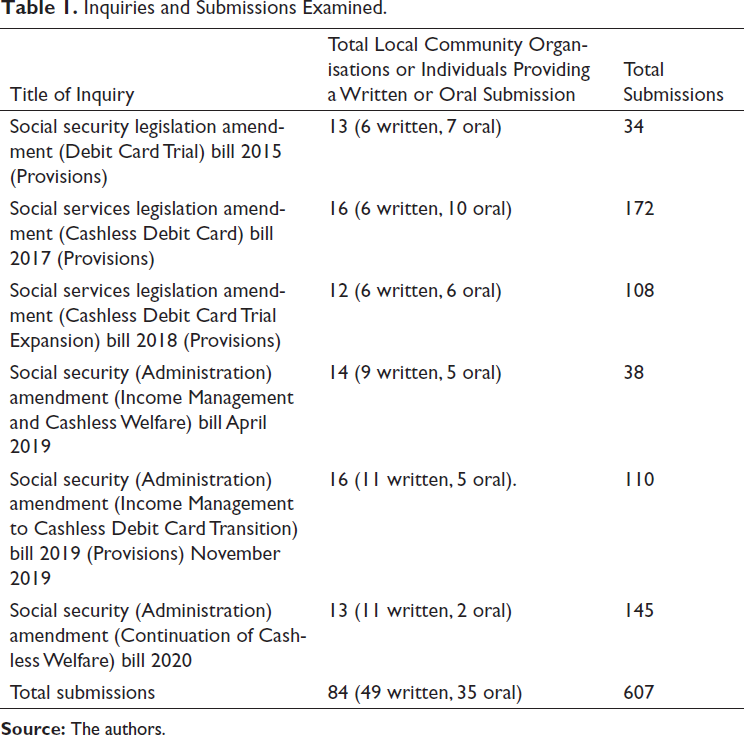
Local community stakeholders included local government (a third level of government in Australia below the national or federal government and the state and territory governments), current local government mayors, and former mayors, local legal and community services, business groups, peak state welfare bodies and online advocacy groups. Submissions were submitted by a range of individuals, groups or organisations representing either professional or community-based organisations or themselves and could be in either written or oral formats. For the analysis process, author three read and recorded all written and oral submissions and reports and completed an initial summary report, which was then further analysed by authors one and two to develop more advanced findings.
Findings
Social Security Legislation Amendment (Debit Card Trial) Bill 2015 (Provisions)
The 2015 Community Affairs Legislation Committee (CALC) Inquiry (February 2016–June 2018) examined the Bill to introduce a Cashless Debit Card trial in the sites of Ceduna and East Kimberley. It was chaired by Senator Zed Seselja from the governing Liberal-National Party Coalition Government and recommended that the Bill be passed in the final, majority report. The Australian Greens presented a dissenting report, and committee members from the Australian Labor Party provided additional comments.
A total of six local community groups/representatives presented written submissions to the inquiry (Community Affairs Legislation Committee [CALC], 2015a). Five of these groups were based on sites where the CDC or IM was implemented. The other group was from Halls Creek, which is adjacent to the CDC site in East Kimberley.
Two groups, the local government District Council of Ceduna (DCC) and the East Kimberley Chamber of Commerce (EKCC), strongly supported the CDC trial. They were both based at CDC sites, and the DCC could reasonably claim to represent a cross-section of the local community. However, given their lack of consideration of alternate critical views on the merits of the CDC, it is debatable whether or not they represent residents who are existing or potential CDC trial participants.
Their principal arguments in favour of the CDC trial included that:
There are long-standing community concerns around substance abuse and related social harms including, public violence and other forms of anti-social behaviour, chronic ill health and multiple deaths (particularly in Ceduna); Current strategies to reduce substance abuse have failed to effect long-term change given the ease with which committed drinkers are able to circumvent restrictions; The CDC will be harder to circumvent due to the limits it places on the availability of cash; The CDC will directly save lives, reduce the level of family violence and divert income to support families, which will contribute to improved child well-being and encourage tourism by limiting alcohol-related violence; According to the DCC, the CDC is supported by the vast majority of the community in Ceduna, and those who are opposed, have vested interests in either wanting to buy drugs and alcohol or wanting to sell those products. In contrast, the EKCC emphasised the need for effective consultation with CDC participants before the commencement of the trial.
Four members of the local Ceduna community and the Shire of Halls Creek opposed the trial. One of the three community members was a potential IM participant, and all four claimed to represent manifestations of anti-CDC sentiment within Ceduna.
Their major objections to the CDC included:
The CDC stigmatises and discriminates against social security recipients and violates human rights; The CDC unfairly restricts consumer choice and will provoke additional crime; Based on the evaluations of the NT income management programme, there is no evidence that the CDC will reduce substance abuse or improve community outcomes; There has been inadequate community consultation, particularly with prospective trial participants; The CDC will potentially place vulnerable elderly residents at greater risk of exploitation; The CDC does not address the underlying causes of substance abuse and gambling, and the funds would be better spent on rehabilitation and financial counselling services.
Seven local community representatives were invited by the Committee Secretariat to be present at the Public Hearing into the Bill (CALC, 2015b). Four members of the Ceduna community opposed the CDC, highlighting the lack of community consultation, the erosion of human rights, privacy concerns, reduced consumer choice, the threat of increased crime by desperate people on the CDC and the failure of the Bill to introduce support services to address substance abuse and other anti-social behaviours.
For example, Suzanne Haseldine attacked the limited consultation with the community in Ceduna, stating:
We have been speaking to people around the town and the area since this was announced and nobody knows of any consultation. So it is only through word of mouth that we have found out. There are quite a lot of people on benefits out here and all of them say the same thing, that they were not consulted (CALC, 2015b, p. 22).
Another concern was that the CDC was restricting the freedoms of a large number of community members in order to address a much smaller number of cases of substance abuse. David Pav opined:
We are probably concerned more about the shotgun or blunderbuss approach to dealing with the problem rather than a surgical attack on the problem. There are 40 to 100 people who are considered as hard-core drinkers and problematic. The mayor has been on record countless times saying that. Why are we attacking the problem with a shotgun rather than targeting those people who are at risk and are the problem? (CALC, 2015b, p. 23).
Three representatives of local community organisations—the Ceduna Council Mayor, the Ceduna Business and Tourism Association and the EKCC—supported the Bill. Their arguments were similar to the content of the written submissions, emphasising the need to address major health concerns including deaths emanating from substance abuse, and the likelihood of wider community benefits such as reduced anti-social behaviour and increased tourism. The EKCC added a caution that the CDC needed to be accompanied by increased detoxification and addiction support services and that there needed to be adequate consultation with key stakeholders, including particularly CDC participants.
The Mayor of Ceduna, Councillor Allan Suter, insisted that the CDC enjoyed strong community support, stating:
As far as Council’s consultation is concerned, we let it be known publicly that we were investigating the trial of the cashless debit card. There has been quite a bit of publicity in the local press and on ABC Radio. We have, through the nine elected members of the Council, consulted extremely widely, and I am very confident when I say that in excess of 95 per cent of the residents of the Ceduna district are supportive of this trial (CALC, 2015b, p. 12).
The inquiry report (CALC, 2015c) included nine direct references to local community views from written submissions and presentations to the Public Hearing. Five cited supports from organisations such as the District Council of Ceduna and the East Kimberley Chamber of Commerce and Industry for the trial on the grounds that it would reduce social harm associated with substance abuse (5, 7 and 9) and enjoyed significant community support (22). The report also cited concerns expressed by opponents of the trial that the blanket approach of the CDC would unfairly target community members who had no history of substance or gambling addiction and that residents in Ceduna and Halls Creek had not been adequately consulted (19, 23–24). Overall, the report seemed to endorse the view of trial proponents that the CDC would be an effective means of reducing substance abuse and related social harm and that the widespread consultation process ensured that diverse community views would be reflected in programme implementation.
In contrast, the dissenting report from Australian Greens Senators highlighted the concerns of trial opponents that consultation processes had been inadequate, particularly in relation to prospective CDC participants. They emphasised the significant level of community opposition to the trial in both Ceduna and Halls Creek (41, 42). The Additional Comments by Labor Senators did not directly cite local community group views.
Social Services Legislation Amendment (Cashless Debit Card) Bill 2017 (Provisions)
The 2017 CALC Inquiry examined the Bill to extend the existing CDC trial in the sites of Ceduna and East Kimberley as well as the expansion of the CDC into the Goldfields Region in WA and Hinkler in Queensland. It was chaired by Senator Slade Brockman from the governing Liberal–National Party Coalition Government, with the majority report recommending that the Bill be passed. Both the Australian Labor Party and the Australian Greens presented a dissenting report.
Six local community organisations/advocates presented written submissions to the Inquiry (CALC, 2017a). Five organisations opposed the Bill. They were the City of Logan Mayor (Logan in Queensland is currently a BasicsCard, not CDC site); the Moreton Bay Access Group; the Say No to the Cashless Welfare Card Australia Hinkler Region online community; the Say No Seven online community (a national online anti-CDC advocacy group claiming 1,020 members) and Kununurra residents (within the East Kimberley site) Bev Walley and Gailene Chulung. The last three groups claimed to represent CDC trial participants, while the first two organisations represented communities in Queensland that may have current or potential CDC or BasicsCard participants among their service users or members.
Their major arguments against the Bill were:
The CDC undermines the human rights, agency and dignity of participants; People with a disability and other likely trial participants were not represented in CDC consultations, and they feel that they have been bullied against voicing their concerns about the trial; The CDC has unintended adverse consequences for participants and their children; A more holistic suite of support services is required to address the complex causes of substance abuse and gambling addiction.
Only one community group, the Wyndham Advisory Group based at the CDC site of East Kimberley, supported the Bill. They argued that the CDC had been effective in reducing socially harmful behaviours associated with substance abuse and advancing child well-being.
Representatives of 13 local community groups presented at the Public Hearing into the Bill (CALC, 2017b, 2017c). Nine of them supported the Bill. They were the City of Kalgoorlie-Boulder and the Kalgoorlie-Boulder Chamber of Commerce and Industry, the Wyndham Advisory Group, the Burrum District Community Centre, the Mayor of Ceduna and the Shires of Coolgardie, Leonora, Laverton and Menzies. All of them represented existing or proposed CDC sites. Their arguments highlighted the prevalence of anti-social behaviour such as family violence and child abuse linked to substance abuse, the failure of existing policies and the potential for the CDC by restricting the availability of cash for purchasing alcohol to reduce social harm. They also asserted significant community consultation and strong public support for a trial.
For example, Jennifer O’Reeri from the Wyndham Advisory Group (East Kimberley) advised that the CDC trial had resulted in positive community changes, including enhanced child well-being as evidenced by higher school attendance, less evidence of childhood hunger given reduced demand for breakfast programmes and increased purchase of baby products. Similarly, Allan Suter, the Mayor of the District Council of Ceduna, opined that the CDC had been highly successful in reducing substance abuse and gambling, enhancing child welfare and lowering crime. He described the CDC as ‘the most successful initiative that’s ever been put in place. We have seen significant improvements in the lives of family members, particularly children… The card actually enjoys a high level of support, we still believe it’s in the nineties’ (CALC, 2017c, p. 25).
Four local community spokespersons opposed the Bill at public hearings. They were the State Labor Party member for Bundaberg, Leanne Donaldson and representatives of the Bundaberg Awareness Group, the No Cashless Debit Card Hinkler Region group and the Say No Seven Online Community. The first three spokespersons were based at the proposed CDC site in Hinkler. They opposed the CDC on the grounds that it was punitive, would widen community divisions, reduce consumer choice and fail to reduce substance abuse or associated anti-social behaviour.
For example, Kathryn Wilkes from the No CDC Hinkler Region group asserted
that there has been little to no public consultation…Minister Pitt is claiming a 70 per cent yes vote for the rollout, yet community surveys that were taken by our local newspapers have consistently showed – the Fraser Coast Chronicle had an 84 per cent no vote in May and News Mail Bundaberg had an 86 per cent no vote in October. This was from the people, not the stakeholders or the government (CALC, 2017c, p. 60).
The Inquiry Report (CALC, 2017d) included 17 direct references to local community views from written submissions and presentations to the Public Hearings. Fourteen of these references emphasised arguments from local community groups in favour of the CDC (7, 8, 9, 11, 13, 16, 18 and 25). Only three referenced the views of the community groups that had opposed the Bill (17, 18 and 20).
Overall, the report seemed to highlight what it called ‘wide-ranging support’ (p. 28) for the CDC and ignore the significant number of local community written and oral submissions that were critical of the CDC. Instead, the report asserted that there was a strong policy rationale for the CDC objectives, that its benefit had been proven by the Orima evaluation of the CDC in the trial sites of East Kimberley and Ceduna, and that consultations had been extensive, resulting in a ‘high level of community support’ (p. 28).
In contrast, the dissenting reports from the Australian Labor Party and Australian Greens cited the views of local community groups (respectively two and one citations, see pp. 32, 42–43) in presenting their opposition to the CDC Bill.
Social Services Legislation Amendment (Cashless Debit Card Trial Expansion) Bill 2018 (Provisions)
The 2018 CALC Inquiry examined the Bill to introduce the CDC to a new trial site in the Hinkler region of Queensland. It was chaired by Senator Slade Brockman from the governing Liberal-National Party Coalition Government with the majority report recommending the Bill be passed. Dissenting reports were presented by both the Australian Labor Party and the Australian Greens.
Six local community representatives presented written submissions to the Inquiry (CALC, 2018a). Five opposed the Bill and they were the Mayor of Fraser Coast Regional Council, Bundaberg Awareness Group and No CDC Hinkler region, No Cashless Card Kalgoorlie and the online Say no Seven Community group. Four of them were based at either the Hinkler or Goldfields CDC sites.
Their major arguments against the Bill were:
It is a paternalistic intervention that erodes consumer choice, privacy and human rights, and it further stigmatises and segregates people already experiencing disadvantage; Lack of adequate community consultation and demonstrated absence of community support. For example, the Say no Seven Community (stating their membership included several hundred Hinkler residents) alleged that the pro-CDC local Coalition MP Keith Pitt had actively excluded social security recipients from local area consultation forums and decision-making processes; High costs associated with administration of the CDC could instead be used to fund badly needed support services in housing/homelessness, mental health, family violence and addiction; Major logistical problems with card operations result in higher bank fees, housing stress and social exclusion; No evidence linking targeted group in the new site Hinkler (i.e. those aged 36 years or younger in receipt of social security payments) with problems of substance abuse and gambling addiction.
One submission from the Shire of Coolgardie in the CDC site of the Goldfields supported the Bill. They argued there had been extensive consultation with the community prior to the introduction of the CDC, logistical problems had been successfully addressed, key support services including financial counselling and housing assistance had been established and the CDC had contributed to a reduction in crime and lower levels of family violence and child neglect.
Representatives of six local community groups presented at the Public Hearings into the Bill (CALC, 2018b). Three of them opposed the Bill. They were George Seymour the Mayor of Fraser Coast, No Cashless Debit Card Hinkler and the Bundaberg and District Neighbourhood Centre. All three were from the proposed Hinkler site. They argued that there had been inadequate community consultation in Hinkler, there was no sensible rationale for either the targeted location or group, and that CDC funding should be redirected to badly needed social support services.
For example, Mayor Seymour argued that the CDC would not empower people, arguing:
In Hervey Bay we have a lot of volunteer services trying to address disadvantage. They do it by respecting people. They do it by respecting them as humans and community members… The church groups that provide breakfast for homeless people on The Esplanade do it like a barbeque, where they can have a chat. They do not do it in the manner of this bill, which takes away people’s personal autonomy and humiliates them (CALC, 2018b, p. 11).
Three local representatives supported the Bill. They were Impact Community Services, Bundaberg and District Chamber of Commerce and Faye Whiffin, the President of the Burrum District Community Centre in Hinkler. All three were from the proposed Hinkler site. They asserted that the CDC would aid the local economy, improve the financial management of participants, give them incentives to seek paid work and reduce child neglect associated with substance abuse.
The Inquiry Report (CALC, 2018c) included 13 direct references to local community views from written and oral submissions. Nine were critical of the Bill, noting concerns about site selection, the suitability of the CDC for addressing youth unemployment, the ongoing stigmatisation of CDC participants as bludgers or addicts, the functionality of the CDC for paying bills and the limited community consultations (10, 15, 19, 20). Only four citations were supportive of the Bill (10, 13–14 and 16).
Yet the report’s recommendation in favour of the Bill downplayed the major concerns expressed by local community groups within the written and oral submissions as cited in the body of the report. The report insisted that there was a high level of community support in Hinkler, the CDC would be effective in addressing major social problems such as youth unemployment and child neglect, and it was appropriate to place some limits on civil rights in order to reduce social harm associated with substance abuse and gambling addiction.
In contrast, the Dissenting reports from the Australian Labor Party and Australian Greens cited the views of local community groups (respectively, five and four citations; see 27–30, 39 and 40) concerning the lack of adequate community consultations and potential negative impact of the CDC in presenting their opposition to the CDC Bill.
Social Security (Administration) Amendment (Income Management and Cashless Welfare) Bill 2019
The CALC Inquiry was conducted in April 2019 and examined the Bill to extend the existing Cashless Debit Card trials in its three sites and to extend the Cape York Income Management Programme known as the CYWR. It was chaired by Senator Lucy Gichuhi from the governing Liberal-National Party Coalition Government with the majority report recommending the passing of the Bill. The Australian Greens presented a Dissenting report and the Australian Labor Party provided additional comments.
Nine local community organisations presented written submissions to the Inquiry (CALC, 2019a). Five supported the Bill including the City of Kalgoorlie-Boulder, Kalgoorlie Chamber of Commerce and Industry (CCI) and the Shires of Coolgardie, Leonora and Laverton. All were based at the WA CDC site in the Goldfields region. They highlighted manifestations of anti-social behaviour such as crime, violence and child neglect linked to substance abuse and gambling addiction and identified the CDC as an effective means of promoting more socially responsible behaviour. They insisted that initial logistical problems had been resolved, and there was majority support for the CDC in their region.
Four groups opposed the Bill. They were the Queensland Council of Social Service (QCOSS), Western Australian Council of Social Service, Say No Seven and No CDC Hinkler. They were state-wide or national groups expressing concerns from local communities in CDC sites. They presented a number of arguments including:
There is insufficient evidence from flawed government evaluation studies regarding the effectiveness of the Card in addressing substance abuse and other forms of anti-social behaviour to warrant an extension of the existing CDC trial; The CDC undermines human rights such as privacy and rights to social security and has directly harmed trial participants, as reflected in increased financial stress, mental health concerns, homelessness, family breakdown and multiple incidents of self-harm and suicide; Stigmatisation and segregation of participants.
For example, the Say no Seven group argued that there had been ‘no inclusive and empirically comprehensive community consultation process undertaken in any current CDC trial in order to gauge participant or public support for the decision to extend trials’. On the contrary, they insisted that the CDC was a blatant example of ‘unilateral top down decision making’ (p. 3).
Representatives of four local community organisations presented at the Public Hearing into the Bill (CALC, 2019b). They were the Kalgoorlie CCI, City of Kalgoorlie, the Shire of Wyndham and the current and former Mayors of Ceduna Council. They represented the three CDC sites in WA and South Australia and were all supportive of the Bill. They argued that the CDC had influenced reductions in alcohol-related anti-social behaviour and crime and associated improvements in child well-being as evidenced by higher childcare attendance rates and increased spending on baby formula and nappies. But they also acknowledged the need for multi-faceted solutions to social problems, including broader social support services as well as the CDC. For example, Bill McKenzie from the Kalgoorlie CCI warned that ‘nobody is silly enough to think that this card is going to be the panacea of all problems. We refer to it as a tool in the toolbox in our submission and we still think that is the case. It seems to be an effective tool’ (CALC, 2019b, p. 36).
The inquiry report included 17 direct references to local community group views (CALC, 2019c). Twelve of the citations were supportive of the Bill referring to the effectiveness of the CDC in reducing social harm such as crime, substance abuse and other forms of anti-social behaviour (13–15). Five citations were critical of the Bill, noting concerns around inadequate community consultation, limitations on the human rights of participants, logistical problems with card operations and the high cost of CDC administration (8, 10, 11, 13).
The inquiry report recommended the continuation of the CDC on the grounds that it was an effective means of addressing chronic social problems. They acknowledged but minimised concerns from community groups regarding limited consultation, urging the government to expand its engagement with local community stakeholders. In contrast, the Dissenting Report by the Australian Greens highlighted community concerns around the problematic nature of CDC evaluations (25 and 26). The Additional Comments by Labor Senators did not directly cite local community group views.
Social Security (Administration) Amendment (Income Management to Cashless Debit Card Transition) Bill 2019 (Provisions) November 2019
The CALC Inquiry conducted in November 2019 examined the Bill to extend the existing Cashless Debit Card trials in its four sites as well as to introduce the CDC into the Northern Territory and Cape York. It was chaired by Wendy Askew from the governing Liberal–National Party Coalition Government with the majority report recommending the Bill to be passed. Dissenting Reports were submitted by both the Australian Labor Party and the Australian Greens.
A total of 12 local community organisations presented written submissions to the Inquiry (CALC, 2019d). Ten groups opposed the Bill. They were Darwin Community Legal Service, Belyuen Community Government Council, Northern Territory Anti-Discrimination Commission (ADC), Law Society Northern Territory, Northern Territory Council of Social Service (NTCOSS), Family Care Shepparton (a Basics Card site in Victoria), QCOSS, Queensland Law Society, No CDC Australia and Say No Seven. The first five groups were local or state-wide groups within the Northern Territory expressing concerns about the transition of existing IM participants within the NT onto the CDC. The other five groups were local, state-wide or national groups that may have current or potential CDC or BasicsCard participants among their service users or members.
These 10 organisations presented the following arguments against the Bill:
The CDC reduces consumer choice, causes financial and psychological stress and erodes the dignity and human rights of participants who are unfairly stigmatised as illicit drug users; The CDC undermines the agency of communities informed by local expertise to determine their own policy solutions; The high administrative costs of the CDC could be more effectively allocated to raising the jobseeker payment rate for the unemployed and funding badly needed support services that address the structural causes of social disadvantage.
Two local groups supported the Bill including the Shires of Wyndham and Coolgardie located in the WA CDC sites, arguing that the CDC was introduced only after substantial consultations with key community stakeholders and had provided beneficial social outcomes for communities. But the Shire of Wyndham cautioned that support services promised alongside the trial in areas such as job creation, childcare and housing had not been adequately delivered.
Representatives of five local community organisations presented at the three Public Hearings into the Bill (CALC, 2019e). Three of the groups opposed the Bill including NTCOSS, Jesuit Social Services Northern Territory and No CDC Hinkler Region. Their criticisms were similar to those presented in written submissions, referring to inconsistent evidence from evaluations, human rights and privacy concerns, reduced consumer choice, negative impact on the physical and mental health of participants and the high cost of CDC programmes. The No CDC in Hinkler group reported that there were no cardholders in the CDC reference group:
It’s all hush-hush, secret-secret. It’s the same with community consultations. The Department of Social Services (DSS) came to Bundaberg and Hervey Bay for one meeting and told everybody how it was going to be. It wasn’t a conversation, they were told how it was going to be (CALC, 2019e, p. 25).
Two local community representatives, former Ceduna Mayor Allan Suter and Faye Whiffin from Hinkler, supported the Bill, suggesting that the CDC was effective in reducing social harm associated with addiction and enhancing the life skills and opportunities of participants and their children. They insisted that there had been thorough community consultations via a co-design process, that problems concerning the design of the card had been addressed and reported substantial community support for the CDC.
The inquiry report included 13 direct references to local community views (CALC, 2019f). Eight were in favour of the Bill, asserting that the CDC had been effective in reducing social harm and enhancing community well-being (9, 10, 12 and 13). Five citations were critical of the Bill, particularly the extension of the CDC to the Northern Territory (11, 15, 16, 17, 19).
The report largely ignored the major limitations identified by local community groups regarding the Bill. Instead, they affirmed the effectiveness of the CDC in reducing social harm and disadvantage in the trial sites and praised the high levels of engagement with community stakeholders in the new sites of NT and Cape York (CALC, 2019f). In contrast, the Dissenting Report by the Australian Greens emphasised growing community opposition to the CDC in Hinkler and concern that income management was increasing hardship in the Northern Territory (34, 35). The Dissenting Report by Labor Senators did not directly cite local community group views.
Social Security (Administration) Amendment (Continuation of Cashless Welfare) Bill 2020 (Provisions) November 2020
The CALC Inquiry conducted in November 2020, scrutinised the Bill which was to transition the existing Cashless Debit Card trials into permanent measures. It was chaired by Wendy Askew from the governing Liberal–National Party Coalition Government with the majority report recommending the Bill be passed. Dissenting Reports were submitted by both the Australian Labor Party and the Australian Greens.
Eleven local community organisations presented written submissions to the Inquiry (CALC, 2020a). Seven groups opposed the Bill. They were NT ADC, NT LAC, NTCOSS, QCOSS, Concerned Constituents of Braddon Community (Tasmania), The Say No Seven Community and No Cashless Welfare Debit Card Australia. The first three groups were local or state-wide groups within the Northern Territory expressing concerns about the transition of existing IM participants within the NT onto the CDC. The other four groups were state-wide or national groups that may have current or potential CDC or BasicsCard participants among their service users or members.
They presented multiple arguments against the Bill including:
The government’s cherry-picking of ambiguous evaluation study findings to support their policy agenda; The failure of the CDC to address issues of structural disadvantage, such as high levels of unemployment; The CDC is directly harmful to participants in that it creates enormous mental health stress, increases financial and housing hardship, causes social stigma and exacerbates their social exclusion.
Four local community representatives supported the Bill. They were the Shires of Leonora and Coolgardie (within the Goldfields CDC site), Allan Suter from Ceduna and Faye Whiffin from Hinkler. They argued that the CDC had reduced anti-social behaviour, driven improvements in financial literacy and enhanced child well-being.
Only two local community groups presented at the three Public Hearings into the Bill (CALC, 2020b). They were Say No Seven and NO CDC Australia. Both groups opposed the Bill, arguing that the CDC causes major distress to participants, including serious physical and mental ill-health. Amanda Smith from Say No Seven argued that the CDC involves ‘legislating segregation of a whole group of people…infringing upon their rights, removing legal protections. We are treating them differently simply because they’re in a different social and economic class’ (CALC, 2020b, pp. 12–13).
The Inquiry Report (CALC, 2020c) included 22 direct references to local community views from the written submissions and Public Hearing. Thirteen were opposed to the Bill, raising concerns regarding the technological limitations of the Card that had adverse consequences for participants and restrictions on consumer choice (17, 18, 19, 20, 23, 24, 27, 28 and 29). Nine were supportive of the Bill, asserting that the CDC had been effective in reducing manifestations of anti-social behaviour and improving child welfare outcomes (11, 12, 13, 14 and 15).
The report argued that the technological problems identified by critics were being resolved by current government initiatives and again endorsed the CDC as an effective strategy for reducing social disadvantage and advancing child well-being (CALC, 2020c). The Dissenting Report by the Labor Senators did not directly cite local community group views. However, the Greens report highlighted the view expressed by No CDC Australia and Say No Seven that there had been no community consultation with current CDC participants (CALC, 2020c, pp. 39–40).
Discussion and Conclusion
Our analysis suggests significant divisions across local community organisations regarding the introduction or extension of the CDC in the trial sites and the transition of existing IM participants within the NT onto the CDC. With the exception of the April 2019 inquiry, a sizeable majority of written community submissions presenting the views of local stakeholders, including CDC participants in the remaining five inquiries, opposed the CDC and the associated government bills. Presentations to the public hearings by local community organisations were more mixed, which is not surprising given that those speakers were selected by the Committee Secretariat in consultation with the then government’s Committee Chair. Overall, a slight majority endorsed the CDC Bills, but critics of the CDC outnumbered supporters at four of the six inquiries.
In addition, there was major contention within local community organisations as to whether or not the CDC measures had been introduced via a partnership model based on substantial consultation with local stakeholders, including community leaders, organisations and potential CDC participants. The findings suggest that many community groups (i.e., a majority of the written submissions and many of those that presented at the public hearings) felt that the consultations with local stakeholders, particularly CDC participants, were inadequate and had in some cases deliberately excluded those directly affected by the CDC programme. Conversely, those local groups supportive of the CDC mostly argued that the community consultations were satisfactory. Community concerns about limited consultation were highlighted in a number of dissenting reports by the Australian Greens and the Labor Party but largely ignored or minimised in the Inquiry reports.
Our findings suggest that the former government’s insistence that the CDC was applied, via a co-designed policy model based on partnership with local community groups and leaders is rejected by many local voices in the CDC sites. Indeed, the contrary view presented by the Greens and the Labor Party, that the CDC policy process involves centralised measures imposed without adequate consultation or mutual decision-making with local communities and particularly CDC participants, is explicitly shared by many community representatives. Notably, the new Labor Party government, elected in May 2022, elected to scrap the CDC and replace it with a voluntary option constructed in partnership with local communities (Rishworth, 2022). A parliamentary inquiry chaired by a government Senator endorsed that proposal (CALC, 2022), and in late September 2022, the government passed legislation to abolish the CDC (Rishworth et al., 2022).
In conclusion, the official inquiry reports from 2015 to 2020 cited both local community supporters and critics of the CDC but mostly downplayed the principal concerns expressed by local community organisations concerning the alleged adverse impact of the CDC on the social rights of participants. Indeed, all six inquiry reports upheld the merits of government legislation aimed at extending existing CDC trial sites and/or introducing new sites on the grounds of prioritising community safety. It seems, therefore, that the majority of local community written and oral submissions had minimal if any influence either on the report recommendations or on associated government policy development and decision-making. In contrast, the respective dissenting reports from the Labor Party and the Greens emphasised the local community critiques of the respective Bills, but their perspectives seem to have exerted no influence on government policy.
Our conclusions have some limitations. In particular, parliamentary inquiries are likely to attract organised community groups that are already involved in policy advocacy and have the skills and resources to connect with policy makers and policy consultation processes. It is not possible to determine how representative the submissions from local community organisations were of the needs and concerns of IM participants at the specific CDC sites. Although some individual IM participants may have presented at the inquiries, many may not have even been aware of the hearings or may have lacked the time or capacity to participate in the inquiry processes. Future parliamentary inquiries dealing with vulnerable groups may need to use a range of innovative co-design approaches to recruit service user participants, including the use of paid lived experience consultants to engage with targeted populations on an outreach basis.
Footnotes
Declaration of Conflicting Interests
The authors declared no potential conflicts of interest with respect to the research, authorship and/or publication of this article.
Funding
The authors received no financial support for the research, authorship and/or publication of this article.
