




Abstract
Amidst shrinking budgets for community development in most of sub-Saharan Africa, the social solidarity economy is touted as a model in local development. This article situates solidarity initiatives and capability-focused outcomes that deliver enhanced livelihoods, social security and community development. The conceptual framing of social theory, social capital and social economy informs this case study with focus on the Ndong Awing Cultural and Development Association, North-West region, Cameroon. The analysis of semi-structured interviews and secondary sources suggests that solidarity networks such as njangis, cooperatives, quarter development unions and diaspora networks promote village-centric development. These overlapping networks generate scarce financial and human resources–essential packages for livelihoods and welfare. Emerging state policy is yet to calibrate these mechanisms of ground-up, mutual development drives. Galvanising these solidarity assets require meaningful co-productionand revamped state−community relations. This article offers a paradigm shift in how village groups mobilise income, capital and financing of village projects, nurtured through human development and agency.
Introduction
An array of state policies have been implemented to salvage emerging economies in sub-Saharan Africa with social solidarity economy (SSE) as a possible alternative (Barkin & Lemus, 2014; ILO, 2020). There is increasing recognition of the role of SSE in sustainable and inclusive development (Steinman, 2017; UNRISD, 2016). In this article, we explore the viability of SSEthrough the prism of a village development association (VDA) and solidarity groups, characterised as village-centric development. The research question is based on two key ideas: we investigate the notion of SSE at the village level and measure outcomes.We then engage with the challenges, question of sustainability and the implications for an emerging state policy. This article is structured as follows: introduction, objectives of the article, theoretical propositions of SSE as an alternative strategy, study context, methodology, data collection and presentation, discussion, implications for emerging state policy and conclusion.
SSE has been advanced as an alternative strategy for pooling scarce resources, particularly in poverty-stricken communities. SSE centres on everyday practices of alternative ways of living, producing and consuming (Kawano & Miller, 2008). Despite its contentious nature and ambiguity, SSE envisions sustainable livelihoods, social enterprises, deviating approaches to economy, participative policy formulation and decent working conditions, consideration of social and human assets dimension, and diverse forms of collective organisation such as cooperatives, networks and unions (Caruana & Srnec, 2013; ILO, 2020; Laville, 2015; Saguier & Brent, 2017). SSE has also been considered as a policy instrument that can ease the attainment of Sustainable Development Goals (SDGs) at the local level (UNRISD, 2016), within the remit of community-based mutual health organisations (Alenda-Demoutiez & Boidin, 2019).
In solidarity-based exchange systems, producers and consumers recognise their interdependence and attempt to create new arrangements for doing business-reciprocally supportive and shielded from problems of market exchange (Moulaert & Ailenei, 2005). Rather than being absorbed on the build-up of capital and ensuring profit accumulation, social solidarity networks emphasise the satisfaction of basic human needs–both physical and social–which are often invisible (Dinerstein, 2015). It is unclear how these social solidarity networks are positioned in improving livelihoods and service provision in resource-constrained communities. At a time of increased clamour for citizen-driven alternatives for the dominant neoliberal economic model, SSE and relational networks provide a pathway to re-focus community development (CD) on everyday livelihood challenges and people’s ecological realities (Fonchingong, 2018). Our mandate in this article is to interrogate the role played by solidarity groups and VDAs as a spatial catalyst. Focusing on the Ndong Awing Cultural and Development Association (NACDA), we argue that these village social networks seek out solution-focused and local capability strategies through a needs mapping and community agency. From a human development perspective, contextual social solidarity strategies enable the scaling up of CD where poverty is rife. An inclusive social development policy can be re-modelled. Harnessing the efforts of village solidarity groups offers opportunities for social justice and an understanding of context specificities in policy making (ILO, 2020).
Based on values of social solidarity, autonomy, cooperation and reciprocity, SSE seeks non-capitalistic economic relations and forms of grassroots socio-economic organisations to transform hierarchical, authoritarian models and operations (Moulaert & Ailenei, 2005; Moulaert & Nussbaumer, 2005). SSE particularly privileges those segments of society which have been historically marginalised; discriminated against; and politically, socially and economically excluded. Often community-based organisations and social movements are embedded. In this way, SSE also comprises a set of indigenous survival strategies developed by marginalised social sectors and non-capitalist cultures (Mbah & Fonchingong, 2019). Dinerstein (2015) suggests SSE as a tool for building up hope–a practice that enables people to envision alternatives; the role of public policies in creating an enabling environment has been explained (Steinman, 2017). This exploratory study encapsulates the proposition of a viable SSE framework in rejuvenating CD. In practice, this builds on indigenous ‘social engineering strategies’, upheld by mutual and reciprocal elements and anchored on everyday spatial realities and ecosystem of the people.
Objectives of the Article
This article wrestles with two key ideas: first, the sustainability of SSE; and second, effective CD as the outcome. We view the sustainability of SSE as the means whilst the injected community spirit constitutes the goal of SSE. These two ideas are contextualised through an outlay of SSE, and the other strand is the emerging state policy in the face of mounting village dynamism to address issues of poverty, social justice and inequality. The following objectives guided the research: Examine the proposition of SSE spearheaded through aVDA Explore the impact of mapped needs on livelihoods and sustainability Find out the attainments, challenges and implications for emerging state policy.
Examining SSE as an Alternative Strategy: Theoretical Propositions
Due to escalating levels of spatial, social and economic inequalities, the viability of SSE as a model for rejuvenation of communities warrants further investigation. A pertinent, yet under-explored challenge is the agency displayed by village associations through social solidarity networks. A bigger concern centres around sustainability, given the myriad overlay of social relations and dynamics embedded. The notions of social relations, based on cooperative organisation, capable of guiding local development are fundamental functions of a social economy (Barkin & Lemus, 2014; Kim & Lim, 2017; Steinman, 2017). This article helps to fill the gap by examining whether SSE as a model is viable or not.
In social economy theory, social enterprises facilitate sustainable local development by including relational assets which embody social capital, bearing on social innovation processes and dynamics (Kim & Lim, 2017). It is argued that the social context and social architecture, including social norms, provide a leverage for social development, enabling legitimate concerns of citizens to be addressed. SSE within this study is conceptualised as new ways of mobilising scarce resources for everyday living, anchored on principles of self-help, inward-looking strategies that are ordered and redistributed for communal benefit. In so doing, local resources are meaningfully deployed, other forms of support sourced, promoted by incremental cultural and relational assets, vital recipes for local economic take-off and social development. As a VDA, the NACDA gravitates a social model that is village centric, people oriented, engineered through community agency and needs mapping. Such a model is hinged on the optimisation of both cultural and relational assets, geared at securing livelihoods and uplifting the economic well-being of the local community.
Within the context of social capital, people are viewed as bonding and forming meaningful relationships, both transactional and supportive in nature (Putnam, 2000). Livelihood diversification enables a reconceptualised debate on peripheral disadvantage and needs to re-focus on contextual development realities (de Haan, 2017). The legitimacy of livelihood diversification gains currency within theoretical narratives on enterprise development and social economy (Kim & Lim, 2017). The solidarity economy paradigm is legitimised through citizen organising and a search for alternative ways of production and redistribution of vital assets and resources for the benefit of members (Dash, 2015; Bateman, 2015).
Addressing the social aspects of development without necessarily obliterating its materialistic tendencies is ingrained in notions of solidarity economics. Proponents of social theory (Coleman, 1990) and social capital (Bourdieu, 1986; Putnam, 2000) converge on the relational structures and institutional norms of social bonds and behaviours, hinged on promoting trust in organisations and communities. The dots are connected through foundational links between morality and internal norms. The concepts of solidarity and social relationships built into social capital theory centre around two core narratives: the bonding capital and bridging capital. The bonding capital discusses relationships in the community or organisation, whereas the bridging capital denotes networks between the organisation and community (Putnam, 2000). A dynamic balance must be struck between social capital and sustainable CD (Dale & Onyx, 2005; Mbah, 2016). Development literature is confronted with envisioning a more acceptable paradigm of SSE underpinned by contextual realities, capability of mobilisation, and levels of accumulation and inequality, particularly in resource-constrained communities. In gaining a nuanced understanding, the solidarity framework represented within this study provides pointers of positives and complexity of SSE as an alternative model. A key factor to consider is how villages map out needs and navigate different spatial realities.
The theoretical proposition signals a need to reconfigure solidarity networks in order to better calibrate the needs and agency of village members. As Bourdieu (1986, p.241) notes, social capital develops incrementally and accrues with individuals’ level of engagement in relationships, which in turn generates the resources people can use, and rely on to pursue their interests. Coleman (1988) averred social capital is embedded within the social structure. Therefore, an understanding of triggers and stressors typified by the social structure is an indicator of progress. Beyond the Keynesian principle of wealth accumulation in society, poverty remains a scourge in most deprived communities. In the light of regeneration, the functional elements of solidarity–cooperation, autonomy and decision-making, social inclusion and social justice–are hinged on productive diversification, thus improving the well-being of every member of the community in a sustainable way (Barkin & Lemus, 2014; Steinman, 2017). Whilst social theory and social capital cannot predict the future, it is inferred that the social and spatial dynamic elements embedded in these theories revolve around the principle of mutualism. Conceptually, we aim to unpick the deficits and capability of the sesocial and spatial networks. We contend that village financing of projects resonates with the key ideas of social capital, bridging and bonding (Putnam, 2000). As a fundamental recipe in human development, village-centric solidarity resides on the efforts of village groups to improve local community access to scarce financing and essential services, all geared for livelihoods improvement. Guaranteeing these initiatives on a sustainable footing remains a daunting challenge.
Context of the Studyand NACDA
Cameroon has a chequered colonial history, firstly, colonised by the Portuguese, then Germany and later splintered between France and Britain with the fusion of majority eight French-speaking and minority two English-speaking regions respectively (Geschiere, 1993). About 40% of Cameroon’s population of over 23 million people live below the poverty line. Human development indicators remain low, with growing levels of poverty, chronically food insecure areas and social inequality, not helped by a corrupt political elite and inept governance (World Food Programme, 2018). Cameroon is an ethnically and geographically diverse country with more than 280 ethnic groups. Although Cameroon has had a period of relative political stability, this is now in tatters with the recent surge in clamour for secession in the English-speaking, North-West and South-West regions (Human Rights Watch, 2019). Cameroon’s economy is projected to grow annually; however, the outcome of this growth remains uneven, and yet to trickle down to large segments of the population. Cameroon’s social development landscape and local government which could strengthen solidarity ventures are obfuscated by the 1990 Law of Association and Decentralisation (Tanga & Fonchingong, 2009). Despite the government’s national development strategy 2020−2030 for structural transformation and inclusive development, it is not clear how this framework will address the development challenges within the context of decentralisation and newly created regional assemblies (Cameroon National Development Strategy, 2020-2030).
Most rural areas are trapped in poverty, compounded by weak infrastructure, unprecedented levels of economic and social dislocation, exacerbated by institutional failings and government wavering on its decentralisation policy promise (Fonchingong, 2018). Although the impact of COVID-19 on rural communities is unknown, it is certain that many communities will be pushed further into poverty (WHO, 2020).
The English-speaking North-West region is renowned for its mosaic of chieftaincy, traditional and local authority-styled structures of governance–a vestige of British colonialism (Geschiere, 1993). The NACDA, established in 1962, is a flagship organisation with an unquestionable social development pedigree, and it has a track record of self-reliant initiatives in the region (Fonchingong, 2013). The NACDA is rooted within Awing village of the North-West region of Cameroon. In terms of its organisational structure, it is represented geographically through operational branches headed by a hierarchical leadership bureau within the village, nationally and in the diaspora. The overall guiding mission of NACDA is embedded in its constitution: ‘uniting around self-reliant development of Awing Fondom, creating an atmosphere of peace, promoting its diverse cultural and social acumen, and projecting a good image of the Fondom’ (Fonchingong, 2017).
Power is exercised through traditional non-elites and authority, headed by the chief and other personnel (mostly government functionaries), who hold executive positions within NACDA and its operational branches (Fonchingong, 2017). Decisions are taken by the NACDA-elected officials in consultation with the village chief and branches, usually at annual assemblies. The 2015 membership records indicate a membership of 63 branches, a women’s wing of 25 branches, a youth wing of 15 branches and 9 quarter development unions. NACDA comprises other social networks (tax groups) nationwide. The membership of the association is open to indigenes of Awing village–Cameroon’s North-West region. The social structure of the community is dominated by the Awing tribe, neighbouring Ngemba tribe and scattered Fulani nomadic communities.
As per the 2015 population and housing census of Cameroon (Cameroon Data Portal, 2015), Awing village has a population of over 55, 000 inhabitants, and it boasts a peasant economy based on subsistence agriculture and the sale of palm wine and agricultural produce such as maize, beans and other food crops. Local food cooperatives and quarter development unions are thriving forms of mutual support for village households. They address livelihood needs such as food sustenance, medical bills and school fees for children. Due to its proximity to the regional capital Bamenda, villagers are able to travel to local and urban markets to dispose of their produce which secures education and employment (Fonchingong, 2017).
Methodology
This study is anchored on the epistemological standpoint and ecological experience of growing up, and coping within a resource-constrained environment, not helped by lethargic governance and limited state intervention in livelihoods, particularly in rural areas. This exploratory case study uncovers the basis of solidarity economics. We utilise a resourceful VDA and explore a re-invention of CD to resolve issues of peripheral disadvantage (de Haan, 2017; Fonchingong, 2018). Exploratory case study constituted the totality of information obtained from varied sources. Exploratory case studies provide insights into and a core understanding of the phenomenon, enabling a deeper assembly of core opinions, motivations and reasons (Yin, 2011), though researcher’s subjectivity, observations and reporting are potential flaws of data generated and analysed (Platt, 1992; Yin, 2011).
A case study as a strategy for a qualitative line of enquiry enables ample back-up in terms of understanding a phenomenon within its real-life context, representing views, and perspectives of participants (Stake, 2008; Yin, 2011). The logic of design (Platt, 1992) revolves around field data, uncovering contextual realities. Ultimately, the end goal is to go beyond data points by looking at more variables of interest, with focus on multiple sources of evidence and data converged in a triangulating style (Yin, 2011).
Data Collection
Demographics of Participants.
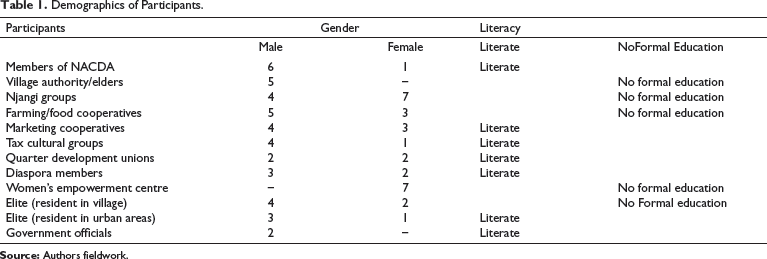
Source: Authors fieldwork.
Emerging Themes and Discussion
VDA as Spatial Solidarity Catalyst
Annual Development Levies by Locality and Gender.
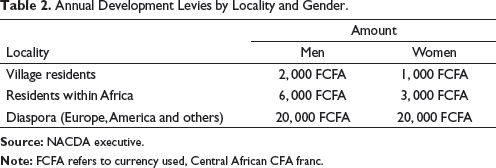
Source: NACDA executive.
Note: FCFA refers to currency used, Central African CFA franc.
Membership of ‘Tax’ Social Solidarity Groups in Yaoundé.
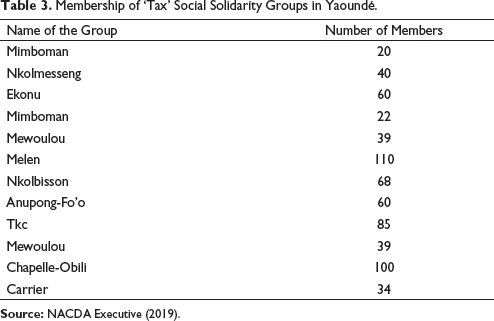
Source: NACDA Executive (2019).
As part of the solidarity groupings, tax cultural groups exist within some NACDA wards (Table 3). The tax groups promote the culture of the village and is a social hub where traditional dance groups and Awing cuisine are organised. Within the tax groups, micro-social networks such as njangis are visible. These cultural assets are directed towards promoting the NACDA CD agenda. Further, part of njangi funds pooled tax groups cover ‘trouble funds’, covering deaths, ill-health, unforeseen contingencies and emergencies (Fonchingong, 2018). Self-help seminars are an integral part of tax groups which provide a platform for information sharing on aspects such as employment, professional advice related to health, education, business start-ups and other socio-economic initiatives.
Village-centric Development
The key question to be discussed here is the role of NACDA in fostering village solidarity development and the factors hindering this process. In this section, we draw some inferences from field data about livelihood-generation activities, the success achieved and the challenges being faced. A multi-layered solidarity framework is utilised to secure livelihoods for villages and communities. However, delivering social development projects for the community remains a challenge for VDAs. Beyond a Marxist orientation of economic organisation to building capable communities, local needs mapping represents a livelihood diversification strategy that recognise contextual realities (Chambers, 2005). In tandem with SDGs, yawning gaps in inequality and social justice can be addressed, through unpicking the interactions of social economy and sustainable development (Hudon & Huybrechts, 2017). Cooperatives (farmer and consumer) are vital forms of resourcing, building capital assets and relational base for members as espoused in Figure 1.
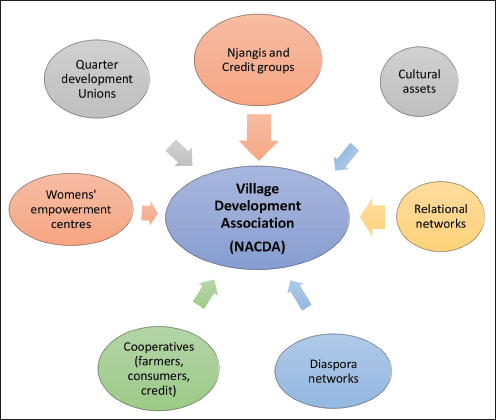
The multi-layered social solidarity and relational networks (Figure 1) cater for diverse interests of socio-economic groups such as women, youths and the elderly. Cultural assets and other repositories of indigenous resources are leveraged by the VDA in collaboration with traditional rulership (village fon/chief). As visible in Figure 1, there are overlapping mechanisms of providing direct and indirect support for every member. Cooperatives offer huge networks of support for production and exchange of goods and services with direct impact on livelihoods. A respondent summed this up, ‘Within our farming cooperatives, we do help one another during planting and harvesting, we rotate in terms of preparing the fields and we take turns to harvest the crops’. Another said, ‘Cooperatives help us to pool our produce together, arrange transport of produce to local and urban markets; sales from our produce enable us to participate in other VDA activities’.
Njangis and Cooperatives
Based on the SSE framework captured in Figure 1, Njangis and cooperatives are a predominant feature of village social solidarity. These relational networks offer members the opportunity to raise seed funds for individual and collective projects in different spatial locations. In the diaspora, njangis generate cash among diaspora communities. Funds generated are ploughed back into individual and community projects touching on livelihoods and well-being which address both personal and community needs. A diaspora participant noted:
Njangis are an umbrella for us to gather, pool together resources and enable members to carry out individual projects. We equally raise funds and support development projects back in the homeland. Equally, we hold diaspora assemblages annually and through the funds raised, we decide on how the money raised is spent liaising with the VDA president back home.
Such relational networks are vital solidarity platforms with direct and indirect benefits for members. It is averred that operating within localised circuits of production, exchange and consumption, SSE organisations and micro enterprises can be beneficial to not only basic needs provisioning but also local economic development (Mendell, 2014; UNRISD, 2016). Another participant captured the tangible benefits of solidarity assemblage in the diaspora, ‘We have helped members solve big problems such as housing, funding and scholarships for higher education, immigration, refugee and asylum claims, childcare costs and assistance with childcare’.
Yet another stated, ‘I have benefited from my njangi and solidarity network through assistance with cutting back on expenses for food; we buy food from wholesalers in bulk, usually at discounted prices, then we share amongst the group, this helps to bring down overall family food costs’.
Still, another participant stated:
When we meet in our social events annually, usually during the summer, it is a good time to interact, share and discuss ideas on how we can move things forward. Usually the host cooks food from our local cuisine, and we can support with drinks. I cannot underestimate the health benefits and mental stability such reunion provides. Members pointed to the social benefits accruing from membership of njangis. A participant stated:
If not for our solidarity njangi, I should have had it difficult when I lost a family member. Everyone rallied even at short notice and pooled together contributions which enabled me to travel back home for funeral rites. Without this support, I would have struggled on my own.
Members also show up for other social events such as births, christening and graduations.
Some diaspora branches have compulsory life insurance schemes for members. These cover difficulties related to ill health, accidents and deaths. Part of the policy caters for repatriation of the corpse upon the death of a member. Solidarity funds are raised to support the family of the deceased. These schemes are prevalent in Latin America where governments are trying to shift responsibility for reducing poverty from the public sector. The poor themselves engage in collective organisation and microcredit programmes (Bateman, 2014). Relying on these opportunities may be ineffective as it deepens participants’ dependency on short-lived programmes without creating a firm handle for assuring basic needs (Barkin & Lemus, 2014). Also, njang is and micro-credit schemes constitute relational assets that are tapped by community members to address individual and community needs. Getting guarantors is a challenge; there are cases of members who default, and these are addressed with additional burden on members. Repeated defaults are referred to the VDA operational branches and eventually to the hierarchy of NACDA for resolution.
Needs Mapping
Needs mapping is an arduous task for VDA sin the pursuit of a livelihood strategy, as well as guaranteeing community cohesion. There are perceived tensions in what constitutes a pressing need, and how such pressing need impacts well-being–both economically and socially. During anNACDA consultation exercise, as indicated by a respondent, the renovation of the Fon’s palace was deemed a pressing need by the VDA; however, community members had reservations as to its importance for ranked priority needs. The VDA’ sposition conjectured the relevance of the palace as a communal habitat and sanctuary–an epicentre of culture and a spatial symbol of community pride. One member stated, ‘The palace is a gravitational force in social development and we as a community look up to it with a sense of pride and identity’. Other members felt differently, ‘I believe our pressing concern is having clean water, schools for our children and pay teachers and retain them’.
Such contentious positions render needs mapping complex. It rekindles the debate on the structure of SSE as spaces for decision-making and deliberation in social development, against the backdrop of social justice and social inclusion (Alenda-Demoutiez & Boidin, 2019). Seeking out viable community-based alternatives in community needs mapping corresponds with the tenets of SSE, build on mutuality and the common good (Dash, 2015). Inevitably, too many demands on the system lead to fracturing; shoring up the capability of communities requires a re-alignment of VDA operational structures that lends itself to relational networks in differential spatial locations–village, nationwide and diaspora (Figure 1).
Rural−UrbanDivide
A rural
Empowerment centres and social hubs are utilised by women to hone their skills, share ideas on marketing and learn new business and production strategies which are some of the noticeable features. A female participant stated:
‘The empowerment centres is our place to share ideas on how we can expand our business; we also learn new skill; ways of doing things that will make our business grow. The centre gives us the opportunity to meet and learn from each other things like meal preparation, traditional dress making, tailoring and so on’.
It is averred that women’s active involvement through SSE can have a significant impact on economic, social and political empowerment (UNRISD, 2016). Women’s energies are unleashed when they collectively engage in enterprise ventures (Mukherjee-Reed, 2015). Evidently, the patterns of production and consumption pursued by SSE organisations and enterprises tend to be more attuned to local environmental conditions than for-profit enterprises (Kim & Lim, 2017).
Scaling-up Incrementally
Although njangis, tax and cooperative groups are used as channels of building up scarce income and other human development assistance, scaling up these social solidarity networks remains a challenge. As testified by respondents’ such platforms grapple with issues of sustainability. One respondent said, ‘We need to think bigger: how we can increase our share of capital so that we can better support each other and our village to grow’.
Additionally, members are concerned about the viability of human and other investments such as time, resources and mutual support in the longer term. Another respondent floated the prospect of global marketing cooperative, ‘We hope one day we can have a big farming cooperative that will enable us sell our goods innational, regional and international markets; this will give us additional funds and insurance when things are not going well in the village’.
Re-investment capacity is a major concern; this has been articulated in the Asian context, and the case of South Korean SSEs is elucidating. Sustainable production and consumption are fostered through core values and principles of democracy, solidarity and social cohesion with considerable potential to reduce inequalities (Kim & Lim, 2017; UNRISD, 2016).
Building on solidarity vibes is important in constructing a viable social solidarity framework. Participants indicated that mutual bonding and a community spirit resonates with central message of not squandering hope. This reinforces an outcome-based and capability-building approach. Through needs mapping, community members find ways of meeting identified needs sustainably. A participant averred: ‘We need to constantly look back at the village, help each other, and seek ways to build bridges, that is the surest way we can inspire ourselves and fulfil our vision’.
Building the blocks of development through community empowerment is positioned as necessary for village-centric development (Fonchingong, 2017).
A revitalisation of cooperative networks within multi-layers of solidarity helps mobilise scare capital. Part of the challenge is to source for funds from external agencies and other organisations. Most participants stated that a social solidarity drive could be used to establish links with external agencies to source for financial resources and expertise in project implementation. Some diplomatic missions such as the SWISS embassy, German Embassy and British High Commission have offered technical expertise and cash injection for the completion of projects such as pipe-borne water, health supplies and equipment for health centres and schools.
Constructing a sustainable financing model remains a huge challenge for VDAs. This requires a streamlined approach and coordination as NACDA mostly operates on an adhoc basis in different spatial locations as indicated in Figure 1. The creation of viable cooperative structures through membership shares form joint ventures with private sector partners. This practice is visible in Latin America and could be a way forward for re-capitalisation and sustainability of SSE. These solidarity groups are vectors of village social development, and emerging state policies could better harness these relational networks.
Implications for Emerging StatePolicy
This exploratory case study unpacks the current neoliberal economic model of development and is failing to address gaps in poverty and inequality. SSE championed by VDAs and NACDA showcases represent an opportunity for communities to redress social development imbalances. This involves tackling individual livelihood challenges and other social problems, besetting communities through needs mapping. Mapping identified needs against a resource-led approach is difficult. A multi-layered approach of needs articulation and agency embeds a sense of communal social justice. This promotes solidarity vibes, though sustainability remains problematic. It is argued that SSE enables the provision of basic services that traditional welfare state systems are no longer able to provide, and the traditional private sector has no interest in providing it (Steinman, 2017).
Public policy and rural development planning have failed to connect these forms of citizen mobilisation in livelihoods improvement. The defining feature of SSE is community centredness geared towards mutual-based activities of community (Alenda-Demoutiez & Boidin, 2019). VDAs are also grappling with spatial realities and variability in scope and distribution of SSE networks and rural−urban dichotomy. These create disaggregated benefits for members with outcomes difficult to quantify. External agencies and other development agencies can engage in evaluation and impact assessments of policies. This will deliver outcomes mapped on the needs of spatial solidarity networks under the operational framework of village associations.
Public policy can calibrate a rural development strategy that entails harnessing the strengths of SSE. The International Labour Organization (ILO) (Steinman, 2017) opined strengthening citizen engagement through an enabling environment for members who primarily rely on these networks. In line with the SDGs’ 2030 agenda, specifically goals 1, 5, 9 and 16, alleviating poverty and reducing gender inequality hinge on mobilising resources for inclusive community development. In attaining the 17 SDGs and set objectives, the local level (village-centric) offers possibilities for resource mobilisation (UNRISD, 2016).
The role of social workers and social welfare practitioners to help communities filter through their needs cannot be ignored. Needs mapping through streamlined partnerships and joint-up working with other agencies, to usefully advocate and address livelihoods and development concerns, are crucial. Understanding the ecosystem, spatial realities, enabling resources to be effectively mobilised, and redistributed based on need will alleviate poverty, thereby lowering inequality. Social services departments and social work practitioners can work closely with these organisations to help with needs mapping, build autonomy and resilience and promote strength-based outcomes through evidence-based analysis. Policy framing should take cognizance of the disruption that is likely to occur from the restructuring of VDAs, and other relational networks that feed into the solidarity framework in different spatial contexts.
A co-production and private−public partnerships underpin the foundation of social solidarity. For members’ livelihoods to be enhanced, streamlined partnerships between the private and public sectors is a possibility. Co-production has been touted to produce better outcomes, but in practice this can be problematic in terms of remit and resourcing (Horne & Shirley, 2009). As captured from the case study, government response to community needs is often met with bureaucratic inertia and lethargy which stifle the implementation of local projects (Fonchingong, 2018). The financing of local village projects through public and private loan schemes and access to banking institutions for most villages would enable cash generation and a savings culture. Others have argued that reclaiming SSE necessitates social enterprise and direct projects with communities; this offers more insights into their problems, enabling an interface between individual and remote community issues that countervail sustainable development (Kim & Lim, 2017; Mendell, 2014).
Public policy realignment through effective decentralisation and co-production between the state, VDAs and intersecting social solidarity structures is a possibility. Partnerships with multilateral development agencies and partners such as ILO, United Nation Research for International Social Development (UNRISD), UNDP, The United Kingdom Department for International Development, Swedish International Development Cooperation Agency, Norwegian Agency for Development Cooperation and the European Union can strengthen village associations.These partnerships would ensure that needs mapping and community agency are aligned to livelihoods improvement. SSE has economic, social and environmental attributes; it involves forms of resistance, mobilisation and active citizenship that can challenge the structures that generate social, economic and environmental injustice (UNRISD, 2016). As evident from Latin America and South Africa, SSE has the potential of creating active citizenship, addressing structural and institutional constraints that undermine development (Dinerstein, 2014; Steinman, 2017). These strategies align with the ILO’s commitment to the advancement of SSE, grounded on its Constitution, the 2008 ILO Declaration on Social Justice for a Fair Globalization and on the 2019 Declaration for the Future of Work.
Enabling VDAs to build a virtual online community will enhance aspects of social capital. The benefits of knowledge exchange and awareness generated through the online presence and ideas of members constitute a good recipe for sustainable development. If solidarity economy is to be rooted within communities, there is a need to harness the benefits of a digital economy through visible online interaction (Kim & Lim, 2017). VDAs can use such platforms to calibrate vibes on social enterprise and policy development. Given the dynamics of sourcing for funds and revitalising relational networks, the tendency is for most projects to be implemented as a one off or sporadic basis. SSE projects are impacted depending on variability in scale, level of participation and viability of social relations. This impedes the efforts of village associations in scaling-up social solidarity initiatives. Building up social capital represents a template for SSE. As argued earlier, Bourdieu (1986, p.241) makes the case strongly; ‘social capital constitute social resources that are accumulated by both groups and individuals, products of effort and work, acquired and transferred, which build up stocks of capital whose value becomes accessible to a group or individual’. However, work ethic and leadership are important parameters that can shift, thereby undermining the mobilisation of social capital.
Conclusion
As an alternative economic paradigm, we have argued that SSE is anchored on the ability of villagers to mutually generate scarce financial and human resources for the benefit of the community.Village solidarity is a paradigm shift in the way villages position themselves to address burning social development concerns. Such a model is underpinned by shared bonds and looking out for one another. Managing these village assets is vital in building resilience and empowerment of marginal groups such as women. VDAs create a platform for self-help, where social relationships are formed and strengthened, building trust and reciprocity. Although members rely on annual development levies, njangis, cooperatives and other networks to buildup financial resources, these forms of capitalisation are not sustainable. Within the framework of social capital theory postulated by Bourdieu (1986) and Putnam (2000), we have argued that the deployment of resources at individual, social and community levels all crystallise in building an SSE. Social capital built on an incremental basis facilitates a collective goal, essential in needs mapping and fostering village-centric development. Public and emerging state policy can calibrate and harness the energy and drive within these village groups through targeted financing and access to banking services. SSE can leverage social justice and inequality as solidarity and mutual forms of support rejuvenate CD, augment livelihoods, enabling social security and welfare needs to be met.
Footnotes
Declaration of Conflicting Interests
Funding
The authors received no financial support for the research, authorship and/or publication of this article.