




Abstract
Social assistance is on the social development agenda of the Southern African Development Community (SADC) member states. It is not only reflected in the Code of Social Security of SADC (2007), but is also anchored in the national legal frameworks and social protection policies of the member states. The implementation realities of social assistance in the region, however, differs. Non-state social assistance makes up for the deficits of state-run social assistance in countries with weak institutions. Countries that have institutionalised social assistance were swift to provide emergency assistance to mitigate the effects caused by the COVID-19 lockdown measures. However, the provided relief has been elusive to many migrants in the region. The implication of this is that without a clear consideration of emergency assistance as needs-based, and separate from social assistance, the region stands a little chance to assist migrants when faced with a disaster such as COVID-19.
Introduction
Social assistance is on the social development agenda of the Southern African Development Community (SADC) member states (see Table 1). It is clearly considered in the Code of Social Security in SADC (2007), and defined as the provision of minimum income support in cash or in kind to persons who lack the means to support themselves and their dependents. Emergency assistance is ad hoc and is spelt out in the Code under special and collective contingencies, where it is stated that the member states should provide for special interventionist approaches to disaster relief at regional and country level. Although the Code is not a binding document, it offers member states a guide and a set of general principles of social assistance and emergency assistance. The COVID-19 pandemic is already putting to test the commitment of SADC member states to their social development agenda. But what is the state of social assistance programmes in SADC, and how suited are they to shield people against the loss of livelihood brought by COVID-19? What are the provisions of emergency assistance that have been availed at national and regional level (in line with the Code of Social Security in SADC)? What are the emerging patterns between the extant social assistance and the emergency assistance in response to COVID-19? Finding answers to these questions is essential to the understanding, and shaping, of social assistance distinctly from emergency assistance in the region, and beyond. This article contributes to filling this gap.
SADC is one of the eight regional economic communities in Africa comprising of 16 member states 1 (see Table 1). Some member states have specified the right to social protection in their constitutions while others have developed and adopted social protection policies. Most of these policies view social protection to include both state and non-state initiatives that provide social assistance, social insurance and access to social services to the poor and vulnerable individuals. 2 The extant literature also shares this view (Devereux & Sabates-Wheeler, 2004; van Ginneken, 2003).
The state-run social assistance dominates the statutory social protection in the SADC. The region has few people with social insurance (ILO, 2017). Contributions towards pensions, health, unemployment and disability are typically made by both employees and employers in the formal sector. More people are, however, employed in the informal sector where social insurance is non-existent. Social assistance, on the other hand, is tax-financed and transfers income ‘in cash and/or in kind to individuals or households experiencing poverty or vulnerability, with the aim of facilitating their permanent exit from poverty’ (Barrientos, 2013 p. 3). Social assistance has taken a prominent role in Africa and is delivered mainly through institutionalised cash transfers, food transfers and public works (UNDP, 2019). This is unlike in the advanced countries, where social assistance is offered by the state as a last resort.
Related to social assistance is the emergency assistance, which is humanitarian, short-term and is in response to crises (Barrientos, 2013). The term ‘safety nets’ was introduced by the World Bank in the 1980s to describe emergency assistance to tide people over a crisis (Independent Evaluation Group, 2011). It was associated with a temporary, rather than institutional, approach to social policy. This, however, changed since the late 2000s. The World Bank no longer distinguishes between the two terms—social assistance and emergency or humanitarian assistance (Grosh et al., 2008; World Bank, 2018). Rather, the term safety net is now used to denote all social welfare programmes—whether short-or long-term (Weigand & Grosh, 2008).
This article follows the approach taken by Barrientos (2013) for two reasons. First, emergency assistance addresses misfortune brought by disasters or hazards, including political conflicts and pandemics. It is targeted to every affected person and does not select based on their socio-economic status or nationality. In contrast, social assistance addresses poverty and vulnerability generated by the structure of the economy and targets the citizens with income below a minimum threshold. Second, emergence assistance operates on a Samaritan principle, that is, on needs-based approach. Its transfers are ad hoc and are typically sourced from donation managed by charities, non-governmental organisations (NGOs) and faith-based organisations (FBOs), and from international assistance. Social assistance operates on a citizenship principle. Its transfers are mostly rights- or justice-based and typically originate from established Ministries of Social Development.
Where state social assistance has deficits in the region, non-state initiatives have been inadequately filling this gap. Community-based initiatives and extended family support have been institutionalised in contemporary Southern Africa (Patel, Kaseke, & Midgley, 2012). These support systems are extensive and diverse depending on the societal, religious and cultural context. Midgley (2011) categorises community-based initiatives into four types. The first is comprised of extended family and kinship support. The second is comprised of community support networks from neighbours, and village heads. The third type constitutes mutual aid associations such as burial societies and rotating credit and savings associations. The fourth type is made up of religiously mandated obligations to assist the poor in the community. Noteworthy is evidence which reveals that even in countries where state social protection is strong, people in need continue to receive assistance from community social support systems (Power, 2010).
International donors and NGOs have also been active in the provision of social assistance in the SADC region, particularly in countries with weak social assistance (see Nino-Zarazúa et al., 2010). Their presence in the region is notably visible in countries such as the Democratic Republic of Congo (DRC), Malawi, Zambia and Zimbabwe. These countries have experimented with cash transfer programmes under donor financing, with rising government involvement and financing in recent times (UNDP, 2019). Yet a lot of poor and unemployed people in these countries remain outside the reach of social assistance. Resultantly, they migrate to countries within the region that have better standards of living to seek employment (Mlambo, 2018).
As SADC continues to move closer towards its aspirations of free trade and economic integration, the issue of migration or free movement of people will remain prominent. A significant proportion of migrants are found in migrants receiving countries in the region (Crush & Dobson, 2017). The migrants are a mixed type. Some are skilled, documented and are employed in the formal sector, while many are unskilled, undocumented and operate in the informal sectors (Crush, 2017). When lockdown measures in response to COVID-19 were introduced, a lot of livelihoods were lost in the informal sector, including those of migrants. The article contributes to literature by collating social and emergency assistance that have been provided to individuals before and during COVID-19 to show how both types of assistance have been elusive to migrants in the SADC region. The article argues that without clearly considering emergency assistance separately from social assistance, the region stands a little chance to assist migrants when faced with a disaster such as COVID-19 pandemic.
COVID-19 and the Effects of Lockdowns
COVID-19 was first recorded in the African continent in February 2020 (Africa News, 2020). Since then, the virus has spread to all African countries. It has been concentrated most in South Africa which, as at 20 May 2020, had the highest number of cases in Africa. The rest of the SADC member states had less than a thousand reported cases each. Notwithstanding the low recorded cases, most SADC countries responded swiftly by implementing various measures to contain the spread of the virus, with a country such as Lesotho embarking on lockdown even before recording a single case (Africa News, 2020).
Embarking on lockdowns meant that millions of people were prevented to leave their homes except for getting essential goods and services. Essential supplies, grocery shops, banks and pharmaceuticals were the only activities permitted to operate in most parts of the region while non-essential activities were not permitted to operate for the entire duration of the hard lockdown. The closure of non-essential services had several unintended economic and human consequences, which could have lasting devastating effects on the lives of the poor. The livelihoods of cross-border traders, local and migrant daily labourers, domestic workers, self-employed workers, street vendors and waitrons have been disrupted. Most of these workers live from hand to mouth and disrupting their activities by even a day could mean food deprivation on their part.
Africa has the largest size of the informal economy, which is estimated to employ 85.5 per cent of workers (ILO, 2018). Most of these workers have a relatively high number of dependents compared to advanced countries. For instance, the ratio of non-working age to working age population in Africa is 80 per cent compared to 74 per cent in the developed economies (UNCTAD, 2017). The structure of the dependency reveals a dire picture for the African workers. In developed countries, a higher dependent population is older persons, who are typically covered by pensions. In Africa, a higher dependent population is children, who are rarely covered by social protection. This shows that any loss of livelihoods due to COVID-19 lockdown has extended effects on a lot of children in the region.
The lockdown in migrants receiving countries, such as Botswana, Namibia and South Africa, has destabilised not only the migrants in the informal sector, but also the flow of remittances to recipient countries. The region has over 5.3 million documented workers living and working outside their country of origin (Parshotam, 2018). South Africa, according to Parshotam, hosts about 58 per cent of these migrant workers. The documented and undocumented migrant workers from Zimbabwe working in South Africa are famous for sending food parcels through an informal courier service known in the local language as Malayitsha (Nzima, 2017). These have all ceased to operate as borders between South Africa and Zimbabwe closed due to lockdowns, with serious consequences on the food security of remittance receiving households in Zimbabwe.
The Code of Social Security in SADC (2007) makes provision for lawfully employed migrants to participate in the social insurance schemes of the host countries. Their participation means that migrants can contribute towards social insurance and equally benefit alongside citizens of the host countries when certain insured events occur. Evidence emerging from South Africa is that most migrant workers who were laid off due to COVID-19 lockdown, who were contributing to the unemployment insurance fund (UIF), were not being paid their benefits (Business Insider, 2020).
Generally, the SADC region has a low coverage of social insurance not only because the majority of workers are employed in the informal economy, but also because those workers employed in the formal economy are also not covered. For instance, of all the SADC member states, only three have unemployment insurance in place and these are Mauritius, Seychelles and South Africa (ILO, 2017). Consequently, it is not only the informal workers who are affected by the lockdown; the formal workers who were laid off by distressed companies, and do not have unemployment benefits to turn to, are severely at risk of hunger as well.
Social Assistance ex ante COVID-19
State-run Social Assistance
The legal framework of state-run social assistance in the SADC region is not uniform. The right to social assistance is specified to citizens and permanent residents only in South Africa. 3 The rest of the member states’ constitutions do not refer to social assistance but refer broadly to social protection, social security and social welfare. Most of these constitutions reflect the historical influence from the colonial period, where emphasis was placed on contributory social security schemes. For instance, in the constitutions of Seychelles and Zimbabwe, the right of citizens is stipulated on social security and not on social assistance. 4 In Comoros and DRC, the right of citizens is specified on social protection, while it is specified on social welfare in Tanzania. 5 Some member states have gone on to enact laws in line with the constitutional provisions. South Africa has a Social Assistance Act of 1994 while Zimbabwe has a Social Welfare Act of 2001. There are some member states that have laws enacted on social security even if these are not specified in the national constitution. For example, Mozambique has a Legal Framework for Basic Social Security enacted in 2012. 6
Inclusion of social assistance, social security and social welfare in the legal frameworks of the SADC member states is closely associated with the rights-based approach (see Piron, 2004). However, most of these rights are not justiciable nor enforceable in the region, save for South Africa. First, the right is only included subject to the availability of resources. Second, the phased development of legal frameworks means that certain demographic groups can claim their right to social assistance, whereas others may not do so until their legal frameworks came into effect. And third, there is lack of social accountability measures in most of the SADC member states.
The availability or lack of justiciability and enforceability of rights to social assistance in the region partly explains the differences in the reach and adequacy of programmes. Table 1 provides an overview of the social assistance targeted to different groups in the life cycle in SADC. In South Africa, where the rights of social assistance are justiciable and enforceable, all groups in the life cycle are targeted. Data from UNDP (2019) 7 shows that more than 11 million children in South Africa were reached through the Child Support Grant in 2015. This is the largest grant in terms of reach in the whole of Africa. Over 1.2 million youths and adults were covered through the Expanded Public Works Programmes, 1.1 million persons were reached through the Disability Grant, and 3.2 million older persons were reached through the Old Persons’ Grant. The latter grant is the oldest in Africa and has been operational since the 1920s. Thus, South Africa has a century of experience in administering social assistance.
Targeted Demographic Groups for Social Assistance in the SADC Region
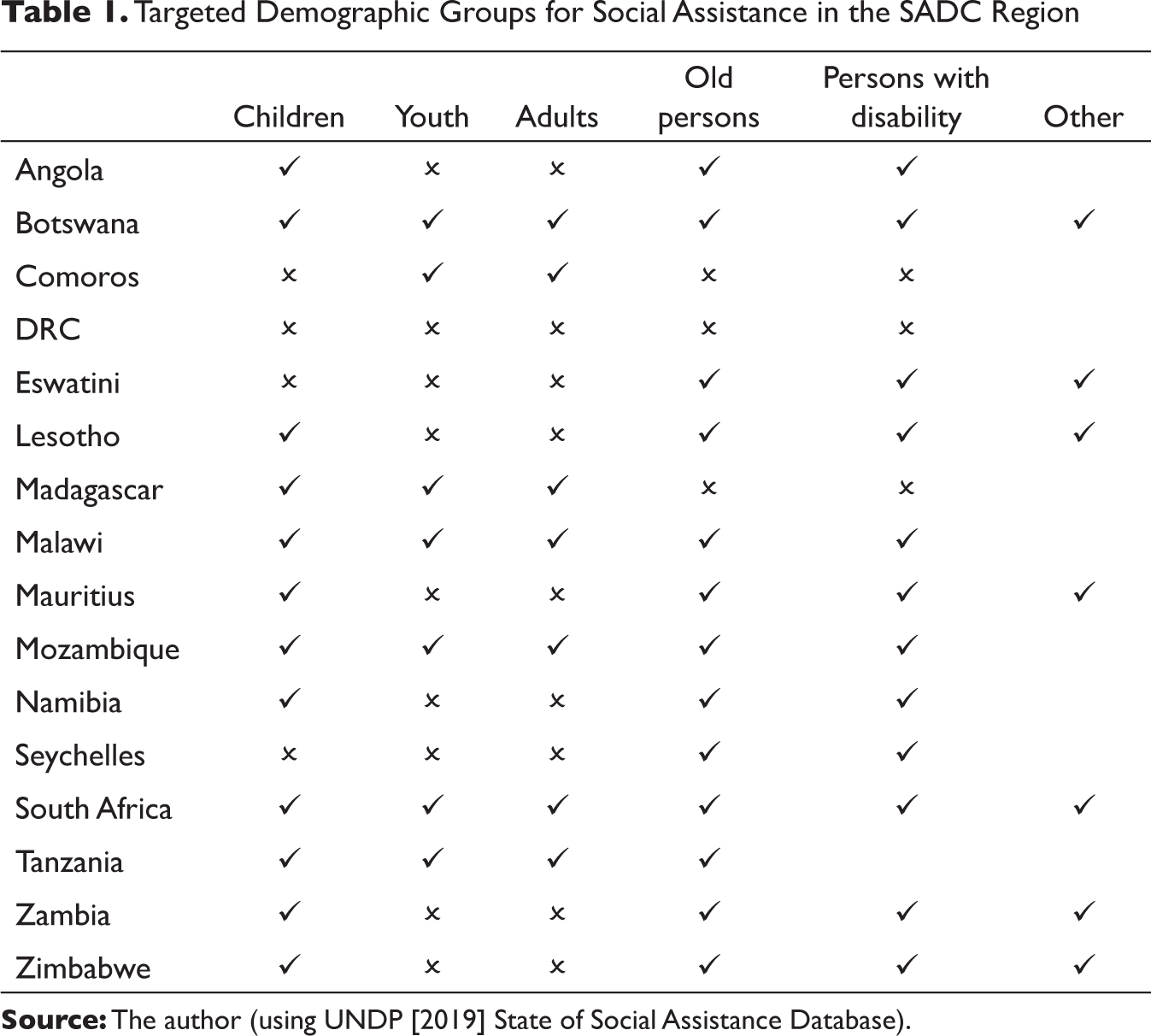
In contrast to South Africa is Botswana, which runs its social assistance without any legal frameworks. The ethical foundation of social assistance in Botswana cannot, therefore, be rights-based. Rather, it is seemingly justice-based, redistributing the national wealth and burdens among the rich and poor (Barrientos, 2016; Miller, 1999). Nonetheless, just like South Africa, its programmes reach all the poor groups in the life cycle. Orphans and vulnerable children are reached through the National Orphan Care Programme. Data from the UNDP (2019) shows that the programme reached over 35,000 households in 2015, which translated to about 129,000 at individual level. These numbers are significant in Botswana because the population is small. There were only 2.2 million people as at that time. About 55,000 youths and adults were covered through Public Works and over 98,000 older persons were reached through the Old-Age Grant. The Vulnerable Group Feeding Scheme in Botswana is one of the largest food transfers in Africa, covering more than 380,000 chronically ill persons as well as other vulnerable people.
Mozambique is a thought-provoking case because it is between South Africa and Botswana in terms of how its social assistance is provided. Just like both countries, all groups in the life cycle are covered through social assistance. UNDP (2019) database shows that Mozambique reached 460,000 households with poor and vulnerable children, persons with disability and older persons in 2015 through its Basic Social Subsidy Programme. This translated to about 2.1 million individuals covered by the programme. The youth and adult group is covered by the Labour-Intensive Public Works Programme. Social assistance is not anchored in the constitution, but is enacted in its Legal Framework on Basic Social Security of 2009. This is unlike in South Africa where social assistance is both anchored in the constitution and enacted in the country’s legislature. It is also unlike in Botswana where social assistance is neither anchored in the constitution nor enacted in the country’s legislature.
Comoros, DRC and Zimbabwe are examples of countries that have specified the right of social protection or social security but lack justiciability and enforceability of the same rights. As shown in Table 1, there is no social assistance in the DRC. It is piecemeal in Comoros and Zimbabwe. Comoros, using the finance of international donors, runs a cash for work programme named Argent Contre Travail (UNDP, 2019). The programme targeted the poor youth and adults with a daily payment of $4.97 in 2015. Children, older persons and persons with disabilities are not covered by any form of social assistance. Zimbabwe heavily relied on the assistance of international donors to run its Harmonised Social Cash Transfer Programme, which reached 52,049 households in 2015. The coverage of this programme is clearly small given that over 1.8 million households have a per capita consumption expenditure below the upper poverty line (ZimStat, 2018).
The fact that social assistance cannot be justiciable and enforced in these countries means that the ethical drivers of its provision are not rights-based. As well, the fact that there is no transparent regard to redistribute national wealth and burden among the rich and poor means that the ethical drivers of social assistance cannot be justice-based either. Furthermore, the fact that social assistance heavily relies on international partners that assist on the need basis means that the ethical drivers of social assistance in these countries are just that—needs-based. Under a needs-based approach, social assistance is justified by referencing the society’s responsibility to ensure the universal satisfaction of basic needs (Munro, 2008). The basic needs school of thought relies on morality based on a sense of human solidarity and compassion in the face of unnecessary suffering, and that this is distinct from rights- and justice-based approaches (Streeten et al., 1981). 8
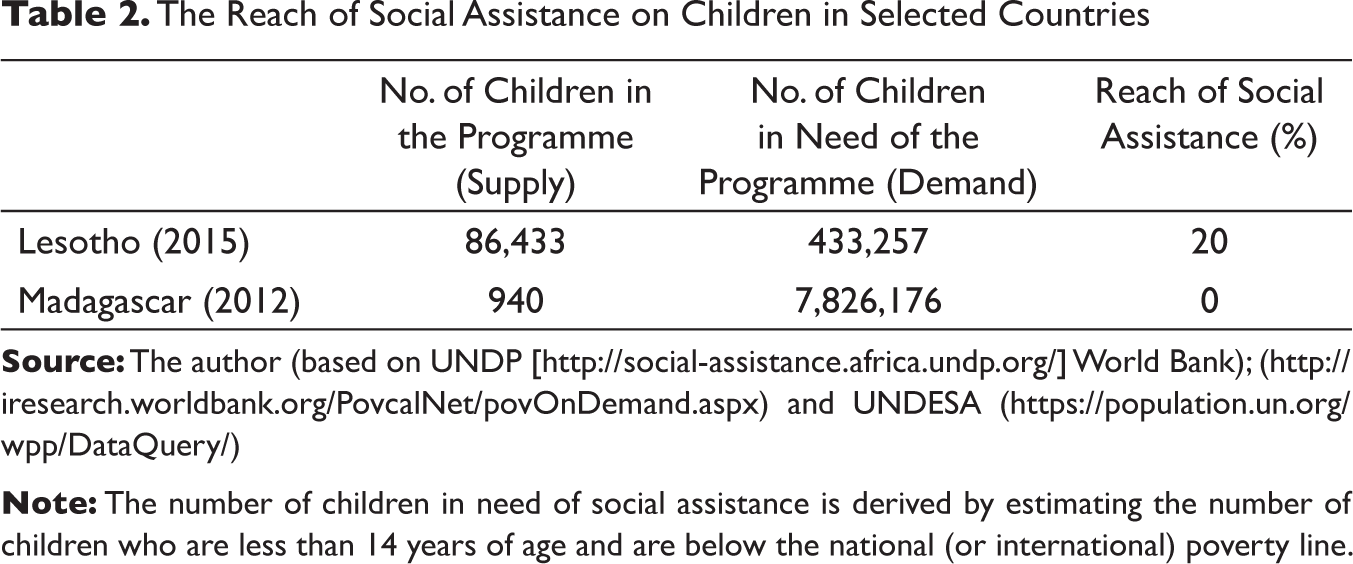
Generally, most countries in the region have programmes that target children, older persons and persons with disabilities, albeit inadequately. In Table 2, two programmes that target children are used to show the deficits of coverage in some countries in the region. The Child Support Grant in Lesotho covers slightly above 86,000 children, yet there are over 400,000 children in need of social assistance. The situation is worse in Madagascar, where only 940 out of 7.8 million children in need of social assistance are reached by the country’s conditional cash transfer, making a coverage of zero per cent.
Most transfer amounts to citizens covered by social assistance are inadequate. In Table 3, programmes that target children in eight selected countries are assessed in terms of whether they provide adequate transfers. Botswana, Mauritius and South Africa have transfers that at least meet the World Bank’s per capita international poverty line, while the rest are not adequate. Namibia’s Child Maintenance Grant is classified as almost adequate because it exceeds the pre-2008 international poverty line of $1 per day.
The Reach of Social Assistance on Children in Selected Countries
The Adequacy of Social Assistance on Children in Selected Countries

2. Local currencies converted using the PPP 2011.
3. * meant to be short-cut for adequacy or inadequacy.
Countries that are seemingly associated with the rights- and justice-based approaches in the region have institutionalised social assistance programmes that are domestically financed. These countries include Botswana, Mauritius, Namibia, Seychelles and South Africa. They are also associated with programmes that have adequate reach and transfers. Countries that are associated with the needs-based social assistance have programmes that heavily rely on international assistance. The attempts of international partners to institutionalise social assistance, and ground it as rights- or justice-based, in these countries is evidently seen through the donor-led proliferation of social protection policies in the region. It started with Malawi in 2008, followed by Comoros, Lesotho and Zambia in 2014, then Madagascar in 2015 and finally DRC and Zimbabwe in 2016. Countries relying on donor financing are associated with inadequate transfers and reach.
Non-state Social Assistance
Non-state social assistance provision in the region has been making up for the deficits of state-run social assistance in countries with weak institutions. Non-state providers of social assistance can be categorised into NGOs and community-based schemes. The former provides social assistance formally and operates registered and regulated activities independently of the state. The latter provides mutual assistance informally and its activities are not registered, neither are they regulated.
SADC has a rich history of mutual solidarity and reciprocity, dating back centuries (Patel et al. 2012). Most of the mutual assistance practices persist, providing essential but limited social assistance to poor and vulnerable people who are not reached by formal mechanisms. In Zambia for instance, mutual assistance is found by Wietler (2007) to exist most among relatives living next to each other. Wietler’s study points out that food offered as gifts is the most common form of mutual assistance. This assistance is typically diverse, stretching from as little as handing out small items like salt and sugar to sharing a harvest with the needy. Destitute households are taken into relatively better off families and would share meals until such a time they can operate independently.
Mutual assistance is very limited for three reasons. First, assistance is typically between community members who are on the same level of poverty and vulnerability. This was found to be the case in Malawi two decades ago by Devereux (1999). Recently, Dafuleya (2017) found evidence of the same in Zimbabwe. As a result, the exchange of cash or food items does not lift households out of poverty. Second, mutual assistance is elusive when a systemic shock, such as COVID-19, is experienced. Third, there is evidence of community-based schemes breaking down in the face of modernisation and commercialisation. Tango (2004) showed how this is the case in Malawi a decade ago, thereby driving citizens to increasingly dependent on social assistance provided by the NGOs.
Indeed, the presence of NGOs does not go unnoticed in the region. In Zimbabwe for instance, the World Vision (2016) reports that it started operating in the country almost five decades ago. In its first seven years of operation, World Vision provided social relief to children’s homes, camps and institutions. This mandate changed after 1980 and focused on rehabilitation and small-scale development programmes for especially displaced groups. Now, the World Vision (2019) reports that it is implementing a total of 20 livelihoods projects reaching 165,385 people. Reliefweb (2016) states that it targets vulnerable households in Zimbabwe with cash transfers that are conditional on eligible families using the cash to buy food. Working in partnership with communities in selected locations of interventions, Reliefweb asserts that it has targeted 400 households mainly composed of the poor and vulnerable people such as child-headed households, older persons, widows and lactating mothers among others. With over seven million people in need of food assistance in Zimbabwe, 9 NGOs are providing an essential but limited assistance to those not reached by formal mechanism.
Drawing from the discussion in this section, it is easy to recapitulate that the extant social assistance, in more than half of the SADC member states, is precarious and not ready to shield livelihoods against hunger threats brought by COVID-19 containment measures. The region has had to embark on emergency assistance during COVID-19 to shield the vulnerable households from income and food shortages, a discussion this article now turns to.
Emergency Assistance during COVID-19
Emergency assistance requires immediate action in response to a dire situation. Although ad hoc, it can be planned and budgeted for as a contingent measure. When COVID-19 cases started to be recorded in Southern Africa, most SADC member states swiftly reacted by implementing lockdown measures to contain the virus. Table 4 shows that between 17 March 2020 and 9 April 2020, all SADC countries had embarked on lockdown measures except for Tanzania and Malawi.
The Timing of COVID-19 Lockdowns and Emergency Responses in SADC

* shows that there was no full lockdown, the country has a curfew that curtails movement at night, or has a temporary partial lockdown of a place to allow contact tracing. N/A is not applicable either because the courts barred the lockdown or the country decided not to engage in it at all.
**Measures announced relate to utility fee waivers or social insurance.
Given that most workers in the region operate in the informal sector, and live on hand to mouth, severe hunger became an immediate crisis as most people could not remain in lockdown even for a day. Without any emergency assistance from the state, the lockdown meant that in trying to save lives from the threat posed by COVID-19, the poor and vulnerable could be condemned to death through hunger. The governments therefore needed to respond swiftly by providing cash or food transfers to affected poor and vulnerable households. Table 4 shows the timing of this response vis-à-vis the beginning of the lockdown.
The emerging pattern of COVID-19 social protection responses show that countries that have institutionalised social assistance, rely on domestic resources, and follow a rights- or justice-based approach, were swift to provide emergency assistance to mitigate the COVID-19 lockdown effects. Within a week, almost all these countries—Botswana, Mauritius, Namibia and South Africa—had already declared their emergency responses. On the other hand, countries in the region with weak state-run social assistance and rely on international donors for finance, lagged far behind in introducing emergency measures to shield people’s livelihood. It took these countries—Angola, DRC, Madagascar, and Zimbabwe—at least one month after lockdown to declare their emergency assistance measures.
Malawi did not implement a lockdown not because the state did not want to, as was the case in Tanzania, but because the court ordered an injunction against its implementation (Matonga, 2020). The condition that was set for the lockdown to be implemented was that the government must first provide emergency transfers to protect the country’s poor and most vulnerable citizens. The government, as shown in Table 4, has since responded by launching an emergency cash transfer programme, targeting 172,000 households with a monthly cash transfer of $50.
The reach of the emergency assistance in countries that finance their own social assistance extends to all the citizens that require it. In contrast, that from countries with weak social assistance is highly limited and fails to reach all the citizens that require it. It is hard to expect that these countries will get any significant foreign assistance from donors, which have always assisted them. This is because their global partners, among them the United States and the United Kingdom, are themselves badly affected by the pandemic and are thus unlikely to focus their attention elsewhere.
The group that is missing from the provisions of emergency assistance is that of migrants. None of the member states in the region made provisions for this group, even though this is stipulated in the Code of Social Security in SADC (2007). The Code stipulates that migrants, including undocumented and illegal residents, should enjoy a minimum level of protection. It also states that during a disaster, as is the case with COVID-19, member states should provide relief at regional level. But none of this has happened in the region.
Non-state emergency responses have been, at least in principle, filling this gap. In South Africa, where most migrants in the region are, food parcels have been made available by various charities, NGOs and FBOs. Most of these organisations depended on international and local donations to assist those who needed a meal (Kesselaar, 2020). These food parcels could be administered to any person who is vulnerable and in danger of hunger, despite the fact that they are citizens or not, or whether they are documented or undocumented migrants. The society of donors took on the responsibility to ensure the universal satisfaction of basic needs during COVID-19. Inopportunely, Heywood (2020) reported that this was not a given. Nationalism and not humanism, unfortunately, clouded the distribution of food parcels in South Africa, resulting in emergency assistance being elusive to many migrants.
The Need to Separate Social and Emergency Assistance
The discussion in the previous sections has shown that countries that rely on domestic resources to fund their social assistance arguably underpin the ethical foundations of their programmes on the rights- or justice-based approaches. International donors that fund countries with weak social assistance seemingly underpin their ethical foundations on the needs-based approach. The objective is not to get deep into the ethical underpinnings of social assistance in the SADC countries, which would greatly exceed the scope of this article. Instead, this section uses these approaches to highlight the need to distinguish social and emergency assistance in the social development discourse.
Emergency assistance targets everyone, social assistance targets citizens
The COVID-19 pandemic is a crisis for everyone. It knows no boundaries, be they national, socio-economic, or racial. It has created misfortune to those that have been unfortunate to have it as much as to those that have been indirectly affected by measures to contain it. Those affected become in need of humanitarian assistance based on human solidarity and compassion, and not citizenship. For instance, if people are drowning from a flood, rescuing them will hardly be conditioned on them being citizens. Rescuing them will simple be based on the moral duty to assist them because they are in need. This is what is termed by Pogge (2006) as the positive duty to improve the welfare of others. Rights-based approaches typically guarantee citizens their entitlement towards receiving assistance. It is this right to decent living that citizens appeal to with or without a crisis. Given that this right rarely applies to migrants, lack of distinction between social and emergency assistance among policymakers, as well as citizens, could lead to ‘nationalism’ and not ‘humanism’ sentiments during an emergency. This has been the case in South Africa during COVID-19 (see Heywood, 2020). This same argument can be made on the justice-based approach. Citizens would feel like it is only just to prioritise locals at the expense of migrants during a crisis, and in the process, most assistance become elusive to migrants. This has been the case in Botswana (Dube, 2020).
Emergency assistance is financed by Samaritans, social assistance is tax-financed
The financing of emergency assistance typically emanates from donations made to NGOs, FBOs, or state-managed solidarity funds and from international assistance. These donors could be corporations, foundations and individuals—locals and non-locals. These donations can hardly be ring-fenced for citizens. Rather, Samaritans donate using the ethical foundation of needs-based approach, that is, because they see a need to alleviate suffering brought by a disaster. Such finances cannot be claimed by citizens only based on their rights to the public purse, neither can they claim the finance based on social justice. In contrast, social assistance is tax-financed. In the view of a social justice approach, the income of wealthy citizens is redistributed to the poor and vulnerable citizens. Extending assistance to a migrant ahead of nationals in such a set-up can easily be problematic. In view of the rights-based approach, the poor and vulnerable have a right to decent livelihood and it is the state’s duty to ensure these entitlements are properly budgeted for and delivered. Recipients, thus, are right-holders. The state is the duty-bearer. Right-holders can complain or hold the state accountable for failing to administer social assistance to them. This has, seemingly, been the basis to put nationals first, or deny migrants, in the distribution of food hampers in SADC member states (Monama, 2020). But this rarely would have been if social assistance is clearly separated from emergency assistance.
Emergency assistance is short-term, social assistance is long-term
Given that it addresses misfortune that is brought by hazards, emergency assistance is short-term. It is only meant to tide the affected population over a crisis. Social assistance, on the other hand, is long-term. It is meant to offer predictive and regular cash transfers to participants in institutionalised programmes. In this context, a clear distinction between social and emergency assistance would significantly reduce the animosity among both policymakers and the public on assisting everyone, other than citizens only, with emergency relief during a disaster such as COVID-19.
Conclusion
To conclude, the article draws from the discussion here to answer the following three questions raised in the introduction section.
What is the state of social assistance programmes in SADC, and how suited are they to shield people against the loss of livelihood brought by COVID-19? The state of social assistance in the region is derisory, except in Botswana, Mauritius, Namibia, Seychelles and South Africa. The fact that additional measures were needed to assist the poor ably demonstrates that social assistance in the region is hardly suited to shield the people against loss of livelihoods brought by COVID-19 containment measures.
What are the provisions of emergency assistance that have been availed at national and regional level (in line with the Code of Social Security in SADC)? Temporary cash and food transfers have been made available at national level. There is no evidence of COVID-19 social protection responses at regional level. No provisions were made for migrants.
What are the emerging patterns between the extant social assistance and the emergency assistance in response to COVID-19? Countries that rely on domestic resources to fund their social assistance programmes were swift to provide emergency relief to mitigate the effects caused by the COVID-19 lockdown measures. Countries that rely on international assistance were slow to react. They are not used to committing domestic resources towards the poor through cash and food transfers.
An emerging implication is that there is need to strongly differentiate social assistance from emergency assistance in the community and social development discourse. The former focuses on citizens, drawing mostly from rights- or justice-based principles. The latter focuses on everyone affected by a hazard, in spite of nationality, and draws mostly from a needs-based approach. This distinction is crucial, not only because some development agencies conflate the two, but also because the SADC region has a significant number of people in migration. Emergency assistance cannot afford to miss them. This is also true even beyond the SADC region.
Footnotes
Declaration of Conflicting Interests
The author declared no potential conflicts of interest with respect to the research, authorship and/or publication of this article.
Funding
The author received no financial support for the research, authorship and/or publication of this article.