



Abstract
This research study ascertained how street corner small shops (called kirana shops in India) in Indian urban landscape adopted resource-based view (RBV) and dynamic capabilities view (DCV) perspectives to strategize regarding unlocking initiatives, process, operational change, and business continuance post COVID-19 pandemic and economic lockdown. The authors used qualitative research method with a semi-structured open-ended questionnaire to collect the data. Thematic content analysis was applied for data analysis. The data was collected in June 2020 in India when the initial unlock process was going on. The application of Situation Actor Process–Learning Action Performance (SAP-LAP) framework in conjunction with strategic management theories such as RBV and DCV provided a holistic understanding of the phenomenon. This study was also a demonstration of how a critical crisis situation like COVID-19 could relate to the SAP-LAP framework. The author found that shopkeepers developed new sets of valuable and rare and inimitable resources and capabilities. While all the aspects of sensing, seizing, and reconfiguration were attained to while devising the shops reopening strategies, new sets of resources and capabilities to attend to customers were also developed.
Keywords
Introduction
Indian government initiated an unprecedented economic lockdown and physical social distancing given the context of COVID-19 pandemic (Behl, 2020; The Economic Times, 2020). Large and small business both were exposed to a unique situation of complexity, chaos, and uncertainty (Bhattacharyya & Thakre, 2021; Nayak & Bhattacharyya, 2020). Indian shopkeepers who ran their shops as stores selling a variety of goods along the lane and by lanes were challenged beyond their comprehension. In different parts of India, the businesses were allowed to reopen from the month of May and June 2020 in a phase-wise manner termed as ‘unlock’ phases (The Times of India, 2020). When the economic and physical lockdown happened, the street corner shops (commonly known as kirana stores) shopkeepers had to shut down their shops within a matter of few hours. Thus, they were in for an abrupt closure. Shopkeepers also did not have any idea as to when their shops would reopen as the lockdown period extended gradually. Once the lockdown period was over spanning a few weeks, shopkeepers started understanding the new realities. The shopkeepers like small business owners had to figure out how to initiate business in the short to medium term. For such a shock, there was lack of strategic management literature regarding business continuance and business sustenance. Thus, the authors in this research set about the objectives to evaluate how shopkeepers strategized based upon the resource-based view (RBV) (Newbert, 2008) and dynamic capabilities view (DCV) (Teece et al., 1997). Furthermore, the authors were also interested in this research to apply the Situation Actor Process–Learning Action Performance (SAP-LAP) framework (Sushil, 2000). This was carried out to fulfill the objective to ascertain the shopkeepers’ managerial mechanisms to cope with the challenges based upon new business ways change and continuity (Sushil, 2005). Based upon interviews with 42 shop owners and managers in Tier 1 cities in India, the author gathered the data. To derive insights, the authors content analyzed the data for thematic analysis (Hsieh & Shannon, 2005; Mayring, 2004). The subsequent section presents the theoretical discourse. Thus, the contribution of the research was twofold. First, the study evaluated how shopkeepers strategized based upon the RBV (Newbert, 2008) and DCV (Teece et al., 1997). Second, this research applied the SAP–LAP framework to ascertain the initiatives of shopkeepers towards reopening and continuance (Sushil, 2000).
Theoretical Perspectives
Street corner shops (commonly known as kirana stores) have been an integral part of the Indian society since the British era (Rani, 2013; Shukla & Shukla, 2013; Sinha et al., 2015). These ownerships or sublet shops have provided to the local needs of customers in a geographical area. The shop owners and their assistants and helpers were a known comforting face in a colony (Yadav et al., 2016). An array of small shops catered to the entire needs of any family household right from grocery, pharmaceuticals, FMCG, white goods, toys, fruits and vegetables, hardware, comestibles, and all other goods and items (Sinha et al., 2015; Yadav et al., 2016; Zameer & Mukherjee, 2011). The advents of large-scale retail marts with the change in the business landscape from the early 2000s altered the shop–society–colony equation (Shukla & Shukla, 2013). The scale, scope, and financial and logistical muscle power of large stores had tremendous potency to erode the market share of the local shops dotting the street sides of any residential colony (Shukla & Shukla, 2013; Yadav et al., 2016). One needed to understand that these small shops were owned or sublet by small businessman or traders traditionally. These owners either self-managed these shops or had given the management charge of the shop to a trusted family or friend who would manage the shop. The shop owners and the managers of the shops would strategize so as to plan regarding what products to stock, how often to source, which supplier to choose what rent agreement to carry forward, how to interact with shop helpers or assistants, what salaries to be paid to the helpers, when the goods to be received for delivery, how to educate customers about new products, how to manage disgruntled customers, how to handle returned products, how to manage supplier payments, how to provide credit to certain customer segments, and such others (Rani, 2013; Shukla & Shukla, 2013; Sinha et al., 2015; Yadav et al., 2016). In a nutshell, the shop owners were like a chief executive managing the show. These owner–managers of shops scanned the market and business landscape so as to change the nature of the shop product range and variety, way to handle customers, so as to be best tuned to the requirement of the market and the customers.
The authors also would like to ascertain the point that these shop owners and managers would also engage in decisions regarding whether the shop size had to be expanded, the shop needed to expand to other localities, shop need to enter into a specialized set of products or niche market segments, or need to streamline the operations of the shop (Rani, 2013; Shukla & Shukla, 2013; Sinha et al., 2015; Yadav et al., 2016). Thus, a shop owner manager managed a shop just like a small business. Thus, RBV perspectives as advocated by Newbert (2008) would be applicable. Thus, shop owners and managers would develop such resources and capabilities that would be valuable to customers, rare in the local business context, not easily copied by the competitors (inimitable), and such that there are not many strategic equivalents to it (that is non-substitutable) (Wernerfelt, 1984). RBV entailed the organizational resources and capabilities (small shops in this case) would be subjected to the same treatment of strategic management discourse like large organizations (Wernerfelt, 1995). Thus, small shop owners would also think in developing such resources and capabilities that were valuable, rare, inimitable, and non-substitutable (Newbert, 2008).
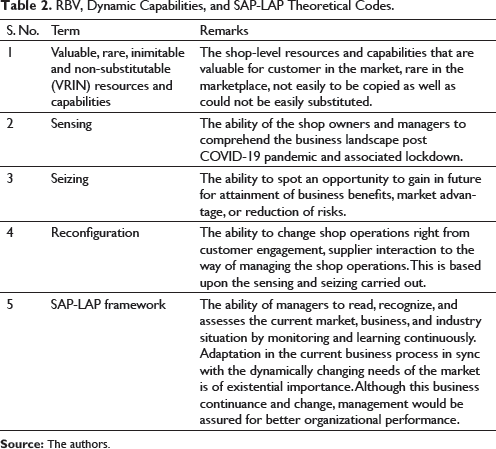
Strategic management literature was also well endowed with the notion of dynamic capabilities that organizations had to change its repository of resources and capabilities so as to suit the business, industrial and market condition (Teece et al., 1997; Winter, 2003). Thus, the shopkeepers had to change the resources and capabilities by reducing or increasing its levels. Further, shopkeepers also had to eliminate certain sets of resources and capabilities and create certain new sets of resources and capabilities to survive in the COVID-19 era. It would also be pertinent to note that shop owners and managers would engage in sensing the business environment (Scharmer, 2001) so as to seize the right market and business opportunities (Joshi, 2010). Finally, the shop owners would have to reconfigure their shops resources and capabilities for seizing the mentioned opportunities (Wilden & Gudergan, 2015). These notions of sensing, seizing, and reconfiguration were well embedded in the theoretical foundations of dynamic capabilities theory (Teece et al., 1997). Thus, the author figured out that both the RBV and DCV could be applied in the study context. The SAP-LAP paradigm consisted of six elements: Situation, Actor, Process, Learning, Action, and Performance (Sushil, 2000). The events which were happening at present and were predicted to occur in near future were the Situations. Shop owners and managers had to recognize and assess the situation in order to identify the opportunities (e.g., the demand and supply spread) and threats involved. An Actor was an entity who had to analyze the situation and act appropriately in order to adapt the existing business to the changing needs of the market. Processes were set of standard procedures followed by the shop owners and managers. When the situations changed, the actor (shop owner) had to act accordingly to regenerate the process as per the changing needs.
The shop owners and managers were expected to monitor the SAP process and use LAP in order to improve the business processes in their shops. Once SAP was applied, the shop owners and managers had to make note of the key issues related to Situations confronted, the actions taken by the Actor(s) and Process(s) had to be followed. They could then ascertain the potential improvements possible in SAP and the flexibilities involved. This was known as Learning. In the Action phase, the shop owner and manager were required to vet what actions could be taken in order to improve the SAP and make it flexible in order to quickly respond to dynamic market changes (e.g., during COVID-19 unlock phase). Finally, the shop owners and managers had to ascertain the impact of the above changes on the Situations, Actors and Processes and monitor the performance.
The coronavirus crisis (COVID-19 pandemic) and its associated economic and physical lockdown altered the shop owners and managers business context (Bhattacharyya & Thakre, 2021). To comprehend the way shop owners and managers altered their strategies needed to be examined from both RBV and DCV perspectives like in many others streams of Strategic management (Bhattacharyya & Verma, 2019; Verma & Bhattacharyya, 2019). In conjunction to the RBV and DCV perspectives (Bhattacharyya & Jha, 2015; Lin & Wu, 2014), the SAP-LAP framework was also applied (Sushil, 2000). There was no past context like what was unraveled by COVID-19 context and the economic and physical lockdown. The intensity of this shock in which shops were closed for many weeks in India was unparalleled (The Economic Times, 2020). The physical goods supply chain, the market demand upheavals, the working capital management system, the ways of carrying out operations, and these aspects, all were contested by the new context (COVID-19) realities. The objectives of the research were to ascertain how, during COVID-19,
The strategic initiatives of shop owners and managers could be explained from an RBV perspective, The strategic initiatives of shop owners and managers could be explained from a dynamic capabilities’ perspective, and Were the shopkeeper’s strategies aligned with the SAP-LAP framework.
Research Methodology
In this section, the research methodology of this study has been presented.
Sampling
The sampling details are presented in this subsection. The authors undertook the research to comprehend how shopkeepers in the trying times of COVID-19 post the phase-wise unlocking of economic shutdown and physical restrictions reasoned their shop’s business strategies. The authors towards this end engaged in carrying out an exploratory study as advocated by scholars (Eriksson & Kovalainen, 2015; Stebbins, 2001). The author undertook telephonic interviews with 44 shop owners and managers. The sampling method was non probabilistic purposive sampling (Crouch & McKenzie, 2006). The data was collected in the month of June 2020. The minimum duration of interview was 22 minutes whereas the maximum duration was 44 minutes. The average duration of interviews was 36 minutes. The average experience of the respondents were 17 years while the maximum experience of the respondents was 22 years. The minimum experience of the shop owners cum managers were 15 years. The authors prepared a semi-structured open-ended questionnaire to capture the perspectives of the shop owners cum managers. The questionnaire had questions regarding: (a) What changes would your shop require for opening up during COVID-19 unlock phase? (b) How would your shop manage the unlock phase based upon the shop resources and capabilities? (c) What would be the key initiatives that shopkeepers have to follow to be successful? (d) How your shop managed change and ensured business continuance (e) Any other point you would like to mention? The semi-structured open-ended questionnaire helped the authors to capture insights which were beyond the extant literature knowledge base as advocated by extant researchers (Reja et al., 2003; Johnson et al., 1974; Harland & Holey, 2011). Further, this questionnaire allowed the authors to probe certain aspects in depth.
Content Analysis Method
The semi-structured open-ended questionnaire was thus prepared in line with the guidelines provided by Harland and Holey (2011) and Reja et al. (2003). The face and content validity of the questionnaire was tested with two academics engaged with teaching marketing and retailing while two shopkeepers were also provided the questionnaire for its mentioned validity. This was as discussed by (Appleton, 1995; Mackison et al., 2010). The shopkeepers cum managers were from a diverse background of shops such as electrical, hardware, grocery, kitchen products and utensils, apparels, electronics, paper and stationery, furniture, multi-items, stores, and others. The data was collected from the urban Indian context. The questionnaire responses were content analyzed for category themes as advocated by Mayring (2004) and Hsieh and Shannon (2005). In this regard, first response paragraph themes were created followed by categorization of the paragraph content with themes. The category themes were derived from extant literature as prescribed by Schreier (2012). The data collection was stopped post reaching thematic saturation (Hsieh & Shannon, 2005). The SAP-LAP theoretical codes consisted of factors Situation (S), Actor (A), Process (P), Learning (L), Action (A), and Performance (P) as defined by the works of Sushil (2000).
Reliability and Consistency Measure of Findings
The data collected was transcribed within 48 hours and the content analysis (thematic) was undertaken simultaneously with the collection. Intra-rater reliability was checked with a gap of 72 hours from the first coding by the author and its value was 92%. The inter-coder reliability was checked with an academic expert with simultaneous analysis with the coding analysis by the author. The value was 90%. Thus, both the inter-coder and intra-coder reliability values were well within the values acceptable of past studies in terms of rigor (Appleton, 1995; Mackison et al., 2010). The next section presents the findings and discussions. Generality was ensured by testing the questionnaire experts as advocated by Mayring (2004).
Findings, Discussions, and Conclusion
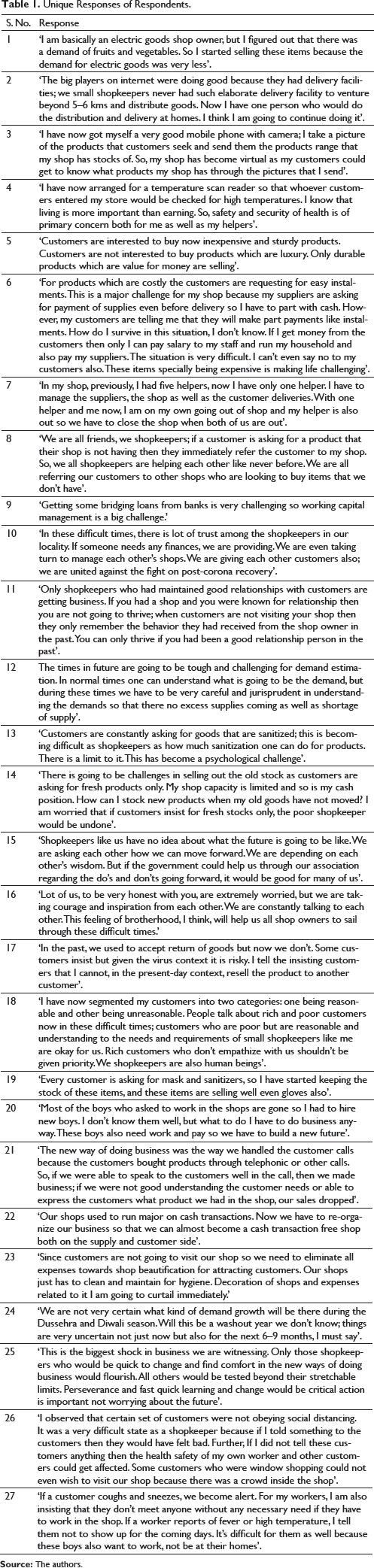
Unique Responses of Respondents.
RBV, Dynamic Capabilities, and SAP-LAP Theoretical Codes.
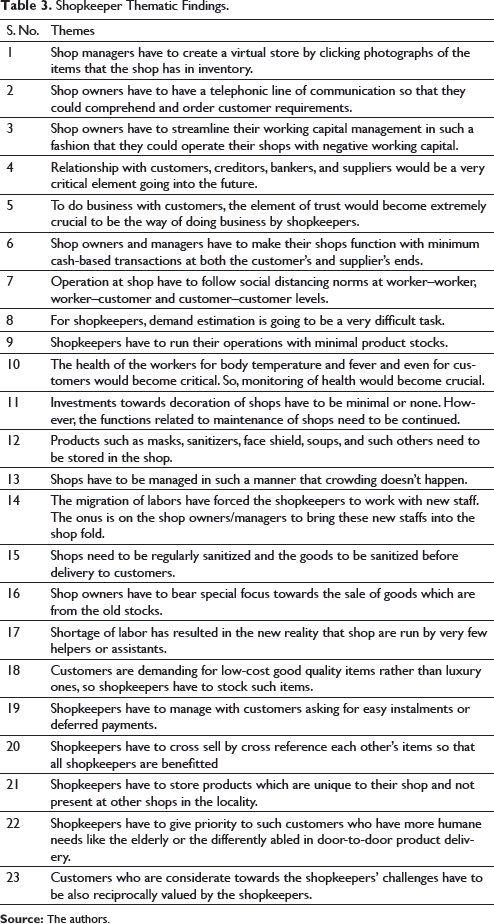
Shopkeeper Thematic Findings.
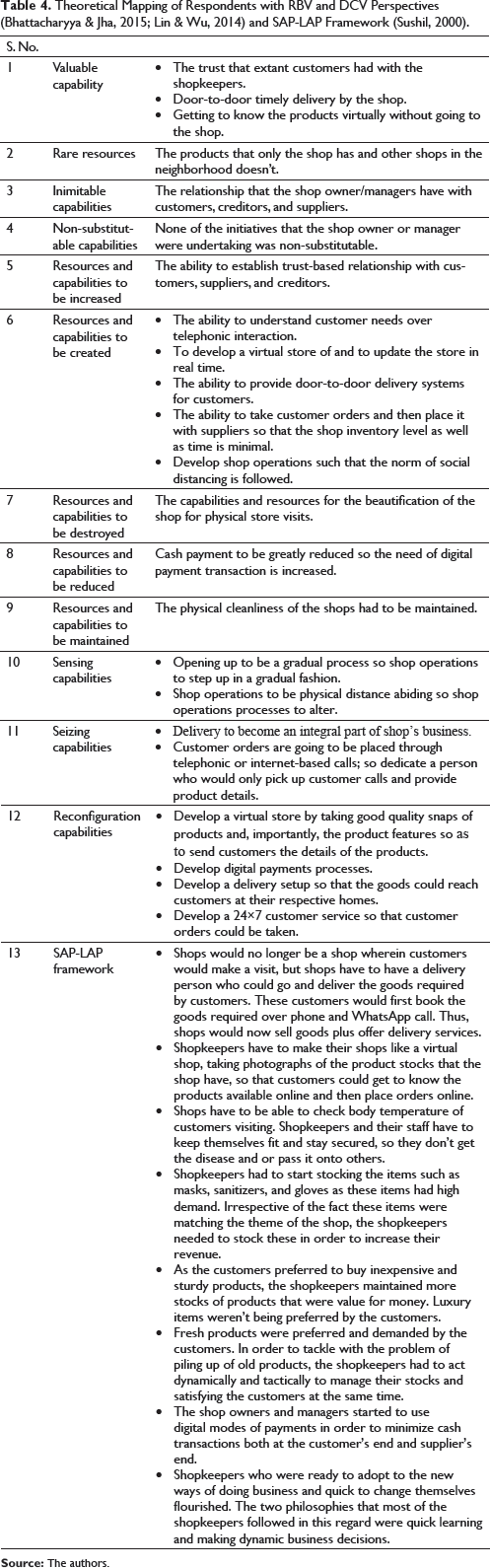
Theoretical Mapping of Respondents with RBV and DCV Perspectives (Bhattacharyya & Jha, 2015; Lin & Wu, 2014) and SAP-LAP Framework (Sushil, 2000).
Mapping the SAP-LAP Framework with Unique Respondent Responses.
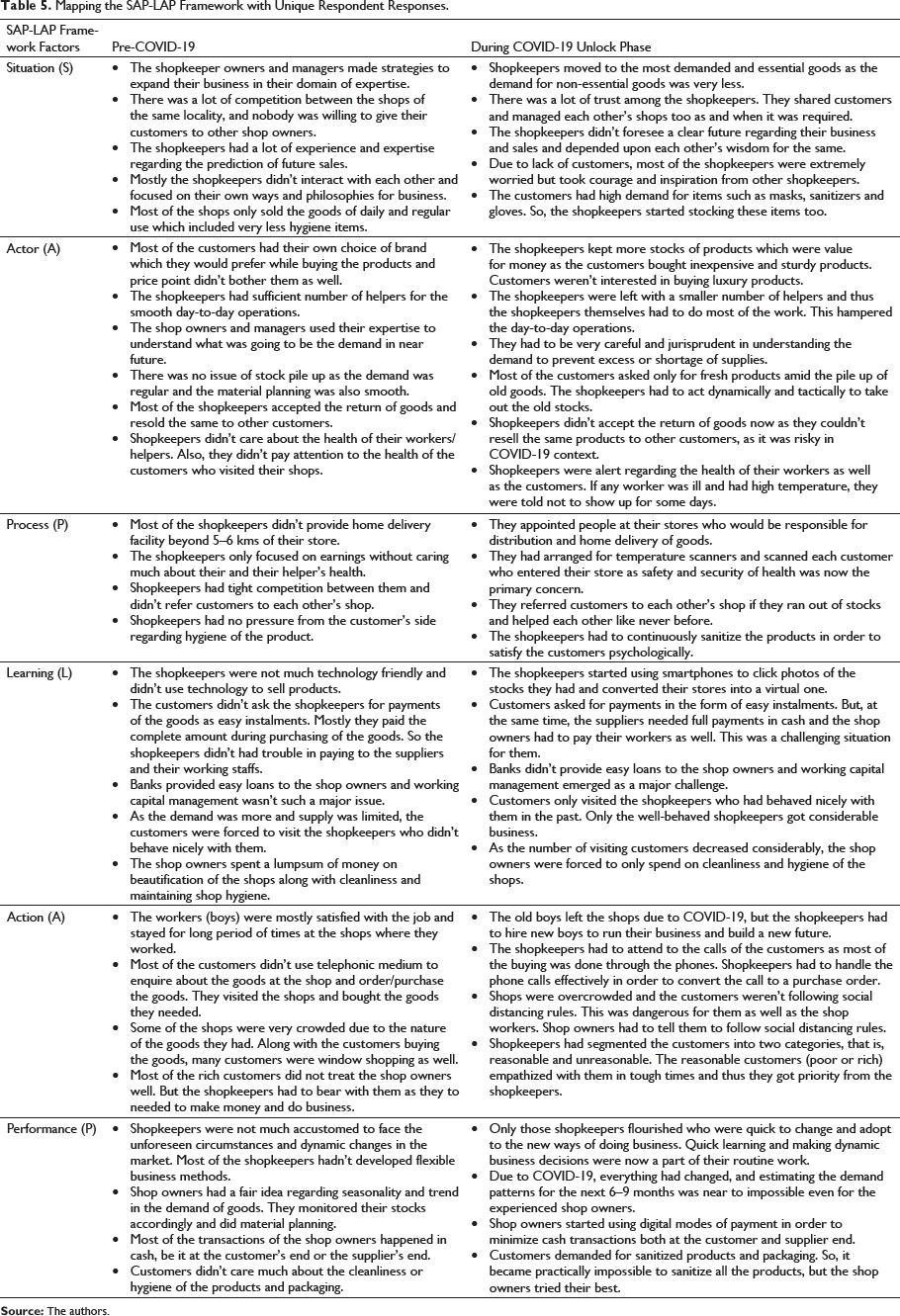
This entailed the shop owner’s ability to develop or create new resources and capabilities, maintain certain set of resources and capabilities, reduce the intensity of certain set of resources and capabilities, or eliminate or destroy certain set of resources and capabilities altogether. It was evident from the findings that the shop owners cum managers were deeply affected by the COVID-19 pandemic and its associated physical and economic lockdown. To reopen their shops, shopkeepers devised a new set of strategies. The availability of slack resources became less as the shop financial resources buffer which was critical for small businesses was not present post shop closure of months duration. The lack of slack was influencing the shopkeeper’s strategies. Shopkeepers worked with a new level and nature of shop resources and capabilities. They were thinking in terms of new sets of resources and capabilities during COVID-19 unlock phase reopening. Trust, which has been viewed as an intangible resource, became strategic resource during the COVID-19 unlock phase. In extant literature, trust was a critical resource as advocated by Wernerfelt (1995) but, during this unlock phase, it became a more critical resource. During the COVID-19 reopening phase, shopkeepers were delivering goods through new delivery assistants to new customers outside the usual neighborhood. Given this, the ability of shopkeepers to generate trust right from the first transaction was critical. As noted by Chen and Wang (2008) and Fainshmidt and Frazier (2017), trust development as a capability became important. The ability to hire delivery boys who were earlier not known to the shopkeepers was also challenging. As established by the works of Prasad and Aryasri (2008) and Goswami and Mishra (2009), shops ran well if the shop workers were good with human relationship management. During the COVID-19 crisis, delivery boys or the boys who were handling the telephone calls were the key, thus salesmanship over telephone as a capability became important. The works of Bhattacharyya and Jagadeesh (2018) had indicated the importance of working capital management in small business ventures in India.
In this study, it was found that most shop owners cum managers confronted unprecedented challenges because of sustained closure of shops towards balancing the cash inflow with the cash outflow. Shop owners and managers who could negotiate with banker, creditor, or suppliers to secure bridge funding or credit could manage the time period of unlock well. This became a vital essential capability. Demand planning has been viewed as a critical capability for small businesses during economic upheavals. In this context also, demand planning became critical as excess demand would lead to higher cash outflow as well as higher inventory costs, as Tripathi and Tiwari (2014) had indicated. Cashless transactions had often been viewed as the way to move forward for business in the future (Gautam & Kavidayal, 2017; Rakesh et al., 2018). The present COVID-19 pandemic hastened this phenomenon. Shop owners cum managers had to develop capabilities and infrastructure so that they could carry out their shop operations both at supplier’s and customer’s ends without the need to undertake cash-based transactions. Extension of scope of business has always been deemed challenging (Prasad & Aryasri, 2008; Sinha et al., 2015; Yadav et al., 2016). In the COVID-19 context, when physical and social distancing norms became commonplace, all shops had to develop the capability of not only taking telephonic calls of customers but also to deliver the goods to the customers home as a door-to-door service. This capability had to be developed fast. Shopkeepers also had to keep products that customers were asking for but were not available around the locality. Thus, the ability of the operating workers who were managing the telephone calls with the customers and suppliers was to ascertain customer needs as well as market supply positions. The results of the study thus indicated that although valuable (i.e., trust), variety (products unavailable in neighborhood locality), and inimitability (relationship with customers, creditors, and suppliers) were there in the VRIN elements, none of the shop resources and capabilities had non-substitutability. Thus, shopkeepers didn’t have the full potency of the VRIN characteristics. The resource and capabilities that shop owners and managers were required to enhance were relationship and trust with suppliers, creditors, and customers. While the resources and capabilities that were needed to be created were physical contactless shop operations, tele calling with customers, doorstep delivery service, cashless shop transactions, and such others. While shopkeepers had to reduce operational inventory costs by linking customer orders with supply provisions, they also had to reduce cash outflow towards the show of the shops. Monitoring the body temperatures or sneezing or coughing symptoms of shop workers (specially) and also of customers might become pertinent. Shopkeepers also followed the SAP-LAP framework (Sushil, 2000) in order to make some changes in strategy, such as selling essential goods in spite of non-essential ones, taking orders from customers through telephonic conversations, carefully understanding the demand of goods to prevent excess or shortage of supplies, making virtual stores by clicking the photos of the stocks of products available in the shop and sending it to the customers, adopting to the new ways of doing business by quick learning and making dynamic business decisions, and such others.
Implications
In this research, the authors deliberated how street corner small shop (commonly known as kirana stores) owners cum managers strategized during the unlock phase when they opened up their shops. The shops were closed for months because of COVID-19 pandemic and associated economic and physical lockdown.
Theoretical Implications
Shopkeepers’ (owners cum managers) perspective strategies for reopening were analyzed based upon the two well-established theoretical notions of RBV and DCV (Lin & Wu, 2014) and SAP-LAP framework (Sushil, 2000). The context of these small street corner shops have been important for theoretical development (Rani, 2013; Shukla & Shukla, 2013; Sinha et al., 2015; Yadav et al., 2016). The RBV-based VRIN analysis was carried out regarding the shop owners’ and managers’ resources and capabilities. One must note that the shopkeepers demonstrated strategic leadership capabilities during the crisis (Bhattacharyya & Jha, 2018; Bhattacharyya et al., 2012 ). Shopkeepers as entrepreneurs knew what was to be done and what was not to be done (Bhattacharyya, 2020a). Shopkeepers, as entrepreneurs, knew that given the challenging realities, technology had to be deployed fast, but it had to be humanistic (Bhattacharyya, 2020a).
Managerial Implications
Trust that the customers had with the shopkeepers was a valuable capability. The products that the shops had which other shops were not able to offer in a given timeframe in a locality was the valuable resources. Shop owners had different levels of relationship with customers, suppliers, and creditors. It was important that the same shop worker handled calls with both the customers and the suppliers. Shopkeepers deployed the DCV perspectives of sensing. This entailed opening shops in a gradual fashion and designing shop operations with physical distancing between coworkers and customers and between workers and customers. Further, seizing would entail developing mechanisms to make telephone-based customer calling and order processing, telephone calling for order placement with customers, and finally delivery of good to customers at their preferred drop location. Finally, shopkeepers engaged with reconfiguration based upon creating a virtual store of their shops by taking a number of quality snaps of the products available at the shop. Order processing through cashless mechanisms have been developed by shopkeepers. Further, 24×7 customer order placements became important.
In this research, the authors provided the reopening strategies of retail small shops from an RBV and DCV (Bhattacharyya & Jha, 2015; Lin & Wu, 2014) and SAP-LAP framework (Sushil, 2000). The author deliberated upon what the new VRIN resources and capabilities shop owners cum managers had to develop. Further, the resources and capabilities that the shop owners and managers have to reduce and eliminate was presented. Thus, strategic resources and capabilities have to be the focus of reopening strategy as well as the non-strategic resources and capabilities that have to be done away with. A cross analysis of VRIN with resources and capabilities development, creation, elimination, and reduction were done. As entrepreneurs, the Indian shopkeepers did comprehend the power of web-based technologies (Bhattacharyya, 2011; Jha & Bhattacharyya, 2020).
In the COVID-19 context, this theoretical aspects coverage was novel. Further, from a DCV perspective, what shop-level resources and capabilities had to be developed was analyzed from the sensing, seizing, and reconfiguration aspects. For shop owners and managers, the study findings provided insights regarding what specific actions were to be taken to design appropriate strategies. The resources and capabilities that needed to be intensified or de-intensified was deliberated upon. The way shop operations and customer servicing had to be carried out through shop process and operations changes were discussed. This was from the SAP-LAP framework perspectives. Shop owners and managers would thus get to know how they could restart/resume their operations and generate cash inflow without much of cash outflow. Specifically, this study provided managerial inputs regarding the changed way of doing business required going into the future. This study was conducted in Indian urban market setting during COVID-19 unlock phase to arrive at an integrated understanding as a well-established practice in strategic management (Bhattacharyya, 2020c; Bhattacharyya & Malik, 2020). In future, studies could be conducted in rural areas of India to ascertain what ways rural shopkeepers undertook. Further, survey-based studies could be conducted to ascertain better generalizability of the study findings as this study was more focused towards developing a theoretical exploratory generalization as has been the norm of qualitative studies. In the context of small street corner shops (known as kirana stores; Rani, 2013; Shukla & Shukla, 2013; Sinha et al., 2015; Yadav et al., 2016), which play an important role in Indian society, this study was a contribution in securing an integrated perspective on RBV and DCV (Lin & Wu, 2015) and SAP-LAP (Sushil, 2000) streams of literature during a crisis. The authors hope that this would encourage other scholars to apply these theories in an integrated manner.
Footnotes
Declaration of Conflicting Interests
The authors declared no potential conflicts of interest with respect to the research, authorship, and/or publication of this article.
Funding
The authors received no financial support for the research, authorship, and/or publication of this article.
