



Abstract
Keywords
Introduction
The current study examines the identity development of young people in foster care. Foster adolescents are a vulnerable group for psychosocial and mental health problems (due to adverse experiences and placement histories). However, little is known about their dealing with central developmental tasks, such as identity development. Identity formation is challenging for each individual throughout the lifespan. However, it may be even more complex when growing up in outof-home care with various more or less available parent figures. We are aiming to extend the knowledge about identity formation in foster care to better support adolescents in challenging caregiving contexts. Before we report the rare findings on identity development in foster families, it is important to understand the fundamental underlying theories and processes of identity development.
Erikson (1968) postulated in his psychosocial theory that individuals are confronted with a sequence of age-related tasks across the lifespan.
Based on their longitudinal evidence, Crocetti, Meeus and colleagues postulated a second dual cycle model, the “A three-factor identity model focused on the dynamics by which adolescents form, evaluate, and revise their identities over time. In this model, commitment, in depth exploration, and reconsideration of commitment are included as critical identity processes.” (Crocetti et al., 2010, p. 173).
The three-factor model assumes that youths engage with their commitments in two ways: During the first cycle (identity formation), adolescents form commitments by considering and reconsidering them (Meeus, 2011). In the second cycle they maintain and consolidate their commitments by exploring them in depth (Meeus, 2011). Therefore, the assumed order of the three processes is reconsideration, commitment, and in depth exploration (Crocetti et al., 2023; Meeus, 2011).
Regarding the first cycle,
In the second cycle, adolescents deal with their commitments through “
The three processes are distinct, but not unrelated (Crocetti et al., 2008): There is a strong positive correlation between commitment and in depth exploration indicating that adolescents who show strong commitments usually also actively reflect on the commitments they’ve made (Crocetti et al., 2008). The three processes occurring in the two cycles of identity development reflect the dynamics of identity formation, maintenance, and revision (Meeus, 2011). The current study is based on the three-factor identity model and examines associations of the three identity processes in specific domains, namely the interpersonal area (i.e. relationship with best friend) and the educational area (e.g. school issues) with psychosocial adjustment of adolescents in foster families and biological families.
Identity processes and their associations to developmental outcomes
Prior research indicates that identity formation is an important predictor of various developmental outcomes in adolescents and young adults, such as personality, social behavior, and psychosocial well-being (Crocetti et al., 2008; De Lise et al., 2023; Meeus, 2011). The direction of the associations between identity development and problem burden remains unclear as the majority of studies is not longitudinal. Bidirectional processes are likely: On the one hand, a high level of problems can impede identity development and on the other hand, an unstable identity is associated with more problems. In a recent meta-analysis, a reciprocal association between identity processes and well-being has been confirmed, which “points to a dynamic loop” between this developmental task and adaptation (De Lise et al., 2023, p. 1).
Meta-analyses and reviews show a clear link between internalizing problems and identity forming (Klimstra & Denissen, 2017; Lillevoll et al., 2013; Branje, De Moor et al., 2021). Research on the dimensional identity models reveal a consistently negative association between commitment and internalizing problems in adolescence and early adulthood (e.g. Crocetti et al., 2009). In contrast, positive correlations between reconsideration of commitment and internalizing problems have been found (Crocetti et al., 2009). Reconsideration of commitment seems to be associated with a sense of despair, associated with the task of abandoning existing commitments and searching for new goals, values, and beliefs (Crocetti et al., 2008). In line with this, Becht and colleagues (e.g. 2016, 2017, 2019) found intra-individual linkages between ongoing identity uncertainty and depressive symptoms and anxiety symptoms later on.
With regard to in depth exploration, some findings indicate that this process can be maladaptive when adolescents evaluate their choices to an extreme degree, ruminating, doubting them and thereby suffering from internalizing problems (Crocetti et al., 2008; Luyckx et al., 2008). Accordingly, the dimensions of exploration in depth and reconsideration of commitments are referred to as “the dark side” of identity development (Beyers & Luyckx, 2016). However, findings on exploration and internalizing problems are not consistent and point to an adaptive way of exploration as well (Klimstra & Denissen, 2017). Luyckx and colleagues) found that the association between internalizing problems and identity is age-dependent: whereas depression and exploration in breadth were not associated in adolescence and early adulthood, exploration became positively associated with depression in adulthood (Luyckx et al., 2013). Finally, the results of a longitudinal study by Crocetti et al. (2009) indicate that high anxiety came along with a more demanding, troubled identity development.
Compared to internalizing problems, the links between identity development and externalizing problems have been investigated less extensively (Klimstra & Van Doeselaar, 2017). In their longitudinal study, Crocetti et al. (2013) show that a higher risk for externalizing problems in early adolescence is associated with lower levels of commitment and more reconsideration of commitments in middle and late adolescence. Mercer et al. (2017) found associations between delinquent behavior and identity dimensions (lower commitment / higher reconsideration of commitment) across adolescence. Furthermore, increased in depth exploration came along with decreased delinquent behavior. Similarly, Klimstra et al. (2011) found lower identity maturity (e.g., lower commitment) among adolescents exhibiting delinquent behaviors compared to their peers in the general population. In summary, externalizing problems seem to be associated with a less structured identity (Crocetti et al., 2013; Mercer et al., 2017), which is also in line with Moffitt’s theory of the maturity gap explaining delinquency as compensatory strategy for the lack of financial and social independence compared to biological maturity (Moffitt, 1993). A recent longitudinal study found bi-directional associations between identity commitment and well-being (De Lise et al., 2023). Moreover, Branje et al. (2021) stated in their review, that a less mature identity with ongoing reconsideration can be a risk for externalizing problems such as aggressive or delinquent behavior and substance abuse.
To sum up, associations between identity development and psychosocial well-being have been consistently found and a few long-term findings point to bi-directional pathways or an inconsistency regarding the direction of the effects (Branje et al., 2021). Branje et al. (2021, p. 917) suppose that “different processes play a role for different groups of youth: In some, identity synthesis might result in better adjustment, in others adjustment problems might trigger identity uncertainty, and yet in others, external factors might result in a change in both identity and adjustment.”. Further research is needed to clarify the complexity of and the individual predictors for these dynamic processes. Altogether, adolescents with a mature identity show lower levels of internalizing or externalizing problems and a better psychosocial adjustment such as relationship qualities and well-being (Meeus, 2011). Therefore, promoting identity formation could be a beneficial starting point in supporting resilience in foster adolescents.
Regarding influences in identity development, the caregiving environment should be considered as well. Previous research has revealed that caregiving experiences, family functioning and attachment quality are associated with identity development in adolescence (Beyers & Goossens, 2008; Meeus et al., 2005; Schwartz et al., 2009; Årseth et al., 2009). Meeus (2011) summed up that there are systematic longitudinal (mutual) links between mature identity and supportive, warm parenting. Furthermore, critical life events, traumatic experiences or adverse childhood experiences can hinder coherent identity development and may induce feelings of discontinuity (Branje et al., 2021; Waterman, 2020). However, the effects of single life events have not been found empirically and longitudinal processes remain inconsistent (for a review see Branje et al., 2021).
Meeus (2011, p.75) reported that studies on “narrative identity have shown that continuity of identity and coherence of the life story both grow in adolescence.”. Hence, the question arises, if identity development is more challenging for adolescents with difficult life stories, adverse childhood experiences and attachment break-ups? Crocetti et al. (2013) stated that identity develops embedded in individual social contexts, like family, peers, or society. From a “social-psychological perspective, identity is never constructed in a vacuum; it is fed by social memberships and experiences of individuals” (Crocetti et al., 2023, p. 162). Taking this into account, it could be far more complex to develop continuity and coherence regarding their biography and identity for adolescents who have lived in multiple caregiving contexts. Further research in high-risk-samples with challenging caregiving experiences in their biographies is needed to shed light on this and, in the longer-term, adequately support these adolescents in coping with their developmental tasks.
Identity formation in challenging caregiving contexts / foster families
In 2021 in Germany 73 090 children and adolescents lived in foster care, 26 167 of them were between 12 and 18 years of age (Statistisches Bundesamt, 2022). Adolescents in foster care often have had critical life events and experienced adverse caregiving before being placed in their foster families. Generally, foster care in Germany serves as an intervention to ensure children’s safety and positive development. However, both difficult experiences in the birth family and challenges associated with placement processes can lead to increased problem burden in foster children. Most findings point to increased social, emotional, or behavioral problems in foster children and adolescents (e.g., Gabler et al., 2010; Gabler et al., 2014; Minnis et al., 2006; Tarren-Sweeney, 2018; Tordön et al., 2019; for reviews see: Bronsard et al., 2016; Engler et al., 2022; Oswald et al., 2010). However, despite the substantial number of adolescents in foster care, little is known about resilient developmental pathways and their coping with central developmental tasks, such as identity formation. There is some research (based on a narrative approach) examining identity development in adopted adolescents. The narrative approach collects autobiographical stories and the coherence of one’s life story with interviews or written accounts retrospectively (Meeus, 2011). Van Doeselaar et al. (2020) found narrative characteristics such as agency to be positively associated with identity formation in the dual-cycle model, especially regarding commitment and exploration. In research with adopted adolescents, the term of adoptive identity has been established by Harold Grotevant and others (2000). The concept of adoptive identity reflects one’s own understanding of identity as an adopted person and must be integrated as an additional feature in one’s concept of identity (Grotevant et al., 2000). As the narrative of one’s life history usually begins with birth, identity development exhibits greater complexity for adoptees, because they have both biological and adoptive parents and their biographies often are characterized by missing information (Grotevant & Von Korff, 2011). Some aspects of their biography might be unknown which makes it more difficult “to construct a coherent narrative linking past, present, and future” (Grotevant et al., 2017, p. 2195). Grotevant et al. (2017) found that the level of integration regarding adoptive identity was associated with internalizing problems: Adopted adolescents in the unsettled identity group had higher levels of internalizing problems.
Regarding identity formation of foster adolescents, some qualitative research was published a while ago. Kools (1999) stated that identity development in foster care may be affected by processes of self-protection as a consequence of devaluation and uncertainty in foster care. McMurray et al. (2011) share the assumption of challenging future orientation and identity formation due to instability, adverse caregiving experiences and lacking autonomy. Salahu-Din and Bollman (1994) found the self-esteem of adolescents in foster care positively associated with their identification with their birth family. Likewise, Thrum (2007, cited in Kindler et al., 2011) found lower mental health problems in foster children, when they show a sense of belonging to both families.
Altogether, to our knowledge, there is no current research regarding identity development in foster families, neither with a narrative approach nor quantitatively based on the dual-cycle model. In the present study we examine the dual-cycle processes of identity formation as well as mental health problems in adolescents living in foster families. In more detail, we are aiming to answer the following research-question: Do adolescents in foster families compared to adolescents living in their biological families differ regarding the three identity processes from the dual-cycle model: commitment, in depth exploration, and reconsideration of commitment? Taking their challenging biography into account, we hypothesize that foster adolescents show lower levels of identity maturity: • Hypothesis 1: Foster adolescents report less commitment (a) and exploration (b) and more reconsideration of commitment (c) compared to adolescents in their biological families.
Secondly, we want to test group differences with respect to behavioral and emotional problems: • Hypothesis 2: In line with prior research, we assumed that foster adolescents report higher psychosocial problems than adolescents living in their birth family.
Furthermore, we hypothesize associations between problem burden and identity processes like previously found in other samples (e.g. see Branje et al., 2021): • Hypothesis 3: Problem burden is associated with the three identity processes from the dual-cycle model in the overall sample: We hypothesize negative associations to commitment (a) and exploration (b) and positive associations to reconsideration of commitment (c). • Hypothesis 4: Problem burden is associated with the three identity processes from the dual-cycle model in the sub-samples: We assume negative associations to commitment (a) and exploration (b) and positive associations to reconsideration of commitment (c).
Methods
Design
The current data are part of a longitudinal project examining adolescent development in different caregiving contexts with a multi-method approach. The present data stem from the first of three assessments (wave 1). It consists of online questionnaires regarding sociodemographic characteristics, mental health problems, coping and developmental tasks in adolescence (in detail see below). Adolescents filled in the questionnaires via SoSci Survey (Leiner, 2019). Data collection took place between January 2020 and June 2022 (due to acquisition challenges during the pandemic). We recruited participants by contacting local clubs (sports, music, diverse other institutions) and youth centers. We specifically targeted adolescents in foster care by cooperating with the local child welfare office asking them to distribute the study among their clients. All adolescents and their parents/caregivers provided written informed consent. The study was conducted following ethical principles in line with the Declaration of Helsinki and was approved by the ethics committee of Friedrich-Alexander-Universität Erlangen-Nürnberg (ethics comittee decision number 28_20 B).
Sample
Our total sample at wave 1 consists of 70 adolescents. The subsample in the present study consists of N = 30 adolescents, from which n = 15 were living in foster homes (age: M = 15.86; SD = 1.22). We matched n = 15 adolescents living in their biological families (age: M = 16.06 years, SD = .88) regarding gender, age and school education. Concerning education, 40% of our sample (n = 12) were pursuing degrees after 10–12 years of education. Most of the adolescents reported to be female (n = 24). For the foster care group, mean time spent in the foster family was M = 118 months (SD = 70).
Measures
Identity development
We used the Utrecht-Management of Identity Commitments Scale (U-MICS; Crocetti et al., 2010; German version: Greischel et al., 2018) to assess the identity dimensions of the three-factor identity model. The U-MICS is a self-report questionnaire measuring commitment, in depth exploration and reconsideration of commitment. The subscale commitment reflects the extent to which adolescents have made steady choices in the specific identity area. The dimension of in depth exploration refers to the degree to which adolescents engage in reflecting their present commitments, gathering further information, and discussing their decisions with others. The subscale reconsideration of commitment reflects the scenario that the adolescents‘ existing beliefs, choices, and goals are no longer satisfying and assesses the extent to which adolescents compare and doubt their current commitments. Commitment as well as in depth exploration consist of 5 items while reconsideration of commitment entails 3 items (13 items in total). Adolescents are asked to indicate their agreement to every statement (item) on a 5-point Likert scale (1 = completely untrue to 5 = completely true). The 13 items can be used to administer identity dimensions in various contexts by replacing the context specific information in each statement. In the current study, we assessed the educational identity (e.g. school issues) and the interpersonal identity (i.e. relationship with best friend). Concerning the validity of the U-MICS, the fit of the three-factor model has been replicated for several European countries (Crocetti et al., 2008, 2010; Schubach et al., 2017). The German version of the U-MICS has demonstrated satisfactory levels of internal consistency in prior studies (Greischel et al., 2018).
Psychosocial adjustment
We used the Strengths and Difficulties Questionnaire (SDQ-S; Goodman et al., 2003; German version: Lohbeck et al., 2015) to examine adolescents’ emotional and behavioral problems as well as prosocial behavior. The SDQ is a brief screening tool including 25 statements regarding conduct problems, hyperactivity, emotional symptoms, peer problems and prosocial behavior. Each of these five subscales contains five items and a total problem-score can be summed up by the scales conduct problems, hyperactivity, emotional symptoms, and peer problems. Adolescents are asked to rate each statement on a 3-point scale (0 = not true, 1 = somewhat true, 2 = certainly true). The SDQ-S was developed for self-reports by adolescents aged between 11 and 16. Significant associations between the German SDQ-S subscales and relevant scales of the German Youth Self Report point to a high construct validity of the German SDQ-S (Klasen et al., 2003). The five-factor structure of the original SDQ-S was also replicated in a large validation study by Becker et al. (2018).
Statistical analyses
Prior to our analyses, we tested variable analysis and examined for missing data and outliers. There was no missing data in the included questionnaires. Extreme values have been replaced by +/− 2 SD. This procedure was performed for three subjects in one subscale and two subjects in another subscale of the U-MICS. First, descriptive data and correlations to sociodemographic characteristics were computed. To investigate group differences regarding the two identity domains (educational and interpersonal), we conducted two separate multivariate analyses of variance (MANOVAs). The Shapiro-Wilk test (α = .05) was performed to test normal distributions. When normal distribution was not given, non-parametric tests were used to confirm findings. According to Finch (2005) one-factor MANOVAs are relatively robust even when normal distribution was not given for all variables. Finally, bivariate correlations (Pearson) were performed to examine associations between identity dimensions and problem scores. All correlations were confirmed with non-parametric analyses. Statistical tests were done one-tailed as the hypotheses were directed and an alpha level of p < .05 was used. Findings with an alpha level of p < .10 were reported as trends. All calculations were done using SPSS Version 29.0.
Results
Descriptive data and group differences for the SDQ total score and the UMICS subscales.
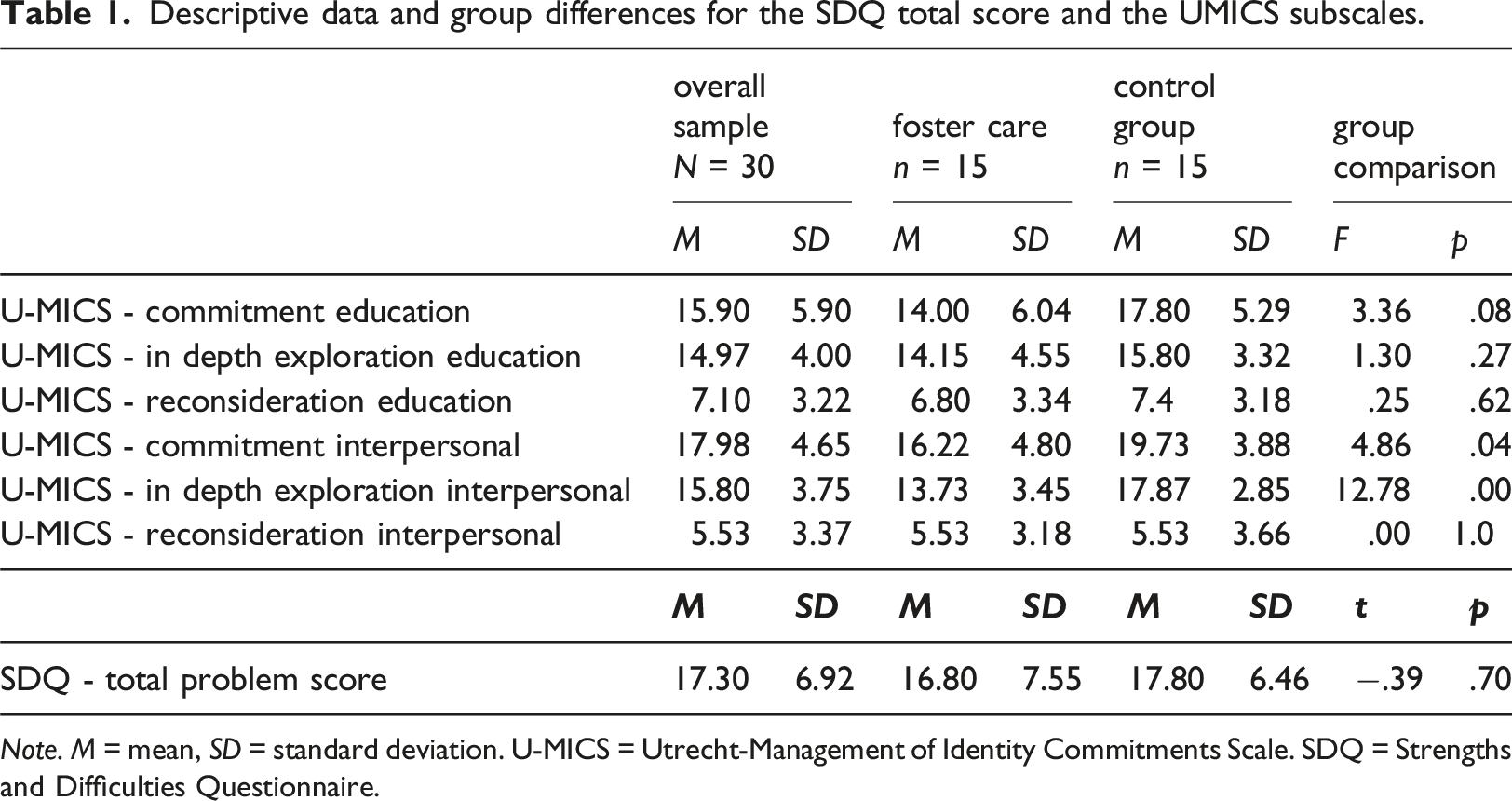
Note. M = mean, SD = standard deviation. U-MICS = Utrecht-Management of Identity Commitments Scale. SDQ = Strengths and Difficulties Questionnaire.
To answer our first research question, we conducted two separate multivariate analyses of variance (MANOVAs) to test group differences for the identity processes in the educational and interpersonal area respectively. We entered the three identity processes as dependent variables and the group membership (foster care vs. biological) as independent variable. The sample was normally distributed across four of the six dependent variables, as assessed by the Shapiro-Wilk test (α = .05), therefore the findings were checked with the non-parametric Mann-Whitney-U-Tests. However, considering similar results of the non-parametric verification and Finch’s (2005) assumption that one-factorial MANOVAs are relatively robust, we report the MANOVAs solely. Homogeneity of variances was given in all dependent variables. Correlations between dependent variables were below r < .90, indicating that multicollinearity was not a confounding factor in the analysis. The one-way MANOVA showed a statistically significant difference between the subgroups on the combined identity processes for the interpersonal area, F(3,26) = 4.03, p = .018, partial η 2 = .32, Wilk’s Λ = .68. The MANOVA for the group effect on the combined identity processes for the educational area was not significant, F(3,26) = 1.26, p = .31, partial η 2 = .13, Wilk’s Λ = .87. Subsequent ANOVAs revealed that adolescents in foster care show significantly lower commitment and exploration in the interpersonal area.
Next, group differences regarding the SDQ total problem score were calculated. Adolescents in foster care (M = 16.80; SD = 7.55) did not differ from adolescents in the control group (M = 17.80; SD = 6.46), t(28) = −.39, p = .70) in their SDQ total problem score.
Associations between the U-MICS subscales and the SDQ total problem score.
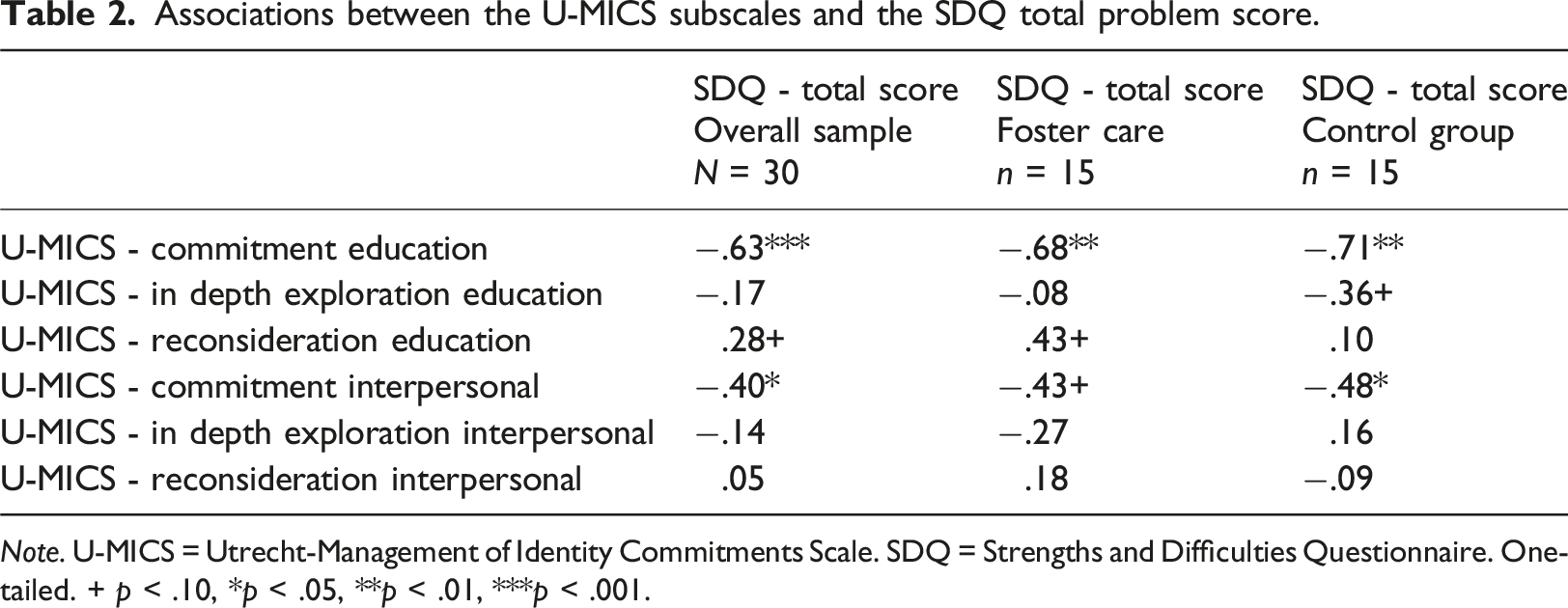
Note. U-MICS = Utrecht-Management of Identity Commitments Scale. SDQ = Strengths and Difficulties Questionnaire. One-tailed. + p < .10, *p < .05, **p < .01, ***p < .001.
Discussion
Contrary to our hypothesis, we found no group difference regarding the problem load assessed with the SDQ total score: Adolescents in foster care show a comparable problem score to adolescents in their biological families. One explanation is that the data collection took place during the pandemic and pandemic restrictions, which was a challenging time for most adolescents (Ravens-Sieberer et al., 2021) and could have led to increased problem burden in the control group as well. Consistently, a comparison of our data with normative data points to clinically relevant problem scores in both subsamples.
Another plausible explanation is the relatively long duration of foster care settings in our sample - over half of the participating adolescents have been living in their current families for more than ten years. The mean duration of placement was high compared to recent data from Germany, according to which 15- to 18- year-olds spend 60 months in the foster families (Statistisches Bundesamt, 2023). Placement stability has been found to be associated with lower problem scores in prior research (e.g. Dubois-Comtois et al., 2021; Newton et al., 2000). Therefore, this result highlights the continuity of out-of-home youth services in Germany, especially in our sample. The findings show that a consistent home environment potentially with corrective relationship experiences with sensitive caregivers may contribute to (partially) adaptive outcomes, at least in the form of a similar problem burden compared to adolescents in their biological families. Importantly, foster care aims at providing positive developmental conditions for children and adolescents and intervening in adverse experiences. While many studies find that difficulties persist during the placement in care, the outcomes are very diverse as shown in meta-analyses by Goemans et al. (2015). A subsequent longitudinal study with Dutch children and adolescents in foster care revealed that a substantial group displayed adaptive psychosocial functioning as assessed with the SDQ and identified potential contributing factors (Goemans et al., 2016). Hence, the beneficial intervention effect of foster care should not be underestimated.
However, regarding
Regarding the present study, the small sample size needs to be considered, and the results should be interpreted cautiously. More research, including intra-individual changes and individual narratives, is needed to examine the dynamics in detail.
In contrast to commitment and exploration, we found no significant group differences regarding reconsideration of commitment. This indicates that adolescents in foster families and biological families show a comparable number of insecurities, reflecting, pondering and possibly desperation concerning their own commitments.
Regarding the
No significant associations between exploration and the problem score have been found in the overall sample. Solely, in the control group educational exploration was negatively associated to the problem score on a trend level. Further research should elucidate whether a certain degree of exploration is an indicator for adaptive development in non-risk samples (Klimstra & Denissen, 2017). The crucial difference between exploration and reconsideration of commitment is that the benefits of their current commitments are explored without questioning the commitments themselves (Klimstra et al., 2010). In this period of identity formation, adolescents’ exploration could be positive or adaptive for their future identity development. The identity process reconsideration of commitment was marginally positively related to the total problem score for foster adolescents in the educational area. Again, this might be due to insecurities regarding their long-term perspective, since official ties to the foster families are limited by age. It seems reasonable that questioning existing commitments in the educational area may be associated with problems as it endangers their future perspective. Moreover, adolescents in foster care likely expect less support and more uncertainty in their educational choices once they age out of the care system, which could contribute to the positive association with perceived problems. An interpretation in the opposite direction also makes sense, as many mental health problems lead to ruminating (Crocetti et al., 2009). However, as our sample size is small, findings on a trend level have to be discussed very cautiously.
Strengths and limitations of the present study
Identity development is deeply connected with (if not depending on) one’s peer and family contexts (see Crocetti et al., 2023). To our knowledge, our study is the first to examine identity development in foster adolescents using the well-established U-MICS. The present study also sheds light on the associations between the attainment of an important developmental task and problem load in adolescence.
The main limitation of the current analyses is the small sample size. The study served to collect pilot data for a larger project. The findings should be interpreted very cautiously and cannot be generalized. Furthermore, most participants were female, which is another limitation regarding the representativity of our sample. Additionally, our sample had relatively high placement stability. One should consider that this is not the case for all adolescents in care. Nevertheless, even in this sample, particularities in identity development were evident. Informed by the experiences during this pilot study, data collection in the future project will include further child welfare agencies and other service providers for foster families and adolescents. Specifically, we aim to reach a larger and more diverse sample of adolescents. Moreover, in the context of identity development, we are interested in specific information about adverse experiences and placement histories, contact with biological caregivers, and characteristics of the foster family including long-term perspectives. Finally, longitudinal associations between developmental tasks and perceived problems can further elucidate underlying processes.
Implications and conclusion
To sum up, results indicate that adolescents in foster care were faced with some challenges in coping with the central developmental task of identity formation. Identity development, especially in terms of commitment, seems to be more complex for youths living in foster homes. As the development of a coherent identity is central for psychosocial well-being, it is important to support individuals in finding out who they are and want to become. Especially for adolescents with a history of adverse childhood experiences, the development of a coherent narrative is a crucial factor for prevention and intervention. An intra-individual perspective fostering an autobiographical integration should be considered, more precisely interventions from a family systems perspective including genograms and timelines as well as individual and social resources such as long-term perspectives.
Footnotes
Acknowledgements
The authors want to thank the DGSF for the financial support of this research. Furthermore, we wish to thank our many assistants in data assessment and analyses, e. g. Lisa Herschmann and Antonia Drasen. Moreover, we want to thank the very helpful comments and constructive suggestions of anonymous reviewers on earlier drafts of this paper. Finally and above all, special thanks to the participating adolescents, who made this study possible.
Declaration of conflicting interests
The author(s) declared no potential conflicts of interest with respect to the research, authorship, and/or publication of this article.
Funding
The author(s) disclosed receipt of the following financial support for the research, authorship, and/or publication of this article: DGSF: Deutsche Gesellschaft für Systemische Therapie, Beratung und Familientherapie (Forschungsförderung 2019).
