




Abstract
Growing up in high-risk environments is detrimental to children’s development of attachment security. Parenting behavior is hypothesized to be the mechanism through which risks exert their influence. However, risk influences can vary between individuals by gender. Aim of this study was to explore specific pathways of family risk on early attachment security and additionally examine the transmission via parenting behavior. The sample consisted of 197 children and their primary caregivers. Children’s age ranged between 10 and 21 months (M = 15.25, SD = 3.59). Data assessment included 21 distal and proximal family risk factors, children’s attachment security, and parental responsivity and supportive presence. Whereas distal risk factors had an adverse effect only on girls’ attachment security, proximal risks negatively affected only boys’ attachment security. Additionally, patterns of risk factors occurring in our sample were analyzed using an exploratory principal component analysis. Regardless of the child’s gender, a low socio-economic status was negatively related to attachment security of all children. Migration and crowding and a high emotional load of the primary caregiver both negatively predicted girls’ but not boys’ attachment security. However, the attachment security of boys was affected by a negative family climate. Most of the adverse risk effects on attachment security were mediated by parental responsivity and supportive presence so that the transmission of risk occurs through parenting behavior. Results revealed a different susceptibility of family risks for girls and boys. The consideration of a gender-sensitive approach in developmental psychopathology and interventions of developmental child welfare services is recommended.
Attachment development is considered one of the milestones in early childhood, and attachment security represents a pivotal construct predicting later psychological adjustment and mental health (Sroufe, 2005). Since attachment security itself is regarded as a protective factor in child development and an aspect of resilience in the presence of risk (Fearon & Belsky, 2004; Hopkins et al., 2013), it is currently one of the key variables frequently used for generating intervention programs designed for high-risk samples (Mountain et al., 2017).
Research of factors leading to unfavorable outcomes and maladjustment in child development has a long tradition (Rutter, 1981; Sameroff et al., 1987), and those risk factors can also be identified for socio-emotional development and the development of attachment security (Cyr et al., 2010; Whittaker et al., 2011). Risk factors are generally defined as characteristics enhancing the probability of child maladjustment (Davies & Sturge−Apple, 2015). The more risk factors children are exposed to, the worse are the developmental outcomes (Cyr et al., 2010; Evans et al., 2013). Traditionally, risk research focuses on general cumulative risk effects on developmental outcomes in samples as large and representative as possible (Belsky & Isabella, 1988; Evans et al., 2013; Flouri et al., 2014). This approach neglects two key aspects.
First, transactional and ecological theories postulate that the development of children is shaped by “proximal” and “distal” variables (Bronfenbrenner, 1979; Sameroff, 2009). While proximal variables provide direct experiences (e.g., behavior of the caregiver), distal variables such as the caregiver’s educational level or unemployment are experienced indirectly. The influence of distal variables on child development is assumed to be mediated by proximal variables like parenting behavior (Bronfenbrenner, 1979; Hopkins et al., 2013). Research in developmental psychopathology uses the distinction between distal and proximal variables also for risk factors (Flouri et al., 2010; Jones et al., 2002). When the sources of influence on child development are arranged on a continuum, distal risk factors are the furthest in time and space from the child’s daily experience. Proximal risk factors are experienced closer, and parenting behavior represents the closest source of experience for a child. Nevertheless, in studies investigating risk effects on child development, proximal and distal risk factors have been combined into one global cumulative risk index (Evans et al., 2013; Sparks et al., 2018). If we want to understand the development of children placed at high-risk environments, it is essential to consider proximal and distal risk factors separately (Belsky & Isabella, 1988; Flouri et al., 2014).
Second, girls and boys often would be considered comparable and studied together in one sample. Concerning attachment development, this is not a primary problem as attachment theory does not propose any general gender differences in attachment security, and several studies did not report gender effects on attachment security (Cadman et al., 2018; Meins et al., 2018). However, research exploring mechanisms of risk effects showed that risk effects on child development could vary inter-individually with the child’s gender (Fearon & Belsky, 2004; Petrenko et al., 2019; Rutter, 1989; Werner & Smith, 2001; Wilson et al., 2009). As, in childhood, girls were reported to be less vulnerable to environmental risks than boys, the female gender has been postulated to be protective in the presence of risks (Hollister-Wagner, Foshee, & Jackson, 2001; Rutter et al., 1979). Moreover, there are indications that boys might be more vulnerable to risks earlier in life compared to girls (Blatt-Eisengart et al., 2009; Murray, 1992; Tronick & Reck, 2009), whereas girls appear to show a higher vulnerability to risks in adolescence (Hammen et al., 2012; Hops, 1996). Regarding attachment development, earlier studies reported on higher rates of insecure attachments for boys when growing up in poverty (Anan & Barnett, 1999; Barnett et al., 1998).
Studies finding such a gender-specific vulnerability to high-risk environments hypothesize that boys show a slower maturation rate (Kochanska et al., 2001; Martel et al., 2009) resulting in a longer period of early susceptibility and allowing boys to be more affected by early risks than girls (McGinnis et al., 2015). Those different vulnerabilities might be intensified by an additional exposure to risky parenting practices and expectations as well as to lower parental investments, which have also been shown to vary by the child’s gender (Blatt-Eisengart et al., 2009; Hammen et al. 2012; Sandner & Jungmann, 2017).
To summarize, evidence indicates gender-specific risk effects on child development. To our knowledge, no other studies are exploring the gender-specific consequences of cumulative family risks on attachment security. We, therefore, wanted to investigate the attachment security of girls and boys growing up in different high-risk contexts.
Predicting early attachment development: Adding family risks
Since the beginnings of attachment theory, research has often focused on a unique predictor to explain differences in children’s early attachment development: Maternal interaction behavior, particularly maternal sensitivity. Maternal sensitivity has been proven as a reliable but only moderate predictor of attachment security (De Wolff & van Ijzendoorn, 1997; Koehn & Kerns, 2018). Additionally assuming transgenerational processes, sensitivity functions as a mediator of the influences of maternal attachment representation on children’s attachment security (van Ijzendoorn, 1995). After several decades of studying maternal sensitivity as the mechanism behind the intergenerational transmission of attachment qualities, there is still a “transmission gap” (van Ijzendoorn & Bakermans−Kranenburg, 2019; Verhage et al., 2016).
However, in addition to maternal attachment representation, other factors, such as adverse environmental circumstances and family-related risk factors, can harm maternal sensitivity (Fößel, 2019; Pereira et al., 2012; Riley et al., 2014). Therefore, the inclusion of family risk markers may provide a useful contribution to a model explaining differences in child attachment security by maternal sensitivity. As outlined above, this should include both distal and proximal variables. To our knowledge, no other studies are exploring the differential effects of proximal and distal family risks on the development of attachment via maternal sensitivity.
Candelaria et al. (2011) examined distal and proximal risk factors and found that both risk domains affected children’s attachment security. Other researchers reported separate findings for demographic and psychosocial risk factors but made no clear distinction between proximal and distal risks (De Falco et al., 2014). They showed that families with a combined demographic and psychosocial risk had children with lower attachment security than families only exposed to demographic risk factors. However, both studies did not consider parenting behavior. Other findings suggested that the adverse effects of proximal risks on preschoolers’ attachment security were transmitted by the caregiver’s sensitivity and scaffolding (Hopkins et al., 2013). In this case, distal family risk factors were not assessed.
Thus, there is a lack of studies disentangling the mechanisms of developing insecure attachments in children growing up in high-risk environments considering specific effects of proximal and distal risk factors in combination with parental sensitivity.
The distinction of family risk factors by the proximity of experience into distal and proximal family risks is based on Bronfenbrenner’s (1979) ecological theory. A further step is to investigate exploratively whether family risk factors are co-occurring or clustered in our sample, creating patterns of family risks. Those patterns of family risks might have differential effects on early attachment security.
Aims of the Current Study
Previous research from the 1970ies to now clearly reported on the adverse effects of early risk exposure on children’s attachment development (Cyr et al., 2010; Vaughn et al., 1979). However, environmental contexts are changing due to political, societal or cultural influences, so the development of cohorts always needs to be seen in the light of actual circumstances. We addressed this issue by examining a large German sample in the middle of the 2010s. For this purpose, we assessed 21 family risk factors, parental sensitivity and children’s attachment security.
As highlighted above, and to our knowledge, little is known about different combinations or patterns of risk factors affecting early attachment security of specific groups of individuals. In this study, we applied two different approaches to establish patterns of family risk factors by grouping them in different ways:
Following a deductive theory-driven approach, considering transactional and ecological theories, family risk factors were categorized into distal and proximal risks according to their temporal and spatial proximity to the child's experiences (Bronfenbrenner, 1979; Sameroff, 2009). The first objective of this study was to investigate differential effects of distal and proximal family risk factors on attachment security including a potential mediation model of proximal risks transmitting distal risk influences on children’s attachment security.
Another way of grouping family risk factors is to use an inductive approach by analyzing whether individual family risk factors frequently co-occurred in our sample and formed a family risk pattern. The second objective of our study was, therefore, to examine these family risk patterns in an exploratory way and then to investigate their differential impact on children’s attachment security.
Since maternal sensitivity is the most studied predictor of early attachment security (De Wolff & van Ijzendoorn, 1997) and is hypothesized to be the mechanism behind the transmission of risk (Hopkins et al., 2013), the third objective of our study was to investigate whether family risk effects on attachment security found in our sample were mediated by parental sensitivity.
Moreover, not every child exposed to early risk factors evolves maladaptive developmental outcomes in the same way; instead, children can show different vulnerabilities for risk influences (for an overview, see Evans et al., 2013). For understanding the developmental pathways leading to maladaptive outcomes or psychological adjustment of individuals, it is essential to explore groups of children being more vulnerable to early risks. One individual characteristic moderating risk effects has been identified in the child’s gender (Petrenko et al., 2019; Rutter, 1989; Tronick & Reck, 2009; Werner & Smith, 2001). The last objective of our study was therefore to explore family risk effects and the transmitting processes on attachment security depending on the child’s gender.
Methods
Design and main project
This study is part of the German Developmental Study exploring correlates and developmental outcomes of distal and proximal family-related risks in families with children under three years of age. The German Developmental Study had a short-term longitudinal cohort-sequential-design (Zimmermann et al., 2016). Family risk factors were assessed prospectively in a representative sample of German families. Using the information on family risk exposure from the pre-assessment, high-risk families were oversampled compared to normal samples enabling the detection of differential risk effects. Data assessment of the German Developmental Study included two waves. Wave 1 was performed between September 2014 and February 2015. Seven months later, wave 2 was conducted. Ethical approval for the pre-assessment was granted by the General Medical Council in the North-Rhine region in Germany (No 2013247). The study was performed according to ethical standards and the data protection law in Germany, and all families provided written informed consent for participating in the study and received an expense allowance of 50€ per wave.
Previous analyses showed that differences in attachment security due to family risk effects were strong at the first wave of measurement (Gerlach et al., In press). Therefore, we wanted to further explore these effects in more detail and exclusively focused on the first wave in this paper.
Sample
197 toddlers and their primary caregivers from two large German cities in North-Rhine-Westphalia participated in our study. Participants were drawn from 937 families that attended the pre-assessment of the National Centers for Early Intervention in Germany (Eickhorst et al., 2015). At wave 1, the gender ratio was balanced with 50.3% of boys, and children’s age ranged between 10 and 21 months (M = 15.25, SD = 3.59).
Most of the primary caregivers were mothers (97%) and, in a few cases, the father (2.5%) or the step-father (0.5%). Primary caregivers were between 20 and 64 years old. The majority of the primary caregivers was born in Germany (85.3%), 12.5% were born in another country (e.g., Africa, Asia, Europe), and 2.2% did not provide any information.
Whereas 60.4% of the primary caregivers reported to have a university degree or a degree from a university of applied sciences, 26.9% stated to have a degree from a vocational school or to have completed an apprenticeship. A minority of primary caregivers (9.6%) had no professional qualification, and 3.1% did not provide any information. 45.7% of primary caregivers were taking parental leave, which is common in Germany during the first 3 years of the child's life. In contrast, close to one-third (31.5%) were gainfully employed, 19.3% of primary caregivers were not employed or were seeking work, and 3.5% did not provide any information. The monthly net income of the families ranged from 600 to 60.000€.
Procedures
Data collection was performed using semi-structured home visits, each lasting about 3 h (for more details, see Gerlach et al., In press). Children and their primary caregivers were observed in dyadic free play and structured play situations (Fößel, 2019), and a situation for observing children’s autonomy behavior and emotion regulation competencies. Additionally, children’s cognitive and language development was assessed using the Bayley Scales of Infant and Toddler Development (Third Edition) (Bayley, 2006). For further examination, all home visits were videotaped. Moreover, individual characteristics of the primary caregiver, the respective family and the children were collected using standardized questionnaires (Zimmermann et al., 2016).
Measures
Family risk factors
In a pre-assessment, about 6 months before the start of wave 1, family risk factors were examined using the KiD: 0–3 questionnaire, a self-report questionnaire for parents (c.f. Eickhorst et al., 2015). The KiD: 0–3 includes items from other standardized and validated questionnaires, official national guidelines and socio-demographic items adapted from previous research to assess and define individual family risk factors (Eickhorst et al., 2015; Gerlach et al., In press). In total, 21 family risk factors from the child’s perspective occurring in the pre-assessment sample were assessed: These were 11 distal risk factors (poverty, crowding, unemployment, single parent, migration, low education, primary caregiver’s experience of maltreatment and/ or neglect in childhood, early motherhood, more than two siblings, lifetime psychiatric disorder, and lifetime substance abuse), and 10 proximal risk factors (parental quarrel, disagreement between parents, inter-parental violence, current depression, negative regard during pregnancy, negative attitude in nurturing, risk for child maltreatment and/or neglect, current stress, child’s poor health condition, and child’s challenging temperament). The definition of risk factors and the distribution for girls and boys are described in the supplement Table A.
The presence of each risk factor was coded with 1 = given and 0 = not given. Finally, cumulative family risk indices were calculated by summing up all present risk factors (c.f. Evans et al., 2013), separately for proximal, distal, and total family risk.
Attachment security
The German version of the Attachment Q-Sort (AQS) by Waters & Deane, 1985 (Schölmerich & Leyendecker, 1999) with some changes in wordings was used for assessing children’s attachment security. Trained coders observed children’s attachment behavior in a natural setting and sorted 90 items describing attachment behaviors yielding an individual profile for each child that is correlated with a fictive expert profile of an “ideal securely attached child” (Cadman et al., 2018). The AQS is a dimensional method for examining attachment security resulting in security scores ranging from -1 to +1 with higher scores depicting higher attachment security. Several studies showed the applicability and validity of the AQS in German-speaking countries (Ahnert et al., 2006; Bovenschen et al., 2016; Gabler et al., 2014).
Trained coders rated children’s attachment security immediately after home visits. Additionally, videotapes of the home visits were rated by one master coder and five extra trained coders blind to families’ risk exposure. 20 videos drawn from the present study were used to assess the interrater reliability of five observers and the master coder yielding intra-class correlation coefficients between .86 and .92. The correlation of attachment security scores of home visit ratings and video ratings was high (wave 1: range between r = .68 and r = .77). Because of the high correlations, security scores resulting from home visits and videotapes were averaged. Since attachment security scores are correlation coefficients and therefore not normally distributed, security scores were transformed by Fisher-Z-Transformation for further statistical analyses.
Parental sensitivity
Primary caregivers' sensitivity was assessed by observer ratings during two 10-min play situations adapted from Matas et al. (1978): First, the child and his/her primary caregiver were observed in a free play session. Second, in a structured play situation, the child and the primary caregiver were presented with two challenging toys (stacking rings and hand puppets), and caregivers were instructed to play with their child with both toys for five min each.
Sensitivity was assessed using three subscales adapted from the sensitivity scales of the NICHD Study (NICHD Early Child Care Research Network, 1999) (Cox, 1997; Frosch & Owen, 2006; Owen et al., 2009), see the manual for the German version by Förthner et al. (2014): (a) responsivity and supportive presence, (b) intrusiveness, and (c) negative regard of the child. We used nine-point Likert-type scales with five behavioral anchors, which ranged from value one (not at all characteristic) to nine (mainly characteristic) (Fößel, 2019). Previous studies have shown the validity of the NICHD scales in Germany (Bovenschen et al., 2016; Gabler et al., 2014).
In this paper, we focused on the first subscale responsivity and supportive presence because our previously reported results showed that parental responsivity and supportive presence was the best predictor of children’s attachment security (Gerlach et al., In press).
The subscale responsivity and supportive presence describes parenting behavior characterized by emotional warmth, sensitive reactions to the child’s needs, and a synchronal and child-centered interaction in emotion and play regulation.
Five trained observers rated parents’ responsive interaction behavior and supportive presence from videotapes. Observers were trained in advance until satisfying levels of interrater reliability (quadratically weighted Cohen’s Kappa Κ w ≥ .70). 10 videos randomly chosen from the sample were used to calculate the post hoc reliability of all observers. Quadratically weighted Cohen’s Kappa ranged from Κ w = .92 to .93 for responsivity and supportive presence (Fößel, 2019). Coders were blind to families’ risk exposure.
To get a more valid assessment of parenting behavior across situations and due to high cross-situational correlations between values of parenting behavior in the free play and the structured play situation (r = .72, p < .001, p < .001), a composite measure for responsivity and supportive presence was computed over both play situations.
Statistical analyses
First, we investigated associations between children’s attachment security and distal and proximal family risks using bivariate correlations, separately for boys and girls. Afterwards, we tested the hypothesis that the influence of distal risks on attachment security is mediated by proximal risks using a linear regression analysis including a mediation model.
Next, we wanted to examine patterns of specific risk factors co-occurring in our sample. We conducted two principal component analyses with an orthogonal rotation (varimax with Kaiser normalization) for distal and proximal risk factors each. To avoid interfering artefacts, family risk factors with a rare occurrence in our sample (N < 10) were excluded in advance. The factor scores (regression method) of the resulting distal and proximal family risk components were included in a multiple, hierarchical regression analysis to predict attachment security with children’s gender as a moderator of the relation of family risk components and attachment security.
Finally, for family risk components found as significant predictors of attachment security, we tested parental responsivity and supportive presence as a potential mediator.
Statistical analyses were performed using IBM SPSS 26. Mediation models were tested using the PROCESS Macro (version 3.5) (Hayes, 2013). Indirect effects can be considered significant if confidence intervals (95%) do not include zero (Hayes, 2013). For reporting mediation models, standardized regression weights were used. All calculations were done two-tailed with an alpha level of p < .05. Due to missing values on individual variables, the sample size is reported for each analysis.
Results
Preliminary analyses
Potential gender differences in proximal and distal risks, attachment security, and parental responsivity and supportive presence were explored using independent t-tests. There were no significant gender effects at all. In addition, potential associations of the child’s age and variables of interest were analyzed using bivariate correlations. No significant relations of children’s age, proximal and distal risks, attachment security, and parent’s responsivity and supportive presence were found 1 .
Cumulative proximal and distal risk effects on attachment security of girls and boys
Descriptive statistics and correlation coefficients of attachment security and family risk indices separated by the child’s gender.
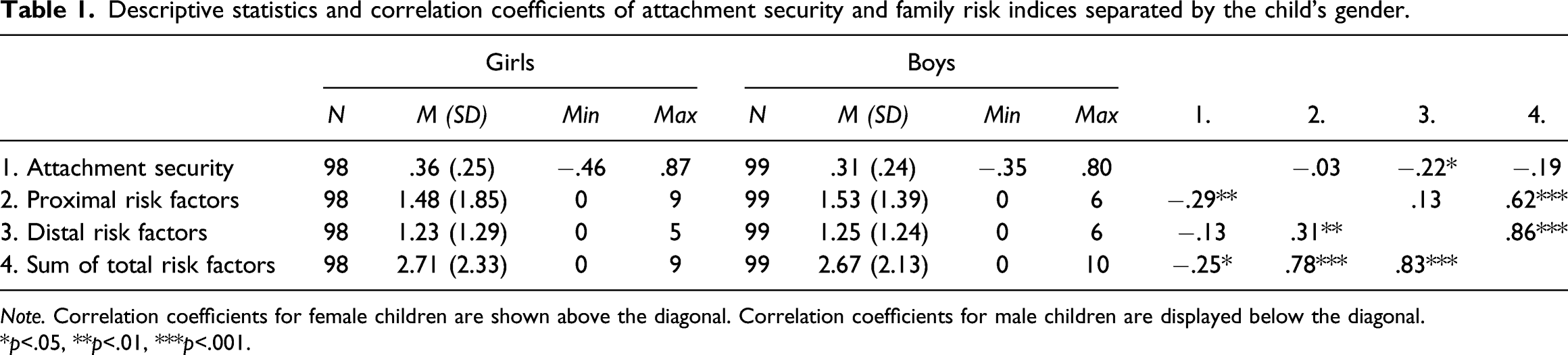
Note. Correlation coefficients for female children are shown above the diagonal. Correlation coefficients for male children are displayed below the diagonal.
*p<.05, **p<.01, ***p<.001.
Additionally, we tested the hypothesis that the influence of distal risk factors is transmitted via proximal risk factors. We analyzed two mediation models, separately for boys and girls, with distal risks as predictor, proximal risks as a mediator, and attachment security as the dependent variable. While there was no significant mediation model for girls, there was a significant indirect effect only for boys (ab = −.09, CI 95% [−.187, −.008], R 2 mediation = .02). For boys, there was no direct effect from distal risks to attachment insecurity; distal risks predicted proximal risks (a = .31, p < .01) which, in turn, predicted attachment insecurity (b = −.28, p < .01).
Gender-specific results of patterns of family risk
We were also interested in patterns of family risk factors that occurred together in our sample and the differential impact of those patterns on the attachment security of girls and boys.
To find patterns of family risk factors, we conducted principal component analyses separately for proximal and distal risk factors. To identify the components, the latent root criterion was used (Hair et al. 1998). All initial eigenvalues were above 1.0, and therefore can be considered significant. Results including factor loadings are reported in the supplement in the Table B.
The principal component analysis for proximal risk factors identified three components: Negative family climate (risk factors: disagreement in parenting between parents, child’s challenging temperament, parental quarrel), primary caregiver’s emotional load (risk factors: current stress, current depression), and negative parenting behavior (risk factors: risk for child maltreatment and/or neglect, negative attitude in parenting). For distal risk factors, the following three components emerged: Low socio-economic status (low SES; risk factors: unemployment, low education, poverty, single parent), primary caregiver’s psychiatric disorder or stress in lifetime (risk factors: lifetime psychiatric disorder, lifetime substance abuse, parent’s experience of abuse or neglect in childhood), and migration and crowding (risk factors: migration, crowding).
Correlation coefficients of children’s attachment security, parental responsivity and supportive presence and family risk components separately for girls and boys.
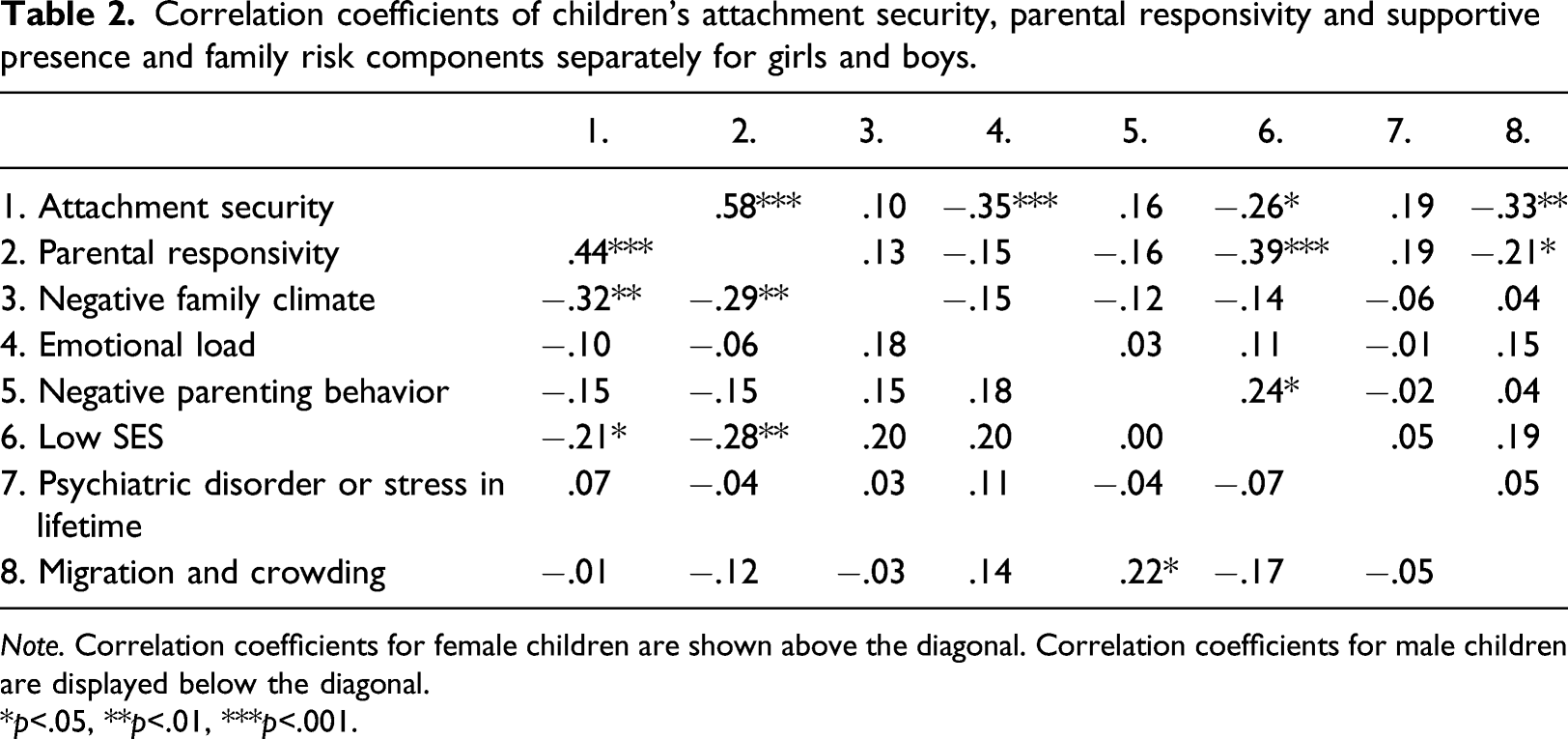
Note. Correlation coefficients for female children are shown above the diagonal. Correlation coefficients for male children are displayed below the diagonal.
*p<.05, **p<.01, ***p<.001.
Results from multiple, hierarchical regression analysis with proximal and distal risk components on attachment security, and gender as a moderator.
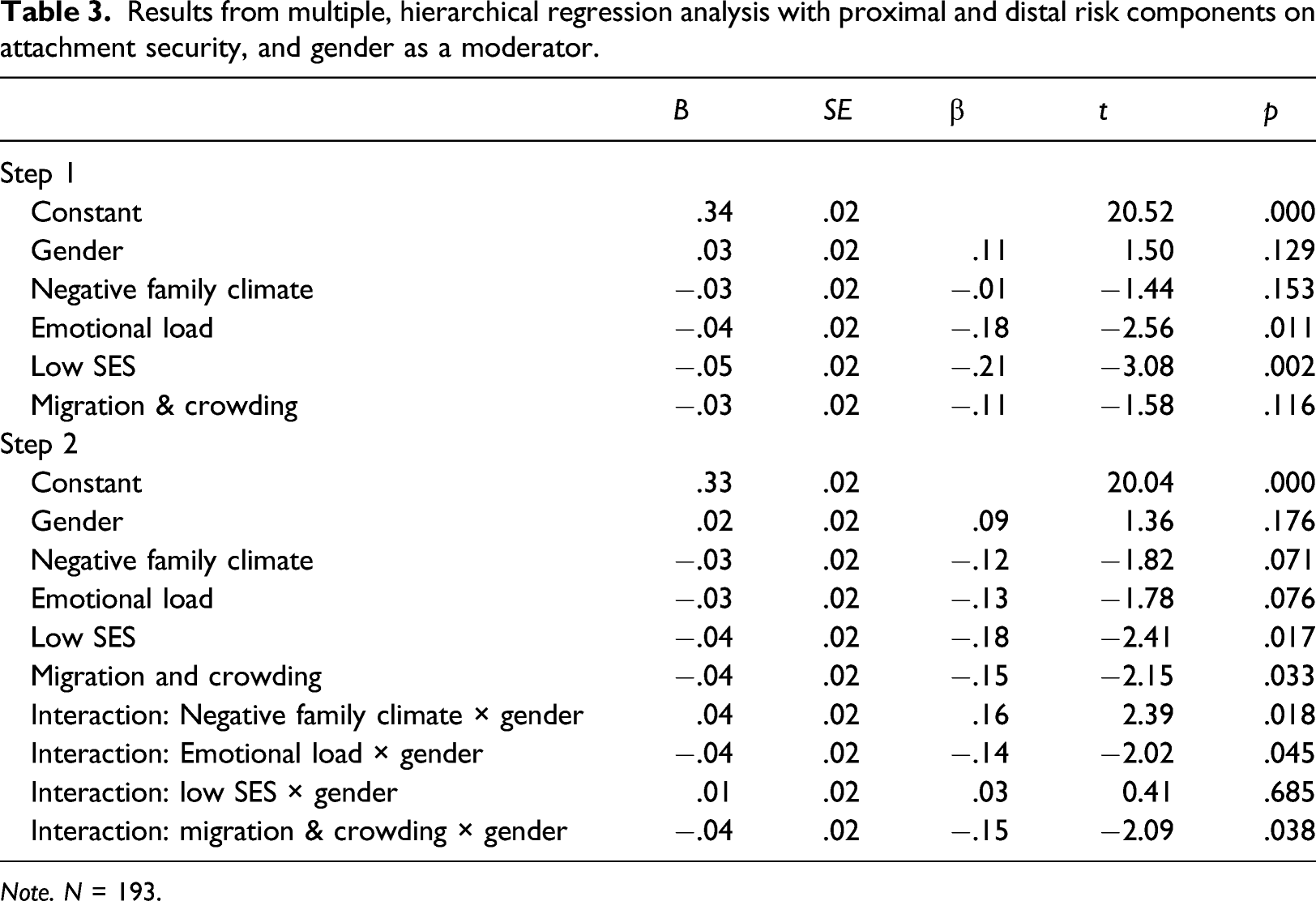
Note. N = 193.
In the first step of the regression model, there were significant main effects for the two risk components, emotional load and low SES, with higher emotional load and lower SES both negatively predicting attachment security. There were no main effects of the other risk components and gender. In the second step of the model, only the component low SES remained significant as a main effect on children’s attachment security. However, there were significant interaction effects of the risk components negative family climate, emotional load, and migration and crowding with gender. The interaction of low SES and gender was not significant. Post hoc simple slope analyses consolidated our previous findings on the correlational level: Negative family climate affected attachment security only in boys and not in girls. In contrast, emotional load and migration and crowding predicted attachment insecurity only in girls and not in boys. Simple slopes are displayed in Figure 1. Simple slopes for the relations between (a) negative family climate, (b) emotional load, (c) migration and crowding, and attachment security depending on children’s gender.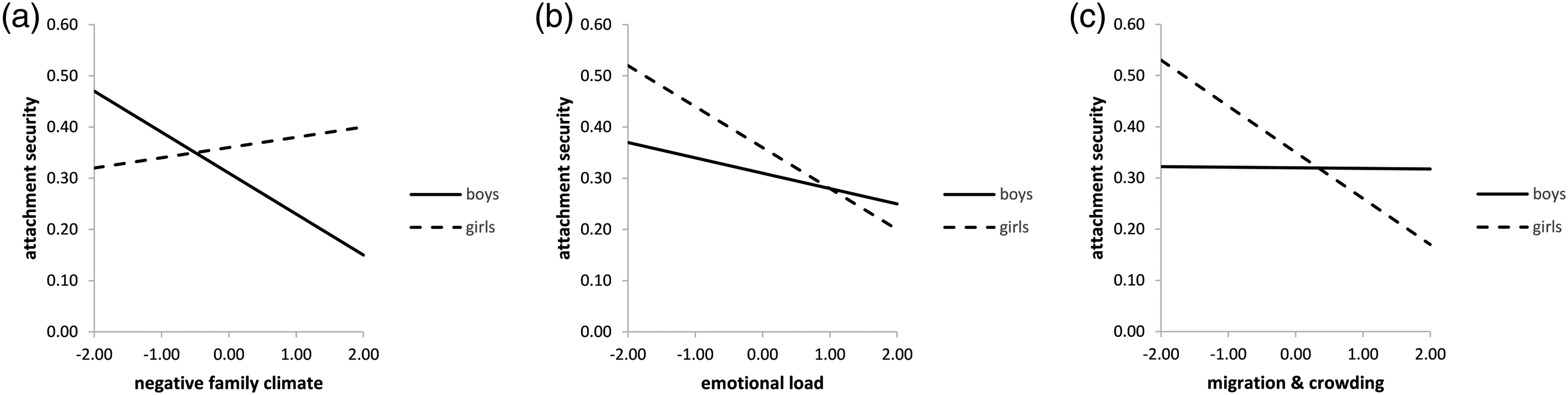
Finally, we wanted to test whether these gender-specific influences of risk components were transmitted via the proximal behavioral variable of parental responsivity and supportive presence. We, therefore, analyzed four separate mediation models with family risk components as predictors, parental responsivity and supportive presence as the potential mediator and attachment security as the outcome variable. Statistical models and standardized regression weights are visualized in Figure 2. Statistical diagram and standardized regression coefficients of simple slope mediation models of family risk components predicting children's attachment security via parental responsivity and supportive presence. ***p < .001, **p < .01, *p < .05 (a) N = 197, (b) N = 98, (c) N = 97, (d) N = 97.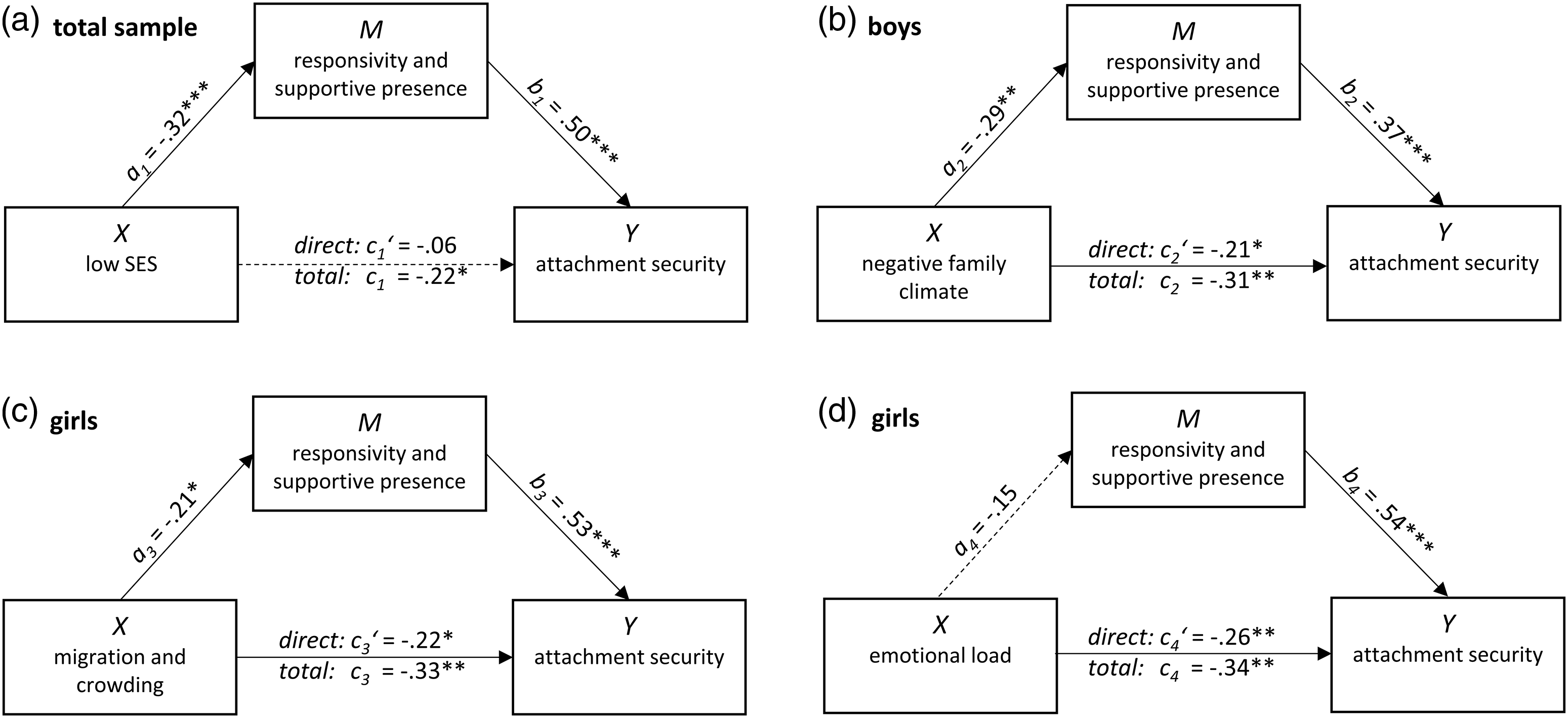
First, there was a significant indirect effect for low SES on attachment security via parental responsivity and supportive presence for the total sample (a 1 b 1 = −.16, CI 95% [−.235, −.090], R 2 mediation = .04). Second, the indirect effect of the proximal risk component negative family climate on attachment security was significant with a 2 b 2 = −.11, CI 95% [−.214, −.029], R 2 mediation = .06) for male children. Third, the indirect effect of the distal risk component migration and crowding on girls’ attachment security was significant, too (a 3 b 3 = −.11, CI 95% [−.210, −.004], R 2 mediation = .06). Forth, the predictive impact of the proximal risk component emotional load on the attachment security of girls was not mediated by parental responsivity and supportive presence, as the indirect effect was not significant. However, emotional load and parental responsivity and supportive presence both predicted girls’ attachment security in the expected directions.
Discussion
In this study, we found a general detrimental effect of cumulative family risks on children’s attachment security comparable to other studies (Evans et al., 2013). Following a deductive research approach, we first distinguished family risks by the proximity to the child’s experience. Cumulative proximal family risks only affected boys’ attachment security, whereas cumulative distal family risks exclusively influenced attachment security in girls. Additionally, distal family risks do not seem to be irrelevant for boys as they had a negative indirect effect on their attachment security mediated by proximal family risks. This result provides evidence for transactional and ecological theories on a behavioral level that distal variables express their impact through more proximal ones (Bronfenbrenner, 1979; Sameroff, 2009). Interestingly, we only found this indirect effect for boys and not for girls.
Some studies reported direct effects of family risk on children’s attachment security (Cyr et al., 2010) and there is some but limited evidence that these effects were transmitted by parenting behavior or responsivity and supportive presence (Hopkins et al., 2013; Gerlach et al., In press). However, previous studies did not report any gender effects or gender-specific pathways of risk influences. Maybe distal and proximal risk effects on girls’ attachment security can be better understood when considering parenting behavior.
While the use of the two cumulative indices of proximal and distal family risks indicated gender-specific adverse effects on attachment security, the results concerning the patterns of family risk factors from an inductive research approach showed a more differentiated picture with some of them negatively predicting attachment security for all children and others only for boys or only for girls.
Low SES. Risk factors indicating a low SES were associated with lower attachment security in both girls and boys, and this effect was largely mediated by parental responsivity and supportive presence. This finding is in line with previous research reporting the adverse effects of a low SES on maternal sensitivity and child attachment security (Bakermans-Kranenburg et al., 2004; Fish, 2001). Restrictions of socio-economic resources can diminish parents’ resources to interact responsively and emotionally warm with their children, resulting in lower attachment security. As shown by Gerlach and colleagues (In press), this is not a deterministic process. If parents succeeded to show high responsivity and supportive presence despite high family risk, children did not develop insecure attachments. This shows that sensitivity is not just an epiphenomenon of low SES but has its mediating function. Thus, high responsivity and supportive presence can serve as a protective factor in the presence of risks (Gerlach et al., In press).
Migration and crowding. We found girls’ but not boys’ attachment security negatively related to the distal risk component migration and crowding. This effect was partially mediated by parental responsivity and supportive presence. In many countries, immigrants represent a substantial part of the population (Daglar et al., 2011). If families immigrate to a new country, potential conflicts between the new culture and the culture of origin may cause stress in the family system leading to parenting problems and affecting children’s psychological well-being (Kia−Keating, 2006). In line with our findings, Daglar et al. (2011) reported that Turkish parents who had immigrated to the United Kingdom showed a more authoritarian parenting style for girls and a more authoritative parenting style for boys. Another study found that Moroccan parents who immigrated to the Netherlands seem to raise their daughters with more discipline, monitoring and more support than their sons (Pels & de Haan, 2003). Comparable to our results, daughters of immigrants might experience more controlling parenting behaviors and less orientation on the child’s needs by their parents, which might lead to lower attachment security in these girls. Our findings underline the harmful consequences of stressful life circumstances like migration and crowding for sensitive parenting behavior especially for parents of girls. It is important to note that parents’ ethnicity does not impact children’s attachment security itself (Dexter et al., 2013). The negative relation might be caused by the stress brought about by migration and intensified by crowding, as family size may be larger and living space more restricted in migration families.
Negative family climate. We found a negative association of negative family climate and attachment security only for boys. Additionally, this effect was partially mediated by parental responsivity and supportive presence. In line with our findings, Sturge-Apple et al. (2004) reported that inter-parental discord decreased parental responsivity to boys’ emotional distress and, in contrast, increased parental responsivity to girls’ emotional distress. Moreover, boys were reported to develop more problem behaviors when exposed to inter-parental discord and disagreements in parenting (Jouriles et al., 1991). Our results showed on a behavioral level that a negative family climate confines the ability of caregivers to react responsively and with emotional support to especially boys’ needs, which then predicts lower attachment security in male children. Thus, the male gender seems to result in a vulnerability for lower attachment security in the context of negative family climate. In contrast to our findings, other studies indicated that girls tended to be more vulnerable to interpersonal distress and to show more problems in their socio-emotional development and stress (Crawford et al., 2001; Rudolph & Hammen, 1999). Therefore, gender differences in response to inter-parental discord or negative family climate do not seem to be fully understood (Brock & Kochanska, 2016) or could be domain-specific. Future research should further investigate the gender-specific pathways of negative family climate and inter-parental discord to children’s socio-emotional development.
Emotional load. A primary caregiver’s high emotional load negatively predicted girls’ attachment security. This effect was not transmitted via parental responsivity and supportive presence which also predicted attachment security but was not associated with emotional load. At first glance, the relation of this risk component and attachment security in girls resembles the findings of Crawford et al. (2001) as well as Rudolph & Hammen, 1999 who found girls to be more vulnerable to interpersonal distress. However, emotional load and interpersonal distress (more comparable to the risk component negative family climate in this study) may be regarded as different qualities of risk from which different risk processes may emerge. Our findings suggested different risk processes in girls and boys, that is, boys appeared to be more vulnerable to family-related distress, whereas girls seemed to be more susceptible to negative caregiver emotionality.
Consistent with our findings, a recent study also found maternal emotional distress to directly affect children’s socio-emotional development (Cheng & Furnham, 2020). However, we additionally expected the primary caregiver’s emotional load to be at least partially transmitted via their responsive and emotionally warm interaction behavior. Although the relation between emotional load and parental responsivity and supportive presence was in the expected direction, it was too small to become significant. One explanation might be that parental emotional load is subject to more daily fluctuations (Lee, 2012). The emotional load might only partly or inconsistently affect caregiving behavior, leading to smaller effects on parental responsivity and supportive presence. Another explanation might be that aspects of emotional load are relevant in daily parent-child interactions but can be suppressed during the observational situation. Maybe primary caregivers made more efforts or succeeded to regulate their negative emotions in the context of observation and thus remained responsively and emotionally warm in interaction with their children. Finally, other aspects of parental behavior not covered by the sensitivity construct might accomplish the transmission of caregiver’s emotional load to children’s attachment security.
To conclude, the initial impression that girls were more vulnerable to distal risks and boys’ attachment security was indirectly influenced by distal risks mediated by proximal risks has to be softened when looking at specific patterns of family risks. Proximal risk components in the form of the caregiver’s emotional load also contributed to the prediction of attachment security of female children. In addition, a low SES, a distal risk component, negatively predicted the attachment security of all children, therefore also in boys. Thus, a closer examination of family risk factors occurring together makes it possible to detect gender-specific pathways in children’s attachment development. Our results indicated that gender per se does not represent a vulnerability itself, postulated by others (Rutter et al., 1979; Tronick & Reck, 2009). In contrast, different processes seem to occur in girls and boys in the context of specific family risks predicting (mal-) adaptive developmental outcomes, and according to our findings also to attachment security, depending on the child’s gender.
Strengths and limitations
An apparent strength of this study is its large sample size with a balanced gender ratio and the prospective assessment of multiple family risks in combination with the oversampling of high-risk families. This design allowed us to explore and detect different pathways of family risk effects on children’s attachment security. Although a high number of different risk factors was assessed, some individual risk factors only showed a low incidence in our sample so that they had to be excluded from further analyses. In addition, the risk factors assessed must be seen from the child’s perspective and were drawn from the existing literature, but the selection of risk factors is by no means all-encompassing. Furthermore, the effects of family risks always have to be interpreted in the light of cultural contexts and cannot be easily generalized. For example, compared to the United States or non-industrialized nations, Germany has a relatively robust social protection system, which could have buffered the adverse consequences of family risks (Gerlach et al., In press). Nonetheless, we were able to detect substantial risk effects on children’s attachment security.
The longitudinal cohort-sequential design of our study has both pros and cons: On the one hand, cohort sequence studies can be used, for example, to generalize age trajectories across different cohorts. On the other hand, the study design does not allow causal conclusions due to its correlative nature.
Lastly, the principal component analyses for grouping family risk factors co-occurring in our sample were only exploratory, following an inductive research approach. The resulting family risk components must therefore be interpreted cautiously and should be replicated in further studies before causal conclusions can be drawn.
Conclusion and future directions
This study revealed different susceptibilities of the attachment security of girls and boys to cumulative family risks. Whereas girls’ attachment security was directly predicted by distal risk factors, there only was an indirect impact of distal risks in boys, which was mediated by proximal risks. Taking a closer look at patterns of family risk factors provided more specific findings: A low SES was negatively related to all children’s attachment security regardless of their gender, a negative family climate was found as a risk factor in boys, and migration and crowding as well as caregiver’s high emotional load were identified as risk factors in girls. Thus, a closer examination of family risk factors showed that in addition to the general pattern of differential susceptibility of boys and girls to distal and proximal risks, there is a contribution of proximal risks (caregiver’s emotional load) in girls and distal risks (low SES) in boys.
Our findings clearly showed that most of these adverse family risk effects were transmitted by the caregiver’s responsivity and supportive presence. This suggests a functional connection between family risks and attachment security, rather than a statistical one, as we were able to detect the process of transmission by parenting behavior. Not surprisingly, the relation of family risk and attachment security was only partially mediated by parental responsivity and supportive presence. Comparable to the transmission gap of the intergenerational transmission of attachment qualities (van Ijzendoorn, 1995; Verhage et al., 2016), we could not fully explain the mechanism transmitting family risks on children’s attachment security. Future research should investigate different aspects of parenting behaviors in this context.
Given the substantial gender-specific susceptibility of family risks found in our study, we would like to re-emphasize the relevance of gender-sensitive research and interventions in developmental psychopathology and child welfare systems.
Supplemental Material
sj-pdf-1-dcw-10.1177_25161032211065459 – Supplemental Material for Effects of family risk on early attachment security: Gender-specific susceptibility and mediation by parenting behavior
Supplemental Material, sj-pdf-1-dcw-10.1177_25161032211065459 for Effects of family risk on early attachment security: Gender-specific susceptibility and mediation by parenting behavior by Jennifer Gerlach, Judith M. Fößel, Marc Vierhaus, Alexandra Sann, Andreas Eickhorst, Peter Zimmermann, and Gottfried Spangler in Developmental Child Welfare
Footnotes
Acknowledgements
The study was a cooperation project of the Friedrich-Alexander-University Erlangen-Nuremberg (P.I. Gottfried Spangler), the University of Wuppertal (P.I. Peter Zimmermann), the University of Bielefeld (P.I. Marc Vierhaus) and the German Youth Institute (P.I. Alexandra Sann and Andreas Eickhorst). It was conducted as intensive study within the research program “Children in Germany (Kinder in Deutschland: KiD 0–3)” supported by the Federal Ministry of Family, Seniors, Women and Youth as part of the Federal Initiative Early Prevention (Grant number 170268403 BI.II.13) provided by the Federal Center for Health Information (BZgA) in Germany. We would like to thank Carina Egger, Alexandra Iwanski, Lucie Lichtenstein, Lea Orth, Fritz Podewski, Judith Schieber, and Sandra Wyrwich for their engagement in data assessment and the home ratings of attachment security. In addition, we are very grateful to Lea Agethen, Leila Al’Zihairi, Franziska Fischer, Nina Gericke, Franziska Potzel, Sebastian Rath, Daniela Schwarz, Ina Trabold, and Nora Zallmann for their assistance in the video-analyses regarding maternal behavior and children’s attachment security.
Declaration of conflicting interests
The author(s) declared the following potential conflicts of interest with respect to the research, authorship, and/or publication of this article: This is to acknowledge that there is not any financial interest or benefit that has arisen from direct applications of our research.
Funding
This study was conducted as intensive study within the research program “Children in Germany (Kinder in Deutschland: KiD 0–3)” funded by the Federal Ministry of Family, Seniors, Women and Youth as part of the Federal Initiative Early Prevention (Grant number 170268403 BI.II.13) provided by the Federal Center for Health Information (BZgA) in Germany.
Ethics approval
The human studies of the pre-assessment were carried out with the approval of the General Medical Council in the North-Rhine region in Germany (No 2013247). The study was performed according to ethical standards in Germany, for data assessment, we only conducted procedures which have repeatedly been used in former studies in the field (e.g., AQS, behavioral observations of parenting behavior). Written informed consent was given by all participating parents. They were informed that their participation is voluntary and that they can withdraw from it any time, and that the data were fully anonymized and treated according to the data protection law in Germany.
Data availability
The data supporting the findings of this study are available on reasonable request from the corresponding author. The data are not publicly available due to privacy or ethical restrictions. The data include individual information (e.g., age, risk factors) which in combination may make it possible to identify individual families. Therefore, the legal provisions on data protection do not allow the data to be made publicly available.
ORCID iD

Supplemental material
Supplemental material for this article is available online.
Note
References
Supplementary Material
Please find the following supplemental material available below.
For Open Access articles published under a Creative Commons License, all supplemental material carries the same license as the article it is associated with.
For non-Open Access articles published, all supplemental material carries a non-exclusive license, and permission requests for re-use of supplemental material or any part of supplemental material shall be sent directly to the copyright owner as specified in the copyright notice associated with the article.
