




Abstract
Indiscriminate friendliness (IF) is atypical behavior often seen in postinstitutionalized and foster children. The current exploratory study examined the associations of children’s attachment security, parental sensitivity, and child inhibitory control with reported and observed IF in 60 family-reared, never-institutionalized foster children. IF was measured with a parent-report questionnaire (Indiscriminate Friendliness Questionnaire) and an observational measure (adapted version of the Stranger at the Door procedure; Bucharest Early Intervention Project). Attachment security and inhibitory control were related to reported IF (i.e., a secure attachment and poor inhibitory control were associated with higher levels of IF), but parental sensitivity was not. No associations were found between observed IF and attachment security, parental sensitivity, or inhibitory control. Thus, foster children with a secure attachment relationship may be more prone to socially interact with others including strangers, whereas better inhibitory control may serve as a buffer against IF but these results were found for reported IF only. More research is needed to gain more knowledge about different measures, other possible correlates, and underlying mechanisms of IF.
Keywords
Introduction
Indiscriminate friendliness (IF), also known as disinhibited social behavior, is typically seen in children adopted from institutions and in foster care (Bakermans-Kranenburg et al., 2011; Love et al., 2015; Van den Dries et al., 2012). However, little is known about the origins of this behavior. IF, like other types of social behavior, may be (partly) explained from attachment theory (specifically the role played by parental sensitivity in the etiology of attachment relationships). Individual child characteristics, such as child temperament, may additionally be associated with IF. More specifically, behavioral inhibition was shown to be negatively related with IF (Doom & Gunnar, 2015). The current study aimed to investigate the associations between children’s attachment security, parental sensitivity, and inhibitory control as a temperamental trait, with IF in foster children. Pre-test data of a randomized controlled trial (RCT) to test the effectiveness of Video-feedback Intervention to promote Positive Parenting and Sensitive Discipline in Foster Care (VIPP-FC; Schoemaker et al., 2018) were used for this study.
Indiscriminate friendliness
Indiscriminate friendliness (IF) is defined as “behavior that is affectionate and friendly toward all adults (including strangers) without the fear or caution characteristic of normal children” (Chisholm, 1998, p. 1094). This kind of behavior is included in the diagnostic criteria of Disinhibited Social Engagement Disorder (DSED) of the Diagnostic and Statistical Manual of Mental Disorders (DSM-5; American Psychiatric Association [APA], 2013). For a DSED diagnosis it is required that at least two of the following behaviors are exhibited by the child: “reduced or absent reticence in approaching and interacting with unfamiliar adults, overly familiar verbal or physical behavior, diminished or absent checking back with adult caregiver after venturing away (in unfamiliar settings), and willingness to go off with strangers with little or no hesitation” (APA, 2013, pp. 265–266). These socially disinhibited behaviors are a result of insufficient care, e.g. neglect or institutional care (APA, 2013; Lyons-Ruth et al., 2009; Pears et al., 2010; Zeanah, Smyke, Koga, & Carlson, 2005), which may explain why IF is not uncommon in foster children.
Studying IF is relevant as research shows that IF underlies the development of behavior problems (e.g., aggressive and hyperactive behaviors; Lyons-Ruth et al., 2009; Pears et al., 2010) and internalizing and externalizing behavior problems increase the risk of foster placement breakdown (Oosterman et al., 2007). Breakdown should be avoided, because the experience of multiple placements is in turn related to the development of emotional and behavior problems later in life (Newton et al., 2000). In addition to adverse early life experiences, there may be parenting and child factors that are associated with IF. In order to better understand and eventually reduce IF it is important to examine these correlates of IF in foster children. The current study mainly focusses on two specific IF behaviors that are included in the clinical representation of DSED in the DSM-5: the relative absence of reticence in approaching and interacting with unfamiliar adults, and the willingness to go off with strangers with little or no hesitation.
Attachment theory
The development of IF may be partly explained from attachment theory. Early adverse experiences, such as abuse, neglect, and separation from an attachment figure, may result in difficulties with trusting new adults in foster children’s life (Greeson et al., 2011; Schuengel et al., 2009). Based on the interactions with primary caregivers, children develop an internal working model consisting of expectations about the world around them (Bowlby, 1969). The relationships children have with their primary caregivers thus serve as a blueprint for social relationships with others. Due to experiences of inconsistent and nonresponsive care, foster children may on the one hand mistrust others, because they have learned that no one is looking after them and they therefore feel that they can only rely on themselves. These children often display inhibited social behavior (e.g., they do not seek or respond to comfort when they are distressed) toward others and this kind of behavior is also included in the DSM-5, as a symptom of Reactive Attachment Disorder (RAD; APA, 2013). On the other hand, foster children may be more prone to approach any adult who is willing to positively respond and pay attention to them, because they have no preferred attachment figure (usually the primary caregiver(s)). Approaching as many people as possible may increase their chances of being taken care of and they may therefore trust all adults including strangers (Bakermans-Kranenburg et al., 2011; Pears et al., 2010). These children show high levels of indiscriminate behavior which is, as described before, a symptom of DSED. Symptoms of both RAD and of DSED are prevalent in foster children (Cappelletty et al., 2005; Kliewer-Neumann et al., 2018; Minde, 2003; Minnis et al., 2006).
In addition to experiences prior to a foster care placement, children also gain social experiences during the current placement that may be associated with IF, such as attachment security and caregiver sensitivity. A longitudinal study in (post)institutionalized children participating in the Bucharest Early Intervention Project (BEIP) has revealed that postinstitutionalized foster children showed lower levels of IF at 54 months of age compared to children who remained in institutions (Gleason et al., 2014). BEIP results additionally showed that attachment security serves as a mediator in the relation between caregiving quality and IF (McGoron et al., 2012). Caregiving quality (e.g., parental sensitivity) at 30 months of age predicted attachment security at 42 months (i.e., secure attachment relationships were more common if caregiving quality was higher), which in turn predicted lower levels of IF at 54 months of age. Other studies show that higher rates of attachment security are not directly associated with a decrease in IF in postinstitutionalized nor in (former) foster children (Bakermans-Kranenburg et al., 2011; Love et al., 2015; Pears et al., 2010; Van den Dries et al., 2012; Zeanah, Smyke, Koga, et al., 2005). Children displaying (symptoms of) attachment disorders can simultaneously show secure attachment behaviors (Bakermans-Kranenburg et al., 2011; Minnis et al., 2006; Rutter et al., 2007). Foster children with experiences of inconsistent and nonresponsive care before placement, can thus develop a secure attachment relationship with their new caregivers despite showing high levels of IF. Thus, there seems to be a theoretical relation between attachment and IF, but empirical findings have been inconsistent so far.
Within attachment theory, parental sensitivity is an important predictor of attachment security (Ainsworth et al., 1974; Ainsworth et al., 1978; Bowlby, 1969). Parental sensitivity consists of two elements: first, correct observations and interpretations of children’s signals, and second, adequate and prompt responses to those signals (Ainsworth et al., 1978). Sensitive care increases the likelihood of a secure attachment relationship, whereas insensitive care, characterized by indifferent, inconsistent, or frightening responses to children’s signals, is related to insecure attachment relationships (Ainsworth et al., 1978; Main & Hesse, 1990).
It is expected that new caregivers, such as foster parents, generally show higher levels of sensitive behavior than the foster children’s biological parents and that the quality of caregiving after placement is therefore better compared to caregiving quality before placement. Improved caregiving environment is related to reduced attachment disorder symptoms, such as IF, in postinstitutionalized and foster children (M. Bruce et al., 2019; Zeanah et al., 2017). Specifically parental sensitivity seems to be predictive of a decrease in IF (Dobrova-Krol et al., 2010; Love et al., 2015). Nevertheless, other studies suggest that IF is not related to attachment security or caregiver sensitivity (Oosterman & Schuengel, 2008) but remains relatively persistent over time despite improved caregiving quality (Guyon-Harris et al., 2018; Lawler et al., 2016; Scheper et al., 2019; Smyke et al., 2012).
Inhibitory control
In addition to factors that represent social experiences during the current foster care placement (i.e., attachment security and parental sensitivity), individual child characteristics may also be associated with IF. Disinhibited social behavior that characterizes IF seems to be related to child temperament. One specific temperamental trait that can induce disinhibited behavior is a lack of inhibitory control. Inhibitory control refers to the ability to regulate the inhibition of attentional or behavioral responses, and includes emotional reactivity as well as self-regulatory capacities that are part of the broader temperamental construct of effortful control (Rothbart, 2007). Children with high scores on effortful control show more behavioral inhibition than children with low scores (Doom & Gunnar, 2015). Because inhibitory control develops after early infancy (Rothbart, 1989), it may be of special interest in foster care studies. Research shows that inhibitory control is indeed related to IF in internationally adopted and foster children; children with poorer inhibitory control showed higher levels of IF (J. Bruce et al., 2009; Pears et al., 2010).
Current study
The current study aimed to investigate if IF is associated with attachment security, parental sensitivity, and inhibitory control. In addition to correlation analyses, multiple regression analyses were conducted to calculate the relative statistical prediction of attachment security, parental sensitivity, and inhibitory control while the other variables were taken into account. Whereas previous research most often used parent-reports of IF, observational measures of IF may provide valuable, i.e. more objective, information about the occurrence of IF in foster children. The Stranger at the Door procedure of the BEIP (Zeanah, Smyke, & Koga, 2005) is suggested to be a valuable observational measurement of IF (Bakermans-Kranenburg et al., 2011). Both a parent-report questionnaire and an observational measure were used in the current study to test the associations of the three correlates with IF in two separate models. To our knowledge, the current exploratory study is the first to examine children’s attachment security, parental sensitivity, and inhibitory control as independent correlates of both reported and observed IF in family-reared, never-institutionalized foster children. Drawing on results from the BEIP (Gleason et al., 2014; Smyke et al., 2010), child age may be an important covariate that should be taken into account when examining the relation between attachment security and IF.
Method
Participants
The current sample consisted of 60 foster parents and children. The mean age of the children was 3.63 years (SD = 1.35, range: 1 to 6) and 45% were boys. For more than half of the children (57%) the current placement was their first foster care placement, for 28% it was their second placement, and for 5% it was their third placement (for 6 children this information was unknown). The majority of the participating foster parents were female (83%) and foster parents were on average 45.43 years old (SD = 7.42, range: 31 to 61). Most foster parents did not have previous experience with foster care placements: only four foster parents (7%) had had two or more foster children placed in their homes before the current placement. The foster families had on average 1.74 foster children (SD = 0.83, range: 1 to 4). 73% of the children were placed with a non-kinship foster family and the children had on average been living with the current family for 27.78 months (SD = 14.82, range: 5 to 64). Descriptive statistics are presented in Table 1.
Descriptive statistics of the total study sample.
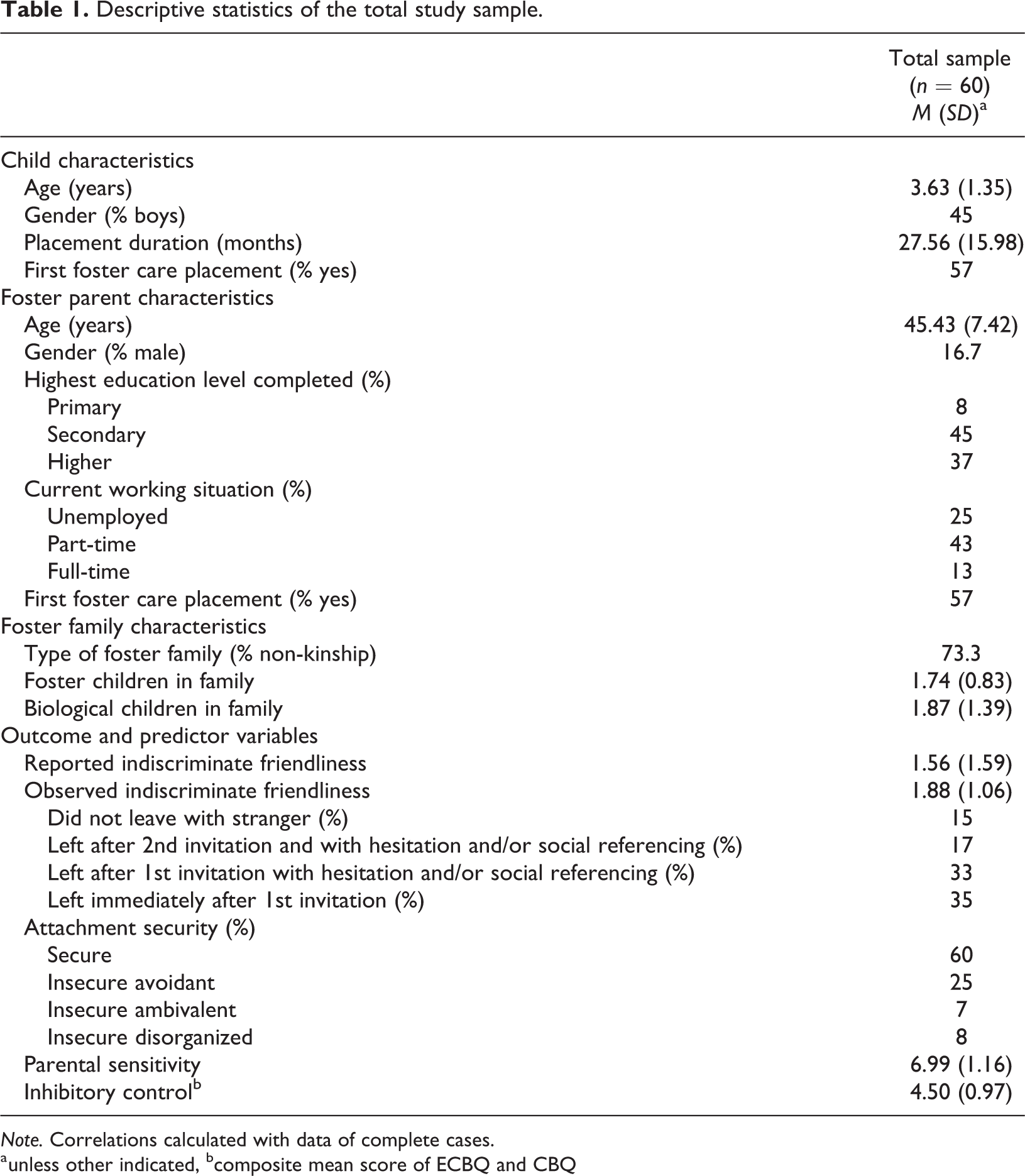
Note. Correlations calculated with data of complete cases.
a unless other indicated, bcomposite mean score of ECBQ and CBQ
Procedure
The current study used pretest data of a randomized controlled trial (RCT) to test the effectiveness of Video-feedback Intervention to promote Positive Parenting and Sensitive Discipline in Foster Care (VIPP-FC; Schoemaker et al., 2018). Recruitment of foster families was done through nine Dutch foster care organizations. Announcements of the study were additionally published on Facebook and in a Dutch foster care magazine, and were distributed among network groups for foster parents to also recruit foster families not involved with one of the nine participating foster care organizations. All foster parents and biological parents with legal custody or the legal guardian of the children signed an informed consent form. Sixty of a total of 434 eligible foster parents were enrolled in the study (response rate of 14%). The main reason for non-participation was that the study was too time-consuming; Foster families were either too busy with extra support programs (e.g., parenting interventions) or just completed an extra support program and were not willing to commit to the study. The primary caregiver (i.e., the foster parent that spend the most time with the child) participated together with one foster child. If there was more than one foster child living with the foster family, the most recently placed child was included, or in case of sibling placement, the oldest child between 1 and 6 years was included. A detailed study protocol describing the procedure for recruitment (e.g., inclusion and exclusion criteria) has been previously published (Schoemaker et al., 2018). Only data collected at the pretest of the RCT were used in the current study. The pretest consisted of a home visit and a visit to the laboratory during which several measurements (observations and questionnaires) were conducted. Ethical approval for the study was granted by the Medical Ethics Committee of the Maasstad Hospital in Rotterdam The Netherlands (NL39376.101.13).
Measures
Indiscriminate friendliness
Two instruments were used to measure reported and observed IF: the Indiscriminate Friendliness Questionnaire (Chisholm et al., 1995) and The Stranger at the Door Procedure (Zeanah, Smyke, & Koga, 2005), respectively.
Reported indiscriminate friendliness
Foster parents reported on IF using the Indiscriminate Friendliness Questionnaire (IFQ; Chisholm et al., 1995). The IFQ consists of 5 items regarding the behavior of children when interacting with unfamiliar adults (i.e., strangers). Each item has four answer options of which one indicated IF. For example for the question “What does your child do if he/she meets a new adult?”, the answer “My child approaches the new adult; he/she talks, he/she shows toys, he/she wants to sit on new adult’s lap” indicates IF (scored as 1), whereas the answers “He/she has not met new adults (yet)”, “He/she sees where the wind blows and observes”, and “He/she is upset around new adults” do not (scored as 0; Chisholm et al., 1995). A sum score of the 5 items was calculated with a higher score indicating higher levels of IF. Internal consistency was fair (Cronbach’s alpha α = .76).
Observed indiscriminate friendliness
An adapted Stranger at the Door (SatD) procedure (Zeanah, Smyke, & Koga, 2005) was performed to observe IF of the child in a laboratory setting (instead of in the home environment as in Zeanah, Smyke, and Koga (2005)). Prior to the procedure the foster parent was informed that a female research assistant (i.e., a stranger) would knock on and open the door to ask the child if he/she wanted to come along because she wanted to show him/her something (Gleason et al., 2011, 2014). The foster parent was instructed to not show any reaction (verbally or non-verbally) during the procedure, for example if the child asked if it was okay to leave with the stranger. If the child did not respond within 10 seconds, the stranger asked if the child wanted to go for a walk together with her and said that they would return to the room afterwards. If the child left with the stranger (after the first or second invitation), they walked a short distance together along the corridor before returning to the foster parent.
The original coding system developed by Zeanah, Smyke, and Koga (2005) coded whether or not the child left with the stranger. To obtain more variance in the measurement of IF, we developed a more elaborate coding system similar to the coding system used by Scheper et al. (2019). In addition to coding whether or not a child was willing to leave with a stranger (Gleason et al., 2011, 2014; Zeanah, Smyke, & Koga, 2005), we also coded whether the child hesitated and/or displayed social referencing, for example when the child sought proximity to the foster parent. A 4-point scale was used with a higher score indicating higher levels of indiscriminate behavior (0 = child did not leave with the stranger, 1 = child left with the stranger after the second invitation, 2 = child left with the stranger after the first invitation with hesitation and/or social referencing, and 3 = child left with the stranger immediately after the first invitation). All SatD procedures were coded using this coding system by the first author and 10 videos were double coded by one other coder. Interrater reliability was good (ICC = 0.93, 95% CI: 0.74 to 0.98).
Attachment security
Attachment security and disorganization were observed with the Strange Situation Procedure (Ainsworth et al., 1978). To categorize the foster children in one of four attachment classifications (i.e., secure, insecure avoidant, insecure ambivalent, or insecure disorganized) the MacArthur Preschool Attachment Classification System (PACS; Cassidy et al., unpublished) was used. For data analysis purposes these classifications were categorized in secure (PACS secure classification) or insecure attachment (PACS insecure avoidant, insecure ambivalent, and insecure disorganized classifications). Fifteen videos were double coded by two Dutch speaking coders (authors RS and EvE) with 67% agreement (Cohen’s kappa κ = .34).
Parental sensitivity
Parental sensitivity was observed during three videotaped play episodes: with toys, without toys, and structured play. During the free play episode with toys the foster parents and children were instructed to play together for 5 minutes with toys provided by the research assistant. During the free play episode without toys the foster parents and children were asked to play together for 5 minutes and they could decide for themselves what they wanted to do. Toys were not available during this episode. During the structured play episode the foster parents and children had 5 minutes to work on a task together that was intended to be a little bit too difficult based on the child’s age (e.g., build a tower of cups (2-year-olds) or putting a Jigsaw puzzle together (5-year-olds).
The Ainsworth Scales for sensitivity and non-interference were used to code parental sensitivity (Ainsworth et al., 1974; Mesman, 2017). The original Ainsworth Scales were developed to observe maternal behavior toward infants (Ainsworth et al., 1974) and small textual changes were made to enable use of the scales to observe behaviors of other caregivers toward older children (Mesman, 2017). Sensitivity was defined as observing and interpreting the signals of the child accurately and responding to these signals promptly and adequately (Ainsworth et al., 1978). Non-interference was defined as the child being able and allowed to take the lead in the interaction with the foster parent. A 9-point scale was used to code both sensitivity and non-interference with a low score indicating highly insensitive or interfering behavior (i.e., 1 = rare or absent sensitive responses, or the foster parent unnecessarily interferes with the child’s behavior and intentions almost throughout the whole episode) and a high score indicating highly sensitive or non-interfering behavior (i.e., 9 = the foster parent responds sensitively to the child’s signals almost continuously throughout the episode, or the child can and is allowed to lead during the whole interaction).
Fifteen videos were double coded by five coders with good average interrater reliabilities on sensitivity (ICC = 0.86, range: 0.77 to 0.92) and non-interference (ICC = 0.85, range: 0.77 to 0.94). The separate sensitivity and non-interference scales were highly correlated (r = .82, p < .001). A total parental sensitivity score was computed by averaging the scores of the sensitivity and non-interference scales on the three play episodes. A higher score indicated more parental sensitivity (Cronbach’s alpha α = .81).
Inhibitory control
The child temperament dimension inhibitory control was measured with the Early Childhood Behavior Questionnaire (ECBQ; Putnam et al., 2006) or the Children’s Behavior Questionnaire (CBQ; Rothbart et al., 2001) which were filled out by the foster parent. The ECBQ measures temperament in 1.5 to 3-year-old children and the CBQ in 3 to 7-year-old children on three broad scales: Extraversion/Surgency, Negative affectivity, and Effortful control. As a subscale of the Effortful control scale, inhibitory control is defined as “the capacity to plan future action and to suppress inappropriate responses” (Rothbart, 2007, p. 208). Inhibitory control is measured with 12 ECBQ items and 13 CBQ items, e.g. “When told ‘no’, how often did your child stop the forbidden activity?” (ECBQ) and “During daily activities, how often was your child able to follow your instructions?” (CBQ). Foster parents indicated to which extent their child had shown the behavior in the last 6 months. All items were scored on a 7-point Likert scale ranging from never (1) to always (7), with an extra “does not apply” option which was not considered in the mean scale scores. Composite mean scores of the ECBQ and CBQ were used as a measure of inhibitory control, with a higher score indicating better inhibitory control. For inhibitory control internal consistency was fair to good (Cronbach’s alpha’s α = .93 and α = .73 for the ECBQ and CBQ, respectively).
Data analyses
Complete questionnaire data of 54 foster parent-child dyads (90%) was available for data analysis. Missing data included records of child (i.e., number of previous placements), foster parent (i.e., age, highest education level completed, current working situation, number of previous placements), and family characteristics (i.e., number of foster and/or biological children), and of reported IF, and inhibitory control for six dyads. Placement duration and the number of biological children of the foster parent were missing for one additional foster family (2%). The observational data of IF, attachment security, and parental sensitivity were complete. Little’s MCAR test revealed that missing values were missing at random (χ2 (25) = 22,57, p = .60). Multiple imputation with the Markov Chain Monte Carlo method and predictive mean matching (PMM) as a model for numeric variables was used to estimate 50 imputed datasets with a maximum of 50 iterations for the missing data. All variables were normally distributed and contained no outliers.
Bivariate correlation coefficients were calculated. Child age was significantly correlated with placement duration (r = .32, p = .01; Table 2). Because of the relatively small sample size, including both child age and placement duration as covariates could have caused a power problem (VanVoorhis & Morgan, 2007). Two stepwise hierarchical multiple regression analyses were performed to statistically predict reported and observed IF, with child age as control variable entered in step one, and predictor variables attachment security, parental sensitivity, and inhibitory control entered in step two. To compare the results with the models using child age as a covariate, multiple regression analyses were also performed using placement duration as covariate.
Pearson correlations of demographic, predictor, and outcome variables.
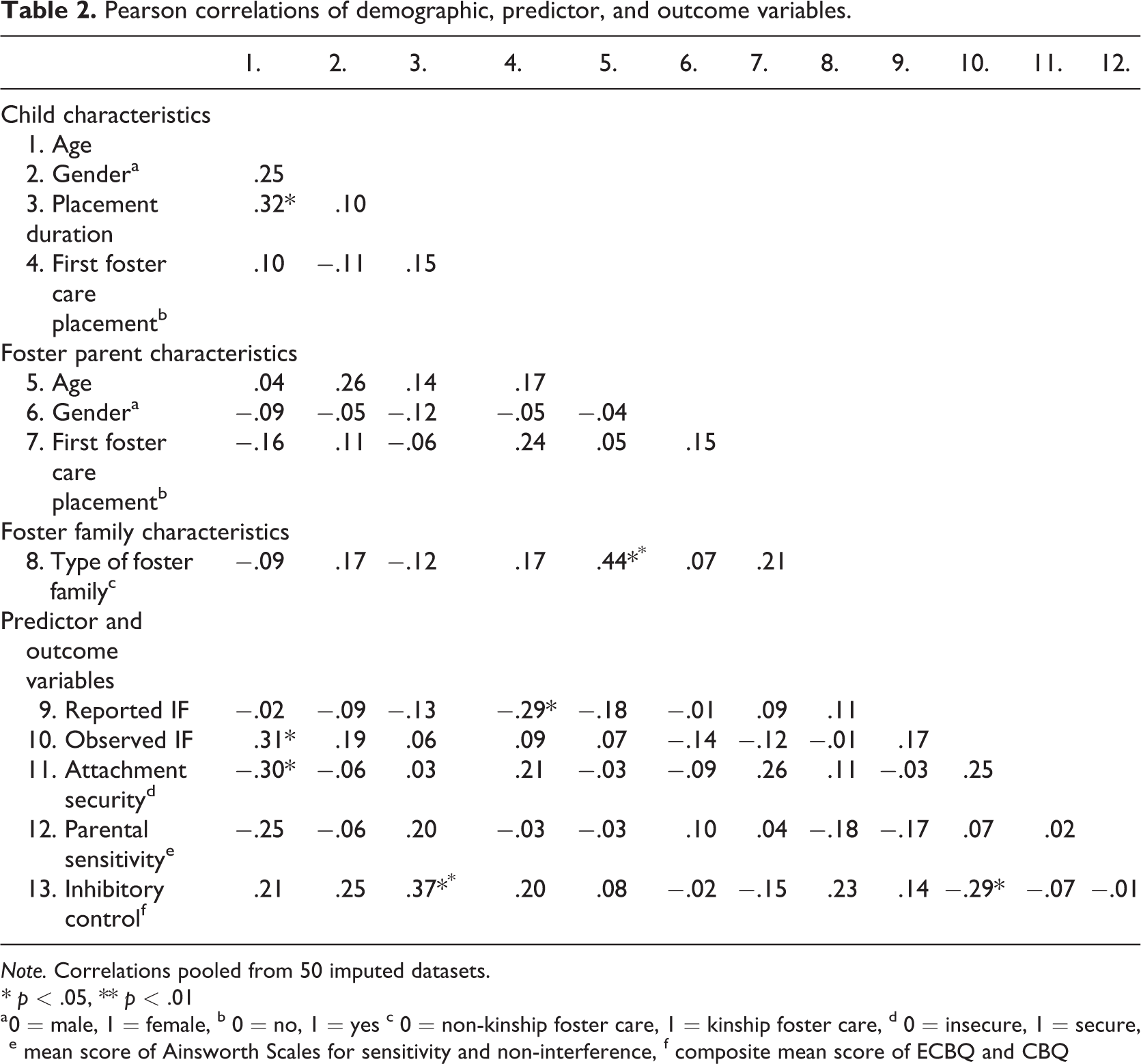
Note. Correlations pooled from 50 imputed datasets.
* p < .05, ** p < .01
a 0 = male, 1 = female, b 0 = no, 1 = yes c 0 = non-kinship foster care, 1 = kinship foster care, d 0 = insecure, 1 = secure, e mean score of Ainsworth Scales for sensitivity and non-interference, f composite mean score of ECBQ and CBQ
Finally, pooled results from the 50 imputed datasets were compared with results from complete cases analyses. IBM SPSS Statistics for Windows, version 25.0 (IBM Corp., 2017) was used for all analyses. The mixed model macro of Van Ginkel (2019) was used to obtain pooled F-tests for the regression analyses. No pooling method to calculate beta’s and R 2 is available in SPSS. Standardized coefficients and effect sizes of all imputed datasets were therefore averaged to get an indication of the pooled beta’s and R 2 of the regression models (Van Ginkel, 2019).
Results
Descriptive statistics
Descriptive statistics of the outcome and predictor variables are presented in Table 1. The children had an average score of 1.88 (SD = 1.06, range: 0 to 3) on the SatD and of 1.56 (SD = 1.59, range: 0 to 5) on the IFQ. More than half of the children had a secure attachment relationship with their foster parent (60%). The average score of inhibitory control was 4.50 (SD = 0.97, range: 2.18 to 6.31). Overall, foster parents showed sensitive behavior during the interaction with their children (M = 6.99, SD = 1.16, range: 3.75 to 9.00).
Bivariate correlation analyses
Bivariate correlations between demographic, outcome, and predictor variables are presented in Table 2. Older children had higher levels of observed IF (r = .31, p = .02) and were more likely to be insecurely attached (r = −.30, p = .02) than younger children. Children who lived longer with the foster family had higher levels of inhibitory control (r = .37, p = .01). Foster parent characteristics were not correlated with any child demographic, outcome or predictor variable, but older foster parents were more likely to be kinship foster parents (r = .44, p = .002).
Higher levels of reported IF were significantly associated with less inhibitory control (r = −.29, p = .04). Observed IF was not correlated with reported IF (r = .17, p = .21) or any of the predictor variables. Observed IF was also not correlated with reported IF when using the original coding system (r = −.02, p = .91). Attachment security was not significantly associated with reported or observed IF, nor with any of the other predictor variables. No significant correlation was found between parental sensitivity and any other demographic, outcome, or predictor variable.
Multiple regression analyses
Two hierarchical multiple regression analyses were performed to examine if attachment security, parental sensitivity, and inhibitory control are predictive of reported and observed IF, respectively, while controlling for child age.
Reported indiscriminate friendliness
Regression coefficients based on the imputed data for reported IF measured with the IFQ are presented in Table 3. Significant main effects were found for attachment security (β = 0.27, p = .049) and inhibitory control (β = −0.30, p = .03), but not for parental sensitivity (β = 0.10, p = .47; R2 = .17, F (4, 52) = 2.32, p = .07). Foster parents in securely attached dyads reported somewhat higher levels of IF than foster parents in insecurely attached dyads(secure: M = 1.85, SD = 1.68 vs. insecure: M = 1.10, SD = 1.34). Thus, children with less inhibitory control showed higher levels of IF as reported by their foster parents than children with more inhibitory control.
Regression coefficients for reported and observed IF.
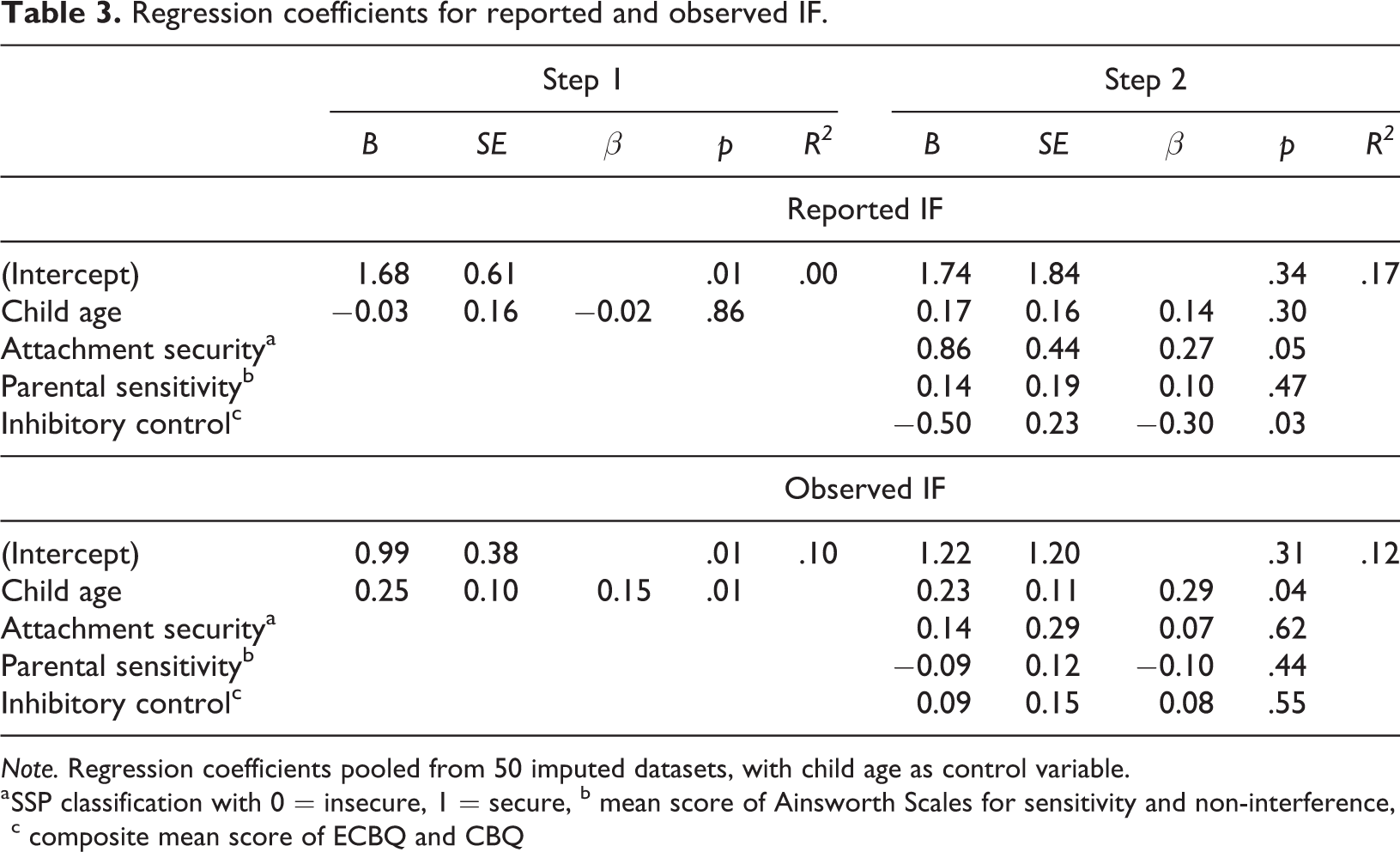
Note. Regression coefficients pooled from 50 imputed datasets, with child age as control variable.
a SSP classification with 0 = insecure, 1 = secure, b mean score of Ainsworth Scales for sensitivity and non-interference, c composite mean score of ECBQ and CBQ
Observed indiscriminate friendliness
Regression coefficients based on the imputed data for observed IF during the SatD procedure are presented in Table 3. No main effects were found for attachment security, parental sensitivity, or inhibitory control (R2 = .12, F (4, 53) = 1.79, p = .14). Attachment security, parental sensitivity, and inhibitory control were not related to observed IF.
Sensitivity analyses
Comparing the pooled results from the imputed datasets with placement duration instead of child age as a covariate resulted in somewhat different results. Attachment security and inhibitory control were no longer significant statistical predictors of reported IF (attachment security: β = 0.23, p = .09, and inhibitory control: β = 0.07, p = .61; R2 = .14, F (4, 51) = 1.84, p = .14). The main effect for parental sensitivity remained insignificant (β = −0.25, p = .10). For observed IF, results were similar to the results with child age as a covariate showing no significant associations (attachment security: β = −0.01, p = .92, parental sensitivity: β = −0.17, p = .20, and inhibitory control: β = 0.10, p = .47; R2 = .50, F (4, 52) = 0.60, p = .67).
Compared to the pooled results, the complete case analyses for the bivariate correlations and multiple regression analyses showed similar results (Supplementary Tables 1 & 2). Also no differences were found for the complete case analyses with placement duration as a covariate instead of child age.
Discussion
Due to adverse experiences early in life, foster children may show indiscriminately friendly (IF) behavior toward strangers. Environmental and individual child factors may, however, decrease IF over time in children at risk of IF. The current study examined associations of (reported and observed) IF with children’s attachment security, parental sensitivity, and inhibitory control. For reported IF, foster parents whose attachment relationships with their children were classified as secure reported higher levels of IF and children with better inhibitory control displayed lower levels of IF according to their foster parents but only when all other variables were taken into account. Parental sensitivity was not related to reported IF. Associations between attachment security, parental sensitivity, and inhibitory control with observed IF were not found when all other variables were considered. Thus, securely attached dyads and children with less inhibitory control showed higher levels of IF according to their foster parents, but not according to objective observations of IF. The correlation analyses did, however, yield an individual negative significant relation between inhibitory control and observed IF.
Attachment security
Attachment security was not related to observed IF, but was related to reported IF with foster parents in securely attached dyads reporting higher levels of IF than foster parents in insecurely attached dyads when all correlates were taken into account. During a stable and secure placement, foster children learn that they can rely on others to help them when needed and that adults can be responsive to their needs, which may result in exploration behavior expressed as socially friendly behavior toward others including strangers. Foster parents in securely attached dyads are also more attuned to their foster children’s behavioral signals which may enable them to notice the children’s behavior more accurately than foster parents in insecurely attached dyads. It is important to note that reported IF scores were quite low, even in the securely attached group. Scores in the current sample were also lower than those for (post)institutionalized children in a study that also used the IFQ as a measure of IF (Chisholm et al., 1995): On average the foster parents in the current sample reported IF at least 1 point lower (on a 5-point scale) than caregivers of (post)institutionalized children in Chisholm’s study. It is possible that the scores in our sample reflect normative socially friendly behaviors. Looking at item level, there were no differences between securely and insecurely attached dyads on the item that most clearly reflects indiscriminate friendliness (“Would your foster child want to leave with an adult he/she just met?”; both groups 21%). The biggest difference between the two groups was found for the question “How friendly is your foster child towards new adults?”, which foster parents of children with a secure attachment answered more often with the IF-answer (i.e., “My foster child is very friendly, interacts freely with everyone”) than foster parents of children with an insecure attachment (63% vs. 38%, respectively).
It is also possible that socially friendly behavior influences attachment security. Children who display socially friendly behavior toward adults in general may experience no or very few difficulties in social interactions and they may therefore find it easier to develop a secure attachment relationship with their foster parents, compared to children who show less socially friendly behavior. This may explain why foster parents of securely attached children reported higher levels of IF compared to foster parents of insecurely attached children in the current study. With reported IF a trait in the children was measured indicating a tendency toward socially friendly behavior in relationships with adults. This trait may have facilitated the children’s adaptation in developing a secure relationship with a caregiver in a safe caregiving environment. However, similar IF outside a safe caregiving environment could pose risks to the children’s healthy adaptation.
Parental sensitivity
The results of the current study did not show a significant association between parental sensitivity and reported or observed IF. In general, the foster parents in the current sample showed high levels of sensitivity, with little variation in sensitivity scores which makes it more difficult to find main effects for parental sensitivity in statistical analyses. Zeanah et al. (2017) reported reduced symptoms of attachment disorders (i.e., both RAD and DSED) in postinstitutionalized children after improved caregiving quality because of placement in foster care. Love et al. (2015) reviewed four studies that reported on the association between caregiving quality and IF of which one study used a normative sample (Minnis et al., 2007) and three studies used an adoption population (Garvin et al., 2012; Rutter et al., 2007; Van den Dries et al., 2012). Even though the adverse history of postinstitutionalized foster and adopted children shows similarities with family-reared, never-institutionalized foster children, examinations of the relation between improved caregiving quality after placement in the latter group are scarce. M. Bruce et al. (2019) did describe reduced attachment disorder symptoms after children had been placed in a foster family, but these results were limited to inhibited social behavior characterizing RAD and did not include symptoms of DSED. Moreover, of these studies only Van den Dries et al (2012) and Garvin et al. (2012) used the Emotional Availability Scales (Biringen et al., 1998) as an instrument to specifically measure parental sensitivity, whereas the other studies presumed that the adoption or foster placement in itself indicated an improvement in caregiving quality (M. Bruce et al., 2019; Rutter et al., 2007; Zeanah et al., 2017). Rutter et al. (2007), however, did not find an association between caregiving environment after adoption and reduced IF. Thus, more research to clarify the relation between parental sensitivity and IF in family-reared, never-institutionalized foster children is needed.
Inhibitory control
Inhibitory control was directly related to reported IF: Foster parents whose children showed better inhibitory control reported less IF. This result is consistent with previous research stating that children with high scores on inhibitory control are more successful in inhibiting their behavioral responses and display lower levels of IF than children with low scores (J. Bruce et al., 2009; Doom & Gunnar, 2015; Pears et al., 2010). However, inhibitory control was not directly related to observed IF.
A possible explanation is the implementation of the adapted SatD procedure in the current study, which may have compromised the observations of IF. In the BEIP, the procedure was conducted at home (Zeanah, Smyke, & Koga, 2005), whereas we conducted the SatD in a laboratory. In an unfamiliar laboratory setting it is not unexpected to come across strangers, which may have influenced the motivation of the foster children to come along with the stranger when asked to. Another explanation may be that more than half of the children in the current sample had not experienced a previous foster care placement and all children had been living with the current family for more than 2 years. Previous literature showed that foster children with experiences of stable placements characterized by responsive care (e.g., sensitive parenting) have better self-regulation and thus better inhibitory control (Bakermans-Kranenburg et al., 2011; Pears et al., 2010). We can thus cautiously conclude that the foster children in the current sample experienced relatively stable placements. This may also be displayed by high levels of parental sensitivity and high percentage of secure attachment relationships which positively influenced social development (Groh et al., 2017) and therefore resulted in higher levels of reported IF in the current sample.
Limitations
Contrary to previous research (that used different measures; Kay et al., 2016), reported IF and observed IF were not related in the current study. The SatD and the IFQ may thus measure different indiscriminate friendly behaviors in foster children. As stated before, whereas the original SatD was conducted at home (Gleason et al., 2011; Gleason et al., 2014), the SatD in the current study was part of a larger sequence of observational measurements during a visit to a laboratory (Schoemaker et al., 2018). In this laboratory setting foster children may have been more expectant of strangers and therefore more willing to go with the stranger than in their home environment.
The IFQ may be a more robust measurement to measure IF than the SatD. However, the IFQ only consists of 5 items and the questions and answer options may not be as discriminate as preferred to measure IF in foster children. One question directly asks foster parents if their child would be willing to leave with an adult that he/she has just met (Chisholm et al., 1995). This question was positively answered for IF by approximately one fifth of the foster parents. The other questions may provide more room for interpretation, considering that (similar to adoptive parents) foster parents may not necessarily view social behaviors toward others as problematic (Chisholm, 1998). Foster parents are not asked to indicate how often or in which situations their children show this behavior. This may be informative in order to be able to examine variations in IF, dependent on frequency and situation. It should also be noted that even though the IF behaviors examined in the current study are included in the diagnostic criteria of DSED in the DSM-5, other behavior patterns of the clinical presentation (e.g., overly familiar verbal or physical behavior that is inconsistent with cultural and age-appropriate social boundaries) may not have been measured as thoroughly with the IF instruments that were used. Additionally, the attachment codings showed moderate reliability between coders.
In addition to children’s attachment security, parental sensitivity, and inhibitory control, there may be other correlates that were not examined in the current study. For example, the reasons for out-of-home placement were unknown and it was thus not possible to examine the direct and possible indirect relation with IF. Because IF is presumed to be a result of neglectful care (APA, 2013; Pears et al., 2010), it could be expected that children with experiences of neglect before being placed in foster care would benefit most from parental sensitivity after placement and therefore would show lower levels of IF compared to children with experiences of abuse. Moreover, because the current study only used pre-test data, all predictors were concurrently measured and causal relations between attachment security, parental sensitivity, inhibitory control, and IF were therefore not examined.
Conclusion and Future Directions
The current study examined associations of (reported and observed) IF with attachment security, parental sensitivity, and inhibitory control. Significant associations of attachment security and inhibitory control with reported IF were found, but only when all other variables were taken into account. Children with a secure attachment relationship may be more prone to display socially friendly behaviors toward others including strangers, but this may not necessarily indicate IF considering the limited range of reported IF behaviors in our sample. In addition, we found that better inhibitory control was related to less reported IF. However, attachment security and inhibitory control were not related to observed IF when considering all correlates in a multiple regression model. Parental sensitivity was not related to reported nor observed IF.
Individual child characteristics other than inhibitory control may play a (moderating) role in the development and persistence of IF and differences in measures of IF should also be taken into account. Future studies should focus on the development of more robust measures of IF in order to examine possible correlates of IF and to understand the mechanisms underlying the development of IF.
Supplemental material
200115s_Indiscriminate_friendliness_in_foster_children_Supplementary_table_1 - Indiscriminate friendliness in foster children: Associations with attachment security, foster parents’ sensitivity, and child inhibitory control
200115s_Indiscriminate_friendliness_in_foster_children_Supplementary_table_1 for Indiscriminate friendliness in foster children: Associations with attachment security, foster parents’ sensitivity, and child inhibitory control by Nikita K. Schoemaker, Harriet J. Vermeer, Femmie Juffer, Ruan Spies, Elisa van Ee, Athanasios Maras and Lenneke R. A. Alink in Developmental Child Welfare
Supplemental material
200115s_Indiscriminate_friendliness_in_foster_children_Supplementary_table_2 - Indiscriminate friendliness in foster children: Associations with attachment security, foster parents’ sensitivity, and child inhibitory control
200115s_Indiscriminate_friendliness_in_foster_children_Supplementary_table_2 for Indiscriminate friendliness in foster children: Associations with attachment security, foster parents’ sensitivity, and child inhibitory control by Nikita K. Schoemaker, Harriet J. Vermeer, Femmie Juffer, Ruan Spies, Elisa van Ee, Athanasios Maras and Lenneke R. A. Alink in Developmental Child Welfare
Footnotes
Acknowledgements
This study was supported by Stichting Kinderpostzegels Nederland (grant awarded to Lenneke Alink, Femmie Juffer, and Athanasios Maras) and the Netherlands Organization for Scientific Research (SPINOZA price awarded to Marinus van IJzendoorn).
Declaration of conflicting interests
The author(s) declared no potential conflicts of interest with respect to the research, authorship, and/or publication of this article.
Funding
The author(s) received no financial support for the research, authorship, and/or publication of this article.

Supplemental material
Supplemental material for this article is available online.
References
Supplementary Material
Please find the following supplemental material available below.
For Open Access articles published under a Creative Commons License, all supplemental material carries the same license as the article it is associated with.
For non-Open Access articles published, all supplemental material carries a non-exclusive license, and permission requests for re-use of supplemental material or any part of supplemental material shall be sent directly to the copyright owner as specified in the copyright notice associated with the article.
