




Abstract
Parental education is a robust predictor of children’s educational outcomes in general population studies, yet little is known about the intergenerational transmission of educational outcomes in alternative family settings such as children growing up in foster care. Using Swedish longitudinal register data on 2.167 children with experience of long-term foster care, this study explores the hypothesized mediating role of foster parents’ educational attainment on foster children’s educational outcomes, here conceptualized as having poor school performance at age 15 and only primary education at age 26. Results from gender-stratified regression analyses suggest that there was an association between foster parental educational attainment and foster children’s educational outcomes but that the educational transmission was weak and inconsistent and differed somewhat between males and females. For males, lower educational attainment in foster parents was associated with poor school performance but was not associated with educational attainment at age 26. The reverse pattern was found among females: the educational gradient was inconsistent for poor school performance but appeared in educational attainment. The results indicate that supported interventions for improving foster children’s educational achievements are needed, even when placements are relatively stable and foster parents have a long formal education.
Introduction
It is well-known that education plays an important role in young people’s life chances (Esping-Andersen, 2005). Empirical research has amassed substantial evidence demonstrating that children with highly educated parents perform better in school and achieve higher educational attainment than children whose parents have less education (e.g., Breen & Goldthorpe, 2014; Hertz et al., 2007; Jackson, 2014). Theoretical links between education and overall life chances comprise mechanisms contributing to behaviors that allow individuals to function in modern societies and have choices about what sort of life they want to lead (Jackson, 2014). Proposed mechanisms include (but are not limited to) the role of norm internalization (Bourdieu & Passeron, 1977) and forward-looking decisions under constraints posed by available and perceived resources (Breen & Goldthorpe, 2014). A general assumption in this area of research is that parent and child interactions are decisive for children’s development of academic skills and school performance (Boudon, 1974; Bourdieu & Passeron, 1977; Coleman, 1988). Given this fundamental significance of the family environment, what about children who grow up in foster care?
International studies report high rates of poor school performance among children with experience of foster care (Kääriälä, Berlin, Lausten, Hiilamo, & Ristikari, 2018; O’Higgins, Sebba, & Gardner, 2017). Longitudinal studies have moreover shown that the educational gap between children with experience of foster care and their peers tends to begin at a young age, increase as they get older, and persist through the course of their lives (Sebba et al., 2015; Vinnerljung, Berlin, & Hjern, 2010). The question as to why individuals with experience of foster care tend to have poor educational outcomes has received much attention, with many alternative proposals related to pre-care factors (e.g., maltreatment, neglect, disruptive behavior), in-care factors (e.g., instability, school interruptions), and post-care factors (e.g., weak support network) (O’Higgins et al., 2017). Mainly due to the lack of adequate longitudinal data, however, the importance of foster family’s educational attainment has not been sufficiently addressed.
Small-scale studies have suggested no or weak association between foster parents’ educational attainment and foster children’s educational outcomes (Heath, Colton, & Aldgate, 1994; Sawyer & Dubowitz, 1994; Wise, Pollock, Mitchell, Argus, & Farquhar, 2010). It has moreover been suggested that foster parents have lower educational attainment than birth parents, which implies that foster children more frequently stay in nonacademic environments (Cameron, Jackson, Hauari, & Hollingworth, 2012; Cox, 2013; Fries, Klein, & Ballantyne, 2016; Zetlin, MacLeod, & Kimm, 2012). It has also been hypothesized that a socioeconomic matching process is involved in the pairing of foster families and foster children, both through social welfare agencies (with or without intent) and through the family network, which may yield an interaction effect (i.e., effect modification) on educational outcomes, that is, that an association between birth parents’ and foster children’s education is mediated by foster parents’ educational level. To our knowledge, this matching hypothesis has not yet been tested empirically.
Using Swedish longitudinal register data for more than 2,000 foster care alumni, the purpose of this study is to further our understanding about the importance of foster parents’ educational attainment in shaping foster children’s educational outcomes. This is achieved by examining the association between foster mother’s (FM’s) educational attainment and foster children’s educational outcomes when controlling for birth mother’s (BM’s) educational attainment in a population of individuals with experience of stable long-term foster care during their formative years. Foster children’s educational outcomes are conceptualized as having poor school performance at age 15 and only primary education at age 26. After controlling for birth parental education and other confounding factors, we expect an educational gradient among foster children in relation to foster parents’ educational attainment, that is, that foster children who live with foster parents with higher education perform better in primary school and have higher educational attainment at age 26 as compared to foster children whose foster parents have lower educational attainment. Since prior research has shown that women typically outperform men in the educational system (Buchmann, DiPrete, & McDaniel, 2008; O’Higgins et al., 2017), we report the results from gender-stratified analyses.
Our study contributes to previous research in the following ways. First, we are not dependent on cross-sectional data and we do not rely on retrospective self-reports. Second, our population—with a long-term follow-up—includes a large number of individuals with low data attrition. Third, we have data on both birth and foster parents’ educational attainment. Data on foster family characteristics are generally lacking in Swedish register studies since the Child welfare Intervention Register does not hold information on foster families. In this study, we linked foster children to foster families by using the Swedish Population and Housing Census. Lastly, we have access to robust outcome measures and high-quality data for constructing relevant confounders related to childhood socioeconomic background.
Methods
This study is a historical prospective cohort study based on record-linkages between eight national registers held by different Swedish authorities and covering the entire Swedish population. The overall quality of the registers is regarded as high, and they were linked by use of the unique 12-digit ID numbers given to all Swedish residents at birth or immigration. Ethical permission for the current study was obtained from the Stockholm Regional Ethics Committee (no 2007/679-31; no 4.2.1-17460/2012).
Study population
The study population was restricted to children in relatively stable placements in order to ensure a fairly coherent exposure from the foster family during primary school years. Thus, the study population was defined as individuals who (a) entered foster care before primary school started, that is, before age 7, (b) stayed in long-term care, that is, more than 5 years before age 18 according to the Child Welfare Intervention Register (held by the National Board of Health and Welfare), and (c) lived with the same FM in two consecutive censuses (5 years in-between) according to the Population and Housing Censuses (held by Statistics Sweden). Individuals who emigrated or immigrated after age 7 according to the Total Population Register (held by Statistics Sweden), or died before age 17 according to the National Cause of Death Register (held by the National Board of Health and Welfare), were excluded from the study.
Foster parents were identified through the Population and Housing Censuses where data were collected partly from questionnaires and partly from registers. The nonresponse rate was approximately 2% in 1990 and lower in previous censuses. The study population consists of individuals born in 1972–1978. The 1980 and 1985 censuses were used for birth cohorts 1972–1973 and the 1985 and 1990 censuses for birth cohorts 1974–1978. Staying in the same foster family across censuses is defined as staying with the same FM, that is, the foster father could be replaced or removed between censuses (this happened in 16% of the cases). The censuses contain information on individuals, households, and housing.
The study population represents 59% (n = 2,167) of all children in long-term care placed before age 7 (N = 3,650). On average, the study individuals stayed in care for 14 years during childhood (before their 18th birthday) and entered care for the first time at age 2.6 years. The main reason for exclusion from the study was that the individual did not stay in the same census household (while in care) across two consecutive censuses (39%), either because they were living with their birth parents at any of the censuses or because they had changed census household (new foster family or in residential care). An additional 2% were excluded because they were not staying with the same census mother across censuses, even though with the same census father. The latter exclusion was done because we decided to tie the analysis to the census mother’s educational attainment. This was done in order to limit the level of missing data since census fathers had far more missing data on educational level than census mothers. The number of individuals staying with the same census mother only (n = 337) was much higher than the number of individuals staying with the same census father only (n = 67). We did not separate those who got a new census father from those who were left with a single census mother after a foster-parent separation.
The average level of school performance measured as grade point average (GPA) in the final year of compulsory school (9 years, age 15–16) was slightly higher among the 59% who stayed in the same foster family across censuses (the study population) than those who were excluded from the study due to not living in the same foster family across censuses (2.5 vs. 2.3 among boys and 2.8 vs. 2.7 among girls) but considerably lower than in the majority population (3.0 among boys and 3.4 among girls).
Outcomes
Poor school performance
Data were retrieved from the National School Register held by the Swedish School Authority and Statistics Sweden. Poor school performance was measured as “no or low grades” in the last year of compulsory school, that is, primary school, where low grades equaled a GPA below 2.4 (mean [M]–standard deviation [SD]). When the study population went to primary school, the grading system consisted of a five-point scale—from 1 (lowest) to 5 (highest). Grades in each subject had a Gaussian distribution on a national level. GPA ranged from a minimum of 0.1 to a maximum of 5.0, with M 3.2 and SD 0.8 in the entire Swedish population. GPA below 1.0 indicated one or more subjects without ratings (most often because the student failed in those subjects). Individuals without ratings in individual subjects were included in the study and were given the value 0 in these cases. The GPA calculation included 16 different school subjects. Physical education and technology were excluded from GPA because some students were exempted from sport and because technology was not taught in all schools.
Only primary education at age 26
Data were retrieved from the Longitudinal Integration database for Health insurance and Social studies (LISA) held by Statistics Sweden. Only primary education was indicated as no completed educational attainment at the upper secondary or postsecondary level at age 26 in accordance to UNESCO’s (2012) International Standard Classification of Education.
Confounders
Combined maternal education
Data were retrieved from LISA and the entire period (1990–2005) was covered in order to reduce missing information. Level of educational attainment is generally stable in mature adult age (Rudolphi, 2013). In our sample, only around 1 in 20 FMs (6%) increased their educational level during the observation period. We used a combination of BM’s and FM’s highest completed educational level in the analyses, where educational level was categorized as Primary (
Birth father’s and foster father’s educational level were also included in the initial analyses but were later excluded due to a high proportion of missing information. Educational homogamy (that partners have similar educational level) is known to be strong in most countries (e.g., Kalmijn, 1998). In our study population, the educational correlation was stronger between foster parent’s education than between birth parent’s education (r = .4 vs. r = .2, not shown in table).
Age at first placement
Data were retrieved from the Child Welfare Register and entered in the statistical analyses as a continuous variable.
Total time in care
Data were retrieved from the Child Welfare Register and entered in the statistical analyses as a continuous variable.
BM’s age
The links between foster children and birth parents were retrieved from the Multi-Generation Register. BM’s age (continuous) was measured at the birth of the foster child.
BM born abroad
Data were retrieved from the Total Population Register.
BM’s psychiatric care
Data were retrieved from the National Inpatient Register held by the National Board of Health and Welfare. The variable indicates if the BM had been hospitalized or died, between 1973 and 2005, with a psychiatric diagnosis (including suicide attempts and suicide). Birth father’s psychiatric care was also included in the initial analyses but was later excluded in the final models due to a large proportion of missing information on birth fathers together with a weak effect in the models.
BM’s substance abuse
Data were retrieved from the National Inpatient Register. The variable indicated if the BM had been hospitalized, or died, with a substance abuse related diagnosis. Birth father’s substance abuse was also included in the initial analyses but was later excluded for the same reason as for birth father’s psychiatric care.
Household size excluding foster parents
Data were retrieved from the first Population and Housing Census (1980 for those born 1972–1973 and 1985 for those born 1974–1978) and referred to the number of persons living in the foster family household besides the foster parents. Previous studies have shown that having fewer children in the household is associated with higher academic achievement (Sawyer & Dubowitz, 1994).
Two foster parents in both censuses
Data were retrieved from the Population and Housing Censuses and referred to if the same two parents were present in both censuses.
Kinship care
Data were retrieved through linkage in the Multi-Generation Register and referred to if the foster child was living with relatives, that is, grandparents or aunts/uncles (siblings of birth parents). Kinship care has been suggested to influence foster children’s educational outcomes or correlate with factors associated with foster children’s educational outcomes (e.g., stability in placement, educational attainment), but results have been mixed and the definition of kinship care varies between studies (Cuddeback, 2004; Winokur, Holtan, & Batchelder, 2018).
Adoption after care
Data were retrieved through linkage in the Multi-Generation Register. We did not have information on date of adoption but the placement terminates when the foster child is adopted (Socialstyrelsen, 2014). Everyone included in the study population was still in care during census years. On average, foster children who were adopted had stayed in care for 16 years (entered care at age 1.7) and foster children who were not adopted for 15 years (entered care at age 2.9).
FM’s age (continuous variable)
Data were retrieved from the Total Population Register and measured at the birth of the foster child. Maternal age was included in the analysis since individuals’ educational level has different meaning across generations due to the educational expansion in recent decades (Breen, 2010).
FM born abroad
Data were retrieved from the Total Population Register.
GPA in primary school
This outcome variable was included as a control variable in the analysis of educational attainment at age 26, and then measured as a four-category variable: no or low grades [GPA < (M − SD)]; low up to mean [(M − SD) < GPA < M]; mean up to high [M < GPA < (M + SD)]; and high grades [GPA > (M + SD)].
Sex
Data were retrieved from the Total Population Register and gender-specific models were used in the analyses.
Birth year of foster child
Data were retrieved from the Total Population Register and all models were adjusted for birth year of the foster child, that is, both crude and adjusted estimates.
Statistical analysis
Logistic regression was used to analyze both poor school performance (Figure 1 and Online Supplementary Table S1) and only primary education at age 26 (Figure 2 and Online Supplementary Table S2). We were searching for an educational gradient in foster children’s educational outcomes in relation to FMs’ educational attainment, that is, the higher the FMs’ educational level, the higher the foster children’s educational outcomes could be expected. Since there is substantial evidence of intergenerational transmission of education between birth parents and their children in long-term care (e.g., Vinnerljung, Öman, & Gunnarsson, 2005), we controlled for BM’s education by using a variable which combined BM’s and FM’s highest completed educational level (combined maternal education). That allowed us to search for a gradient in relation to FM’s education given the BM’s education.
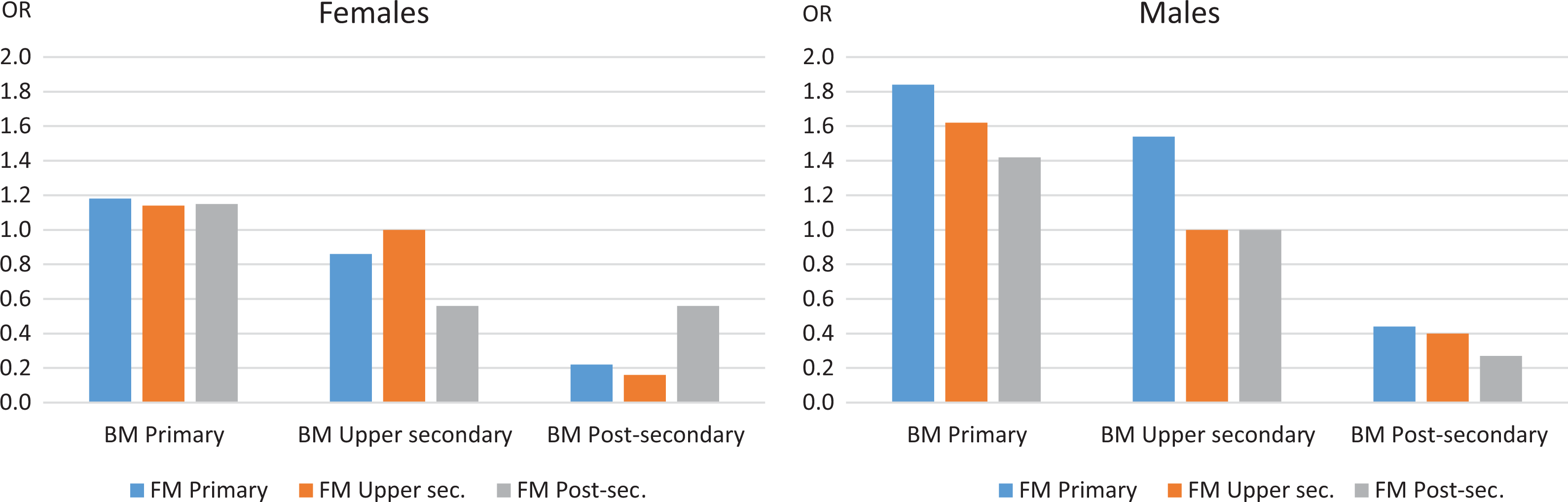
Poor school performance in primary school. Logistic regression estimates (OR) for combined maternal education, adjusted for all control variables. OR = odds ratio.
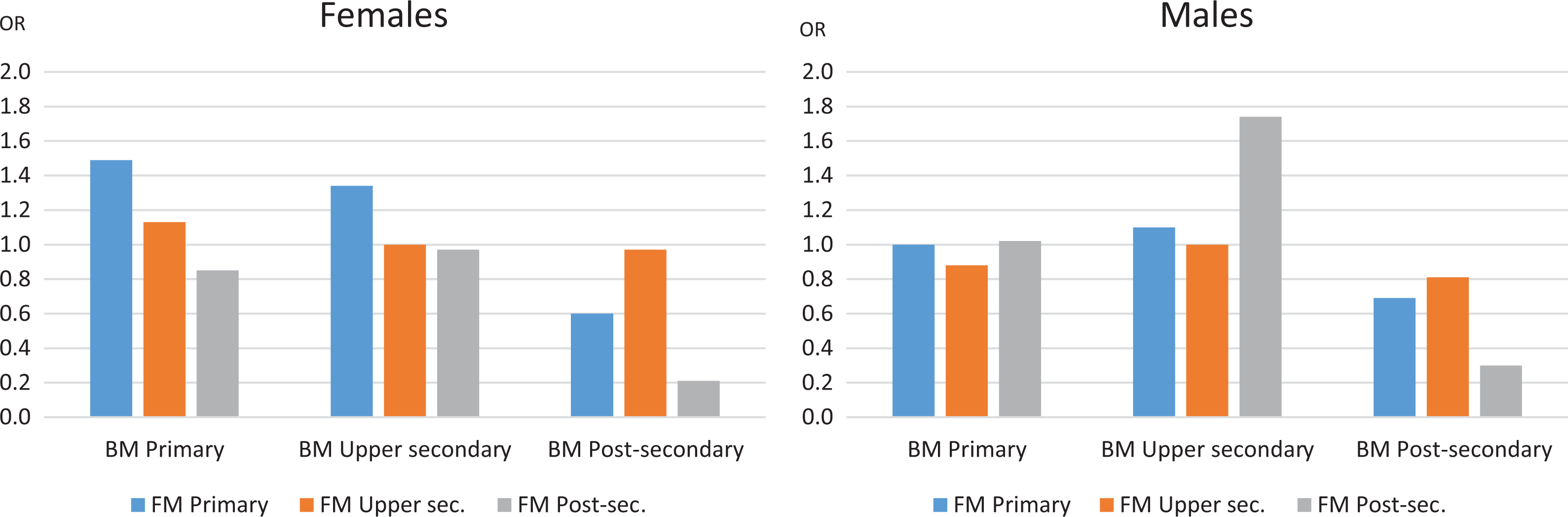
Only primary education at age 26. Logistic regression estimates (OR) for combined maternal education, adjusted for all control variables. OR = odds ratio.
Those whose BMs had missing information on educational level were included in the analyses, but the estimates are not presented in figures and tables due to insufficient information for interpretation of the results. Additional complete case analyses (excluding those with missing information) were also tested, and with similar results as in the final analyses presented in the article. The choice of control variables was guided by prior research but was also constrained by what was available in the registers. All analyses were made with the SAS software package 7.1.
Results
Descriptive statistics
Table 1 presents descriptive statistics for the variables used in the analyses. The two outcome variables – no or low grades in primary school and only primary education at age 26 – had a considerably higher prevalence in the study population as compared to the majority population, which has been reported in previous studies (Berlin, Vinnerljung, & Hjern, 2011; Vinnerljung et al., 2010). While 48% in the study population (and 57% in the excluded long-term care group) had no or low grades in primary school, the corresponding proportion in the majority population without foster care experience was 19% (not shown in table) and 54% in the study population (and 66% in the excluded long-term care group) had not achieved an upper secondary education (thus only primary education) at age 26 as compared to 28% among peers without foster care experience (not shown in table).
The proportion with missing values in the National School Register (i.e., no grades in primary school) was substantially higher in the study population compared to peers without foster care experience (10% vs. 4%, not shown in table). Missing values could either be a result of frequent truancy from school or attending a school which did not, for different reasons, report grade points to Swedish authorities, for example, schools at residential care institutions. Children who grow up in foster families during their early years are known to be heavily over represented in residential care for adolescents (Vinnerljung, 1999), which could be one reason for their higher rate of missing values. Also, some schools for students with certain needs (e.g., due to learning disabilities) do not give grade points. Ultimately, it is not possible to identify the reason for missing values in the register.
The control variable in focus in this study is the combination of BM’s and FM’s educational level. The most common combination was BM having primary level and FM an upper secondary level (20%), followed by both having primary level (17%). On average, FMs had a higher educational level than BMs. Only a very small group of BMs had postsecondary education (3%). In comparison with the majority population (not shown in table), FMs had lower educational attainment than mothers whose children were not in care but the differences were not substantial (the proportion with upper secondary education were similar, while the proportion with postsecondary education was lower among FMs than mothers in the majority population, 18% vs. 27%). We found a matching effect, such that children whose BMs had higher educational attainment were placed in foster families where the FM had higher education, both in kinship care and nonrelative foster families. However, when maternal education was divided into three broad groups (shown in Table 1), the effect was only visible among BMs with postsecondary education.
Sample properties: Descriptive statistics (proportion/means).
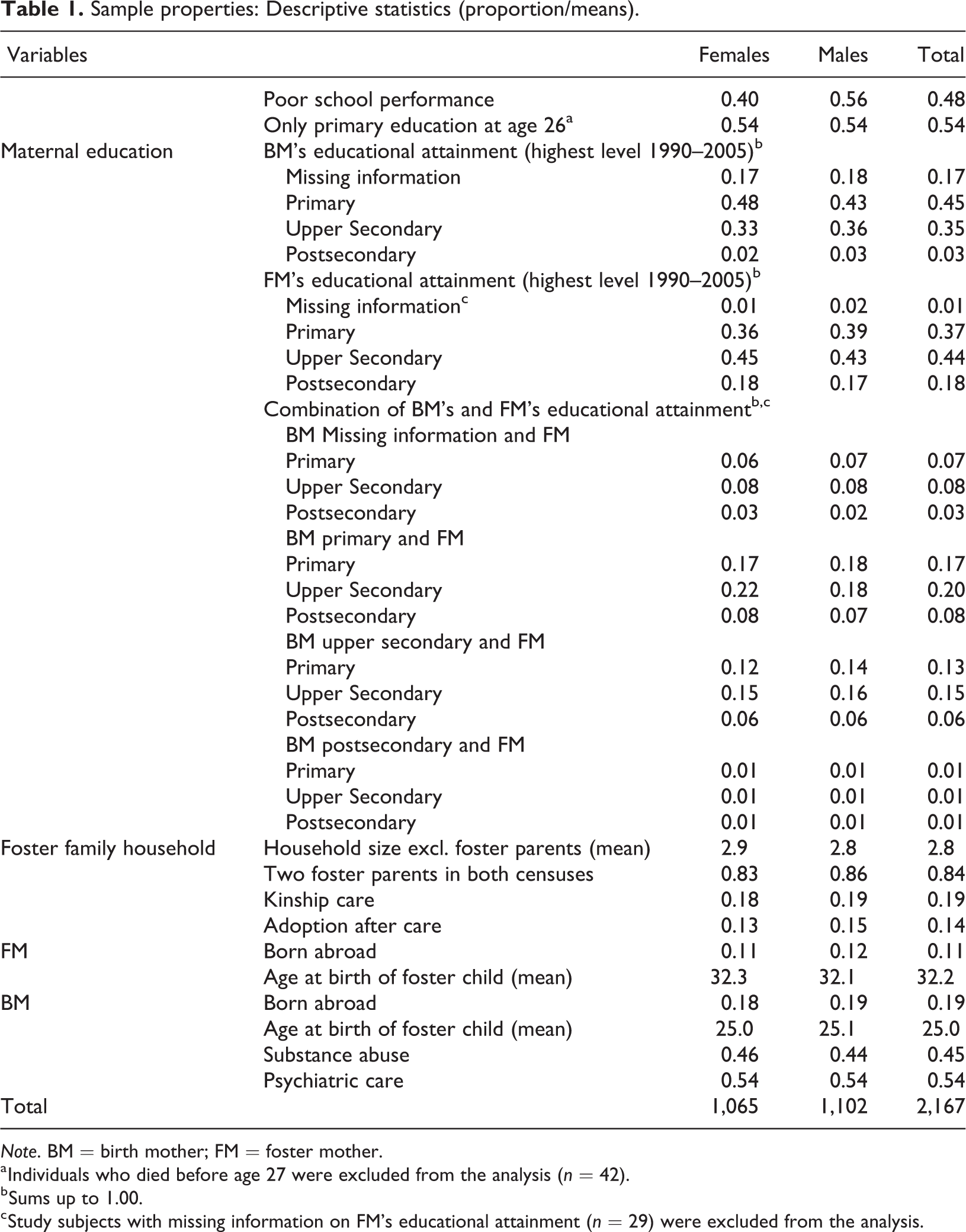
Note. BM = birth mother; FM = foster mother.
a Individuals who died before age 27 were excluded from the analysis (n = 42).
b Sums up to 1.00.
c Study subjects with missing information on FM’s educational attainment (n = 29) were excluded from the analysis.
The control variables had a similar distribution among female and male foster children; 45% of the BMs had an indication of substance abuse and 54% had been in psychiatric care. BMs were more often born abroad than FMs were, and there was a positive correlation between the BM and the FM being born abroad (r = .3, not shown in table). Two thirds of the foster children in the study population were staying with nonrelatives and had not been adopted at the end of follow-up (December 2005). On average, FMs in families where one of the parents was related to the foster child (grandparents or aunts/uncles) had lower educational attainment were older (while BMs were younger), compared to FMs in nonrelative families (not shown in table). Foster parents who adopted the foster child after placement had slightly higher educational attainment than nonrelatives who had not adopted the child (not shown in table).
Regression estimates
Figure 1 presents estimates for the combined variable on maternal education in the analysis of poor school performance (no or low grades) in primary school (for females and males respectively) when adjusting for all control variables (i.e., birth cohort, age at first placement, total time in care, BM’s characteristics [born abroad, age, substance abuse, psychiatric care], FM’s characteristics [born abroad, age], household size, kinship care, adoption after care, two foster parents in both censuses).
The bars in the figure are organized into three groups based on BM’s educational level, with three bars in each group representing FM’s educational level. The first group (leftmost) shows the odds of poor school performance when the BM had a primary education in combination with different educational levels of the FM (i.e., primary, upper secondary, and postsecondary education, respectively). The second group (middle) shows the odds of poor school performance when the BM had an upper secondary education in combination with different educational levels of the FM. And the third group (far right) shows the odds of poor school performance when the BM had a postsecondary education in combination with different educational levels of the FM. Individuals with missing information on BM’s educational attainment (17%) were excluded from figures and tables (although included in the analysis, see the method section).
The odds of poor school performance were generally higher among those whose BMs had primary education (the first group) and lower among those whose BMs had postsecondary education (the third group), as compared to those whose BMs had upper secondary education (the second group). However, that was expected and not the main focus in this study. Instead, we were searching for an educational gradient within each group, that is, the higher the FM’s educational level, the lower the odds of poor school performance regardless of BM’s education. We concentrated on the first two groups (BMs having primary or upper secondary education) which contained the majority of the study population (80%), since postsecondary education was unusual among BMs (3%). The results showed a gradient in regard to FM’s education given the BM’s education, but the pattern differed between females and males (see also Online Supplementary Table S1).
For males, there was an educational gradient in relation to FMs’ educational attainment. The gradient was most consistent in the biggest group, that is, among those whose BMs had primary education (43% of all males, see Table 1). For females, the pattern was inconsistent. In addition to maternal education, some of the control variables did also have a statistical significant association with school performance (not shown). For foster children who were adopted after placement, the odds of poor school performance were significantly lower (females and males: odds ratio [OR] = 0.54; 0.58). This might be a selection effect where a well-functioning foster care placement may have increased the likelihood of a future adoption. The odds were also lower for foster children in kinship care, both for males and females (OR = 0.74; 0.82), although not significantly. For males, the odds for poor school performance were also significantly lower when both foster parents remained in the foster family in both censuses (OR = 0.54).
Figure 2 presents estimates for the combined variable on maternal education in the analysis of educational attainment (only primary education) at age 26 when adjusting for all control variables including GPA in primary school. The bars are organized in the same way as in Figure 1. As compared to poor school performance (Figure 1), the gender pattern was reversed and females whose BMs had primary education (48% of all females, see Table 1) showed a gradient in relation to FM’s education while the gradient among males disappeared. In the crude models (see Online Supplementary Table S2), both females and males had an educational gradient in relation to FM’s education, with the exception of females whose BMs had postsecondary education (3% of all females, see Table 1) and males whose BMs had upper secondary education while FMs had postsecondary education. Besides the combined variable of maternal educational attainment, BM being born abroad (OR = 1.52) or having had psychiatric care (OR = 1.38) significantly increased males’ odds of only having primary education at age 26, while being adopted significantly decreased (OR = 0.63) their odds (not shown). Kinship care had no significant effect on the fostered individual’s educational attainment (not shown).
Discussion
In the present study, we investigated the intergenerational transmission of educational attainment in foster care settings. The transmission of education from parents to children is known to be strong in the majority population (e.g., Breen & Goldthorpe, 2014; Hertz et al., 2007; Jackson, 2014), which creates an educational gradient where higher educational attainment among parents is also seen in their children. In this context, we were searching for an educational gradient in foster children’s educational outcomes in relation to FMs’ education when controlling for BMs education. To some extent, our results showed a gradient but it was generally weak and inconsistent and differed between males and females. For males, there was an educational gradient in poor school performance, that is, the odds of poor school performance were generally lower when FMs had higher educational attainment. However, the educational gradient was inconsistent for later academic achievements (only primary education at age 26) and no longer present when adjusting for background factors including grades in primary school. The reverse was true for females. Regarding poor school performance, females’ educational gradient was inconsistent but did instead appear in later academic achievements also when we adjusted for background factors and grades in primary school.
Our results suggest that FM’s education was not such a robust predictor of foster children’s educational outcomes as parental education is found to be for children who live continuously with their birth parents (e.g., Breen & Goldthorpe, 2014; Hertz et al., 2007; Jackson, 2014; Vinnerljung et al., 2010). Considering that the foster children in this study entered care before primary school started, and were brought up in foster care and spent most of the primary school years in the same foster family (at least five out of nine years), we expected a more consistent educational gradient in relation to FM’s educational attainment. Hence, our findings suggest that the mechanisms that transmit higher education from parents to children in the majority population were attenuated in the foster family setting. However, the difference between males and females were in line with previous findings in the majority population which suggest that boys benefit more than girls do from an advantageous home environment in terms of school performance, that is, GPA (Brenøe & Lundberg, 2018). And further, that later educational choices are same-sex correlated, that is, that mothers’ education is more important for daughters while fathers’ education is more important for sons (Humlum, Nandrup, & Smith, 2019). This might explain the absence of a gradient in males’ educational attainment in relation to FMs’ educational level.
It has been suggested that foster children’s adverse pre-care experiences have an overriding negative impact on their school performance (e.g., Berridge, 2007; Pears, Kim, & Brown, 2018; Trout, Hagaman, Casey, Reid, & Epstein, 2008) but evidence also suggests that maltreated children (Fox, Almas, Degnan, Nelson, & Zeanah, 2011) and foster children (Flynn, Tessier, & Coulombe, 2013; Tideman, Vinnerljung, Hintze, & Aldenius Isaksson, 2011) respond well to educational support. Contrary to scholars who emphasize pre-care factors as the major determinant for foster children’s low educational achievement, others stress the importance of in-care factors where caregiver involvement plays a crucial role (Flynn et al., 2013; O’Higgins et al., 2017). The transmission of educational opportunities involves multiple factors that affect both educational performance and educational choice (Jackson, 2014). For children growing up with their birth parents, those factors are generally cohesive and generate educational advantages or disadvantages over time, from learned preschool abilities and school readiness, to school performance, educational aspiration, and knowledge of the educational system.
An important aspect of our results is that the construction of fairly stable placements (5 years in the same foster family during primary school years) was done in retrospect. In Sweden, foster care placements are reviewed and formally reconsidered every sixth months (Socialstyrelsen, 2013). Upon placement, the foster child does not know for how long he or she will stay in the foster family nor do the foster parents. This can potentially impair foster families’ motivation and ability to support and guide the child in the educational system. Evidence is sparse but studies suggest that caregiver involvement tends to be less in foster family settings compared to birth family settings, and that several factors contribute, including frequent lack of information on the child’s previous schooling (Munford & Sanders, 2016; Zetlin et al., 2012). The uncertainty of permanency may likewise affect children and potentially reduce their school ambition and aspiration for higher education. This might also explain why the study population had about as low overall performance as the excluded long-term care group with less stable placements.
Another potential attenuating factor is the feeling of “being different” (Cheung, Lwin, & Jenkins, 2012). In a study on educational success among high achievers with foster care experience, virtually all stressed the importance of being like everyone else, for example, having the freedom and financial support to take part in after-school activities and to socialize confidently with peers (Martin & Jackson, 2002). Results from a Swedish national survey among 12- and 15-year-olds showed that children who did not live with their birth parents (in the Swedish context, most often foster children) reported being bullied more often, having lower well-being, and not being able to afford the same clothes and engage in the same activities, and this was more prevalent in high performing schools compared to schools where students performed at a lower level (Berlin, 2012).
Further, we do not know if the foster children stayed in the foster family after graduating from primary school. Hence, the weak gradient in educational attainment at age 26 might be explained by the fact that many have moved out from their foster families. The support foster children get when they leave care, that is, the after-care factors, is of great importance (Mendes, Michell, Wilson, Lehmann, & Sanders, 2014). Since foster children generally experience weaker emotional bonds to their foster family and less reciprocity after age of majority, compared to other peers in birth families (Höjer & Sjöblom, 2010; Stein, 2006), this might result in a lower degree of intergenerational transmission of resources (Amato, 2005). Even though education is free in Sweden, the opportunity cost of continuing to higher education might be too high and returns too uncertain for foster children. Studies on the after-care situation for care leavers in Sweden show that they worry about how to cope with housing, personal finance, and employment when they leave care (Höjer & Sjöblom, 2010).
In summary, the answer to the initial questions is: Yes, FM’s educational attainment matters—somewhat—for foster children, but the transmission of educational level was generally weak and inconsistent in the foster family setting.
Strengths and limitations
The strength of this study is that we have been able to use both BM’s and FM’s educational attainment, together with additional information on BM’s and foster family’s characteristics, for all foster children born in 1972–1978 in Sweden. However, the present study also has a number of limitations. First, the Child Welfare Intervention Register does not hold information on reasons for care entries, which would have been preferable as an indicator of pre-care experiences. Second, birth parents’ substance abuse and psychiatric care data were collected throughout the period 1973–2005, which implies that our study subjects may have been adults when their birth parents had an event related to one of these indicators. Since hospitalization or death due to alcohol or substance abuse most often occur after many years of substance abuse, we used an extended time of observation. More importantly, it is still quite possible that these crude indicators of early childhood determinants underestimate the effect of these factors in real life. Third, it was not possible to identify reasons for missing values in the National School Register, which holds one of the key variables in this study—grades in primary school. Fourth, paternal characteristics (birth fathers and foster fathers) were not included in the study due to the high prevalence of missing values. Including both maternal and paternal education would have given a more optimal model (Thaning & Hällsten, 2018), but that would have resulted in excluding a large proportion of the study population.
Conclusion
The results from this study show that the educational situation for foster children should not be left for foster parents to solely manage on their own, even when foster parents have a long formal education. Thus, delivery of educational support programs from agencies is vitally important. At present, tutoring programs have the best empirical support (Flynn, Marquis, Paquet, Peeke, & Aubry, 2012; Forsman & Vinnerljung, 2012; Harper & Schmidt, 2016) but several other interventions have shown promising results (e.g., Forsman, 2019; Männistö & Pirttimaa 2018; Tideman et al., 2011; Vinnerljung, Tideman, Sallnäs, & Forsman, 2014). Enhancing school performance among children in OHC is as important today as ever before, since educational differences are increasing in Sweden (OECD, 2018) and foster children are getting left further behind (Socialstyrelsen, 2016).
Supplemental material
Supplementary - Educational outcomes of children from long-term foster care: Does foster parents’ educational attainment matter?
Supplementary for Educational outcomes of children from long-term foster care: Does foster parents’ educational attainment matter? by Marie Berlin, Bo Vinnerljung, Anders Hjern and Lars Brännström in Developmental Child Welfare
Footnotes
Declaration of conflicting interests
The author(s) declared no potential conflicts of interest with respect to the research, authorship, and/or publication of this article.
Funding
The author(s) disclosed receipt of the following financial support for the research, authorship, and/or publication of this article: We are grateful for financial support from the Swedish Research Council (Vetenskapsrådet), grant 2017-01746, and via the Swedish Initiative for Research on Microdata in the Social and Medical Sciences (SIMSAM), grant 340-2013-5164.

Supplemental material
Supplemental material for this article is available online.
References
Supplementary Material
Please find the following supplemental material available below.
For Open Access articles published under a Creative Commons License, all supplemental material carries the same license as the article it is associated with.
For non-Open Access articles published, all supplemental material carries a non-exclusive license, and permission requests for re-use of supplemental material or any part of supplemental material shall be sent directly to the copyright owner as specified in the copyright notice associated with the article.
