




Abstract
Objectives
Patient safety competencies (PSC) of nursing students are, in particular, critical for quality and safe care. In the study, it was aimed to determine the PSC of nursing students and the factors affecting them.
Methods
This descriptive cross-sectional, relationship-seeking, and comparative study was conducted between February 1st and May 15th, 2022. The sample of the study consisted of 441 students studying at three universities. The data were collected online using the Sociodemographic Data Form and PSC Self-Evaluation Tool.
Results
In institutions where the study was conducted, students rated their level as above moderate in the PSC. Those aged 23 and over, and those who had received education on patient safety in patient care and drug administration were found to have a higher level of PSC. When the scores that all students obtained from the overall scale and its subscales were compared, it was determined that students of University C had statistically higher overall and subscale scores than those in the other two universities.
Conclusion
The assessment of PSC and the determination of the influencing variables may shed light on the regulations to be conducted in this regard. Patient safety courses should be included in the nursing curriculum as a compulsory course in two semesters at basic and advanced levels.
Introduction
Every year, a large number of patients are harmed or lose their lives due to unsafe health services. 1 All types of measures taken to prevent, report, and analyze undesirable events during the provision of health care services, and to eliminate or reduce problems caused by errors in patients are included in the concept of patient safety. 2
Nurses have a critical role in preventing unwanted events, and therefore ensuring and maintaining patient safety.3,4 Since, nurses, compared to other healthcare professionals, provide health care to patients for a long period of time within complex processes, 5 they have the opportunity to identify the risk factors and conditions, as well as taking an effective part in reducing errors. 6 Therefore, nursing students are required to graduate with adequate knowledge, skills and attitude toward patient safety.
Patient safety is an inseparable part of a quality nursing education, and previous research indicates that patient safety should be emphasized at all stages of the health education system.7–9 Bianchi et al. 10 stated that the complex skills of nursing students should be developed in order to improve their competencies related to patient safety. Levett-Jones et al. stated that nursing students are required to be competent in seven areas as “person-centered care, therapeutic communication, cultural competency, teamwork and collaborative practice, clinical reasoning, evidence-based practice, and preventing, minimizing and responding to adverse events.” In the same study, it was also mentioned that in order to develop PSC, nursing students are required to have the necessary knowledge of patient safety, in addition to improving their analysis, interpretation and assessment skills through being provided with practical training (in a simulated environment, etc.); and that they need to be able to express themselves in a clinical environment through their knowledge and skills. 11
It is recommended to determine whether the current nursing programs adequately cover the context of patient safety and how it is discussed and taught, and to assess current competency levels of nursing students. 12 However, the relationship between nursing students’ level of PSC and demographic characteristics,13,14 educational background, status of working in health care, and status of receiving education and participating in courses on patient safety should be revealed, 14 since such information can guide researchers and educators for initiatives to be performed to improve PSC in the future.
Although there is a great amount of studies conducted in other countries aimed at revealing and improving the PSC of nursing students,15–17 those conducted in Turkey are very limited, and only use descriptive design.18,19 In one of these studies, it was determined that nursing students had inadequate knowledge of patient safety, 18 while one of the similar studies suggested that they had a high level of knowledge and competency on patient safety. 19
Therefore, in this study, it was aimed to determine the PSC of nursing students who would have an important role and responsibility in healthcare services in the future and to reveal the relationship between their PSC and sociodemographic characteristics. In addition, in this study, it was also aimed to compare the educational institutions in terms of PSC. The study was considered to guide the evaluation of education provided on patient safety, and the practical studies and curriculum development studies to be planned to increase the effectiveness of the programs, and thus to be useful in providing safe and high-quality nursing care.
Methods
Study design and participants
This descriptive cross-sectional, relationship-seeking and comparative study was conducted between February 1st and May 15th, 2022.
The research was conducted in two states and one foundation university providing nursing undergraduate education located in a province in the Central Anatolian region in Turkey. There were several reasons for choosing the subjected institutions for the study. The first was that the institutions were located in the same province, leading to factors such as easy transportation between the institutions, and students with similar climate and culture. The second was that the institutions were implementing different models and educational structures, which was considered to enable the researchers to determine whether there was a difference between the educational structures in terms of PSC. The state university located in the city center (A) provides nursing education in the faculty of nursing, and patient safety is included as an elective course in the second grade curriculum. The state university located in the district (B) provides nursing education in the Health Sciences Faculty Department of Nursing. (B) University does not have an elective or compulsory patient safety course. Patient safety is only included as a general subject for 1 h each in the “Fundamentals of Nursing” course in the second semester of the first year and in the “Surgical Nursing” course in the first semester of the third year.
The foundation university located in the city center (C) has a curriculum based on the “Orem's Theory of Self-Care” within the College of Health Sciences Department of Nursing. (C) University does not have an elective or compulsory patient safety course. Patient safety is only covered as a general subject for 2 h in the “Introduction to Health and Nursing Discipline” course in the first semester of the first year. However, according to “Orem's Theory of Self-Care,” patient safety is important and is emphasized in every course and laboratory practice.
The students of (A) and (B) participate in an internship program in the hospital environment for practice starting from the second semester of the first year(fundamentals of nursing, surgical nursing, internal medicine, pediatrics, etc.). Students generally make observations and simple practices during their first-year internships. In the (C), students start their internship program in the second grade. Since the first and second grade nursing students in Turkey do not have adequate experience in clinical practice, and thus may not be able to provide proper answers to questions about patient safety, it is not recommended to apply the scale to those students. 20 For this reason, the universe of the research consisted of third and fourth-grade nursing students studying at these universities. Accordingly, a total of 539 nursing students, whose distributions were given in Table 1, and consisting of 283 third graders and 256 fourth graders constituted the universe of the research. No sample selection was performed in the study. Questionnaires were applied to the entire universe. Consequently, 251 of third graders and 190 of fourth graders fully completed the questionnaires. A total of 441 (81.8% participation rate) students participated in the study (Table 1).
Sociodemographic characteristics of nursing students from university A, B and C (N: 441).
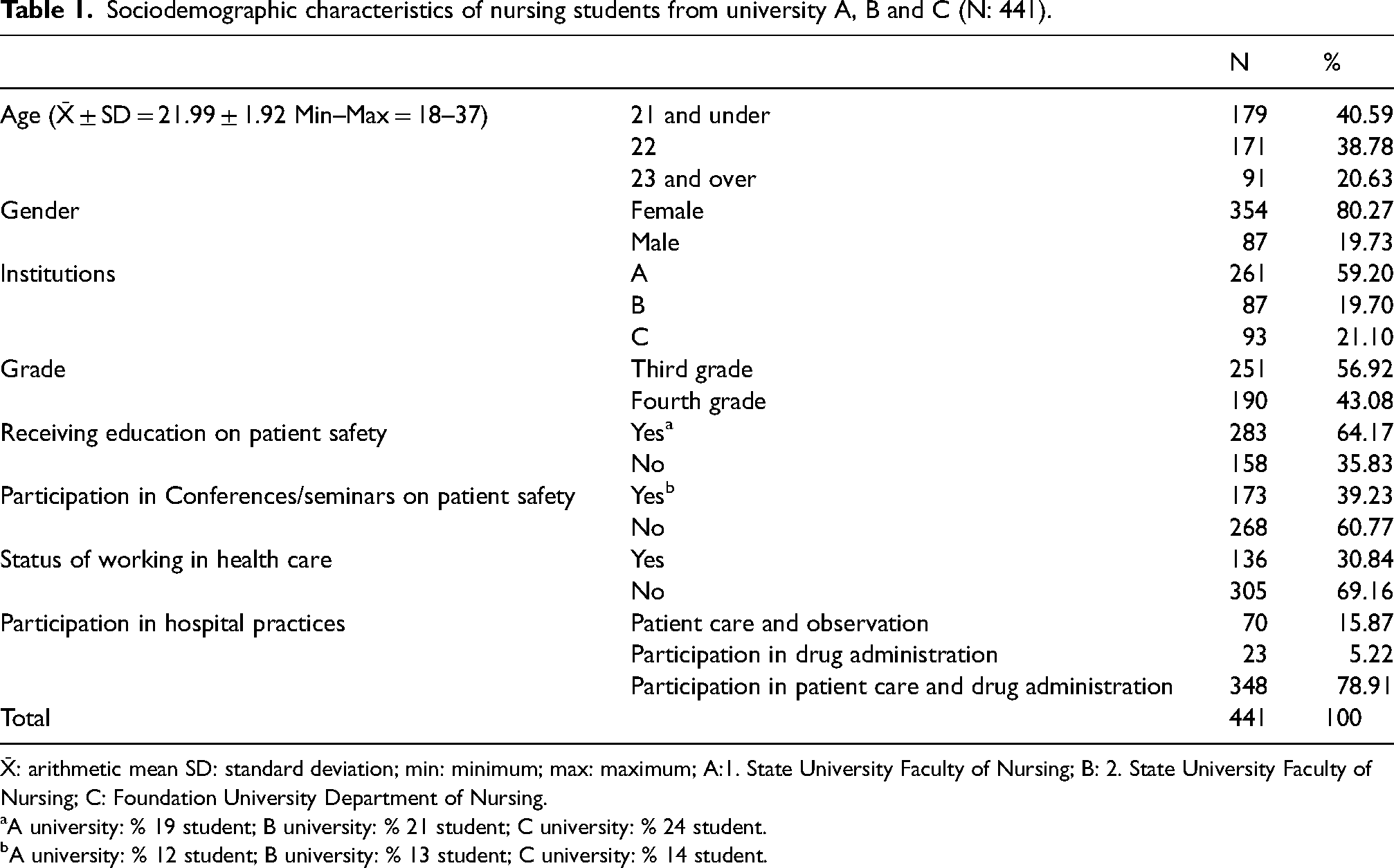
X̄: arithmetic mean SD: standard deviation; min: minimum; max: maximum; A:1. State University Faculty of Nursing; B: 2. State University Faculty of Nursing; C: Foundation University Department of Nursing.
A university: % 19 student; B university: % 21 student; C university: % 24 student.
A university: % 12 student; B university: % 13 student; C university: % 14 student.
Data collection and procedure
The data were collected using the demographic form and PSC Self-Evaluation Tool (PSCSE) between February 1st and May 15th, 2022. The informed consent form, demographic form and PSCSE scale were transferred to Google Forms. After obtaining institutional permission, the questionnaire was sent to the students via email through student affairs. It took approximately 15 min for the participants to complete the questionnaire. After the data entry was completed, the online copies of the questionnaire were deleted.
Sociodemographic form
The demographic form, prepared in accordance with the literature to investigate the demographic characteristics of students that may affect their patient safety competencies,13,14 consists of 10 questions about age, gender, educational background, the status of working in health care, the status of participating in training and courses on patient safety, 14 and status of participating in clinical practices.
PSC self-evaluation tool (PSCSE)
The scale, which was developed to evaluate the PSC of nursing students, was composed of 41 items in three dimensions, namely knowledge (six items), skills (21 items) and attitudes (14 items). Items were scored on a five-point Likert scale, ranging from one (strongly disagree) to five (strongly agree). 21 PSCSE was developed by Lee et al. 21 to evaluate the patient safety competencies of nursing students and was adapted into Turkish by Eskici et al. 20 In the evaluation of the scale, item overall score averages are used in the calculation of the overall scale and subscale scores. The lowest possible score to be obtained from the overall scale and its subscales is 1, while the highest possible score is 5. It should be considered that items 38 and 39 are reverse-scored. The Cronbach's alpha was found 0.941 for the original overall scale, while in the current study, it was 0.924 for the overall scale, 0.773 for the Knowledge subscale, 0.906 for the Skills subscale, and 0.863 for the Attitude subscale.
Data analysis
Statistical Package for the Social Sciences (SPSS) 24.0 Statistical package program was used for statistical analyses. In data analysis, in addition to descriptive statistical methods (frequency, percentage, mean, standard deviation), Skewness and Kurtosis values were required to range between +1.5 and −1.5 in order to examine the conformity to normal distribution. 22 The independent samples t-test was used in groups with normal distribution, while the Kruskal–Wallis test and Mann–Whitney U test were used for those not indicating normal distribution. The predictability of independent variables on PSCSE scores could not be evaluated since it was not compatible with the linear regression model. The results were analyzed at a confidence interval of 95% and with a significance level set at p < 0.05. The Cronbach's alpha coefficient was calculated for the overall reliability and reliability of the subscales.
Ethics committee approval
Permission was obtained via email from the authors of the validity and reliability study that adapted the PSCSE to Turkish. Prior to starting the data collection, the ethics committee approval dated 20 December 2021 and numbered 2021/009 was obtained from the Scientific Research Ethics Committee of a Foundation University. Written institutional permissions were obtained from the universities where the research was conducted. The students who agreed to participate in the study were included in the sampling, and were asked to complete the questionnaire after filling out the informed consent form.
Results
Demographic characteristics
The average age of the students participating in the study was 21.99 ± 1.92 (min: 18–max: 37), and the majority (80.27%) were female. 59.20% were studying at University A, and 56.92% consisted of third graders. While 64.17% stated that they had received education on patient safety, 39.23% said they had participated in activities such as conferences/seminars on patient safety. Of the total, 30.84% were working in a hospital environment. When students’ participation in nursing practices in the hospital internship environment was evaluated, it was found that 78.91% had participated in patient care and drug administration, 5.22% had participated only in drug administration, and 15.87% had provided care and performed observation during their internship (Table 1).
PSCSE and subscale score averages of nursing students
The overall score average that students obtained from the scale was found X̄ = 3.91. SD = 0.40. The highest score was obtained from the Attitude subscale (X̄ = 4.28. SD = 0.47), while the lowest score was obtained from the Knowledge subscale (X̄ = 3.51. SD = 0.61). The highest score obtained from the Skills subscale belonged to “Infection prevention” (Avg. = 4.47. SD = 0.53), and the lowest score belonged to “The concept of error and cause analysis” (X̄ = 3.37. SD = 0.75) (Table 2).
PSC scores of nursing students (N: 441).
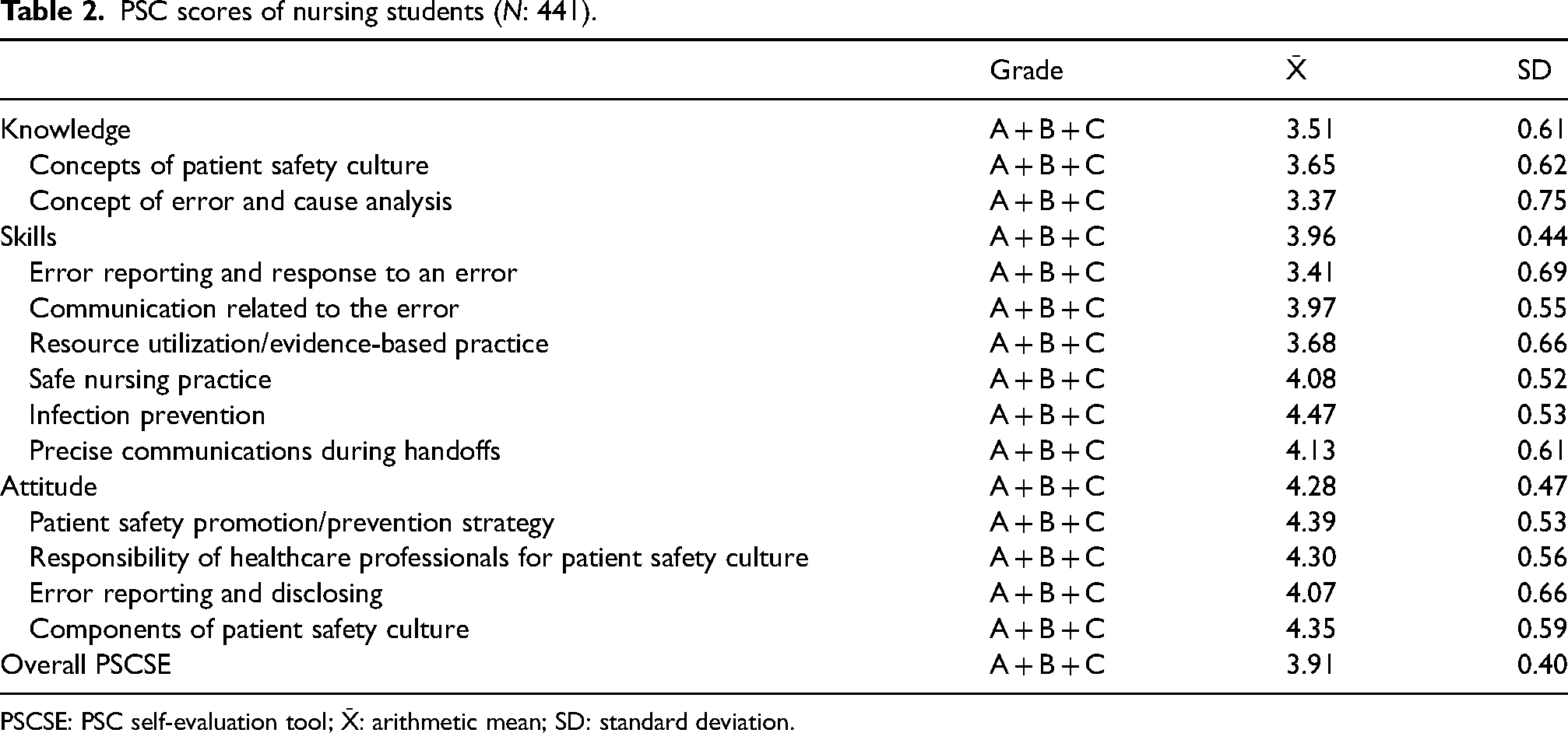
PSCSE: PSC self-evaluation tool; X̄: arithmetic mean; SD: standard deviation.
Comparison of the overall PSCSE and subscale score averages of nursing students according to the institutions
The overall PSCSE and subscale scores of the students according to the institutions were given in Table 3. Accordingly, in all three institutions where the study was conducted, students rated their level above moderate in the overall PSCSE and subscales. When the overall PSCSE and subscale scores obtained from the Kruskal–Wallis test were compared for all institutions, it was found that students of University C had statistically higher overall PSCSE (p = 0.00) and subscale scores (knowledge (p = 0.00), skills (p = 0.00), attitude (p = 0.019)) than other students (Table 3).
Comparison of PSC scores according to institutions (N: 441).
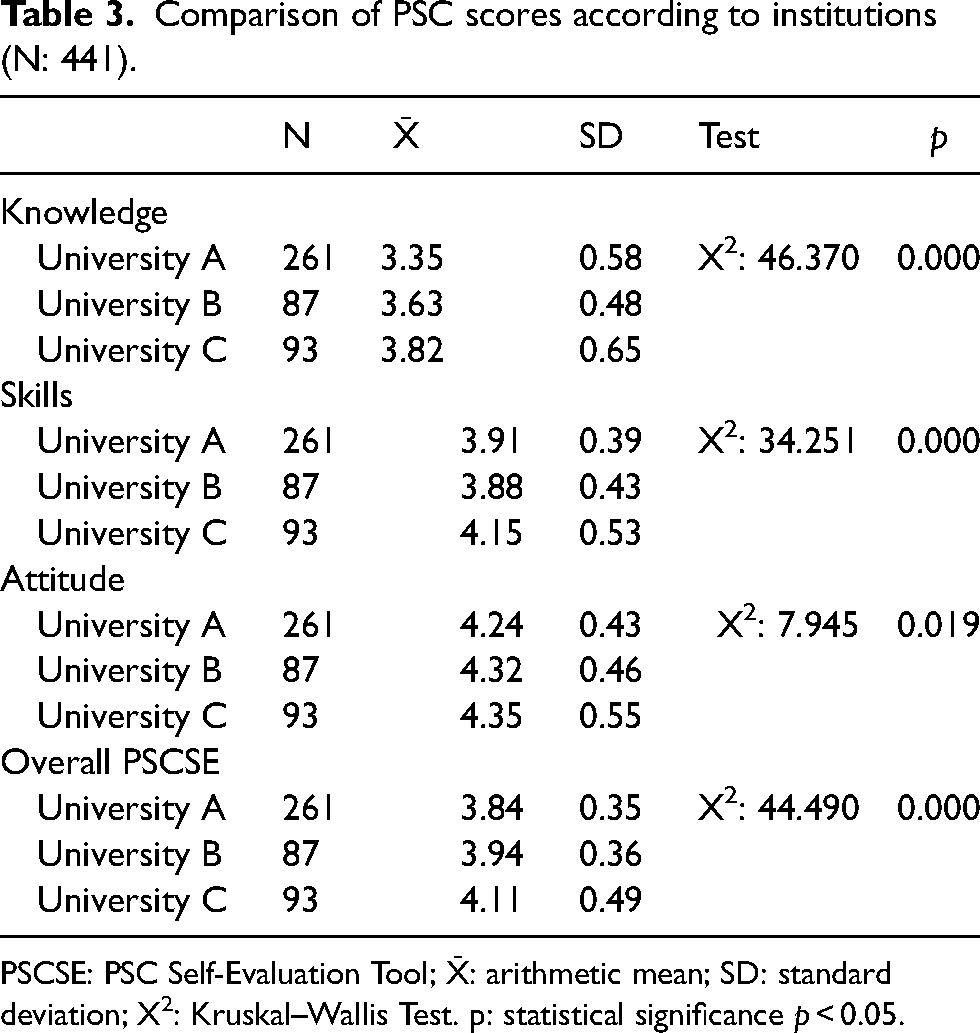
PSCSE: PSC Self-Evaluation Tool; X̄: arithmetic mean; SD: standard deviation; X2: Kruskal–Wallis Test. p: statistical significance p < 0.05.
The relationship between the sociodemographic characteristics and PSCSE of the students
In Table 4, the relationship between the PSCSE and the demographic characteristics of the students was examined using the Kruskal–Wallis and Mann–Whitney U test. According to the test, the scores that students aged over 23 obtained from the Skill subscale were higher (X2: 12.769, p = 0.002) compared to others. Those receiving education on patient safety obtained higher scores from the Knowledge (Z: −5.185, p = .000) and Skills (Z: −4.011, p = 0.000) subscales, as well as from the overall scale (Z: −4.509, p = 0.000). In addition, those participating in seminars/courses, etc., on patient safety were found to obtain higher scores from the Knowledge subscale compared to those who had not participated (t: 2.888, p = 0.004). It was found that those participating in patient care and drug administration in the hospital obtained higher scores from all subscales (X2: 15.592, p = 0.000, X2: 13.061 p = 0.001, X2: 7.015 p = 0.030), respectively, and the overall scale (X2: 18.889, p = 0.000). In the study, no relationship was found between gender and status of working in health care and the PSCSE (p > 0.005) (Table 4). When the overall PSCSE and subscale scores were examined according to the grade, no statistical difference was found between the overall PSCSE and subscale scores of third and fourth graders (p > 0.005).
The relationship between PSC and sociodemographic characteristics of students (N: 441).
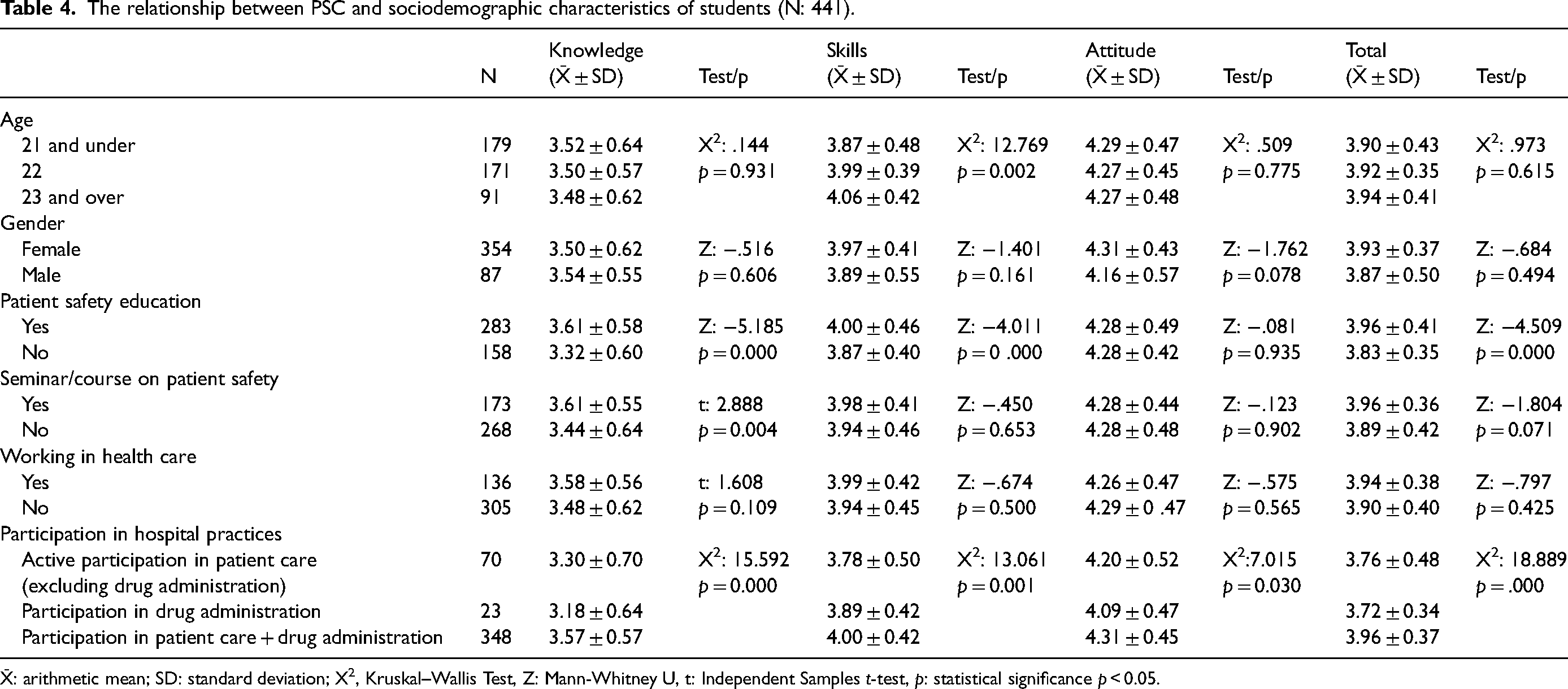
X̄: arithmetic mean; SD: standard deviation; X2, Kruskal–Wallis Test, Z: Mann-Whitney U, t: Independent Samples t-test, p: statistical significance p < 0.05.
Discussion
PSCSE and subscale scores of nursing students
The perception of the nursing students toward PSC was assessed using the self-reported PSCSE tool in terms of attitude, skills and knowledge. The results revealed that self-reported PSC was above the moderate level among Turkish undergraduate nursing students. Similar results were obtained in similar studies.18,20,23 When the current result is compared with the previous results of studies conducted in other countries, it may be concluded that nursing students in Turkey report a higher PSCSE.14,24 When the PSC subscale scores of the students were compared, it was seen that they had a high level of attitude, moderate level of skills and low level of knowledge scores. The responses that students have provided to the questionnaire indicate that although they have positive attitudes, they lack adequate knowledge of patient safety. This result is consistent with other study results in which most students rate their knowledge of medical errors and patient safety at a low or moderate level.4,16,20,23 The Knowledge subscale of the scale is related to the patient safety culture, the concept of error and cause analysis. This result may be associated with the fact that third and fourth-grade nursing students participate in intensive internship programs in hospitals, and thus they are influenced by the safety culture adopted by the nurses they work with. As a matter of fact, previous studies have revealed that errors are hidden and not reported, and root cause analysis is not conducted due to the blame culture in hospitals in Turkey, therefore, nurses have a low level of patient safety culture.25,26 In our study, it is considered a surprising result although the vast majority of students have reported that they received education on patient safety. It may be associated with the fact that the patient safety culture is not adequately addressed in the course content in the institutions where the study was conducted or the lack of learning opportunities in the current curriculum. Çiftcioğlu et al. 27 have reported that the patient safety culture of nursing students is at a moderate level. It has also been stated that an effective educational curriculum is essential to create a patient safety culture and that a safety culture should definitely be emphasized in the nursing curriculum. 15 The results of this study may constitute an opportunity for nurse educators to reconsider the patient safety curriculum.
Nursing students exhibit certain attitudes toward patient safety through their knowledge, feelings and behaviors related to the subject. In our study, it is observed that most participants reported positive student attitudes in their statements. Accordingly, it may be concluded that nursing students are aware of the importance of patient safety in nursing practice, and have a positive attitude toward it. 23
Comparison of the PSCSE and subscale scores of nursing students according to the institutions
When the overall PSCSE and subscale scores are compared according to statements in all three institutions, it is seen that the PSC of those in University C is statistically higher than others. This result may be explained by different knowledge and attitude levels of the institutions where the study was conducted, and the differences in the structure of the curriculum, courses, and internship programs. University C provides nursing education according to Orem's theory, which argues that the self-care needs of patients are primary and that care services should be provided with a holistic approach.
There are three main differences that distinguish the curriculum of the nursing department of university (C), which provides education according to Orem’s theory, from other nursing education programs. The first one is a combination of the educational sciences model and the experimental, aesthetic and ethical learning methods that form the basis of nursing. The second difference is the compulsory and elective courses included in the program and carefully implemented to eliminate the lack of self-care and gaps in nurse-patient communication. The third difference is that nursing care is based on the understanding of nursing care theorists rather than a medical model. The fact that University C provides education according to nursing care theory, has a curriculum that emphasizes communication, and applies experimental education with an educational sciences model may have been effective in improving students’ PSC. Another reason can be explained by the fact that (C) university is private and therefore has better facilities such as laboratories, etc. In addition, in this institution, patient safety education is provided to students as a topic within the scope of the “Introduction to Health and Nursing Discipline” course and constantly highlighted in laboratory courses. Students start their internship in the second grade in this institution and thus meet with patients. In other institutions, they start their internship in the first grade with basic nursing education. (C) university students’ theoretical/practical skills in classrooms and laboratories are developed by attaching importance to patient safety, and their encounters with patients in the second year may have led to a more developed PSC.10,11 Most students from (C) university stated that they attended courses and seminars related to patient safety (Table 1). Therefore, this may have been effective in improving students’ PSC.
Although (A) university has a patient safety course, the PSC of these students is lower than (C) university. This is because the patient safety course is an elective course. In this school, the quota for elective courses is limited to 40 students. Therefore, in a class of 200 students, only 40 students (assuming that the quota is fully filled) may have taken the patient safety course. As a matter of fact, the majority of the students of (A) University who participated in the study stated that they had not taken any course, training or seminar on patient safety (Table 1). The students who took the course and participated in the study took this course in the second grade. The study was conducted in the third and fourth grades. Therefore, students may have forgotten their knowledge about patient safety.
The relationship between the PSCSE scores and sociodemographic characteristics of nursing students
In the study, when the relationship between the overall PSCSE and subscale score averages and sociodemographic characteristics of the students were examined, it was found that those aged 23 and over obtained higher scores from the Skills subscale compared to others. There are studies indicating that there is a relationship between PSC and age.17,22 It is expected that as the grade higher, in other words, as the age of the students increases, the scores obtained from the Skills subscale will also increase, 4 since these students are engaged in more intensive clinical practices in accordance with the educational curriculum, and encounter more patient safety issues.16,24 In addition, it is also reported that patient safety and cultural competencies are primarily developed through classroom activities, rather than laboratory/simulation or clinical settings. 23 However, the current study findings also revealed that score averages of the overall PSCSE and all three subscales (knowledge, skills and attitude, respectively) of the students participating in patient care and drug administration practices in the hospital were higher than the others. In similar studies, it has been emphasized that the clinical environment has a more positive effect on the PSC of nursing students compared to the classroom environment.24,28 Therefore, this result can be explained by the fact that nursing students practice more in clinical settings as their age increases, which improves their skills in patient safety.
The overall PSCSE and Knowledge and Skills score averages of the students receiving education on patient safety were higher than others. As a matter of fact, in our study, the majority of students stated that they received such education. In addition, those participating in seminars/courses, etc., on patient safety obtained higher scores from the Knowledge subscale than those who had not participated. It may be concluded that training, seminars and course activities on patient safety are effective in developing PSC. The results of the current study are similar to the results of those evaluating students’ knowledge and attitude toward patient safety.15,17 Although various studies report that PSC improves through education,4,16,24 it should also be noted that the level of knowledge and perception regarding the concept of patient safety should be adequate and satisfactory.
The results of this study revealed that nursing students assessed their level as above the moderate in the overall PSCSE and its subscales, and those over the age of 23, receiving education on patient safety, participating in seminars/courses, etc., and participating in patient care and drug administration in the hospital had a higher level of PSC. In addition, it was determined that the overall PSCSE and subscale scores of the students in University C were statistically higher than others.
Strengths and limitations
One of the strengths of this study is that it is the first to examine PSC within a wide framework including the knowledge, skills and attitude of nursing students in Turkey. In addition, the study was conducted in three different nursing departments with different educational structures located in the same city, which enabled the researchers to conduct comparisons. The disadvantage of this study is that the PSC of the students was tried to be measured based on their own statements, and they may have provided socially acceptable answers in their own will. Therefore, the results obtained from this study cannot be generalized for most of the nursing departments in Turkey.
Conclusion
Nurses, compared to other health professionals, are required to graduate with adequate knowledge, skills and attitude toward patient safety, since they provide health care within complex environments and processes for long periods. Therefore, a patient safety course should be included in the nursing curriculum as a compulsory course in two semesters at basic and advanced levels. Given the relatively lower competency of nursing students in knowledge compared to the higher competency in attitude, it is necessary to develop an integrated approach to balance their competency in all aspects. In addition, since PSC cannot be easily acquired only through lectures, it is important to develop, implement and maintain a range of teaching methods in order to achieve effective development (laboratory/simulation sessions, video, etc.). The evaluation of PSC and the determination of influencing variables may shed light on the regulations to be performed in this regard. It is recommended to conduct experimental and qualitative studies to improve PSC.
Footnotes
Acknowledgments
The authors thank the nursing students who participated in the study.
Author contributions
Criteria, Author Initials: The concept: AY. Design: AY and ÖE. Data collection or processing: AY and ÖE. Analysis or interpretation: AY and ÖE. Literature review: AY. Write: AY and ÖE.
Declaration of conflicting interests
The author(s) declared no potential conflicts of interest with respect to the research, authorship, and/or publication of this article.
Ethics statement
The ethics committee approval dated 20 December 2021 and numbered 2021/009 was obtained from the Scientific Research Ethics Committee of a Foundation University.
Funding
The author(s) received no financial support for the research, authorship, and/or publication of this article.
Presentation information
This study was presented as an oral presentation at the 8th International Nursing Management Congress held in Istanbul on 27–29 October 2022.
