



Abstract
Background:
The loss of central vision plays a major role in the quality of life (QoL). This study evaluates the changes in QoL in the treatment of low-risk neovascular age-related macular degeneration (AMD).
Objectives:
The aim of this study was to evaluate the changes in vision-related QoL in patients receiving intravitreal ranibizumab loading dose for low-risk neovascular AMD.
Design:
A prospective study.
Methods:
Forty-two eyes of 42 patients receiving ranibizumab injections for neovascular AMD were included in this prospective study. The changes in best-corrected visual acuity (BCVA), central macular thickness (CMT) of the patients before the treatment, and 1 month after three loading doses were evaluated. Turkish version of the National Eye Institute 25-Item Vision Function Questionnaire (NEI VFQ-25 TR) was conducted. The changes of QoL scores through the NEI VFQ-25 TR questionnaire were compared with visual acuity (VA) and CMT measurements before the injections and 1 month after the loading dose.
Results:
Forty-two patients (19 females and 23 males) were included in the study, and the mean age was 72.69 ± 7.12 years. After the treatment, a statistically significant improvement in BCVA (0.98 ± 0.44, 0.76 ± 0.42 logMAR, p < 0.001) and a significant decrease in CMT (357.90 ± 71.71, 274.50 ± 58.35 μm, p < 0.001) was observed. The QoL composite score was found to be statistically significantly higher after the treatment (64.27 ± 11.47, 68.56 ± 11.39, p < 0.001). General vision (p < 0.001), ocular pain (p = 0.025), near activities (p < 0.001), distance activities (p = 0.027), vision-specific mental health (p = 0.014), vision-specific role difficulties (p < 0.001), and peripheral vision (p = 0.046) were significantly higher after the treatment.
Conclusion:
NEI VFQ-25 TR is a useful questionnaire for evaluating changes in visual functions and psychosocial characteristics of low-risk neovascular AMD patients before and after the injections.
Introduction
Age-related macular degeneration (AMD) is a disorder affecting the macula and leading to the progressive loss of central vision. Neovascular AMD causes serious and permanent visual impairment. The loss of central vision plays a major role in the quality of life (QoL) and functional independence within the disease period. 1 In addition, AMD is the most common cause of irreversible blindness in the elderly population in developed countries. 2 There are two types of AMD: dry and wet (neovascular) types. In the dry type, AMD usually causes visual impairment to some extent or sometimes gives rise to severe blindness. On the contrary, the wet-type AMD or neovascular AMD commences with a sudden onset, affects between 10–15% of AMD patients, and rapidly progresses to blindness, if left untreated.3,4
Patients with AMD are expected to be nearly 300 million by 2040. Based on the literature, it is estimated that 77 million people will be affected by AMD around the world, and the incidence of new cases will increase by 75%.5,6 The prevalence of AMD increases with age, affecting 2% of the population at the age of 40, and 1 in 4 people by 80 years of age. 2 The total number of those with Alzheimer’s disease is estimated to reach 115.4 million worldwide by 2050. 7 It is also estimated that there will be 22 million new cases and 13 million cancer-related deaths annually by 2030. 8 Therefore, AMD is an important public health challenge, such as cancer and Alzheimer’s disease.
Produced from Escherichia coli through the recombinant DNA technology, ranibizumab, which the US Food and Drug Administration (FDA) has approved lately to treat neovascular AMD, is an antibody fragment directed against human vascular endothelial growth factor-A (VEGF-A) and inhibits all the isoforms of VEGF-A and VEGF165, VEGF121, and VEGF110. 9
The National Eye Institute 51-Item Vision Function Questionnaire (NEI VFQ) was developed to determine the QoL of individuals with chronic eye diseases, such as cataracts, AMD, diabetic retinopathy, glaucoma, and retinitis in 1998 by Mangione et al. 10 However, NEI VFQ-25 is the short version of the 51-item NEI VFQ. 11 The Turkish version of the NEI VFQ-25 questionnaire has been created, and the validity and reliability tests of NEI VFQ-25 were performed by Toprak et al. 12 as NEI VFQ-25 TR. In this study, the QoL scores and subscores were evaluated through the NEI VFQ-25 TR questionnaire before and after loading ranibizumab to treat the patients with low-risk neovascular AMD.
Thus, this prospective study aims to evaluate the changes in vision-related QoL after short-time monthly injections (loading three doses) in the patients receiving intravitreal ranibizumab injection due to neovascular AMD, which is responsible for serious vision loss.
Materials and methods
This study was designed as a prospective study involving 42 consecutive newly diagnosed patients with neovascular AMD in one eye admitted to the ophthalmology outpatient clinic between February and December 2018.
While the inclusion criteria of our study were composed of the treatment-naive patients with neovascular AMD never receiving injection therapy, the exclusion criteria included those with pathologies likely to affect visual acuity other than macular degenerations, such as diabetic retinopathy, corneal opacity, glaucoma, optic neuropathy, uveitis, retinal vein occlusion, degenerative myopia, amblyopia, patients undergoing cataract surgery, and neodymium (Nd): yttrium aluminum garnet (YAG) laser capsulotomy and panretinal laser photocoagulation in the last 6-month, comorbid disorders. Intravitreal ranibizumab injection of 0.5 mg was administered to all eyes three times monthly as a loading treatment in the operating room.
In our practice, detailed ophthalmological examinations of the patients were performed before the injections. While the best-corrected visual acuity (BCVA) was evaluated as logMAR, the intraocular pressure (IOP) was measured with the Goldmann applanation tonometry, biomicroscopic anterior segment examinations, and fundus examinations were conducted using a 90D lens. In addition, the fundus fluorescein angiographies of the patients were taken, and the measurements of the central macular thickness (CMT) were achieved with the spectral-domain optical coherence tomography (OCT) (Cirrus HD-OCT 4000; Carl Zeiss Meditec, Jena, Germany).
BCVA, IOP, CMT measurements, and NEI VFQ-25 TR questionnaire were performed before and 1 month after the third injection, and the QoL scores after the measurements were compared. While the patients having no reading problems completed the questionnaire themselves, those with difficulties in reading due to visual challenges achieved the questionnaire with the help of the interviewers.
The questionnaire is composed of a total of 38 questions, 25 of which were about general health and vision, difficulties related to activities and results of vision problems, and additional 13 questions were about such subscales as general health status, general vision, near vision, far vision, social function, driving, role restriction, well-being/distress, and dependency.
All statistical analyses were performed with the Statistical Package for Social Sciences (SPSS) for Windows, version 21.0 (SPSS Inc., Chicago, IL, USA). For checking the normality, the Shapiro–Wilk’s test was used, and the data were given as mean ± standard deviation (SD) and median (min–max) for the continuous variables and as frequency (percentages) for the categorical variables. However, the normally distributed variables were analyzed with the two-way repeated-measures analysis of variances (ANOVAs), while the non-normally distributed variables were analyzed with the Wilcoxon Signed-Rank Test. A comparison of these variables was performed between the groups by analyzing differences between the measurements through the Mann–Whitney U-test. In addition, the Spearman’s correlation coefficients were also calculated to evaluate the relationships between continuous variables. A p value of <0.05 value was accepted to be statistically significant.
Results
Forty-two patients (19 females and 23 males) were included in the study, and the mean age rate was found to be 72.69 ± 7.12 (ranging between 57 and 87 years). It was seen that BCVA was significantly improved (0.98 ± 0.44 vs 0.76 ± 0.42 logMAR, p < 0.001; Figure 1). Even so, while CMT was observed to be significantly lower (357.90 ± 71.71 vs 274.50 ± 58.35 µm, p < 0.001; Figure 2), IOP was also detected to be significantly lower (11.93 ± 2.05 vs 11.50 ± 1.90 mmHg, p = 0.041) after the treatment. Given the scores of NEI VFQ-25 TR, the QoL composite score was statistically significantly higher after loading ranibizumab treatment than the previous score (64.27 ± 11.47 vs 68.56 ± 11.39, p < 0.001; Figure 3).

Visual acuity (logMAR) before and after the interventions.

Macular thickness before and after the interventions.

NEI VFQ-25 TR composite scores before and after the interventions.
Given the measurements and NEI VFQ-25 TR scores before and after the interventions, the following criteria of general vision (37.02 ± 10.36 vs 50.12 ± 12.85, p < 0.001), ocular pain (79.76 ± 14.86 vs 82.74 ± 12.94, p = 0.025), near activities (56.18 ± 15.48 vs 65.60 ± 15.21, p < 0.001), distance activities (65.93 ± 14.35 vs 68.19 ± 14.92, p = 0.027), vision-specific mental health (68.69 ± 13.88 vs 70.95 ± 14.53, p = 0.014), vision-specific role difficulties (52.98 ± 18.94 vs 61.31 ± 21.26, p < 0.001), and peripheral vision (67.26 ± 15.11 vs 69.64 ± 14.12, p = 0.046) were found to be significantly higher after the interventions than the previous criteria. There was no significant difference between the scores of general health, vision-specific social functioning, vision-specific dependency, driving, and color vision after loading treatment of ranibizumab (Table 1).
The summary of the measurements and Turkish version of the National Eye Institute 25-Item Vision Function Questionnaire scores before and after the interventions.

BCVA, best-corrected visual acuity; IOP, intraocular pressure; NEI VFQ-25 TR, Turkish version of the National Eye Institute 25-Item Vision Function Questionnaire.
There was an increase of 4.29 points in composite scores. When evaluating the subscales, it was also seen that there were increases of 13.1 points in general vision, 2.98 points in ocular pain, 9.42 points in near activities, 2.26 points in distance activities, 2.26 points in vision-specific mental health, of 8.33 points in vision-specific role difficulties, and 2.38 points in peripheral vision.
When the changes in terms of the measurements and NEI VFQ-25 TR scores concerning genders were evaluated, no significant difference was found between both genders (Table 2).
The summary of the measurements and Turkish version of the National Eye Institute 25-Item Vision Function Questionnaire score changes after the interventions in terms of genders.
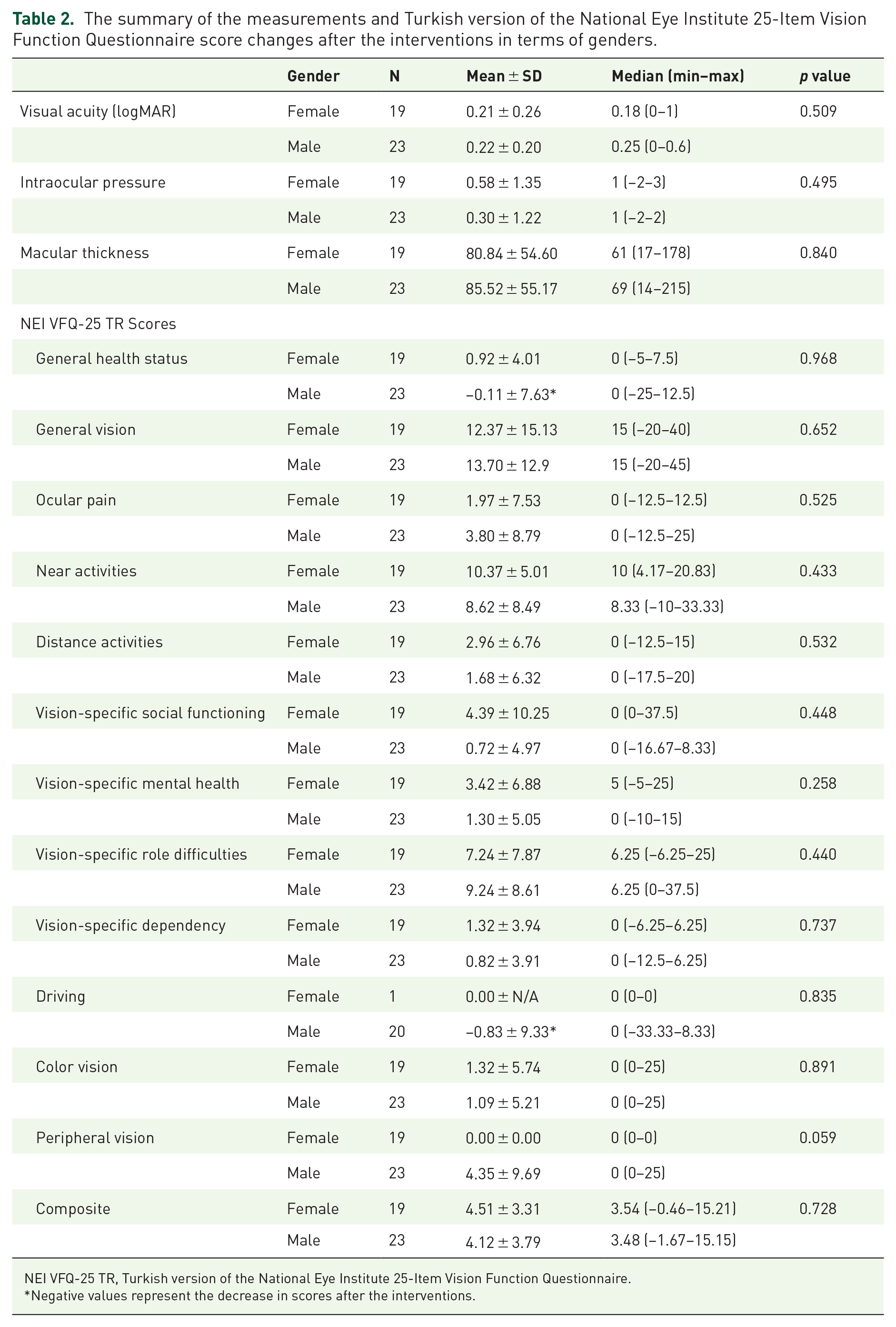
NEI VFQ-25 TR, Turkish version of the National Eye Institute 25-Item Vision Function Questionnaire.
Negative values represent the decrease in scores after the interventions.
In addition, when the relationships between age, the change in visual acuity, macular thickness, and the change in NEI VFQ-25 TR scores were evaluated, a moderate positive correlation was found between the change in general vision scores and that in visual acuity (r = 0.568, p < 0.001). The change in ocular pain scores had a low negative correlation with that in visual acuity (r = −0.308, p = 0.047). There were no significant correlations between other variables (Table 3).
The relationships between variables.

NEI VFQ-25 TR, Turkish version of the National Eye Institute 25-Item Vision Function Questionnaire.
p value of < 0.05 value was accepted to be statistically significant.
Discussion
AMD is a chronic progressive disease primarily affecting individuals over the age of 50 years. 13 However, while leading to no complete blindness, AMD significantly affects individuals’ perception of the outside world and daily QoL, such as losing self-care abilities, and difficulty in shopping and recognizing faces. Rapid vision loss occurs when AMD becomes the wet type. So, AMD is a socially important disease worldwide. 14
The initiation of anti-VEGF therapy immediately or a few days later may lead to better improvements in vision within the 3-month follow-up period, compared to the initiation of 2-week treatment. So, the initiation of early treatment is important. 15
Upon being less than 20/63 in the better-seeing eye, VA is identified as low vision; however, VA less than 20/63 in the worse-seeing eye is identified as unilateral low vision. 16 A low-risk lesion is defined as an active choroidal neovascularization size less than or equal to 1 disk area. The low-risk patient is described as an individual with low-risk lesions and good vision in the fellow eye 20/63 and above. The treatment plan for such patients is a short-term monthly intravitreal anti-VEGF injection (three doses) until the disease is inactive. If the macula is dry in the third month, the treatment is discontinued, and an extended regimen is applied. If relapse occurs within 1 year, the short-term treatment and extended regimen are applied; if it occurs after 1 year, the previous protocol (short-term monthly injections) is repeated. It has been determined that in newly diagnosed neovascular AMD patients with low vision in their fellow eye, the disease may restrict daily activities in a short time with an accelerated progression and insufficient treatment management. 17
BCVA and macular thickness measurements are used in the follow-up of those with neovascular AMD. 18 The decrease in visual acuity is known to have negative effects on QoL, and VA between 20/50 and 20/100, which affects QoL, requiring assistance in daily functions. 19 As well as the response to treatment, it has become important to evaluate the vision-related QoL.20,21
NEI VFQ has recently been used in studies investigating AMD. The age-related Eye Disease Study (AREDS) supports the use of NEI VFQ as a valid measurement method of health-related QoL among patients with AMD, cataracts, and decreased VA due to other etiologies. 22
In the Treatment of Neovascular Age-Related Macular Degeneration (MARINA) study comparing ranibizumab with the treatment of sham, a significant improvement was observed in the composite scores of 5–6 points at the end of 1 year, and a significant improvement above 4 points was observed in 6 of the 12 subscales at 0.5 mg dose of ranibizumab; in addition, there was an improvement above 8 points in near activities, general vision and mental health subscales at the end of 2 years. 23
In the Anti-VEGF Antibody for the Treatment of Predominantly Classic Choroidal Neovascularization in AMD (ANCHOR) study where ranibizumab was compared with the photodynamic therapy, the improvement in composite scores at 1 year was reported as 5.9 and 8.1 points, respectively, in those administered with ranibizumab doses of 0.3 and 0.5 mg, and it was reported to be very significant when compared with photodynamic therapy. At the end of 2 years, more remarkable improvements were observed in most subscales, such as near-distance activities and dependency. 24
In another study by Suñer et al., 25 it was indicated that an improvement in the scores of NEI VFQ (composite or subscale) of four or more points shows a clinically significant change in VA. In the study performed by Jelin et al., 26 a significant improvement was stated in the Patient-Acceptable-Symptom-Status (PASS 5) and NEI VFQ-25 scores at the end of the treatment after 12 months from baseline; however, the EuroWol-Group-Questionnaire (EQ-5D-3L) and the Dimensions of Importance in Treatment of neovascular AMD (DITAMD) measures were found not to display significant changes in those with neovascular AMD, compared to the controls.
In the study carried out by Almeida et al., 27 it was found that the results of NEI VFQ-25 demonstrated no significant differences after the treatment, and a single intravitreal ranibizumab injection could produce early significant changes in OCT parameters and improved VA in those with AMD.
In the study of Bertelmann et al., vision-related QoL was investigated in various diseases such as neovascular AMD, diabetic macular edema, retinal vein occlusion. In the scoring of the questionnaire, general health was affected the most in the scoring of the questionnaire, followed by general vision. 28 However, in this study, though the general vision was the most-affected subscale, general health was seen not to be affected. This result could be attributed to the good vision of the fellow eye in the study group consisting of low-risk AMD patients. Moreover, Bertelmann et al. showed that ocular pain and color vision were the least affected, followed by vision-specific social function and vision-specific dependency. There was no major difference between age, gender, basal visual acuity, and questionnaire results. 28
In this study, the short-term monthly ranibizumab injection (three doses) was administered to the treatment-naive low-risk neovascular AMD patients with unilateral low vision. The visual function was evaluated with the changes in BCVA, and the anatomical function was assessed with the changes in CMT by using OCT. The effects of loading ranibizumab treatment on QoL were also evaluated with the NEI VFQ-25 TR questionnaire. In our study yielding similar results to those reported by previous studies, BCVA was significantly improved, and CMT was significantly lowered after ranibizumab loading treatment. Given the composite scores of NEI VFQ, the score of QoL was seen to be statistically significantly higher after loading the treatment. Such values as general vision, ocular pain, near activities, distance activities, vision-specific mental health, vision-specific role difficulties, and peripheral vision were found to be significantly higher after loading treatment. However, there was no significant difference in general health status. Likewise, there were no significant differences between the subscales of vision-specific social functioning, vision-specific dependency, driving, and color vision scores after loading the treatment. It is considered that the reason why no changes were present in these subscales was related to the good vision in the fellow eye 20/63 and above. The absence of an increase in the score of general health status can be assumed that patients do not evaluate AMD negatively in terms of their overall health or the good vision in the fellow eye.
It is known that ranibizumab treatment improves VA. Therefore, in our study, the psychosocial effects of short-term ranibizumab treatment were evaluated along with VA in low-risk neovascular AMD patients. As to the subscales, the most prominent improvement was observed in general vision, near activities, and vision-specific role difficulties as 13.1, 9.41, and 8.33 points, respectively. Given the changes in the measurements and NEI VFQ-25 TR scores concerning genders, no significant difference was found between both genders. It was also found that the change in general vision scores had a moderate positive correlation with that in visual acuity, and the change in ocular pain scores had a low negative correlation with that in visual acuity. Even so, no significant correlations were observed between other variables. In addition, the decrease in ocular pain with increasing VA was attributed to the psychological effects of the improvement in vision.
The limitations of the study are the short follow-up period and the small number of patients included. Further studies with more patients and longer follow-ups are needed to evaluate the questionnaire results and the validity of the questionnaire.
Conclusion
In conclusion, the major problems encountered in AMD patients are reading and deficiencies in self-sufficiency. With the help of modern anti-VEGF therapies in neovascular AMD patients, vision scores are recovered, as well as mental health status and role restriction. The treatment of neovascular AMD patients with low vision is important not only for visual and mental rehabilitation but also for a better social QoL. NEI VFQ-25 TR is a useful scale for evaluating the changes in visual functions and psychosocial characteristics of low-risk neovascular AMD patients before and after loading ranibizumab treatment. We have found out that the vision-related QoL among low-risk neovascular AMD patients has improved significantly after loading ranibizumab treatment.
