




Abstract
Background:
Twitter is a leading microblogging platform, with over 126 million daily active users as of 2019, which allows for large-scale analysis of tweets related to migraine. June 2020 encompassed the National Migraine and Headache Awareness Month in the United States and the American Headache Society’s virtual annual conference, which offer opportunities for us to study online migraine advocacy.
Objective:
We aim to study the content of individual tweets about migraine, as well as study patterns of other topics that were discussed in those tweets. In addition, we aim to study the sources of information that people reference within their tweets. Thirdly, we want to study how online awareness and advocacy movements shape these conversations about migraine.
Methods:
We designed a Twitter robot that records all unique public tweets containing the word “migraine” from May 8th, 2020 to June 23rd, 2020, within a 400 km radius of New Brunswick, New Jersey, United States. We built two network analysis models, one for the months of May 2020 and June 2020. The model for the month of May served as a control group for the model for the month of June, the Migraine Awareness Month. Our network model was developed with the following rule: if two hashtag topics co-exist in a single tweet, they are considered nodes connected by an edge in our network model. We then determine the top 30 most important hashtags in the month of May and June through applications of degree, between-ness, and closeness centrality. We also generated highly connected subgraphs (HCS) to categorize clusters of conversations within each of our models. Finally, we tally the websites referenced by these tweets during each month and categorized these websites according to the HCS subgroups.
Results:
Migraine advocacy related tweets are more popular in June when compared to May as judged by degree and closeness centrality measurements. They remained unchanged when judged by between-ness centralities. The HCS algorithm categorizes the hashtags into a large single dominant conversation in both months. In each of the months, advocacy related hashtags are apart of each of the dominant conversation. There are more hashtag topics as well as more unique websites referenced in the dominant conversation in June than in May. In addition, there are many smaller subgroups of migraine-related hashtags, and in each of these subgroups, there are a maximum of two websites referenced.
Conclusion:
We find a network analysis approach to be fruitful in the area of migraine social media research. Migraine advocacy tweets on Twitter not only rise in popularity during migraine awareness month but also may potentially bring in more diverse sources of online references into the Twitter migraine conversation. The smaller subgroups we identified suggest that there are marginalized conversations referencing a limited number of websites, creating a possibility of an “echo chamber” phenomenon. These subgroups provide an opportunity for targeted migraine advocacy. Our study therefore highlights the success as well as potential opportunities for social media advocacy on Twitter.
Introduction and literature review
With 126 million daily active users, Twitter, a popular microblogging platform, is one of the most disruptive forces in our society. 1 Twitter posts, called tweets, have influenced topics ranging from viral outbreaks to national elections. 2,3 Aside from news items, however, Twitter users often do post very personal subjects, including their experiences with migraine. As a result, migraine advocacy groups have utilized Twitter for raising awareness in June 2020. (June is National Migraine Awareness Month in the United States.) This is characterized by #rallyagainstchornicmigraine, #shadesformigraine, #cmaware, and #chronicmigraineawarenessmonth.
Our project seeks to explore the landscape of migraine microblogging on Twitter and the ways in which migraine advocacies change the online migraine conversation. Specifically, we ask: What do people tweet about when they tweet about migraine/headaches? What kinds of topics tend to be discussed together? Where do users obtain the sources of their information? Furthermore, how do online awareness and advocacy movements shape these conversations?
In this project, we seek to answer our inquiries on Twitter migraine advocacy by applying network analysis—a widely used applications of graph theory techniques in modeling and analyzing networks in social sciences and humanities—to hashtags, a user generated topic classification convention, in the Twitter platform for the months of May and June 2020. 4 –6
In other words, the aim of this cross-sectional study is to determine which hashtags are considered important in the month of May versus the month of June; to determine which hashtags belong together; to determine what are the websites referenced by conversations with specific hashtags. We hypothesize that migraine advocacy movement will influence data recorded in June as compared to those recorded in May.
A handful of prior studies have been done on migraine discussions on Twitter. 7 –10 However, we are only aware of one prior study on network analysis of migraine hashtags by the author. 11 This project is an improvement on this prior endeavor.
Methodology
Our project is separated into two phases: Data Gathering and Data Analysis phase. In the Data Gathering phase, cross-sectional data for the month of May and June are obtained. In the Data Analysis phase, we apply network analysis techniques to our dataset. Details for each of the phases are described below.
Data gathering methods
We designed a Twitter robot that records all unique tweets containing the word “migraine” from May 8th, 2020 to June 23rd, 2020 and within 400 km of New Brunswick, a city in the state of New Jersey in the United States. (New Brunswick is the location of the authors’ home institution, Rutgers University.) We have decided on a 400 km radius so as to include major cites between Boston to Washington DC and therefore a number of established Headache Centers in the Northeastern United States. We posted the number of tweets, as well as a rolling average of these tweets, on @MigraineTweets. This robot is implemented through proprietary software designed by the author with Python, a programming language and Tweepy, a Python library. 12 It is implemented continuously on a Raspberry Pi 3 system. While actual source codes of our Twitter bot is proprietary, implementations of similar Twitter bots are not uncommon and can be found at a number of online tutorials. 13,14
Data analysis methods
Once data recording has been completed, all tweets are made into lower case and filtered to have only alphanumeric characters as well as space and “#.” Each tweet is then made to occupy a single line in our database. This resultant dataset is then used for data processing. A similar filtering technique is done for websites and hashtags; if a hashtag and a website is mentioned together in a single tweet then the two are documented as connected in our database.
Twitter hashtags are often used together. As such, co-occurrence of hashtags can be interpreted as forming a social/linguistic content network. 15 To answer the question “What do people tweet about when they tweet about migraine/headaches?” we model this content network as a network graph: each hashtag in our data set can be interpreted as a node, if one hashtags is on the same tweet as another then an edge exists between them.
To assess how topics changes or remain constant despite major advocacy movements, we generated two network graphs according to the method described above, one for May and the other for June. Once the two models were generated, we calculated the most important 30 hashtags for each model through traditional network analysis methods of centrality measurements. (In a network graph, centrality measures are mathematical methods of measuring which nodes are the most important. 6
We used three commonly utilized centrality measurements to assess hashtags relationships on a network scale: Degree centrality allows us to rank the most “popular” hashtags. Between-ness centrality allows us to find the “brokers” and key “bridges” in a network. (In network theory, the concept of “brokers” and “bridges” are near synonymous terms used to describe actors or nodes in a network that connects two otherwise separate groups within that network; these actors or nodes therefore facilitates information exchange between groups within the network. 16 Finally, closeness centrality allows us to find topics that are closest to all of the members in a network. We obtained all three centrality measurements for our models.
We are also interested in how Twitter topics of conversation cluster together. We applied Hartuv and Shamir’s highly connected subgraph (HCS) as a way of determining subgroups within the graph. 17 We hypothesize that this clustering algorithm will help us to differentiate dominant versus marginalized conversations.
Finally, we would like to know from where Twitter users obtain their sources of information. To accomplish this, we extracted all website domains from http links referenced by our tweets. We further hypothesize that individual subgroups of hashtags may contain references to different sources of websites. In other words, different subgroups obtain their sources of information differently. To test this hypothesis, we group websites in accordance with their HCS subgroups.
Formatting of the above data set for analysis as well as access of websites are done through Haskell, a programming language. Clojure, with the use of http library clj-http, is used for accessing website references. 18 Data analysis for network analysis, including HCS and clique, are done through Haskell and Python with public domain codes and also Networkx, a network analysis library. 19,20
Ethical considerations
Our project is considered a big data project. Since individual user data is not tracked nor recorded, an Internal Review Board is therefore not necessary in accordance with big data research standards. 21 To ensure legal compliance, the authors of this study have also disclosed our bot to Twitter platform explicitly. 22
Results
All tweets within the acquisition date range were recorded. A total of 4068 tweets were obtained for May. A total of 3587 tweets were obtained for June.
The 30 most commonly used hashtags for each months are presented in Table 1 (Figure 1a and 1b). As expected, hashtags such as #migraine is consistently ranked number 1 in both months whereas #headaches are ranked 5th and 3rd in May and June, respectively. Hashtags such as #chronicpain, #chronicillness, #painrelief, #spoonie and #chronicpaintwitter are presented in the top 30 in May. Hashtags of #chronicpain, #pain, #painrelief and #chronicillness are present in the top 30 in June. Alternative medicine and health strategies such as #yoga is present in May and #acupuncture, #chiropractic is present in June. Advocacy topics such as #mham (Rank 2), #mham2020 (Rank 4), #shadesformigraine (Rank 5), #cmaware (rank7), #rallyagainstchronicmigraine (13), #migraineawareness (10) are the most commonly hashtags presented in June; #cmaware, #mham, #rallyagainstchronicmigraine, #migraineawareness were ranked at 3, 6, 12, 19, respectively in May.
Top 30 hashtags by count.


(a) Top 30 hashtags by frequency in May 2020. (b) Top 30 hashtags by frequency in June 2020.
The Top 30 hashtags by degree centrality represents “popularity” on a network scale and is therefore different from frequency of hashtags as a measurement. This is displayed in Table 2 (Figure 2a and 2b). As expected, #migraine, #headache occupy the top 1st and 2nd spots in both May and June. Hashtags #chronicpain, #chronicillness, #spoonie, #clinicalpain, #clinicalpaintwitter are among the top 30 and #chronicpain, #pain, #painrelief, #chronicillness are present in June. Hashtags of #yoga is again present in May and #chiropractic, #acupuncture is present in June. A group of hashtags #bblogers, #bloggershutrt, #bloggerstribe, #bloggingals, #grlpowr, are present in both May and June. There are no advocacy related topics in the top 30 hashtags by degree centrality in May. However, #mham, #mham2020, #youneed community, #migraineawarenes, and #shadesformigriane are present among the top 30 hashtags in June.
Top 30 hashtags by degree centrality.
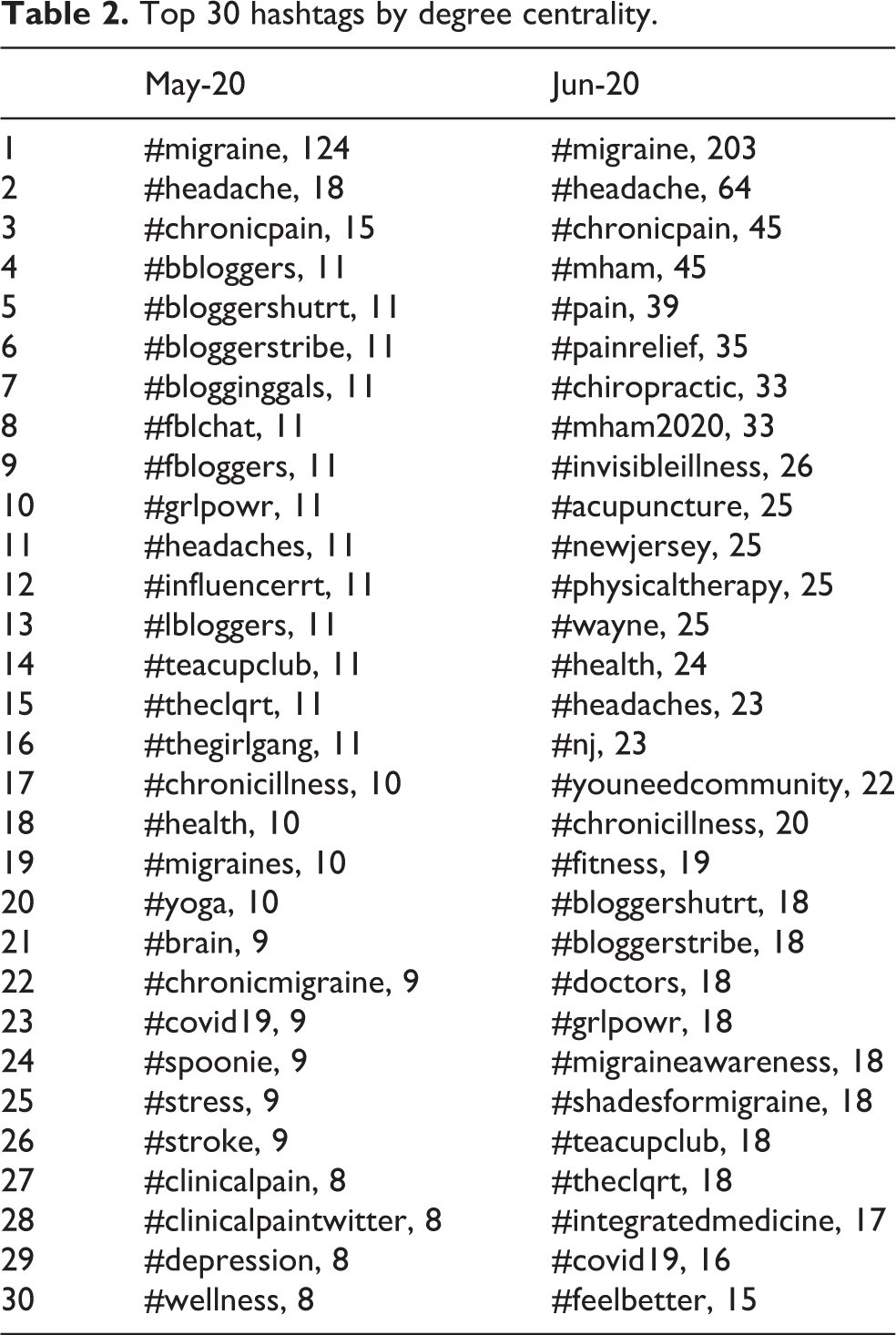

(a) Top 30 hashtags by degree centrality in May 2020. (b) Top 30 hashtags by degree centrality in June 2020.
Betweenness centralities are presented in Table 3. Hashtags such as #migraine and #headaches are again present. Hashtags such as #chronicillness, #spoonie, #clinicalpain, #clinicalpaintwitter,#chronicpain are again among the top items in May. Hashtag of #chronicpain, #pain#, painrelief, #chronicillness are again in June listed in June. Hashtags of #yoga is listed in May; #acupuncture, #chiropractic are listed in June.
In terms of advocacy: In May, #mham occupied 4th and was the highest advocacy related hashtag in the top 30 betweenness centralities. The hashtag #rallyagainstchronicmigraine is ranked #21 in May. In June, #mham is ranked #3 and #rallyaginstchronic migraine is ranked #27th among the top 30.
Top 30 betweenness centrality.

Closeness centralities are presented in Table 4. #migraine, #headaches are again the most highly connected. #chronicpain, #chronicillness, #spoonie, #clinicalpain, #clinicalpaintwitter are again listed in this centrality for May. In June, #pain, #chronic pain, # painrelief are among the top 30. #yoga is again listed in May. #acupuncutre, #chiropractic is again listed in June. Only two advocacy hashtags are presented in May (#mham and #migraineawareness) whereas 5 are represented in June (#mham, #mham2020, #shadesformigraine, #migrianeawarenessmonth, #migraineawareness.)
Top 30 hashtags by closeness centrality.

A list of highly connected subgroups for each month, as well as the website that these tweets references, are presented in Table 5. We have decided to only include those subgroups that contain more than 2 members. Those with only one member are therefore not included our table.
For both the month of May and June, the biggest subgroup in the graph (we call this the dominant subgroup) contains the majority of migraine related hashtags: for example, #migraine, #migraineroutine, #headaches, #migarinesupport are present here. Chronic pain related hashtags are also present here: for example #chronicpain#, clinicalpaintwitter, #spoonie and #chronicillness. Specific kinds of chronic illness that is related to pain is included: for example #lymedisease, #multiplesclerosis, #rheumatoidarthrtiis, #diabetes, #sicklecell and #hiv. Specific migraine treatments, both alternative and traditional, are included: for example #aimovig, #nerivio, #celecoxib, #yoga, #botulinumtoxin, #neuromodulations, #prednisone, #nerveblock, #chiropractice. COVID related tweets are also contained this this subgroup.
HCS subgroups that has more than 2 members.

Aside from the largest subgroup, other subgroups can be quite diverse. A number of these subgroups are form by specific thematic elements: for example, a subgroup encompassing #canon6d and #conertphotography in May only cites www.instagram.com as a contributing website. As another example, black lives matter subgroup contains hashtags as expected for the movement: #sayhisnamegeorgefloyd, #justiceforgeorge, #breonnataylor.
Some of the subgroups are unified by specific websites: for example, whatcorinnedid.com appears to belong exclusively to a subgroup with #bloggershutrt,#bloggerstribe, #bloggers, #thegirlgang, #teacupclub, #grlpower. (Of note, these hashtags rank highly in degree centrality measure.) The website, choosingwisely.org, appears to contribute to a subgroup dominated by only two hashtags: #choosingwiselywednesday and #choosingwisely, The website innovationorigins.com forms a subgroup of hashtags that are mainly concerned with machine learning and AI. The website insidehealthpoly.com appears to form a subgroup that contains pharmaceutical companies including AstraZeneca, Allergan and AbbVie.
Advocacy related hashtags is also the most diverse in regard to websites referenced. These references include websites for specialists, such as ninds.gov, to advocacy related websites such as migraineheadacheawarenessmonth.org, to patient blogs. Non-dominant subgroups are characterized by either lack of references or references to one or two websites. It is worth noting also that the composition of websites referenced by the dominant conversation group also changes between the 2 months.
A list of most commonly referenced website domain is presented in Table 6. Unsurprisingly Twitter and Instagram are the most commonly references.
Top 30 websites by count.

Discussion
Twitter migraine conversation evolves rapidly. How this conversation changes influences how patients, practitioners, and the public view our field. This project demonstrates that advocacy can successfully change this conversation; we will provide a genealogical discussion of our methodology as well as its implications below.
Genealogy of our methodology
Our study is not the first studies of social media platform in health care. Indeed, infodemiology as coined by Gunther Eysenbach, refers to “the study of the determinants and distributions of health information and misinformation” and forms a discipline of its own popularized through peer review journals such as Journal of Medical Internet Research. 23 A recent editorial in Cephalalgia noted that digital epidemiology may emerge as a new influential research field in headache. Indeed, recent analyses of YouTube and Google as sources of information on migraine demonstrate that there is an interest from patients and healthcare providers alike. 24 –26
In regard to the study of the migraine conversation on Twitter, we know of five prior studies: 1) Callister et al. had conducted a cross sectional analysis of Twitter activities during American Headache Society (AHS) meeting. 8 2) Nascimento et al. conducted an infodemological study of the migraine space in Twitter with primary focus on word frequencies and attention to descriptions of “migraine impact,” “pain descriptors,” as well as geographical and temporal patterns. 7 3) Deng et al. has recently published a study of migraine Twitter feeds using natural language processing techniques including sentiment analysis and latent Dirichlet analysis. 9 4) Mullins et al. have studied topics and keywords in a randomly chosen 14-day periods in 2017 in Ireland. 10 5) Finally, in a survey of 20,301 tweets from September 30, 2019 to January 14, 2020 we showed that topics of “#CBD,” “#cannabis,” as well as “#chronicillness,” “#chronic pain” and “#spoonie” were some of the most commonly tweeted hashtags. 11
Our study takes a different methodological approach from most of the above studies: Utilizing hashtag, a built-in user topic classification system, we use network analysis to analyze migraine conversations. Application of network analysis to hashtags in social media is a well-established technique, with uses ranging from political science, to marketing research, to academic research. 27 –29 Indeed, our study has as a methodological precursor in Tighe et al.’s analysis of Twitter hashtag on the word “pain.” In the Tighe study individual word are considered nodes and, similar to our project, edge represents co-occurring words in the same tweet. 15 Tighe et al.’s study, unfortunately, is not specific to migraine and yields no major thesis on headache advocacy. Finally, we have previously submitted preliminary results of a longitudinal study as a presentation at the AHS Virtual Meeting. 11 Our current iteration improved upon our prior approach and further taken into account, as a topic of main interest, advocacy and sources of information.
Evolving centralities, clustering and its implications
In considering the answer to the question “What do people talk about when they talk about migraine?” our study appears to support some of the findings in previous study—tweets on chronic pain and chronic illness often occur alongside migraine tweets. 11 This finding is again supported this study, where in both May and June, chronic pain hashtags dominate all centrality measurements besides migraine tweets.
The addition of HCS technique for subgroups analysis allows for a more nuanced answer to our question on topics of migraine discussion on Twitter. First, as evidence by Table 5, the migraine conversation appears to be largely composed of one big conversation with a number of smaller marginal conversations. The largest subgroup is not a homogenous discussion on one topic (as they often are for the smaller subgroups) but rather a cluster of closely related topics. For example, as expected, #migraine, #headaches as well as any migraine related conversations (#migrainetips, #chronicmigraine, etc. or migraine treatment such as #botox, #aimovig, #nsaids etc.) is a part of the largest conversation. (This is supported by Mullin et al.’s study, where migraine tweets can be categorized as either “awareness,” “advice,” or “research” oriented. 10) However other diseases such as other headache disorders (#clusterheadaches, #csfleak, #tensionheadache, #trigeminalneuralgia), mental disorders (#anxiety, #depression) and chronic pain tweets—even specific subtypes of chronic pain such as #lupuswarriors or #crps—are also parts of this dominant conversation. We suspect that this reflects the comorbidities associated with migraine as well as the closely considered alternative diagnoses often associated with a migraine diagnosis. 30,31
Parts of this larger conversation, surprisingly, also includes seemingly unrelated topics such as #gradschool, #writinglife, #cartoon, #cooking, #weekend, #workout and #covid or #quarantinelife. We speculate that these topics arise organically as migraine patients comment on how the illness affects important aspects of their lives. 30,32 The dominant conversation also includes topics that are rather technical—for example, #eeg, #pfo, #cpp, #fdaapproval, and #telemedicine—we suspect these describe headache practitioners’ perspectives.
Our project demonstrates that advocacy can successfully change the way in which hashtag topics on Twitter are interconnected; specifically, during the month of Migraine Awareness Month, advocacy related tweets increase in frequency (Table 1) and popularity (Table 2) among “migraine” tweets. Advocacy tweets, do not, however, dramatically change as brokers of ideas (Table 3). Taken together, this implies that migraine advocacy movements successfully establish themselves as dominant topics of conversations during the month of June; when people talk about migraine in the month of June, they do indeed talk about Migraine Awareness. These conclusions are, in some sense, expected and are reassuring results for migraine advocates.
Advocacy also appears to bring in new topics of conversation into the migraine space. Between the month of May and June, migraine advocacy related tweets are among the dominant subgroup (that is, the largest subgroup as judged by HCS) and the number of distinct members in this subgroup also increased from May to June. While multiple forces can be at play (for example, AHS virtual meeting, which began on June 13th and remained online until August 24th, and Black Lives Matter movements, triggered by the murder of George Floyd in May) this does seem to imply that migraine advocacy draws in new topics into the migraine conversation. 33 –35
Migraine advocacy, however, do not necessarily make new topics popular with the exception of non-pharmacological treatments such as physical therapy, acupuncture, and chiropractic maneuvers: We do not see, for example, a dramatic difference between the non-advocacy related tweets in May versus June except for those related to integrative medicine. While #physicaltherapy, #acupuncutre, #chiropractic did become more popular in terms of frequency and popularity in the month of June, the rest of the top 30 have always been there: #chronicpain and #chronicillness related tweets such as #pain, #painrelief, #spoonie are among the top 30 by frequency (Table 1) and also popularity in both months (Table 2).
Migraine advocacy also appears to have diversified the source of reference material in the dominant subgroup, i.e. the dominant conversation cluster. In the month of June, the number of unique websites that has been referenced by the dominant subgroup significantly increased compared to the month of May. Indeed, nlm.nih.gov was referenced in June and not in May. Advocacy therefore has the potential of improving the source of migraine information on social media. This is further supported by Table 6, where, www.migraineheadacheawarenessmonth.org actually beats out www.instagram.com, another popular social media site, in terms of popular site of information. We should note a major confounder to our interpretation above, however—the AHS virtual meeting also occurred in June, thus likely contributing to diversification of the source of migraine conversation.
Finally, and not surprisingly, nothing does more for migraine advocacy than the popular Chicago Bull’s retrospective The Last Dance (#thelastdance), featured on ESPN, where a key player’s migraine attack during a game drastically influenced sports history. As such, #thelastdance made it as 2nd most frequently occurring tweet in our dataset; it is nevertheless not “popular” according to degree centrality. This is likely that it has never infiltrated the dominant subgroup of conversation as noted by the HCS algorithm.
Marginalized conversations
While migraine advocacy appears to have situated itself as the dominant conversation on Twitter in the month of June, it is also worthwhile to examine the marginalized conversations as interpreted by the HCS algorithm: these are clusters of conversations that seemingly forms its own small insular group. First, as described in the results section, a number of small subgroups appear to arise from conversation around specific websites. The websites choosingwisely.org (an American Board of Internal Medicine initiative), insidehealthpolicy.com (a website focusing on health care policy), and innovationorigins.com (a news site on innovation) contain clusters of hashtags that focus on very narrow topics such as pharmaceutical companies or machine learning techniques. Of specific interest is that the website whatcorinesaid.com, a popular blog, actually was able to produce a subgroups of hashtags (#bloggershutrt, #fblchat, #theclqrt, #teacupclub, #grlpowr) with signals so strong as to make it into the most frequent degree centrality measurement.
In general, we observed that marginalized conversations belong to three distinct groups: Some of the smaller subgroups appear to be related to migraine. For example: subgroup 6 in May appears to be associated with #acupuncture, #pharmaceutical and takes sources from americanheadachesociety.org. Subgroup 23 in May appears to be related to chocolate, a commonly cited, but questionably contributing, migraine trigger.
36
Subgroup #34 in May is about the Entertainment and Sports Programing Network (ESPN) show The Last Dance. We suspect that the reason these subgroups are marginalized in the migraine conversation is that these conversations are not intended to be about migraine per se. For example, those who talk about The Last Dance on ESPN likely care more about basketball than migraine; therefore, their conversation is unlikely to be about #mham or other hashtags in the dominant subgroup. As noted below in our section on “echo chamber” phenomenon, these subgroups never contain more than 2 websites as sources of information. As such, these subgroups of conversations may represent windows of opportunities for migraine education in an online forum. Some of these subgroups appear to be unrelated to migraine: for example, subgroup 8 in the month of May is on concert photography whereas in the month of June, subgroup #11 is on cats. We hypothesize that likely migraine appears in these conversations inadvertently. Finally, some conversations represent popular national movements: subgroups 7, 8, 9 in June represent topics from the Black Lives Matter movement. We hypothesize that likely migraine patients who are either Black Lives Matter proponents or opponents contribute to these tweets. It is beyond the scope of this article, but nevertheless it is an important point to ponder whether the Black Lives Movement should be a separate topic of conversation apart from the dominant migraine conversation: We know, for example, that there is a significant racial disparate in health care.
37,38
Furthermore, mass media often portrays migraine sufferers as white females.
39
This gender and racial stereotype could potentially consolidate unconscious bias and marginalized patients of color. When we consider Twitter as an advocacy tool for migraine, we should also not forget that Twitter could be an advocacy tool for racial equality in migraine.
“Echo chamber” phenomenon?
It is important to note that marginalized conversations in our study contain no more than 2 websites as sources of reference. Indeed, a number of these marginalized conversations do not contain any references at all and when they do, they simply reference Twitter itself. We will require more data to determine whether this model “the echo chamber” phenomenon that has often been hypothesized on social media as source of misinformation. 40
As discussed above, one can categorize marginalized conversations into the following: those that are clearly migraine related, clearly not migraine related, and related to major social movements. For those subgroups that are not migraine related and to which migraines are perhaps simply inadvertently mentioned this “echo chamber” effect is perhaps not particularly detrimental. For example, subgroup 11 in June appears to be a cat-oriented subgroup. To demand rigor scientific references for migraine in these discussions are perhaps excessive. However, for migraine related and/or major social movement related subgroups, the lack of diverse referenced information on migraine may be a missed opportunity for migraine education/advocacy, or worse, a potential source of propagating misinformation.
Sources of information
Our article appears to be the first project to investigate the sources of Internet information on Twitter in relations to migraine. We believe this to be a particularly important topic of investigation in the era of fake news, misinformation, and disinformation. At first glance, Twitter appears to be a self-referencing project: Twitter.com remains the most commonly referenced website. However, this observation maybe biased in that “gifs” and emojis, as well as a various numbers of Twitter objects, are from the Twitter website itself. Yet despite this bias, it is important to note that other social media sites such as youtube.com, instagram.com, and whatcorinedid.com remain the most commonly cited source of information. (As noted above, that whatcorinedid.com belongs not to the dominant subgroup but belong to subgroup #17 and 7 in the month of May/June. Thus, likely it is not a website that contribute to the majority of migraine information in the dominant subgroup of conversation.) Therefore, our project suggests that a significant number of information on Twitter come from other social media. Indeed, only clinicalpainadvisor.com and migraineheadacheawarenessmonth.org rival other social media websites as sources of information (Table 6). We know that online portrayal of objective information on migraine—such as migraineous aura—are often incorrect. 41 Information on migraine treatments in Google searches are more often than not contributed by non-medical professionals or by those with commercial interests. 26 Given these biases and problematic information, social media self-referencing can be a significant factor in propagating misinformation. This is especially true in the area of alternative medicine and integrative medicine, which appear to have a rising interest in our dataset. This mirrors a similar rise in interest for complementary medicine in YouTube as noted by Saffi et al. 25 Unfortunately those complementary medicine contents on YouTube are often non-evidenced based and thus has the potential of becoming sources for misinformation. 25 In sum, if social media self-referencing is an important phenomenon, then it becomes more vital for practitioners and headache physicians to influence social media conversations from within.
Limitations
Our approach in documenting only local migraine tweets around the United States Northeast can be seen at first as provincial. Certainly, the lived experiences of migraine sufferers globally cannot be extrapolated entirely from East Coast Americans. However, we have decided on this approach based on the criticism that recording and analyzing global migraine tweets suffer from reductionism, blurring the manifestation of migraine pain across culture and geographical regions. As Deleuze and Guattari suggested, “[one] will never find a homogenous system that is not still or already affected by a regulated, continuous, immanent process of variation…” 42 We have therefore decided to narrow our project by only studying US Northeasterner’s migraine perspective as it is expressed on Twitter.
As mentioned above, the occurrence of American Headache Society’s meeting in the month of June introduces confounding factors to our project. However, instead of arguing for separation of migraine awareness month from AHS meeting so we can obtain cleaner data on advocacy, we believe the co-occurrence of the two in the month of June provides an advantage for online migraine conversations. As our data suggests, the migraine advocacy movement allows for increased awareness, allowing AHS meeting to introduce authoritative sources of information into the migraine conversation.
The COVID-19 pandemic is also a confounding factor for our study. During the month of March, April, and May 2020, the Northeast USA experienced a surge of COVID-19 infections. During the month of June, for example, there is a decrease in the number of COVID19 cases in New Jersey and New York. 43 We are unsure how this change may have influenced tweeting habits in our area as related to migraine; headache is a neurological complaint associated with COVID-19. 44 In addition, there were several large-scale behavioral changes resulting from the pandemic, ranging from mass closure of workplaces and schools, as well as restrictions on travel and social interactions. For example, New Jersey had statewide shut down starting in early March of 2020. On May 18th, stage 1 of reopening was announced followed by stage 2 reopening in June 18th. 45 We are also unsure how this affects tweeting habits.
Methodologically, this study also does not study retweets nor does it study private tweets, both phenomena which may change measurements on which tweets are more popular. If we view retweeting as a kind of voting mechanism, for example, then specific topics may be more relevant than they are observed here.
Finally, we note the surprising observation that the number of tweets in May actually exceeds those in June. Unfortunately, our model as it stands does not offer us explanation as to the cause of this phenomenon. We speculate that the quantity of “migraine” related tweets in a given time frame is likely multifactorial and fluctuates due to a variety of factors. (For example, ESPN’s #thelastdance itself alone accounts for at least 38 tweets in our May dataset.) In counting migraine tweets in a separate project, for example, we noted that there is a questionable correlation between the number of migraine tweets and barometric pressure. 46 One explanation is that the effect of advocacy is not strong enough to overcome these multifactorial factors. Alternatively, since our model does not take into account retweets, it is conceivable that our model may have missed a significant uptick in retweets, thus resulting in current phenomenon. We are convinced that a word frequency comparison likely would not offer us an explanation for this phenomenon, however, based on a prior project. 11 Despite our speculations, only a repeat study in the future would help elucidate this observation further.
Future directions
Further longitudinal data will no doubt help us to consolidate our conclusions. Specifically, selection of an additional number of months prior to the migraine awareness month may offer a more accurate control. To avoid reductionism but also allow for increased diversity of data, conducting similar Twitter surveillance in multiple geographical regions will also allow us to obtain more accurate and perhaps more generalizable results.
Conclusion
Our project provides several new insights into social media attitudes on migraine, and it provides encouraging evidence for the importance and success of migraine advocacy movements. We find a network analysis approach to be fruitful in the area of migraine social media research. Our study highlights the success as well as potential opportunities for social media advocacy on Twitter.
Clinical implications
We analyze how Twitter users communicate about migraine using network analysis techniques. Tweets related to Migraine advocacy were more popular in National Migraine and Headache Awareness month of June 2020 than in May 2020. We showed that Migraine advocacy campaigns help promote online awareness about migraines and promote more trustworthy reference websites among online Twitter users.
Footnotes
Acknowledgements
We would like to thank the reviewers of Cephalalgia Reports for their constructive comments on this manuscript.
Declaration of conflicting interests
The author(s) declared the following potential conflicts of interest with respect to the research, authorship, and/or publication of this article: Santosh Bhaskarabhatla: No conflict. Pengfei Zhang: He has received honorarium from Alder Biopharmaceuticals, Board Vitals, and Fieve Clinical Research. He collaborates with Headache Science Incorporated without receiving financial support. He has ownership interest in Cymbeline LLC.
Funding
The author(s) received no financial support for the research, authorship, and/or publication of this article.
