




Abstract
The objective were to evaluate the effects of supplementation of standardized dry extract of Rosmarinus officinalis (RO) and the application of aesthetic radiofrequency on the oxidative stress markers catalase (CAT), superoxide dismutase (SOD), non-protein thiols (NP-SH), and thiobarbituric acid reactive species (TBARS) and the biochemical markers triglycerides, total cholesterol, high density lipoprotein (HDL) cholesterol, glutamic-oxaloacetic transaminase (TGO/AST), pyruvic-glutamic transaminase (TGP/ALT), gamma glutamyl transpeptidase (gamma-GT), and creatinine. This study included 32 women received the aesthetic therapy to reduce localized fat. They were divided into the control group (n = 8) receiving placebo capsules and the intervention group (n = 24) subdivided into Group A, B, and C, each with eight members receiving supplementation with 100, 500, and 1000 mg/day of standardized dry extract of RO, respectively. The Universal Trial Number (UTN) – U1111-1274-6255. Supplementation with RO (500 mg/day) demonstrated a reduction in oxidative stress (quantified with through a significant increase in NP-SH and a reduction in SOD and CAT enzymes). The radiofrequency aesthetic treatment did not promote an increase in oxidative stress; however, it caused significant changes in total cholesterol, HDL cholesterol, and creatinine. RO is a plant with antioxidant effects and its oral consumption is safe in selected women subjects in hepatic and renal markers.
Introduction
Radiofrequency devices promote high-frequency electromagnetic field energy, which acts by selectively heating adipose tissue, increasing local metabolism, and, consequently, promoting lipolysis in adipose cells. Through a reversible biochemical phenomenon promoted by the increase in temperature, the release and degradation of triglycerides occurs in adipocytes, culminating in the generation of glycerol and non-esterified fatty acids, which can be used for energy production. This release of lipid content leads to adipocyte hypotrophy, that is, to a decrease in its volume and, consequently, a reduction in localized fat. 1 The lipolytic effect exerted by radiofrequency is explained by thermal mechanisms, given evidence that adipose cells exposed to temperatures around 44 °C suffer apoptotic lesions, with membrane denaturation and lipid release, being then eliminated by phagocytic mechanisms. 2
Considering the physiological effects promoted by aesthetic radiofrequency, it can cause inflammation. The increase in temperature generated signs of inflammation in animal models, 3 which is a response mechanism to radiofrequency exposure, and in this sense, it can trigger oxidative stress, 4 which generates cellular damage. 5
As an alternative to maintain the balance between the production of reactive oxygen species (ROS), many plants play an antioxidant role. Rosmarinus officinalis (RO, Rosemary), 6 an aromatic plant with polyphenols in its structure, is among these. 7 RO has pharmacological effects already validated by research such as: treatment of withdrawal syndrome and insomnia, 8 reduction of blood glucose, triglycerides, total cholesterol, and LDL cholesterol; 9 treatment of patients with type 2 diabetes mellitus; drug resistant conventional; 10 reduced symptoms of persistent asthma; 11 memory improvement; reduction in anxiety and depression;12–16 improved cognitive performance;17–19 reduction of oral bacterial plaque and gingivitis;20–22 use as a topical healing agent; 23 and decreased ROS and damage to cellular DNA.24,25 Studies in animal models suggest positive effects on the cardiovascular system26,27 and dyslipidemic effects. 28 In addition, in vitro studies demonstrate that it reduces the expression of cancer cells 29 and oxidative stress. 24 Although, in vitro and animal studies have already been carried out with positive results, research on the use of RO extract in humans is scarce. In addition, no previous work evaluated the antioxidant potential of RO during an aesthetic radiofrequency procedure.
The study of medicinal plants is necessary to validate the efficacy and safety of this resource at the same level of demand as conventional pharmaceutical products. This is done through proof of their safety for human use. 30 The aim of this study was to evaluate the effects of supplementation of different doses of the standardized dry extract of RO and the application of aesthetic radiofrequency on the oxidative stress markers catalase (CAT), superoxide dismutase (SOD), non-protein thiols (NP-SH), and thiobarbituric acid reactive species (TBARS) and the biochemical markers triglycerides, total cholesterol, HDL cholesterol (HDL), glutamic-oxaloacetic transaminase (TGO/AST), pyruvic-glutamic transaminase (TGP/ALT), gamma glutamyl transpeptidase (gamma-GT), and creatinine.
Methods
Study Design and Participants
This was an experimental, longitudinal, analytical, prospective, randomized, and double-blind clinical trial in which biochemical and oxidative stress markers were analyzed. The study was approved by the Research Ethics Committee of the Universidade Regional do Northwest of the State of Rio Grande do Sul (UNIJUÍ), with opinion number 4,461,079/2020; Brazilian Registry of Clinical Trials (ReBEC): RBR-86m4sns (https://ensaiosclinicos.gov.br/); The Universal Trial Number (UTN) – U1111-1274-6255 (https://trialsearch.who.int/utnvalid.aspx).
The sample consisted of 32 women between 18 and 50 years old with complaining of visible localized abdominal fat. They were randomly invited through dissemination in the local media and included in the research after signing the Free and Informed Consent Term (ICF). Because of the COVID-19 pandemic, four participants needed to be replaced for reasons of need for social isolation, making it impossible to carry out the aesthetic procedure. The sample size calculation was performed using the Lee-Laboratory of Epidemiology and Statistics software (http://www.lee.dante.br/pesquisa.html), with data from a previous study that used the mean difference in SOD between the control group and the intervention the value of 0.02 and difference between standard deviation of 1.1 (41). A significance level of 0.05 and test power of 80% were adopted, obtaining a sample of 8 patients in each group.
Those who did not present comorbidities, did not undergo non-invasive cosmetic procedures in the last 30 days, and were not on a restrictive diet for weight reduction were included in the study. Women who: had a physical disability; were pregnant or breastfeeding; used anti-inflammatory drugs, herbal medicines, or weight loss products; had a known allergy or intolerance to RO; or had sensitivity or allergies to radiofrequency or other contraindications were excluded from the study. Obese women with body mass index (BMI) ≥ 30, 31 calculated using the formula BMI = weight (kg)/height2 (m2) 32 were also excluded, as were women who had undergone invasive aesthetic procedures in the last 12 months.
Women were randomized considering age as a matching criterion. Figure 1 shows the consort flow diagram of this trial.

Study consort flow diagram.
RO
RO was chosen as a study plant, considering its good adaptation to the Brazilian climate. RO capsules were produced from standardized dry extract purchased from the supplier “Florien” from Piracicaba, Sao Paulo, Brazil, batch NPT.0321/243, authorized by national health agencies. The manipulation of herbal and placebo capsules was carried out at the Pharmacy school of the Regional University of the Northwest of the State of Rio Grande do Sul in compliance with good handling practices. The excipient used to produce the capsules and the placebo was starch. The quality control recommended by the Brazilian Pharmacopoeia and required by Collegiate Board Resolution (RDC) 67/2007 was carried out for each batch of capsules produced, and average weight, upper and lower limits, and coefficient of variation were calculated. The standardized dry extract and presents a report with quantification of flavonoids of 0.6% (flavonoids: diosmetin, diosmin, genkwanin, luteolin, hispidulin and apigein; another 3 glucuronic flavonoids in the leaves; triterpenic acids: oleanolic acids and ursolic and diterpene carnosol; phenolic diterpenes: caffeic, chlorogenic, labiatic, neochlorogenic and rosmarinic; elevated amounts of salicylates. they also have saponin, traces of alkaloids, bitter principles, tannins). The definition of the doses used in the present study was based on the literature. 11
Jars containing 30 capsules (each group received its respective treatment: placebo or 100 mg/day of RO or 500 mg/day of RO or 1000 mg/day of RO) each were delivered to participants on the day of baseline assessments and blood collection. Participants were instructed to drink daily in the morning.
Interventions
The study was carried out in a multidisciplinary private clinic in the city of Ajuricaba and in a school clinic in the city of Ijuí. The protocol was applied between December 2020 and June 2021.
Study participants were divided into groups: control (CG) and intervention (IG). Both groups received the application of 12 aesthetic sessions with radiofrequency equipment three times a week for 4 weeks. Radiofrequency with temperatures between 39 °C and 43 °C was applied to the abdominal region subdivided into four subregions of 100 cm2 for 10 min each, for standardization. A bipolar applicator with a concentric field and a frequency of 640 KHz was used. This procedure was performed by the researcher.
The pharmacological intervention using RO took place in the same period as the aesthetic treatment (4 weeks). In the control group (n = 8) placebo capsules were inserted. The intervention group was divided into three subgroups: Group A (n = 8) received a supplementation of 100 mg/day of RO in capsules and radiofrequency; Group B (n = 8) received 500 mg/day supplementation of RO in capsules and radiofrequency. Group C (n = 8) received supplementation of 1000 mg/day of RO in capsules and radiofrequency. It should be noted that the capsules were manipulated according to the corresponding quantity at the pharmacy school of Regional University of the Northwest of the State of Rio Grande do Sul.
Outcomes
The primary outcome to verify the safety of oral consumption of standardized dry plant extract and the radiofrequency aesthetic procedure in this study was the change in biochemical and oxidative stress markers,. Laboratory tests were used to quantify biochemical biomarkers (triglycerides, total cholesterol, HDL, TGO/AST, TGP/ALT, gamma-GT, creatinine, and cortisol and oxidative stress biomarkers (CAT, SOD, NP-SH, and TBARS).
At the beginning and end of the study, blood samples were collected after a 12-h fast to quantify the presence of the aforementioned biomarkers. Blood collections were performed at the Clinical Analysis Laboratory of UNIJUÍ (UNILAB).
For the analysis of the oxidative stress biomarkers, blood was collected in an ethylene-diamine-tetraacetic acid tube to obtain erythrocytes (RBCs), in which the whole blood samples were centrifuged for 15 min at 2500 rpm (revolutions per minute), washed twice in 0.9% NaCl, and recovered with centrifugation. Afterwards, they were frozen at 0 °C until analysis. The techniques were performed using a UV-VIS spectrophotometer, model IL-592-LC-BI (Purchased from KF Equipamentos, Porto Alegre, Brazil). The techniques were performed following the procedures described below:
CAT technique
CAT activity in RBCs was measured using the Aebi method, by adding RBCs to a cuvette with 50 mM phosphate buffer (pH 7.0) and starting the reaction by adding 0.5 mM H2O2 (pH 7.0) freshly prepared. The rate of decomposition of H2O2 was measured with a spectrophotometer at 240 nm. CAT activity is expressed in mmol/H2O2/mL erythrocytes. 33
SOD technique
SOD activity was analyzed using the method described by McCord and Fridovich, which is based on the ability of SOD to inhibit the auto-oxidation of adrenaline to adrenochrome. The test was performed with a diluted solution of RBCs (using three volumes of diluent) being read in a spectrophotometer at 480 nm. SOD activity is expressed as μSOD/mL of hemoglobin. 34
Non-protein SH technique
The non-protein thiol groups of RBCs, which allow for the indirect verification of the levels of glutathione (GSH), were determined using RBCs hemolyzed with 10% Triton. Twenty percent trichloroacetic acid (TCA) was added to this mixture; the resulting mixture was centrifuged at 4000 rpm for 10 min. The supernatant was used as a sample, and the standard curve was created using different concentrations of 1 mM GSH. 5,5-dithio-bis-(2-nitrobenzoic acid) was added and the mixture was read immediately in a spectrophotometer at 412 nM. 35
TBARS technique
The TBARS technique uses RBCs prepared with 10 mM butylhydroxytoluene and 20% TCA, homogenized by vortexing, and centrifuged for 5 min at 4000 rpm (revolutions per minute) in in centrifuge model 80-2B maximum speed 2325 XG (Purchased from IONLAB- Araucária – Paraná). The sample was the supernatant, from which a standard curve was made using different concentrations and volumes of distilled water, 0.03 mM malondialdehyde (MDA), 10% phosphoric acid (H3PO4), and 0.6% TBA. The tubes were placed in a water bath at 95 °C for 60 min and the reading was performed immediately in a spectrophotometer model IL-592-LC-BI at 532 nm. 36
For analytical validation of oxidative stress tests, selectivity, specificity and linearity were performed.
For the quantification of biochemical markers, blood samples were collected for conventional analyzes of the following: creatinine, gamma-GT, TGO/AST, TGP/ALT, total cholesterol, HDL, and triglycerides. The reference values used by the laboratory are as follows: cortisol: 5.3 to 22.5 mcg/dL; creatinine: 0.4 to 1.3 mg/dL; gamma-GT: 7.0 to 32.0 U/L; TGO/AST: 13 to 35 U/L; TGP/ALT: 7 to 35 U/L; total cholesterol: <200 mg/dL; HDL: 30 to 85 mg/dL; triglycerides: <150 mg/dL.
Statistical Analysis
For data analysis, scientific formulas were used in the Microsoft Excel program. The analyses were performed using the GENES Software (Quantitative Genetics and Experimental Statistics, version 2015.5.0).
Data normality was tested using the Kolmogorov–Smirnov test. Continuous data were described as the mean ± standard deviation or median (interquartile range), and categorical data as absolute and relative frequency. To verify the association of quantitative variables was used ANOVA and the test of comparison of means for paired samples by Student's t test was used. For all tests, a 5% level of significance was considered.
Data were subjected to analysis of variance to detect the main effects and interaction of RO use and radiofrequency exposure. Linear regression analysis (Y = b0 ± b1x) was then performed in the dimensioning of the efficiency of the use of RO to change biomarkers using the value of the linear coefficient = intercept (b0), which indicates the starting point of the variable in the regression, and the slope (b1), which determines the rate of growth or reduction of variable y by the dose of RO. The analysis of the regression parameters by the mean plus or minus one standard deviation in the indication of superiority or inferiority of the parameters that describe the efficiency of RO in the different doses followed. In the quantitative factor, regression equations were adjusted based on the F test of the coefficients at 5% of probability and on the coefficient of determination (R²). For the analysis of correlations, Pearson's test was used to compare all doses to the zero dose and the initial and final data were used.
Results
Effect of RO Supplementation on Oxidative Stress Markers
The study had 32 participants, sociodemographic data are presented in Table 1. The mean age of the participants was 34 years, with a standard deviation of 8.97. The present study demonstrated that radiofrequency did not cause oxidative stress, as the levels of SOD, CAT, TBARS, and NP-SH markers remained similar in the control group supplemented with placebo (dose 0).
Demographic Characteristics of Study Participants.

No significant differences were detected in the markers of oxidative stress with the supplementation of 100 mg of RO, as seen in Table 2. However, RO demonstrated an antioxidant effect at the dose of 500 mg, as observed with the increase in NP-SH with statistical differences and values above the mean + 1 standard deviation. SOD and CAT enzymes decreased significantly in those who used the 500-mg dose when compared to those who used other doses of this herbal medicine.
Analysis of Oxidative Stress Markers Through Initial and Final Means in Women Subjected to Radiofrequency at Different Doses of RO.
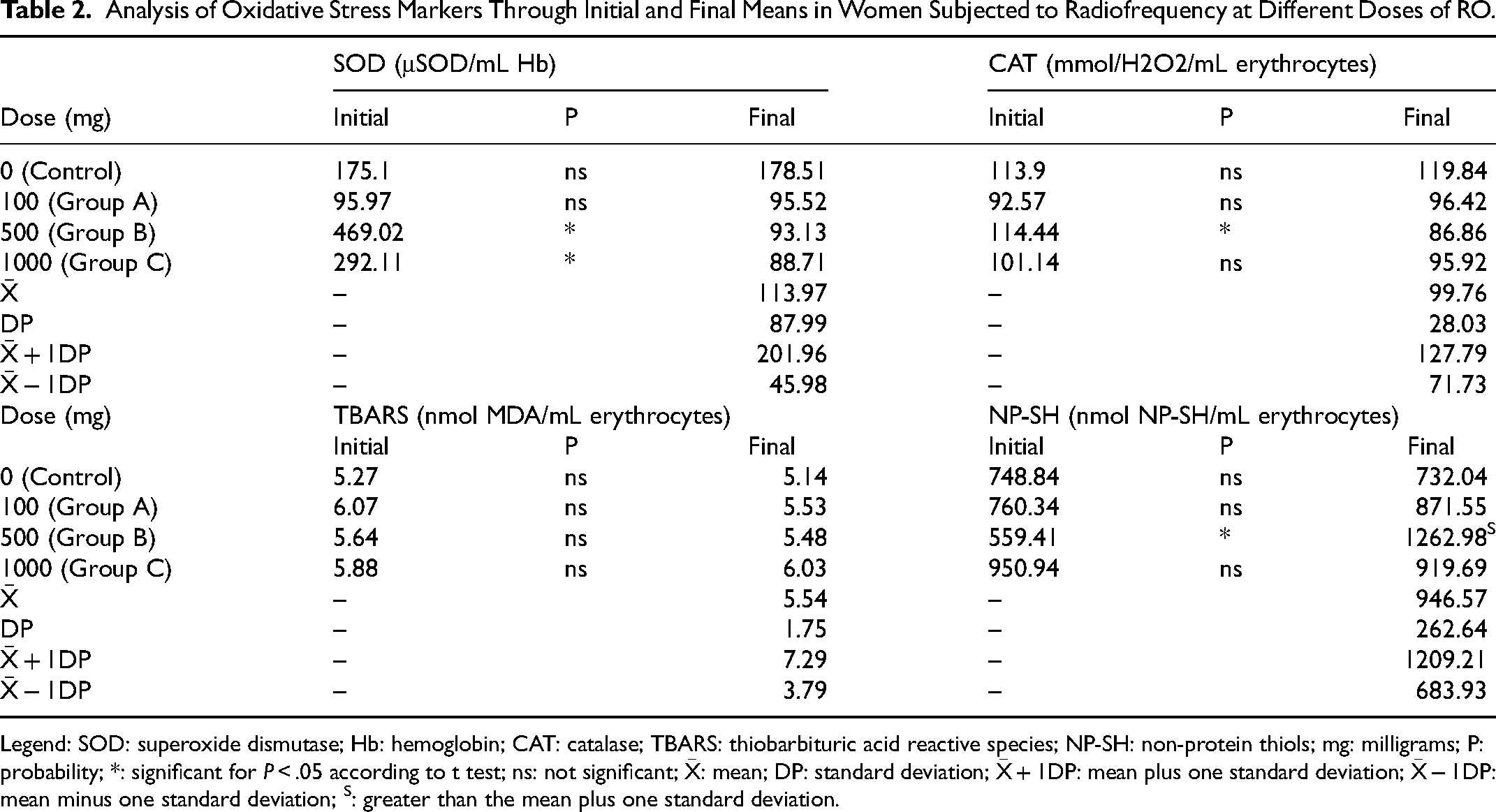
Legend: SOD: superoxide dismutase; Hb: hemoglobin; CAT: catalase; TBARS: thiobarbituric acid reactive species; NP-SH: non-protein thiols; mg: milligrams; P: probability; *: significant for P < .05 according to t test; ns: not significant;
A significant decrease was observed only in the SOD enzyme in those who received the 1000-mg supplementation, demonstrating an antioxidant effect of RO not dependent on the dose. There was also a tendency toward decreased SOD enzyme activity with increasing doses, emphasizing a sudden drop when compared to the higher concentration of RO with placebo.
The result of the analysis of variance presented in Table 3 indicated that the variations in doses and markers of oxidative stress were significant. Therefore, statistical significance was evidenced only in the oxidative stress markers CAT and NP-SH. These are second degree regressions, and their equations are shown in Table 3. The optimal dose of RO (600 mg) and the maximum expression value of 83.38 mmol/H2O2/mL erythrocytes for CAT were evidenced. A trend in the values of NP-SH was observed, as evidenced by the the optimal dose of RO (573 mg) being associated with a value of 1.246 nmol NP-SH/mL erythrocytes.
Regression Equation of Oxidative Stress Markers as a Function of Different Doses of RO in Women Subjected to Radiofrequency.

Legend: R²: coefficient of determination; y: maximum expression; ns: not significant at 5% probability by the t test; *: significant at 5% probability by the t test.
Analysis of Biochemical Markers
Regarding the biochemical parameters, there was statistical significance (P < .05) only with placebo supplementation and the radiofrequency aesthetic procedure. There was an increase in the means of HDL and total cholesterol as well as an increase in the means of the final creatinine levels in this group, when compared to the means before the intervention.
It is noticeable that the levels of triglycerides decreased with all doses of supplementation, with an emphasis on the dose of 500 mg, which generated a reduction of 19 mg/dL. None of these data presented statistical significance.
The markers linked to liver function (TGO and TGP), although without statistical significance, showed greater variation at the 1000 mg dose with decreases in the means of 5.07 U/L and 7.25 U/L, respectively. The greatest decrease in the means for gamma-GT was at the dose of 500 mg with 6.16 U/L decrease, as seen in Table 4.
Descriptive Analysis of Biochemical Parameters of Women who Received Radiofrequency, Comparing the Initial and Final Means, in Different Doses of RO.

Legend: TOTAL COL: total cholesterol; COL HDL: high density lipoprotein cholesterol; TGO: glutamic-oxaloacetic transaminase; TGP: pyruvic-glutamic transaminase; GAMMA-GT: gamma glutamyl transpeptidase; mg: milligram; dL: deciliter; U/L: micromol per liter;
Study participants had an average of 193.09 mg/dL of total cholesterol and 65.78 mg/dL of HDL cholesterol. It is also noticeable that there was a reduction in total cholesterol and an increase in HDL at doses of 100 mg and 500 mg of RO. At the 1000 mg dose, there was an increase in total cholesterol. Furthermore, HDL cholesterol increased at all doses studied. It is noteworthy, however, that such data were not significant.
The greatest variation between the initial and final values for creatinine was induced by the 1000-mg dose, with a decrease of 0.05 mg/dL. However, as previously mentioned, the statistical significance was seen in the 0.04 mg/dL increase in creatinine in the placebo group.
The regression equations were applied to verify a possible trend in the behavior of the variables, which can be seen in Table 5.
Regression Equation of Biochemical Markers as a Function of Different Doses of RO in Women Submitted to Radiofrequency.

Legend: R²: coefficient of determination; y: maximum expression; ns: not significant at 95% probability by the t test; *: significant at 95% probability by the t test.
Statistical significance was found in the total cholesterol and HDL markers, obtaining the optimal dose of RO of 532 mg for the maximum expression value of 181 mg/dL of total cholesterol and the optimal dose of 500 mg for the maximum expression value of 60 mg/dL HDL cholesterol.
Discussion
One of the main findings of this study was to demonstrate the renal and hepatic safety in the oral use of dry RO extract in women undergoing aesthetic radiofrequency. This data could be visualized through the non-alteration of the hepatic markers TGO, TGP, and gamma-GT and the renal marker creatinine. Furthermore, there were benefits in associating aesthetic procedures with supplementation with this plant because RO is an effective means to minimize systemic changes caused by radiofrequency. For example, an increase in the renal function marker and total and HDL cholesterol was observed when radiofrequency used without herbal supplementation, and the use of RO minimized such effects. The use of different doses of RO in women, demonstrated antioxidant capacity, demonstrated by increases in NP-SH and significant decreased in CAT and SOD. We put forth the following as a contribution of this study: the non-change in oxidative stress markers with the radiofrequency aesthetic procedure, demonstrating the safety of the technique in the evaluated parameters.
It was found in this study that the application of aesthetic radiofrequency does not produce changes in the levels of oxidative stress. Previous studies using similar methodology were not found. Research that aimed to evaluate the combination of radiofrequency and ultrasound on anthropometric indices, antioxidant and pro-oxidant balance, and high sensitivity C-reactive protein found that there was no significant change in the variables analyzed. 37 It can be concluded that the heat generated by the procedure did not change such the results of assays of oxidative stress markers, demonstrating the safety of the procedure.
In this study, a significant decrease in CAT enzymes was observed at the dose of 500 mg. This fact, although not well described in the literature, was verified in another study with animal models: the administration of plants traditionally used in Portugal (savory, sage, and agrimony) reduced CAT levels, as a sign of decreased H2O2 in the circulatory system and, therefore, a decrease in oxidative stress. In this sense, the use of medicinal plants may reduce the amount of H2O2 in circulation or inactivate the enzyme itself. 38 Also, except for sage, the other plants in this same study also decreased SOD activity. This result agrees with the present study, when considering the doses of 500 and 1000 mg. The reduced activity of the enzymes may represent partial inactivation by hydroxyl radicals and H2O2.39–42 SOD and CAT act as mutually supportive antioxidant enzymes that provide a protective defense against ROS, 43 justifying the results of decreased expression of these enzymes.
The decrease in CAT activity leads to the accumulation of H2O2. However, depending on the cell compartment, this substance can be degraded by the compensatory activity of glutathione peroxidase (GPX). 42 Considering that under physiological conditions the actions of enzymes as antioxidant defense systems are coordinated, compensatory changes in this activity can be expected. That is, changes in the function of one enzyme can affect the activity of another. 44 This compensation can be observed in this study. The increase in NP-SH at a dose of 500 mg is because it acts as an electron donor for the body's free radicals, ensuring an antioxidant effect and decreasing the production of ROS. Thus, the demand for SOD and CAT enzymes decreased. Supplementation with dry extract of RO decreased the expression of the CAT enzyme, resulting in a reduction in oxidative stress promoted by the increase of NP-SH.
The NP-SH technique used in this study indirectly measures free GSH levels. GSH is the main non-protein intracellular thiol, and it provides primary defense against oxidative stress because of its ability to scavenge free radicals. 45 This antioxidant effect was verified in this study through the significant increase in NP-SH values. In research with animal models, GSH was significantly increased with RO extract supplementation, demonstrating protection against toxicity induced by the chemical creosote. 46 Another study found that washing postoperative peritoneal adhesions induced in animal models with RO significantly increased the level of GSH. 47 In research with rats with ethanol-induced gastric ulcers, an ethanolic extract of RO increased GSH activity. 48 Also, in rats with diet-induced hypercholesterolemia, phenolic compounds present both in the aqueous extract and in the non-esterified fraction of RO affected the activity of the endogenous antioxidant enzymes CAT, GPX, and SOD, confirming the action of the antioxidant compounds on parameters of oxidative stress. 49 No studies with humans that evaluated the activity of GSH and RO were found in the researched databases, which is a differential of this study.
Although there was a significant decrease in SOD enzymes with the use of 1000 mg of RO, in the other variables evaluated at this dose the effect was not significant, demonstrating a non-dose-dependent effect. SOD is more susceptible to reduced activity and is also regulated by reactive species, depending on glutathione levels. 40 In a study with animal models using tincture of RO, dose-dependent effects were also not found: when evaluating liver parameters and oxidative stress markers, the highest doses did not show the best results, 50 corroborating the findings of the present study.
The optimal dose of 573 mg of RO was still evidenced, demonstrating data not yet presented in the researched databases in clinical studies of this plant in women. Studies are needed to evaluate the mechanism of action of this plant and its relationship with its chemical constituents. Furthermore, studies are needed to understand the pharmacokinetics and pharmacodynamics of its major compounds, especially those related to antioxidant activity. These studies may validate the optimal dose found and indicate a possible saturation of receptors related to the mechanism of action of this plant in the human organism.
The effects of the plant on free radicals revealed in the present study are related to the antioxidant power of the compounds present in RO. Studies in animal models demonstrate antidiabetogenic effects in diabetic rabbits. The rabbits received a dose of 200 mg/kg of RO extract for 1 week, which inhibited lipid peroxidation and activated antioxidant enzymes. 51 Extracts obtained from RO can eliminate several nitrogen species and reactive oxygen types, and this is believed to be one of the main mechanisms of the antioxidant action exhibited by the phenolic compounds present in RO. 52 Regarding the constituents of RO, the most important diterpenes in terms of the biological significance of the plant are carnosic acid and carnosol, accounting for more than 90% of the antioxidant effects of RO. The structural characteristics of carnosic acid and carnosol are described with metal chelation properties, which is one of the known mechanisms of antioxidant effects. 53 The use of phenolic-rich extracts from green tea and RO resulted in decreased absorption of dietary iron in women. 54
Further studies are needed to develop extracts concentrated in antioxidant compounds to provide a better effect at lower doses. However, there is a lack of standardization of methods for evaluating oxidative stress biomarkers. There are few studies that evaluate the effect of RO on human health with the oral use of dry extracts. The available studies are directed to different health conditions in isolation and were developed with specific populations. This knowledge gap was solved with the present study, which proves the benefits of using the plant in healthy people.
The initial and final values of the markers linked to liver function (TGO, TGP, and gamma-GT) were not different, demonstrating the safety of using the herbal medicine with respect to the analyzed parameters. A study with RO tincture highlights the presence of polyphenols and terpenoids with antioxidant and hepatoprotective properties, which may be useful for protection against liver tissue damage in animal models. 50 One study used enteral RO essential oil, a product different from the one used in the present research, in rats with acute liver injury induced by carbon tetrachloride. It was found that the oil exerted hepatoprotective effects, through antioxidant effects in the regulation of enzymes. 55 Furthermore, in animal models, diets of 1 and 3 g/kg of RO decreased hepatic steatosis in fish. 56
Regarding markers of renal function in rats, treatment with RO caused a decrease in the amounts of urea, creatinine, and uric acid. Therefore, bioactive phytochemicals with high antioxidant potential for scavenging free radicals and inhibiting oxidation contribute to the hepatoprotective characteristics in animal models. 57 The data from the present research agree with a human study that shows that consumption of RO did not affect liver and kidney functions. 58 This study has important differences in relation to the present study, using infusion and for a shorter time.
Regarding the renal marker of creatinine, values between 0.6 and 1.1 mg/dL are considered normal for adult women.59,60 In this study, women had an average of 0.72 mg/dL, with the sample average within normal levels for this parameter. The greatest variations in creatinine levels were observed in the group that received only radiofrequency as an intervention, with a significant increase from 0.72 to 0.76 mg/dL. In a study of aesthetic treatment including the radiofrequency equipment, no significant changes were found in creatinine levels after intervention with eight weekly sessions. 61 In the present study, a total of 12 sessions were performed, three times a week over 4 weeks, a difference that may explain the changes in the markers. This may evidence a possible overload that can occur with supplementation, as previously mentioned. It was possible to evidence with this study that the alterations caused by the radiofrequency are supplied using RO, since in the other supplemented groups, the creatinine decreases.
Research with animal exposed to electromagnetic fields evidences the therapeutic action of a methanolic extract of RO leaves at a dose of 5 mg/kg against the harmful effects induced by radiation; the use of this plant minimized changes in total bilirubin, urea, creatinine, uric acid, and malondialdehyde, among other markers, 62 corroborating the findings of our research. In animal model studies, RO essential oil minimized renal toxicity. 63 Studies in humans that demonstrate the safety of using RO through liver and kidney markers are scarce, demonstrating the importance of this research.
There was a significant increase in total cholesterol and HDL cholesterol with the use of radiofrequency. There seems to be an accumulation of cholesterol with the use of radiofrequency, 1 which is reflected in increased levels of blood cholesterol. This effect seems to be supplied with doses of 100 and 500 mg of RO, because there is an increase in HDL cholesterol and a decrease in total cholesterol. Both increase at the 1000 mg dose, suggesting that this dose is saturating the pathway. This data is confirmed by the regression analysis in Table 5, in which the optimal dose for changes in total and HDL cholesterol markers is between 500 and 532 mg of RO for the values of 60 and 181 mg/dL of these markers, respectively.
In view of the physiological effects produced by the aesthetic treatment, the triglycerides and cholesterol mobilized from the tissues are associated with high molecular weight lipoproteins (eg, HDL) through a concentration gradient created by the enzyme lecithin-cholesterol acyltransferase, which attracts tissue cholesterol and other lipoproteins to HDL (1). This becomes denser and discharges cholesterol into the liver for metabolism. 64 In this study, we observed statistical significance in the increase in HDL cholesterol, which can be explained by the phenomenon described above.
There was a trend toward a decrease in triglyceride values at all doses studied; however, no statistical differences were found, as shown in Table 4. Studies with different RO products have already detected positive effects on triglycerides. 65 Fourteen type 2 diabetic volunteers and 15 non-diabetic volunteers aged 40 years or older and with high lipid levels participated in a study using doses of RO higher than in the present study. This study found that the use of powdered leaves and stems of RO three times a day totaling 3 g for 4 weeks reduced blood glucose by 21%, triglycerides by 32%, total cholesterol by 35%, and LDL by 31%; HDL, in contrast, increased by 22%. 9 Many reports of altered lipid levels are in animals induced in some way. Because healthy volunteers with biochemical markers within the normal range were sampled in this study, small variations may not result in statistical significance. The effects of RO in women with triglyceride values within the normal range were not known or presented in previous studies.
It is inferred that RO offered liver protection because of its antioxidant effects, and the use of the plant seems to be an alternative for lipid safety in individuals undergoing aesthetic procedures. It is noteworthy that there are few studies on the effect of radiofrequency on biochemical markers. This is a differential of the results presented here using larger populations and longer times to evidence effects of aesthetic procedures on biochemical markers in human beings in the long term. Thus, considering the concern for the physiological safety of aesthetic procedures, which motivated the present study, we suggest the use of RO as an alternative to protect the body.
Limitations of this clinical trial include the small number of participants, the short follow-up time, and limited financial resources.
Conclusion
This study demonstrates antioxidant effects of doses between 573 mg and 600 mg of RO in women, emphasized through a significant increase in antioxidant defenses, with an increase in the expression of NP-SH and a decrease in the expression of CAT and SOD enzymes. Twelve radiofrequency sessions did not promote an increase in oxidative stress in healthy women, evidenced by the maintenance of the values of these oxidative stress markers.
Aesthetic treatment with radiofrequency can cause biochemical changes in healthy women by increasing the levels of creatinine, total cholesterol, and HDL cholesterol. These changes can be suppressed with oral supplementation of dry extract of RO, with doses around 500 mg/day.
RO is safe for oral use, as it does not promote changes in hepatic and renal markers with supplementation of doses from 100 to 1000 mg when associated with aesthetic radiofrequency. In view of this benefit to human health, studies with larger populations and prolonged periods may provide more information about the action of the plant in the human body.
This research received no specific grant from any funding agency in the public, commercial, or not for profit sectors.
Footnotes
Acknowledgements
To UNIJUÍ, for providing the physical space to carry out the research.
Author Contributions
Greissi Tatieli Franke Tremêa: Conceptualization; Data curation; Investigation; Methodology; Project administration; Resources; Writing – Original Draft. Karine Raquel Uhdich Kleibert: Conceptualization; Data curation; Investigation; Validation; Writing – Review & Editing. Lenara Schalanski Krause: Conceptualization; Data curation; Investigation; Validation; Writing – Review & Editing. Ana Paula Weber Fell: Conceptualization; Data curation; Investigation; Validation; Writing – Review & Editing. Anais Regina Scapini: Conceptualization; Investigation; Validation; Writing – Review & Editing. Keli Wilchen Marschall: Conceptualization; Investigation; Validation; Writing – Review & Editing. Cristiano Sartori Baiotto: Conceptualization; Investigation; Validation; Writing – Review & Editing. Martha Héllen Tremêa da Silva: Conceptualization; Investigation; Validation; Writing – Review & Editing. José Antonio Gonzalez da Silva: Conceptualization; Formal analysis; Methodology; Christiane de Fátima Colet: Conceptualization; Formal analysis; Methodology; Project administration; Resources; Supervision; Writing – Review & Editing.
Declaration of Conflicting Interests
The authors declared no potential conflicts of interest with respect to the research, authorship, and/or publication of this article.
Funding
The authors disclosed receipt of the following financial support for the research, authorship, and/or publication of this article: For publication of this article, the authors received support from Unijuí.
Ethical Approval
We declare that the article follows all the ethical precepts of research with human beings.
