



Abstract
The rapidly increasing global burden of healthcare associated infections (HAI) is resulting in proportionate increase in chemical disinfection in healthcare settings, adding an extra burden of environmental toxicity. Therefore, alternative disinfection techniques with less or no adverse side-effects need to be explored. In this regard, ayurvedic ‘dhoopan’ technique involving slow combustion of medicinal herbs, minerals and animal products hold great promise. In this study, dhoopan of a traditionally defined ayurvedic medicinal mix, ‘Vishaghn Dhoop’ (VD) has been assessed for its anti-microbial potentials against both Gram-positive and negative pathogenic bacteria, Mycobacterium and pathogenic fungus, Candida albicans. Fume generated from slow combustion of VD was subjected to physico-chemical characterization and was assessed for anti-microbial effects. VD fume contained particles of 354 ± 84 nm size, laden with anti-microbial metabolites. On agar plates, VD fumigation reduced bacterial growth by 13 - 38%. Liquid culture aeration with VD fume inhibited bacterial growth by 50 - 85%, and fungal growth by 80%. In real life settings (in vivo), un-sanitized rooms fumigated with VD fumes for 30 min reduced the environmental microbial loads by 10 folds. In addition, the safety of VD fumigation was evaluated through in vitro cytotoxicity assay on human lung epithelial (A549) cells. Cells exposed to media-collected VD fumes for 24 h exhibited normal cyto-safety profile. Collectively, these observations provide scientific evidence in support of a traditional technique of disinfection, which can be fine-tuned to have implications in clinical, healthcare and food industry where, disinfection is a prime requirement.
Keywords
Introduction
Healthcare associated infection (HAI), according to World Health Organization (WHO) is an unmet cross-cutting problem. 1 The global burden of HAI has reached such a precipice that WHO has put it on a top priority. Disinfection and sterilization are critical requirements for preventing HAIs. Chemical disinfection through fumigation is still the most preferred mode of preventing HAIs. 2 However, chemical disinfection has several drawbacks, health and environmental toxicity and material incompatibility being the most prominent ones. 3 While fumigation is beyond doubt the most hassle-free and effective technique to ensure disinfection of large areas, the chemicals used, add an element of substitutability to it. In this conjecture, alternative techniques akin to chemical fumigation, but with less or no toxic effects will be more preferred. In this regard, unique smoking techniques of ‘dhoopan’ mentioned in the traditional Indian medicine (TIM) system of ayurveda hold great promise.
Dhoopan is the technique of generating fume through slow combustion of various medicinal herbs, herbo-minerals and medicines of animal origin for fumigation. In fact, ayurveda recommends fumigation therapy or Dhoopan chikitsya for treating pandemics (Janpadodhwansaj vicar) and infectious diseases (Auopsargika roga), 4 healing wounds/ulcers (Vrana), dysmenorrhea (Yonivyapada), ear ailments (Karna Roga), nose ailments (Nasa Roga), ailments of large intestine (Guda Roga), treating body odor (Gatra Daurgandhya), disinfecting apothecary (Bheshajagara), delivery room (Sutikagara), surgery room (Shastrakarmaghruha), nursery/neonatal room (Kumaragara) and also to sterilize ayurvedic fermented formulations, Asavas and Aristas. 5 Dhoopan is an integral part of Rakshavidhi, literally meaning protection protocol, designed to ensure protection against microbes, that has been described in detail by the ancient Indian surgeon, Suśruta in his treatise, Suśruta-saṃhitā (the Compendium of Suśruta), written in sixth century BC.5–7 Fume generated from combustion of medicinal herbs is an excellent way of purifying the environment and has been used for ages in domestic disinfection. 8 The few reviews and reported studies available in the public domain on anti-microbial property of dhoopan technique do not provide insight into the physical and chemical characteristics of the dhoop or fume and the co-relation with the disinfection function observed thereof.9–13 In this study, dhoopan of a mix of medicinal herbs, rock salt and clarified butter (Ghee), called ‘Vishaghn Dhoop’ (VD) has been assessed for its anti-microbial potentials against Gram-positive and negative pathogenic bacteria, Mycobacterium and pathogenic fungus, Candida albicans. VD consists of twelve medicinal herbs, resin from Laccifer lacca, rock salt and clarified butter (Table 1). Composition of VD is mentioned in the Compendium of Suśruta (Suśruta-saṃhitā) 14 and reports of anti-microbial efficacy of individual components of VD are available across other classical ayurvedic texts, like, Caraka-saṃhitā, Dhanwantari-nighantu, Śāligrām-nighantu, Madnādi- nighantu, Bhāvprakāsh-nighantu, Aśtanga-nighantu, Śodhāla-nighantu, Laghu-nighantu and Rāja-nighantu. However, metabolites released upon slow combustion of a mix of all these ingredients are not identified, although, the Compendium of Suśruta (Suśruta-saṃhitā) recommends the use of fume generated from burning VD in disinfection. 14 So, this study was designed to scientifically validate the claimed anti-microbial property associated with VD; and to identify the constituents present in VD fume, that could possibly be contributing to this activity.
Composition of Vishaghn Dhoop.

Ss: Suśruta-samhitā, Cs: Caraka-samhitā, Dn: Dhanwantari-nighantu, Sn: Śāligrām-nighantu, Mn: Madnādi-nighantu, Bn: Bhāvprakāsh-nighantu, As: Aśtanga-nighantu, Shn: Śodhāla-nighantu, Ln: Laghu-nighantu, Rn: Rāja-nighantu.
Materials and Methods
Preparation of VD and Generation and Harvest of VD Fume
The preparation of VD was done according to the verse 12 mentioned in section 6 of Compendium of Suśruta (Suśruta-saṃhitā) which recommends air purification by burning together equal amounts of the ingredients mentioned in Table 1. 14 VD was prepared by mixing equal weights (in grams) of all these ingredients. The herbs were sun-dried before including in the mix. Mix was ground into fine powder before subjecting to slow combustion.
For slow combustion of VD and harvesting of the fume generated for subsequent experiments, an ingeniously designed stainless steel fumigator was used. It had a snug-fitting lid at the top for material input and prevent fume loss. A narrow pipe emanating from the lid served as the outlet for generated fume. The outlet of the fumigator was connected to either Büchner flasks with solvent for Gas chromatography-mass spectrometry (GC-MS) or actively growing microbial cultures or a closed chamber with spread plates of pathogenic microbes in it. The outlets from the Büchner flasks and the plate chamber were connected to a vacuum pump (Figure 1). The vacuum pump ensured efficient transfer of fume from the fumigator. This basic circuitry and the amount of VD being burnt were modified according to specific experimental requirements. For example, when the fume was to be collected for physico-chemical characterization, a 250 ml Büchner flask with 100 ml sterile water in it was connected to the rubber tubing from the outlet of the fumigator through a pipe inserted in its cork. The lower end of the pipe, inside flask, was submerged inside the water [for dynamic light scattering (DLS) sample)] or hydromethanolic solvent (GC-MS sample) in such a way that its tip was 1 inch above the bottom of the flask. 25 g of VD was burnt for 15 min and the solvent in the flask was aerated with the generated fume. This fume-enriched solvent was then used as sample for GC-MS analysis

Pictorial illustration of the study plan. The entire study plan is schematically depicted here with supplementation of still pictures shot during the conduction of various parts of the experiment. Measured quantities of finely powdered mix of designated herbs constituting VD were slowly burnt in the ingeniously designed closed fumigator, the outlet of which was either connected to a chamber containing different bacterial pathogens spread on agar plates (Assembly 2) or to Büchner flask meant to collect the generated fume for physio-chemical analyses (Assembly 1), exposure of liquid bacterial cultures to VD (Assembly 3) or to aerate bacterial cultures (Assembly 4). The outlet of the fumigator was connected to plate containing chamber or Büchner flasks via rubber tubing. In case of Büchner flasks (Assemblies 1, 3 and 4) the rubber tubing was attached to a pipe inserted through the cork at the mouth of the flask. In case of Assembly 3 designed to expose bacterial cultures to VD fume, opening of the pipe inside the flask was deliberately kept 2 inches above the surface of the culture. For assemblies 1 and 4, the end of the pipe inside the flask was submerged into the solvent and culture respectively, but, kept 1 inch above the bottom of the flask. The outlets of the chamber with bacteriological plates and Büchner flasks were connected to vacuum pump to ensure efficient retrieval of VD fume from the fumigator. Still pictures of different assemblies are provided alongside the schematic describing them. Fume-filled chamber with bacteriological agar plates is shown in the outset of the still for Assembly 2. Similar outsets of Büchner flasks showing bacterial culture exposed to and aerated with VD fume are provided with the still picture showing the circuitry of Assemblies 1, 3 and 4.
Physico-Chemical Characterization of VD Fume
Field emission scanning electron microscopy (FESEM)
Field emission scanning electron microscopy (FESEM) was used to visualize the particle structures produced on combustion of VD. For FESEM imaging, combustion of 5 g of VD was carried out in the specially designed fumigator and collected as depicted in Assembly 2 of Figure 1. Instead of bacteriological plates, cover slips were placed inside the chamber. The collected fume was allowed to settle on the cover slip for 24 h, which was then dried overnight to ensure that no moisture was left behind. Cover slip with dried particles of VD fume was mounted on dedicated FESEM stub with carbon tape and gold coated for 180 s. A drop of silver paste, for improved conductivity, was put on the stub before loading it into the electron chamber. FESEM analysis was done on MIRA3 TESCAN (Tescan Orsay Holding, Kohoutovice, Czech Republic). The size and morphology of fume particles was detected using a JEOL 3010 at 10 kV.
Dynamic light scattering (DLS)
For determining the size range of the VD fume particles DLS analysis was done using Zetasizer Nano ZS (Malvern Pananlytical, Malvern, UK). For DLS, 25 g of VD was combusted for 15 min and collected in 100 ml water, since, water was to be used as dispersant during analysis. 100 µl of this suspension was subjected to DLS at a count rate of 76.4 kcps for 110 s from a distance of 4.65 mm. Data was recorded and delivered as size distribution by intensity histogram by the in-built Zetasizer ver 7.11 software (Serial Number: MAL1030285).
Gas chromatography-mass spectrometry (GC-MS) analysis of VD fume
The chemical composition of fume generated after the combustion of VD was analyzed using GC-MS/MS (7000D GC/MS triple quad with 7890B GC system) of Agilent with mass hunter software. For GC/MS/MS analysis, fume generated after the combustion of 25 g VD for 15 min in the fume assembly was extracted in hydro-methanol (50:50) solution. For extract preparation, 100 ml of hydro-methanol solution in 250 ml Büchner flask was aerated with fume for 15 min. The solution obtained was further centrifuged at 10 000 rpm for 5 min to separate any solid particles. The separation was carried out using HP-5MS capillary column (30 m × 0.25 mm, 0.25 µm). The injection volume was set to 1 μl using Helium as a gas carrier at a flow rate of 1 ml/min. The temperature of the split injector was programed at 280 °C with split ratio 20:1 with 60 °C as the initial temperature of the column (hold time 4 min) and then programmed at 3 °C /min to 135 °C (hold time 4 min), followed by 15 °C /min to 180 °C (hold time 4 min). The GC–MS ion source temperatures were set at 230 °C with an ionization potential of 70 eV. The relative percentage of each constituent present in VD fume hydromethanolic extract was calculated according to the area of the chromatographic peaks. The results were compared with the reference database using Standard Reference Data Program of the National Institute of Standards and Technology (NIST) Mass Spectral Library, version 2.2.
Bacterial Strains, Spread Plate Preparation and Assessment of Anti-Bacterial Effect of VD Fume on Bacterial Growth on agar Plate and in Culture
The bacterial strains of Staphylococcus epidermidis (MTCC 435), Staphylococcus aureus (MCC2408), Pseudomonas aeruginosa (MCC 3097), Pseudomonas fluoroscens (MTCC 2421), Salmonella enterica (MTCC 1165), Escherichia coli (MTCC 724), Streptococcus pneumonia (MCC 2425), E. coli (MTCC 729) (UPEC) and Mycobacterium spp. (NCIM 5240) were used for determination of antibacterial property of VD. S. epidermidis, P. fluoroscens, S. enterica and both E. coli strains were procured from Microbial Type Culture Collection (MTCC) in Council of Scientific & Industrial Research (CSIR)-Institute of Microbial Technology, Chandigarh, India. S. aureus, P. aeruginosa and S. pneumonia were procured from National Centre for Microbial Resource (NCMR) in National Centre for Cell Science, Pune, India. Mycobacterium spp. was obtained from National Collection of Industrial Microorganisms (NCIM) in National Chemical Laboratory, Pune, India. Total 50 µl of overnight culture of each bacterial strain containing 106 cells were spread on sterilized 60 mm nutrient agar plate. For each bacterial strain plates were prepared in two independent sets. One set was used for fume exposure and the other served as control. 5 g of VD was combusted for 3 min and fume collected as shown in
For assessing the anti-microbial effect of VD fume on growth kinetics of bacteria, fume generation and harvest was carried out according to either
Anti-Fungal Activity of VD Fume
The antifungal activity of VD fume was assessed on Candida albicans (MCC 1155), obtained from NCMR in National Centre for Cell Science, Pune, India. Experimental plan followed was same as
Evaluation of Environmental Disinfecting Capacity of VD
In three independent un-sanitized rooms [sized 16 (L) × 12 (W) × 10 (H) feet], VD was generated through a set up similar to the one shown in Assembly 2 of Figure 1, except instead of collecting the medicated fumes in a closed container, they were allowed to diffuse into the room randomly. A total of 40 g of VD was slow-combusted for 30 min to fill each room with medicated fumes. Five plate count agar (PCA) plates with lids removed were placed strategically across each room and exposed to the fumigated environment for 24 h. A similar set of plates were exposed before fumigation with VD. Both sets of plates following environmental exposure were incubated at 37 °C incubator for 24 h for microbial growth. Colonies appearing on the PCA plates exposed before and after disinfecting the rooms were counted and plotted as scatter plot.
Cytotoxicity Assay
Safety of the VD was evaluated on A549 human lung epithelial cells through alamar blue assay. The A549 cells were procured from American Type Culture Collection (ATCC) recognized repository at National Centre for Cell Sciences (NCCS), Pune, Maharashtra, India. The cells were cultured in Dulbecco's Modified Eagle Medium (DMEM) media (Catalog # 12100-038, Gibco, MA, USA) supplemented with 5% fetal bovine serum (FBS) (Catalog # RM9955, HiMedia, Mumbai, India) and 1% penicillin-streptomycin mixture (Catalog # P4333, Sigma Aldrich, Bangalore, India) at 37 °C in a humidified incubator with 5% CO2. For alamar blue assay, 10 000 A549 cells/well were plated in complete medium in 96 well plate and allowed to grow upto 70% confluency. VD aerated medium was prepared by slow-combusting different amounts of VD (0.15, 0.3, 0.6, 1.25 and 2.5 g) for 5 min, and collecting the fumes in 100 ml of media, by bubbling those independently. Subsequently, plated A549 cells were exposed to VD aerated complete growth medium and incubated for 24 h. Viable cells were stained for 3 h at 37 °C with alamar blue (15 µg/ml) (Catalog # TC235, Sigma Aldrich, Bangalore, India) prepared in serum free DMEM media. Fluorescence from each well was measured using Envision microplate reader (Perkin Elmer, MA, USA) with excitation and emission at 560 and 590 nm, respectively. Percentage cell viability was calculated with respect to untreated cells and data represented as mean ± SEM.
Quantitative Data Representation and Statistical Analysis
All quantitative data were represented through line or bar graphs plotted using GraphPad Prism Software (version 7.0) (San Diego, CA, USA). In built analysis option of the software was used to determine the statistical significance of the observed differences between various groups, and were represented with *, ** and *** for P value < .05, .01 and .001, respectively. Two-way analysis of variance (ANOVA) was used to compare two or more parameters across more than two groups, whereas, t-test was employed when a single test parameter was compared between two groups.
Results
VD Fume Production, Collection and Transfer for Subsequent Analyses
Assessing the anti-microbial potential of the fume generated from the slow combustion of traditionally defined mix of medicinal herbs required ingenious experimental designing in terms of apparatuses used and protocols employed. Figure 1 illustrates the entire experimental plan. A typical production, collection and transfer circuitry consisted of a specially designed closed fumigator made of stainless steel, the outlet of which was connected to a closed microbiological chamber or Büchner flasks through sterile rubber tubing. The outlets of the microbiological chamber and Büchner flasks were further connected to a pump to enable efficient suction of fume from the fumigator. Prior to subjecting VD to slow combustion, the constituting herbal mix was finely powdered. Constituent medicinal herbs present in VD are enlisted in Table 1. Slow combustion of measured quantities of VD was carried out in the closed fumigator to generate thick fume which was transferred to either a closed chamber with bacteriological agar plates or Büchner flasks, depending on the subsequent analysis to be carried. For physico-chemical characterization through FESEM, DLS and GC-MS, VD fume was collected in Büchner flasks containing suitable solvents, such as, water for DLS and hydro-methanol for GC-MS. This circuitry is denoted as
Physico-Chemical Characterization of VD Fume
For physico-chemical characterization, VD fume was subjected to FESEM, DLS and GC-MS analyses, the first two for gaining insight into the physical nature of the fume and the last one for identifying the constituent phytochemicals present in it. Micrographs at different magnifications obtained from FESEM analysis provide a visual perception of the physical appearance of VD fume

Physical analyses of VD fume.
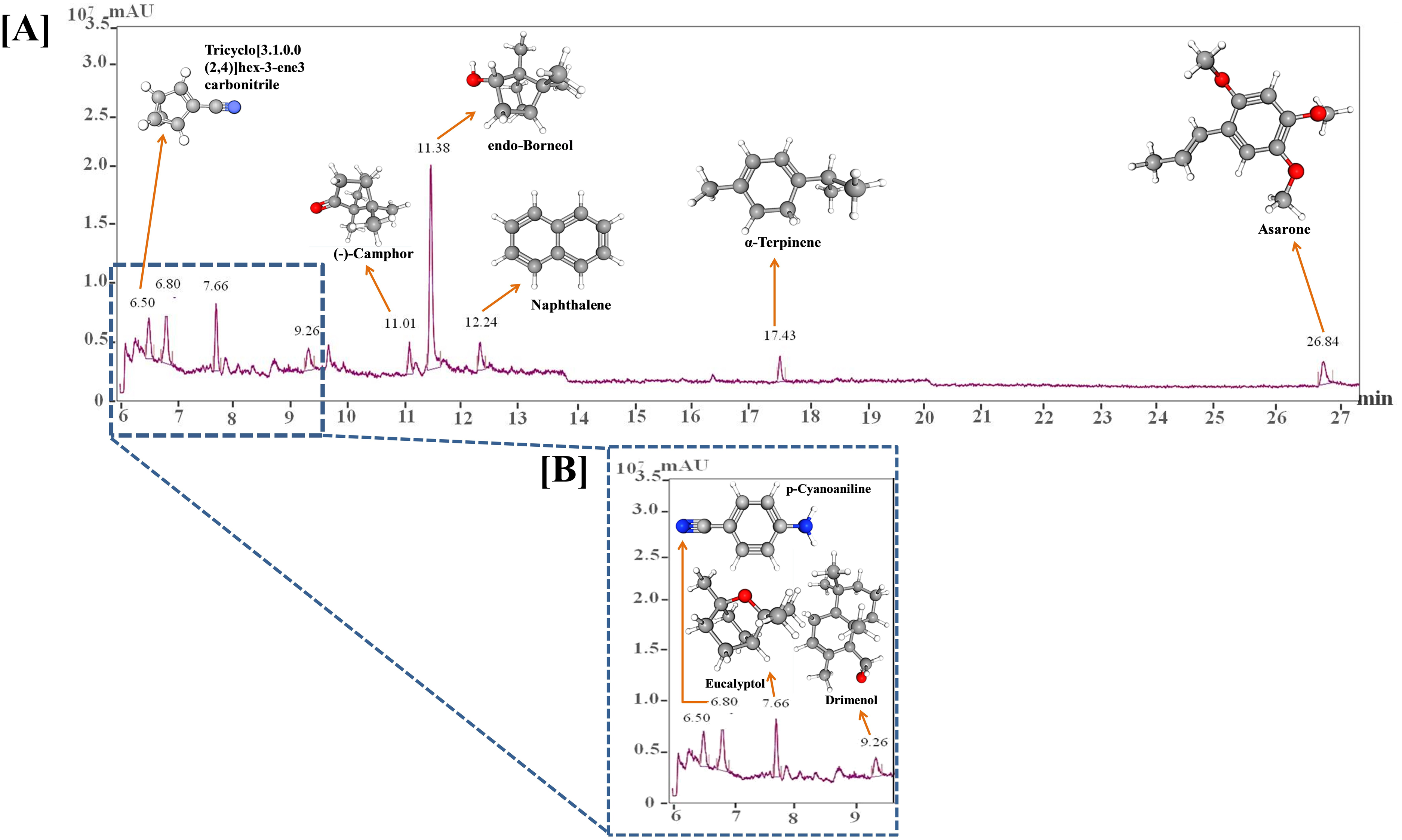
GC-MS analysis of VD fume.
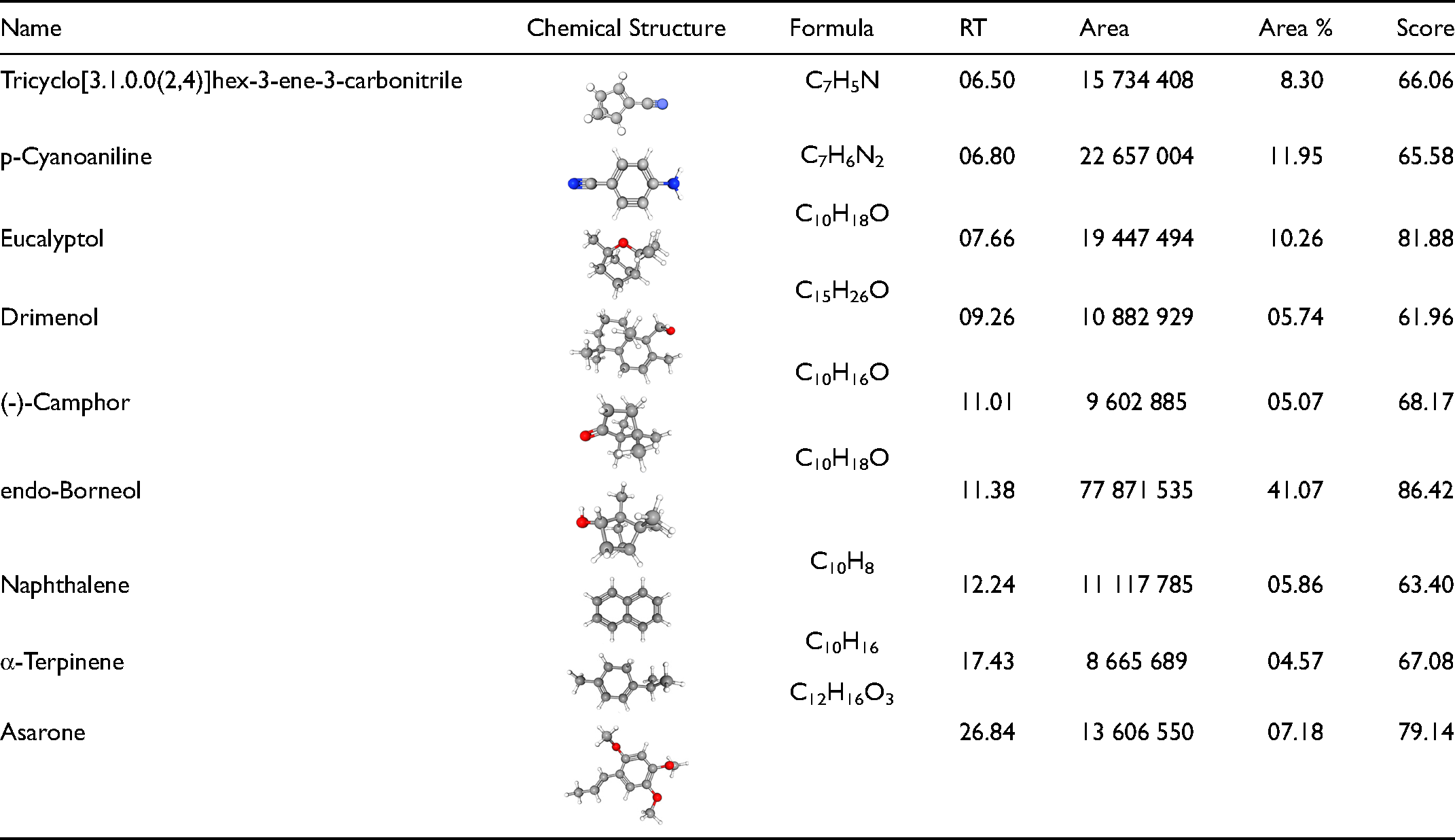
Identified Compounds in Vishaghn Dhoop.
VD Fume Reduced Bacterial Growth on agar Plates
The first evaluation of the potent anti-microbial activity of VD fume was done on nine pathogenic bacteria, including both Gram-positive and Gram-negative members and belonging to different categories, such as, surface pathogens, like, S. epidermidis, P. aeruginosa, P. fluorescens and S. aureus, lung pathogen, like, S. pneumonia, gastric pathogens, like, E. coli and S. enterica, uropathogen, like, uropathogenic E. coli (UPEC), and a generic pathogen Mycobacterium spp. Actively growing cultures of these pathogenic bacteria were individually spread on agar plates before exposing to VD fume in the closed microbiological chamber, as mentioned in Figure 1 and incubated for 24 h at 37 °C. A set of corresponding spread plates of these pathogens without exposure to VD fume were incubated under identical conditions. Representative digital photographs of the bacteriological plates demonstrate that reduction in CFUs was observed in case of all the pathogens, the extent varying from pathogen to pathogen (Figure 4). Maximum percent reduction in CFU (38.4%) was observed in case of S. pneumonia, where, an entire bacterial lawn on an untreated plate was reduced to few countable CFUs on the VD treated plate (Figure 4, green dashed box). In case of P. fluorescens and Mycobacterium spp., respectively, 17.4% and 15% reductions in CFU were accompanied by visible decrease in the colony sizes (Figure 4, orange dashed box). Others, like, E. coli (gastric), S. enterica, E. coli (UPEC), S. epidermidis and P. aeruginosa showed 16.2, 15.5, 15.1, 13.3 and 11.7% decrease in CFU, respectively. Visible reduction in colony size was more pronounced in case of S. aureus (Figure 4, blue dashed box). These observations clearly demonstrated that VD fume reduced growth of all the nine pathogenic bacteria included in the study. Gram-staining status of the pathogenic bacteria did not appear to co-relate with the anti-bacterial activity of VD fume indicating that this fume treatment is likely to have a broad spectrum of targets. In fact, inhibitory effect of VD on Mycobacterium spp, known for thicker, waxy, mycolic acid rich cell wall, corroborates its broad spectrum targeting.

VD fume affected the growth of a variety of pathogenic bacteria on agar plate. A self-explanatory picture reporting the fold changes observed in the number of colony forming units (CFUs) upon exposure of agar spread plates of different pathogenic bacteria in comparison to untreated control plates. Representative pictures of different bacterial plates in untreated and VD treated groups are provided. Type of Gram staining taken by each of the studied pathogenic bacteria is also mentioned. Mycobacterium due to waxy cell wall is incompatible with Gram staining and hence, not identified with respect to Gram staining. Categories of these pathogens based on their area of prevalence or target organ within the body, such as, surface, lung, gastric, urogenital and generic, are mentioned. Bacterial pathogens exhibiting decrease in colony size with or without decrease in CFUs are demarcated with orange and blue dashed boxes, respectively, and identified underneath with observed specific effects. Representative plate pictures of S. pneumoniae exhibiting maximum fold change in CFU is demarcated with green dashed box.
VD Fume Inhibited Bacterial Growth in Cultures
In real life situations, presence of pathogenic bacteria is not limited to solid surfaces. Moreover, given the observations that VD fume can inhibit pathogenic bacteria that affect internal organs, where the milieu is expected to be fluidy, it was pertinent to evaluate the anti-bacterial efficacy of VD on bacterial cultures. Two modes of fume treatment of bacterial cultures were first evaluated using four pathogens, namely, S. enterica, P. aeruginosa, E. coli, both gastric and UPEC. In the first set up

Media aeration with VD fume inhibited bacterial growth more efficiently. [A, B] Pictures of Büchner flasks showing the bacterial culture exposed to VD fume (A) and aerated with VD fume (B).

VD fume aerated cultures of different pathogenic bacteria exhibited reduced growth. Effect on growth kinetics of different actively growing pathogenic bacteria belonging to various categories represented through line graphs. Categories include surface pathogens, like, S. epidermidis

Comparison between the growth inhibitory effects of VD fume on different pathogenic bacteria. Composite bar graph showing percent growth inhibitions of nine pathogenic bacteria recorded at different time points. Cultures were aerated with VD fume at 2 h which is indicated with red arrow along the X-axis. The overall maxima-minima inhibition range is demarcated with red dashed lines.
Anti-Fungal Activity of VD Fume Against Candida albicans
Employing experimental designs identical to bacterial pathogens, anti-fungal activity of VD fume on C. albicans was evaluated according to the study design depicted in Assemblies 2 and 4 of Figure 1. Actively growing culture (indicated by red arrow in Figure 8A) of C. albicans was either directly aerated with VD fume or spread on potato dextrose agar plates and then exposed to VD fume. Growth arrest in case of actively growing culture was found to set in 4 h after VD fume treatment although, statistically significant observation took another 8 h to surface. The anti-fungal activity of VD fume against C. albicans was found to be comparable to its anti-bacterial activity as evident from 80% inhibition of fungal growth by 16 h of VD treatment (Figure 8B). This effect was even more robust on agar plates (Figure 8C). Thus, VD is not only effective against pathogenic bacteria, but could also affect pathogenic fungus.

Anti-fungal potential of VD fume against Candida albicans. [A] Effect of culture aeration with VD fume on growth kinetics of pathogenic C. albicans shown as line graphs. Cultures were aerated with VD fume at 4 h which is indicated with red arrow along the X-axis. Statistical significance of the observed difference between growth in untreated and VD fume aerated C. albicans cultures was analyzed using two-way analysis of variance (ANOVA) with Bonferroni's post-hoc test and indicated with *, ** and *** for P-values < .05, < .01 and < .001, respectively.
VD Reduced Environmental Microbial Load Without Affecting the Cells Adversely
In order to test the practical applicability of VD in sterilizing indoor air, environmental monitoring of rooms was done before and after exposure to the medicated fumes. There was an appreciable visible reduction in the microbial load following fumigation of the rooms with VD for 30 min (Figure 9A), showing nearly 10-fold drop in the counts of CFUs (Figure 9B).

VD reduced microbial load in indoor environment without adversely affecting the human lung cells in vitro. [A] Representative plate pictures showing the effect of VD on environmental microbial load.
The other important aspect of practical application of fumigation technique is its safety. In case of VD, that was appraised through cytotoxicity assay using human lung epithelial cells, A549. The actively growing cells were exposed for 24 h to media aerated with different concentrations of VD (1.5, 3.12, 6.25, 12.5 and 25 mg/ml) bubbled in culture media, before assessing the cytotoxicity. Results show that A549 cells were viable up to the highest dose tested (25 mg/ml) of VD aerated media. (Figure 9C). Taken together, it can be concluded that VD is capable of sterilizing indoor atmosphere and is safe on human lung cells in culture.
Discussion
Burden of HAIs is increasing rapidly. 1 Chemical disinfection is the most commonly employed measure to contain HAIs.2,3 However, due to the adverse side-effects, including toxicity, carcinogenicity and high risk of environmental pollution, the HAI management system is gradually heading towards a precipice of tradeoff between prevention of HAIs and the mostly employed preventive technique. Alternative options of disinfection, with less or preferably no side-effects, will be a respite beyond comparison. With this requirement as the premise, the current study was conducted to offer preliminary scientific evidence in favor of disinfection techniques, described in ayurveda, the traditional Indian system of medicine. In this regard, the technique of dhoopan, one of the traditional disinfection methods, was selected. Dhoopan involves generating thick fume through slow combustion of individual or mix of medicinal herbs, minerals and/or animal products. 4 In this study, a specific mix of twelve medicinal herbs, resin from Laccifer lacca, rock salt and clarified butter called ‘Vishaghn Dhoop’ was used. The fume generated from VD was subjected to physico-chemical characterization and evaluation of anti-microbial activities against nine pathogenic bacteria belonging to different categories based on their site of infection, namely, surface pathogens, like, S. epidermidis, S. aureus, P. aeruginosa and P. fluorescens, gastric pathogens, like, S. enterica and E. coli, lung pathogen, like, S. pneumonia, uro-pathogen, E. coli (UPEC) and generic Mycobacterium spp. and pathogenic fungus, C. albicans. Centre for Disease Control, World Health Organization (CDC-WHO) has identified S. aureus, P. aeruginosa, E. coli and non-tuberculous Mycobacteria (NTM), the one used in this study, among others to be responsible for HAIs. 15 Likewise, C. albicans (and very recently, emerging C. auris) has been identified by CDC-WHO through Emerging Infections Program (EIP) Healthcare-Associated Infections Community (HAIC) Interface as the major fungal source of HAI. 16 Micro-organisms included in this study is a representative range involved in causing HAIs.
All the ingredients of VD, including the medicinal herbs, Curcuma longa L., Aconitum heterophyllum Wall. Ex, Terminalia chebula Retz. Royle, Cyperus rotundus L., Elettaria cardamomum (L). Maton, Cinnamomum verum Lukman, Tabernaemontana divaricata (L). R. Br. Ex Roem & Schult, Saussurea costus (Falc). Lipsch, Acorus calamus (L), Callicarpa macrophylla Vahl, Brassica campestris var. sarson Prain and Commiphora wightii (Arn) Bhandari, are known for their anti-microbial activities.17–29 Besides, the rock salt and clarified butter present in VD are also reported to have anti-microbial property. Interestingly, authoritative ayurvedic texts, like Caraka-saṃhitā, Suśruta-saṃhitā and Vāgbhata-saṃhitā, not only identify micro-organism as Krimi but classify and nomenclate them based on their visibility to naked eye [invisible (Adrishya) and visible (Drishya)] and pathogenicity [non-pathogenic or natural (Sahaja) and pathogenic (Vaikārika)]. The pathogens are further classified into external (Bāhya) and internal (Ābhyantara).30–32 In addition to the mention of the composition of VD in the Compendium of Suśruta (Suśruta-saṃhitā), 14 references for anti-microbial activity of these ingredients (that is, their ability to destroy Krimi, the ayurvedic identity of micro-organisms) are also available in other classical texts of ayurveda. For example, Dhanwantari-nighantu mentions about the anti-microbial capability of L. lacca, C. longa, A. heterophyllum, C. rotundus and A. calamus. C. rotundus is also mentioned in Bhāvprakāsh-nighantu. Similarly, Caraka-saṃhitā mentions about the anti-microbial potency of C. longa. Śāligrām-nighantu recommends A. heterophyllum, T. chebula, and C. verum as anti-microbial agents. Madnādi- nighantu identifies the anti-microbial potency of T. chebula. Laghu-nighantu and Śodhāla-nighantu mention about E. cardamomum and C. macrophylla, respectively. Anti-microbial potential of T. divaricata and S. costus are mentioned in Aśtanga-nighantu. Thus, the ingredients present in VD are not chosen randomly, rather, the anti-microbial activity of each of them is recognized in more than one classical ayurvedic texts and testified by scientific studies.
The ingenious experimental designs comprising of a basic circuitry governing the generation, collection and transfer of VD fume have been devised keeping practical reproducibility in perspective. Set-ups used for VD fume generation, plate exposure and solvents/ medium used for fume harvest for different analyses were chosen with care to ensure minimum variability in the analyzed VD fume, from the one to be generated during its intended practical application. Considering the atmospheric moisture, the VD fume for GC-MS was collected in water. Similarly, to ensure translatability of these studies to practical applications against, anti-bacterial assays were conducted on bacteria growing on agar plates as well as in liquid cultures. The observed particulate nature of the VD fume shows that it can be a potential alternative for chemical fumigation to disinfect difficult to reach niches. Metabolites identified in VD fume, endo-Borneol, p-Cyanoaniline, Eucalyptol, Tricyclo [3.1.0.0(2,4)] hex-3-ene-3-carbonitrile, Asarone, Naphthalene, Drimenol, (-)Camphor and α-Terpinene have anti-microbial activities.33–41 It is fascinating to note that while nanoparticle mediated disinfection is being considered as a promising approach to replace chemical disinfection, an ancient technique of fume disinfection, like, dhoopan, in actually capable of generating nano-sized particles laden with anti-bacterial metabolites, just by following a traditionally described protocol. The observed anti-bacterial and anti-fungal activities of VD fume provide evidence in favor of a completely natural potential alternative for chemical fumigation. Due to all-natural ingredients and the employed process being in-sync with nature, this technique likely to have no deleterious side-effects. In addition, the technique of dhoopan can be modulated and extended beyond its projected use in disinfection, through variation of medicinal herbs/ herbal mixes being burnt in combination with different respiratory exercises described in Yoga. Actually, the noteworthy ability of VD fume to reduce S. pneumoniae growth, both on plate and in culture testifies this possibility. These microbiological observations become more appreciable with real-life (in vivo) validations. In this regard, un-sanitized rooms were fumigated with VD fumes and microbial load was assessed through environmental monitoring. Air from each room was sampled on five randomly placed plates to eliminate sampling bias. The microbial loads in these rooms were visibly reduced after fumigation with VD fumes. This demonstrated the ability of VD fumes to sterilize indoor air. The cost of fumigating one of these rooms was approximately 30 INR, excluding the price of the fumigator. Therefore, sterilization with VD fumes can be cost-effective. Further validation of air sterilizing potential of VD fumes in larger enclosures and actual health care settings are warranted. Fumes are readily inhaled and therefore, are a ready source of occupational respiratory hazard. So, it was pertinent to establish the safety of VD fumes. Lungs are the primary internal targets of hazardous fumes, therefore, preliminary evaluation of the safety associated with VD fumes was conducted on deliberately chosen A549 human lung epithelial cells. Actively growing A549 cells were exposed to VD aerated growth media for 24 h, and the effect on their survival was monitored. Using the flexibility of an in vitro system, the effect of a dose dependent exposure of A549 cells to VD fumes was assessed. The VD fumes were found to be safe on these lung cells, thereby, satisfying a crucial requirement of non-toxicity. Altogether, the observations from this study provided substantial evidence to encourage developing the combination of Dhoopan technique and Vishaghn Dhoop into an acceptable disinfection technique in general healthcare set-ups. Further elaborative studies at multiple sites would re-affirm and strengthen the scientific validation of VD reported here.
Conclusions
The current study was initiated with the aim of producing scientific testimony to the efficacy of dhoopan, the ancient technique of fumigation. With an enterprising approach, the lack of prior literature on similar studies was circumvented and the evidence establishing the anti-microbial efficacy of Vishaghn Dhoop/dhoopan combination was generated. In order to develop this combination into a disinfection technique, with no potential harmful effects, further studies in healthcare settings are required. Nevertheless, the observations made here warrants for further elaborative studies at multiple sites to establish the effect of this traditional sterilization technique in hospital settings. With rapid increase of HAIs, demand for disinfection in the healthcare settings are rising proportionately. Thus, this is actually an appropriately timed study to introduce the idea of possible complementary and/or alternatives for harmful chemical fumigation in managing HAIs.
Footnotes
Acknowledgments
We are grateful to Prof. Partha Roy (Department of Biotechnology, Indian Institute of Technology Roorkee) for his help with DLS analysis of VD fume. We thank Dr Anamika Kumari for the experimental help. We acknowledge Mr Tarun Patel for his help with photography of the experimental assembly. We are thankful to Dr. L. P. Singh and colleagues at Central Building Research Institute, Roorkee, India for their support with the Scanning Electron Microscopy. We extend our gratitude to Ms Priyanka Kandpal, Mr Tarun Rajput, Mr Gagan Kumar and Mr Lalit Mohan for their swift administrative support. This research received no external funding. This presented work has been conducted using internal research funds from the Patanjali Research Foundation Trust, Haridwar, India.
Author Contributions
Conceptualization, A.B. and A.V.; Methodology, S.Y., S.V., K.S., Y.V. and S.R.; Validation, S.H.; Formal analysis, S.H.; Investigation, S.Y., S.V., K.S., Y.V. and S.R.; Resources, A.B. and A.V.; Data curation; S.H.; Writing – Original Draft, S.H.; Writing – Review & Editing, A.V. and S.H.; Visualization, S.H.; Supervision, A.V.; Project administration, S.H.; Funding Acquisition, A.B. and A.V.
Declaration of Conflicting Interests
The author(s) declared no potential conflicts of interest with respect to the research, authorship, and/or publication of this article.
Funding
This work has been conducted using internal research funds from Patanjali Research Foundation Trust, Haridwar, India.
