




Abstract
Verbena officinalis L. has a folkloric repute for the management of digestive disorders, including diarrhea. However, the safety and efficacy of the plant material has not been scientifically validated yet. This study was, therefore, aimed to evaluate the overall antidiarrheal activity of the 80% methanol extracts of V officinalis in mice. The antidiarrheal activity of the 80% methanol extracts of the roots (R-80ME) and the leaves (L-80ME) of V officinalis was tested in castor oil–induced diarrhea in mice. R-80ME was further evaluated using charcoal meal and entero-pooling. In each test, group I and group II (controls) received 10 mL/kg distilled water and standard drug (5 mg/kg loperamide), respectively, whereas groups III, IV, and V (test groups) received 100, 200, and 400 mg/kg of the 80ME, respectively. The R-80ME at 200 mg/kg (P < .01) and 400 mg/kg (P < .001) significantly delayed the onset of diarrhea compared with negative control. Both R-80ME and L-80ME at 200 and 400 mg/kg significantly decreased the frequency of wet fecal outputs (P < .01). Generally, 70.24% inhibition of the number of wet fecal output was recorded at R-80ME 400 mg/kg. Results from the charcoal meal test revealed that the R-80ME at 200 (P < .01) and 400 mg/kg (P < .001) produced a significant antimotility effect. In entero-pooling test, the R-80ME, at 200 and 400 mg/kg doses (P < .01), showed a significant decline in both the volume and weight of intestinal contents. The maximum in vivo antidiarrheal index was determined to be 95.25 at dose of 400 mg/kg R-80ME. This study demonstrated that the 80ME, mainly the root extract, produced promising antidiarrheal activity and hence provides a scientific support for acclaimed traditional use of the plant material for treatment of diarrheal diseases.
Since time immemorial, medicinal plants have played an important role in the development of potent therapeutic agents. Today, it is estimated that about 80% of population in developing countries still rely on traditional medicine for their primary health care. Herbal medicines are currently in great demand and their popularity is also increasing over time. 1 –4 Among the medicinal plants, Verbena officinalis L has a folkloric repute for the management of various ailments including diarrhea. It is a perennial herb belongs to the genus Verbena and the family Verbenaceae (Figure 1). The plant is known with different vernacular names in different areas of Ethiopia: Atuch (Amharic), Atush (Tigiregna), Qoricha albaatii (Afan Oromo), and Guni tesha (Aari, Omotic). In Ethiopia, the plant is distributed in several regions, including Gondar, Gojam, Wollo, Shewa, Bale, Harerghe, Gamo Gofa, and Tigray. It is also wildly distributed in African countries, including West Eritrea, Democratic Republic of Congo, Sudan, Zambia, Zimbabwe, and South Africa. 5

Photograph of Verbena officinalis.
The anti-inflammatory and analgesic effects of V officinalis extract in different formulations have been studied and confirmed. 6 In addition, the extract of aerial parts of V officinalis has antipyretic, sedative, 7 and anticancer effects in traditional medicine. 8 Moreover, the plasters of aerial parts of V officinalis (sometimes with petrol) are used as hemostatic and antirheumatic in knees and elbows. 9 Apart from this, the extract or the juice of roots of V officinalis can be used for the treatment of tonsillitis and ascariasis. The leaf extract is also used in the treatment of ear disease by applying some drops of the extract through the ear 10 and control of snake bite poisoning. 11 With regard to treatment of diarrheal disease, the different parts of this plant are traditionally used for several purposes, especially for the management of stomachache, diarrhea, or dysentery. For instance, the extract of whole plant, after boiled with tea, is given orally for the treatment of dysentery. 12,13 In addition, the root extract, after maceration in water is drunk for the control of diarrhea. 14 On top of these, fresh leaves, 15 fresh roots, 16 or whole plant 10 are chewed and its juice is swallowed to treat stomachache or abdominal pain. Woldeab et al 17 has also reported the way that the traditional healers are using this plant material by grinding the root part into coarse powder; mixing it with water for some time and decanting/filtering it and finally the extract is drunk to treat diarrheal diseases. In some areas of Spain, V officinalis has been used for the management of varies digestive problems, including stomachache and abdominal cramp. 18 Based on this claim, this study was aimed to investigate the efficacy and safety profiles of crude extracts of V officinalis as antidiarrheal agent with possible antispasmodic and antisecretory potential.
Materials and Methods
Drugs, Chemicals, and Reagents
Distilled water, castor oil (Amman Pharmaceutical Industries, Jordan), activated charcoal (Acuro Organics Ltd, New Delhi, India), loperamide (Daehwa Pharmaceuticals, Republic of Korea), methanol (Carlo Erba reagents, SAS, France), Tween80 (Atlas Chemical Industries Inc, India) were used for the experiment. For phytochemical screening, reagents and chemicals including chloroform (Hi-Media Laboratory Reagents, India), glacial acetic acid, ammonia, hydrochloric acid, ferric chloride, acetic anhydride, Mayer’s reagent, Dragendroff’s reagent, sulfuric acid (all of them from BDH Chemicals Ltd, England) were used.
Plant Material Collection and Identification
Both the leaves and roots of V officinalis were collected from Debre Markos town and its surrounding, which is 300 km away to northwest of the capital of Ethiopia, Addis Ababa, in February 2017. The roots of the plant were carefully collected and gently washed with distilled water to remove dirt, soil, rootlets, and diseased portions. Care was maintained when digging out underground parts so as not to distract the medicinal components and to avoid microbial contamination and spoilage. The identification of the plant specimen was undertaken by a taxonomist at the National Herbarium, College of Natural and Computational Sciences, Addis Ababa University, where a voucher specimen was deposited for future reference (ID: MS002/2017).
Experimental Animals
A total of 108 healthy Swiss albino mice of either sex, weighing 20 to 30 g and aged 6 to 8 weeks were used for the actual experiment (48, 30, and 30 for the castor oil–induced diarrhea, charcoal meal, and enteropooling models, respectively). The animals were obtained from animal center of Ethiopian Public Health Institute, Addis Ababa, and interbred in the animal house of central laboratory of Haramaya University. Five to 8 mice were housed in polyethylene cages having metallic cover with woodchip bedding at ambient room temperature, exposed to 12-hour light/dark cycles and with free access to standard pellet food and water. The animals were acclimatized to laboratory conditions for 1 week prior to the actual experiment. 19 The use and handling of mice was in accordance with the guidelines for the care and use of experimental animals. 20
Preparation and Extraction of Plant Materials
The leaves were washed gently and dried at room temperature under shade for 2 weeks. The dried leaves were then reduced to appropriate size using mortar and pestle. The roots of V officinalis were manually cut into pieces and dried under shade for two weeks and then, ground in a coarse size powder using mortar and pestle. Then, 125 g of powdered root material and 150 g of coarse leaf powder were macerated separately in 2 L Erlenmeyer flasks with 400 mL 80% methanol for a period of 3 days with frequent agitation using mini-orbital shaker at room temperature. The extracts were filtered through double layered muslin cloth followed by Whatman No. 1 filter paper (Schleicher and Schuell Micro Science GmbH, Germany). The marcs of both extracts were remacerated twice with the same volume of fresh solvent to exhaustively extract the soluble components. Similar filtration procedure was taken place for the marc to get the final filtrates. The combined filtrates were concentrated to dryness with rotary evaporator (Buchi Labortechnik AG, Switzerland). The remaining aqueous residue was deep frozen to form ice and lyophilized (freeze dried) to get the final extract. 21 –24 Then, the percentage yields of 80% methanol root (R-80ME) and leave extracts (L-80ME) were found to be 15.5% (w/w) and 9.25% (w/w), respectively. Finally, the dried extracts were kept in deep freeze with airtight container and reconstituted in distilled water at appropriate concentration during the day of experiment.
Acute Oral Toxicity Test
Acute oral toxicity test was performed according to the OECD guideline 425. Five female albino mice aged 6 to 8 weeks were used for each test. For doing this, a single female mouse was given 2000 mg/kg of the either extracts as a single loading dose by oral gavage. As no death was observed within 24 hours, additional 4 female mice were recruited and dosed similarly in each extract. The animals were observed continuously for 4 hours with 30-minute interval and then for 14 consecutive days with an interval of 24 hours for the general signs and symptoms of toxicity. 19
Animal Grouping and Dosing
In all models, animals were randomly divided into 5 groups (2 controls and 3 test groups) comprising 6 animals each. Negative controls received vehicle (10 mL/kg distilled water) and positive controls were treated with standard drug (5 mg/kg loperamide) in all models. The test groups (groups III, IV, and V) received 100, 200, and 400 mg/kg of each extract, respectively with oral gavage based on the acute oral toxicity result.
Determination of Antidiarrheal Activity
Castor Oil–Induced Diarrhea
The method described by previously published studies was considered with slight modification. 21 –23,25 Swiss albino mice of either sex were fasted for 18 hours with free access to water. One hour after dosing of the respective treatments, each mouse was given 0.5 mL of castor oil orally for induction of diarrhea and was placed individually in plastic cage where the floor had been lined with white paper. The paper was changed every hour for a total duration of 4 hours. During the observation period, the onset of diarrhea, the frequency and weight of wet and total fecal outputs were recorded. Finally, the percentages of diarrheal inhibition and fecal output were calculated by using the formulae described below. 22,25

where, WFC = wet feces in control group and WFT = wet feces in test group

Castor Oil–Induced Entero-Pooling
The activity of R-80ME on intraluminal fluid accumulation was determined using the method described by Robert et al. 26 Mice were fasted for 18 hours, grouped and treated accordingly. In this case, the mice were also deprived of water. After an hour of treatment, 0.5 mL of castor oil was administered, and the mice were sacrificed by cervical dislocation 1 hour following castor oil administration. The abdomen of each mouse was then opened; the small intestine was ligated at both ends (at pyloric sphincter and ileo-cecal valve) and dissected. The dissected small intestine was weighed and the intestinal content was then collected by milking into a graduated tube to measure the volume of the contents. The intestine, following milking, was reweighed and the difference was recorded as measure of weight of intestinal contents. Finally, percentage of reduction of intestinal contents (volume and weight) was calculated using the following formulae 22 :

where, MVICC = mean volume of intestinal content of control group and MVICT = mean volume of intestinal content of test group

where, MWICC = mean weight of intestinal content of control group and MWICT = mean weight of intestinal content of test group.
Gastrointestinal Motility Test
The mice were fasted for 18 hours with free access to water and divided and treated as described earlier. Then, 0.5 mL castor oil was administered for each mouse. One milliliter of the marker (5% activated charcoal suspension in distilled water) was administered orally 1 hour after castor oil induction. The mice were then sacrificed by cervical dislocation just 1 hour following charcoal meal. The small intestine was dissected out from pylorus to caecum and placed length wise on a white paper. The distance travelled by the charcoal marker and the total length of the small intestine was then measured. The peristaltic index and percentage inhibition were calculated by using the following formulae 22,25,27 :


In Vivo Antidiarrheal Index
The in vivo antidiarrheal index (ADI) for the positive control and R-80ME was determined using the following formula 22,27 :

where, Dfreq is the delay in the defecation time (minute) with reference to of negative control (%), Gmeq is reduction in distance moved by the charcoal meal with reference to negative control (%), and Pfreq is the reduction in the number of wet stools with reference to negative control (%).
Preliminary Phytochemical Screening
The presence of secondary metabolites such as alkaloids, flavonoids, saponins, tannins, terpenoids, glycosides, and steroids was evaluated in both crude extracts using standard testing methods. 22,28,29
Data Analysis
Data were entered and analyzed using IBM Statistical Package for the Social Sciences (SPSS) Version 20.0 software (Armonk, NY, USA). Results were expressed as mean plus or minus standard error of the mean (M ± SEM). Normality of data distribution was checked using Kolmogorov-Smirnov and Shapiro-Wilk tests. One-way analysis of variance (ANOVA) was performed followed by Dunnett’s post hoc test for multiple comparisons. The analysis was performed at 95% confidence level and P < .05 was considered as statistically significant.
Results
Acute Oral Toxicity Test
Both R-80ME and L-80ME of V officinalis produced neither overt toxicity nor death during the 14 days observation period following oral administration of a single dose of 2000 mg/kg. The absence of mortality and any sign of overt toxicity up to 5 times the maximum effective dose of the extract suggested that the crude extracts have a wider safety margin and median lethal dose (LD50) greater than 2000 mg/kg in mice model.
Effect on Castor Oil–Induced Diarrheal Model
In the general model, the R-80ME of V officinalis significantly prolonged the onset of diarrhea and reduced the frequency of wet and total fecal outputs at doses of 200 and 400 mg/kg compared with the negative control (P < .01). Besides, only 400 mg/kg of R-80ME significantly reduced the average weight of both wet and total fecal outputs (P < .05). Despite its modest effect on affecting urgency of defecation, the L-80ME at 200 and 400 mg/kg doses significantly inhibited the frequency of wet feces but not the weight of fecal outputs. The maximum percent inhibition of wet fecal output was observed at 400 mg/kg of R-80ME (70.24%) (Table 1).
The Antidiarrheal Activities of R-80ME and L-80ME of Verbena officinalis in Castor Oil–induced Diarrhea in Mice Model.a

Abbreviations: CON, negative control (10 mL/kg distilled water); LOP, loperamide; R-80ME, 80% methanol extract of roots; L-80ME, 80% methanol extracts of leaves.
aValues are presented as mean ± standard error of the mean (SEM) (n = 6); analysis was performed using one-way analysis of variance(ANOVA) followed by Dunnett’s post hoc test.
bCompared with negative control value; *P < .05, **P < .01, ***P < .001.
There was a dose-dependent reduction in the percentage weight of wet and total fecal outputs in both R-80ME and L-80ME with 400 mg/kg of the R-80ME showing the highest effect. There was a linear increment in the percentage reduction of fecal outputs in both extracts. The highest reduction was observed at 400 mg/kg of R-80ME of V officinalis (53.07% and 49.44%) (Figure 2).

Percentage reduction of fecal outputs in R-80ME and L-80ME of Verbena officinalis. R-80ME, 80% methanol extract of roots; L-80ME; 80% methanol extracts of leaves.
Castor Oil–Induced Intestinal Transit in Mice (Charcoal Meal Test)
The R-80ME significantly inhibited the distance moved by the charcoal meal and reduced peristaltic index at doses of 200 and 400 mg/kg. The data revealed that the percentage reduction of gastrointestinal motility was 33.52% (P < .01) and 52.97% (P < .001) at doses of 200 and 400 mg/kg, respectively. The maximum dose of R-80ME showed slightly higher antimotility effect than that of the standard (45.80%, P < .001) (Table 2).
The Antispasmodic Effect of R-80ME of Verbena officinalis in Castor Oil–Induced Gastrointestinal Transit (Charcoal Meal) in Mice.a
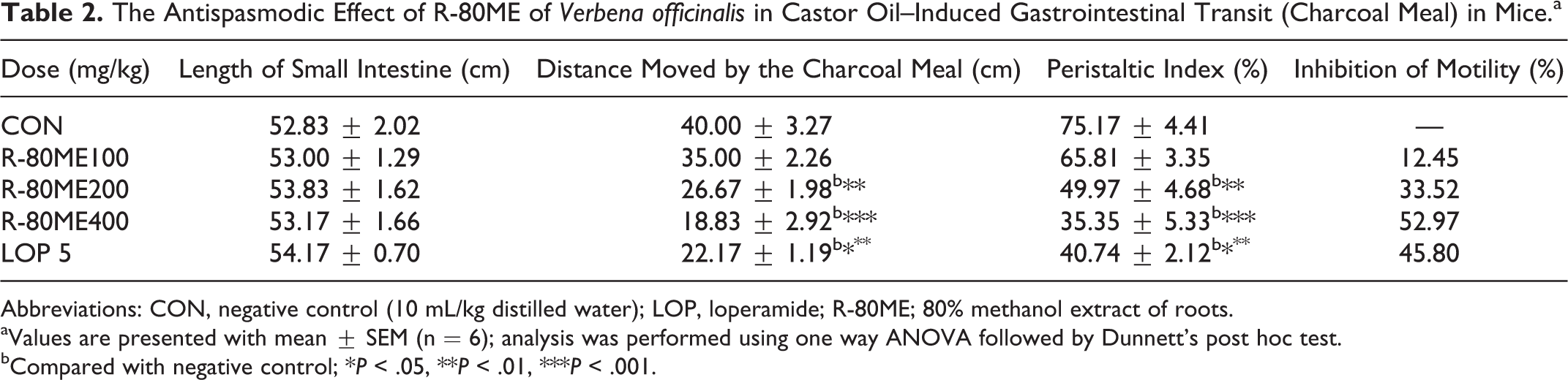
Abbreviations: CON, negative control (10 mL/kg distilled water); LOP, loperamide; R-80ME; 80% methanol extract of roots.
aValues are presented with mean ± SEM (n = 6); analysis was performed using one way ANOVA followed by Dunnett’s post hoc test.
bCompared with negative control; *P < .05, **P < .01, ***P < .001.
Castor Oil–Induced Entero-Pooling (Intraluminal Fluid Accumulation)
In this test, the R-80ME revealed significant reduction in the average volume and weight of intestinal contents at 200 and 400 mg/kg doses as compared with control (P < .01). The percentage inhibition of volume and weight, respectively, was 34.57% and 27.45% at 200 mg/kg and 48.15% and 38.23% at 400 mg/kg dose (Table 3).
The Antisecretory Effect of R-80ME of Verbena officinalis in Castor Oil–Induced Gastrointestinal Fluid Accumulation (Entero-Pooling) in Mice.a

Abbreviations: CON, negative control (10 mL/kg distilled water); LOP, loperamide; R-80ME; 80% methanol extract of roots.
aValues are presented with mean ± SEM (n = 6); analysis was performed using one-way ANOVA followed by Dunnett’s post hoc test.
bCompared with negative control value; *P < .05, **P < .01, ***P < .001.
In Vivo Antidiarrheal Index
The in vivo antidiarrheal index (ADI) was measured by considering 3 important parameters such as delay in defecation (time of onset, Dfreq), gut meal travel distance (Gmeq), and purging frequency in number of wet stools. The highest ADI value was recorded at 400 mg/kg R-80ME (95.25), which is slightly higher than that of standard drug dosed at 5 mg/kg (Table 4).
The In Vivo Antidiarrheal Index of the R-80ME of Verbena officinalis.
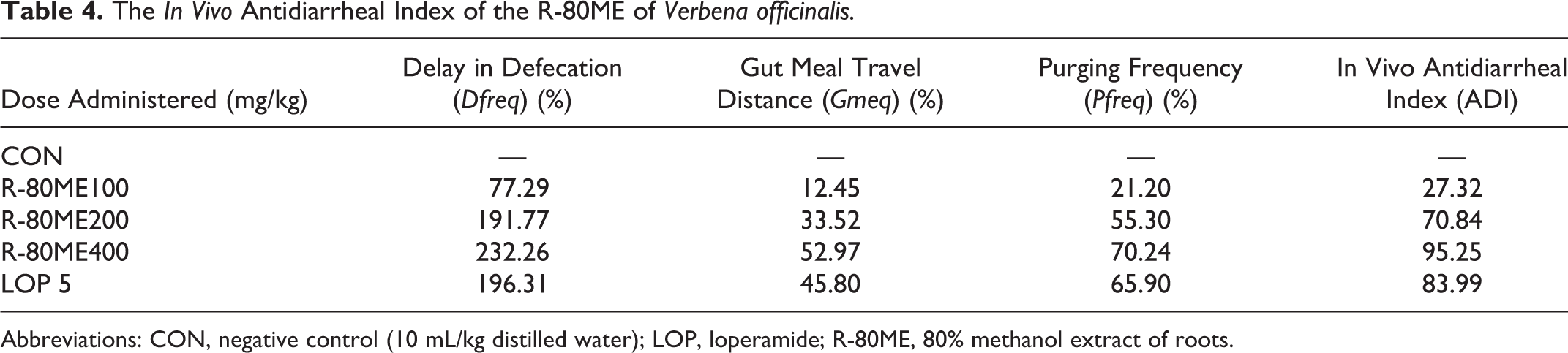
Abbreviations: CON, negative control (10 mL/kg distilled water); LOP, loperamide; R-80ME, 80% methanol extract of roots.
Preliminary Phytochemical Screening
The presence of phytochemical constituents was tested on L-80ME and R-80ME. Flavonoids and terpenoids are rich secondary metabolites in both crude extracts of V officinalis. Tannins were detected in the roots but not in the leaves. Glycosides, steroids, and alkaloids were not detected in both crude extracts (Table 5).
Preliminary Phytochemical Screening of R-80ME and L-80ME of Verbena officinalis.

Abbreviations: R-80ME, 80% methanol extract of roots; L-80ME, R-80ME, 80% methanol extract of leaves; “+”, present, “
Discussion
There is a great demand for newer, more efficacious, less costly, and safer herbal medicines to overcome the current challenges, including drug resistance, toxicity, and treatment failure. 4,30 Plants have been traditionally used for treatment of various diseases, including diarrhea without assessing the safety and efficacy. It is of paramount importance to screen and validate the safety and efficacy profile of herbal medicines that are under use in complementary and alternative medicines. This study was aimed to validate the safety and efficacy of the antidiarrheal agent V officinalis based on folkloric medicine.
Hydro-alcoholic cosolvents are generally considered to give high extraction yields, owing to their expanded polarity index. 31 Generally, cosolvents such as 80% methanol seem to possess the optimum solubility characteristics for crude extraction of plant materials and therefore, 80% methanol has been used as a universal solvent for extended extraction of bioactive metabolites. Hence, the roots and leaves of V officinalis were extracted with this solvent mixture.
The acute oral toxicity of R-80ME and L-80ME of V officinalis was evaluated based on OECD guideline 2008:425. 19 To this end, the LD50 was found to be >2000 mg/kg for both extracts. Generally, if the LD50 value of the test substance is greater than 3 times the minimum effective dose, the substance is considered as a good candidate for further studies. 32 Since both extracts had an LD50 value of more than 3 times the minimum effective dose, it was considered as a good candidate for further studies. In toxicology, LD50 has also been used for classification of chemicals. Based on the World Health Organization hazard classification schemes, both extracts of V officinalis with LD50 > 2000 mg/kg are treated as “unlikely to be hazardous.” 33
Diarrhea is a symptom of many diseases/disorders whereby an imbalance between the absorptive and secretary processes of gastrointestinal tract and/or an alteration of motility of intestinal smooth muscles play a pivotal role. 34 The use of castor oil as diarrhea-inducing agent is very well documented. 35,36 On oral administration, it induces irritant laxative effect mediated by its active metabolite, ricinoleic acid—a hydroxylated fatty acid released by intestinal lipases. Ricinoleic acid induces local irritation of the intestinal mucosa, causing the release of prostaglandins that eventually increase net secretion of water and electrolytes and gastrointestinal motility. 26,37
Castor oil–induced diarrheal model was aimed to evaluate the potential of a test substance in reducing the urgency of defecation, frequency, and weight of fecal output as well as in modifying the consistency of stools. The R-80ME (at middle and higher doses) significantly delayed the onset of diarrhea and reduced the frequency of both wet and total fecal outputs. The maximum dose of R-80ME revealed a significant effect in reducing the weight of fecal outputs. Despite its modest effect in hindering diarrheal urgency, the L-80ME at middle and high doses significantly reduced the number of wet fecal outputs. However, the overall percentage inhibition is less than the effect of R-80ME. Generally, diarrhea is characterized by fecal urgency and incontinence. 38,39 Substances exhibiting potential antidiarrheal activity may have a tendency to retard the onset of diarrhea significantly as observed in the root extract of V officinalis Even though diarrhea has been defined over time by various scientific groups and organizations in different ways, greater emphasis is given on the consistency of stools than the number. 39 Therefore, determination of percentage inhibition has mainly focused on the reduction of frequency of wet fecal outputs as a good marker of antidiarrheal activity. Diarrhea is also presented with an increase in weight of defecation. 39,40 Accordingly, both extracts displayed a dose-dependent reduction in weight of fecal outputs, with greater intensity seen in root extract, indicating the antidiarrheal potential of the extract. With regard to other medicinal plants having confirmed antidiarrheal activity, the antidiarrheal activity of the root extract of this plant revealed comparable effect (74.9%) with the 80ME of leaves of Myrtus communis at the same maximum doses (400 mg/kg). 22 80ME of the leaves of Lantama camara (87.6%), 21 and Mimusops kummel (85.7%) 41 also exhibited better antidiarrheal activity at 400 mg/kg. Other medicinal plants, including Ajuga remota, 23 Idigofera spicata, 42 and Osyris quadripartia, 43 showed relatively lower antidiarrheal activities compared with the same dose of the root extracts of V officinalis though they exhibited comparable effects when compared with the leave counterparts.
Observing the overall antidiarrheal activity of both morphological parts of the plant material (leaves and roots), the root had exhibited a better antidiarrheal potential and chosen for further in vivo antimotility and antisecretory studies elucidating the potential mechanisms of action at glimpse. The reduction of gastrointestinal motility is one of the mechanisms by which antidiarrheal agents act. 44 To this end, the R-80ME, particularly at middle and maximum doses, significantly suppressed the movement of charcoal marker along the small intestine. This finding suggests that the extract has the ability to influence the peristaltic movement of intestine thereby indicating the presence of an antimotility activity in-vivo.
The enter-opooling model was designed to evaluate the secretory components of diarrhea. In this model, the R-80ME, at middle and maximum doses, showed significant reduction in both the volume and weight of intestinal contents relative to negative control. Mascolo et al 45 reported that the active metabolite, ricinoleic acid can activate the nitric oxide pathway and induces nitric oxide (NO)–mediated intestinal secretion. A growing body of evidence has revealed that phytochemical constituents such as terpenoids 46 and flavonoids 47 are implicated in attenuation of NO synthesis. In line with the present preliminary phytochemical screening, previous phytochemical studies indicated that flavonoids and terpenoids are major secondary metabolites found in this plant. 48 –50 It is further supported by the study conducted by Carnat et al 51 who isolated luteolin 7-diglucuronide as a major flavonoid in V officinalis. Moreover, as it is rich in tannin, the root of V officinalis has been treated as a potential astringent. 49 Although based on qualitative phytochemical analysis only, current data suggest that the difference in antidiarrheal activity of the 2 morphological parts of this medicinal plant can partly be ascribed to the presence of tannins in roots but not in leaves.
Generally, the in vivo ADI value indicates the potential of a given extract in treating diarrhea. 35 The ADI has shown a linear increment with dose, suggesting the dose dependency nature of this parameter. The R-80ME at 400 mg/kg showed highest in vivo ADI value, which is slightly higher than the standard drug, reinforcing the notion that this plant is endowed with promising antidiarrheal activity. Besides, having a broad-spectrum antimicrobial activity, 52,53 the plant is a good candidate for management of diarrheal diseases with diverse pathophysiology, including those with infectious etiology.
Conclusion
This study revealed that the extracts of V officinalis are endowed with secondary metabolites having promising antidiarrheal activity. The root extract has better antidiarrheal potential than that of the leaf counterparts. Considering the high safety margin (median lethal dose >2000 mg/kg) and dose dependent nature of the extracts, the recommended effective dose should be between 200 and 400 mg/kg. Generally, this finding provides a scientific evidence for acclaimed traditional use of V officinalis for treatment of diarrheal diseases, including those with infectious component.
Footnotes
Acknowledgments
We would like to acknowledge Haramaya University for granting finance and materials to conduct this laboratory-based research work.
Author Contributions
MS conceived and designed the study; MS, NB, and TG conducted the experiment and acquired the data. MS also analyzed, and interpreted the data, drafted the manuscript and prepared the final version for publication. All authors have read and approved the final version.
Declaration of Conflicting Interests
The authors declared no potential conflicts of interest with respect to the research, authorship, and/or publication of this article.
Funding
The authors disclosed receipt of the following financial support for the research, authorship, and/or publication of this article: Haramaya University covered financial costs for this research work.

Ethical Approval
Ethical approval of this research project was obtained from Institutional Health Research Ethics Review Committee of College of Health and Medical Sciences, Haramaya University. The ARRIVE guidelines were also strictly followed while conducting this research work.