




Abstract
The aim of this study was to investigate the expression patterns of miRNA-let 7a, 7b, and 7c in bronchoalveolar lavage fluid in infants with asthma and airway foreign bodies. Between January 2016 and February 2017, 27 infants were included and divided into observation group (infants with asthma, n = 15) and control group (infants with airway foreign bodies, n = 12). The differential expression profiles of miRNA-let 7a, 7b, and 7c were determined by reverse transcription–polymerase chain reaction in bronchoalveolar lavage fluid (BALF) from infants of the 2 groups. The BALF was collected from infants undergoing flexible bronchoscopy. MiRNA-let 7a, 7b, and 7c increased significantly in infants from observation group as compared with control group (2.72 ± 0.48 vs 1, 8.23 ± 1.64 vs 1, 3.16 ± 0.62 vs 1, respectively). The increased expression of miRNA-let 7a, 7b, and 7c were associated with the asthma of infants.
In Germany, the 1-year prevalence of asthma for children ranges between 3.8% and 11.8%, which contributes to costs range between €690.4 million and €1.36 billion. 1 China has the largest asthmatic population in the world. Various aspects of social disadvantages, including psychosocial stress and violence, and environmental concerns are associated with poor asthma control. 2 Flexible bronchoscopy (FB) and bronchoalveolar lavage (BAL) makes contribution to investigation, monitoring, and diagnosis in the clinical management of children with bronchiectasis is localized and indigenous children with non–cystic fibrosis bronchiectasis. 3 Bronchoscopy and endobronchial biopsy can be performed safely under general anesthesia in children with difficult asthma. 4 Moreover, Boesch et al 5 concluded that transnasal FB has the advantages with high yield in children with poorly controlled asthma. In the past 10 years, there has been a growing evidence in the understanding of asthma genetics and airway biology, which might be of diagnostic value. MiRNAs expression profiles were increasingly determined in BAL fluid (BALF). 6,7 The kinetics studies of 5 miRNAs in BAL samples showed that miRNAs analysis should be handled within the first 8 hours after bronchoscopy at room temperature. 8
In this study, we explored the expression patterns of miRNA-let 7a, 7b, and 7c in BALF in infants with asthma and airway foreign bodies within the first 8 hours and demonstrated whether the changed expression of miRNA-let 7a, 7b, and 7c in BALF were related with the asthma of infants.
Materials and Methods
Patients
Twenty-seven infants treated at department of respiratory medicine in The Children’s Hospital, Zhejiang University School of Medicine from January 2016 to February 2017 were included in the study according to Global Initiative for Asthma (GINA) guidelines and the European Respiratory Society statement. 9,10 Twenty-seven infants were divided into observation group and control group based on diagnosed disease: asthma (n = 15) and airway foreign bodies (n = 12). This study obtained the informed consent of all infants’ parents. The characteristics of 27 infants with asthma and airway foreign bodies are shown in Table 1.
Characteristics of Infants With Asthma and Airway Foreign Bodies.

a Statistically different for infants with asthma versus those with airway foreign bodies.
Study Design
This study was approved by the Ethics Committee of The Children’s Hospital, Zhejiang University School of Medicine and performed according to the amended Declaration of Helsinki. BAL was performed with a flexible bronchoscope using previously described procedures. 11 The specimen was from middle lobe of right lung lavage after bronchoscopy in infants with asthma of remission stage. Moreover, the specimen was from the non-airway foreign bodies lung lavage. Stroke-physiological saline solution of 5 mL at 37°C were injected via bronchoscope suction hole twice. Immediately, aspiration was performed with negative pressure of 100 to 150 mm Hg. The cell-free supernatant (BALF) were obtained by centrifugation at 500 × g and 4°C for 10 minutes and stored at −80°C until use.
Reverse Transcription–Polymerase Chain Reaction (RT-PCR)
Total RNA was extracted from BALF using the Tri-reagent for RNA isolation (Sigma-Aldrich, St Louis, MO, USA) according to the manufacturer’s instructions. RT-PCR was performed to analyze the expression profiles of miRNA-let 7a, 7b, and 7c as previously described. 12 The results were shown as relative expression of miRNA-let 7a, 7b, and 7c normalized by U6 snRNA and calculated using the 2−ΔΔCt method. The results of miRNA-let 7a, 7b, and 7c expression in BALF from infants with asthma and airway foreign bodies were further shown with the average data for intermittent universally set as one.
Statistical Analysis
The relative expression profiles of miRNA-let 7a, 7b, and 7c were expressed as mean ± standard deviation. SPSS 20.0 (IBM, Armonk, NY, USA) was used to determine the significance of differences between the 2 groups by using Student t test. The significance was valued at the level of .05.
Results
Characteristics of Infants
The characteristics of infants from the 2 subgroups are shown in Table 1. Twenty-seven infants aged 12 to 19 months with body mass index ranging between 14.4 and 26.7 kg/m2 were enrolled in this study. The infants with asthma had significantly reduced Tiffeneau index (TI), lower vital capacity with increasing severity order (P < .01). There was no significant difference in other characteristics of infants with asthma and airway foreign bodies. More detailed information is shown in Table 1.
MiRNA-let 7a Expression in Infants With Asthma and Airway Foreign Bodies
MiRNA were isolated from BALF and expression levels were determined by RT-PCR. As shown in Figure 1, the expression level of MiRNA-let 7a in infants with asthma increased significantly compared with that in infants with airway foreign bodies (2.72 ± 0.48 vs 1).

MiRNA-let 7a expression in infants with asthma and airway foreign bodies.
MiRNA-let 7b Expression in Infants With Asthma and Airway Foreign Bodies
Not only MiRNA-let 7a, but we also detected the expression levels of MiRNA-let 7b in BALF derived from infants with asthma and airway foreign bodies. As shown in Figure 2, the expression level of MiRNA-let 7b in infants with asthma increased significantly compared with that in infants with airway foreign bodies (8.23 ± 1.64 vs 1).
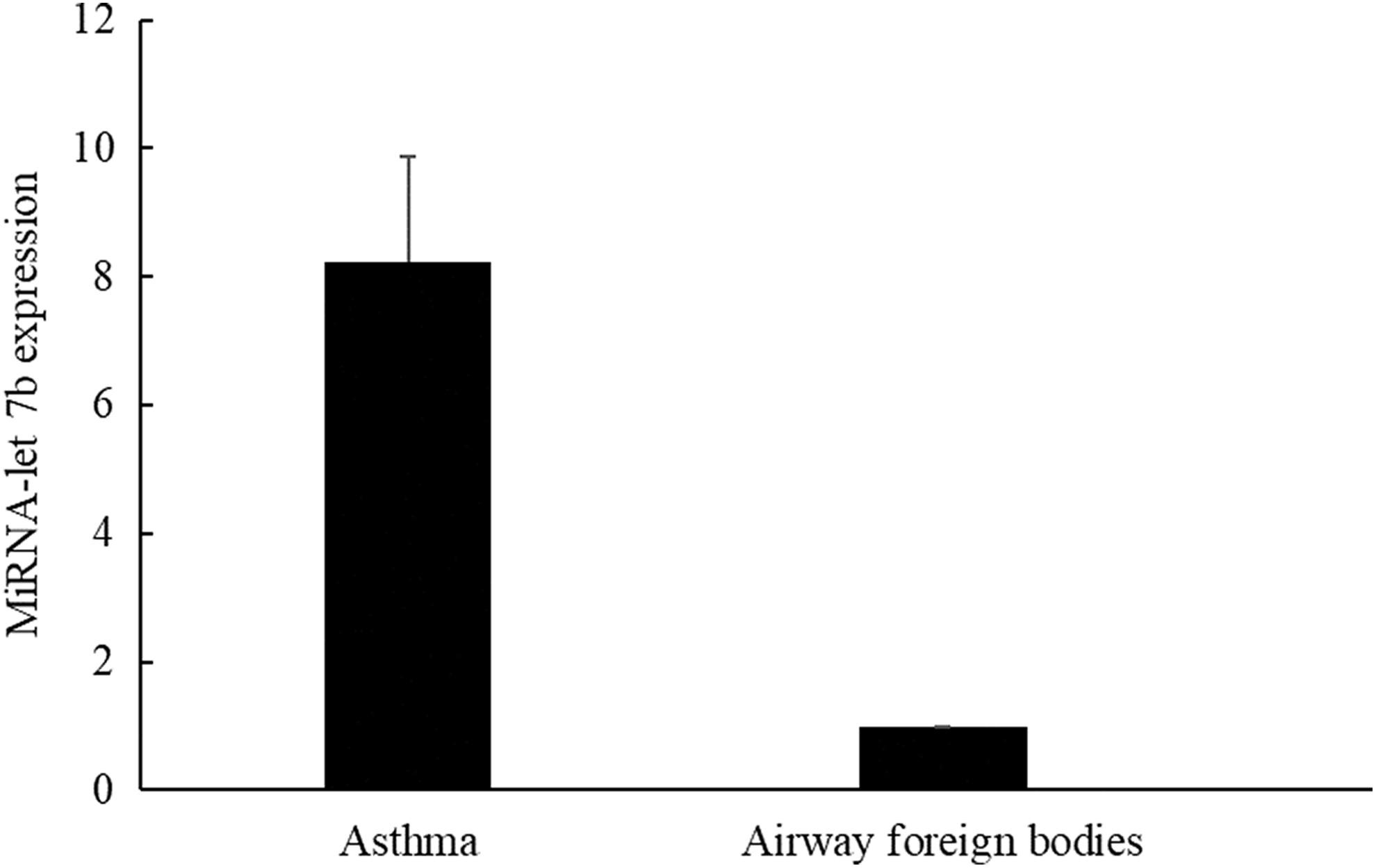
MiRNA-let 7b expression in infants with asthma and airway foreign bodies.
MiRNA-let 7c Expression in Infants With Asthma and Airway Foreign Bodies
Same method of RT-PCR was used to determine the expression levels of MiRNA-let 7c in BALF derived from infants with asthma and airway foreign bodies. As shown in Figure 3, the expression level of MiRNA-let 7c in infants with asthma increased significantly compared with the expression in infants with airway foreign bodies (3.16 ± 0.62 vs 1).

MiRNA-let 7c expression in infants with asthma and airway foreign bodies.
Discussion
The present study has found that the increased expression of miRNA-let 7a, 7b, and 7c in BALF from infants were related to the asthma. Asthma is a common long-term inflammatory disease characterized by airway narrowing of the lungs in response to nonspecific stimuli. Candidates of protein and miRNAs biomarkers from lavage, urine and serum in military subjects can be used for evaluating dyspnea. 6 Moreover, a previous study has investigated differential expression profiles of exosomal miRNAs in patients with mild intermittent asthma and following subway air exploration demonstrated that substantial differences of exosomal miRNAs expression existed between healthy subjects and patients with unprovoked, mild, stable asthma. 13 The pathway analysis has revealed that altered miRNAs were associated with significant alteration of 3 distinct KEGG pathways: MAPK (mitogen-activated protein kinase signaling pathway), CCRI (cytokine-cytokine receptor interaction), and JAK-STAT (Janus kinase–signal transducer and activator of transcription signaling pathway). Fujita et al 14 have also demonstrated that extracellular vesicles such as exosomes and microvesicles mediated miRNAs could be used as biomarkers in asthma.
MiRNAs, short single-stranded noncoding RNAs, are one kind of candidate biomarkers. In the candidate miRNAs, the 21-nucleotide MiRNA-let 7 was first identified in the Caenorhabditis elegans heterochronic gene pathway and the first known human miRNA. 15,16 Let 7 mi RNA contains 12 members of miRNA and various members of let 7 RNA family have been found in different species that are highly conserved. These members have become multifunctional RNAs and have attracted the attention of researchers in various fields, including respiratory medicine. 17,18 In the proliferation, metastasis, and malignancy progression of lung carcinoma, MiRNA-let 7 family plays an inhibitory activity of prevention. 19 Moreover, a few miRNAs, including MiRNA-let 7, miRNA 21, miRNA 142, and miRNA 146, were recognized as a core set of miRNAs that regulated allergic inflammation in the allergic disease such as asthma. 20 In the experimental model of asthma, let 7 miRNAs have been proved to have a proinflammatory role. 21
This study has investigated the expression profiles of 3 members of MiRNA-let 7 family: MiRNA-let 7a, 7b, and 7c in BALF of infants with asthma and airway foreign bodies. The expression levels of MiRNA-let 7a in infants with asthma increased significantly compared with that in infants with airway foreign bodies. This is inconsistent with the results of the study by Matija et al. 22 However, reverse results have been found in a few previous studies that indicated that there is no significance between healthy subjects and asthmatic donors. 23 Decreased expression patterns of MiRNA-let 7a have been found not only in the bronchial biopsies but also in the serum of asthmatic patients. 24 In this study, we found that the expression level was significantly increased in infants with asthma compared with that in infants with airway foreign bodies. The expression levels of MiRNA-let 7b have been demonstrated to significantly increase in infants with asthma compared with the levels in infants with airway foreign bodies. Collison et al 25 have found that MiRNA-let 7b expression levels elevated significantly in the airways of mice, which was implicated in airways epithelial cell function. The third member of let 7 family, MiRNA-let 7c, was also increased significantly in infants with asthma compared with that in infants with airway foreign bodies. However, in the chronic obstructive pulmonary disease, levels of expression of MiRNA-let 7c was reduced significantly in the sputum of smoker patients. 26
Conclusion
In conclusion, the increased expressions of miRNA-let 7a, 7b, and 7c in BALF from infants were related to the asthma, not airway foreign bodies. The expression levels of miRNA-let 7a, 7b, and 7c might be potential biomarkers for distinguishing asthma and airway foreign bodies in infants.
Footnotes
Author Contributions
H-HZ performed the experiments, analyzed the collected data, and wrote the manuscript. C-XL performed the experiment and analyzed the collected data. L-FT designed the study and provided the experimental materials.
Declaration of Conflicting Interests
The authors declared no potential conflicts of interest with respect to the research, authorship, and/or publication of this article.
Funding
The authors received no financial support for the research, authorship, and/or publication of this article.
Ethical Approval
This study was approved by Ethics Committee of The Children’s Hospital, Zhejiang University School of Medicine.