




Abstract
Background.
Montanoa frutescens and Montanoa grandiflora have been indistinctly used for centuries in traditional Mexican medicine for reproductive impairments, anxiety, and mood disorders. Preclinical studies support their aphrodisiac and anxiolytic properties, but their effects on mood are still unexplored.
Methods.
The effects of 25 and 50 mg/kg of M frutescens and M grandiflora extracts were evaluated on days 1, 7, 14, 21, and 28 of treatment, and compared with fluoxetine (1 mg/kg) and Remotiv (7.14 mg/kg) in Wistar rats. The participation of GABAA receptor in the effects produced by the treatments was explored.
Results.
Montanoa extracts reduced immobility since day 1 of treatment, while fluoxetine and Remotiv required 14 days. The GABAA antagonism blocked the effects of Montanoa extracts, but not of fluoxetine or Remotiv.
Conclusions.
Montanoa extracts prevented quickly the stress-induced behaviors in the swimming test through action at the GABAA receptor, exerting a protective effect different to the typical antidepressants drugs.
Depression is a worldwide stress-related psychiatric disorder. 1 According to the World Health Organization, depression is the fourth largest contributor to the global burden disease and has been predicted to reach the second place by 2020. Pharmacological treatments of mood disorders as depression are based on a wide group of drugs including inhibitors of monoamine oxidase, tricyclic antidepressants and selective serotonin reuptake inhibitors as fluoxetine, among others. 2,3 Despite clinical effectiveness of antidepressant drugs, patients also use alternative therapies based on extracts of plants or standardized herbal products, that is, Hypericum perforatum, with reputed antidepressant properties. Nowadays, Hypericum perforatum is used at clinical level exerting anxiolytic and antidepressant effects in humans, 4 –6 with probed effects on animal models similar to fluoxetine and other clinically effective antidepressant drugs. 7 –9 Nonetheless, long-term use is limited by some severe side effects. 10
In the ancient Mexican traditional medicine, the Badianus Codex or Libellus de Medicinalibus Indorum Herbis written in 1552, 11 describes the use of Cihuapatli (“women’s medicine” in the Nahuatl language) for the treatment of mood and nervous disorders. Cihuapatli is the common name assigned to plants from the Montanoa genus (family: Asteraceae; tribe: Heliantheae), including Montanoa tomentosa, Montanoa frutescens, and Montanoa grandiflora, among others. The aqueous crude extract from these plants has been used individually or mixed for centuries in traditional Mexican medicine as a remedy for reproductive impairments, anxiety and mood disorders. 12 –14 Preclinical studies, however, also show that the Montanoa tomentosa, Montanoa frutescens, and Montanoa grandiflora crude extracts facilitates expression of sexual behavior and increase the ejaculatory potency in male rats, suggesting a potent aphrodisiac effect that involves a positive motivational state. 15,16 The extract of Montanoa frutescens produced anxiolytic-like effects similar to diazepam in male Wistar rats, through the modulation of γ-aminobutyric acid-A (GABAA) receptors. 17 Similar anxiolytic-like effects can be observed in rats during metestrus-diestrus phase of the ovarian cycle treated with Montanoa grandiflora and Montanoa frutescens extracts. 18 Interestingly, Montanoa tomentosa extract also produces anxiolytic-like effects in rats with long-term absence of ovarian hormones 19 by action on GABAA receptors. 20 In addition, a preliminary study identified the potential antidepressant-like effects of Montanoa tomentosa extract 21 ; however, the potential antidepressant-like effect of Montanoa frutescens and Montanoa grandiflora extracts remains to be explored. All these data support traditional use of Montanoa plants as potent aphrodisiac and anxiolytic agent, but its effect on depression symptoms remains to be further explored.
Preclinical and clinical studies support both anxiolytic and antidepressant effect of fluoxetine and Hypericum extracts. In the particular case of Montanoa frutescens and Montanoa grandiflora extracts the anxiolytic-like properties have been identified but the potential antidepressant-like effects have not been tested, which limit their use as a treatment for mood disorders. It is noteworthy that some agents that act on the GABAA receptors, in addition to their anxiolytic-like effects also produces antidepressant-like effects in experimental models as the forced swim test, for instance some neurosteroids as progesterone and allopregnanolone, which in turn may be blocked by previous administration of antagonist of the GABAA receptor. 22–25 All these data together point out the necessity to evaluate Montanoa extracts to support or discard its traditional use as antidepressant agents. Therefore, the aim of the present study was (a) to study the probable antidepressant-like effects produced by a long-term treatment with Montanoa frutescens and Montanoa grandiflora extracts and compare it against fluoxetine and Remotiv, 2 clinically effective antidepressant drugs and (b) to explore the participation of GABAA receptors on the potential antidepressant-like effects of the extracts in rats.
Methods
Animals
Adult male Wistar rats weighing between 250 and 300 g at the beginning of the experiments were used. The rats were housed in Plexiglas cages (5 rats per cage), with a 12-hour/12-hour light/dark cycle (lights on at 07:00 hours), an average room temperature of 25°C (±1°C) and free access to water and food. All experimental procedures were performed according to the Guide for the Care and Use of Laboratory Animals published by the National Institutes of Health 26 and, the Norma Official Mexicana para el Uso y Cuidado de Animales de Laboratorio. 27 This protocol received authorization from the Ethical Internal Committee from Escuela de Medicina Veterinaria y Zootecnia, Universidad Autónoma de Tlaxcala (Reg. No. MVZ-189/12).
Doses, Plant Material, and Preparation of Montanoa frutescens and Montanoa grandiflora Extracts
The doses of the aqueous crude extracts of Montanoa frutescens and Montanoa grandiflora used in the present study (25 and 50 mg/kg) were selected from a dose response curve in which 25 and 50 mg/kg of Montanoa frutescens and Montanoa grandiflora produced anxiolytic-like effects, while higher doses (>75 mg/kg) produce motor hypoactivity 17,18 ; for this reason no lower or higher doses were evaluated.
Montanoa frutescens and Montanoa grandiflora (family: Asteraceae; tribe: Heliantheae) were collected on September 2014, in their habitat in the state of Tlaxcala, México. Specimens were authenticated by Dr José Luis Martínez y Pérez from Herbarium (TLXM) of the Universidad Autónoma de Tlaxcala 28 ; in this place voucher specimens are preserved (serial number of Montanoa frutescens TLXM MCarro02 and Montanoa grandiflora TLXM MCarro03).
The leaves of Montanoa frutescens and Montanoa grandiflora were collected and prepared for drying for 20 days under ambient conditions. Once dried, the material was ground into a fine powder average 1 g, which was mixed with 20 mL of purified water. The mixture was warmed for 10 minutes, just before boiling. The obtained infusion was filtered and oven-dried at 55°C, and the brownish residue of the extract yield was calculated as 80 to 85 mg. The dried extract of the plant was maintained at 3°C and then used to prepare the stock solutions. In the present study, a 50 mg/mL solution was initially prepared and then diluted to obtain equivalent solutions of 25 mg/mL. The extracts used in each dose were prepared daily, 40 minutes prior to administration, to avoid alterations of their chemical properties.
Preliminary Phytochemical Tests
The Montanoa frutescens and Montanoa grandiflora extracts were subjected to phytochemical analyses using preliminary qualitative methods through standardized techniques to detect the presence of secondary metabolite groups. 29 –32 The following qualitative tests were used: Dragendorff and Wagner reagents for alkaloids, Liebermann-Burchard and Salkowski tests for sterols and terpenes, Shinoda test for flavonoids, Molisch test for saponins, and Legal and Baljet reagents for sesquiterpene lactones. All qualitative tests were realized in duplicate.
Drug and Dosage
Two doses of the extract of Montanoa frutescens and 2 of Montanoa grandiflora were evaluated and compared with Remotiv (produced, authenticated, and elaborated by Max Zeller SOHNE AG Seeblickstrasse 4, CH Romanshorn, Suiza and distributed by Grunenthal de México, S.A. de C.V., Ciudad de México, México) and fluoxetine chlorhydrate (Prozac, authenticated and elaborated by Eli-Lilly Compañía de México, S.A. de C.V., Ciudad de México, México; PubChem CID: 62857). The dose of Remotiv used in the present experiment (7.14 mg/kg), was taken from a previous study that showed their antidepressant-like effects in the weekly repeated forced swim test, 33 which is equivalent to that doses used for treatment of depression symptoms in humans. Fluoxetine has antidepressant-like effects in the swim test at doses of 1 mg/kg when it is administered during 21 consecutive days in rats. 33,34
All treatments were administered once per day (10:00 hours) during 28 consecutive days at a volume equivalent to 1 mL/kg of purified water through an oral gavage stainless steel curved cannula (18G X 3.0″ w/2.5 mm ball. Cadence, Inc, Staunton, VA, USA), coupled to a 1-mL disposable syringe (Terumo Medical de México, SA de CV, Ciudad de México, México). This route of administration was selected considering that is the most similar to the route used by humans, where the passage through digestive system could influence in the biotransformation of extracts to produce their pharmacological activity; also, under this condition a control of the quantity of extract consumed is possible.
The doses and treatment schedules with picrotoxin (1 mg/kg; PubChem CID: 57402144) in the present experiment were based on previous studies that reported the efficacy to antagonize the behavioral effects produced by anxiolytic and antidepressant drugs. 17,35
The effects of treatments were evaluated in the behavioral test, first in the locomotor activity test and subsequently in the forced swim test. The behavioral tests were performed between 11:00 and 13:00 hours.
Behavioral Tests
Locomotor Activity Test
To evaluate the effect of the treatments on the spontaneous locomotor activity, rats were individually placed in an opaque Plexiglas cage (44 × 33 cm, base) with walls 20 cm high and the floor delineated into 12 squares (11 × 11 cm). In this test, variables as crossing and time spent in grooming and rearing were evaluated. When the hind legs crossed the line of the squares, the rat was considered to have crossed from one square to another (crossing). Grooming included all self-directed behaviors of cleaning from head, ears, limbs, and anal-genital region. 36 Rearing was also measured when rats explored the cage in a vertical position standing on its rear limbs. After each rat was tested in the locomotor activity cage, it was carefully cleaned with 10% alcohol solution to remove the scent of the previously evaluated rat. After the locomotor activity test, rats were subjected to the forced swim test.
Forced Swim Test
In this paradigm, rats were individually forced to swim in a rectangular pool (50 × 30 × 60 cm) with 25 cm deep water (25°C ± 1°C), which has been validated to detect antidepressant-like effects of clinically effective antidepressant drugs as clomipramine, desipramine, and fluoxetine 34,37 ; neurosteroids as progesterone and allopregnanolone, 22,23 and some extracts from Mimosa pudica and Hypericum perforatum 33,38 The variables evaluated were: the latency to first immobility and total time of immobility. Latency to the first immobility is the elapsed time since the rat was introduced to the pool, until the first immobility episode. The immobility was considered when the rat floated for more than 2 seconds without making vigorous movements leading to displacements and only maintaining its head above the water surface. All experimental sessions were video-recorded and 2 independent observers, blind to treatment, measured the behavioral variables with a concordance level of at least 95%.
Experimental Groups
Experiment 1: Temporal Effects of Montanoa frutescens and Montanoa grandiflora Extracts
In a first experiment, rats were assigned to seven independent groups administered during 28 days and evaluated at 1st, 7th, 14th, 21st, and 28th day in the behavioral tests, a schedule successfully used to measure the time elapsed until the appearance of the behavioral effects of antidepressants. 33,39 The control group received only the vehicle in which fluoxetine, Remotiv or the extracts were dissolved (1 mL/kg of purified water). Four additional groups received two different doses of Montanoa frutescens or Montanoa grandiflora (25 and 50 mg/kg, respectively). The fluoxetine group received 1 mg/kg of fluoxetine chlorhydrate and the last group received 7.14 mg/kg of Remotiv. Treatments were administered orally in a volume of 1 mL/kg. The groups were similar in size (n = 10), except Remotiv (n = 8).
Before any pharmacological administration, all rats were subjected to a 5-minute pretest in the locomotor activity test and subsequently a 15-minute pretest in the forced swim test. Results of these pretests were discarded from the statistical analysis, given that pretest is only used for habituation to the novel situation. 40 In the forced swim pretest, rats confronted a stressful aversive situation represented by swimming that triggers the development of behavioral despair. Twenty-four hours later (defined as day 0), rats were subjected to a 5-minute test session in the locomotor activity and subsequently to forced swim test to evaluate baseline behavioral activity. After this test session, the pharmacological treatments were initiated and its effects were evaluated on the 1st, 7th, 14th, 21st, and 28th day of treatment, 1 hour after the corresponding administration on the test day, as previously performed. 33 Day 28 was the last day of treatment. In order to measure the effect of treatment withdrawal, all rats were tested again 24 and 48 hours after the last administration.
Experiment 2: Antagonism of GABAA Receptor
In a second experiment, rats were assigned to 8 independent groups (n = 8 per group) administered during 28 consecutive days with vehicle, extracts or fluoxetine, but in this experiment, the behavioral effect only was evaluated at 28th day of administration. The vehicle group received purified water plus saline solution (vehicle of picrotoxin), 2 groups received 50 mg/kg of Montanoa frutescens or Montanoa grandiflora extracts followed by saline solution; another group received 1 mg/kg of fluoxetine plus saline solution, while other group received purified water followed by 1mg/kg of picrotoxin. Additionally, 3 groups received the same chronic treatments with Montanoa grandiflora, Montanoa frutescens, or fluoxetine, respectively, but were also administered with picrotoxin (1 mg/kg). The long-term treatment for 28 consecutive days (vehicle, Montanoa grandiflora, Montanoa frutescens, and fluoxetine) was administered orally in an equivalent volume of 1 mL/kg. The acute treatment with the antagonist was administered intraperitoneally, just once, 30 minutes before the last administration of the long-term treatment (at day 28 of treatment). The effects of treatments were evaluated on the locomotor activity and forced swim tests, 1 hour after the last administration of extracts or fluoxetine (day 28 of administration).
Statistical Analysis
In the first experiment, data were analyzed with 2-way repeated-measures analysis of variance (ANOVA) to evaluate the effect of treatments along time, with treatment (vehicle, extracts, Remotiv, and fluoxetine) and days of treatment as factors. Significant effects in the ANOVA were followed by the Student-Newman-Keuls post hoc test. In the second experiment, a 1-way ANOVA was used to analyze the data from the antagonism study, with treatment as the only factor. Significant effects in the ANOVA were followed by Student-Newman-Keuls post hoc test. Values of P ≤ .05 were considered statistically significant. In cases of nonparametric distributions of the data, we used the Kruskal-Wallis post hoc tests. The results are expressed as mean ± standard error.
Results
Preliminary Phytochemical Test
The preliminary phytochemical analysis of the Montanoa frutescens and Montanoa grandiflora aqueous crude extract showed the presence of flavonoids, alkaloids, sesquiterpene lactones, and terpenes in both extracts. The presence of sterols only was positive in the Montanoa grandiflora extract, but not in Montanoa frutescens extract. The presence of saponins was not identified in any of the Montanoa extracts.
Experiment 1: Temporal Effects of Montanoa frutescens and Montanoa grandiflora Extracts
Locomotor Activity Test
The analysis of crossing revealed significant differences, F(6, 427) = 3.689, P < .003, by treatment; days of treatment, F(7, 427) = 484.555, P < .001; and interaction between factors, F(42, 427) = 1.957, P < .001. The post hoc test showed that from day 14 of treatment all groups, including vehicle, decreased crossing, even after treatment withdrawal. Only 50 mg/kg of Montanoa frutescens or Montanoa grandiflora at day 1, and Remotiv at day 21 had higher crossing than the vehicle group, but despite this increment, all groups decreased crossing along the treatment when compared with its respective day 0 (Figure 1).
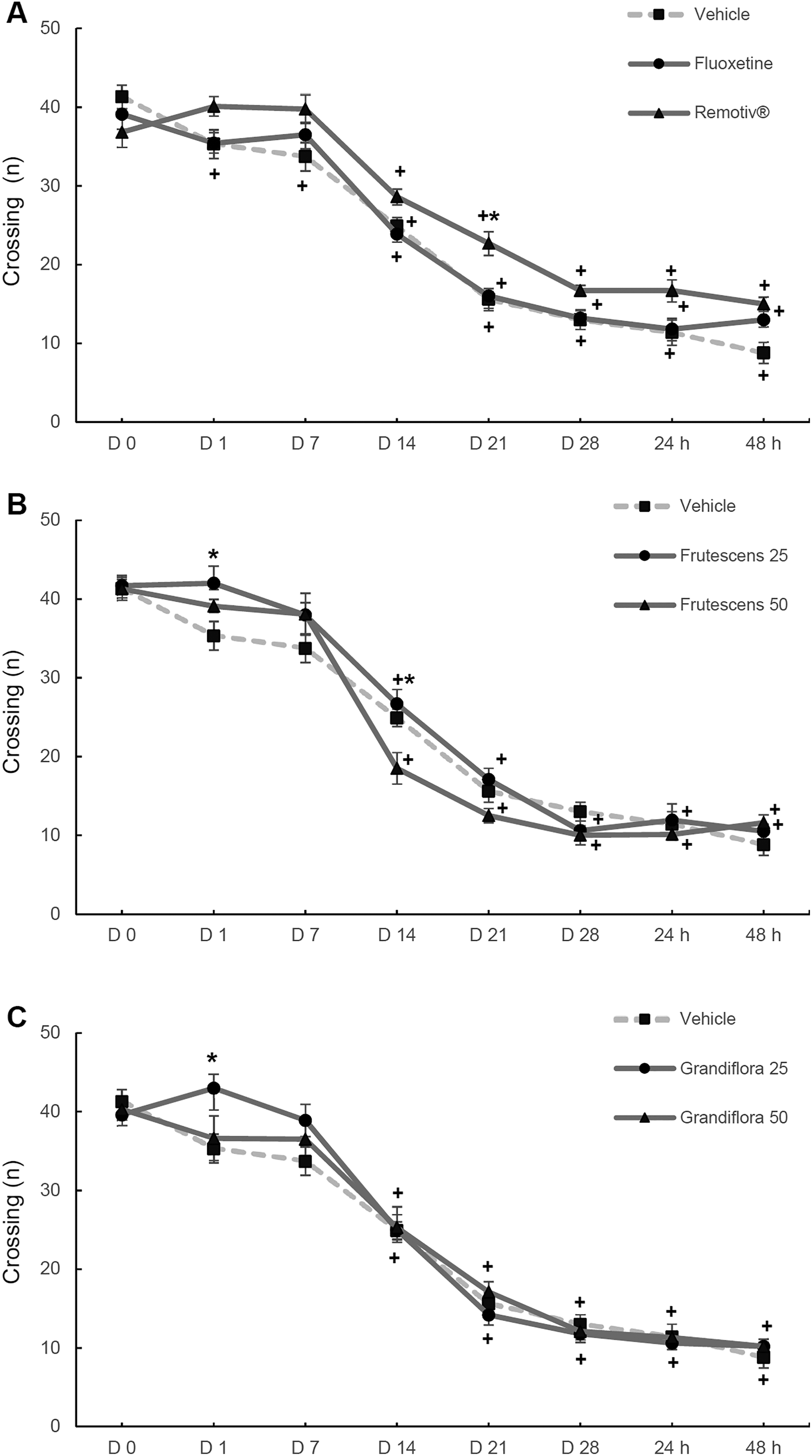
Temporal effects of Montanoa frutescens and Montanoa grandiflora extracts on crossing in locomotor activity test. (A) Pharmacological controls, fluoxetine and Remotiv, versus vehicle group; (B) Montanoa frutescens extracts versus vehicle group; (C) Montanoa grandiflora extracts versus vehicle group. Values are expressed as mean ± standard error. + P < .05, compared with day 0 of the same group; *P < .05, compared with the respective session of vehicle group. Two-way repeated-measures analysis of variance followed by Student Newman-Keuls post hoc test.
The analysis of total time of grooming revealed significant, F(6, 427) = 95.946, P < .001, differences by treatment; days of treatment, F(7, 427) = 107.157, P < .001; and interaction between factors, F(42, 427) = 11.987, P < .001. The post hoc analysis showed that a decreased of grooming was produced in the control and most of the experimental groups: Rats treated with fluoxetine or Remotiv prevented this decrease since they had a longer time of grooming than control from day 21, but it was shorter compared with the first day of treatment in the same group. This effect lasted even 48 hours after treatment withdrawal. Groups treated with 50 mg/kg of Montanoa frutescens or Montanoa grandiflora also prevented the decrease of grooming from the first day of treatment, but the effect only persisted 24 hours after withdrawal; 48 hours after withdrawal the effects disappeared (Figure 2).
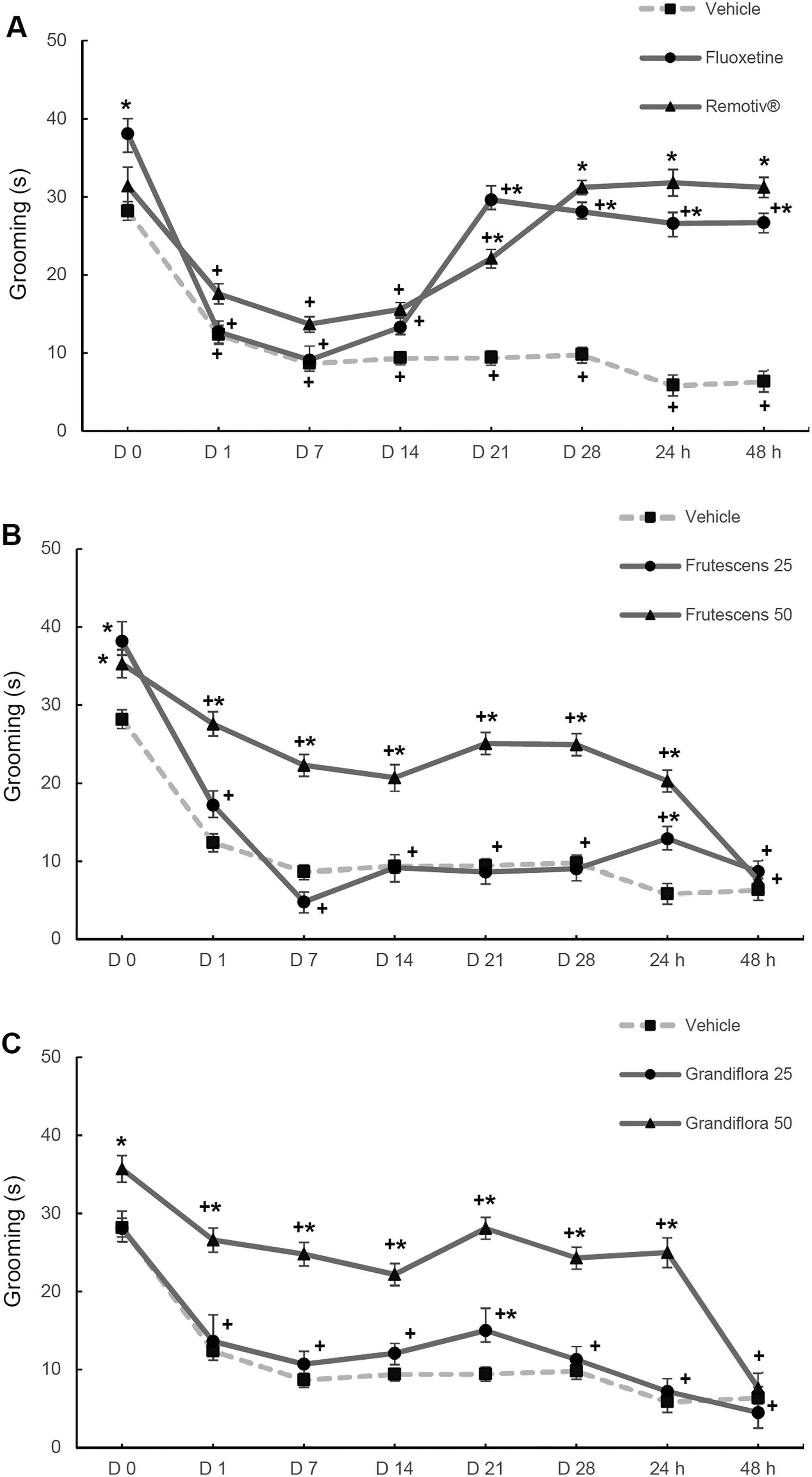
Temporal effects of Montanoa frutescens and Montanoa grandiflora extracts on grooming in locomotor activity test. (A) Pharmacological controls, fluoxetine and Remotiv, versus vehicle group; (B) Montanoa frutescens extracts versus vehicle group; (C) Montanoa grandiflora extracts versus vehicle group. Values are expressed as mean ± standard error. + p < .05, compared with day 0 of the same group; *P < .05, compared with the respective session of vehicle group. Two-way repeated-measures analysis of variance followed by Student-Newman-Keuls post hoc test.
With regard to the total time spent in rearing, there were significant, F(6, 427) = 4.935, P < .001, effects of treatment; post hoc test showed that rats treated with Remotiv had more rearing independently of days of treatment. The factor days of treatments, F(7, 427) = 1.358, P = .221, nonsignificant, and the interaction between factors, F(42, 427) = 1.108, P = .303, were not significant (Figure 3).

Temporal effects of Montanoa frutescens and Montanoa grandiflora extracts on rearing in locomotor activity test. (A) Pharmacological controls, fluoxetine and Remotiv, versus vehicle group; (B) Montanoa frutescens extracts versus vehicle group; (C) Montanoa grandiflora extracts versus vehicle group. Values are expressed as mean ± standard error. + P < .05, compared with day 0 of the same group; *P < .05, compared with the respective session of vehicle group. Two-way repeated-measures analysis of variance followed by Student-Newman-Keuls post hoc test.
Forced Swim Test
The analysis of latency to the first immobility revealed significant, F(6, 427) = 191.475, P < .001, differences by treatments; days of treatment, F(7, 427) = 32.155, P < .001; and interaction between factors, F(42, 427) = 24.450, P < .001. Post hoc test revealed that rats treated with fluoxetine increased the latency from day 14 of treatment, while Remotiv did it until day 21 respect their basal session and respective session of the control group; both effects prevailed 48 hours after treatment withdrawal. In contrast, all doses of extracts did not modify latency; nevertheless, from day 14, Montanoa frutescens (25 mg/kg) prevented the decrease of latency with regard to the vehicle group, an effect that only lasted 24 hours after treatment withdrawal. Montanoa grandiflora (25 mg/kg) only prevented the decreased of latency on day 28 of treatment, which was maintained until 24 hours after conclusion of treatment with regard to vehicle group (Figure 4).

Temporal effects of Montanoa frutescens and Montanoa grandiflora extracts on latency to the first immobility in the forced swim test. (A) Pharmacological control, fluoxetine and Remotive, versus vehicle; (B) Montanoa frutescens extracts versus vehicle group; (C) Montanoa grandiflora extracts versus vehicle group. Values are expressed as mean ± standard error. + P < .05, compared with day 0 of the same group; *P < .05, compared with the respective session of vehicle group. Two-way repeated-measures analysis of variance followed by Student-Newman-Keuls post hoc test.
For total time of immobility, the statistical analysis revealed significant, F(6, 427) = 52.879, P < .001, differences by treatment; days of treatment, F(7, 427) = 27.329, P < .001; and interaction of factors, F(42, 427) = 13.568, P < .001. Post hoc analysis showed that the groups treated with fluoxetine or Remotiv decreased immobility from day 14 and 21 of treatment, respectively, an effect that continued even 48 hours after treatment withdrawal. On the other hand, experimental groups treated with the dose of 50 mg/kg of Montanoa frutescens or Montanoa grandiflora showed an immediate reduction of immobility (day 1 of treatment), but this effect disappear 24 hours after the interruption of treatments. Although 25 mg/kg of Montanoa frutescens was not effective to reduce immobility, after 24 hours of treatment withdrawal a fortuitous increased of immobility was observed (Figure 5).
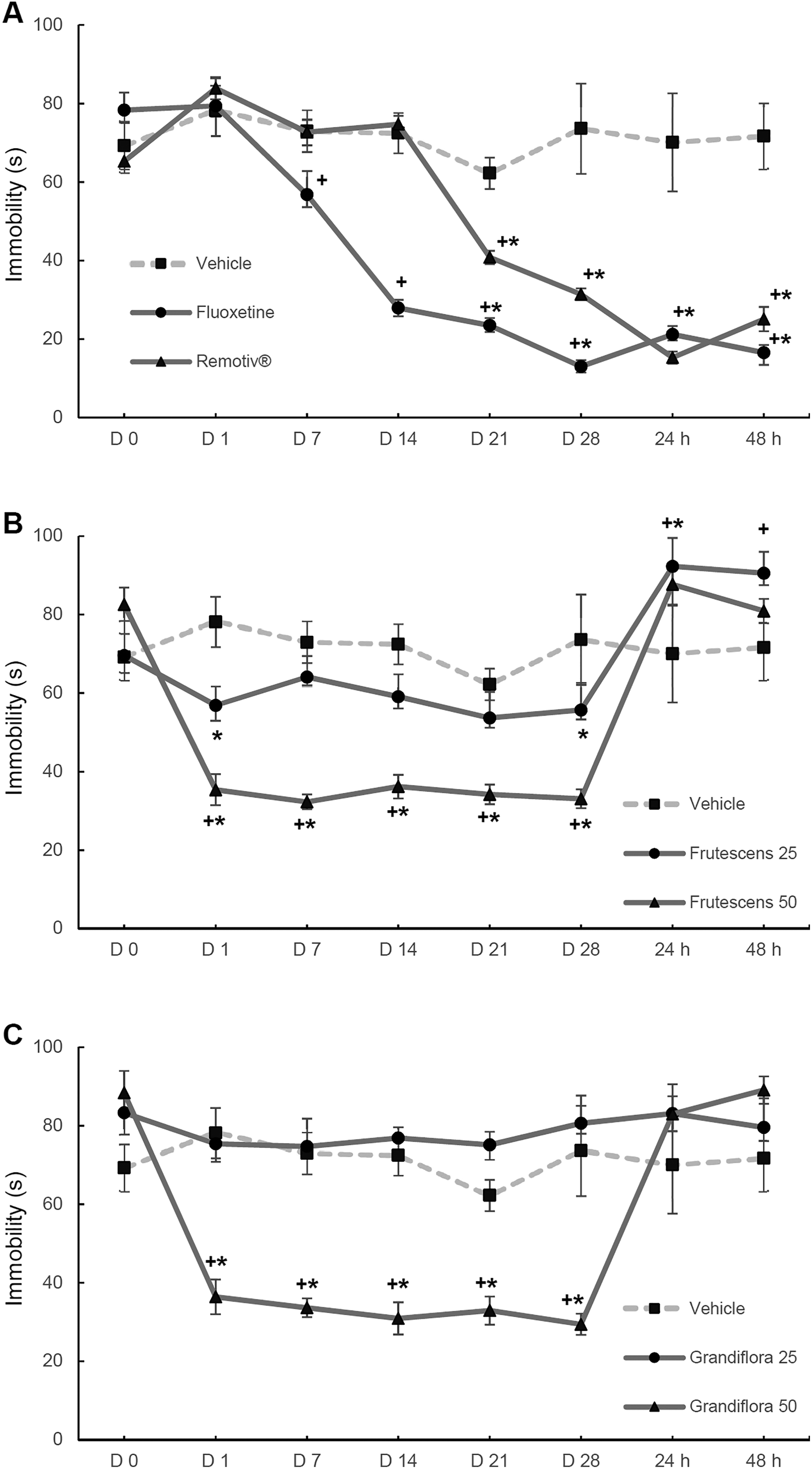
Temporal effects of Montanoa frutescens and Montanoa grandiflora extracts on total immobility time in the forced swim test. A) Pharmacological control, fluoxetine and Remotive, versus vehicle group; (B) Montanoa frutescens extracts versus vehicle group; (C) Montanoa grandiflora extracts versus vehicle group. Values are expressed as mean ± standard error. + P < .05, compared with day 0 of the same group; *P < .05, compared with the respective session of vehicle group. Two-way repeated-measures analysis of variance followed by Student-Newman-Keuls post hoc test.
Experiment 2: Antagonism of GABAA Receptors
Locomotor Activity Test
The results of crossing, grooming, and rearing are presented in Table 1. The analysis of crossing revealed nonsignificant, H(7) = 2.484, P < .928, differences between treatments. With regard to statistical analysis of time spent in grooming, it revealed significant, F(7, 56) = 19.66, P < .001, differences between treatments. Post hoc test showed that rats treated with Montanoa frutescents, Montanoa grandiflora or fluoxetine all exhibited longer times of grooming compared with vehicle group. The treatment with picrotoxin has no effect on grooming itself; nevertheless, picrotoxin blocked the effect of Montanoa frutescens and Montanoa grandiflora but lacked an effect on the fluoxetine-treated rats. On the other hand, the analysis of time spent in rearing revealed not significant differences, H(7) = 3.696, P < .814, between treatments.
Effects of Treatments and Antagonist on the Locomotor Activity Test.a

Abbreviation: PTX, picrotoxin; n, number; s, seconds.
aNo significant changes in crossing and rearing were associated with treatments. Grooming behavior was higher in Montanoa-treated rats (50 mg/kg/28 days) similar to fluoxetine (1 mg/kg/20 days). PTX blocked the effect of Montanoa extracts, but not of fluoxetine. One-way analysis of variance, Student-Newman-Keuls post hoc test. Values are expressed as mean ± standard error.
*P < .001 versus vehicle, PTX, M frutescens–PTX, and M grandiflora–PTX groups.
Forced Swim Test
Statistical analysis of latency to the first immobility revealed significant, H(7) = 38.684, P < .001, differences between treatments. Post hoc test revealed that rats treated with fluoxetine, had a longer latency to immobility, with regard to vehicle group, which was unaffected by picrotoxin. There were not significant differences in groups treated with Montanoa frutescens or Montanoa grandiflora extracts alone or combined with picrotoxin, compared with vehicle group (Figure 6A).

Forced swim test. (A) Latency to the first immobility. Fluoxetine (1 mg/kg), but not Montanoa extracts (50 mg/kg), produced a longer latency to immobility, which was not blocked by picrotoxin. (B) Total time of immobility. Rats treated with Montanoa frutescens, Montanoa grandiflora, or fluoxetine had shorter times of immobility than vehicle group. Treatment with picrotoxin (PTX) blocked the effect produced by both Montanoa extracts, but lacked an effect on fluoxetine treated rats. Picrotoxin by itself has not significant effects. *P < .001 versus vehicle, + P < .001 versus all groups except fluoxetine-picrotoxin (PTX), Kruskal-Wallis test.
With regard to the total time of immobility, the statistical analysis reported significant, F(7, 56) = 97.010, P < .001, differences among treatments. Post hoc test revealed that rats treated with 50 mg/kg of Montanoa frutescens or Montanoa grandiflora, as well as with 1 mg/kg of fluoxetine had shorter times of immobility than vehicle-treated rats. Interestingly, the combination of treatment with picrotoxin blocked the effects of Montanoa extracts, but not of fluoxetine; while picrotoxin has no effect itself. A higher reduction of immobility (P < .001) was detected in fluoxetine-treated rats compared with Montanoa extracts (Figure 6B).
Discussion
The present study evaluated the effects of the aqueous crude extracts of Montanoa frutescens and Montanoa grandiflora at 2 different doses (25 and 50 mg/kg), during a long-term treatment of 28 consecutive days on depression-like behavior. The experimental design explored the immediate effect of treatments (1 day later) and continued every week until day 28; the effect of treatment withdrawal (24 and 48 hours after treatment interruption) was also measured. Additionally, in a second experiment, the participation of GABAA receptors in the actions of effective dose (50 mg/kg) of Montanoa extracts to reduce immobility time was evaluated by antagonizing GABAA receptors with picrotoxin. All effects were compared with fluoxetine and Remotiv, which are clinically effective synthetic and natural antidepressant drugs, respectively.
Forced Swim in Experiment 1
The forced swim is a widely used model, validated and employed to investigate drugs and substances with potential antidepressant effects. In this model, the stress of being forced to swim without any possibility of escape triggers immobility behavior, which is measured as an indicator of low levels of motivation of the animal and interpreted as despair. 40 This test applied in repeated sessions is used to evaluate gradual effect of antidepressant drugs, 39,41 permitting reduction of the number of animal used in an experimental series as recommended by 3Rs of Russell. 42 The latency to the first period of immobility is considered an indicator of the magnitude of the first effort of rats to solve the demanding situation represented by the forced swim test 37,43 ; a short latency is considered a complementary indicator of despair behavior, while a larger latency is associated with the antidepressant-like effect produced by some antidepressant drugs. 44 An increase in the total time of immobility is considered a depression-like behavior, which can be reversed by antidepressant drugs. 40,45 In this model, antidepressant-like effects can be obtained with high doses (10-20 mg/kg) of antidepressant drugs in a subchronic schedule of treatment: 24, 5, and 1 hour before the test 46,47 ; however, these rapid effects are not observable in humans.
At the clinical level, most antidepressants including fluoxetine have an initial delay of two or more weeks to establish its therapeutic effects. 48,49 It is noteworthy that in rats, lower doses of fluoxetine (1 mg/kg) requires more time, around 14 to 21 days to reduce immobility and to increase latency to the first immobility in the forced swim test, 33,34 resembling the delay of therapeutic effects in humans. The delay of therapeutic effects of antidepressant drugs has been related with synaptic and neuronal plasticity, including changes in brain-derived neurotrophic factor, CREB (cAMP response element binding) protein, and number of dendrites or synaptic receptors that require of several days to instauration. 50
In the present experiment, long-term treatment with Montanoa frutescens and Montanoa grandiflora extracts (50 mg/kg) exerted behavioral effects (ie, reduction of total time of immobility), similar to antidepressant drugs 34 ; but opposed to the typical antidepressant fluoxetine and Remotiv that required at least 14 days of treatment, Montanoa extracts elicit a shorter latency to produce its effects as occurred at day 1 after the first administration, which rapidly disappeared when administrations were discontinued. These data suggest that the effects produced by the extracts here analyzed are established by action on ionotropic receptors, in contrast to antidepressants fluoxetine and Hypericum perforatum phytomedicine that require of metabotropic receptors and neuronal plasticity to establish their therapeutic effects in the long term. 51,52
In the present investigation, the effects of withdrawal were also evaluated. Results showed that reduction of immobility observed with Montanoa frutescens and Montanoa grandiflora extracts on day 28, disappeared after 24 hours, returning to values similar to the vehicle group. In fact, withdrawal in the groups treated with the extracts showed a tendency after treatment interruption to increase immobility compared with the previous days of treatment, until differences versus control disappeared; even so the dose of 25 mg/kg of Montanoa frutescens increased immobility significantly than the control animals, but this increase is not longer than 10 seconds respect to the other groups treated with extracts. Interestingly, the antidepressant-like effects produced by fluoxetine and Remotiv remained until 48 hours after the interruption of treatments. These results support the notion that Montanoa extracts exert their action on ionotropic receptors, with short-lasting activity on the reduction of immobility similar to neurosteroids. In the forced swim test, neuroesteroids reduce immobility through actions on ionotropic receptors; exhibit a short-lasting activity, with a starting average of 30 minutes and a total approximate that let go in approximately 6 hours after administration. 53 In contrast, fluoxetine and Remotiv probably produce neuronal plastic changes of long instauration as reported by other authors 54,55 , which allows the permanence in the reduction of immobility even after suspension of treatments.
Forced Swim in Experiment 2
The second experiment demonstrated that, in contrast to fluoxetine, the antidepressant-like effects of Montanoa frutescens and Montanoa grandiflora extracts are mediated by GABAA receptors. The administration of picrotoxin, a noncompetitive antagonist that block chloride ion channels of this receptor, 56,57 blocked the reduction of immobility produced by Montanoa frutescens and Montanoa grandiflora extracts, but lacked an effect on the reduction of immobility provoked either by fluoxetine or by Hypericum perforatum extracts, as previously reported. 9 Thus, results suggest that the protective effects of the extracts of Montanoa plants against the stress induced by the forced swim test are mediated through GABAA receptor chloride ion channels and are not completely comparable to the typical effects of antidepressant drugs as fluoxetine, but in contrast a protective effect against the stress-induced behavioral changes produced by these extracts could be suggested. In line with this notion, the concept of “protective effect against the stress-induced behavioral changes” is referred to the property of some substances (ie, neurosteroids) to prevent the development of behavioral changes associated with the exposure of animals to physical stressors. Thus, for instance, progesterone prevents the behavioral changes produced by the immobilization-induced stress, 35 while allopregnanolone precludes behavioral effects produced by prenatal-induced stress 58 or exposure to conflict situations in rats. 59 The acute effects of both Montanoa extracts on the immobility here reported are similar to those produced by neurosteroids as progesterone or allopregnanolone, which at low doses promptly reduce immobility in the forced swim test and whose effects are blocked by antagonists of the GABAA receptors, including picrotoxin, 23,24 further supporting the notion that the Montanoa extracts exhibit a protective activity against behavioral effects produced by stress. Thus, present results confirm previous studies that demonstrated that pharmacological action of Montanoa extracts on emotional states are established by action on ionotropic GABAA receptors 17,20 ; as a result, the observed short permanency of its behavioral effects is naturally expected. In addition, present findings suggest that some of the chemical compounds contained in Montanoa extracts (probably flavonoids) apparently have pharmacological actions similar to neurosteroids. Specific studies are necessary to test this hypothesis.
Locomotor Activity
The locomotor activity was measured to discard or identify any motor effect that could interfere with immobility behavior in the forced swim test. No significant changes in crossing allows us to discard motor disturbances on the immobility in the forced swim test; as a result, the effects in the forced swim test are only attributed to the motivational status, but not to motor interferences (ie, hyperactivity). In this animal model, rearing and grooming were also measured; these behaviors are emotional indicators of the animal exposed to a novel environment. 60 Present data show that the vehicle groups displayed the lowest level of grooming, probably due to the stress induced by forced swim as reported in other studies after stressful sessions. 61 Reduction of grooming can be prevented, returning to values of unstressed animals by administration of diazepam and other substances with well-characterized anxiolytic potency. 62,63 In the present study, Montanoa frutescens and Montanoa grandiflora extracts maintained grooming behavior constant along the treatment, suggesting a low stress-related behavior that was in turn prevented by picrotoxin. Similarly, fluoxetine maintained grooming but it occurred only after 21 days of treatment and its effects were not antagonized by picrotoxin, which again sets important differences between the classical effects of antidepressant fluoxetine and the extracts here tested. Besides, rearing was not modified by treatments in both experiments, suggesting that this variable is not sensible enough to emotional disturbances as the forced swim test, which is the validated model measure such effects.
Finally, it has been hypothesized that the long latencies for the establishment of therapeutic effects of antidepressant treatments are characteristic of the drug but not of the disease; in accordance, research efforts are directed to test substances that exhibit a short latency of onset. 64 Montanoa frutescens and Montanoa grandiflora seem to have antidepressant effects with short latencies; nonetheless the short term of its effects after the treatment withdrawal and their action modulated through the GABAA receptors, suggest that Montanoa extracts do not possess tangible antidepressant properties, but instead have protector effects that prevent the stress triggered by forced swim. This might be important to design specific phytomedicines destined to particular emotional or affective disorders in the future.
Plants of the Montanoa genus contain active compounds of medical importance such as triterpenes, diterpenes, sesquiterpene lactones, alkaloids, and flavonoids. 65 –67 In present study using qualitative phytochemical techniques was possible to identify the presence of terpenes, alkaloids, flavonoids and sesquiterpene lactones in both Montanoa extracts. The present study partially described the potential mechanism of action through Montanoa frutescens and Montanoa grandiflora exert its antidepressant-like actions, and even though the active compounds of the extracts inducing such activity were not isolated and identified, the qualitative phytochemical analysis confirm the presence of flavonoids and alkaloids, as reported in other studies, 65–67 which could contribute to the behavioral actions reported in the present investigation. In line with this proposal, it has been widely reported that flavonoids from different sources may cross the hematoencephalic barrier and exert actions on the central nervous system, 68 producing neuroprotective, antistress, anxiolytic, antidepressant and anticonvulsant effects acting at the GABAA receptors. 69 –72 Flavonoids have high affinity for GABAA receptors. 73,74 When GABAA receptors are activated by its agonists the conductance of chloride ions increases, thus hyperpolarizing the neuron and consequently inhibiting neuronal activity. This neurophysiological effect that occurs through GABAA receptor chloride ion channels is associated with the psychopharmacological effects of several substances, including benzodiazepines, barbiturates, psychoactive drugs, some neurosteroids, and flavonoids. 75,76 These latter 2 substances also quickly reduce immobility time in the forced swim test suggesting an antidepressant-like effect mediated by GABAA receptors. 23,24,77,78 In the present study, pretreatment with picrotoxin did not produce intrinsic effects in the forced swim test but prevented the effects of the effective dose of Montanoa extracts to reduces immobility time. Therefore, the observed anti-immobility effects of both extracts appear to be mediated by GABAergic actions.
This possibility opens new lines of investigation to find the specific bioactive compounds responsible of the effects here reported. At this moment, the present investigation contributes to partially support traditional use Montanoa extracts to ameliorate the impact of stress on mental health and prevent the development of mood disorders as people use it in their communities (ie, aqueous crude extract). Nonetheless, additional studies on toxicity and drug interactions are required before Montanoa extracts could be widely recommended for human use as a safety and efficient therapeutic alternative.
Conclusion
The results of the present study show that the extracts of Montanoa frutescens and Montanoa grandiflora (50 mg/kg) exert immediate protective effects against stress-induced behaviors in forced swim test through actions on the GABAA receptors, instead of a typical antidepressant-like effect.
Footnotes
Acknowledgments
We are grateful to Consejo Nacional de Ciencia y Tecnología (CONACyT) for the fellowships assigned to LAF-A and GUR-S during the present investigation for postgraduate studies in Neuroethology, Reg. 714872 and 714866, respectively.
Author Contributions
JFR-L and MC-J conceived the project, the experimental design, and wrote the protocol. LAF-A, GUR-S, and FG-O carried out the experiment and measured the behavioral variables. JFR-L, JCE, and MJR-H realized the statistical analysis and interpretation of results. All the authors significantly reviewed and discussed the final version of the manuscript.
Declaration of Conflicting Interests
The authors declared no potential conflicts of interest with respect to the research, authorship, and/or publication of this article.
Funding
The authors disclosed receipt of the following financial support for the research, authorship, and/or publication of this article: This study was partially supported by funding from Universidad Veracruzana (UVE-CA-25) and Universidad Autónoma de Tlaxcala (UATX-CA-215), but did not participate in the study design, data collection, data analysis, interpretation of the data, writing of the manuscript, or decision to submit the paper for publication.

Ethical Approval
This project was approved by the Ethical Internal Committee from Escuela de Medicina Veterinaria y Zootecnia, Universidad Autónoma de Tlaxcala (Reg. No. MVZ-189/12).