



Abstract
Citations are the main avenue through which scholarly contributions are recognized. However, decisions about what to cite (or not cite) are often made without much systematic thought. Suboptimal citing practices undermine psychological science. Yet psychological science as a field has yet to comprehensively discuss ways to improve authors’ citing decisions. We outline the importance of citing for promoting the cumulativeness of the scientific endeavor, which encompasses promoting diversity, equity, and inclusion in the field. We describe how psychologists make citing decisions and some negative consequences when citation decisions are negligent (or even fraudulent). Moreover, we describe how citations driven by insular professional networks can reinforce historical exclusion and result in reference sections that reflect a failure to meaningfully search and engage with existing literature. Then, we review some potential causes of problematic citing behaviors, which include factors that manifest at the level of the individual, such as a desire to elevate one’s own professional profile, and systemic factors, such as the exponential growth in published literature. Finally, we offer strategies for the field, journals, labs, and individuals to improve citations. In framing our arguments and recommendations, we refer to empirical data collected on citing decisions from editorial-board members (N = 213) at 23 psychology journals.
Keywords
A psychologist is writing a manuscript for publication. The psychologist has spent months, maybe even years, designing a research question, fleshing out a robust methodology, collecting data, and analyzing the results. While drafting the manuscript, the psychologist types a sentence and thinks that a citation should be added. But who should be cited? And why? When citing, psychologists make a series of highly consequential decisions. Yet with little formal training or guidance on how to approach this process, many scholars implement ad hoc, informal, or effort-avoiding strategies that can undermine the cumulativeness and inclusiveness of the field. There is little professional reward for being a highly rigorous citer, so why do it differently?
In this article, we describe common reasons for insufficient or inaccurate citations, examine how poor citing contributes to a less cumulative and less inclusive psychological literature, and suggest strategies to help researchers make high-quality citing decisions more easily. Our hope is that our article can serve as a springboard for future discussions, recommendations, and policy changes. To facilitate these aims, we conducted a preregistered survey of the editorial boards of 23 psychology journals (for a detailed description of this study, see the Appendix). A total of 213 editorial-board members (articles reviewed/edited: Mdn = 100) provided their opinions on various aspects of citing decisions via an ad hoc survey. They also offered open-ended suggestions for how citing could be improved. These data, which reflect the viewpoints of reviewers with moderate to extensive peer-review experience, are used purely for description and serve to complement our discussion in this article that is primarily motivated through logical arguments supported by previous theoretical and empirical work.
Now Is the Time to Systematically Discuss Citing Decisions
Psychological science has been undergoing a “credibility revolution” (Vazire, 2018) in which scientists, journals, associations, and funders are working to improve the soundness of research (Nelson et al., 2018). Citing is a foundational step in the research process because rigorous and accurate citation is critical to ensuring the credibility and cumulativeness of scholarship (Cobb et al., 2024). In our survey of psychology-journal editorial-board members, 93% of respondents agreed that “citing is foundational to the credibility of psychological scholarship.” 1
At the same time, citing is a key domain in which the diversity, equity, and inclusiveness goals of our field (e.g., see American Psychological Association [APA] Racial Equity Action Plan; APA Board of Directors, 2022) can be either supported or undermined. Most (82%) editorial-board members agreed that “citing is foundational to advancing diversity, equity, and inclusion in psychological scholarship.”
Yet psychological scientists appear to widely disagree as to whether the credibility of citations should be understood as intertwined with the diversity and inclusiveness of citations. In our survey, 33% of board members held the view that “the diversity and inclusiveness of citations is largely
In preparing this article, we concluded that the diversity and inclusiveness of citations are not synonymous with the rigor and substantive accuracy of citations but that these issues are meaningfully linked in important ways and that psychologists should consider them together in mapping out a path to improving citing decisions. 2 For psychologists to appropriately follow the guidelines from the seventh edition of APA’s (2020) Publication Manual by citing “the work of those individuals whose ideas, theories, or research have directly influenced your work” (p. 253), they must be thoughtful about the contributions of other scientists, past and present. If successive additions to the literature are to build optimally on each other, then scientific research must be referenced critically and as a result of rigorous literature review, which will likely also result in references being dispersed more inclusively and equitably. 3
Yet what psychologists are actually doing (or not doing) and what their intentions are when they cite others has yet to be broadly discussed. What are the psychological underpinnings of citing decisions? How can scholars more effectively identify and cite prior work, and how will this process benefit the field? How can journals’ review mechanisms better deter misleading, negligent, and exclusionary citing behaviors? How can improving citing promote citational justice, a process of acknowledging and eliminating inequities in whose scientific contributions are recognized (e.g., the “Cite Black Women” movement, C. A. Smith, 2021), and why is citational justice essential for a truly cumulative science? Critically examining citing decisions in psychology can provide insight into these questions and suggest strategies to improve citations even when resources are limited.
Given the broad, sustained impact of citations, it is surprising that there is relatively little published work on the topic in the field. 4 Although a wealth of research on scientists’ citing behaviors has been produced by information-science scholars and sociologists of science, only rarely has such work been published in psychology journals (one notable exception is Psychology of Women Quarterly, which has published multiple citation-network analyses; Lykes & Stewart, 1986; Moradi et al., 2023). Even when such work has been produced by psychologists or focused on citing specifically in psychology (e.g., Adair & Vohra, 2003; Bavelas, 1978; Cronin, 1982; Safer & Tang, 2009; Shadish et al., 1995; White & White, 1977), subsequent discussion of such articles has been minimal in psychological spaces. To the extent that citations are discussed by psychologists, it is typically in less formal forums, such as Bluesky/X or blog posts. In our survey, 86% of editorial-board members at least slightly agreed that “thus far, our field has not paid enough attention to improving the quality of citing decisions.”
This lack of attention is paralleled in the training provided to psychologists. As noted by Klitzing et al. (2019), “In general, guidelines on citing are quite scarce” (p. 63). For example, whereas the APA’s citation guidelines have 24 pages focused on plagiarism and citation formatting, less than half a page of the manual is dedicated to other aspects of citing, which may signal that authors have total license to make highly subjective decisions about whom and what to cite. In our survey, some reviewers suggested that major societies, such as the APA and Association for Psychological Science, should formulate thorough guidelines for best practices in citing. More broadly, limited evidence suggests that most researchers receive little or no formal instruction in citing practices (Klitzing et al., 2019). Most board members (80%) in our survey agreed that “many psychologists receive little to no formal instruction about citing,” and most (84%) agreed that “most graduate programs should do more to train students in how to approach citing decisions.” As one highly experienced reviewer offered, “I have never seen a research methods text or syllabus address this issue.”
This backdrop suggests that compared with the timeline of psychology’s other efforts to remedy deficits in credibility and inclusiveness (e.g., preregistration, diversity initiatives in faculty hiring), improving citing sits stalled at the beginning stage of reform. One consequence of not engaging in comprehensive discussion of citing behaviors is that the field may unintentionally reinforce problematic citing decisions, such as systemic biases leading to valuable work being omitted and certain genres of citations (e.g., work that “dispute[s] your thesis,” APA, 2020, p. 253) being intentionally downplayed. These problematic citing decisions give rise to a research literature that does not accurately represent the field’s knowledge accumulation and unjustly discounts the work of less powerful and privileged researchers. The underrecognized researcher degree of freedom in citing is also vulnerable to self-serving gamesmanship. Some have even argued that “problematic citing practices both constitute a particularly detrimental QRP [questionable research practice] in and of itself, as well as one of the major causes triggering a wider set of other QRPs” (Horbach et al., 2021, p. 3). 5
The Basic Importance of Citations to a Cumulative Psychological Science
Citations convey prior ideas and resources to readers and are essential for collective scientific efforts at both the level of the citing work itself (proximal) and citation metrics (distal). In terms of proximal impact on readers, each citation should represent at least one specific input to the citing author’s evidentiary and/or argument chain (Kaplan, 1965). Ideally, a reader should be able to rely on the author’s references as a representative and unbiased database of the most relevant past literature by which to evaluate the author’s contribution. If authors fail to cite or incorrectly cite a valuable contribution that directly relates to their work, they risk undermining the accumulation of knowledge (Cobb et al., 2024).
More distally, citations play the important archival role of raising and preserving awareness of prior scientific efforts and the scientists who generated them. Many scholarly works are never cited by anyone but their own authors, and few articles continue to be cited frequently beyond the first few years following their publication (for a bibliometric study documenting the distribution of citations over time, see Glänzel & Schoepflin, 1995). Although some neglected literature may be of too minor value to cite, other work may have long-term importance. For example, scholars have often observed that ostensibly novel points being made in articles published decades into the third millennium were already made many decades before. Indeed, most of the board members in our survey (88%) believed that “authors often claim novelty while failing to cite earlier relevant work,” and half (50%) further believed these “claims about novelty are often a problem (e.g., wastefully reinventing the wheel).” If these beliefs are accurate, psychologists are not only wasting resources but also failing to give credit to the scholars who initially generated these ideas. Moreover, an author who prominently cites valuable but underrecognized work, such as underappreciated work by less privileged researchers or works that could be “Sleeping Beauties” (scientific works that are neglected for many years but are subsequently raised to prominence; van Raan, 2004), 6 provides a valuable service to the field.
In many cases, there are multiple prior sources that could (at least minimally) fulfill the same function, such as explaining a concept or supplementing discussion of a research method, and an author may need to choose only one or a few sources to cite rather than referencing all of them. In this culling, authors will often be subtly led by subjective prejudices or heuristics, such as article-citation counts, journal-impact factors, age of the article, whether they themselves are cited in the article, and often perhaps above all, characteristics of authors and author institutions, such as prestige and personal familiarity (for a description of these kinds of subjective prejudices in reference selection, see Camacho-Miñano & Núñez-Nickel, 2009). Ideally, though, authors should carefully evaluate and compare the scholarly quality of the possible references; the most valuable work(s) should ultimately be among those referenced.
Citing quality is not just a matter of which works are included but also how a reference is cited in text (Gernsbacher, 2018). There is a major communicative difference between including an article in a string of citations without any elaboration (e.g., “The XYZ questionnaire has been widely discussed in personality research [A et al., 1999; B, 2001; C, 2006])” and citing an article while specifically communicating its relevance (e.g., “Although the XYZ questionnaire developed by A et al. [1999] continues to be widely employed, B [2001] found that it had low internal consistency, and C [2006] expressed concerns about its lack of discriminant validity”). The latter citation structure arms readers with awareness of the relevance of prior works and explains how references connect in a broader evidentiary chain (Lavigne & Good, 2017).
Citations that ensure that key claims are well supported and that ideas and credit are appropriately and equitably transferred across time are vital contributions to a cumulative and inclusive psychological science. In their proximal impact, poor citations can undermine the transmission of ideas to readers, resulting in propagation of inaccurate information, lack of awareness of opposing and diverse viewpoints, or false perceptions of novelty. In their distal impact, deficient citations result in collective loss of valuable knowledge, particularly from marginalized scholars and scholars with less professional or institutional privilege.
Cumulativeness Requires Inclusiveness in Citations
“Citational justice isn’t only about justice . . . it’s about doing robust, rigorous science, where you are truly exploring all the potential areas of research and what has been conducted before to accelerate the progress of science” (Dr. Cassidy Sugimoto, cited in Kwon, 2022). We argue that neglectful or low-effort citing decisions serve to uphold and reinforce inequitable systems of recognition and power, which directly undermines the cumulativeness of science.
As a field, psychology is increasingly acknowledging that classism, racism, sexism, ableism, colonialism, xenophobia, homophobia, transphobia, and other dynamics of injustice are serious problems within the scientific community (Adams et al., 2015; Dupree & Kraus, 2022; Gruber et al., 2021; Ledgerwood et al., 2022; Roberts et al., 2020). These systemic inequities manifest in the composition of and feelings of belonging within communities of researchers (Fox Tree & Vaid, 2022), the homogeneity of populations studied and the generalizability of findings across sociodemographic groups (Henrich et al., 2010; Williamson et al., 2022), and how collective attention is allocated (e.g., undervaluing race-related research, Roberts et al., 2020; neglecting ethnic minorities in developmental psychology, Syed et al., 2018).
In addition to being a moral harm, inequities faced by historically excluded researchers obstruct the cumulativeness of research. Engaging with a diverse group of authors is likely to promote broader links both within and between topics and ensure that contributions are equitably appreciated. For example, consider the “diversity-innovation paradox” described by Hofstra et al. (2020). Using natural language processing of 1.2 million U.S. dissertations, the authors generated “conceptual novelty” scores based on the number of novel linkages between scientific concepts. Then, they analyzed the number of times that the dissertation’s linkages were found in subsequent works by others: This captured “impactful novelty.” Hofstra et al. observed that the more historically demographically excluded the dissertation writers were in their respective disciplines (e.g., women in computer science, non-White researchers in sociology), the more likely they were to make novel conceptual linkages. However, novel linkages were less likely to be subsequently adopted by other scholars when the dissertation author had a more marginalized identity than if they were a White man. Thus, Hofstra et al. described the diversity-innovation paradox: Scholars from historically excluded groups are more likely to produce innovative work, yet their novel contributions are disproportionately discounted.
Moreover, systemic inequities restrict the range of topics supported and rewarded. For example, Syed (2017) outlined how, given psychology’s exclusionary tendencies, research areas related to ethnic minorities have often been inadequately described. As a result, before explanatory and predictive research programs can be developed, researchers investigating issues related to ethnic minorities often need to engage in major qualitative and quantitative descriptive research (for a broader promotion of the value of descriptive work, see Rozin, 2009). Yet because psychology’s prestigious journals, funders, and other gatekeepers give comparatively less credit to descriptive work than to explanatory or predictive work, research on such topics has been systematically undersupported and undercited (Syed, 2017). The cumulative pursuit of psychological knowledge is thus undermined by depressing research on historically excluded minorities, which impedes the professional success of the researchers who tackle such topics.
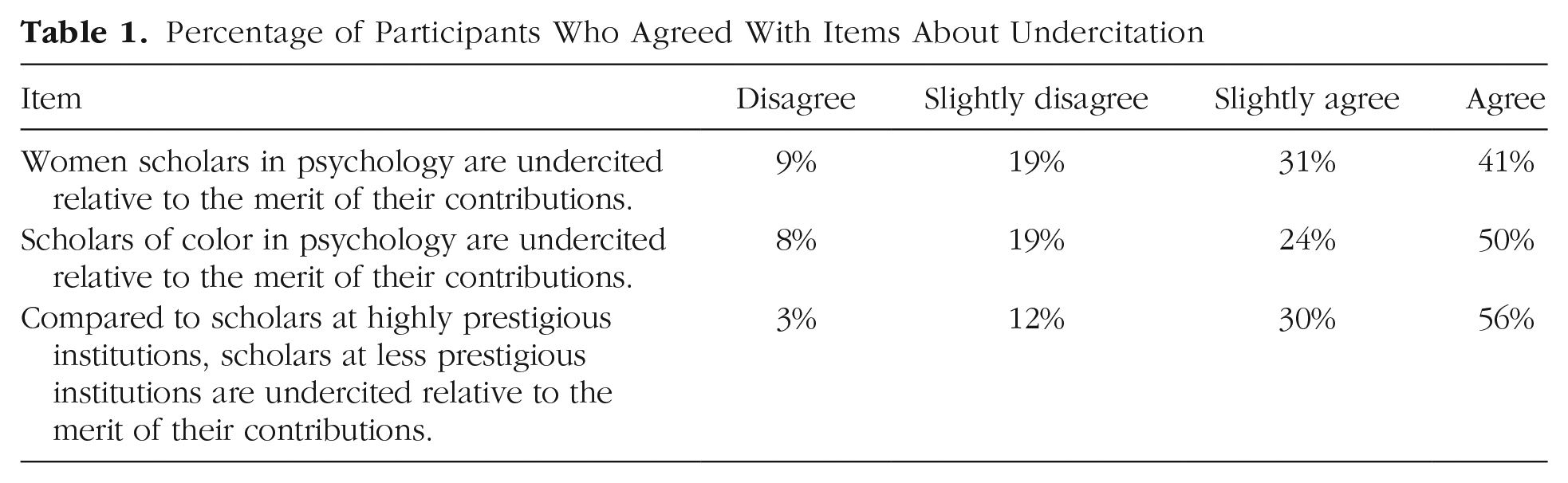
Many scholars have pointed to author-citing decisions as an important arena for working toward collective equity goals (e.g., Dworkin et al., 2020; Fox Tree & Vaid, 2022). Women and scholars from historically excluded racial and ethnic groups tend to be undercited in scientific literature (Bertolero et al., 2020; Kwon, 2022; Larivière et al., 2013; C. A. Smith & Garrett-Scott, 2021; Zurn et al., 2022). Table 1 shows that most editorial-board members in our survey agreed that such scholars are undercited relative to the merit of their contributions.
Percentage of Participants Who Agreed With Items About Undercitation
Not only do authors from some historically excluded groups (e.g., Black women) tend to publish on less cited topics, but their works also tend to be undercited compared with articles by other intersectional groups (White men) in the same topic area (Kozlowski et al., 2022; Liu et al., 2023; C. A. Smith & Garrett-Scott, 2021). Tellingly, an author’s reduced citing of authors from historically excluded backgrounds is associated with higher relative insularity of the citing author’s citational network (mapping of coauthorship linkages; Bertolero et al., 2020).
As one example of inequitable citing, Bailey and Trudy (2018) described the troubling experience of frequently not being cited for their role in creating and proliferating the term “misogynoir,” a unique form of misogyny directed at Black women. Some such citation omissions have been conducted by what Bailey and Trudy called “opportunistic plagiarists” who use “writing and tweets without citation to meet journalistic and academic deadlines, whether for pay, social status (as misogynoir guarantees anyone socially/economically ‘above’ an unaffiliated Black woman would be praised for the things Black women theorize and write), or both” (p. 765), whereas they categorized other citation omissions as intentionally malicious and exclusionary. Note that the outcome of missing a foundational citation, either negligently or intentionally, looks the same to readers and has the same harmful impact on the omitted authors. Thus, Reddy and Amer (2023) argued that “poor citational practices reinscribe power to white and WEIRD scholars” (p. 81). Because citations are a signal that prior work directly influenced the current work and therefore merits attention, inadequate citing can lead to a lack of attention toward the ideas themselves produced by marginalized scholars.
The Matthew Effect: A Key Barrier to Cumulative and Inclusive Citing
The intertwining of credibility and inclusiveness in citing decisions is especially clear in terms of the Matthew effect (Merton, 1968), a reference to the Gospel of Matthew (25:29): Prominent scientists tend to receive substantially more credit for their work than less prominent researchers even when their contributions are similar. This “rich get richer, poor get relatively poorer” dynamic operates in all forms of scientific recognition, from hiring and grants to publications and citations (e.g., for an examination of the Matthew effect in grant funding, see Bol et al., 2018).
Resources are distributed unequally across scholars, often in ways that are partly or completely detached from scholarly aptitude or merit. These resource disparities foster inequities in how much attention is given to individual researchers and research topics. Neglectful or low-effort citing tends to reinforce disparities via the Matthew effect and, in so doing, obstruct the cumulativeness of research by decreasing the rigor and credibility of citing decisions and undermining the inclusiveness necessary for scientific progress.
As one example of the Matthew effect, consider the case study presented by Huber et al. (2022). Economists worked together on an article and submitted it to a peer-reviewed journal; one of the authors was a Nigerien early career researcher (Sabiou Inoua) and another was a White American Nobel-prize winner (Vernon Smith). In a preregistered study, Huber et al. worked with the journal to invite thousands of scholars to review the article; one-third were given documents that included only Inoua’s name, one-third were given documents that included only Smith’s, and one-third were given documents that included no author identity. Compared with the anonymous-author condition, reviewers were less likely to positively rate the article when Inoua’s name was visible. Given that the same manuscript was used in every condition, reviewer perceptions of the quality of the work were influenced by the identity of the visible author, demonstrating the Matthew effect whereby an already famous scholar receives disproportionately positive praise for the work while a lesser known scholar receives less positive feedback than would an anonymous author for the exact same work.
The mechanisms that drive the Matthew effect in citing can range from a desire to use citations to please editors and reviewers, who may react more favorably to citations of themselves 7 and other powerful scholars in their networks, to simply low-effort literature search and review or overreliance on personal acquaintanceship. For example, “when there are multiple works that could be cited for a particular point,” almost all editorial-board members (95%) agreed that “authors often choose to cite works based on name recognition,” and 88% agreed that “authors often choose to cite people they know personally.”
Regardless of the mechanism, the Matthew effect leads to underciting less privileged scholars and overciting more privileged scholars, for example, by reinforcing gender disparities in science with men gaining disproportionate recognition while equally deserving women receive less than they merit (the “Matilda effect”; Rossiter, 1993). This dynamic has garnered substantial attention in the natural sciences (e.g., for gendered citation practices in physics, see Teich et al., 2022). In psychology, Yan et al. (2024) found that this undercitation of women stems from discrepancies in memory accessibility; women scholars do not come to mind as easily for men citers. A similar process is likely to play out in the disproportionate underciting of researchers from historically excluded racial and ethnic groups. In the language of the diversity-innovation paradox, insular citing practices and the Matthew effect exacerbate the underrecognition of marginalized scholars even when the work that they produce is scientifically equivalent to that of majoritized or otherwise privileged scholars.
The Prevalence of Problematic Citing
Despite APA (2020) guidance that one should “cite only works that you have read and ideas that you have incorporated into your writing” (p. 253), concerns about problematic citing endure. Bibliometric research has identified typographical errors in references (e.g., inaccurate title or page numbers) that are repeated verbatim in subsequent articles by many different authors. Tracking these reference misprints, one study suggested that an estimated 70% to 90% of references in major physics journals were simply lifted from the reference lists of other articles without checking accuracy (Simkin & Roychowdhury, 2005). This finding aligns with the long-standing worry that scientists may not read the articles they cite. Ioannidis (2018), for example, argued that authors often use flawed methods because “they have never read carefully any paper that describes the method in depth” (p. 1021). 8 In our survey, most respondents (88%) agreed that “authors often cite work having only read the abstract,” and perhaps more concerningly, nearly half (46%) agreed that “authors often cite work of which they have never read any part.”
In addition, labor-intensive studies checking the substantive accuracy of citations have found disturbingly high rates of erroneous citations. For example, in a study of general-science journals with high impact factors, approximately 25% of citations were substantively incorrect (N. Smith & Cumberledge, 2020). In the only such study in psychology, Cobb et al. (2024) examined the substantive accuracy of citations in 89 articles in nine high-profile psychology journals: They reported that “roughly 19% of citing claims either failed to include important nuances of results (9.3%) or completely mischaracterized findings from prior research altogether (9.5%)” (p. 299). Of the editorial-board members in our survey, 79% said that their own published works have been substantively inaccurately cited. Of these, two-thirds (68%) had this happen once or twice, and the remaining one-third (32%) reported it happening “numerous times.”
One type of problematic citing behavior that has been highlighted in psychology is neglecting to cite important replication failures. Multiple projects have investigated citations of articles after their findings have failed to replicate (Hardwicke et al., 2021; Schafmeister, 2021; von Hippel, 2022). They have found that meaningful failures to replicate have minimal or negligible impact on the subsequent citation rates of the original articles. Moreover, studies demonstrating failure to replicate are often minimally cited (co-cited with the original articles in only 3% of cases, von Hippel, 2022; for four higher profile failures to replicate, co-cited in fewer than half of cases, Hardwicke et al., 2021). Neglecting replication failures when evidence against the original finding is strong is a “smoking gun” that problematic citing behaviors are prevalent. 9
How Citing Goes Wrong
Why do poor citing decisions impede psychology’s cumulativeness and inclusiveness? There is evidence that citing is motivated by individuals and amplified at the structural level.
Individual-level reasons underlying problematic citing behaviors
Scientific endeavors are typically a team effort, with researchers working together to address problems (either more directly in labs or coauthor teams or less directly in the peer-review process). However, the current structure of academia is one in which professional achievements (e.g., grant funding, higher h index, hiring and promotion decisions) are made at the individual rather than team level. We next examine three primary reasons for problematic citing behaviors that are rooted within individuals, including (a) being motivated to persuade one’s readers to see oneself as knowledgeable and one’s arguments as compelling, (b) being motivated to “profit” from citations used like currency, and (c) embracing a low-effort “good enough” approach to citing.
Normative and persuasion theories of citing motivation
Although many individual citing motivations have been proposed (e.g., Erikson & Erlandson, 2014; Lyu et al., 2021), the two most discussed are the “normative” motivation (often credited to Merton, 1973) and the “persuasion” motivation (Gilbert, 1977, is commonly referenced as a seminal work in this vein). The normative theory presumes that citing is heavily driven by “intellectual property” norms of giving credit to the scholars who have influenced one’s thinking on a topic. Normative citing motivations result in largely positive consequences with one modest exception: If the desire to give credit is not specific enough in scope, the result can be strings of citations too long to be helpful to the reader (“Overcitation can be distracting and is unnecessary,” APA, 2020, p. 254).
In contrast, the persuasion theory presumes that citations are partly used as a rhetorical device to persuade readers to believe the citing author’s claims rather than to help readers fairly examine them. For instance, an author primarily motivated to persuade may (a) cite only supportive evidence and ignore nonsupportive evidence, (b) intentionally cite widely respected scholars over less known scholars, (c) cite “authoritative” works even if they have not meaningfully influenced the thinking in the manuscript, (d) cite certain works to signal that one is a member of the “right” intellectual community, or (e) cite excessively to give an appearance of erudition (for a similar enumeration of misleading, overselling, or obfuscating citing practices, see Corneille et al., 2023). 10
Being somewhat rhetorically persuasive can be helpful; readers of scientific articles are not logical automatons, and their abilities to understand an article are partly constrained by their training, area of expertise, and background knowledge of prior works or scholarly reputations (Gilbert, 1976). Thus, some small degree of persuasive tailoring of one’s cited references to one’s intended audience may be helpful for readers to fairly examine claims. However, many of the previous examples expressly contradict APA guidance on citations, and there are substantial negative consequences for the field when individuals are excessively motivated by persuasion motives. These self-seeking persuasion motives not only potentially mislead readers but also are likely to amplify recognition for individuals who already have high prestige while undermining recognition for less powerful scholars. When taken to extremes, persuasion motives can even descend into fraudulent citing behaviors, such as intentionally omitting references that would cast doubt on the validity of one’s claims (Box 1). As one indication, 53% of editorial-board members in our survey endorsed that “authors sometimes intentionally omit citations that would raise concerns about the novelty or validity of their work,” which is a fraudulent citing behavior.
Fraudulent Citing

Citations as currency
In an earlier era, Bavelas (1978) raised a question she considered “fantasy” but is now likely a reality: “If citation counts become the currency of the future, will this affect citation patterns, so that authors dispense or withhold citations for non-scholarly reasons?” (p. 161). With the rise of citation-count indices in evaluating the performance of scientists, citations themselves are, more than ever before, a currency of the scientific realm (Wang et al., 2021; for examples of estimations of the monetary value of citations, see Diamond, 1986; Faria & Mixon, 2021). Citations are now not merely an index; they are a target (cf. Strathern’s, 1997, rephrasing of Goodhart’s law: “When a measure become a target, it ceases to be a good measure”).
Thus, some citing behaviors can be explained by a currency motive. For example, one motive for citing may be to promote increased citations of one’s own work. Beyond inappropriate self-citation (i.e., citing an article authored by oneself when it is superfluous), 11 such currency goals can be promoted by strategically citing scholars who may cite your work in return (for how perverse incentives can contribute to “reciprocal citing,” see Posner, 2000; Zaggl, 2017; for discussion of fraudulent “review and citation rings,” see Biagioli, 2016). In this vein, some scholars have argued that citations are deployed strategically to please gatekeepers in peer review, such as citing works by a likely reviewer in the hopes of increasing the chance the author’s submission will be accepted (e.g., as theorized by Vinkler, 1987) or adding citations specifically to articles in the journal to which a manuscript is to be submitted (e.g., as theorized by Macdonald, 2023). As one board member in our survey put it, “So long as we view citation count as a measure of academic success and reward that with promotion and tenure and awards, it will always be subject to corruption pressures.” Currency motivations may also encourage an author to cite friends or students whom they care about and want to help professionally.
Currency-citation motives have the potential to either help or harm the professional success of scholars with backgrounds that have been historically marginalized in psychology by diverting from or directing attention to the ideas themselves produced by such scholars. For example, self-serving citational-currency motives, such as attempting to curry favor with editors, could lead to overciting the most powerful scholars (disproportionately White men) and neglecting others. More altruistic citational-currency motives can serve to intentionally promote the recognition of works by scholars from historically marginalized groups. Given structural inequities within academic psychology and the implicit biases of individual researchers (e.g., see Huber et al., 2022), such characteristics may be worth weighing; however, citing decisions should ultimately be driven by the relevance of the ideas to the citing work.
Citing behaviors as effort avoidance: the good-enough problem
Some citing decisions reflect a desire (or even a need!) to avoid effort. The ever-increasing volume of existing work inevitably means that many researchers do not read, evaluate, and cite prior works as comprehensively as they would hope. As a result, current citing behaviors can increasingly be understood through the lens of “satisficing,” or employing less effortful cognitive strategies that are minimally acceptable to accomplish tasks (for the general concept of satisficing, see Simon, 1957). Satisficing is contrasted with “maximizing,” a process that involves expending more effort to weigh options and optimize a solution.
Scholars near the satisficer versus maximizer ends of the citing continuum engage with the citing process in distinct ways. A strong maximizer begins with a comprehensive literature search, taking care to read beyond disciplinary and terminological boundaries. They endure the time-consuming process of reading and critically engaging with curated studies, which includes incorporating citations from prior articles that were missed in the initial search. During this engagement, maximizers keep records of ideas they encounter, which helps facilitate incorporation of prior work into the planning and execution of one’s own project. In drafting a manuscript, a maximizer ensures that each citation is accurately and effectively presented. An author taking this approach would choose citations that not only better integrate prior research but also would naturally tend to be somewhat more fairly and inclusively distributed (simply by being less shortcut-driven in how they were identified). However, this time-consuming maximizing process may feel unfamiliar and probably unrealistic because it is not well incentivized and can be unfeasible given the time and energy constraints of an academic’s working life.
Satisficing can occur at any or all steps of the citing process. When searching literature, satisficing could mean relying mostly on studies from one’s close network (e.g., Teplitskiy et al., 2020, found that highly cited articles were more often discovered through social contact and early in the research life cycle than lightly cited articles). Instead of carefully reading and critically engaging with articles, a satisficing author may read only abstracts. 12 When writing a manuscript, satisficing could involve sprinkling citations throughout without carefully communicating their relevance. These low-engagement processes may lead to haphazardly accounting for prior literature and inadvertently misleading readers. 13
Satisficing is also likely to be a dominant driver of the Matthew effect, with staggering negative implications for diversity and innovation. Low-effort literature review will result in authors engaging with an overly narrow range of works, which will produce reference sections that disproportionately neglect the work of researchers outside of one’s own professional network and who hold less institutional prestige (Moradi et al., 2020). When satisficing, authors spend less time seeking out literature that is not firmly “on the beaten path” of articles or scholars with which they are familiar; the result can be a relative ossification of a scholar’s (and even a field’s) empirical and conceptual perspectives (for an explanation and empirical demonstration of this ossifying process, see Chu & Evans, 2021). Shortcuts in citing will likely privilege those scholars who are already afforded the most power and privilege in the field while leaving innovation from less privileged scholars underrecognized and undervalued.
Despite these harmful consequences of satisficed citing decisions, satisficing to a limited degree can be necessary for the cumulative progress of science. Scholars who try to read and carefully evaluate everything potentially of relevance to their scholarship will be greatly hampered in their capacity to produce their own original work. For most research topics, careful literature searching eventually runs into diminishing returns, with the incremental value gleaned from each article decreasing quicker and quicker as one’s grasp of the literature becomes fuller and fuller (cf. “diminishing returns” economic perspective on scientific research, Peirce, 1879). Diminishing returns deter even highly motivated authors from maximizing their citing process. For example, despite being strongly motivated to model high-quality citing decisions in this present article, our authorship team nonetheless still engaged in some satisficing behaviors and likely omitted important, relevant citations to prior works. We did not completely read every work in our reference list (e.g., we read only sections of some books referenced, a limitation we acknowledge in the annotated references), and for some of the references we did fully read, we did not take comprehensive notes. Because satisficing versus maximizing citing decisions exist on a spectrum, we are careful to note that we do not believe all scholars should spend their time becoming peak maximizers. Instead, all of us can make incremental progress to move closer toward the maximizing side of the spectrum in the citing process while also working to mitigate the structural barriers that exacerbate the tendency to satisfice.
Structural factors impeding better citing behaviors
Several structural factors work against high-quality citing. For example, journals often impose maximum word and/or reference counts, which can force authors to cut valuable works from their reference lists and integrate in-text citations in the fewest number of words, minimizing room for effective communication of the specific relevance of citations. As journals become increasingly reliant on online publication, these kinds of barriers can be more easily adjusted when needed. Two broader structural factors, though, are not amenable to easy fixes and more dauntingly impede better citing behaviors: the exponential growth in publications and the inherent difficulty of identifying specific instances of most problematic citing behaviors.
Exponential growth in publications and reference overload
Over the past decades, there has been a tremendous explosion in the quantity of peer-reviewed psychology articles, with the total number of publications steadily increasing (Ellemers, 2013). Unsurprisingly, there has been a corresponding uptick in the quantity of references in published articles (e.g., Adair & Vohra, 2003, demonstrated this trend a generation ago). To provide a snapshot example at present, we examined the average number of references in articles published in the Journal of Personality and Social Psychology (JPSP) each decade from 1970 to 2020 (Fig. 1). 14 The average number of references in JPSP articles increased from 17 in the year 1970 to 63 in the year 2000; in 2020, JPSP articles averaged 99 references.

Average number of references in Journal of Personality and Social Psychology articles published from 1970 to 2020.
In 1970, when a typical article rarely had more than a few dozen references, authors had a better chance of carefully reading and critically engaging with them all. 15 Today, when a typical article may have at least 100 references, it is much more time-consuming for authors to read and critically engage with all the works they are citing. 16 As the competition for scholarly attention grows stiffer, authors come to rely more on shortcuts. In introducing the Matthew effect, Merton (1968) was concerned that the increased rate of publication production was a major driver; given the manyfold increase in the rate of publication production since the 1960s, Merton’s concern should appear particularly alarming now. 17 Multiple survey respondents mentioned the volume of published literature as an obstacle to high-quality citing (e.g., “I struggle with the sheer volume of information that is out and therefore how to properly and ethically summarize it”). Many academics would probably like to “publish less, read more” (Phaf, 2020), yet most simply do not have enough time. With the lack of incentives for high-quality citing, researchers cannot be expected to prioritize this fundamental aspect of the research process.
Difficulty with identifying problematic citing behaviors
Another structural barrier is the difficulty in identifying problematic citing beyond clear cases of plagiarism because citing motives reside in the mind of the citer (see review in Brooks, 1985). Consider fraudulent citing: As with most cases of fraud, the degree of intentionality is difficult for an outside observer to assess. In legal terms, the actus reus (“guilty act”; omitting an incredibly important and/or damning citation) itself may be obvious but not the mens rea (“guilty mind”; omitting that citation intentionally). This same difficulty applies to other problematic citing behaviors, such as trying to curry favor with colleagues by citing them. Social-psychological elements in citing motivations are “hidden behind a veil” of normative presumptions (Erikson & Erlandson, 2014, p. 262). For instance, through subtle wordsmithing, “one can under-cite without actually stealing results, or over-cite with the effect of inflating the value of the property of a colleague” (Ravetz, 1971, p. 257). Given the norm-violating nature of many citing motives, authors may be reluctant to admit them even to themselves (as described by Bornmann & Daniel, 2008). 18 As one respondent in our survey explained, “We can’t get scientists to be honest about what they did to their data. Citations would be even more difficult.” As a result, not only is it difficult for reviewers, editors, and even collaborators to detect negligent or malicious citing decisions, but it is also inherently challenging for researchers to credibly estimate the prevalence of poor citing practices across psychological research.
Looking Forward to Strategies for Optimistic Scholars
Improving citing decisions in psychology will likely be a long and arduous path, but now is an opportune time to take this on as a field. Although improving the citing of individual researchers is required, institutions can take steps to make high-quality citing easier and more well incentivized. It is not sufficient to leave responsibility for improvement purely to individuals because institutional norms and practices affect the psychological processes of individual researchers (for a theory of how sociocultural contexts serve to organize the self and how the self can, in turn, affect ideas and practices of various institutions, see Markus & Kitayama, 2010). Moving beyond the individual level is particularly important given that current citing decisions are entrenched and self-reinforcing (i.e., unlikely to change without dedicated interventions). 19 Direct actions at different levels—field-wide, at journals, in lab and graduate instruction, and by individuals—can better serve cumulative and inclusive science (see Table 2). Moreover, direct action at each level combined can lead to a more equitable distribution of the necessary labor, ensuring, for instance, that historically excluded scholars are not disproportionately burdened by efforts to achieve citational justice.
Intended Goals and Potential Strategies to Improve Citing Behaviors

Note: BIPOC = Black, Indigenous, and people of color.
Although the prior research we discussed has provided substantial evidence regarding the perils and prevalence of deficient citing, there has been comparatively little investigation of potential solutions. Some intriguing proposals have been offered (a few of which are described below), but the empirical evidentiary basis for their feasibility and effectiveness has thus far been limited or nonexistent. Through our literature review, internal discussions, and survey of editorial-board members, we have compiled a range of potential strategies for improving citing behaviors. Based on this limited evidence, scholars do not appear to have consensus about preferred strategies; for example, some respondents in our survey thought the field should impose stricter limits on the number of citations in manuscripts, whereas others argued that journals should abolish existing citation limits. In arranging potential strategies in this article, we cannot make strong claims as to their effectiveness; it is possible some may even be counterproductive in their effects. Thus, our goal is not to make final recommendations but, instead, provide fodder for serious and comprehensive discussion among psychological scientists and help set the stage for empirical testing of different approaches.
Field-Wide Efforts
One of the biggest obstacles individual researchers face in citing is that current indexing tools (e.g., PsycInfo, Google Scholar) provide a woefully limited amount of information. Citation indexes in science were originally inspired by legal citation indexes (e.g., Garfield, 1955), but they have never received the level of investment needed to match those legal-citation tools, which track not only which cases cite which prior cases but also how those prior cases are cited (e.g., completely overruled, overruled in part, further explained, questioned, affirmed). If indexes in science were improved in this direction, the cumulative quality of research would likely improve as well. For illustration, Spellman (2012) asked the reader to imagine using a tool where you can see how your empirical paper has been cited. In the center of your screen is the name of your publication. Emanating from it are short links . . . that are predominantly red—indicating failures to replicate. But there are also longer links . . . that are predominantly green, showing later replication success. The yellow links show theory and review papers that question your findings, the blue links are to those papers that cite it approvingly, and the gray links are to papers that mention it neutrally. (p. 304)
Few citation-indexing tools aid psychological scientists trying to efficiently sort through the vast literature when compiling evidentiary chains. By reverse-engineering Google Scholar’s ranking algorithm, Beel and Gipp (2009) found (at that time) that the search engine weighted an article’s citation count most heavily for display ranking (i.e., the order in which results are presented to searchers), which they noted likely promoted the Matthew effect. Newer citation tools, such as scite and Elicit, use deep-learning models of surrounding text to try to categorize whether a citation provides supporting or contrasting evidence or is simply mentioned by citing authors (Nicholson et al., 2021; also see Note 23). However, no existing tool can narrow in on the specific substantive relevance of works, and scientific organizations should examine the feasibility of smart citation indices to implement the system sketched by Spellman (2012).
Anicich (2014) expanded on Spellman’s (2012) suggestion by outlining how articles could employ superscripts added to each reference to indicate how it has been used by the citing work (e.g., e = single empirical study supporting the claim, m = meta-analytic review). 20 This scheme would negligibly add to the length of manuscripts and would not detract from readability; once a standardized scheme is adopted, journals could require it. Through automation, superscripts could be fed into a citation-index tool to track the information.
The power of publishers: leveraging journal policies
Many editorial-board members in our survey pointed to journal policies and/or peer reviewers as key to improving citing. Academic journals have substantial power to facilitate change in citing behaviors through their publication guidelines. For example, journals, especially those published solely online, could consider removing reference limits and/or excluding references from word/page limits while also providing explicit commitment to their belief in the importance of high-quality and inclusive citing. These acts could motivate individual authors to extend their citation networks beyond a limited, more homogeneous in-group; for example, scholars such as Buchanan et al. (2021) and Yan et al. (2024) have advocated removing journal reference limits as one strategy to help upend race and gender biases in psychology.
Journals could also request or require that authors annotate their references, as we do in the present article (see project OSF page for our annotated references and an example template for researchers looking to annotate their own references). Annotated references include a concise description of why a source was cited and its importance. As shown in our own annotated references, these descriptions also serve as a place for transparency about which works one has not fully read. The extra step of annotating one’s reference list is relatively low-cost for authors when done concurrently with manuscript drafting. Note that requiring fully annotated references and removing citation limits simultaneously are likely to balance out any drastic increase in citations that journals may fear; authors will have to handle each reference more thoughtfully, which will deter frivolous overcitation that reference limits might aim to constrain.
Likewise, journals could request citation-diversity statements (Zurn et al., 2020). A citation-diversity statement is a paragraph in which the authors acknowledge the importance of citation diversity and equitable citing practices and/or attempt to quantify the demographic representation in their cited references (e.g., see our citation-diversity statement at the end of the article). Personality and Social Psychology Review (PSPR) currently requires a “Citations Statement,” in which authors are asked to speak to the diversity of the scholars whose work they built on (Adler, 2022). We reviewed PSPR Citations Statements from January 2022 to October 2024 (for data and preregistration, see OSF). Of the 19 PSPR articles published between January 2022 and May 2023, none mentioned citing decisions. Starting in August 2023, when the new editorial board began to appear on the journal masthead, 15 of 19 articles (79%) had an identifiable Citations Statement. Two out of the 15 (13%) Citations Statements included specific statistics about the cited authors generated by a third-party database, and one of these statements acknowledged the inherent limitations of probabilistically assigning gender and ethnicity based on author names. Despite being incorporated in text in either the introduction (5/15; 33%) or discussion (10/15; 67%), Citations Statements were almost always confined to a section also including the required positionality and constraints on generality statements; only one article discussed citation diversity across multiple paragraphs (Van Zomeren et al., 2024). This lack of integration may limit the impact of Citations Statements, but overall, we view the evidence from PSPR as promising—the majority of articles published under the current editorial team include a discernable Citations Statement, and even those that were one sentence long (e.g., “Considering this positionality is important, particularly given that much of the cited research in this paper is led by cis White American men, particularly the older work in person perception and social cognition”; Hester & Hehman, 2023, p. 427) may cause readers to think more critically about citations. As a next step, journals like PSPR could publish their own annual analysis of their collective database of citations (e.g., which journals were most cited, how many different journals were cited across the year) to show the breadth of work that influenced their articles.
Journals can also influence citing through peer review. When submitting a manuscript, journal policy could require that authors attest that they have checked the substantive accuracy of each citation and searched for replication studies relevant to key points and appropriately cited them alongside original studies (for similar suggestions, see Cobb et al., 2024). Likewise, reviewers could be explicitly encouraged via guidelines to comment on whether important citations were missed or buried in a string of citations. Mentioning this feedback in a review can encourage the authors to provide a more in-depth description of the cited work and its influence on the present study. Although this unofficial practice is already common, editors could be even more intentional about inviting reviewers to attend to such matters (for questions editors and reviewers can ask themselves when considering citations, see Lavigne & Good, 2017). 21
“Training, training, training . . . ”: individual labs and graduate-school courses
Another closer-to-home avenue for inspiring strong citing behaviors is via individual lab culture and through graduate courses. Psychology graduate students are often required to take courses in research methods; as suggested by Lavigne and Good (2017), strong citing practices, including how to handle self-citations, could be emphasized in these courses. Likewise, advisors can be more explicit about teaching citing norms rather than assuming that these skills will develop naturally from reading published articles; for example, citing norms should be included in centralized locations of lab-wide knowledge. Graduate training could also do more to encourage students to read and cite widely across journals and disciplines by explicating the importance of building on work by the many intelligent scholars who came before. Programs and mentors who emphasize citing only articles in high-impact journals encourage the development of problematic citing behaviors in students.
Labs can also work toward citational justice. For example, labs can gauge the diversity of reference lists in their manuscripts. To this end, one lab group designed a “do-it-yourself” method to approximate the racial/ethnic demographics of cited authors and then used this information to intentionally diversify references (Azpeitia et al., 2022). 22 Intentionally diversifying references can involve becoming more familiar with scholars of color in one’s research area, seeking out work in community-curated databases of researchers from historically excluded groups, increasing cross-disciplinary reading to expand the pool of potential authors to cite, and paring down tangential citations of canonical articles written by scholars who have already achieved wide recognition (these strategies largely overlap with APA’s Journal Article Reporting Standards on Race, Ethnicity, and Culture; APA, 2023). Ultimately, these lab-focused tools are simply meant as a first steppingstone in advancing citational justice (cf. Syed, 2022, who worried that citational-diversity tracking tools could end up being used to meet superficial quotas rather than actual engagement with the works being cited). Diversification of references should not be treated as a quota or quantifiable end goal. Instead, these efforts should push researchers to engage with the ideas and promote the work of historically marginalized scholars.
Intrinsic motivation: inspiration for individuals
Finally, individual authors hold enormous power to improve their own citing decisions. A shift to higher quality citing can occur when individuals develop a stronger appreciation of citing’s importance and act on these values. Some motivations that our author team has found helpful in working to improve our own decisions include viewing citing as a technical skill that can be honed with practice, an act of recognition for those scholars whose efforts have helped to bring our own thinking forward, a component in a broader cultural shift toward more inclusive science, and a moral obligation to fellow researchers and the psychological community.
Note that even authors with the best intentions make poor citing decisions. Therefore, it is important to highlight not only the motives that underlie citing decisions but also the outcomes. Beyond motivation, good citing behavior includes rigorously searching the literature and expanding beyond one’s own limited academic network, carefully reading and critically engaging with the literature, taking steps to counter implicit biases and unreliable heuristics in assessing the value of work produced by different authors and published in different outlets, and carefully communicating the relevance of each citation. To facilitate more efficient literature review and promote substantive citation accuracy, we recommend using reference managers, such as Zotero, that allow space for notes and comments on individual PDFs. In addition to checking one’s own substantive citations, it can also behoove authors to ask collaborators to read through a manuscript before submission with a focus on making sure that the meaning and relevance of each citation are clear. To identify a more diverse range of potential references, we suggest intentionally reading beyond one’s own subdiscipline and reviewing databases that highlight works by scholars from historically excluded backgrounds (e.g., the Black, Indigenous, people of color-authored Psychology Papers database moderated by Dr. Erica Wojcik). 23
Conclusion
Citations are foundational to a cumulative and inclusive psychological science. We are hopeful that most scholars share this belief; indeed, nearly all the editorial-board members in our survey (91%) agreed that “most authors genuinely care about accurately citing works.” Unfortunately, the practice of citing has received far less attention than it deserves, which allows poor practices to flourish. By conducting rigorous and less insular literature searches, meaningfully engaging with prior research, working to counter systemic inequities in whose work is valued and cited, and accurately conveying to readers the relevance of each citation in one’s manuscripts, citing authors can assist the future flourishing of the field. Meanwhile, institutions such as professional societies and journals can encourage such efforts by researchers and provide helpful tools to facilitate them.
Citation-Diversity Statement
Research has found evidence for bias in citing decisions such that scholars from backgrounds that have been historically marginalized tend to be undercited compared with scholars with more privileged identities. In this article, we sought to proactively identify references that reflect the diversity of researchers who have studied and are studying citing decisions. To measure progress toward that goal, we conducted a citation audit using a procedure created by Azpeitia et al. (2022) in which the presumed gender and race/ethnicity of all cited authors were documented using information on the internet, including biographies, interviews, Wikipedia, and/or an image of the author. This method is necessarily limited because coders made assumptions about various aspects of the authors’ identities that may or may not be how the authors would describe themselves. Acknowledging the limits of this method, the majority of our cited authors were presumed to be White (67%); the remaining authors were presumed to be Asian (13%), Black (9%), Hispanic/Latinx (5%), Middle Eastern/North African (5%), Indigenous/Native American (1%), and/or multiracial. With respect to gender, most cited authors were presumed to be men (60%), compared with 39% women and 1% nonbinary authors. This pattern of tending to cite authors with more privileged identities was magnified when examining only first authors, of which, 80% were presumed to be White and 76% were presumed to be men. This citation audit suggests that there is room to further diversify the identities of authors we cite in our future work. In addition, there are other dimensions of exclusion that could be considered in future citation audits, including whether authors live and/or work outside of the United States, Europe, Australia, and New Zealand and ways that intersecting identities affect exclusion (e.g., citations of Black women vs. White men). It is also important to consider the journals that appeared most frequently in our references and how these frequencies may relate to author identities because of biases in publishing. The journal with the largest number of articles we cited was Perspectives on Psychological Science (13 cited articles), followed by Scientometrics (seven cited articles) and Proceedings of the National Academy of Sciences (six cited articles). We are committed to supporting more equitable and inclusive citing behaviors in psychology, including working to diversify our citations in terms of author identities and journal outlets.
Footnotes
Appendix
To gather empirical data about psychologists’ opinions about citing decisions in the field, we conducted a preregistered online study of editorial-board members at a diverse range of psychology journals (https://osf.io/p6svu/). This study was approved by the Rhodes College Institutional Review Board (Protocol No. 2024007). Using information listed on journal websites, we obtained the names of editors and editorial-board members at 23 psychology journals (listed below). We found 1,911 email addresses corresponding to editorial-board members, and using Microsoft mail merge, we sent all eligible participants personalized email links to an anonymous 20-item Qualtrics survey. After completing the citing survey, participants were offered the opportunity to enter a raffle for one of 30 $25 U.S. Amazon gift cards by providing their contact details in a separate, unlinked Qualtrics survey. One hundred thirty-one participants signed up for the raffle. No data were excluded or manipulated, and we report all measures that we collected in the survey.
Included journals are as follows:
Of the 219 participants who began the Qualtrics survey, 213 provided informed consent. These 213 editorial-board members were, on average, experienced with reviewing and/or editing manuscripts for psychology journals (manuscripts: Mdn = 100, M = 325, SD = 536, range = 5–4,000). These descriptive statistics about the number of manuscripts reviewed and edited by our participants may be underestimates because we took the middle of the range when participants provided a range in response to this question (e.g., the response “100–200” was coded as 150) and the number provided when only a lower bound was presented (e.g., the response “1,000+” was coded as 1,000). With respect to identity characteristics, most participants (59%) did not consider themselves to belong to one or more demographic groups that are minoritized in psychology, but 40% of respondents endorsed at least one minoritized identity.
In Tables A1 and A2, we present complete quantitative results for every survey item. This survey was ad hoc, but when possible, we incorporated items from Cronin’s (1982) Table 2 that were applicable (at least in a revised form). In particular, Cronin’s Item 1, “Authors commonly cite works they have not read,” parallels our item, “Authors often cite work of which they have never read any part”; Cronin’s Item 2, “Authors frequently fail (intentionally or otherwise) to cite all pertinent work,” touches our item, “Authors sometimes intentionally omit citations that would raise concerns about the novelty or validity of their work”; and Cronin’s Item 6, “Many authors display institutional bias in their referencing habits,” parallels our item, “Compared to scholars at highly prestigious institutions, scholars at less prestigious institutions are undercited relative to the merit of their contributions.” Despite drawing on these Cronin items, concerns with ad hoc measures still apply. We do not believe this survey leads to measurement proliferation (Anvari et al., 2024) because there were no suitable existing measures to assess our constructs of interest.
For disagree-agree items, in the article, we collapsed responses across slightly agree and agree when quantifying how many participants agreed with each statement. In addition to quantitative items, we obtained qualitative responses from two questions about (a) whether the credibility and diversity/inclusivity of citations are related (“Citations can more or less equitably recognize the works of minoritized and/or less privileged scholars. Some researchers see the diversity and inclusiveness of citations as largely unrelated to the credibility of citations. Other researchers see diversity and inclusiveness of citations are largely intertwined with the credibility of citations. Which statement best represents your view?”; responses from 158 out of 213 of participants; 74%) and (b) solutions to improve citing (“Do you have any specific suggestions for how the field of psychology could improve the way authors approach citing?”; responses from 155 out of 213 of participants; 73%). The OSF page includes a comprehensive codebook, R script, and data files for quantitative and qualitative responses.
Acknowledgements
Thank you to Abby Brown, Alex Fisher, Boo Elliott, Doratea Crunk, Emma Ledger, Graciela Fernandez, Julie Caffrey, Railey Stern Yen, and Sarah Liu at Oberlin College for assistance in coding reference counts and completing the citation-diversity audit. Thank you to Isabella Caro, Ryan Johnson, and Isobel Letizia at Rhodes College for assistance in collecting emails for the editorial-board survey. Thank you to Julia Bottesini for donating the gift cards used as participant compensation in the editorial-board-members survey. Thank you to the Social Identity Lab at the University of Washington for their feedback on an earlier draft of this article. Much gratitude to Judith Hall for her mentorship, editorial eye, and support throughout this project. A preregistration and all study materials, reproducible code, and anonymized data can be found at the project OSF page:  .
.
Transparency
Action Editor: David A. Sbarra
Editor: David A. Sbarra
Author Contributions
K. M. Lawson and B. A. Murphy contributed equally to the present article and hold co-first-author positions.