



Abstract
Albarracín et al. (2008, Experiment 7) tested whether priming action or inaction goals (vs. no goal) and then satisfying those goals (vs. not satisfying them) would be associated with subsequent cognitive responding. They hypothesized and found that priming action or inaction goals that were not satisfied resulted in greater or lesser responding, respectively, compared with not priming goals (N = 98). Sonnleitner and Voracek (2015) attempted to directly replicate Albarracín et al.’s (2008) study with German participants (N = 105). They did not find evidence for the 3 × 2 interaction or the expected main effect of task type. The current study attempted to directly replicate Albarracín et al. (2008), Experiment 7, with a larger sample of participants (N = 1,690) from seven colleges and universities in the United States. We also extended the study design by using a scrambled-sentence task to prime goals instead of the original task of completing word fragments, allowing us to test whether study protocol moderated any effects of interest. We did not detect moderation by protocol in the full 3 × 2 × 2 design (pseudo-r2 = 0.05%). Results for both protocols were largely consistent with Sonnleitner and Voracek’s findings (pseudo-r2s = 0.14% and 0.50%). We consider these results in light of recent findings concerning priming methods and discuss the robustness of action-/inaction-goal priming to the implementation of different protocols in this particular context.
In their seventh study, Albarracín et al. (2008) investigated whether priming action or inaction goals, which were subsequently fulfilled or not, caused participants to behave more or less actively in a later task, compared with participants in a neutral control condition. Action was defined as cognitive or motor output; inaction was defined as a lack of cognitive or motor output. Their design tested a prediction stemming from the notion that there may be cognitive and behavioral consequences of goal fulfillment. If a goal is rendered cognitively accessible, but goes unfulfilled, an individual should be more likely to act on that goal when later given a chance. In the words of Albarracín et al., An action goal should be present when participants were primed with action and had no opportunity to be active, and an inaction goal should be activated when participants were primed with inaction and had no opportunity to be inactive. . . . Action and inaction primes followed by an immediate prime-consistent task should . . . yield less activity than would unsatisfied action goals, and satisfied inaction goals should yield more activity than would unsatisfied inaction goals. (pp. 518–519)
In other words, unsatisfied goals should produce heightened tendencies toward goal fulfillment (more activity in the case of action goals, less activity in the case of inaction goals) compared with satisfied goals.
In Experiment 7, Albarracín et al. (2008) used a word-completion task to prime participants with an action goal, an inaction goal, or a neutral concept. They were then randomly assigned to be active (to doodle or make a paper airplane) or inactive (to rest) for 2 min, in a 3 (prime: action, inaction, neutral) × 2 (task: active, inactive) design. Finally, participants listed thoughts in reaction to a passage about vegetarianism, and the number of thoughts listed served as a measure of goal-fulfillment tendencies—the key dependent variable.
Results revealed support for the predicted, key 3 × 2 interaction effect. Participants primed with action goals, then asked to rest, listed significantly more thoughts compared with participants primed with inaction goals, then asked to be active. That is, unfulfilled goals were associated with heightened tendencies toward goal fulfillment.
As part of the Reproducibility Project: Psychology (RP:P), Sonnleitner and Voracek (2015) attempted to directly replicate Albarracín et al.’s (2008) Experiment 7 in a sample of German university students (N = 105), but they did not find evidence for the key 3 × 2 interaction. Albarracín (personal communication, April 27, 2014) expressed concerns about Sonnleitner and Voracek’s study. Chief among these concerns was the cross-cultural comparability of the action and inaction primes in the German context, given that the original paradigm was validated in an American context (and in English).
The current study sought to replicate Albarracín et al.’s (2008) Experiment 7 using a larger sample of U.S. participants. We also made improvements to the study design in a second protocol, in order to increase the probability of a successful replication. Specifically, in reviewing Sonnleitner and Voracek’s (2015) materials and data, we noticed an apparent shortcoming of the priming method used in both the original study and the replication. 1 Specifically, both previous studies asked participants to complete word fragments consisting of two-letter prompts, in order to prime them with their intended goal. For instance, the fragment MO- was used to prime the concept “motivation.” Participants could have completed the fragment in other ways (e.g., moon, month), which suggests that there are many ways in which completing the word fragments may not have primed the desired concept.
Because of these issues with the priming manipulation, we used scrambled sentences to prime participants (as in Albarracín et al.’s, 2008, Experiment 5) in the revised protocol in order to strengthen the manipulation and have a higher chance of successful priming. To directly test the utility of different priming methods, we specifically included the priming method as a manipulated factor in the replication study. Thus, the study had a 3 (prime: action, inaction, neutral) × 2 (task: active, inactive) × 2 (protocol: RP:P, revised) design. All participating sites tested the full 3 × 2 × 2 design. If the two methods of priming are equally effective, and the theory underlying Albarracín et al.’s (2008) predictions is correct, then we would observe a 3 (prime) × 2 (task) interaction with a pattern of results following Albarracín et al.’s results. If scrambled sentences more reliably prime the target goals (compared with word fragments), and the theory underlying Albarracín et al.’s predictions is correct, then we would observe a 3 (prime) × 2 (task) × 2 (protocol) interaction, with a pattern of results following Albarracín et al.’s in the protocol with scrambled-sentence primes, but a weaker or null effect in the RP:P protocol (consistent with Sonnleitner & Voracek’s, 2015, failure to replicate the original result). Our replication study not only assessed the replicability of the original effect of goal consistency, but also identified the precise conditions regarding which study design might be most likely to produce the hypothesized effect.
Disclosures
Preregistration
Our design and confirmatory analyses were preregistered on the Open Science Framework at https://osf.io/725ek/.
Data, materials, and online resources
All materials, data, and code are available on the Open Science Framework at https://osf.io/j5s8c/.
Reporting
We report how we determined our sample size, all data exclusions, all manipulations, and all measures in the study.
Ethical approval
Data were collected in accordance with the Declaration of Helsinki guidelines. The institutional review board at each of the participating sites approved the research.
Method
Power analysis and participants
As reported by Sonnleitner and Voracek (2015), a power analysis using the effect size from the original study (η p 2 = .087) suggested that a sample size of 165 would yield 95% power to detect the 3 × 2 effect of interest (α = .05). We therefore planned to conduct the full 3 × 2 × 2 design with a minimum of 330 participants per site (i.e., 165 participants for each protocol). To satisfy guidelines for the Many Labs 5 project, we sought to recruit at least three sites that could collect data from 330 participants; we also recruited additional sites that were not likely to hit the target sample size in order to further increase total power (i.e., power in the aggregate analysis across sites). An additional power-analysis simulation is available on the Open Science Framework at https://osf.io/2vmn5/. Results of that simulation suggest that power to detect the 3 × 2 (Prime × Task) interaction was very high (> 95%) in all simulated conditions. The power to detect the 3 × 2 × 2 (Prime × Task × Protocol) interaction was poor for each individual site (32% or 63%, depending on the assumed effect size), but acceptable for three sites pooled (76% or 98%, depending on the assumed effect size). Note, these simulations assumed that the 3 × 2 (Prime × Task) interaction in Albarracín et al.’s (2008) Experiment 7 would be successfully replicated in both protocols, but would have a stronger effect in the revised protocol than in the original protocol.
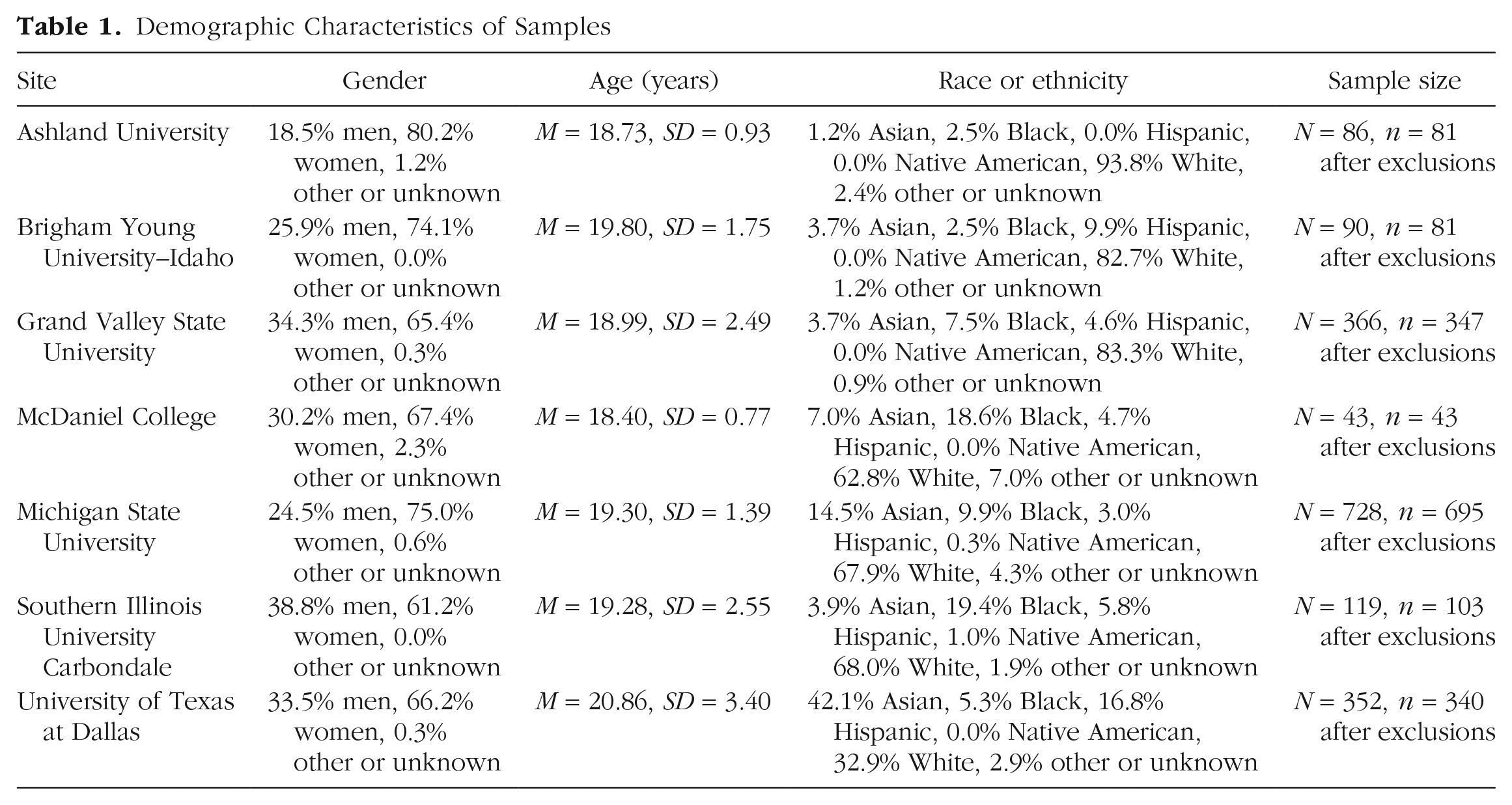
Ultimately, we collected data at seven colleges and universities; three sites exceeded the target of 330 participants, and four sites collected data from smaller samples (total N = 1,784). Demographic information for the seven sites is in Table 1. As in Sonnleitner and Voracek’s (2015) study, participants who did not separate their listed thoughts with “***” (as instructed) were excluded from analysis (excluded n = 47). Participants were also excluded if they did not complete the study. Completion was defined as entering at least one response to the study demographic questions, which were the last page of questions in the study (excluded n = 47). Table 1 notes the number of participants excluded per site (about 5% of all cases were excluded). The total sample size for the analyses was 1,690.
Demographic Characteristics of Samples
Materials and procedure
The experiment had a 3 (prime: action, inaction, neutral) × 2 (task: active, inactive) × 2 (protocol: RP:P, revised) between-subjects design. Participants completed the study at individual computer workstations. At six of the seven sites, each workstation was out of visual range of other workstations so that participants could neither see nor hear each other. At one site, participants wore headphones and were out of visual range of one another.
The study proceeded as in the original study and the previous replication, except as noted here. The basic procedure was as follows. After providing consent, participants were randomly assigned by the Qualtrics algorithm to be primed with action, inaction, or neutral words in a word-fragment-completion task (RP:P protocol) or a scrambled-sentence task (revised protocol). They were then randomly assigned to doodle or make a paper airplane (active task) or to rest (inactive task) for 2 min. When a chime sounded to inform them that it was time to move on to the next part of the study, they read a passage about vegetarianism, listed their thoughts in response to the passage 2 , and performed a word-fragment-completion task as a validity check (a new step). Finally, they completed a mood check and demographic questions (including a question about whether they were a vegetarian or vegan, which was added in Sonnleitner & Voracek’s, 2015, replication).
Alterations to the procedure
The study was administered using Qualtrics rather than E-prime (which was used in the original study and Sonnleitner & Voracek’s, 2015, replication). Unlike in the replication, but as in the original study, we collected data exclusively from U.S. respondents in order to avoid having to validate the primes in other linguistic and cultural contexts.
At the end of the study (after the main study tasks and just prior to demographic questions), participants completed a validity check so we could verify that the prime had its intended effect. We used the same validity check used in the validation study (described in Chartier et al., 2020, this issue). Because this validity check could have potentially disrupted the process of priming, and given that a check early in the protocol might have unintentionally cued explicit attention to primes, we included the validity check only at the end of the study, after the main procedures were completed.
For the validity check, participants completed the word fragments in Appendix B as a measure of accessibility of “action” and “inaction” concepts. If the priming manipulation was successful, participants primed with action would complete more word fragments as action-related words than participants primed with inaction, whereas participants primed with inaction would complete more word fragments as inaction-related words than participants primed with action. Further, given successful goal priming, this effect would be strongest for participants who did not have the opportunity to satisfy their action or inaction goal by doodling or making a paper airplane (action) or resting (inaction). The validity check was tested using similar analyses to the main study: one mixed-effects model with number of action-related completions as the dependent variable and one mixed-effects model with number of inaction-related completions as the dependent variable. If the main study’s hypothesis was supported (e.g., doing an action task reduces action goals), then we would predict an interaction effect on this validity check too.
Deviation from preregistered plan
After data collection was completed, we noticed that in the neutral scrambled-sentence priming condition, 1 of the 12 scrambled sentences contained an error. The 3rd scrambled sentence should have read: “there” “put” “the” “cheek” “lamp”
Instead it read: “there” “put” “the” “pause” “cheek”
In the action- and inaction-priming conditions, 8 of 12 sentences contained a priming word (either action or inaction related), whereas 4 sentences were neutral. In the neutral condition, all 12 sentences should have contained only neutral words, but because of the error, 1 sentence contained an inaction-related word. (Note, this error also affected the validation study reported by Chartier et al., 2020, in this issue and summarized in the Results section.)
Therefore, of the 12 conditions in the design, 2 were affected by the error. Both of these conditions were in the revised protocol. The 6 conditions that corresponded to the original study’s test of the focal Prime × Task interaction were faithfully tested. Additionally, the action- and inaction-priming conditions in the revised protocol were not affected.
Comparisons with the neutral condition in the revised protocol were potentially affected by the error, but other comparisons in the design remained intact. However, given the logic of accessibility theory, according to which additional exposures to primed concepts should strengthen accessibility, we suspected that the effects of this brief exposure to 1 out of 12 words would be minimal. Nonetheless, we consider the potential effects of this error further in the Discussion section.
Results
Analysis plan
We had a very similar analysis plan to Sonnleitner and Voracek (2015), adapting it to accommodate multisite data collection and the protocol manipulation (RP:P vs. revised). We tested the focal 3 × 2 (Prime × Task) interaction tested in both the original study and the RP:P replication and also extended this model to include one additional factor representing whether the RP:P protocol or the revised protocol was used, thus creating a focal 3 × 2 × 2 (Prime × Task × Protocol) interaction. Like Sonnleitner and Voracek, we preregistered a plan to follow up a nonsignificant focal test with a model that collapsed the priming variable from three levels (action, inaction, neutral) into two (action/inaction, neutral), as recommended by Albarracín during the design of Sonnleitner and Voracek’s study (see our preregistration document at https://osf.io/xpmyn/). As with the focal test, we conducted two models: a 2 × 2 (Prime × Task) model, like Sonnleitner and Voracek, and a 2 × 2 × 2 (Prime × Task × Protocol) model.
We adapted each of Sonnleitner and Voracek’s (2015) models to take the form of a mixed-effects model (to account for the nonindependence of participants nested within study site). Specifically, we first constructed a mixed-effects model with prime, task, and all two-way interactions as fixed effects. Prime was effects-coded with two contrasts (Contrast 1: action goal = 0.5, inaction goal = −0.5, neutral goal = 0; Contrast 2: action goal = 0.33, inaction goal = 0.33, neutral goal = −0.66). Task was effects-coded with a single contrast (active = 0.5, inactive = −0.5). We then added a main effect and all two-way and three-way interaction terms with protocol (RP:P = 0.5, revised = −0.5). Finally, we specified a random intercept for study site, as well as a random slope for each of the fixed effects.
Table 2 displays descriptive statistics for each condition (see also Fig. 1). The model did not converge, so as planned, we collapsed the four sites with small samples into one larger group (reducing the number of higher-level groups from seven to four). The model still did not converge, which required us to follow our plan to eliminate random-slope terms, beginning with higher-order interactions, until the model converged.
Descriptive Statistics for the Number of Thoughts Listed in Albarracín et al. (2008, Experiment 7), Sonnleitner and Voracek (2015), and the Current Replication Study
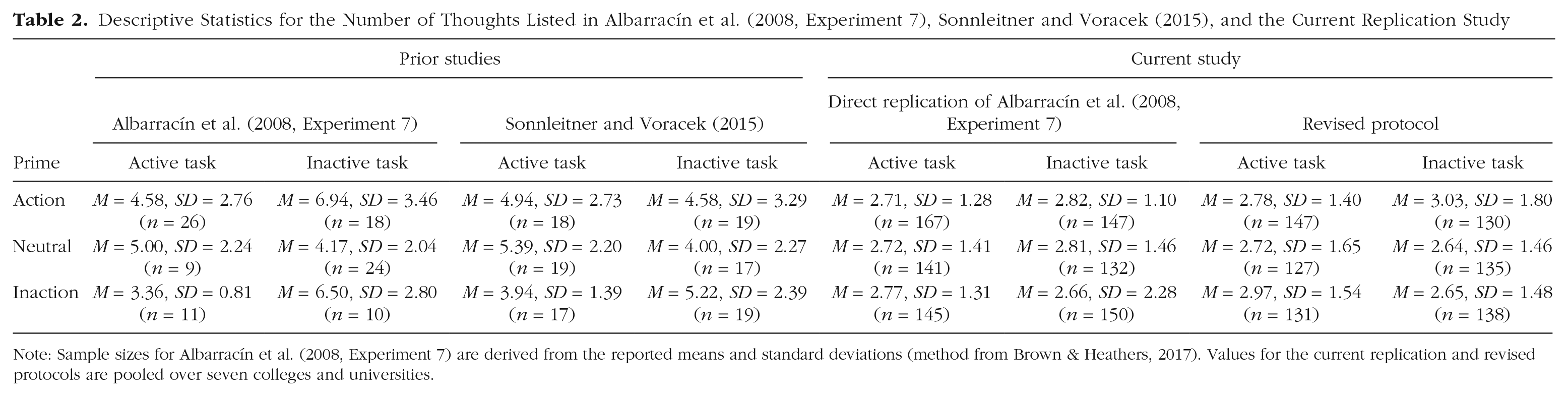
Note: Sample sizes for Albarracín et al. (2008, Experiment 7) are derived from the reported means and standard deviations (method from Brown & Heathers, 2017). Values for the current replication and revised protocols are pooled over seven colleges and universities.
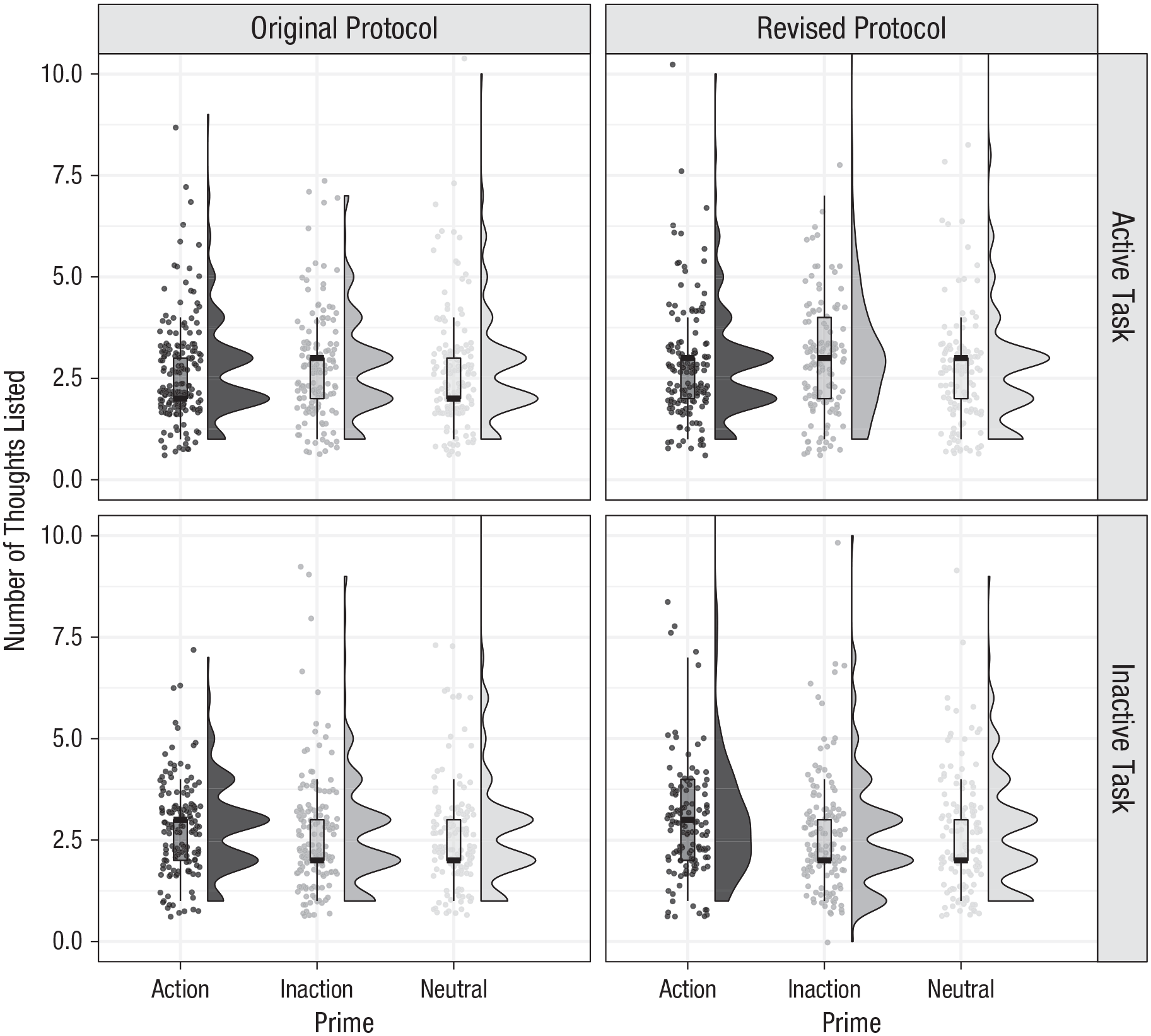
Distribution of thoughts listed as a function of priming condition (action vs. inaction vs. neutral), by protocol (columns; original vs. revised) and task (rows; active vs. inactive). Four outliers with values greater than 10 are not displayed for clarity. The boxplots show the range from the 25th to the 75th percentile (i.e., the interquartile range); the error bars extend 1.5 times the interquartile range, and the dark horizontal bars represent the median. The frequency curves show the density distributions of responses.
Validation study
Chartier et al. (2020, this issue) report a study validating the scrambled-sentence task we used. In that study, participants unscrambled sentences with action, inaction, or neutral themes (the same sentences as in the current study; see Appendix A) and then completed word fragments (again, the same fragments used in the current study; see Appendix B). Briefly, the validation study revealed that unscrambling action-related versus inaction-related sentences was associated with differential accessibility for action-related completions as well as for inaction-related completions. Overall, the effect of the manipulation was somewhat weaker (r = .10) for action-related completions than for inaction-related completions (r = .23). Thus, the (mostly) successful validation of the scrambled-sentence priming methodology in the current context allowed us to proceed more confidently with the focal-hypothesis test (but see the Discussion section for additional considerations).
Tests of the main hypothesis
Key 3 × 2 × 2 model
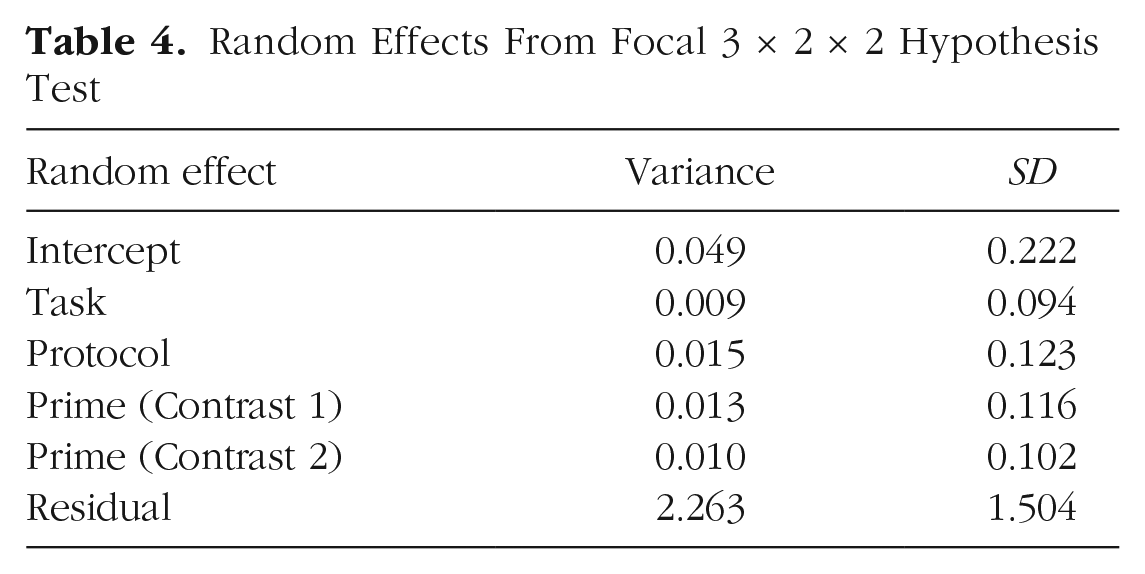
Tables 3 and 4 report the results of the full 3 × 2 × 2 model. A likelihood ratio test comparing the 3 × 2 model from Albarracín et al.’s (2008) Experiment 7 (ignoring protocol) with the model incorporating main effects of and interactions with protocol was not statistically significant. These effects did not explain additional variance in the model, χ2(11) = 5.26, p = .918. The amount of between-site variability in the number of thoughts listed was 2.09% per the intraclass correlation (τ = 0.222). Random slopes did not add significantly to the model (see Table 3). We next reran the mixed-effects model within each protocol in order to test whether the effects of interest replicated in each protocol separately.
Fixed Effects From Focal 3 × 2 × 2 Hypothesis Test
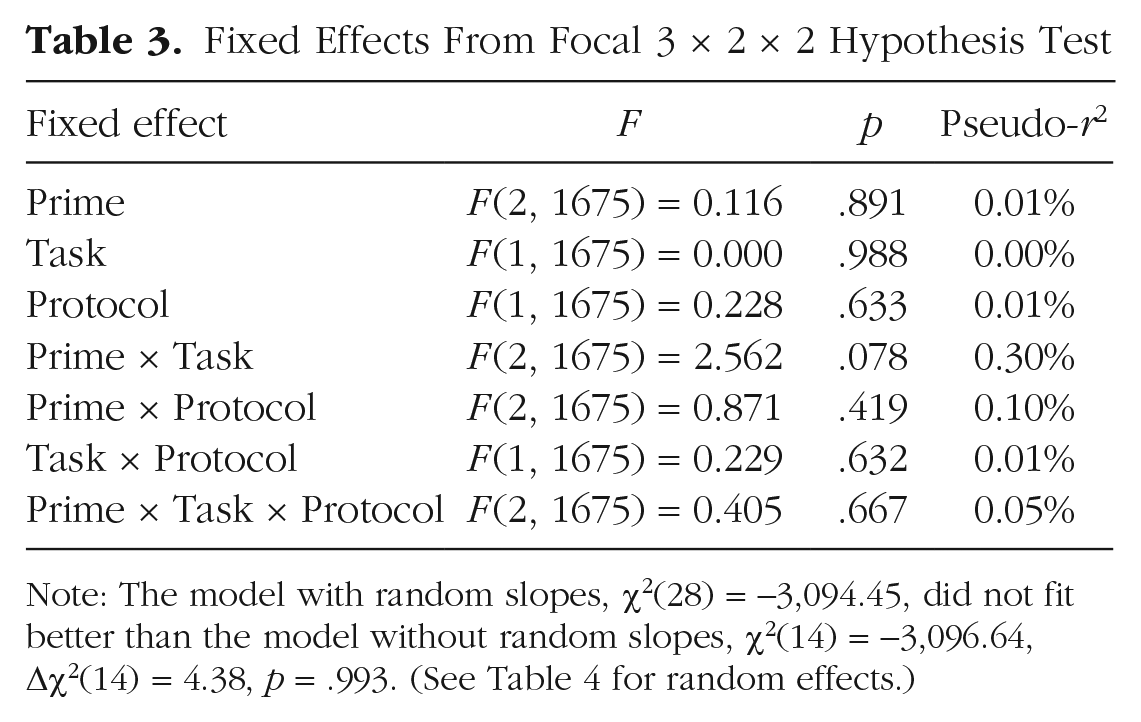
Note: The model with random slopes, χ2(28) = −3,094.45, did not fit better than the model without random slopes, χ2(14) = −3,096.64, Δχ2(14) = 4.38, p = .993. (See Table 4 for random effects.)
Random Effects From Focal 3 × 2 × 2 Hypothesis Test
Results of the RP:P protocol
As planned, we ran the 3 × 2 model with random slopes as specified earlier. This model did not converge, so we ran a model with the random slopes removed. The key 3 × 2 effect was not statistically significant in this direct replication of Albarracín et al.’s (2008) Experiment 7, F(2, 873) = 0.605, p = .546, pseudo-r2 = 0.01%. Full results are displayed in Table 5.
Results From the 3 × 2 Hypothesis Test for Each Protocol
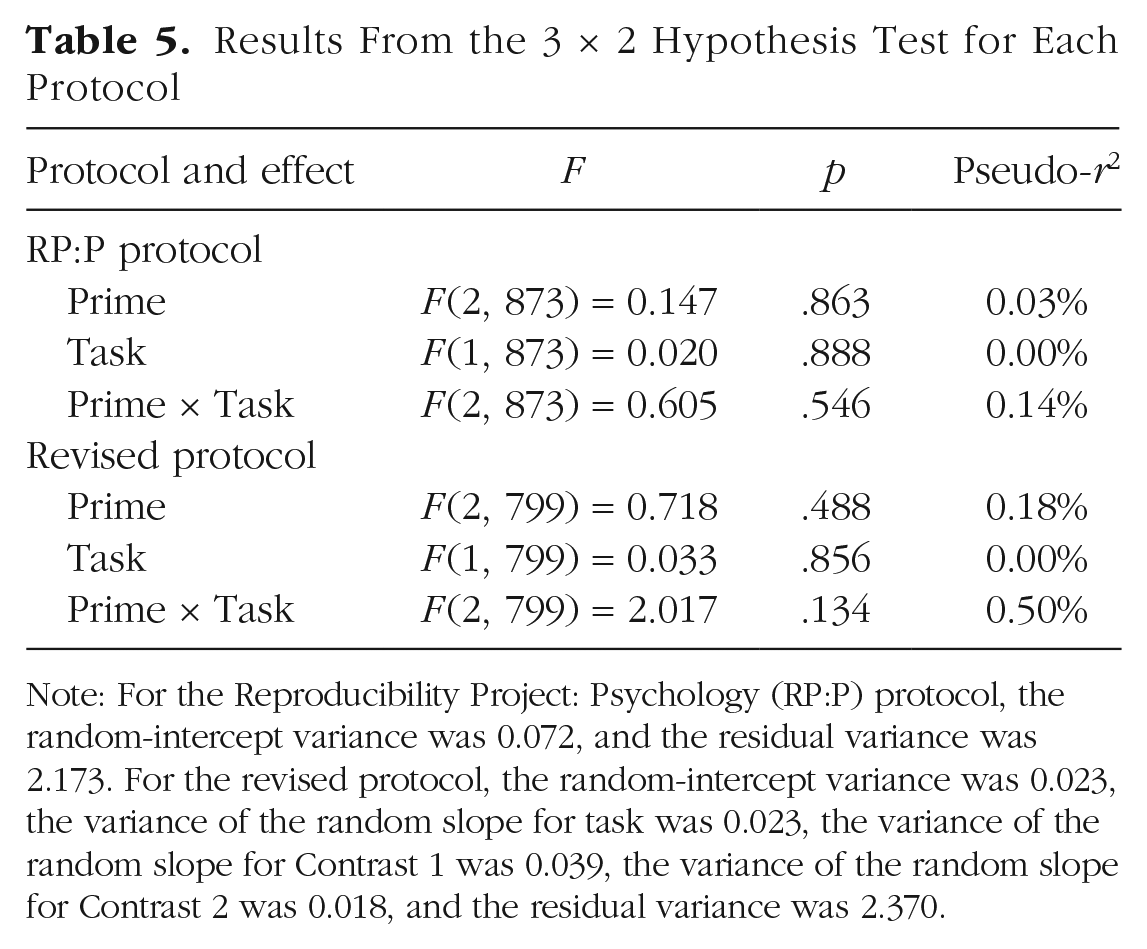
Note: For the Reproducibility Project: Psychology (RP:P) protocol, the random-intercept variance was 0.072, and the residual variance was 2.173. For the revised protocol, the random-intercept variance was 0.023, the variance of the random slope for task was 0.023, the variance of the random slope for Contrast 1 was 0.039, the variance of the random slope for Contrast 2 was 0.018, and the residual variance was 2.370.
Results of the revised protocol
The key 3 × 2 effect was not statistically significant in the conditions using scrambled sentences as the priming manipulation, F(2, 799) = 2.017, p = .134, pseudo-r2 = 0.05%. Full results are displayed in Table 5.
Follow-up 2 × 2 models
Given that the 3 × 2 focal interaction did not attain statistical significance in either protocol, as in Sonnleitner and Voracek (2015), we collapsed the action- and inaction-priming conditions into one group and reran the models (using the same random-effects structure that converged previously) with the following specifications: Model 1: Prime (action/inaction = 0.5 vs. neutral = −0.5) × Task (active = 0.5 vs. inactive = −0.5) Model 2: Prime (action/inaction = 0.5 vs. neutral = −0.5) × Task (active = 0.5 vs. inactive = −0.5) × Protocol (RP:P = 0.5 vs. revised = −0.5)
The model including protocol as a predictor was not a significant improvement on the model without protocol, Δχ2(8) = 3.88, p = .868. The key 2 × 2 × 2 interaction was not statistically significant, F(1, 1679) = 0.147, p = .701, nor was the focal 2 × 2 interaction in either the RP:P protocol, F(1, 875) = 0.166, p = .684, or the revised protocol, F(1, 801) = 0.013, p = .911. The focal 2 × 2 interaction was also not statistically significant in the initial model omitting protocol, F(1, 1683) = 0.037, p = .848. 3
Validity check
The models described in the previous sections were reproduced using the numbers of action-related completions and inaction-related completions from the validity check as the dependent variables. We found no evidence of a main effect of prime on either the number of action-related completions, pseudo-r2 = 0.19% or the number of inaction-related completions, pseudo-r2 = 0.00%. Additionally, prime did not interact with task to predict the number of either action-related completions, pseudo-r2 = 0.01% or inaction-related completions, pseudo-r2 = 0.01%. 4
However, unexpectedly, for both action- and inaction-related word completions, there was a main effect of protocol. The revised protocol was associated with higher numbers of completions of both types (action-related completions: pseudo-r2 = 3.69%; inaction-related completions: pseudo-r2 = 4.02%).
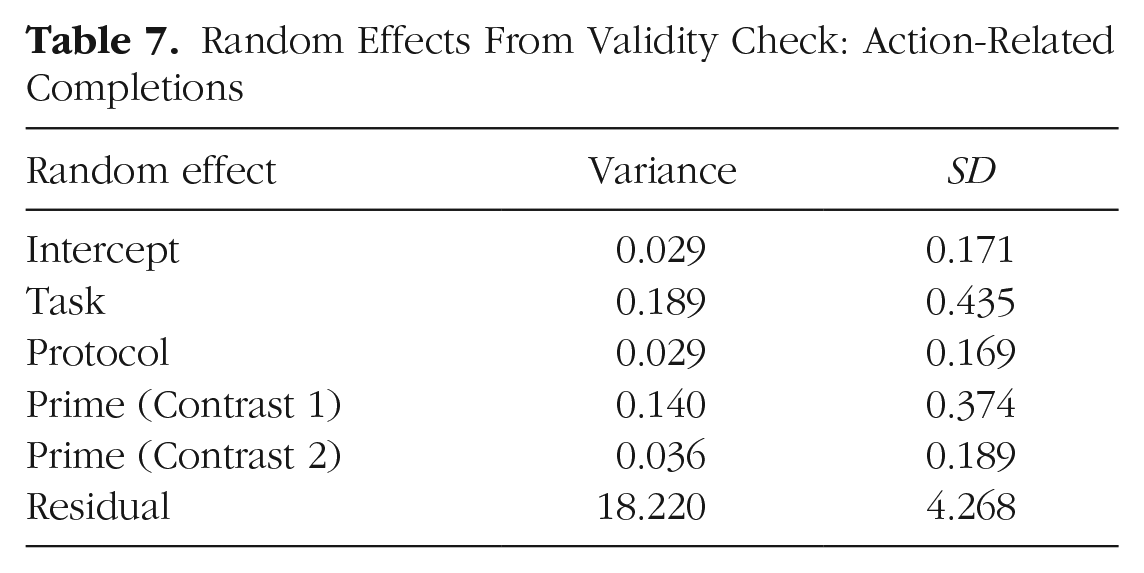
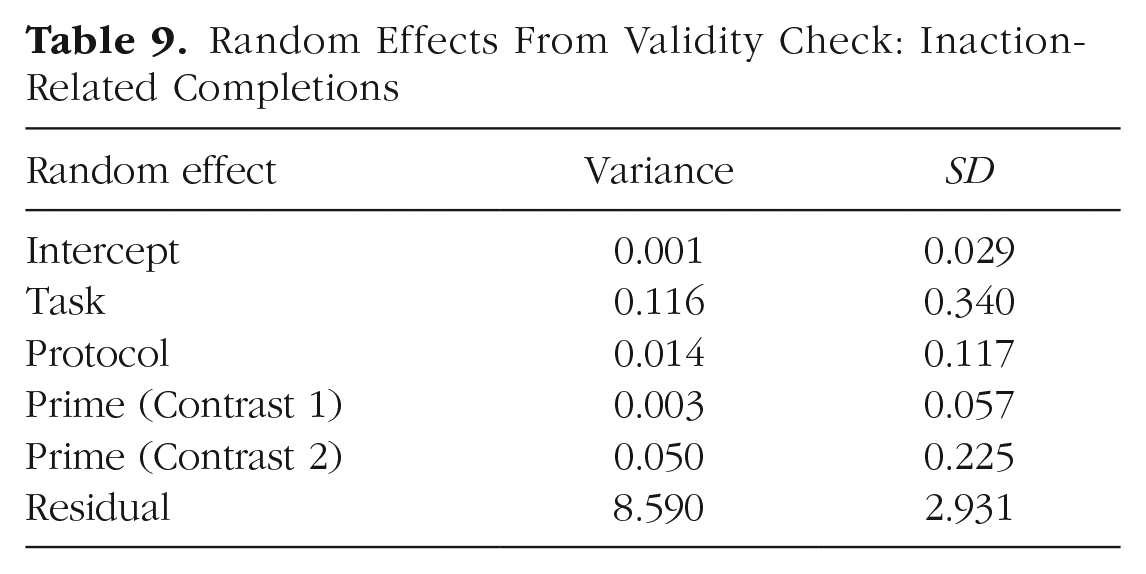
Also unexpectedly, these main effects of protocol were qualified by interactions. Protocol interacted with task to predict action-related completions (pseudo-r2 = 0.39%), for the RP:P protocol, the inactive task was associated with higher numbers of action-related completions than the active task, whereas the reverse was true for the revised protocol. For inaction-related completions, there was a statistically significant interaction of protocol with the prime contrast comparing action with inaction primes (pseudo-r2 = 0.73%); for the RP:P protocol, inaction primes, compared with action primes, were associated with lower numbers of inaction-related completions, whereas the reverse was true for the revised protocol. Tables 6 through 9 display the full results; Table 10 gives descriptive statistics.
Fixed Effects From Validity Check: Action-Related Completions
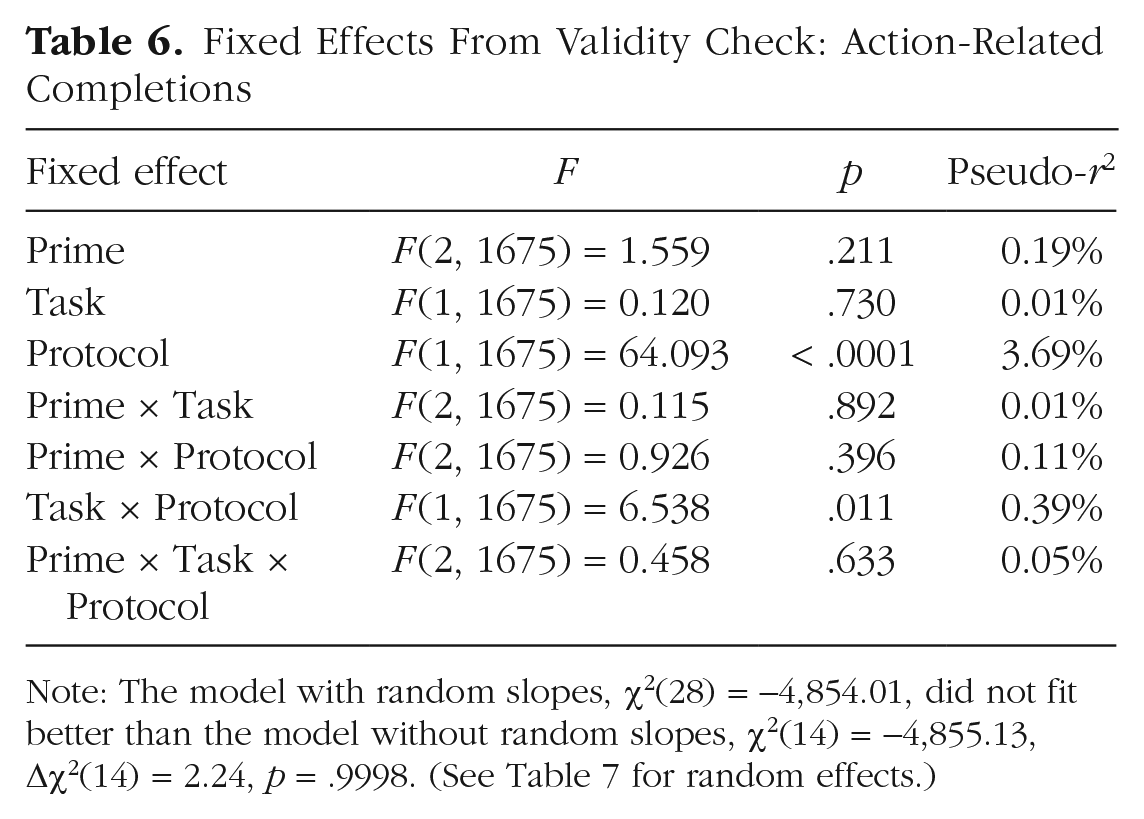
Note: The model with random slopes, χ2(28) = −4,854.01, did not fit better than the model without random slopes, χ2(14) = −4,855.13, Δχ2(14) = 2.24, p = .9998. (See Table 7 for random effects.)
Random Effects From Validity Check: Action-Related Completions
Fixed Effects From Validity Check: Inaction-Related Completions
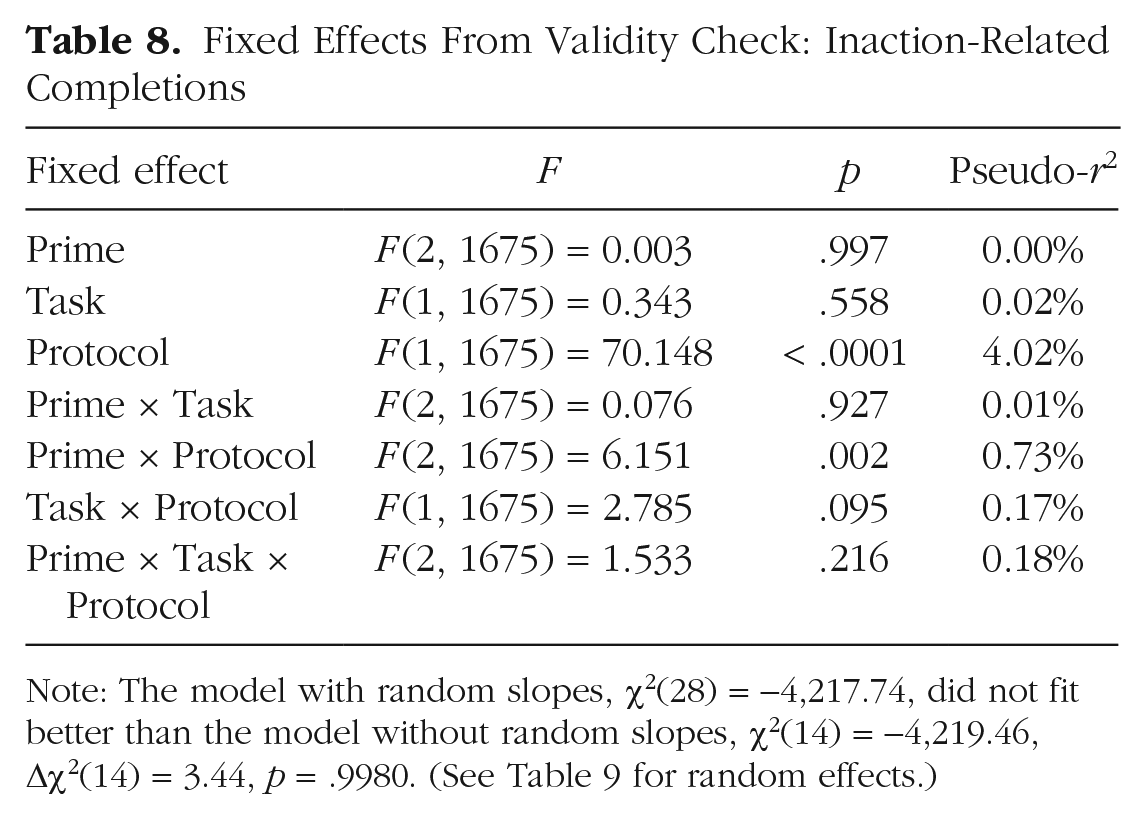
Note: The model with random slopes, χ2(28) = −4,217.74, did not fit better than the model without random slopes, χ2(14) = −4,219.46, Δχ2(14) = 3.44, p = .9980. (See Table 9 for random effects.)
Random Effects From Validity Check: Inaction-Related Completions
Descriptive Statistics for Validity Check
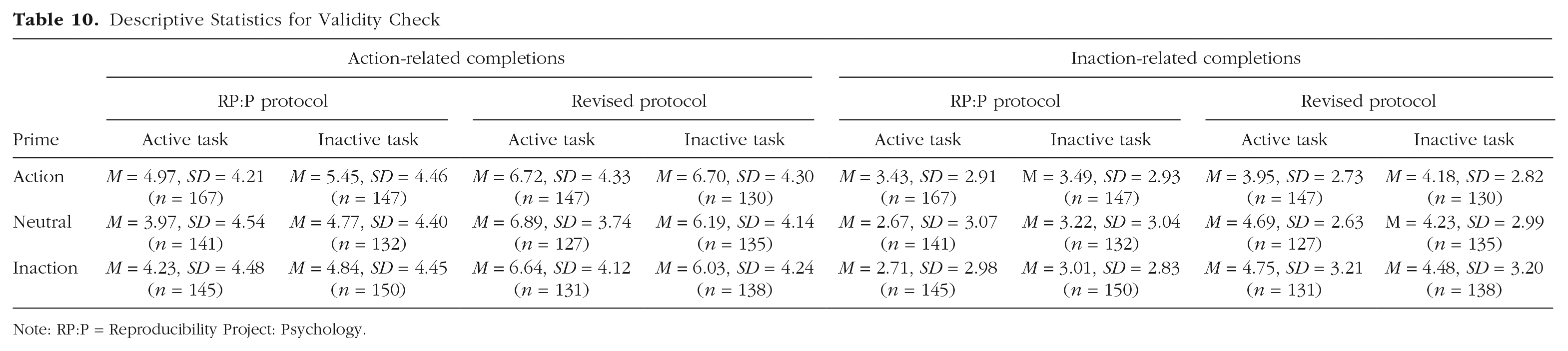
Note: RP:P = Reproducibility Project: Psychology.
Exploratory interpretation of validity check
Although the interaction effects are small in magnitude, they seem to suggest heightened accessibility of inaction-related concepts in the inaction-priming condition of the revised protocol compared with the RP:P protocol, as well as heightened accessibility of action-related concepts in the active-task condition of the revised protocol compared with the RP:P protocol. The larger main effects of protocol more clearly point to heightened accessibility of both action- and inaction-related concepts following the scrambled-sentence task compared with the word-fragment-completion task. However, the fact that the main effects of protocol were qualified by an interaction with the first prime contrast for inaction-related completions but not action-related completions suggests that the differences in accessibility may have been due less to prime content and more to features endogenous to the scrambled-sentence task (e.g., the phrasing of the directions or the act of unscrambling the sentences itself). 5
Discussion
The current study sought to further investigate the effects of action and inaction priming on cognitive output, following work by Albarracín et al. (2008, Experiment 7) and Sonnleitner and Voracek (2015). We directly replicated the procedures in the original study in a large multisite sample of college students in the United States, and we extended those procedures to use a more blatant priming method (similar to the methods used in other studies reported in the original Albarracín et al. article), given the issues that were observed with the word-fragment priming method used in the original study and in Sonnleitner and Voracek’s replication study. In general, our results did not support the original findings.
The current study used only participants in the United States, as did the original study; in contrast, Sonnleitner and Voracek (2015) conducted their study with German participants. Our protocol that used word-fragment priming yielded results that mimicked those of Sonnleitner and Voracek, which suggests that differences in linguistic and cultural contexts were not the sole reason for Sonnleitner and Voracek’s failure to replicate the original study. However, our protocol that used scrambled-sentence priming also did not provide support for Albarracín et al.’s (2008) conclusions.
Notably, there was a seemingly large difference in the average number of thoughts generated between our study and both Sonnleitner and Voracek’s (2015) replication and Albarracín et al.’s (2008) Experiment 7 (see Table 2). It is possible that this difference stemmed from our decision to switch the experimental software to Qualtrics from E-prime (which both Sonnleitner and Voracek and Albarracín et al. used). We made this choice to increase the number of labs that could contribute to the current project. It may be that somewhat arbitrary differences between the two programs’ displays (e.g., the size of the response field) caused participants to list fewer thoughts overall in our study. Alternatively, participants in our study may have been less engaged with the thought-listing task than previous participants were, though it is not immediately apparent why that would be the case, especially given the similarity in sample characteristics and design between the original study and the current attempt. The decrease in the overall mean number of thoughts listed did not necessarily preclude us from detecting any between-conditions differences, given that the means we observed do not appear to have been at the floor (i.e., there was still sizable within-condition variability).
Intriguingly, the results of the validation study (Chartier et al., 2020, this issue) suggest that action priming may not be an effective means of increasing accessibility of action-related concepts. Although inaction priming caused stronger accessibility of inaction-related concepts compared with neutral and action priming, the effect of action priming on action-related concepts was not as strong as these effects of inaction priming. Indeed, the effect of action priming on action-related concepts was not detectably different from the effect of inaction priming on action-related concepts. In the current study, for participants primed with scrambled sentences, a similar pattern was observed; accessibility of inaction-related concepts, but not action-related concepts, differed between conditions (see Tables 8 and 9). We note that the current validity check suggests that the effects of the error in the scrambled-sentence task (which resulted in participants in the neutral condition having inadvertent exposure to one inaction-related word) were relatively minimal.
Overall, despite some success with priming inaction-related concepts in our study, this heightened accessibility did not translate into downstream consequences for the thought-listing task. In this way, our results are similar to those observed by McCarthy et al. (2018). That study used scrambled sentences to prime aggression-related concepts, and, as in the scrambled-sentence conditions in the current attempt, a validation test revealed a statistically significant, but small, effect of priming on word-fragment completion (r = .15 or r = .25, depending on scoring strategy). Also, as did the current study, it failed to find an effect of priming on downstream behavioral consequences. Taken together, the results of the current study and McCarthy et al. may suggest that scrambled-sentence primes do not have large enough effects on accessibility to produce reliable downstream effects on behavior. Alternatively, the primes may have small but robust effects on accessibility, but the effects of this accessibility on later cognition and behavior may be minimal.
The current study does have limitations and constraints on generalizability. First, as just noted, although results are consistent with other studies using the scrambled-sentence priming methodology, it remains to be seen whether our findings apply only to the domain of action and inaction priming or apply more broadly. Second, in the revised protocol, an error in the materials led to contamination of the neutral-priming condition; participants were exposed to an inaction-related word. Although this was a relatively minor error, it does render the effects of those conditions harder to interpret (despite some evidence from the validation study suggesting that the error was not associated with differences in the accessibility of action- or inaction-related concepts). Furthermore, our validity-check results did not support the notion that action-related concepts were more accessible in the action-priming conditions than in the neutral-priming conditions (under either the RP:P or the revised protocol), but these results are somewhat hard to interpret given that the validity check occurred at the end of the study, after accessibility may have decayed.
Conclusion
The current study investigated the effects of action and inaction priming on cognitive outputs. Overall, we found little support for the hypothesis that participants primed with action or inaction goals, which are subsequently fulfilled or not, behave more or less actively in a later task compared with participants who receive a neutral prime. The results suggest that scrambled sentences are a more effective priming method than word fragments, but heightened accessibility stemming from primes may not translate into downstream consequences for behavior on a thought-listing task.
Supplemental Material
Corker_AMPPSOpenPracticesDisclosure-v1-0 – Supplemental material for Many Labs 5: Registered Replication of Albarracín et al. (2008), Experiment 7
Supplemental material, Corker_AMPPSOpenPracticesDisclosure-v1-0 for Many Labs 5: Registered Replication of Albarracín et al. (2008), Experiment 7 by Katherine S. Corker, Jack D. Arnal, Diane B. V. Bonfiglio, Paul G. Curran, Christopher R. Chartier, William J. Chopik, Rosanna E. Guadagno, Amanda M. Kimbrough, Kathleen Schmidt and Bradford J. Wiggins in Advances in Methods and Practices in Psychological Science
Footnotes
Appendix A: Scrambled-Sentence Task (From Albarracín et al.,2008)
The following paragraphs reproduce the scrambled-sentence task used in Albarracín et al.’s (2008) Experiment 5. Words that differed across the three conditions are in italics; words separated by a slash were presented in the inaction and action conditions, respectively, and words that were substituted in the neutral condition are shown in brackets.
We are pretesting some materials to see whether they should be used in our future studies. It is important that you pay close attention to each task so you can tell us your opinion. In the task, we will show you FIVE words that are disordered. Your goal is to order FOUR of the words to make a complete sentence. Let’s consider an example. Suppose you are provided the following FIVE words: “she” “an” “apple” “door” “ate” You could order FOUR of the words to make the complete sentence: “She ate an apple.” Let’s begin! 1. Your five words are: “I” “them” “see” “shoes” “occasionally” Please arrange FOUR of them to make a complete sentence that you should type in the space below. 2. Your five words are: “still/motivation” “Alice” “yesterday” “went” “home” [new word for neutral condition: branch] Please arrange FOUR of them to make a complete sentence that you should type in the space below. 3. Your five words are: “there” “put” “the” “pause/doing” “lamp” [new word for neutral condition: cheek] [Note: In the neutral condition, “cheek” was inadvertently substituted for “lamp” instead of “pause.” Thus, participants in the neutral condition viewed “there” “put” “the” “pause” “cheek.”] Please arrange FOUR of them to make a complete sentence that you should type in the space below. 4. Your five words are: “me” “green” “she” “to” “spoke” Please arrange FOUR of them to make a complete sentence that you should type in the space below. 5. Your five words are: “was” “that” “a” “gesture” “interrupt/go” [new word for neutral condition: listen] Please arrange FOUR of them to make a complete sentence that you should type in the space below. 6. Your five words are: “malls” “people” “shop” “at” “calm/behavior” [new word for neutral condition: chair] Please arrange FOUR of them to make a complete sentence that you should type in the space below. 7. Your five words are: “this” “salty” “is” “food” “freeze/engage” [new word for neutral condition: true] Please arrange FOUR of them to make a complete sentence that you should type in the space below. 8. Your five words are: “the” “tells” “inaction/make” “watch” “time” [new word for neutral condition: large] Please arrange FOUR of them to make a complete sentence that you should type in the space below. 9. Your five words are: “the” “your” “big” “moon” “looks” Please arrange FOUR of them to make a complete sentence that you should type in the space below. 10. Your five words are: “lamps” “homes” “homes” [sic] “in” “foot” Please arrange FOUR of them to make a complete sentence that you should type in the space below. 11. Your five words are: “candles” “provide” “paralyze/active” “added” “light” [new word for neutral condition: canvas] Please arrange FOUR of them to make a complete sentence that you should type in the space below. 12. Your five words are: “book” “stop/action” “is” “the” “fictional” [new word for neutral condition: see] Please arrange FOUR of them to make a complete sentence that you should type in the space below. Please tell us what you thought of the task. How enjoyable did you find this task? 1 (not at all) to 5 (extremely)
Appendix B: Word-Completion Task
Table B1 summarizes the stimuli that were developed for the validity check added to this study.
Transparency
Action Editor: Daniel J. Simons
Editor: Daniel J. Simons
Author Contributions
We categorized contributions using the Contributor Roles Taxonomy (CRediT;  ). K. S. Corker supervised and administered the project, designed the methodology, programmed the study, managed the investigation process and data curation, performed data analysis, wrote the original draft of the manuscript, and supervised review and editing of the manuscript. P. G. Curran independently reproduced all the data analyses and participated in reviewing and editing the draft. D. B. V. Bonfiglio facilitated validation of the study’s manipulation. J. D. Arnal, C. R. Chartier, W. J. Chopik, R. E. Guadagno, A. M. Kimbrough, K. Schmidt, and B. J. Wiggins conducted the investigation and participated in reviewing and editing the manuscript.
ORCID iDs
Notes
References
Supplementary Material
Please find the following supplemental material available below.
For Open Access articles published under a Creative Commons License, all supplemental material carries the same license as the article it is associated with.
For non-Open Access articles published, all supplemental material carries a non-exclusive license, and permission requests for re-use of supplemental material or any part of supplemental material shall be sent directly to the copyright owner as specified in the copyright notice associated with the article.
