



Abstract

Original article: Simonsohn, U. (2018). Two lines: A valid alternative to the invalid testing of U-shaped relationships with quadratic regressions. Advances in Methods and Practices in Psychological Science, 1, 538–555. doi:10.1177/2515245918805755
Figure 1 in this article used results from Simonton (1976) to illustrate that a statistically significant quadratic term in a linear regression need not imply a U-shaped relationship, because the implied inflection point could be outside the set of possible values. However, Figure 1 did not take into account that Simonton mean-centered the predictors. The correctly computed inflection point, obtained by assuming a quadratic function, actually does fall within the set of possible values. The author thanks Dean Simonton for alerting him to this error, which is now being corrected. Figure 1 is being replaced with the new figure shown on the next page, and the section titled “Level 1: Is the Quadratic Term Significant?” is being replaced with the following:
The most basic approach involves checking if the estimates of a and b in y = ax + bx2 imply a U-shaped function and if the estimate of b is statistically signifcant. This approach is advocated in some prominent textbooks. For example, Cohen et al. (2003) wrote, “The [quadratic] coefficient is negative [and significant] . . . , reflect[ing] the hypothesized initial rise followed by decline” (p. 198; italics added). The significant coefficient need not, in fact, imply a U-shaped relationship.6 Imagine estimating a regression using soccer players’ educational achievement (x) to predict the number of goals (y) they scored during their careers, and that the regression analysis yielded the following results: y = 4.872x – 11.96x2. Figure 1 shows that even if the quadratic coefficient is significant, and even though the implied overall relationship between x and y is U shaped, the regression results do not imply a U-shaped relationship between education and number of goals within the range of possible x values. For every possible value of x, higher x is associated with lower y. Only for negative (impossible) values of education are higher values of x associated with higher values of y.
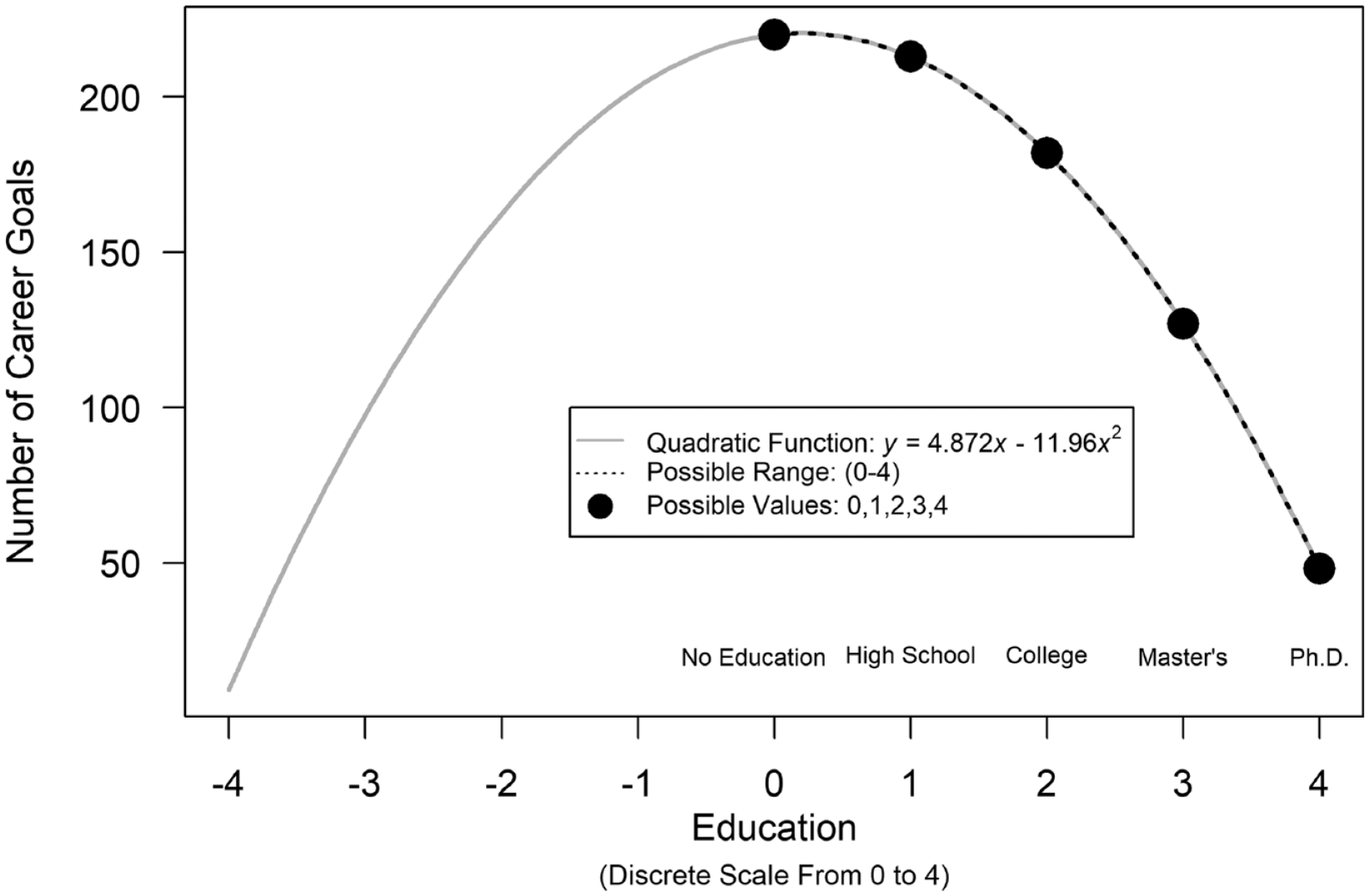
Hypothetical example of a significant quadratic term not associated with an actual U shape. Number of goals scored by soccer players during their careers is graphed as a function of the players’ educational achievement. Although the regression analysis yielded a quadratic function, the overall pattern is U shaped only if impossible values of x are included.
Simonton, D. K. (1976). Biographical determinants of achieved eminence: A multivariate approach to the Cox data. Journal of Personality and Social Psychology, 33, 218–226.