




Abstract

The Many Labs 2 project described in this issue (Klein et al., 2018, this issue) included one of our previous studies (Kay, Laurin, Fitzsimons, & Landau, 2014, Study 2), which showed that reminding people of predictable structure in their physical environment promoted goal pursuit. It seems uncontroversial that perceiving the external world as well structured is a prerequisite for motivation. If people instead perceived the world as chaotic, they would have little confidence that their actions would get them any closer to their goals. Indeed, the notion that structure facilitates goal-directed action is fundamental to theoretical perspectives from diverse corners of psychology (Atkinson, 1957; Becker, 1964; Emmons, 1986; Heine, Proulx, & Vohs, 2006; Kay, Gaucher, Napier, Callan, & Laurin, 2008; Lerner, 1977, 1980; Pervin, 1989).
Nonetheless, the data gathered in the Many Labs 2 project failed to replicate our findings. Participants who read about structure (vs. chaos) in their environment did not express greater willingness to pursue personal goals. One possible explanation is that perceptions of structure have no impact on motivation, and our findings were mere artifacts. This could well be true. However, given the abundant theoretical support for our hypothesis, we wondered if our results could be replicated in modified forms. In this article, we examine what those might be.
One clue comes from our follow-up study (Kay et al., 2014, Study 5) showing that the hypothesized effect emerged specifically among individuals who, at baseline, perceived a weak relation between their actions and outcomes. People who strongly believe their actions produce expected outcomes presumably already perceive the world as predictably structured, and therefore do not need to be reminded of this to feel motivated. A related moderator emerged in subsequent research: Reminders of structure provided by a powerful God boosted motivation only among participants with low self-efficacy (Khenfer, Roux, Tafani, & Laurin, 2017). Participants with high self-efficacy—who were confident that their actions reliably produce desired outcomes—showed the reverse effect. Neither moderator—action-related perceptions or self-efficacy—was assessed in the Many Labs study because it was a replication of our Study 2.
Still, the Many Labs data offered us the further opportunity to explore moderation by individual differences. The most reasonable index of our conceptual moderator in the data set is the measure of self-esteem (Robins, Hendin, & Trzesniewski, 2001). People high in self-esteem are confident that they can achieve their goals through their own personal agency (Harter, 1978; Kuhl, 1992; Nicholls, 1984), and such confidence implies strong beliefs in structure and contingency (Laurin & Kay, 2017). We therefore predicted that reminders of structure would boost motivation among participants low, but not high, in self-esteem—at least in the North American populations our past research drew on.
We tested this prediction first with the randomly selected one third of the Many Labs 2 data initially made available. Using the data collected in the United States and Canada, we ran a multilevel model with the following predictors: self-esteem (centered), condition (structure = 1, no structure = −1), their two-way interaction, and random intercepts for the specific labs that collected the data. The dependent measure in the Many Labs 2 project was a composite of two items (how much participants would work hard and how much they would sacrifice to achieve their goal) with the subjective value of the goal partialed out. As a simpler way of testing the same variable, we used the composite itself as our dependent measure and included subjective value as a covariate in the model. The predicted interaction emerged. Aiken and West’s (1991) method revealed that among participants low in self-esteem, being reminded of order in the physical environment increased motivation, but participants high in self-esteem showed the reverse effect (see Table 1 for a complete summary of the results obtained using this method). Thus, our original finding (Kay et al., 2014, Study 2) was replicated among participants low in self-esteem.
Coefficients From Analyses of the North American Samples
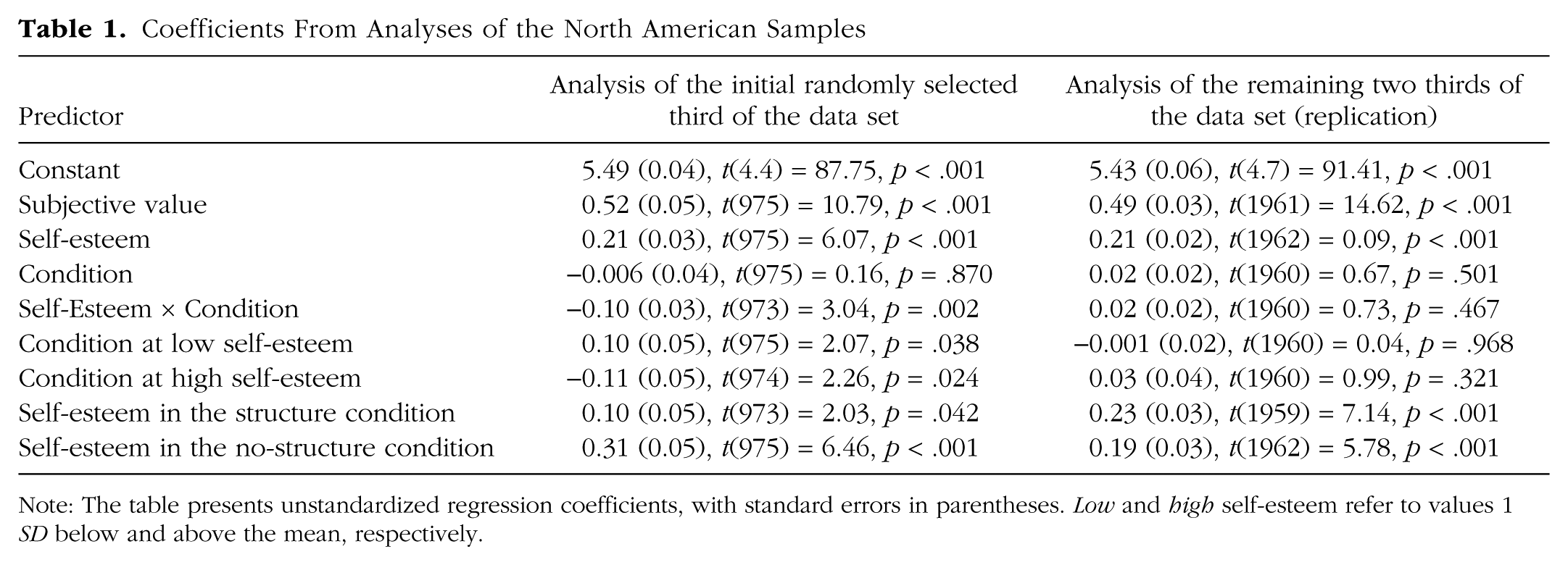
Note: The table presents unstandardized regression coefficients, with standard errors in parentheses. Low and high self-esteem refer to values 1 SD below and above the mean, respectively.
We then explored cultural variability. Past research suggests that self-esteem and personal agency correspond with preexisting beliefs about the external world in individualist cultures that prioritize the self, whereas this relation is less pronounced in collectivist countries that define the self in interpersonal terms (Oyserman, 2011). Going further, we predicted that self-esteem would moderate the motivating effect of structure on goal pursuit in individualist, but not collectivist, cultural contexts.
Thus, we reran the analysis on the data in this entire subset of the Many Labs 2 data set, including country-level individualism (Hofstede Insights, n.d.; see Table 2) as the third predictor (with random intercepts for lab nested within country). A significant three-way interaction emerged. As expected, Aiken and West’s (1991) method revealed that at 1 SD above the mean of country-level individualism, the predicted Self-Esteem × Condition interaction was replicated; at 1 SD below the mean of country-level individualism, this interaction did not emerge (see Table 3 for a complete summary of the results obtained using this method).
Scores for Individualism for All the Countries Sampled
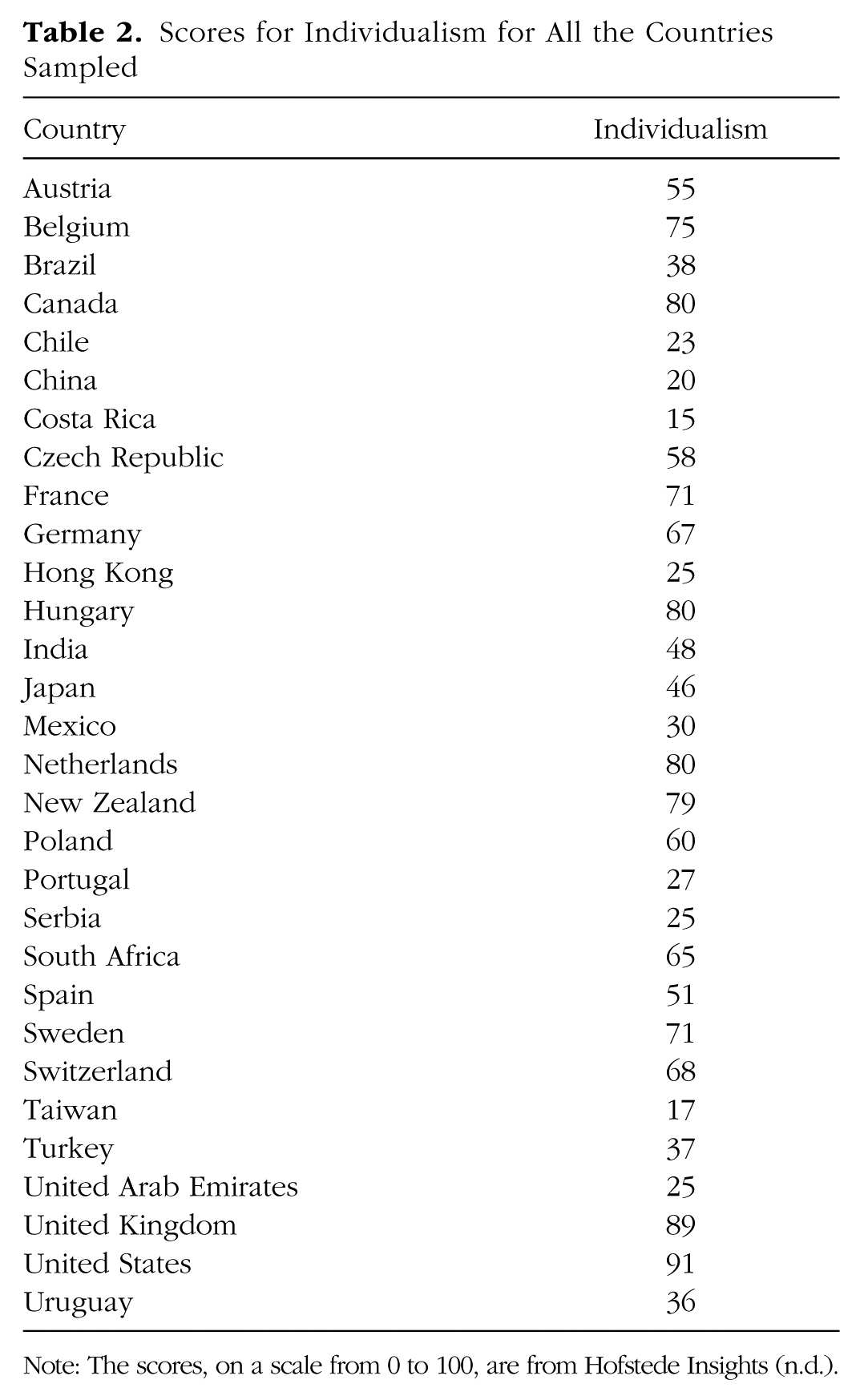
Note: The scores, on a scale from 0 to 100, are from Hofstede Insights (n.d.).
Coefficients From Analyses Including Country-Level Individualism as a Predictor
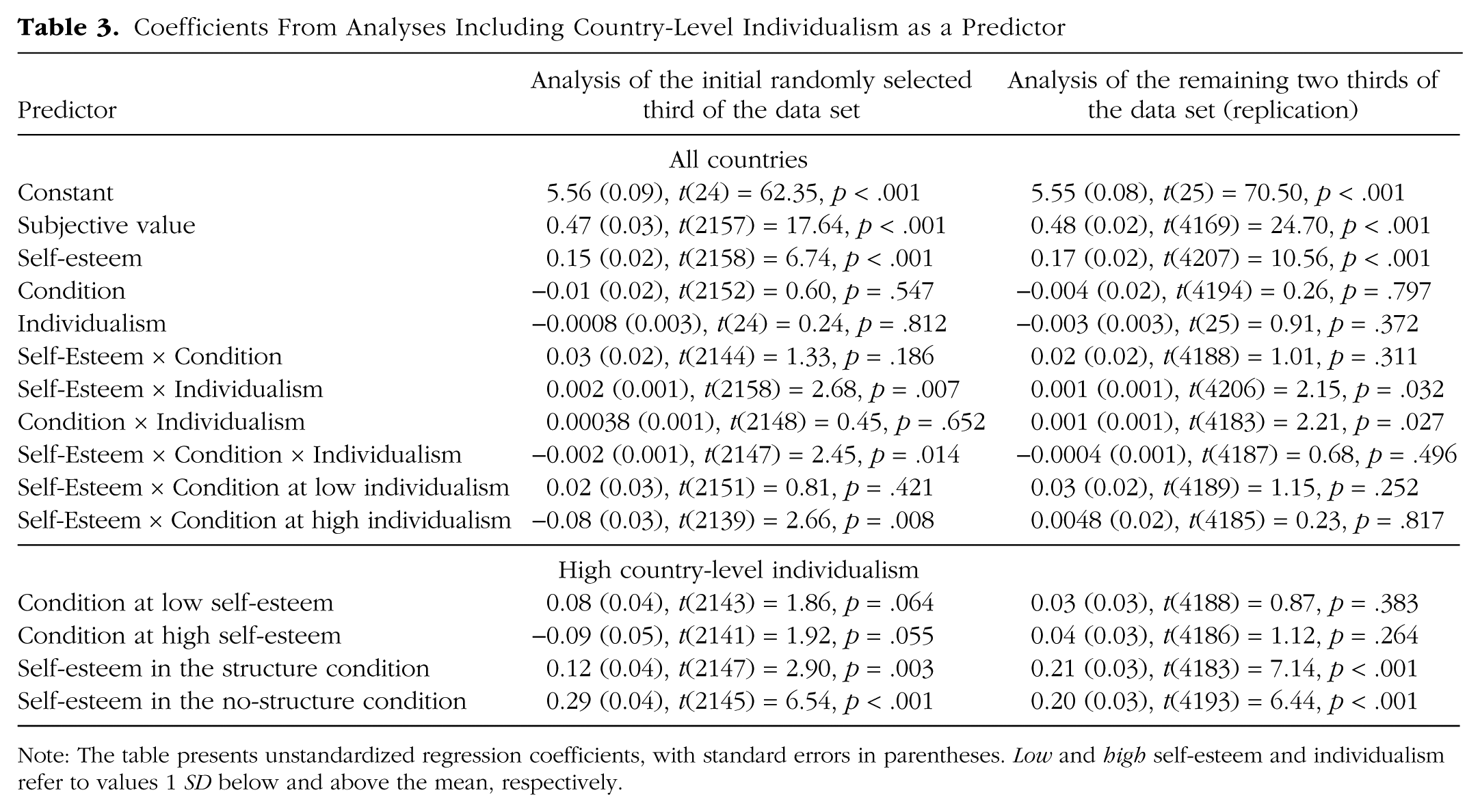
Note: The table presents unstandardized regression coefficients, with standard errors in parentheses. Low and high self-esteem and individualism refer to values 1 SD below and above the mean, respectively.
These findings suggest that reminders of structure bolster motivation particularly among low-self-esteem individuals in relatively individualist countries. Three-way interactions are often underpowered, and should be treated with caution. Therefore, to conduct a confirmatory test of this exploratory result, we preregistered our analyses (https://osf.io/yefzn/?view_only=e8426ab0b99f46ab8856c01eb6a9c962) and ran them on the remaining two thirds of the Many Labs 2 data. The results were inconsistent with the preliminary results; we did not observe a two-way interaction in the North American sample (see Table 1) or a significant three-way interaction (see Table 3). These confirmatory findings help clarify the value of further research on this topic and point to the need for more nuanced theorizing in this area.
Footnotes
Action Editor
Daniel J. Simons served as action editor for this article.
Author Contributions
K. Laurin and A. C. Kay developed the conceptual ideas expressed in this Commentary, in consultation with M. J. Landau. K. Laurin conducted the analyses. K. Laurin, A. C. Kay, and M. J. Landau drafted the manuscript.

Declaration of Conflicting Interests
The author(s) declared that there were no conflicts of interest with respect to the authorship or the publication of this article.