




Abstract
Background:
Seasonal influenza vaccination is recommended for certain at-risk groups in Bulgaria, but vaccine coverage and the population’s perception of vaccination are currently unknown. The objective of this study was to assess the level of seasonal influenza vaccination in Varna Region, Bulgaria. It also aimed to investigate the status of knowledge and the attitude towards the reliability, safety, and other aspects associated with the use of influenza vaccines.
Methods:
A cross-sectional survey was conducted among 120 responders in Varna Region, Bulgaria. They completed a questionnaire assessing the practice, knowledge, and attitude towards seasonal influenza vaccination.
Results:
Nearly 70% of all responders have never been vaccinated against seasonal influenza in their lives. The main reason indicated was a lack of confidence in the vaccine in general (53.7% of nonvaccinated responders). Individuals with insufficient knowledge, or with a negative perception, were more likely to not be vaccinated: being poorly informed and having a negative attitude towards influenza vaccination also decreased the chance of being vaccinated by 29% and 36%, respectively.
Conclusions:
This study indicates that efforts should be made towards achieving better understanding and knowledge of the vaccine’s mechanism of prevention and effectiveness among the Bulgarian population.
Introduction
Seasonal influenza occurs at regular periods and, although regarded as a common and often underestimated disease, it exhibits significant morbidity across European countries. Each year, the European Centre for Disease Prevention and Control reports 4–50 million symptomatic cases and 15,000–70,000 lethal cases in EU/EEA countries. 1 Certain at-risk groups (elderly, chronically ill patients, pregnant, children) are especially vulnerable to severe infection and complications.
The annual influenza vaccination is the most important measure to prevent infection transmission and to reduce economic and social burden. 2 Safe and effective vaccines are available in all European countries, including Bulgaria, where a national seasonal influenza vaccination program exists and immunization is recommended for (1) individuals 65 years of age and above; (2) people with chronic pulmonary diseases, cardiovascular diseases, metabolic diseases, renal diseases, and immunosuppression; (3) people living in closed groups (care facilities, barracks, prisons); (4) people with high-risk professions (health care workers, transport workers, etc.); and (5) contacts of at-risk individuals. 3 However, no national recommendations are issued for pregnant women and children, and the vaccination costs are not covered by the National Health Fund.
The European vaccination coverage target was set at 75% in vulnerable groups, 4 but different countries have widely varying coverage rates: in general, high-income countries distribute a higher number of vaccines compared with middle- and low-income countries. 5 Recently, only the Netherlands and the United Kingdom reported reaching the 75% vaccination goal in older age groups. 6 In Bulgaria, which is an upper-middle-income country, the national statistic and surveillance bodies are not able to provide the exact coverage rate in the country, but the number of purchased and administered doses of influenza vaccines for the 2014–2015 season was 254,586 (which yielded an estimate of 3.5% vaccinated people in the general population). 6 To the best of the authors’ knowledge, studies examining the influenza vaccination rates with more precise methods are not available for the general Bulgarian population, or for the specific population groups targeted for vaccination.
The varying influenza vaccine coverage across countries corresponds to the level of knowledge and attitude toward seasonal influenza vaccines, both in the general population and in the at-risk groups: individuals with little knowledge and a negative attitude towards vaccination are usually not vaccinated.7 –10 In addition to the lack of information on vaccine coverage, the perception and the beliefs of Bulgarians regarding the seasonal influenza vaccination are currently unknown. This prompted us to explore the knowledge, attitude, and practice toward the reliability, safety, and other aspects associated with the use of influenza vaccines among the population of Varna Region, Bulgaria.
Materials and methods
Participants and questionnaire
We conducted a cross-sectional study between March and June 2018 after the end of the 2017–2018 influenza season in Varna. Varna is the third-largest region of Bulgaria and is located on the Bulgarian Black Sea coast. The total population of the region was estimated to be 471,252 at the end of 2018. 11 The majority of the population live in urban areas (84%) and are mainly employed in the service-based sector (tourism and international maritime transport). Owing to the significant proportion of people in high-risk occupations, we assumed a higher level of influenza vaccination among the Varna population compared with the rest of the country. To calculate sample size, 12 we set the expected prevalence at 5% and chose a precision of 4% (1–9% width of confidence interval) because of the uncertainty in expected coverage rate. Therefore, the required sample size for the survey was calculated as 114. We assumed a 30% attrition rate and fixed the final sample size to 150 responders.
To confirm the validity, the clarity and the ease of administration of the planned survey, a pilot study was organized among 15 individuals of different ages and occupations. After the required corrections, a final 14-question questionnaire assessing the knowledge and attitude towards the influenza vaccination was designed. The final version of the questionnaire consisted of four main parts: (1) demographic information: sex, age, residence, education level, and occupation; (2) knowledge of the influenza vaccine (five questions); (3) attitude toward the influenza vaccine (four questions); and 4) practice of influenza vaccination (five questions). The survey locations (a beauty studio, a shop, a pharmacy, and a medical college) were chosen on the basis of the following criteria: the owner’s willingness to contribute, central location, easy accessibility, and visibility. At each location, one or more employers received instructions on how to invite people to participate and how to explain the objective of the study. Participation in the study was suggested to all individuals aged 18 years or above who visited the locations during the standard working day during the survey period. The anonymity of individuals who agreed to contribute was assured and their verbal informed consent was obtained before they completed the questionnaire, following a clear explanation of the study objectives. When 147 questionnaires had been collected the survey was terminated. A total of 120 responders returned completed questionnaires with no missing data. These individuals were considered eligible for the study.
Data collection and analysis
To avoid errors in results collection, two researchers independently entered the results from each of the completed questionnaires. After the verification of the entered results, the data was statistically processed with R-commander software (R project, 13 ) to calculate proportions and confidence intervals. A chi-squared test was used to compare categorical outcomes. The results from the five items measuring the knowledge level were combined into one dichotomous variable (people showing >60% of correct answers were designated as well-informed whereas those with <60% of correct answers were designated as poorly informed). The attitude items were also transformed into one variable: responders with a generally positive attitude and responders with a generally negative attitude; people with an unclear attitude (>50% of ‘cannot answer’) were excluded from the analysis. The outcome variable (vaccination status) was also transformed into one dichotomous factor: never vaccinated people and people with at least one vaccination in their life. The absolute risk of not being vaccinated was calculated for the groups of responders with a negative attitude, and poor knowledge, as well as for the groups of people with a positive attitude and good knowledge, respectively.
Results
Descriptive data of the responders
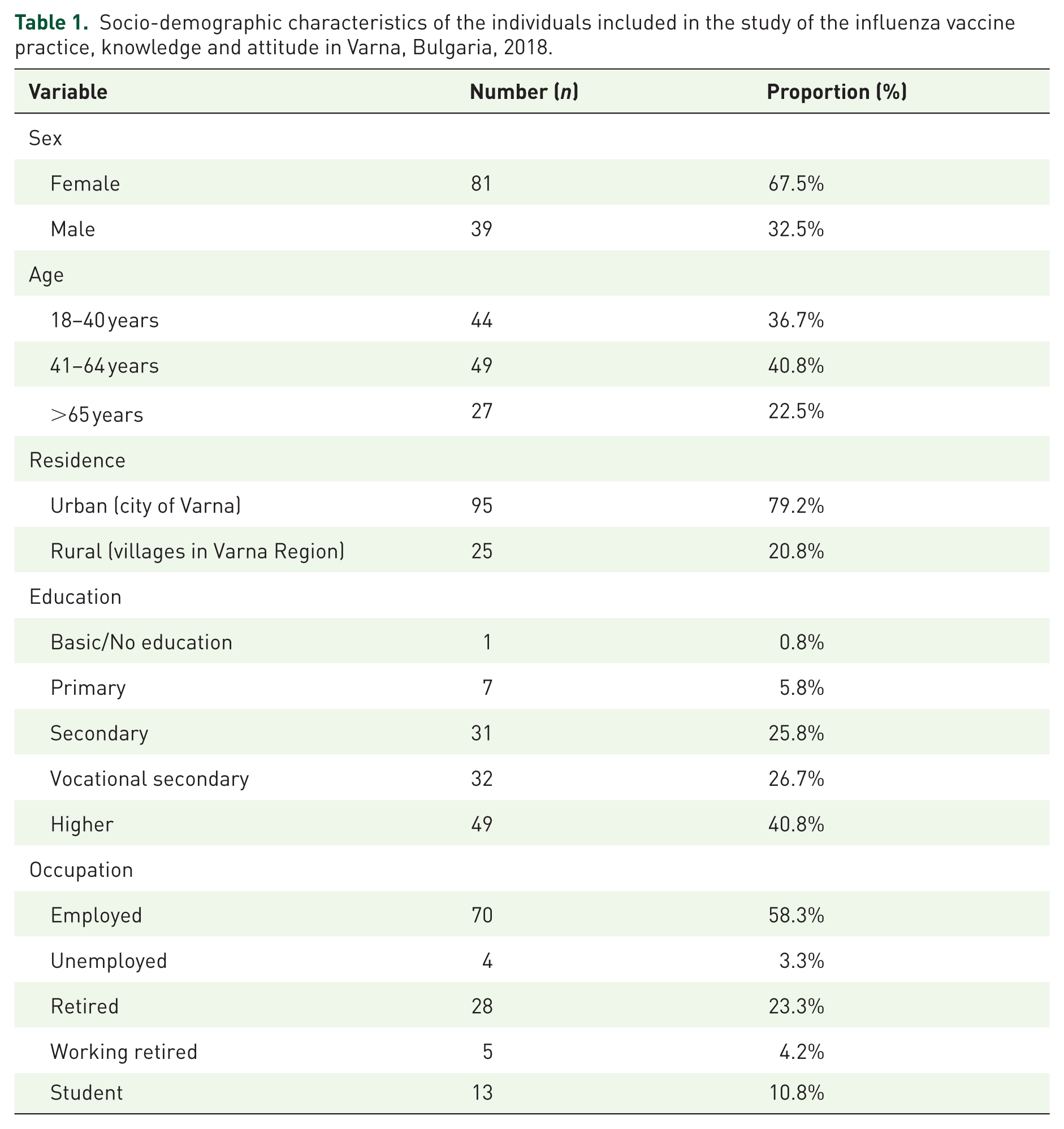
The socio-demographic characteristics of the responders recruited in the current study are listed in Table 1. The mean age of the sample was 48.5 ± 18.6 years (ranging from 18 to 85). Females predominated, and the age group from 41 to 64 years was the most represented (49 out of 120 participants).
Socio-demographic characteristics of the individuals included in the study of the influenza vaccine practice, knowledge and attitude in Varna, Bulgaria, 2018.
Practice of influenza vaccination
The majority of the responders (n = 82; 68.3%; 95% CI 60–76%) have never been vaccinated against influenza during their life and only 8 (6.7%; 95% CI 3.2–12.8%) of the studied individuals used the recommended influenza vaccines on an annual basis (Table 2). The vaccination status did not differ with the sex (χ2 = 0.5, p = 0.5), education (χ2 = 3.2, p = 0.7), occupation (χ2 = 4.1, p = 0.4), residence (χ2 < 0.1, p = 0.9) or age (χ2 = 1.3 and p = 0.3) of the responders.
Practice of influenza vaccination in Varna, Bulgaria, 2018.

The main reasons for nonvaccination varied, but the main reason was the lack of a positive attitude towards the vaccines in general (53.7% of the never vaccinated responders; Table 2). This nonconfidence in vaccines did not depend on the age, sex, education, occupation, or residence of the responders (p > 0.05 in χ2). The second leading reason why people were not vaccinated was the ignorance about the availability of the vaccine (26.8%).
People who have never been vaccinated against influenza (68.3%) did not vaccinate their children or their elderly parents (53.3%) (Table 2). This association was statistically significant (χ2 = 54.3, p < 0.01).
Only 2.5% of the responders declared they were sufficiently informed each year by their GPs about influenza vaccines, but more than the half of all participating individuals (57.5%) had never discussed possible immunization with their GP (Table 2). Among those informed by their GPs, only 28.6% had received comprehensive information about the advantages and risks of influenza vaccines. In addition, people who were not informed by their GPs were in general not vaccinated against influenza (χ2 = 9.5, p = 0.002).
Attitude toward influenza vaccines
When assessing the attitude towards influenza vaccination we found that: 44.2% of the participants did not consider the immunization against influenza as useful; 36.7% of the participants did not consider the immunization against influenza as effective and 27.5% of the participants did not consider the immunization against influenza as safe (Table 3). All of these proportions were closely dependent on the number of people who have not been vaccinated during their life (all p < 0.05).
Attitude towards influenza vaccination in Varna, Bulgaria, 2018.

When combining the answers to the attitude items into one attitude variable, the sample was divided into three groups: responders with a general positive attitude (n = 48, 40%), responders with a negative attitude (n = 45, 37.5%), and responders with an unclear attitude (n = 27, 22.5%). In the group of people with positive attitude, 22 had never been vaccinated, which yielded a proportion of 45.8% (95% CI 31.7–59.9%), while in the group with a negative attitude, 37 had never been vaccinated, which yielded a proportion of 82.2% (95% CI 71.0–93.4%). Therefore, in absolute terms, the risk of never being vaccinated is 36% higher (95% CI 18.4–54.4%) in individuals with a negative attitude, when compared with responders with a positive attitude towards seasonal influenza vaccination. This difference was statistically significant: Cχ2 = 13.26, p < 0.001.
Knowledge about influenza vaccines
The knowledge of influenza vaccines showed a similar pattern: 70.8% of the participants did not have any information on the composition of the vaccine against influenza and an additional 21.7% were not sure of the exact composition. Only 7.5% of the studied individuals pretended to know the influenza vaccine composition, and the majority among them gave a wrong answer. In addition, 37.5% of the participants did not know whether the influenza vaccine was included in the obligatory immunization schedule of Bulgaria and 7.5% considered it as a mandatory vaccination, 27.5% of the participants did not know whether the vaccine was free, and 27.5% did not know where to obtain the vaccine against influenza. In addition, 35% of the participants did not know the recommended time for vaccination and 3.3% considered the months of the seasonal epidemic as recommended time for administration of the vaccine (Table 4).
Knowledge about influenza vaccine in Varna, Bulgaria, 2018.

Similarly to the attitude items, we defined two groups regarding the knowledge about influenza vaccines: responders with good knowledge (n = 58, 48.3%) and responders with poor knowledge (n = 62, 51.7%). In the group of people with good knowledge, 31 had never been vaccinated which yielded a proportion of 53.4% (95% CI 40.6–66.2%), while in the group with poor knowledge, 51 had never been vaccinated yielding a proportion of 82.3% (95% CI 72.8–91.8%). Therefore, in absolute terms, the risk of never being vaccinated is 29% higher (95% CI 12.9–44.9%) in individuals with poor knowledge, when compared with responders with good knowledge. This difference was statistically significant: χ2 = 11.49, p < 0.001.
Discussion
Seasonal influenza vaccination is an effective and safe way to limit the burden of the disease. 14 However, vaccination coverage is still suboptimal in most European countries. 6 Different factors (demography, knowledge, attitude, other diseases, healthcare system satisfaction, etc.) have been associated with influenza vaccination uptake. 7 Among them, a good knowledge level and a positive attitude have always been positively correlated (although with different strengths) with getting vaccinated.7,9,15,16 Owing to their subjective nature, these two factors vary widely among the different study samples and have a different effect on the vaccination status of both the general population and at-risk groups.
In this study, we found a very low number of regularly vaccinated people: only 6.7% of the recruited citizens of Varna Region. This number is significantly lower than the average vaccination coverage in other European countries, where 9.5–28.7% of the population is annually vaccinated against influenza viruses. 17 A possible explanation could be that in Bulgaria everybody has to pay for the vaccine, which is in contrast to most other European countries. Despite the low price of the vaccine (<3% of the minimum monthly wage), some people may consider it a significant expense. An alternative explanation was provided by this study: 36.7% of the responders had a negative attitude toward all vaccines. While the mandatory vaccines are obligatory for day-care admission of children and people are forced to use them irrespective of their own beliefs, the recommended ones are often regarded as unsafe and ineffective. This finding is maybe the most alarming and the national authorities should employ measures to restrict the strong antivaccine feeling in the country.
In addition, the total level of knowledge about seasonal influenza vaccination found in our study is very low, GPs do not inform their patients about influenza vaccines and people have significant gaps in their knowledge about the composition of the vaccine and the best time for immunization.
The risk analysis showed that a negative attitude and poor knowledge about the influenza vaccines were factors strongly and negatively associated with the vaccination status of the people in Varna Region of Bulgaria.
To the best of the authors’ knowledge, this study is the first of its kind in Bulgaria and one of the few similar surveys in the Balkans. This uniqueness is the main strength of it, as the results can be used for building more effective national and regional policies in the area. In addition, similar studies are available for particular at-risk populations18 –20 but are rare for the general population.
The limitations of the study include the cross-sectional nature of the survey, the small sample size, and the possible self-selection bias because people who chose to participate in the study might be more informed about the influenza vaccine than those who chose not to complete the questionnaire. This may explain the difference between the vaccine coverage found in our sample (6.7%) and the national coverage calculated on the basis of the purchased vaccines (3.5%). However, we should also consider that our study was conducted in Varna, with 84% of all participants living in the urban areas of the region, therefore people have higher exposure risk and higher awareness. In addition, a significant proportion of the active population of Varna is employed in the international maritime sector, where seasonal influenza vaccines are strongly advised and are distributed free of charge.
Conclusion
The current study indicates that efforts should be increased to achieve a better understanding and knowledge of the vaccine’s mechanism of prevention and effectiveness among the Bulgarian population. The results should be further confirmed in both the general population and at-risk groups. New studies assessing the vaccine uptake, as well as the general vaccine attitude and knowledge, are urgently needed to make a relevant national vaccination policy and to reduce the morbidity of the disease.
Footnotes
Funding
The author(s) received no financial support for the research, authorship, and/or publication of this article.
Conflict of interest statement
The authors declare that there is no conflict of interest.
Ethical approval
This article does not contain any experiments with human participants or animals.
