



Abstract
Emotions are inherently embedded in the entrepreneurial process and are highly influential in driving entrepreneurship. The role of emotions in entrepreneurship education (EE) has also been documented, but knowledge is still scarce. This empirical study explores the role of emotion in EE in shaping students’ entrepreneurial competencies and identities. Through an exploration of Kolb’s learning styles (KLS), we empirically scrutinize the correlation between these styles—Doing, Observing, Reasoning, and Emotions—and students' confidence, control, and competence, as gauged by Entrepreneurial Self-Efficacy (ESE) and Entrepreneurial Identity Aspiration (EIA). The study addresses whether a relationship exists between KLS and ESE/EIA, and if specific learning styles, notably Emotions, influence students’ thinking and entrepreneurial behavior. While Doing, Reasoning, and Observing exhibit moderate or no linkages with ESE and EIA, Emotions emerge as a potent influencer, demonstrating a robust positive connection with both constructs. Emotions, as a preferred learning style, significantly relates to students' control, confidence (ESE), and aspirations to become entrepreneurs (EIA). This study sheds light on an underexplored intersection between students’ learning styles and entrepreneurial self-efficacy/identity, emphasizing the role emotions play in fostering entrepreneurial learning. The study also underscores the need for targeted pedagogical approaches that harness the influence of emotions in entrepreneurship education.
Keywords
Introduction
As educators, we are deeply interested in how students learn as well as how to provide the proper pedagogy stimulating to students’ learning potential. In this respect, Kolb’s learning styles have been influential, and scholars have empirically tested students’ preferences for learning styles in several studies (Jepsen et al., 2015; Van der Lingen et al., 2020; Yousef, 2018). In this paper, we are interested in the fundamental factors inducing students to think and behave entrepreneurially and more precisely how emotions may play a role in this respect. This is because there is a recent urge for research into the specific role of emotions in studies seeking to elevate entrepreneurship education (Fox et al., 2018; Ilonen & Heinonen, 2018). Emotions are seen as subjective feelings that can elicit various behavioral responses (Hökkä et al., 2022). In this paper, we respond to this call by investigating how learning styles, with an emphasis on emotions, are related to students’ entrepreneurial self-efficacy and entrepreneurial identity.
Entrepreneurship education usually underscores practical, real-world learning alongside traditional methods (Higgins & Galloway, 2014; Taatila, 2010). This approach, effective in fostering competencies like entrepreneurial self-efficacy and identities (Kubberød & Pettersen, 2017, 2018a), aligns with Pittaway & Thorpe’s (2012: 851-52) advocacy for educators to emulate entrepreneurial learning. Learning arenas mirroring authentic entrepreneurial processes, with uncertainties and critical events, can cultivate competencies and identities. In university programs, some students are entrepreneurs developing ideas, while others engage in practice-based learning within entrepreneurial teams, exposing them to uncertainty. This immersive learning, likely involving emotions, stimulates students’ transformative learning, developing entrepreneurial competence.
Entrepreneurship scholars have argued that emotions are inherently embedded in the entrepreneurial process (Cardon et al., 2012; Cope, 2011; Foo et al., 2009; Hayton & Cholakova, 2012; Lee & Herrmann, 2021; Muehlfeld et al., 2017; Podoynitsyna et al., 2012). Furthermore, the entrepreneurial process of business creation is a highly personal one, where the experience with diverse tasks, social encounters, success and failures induces emotions. Further, emotional reactions are found to influence attitudes and behaviors. Emotions may also represent the driving force to overcome barriers and problems during the development process of a start-up, to be passionate about a business idea, and to stay committed and true to yourself (Lee & Herrmann, 2021; Mortan et al., 2014). Entrepreneurship education scholars have also emphasized emotions in the entrepreneurial learning process (e.g., Keller & Kozlinska, 2019). Entrepreneurship courses typically include creative and open-ended tasks involving uncertainty and critical learning events charged with emotional intensity (Cope, 2003, 2011). Learning from these tasks is assumed to generate transformative learning, where entrepreneurial engagement contributes to entrepreneurs’ understanding and competence, that is, entrepreneurial self-efficacy, and self-awareness and entrepreneurial identity (e.g., Kubberød & Pettersen, 2017).
Scholars have focused on diverse learning outcomes in entrepreneurship education. In that vein, Ilonen and Heinonen (2018) discuss how measures of students’ entrepreneurial identity formation (i.e., entrepreneurial awareness, self-confidence, self-esteem, need for achievement, entrepreneurial spirit, and entrepreneurial passion) could be regarded as an emotional outcome of entrepreneurship education. Hence, in this empirical study, we concentrate on the following learning outcomes: Entrepreneurial Self-Efficacy (ESE) and Entrepreneurial Identity Aspiration (EIA). More specifically, we explore the relationship between the four learning styles (Kolb & Kolb, 2005): feel/emotions, think, observe, and doing and the learning outcomes: ESE and EIA. The empirical study hence aims to explore if or to what degree emotions as a dimension of students’ learning style play a role in developing ESE and EIA.
The paper outline is as follows. First, the literature review regarding the role of emotions in entrepreneurship is presented, followed by the few studies that have investigated the role of emotions in entrepreneurship education. We then present Kolb’s learning styles and as a summary of the theory, we formulate the hypotheses. The research methodology and student sample follow. Further, we present results and analysis. We then discuss the results and suggest theoretical implications as well as implications for entrepreneurship education. Lastly, limitations and further research are addressed.
Theoretical Framework
The Role of Emotions in Entrepreneurship
Emotions are inherently embedded in the entrepreneurship process (Cope, 2011; Foo et al., 2009; Hayton & Cholakova, 2012; Lee & Herrmann, 2021; Muehlfeld et al., 2017; Podoynitsyna et al., 2012.). Cardon et al. (2012, p. 3) assume entrepreneurial emotion is antecedent to, coexists with, and/or results from entrepreneurial tasks, for example, opportunity recognition and exploitation, securing financial capital, developing new prototypes, engaging with pilot customers, and organizing a team. The establishment of a new venture is loaded with affective ups and downs, and entrepreneurs are often described as passionate, enthusiastic, and enduring even faced with difficulty and various challenges (Foo et al., 2009). However, several studies show that entrepreneurs act in line with their emotions, and emotions are likely to influence entrepreneurial decisions and actions (Foo et al., 2009; Hayton & Cholakova, 2012; Muehlfeld et al., 2017; Podoynitsyna et al., 2012). The affective domain of learning is complex for several reasons: it is highly individual and, hence, difficult to measure, and it infuses other learning domains (cognitive domain) because of their intertwined role in meaningful learning (Ilonen & Heinonen, 2018).
Affect is a general construct that incorporates both emotions and moods (Hayton & Cholakova, 2012). Emotions and moods would contrast in their specificity, intensity and duration. Moods tend to be “low-intensity, diffuse, and relatively enduring affective states without a salient antecedent cause,” whereas emotions are liable to be “more intense, short-lived and usually have a definite cause and clear cognitive content” (ibid, 2012: 44). Hayton & Cholakova (ibid) emphasize that entrepreneurs incessantly must cope with uncertainty and ambiguity, high pressure and tension, and need to take action immediately. Situations such as these are emotional and likely to influence entrepreneurial decisions and behaviors (ibid). Furthermore, scholars think that dispositional positive affect broadens the range of entrepreneurs’ attention, cognition and action. More specifically, positive affect will expand entrepreneurs’ attitudes, motivating ideas of a wider choice of opportunities and actions, and would diminish “…the selectivity of attentional filters” (Muehlfeld et al., 2017, p. 539). In relation to this, entrepreneurs are likely to engage effortlessly in “trial-and-error” learning, as this type of learning process would incorporate a relatively higher cognitive flexibility and range of attention.
Given that the entrepreneurship process is highly emotional, entrepreneurs would need to appropriately manage, regulate, and use emotions to build competence, confidence, and control (ESE) to drive the venture forward (Mortan et al., 2014). The regulation of emotions implies strategies to engage, prolong or detach from emotional states, to monitor and reflect on feelings and to reframe perceptions of the situation. Mortan et al. (2014) further emphasize that these elements, among others, can be associated with the construct ESE, for example, “…working under stress, facing unexpected changes, and build an innovative environment” (2014: 102).
Moreover, learning through critical incidents and failure related to an entrepreneurial project or task is assumed to stimulate transformational learning that proves essential to the entrepreneur with respect to personal growth and competence building. Hence, if the learner can regulate emotions and recover, negative emotions related to failure can induce a process of meaningful rebuilding (Shepherd et al., 2009). Failure can stimulate deep transformation in both self-awareness and the underlying assumptions and social practices that guide entrepreneurial action and involve a future-oriented reflection about the entrepreneurial self (Cope, 2011; Shepherd & Kuratko, 2009). Entrepreneurship scholars therefore have emphasized the strong connection between the development of an entrepreneurial self or identity to the entrepreneurial (and inherently emotional) learning process of creating a venture. Further, it is likely that self-enhancing positive affect and entrepreneurial passion are present when entrepreneurs are engaged in entrepreneurial activities that are meaningful and salient to the self-identity of the entrepreneur (Farmer et al., 2011; Gregori, Holzmann, & Schwarz, 2021). Entrepreneurial identity is seen as a powerful precursor of intentions leading to entrepreneurial behaviors and actions (e.g., Krueger et al., 2000; Stryker & Burke, 2000). Farmer et al. (2011) found strong links between entrepreneurial identity aspiration (EIA) and discovery and exploitation behaviors as experienced in prior start-up efforts.
The Role of Emotions in Entrepreneurship Education
Both cognitive and affective/emotional aspects are involved in entrepreneurship education, and especially for students engaging in real-life entrepreneurial projects and/or creative and innovative practice (Kurczewska et al., 2018). The role of emotions in entrepreneurship education research has gained increased scholarly interest (Ilonen & Heinonen, 2018; Keller & Kozlinska, 2019; Kurczewska et al., 2018; Lackéus, 2014). However empirical evidence is still lacking to understand how emotions/affect influence the learning process and learning outcomes in EE. Below, we present some empirical studies exploring the influence and role of emotions in EE.
Various studies been done by scholars with focus on how EE could strengthen entrepreneurial emotions during the learning process. Ilonen and Heinonen (2018) conducted an empirical study based on bachelor students’ learning reflections in diaries and explored affective learning outcomes in EE, with a focus on the learning process and how it influences learning outcomes, such as entrepreneurial awareness, self-confidence, self-esteem, need for achievement, entrepreneurial spirit, and entrepreneurial passion. In their meta-study on entrepreneurship education and emotions, Keller and Kozlinska (2019) see a link between experience-based learning and emotions. In that vein, Kurczewska et al. (2018) report a strong connection between gained procedural knowledge and emotions and motivation in their study of student learning in an entrepreneurship educational program. Keller and Kozlinska (2019) argue that emotions are an antecedent to intentions. Such discrete emotions could be developed into chronic affective feelings, that is, attitudes (Barsade & Gibson, 2007). As such, entrepreneurship education strengthens students’ discrete entrepreneurial emotions, according to Keller and Kozlinska (2019). In the same vein, Rose et al. (2019) emphasize the facilitating role of the teacher in arranging for learning events, learning events that orchestrate emotions as a vehicle for aiding and motivating the students’ journey across unknown territory.
Lackéus (2014) investigated the relationships between emotional events and students’ development of entrepreneurial competencies in an action-based entrepreneurship program where students create real-life ventures. The findings reveal connections between emotional events and the development of entrepreneurial competencies. Especially emotional events connected to interactions with the outside world, uncertainty and ambiguity, and teamwork experience were crucial and induced the formation of entrepreneurial identity, increased self-efficacy, increased uncertainty and ambiguity tolerance, as well as increased self-insight.
Gregori et al. (2021) find that students’ entrepreneurial identity aspiration is driven by, among others, ESE and suggest that educators pursue action-based teaching methods to instill a want among students to become entrepreneurs. Kubberød and Pettersen (2017) investigated students participating in real entrepreneurial teams performing entrepreneurial tasks. The authors discuss how situated ambiguity induced by a foreign culture stimulated self-awareness, critical reflection, transformational learning, and entrepreneurial learning outcomes, including ESE. The findings reveal that the foreign context-induced uncertainty and ambiguity enhanced emotional exposure in learning situations. The students had to develop new methods to cope with critical incidents and the need to push their comfort zone, and thereafter achieved mastery and ESE. In our study we investigated emotions as an antecedent to building EIA and ESE which appear to be a gap in the literature, and discuss in the next section emotion as one of Kolb’s learning styles from which learning can be initiated.
Kolb’s Experiential Learning Theory and the Four Learning Styles
Kolb’s Experiential Learning Theory (ELT) defines learning as “the process whereby knowledge is created through the transformation of experience. Knowledge results from the combination of grasping and transforming experience” (Kolb, 1984, p. 41). The Kolb Learning Style Index’ (KLSI) has four dialectically related style modes which are associated with different approaches to learning. The four learning style modes, with other terminology and abbreviations used for each mode in brackets, are Concrete Experience (emotions/feel – EMO), Reflective Observation (observe/watch – OBS), Abstract Conceptualization (reason/think – REA), and Active Experimentation (do/act – DO). In an idealized learning cycle, the learner experiences all four learning modes and responds to the learning situation and learning outcome. EMO is the basis for OBS, whereas OBS forms the basis for ABS, ABS for DO, and DO for EMO in the learning cycle which could initiate from any of the learning modes.
The four learning modes are based on how people grasp and transform experience (interpret and act on information) (Kolb & Kolb, 2005). Their ELT model describes how individuals develop a preference for one of the four learning modes based on previous experiences, environment, and educational influence. We refer further to the four learning modes as learning styles in this paper. The four learning styles (EMO, OBS, REA, DO) are associated with different approaches to learning. Individuals with both REA and OBS dominance are less focused on people and best at understanding substantial amounts of information and converting it into logical form.
EMO in the ELT model relates to the process of taking in information and finding meaning from deep involvement in experience. If the dominant learning style is EMO the individual learns from involvement in life experiences and contexts, and thus relies on the feelings/emotions and reactions to people and circumstances to learn. Greenberg’s (2015) theory and principles of emotion-focused therapy report on the importance of both emotions and feelings in shaping concrete experiences. Within the psychodynamic approach, emotions are viewed as subjective feelings that can elicit various behavioral responses (Hökkä et al., 2022).
Individuals with both EMO and OBS as dominant learning styles learn by observing and reflecting on their feelings from previous experiences (Kolb & Kolb, 2009). Individuals with both EMO and DO as dominant learning styles learn from “hands-on” experience and often involve themselves in new and challenging experiences relates stronger to entrepreneurial learning than the other learning styles.
EMO and REA have been found to be inseparably related in their effect on learning and memory (Damasio, 2002; LeDoux, 1997; Zull, 2002). Thinking requires the ability to control ideas in one’s head and can be diverted by intense emotions and need to take immediate action. Emotions influence whether of what we learn, and this is evidence from fear and anxiety that can restrict learning. On the other hand, positive emotions or feelings of attraction can enhance learning.
Conceptual Model and Development of Hypotheses
Although students studying towards specific professions showed a tendency to a preferred mode (Kolb & Kolb, 2009), entrepreneurs are involved in all disciplines, and any of the four learning styles could be the preferred. Entrepreneurial learning is a process, and preferred learning can thus be initiated at any of the four learning styles. Entrepreneurial didactics often include all four learning styles or some, for example, DO (Taatila, 2010), EMO (Kurczewska et al., 2018), OBS (Cope, 2003), and REA (Gemmel, 2017).
Based upon the discussion on how students learn and how this learning builds their understanding of what they are capable of and how they could envision themselves, we formulate explorative hypotheses related to how students engage their preferred learning style to master entrepreneurial challenges (ESE), and how students engage their preferred learning style in developing an entrepreneurial identity aspiration (EIA). We specify these two outcomes of learning in relation to each of the four preferred learning styles as in Figure 1. These proposed relations between the four learnings styles (DO, OBS, REA, and EMO) and the capacity to master ESE and developing an EIA is then presented in the conceptual model of the study (see Figure 1). The figure indicates that the four learning styles (DO, OBS, REA, and EMO) have a positive influence on the capacity to master ESE and toward developing an EIA, and that ESE has a positive influence toward developing an EIA. The conceptual model of the study.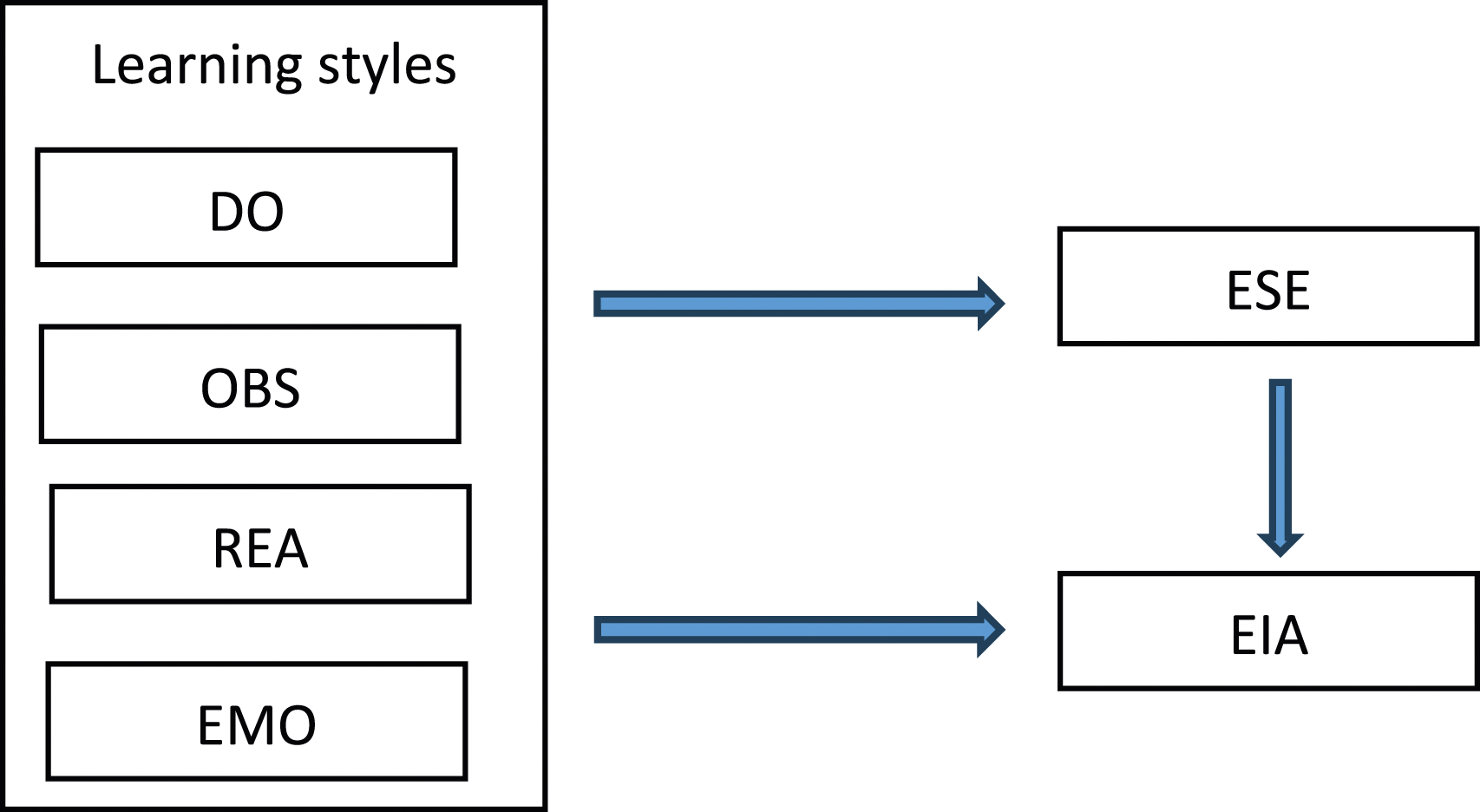
This then leads to a set of explorative hypotheses describing these proposed relationships.
The Influence From the Learning Styles Toward the Capacity to Master Entrepreneurial Challenges (ESE)
Husin, et al., (2022) find that a visual learning style is important for developing entrepreneurial skills among 212 Indonesian engineering students. Taneja et al. (2023) studied the influence from experiential learning as a multi-dimensional construct consisting of EMO, OBS, REA, and REA on ESE. They found a positive influence for their sample of 323 Indian students. All their respondents underwent a course in entrepreneurship and had strong intentions to become an entrepreneur. To the contrary, Lin et al. (2023) in their study of 1399 Chinese students found that experiential learning had a significant negative, but weak, impact on ESE. Hence, we propose the following set of hypotheses:
Students engage their preferred learning style in order to master entrepreneurial challenges (ESE).
Students with a preference for DO as a learning style will show higher levels of ESE.
Students with a preference for OBS as a learning style will show higher levels of ESE.
Students with a preference for REA as a learning style will show higher levels of ESE.
Students with a preference for EMO as a learning style will show higher levels of ESE.
The Influence From the learning Styles Toward Developing an Entrepreneurial Identity Aspiration (EIA)
Chen et al. (2021) report from an in-depth case study that educational offerings as teamwork focusing on learning-by-doing didactics contribute positively toward an entrepreneurial identity. Seoke et al. (2023) find that observing entrepreneurship through consumption of mass media entrepreneurship education positively influences the radio listeners entrepreneurial mindset. On the other hand, Donnellon, Ollia & Middleton (2014) in their literature study, examine how the potential entrepreneur form their entrepreneurial identity through an internal discussion related to storytelling, strategic positioning the self in a new role. Zainuddin et al. (2022) based upon their qualitative study of the forming of entrepreneurial identities among postgraduate students, proposes that entrepreneurship education should tailor its structure to tap into sources of passion, allowing for deep exploration and self-reflection. Such a flexible approach fosters the development of entrepreneurial traits, aiding postgraduate students in their career transitions by internalizing these virtues and cultivating an authentic entrepreneurial identity. Hence, we propose the following set of hypotheses:
Students engage their preferred learning style in developing an EIA.
Students with a preference for DO as a learning style will show higher levels of EIA.
Students with a preference for OBS as a learning style will show higher levels of EIA.
Students with a preference for REA as a learning style will show higher levels of EIA.
Students with a preference for EMO as a learning style will show higher levels of EIA.
The Influence From the Capacity to Master Entrepreneurial Challenges (ESE) Toward Developing an Entrepreneurial Identity Aspiration (EIA)
Studies have found that ESE drives the creation of an entrepreneurial identity (Gregori et al., 2021; Murad et al., 2022; Ndofirepi, 2022; Seo et al., 2024). Hence, we propose the following hypothesis:
The higher the student score on ESE, the higher the student will score on the EIA measure.
Research Method
Research Approach and Student Samples
The sample included undergraduate engineering students from Norway (n = 198). The students responded to the survey voluntarily, just as the course was about to end. The survey was administered for two cohorts, in 2016 and in 2017. Among these 198 were 134 males and 64 females; all were enrolled for an entrepreneurship course as a requirement of their degree. Students from a variety of engineering departments; chemical engineering, computing, electronics and communication systems work together in teams. Students are expected to develop their creative skills combined with their basic engineering discipline and develop a business idea and propose a final business model. The pedagogy emphasizes student-centered and action-oriented experiential learning methods, and students engage in practical tasks to create innovative solutions and must actively search for information to solve problems with fellow students. Students use innovative and creative tools to engage in an entrepreneurial process and finally complete a business plan. The student teams present their business idea and stakeholder analysis to an external panel of business experts, who will assess the students’ ideas. The practical course is the students’ first encounter with action-based teamwork stimulating creativity, where assessment is “open ended” (business plan). Hence, the didactics are assumed to induce uncertainty and diverse critical events, for example, related to teamwork and creative process. Likewise, students may experience the creative aspect of the course to be fun and enjoyable, inducing positive emotions. The course design hence is assumed to stimulate all four learning styles (DO, OBS, REA, and EMO), but may favor those students who are oriented towards the learning styles: Concrete Experience (emotions/feel – EMO), and Active Experimentation (do/act – DO). The students were 25-year-old on average.
Constructs, Measures and Scales
EIA is a person’s desire to become an entrepreneur. The applied EIA measure was adopted from Farmer et al. (2011). We omitted one item focusing on “becoming an entrepreneur” as we pursue a broader content of the entrepreneur than just starting a business. The remaining five items open for entrepreneurship as seizing and acting upon opportunities in a broader environment. Table 1 (in Appendix) reveals the wording of the applied measures.
Bandura’s theory of self-efficacy states self-efficacy as “people’s beliefs in their capabilities to produce desired effects by their own actions” (Bandura, 1997, p. vii). The ESE construct developed by de Noble et al. (1999) measures the self-efficacy of entrepreneurs specifically and tailored to specific skills entrepreneurs required to set up a venture. The ESE measure in this study was inspired by de Noble et al. (1999). The items are presented in Table 2 (in Appendix). The concept of entrepreneurship itself, and what we as teachers seek to inspire our students to engage in, has changed since the publication of de Noble et al. (1999).
The KLSI has four dialectically related style modes which are associated with different approaches to learning. The four learning style modes are Concrete Experience (CE), Reflective Observation (RO), Abstract Conceptualization (AC), and Active Experimentation (AE). Other terminology used for each mode is: CE (“feel” or “emotion”), AC (“reason” or “think”), RO (“observe” and “watch”) and AE (“do” or “act”). The items capturing Kolb’s four preferred learning styles were derived from Manolis et al. (2013). The items are presented in Table 3 (in Appendix).
Results
The item loadings for the EIA measure adopted from Farmer et al. (2011) are displayed in Table 1. Table 1 offers a Principal Component Analysis (PCA) showing satisfactory loadings and extractions. Hair et al. (1998) suggests that factor loading greater than .50 could be practically significant. Here the loadings are all .94. Moreover, Hair et al. (Hair et al., 1998) explain that extractions should be higher than .5 to contribute to the model. Here the extractions all are about .84. The PCA explains 88% of the variance and the eigenvalue is 4.2, while the Cronbach alpha is .955. Hair et al. (ibid) recommends Cronbach’s alphas to be higher than .7, and Eigenvalues higher than 1.0. Pallant (2013) recommends the Keiser-Meyer-Olkin (KMO) measure to be higher than .6, and the sample to be higher than 150, our sample consists of 198 students and the KMO is .884.
Table 2 details the ESE measure inspired by de Noble et al. (1999). A PCA shows that all items have a satisfactory loading and extraction, the measure captures 69% of the variance, the Eigenvalue is 4.2 and the Cronbach’s alpha is .910. Likewise, Table 3 offers a PCA of the items capturing Kolb’s four preferred learning styles. The table shows how the 14 items load on the four dimensions: a preference for Doing, Observing, Reasoning and Logic and for Emotion evoking didactics. Side loading less than .4 is suppressed in the table. The extraction and the loadings are satisfactory; the four dimensions capture 77% of the variance, Eigenvalues range from 5.7 to 1.0, while the Cronbach’s alphas range from .90 to .81.
Table 4 further reveals how these measures are associated. Table 4 shows the Pearson correlation for summed averaged scores for the four preferred learning styles, ESE, EIA and some demographic variables (age and gender). Even if the mean is in the range of 3.37–5.57 on a measure ranging from 1 – Totally Disagree to 7 – Totally Agree), the skewness and kurtosis measures are all within the recommended threshold of −1 to 1 (Hair et al., 1998).
The SEM model is presented in Figure 2. The figure shows how the four components of Preferred Learning Styles; Doing, Observing, Reasoning and Emotions are linked to ESE and EIA. The figure also shows how ESE links to EIA. Furthermore, it shows how the four components of Preferred Learning Styles; Doing, Observing, Reasoning and Emotions are linked to EIA. The realized model SEM model of Preferred Learning Styles (DO = doing, OBS = observing, REA = reasoning & logic, EMO = emotions), Entrepreneurial Self-Efficacy (ESE) and Entrepreneurial Identity Aspiration (EIA), standardized coefficients * *n = 198; Chi-square (x2) = 537.3; Degrees of freedom (DF) = 260; p-value = .000, Root Mean-Square of Error of Approximation (RMSEA) = 0.073; SRMR = 0.060; Tucker-Lewis Index (LTI) = 0.915, Comparative Fit Index (CFI) = 0.927; Goodness-of-fit Index (GFI) = 0.820; Adjusted Goodness-of-fit Index (AGFI) = 0.774; NFI = 0.868. *** indicate p < .001, ** indicate p < .01, * indicate p < .05; Source: R sem_3.1–9.tar.gz.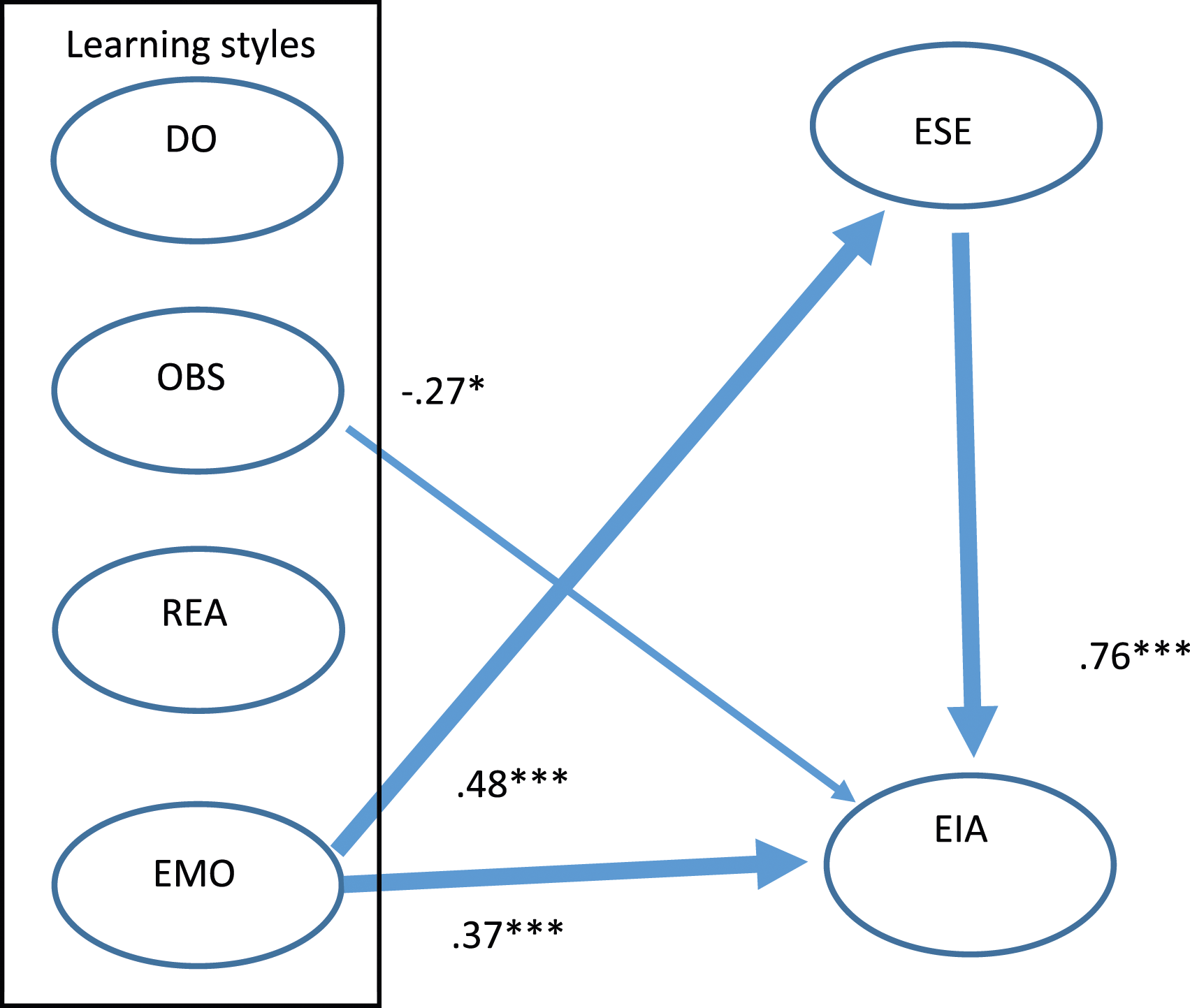
Figure 2 shows that the SEM model revealed a moderately negative link between Observing and EIA (−.27*), while a preference for Observing as learning mode was not significantly related to ESE. A preference for Doing or Reasoning as learning styles was not significantly linked to ESE nor significantly linked to an EIA. On the other hand, Emotion as preferred learning style was strongly positively linked to ESE (.37***) and to EIA (.48***). ESE is strongly linked to EIA (.76***).
A good model should explain as much of the variance as possible, but still be as simple as possible. A model’s explanatory power is indicated by its goodness of fit measures. Hair et al. (1998: 623 & 636) claim that a SEM model’s goodness-of-fit indexes, such as AGFI, NLI and TLI should be higher than .9, but could be accepted as marginal at .8 levels. Kline (2011, p. 195) explains that “if the value of an absolute fit index is .85, then we can say that the model explains 85% of the observed covariances”. Hair et al. (1998) recommend Root Mean Square Error of Approximation (RMSEA) to be lower than 0.10 for acceptable models while Hu and Bentler (1999) claim that RMSEA below 0.06 indicates a very good fit to the data. The goodness-of-fit index RMSEA for the presented model is .073 with a 90% confidence interval to be in the range 0.065–0.082. Furthermore, Kelloway (2015) recommends Standard Root Mean Square Residual (SRMR) to be lower than 0.08, the present SRMR is 0.060. Other goodness of fit measures is also within the acceptable range. The Tucker-Lewis Index (LTI) is .915 and the Comparative Fit Index (CFI) is .927.
SEM is a confirmative method, guided more by theory than by empirical results (Hair et al., 1998, p. 590). Based upon this discussion, we could claim that our SEM model linking EIA and ESE, and ESE to Kolb’s 4 preferred learning styles, and DO, OBS, REA and EMO showed acceptable fit indicators (Hair et al., 1998) and could be the basis for further interpretation. Hence, the proposed model allows us to discuss its implications.
Discussion
This empirical study seeks to contribute to EE research by exploring the role of emotions in entrepreneurship education, raising our understanding of how emotions may lead to entrepreneurial learning outcomes. We empirically explore these relations through Kolb’s four preferred learnings styles, where emotions and affective dimensions are included in the measurement. The research draws on entrepreneurship and entrepreneurship education research that emphasizes the role of emotions in entrepreneurship and entrepreneurial learning, among entrepreneurs and students, and Kolb’s experiential learning theory.
Kolb (1984) suggests four different preferred learning styles among students. Some students prefer to learn through action or doing, others by observing, others again on reasoning and applying logic, while some learn best when their emotions and feelings are stimulated. The literature reviewed for this study indicates that emotions and affect are integral in the entrepreneurial learning process and influential in developing entrepreneurial competence (ESE) and in creating an EIA.
In a SEM model including Kolb’s four preferred learnings styles, ESE and EIA, we investigated these relationships among Norwegian engineering students taking a compulsory course in entrepreneurship. The SEM model worked well and demonstrated a good fit.
The preference for action and doing as learning style were not significantly related to ESE nor EIA. This implies that H1a and H2a was rejected. The preference of OBS as learning style was not significantly positively linked to ESE or an EIA. Hence, H1b and H2b were both rejected. The preference for reasoning and logic as learning style was not significantly related to ESE nor EIA. Hence, both H1c and H2c were rejected. Both hypotheses (H1d and H2d) concerning EMO as the preferred learning style were confirmed. EMO as the preferred learning style was strongly related to entrepreneurial control and confidence measured as ESE and to a want to be entrepreneurial, measured as EIA. The data suggest a mediating role for emotions in spurring students’ EIA. There was a direct effect on students’ EIA from emotions, but also an indirect effect via ESE.
This study further finds a strong relationship between ESE, that is, confidence, and an EIA, supporting hypothesis 3. These findings hint that doing and action-based as well as reasoning and logic does not relate to an EIA nor to building a sense of control over the conditions and ingredients of entrepreneurial activities. EMO relate strongly to both entrepreneurial control and confidence as well as directly toward envisioning oneself as an entrepreneur. Control and confidence also seem to be vital as entrepreneurship identity enhancing factors.
Implications for Entrepreneurship Education
The aim of entrepreneurship education is to develop entrepreneurial mindsets, competences and identities among students (Raposo & Paco, 2011; Rideout & Gray, 2013). Kolb’s four experiential learning styles are assumed to be influential in developing and enhancing entrepreneurial mindsets and competencies among students in educational settings (Kakouris et al. (2015), Honig & Hopp, 2019; Van der Lingen et al., 2020). Yet, the theory assumes an idealized learning cycle, where the learner experiences all four learning modes and responds to the learning situations developing various learning outcomes. In this study, we specify and investigate the four learning style modes and finds that EMO has the greatest impact on students’ ESE and EIA. More, we found a strong relation between ESE and EIA. To our knowledge, scant research has examined these relationships. We then share some hints on how we as researchers and educators should interpret these findings to study and propose relevant and effective didactics and pedagogy to spur entrepreneurial mindsets and competencies.
Experiential learning using different learning styles is assumed more effective as each individual has a specific preferred learning style and didactics matching the individual’s preferred learning style will lead to higher levels of achievement (Kurczewska et al., 2018). Yet it seems to exist a powerful relationship between emotions and the learning outcomes: ESE and EIA. This significant relationship is consistent with research on the role of emotions among real entrepreneurs (cf. 2.1), and with studies investigating the role of emotions in entrepreneurship education (cf. 2.2). Traditionally, scholars and educators have emphasized development of entrepreneurial skills and competences, to understand how entrepreneurs and students think, rather than examining how emotions are integrated in entrepreneurial tasks, and how that may drive entrepreneurship. We therefore argue that our study may inspire and instruct educators and entrepreneurship scholars. Our study might further contribute to social identity theory, providing a deeper understanding of emotions’ role in EAI development.
First, our findings indicate that a sole focus on enhancing students’ entrepreneurial skills and competences, and by such developing and enhancing their ESE is not enough. It is also important to cultivate a desire to engage in entrepreneurial tasks, and to inspire students to entrepreneurship (Cope, 2011), and as such stimulate positive emotions that can drive their engagement and efforts. Kurczewska et al. (2018) study the interplay between cognitive, conative and affective elements of learning and finds that emotions play a significant, but yet neglected, role in learning. Similarly, we find that emotions play a significant role in the learning process. As practitioners in facilitating student learning, presenting problems and challenges that push the students out of their comfort zone could raise emotions that provide valuable entrepreneurial learning (Cope, 2011; Kubberød & Pettersen, 2018b). The negative emotion of the unsolved challenge could become a positive emotion of mastering the same task as the challenge is successfully solved. Balancing the complexity of the problem with the likelihood of student success could raise emotions that provide valuable entrepreneurial learning.
The entrepreneurship education curriculum should also emphasize the emotion management capability of students in addition to the practical and theoretical aspects of entrepreneurship. We urge educators to assist the students in reflecting on how their emotions regulate and invite them to learn. That is learning how to appropriately manage, regulate, and use their emotions to foster their own entrepreneurial path.
According to our findings, emotions are found to release entrepreneurial identity by translating this emotional drive into skills that enhance their ESE. In this kind of learning situations, it is critical to provide students support and mentoring to cope and grow with the learning tasks (Kubberød & Pettersen, 2017). To inspire students’ entrepreneurial identity-building process, it may be adequate to expose them to both successful and unsuccessful entrepreneurs through the histories of various entrepreneurs (e.g., as guest lecturers, and role models), and through experiential learning. More, engaging students in fun and creative entrepreneurial activities, triggering their inner motivations, may also enhance their learning outcomes (Pettersen et al., 2019).
Limitations and Further Research
There are several limitations to this study. A reversed model where the students ESE and EIA predict their preferred learning style does not offer good enough fit indexes to be accepted. Still, we make no causal claims given the cross-sectional nature of our study. Our sample only consists of Norwegian engineering students enrolled in a compulsory course. We urge future studies to seek more variation also across country conditions, as well as among the respondents.
A weakness of our study is that we presume a linear relationship between the independent and the dependent variables; there could be a threshold value or a non-linear relationship which we did not address. Similarly, we did not explore how a mix of preferred learnings style affects the explored learning. We did not probe which of our didactical engagements raised which emotions. This would demand a qualitative research design asking students when, how, and why they learn and which effort from the teacher aided their learning. Such an elaboration and preciseness are not necessary to put forth our main claim; it is important to evoke the students’ emotions via deliberate didactics when teaching entrepreneurship—given that the wanted result of such educational efforts is to raise the students’ entrepreneurial capability and identity.
The problem of reverse causality is a concern insofar as continuing engagement in entrepreneurial behaviors can generate a current entrepreneurial identity and an entrepreneurial identity could precede and cause ESE. Moreover, entrepreneurial identity and ESE could influence the preference for specific learning styles.
Further research could therefore adopt an experimental design, allowing for better control of prior experience and matching individuals at a certain level of EIA. Researchers would then be able to detect the effects of manipulations on aspiration as well as track effects over time. Our survey contained a question probing if the student aspired to be an entrepreneur or preferred to become employed. As the SEM model was equally valid for both the students aspiring to become entrepreneurs and the ones wanting to become employees, we conclude that evoking emotions is vital for both subgroups.
To grasp the more complex relationships between students’ learning styles and the two dependent variables during the entrepreneurial learning process, we suggest researchers to conduct a qualitative and longitudinal approach, conducting in-depth interviews with students allowing for rich data. Another issue for further study is that introducing more sophisticated and complex approaches to entrepreneurship education requires skillful and committed teachers as facilitators. Insights on how to achieve this are underexplored.
Footnotes
Declaration of Conflicting Interests
The author(s) declared no potential conflicts of interest with respect to the research, authorship, and/or publication of this article.
Funding
The author(s) received no financial support for the research, authorship, and/or publication of this article.
Ethical Approval
This study did not require ethical approval.
