



Abstract
This paper takes the popular but under-researched extracurricular format in school-based Enterprise and Entrepreneurship Education - the one-day competition– as its focus. One-day competitions are frequently implemented in practice, with teachers’ surveys and national evaluations showing them to be the most common activity in schools. Yet one-day provision receives surprisingly little research attention in literature and implications of the competitive nature of activities are not meaningfully explored. More generally, current evaluation approaches in Enterprise and Entrepreneurship Education tend to be measurement-focused, which obscures crucial differences - between students, schools and program experiences - behind reports of average effect sizes. In this study, the perspective and resources of Realist Evaluation are used to provide a holistic and comprehensive theorisation of experiences and effects in one-day competitions in secondary schools. The contribution of this approach is twofold. First, it provides a much-needed elaboration of what can happen in one-day competitions, developing foresight with which to think through how effects are generated for different students in different contexts. Second, by applying Realist Evaluation to explore a familiar enterprise and entrepreneurship activity, with regards to impact evaluation approaches, this study shows the usefulness of complementing measuring with thinking.
Keywords
Introduction
One-day competitions are an observable and popular activity in practice but appear only fleetingly in Enterprise and Entrepreneurship Education literature. This paper addresses this issue, providing a holistic and comprehensive exploration of one-day competitions in secondary schools to richly illuminate what can happen in such programs. The perspective and resources of Realist Evaluation are applied (Emmel et al., 2018; Pawson, 2006, 2013; Pawson & Tilley, 1997), an evaluation approach which helps to generate foresight about how programs will work in practice. This approach reveals contextual resources which help generate more positive results in one-day competitions as well as new knowledge and evidence about ‘for whom’ such activities do not work so well. While this study focuses on one-day competitions in secondary schools in England (with students aged 11–16), the goal of abstraction in Realist work results in portable insights (Pawson, 2006). Results from this study develops foresight - that is insight and wisdom (Jagosh, 2020) - for educators at all levels to think through what can happen in one-day competitions as a result of the different starting points of students. The paper unfolds as follows: first the practice of one-day competitions is established and a gap in knowledge and evidence about these programs is revealed. Next, the Realist approach is introduced, including the approach to collecting, working with and presenting data. In theorising results, more positive and more negative pathways of subjects (students), are re-constructed, showing how some arrive equipped to compete and others arrive on the back foot. Promising middle range theories and the implications of results for practice and research are discussed. Given that I have not located one study that rigorously explores the one-day competition, in particular the competitive structure of activities, this paper represents a significant contribution to better understanding a ubiquitous, but under-researched extracurricular activity.
One-Day Competitions in Practice
In schools, Enterprise Education and Entrepreneurship Education (EE/EE) share conceptual ground and are framed as being focused on developing the skills and competencies, behaviors and attitudes of students and supporting personal and social development (cf Gibb, 2008; Bacigalupo et al., 2016). Can-do confidence and entrepreneurial spirit are sought after outcomes articulated about EE/EE as a policy-related activity (Young, 2014; Conway, 2022). In secondary schools, a common EE/EE model to pursue such aims is the extra-curricular ‘enrichment’ or ‘drop down’ day, where the curriculum is suspended, and students participate in a one-day competition. One-day competitions are also known as themed days, workshops, challenge days, Enterprise Challenges or Dragon’s Den days. The popularity of the format has been highlighted in Enterprise Education evaluations and teacher surveys. For example, McLarty et al. (2010) identified ‘Enterprise Challenges’ as the most common format of activity, with 90% of schools surveyed providing them. Concern was noted about this situation: “Evidence from this evaluation suggests that less enterprising schools do over-rely on external provision – especially enterprise challenge days as a way of ticking the box, even though pupils may not be entirely satisfied by this…” (McLarty et al., 2010, p. 85). However, this concern did not significantly alter delivery patterns, with a more recent school-focused survey (re)confirming an over-reliance on challenge days (Mann et al., 2017, p. 12), with 80% of surveyed teachers familiar with one-day competitions.
Many providers offer schools’ competitive activities which fit the one-day structure, for example: Business idea and product development days (School Speakers, n.d.a); Green Dragons challenge days (Bright Green Enterprise, 2024); and Enterprise Challenges run by private (Enterprise Days, 2024), public (Derby City Council, 2021), and charitable (Young Enterprise, 2023), organisations. One-day competitions can also be supported by business, for example, representatives from the Institute of Directors taking part in Dragon’s Den days (Form the Future, n.d.a.), or a local entrepreneur working with a school to provide the focus and judging for the day (Woodbridge School, 2022). Schools can also buy prepared slides and booklets to run their own days (Cre8tive Resources, n.d.a.). Promotional copy, marketing and news reports of such days are extremely positive, tending to emphasise the confidence and team skills students acquire, as well as inspiration from and for business. The competitive element tends to be under-emphasised or mentioned in a matter-of-fact way, sometimes only discernible through mention of judges and prizes. Now the use of extra-curricular one day competitions in practice has been established, the following section explores how they feature in literature.
One-Day Competitions in Literature
Given the frequency of extra-curricular one-day competitions, one might assume they have been well-investigated. After all, significant attention has been given to long-form competitions (student mini companies), in secondary schools, though these programs reach fewer pupils and are generally voluntary (c.f. Peterman & Kennedy, 2003; Oosterbeek et al., 2010; Athayde, 2009, 2012; Moberg, 2014; and various works by Vergard Johansen about Young Enterprise/Junior Achievement).
A guidance document ‘Business games and enterprise competitions. What Works?’ (Hanson et al., 2017), asserts it draws together “the evidence base” for competitively structured EE/EE activities in schools. It highlights that competitions have different durations: “Competitions can be short, perhaps only lasting for a lesson or they can be long, running for an academic year or more” (Hanson et al., 2017, p. 4). However, throughout the rest of the document, general statements are made about the effects of ‘business games and enterprise competitions…’, as if they are the same type of activity, rather than establishing good practice or evidence for a short form or long form intervention. On closer inspection it can be seen that general assertions made about ‘Business games and enterprise competitions’ are supported by literature which did not investigate the effects of one day, face to face competitions (Author, 2022). A small number of impact measurement studies are cited which focus on long term and voluntary enterprise competitions such as Junior Achievement and Young Enterprise into which pupils self-select (Athayde, 2009, 2012; Peterman & Kennedy, 2003), or a Biz World program which takes place over several sessions in a primary school, and into which schools self-select (Huber et al., 2012). One study focused on a long-term program which was compulsory, showed negative effects (Oosterbeek et al., 2010). This should cause concern as the one-day competition in schools is generally a compulsory activity - the timetable is suspended, so students don’t get a choice. Yet there is not one study of a compulsory one-day competition highlighted in the evidence base presented.
This omission with regards to extra-curricular one day competitions is reflected and replicated in reviews of ‘effects’ studies at every level of education in EE/EE. In a higher education impact studies review there is no ‘one day competition’ identified or critiqued (Rideout & Gray, 2013), but rather effects studies focus on longer term courses and programs. Impact studies reviewed by Longva and Foss (2018), include school focused articles (Athayde, 2009, 2012; Oosterbeek et al., 2010; Peterman & Kennedy, 2003; Volery et al., 2013), but identify that the shortest intervention they find is 2–4 weeks, and from a primary school (Huber et al., 2012). A more recent review of 96 experimental effects studies (Englis & Frederik, 2023, pp. 15–25), presents a similar picture. Whilst a number of studies have secondary schools as their setting (Huber et al., 2022; Rosendahl Huber, Sloof, Van Praag, & Parker, 2020; Kim et al., 2020; Rodrigeuz & Lieber, 2020; Volery et al., 2013; Sanchez, 2013; Oosterbeek et al., 2010; Athayde, 2009; Peterman & Kennedy, 2003; Blimpo & Pugatch, 2021; Bjorvatn et al., 2020), not one study has the face-to-face one-day competition as its focus.
One paper (Thompson & Kwong, 2016), deals with compulsory extracurricular Enterprise Education (EE) at secondary school level, referring to the “compulsory five days of entrepreneurship education” (recommended in a government review by Davies, 2002), so it might be assumed that one-day competitions were part of this provision. The authors use GEM survey data from 2006–2007 (which involves a minimum of 2000 participants) and perform various statistical analyses aiming to establish a causal chain between compulsory school-based EE/EE and later involvement in voluntary enterprise education or training, which would be seen as a positive effect of the school intervention. While the analysis takes into account personal and environmental factors which might influence results, the study does not say anything about survey respondents’ program experience or how this might impact their sustained interest in EE. Authors find that those who participate in compulsory EE at school are 20–30% more likely to indicate that they expect to be involved in a business start-up. However, the potential influence of differing program experience cannot be explored as the study is measurement focused, providing average effect sizes to establish causality. Furthermore, it is not considered that GEM survey respondents might be particularly interested in Entrepreneurship or have some other special qualities, thus introducing volunteer bias (Heiman, 2002; Keiding & Louis, 2016), a research phenomenon where the nature of participants influences the results of a study.
There are a small number of papers studying one-day provision, but these papers are limited in that they cite ‘market days’ among a range of interventions in a business course but do not explore them (Nchu et al., 2017), do not meaningfully address or explore the competitive nature of interventions (Shahin et al., 2021), or are set in a university (Szymanska et al., 2020).
A recent review of Entrepreneurship Education (EE) program evaluations in upper-secondary schools summarises persistent problems with research assumptions and methodologies (Lin et al., 2023). Effects studies “implicitly desire the positive effect of entrepreneurship education” to prove the success of the intervention; meanwhile, the “cogs and wheels of the entrepreneurship education intervention” are less documented (Lin et al., 2023, pp. 36–37). Authors say that explanations for conflicting and mixed results in EE studies have not been developed because impact measurement studies can only measure limited variables. In addition, knowledge about the environment – schools, personnel, partnerships and resources – are significantly missing. Evaluative research is needed on existing programs to understand what is working, educationally and institutionally, and in the long term (Lin et al., 2023). Specifically, research is needed which is presented “holistically…to better inform policy makers” (Lin et al., 2023, p. 38).
Considering this, it is fair to propose that, in EE/EE, there is what evidence-based policy researchers call an evidence gap (Parkhurst, 2017). This describes a gap in knowledge about decisions made in policy and practice, and to which new knowledge creation should prioritise addressing (Parkhurst, 2017). To summarise: the extra-curricular one-day competition is observable in practice, is identified and promoted as an appropriate activity for secondary schools and students and yet has received scant evaluative attention. Therefore, providing a holistic and comprehensive exploration of one-day competitions in schools contributes important knowledge regarding an omnipresent but under-studied extra-curricular EE/EE activity. In the following section, the philosophical underpinning to this study is introduced.
A Realist Approach to Inquiry
A persistent weakness identified in EE/EE evaluation is that approaches are not able to say what types of programs work for which students in what contexts and why (Rideout & Gray, 2013; Longva & Foss, 2018; Lin et al., 2023). The possibility of developing such explanations depends not just on research strategies and evaluation designs but the philosophies that underpin them (Greenhalgh et al., 2017a). For example, experiments underpinned by a positivistic philosophy aim to measure ‘facts’ through observation but do not provide a comprehensive picture of program experiences or explore how contexts influence effects (Greenhalgh et al., 2017a). To counter this, evaluators developed Realist Evaluation, an approach underpinned by the philosophy of Scientific Realism, which posits that things we experience or observe are caused by deeper, usually non-observable processes (Pawson, 2006; Pawson & Tilley, 1997). This assumption means that in Realist Evaluation there is a view that what causes something to happen has nothing to do with the number of times we observe it (Bhaskar, 1975, 1997; Greenhalgh et al., 2017b; Maxwell, 2012). Instead, evaluators focus on understanding how different participants respond to programs and how context influences these responses (Greenhalgh et al., 2017c). Pawson (2006, p. 31), provides a structured way of thinking about context, identifying four layers – The Four Is – which are at play in programs: • the • the • the • the wider
Attending to these layers provides a rigorous approach to exploring the complexity inherent in programs and deepening understanding about how effects are caused (Author, 2020). The theorising diagram at Figure 1, visualises these four layers in relation to one-day competitions, figuratively representing students, teams, teachers and judges to draw attention to the complexity at work. Four Layers of Context which can help generate positive and negative effects.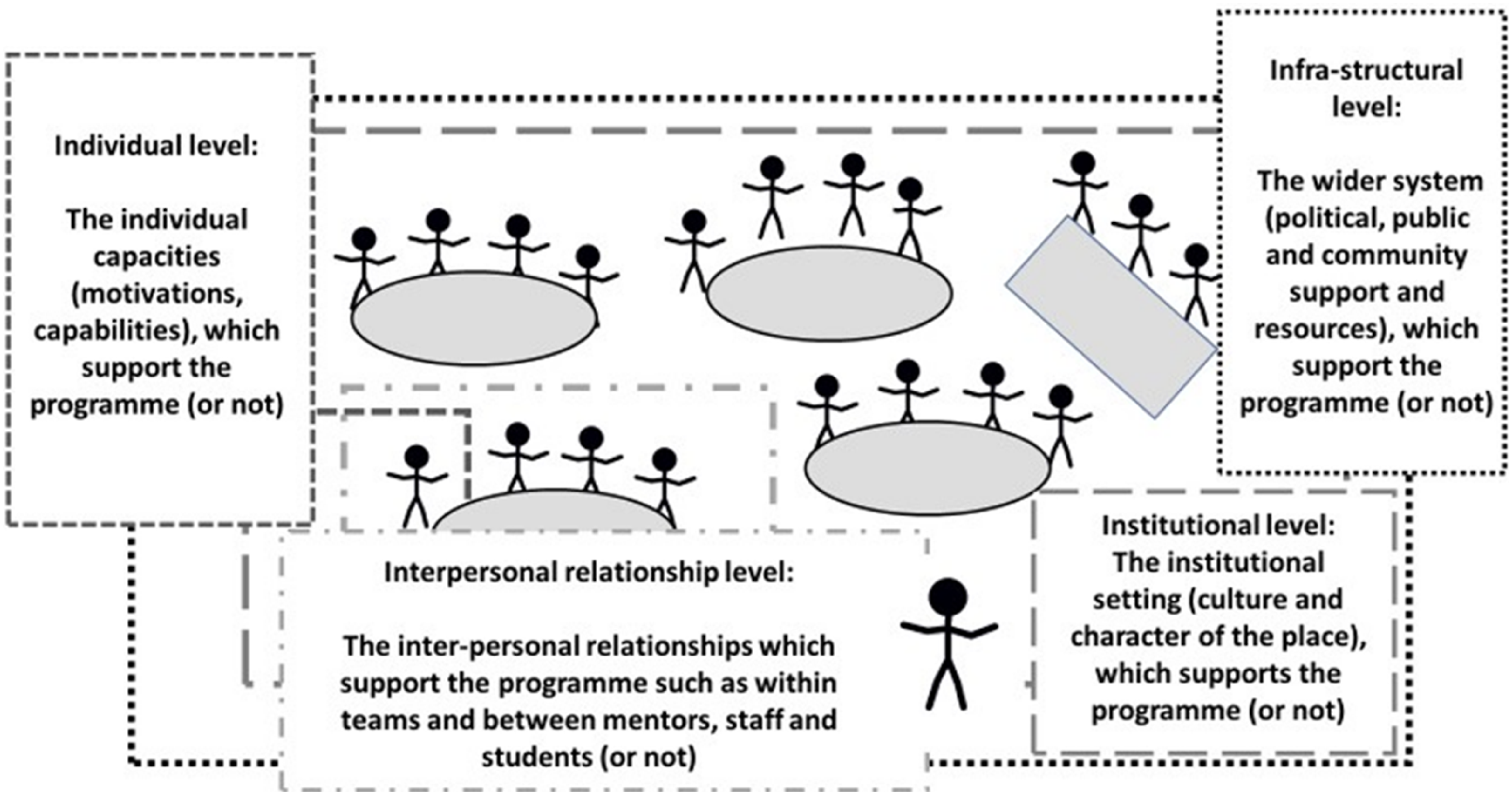
In summary, Realist Evaluation encourages a search for that which is difficult to measure, but which might actually determine why, and in what circumstances, socially contingent programs work, or not (Jagosh, 2017). This is why Realist Evaluation is often called a way of thinking, or theorising (Astbury, 2018; Jagosh, 2020; Pawson, 2006, 2013). In the next section the strategy and methods for collecting, working with and presenting data are introduced.
Collecting Data Through Realist Interviews
In Realist Evaluation, there is no methodological recipe and researchers creatively adapt the Realist orientation to their specific research scenario (Pawson, 2013; Astbury, 2018). However, Realist Evaluation does offer a key method – the Realist Interview (Manzano, 2016; Pawson & Tilley, 1997) - to explore what is happening in programs. This paper draws on data collected from a formal PhD research program (Author, 2022), where Realist Interviews were used to explore what works for whom and why in school-based competitive EE/EE programs. Interviews were conducted with program practitioners, that is people who take on different roles in the provision of programs. Program practitioners are treated as experts (Pawson, 2006), and their experiences and ideas provide evidence about what is actually happening in programs (Mukumbang et al., 2020). While the study is not longitudinal in the sense of taking place over time (Lin et al., 2023), it has the benefit of drawing from the temporally extensive experience of program practitioners.
In Realist interviews, sampling is based on the goal of providing explanation (Emmel et al., 2018), therefore stakeholders who took part in the study had experience of competitive activities in schools. Fourteen in-depth interviews were conducted with: Commissioner/Managers, Consultant/Providers of competitive EE/EE activities and School-Based Educators involved in EE/EE. In addition, two interviews were conducted with Consultant/Providers who delivered skill and competency development through non-competitive (cooperative) workshops, challenges and masterclasses. This was done to promote counter-factual thinking that is, thinking related to “…what something is, in relation to what it is not…” (Danermark et al., 2002, p. 101). The rationale for selecting these program practitioners was as follows: Commissioner/Managers were assumed to have ideas about why programs were competitive and the benefits of this; Consultant/Providers were assumed to have experience of how programs worked across a range of contexts and School Based Educators were assumed to have deeper knowledge of how programs worked in the particular settings they had experience of, and some of these settings were well-resourced schools and others were lower-resourced schools, developing contextual insight.
Interview questions revolved around exploring program practitioners’ experiences of competitive EE/EE activities and considering what might help generate (or hinder) positive effects and for whom such activities work (or don’t). Interviewees were provided with information about the realistic perspective of the study, a framework of sought after outcomes in competitions (such as team-work skills, confidence and inspiration about business), and factors which might influence outcomes (such as volunteering/being conscripted or winning/losing). This information provided a shared understanding of what ‘working well’ meant and also ideas about program variations which might influence effects. Interviews were transcribed in full by the author. A summary of all interview participants is provided at Appendix 1, though for this paper, evidence from program practitioners with experience of one-day competitions was particularly relevant and most-used.
A Realist Thematic Analysis
A realist thematic analysis was conducted (Wiltshire & Ronkainen, 2021), where the ontological depth of applied Scientific Realism - the Four Is proposed by Pawson – was used as the frame to organise evidence regarding more positive and more negative effects. Two realistic questions – what is being leveraged from the context to help generate positive effects, and for whom do programs not work so well – were used to aid interpretation in this process. An extensive, qualitative narrative of program practitioners’ evidence, which is beyond the scope of a journal article word limit, can be read in full elsewhere (Author, 2022). In this paper descriptive summaries are developed which piece together evidence fragments (Pawson, 2021) to illuminate program variations. Colloquialisms and unnecessary words are removed to achieve word economy. Evidence fragments are ascribed to program practitioners with a label. Sometimes connections are made between fragments and sometimes the purpose of presenting one evidence fragment after another is to illuminate the previously unseen, or as Pawson would say: “Behold complexity!” (Pawson, 2013, p. 45).
While Realist research is often presented in terms of CMO (Context, Mechanism, Outcome) configurations, the challenges of untangling and selecting potentially infinite CMO possibilities are well documented (c.f. Dalkin et al., 2015; Emmel et al., 2018). Given this complexity, researchers are encouraged to concentrate their fire (Astbury, 2018). Articulating ‘leveraging’ in programmes, is a way of concentrating evaluation efforts (Jagosh, 2017). Researchers should explore: “What is leveraged, consciously and unconsciously from the context to maximise program outcomes?” (Jagosh, 2017). Definitions of the word leverage clarify this focus. The verb leveraging means to use something that you already have in order to achieve something new or better (Cambridge Dictionary, 2022). Leveraging in Realist Evaluation therefore refers to some resource, pre-existing in the context, that a program relies upon to generate positive outcomes, but which is not part of the program architecture and therefore is often under-theorised in explanations about the program. The focus of this study was also influenced by scholars in EE/EE who urge that more attention be paid to the potential negative effects of programs, not just the positive (Krueger, 2007; Lin et al., 2023), and effects on society itself (Fayolle, 2013). Realist research, with its focus on what works (or not) and why, explicitly pursues understanding of the negative as well as the positive. Realist work should also aim for “abstraction”, making clear “aspects that seem most crucial to success...” and/or that which “…alerts policy makers to the difficulties they might expect to confront…” (Astbury, 2018, pp. 75–76), hence the focus on more positive and negative pathways of program subjects.
Presenting Data - Describing and Redescribing
In presenting data, I follow Danermark et al. (2002), who advise that explanations of social phenomena should begin in the concrete, with descriptions of what happens in participants own words. Then, the Four Is are used as a structure to present descriptive summaries of evidence relating to more positive effects and then more negative effects. Evidence fragments (Pawson, 2021), were selected based on insight they provided regarding two realistic questions: what is being leveraged in the context to help generate positive effects and for whom are these activities not working so well? Data is then used to re-construct different pathways of subjects (Pawson, 2013), illuminating that in one-day competitions, some students arrive equipped to compete and some students arrive on the back foot and their relative differences in advantage and disadvantage influences effects. This enables a re-contextualisation or re-description of data from a realistic perspective, in order to see something as something else (Danermark et al., 2002). Middle range theories are suggested which could be fruitful for further exploration. The implications for practice and research are discussed.
Description – One-Day Competitions in Program Practitioners own Words
In describing what happens in a one-day competitions, School Based Educators, Consultant Providers, and Commissioner Managers often use the phrase ‘Dragon’s Den’ as shorthand to indicate a common format. Dragon’s Den is a well-known TV Series where entrepreneurs get 3 minutes to pitch their business ideas to multimillionaires who might invest time, money, and expertise to kick start the business (BBC, n.d.). This format is used to describe what students experience on a day: “…the Dragon’s Den type thing… [where students participate in].. a challenge… and do a presentation…” (Consultant Provider Competitive 5).
Whilst the original Dragon’s Den format involves an entrepreneur presenting their own product or service, a variation on this focus is “students [are given an] existing product” to pitch to local employers who judge the presentations (School Bases Educator 1). Alternatively, the day could revolve around the development of a product where “students would start the day by developing a product, they’d build a business case around it, and then they would pitch it…” (Consultant Provider Competitive 3). Sometimes the challenge presented is non-business focused, for example working in teams on an “egg drop challenge” where students had to design a way of protecting an egg from a fall, but that this would still culminate in presenting their idea and experience to “the dragons” (Consultant Provider Competitive 1). A challenge might have a specific theme, for example “…something like environmentally friendly products” where students developed a product that could be “made from recycled materials” (School Based Educator 3), or “a green theme” such as recycling, or “an Olympic theme” where a competition was connected to a larger social or cultural event (Consultant Provider Competitive 1). In terms of organisation, activities could be teacher-led and “in-house” (School Based Educator 3), or provider-led and, potentially inter-school and “off-site” (School Based Educator 3). Programs might serve a year group, from approximately 80–130 students (Consultant Provider Competitive 1), in a hall, or potentially up to 300 where students receive and complete the brief and the challenge in their tutor group/home room, with support from tutors or mentors (School Based Educator 3). Now we have descriptions of one day competitions in program practitioners’ own words, in the following section, evidence relating to the four layers of context– the Four Is - (Pawson, 2006; Pawson & Tilley, 1997), is presented.
What Resources are One-Day Competitions Leveraging from the Context?
Individual Capacities
In discussing who does well in one-day competitions, individual resources include the students’ existing mindset, attitudes and capabilities. In this regard, “higher achievers” are discussed as doing well as they “just have a mindset that… is more ‘go-getty’ and initiative taking” (Consultant Provider Competitive 1). These sorts of students are characterised as those who “naturally take 100% out of everything” and the ones who “put their hands up… [and are] in the school choir” or “become prefects”, these are students who “see the point in doing it” (Consultant Provider Competitive 2). One consultant asserted that generally girls are at an advantage, especially when it comes to the finale of the one-day competition - the public pitch - as they are: “… more confident… they seem more willing to take a risk in terms of the presentation…” (Consultant Provider Competitive 6). Confidence is identified as important for all students, for example, a School Based Educator discussed confidence in relation to a male student, somebody “approaching the starting line on the backfoot” and from a less advantaged background, whose “cockiness” was key to doing well in a one-day competition (School Based Educator 3). The educator also wondered if it was the “little bit of freedom” such a day created that was important for this student. A “day-off” normal timetable is seen as a novelty “a bit of a change” and “an influence” towards positive effects (Commissioner Manager 1).
Some students with specific profiles are picked out as being more inclined towards a one-day competition, for example an ADHD student who might “love the competitive side” (School Based Educator 1), or a young man with “a high testosterone level” who may find competition “conducive to creativity and excitement” (Consultant Provider Non-Competitive 2). Existing capacities and inclinations also interact with the organisation of a one-day competition, for example, if there is preparation required by students. Describing a one-day competition with an environmental theme, one educator said: “students had to provide some resources themselves, in the form of recycled materials…it was quite evident that those who were more enthusiastic…tended to equip themselves better…and had more chance of success…” (School Based Educator 3).
Some students are also described as being better at getting on with an activity, for example, “engaging with the materials”, “talking to the people around them” and “not going on phones” indicating that these students are “on task” (Consultant Provider Competitive 1), signposting advantageous cognitive and social capacities. Students also work better and are more motivated when they have “a product they believed in” (School Based Educator 1). One program practitioner summarised that those already equipped to compete (with the cognitive and social capacities to engage with the task), thrived in competitive tasks: “The one-day competition in school is great for those who do well, but they do well because they came in equipped to do well. You could almost predict at the start of the day who was going to do well at the end of it, despite the effort you put in…” (School Based Educator 3).
Interpersonal Relationships
In discussing who does well in one-day competitions, program practitioners described some pre-existing inter-personal qualities which support involvement, such as enjoying working with others, and supportive mentorship and engaged teachers. In regard to the students’ team working inclinations, one program practitioner reflected “I’ve seen them really enjoy it [a one-day competition] and wonder if it is a competition element that they enjoyed? Or whether it’s…working with different people, doing something new… I’m not sure actually.” (Consultant Provider Competitive 1). In practice, they said, working well together involves the ability to share and delegate tasks, for example “…where someone is happy to be doing the poster and someone is happy to be doing the finance…” (Consultant Provider Competitive 1). In addition to the harmoniousness of inter-personal relationships in a team, the quality of support and input from mentors or volunteers is important. One consultant said: “I think if they’re inspired…it comes from…when you have good volunteers in…to give that inspiration…they’re feeding the confidence…” (Consultant Provider Competitive 2). Alongside the availability and skill of good volunteers, the role of teachers within the school is also discussed as significant in generating positive outcomes. A provider discussed the importance of students getting “practical support during the day by talking to the teachers” (Consultant Provider Competitive 1). The “support of a teacher” in the activity helps “something drop” (Commissioner Manager 1). This evidence shows that teachers – a resource already existing in the context – helps generate more positive outcomes in a one-day competition. One consultant summarised activities work well when: “…you’ve got a very engaged teacher, who’s really supporting them…in doing the best they can within that challenge…” (Consultant Provider Competitive 6).
Institutional Setting
The third category of resources which one-day competitions leverage is various pre-existing institutional resources. As the previous section started to identify, the existence of a good teacher, taking ownership, is important: “… if you’ve got a good teacher, a mover and a shaker, someone who’s invested, then it will happen…” (Consultant Provider Competitive 4). A School-Based Educator demonstrates the value of such a person by describing the numerous developments they established in their school: “…every year group gets to take part in some enterprise related activity…our Y7 and 8 students are in enterprise club, but also take part in an enterprise challenge, which is also a national competition…Year 9 students have the opportunity to take part in a different competition….we also enter them in other business competitions like a student investor challenge, a start-up challenge and other bespoke competitions with companies…” (School Based Educator 2). It is important to note that this educator established this program of support in a well-resourced setting. The educator was able to negotiate time for activities, deepen and apply their professional expertise and there was financial resource to buy provision: “…we have off timetable enterprise days, that we can resource quite well, we buy some specialist software for enterprise competitions…” (School Based Educator 2). This educator also described a more elite-type school setting “where competition exists…and students are used to competing and want the challenge to try to win competitions…” (School Based Educator 2). This competitive culture is “massively important”, and students have “… an almost unlimited number of competitions that they can take part in…” (School Based Educator 2). As a result, at this well-resourced school, an existing competitive spirit exists which one-day competitions leverage: “A lot of the students expect there to be an outcome and a winner. And they want that competition. If we do presentations and haven’t announced the winner for 5 minutes, you can almost guarantee someone will put their hand up and say ‘who’s the winner?’” (School Based Educator 2).
Infrastructural System
The final category of pre-existing resources which one-day competitions leverage are those which come from the home setting and the responsiveness of the provider. In discussing students who did well in one-day competitions, one School Based Educator in a lower resourced setting, described a connection between preparedness for the activity and the student’s home background: “…those things that you have at the starting line…come from preparation in the school…or from social setting…from parental setting…” (School Based Educator 3). This comment indicates that success in a one-day competition is supported by resources which exist beyond the institutional realm. Developing this idea further, specific qualities of families are discussed in relation to the students’ performance: “…you didn’t start on a level playing field…you started on a playing field where students, often whose parents were in some way entrepreneurial, came very well equipped for the event…” (School Based Educator 3). This educator further clarified that the entrepreneurial activity that was advantageous was not simply people working for themselves in “trades”, but rather higher achieving families who had “broken the mould” in some way “… it’s the people from those backgrounds who approach the starting line better equipped who actually take advantage of enterprise education…” (School Based Educator 3). These out-of-school resources are acknowledged by another provider, who highlights the importance of family influence, saying that “those kids…[who]…naturally take 100% out of everything”, may have that “natural” spirit in them, or it maybe it’s a “family, cultural thing” (Consultant Provider Competitive 2). One program practitioner also identified advantageous hobbies students have: “… parents who take them into lots of extracurricular activities that have a competition element, like the gymnastics, swimming, horse riding…” (School Based Educator 2). These activities develop skills useful in competitions “they’re taught from a young age to be resilient…to see failure or not winning as a bad thing and how to cope with failure” (School Based Educator 2).
In addition to resources from home-background, some providers described acting responsively and making adaptations to events and criteria to be more inclusive: “there’s a sense schools don’t want ‘one winner’ and a hundred losers in the room…there’s a bit more challenge around …how can we make this work for all of the young people and not just the winners…” (Consultant Provider 6). This provider ran one-day competitions as heats in schools and then a one-day competition grand final, but encouraged schools to send teams which didn’t ‘win’ at school-level to the main event. They identified positive results for students, including those who might be characterised as less well equipped to compete: “…we’re very surprised by the impact it’s had on those kids who were furthest away from your ideal cohort…I think part of the reason is that young people presenting and facilitating are generally only a few years ahead of those young people as well. (Consultant Provider Competitive 6). This different pattern of reporting - that those students “furthest away from your ideal cohort” were achieving in a one-day competition – is important to further explore. While the consultant considered the types of facilitators important it is also vital to note that specifically a final of finals was being described. This event had a “great sense of occasion” and was held “at an iconic venue” (Consultant Provider Competitive 6). Thus, the context of this one-day competition - involving students who had already succeeded in a selection process or been chosen to progress - influences more positive outcomes. These students had won a place or were selected into that group. In Realist terms, this was an element that needed to be in place (Danermark et al., 2002), for the positive effects, rather than the experience alone generating these elements.
Figure 2 summarises evidence relating to the different layers of context, illuminating the existing resources being leveraged to help generate more positive effects in one day competitions. What resources are one-day competitions leveraging from the context.?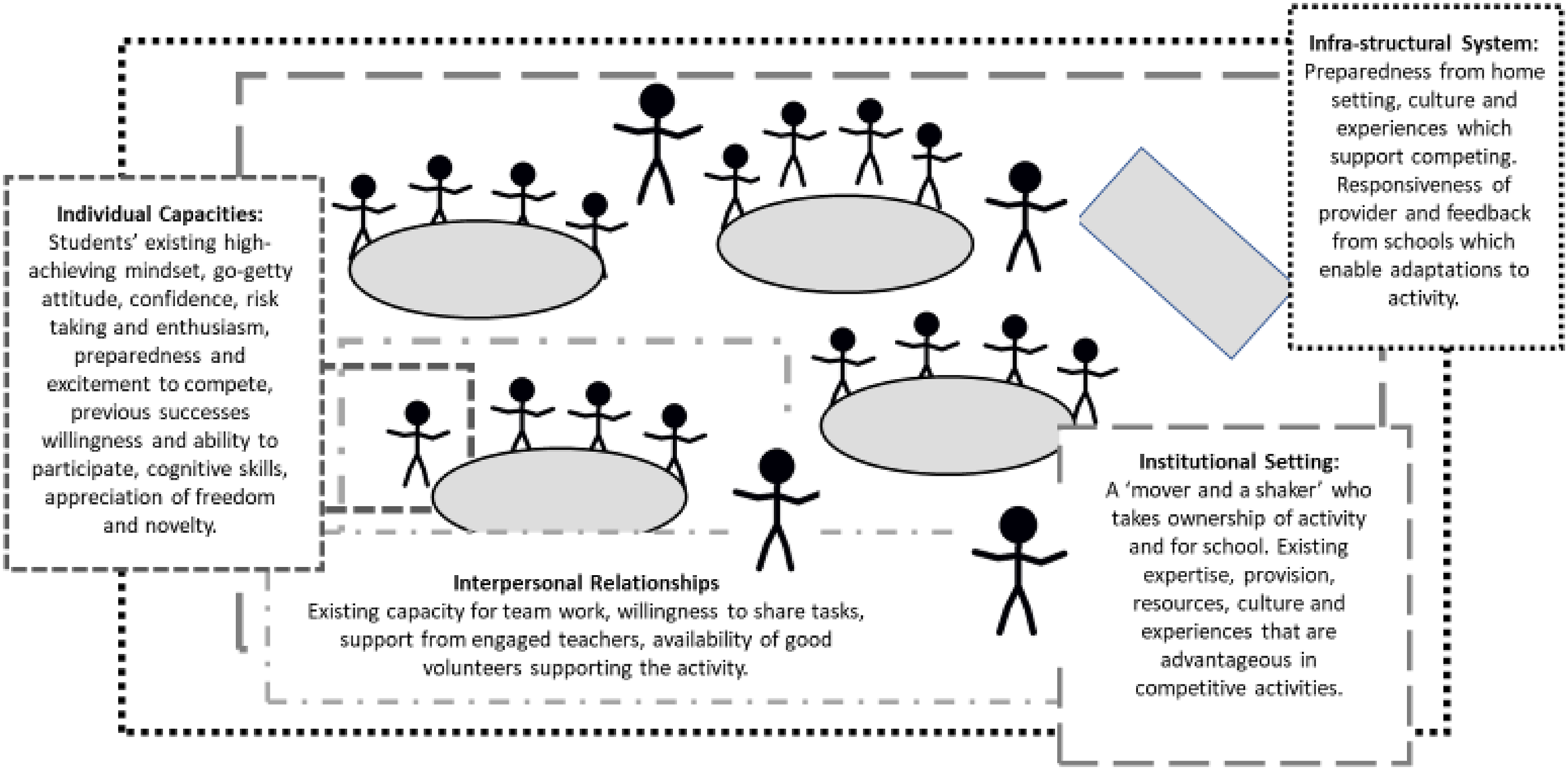
In the following sections evidence is presented regarding for whom these types of activities are not working so well.
For Whom are One-Day Competitions Not Working So Well?
Individual Capacities
Regarding influences on individual motivations, the nature of one-day competitions being compulsory and organised in larger groups is discussed. One consultant said: “…the one-day in a hall…they’re not making that decision for themselves, so they’re not as invested and if they’re not as invested, they don’t get the potential out of it...” (Consultant Provider Competitive 2). Other program practitioners assess with large groups you have “the ones who were interested and the ones who are not interested” (School Based Educator 3), and say “…if you’ve been forced or conscripted… that’s definitely going to impact on your motivation...” (Consultant Provider Competitive 1). Another factor is the extent to which students appreciate or enjoy the task. One consultant described a group of students who “just took umbrage to the product we were asking them to develop….” and, despite the consultant offering alternative ideas and tasks “nothing stuck, nothing would take…they were pretty disruptive as a group and in the end, we had to take them out…” (Consultant Provider Competitive 3). A School Based Educator described one-day competitions where students had to pitch existing products, saying the students “really struggled with products that were boring to them…trying to promote something they weren’t fully behind…” (School Based Educator 1). In addition to task motivation, students’ personal capacities also played a role: “…we would have a real mix of abilities across a year group… I would definitely see kids just disengage…” (Consultant Provider Competitive 3). This consultant identified two types of disengagement: “At the very top end, you would get the kids who just finished everything too quickly, because they knew the game…then you would have the group at the other end who didn’t think they had a chance, who were very down on themselves because of their own abilities and disengaged for those sorts of reasons...” (Consultant Provider Competitive 3). Another consultant discussed this scenario, identifying that students who were “lower achieving” did not do so well in one-day competitions: “no matter how hard they tried they never did as well, they just weren’t as good, and there’s nothing you can do about that…” this provider concluded “not everyone is good at everything... but that was clear it was de-motivating” (Consultant Provider Competitive 1). Students also articulated this situation; one consultant said: “…I definitely had scenarios where we have been running things in a school and it’s ‘Ah well, we never win because we’re the thick kids…so we’re not really going to try…’” (Consultant Provider Competitive 3).
A non-competitive consultant discussed students being “at different levels”, not just in terms of “intellectually…in the sense of IQ”, but also in relation to “social baggage” (Consultant Provider Non-Competitive 2). Another consultant identified specific learning needs which made the activity inaccessible. For example, an autistic student “couldn’t cope with the amount of noise” and went home (Consultant Provider Competitive 1); or a student “on the autistic spectrum” didn’t respond to competitiveness (School Based Educator 1). While such students are likely have the choice to opt out if they feel overwhelmed, other students without a specific SEN diagnosis would likely have to carry on, or potentially “act up” until they were excluded (Consultant Provider Competitive 1).
The extent to which one-day competitions generate strong emotions and reactions was a striking feature of the program practitioners’ evidence. One consultant said: “…the downside is for some kids they are incredibly alienating…they can be very stressful…they can cause a lot of upset…and kids walk out of stuff crying…” (Consultant Provider Competitive 3). Another consultant identified that the presentation finale was a source of stress “…they often didn’t want to do it and they’d stand there with their posters in front of their faces and one person might talk…I remember how I felt at that age…it would have been nerve wracking.” (Consultant Provider Competitive 1).
In addition, winning and losing are important: “Not understanding why they didn’t win is the big one…you go ‘well, this team is the best, yay!’ that leaves a load of teams going ‘well mine’s as good as that, why didn’t I win?’ and it’s unanswered questions, and ‘what’s the point?’...” (Consultant Provider Competitive 2). In some cases, students are characterised as being “very poor losers” where the feedback on the day is focused on the fact they didn’t win, with evaluation comments such as “we should have won” or “angry that we didn’t win” and students being “disillusioned” by the experience (Consultant Provider Competitive 1). The importance of winning and losing is observed in a change in atmosphere when winners are announced: “…as soon as you’ve announced who won and lost…people might immediately lose interest…they might not give another moment’s consideration to what they’ve developed throughout the day…” (Consultant Provider Competitive 1).
Overall, one School Based Educator said it was predictable at the beginning of the day who would do well: “ There are not a lot of examples that come to mind, of students who started ill-equipped for enterprise, whatever you mean by that, under-prepared, lacking in confidence, there are not many examples of students who approached enterprise ill-equipped and were transforming themselves through those activities...” (School Based Educator 3).
Interpersonal Relationships
Evidence regarding interpersonal relationships relates to how students feel within a team, how teams interact with each other and how students compare their success in relation to other teams. Program practitioners describe how social comparison within a team may cause a student to feel de-motivated, where students become aware, that no matter how hard they try, they won’t be as good as a teammate: “…they know…certain people are better at something than they are…[and] that can be quite de-motivating” (Consultant Provider Competitive 1). This consultant extended this analysis to “any competitive learning situation”, where “no matter how hard they tried…they weren’t as good…”, concluding “… the de-motivation; it’s happening all the time” (Consultant Provider Competitive 1). In addition, differing attitudes of students to the task impacts the group: “If you got one or two negative students in the group, it kind of pulled the others down…I was talking to them…trying to gee them up a little bit… but… it was group dynamics…” (School Based Educator 1). This educator connected lack of engagement with the task to attitudes, saying students who are “lacking enthusiasm” and “not into it” can create negative effects in a group (School Based Educator 1). Another issue is attitudes towards group roles, for example, a students’ attitude towards the MD (Managing Director): “…[if] someone’s being bossy… they may feel demotivated because they’re thinking ‘who are they to tell me what to do?’…” (Consultant Provide Competitive 1). A School Based Educator said: “Some students struggle in a group…with their social skills…[or] you’ll get…someone who domineers…[or] someone who doesn’t listen to other people…” (School Based Educator 1). One consultant said: “…you could have somebody come up with a brilliant idea and he’s walked all over by the alpha person in the team, for no reason except that the other guy just talks more.” (Consultant Provider Non-Competitive 2).
These interpersonal challenges can be experienced intensely by students, one consultant who had provided “hundreds” of one-day competitions said: “I’ve seen students argue, and get upset, I’ve never had any students assault each other, I’ve seen it come close, definitely…” (Consultant Provider Competitive 3). They explained that arguments often arise in relation to decision making about ideas: “One student would say ‘I want to go this way.’ And another student would say ‘No, I want to do this’ … [then it’s] ‘Ah, well you’re stupid’, and all of a sudden, you’re standing in between the two of them going ‘Look guys, it’s a bit of fun….just relax a second’ or splitting up teams potentially...” (Consultant Provider Competitive 3).
Non-competitive consultants discussed group dynamics in relation to why they pay special attention to facilitating good group behaviors: “They go in groups, but they don’t work as a group…they’re not open to other people’s suggestions.” (Consultant Provider Non-Competitive 1). Non-competitive practitioners discussed specific methods for example ‘Diamond 9’ a confidential decision-making process which facilitated “quiet ones” to effectively contribute ideas (Consultant Provider Non-Competitive 1). Another example was “micro-organising structures and interactions between students” through cooperative learning teaching strategies (Consultant Provider Non-Competitive 2), this is where specific patterns of speaking and listening enabled equal participation of students.
In a one-day competition, as well as dysfunction within a team, “horrible stuff” can happen where teams upset students outside their group, for example when “kids are up on stage…[and others were] openly mocking…” (Consultant Provider Competitive 1). Another consultant said: “…you will always get that group of kids who disrupts everyone else... they’re having a fine old time… but their interactions are bothering everybody else and having a negative impact.” (Consultant Provider Competitive 2).
Another interpersonal influence is where a team may feel hard done by or confused by their failure to win: “…you’ll hear ‘…their team did really well, because they had so and so, who’s good at maths,’…” (Consultant Provider Competitive 2). In addition, students will have their ideas about who will win confirmed: “…do the same people always win? …[it’s] often the case. It’s ‘Oh God, it’s them again.’ (Consultant Provider Competitive 4). One educator summed up: “…the students start and most of them think ‘I’ve got a chance’…then they see other teams moving ahead and paths diverge…the reality is that competition works for those who are on the more successful side and disengages those who are on the less successful side…” (School Based Educator 3).
Institutional Setting
Evidence relating to institutional unpreparedness and incoherence, the behaviors of teachers and the unsustainability of (some) schools’ programs is presented in this section. With a one-day competition, students “are just told…go in that room, do something for a day…” with the result that “it’s all just a blur for a lot of kids I think” (Commissioner Manager 1). One consultant thought that students were stressed because of their unprepared-ness: “…it’s probably somewhere between 50 and 100, who I’ve ever seen cry…. Some say ‘I’m not really good at pitching…’ or ‘I don’t want to be videoed,’ or [it’s just] the whole stress of being in those kind of environments. They weren’t adequately prepared for it” (Consultant Provider Competitive 3). Another consultant said: “…some just don’t see the point of it…why they are being taken out of school to do an enterprise education competition…because it doesn’t go towards exam results directly.” (Consultant Provider Competitive 1). Another consultant discussed how Enterprise is rolled into a wider enrichment program which could include content about healthy schools, safeguarding and drugs, and described asking the students if they liked it: “…they were like ‘No, awful. I prefer my normal lessons. I don’t know what I’m doing.’ … healthy eating for half a day. A one-day enterprise competition. It’s like why do it? It has no meaning to the student.” (Consultant Provider Competitive 4). This consultant linked these situations to a “lack of coherent planning” within a school and instead ‘ticking a box’ by doing a discrete activity: “We’re doing it because we’re ticking a box, whoever’s box that is… we’re not doing it because we’ve sat down as a staff and decided what skills we want students to have, or what enterprise experiences we want them to have…” (Consultant Provider Competitive 4).
Teachers’ behaviors were also discussed: “… if they [the teacher] just see it as an opportunity to have a day, or, a series of days off curriculum where they can catch up with their marking…it’s not going to be the quality of impact…” (Consultant Provider Competitive 6). Whilst another consultant identified that teachers “often sit back” they also observed that when providers come in and ‘deliver’ then teachers “don’t really know what their role is, so they don’t really actively take part” (Consultant Provider Competitive 4). This consultant summarised that days-off-timetable are “quite chaotic”, and no one is sure what the “so-what?” is, or “why are we doing it?” (Consultant Provider Competitive 4). Another problem with the one-day competition that remains discrete (and reliant on outside providers), is sustainability: “…it’s not at all embedded, and with that, comes the question of sustainability… because if there’s no funding for that activity then how can it be continued…?” (Consultant Provider Competitive 5). The stress on teachers from a one-day model was also acknowledged: “…a one-day competition model, off timetable…that’s quite distressing in lots of ways…[it] puts a lot of teachers under a lot of pressure, because they’ve got such a lot on, they don’t want to be giving up their time to do a one-off thing…” (Consultant Provider Competitive 4). An extra-curricular activity also means time from subject teaching: “teachers who are under pressure, will complain very often about the disruption that’s caused by these special enterprise activities which mean that suddenly they’ve lost two lessons of English or maths or whatever…” (Consultant Provider Competitive 5). As well as time, financial resources are also a factor: “Often if you’re buying a competition in, people will do it for you, I won’t say it’s minimum effort, because I think they’re a lot of effort, but then they’re very expensive as well...” (Consultant Provider Competitive 4), providing an alternative perspective on ‘for whom’ a one-day competition is not working so well, which is a time-poor and stressed teacher or an enterprise coordinator whose funding is tight and the cost of ‘a day’ is expensive and takes time lesson time.
Infrastructural System
In relation to the infrastructural system, program practitioners discussed social disadvantage and the weaknesses of short term, competitive activities to address this. One educator discussed the different level of preparedness from the “parental setting” and connected this to students’ ideas of success: “…because you’re less prepared, you do less well… you see that there’s somebody there who is going to do better…I imagine you think ‘whatever situation I’m going to come across in life, there’s always going to be somebody better than me, so I’m destined always to be second best'…” (School Based Educator 3).
The short-term nature of activities and difficulty in tracking students led one provider to assess the impact of such activities is not well understood: “…one of the challenges is in terms of how you can track the young people… that makes it difficult to really understand the true impact.” (Consultant Provider Competitive 6). In addition to impact on students (or lack of knowledge about impact), another effect of one-day competitions is that they institutionalise certain practices and ideas: “…it’s negative in terms of the capacity it creates within institutions, because they end up only delivering that kind of activity….” (Consultant Provider Competitive 3). Furthermore, a one-day competition may also set up unrealistic and unhelpful expectations: “…unfortunately, this style of enterprise education…Dragon’s Den, make a million…it was like saying, you know ‘You come up with a bright idea, you pitch in and get your funding and suddenly you can buy a Porsche’…that was a really inappropriate thing to be putting in front of youngsters…it’s not realistic for a start. They seldom got the story about the failure rate of new ventures, so…it’s just playing around with it.” (Consultant Provider Competitive 5). Because issues are taught in a “simplistic fashion” in a one-day competition they are “not meaningful” (Consultant Provider Competitive 3). “I’m giving kids a taste of something, but I’m not even sure it’s well understood what they’re really getting a taste of. The educational value of all that activity, I would argue, is very low.” (Consultant Provider Competitive 3).
A consultant providing non-competitive activities was also concerned about the values activities reproduce: “… if you’re just put in a competitive world, and no other world…you’re only given one side of the story. You’ve not got the whole story, so if it’s just competitiveness, and that’s how you’re taught, that’s all you’re going to know.” (Consultant Provider Non-Competitive 1). The cooperative practitioner said that students in disadvantaged communities could benefit from alternative business models: “I work in very deprived areas…I’ve said to a lot of these students ‘you could set up a cooperative window cleaning service’… ‘you could set up a cooperative alternative to Deliveroo’. There’s so many things in your community you could…gain money from, if you were just given that opportunity.” (Consultant Provider Non-Competitive 1). Regarding the wider, social impact of one-day competitions, a competitive consultant said: “I don’t see a scenario where anything in those activities is highly transformative of any particular social issues…And I don’t feel that in their current format they do much to challenge stereotypes…because fundamentally they are a Dragon’s Den-ey thing, they are pretty masculine in nature. They reinforce many of the stereotypes of who entrepreneurs are.” (Consultant Provider Competitive 3).
Figure 3 summarises evidence relating to the four layers of context, illuminating for whom such activities are not working so well. Comparing Figures 2 and 3 shows the variation in program experience and effects, depending on contextual differences. For whom are one-day competitions not working so well?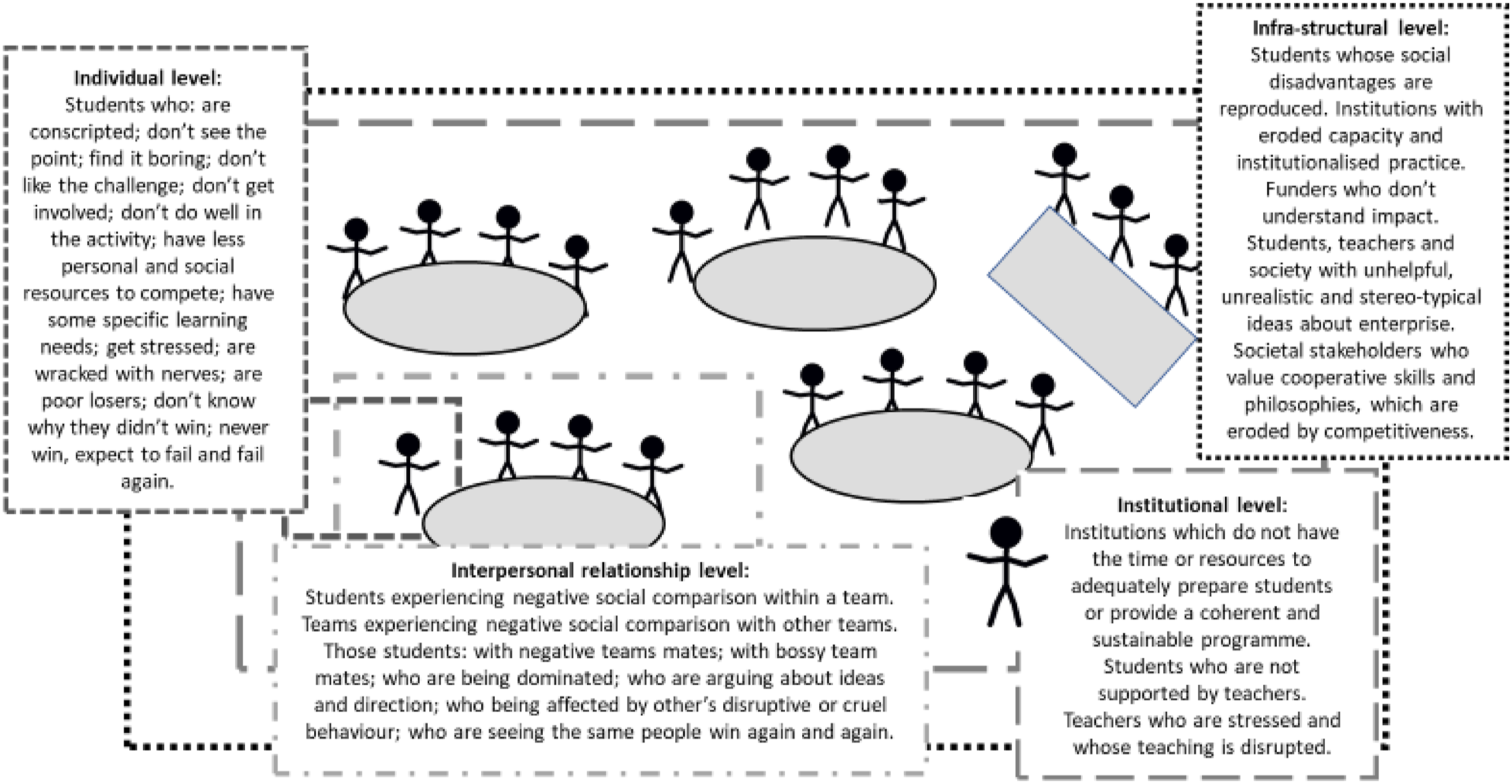
In the following sections data reconstructed to abstract pathways of subjects – more positive and more negative – in one-day competitions.
Re-Describing One-Day Competitions Through Pathways of Subjects
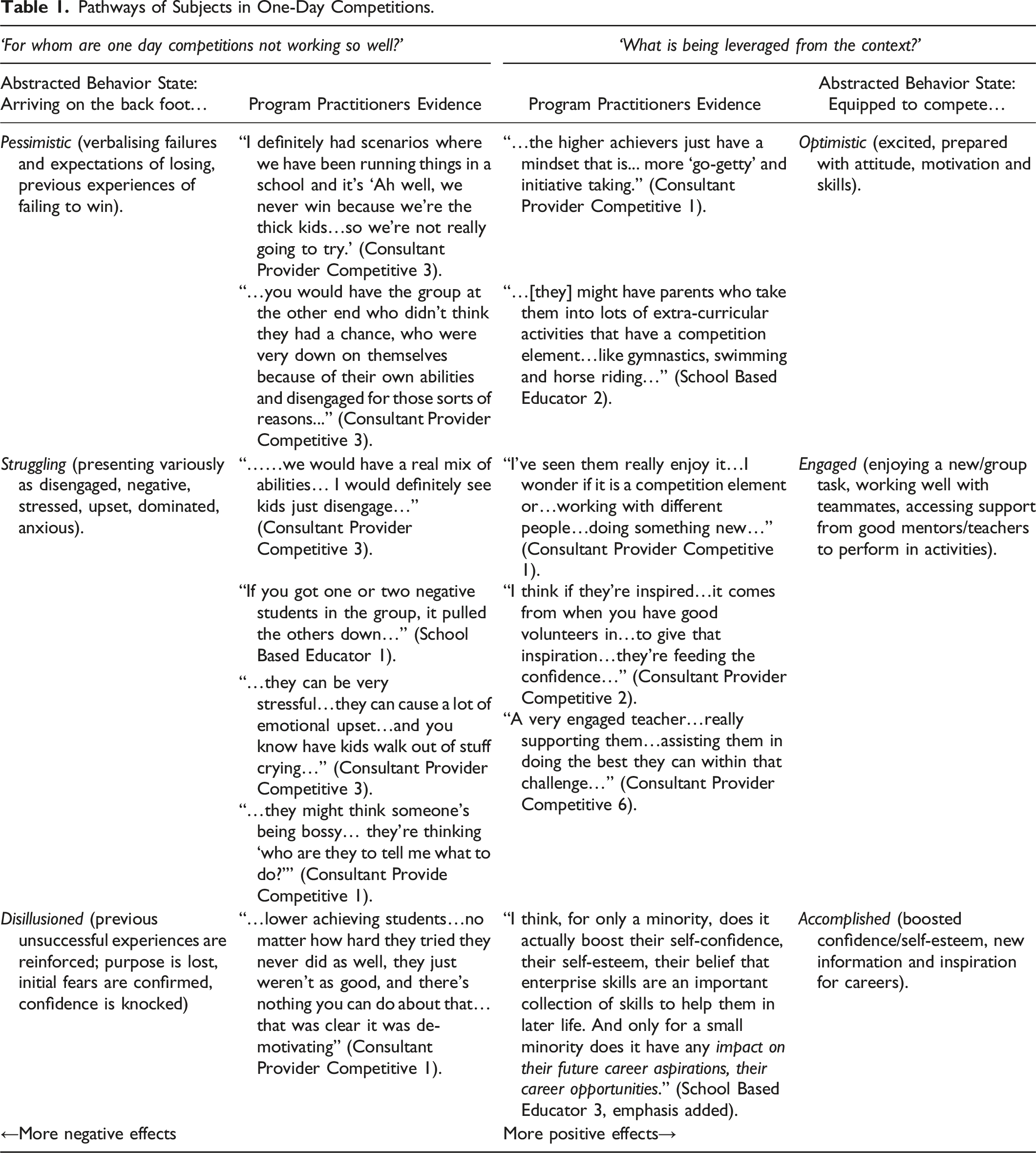
In Realist Evaluation the goal is not to prove if something works or not, instead, rigour comes from developing foresight that might influence program re-design or better targeting (Jagosh, 2019, 2020). Pawson (2013) argues that modelling the pathways of subjects in programs is a particularly useful strategy in the way it walks through the behavior states of participants in different contexts. Pathways of subjects aim to portray “a subject’s state …in the abstract” (Pawson, 2013, p. 128). To develop pathways of subjects selected evidence fragments from program practitioners were reconstructed in relation to more positive and more negative effects then the abstracted behavior states of students were theorised.
Pathways of Subjects in One-Day Competitions.
Though beyond the scope of this paper, further Realist program theorising can be supported by working with middle range theory (Pawson, 2008). Given the pathways of subjects illuminated here, the perspective of Social Comparison Theory (where unfavourable social comparisons damage self-worth), Self-Determination Theory (where external rewards undermine intrinsic motivation) and Achievement Goal Theory (where winning is prioritised over mastery) are all promising theories to explore. In addition, given the evidence on the importance of school and family context, Social Reproduction (where an un-level playing field re-produces existing advantage and disadvantage), needs more attention. These theories have been proposed as potentially important elsewhere (Author, 2018), and this study provides empirical evidence which confirms this.
Implications for Practice and Research
As discussed at the beginning of this paper, the stated goals for EE/EE in schools are centred around the development of can-do confidence and entrepreneurial spirit for all individuals (Young, 2014; Conway, 2022). One-day competitions are promoted and delivered to achieve this (Mann et al., 2017; McLarty et al., 2010). At the end of this study, we have a more realistic picture of the existing advantageous resources which help generate more positive effects, as well as how positions of disadvantage can be reinforced by such activities.
One important implication is to consider the Ripple Effects of one-day competitions, where the nature of the program changes the context itself (Jagosh et al., 2015). For example, experiences on one-day competitions may feed forwards to influence who self-selects into voluntary enterprise competitions. Impact measurement studies about long-form enterprise competitions do not fully, qualitatively, consider non-volunteers, that is, students who don’t select into programs. With the evidence presented in this paper it is possible to theorise that one Ripple Effect of one-day competitions is that they diminish interest in EE/EE. Whilst decreased intentions have previously been linked to greater understanding of what entrepreneurial careers involve (cf. Hanson et al., 2017), this study reveals a different possibility - experiencing a competitively designed program on an un-level playing field contributes to negative attitudes. Another Ripple Effect is that one day-competitions, structured as they are to conclude with winners and losers, amplifies broader individualistic and competitive values and does not give students a full or meaningful picture of entrepreneurial action - for example, cooperating towards a common, business, objective, not just competing - and feeds fixations on winning. Overall, the analysis presented in this paper demonstrates that one-day competitions should not simply be expected to fulfil the stated goals of policy, straightforwardly feeding into personal and social development. Instead, such activities have the power to elevate students who arrived at a competition better equipped to compete, whilst diminishing disadvantaged students whose more challenged starting point means they arrived on the back foot.
In terms of further research this signposts important directions which require attention in EE/EE. First, how can this space – the compulsory extracurricular day - be better designed? Whilst beyond the scope of this paper, educators and providers highlighted ideas and models such as consultancy days, skill development masterclasses and inclusive curriculum approaches to address/re-dress the un-level playing field. In addition, it is important to note that some one-day competitions have an environmental or eco-focus. Now it is clearer that one-day competitions can be disillusioning for some students this should raise concern that Green Dragon’s Den days and eco-challenges could switch students off from sustainability as well as EE/EE.
Second, how can program evaluation provide a richer and more comprehensive picture of what is happening in programs? Realist Evaluation is a valuable approach and the thematic analysis focused on the Four Is provides a manageable strategy, but there are also many other interesting and creative qualitative approaches that could enlighten the field alongside the pursuit of average effect sizes.
Third, given the striking evidence gap with regards to one-day competitions, scholars might explore why such activities are so prevalent in EE/EE. What taken-for-granted assumptions are at play? What ideologies, institutions and organisations, social groups and systems benefit from these activities? Education scholars appeal that interest in program impact extends beyond ‘does this program work?’ and to ‘what does it work for?’ (Biesta, 2007). This requires a shift from thinking about evidenced-based education to values-based education (Biesta, 2010); where consideration is expanded beyond the outcomes-argument, that is, the outcomes the various educational endeavours are supposed to bring about, and towards the civilisation-argument, that is, what are the things we value as a society.
Conclusion
This paper identifies an evidence gap regarding one-day competitions in school-based EE/EE provision and contributes new knowledge in a holistic and comprehensive way. It reveals important contextual conditions and variations in program experience which influence effects. Foresight about what can happen in one-day competitions is developed, which is more useful than capturing what happened in a single program in one context. Overall, the approach of applying Realist Evaluation to a ubiquitous but under-researched intervention underscores the importance of complementing measuring with thinking.
Footnotes
Declaration of Conflicting Interests
The author(s) declared no potential conflicts of interest with respect to the research, authorship, and/or publication of this article.
Funding
The author(s) disclosed receipt of the following financial support for the research, authorship, and/or publication of this article: This work was supported by the Sheffield Hallam University (Ethics Review ID: ER9511408) and Sheffield Business School Scholarship Program.
Ethical Approval
This study did not require ethical approval.
