



Abstract
Focusing on a specific form of entrepreneurship education, entrepreneurial mentoring, we take a relational mentoring perspective and develop a model of entrepreneurs’ assessments of potential mentors. We theorize that if mentees perceive their business-related values to be similar to a potential mentor’s values, they are more likely to choose this mentor, and that this relationship is moderated by different types of the potential mentor’s experiences (i.e., entrepreneurial experience, industry experience, and mentoring experience). We test our hypotheses using a metric conjoint experiment and 2,240 assessments of potential mentors by 140 entrepreneurs. Our findings reveal that mentees' perception of business-related value similarity with a potential mentor increases the likelihood of choosing this mentor. Further, higher levels of mentors’ experiences strengthen this relationship. We discuss the implications of our study for research on entrepreneurial mentoring and relational learning in the entrepreneurial context, and we provide practical insights on how the matching process in mentoring programs may be facilitated.
Keywords
Introduction
Given that general entrepreneurship research has the potential to inspire research on entrepreneurship education, the widening gap between entrepreneurship research and entrepreneurship education research and practice has received increasing scholarly attention (Neck & Corbett, 2018; Shepherd & Gruber, 2021; Wiklund et al., 2019). While entrepreneurship research has highlighted the importance of knowledge for the entrepreneurial process (Dimov, 2010; Gruber et al., 2012; Marvel et al., 2016) and has differentiated between entrepreneurs’ different types of knowledge (e.g., entrepreneurial vs. industry knowledge; see Marvel et al., 2020), the question of how entrepreneurs can acquire various types of knowledge has traditionally been the focus of entrepreneurship education research (Neck & Corbett, 2018). Specifically, this literature has explored different forms of entrepreneurial learning, including traditional experiential and action-based methodologies, such as the lean startup model (Martina & Göksen, 2022; Rasmussen & Sørheim, 2006; Shepherd & Gruber, 2021). More recently, scholars have focused more on interpersonal approaches, such as entrepreneurial mentoring (Baluku et al., 2019; Hanson, 2021; Sullivan, 2000), which enables mentees to learn from the knowledge of their more experienced and oftentimes senior mentors (Haggard et al., 2011; Kram, 1985).
Indeed, both research and practice have emphasized that mentoring is a key learning opportunity for entrepreneurs (Bergman & McMullen, 2022; Hanson, 2021; Rasmussen & Sørheim, 2006; St-Jean & Audet, 2012; Sullivan, 2000; Zhang et al., 2022). Studies have shown that mentoring can encourage the development of entrepreneurial intentions and self-efficacy (Baluku et al., 2019; Meoli et al., 2020), improve opportunity recognition (Ozgen & Baron, 2007; Rigg & O’Dwyer, 2012), and enhance entrepreneurs’ ability to meet strategic goals (Deakins et al., 1998). Mentoring can be beneficial for novice entrepreneurs as well as for more experienced entrepreneurs (Marvel et al., 2020; Ozgen & Baron, 2007) because it helps them deal with the high levels of uncertainty and setbacks associated with the venture-creation process (Delmar & Shane, 2006; McMullen & Shepherd, 2006). Mentoring can also trigger different forms of learning (i.e., reflection or experiential learning; St-Jean & Audet, 2012; Sullivan, 2000) that ultimately enhance the chances of mentees’ entrepreneurial success (Sullivan, 2000).
However, although both entrepreneurial practice and the academic literature have highlighted the potential value of mentors for entrepreneurs, mentoring is a relational process (Humberd & Rouse, 2016; Ragins, 2012). Thus, its success depends on entrepreneurs’ willingness to work with their mentors and how they, as mentees, perceive these relationships (Kuratko et al., 2021; Marvel et al., 2020; Ragins, 2012). The relational mentoring literature has suggested that mentees are more open to mentors who have similar values to facilitate the development of a high-quality relationship (Ensher et al., 2002; Ragins, 2012) characterized by high personal fit (Hanson, 2021), a positive attitude toward each other (Zhang et al., 2022), and high engagement of both parties in a process of identification with each other (Humberd & Rouse, 2016). Therefore, when choosing a mentor, it appears essential that mentees have similar business-related values—values with respect to founding and managing a venture—as their potential mentors. Indeed, similar values between mentees and their mentors may enhance not only relationship satisfaction and mutual liking (Ragins, 2012; Ragins et al., 2000) but also learning processes (Godshalk & Sosik, 2003; Lankau et al., 2005; Ragins et al., 2000; Wanberg et al., 2006) and thus the extent to which mentees expect to benefit from their mentors’ prior experience. Thus, in this study, we ask: To what extent do mentees choose potential mentors based on the mentees’ perceived business-related value similarity with mentors and mentors’ experience?
Addressing this question is important because a relational perspective on entrepreneurial mentoring extends the notion of the relevant experience mentors bring to mentoring relationships (Ozgen & Baron, 2007) by focusing on the extent to which mentees are actually receptive to their mentors’ inputs. Thus, by studying how business-related value similarity in conjunction with mentors’ experience impacts mentees’ assessments of potential mentors, we gain a more holistic understanding of the prerequisites for initiating effective mentee-mentor relationships from the mentees’ perspective. Building on these thoughts, helping mentees identify mentors based on mentors’ similar values and their experience might be a way to increase the effectiveness of entrepreneurial mentoring programs as it can facilitate the transfer of mentors’ knowledge. This understanding can help establish better matching processes, for example, in the context of venture incubation programs (Bisk, 2002; Rasmussen & Sørheim, 2006).
Therefore, in this study, we offer a model of mentees’ assessments of potential mentors based on their perceived business-related value similarity and mentors’ different types of experience (i.e., mentoring experience, entrepreneurial experience, industry experience). To empirically test our model, we draw on 2,240 assessments by 140 mentees relying on a metric conjoint study. By applying an experimental vignette design (Aguinis & Bradley, 2014), we follow recent calls for a wider application of experimental methods in the field of entrepreneurship education research (Englis & Frederiks, 2023). We contribute to research on and the practice of entrepreneurship education and entrepreneurial mentoring in at least three ways.
First, studies have examined the important role of entrepreneurial mentoring for entrepreneurs (Deakins et al., 1998; Ozgen & Baron, 2007; Rigg & O’Dwyer, 2012) but have provided few insights into the onset of mentee-mentor relationships. Taking a relational perspective from the mentees’ point of view, we identify business-related value similarity as an important driver of mentees’ choice of a mentor. Second, we extend insights from prior studies demonstrating that mentors’ previous domain-specific experience, such as entrepreneurial and industry experience, are valuable for entrepreneurial mentees (Marvel et al., 2016; St-Jean & Audet, 2012). Specifically, by showing that mentoring experience serves as an important contingency for mentees when choosing their mentors, we shift the attention toward mentors’ prior relational experience. Finally, extant studies have highlighted the important role of mentors’ experience for their mentees (Allen, 2003; Allen & Eby, 2004). We extend this understanding of the role of mentors’ experience by showing that it can strengthen the role of business-related value similarity, indicating that a potentially positive mentee-mentor relationship is seen as even more valuable by mentees when it is complemented with a mentor’s helpful experience.
Theoretical Background
Relational Mentoring
Mentoring is commonly defined as a “developmentally oriented relationship” (Eby et al., 2013) between an experienced and oftentimes rather senior mentor and a mentee (Haggard et al., 2011; Kram, 1985). Mentoring frequently takes place in informal settings (Day & Allen, 2004) and may vary in its temporal horizon (Eby et al., 2013; Haggard et al., 2011). While mentoring practices can differ considerably across mentor-mentee dyads, mentors often provide both instrumental support (i.e., facilitation of performance goal attainment) and psychosocial support (i.e., increased self-perceived competence and subsequent personal growth) to their mentees (see Eby et al., 2013).
The quality and nature of mentee-mentor relationships substantially impacts the outcomes for both mentors and mentees (Allen & Eby, 2004; Eby et al., 2013; Zhang et al., 2022). To understand these relationships, scholars following the positive organizational scholarship tradition (see Cameron et al., 2003) have developed the concept of relational mentoring (Ragins, 2012; Ragins & Verbos, 2007). This concept is grounded in the idea that high-quality relationships in the workplace are key to achieving “mutual growth, learning, and development” (Ragins, 2012, p. 2), thereby focusing on the interpersonal processes inherent in every mentoring activity. As opposed to traditional hierarchical conceptualizations of mentoring, relational approaches apply a dyadic and reciprocal perspective emphasizing the multidirectional nature of growth and development for both parties involved (see Ragins, 2012). Indicative of a high-quality relationship are a strong emotional bond, liking, trust, and satisfaction with the relationship (Allen & Eby, 2003; Humberd & Rouse, 2016; Ragins, 2012). Learning, in this regard, is a relational process emerging in mentee-mentor interactions (Myers, 2021; Zhang et al., 2022).
Two main mechanisms explain how relational learning in mentoring relationships unfolds (see Eby et al., 2013). First, mentors can act as role models who trigger vicarious learning cycles in mentees (Lévesque et al., 2009; Myers, 2021). In this process, it is important not only for mentees to identify with their mentors as desirable future images of themselves (Humberd & Rouse, 2016) but also for mentees to recognize their mentors as potential sources of learning (Zhang et al., 2022). Second, effective relational mentoring unfolds through the process of scaffolding and reflection. That is, mentees are provided with a cognitive framework to aid understanding and give meaning to the complex information and experiences they face (Eby et al., 2013; Sullivan, 2000). For example, by directing mentees’ attention to inter- and intraorganizational trends and developments, mentors can create consecutive learning experiences and enable mentees’ long-term behavioral and attitudinal change (St-Jean & Audet, 2012; Sullivan, 2000).
From a mentee’s perspective, relational learning in mentoring includes cognitive as well as affective processes (St-Jean & Audet, 2012). Cognitively, learning typically occurs from receiving advice (Deakins et al., 1998). This advice is limited by the extent of mentors’ experience and mentees’ receptiveness to it, posing an important contingency on cognitive learning and the instrumental role of mentoring (Fagenson-Eland et al., 1997; Ragins, 2012). Affective learning, in contrast, can only take place if a mentee-mentor relationship is of high quality, as acknowledged by the relational mentoring approach. In this case, important mentoring activities are less formal and specific but rather fulfill the psychosocial functions of mentoring (St-Jean & Audet, 2012). Especially on the affective level, the perceived quality of the relationship between a mentee and mentor is of utmost importance (Allen & Eby, 2003). Therefore, taking a relational mentoring perspective emphasizes the importance of considering not only what mentees and mentors bring to their relationships but also to what extent mentees are actually receptive to the guidance and advice offered based on their mentors’ experience.
Value Similarity and Mentees’ Choice of a Mentor
A decisive factor in building high-quality relationships between mentees and mentors lies in sharing similar values (Eby et al., 2013; Ensher et al., 2002). Value similarity between individuals is associated with high levels of relationship satisfaction and liking (Ragins, 2012; Ragins et al., 2000), both of which are key elements of high-quality relationships (Godshalk & Sosik, 2003; Lankau et al., 2005; Ragins et al., 2000; Wanberg et al., 2006). First, similarity in values fosters harmony and interpersonal comfort, thus reducing the likelihood of conflict (Jehn et al., 1999) that can undermine high-quality relationships. Second, perceived value similarity increases trust between individuals (Williams, 2001), which is a key building block of high-quality relationships (Edwards & Cable, 2009; Ragins, 2012). Third, value similarity enhances communication between individuals. Since “having shared standards concerning what is important establishes a common frame for describing, classifying, and interpreting events” (Edwards & Cable, 2009, p. 656), similar values make communication flow easier, which can trigger stronger interpersonal bonds.
While values can capture different activities and aspects of life (see Schwartz, 2012) and work (Ros et al., 1999; Sagie et al., 1996), in the context of entrepreneurial mentoring, we focus on business-related values, defined as values with respect to founding and managing a venture. Entrepreneurs’ values related to how they want to work shape their preferences for their own development and that of their ventures (Almeida & Teixeira, 2017; Berings & Adriaenssens, 2012; Edwards & Cable, 2009; Kirkley, 2016). For example, mentees and mentors may differ more or less in their values regarding sustainability, leading to potentially different views on how much ventures should invest in proenvironmental considerations and activities (Eby et al., 2000; Vuorio et al., 2018). As another example, mentees and mentors may also be more or less similar in terms of their growth-related values, which can impact the (differential) ways in which they think about ventures’ strategic development (Fayolle et al., 2014; O’Neil & Ucbasaran, 2016). As a consequence, differences in business-related values between mentees and their mentors may indicate to mentees that conflict with their mentors about important issues may arise (in our examples, about their ventures’ sustainability orientation and growth strategy), thereby undermining trust, liking, and the quality of these relationships. To the extent mentees anticipate these problems when assessing a potential mentor with lower perceived value similarity, their likelihood of choosing this mentor decreases. Thus, we propose the following: Hypothesis 1. Mentee-mentor value similarity positively impacts a mentee’s choice of a mentor.
Value Similarity, Mentors’ Relational Experience, and Mentees’ Choice of a Mentor
Mentoring is a complex relational process, and mentors’ procedural know-how can ensure the best possible outcomes for mentees (Ragins, 2012; Zhang et al., 2022). Previous mentoring experience through which mentors have developed this know-how may therefore be an important contingency factor for the impact of business-related value similarity on mentees’ choice of a mentor.
First, mentees may assume that mentors with mentoring experience are more likely than mentors without mentoring experience to leverage the harmony and interpersonal comfort of a high-quality relationship arising from similar business-related values (Eby et al., 2013; Ensher et al., 2002). More specifically, mentees may think that mentors with mentoring experience are more likely to have already developed helpful communication skills and likely know how to utilize a harmonious mentoring relationship to discuss relevant topics that add value for mentees. Previous studies have shown that mentoring experience is indeed associated with a greater level of career guidance (Fagenson-Eland et al., 1997), indicating that experienced mentors know how to get the best out of a high-quality relationship for their mentees.
Second, mentors’ previous mentoring experience may strengthen mentees’ trust in these mentors. While similarity in business-related values provides the basis for generating trust in an interpersonal relationship (Williams, 2001), mentors’ previous mentoring experience can amplify this effect because it gives mentees reason to believe that mentees’ problems and challenges are not only safe with their mentors but also have a good chance of being solved. The fact that a mentor has been involved in the problem-solving process with other mentees before indicates that they are motivated and know how to approach new mentees’ challenges in a way that is conductive to success. Initial empirical results support this notion by showing that more experienced mentors are more engaged and willing to support their mentees compared to less experienced mentors (Allen, 2003; Ragins & Cotton, 1993).
Last, previous mentoring experience may also further enhance the communication flow between a mentor and a mentee. The common frame of reference established in a mentee-mentor relationship based on value similarity is likely strengthened when mentees assume that their mentors not only listen but fully understand topics and challenges communicated in the process. Challenges and problems brought up by mentees can then be addressed appropriately when mentors have the necessary skills to do so based on their previous mentoring experience.
In contrast, mentors with no or hardly any mentoring experience signal to mentees that they are less capable of building on the high-quality relationship arising from value similarity. Even if they perceive high value similarity, mentees are likely to have less trust that such a potential mentor can solve the challenges they bring up. Finally, the common frame of reference between a mentor and mentee is likely less developed to facilitate communication if a mentor has not sufficiently learned to act upon their frame of reference. Thus, we propose the following: Hypothesis 2. A mentor’s mentoring experience moderates the positive relationship between value similarity and a mentee’s choice of a mentor. The greater the mentoring experience of a potential mentor, the stronger the relationship between mentor-mentee value similarity and a mentee’s choice of a mentor.
Value Similarity, Mentors’ Domain-Specific Experience, and Mentees’ Choice of a Mentor
Mentees are likely only able to comprehend and implement mentors’ advice to derive tangible benefits from their mentoring relationships if they share a mutual understanding of business-related values. Accordingly, having a frame of reference based on shared values is particularly attractive for mentees when the knowledge and experience they hope to receive from a mentor seems relevant to them. Therefore, the role of value similarity in assessing the attractiveness of mentors is contingent on the domain-specific knowledge and experience (Ragins, 2012; Sullivan, 2000) that potential mentors bring to mentoring relationships.
Experience in a specific domain can be acquired through direct observation or participation in a given field, resulting in a steady increase of knowledge and expertise (Holcomb et al., 2009). However, although some level of domain-specific experience is a prerequisite for individuals to qualify as entrepreneurial mentors, studies have also highlighted that there is considerable heterogeneity in mentors’ experience (Fagenson-Eland et al., 1997; St-Jean & Audet, 2012). In the entrepreneurial context, research has indicated that different types of experience have differential effects on performance outcomes at both the individual and venture levels (Gruber et al., 2012; Wennberg et al., 2011). In particular, both prior entrepreneurial and industry experience are of particular relevance for entrepreneurs compared to other types of experience (Cassar, 2014; Marvel et al., 2016). Thus, we suggest that for mentees’ choice of a mentor, these two types of experience represent important resources that mentors can bring to the table and that have the potential to moderate the relationship between value similarity and the attractiveness of a potential mentor.
Entrepreneurial experience, defined as previous involvement in new venture creation (Delmar & Shane, 2006), can build expertise in a broad range of activities and diverse knowledge on the entrepreneurial process (Delmar & Shane, 2006; Dimov, 2010). Prior entrepreneurial experience can help individuals identify new business opportunities (Dimov, 2010) because it enables them to “connect the dots” (Baron & Ensley, 2006, p. 1331) and recognize patterns representing opportunities. Experienced entrepreneurs have also learned that resources are fungible and can be used in different market domains (Gruber et al., 2008; Penrose, 1959), and they typically know how to flexibly adjust business models to these domains (Dimov, 2010). Finally, entrepreneurial experience helps individuals better understand the value-creation potential of new products (Gruber et al., 2008).
We expect that mentors’ entrepreneurial experience strengthens the relationship between value similarity and mentees’ choice of a mentor. On the one hand, mentees may feel that their perspective is more represented in advice coming from mentors who used to be entrepreneurs themselves (Erez et al., 1985), reinforcing the quality of mentee-mentor relationships. This effect may go as far as mentees considering experienced mentors as role models and feeling particularly comfortable opening up to them (St-Jean, 2012). On the other hand, in a mentoring relationship characterized by trust arising from value similarity, mentees are probably less hesitant to also ask questions about the entrepreneurial journey that they may believe would damage their reputation or legitimacy among important stakeholders in other settings. When such mentors also have substantial entrepreneurial experience, mentees will likely be convinced that they can really tap into these mentors’ experience (Ragins, 2012) and profit from it in confidential matters, such as negotiations with investors (Douglas et al., 2014) or conflicts with founding team members (Preller et al., 2023). Furthermore, mentors with substantial entrepreneurial experience give mentees reason to believe that the challenges they describe in the mentoring process are well understood since these mentors likely experienced these or similar challenges firsthand. In this case, the shared frame of reference between mentees and their mentors is extended to include not only the communication level but also a contextual level that may facilitate exchange and subsequent learning.
In contrast, despite high levels of value similarity, if mentors bring little entrepreneurial experience to their mentoring relationships, mentees may not feel as strongly connected to them, which reduces the interpersonal comfort typically prevalent in mentoring relationships characterized by high value similarity (St-Jean, 2012). Mentees are less likely to benefit from a trustful relationship arising from value similarity if potential mentors’ entrepreneurial experience is low because mentees may be skeptical that this trustful relationship will give them an advantage in terms of the knowledge and advice they may receive from such mentors. Lastly, the shared frame of reference between mentees and their mentors is less beneficial for mentees if it does not include mutual experience in what being a founder is like since this mutual experience is often the basis for both describing relevant challenges on the mentees’ side and giving relevant advice on the mentors’ side. Thus, we propose the following: Hypothesis 3. A mentor’s entrepreneurial experience moderates the positive relationship between value similarity and a mentee’s choice of a mentor. The greater the entrepreneurial experience of a potential mentor, the stronger the relationship between mentor-mentee value similarity and a mentee’s choice of a mentor.
In addition to general knowledge about venture creation, it is also reasonable to assume that a potential mentor’s experience in a mentee’s industry can shape the relationship between business-related value similarity and the mentee’s choice of a mentor because industry experience is another crucial form of experience in the entrepreneurial process (Cassar, 2014; Marvel et al., 2016).
Industry experience gained from previous work in a certain industry (Delmar & Shane, 2006; Dimov, 2010) allows individuals to acquire knowledge about the potential opportunities and threats in that particular sector, including the industry’s competitive landscape, legal frameworks, rules, and norms (Delmar & Shane, 2006) as well as relevant products, processes, and technologies (Cooper et al., 1994). This prior experience can help entrepreneurs identify and evaluate new opportunities in a specific industry (Cassar, 2014; Dimov, 2010). Moreover, industry experience can provide individuals with knowledge on suppliers, customer needs, and trends in a specific sector (Cassar, 2014; Dencker & Gruber, 2015). Finally, industry experience helps individuals build sector-specific networks with key stakeholders (Cooper et al., 1994; Eisenhardt & Schoonhoven, 1996). Based on such knowledge and networks, entrepreneurs can not only identify new high-quality business opportunities (Cassar, 2014; Dencker & Gruber, 2015; Gruber et al., 2013) but also make better strategic decisions (Deakins et al., 1998).
Again, high trust (Williams, 2001) and effective communication (Radu Lefebvre & Redien-Collot, 2013) based on high value similarity between mentees and mentors are prerequisites for mentees to accept mentors’ advice and thus for the transfer of industry-specific knowledge and networks from mentors to mentees. In a mentoring relationship characterized by high value similarity and a high level of arising trust between a mentor and mentee, the potential mentor’s high level of experience in the mentee’s industry may further strengthen this trust because the mentee is more confident that the challenges they share with their mentor can actually be solved in the mentoring process. Building on their mentor’s knowledge about relevant players and networks in the industry (Cassar, 2014), mentees may trust their advice more, for example, on how to establish strategic alliances or develop a go-to-market strategy in this specific industry. Furthermore, mentors and mentees who come from the same industry have already started to establish a mutual understanding about the market, relevant players, processes, and trends in this industry. Communication is thus facilitated not only by the shared frame of reference based on value similarity but also by the shared understanding of the industry and, therefore, the context the focal mentee operates in. Since that will be the starting point for many conversations over the course of a mentoring relationship, we expect effective communication to be further strengthened by the level of relevant industry experience mentors possess.
In contrast, if a mentor does not have substantial experience in their mentee’s industry, the mentee may be less likely to assume that their mentoring relationship can pay off for them despite high value similarity. Due to a lack of relevant expertise on the potential mentor’s side, the mentee may be less likely to expect that the trusting relationship with such a mentor will help them tackle the problems they discuss with their mentor. Further, while value similarity improves communication quality (Edwards & Cable, 2009), mentees are unlikely to expect a smooth conversation with a potential mentor who has only limited experience in their industry because they will likely need to substantially elaborate on the context they operate in. Thus, we propose the following: Hypothesis 4. A mentor’s industry experience moderates the positive relationship between value similarity and a mentee’s choice of a mentor. The greater the industry experience of a potential mentor, the stronger the relationship between mentor-mentee value similarity and a mentee’s choice of a mentor.
Methodology
Data and Sample
Our sample includes entrepreneurs whose ventures were located in randomly selected business incubators organized in the major German association of innovation and incubator centers (Arbeitsgemeinschaft Deutscher Technologie-und Gründerzentren, 2015) in the year 2015. Because incubator ventures are typically in an early stage of development (Rice, 2002), they are an appropriate sampling context for our study. We first composed a list of all incubators presented on the German association of innovation and incubator centers’ homepage (Arbeitsgemeinschaft Deutscher Technologie-und Gründerzentren, 2015). This step resulted in a list of 140 incubators that focused on startups in general and were not limited to social or sustainable ventures specifically. We randomly selected 100 of them, thereby following established sampling procedures (Choi & Shepherd, 2004). Subsequently, we compiled a list of all ventures in these incubators based on the information provided on their websites. Consistent with our focus on young ventures, we excluded all ventures that were older than six years. Furthermore, we excluded subsidiaries as their founders are likely to obtain strategic guidance and support from the respective parent company (Domurath & Patzelt, 2016), which likely differentiates their support needs from other entrepreneurs. Finally, we also excluded freelancers from our sample as they represent a “hybrid of employees and entrepreneurs” (van den Born & van Witteloostuijn, 2013, p. 25) and might have different support needs compared to other entrepreneurs. This approach resulted in a primary list of 1041 ventures.
We tried to contact one entrepreneur from each venture via phone to personally introduce our study, explain its purpose, and ask for participation. We were able to reach 593 entrepreneurs by phone, verified the exclusion criteria listed above, and excluded another 131 ventures because they did not end up matching the focus of our study. Further, 64 entrepreneurs did not want to participate in the study. There was no monetary remuneration for participating; however, we explained the purpose of our study in detail, offered all respondents an overview of the results, and asked them if they agreed to participate. Thus, we sent out an email with a personalized link to our online research instrument to a total of 398 entrepreneurs who verbally agreed to participate in the study. If an entrepreneur did not participate after the first invitation email, they received a reminder email one week later highlighting the importance of their response and asking the entrepreneurs again to confirm the consent to participate. Finally, 154 entrepreneurs completed our survey, which corresponds to a response rate of 25.9% in terms of entrepreneurs contacted. Upon inspection of the survey data, 14 more entrepreneurs did not meet our sampling criteria or did not respond reliably (see below) and were therefore excluded from the sample. This process resulted in 140 complete and useable responses.
To test for nonresponse bias, we followed the recommendations of Armstrong and Overton (1977) and compared respondents and nonrespondents in terms of variables that were directly available from the ventures’ webpages or from online company registers. Information on industry membership and venture age was available for 90.65% of the nonrespondents. We did not find any significant difference between respondents and nonrespondents (p > .1), which suggests that our sample is not strongly affected by nonresponse bias.
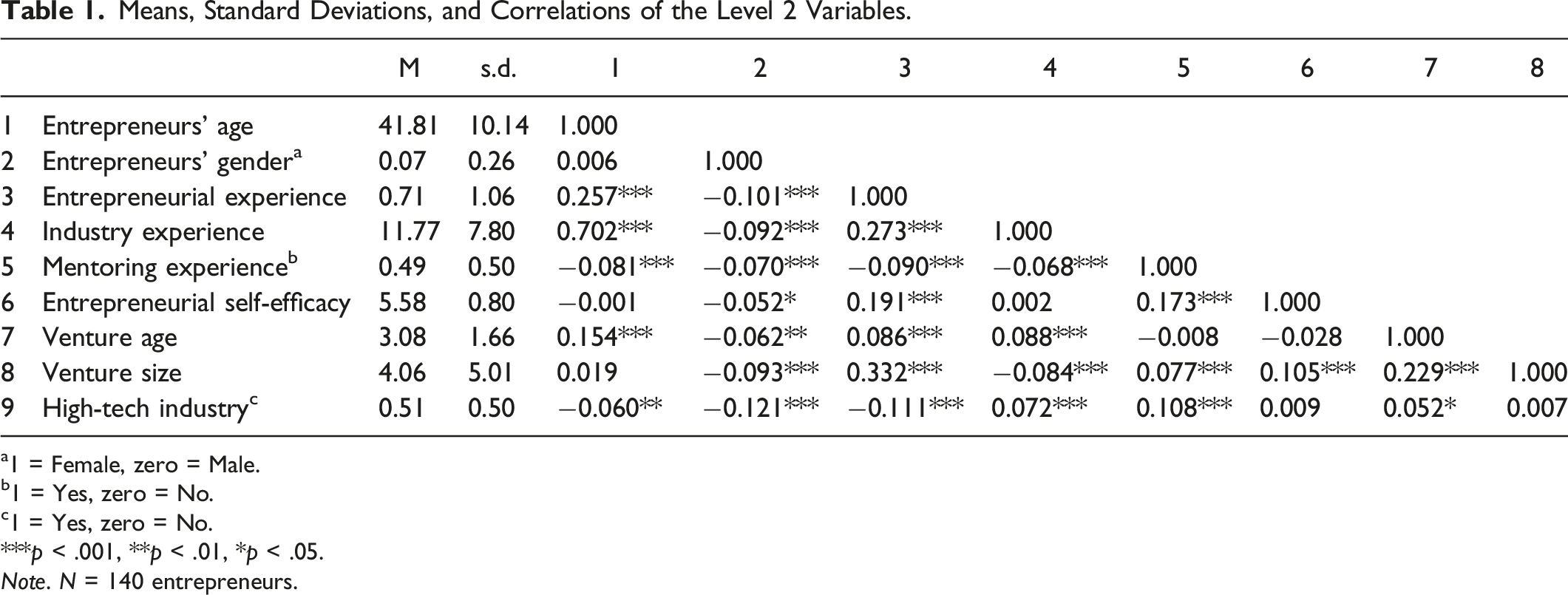
The entrepreneurs in our final sample were 40.81 years old on average (sd = 10.14), and 92.86% were male. With respect to education, 65.71% held a master’s degree or higher. To gain a deeper understanding of the variety of educational backgrounds, we allowed participants to choose from various fields of study (multiple options possible per respondent). Most of them had a background in engineering (47.14%) followed by business (34.29%) and mathematics and natural sciences (20.71%), and 23.57% had an educational background in other disciplines. They had 11.77 years of industry experience on average (sd = 8.00) and had founded an average of 0.71 ventures before (sd = 1.06). Their current ventures were 3.08 years old on average (sd = 1.66) with an average of 4.06 employees (sd = 5.01). While 50.71% of the ventures operated in high-technology industries (e.g., science based and computer hardware/software), 49.29% were active in low-tech industries (e.g., consumer goods, services). Of the respondents, 48.57% had a mentor at one point and 34.29% had a mentor at the time of participating in our study.
Research Design
We used metric conjoint analysis to test our hypotheses (Priem, 1992; Shepherd & Zacharakis, 1999). This method requires respondents to make a series of assessments based on profiles characterized by several decision-relevant attributes (Shepherd & Patzelt, 2015) (see Appendix A). This approach allowed us to decompose the underlying decision policies of the potential mentees we studied to better understand which attributes of a mentor (or combinations thereof) make them especially attractive for entrepreneurial mentees. The method captures respondents’ assessments in real time and thereby overcomes several validity threats of alternative post hoc methods (Lohrke et al., 2010). Given these advantages, conjoint analysis is frequently used to investigate entrepreneurs’ assessments, for example, with respect to opportunities (Choi & Shepherd, 2004; Shepherd et al., 2013) and strategic choices (Domurath & Patzelt, 2016; Patzelt et al., 2008). Moreover, several studies have investigated respondents’ assessments based on hypothetical people represented in conjoint profiles (Brundin et al., 2008; Kollmann et al., 2009). Thus, conjoint profiles are well suited to present hypothetical potential mentors for assessment by entrepreneurs. Before we started our online experiment, we asked seven practicing entrepreneurs to review the materials to ensure entrepreneurs could make sense of the profiles.
In our online survey, the hypothetical potential mentors were characterized by four attributes (business-related value similarity and three types of experience) that varied on two levels each, resulting in 16 possible attribute-level combinations—that is, 16 profiles (see Appendix B). To avoid participants’ fatigue and increase their overall willingness to participate, we reduced the number of profiles using the fractional factorial design by Hahn and Shapiro (1966). The key idea behind this design is to select a subset of factor combinations that still provide sufficient informational value. In our case, the design allowed for a reduction of the number of profiles presented to participants to eight while still capturing all the main effects as well as three independent two-factor interactions in accordance with our hypothesized interaction effects. Thus, the fractional factorial design did not change the benefits of the experiment compared to a full factorial design. Each profile was replicated to check for consistency in respondents’ answers. In our study, the mean test-retest correlation is 0.81, which is similar to other conjoint analyses in entrepreneurship research, indicating that participants answered consistently across the profiles (e.g., Dawson, 2011; Shepherd & Patzelt, 2015). For 94.5% of the respondents, Pearson correlations between their assessments of the original and replicated profiles exceed 0.5, indicating reliable responses. Consistent with other studies using conjoint analysis (e.g., Patzelt & Shepherd, 2009; Shepherd et al., 2013), we excluded the nonreliable respondents (n = 8) from the study.
The experiment started with an additional practice profile to familiarize respondents with the assessment task, which was followed by the eight original profiles and the eight replicates, all of which were randomly ordered to avoid order effects. Furthermore, respondents were randomly assigned to one of two versions of the experiment that differed in the order of the attributes within the profiles. There was no significant difference (p > .10) between the two versions, indicating that the attribute order likely did not influence respondents’ assessments.
Measures and Variables
Dependent Variable
The dependent variable is mentees’ assessments of potential mentors. Respondents were asked to assess how likely they would choose a potential mentor on a seven-point Likert scale ranging from 1 (“It is very unlikely that I would choose this mentor”) to 7 (“It is very likely that I would choose this mentor”).
Independent Variables
The mentors in our conjoint profiles were characterized by four attributes. First, business-related value similarity described how similar the mentor’s values with respect to founding and managing a venture were compared to the participant. Hence, business-related values were associated with the key activities of entrepreneurs (Cassar, 2014) to closely align with the decision context of our study. By choosing such a general description and not specifying distinct values, we avoided any confounding influence of participants’ actual values (future research may focus on more specific values). Business-related values could take the level “similar” or “different” compared to the responding participant’s values. Second, mentoring experience described how much experience the mentor had in this function and was represented as either “high” or “none.” Third, entrepreneurial experience, corresponding to past involvement in new venture creation (Toft-Kehler et al., 2014), described the mentor’s level of personal experience in establishing new ventures. Fourth, industry experience, originating from previous work in a specific industry (Delmar & Shane, 2006), described the mentor’s level of experience in the industry of the participant’s venture. The latter two attributes could take the value “high” or “low,” corresponding to the mentor’s either high or low level of experience in the respective domain. Since it is conceivable that a mentor is taking on the mentoring role for the first time when entering a mentoring relationship, the lower value of mentoring experience differed from the lower value of industry and entrepreneurial experience as these types of domain-specific experience are essential prerequisites for mentors to be considered as mentors in the first place. 1 In the descriptions of the characteristics, we deliberately refrained from quantifying the levels of the decision attributes since cognitive psychology posits that an individual’s (correct or incorrect) perceptions of environmental stimuli (e.g., characteristics of a mentor), rather than the situation’s objective characteristics, impact their evaluation of a particular situation (e.g., whether to enter a mentoring relationship) (Merikle & Joordens, 1997; Rock et al., 1992).
Control Variables
With respect to individual characteristics, we controlled for participants’ own entrepreneurial and industry experience. As mentors can compensate for a mentee’s lack of experience (Ozgen & Baron, 2007), respondents might differ in their preferences depending on their own experience. We measured entrepreneurial experience as the number of firms a respondent had founded prior to the current one (Hmieleski & Baron, 2009; Stuart & Abetti, 1990) and industry experience as the number of years a respondent had worked in the industry in which their current venture operated (Boeker & Karichalil, 2002; Dimov, 2010). Furthermore, we controlled for respondents’ experience as a mentee using a binary coded variable (0 = no experience as a mentee and 1 = worked with at least one mentor) because it likely determines the basis for assessing mentors (Ragins & McFarlin, 1990). Additionally, we controlled for entrepreneurial self-efficacy as it impacts entrepreneurs’ decision-making (Shepherd et al., 2015) and might influence their perceived need for support. We measured entrepreneurial self-efficacy using a scale by Zhao et al. (2005), which includes four items (Cronbach’s alpha = 0.70). Moreover, we controlled for participants’ age (in years) and gender because they have been associated with differences in entrepreneurial decision-making (Shepherd et al., 2015). With respect to the characteristics of respondents’ firms, we controlled for venture age (in years) and size (number of employees) because the problems entrepreneurs face—and consequently their support needs—are likely to change as their ventures mature (Orser et al., 2000). Finally, we also controlled for high-technology industries because industry-related advice might be perceived as particularly valuable in sectors involving complex technologies (Kor & Misangyi, 2008). We measured this variable using a dummy variable for high-technology industries (low-tech industries are the reference category).
Results
In total, the 140 mentees in our sample made 2,240 assessments. As the assessments are nested within the individuals, we used hierarchical linear modeling (HLM). 2 This method takes into account the likely problem of autocorrelation in our data and allows for separating the variance in the outcome measure at both levels of analysis (Raudenbush & Bryk, 2002): the assessment (Level 1) and the individual (Level 2). Level 1 variables were group-mean centered and Level 2 variables were grand-mean centered before we entered them in the analyses (Aguinis et al., 2013).
Means, Standard Deviations, and Correlations of the Level 2 Variables.
a1 = Female, zero = Male.
b1 = Yes, zero = No.
c1 = Yes, zero = No.
***p < .001, **p < .01, *p < .05.
Note. N = 140 entrepreneurs.
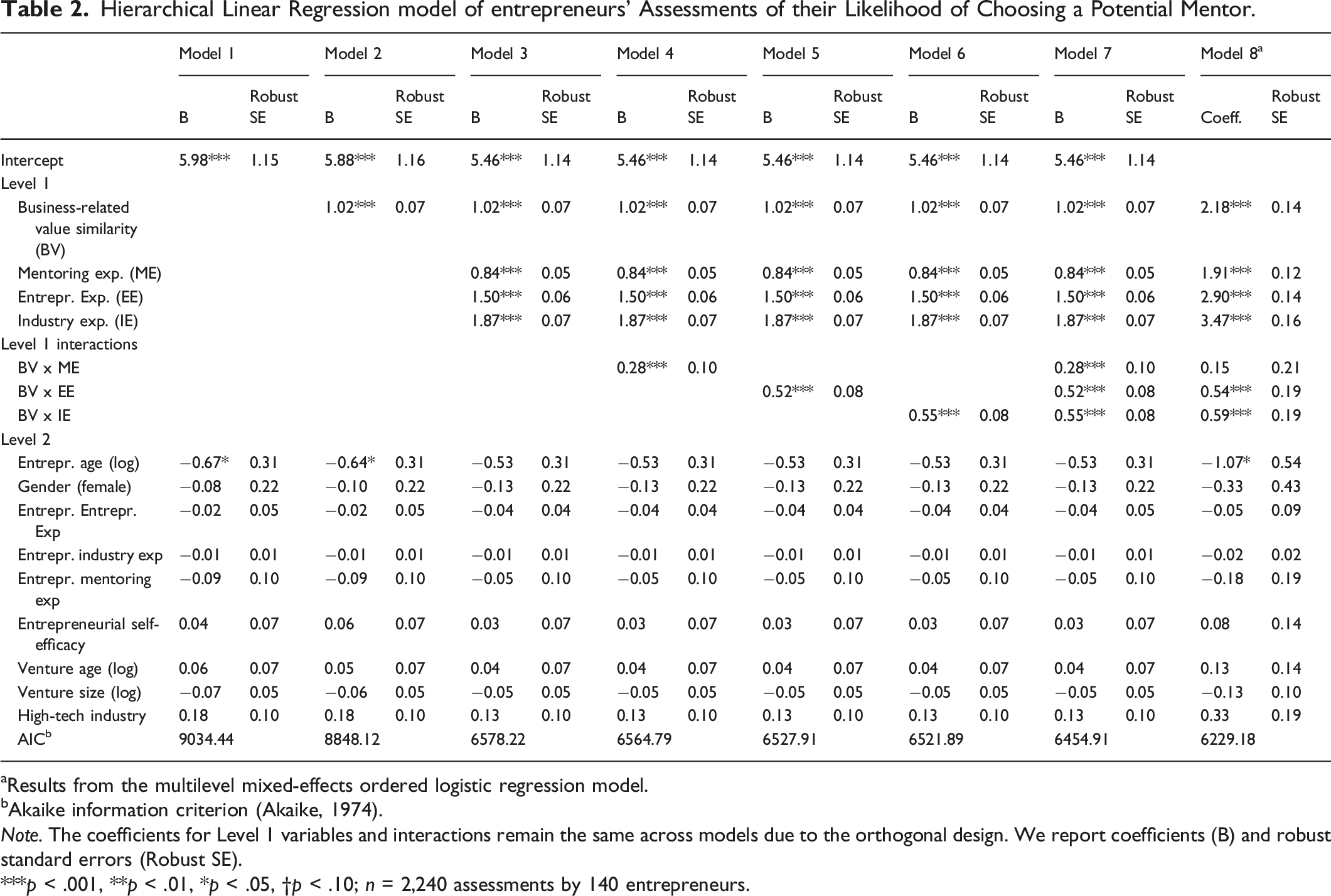
Hierarchical Linear Regression model of entrepreneurs’ Assessments of their Likelihood of Choosing a Potential Mentor.
aResults from the multilevel mixed-effects ordered logistic regression model.
bAkaike information criterion (Akaike, 1974).
Note. The coefficients for Level 1 variables and interactions remain the same across models due to the orthogonal design. We report coefficients (B) and robust standard errors (Robust SE).
***p < .001, **p < .01, *p < .05, †p < .10; n = 2,240 assessments by 140 entrepreneurs.
Hypothesis 1 states that mentee-mentor value similarity positively impacts mentees’ choice of a mentor. The results of Model 7 (coefficient = 1.02, p < .001) are consistent with Hypothesis 1. Hypothesis 2 states that mentors’ mentoring experience moderates the relationship between value similarity and mentees’ choice of a mentor. The greater the mentoring experience of a potential mentor, the stronger the relationship between mentor-mentee value similarity and a mentee’s choice of a mentor. Model 7 shows that there is indeed a positive interaction between business-related value similarity and potential mentors’ level of mentoring experience (coefficient = 0.28, p < .001), consistent with Hypothesis 2. Hypothesis 3 states that mentors’ entrepreneurial experience moderates the relationship between value similarity and mentees’ choice of a mentor. The greater the entrepreneurial experience of a potential mentor, the stronger the relationship between mentor-mentee value similarity and a mentee’s choice of a mentor. Model 7 shows that there is a positive statistically significant interaction between perceived business-related value similarity and potential mentors’ entrepreneurial experience (coefficient = 0.52, p < .001), consistent with Hypothesis 3. Finally, Hypothesis 4 states that mentors’ industry experience moderates the relationship between value similarity and mentees’ choice of a mentor. The greater the industry experience of a potential mentor, the stronger the relationship between mentor-mentee value similarity and a mentee’s choice of a mentor. The results displayed in Model 7 show a positive interaction between business-related value similarity and mentors’ industry experience (coefficient = 0.55, p < .001), thereby supporting Hypothesis 4.
To better understand the nature of these significant interactions, we plot them in Figure 1. The y-axis represents entrepreneurs’ likelihood to choose a potential mentor, and the x-axis represents the perceived similarity in business-related values. In the three plots for mentors’ (A) mentoring, (B) entrepreneurial, and (C) industry experience, the line for high experience (dashed line) is steeper than the line for low experience (solid line), which indicates that mentees perceive business-related value similarity as more important when entering into a mentoring relationship when each of the three types of experience is high than when it is low. These patterns are consistent with Hypotheses 2 to 4. Perceived business-related value similarity (BV), mentors’ experience, and entrepreneurs’ assessments of potential mentors.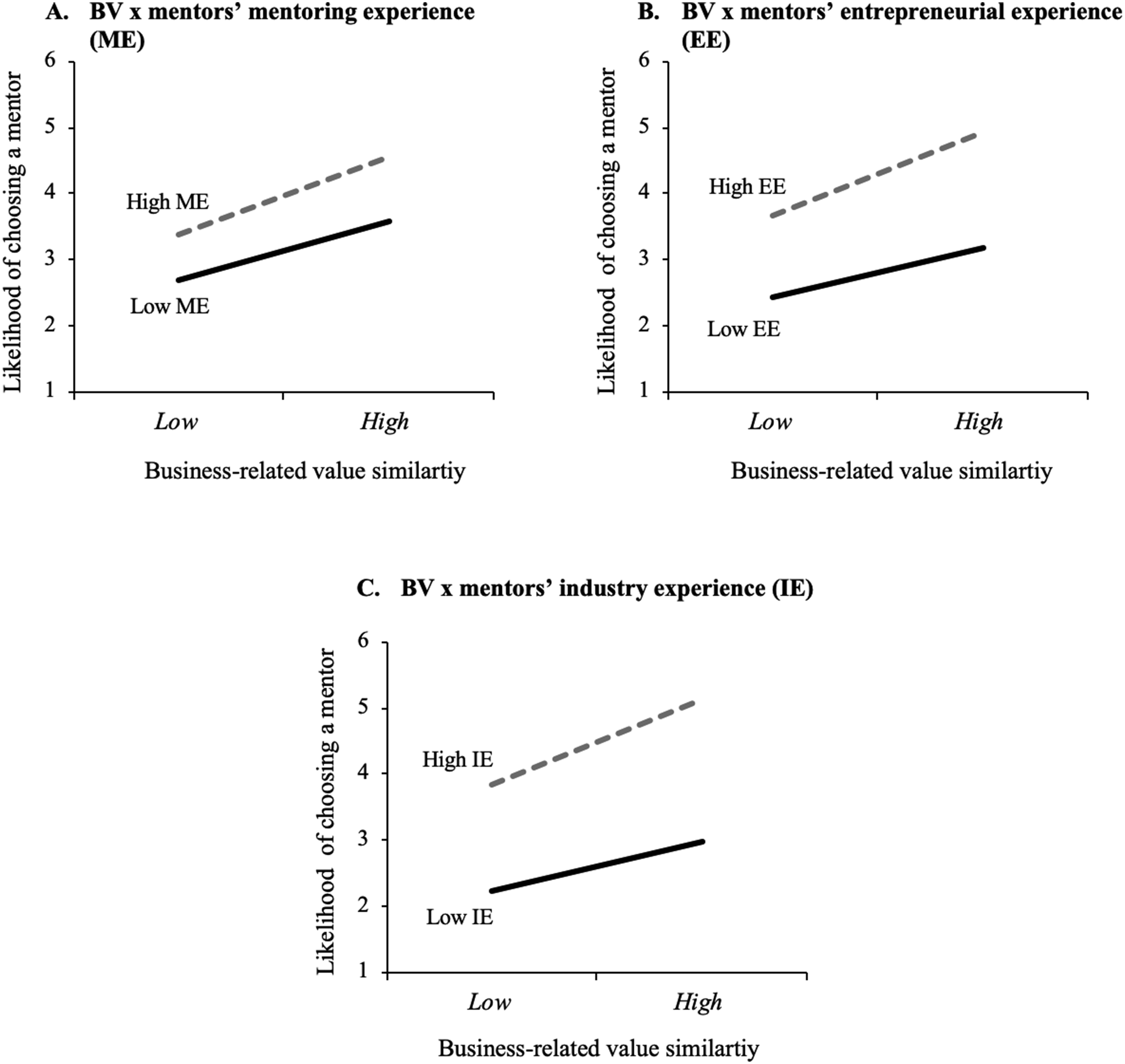
To test the robustness of our results, we additionally fit an ordered logistic regression model with our data (Model 8 in Table 2). The results remain largely unchanged except for the interaction between mentoring experience and business-related value similarity, which is no longer significant.
Discussion
In this study, we set out to understand how entrepreneurs decide on starting relationships with potential mentors. A relational mentoring perspective can provide new insights into factors that drive these decisions beyond mentors’ human capital (Sullivan, 2000), and it potentially identifies relational conditions under which mentors’ human capital is more or less valued by mentees. This is an important issue because such factors can help improve the matching of mentees and mentors, for example, in the context of incubation programs (Bergman & McMullen, 2022; Bisk, 2002; Rasmussen & Sørheim, 2006). By theorizing and showing that mentees assess mentors more positively when they perceive more similarity between their own and potential mentors’ business-related values and that business-related value similarity moderates the impact of mentors’ different types of experience on mentees’ decisions to work with mentors, we make several theoretical and practical contributions.
Implications for Theory and Practice
First, we introduce the concept of business-related value similarity as a relational factor that drives mentees’ choice of a mentor. This insight is crucial because it illustrates that mentees go beyond assessing the “hard factors” that are known drivers of mentors’ potential value—namely, mentors’ experience and networks in a particular industry (Ozgen & Baron, 2007; Sullivan, 2000). While there is a significant literature on work values (e.g., for reviews see, Ros et al., 1999; Sagie et al., 1996) and values in entrepreneurship (Fayolle et al., 2014; Kirkley, 2016; O’Neil & Ucbasaran, 2016) emphasizing that values (and value differences) shape the interactions and relationships between individuals, what is notable in this context is that mentees also seem to anticipate these effects (at least to some extent) when choosing mentors. Thus, the prevalent approach in the literature to study entrepreneurial mentoring relationships from a post hoc perspective (i.e., ongoing mentoring relationships) seems to underestimate the potential role of values for these relationships.
Our results indicate not only that perceived value similarity with mentors is important for mentees’ choice of a mentor but also that mentors’ different types of experience can strengthen the relevance of value similarity for these decisions. Consistent with relational mentoring approaches focusing on high-quality relationships (Ragins, 2012), it appears that the high-quality relationship, higher level of trust, and enhanced communication arising from value similarity are seen as more beneficial when a potential mentor also has some experience that will help them address a mentee’s challenges, such as mentoring, entrepreneurial, and relevant industry experience. Thus, similarity in business-related values represents an important precondition that enables mentees to see the benefits of their potential mentors. Generally speaking, our results complement existing studies on the contingency factors of entrepreneurial decision-making (Shepherd et al., 2015) and call for more integration of relational factors in the entrepreneurial mentoring and stakeholder literatures.
Consistent with a relational perspective, our study also identifies prior mentoring experience as an important contingency for mentees choosing mentors based on value similarity. This finding is interesting because mentoring experience is not directly linked to entrepreneurial and venture outcomes but rather indicates a mentor’s expertise in managing interpersonal relationships. It is intriguing to speculate that similar relationship-based experience may impact the onset of other entrepreneur-stakeholder relationships, such as relationships with potential key suppliers, investors, and customers, by reinforcing the role of the anticipated quality of such relationships. Scholars can make important contributions by exploring how entrepreneurs’ perceptions of stakeholders’ prior relationship-based experience can contribute to shaping whether entrepreneurs initiate such relationships.
Moreover, the extant mentoring literature has mainly built on the assumptions that more experienced mentors are better for their mentees (Haggard et al., 2011; Kram, 1985) and that entrepreneurs can always benefit from their mentors’ experience (Ozgen & Baron, 2007). Importantly, this research has not sufficiently embraced a relational approach highlighting that a high-quality relationship between a mentor and mentee arising from similar business-related values is an important prerequisite for successful mentoring. Indeed, our study indicates that mentors’ similar values represent a key selection criterion for entrepreneurs in their choice of a mentor. Moreover, the role of similar values can further be strengthened by a potential mentor’s relevant experience. Thus, not only do more experienced mentors provide direct support for mentees, but mentees also seem to expect mentors’ experience to increase the quality of their mentoring relationships. This finding indicates that the prior literature on entrepreneurial mentoring has underestimated the role of mentors’ experience by focusing on the direct benefits this experience provides for mentees.
Finally, our study has implications for practice. Over the past two decades, a multitude of mentoring programs for entrepreneurs have been established (Bisk, 2002; Rasmussen & Sørheim, 2006). Research has indicated that the success of these programs depends on the matching of mentors and mentees (Bisk, 2002; Deakins et al., 1998). While previous research has suggested that mentees should be matched with mentors who have experience in the industry of the mentees’ ventures (Deakins et al., 1998), our results highlight an important prerequisite for potential mentors’ attractiveness for mentees—namely, similarity in business-related values. The resulting relationship quality (Lankau et al., 2005; Ragins, 2012) can then further increase if potential mentors’ have relevant experience. Interestingly, mentors’ mentoring experience also plays a role in our study, suggesting that mentoring programs could support novice mentors in effectively fulfilling their role as mentors. For example, mentors with more mentoring experience could share best practices with new mentors, or mentors could be offered some insights on communication skills that would be helpful for their mentoring relationships.
Limitations and Future Research
Like all empirical studies, our research is connected to some limitations. We chose a conjoint experiment to test our model because it enabled us to investigate mentees’ decision-making in real time (Lohrke et al., 2010), thus reducing the risk of hindsight and retrospective biases. Indeed, studying ongoing mentee-mentor relationships is connected to a selection bias that our conjoint-based approach avoided (and helped clarify). However, we acknowledge that there are also possible limitations associated with conjoint analyses. First, as the potential mentors in our study were represented in conjoint profiles rather than being real people, the decision environment in our study differed from the real world. However, decisions based on hypothetical profiles have been found to be very similar to real decisions (Brown, 1972; Riquelme & Rickards, 1992), which makes conjoint profiles well established in research to represent real people (e.g., Kollmann et al., 2009; Shepherd & Patzelt, 2015). Second, some may contend that our participants only considered the attributes of our study as important decision cues because they were presented in the conjoint profiles (Shepherd & Zacharakis, 1997). However, our study mitigates this potential limitation because the decision cues in the profiles are based on prior empirical work and strong theoretical arguments. Third, conjoint profiles may not represent the complexity of real-world situations since they are based on a limited number of attributes. We note, however, that this reductionism reflects prior findings of decision-making studies illustrating that even in real-life situations, individuals usually use only three to seven attributes to make decisions (cf. Stewart, 1988).
Another limitation is our conceptualization of business-related values as a rather broad concept with respect to founding and managing ventures. While one strength of conjoint analysis is that it allows for the use of broad conceptual descriptions, we did not capture more nuances of (potentially different) business-related values. The degree of similarity of different business-related values might have more specific effects on mentoring relationships and their onset. Future research could explore these effects, potentially using a similar design as our study but replacing the experience manipulations in our design with manipulations of multiple values.
Moreover, understanding mentees’ assessments of potential mentors can help to explain the formation of mentoring relationships. However, insights into the consequences of these assessments for mentees and their ventures are also important. Specifically, research is needed to examine the implications of our findings for the quality of mentoring relationships and, ultimately, for new venture performance. Future research can explore if entrepreneurs initially prefer mentors who are best for their ventures and how additional interpersonal contingency factors (e.g., the emergence of both parties in the identification process; Humberd & Rouse, 2016) may impact mentoring relationships. Another potential avenue for future research is to examine the impact mentees’ own prior mentoring experience has on the onset and development of mentoring relationships. This change of perspective may reveal critical implications and contingency factors for the application of the findings presented in this study. Lastly, it would be interesting to explore whether the effect of value similarity we show in the present study differs across commercial and prosocial or sustainable ventures since values typically play a particularly important role in the venturing process for entrepreneurs of these ventures (Fauchart & Gruber, 2011).
In conclusion, this paper offers a model of entrepreneurial mentees’ choice of a potential mentor that demonstrates a complex interplay involving business-related value similarity between mentees and mentors and mentors’ different types of experience. In particular, the central role of perceived business-related value similarity between mentees and mentors is further strengthened by potential mentors’ experience. Thus, our results support a relational perspective on entrepreneurial mentoring and offer insights into how mentees should be matched with potential mentors.
Footnotes
Author contributions
Declaration of conflicting interests
The author(s) declared no potential conflicts of interest with respect to the research, authorship, and/or publication of this article.
Funding
The author(s) received no financial support for the research, authorship, and/or publication of this article.

Notes
Appendix A
The potential mentor has the following characteristics:
Appendix B
Note. Design based on Hahn and Shapiro’s (1966) Master Plan 2, Columns 3, 4, 6, 9. a1 = Similar, zero = Different. b1 = High, zero = Low. c1 = High, zero = None.
Experimental design of the conjoint study (version 2)
Values per attribute
Profile
Business-related values
a
Entrepreneurial experience
b
Industry experience
b
Mentoring experience
c
1
0
0
0
0
2
1
1
0
0
3
0
1
0
1
4
1
0
0
1
5
0
1
1
0
6
1
0
1
0
7
0
0
1
1
8
1
1
1
1