



Abstract
Entrepreneurship education has established itself as a broad research stream, covering such topics as entrepreneurial intentions, skills, competences, and activities. Paradoxically, research is scant concerning detailed descriptions of pedagogical interventions or models for how to support the development of entrepreneurial skills in higher education. We address this research gap by describing and analyzing an empirical case, in which two higher education institutions have formed a joint learning platform for enhancing entrepreneurship education. The learning platform aligns project-based learning, collaborative learning, and action learning, referred to as the action-based approach to entrepreneurship education. Based on data collected through participatory action research, three aspects emerge as essential factors for the learning platform to continue to embrace action-based learning, namely (i) awareness of strategic and pedagogical visions within its community, (ii) dimensions of power and control, and (iii) reflective practices. Reflection occurs as a result of collaborative and project-based learning in authentic contexts with real-time, client-sponsored challenges and tasks.
Keywords
Introduction
Entrepreneurship education (EE) has positioned itself as a research discipline for nearly 75 years (see Katz, 2003; 2008), especially in the context of university education (Liguori et al., 2018). A focal area within EE deals with entrepreneurial skills (Fayolle et al., 2014; Liñán et al., 2011; ). Liñán and Chen (2009) define entrepreneurial skills as the activities or know how required to establish and operate an enterprise successfully. Skills are, however, not equivalent to competencies, which are considered a rather specific set of quality characteristics that describe the ability of an entrepreneur to perform a job (Man et al., 2002; Mitchelmore & Rowley, 2010). Entrepreneurial skills are often measured as outcomes in various studies on EE (e.g., Hahn et al., 2020) addressing basic tasks such as identifying and acting upon new business opportunities (Karlsson & Moberg, 2013), managing uncertainty and risk, and innovating (McGee et al., 2009). Oosterbeek et al. (2010) list market awareness, creativity, and flexibility as entrepreneurial skills, while Rosique-Blasco et al. (2016) define creativity, risk taking and proactivity as entrepreneurial skills.
Regardless of an absent coherent framework for listing entrepreneurial skills, it is argued that entrepreneurial skills can be taught and upgraded when necessary (Jones et al., 2012), and that education programs should support the students’ creativity and proactivity, as well as working in teams (Oosterbeek et al., 2010). However, Honig (2004) and Mueller and Anderson (2014) note that it is particularly difficult to teach entrepreneurial skills if the student does not actively take part in the learning process. In fact, several studies emphasize the learning process and meaningful learning (Chang & Rieple, 2013; Politis, 2005). Following Pyysiäinen et al. (2006) and Al Mamun et al. (2019), this study views entrepreneurial skills as likely outcomes of a process of learning and adopting essential characteristics in order to perform entrepreneurial tasks through interactions within a social and physical environment.
Nabi et al. (2017) and Winkler et al. (2018) note a paradoxical research gap within research on EE: there is little research describing pedagogical intervention or models detailing how to support the development of entrepreneurial skills in higher education. Researchers have called for depictions of strategic interventions that enable students to utilize their resources in order to build competences (Béchard and Grégoire, 2005), but little is reported on how higher education institutions (HEIs) can pedagogically facilitate student entrepreneurship, and by which methods and approaches. There is a need, both from a scholarly and a pragmatic perspective, to identify relevant tools for enabling innovative pedagogical approaches to teaching and learning, especially such approaches that foster entrepreneurial skills among students.
We address this research gap by discussing the pedagogical prerequisites for supporting EE. We empirically explore a learning platform for students of higher education, relying on action learning, and propose a conceptual model designed to enhance entrepreneurship and the development of entrepreneurial skills. We specifically focus on the pedagogical elements supporting entrepreneurship. Our research questions are: Which pedagogical elements support and enhance EE? Which activities are fundamental in learning platforms designed to enhance EE? How can a learning platform act as a tool to develop students’ entrepreneurial skills?
Empirically, we study a joint initiative between two higher education institutions (HEIs) in Finland, which have formally established a platform, NÅA Business Center 1 , for interactions between students and business and other stakeholders interested in collaborating with the HEIs. The platform has been active since 2018 with approximately 50 student projects carried out annually. We build on a case study, utilizing interview and observation data of the NÅA Business Center’s activities and key personnel, and complement this data with focus group interviews with students possessing active roles in the business center (referred to as community managers). The aim of the focus group data is to map narratives on how the students, who are the main resource of the business center, perceive the business center. Observation notes encompass minutes of meeting, meeting notes, written reflections on the business center, as well as project reports including learning reflections by previous community managers.
The article is structured as follows. First, we discuss the pedagogical elements of a supportive environment for entrepreneurship and present a conceptual model for a learning platform that enhances entrepreneurship. Second, we present the case study and elaborate on the methods used for data collection, namely participatory action research and data analysis. Third, we present the case study findings. Fourth, we identify and elaborate on emerging themes drawn from the case data that advance the conceptual model and our knowledge of designing learning platforms supporting EE. Finally, we discuss contributions, implications, and suggestions for future research.
An Action-Based Approach to Entrepreneurship Education
Learning is a transformational process, which takes place in a context (Botha et al., 2010) and indicates a permanent change in an individual’s behavior (Alexander et al., 2009). In EE, scholars have found active learning pedagogies to enhance entrepreneurial skills (Sroufe & Ramos, 2011; Järvi, 2015). These especially include project-based learning (Doppelt, 2003), action learning (Leonard & Lang, 2010), and experimental learning (Clark & White, 2010). According to Pittaway and Cope (2007), EE requires a context in which students learn entrepreneurially and experientially through action. Research on action learning shows that learning is effective when students encounter real-time problems during the process of achieving learning goals (Reynolds & Vince, 2004). The action learning framework by Revans (1982) thus emphasizes real-time and real-world problems in actual working conditions, but most importantly, reflection (talk, dialog, and communication) as a pivotal element of the learning process among individuals, student groups or teams, facilitated by an instructor or adviser. Argument, debate, and collaboration with others are thus central elements of action learning (Pittaway & Cope, 2007). Specifically, the emphasis is now shifting toward environments, which are authentic and contextualized, and in which students collaborate in a team setting to solve problems over an extended period of time (Botha et al., 2010). The focus on deliberately designing learning environments that foster the development of entrepreneurial skills, is thus slowly gaining ground (Doppelt, 2003; Harms, 2015).
Nevertheless, there is a need to explicate the pedagogical approach of learning environments more thoroughly. We thus propose the action-based approach to EE as a pedagogical tool for combining action learning (experiences and reflection), collaborative learning (teams and shared experiences), and project-based learning (clients in authentic contexts). This approach is participatory and aimed at engaging the student through experience and reflection, and to ultimately seek a change in behavior (Chenhall & Chermack, 2010). Change in behavior occurs through the development of entrepreneurial skills (focus on how to create value for others) in a democratic and inclusive environment (focus on fostering student agency) through reflective practices (focus on supporting, verbalizing, and illuminating learning). In the following, we further clarify the elements of the action-based approach to EE (Figure 1). The elements of the action-based approach to entrepreneurship education.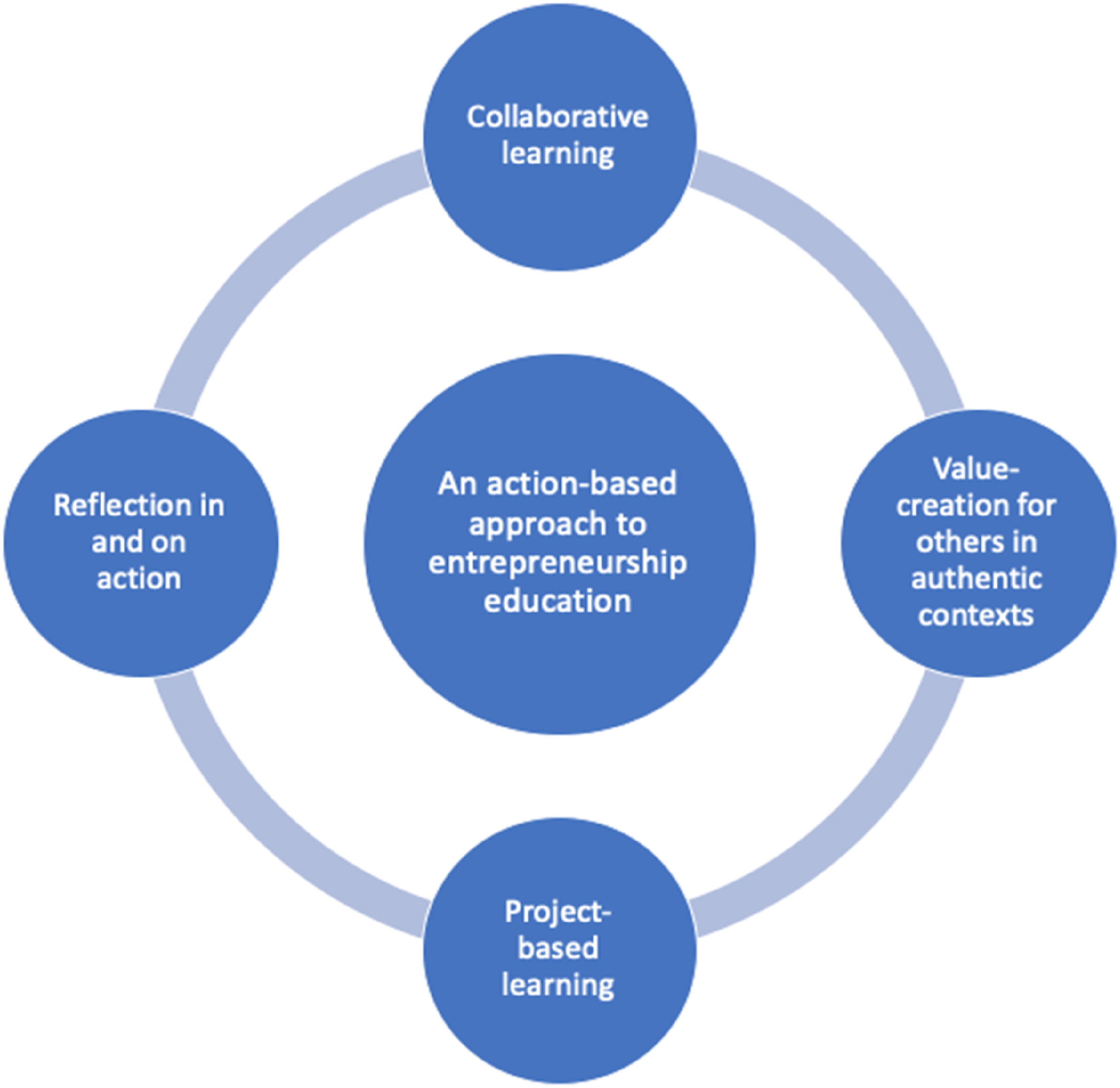
Project-Based Learning
Project-based learning (PBL) as a way of fostering entrepreneurial skills has recently received scholarly attention (Arias et al., 2018; Carnawi et al., 2017; Chemborisova et al., 2019; Vala et al., 2017). PBL refers to an individual or group activity continuing over a period of time and resulting in a product, a presentation, or a performance (Donnelly & Fitzmaurice, 2005). PBL is a student-driven and teacher-facilitated approach to learning (Bell, 2010), comprising of a question or a problem that organizes and drives the activities (Blumenfeld et al., 1991). As a result, a distinctive feature of PBL is problem orientation (Helle et al., 2006), which includes students solving authentic tasks and real-world problems, while the role of the instructors is to facilitate students’ reflection-in-action and reflection-on-action (Schön, 1987). In PBL, mental tools such as concepts and theories are used in order to facilitate learning: the students’ attention is directed to the activity of “making meaning”. Following this notion, in the process of project work, students can observe and experience the reality to which difficult concepts and interactions are related. Scarbrough et al. (2004) identify two approaches to PBL, namely learning-by-absorption and learning-by-reflection. The former indicates that students absorb new information, assimilate it and then apply it to commercial ends, while the latter refers to the individual possessing knowledge of the circumstances of their actions and the interpretive and normative rules that they follow. While PBL involves both vertical learning (i.e., cumulation of subject matter knowledge) and horizontal learning (i.e., generic skills such as project management) it enables not only the integration of knowledge from different disciplines but also theory and practice (Helle et al., 2006).
Reflection-in-Action and Reflection-on-Action
In action learning, agency is at the heart of the learning process and has been found to develop problem-solving skills and the ability to learn how to learn through reflection in a supporting and challenging environment of peers (Ram & Trehan, 2009; Revans, 1982). This is followed by questioning and reflecting on outcomes and consequences of the taken action. Ryan (2013) identifies two main elements of reflection, namely making sense of experience in relation to oneself, to others as well as to the contextual conditions, and rethinking and planning future experiences.
The reflective practice associated with action learning creates a circularity between action and reflection, or the practice of questioning our habitual methods of problem-solving. The quality of learning is then related to the development of reflective practices (Boud et al., 1985; Schön, 1987). Practicing “reflection-on-action” allows learners to gradually internalize reflection during action, aiming to develop the “reflection-in-action.” Reflection-on-action is done in retrospect, recalling how knowledge was used in a practical setting, whereas reflection-in-action refers to simultaneously interpreting actions as they take place. This allows the student to re-evaluate and redesign actions while the learning process is in progress.
Collaborative Learning
Collaborative learning situations enable individuals to develop skills such as communication and teamwork (Donnelly & Fitzmaurice, 2005). Collaboration indicates that a group of individuals are solving a problem or performing a task together (Dillenbourg, 1999). In project work, the tasks are distributed among the team members, but simultaneously, they aim to construct a shared outcome. A project is typically designed in such a way that it cannot be completed without joint effort (Helle et al., 2006). While the collaborative learning process starts with forming a learning group or a team of students, the formation of groups does not automatically result in better learning and motivation as team learning is dependent on the quality of the student interaction within the team (Scager et al., 2016). Scholars have therefore emphasized the need for the teacher to take on the role of a facilitator; collaborative learning can be achieved when teachers make adequate instructional decisions and play a crucial role in fostering positive student interaction (Kaendler et al., 2015; Van Leeuwen & Janssen, 2019).
Value-Creation for Others in Authentic Contexts
Entrepreneurship is defined by scholars as value-creation for others (Bruyat & Julien, 2001; Moroz & Hindle, 2012), an idea that has been developed further by Miller et al. (2012), who explicate that entrepreneurship is about creating value for known and un-known others, contributing, for instance, to social and environmental sustainability. Similarly, Lackéus and Williams Middleton (2018) draw upon this notion in their entrepreneurial learning approach that is based on the value that students are able to create when engaging external stakeholders in the learning process, that is, clients. This approach relates to the assessment of the outcome, and the external stakeholder explicitly evaluates the results (product, presentation etc.), not the learning per se. This, in turn, is evaluated by the instructors (faculty members) through performance, reflection and/or self- and peer-assessment. Nevertheless, a means to access the authentic environment and subsequent value-creation entails, for instance, live consultancy projects, which are also at the core of project-based learning. Live consultancy projects entail direct interaction with practitioners outside of the academic environment; such projects have been found to influence students’ mindsets toward a more professional behavioral mode (Fitch, 2011). Scott (2017) argues that live consultancy projects not only improve cognitive learning (the acquisition of factual knowledge) but also foster affective learning (self-actualization) and behavioral learning (developing skills). PBL increases students’ critical thinking and problem-solving skills, positively affects life-long learning, and improves students’ motivation (Barron et al., 1998; Doppelt, 2003), which are also intrinsically important elements of value-creation.
NÅA Business Center—The Learning Platform for Enacting the Action-Based Approach to Entrepreneurship Education
The NÅA Business Center1 is a joint effort between the School of Business and Economics at Åbo Akademi University (ÅAU) and Novia University of Applied Sciences (Novia) in Turku, Finland. Through the NÅA Business Center, multidisciplinary student teams are able to apply theory to practice by executing projects (equivalent to live consultancy projects) for companies and organizations (clients). The NÅA Business Center specializes in marketing, accounting, business development, and entrepreneurship. The business center is partly developed as a means of bridging and increasing cooperation between the two founding HEIs, and partly as a response to the increased need to interact with, and create value in, the surrounding society.
Since 2009, business students at Novia have carried out client projects with local companies as part of their studies in accounting and marketing. During a joint EU funded rural development project in 2016–2019, Novia and ÅAU decided to create a joint learning platform where student–industry cooperation could be coordinated more efficiently. Teachers from both HEIs developed the strategy for the platform, which was approved by both boards of the HEIs. The NÅA Business Center was established in 2018. The HEIs identified a need to implement the application of theory to practice and to build contacts with potential future employees. Local firms expressed a need for fresh ideas from the students as input in different developmental processes. In addition, the NÅA Business Center aimed at facilitating the contact between the faculty members and firms; teachers were able to redirect client projects to the business center in cases where the projects could not be assimilated into courses or modules, or with course time schedules. Rather than declining any approaches by firms to the HEI’s, the faculty member was then able to forward the project to students via the business center. Before the establishment of the business center, the responsibility of organizing the activities between students and firms rested on individual teachers. With the establishment of the business center, they were able to focus more on teaching and research (written reflection by the NÅA Operative Manager, 2020).
NÅA Business Center is not a legal entity but rather a community, managed by an operative board and guided by a strategic board, consisting of members from the management of both HEIs. The strategic board meets twice a year to discuss the long-term development of the platform. The first Community Managers recruited were students at Novia, and in 2019, students from ÅAU joined the operative board. In 2020, the number of Community Managers increased to six, compared to the original three.
Method
We build a case study (Yin, 2018) based on participatory action research (PAR) (Kemmis, 2006; Kidd & Kral, 2005). The aim of the case study is to generate insights into the process of developing alternative approaches to enhancing entrepreneurial skills. Here, the case study enables in-depth analysis of a multifaceted and pedagogically grounded learning platform for the purpose of developing conceptual models for curriculum development and EE. Winkler et al. (2018) recently utilized action research to illustrate EE and provide a practical tool for entrepreneurship educators.
Participatory Action Research
The aim of participatory action research (PAR) is to engage “participants” in knowledge creation regarding specific issues relevant to them, thereby stimulating societal or personal change (Parrello et al., 2019). The unique feature of PAR is its participatory nature, as the research process combines analysis and interpretation of data with the researcher(s) responsible for data gathering, and then dissemination to the participants who contribute to a broader perspective. PAR applies the participants’ reflections on the issues being researched; this is evidenced through participants having experienced the issues under research. Therefore, they are asked to reflect on these issues and draw causal lines between the events and the forces behind them (Chevalier & Buckles, 2019). PAR research methods include participant observation, focus groups, interviews, diaries, surveys, and questionnaires (McNiff & Whitehead, 2010; Vaughn & Jacquez, 2020). In line with previous research (e.g., Zuber-Skerritt, 2018; Ripoll Gonzalez & Gale, 2020), integrating observation with interviews and focus groups is a prudent approach; it enables the researcher to have greater access to the case and an in-depth exploration of the phenomenon being studied. The researcher is involved in the process while being observant and immersed in the phenomenon. The role of the researcher includes listening, monitoring activities, as well as noting events and experience.
Data Collection
Overview of Datasets.
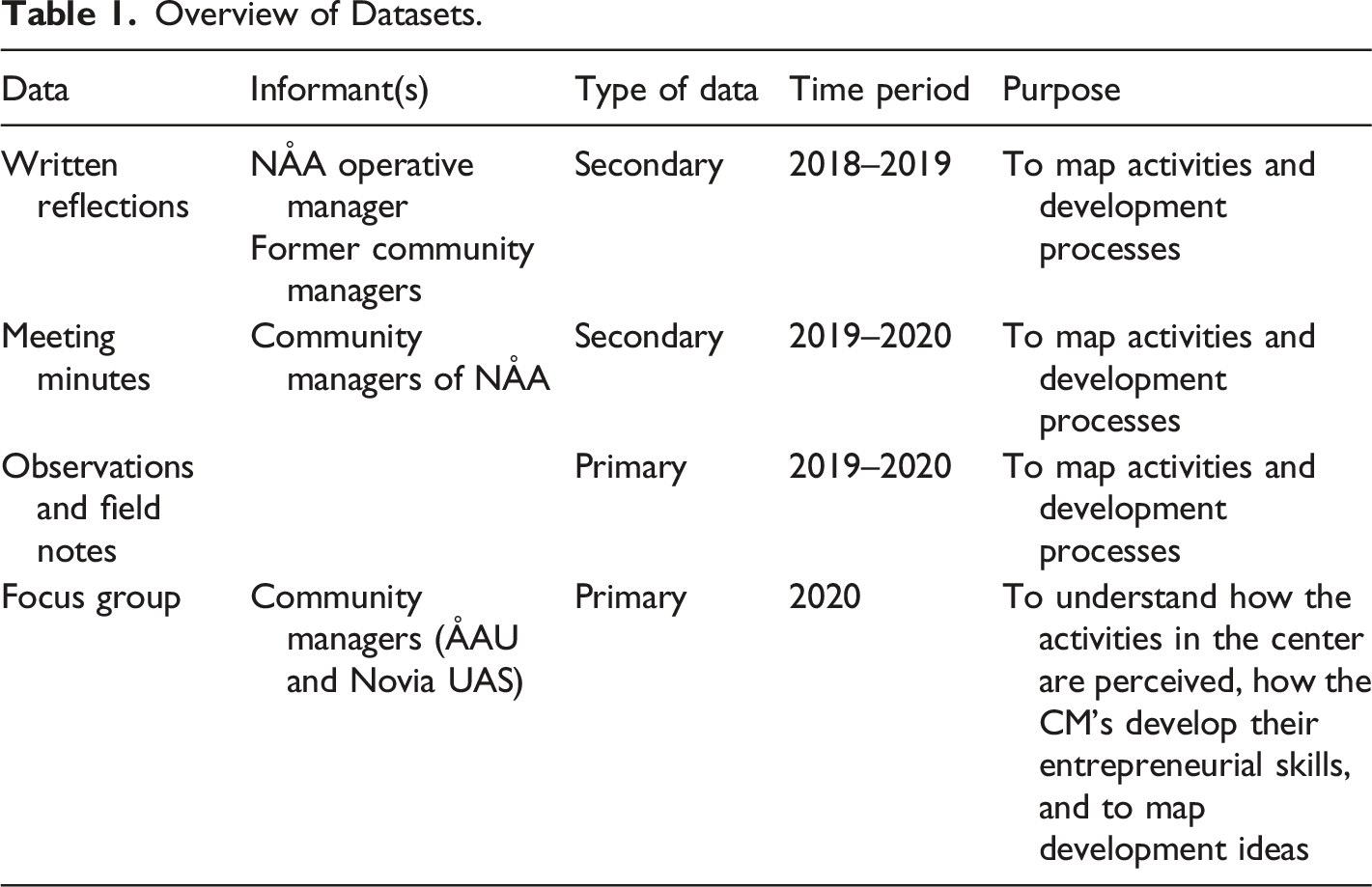
The data collection team included three of the authors, who followed the PAR cycle of planning, action, observation, and reflection as described by Zuber-Skerritt (2018). The research team held regular weekly research meetings to fulfill the aim of the study, plan actions, decide upon who and what should be included and where and when the study would take place and commence, as well as how the study would be implemented. The researchers compared notes, thoughts, and initial data analysis with each other. Observation in the form of meeting attendance was employed. The researchers carried out observations 2019–2020, when the NÅA Business Center was actively developed. Observations were documented as written notes during the 1–2-hr long meetings every second week with the team at the NÅA Business Center. During the time period studied, approximately 30 meetings took place. A focus group interview was conducted with the Community Managers (n=5) at the NÅA Business Center, aimed at mapping their view on the business center’s activities, enhancing the quality of data, and elucidating any further issues resulting from the primary data. The focus group was conducted online (via Zoom, September 20, 2020) using a semi-structured interview guide (Saunders et al., 2009). All five informants had been or were involved in the business center as Community Managers during 2019–2020. The interviews focused on the following themes: (i) activities and processes within the business center, and (ii) action learning through project management, and (iii) entrepreneurial skills. The interview lasted approximately 60 minutes, and was recorded and transcribed for further analysis.
Data Analysis
Data were analyzed following the principles of thematic analysis in qualitative research (e.g., Lincoln & Guba, 1985; Fugard & Potts, 2019), which is considered suitable for participatory research and enables researchers to collaboratively identify and organize relevant themes and subthemes as units of analysis in subsequent detailed re-readings of a dataset. We followed the ten-stage guidelines for synthesizing and analyzing PAR data (Wimpenny & Savin-Baden, 2012). The analysis process involved concurrent periods of data collection and logical inductive methods of analysis. Analysis was performed first at the individual level by the researchers as data was collected. In this way, we were able to scrutinize and share the different sets of data and to make comparisons and interpretively integrate the results.
In relation to observation and additional written secondary documentation, the data analysis was done manually, which enabled the researchers to successfully manage and arrange the raw observed data. All researchers re-read the observational written notes and documented their answers following the themes used in the focus groups’ interview guide design to summarize the core ideas. Important sections and themes relevant to the study were highlighted, thus identifying similarities and relationships in the data (patterns). Similar procedures were applied when analyzing the written secondary documentation, which enabled critical reflection on the relevance and trustworthiness of the study. Findings were systematically categorized in relation to the themes. Subsequently, the primary and secondary datasets were combined to generate an overview of the findings. The analysis continued with participatory group discussions and interpretations in order the review and make sense of the themes.
Action-Based Learning and Development of Entrepreneurial Skills Using the Learning Platform
The case study learning platform builds a community of practice (Wenger, 1998), which relies on a set of pedagogical principles: reflection through action learning, and teamwork in collaborative projects, supported by an instructor embracing the role of facilitator of learning. The following section reveals the Community Managers’ perceptions of learning entrepreneurial skills through an action-based approach linked to a learning platform (NÅA Business Center).
Student-Led Activities and Processes
The learning platform is a collaborative effort involving Community Managers, students, clients, and instructors. The learning platform is, however, mainly coordinated by the Community Managers, who are responsible for managing the operational activities in the business center. Community Managers regard their position in the NÅA Business Center as more of a job than a learning experience or a means of developing their skills. As the main reasons for becoming Community Managers they highlighted networking, belonging to a community, a high level of interest in the business center, and doing practical work; such phrases were used as “a connection between students and working life”, “a cooperation between students and companies” and “a connection to the business life outside of school”.
When asked how the Community Managers perceive their roles, the majority commented that the division of labor is somewhat unclear between the Community Managers themselves as well as between the Community Managers and the instructors. This was also noted by the observers 2 . The unclear roles created confusion, which led to projects not advancing as expected. Teachers who are board members of the NÅA Business Center do not have specific titles or well-defined roles, apart from being Operative Managers. On the other hand, a few Community Managers feel confident in their role and know their responsibilities well.
“I have a lot of things on my plate compared to others, but that’s because I’ve wanted those tasks and wanted to be in that position and have the responsibility. It is absolutely possible for me to brainstorm with the others and delegate, but I think it is easier if someone has the main responsibility to see that the things get done.” (CM3, Novia)
Even though the division of labor in the NÅA Business Center is regarded as being somewhat unclear, the essence of the internal process is well understood by the Community Managers. They regard themselves as a link between the company and the project teams. However, the Community Managers’ own initiative plays a role in how much responsibility they are willing to assume and what tasks they choose to do, for example, as the contact person for clients. Currently, the Operative Manager is considered a key person and player, who also part takes in negotiations with clients. In the near future, Community Managers may be willing to take on more responsibilities as regards negotiating with clients on projects and pricing.
Furthermore, based on the observations and the comments from the Community Managers, a clear vision is lacking for the NÅA Business Center. This makes prioritization of tasks difficult and potentially delays the initiation of projects. The issue was also discussed in several meetings 3 .
“I think honestly we lack a bit of vision. We are not talking so much about goals and the vision of NÅA. We talk a lot about projects but not about ourselves, our organization. Except that we need to establish ourselves at ÅAU, but we are not talking about long-term goals. Now it feels like we are just surviving, and we are not trying to grow or develop that much. It is a struggle to survive. Especially from ÅAU’s side it is quite sporadic and vague right now.” (CM4, ÅAU)
Another challenge that the Community Managers face is the task of evaluating which project fits which student team. The Community Managers are not professionals in pedagogics, and thus not familiar with all the requirements of a master’s or bachelor’s level project or how to formulate an offering to a client company. Currently, and especially as regards Novia, the Community Managers require support from and cooperation with teachers in order to link suitable students to a project team.
“[Finding students is] an active cooperation with Novia teachers. They evaluate if a project is suitable for a course that they are teaching. There has been a lot of evaluations [by the Operative Manager].” (CM3, Novia)
Learning and Developing Entrepreneurial Skills
The Community Managers keep learning diaries throughout their mandate, a task which is carried out with varying success. Based on the focus group interview with the Community Managers, it is evident that some are more willing to invest in their own learning; these students, who endeavor to achieve a high degree of learning are the same individuals who also undertake the most responsibility. Currently, the Community Managers representing Novia are more active than the Community Managers representing ÅAU. This may also relate to cultural differences and a logic regarding “how things are done,” as the students of the former are more accustomed to project-based learning than the latter. When asked how the Community Managers perceive learning in the business center, they verbalized it as “applying theory in practice,” “learning in projects,” and “practical experience.” This does not, however, signify that the Community Managers grasp the essence of the pedagogical principles of the NÅA Business Center; therefore, the discussion on pedagogics should be more elaborate. “I think that [learning] happens subconsciously because when a similar situation comes on later, I start to think that I’ve been involved in something similar before, and then I use this previous experience to [solve] that.” (CM3, Novia)
As regards entrepreneurial skills, the Community Managers acknowledge that taking part in the business center had developed some aspects of their entrepreneurial skills. It is, however, unclear whether they fully understand the concept of entrepreneurial skills. The Community Managers can name a few entrepreneurial skills, such as taking the initiative, teamwork, planning, contacting companies, and keeping deadlines, but they have difficulties in identifying such skills in themselves. This may be partly due to the insufficient reflection on learning during the Community Managers’ mandate.
“I’ve learned, perhaps, to take action. And if you want something to be done, you need to do it yourself or take initiative, and that has to do with entrepreneurship and working here [at NÅA Business Center]. If you want to work, there’s always something to be done here.” (CM4, ÅAU)
Emerging Themes in the Action-Based Approach to Entrepreneurship Education
The role of the literature review was to build an initial theoretical base to induce new insights and to offer an explanatory perspective on the processes permeating the case. The literature review was thus developed as an analytical tool for organizing the data (Figure 1) and coding those elements that support the action-based approach to EE. However, in pursuing our goal to demonstrate and validate a model or a design for a learning platform that enhances EE, we noticed that the practical deployment of pedagogical approaches and principles is cumbersome and time consuming for the individuals involved. Three major themes emerged in the data analysis as indicative of the functioning of the action-based approach to EE, namely (i) awareness of strategic and pedagogical visions, (ii) dimensions of power and control, and (iii) reflective practices.
Awareness of strategic and pedagogical visions
The learning platform encourages students to actively be involved in communication activities, relationship building to third parties (clients), and marketing efforts both externally and internally. The NÅA Business Center Community Managers prepare offerings, project descriptions, supervise recruitment, and assign instructors to each starting project. It is important that the learning platform is student-led, as it fosters the development of entrepreneurial and project management skills per se. The student-led approach thus includes an expectation that students understand the pedagogy applied within the learning platform. Community Managers must be able to motivate and explain how the business center functions both internally (students, teachers) and externally (clients). Thus, the pedagogy behind any learning platform involving students must be clearly explained. A pedagogical understanding toward the community practices does not only concern the faculty members, but also the Community Managers. Currently, a common understanding of the pedagogical cornerstones of the learning platform is not evident in the case study, which may hinder the NÅA Business Center’s future development as well as nurturing a learning and action-oriented culture. As regards the strategy and strategic visions of the learning platform, these are mostly articulated and understood by the founding faculty members. However, the Community Managers do not view the strategic goals as being sufficiently coherent to develop practical tools and tasks that advance the activities of the business center. This lack of understanding indicates that student agency and engagement could be elevated even in the light of their current self-directed and team-oriented approach to leading the activities. Conversely, in line with the idea of student-led activities and reflective practices, pedagogical and strategic visions must be jointly created by the faculty members and students.
Dimensions of power and control
According to research on action learning, teachers should frame their roles as facilitators rather than project managers, supervisors, or evaluators (Kaendler et al., 2015). The case data shows that when teachers and educational designers are a part of the development process their roles must be clearly outlined. The Community Managers expressed concern as regards ambiguity in the current role definitions. Action learning puts agency at the center of the learning process (van Lier, 2007). Agency refers to “a sociocultural mediated capacity to act” (Ahearn, 2001, p. 112). This entails action learning and teaching as exigent pedagogical strategies, but simultaneously they offer both teachers and learners the possibility to design an educational setting in which democratic rights and conditions are realized. For action learning to succeed, Bernstein (2000) argues that the learning context must be democratic, enabling individual growth, social inclusion (the right to be involved socially, intellectually, culturally, and personally as well as the right to autonomy in the learning environment), and the right to participate in practices. These are determined by two forces, namely power and control (Bernstein, 2000). Weak power allows for innovations, while strong power builds inflexible boundaries presenting difficulties for enabling innovations. Power thus refers to the construct of categories (classification), while control refers to communication in local interactional pedagogic relations and the internal logic of pedagogical practice (Bernstein, 2000). While the data do not disclose views on power and control specifically, the concepts enable us to understand the prerequisites for roles in the action-based approach to EE: in order to enable agency and autonomy, both instructors and students must clearly understand their roles and the associated expectations. The case data indicates that the development process entails elements of questioning roles, such as discussions on whether there is a need for an Operative Manager as well as listening to the Community Managers’ opinions on their willingness to take a center stage in the running of the operations.
Reflective practices
The focus group interview strongly indicates that students have a limited view of their own entrepreneurial skills. The Community Managers are able to articulate benefits of their actions and activities in terms of how they augment future work-life skills but are not able to verbalize entrepreneurial skills specifically or even very broadly. This may be due to a lack of enabling and motivating students to continuously reflect on their competencies and skills, and link development to their past (reflection-on-action) and current activities (reflection-in-action). Reflection is not only facilitated by the instructors, but also promoted within the student teams. As noted earlier, the quality of student interaction in the team is of great importance to the learning process (Scager et al., 2016). The student interaction could very well focus more on the circularity between action and reflection (Boud et al., 1985).
In line with Schön (1987), the findings reveal that the action-based approach to EE emphasizes reflection “in and on action” by both students and instructors. To effectively see the value of a learning platform, it should incorporate diverse approaches for regular reflection and the monitoring of learning success. In this instance, the platform should offer learners relevant self-evaluation and assessment tools. Thus, as a result of reflection, learners become cognizant of their learning progress, learning levels, and areas of improvement (Scarbrough et al., 2004). Reflection should also enable instructors to identify areas in need of development, and subsequently advance specific actions to improve students’ learning using the platform.
If effectively employed, reflection enables a structure that allows for sense making of knowledge gained, and the embeddedness of concepts and theories into practice while concurrently promoting continuous learning and innovation within the platform. For instance, Kuckertz and Wagner (2010) highlight that learning about the facts of business leads (business) students toward evaluating entrepreneurial opportunities more vigorously. This notion links back to the notion of power and control, highlighting the role of instructors to encourage students to actively and analytically reflect “in-action” and “on-action” (Schön, 1987). Further, instructors must model reflective practices by enhancing their own reflective practices and continuously be responsible for reflections concerning their own actions, and how they offer support for students and influence their learning.
Concluding Discussion
The role of HEIs in supporting the development of entrepreneurial skills is much debated (Fayolle, 2013; Lackéus, 2014). Bae et al. (2014) argue that research on EE mostly focuses on entrepreneurial attitudes and skills from a teaching perspective. Liguori et al. (2018) as well as Neck and Corbett (2018) note an overall struggle of EE as a research discipline. We contribute to the discussion on EE in multiple ways. First, we show how different pedagogical perspectives can align into a common learning platform. We identified action learning, collaborative learning, and project-based learning as pedagogical cornerstones of a learning platform supporting EE, which we refer to as the action-based approach to EE. The action-based approach to EE advocates the development of entrepreneurial skills (focus on learning and how to create value for others), a democratic and inclusive environment (focus on fostering student agency), and reflective practices (focus on supporting, verbalizing, and illuminating learning).
Second, our findings highlight emerging themes that are crucial to the practice of the action-based approach to EE, namely (i) awareness of strategic and pedagogical visions, (ii) dimensions of power and control, and (iii) reflective practices. The themes indicate areas of the approach and learning platform that require further analysis. We thus contribute specifically to research on pedagogical intervention or models for enhancing EE (Nabi et al., 2017; Winkler et al., 2018), by unfolding topics that emerge when implementing the pedagogical design of a learning platform. For instance, the case study data showed unclear roles and variability in leadership, which can be analyzed, for example, utilizing Bernstein (2000) notion of power and control in learning environments. Furthermore, the themes that emerged illuminate how theoretically approached pedagogical interventions call for an iterative approach to data collection and data analysis. For instance, action and participatory research as well as processual analysis provide methods that enable the capturing of underlying attitudes and issues that prevent or facilitate the practice of models of pedagogical intervention in EE. The focus on activities and narratives in the learning platform community of our case study allowed us to identify the essence of the learning platform and link it directly to the philosophy of action learning, while simultaneously being able to pinpoint flaws and areas in need of development.
Third, the teachers and developers of higher education studies learned how pedagogical methods can be executed as a joint effort between two or more HEIs. Instead of building silos, cooperation between HEIs is a viable solution that also benefits the students, as they interact and learn in multidisciplinary, multicultural, and multigenerational teams. The learning platform allows for collaborative learning (Noyes, 2018), where students share knowledge with each other. Such an approach has previously been suggested by Lee et al., (2018), p. 320), serving as a driver of “forming entrepreneurial ecosystems within and across universities.” Teaching within such a system should be viewed as a strategic intervention that influences and enables students to organize their disposable resources (knowledge, abilities etc.) in such a way that they can be turned into competences and mobilized into actions (Béchard & Grégoire, 2005). In order for the learning platform to enhance entrepreneurial skills, and based on the case study presented in the article, we suggest focusing on generating clear roles for the actors involved in the learning platform as well as cooperatively constructing and creating its vision.
Fourth, we acknowledge the role of the instructor (teacher as facilitator) and the notion of reflection (in- and on-action) as important elements in the learning platform for enhancing entrepreneurship. Reflection (Boud et al., 1985; Schön, 1987) takes place as a result of student interaction and collaborative learning, eventually becoming a continuous and interactive process in the learning platform community. All participants of the community/learning platform are thus contributors to reflective practices and processes, including instructors and members of the faculty. In fact, facilitating learning is not solely the responsibility of the instructors. Rather, community managers, even though considered peers, are also facilitators of learning in their roles of acquiring projects, matching students to project teams, communicating with clients and collecting feedback. The student-led learning platform thus contains a number of actors with different experiences, but a shared goal and vision. The most important finding relates to encouraging and enabling continuous reflection on entrepreneurial growth among all individuals involved in the learning platform. Action learning finds expression in reflection, which is followed by actions that solve problems and create value (for known and un-known others).
Limitations and Future Research.
Some limitations should be noted in regard to the current study. First, the case study approach has several limitations with respect to generalization. The focus of the case study approach is not to achieve “statistical generalization” but rather “analytical generalization” (Yin, 2018) within the clarified boundaries of the study. The current study aims at providing contextual knowledge for further exploratory and analytical knowledge creation. The study’s results can thus be considered comparable and applicable to other situations within the realm of similar contexts. Second, only a limited sample was included in the research (all students were business undergraduates). Further research may include a large and much more varied sample in order for the results to be generalizable and transferrable to other contexts. Such an approach may also reveal differences or similarities between the attitudes of academic disciplines towards learning entrepreneurial skills.
A focus on instructors acting as teacher–coaches requires more attention by EE scholars. An academic faculty transitioning from established routines toward facilitators and coaches may seem conflicting and potentially hinder agency among learners (Weinstein, 2012).
Furthermore, longitudinal studies analyzing the process of developing the entrepreneurial skills of students would enable the development of a practical framework for coaching teams, facilitating reflection, and potentially altering the platform’s further suitability for the requirements of future markets. Assessments of value-creation among stakeholders are an important input that could be linked to the perceived learning of the students, providing knowledge of the effects of the action-based approach to EE. Future research should also employ comparative case studies to discover how the learning levels of students may impact the success of the learning platform. In this regard, quantitative research, wherever possible, would add significantly to theory-development, that is, measuring skills development over time.
Footnotes
Declaration of Conflicting Interests
The author(s) declared no potential conflicts of interest with respect to the research, authorship, and/or publication of this article.
Funding
The author(s) received no financial support for the research, authorship, and/or publication of this article.
