




Abstract
If experience is the guiding light in entrepreneurship education, then where is the philosophy of experience? This article illuminates the philosophical foundations of entrepreneurship education by discussing learning through experience. We introduce a diagram that addresses primary and secondary experiences and their interplay as well as a model that further reveals how educative entrepreneurial experience can be researched through empirical phenomenology. We suggest that although entrepreneurship is currently positioned as an experiential subject in academia, the theoretical and philosophical roots of experience in learning have not been fully addressed, leading to a deficit in our understanding of how knowledge is derived from experience, and how experience may differ depending on its philosophical underpinnings.
Introduction
We start with two reflections on entrepreneurship education. The first relates to the position of entrepreneurship education, which is tenuously positioned in higher education. Should entrepreneurship education run as a red thread throughout all higher education, as many influential decision-makers argue? Or should it find its own specialized path and build a base upon which practitioners and researchers could lean? The second reflection relates to the concept of experience. If experience is the guiding light in entrepreneurship education, then why is there so little ongoing discussion about a philosophy of experience? In other words, why do we often rely on a taken for granted understanding of experience instead of studying its roots to improve its translation to entrepreneurship education? This article is a response to these questions and we hope to enrich experience-based entrepreneurship education both in theory and practice.
The development of entrepreneurship is closely related to governmental interventions (e.g., Ball, 1989) and closely aligned to the British and American neoliberal policies of promoting the enterprising self in the 1980s (Foucault, 2008; Harvey, 2005; Rose, 1996). In line with these governmental interventions, higher education throughout the world has been assigned the task of stimulating and increasing entrepreneurialism among the population to develop the self and support an intrinsic motivation for professional success (Ball & Olmedo, 2013; European Commission, 2013; Hägg & Schölin, 2018). In this vein, entrepreneurship education has expanded as a governmental tool for populations to become more than their current states. The importance of learning to be entrepreneurial throughout society has thus become an expectation (e.g., Ball, 1989; European Commission, 2013; Lackéus, 2017). However, the theoretical advancements of entrepreneurship education as a research field have not developed at a similar pace as the promotion of the subject (e.g., Fayolle et al., 2016; Neck & Corbett, 2018; Pittaway & Cope, 2007a; Rideout & Gray, 2013). Neck and Corbett (2018) have called for a greater attention to the theoretical foundations of entrepreneurship education, building on past critical work (e.g., Fayolle, 2013; Rideout & Gray, 2013).
This article responds to that call by contributing to a philosophical discussion on learning through experience and its relation to the phenomenon of entrepreneurship. We also propose a method to access actual entrepreneurial experiences when researching learning within entrepreneurship education. Finally, we discuss some implications of applying a philosophical perspective to entrepreneurship education.
From Policy Intervention to Educational Practice—How Philosophy Could Lend a Hand
Entrepreneurship education has expanded rapidly, but its theoretical and philosophical foundations have only briefly been addressed (e.g., Fayolle, 2013; Hannon, 2005; Kyrö, 2015; Rideout & Gray, 2013). Entrepreneurship education has largely been studied as a driver for economic and social development (Ball, 1989; Birch, 1979; Van Praag & Versloot, 2008). However, less attention has been paid to the heritage of education and philosophy and their potential to make entrepreneurial learning possible (e.g., Béchard & Grégoire, 2005; Béchard & Toluouse, 1998; Fayolle, 2013).
Historically, entrepreneurship education has leaned on empirical findings pertaining to how practicing entrepreneurs learn (Gibb, 1987; Sexton & Bowman, 1984; Weinrauch, 1984). The development of the field has moved the focus towards action and experience, as practicing entrepreneurs learn-by-doing which trickles down to teaching about experiential learning (Cope, 2005a; Cope & Watts, 2000; Minniti & Bygrave, 2001; Politis, 2005). This action-focused phenomenon is seen in the early literature on entrepreneurship education (e.g., Johannisson, 1991; Ronstadt, 1985; Weinrauch, 1984), where courses included field trips to entrepreneurial ventures and small businesses in addition to inviting entrepreneurs to guest lecture (Solomon & Fernald, 1991). These early views in entrepreneurship education also opened up the arena for developing pedagogical approaches (Hägg & Gabrielsson, 2019), where traditional management education was supplanted by the supposedly more practical experiential model pioneered by entrepreneurs (Gibb, 1987; Sexton & Bowman, 1984). Consequently, entrepreneurship education started to follow adult education (Weinrauch, 1984), where the use of experiential learning theories had a prominent position (e.g., Boud & Walker, 1998; Brookfield, 1987; Mezirow, 1991).
Although arguments have been made for the theoretical and philosophical roots of entrepreneurship education (e.g., Hannon, 2005, 2006; Jones, 2006; Kyrö, 2015), implications for how to view the development of entrepreneurship education have rarely been articulated and discussed in relation to the transition from a market-pleasing intervention towards an educational intervention.
First, we describe experience and how it became a buzzword in entrepreneurship education. We then present a pragmatic view on entrepreneurship education, which leads us to phenomenology as a method for understanding entrepreneurial experiences. We conclude with thoughts on and implications of philosophical inquiries in entrepreneurship education.
Experience and Entrepreneurship
Experience is one of the most debated words in the history of science (Jay, 2005). It has been the foundation for learning since the ancient Greeks, where Aristotle discussed it not only as one of five virtues but also as one aspect of knowledge (Thomson et al., 2004). However, experience lost its importance in higher education during the 19th century. Instead, theoretical knowledge and thought were considered more important for education (Dewey, 1930). Learning from experience became an outsider approach, only occupying space in lower level education (Dewey, 1929). How has it then become such a powerful part of today’s entrepreneurship education?
It started with the empiricist quest for understanding how entrepreneurs and small business owners learn in practice during the 1970s and 1980s as a result of the increasing instabilities caused by a globalized world and new market-oriented ideological zeitgeist (Gibb, 1997; Landström, 2010). Since then, the field of entrepreneurship education has continued to provide an influential stream of research for educators searching for input in course design and inspiration (e.g., Béchard & Grégoire, 2005; Cope & Watts, 2000; Gibb, 1993; Politis, 2005). This shift, and an influx of different ways of thinking about learning (e.g., Jonassen, 1991; Piaget, 2013; Schunk, 2012), also opened up the educational arena for the shift from teacher-led to student-driven pedagogical practices (Brown, 2003). Through these developments, connections were made between how entrepreneurs learn and the theoretical currents undergirding experiential learning (Katz et al., 1994; Kolb, 1984; Pittaway & Cope, 2007a, 2007b). However, the question remains: If this path has been followed, why is there so little grounding in research on experience and why have the connections to research on pedagogy and learning been so sparsely discussed? 1 First of all, experience has subjective and different meanings and, so far, experience in entrepreneurship has only briefly been related to how learning is extracted from experience. At least three different views of experience presently exist in the research: knowledge-oriented experience, religious experience, and aesthetic experience.
In early discussions on experience, the root cause was divided between an empiricist notion and an idealist notion of experience, where the discussion dealt with epistemological differences traced back to a Platonic view and an Aristotelian view. Although they differed in opinion, the main focus for understanding the meaning behind experience was to make claims on knowledge and, more precisely, on how scientific knowledge is developed from a cognitive perspective by means of the five senses (Jay, 2005). This debate overlooked the relation between experience and the human being, which emerged in later theorizations of experience, such as religious experience and aesthetic experience (e.g., Dewey, 1958).
From a religious perspective, “experience was not to be seen as a purely cognitive enterprise, but instead as something that emerged from within the human being, based upon will, belief or pious awe” (Jay, 2005, p. 79). However, the main problem with religious experience is that, as it is bound to specific cultures, it becomes insufficient for understanding a universal world of learning and education.
This is when we turn to a theorization of aesthetic experience that began with Kant but is best understood from the thoughts of Dewey and his discussion of the interplay between aesthetic experience and art as experience (Dewey, 1906, 1946, 1958). According to Jay (2005), Aesthetic experience is an open-ended process of cumulative realization. That process involved what Dewey called “having an experience,” which meant the achievement of a holistic, organic unity that “carries with it its own individualizing quality and self-sufficiency.” Although he insisted on the qualitative immediacy of intense aesthetic experiences, as opposed to the fetish of abstract relations typical of reflective philosophy, Dewey did not ignore the moment of reflexivity in those experiences, nor their cumulative integration over time. (p. 162).
While the practical and embodied concepts of aesthetic and religious experience are developed, the underlying theoretical is underdeveloped and existing research has paid little attention to their foundation. Politicians around the world have put faith in the hands of entrepreneurship scholars and practitioners (see, e.g., European Commission, 2013). But how can we make claims about entrepreneurship education being the key to the future when we do not pay enough attention to understanding its key concepts from the past? To better explicate the difference between understanding entrepreneurship at a practical level and understanding entrepreneurship at a theoretical level, the following two sections discuss Erlebnis as a primary experience, followed by Erfahrung as a secondary experience, and culminate with a discussion of their relationship.
Primary Experience
In the entrepreneurship literature, primary experience, the in-the-moment experience one has doing a technical job or learning a skill, is central (Dhliwayo, 2008; Fiet, 2001; Rasmussen & Sørheim, 2006; Rideout & Gray, 2013). Secondary experience has been less discussed (Neck & Greene, 2011) but has gained attention in contemporary discussions, though primary experience has retained primacy, legitimacy, and longevity (Gibb, 1987; Sexton & Bowman-Upton, 1987; Weinrauch, 1984). Action has thus remained the center of attention. It is also due to this legacy that contemporary scholars have argued for a more action-oriented type of pedagogy when developing courses, programs, and curricula (Heinonen & Poikkijoki, 2006; Johannisson, 1991; Rae, 2009; Rasmussen & Sørheim, 2006). Therefore, primary experience related to action could be defined as “a hierarchy of stimuli, interaction and activity and response within a scope of sequentially related events” (Steinaker & Bell, 1979, p. 9). This part of experience has little (but at the same time everything) to do with the reflective and cumulative aspect addressed in secondary experience, as it sees to the present, but if not followed up, little time is given to afterthought and the future (e.g., Hägg, 2017). This makes experiencing unreflective, and more importantly, it lowers the ability to create a learning environment that fosters the development of knowledge and insights for future endeavors. Primary experience is when we “meet crude subject matters” (Dewey, 1958, p. 4), but to learn and extract knowledge from these primary experiences we need to digest the experience through secondary experience.
Secondary Experience
For learning to be achieved experience needs to be processed through reflective thinking. This is denoted secondary experience (Boyd & Fales, 1983; Dewey, 1910; Freire, 1970/1996; Roberts, 2012; Rodgers, 2002). To concretize the concept of reflective thinking, we use the following definition: “reflective thought is an active, persistent, and careful consideration of any belief or supposed form of knowledge in the light of the grounds that support it, and the further conclusions to which it tends” (Dewey, 1910, p. 6). During reflective thought, the individual recaptures the experience by working with it, thinking about it, and evaluating it and thus generates the learning process and knowledge (Boud et al., 1985; Dewey, 1916/2007; Rodgers, 2002). Although all human beings reflect on an unconscious level (Dewey, 1910), “to learn from experience one needs to make reflection conscious, as otherwise it does not allow us to make active and conscious decisions about our learning” (Boud et al., 1985, p. 19). In entrepreneurship education, the final act of knowledge production, reflection, has not been covered as extensively as action (Politis, 2005), though it has been debated contemporarily (Hägg & Kurczewska, 2016; Kassean et al., 2015; Lindh & Thorgren, 2016; Pittaway & Cope, 2007b). However, merely focusing on secondary experience will not automatically lead to any profound development and might only result in “verbalism” (Freire, 1970/1996, p. 68). It is thus necessary to consider the interplay and relationship between primary and second experience.
The Interplay Between Primary and Secondary Experiences in the Development of Knowledge
To enhance our understanding of entrepreneurship education, there is a need to develop both continuity between different experiences and interplay between primary and secondary experiences. Reflection enables us to clarify intentions and move forward for future experiences. Dewey (1958) addressed this interplay: That the subject-matter of primary experience sets the problems and furnishes the first data of the reflection which constructs the secondary objects is evident; it is also obvious that test and verification of the latter is secured only by return to the things of crude or macroscopic experience – the sun, earth, plants and animals of common, every-day life. But just what role do the objects attained in reflection play? Where do they come in? They explain the primary objects, they enable us to grasp them with
Figure 1 illustrates the above discussion on interplay as well as the continuity aspect of learning through experience in the context of entrepreneurship education. It also addresses the development of entrepreneurial knowledge (either extending existing knowledge structures or developing new ones) that is accomplished through this interplay by synthesizing what has been experienced, which then provides the foundation for new entrepreneurial experiences (see, e.g., Dewey, 1958). The development of entrepreneurial knowledge in the educational setting is thus internalized when learners engage and seek to understand the interplay between primary and secondary experiences, which creates grounds for externalizing the knowledge in future primary experiences based on real life entrepreneurial action. Together, considering the dual processes of primary and secondary experiences facilitates an educative entrepreneurial experience (see, e.g., Hägg, 2017).
Developing Educative Entrepreneurial Experiences in the Learning Process Through Interplay Between Primary and Secondary Experiences.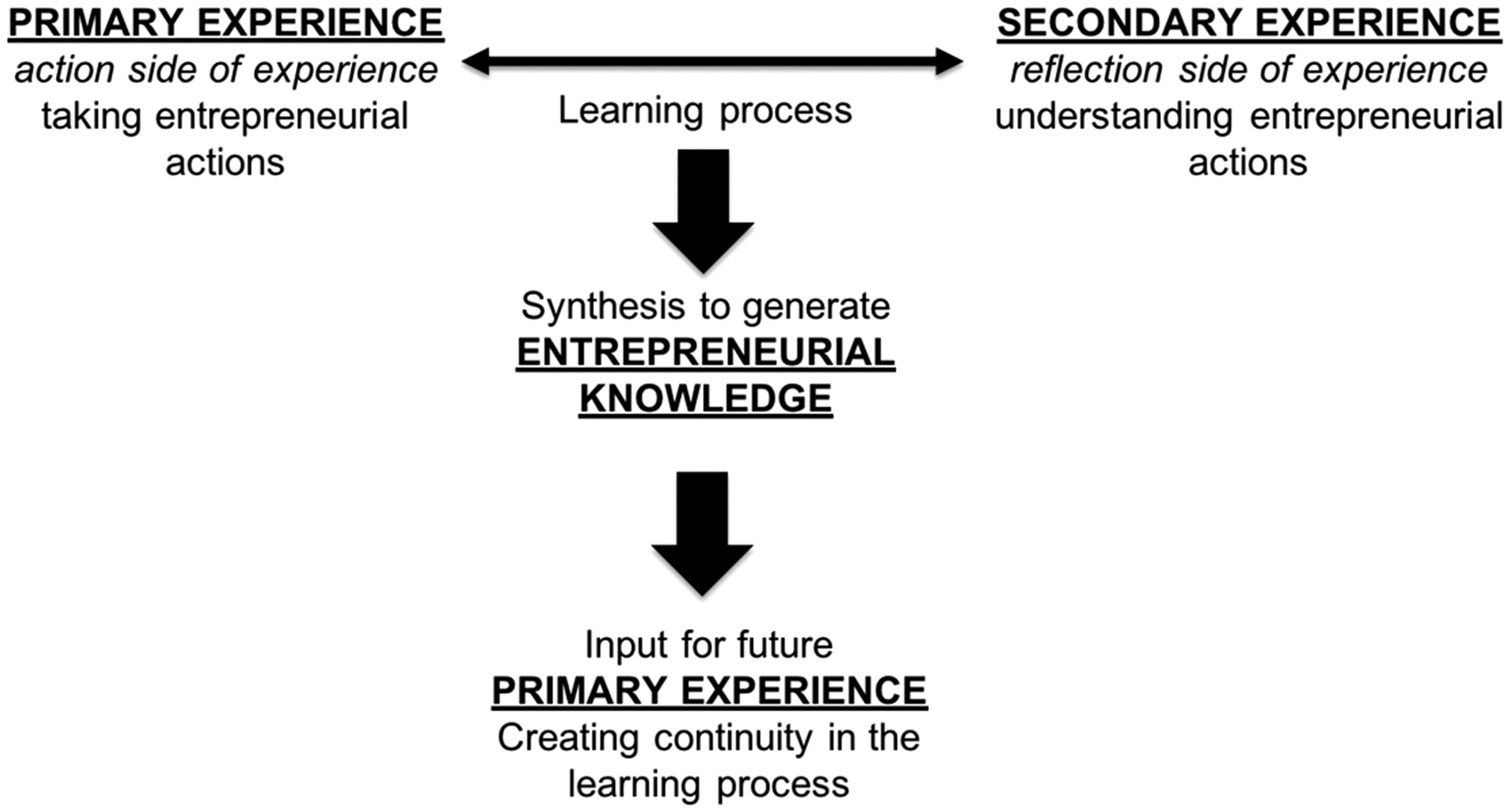
Still, primary experience has long predominated this combination of primary and second experiences in entrepreneurship education (Gibb, 1997; Kassean et al., 2015). Within the context of education, we must also acknowledge how previous learning philosophies and theories have addressed the aspect of learning through experience. For example, Freire (1970/1996) argued that “learning comprises both an active side and a passive side, where mere action only leads to activism and mere reflection leads to verbalism” (pp. 68–69). Learning from the past (e.g., Aristotle, Brookfield, Dewey, Freire, Mezirow, and Piaget), we must understand that thoughtful and grounded knowledge derived through the interplay between theory and experience is essential for developing new pathways from learning.
A Learning Philosophy Based on Experience
The previous section laid the foundation by discussing experience’s role in entrepreneurial education. However, it is not merely any experience that guides this education, but directed and lived experiences connected to entrepreneurship, and more specifically, the entrepreneurial process (Gartner, 1985) from start-up to running a new venture (Cope, 2005a; Cope & Watts, 2000; Politis, 2005). This is closely connected to the aspect of learning-by-doing (Kolb, 1984), a term coined by the writing of John Dewey. But learning by doing in entrepreneurship has mainly been seen as a means for acting, changing the old school pedagogy based on a teacher-led traditional lecture-based approach (Ronstadt, 1985; Sexton & Bowman-Upton, 1987) to a more active and action-oriented pedagogy that puts the learner at the center of attention (Gibb, 1987; Johannisson, 1991; Kassean et al., 2015). The other, reflective, side of experience has been less discussed when designing learning interventions, although it is gaining ground in contemporary discussions on entrepreneurial education (e.g., Lindh & Thorgren, 2016; Neck & Greene, 2011; Williams Middleton & Donnellon, 2014).
The original intention of introducing action into education lies in the progressive thoughts on education defined and developed in the early 20th century by Dewey. This new notion of education is actually not novel, but is merely a shift away from the traditional banking model of education (Freire, 1970/1996), where teachers taught and learners were considered passive depositories of knowledge. Moving away from this banking model, Dewey (1916/2007) argued for an education that put learners at the center, where their experiences would be used as a foundation for their personal development and knowledge acquisition. In essence, McLellan and Dewey (1889, cover page) argued that to learn from experience one has to “learn to do by knowing and to know by doing,” which implies an interplay of knowledge and practice (Hickman, 1992; Jay, 2005; Jonassen, 1991).
The focus on experience was essential, as it was (and still is) considered the root not only for developing meaningful learning (e.g., Boyd & Fales, 1983; Mezirow, 1990; Roberts, 2012; Rodgers, 2002) but also for engaging the learner in the learning process. However, not every experience leads to meaningful learning, as the experience needs to be purposefully selected and the learner has to experience it first-hand (Dewey, 1938, 1946). Through these primary experiences, the learner can then, with the aid of the theories (mind/instruments/tools), reflect on the experience (secondary experience) in an effort to learn and develop knowledge. Purposeful experiences are those that interact and create continuity in the learning process, where previous experiences feed into experiences in the present to form a foundation for how to engage in future acts that lead to new experiences (Dewey, 1946). Students need to interact with the world around them to gain purposeful experiences in learning, as interaction allows them to make connections between theory and practice (see Garrison, 1995 on the aspect of Deweyan logics and language as the tool of tools in education). Therefore, to learn from experience, students need to directly apply theory to real world situations, which gives rise to educative experiences (Dewey & Dewey, 1915). This view is explicated in the following quotation on experimental knowledge from Dewey (1930): According to the analysis of experimental knowing, the distinction of sense and thought occurs within the process of reflective inquiry, and the two are connected together by means of operations overtly performed … From the experimental point of view, the art of knowing demands skill in selecting appropriate sense-data on one side and connecting principles, or conceptual theories, on the other. It requires a developed and constantly progressive technique to settle upon both the observational data and the idea that assist inquiry in reaching a conclusion in any particular case. (pp. 164–165)
Arguing for a shift away from trial and error, Dewey (1916/2007, 1938) argued for a scientific experimental method, the logic of inquiry, as a way of testing ideas through experiencing. This method includes the rawness of a purposeful experience and the elaboration of conceptual knowledge about it, which are synthesized by means of reflection (Dewey, 1910, 1916/2007, 1938). Through this process, learning is developed into knowledge from the experience, which is then used in future experiences, making the process deliberate and based on intelligent inquiry in a continuous future-oriented process of learning. By making the process deliberate, it is possible to derive meaning and understanding of why one acted in a certain way and why a specific decision or course of action was chosen above others.
Knowing that experience plays such a crucial role, what type of philosophy could find its way into this kind of learning? As the concept of experience has been debated in almost every single ontological worldview (Jay, 2005), it could seem that it is only necessary to pick one that fits one’s own worldview. However, we argue that a philosophy of learning and experience is crucial for entrepreneurship education.
We start by arguing that the foundation of this philosophy rests on the pragmatic worldview, both through the progressive philosophy of learning on which contemporary entrepreneurship education rests, and through its emphasis on experience and an uncertain future where truth is only justified in its present stage. But learning through experience is also influenced by phenomenology, as understanding how entrepreneurs learn demands a micro perspective where being close to the phenomenon is key. To this end, we start in pragmatism and end in phenomenology and incorporate insights and ideas derived from contemporary discussions in entrepreneurship education research.
Pragmatic View on Truth and Knowledge
Charles Sander Peirce’s metaphor “the ground on which science stands is a bog” is a good starting point to understand pragmatism. Peirce (1992) argue that science does not stand upon a bedrock of facts but is instead walking on a bog and that “this ground seems to hold for the present, and will here stay, until it begins to give way” (p. 73). Knowledge exists in the present and only lasts until new evidence proves it faulty or incomplete. The same goes for entrepreneurship and the experiences an entrepreneur gains, as they are present, but will not last forever. Because the entrepreneurial world is constantly in flux with new competitors and true uncertainty about what the future will bring (Knight, 1921), the claim of ever-lasting truths, or knowledge, does not hold in the entrepreneurial world. This brings us to truth, explained as theories in use, but also as the pragmatic view on knowledge (Dewey, 1916/2007; James, 1975).
If a philosophy of entrepreneurship education is to be developed and discussed, there must be some sort of consensus about what this means. Therefore, we turn to contemporary discussion on entrepreneurship education. Entrepreneurship education has a rather short history and from its inception has been associated with action-orientation (Gibb, 1987; Johannisson, 1991; Ronstadt, 1985; Solomon & Fernald, 1991), which could be argued to be future oriented, where the pedagogical idea has developed an experiential-oriented character (Nabi et al., 2017; Pittaway & Cope, 2007a; Politis, 2005), leaning on theories such as action learning (Revans, 2011), experiential learning (Kolb, 1984), and problem-based learning (Barrows & Tramblyn, 1980). The introduction of these learning theories within entrepreneurship education (e.g., Gundry & Kickul, 1996; Katz et al., 1994; Scott et al., 2016) has led to the inclusion of an increased focus on the role of experience in the learning process (Kassean et al., 2015; Mandel & Noyes, 2016). As we have previously stated that experience is a double-edged term that is future as opposed to past oriented, it could be argued that it follows the truth concept of pragmatism. Any truth in pragmatism is only valid as long as no new experiences prove it to be incorrect, a view that bears a similarity to the concept of fallibilism, where all knowledge is seen as temporary and could be proven wrong (Laudan, 1990; Losee, 2004). In this sense truth is related to knowledge and expressed through the theories in use (Hickman, 1992). This is also clearly stated in Dewey’s (1916/2007) writings on learning: Since learning is coming to know, it involves a passage from ignorance to wisdom … How is such a transition possible? Is it the relation between reason and action, of theory to practice, since virtue is clearly dwelt in action? (p. 267)
It is only when we are able to go back and change what was once held to be true that we are able to change our direction in the future, which is built on what we conclude in the present. As a result, our goals change, our knowledge base is developed, and we as human beings are able to find our way in what could be termed the “swampy lowlands” (Schön, 1983, p. 42), which in many respects represent life in general.
Reflection is the foundation for discussing philosophical roots for understanding learning in entrepreneurship education. As philosophy concerns thinking, experience is dependent upon the act of reflection for progressing. The view of acting, experiencing, reflecting, and knowing resembles an old view of the logic of abductive reasoning discussed and developed by Peirce (1905). Abductive reasoning is concerned with developing hypotheses or propositions based on doubting current practice, which are then examined through either deductive or inductive methods (Peirce, 1905; Peirce, 1992).
Developing hypotheses and deriving explanations through practice are at the heart of abductive reasoning but are also closely tied to the context of entrepreneurship. At first glance, our argument for abductive reasoning opens the door for effectuation (Sarasvathy, 2001) when discussing how abductive reasoning could help in understanding how entrepreneurs act and behave. Effectuation is broadly understood as an entrepreneurial decision-making logic based on how expert entrepreneurs think and make decisions (Sarasvathy, 2008). The logic of effectuation is closely linked to finding solutions and testing them out in an uncertain environment. Effectuation is a decision-making logic in accordance with James’ thoughts on pragmatism from a largely empiricist standpoint (Sarasvathy, 2008, pp. 59–60). However, as Sarasvathy et al. (2008) admit, there are differences between abduction and effectuation. They describe abduction as a cognitive exercise, whereas effectuation relates more to a logic of actions. Effectuation takes place in the case of expert entrepreneurs and is “a logic for a stream of actions the entrepreneur undertakes” (Sarasvathy et al., 2008, p. 346).
In our previous discussion, we have argued that action relates to primary experience, but to learn and develop entrepreneurial knowledge secondary experience also needs to be included in the educational learning process. Therefore, abductive reasoning, as explained in Peirce (1905) and related to Dewey’s (1930) discussion on experimental knowledge, might be more closely tied to the entrepreneurial discovery process (Kirzner, 1997), whereas effectuation is more connected with following entrepreneurial consequences within an entrepreneurial exploitation process. This is one of the important issues that needs to be addressed when translating and also adopting findings from entrepreneurial education (see Günzel-Jensen & Robinson, 2017). Effectuation is primarily based on understanding the logical chain of action undertaken by expert entrepreneurs, whereas most entrepreneurs in an educational context are novices (Günzel-Jensen & Robinson, 2017; Hägg & Kurczewska, 2019).
There are also differences between effectuation and entrepreneurial inquiry (Hägg, 2017), which builds on the logic of inquiry developed by Dewey (1938). Effectuation applies to expert entrepreneurs, whereas the point of departure for entrepreneurial inquiry is how novice learners develop their entrepreneurial abilities to act in an entrepreneurial way. Although effectuation has provided important insights on how expert entrepreneurs engage in making decisions and the logic behind their actions, the translation from practice into the classroom also needs to address the differences between an expert and a novice (see, e.g., Ertmer & Newby, 1996; Kalyuga et al., 2003; Kirschner et al., 2006; Sweller, 1988, 2016). Therefore, when making a connection to our current understanding of how entrepreneurs behave in practice and translating it into education, we also need to address how this translation could be modified based on what we know from learning theory and the discussion on experience.
As we have previously argued, entrepreneurship is in a constant state of flux, and with that comes uncertainty (Knight, 1921), which in many cases makes deduction difficult to apply. We do not know what the future will bring and if we are to educate individuals in relation to the entrepreneurial world, making a deductive approach insufficient (cf. Neck & Greene, 2011). An inductive approach is equally impossible in the realm of education, as our insights are built on the accumulation of knowledge about how to teach and how individuals learn. The empirical nature of studying practicing entrepreneurs and their behavior does not perfectly correlate to how novice learners engage and learn from entrepreneurial experience in education. Hence, acknowledging the logic of abductive reasoning in relation to learning is imperative, where one goes back and forth between theory and practice (Dewey, 1930) and between deduction and induction (Peirce, 1905). To grasp this interplay between theory and practice and further develop the scholarship of teaching and learning in entrepreneurship education (Neck & Corbett, 2018), it is necessary to address the issue of epistemology and discuss a potential method for how to understand the entrepreneurial process of learning in education.
Phenomenology as a Method for Studying Actual Human Experiences
If the overarching philosophy of entrepreneurship education rests on a pragmatic view, the method for investigating it lies in getting close to the lived experience (Berglund, 2007), which in many cases follows Dewey’s logic of inquiry (Hickman, 1992), but also the phenomenological method. In a phenomenological approach, experience becomes the center of attention and lived experience the means for understanding both the parts and the whole (Koch, 1995; Ricoeur, 1976).
Phenomenology is a field in philosophy and a philosophical movement grounded in the thoughts of Edmund Husserl (Aspers, 2009; Audi, 1999; Tesch, 1995), where the focus is on the structures of experience and consciousness seen from the first-person perspective by studying the phenomena (things as they appear and are understood). It focuses on understanding the essence of experiences as they manifest themselves in the consciousness.
As it is a field that addresses actual human experiences, phenomenology may potentially have a great deal to offer to entrepreneurship education. Figure 2 provides some suggestions for how to research the entrepreneurial learning through phenomenology. It elucidates the problem of considering both the internal and external viewpoints of the learner in the process of learning. In this sense, when researching how learning is developed in entrepreneurship education, empirical phenomenology could bridge the interplay between activities and thoughts to facilitate understanding of how entrepreneurial behavior emerges through the learning process. By following learners’ reflections on the entrepreneurial processes (internal world) and their entrepreneurial actions (external world), we can study the interplay between them. Empirical phenomenology investigates both the world of appearances and structures of reality to create an understanding of the nature of experience (O’Brien & Opie, 2001).
Researching the Entrepreneurial Learning Process Through the Phenomenological Method.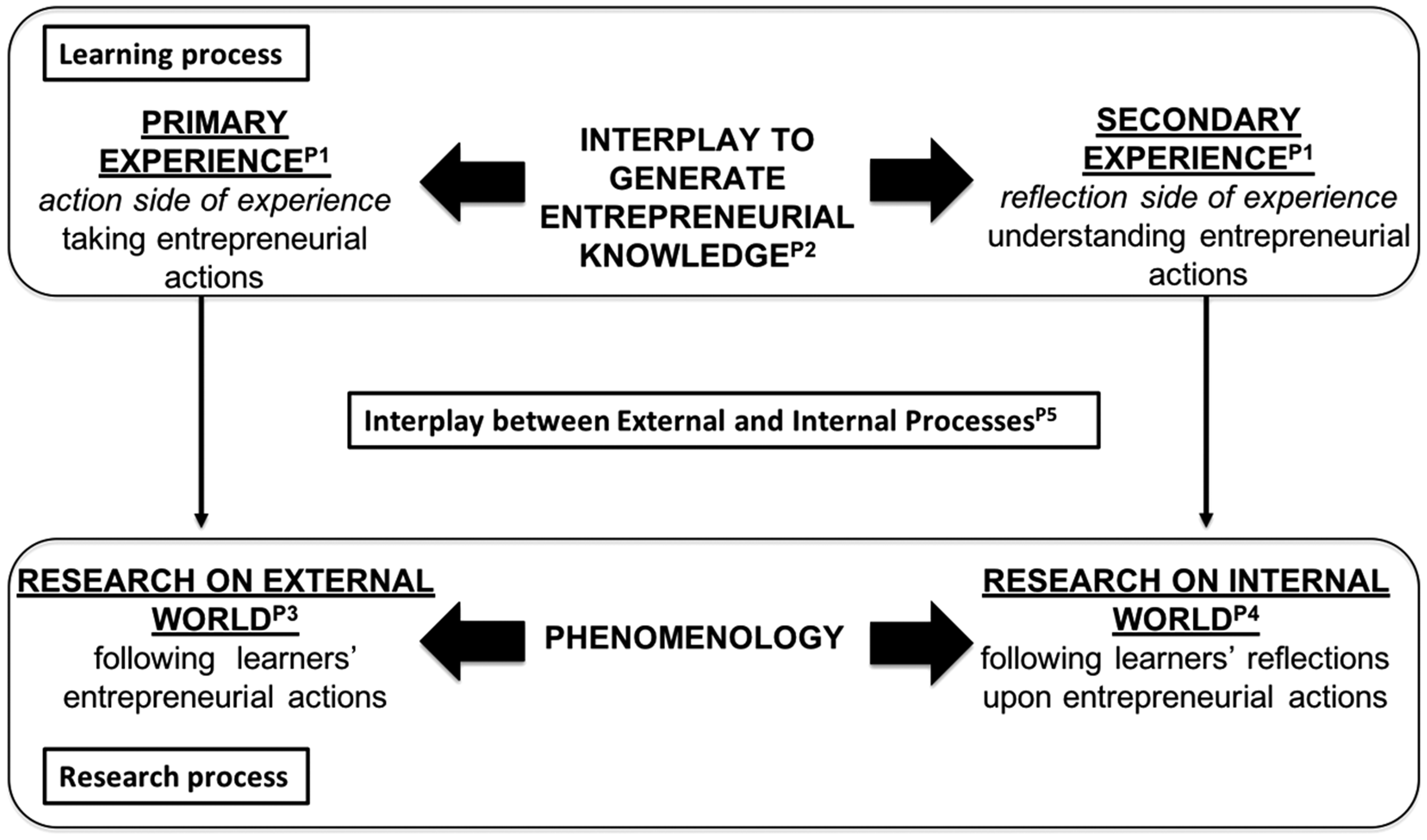
Figure 2 includes some propositions regarding how to research the interplay between primary and secondary experiences in the entrepreneurial learning process: P1. To understand how entrepreneurial knowledge is generated during entrepreneurial learning, both the primary and secondary experiences of the learner need to be considered. Following primary experiences means investigating entrepreneurial actions, whereas following secondary experiences implies exploring the reflection side of experiences. P2. To create understanding about the learning process in experience-based entrepreneurship education, both the interplay between primary and secondary experiences as well as the continuity of experiences needs to be examined. P3. To grasp the primary experience, it is necessary to study the process of entrepreneurial action and how it unfolds through the lived experience of the learner within the social setting of entrepreneurship education. P4. To interpret the secondary experience, it is necessary to study the process within the internal world of the individual learner. P5. To understand the generation of entrepreneurial knowledge in entrepreneurship education from a phenomenological perspective the researcher needs to study the interplay between external and internal processes of learners who engage in educative entrepreneurial experiences (see Figures 1 and 2).
In practice, when researching how entrepreneurial experience in entrepreneurship education creates a learning process that develops entrepreneurial knowledge, a researcher has to be capable of “explicating the actors’ meaning structure” (which resembles the arguments discussed by Mezirow, 1991) and the ideal types they themselves use within their natural attitude (Aspers, 2001, p. 183). The above follows an abductive logic emanating from Deweyan pragmatism to develop the interplay between primary and secondary experiences and to capture the phenomenological interplay between the external and internal process. Together, these dual processes create new insights for the future and aim to establish educative entrepreneurial experiences from a continuity perspective.
Concluding Thoughts on Philosophical Inquiries in Entrepreneurship Education
In this article, we argue that to understand and actually learn how to develop entrepreneurship education, we need to consider not only the part (the method approach) but also the whole (the student entrepreneurs’ journey and the educational context) for understanding how students can learn entrepreneurship through education. This approach builds on the argumentation by Rorty (1999) where education is the process of both individualization and socialization. Consequently, we argue that interpretation of experience on two levels is required. As Little (1991) argues, “to understand individual meanings and actions it is necessary to interpret them, and to understand social practices it is necessary to understand the meanings and values attributed to them” (p. 76).
Therefore, as has been continuously argued in research on entrepreneurship education, we need to build our pedagogical interventions through an experience-based pedagogy (e.g., Liñán et al., 2018; Nabi et al., 2017), where the learner forms their own learning in the subject domain. This remains a challenge due to the boundary conditions of education set by governmental institutions in different countries but is important to keep in mind. We address the importance of lived experience (Cope & Watts, 2000), learning-by-doing (Cope, 2005a; Politis, 2005), reflection as a natural element (Neck & Greene, 2011), and action-orientation (Gibb, 1987; Johannisson, 1991; Pittaway & Cope, 2007b). We also synthesize the development of the field in order to build a foundation for further inquiries aimed at understanding how we can justify our subject in future endeavors that are still veiled in uncertainty (Knight, 1921).
In this article, we have discussed an approach to a philosophy of entrepreneurship education. It is an attempt to build an understanding of what previous research has argued for and what contemporary discussions in the field are addressing. If we claim that entrepreneurship education is special and differs from other subjects, we need to explain the difference and what makes the discipline unique from a research perspective (Neck & Greene, 2011). It is not enough to claim that entrepreneurship should impact everyone; it must have foundations that actually justify its right to be part of everyone. At the present stage of development, we are not completely convinced that entrepreneurship education has earned this right. There are no justified truths (from a pragmatic view) that can back up the claim that entrepreneurship is good for all and our main aim in writing this article is further supported by the current arguments on the lack of theoretical and philosophical grounding when researching entrepreneurship education to develop the field both in theory and practice (e.g., Fayolle et al., 2016; Kyrö, 2015; Rideout & Gray, 2013).
Relating back to the question raised in the introduction of the article “whether entrepreneurship education should be integrated throughout higher education or stand alone as an individualized path?,” based on our discussion throughout the article, we argue that entrepreneurship education demands a very careful implementation of different forms of experiential learning theories, where both sides of learners’ experiences; primary (action) and secondary (reflection), are included, and where the interplay and continuity of entrepreneurial experiences are ensured. This type of learning is highly associated with student-centered approaches in education (see, e.g., Robinson et al., 2016), which demand a close relationship between educator and student, seldom achieved in a traditional lecture-based education. Although learning is achieved on an individual level, our learning both affects and is affected by the context. To understand and develop the field of entrepreneurship education, both in research and in practice, there is a need for a progressive philosophy rooted in understanding the dual nature of experience as well as considering the duality in education comprising both individualization and socialization. Our discussion throughout the article does not provide a clear answer on whether entrepreneurship education should be integrated throughout higher education or stand alone as an individualized path mainly connected to its subject-specific domain. It does, however, open up for questioning how to develop continuous educative experiences. Our aim has been to raise this discussion and create awareness of the dilemma that might be caused by a politicized push in promoting entrepreneurship as an interdisciplinary project in higher education (e.g., Ball, 1989), causing what Rideout and Gray (2013) argue is a race to take action without grounding the action in conceptual and philosophical foundations.
Implications for Theory and Practice
By addressing the philosophical roots of education and experience and bringing them to the surface, this study highlights at least two implications for furthering research on entrepreneurship education.
First, it addresses the importance of delimiting research and use of theory when explaining how students learn and develop entrepreneurial knowledge. Although multiple views occur in research on entrepreneurship education, it is important to recognize where our theories emerged and what philosophical foundation they rest upon when making future contributions, as that will have an impact on research development.
Second, by delimiting our view on how to address entrepreneurship education and what experience entails, we also acknowledge its roots and explicate what we can claim when conducting research based on a pragmatic view of entrepreneurship education. In addition, by proposing phenomenology as a potential methodology for gaining access to and an understanding of actual human experiences, the study provides some practical examples of how to study the interplay between primary and secondary experiences.
Furthermore, the study also has some implications for practicing entrepreneurship education. First, when tailoring learning activities that are based on experience, it is important to develop continuity between them to create a process perspective that results in knowledge development. For example, a learning process that tries to emulate the entrepreneurial process might be linear, based on our understanding of how ideas develop into business ideas and subsequently into start-up activities. From a learning perspective, continuity is important for guiding students when developing entrepreneurial knowledge, despite reasoning from entrepreneurship research that supports the nonlinearity of entrepreneurs’ everyday practice (e.g., Neck & Greene, 2011; Sarasvathy & Venkataraman, 2011).
Second, when developing pedagogical methods that involve experience, it is essential to bear in mind the importance of allowing time for processing the experience through reflective sessions and connecting the experiences to concepts and theories to create multiple perspectives. Entrepreneurial challenge or pitch competitions are examples of entrepreneurial learning interventions based on purposeful experiences. In these activities, individuals work proactively and consciously on their business ideas but at the same time need to reflect in order to be able to better communicate their ideas and interact with their environment. Incorporating an exercise where participants reflect in written journals could enhance these activities, where learners assess how or why they perceived, thought, felt or acted (Mezirow, 1990), making it possible for them to investigate their own actions in a given situation (Høyrup, 2004). At present, there is a critical stream of entrepreneurship education research that seeks to highlight alternative ways of teaching entrepreneurship and how a more questioning perspective of the neoliberal enterprising self has created new norms in society (e.g., Berglund & Verduyn, 2018). These alternative teaching methods could enhance students’ understanding of entrepreneurship and the broader implications of what entrepreneurship might mean when positioned in different contexts.
And third, as a facilitator, it is important to guide students so that they have purposeful experiences, but it is equally essential to allow them freedom when engaging in the experience so that they feel that they have ownership of their learning. Therefore, the importance of socialization and individuation becomes apparent in the context of entrepreneurship, where both the student’s individual journey and the social context of how to engage in different forms of entrepreneurial experience become key aspects when developing learning activities that include experience as a source of entrepreneurial learning.
Footnotes
Acknowledgments
The authors would like to thank two anonymous reviewers for their helpful comments for developing this work. The authors are also grateful for valuable comments and suggestions on an earlier version from Professor Diamanto Politis.
Declaration of Conflicting Interests
The author(s) declared no potential conflicts of interest with respect to the research, authorship, and/or publication of this article.
Funding
The author(s) disclosed receipt of the following financial support for the research, authorship, and/or publication of this article: Agnieszka Kurczewska’s contribution to this study is part of the project financed by Polish National Agency for Academic Exchange (Bekker Program).
