




Abstract
Over the past decade, the reemerging debate about the introduction of ecocide as an international crime has brought about increasing scholarly and public debate. Small Island States have played a major role in this debate arguing for sanctioning and codifying widespread and long-term environmental harm in international criminal law. Recognizing the diversity among the Small Island States, five countries that have adhered to the Rome Statute are of particular interest: Belize, the Republic of Fiji, the Republic of Maldives, Samoa, and the Republic of Vanuatu. We explore which role these states have played in the debate on the judicialization of ecocide and ask how and to what extent they have contested prevailing norms in global environmental governance regarding the criminalization of grave environmental harm. With a qualitative document analysis, we scrutinize the agency of the Small Island States involved in global power dynamics around the judicialization of ecocide. Based on our empirical analysis, we argue that these processes can be conceptualized as norm contestation, revealing an ‘agency of the governed’. By discursively disapproving international norms – either regarding their validity per se, or regarding their general or situational application –, these actors formerly perceived as mere ‘norm takers’ have become norm entrepreneurs, actively shaping the international normative fabric of global environmental governance.
Introduction
While the Intergovernmental Panel on Climate Change issued a final warning in their sixth assessment report, environmental damages have increased and affected people – particularly in the Small Island States – for decades (IPCC, 2023b). Recognizing that human action continues to cause mass ecological destruction, the debate about ensuring accountability for grave environmental harms has recently brought about new scholarly and public debate. Prominent approaches for environmental justice include recent developments in the European Union with a new directive on the protection of the environment through criminal law (EU, 2024) or the initiative of an independent panel of international criminal and environmental lawyers to develop a broadly recognized definition of ecocide as a first step towards its codification in international law. The panel has defined ecocide as the “unlawful or wanton acts committed with knowledge that there is a substantial likelihood of severe and either widespread or long-term damage to the environment being caused by those acts” (Stop Ecocide Foundation, 2021). Supporters of these initiatives consider criminal liability for environmental harm not only as a powerful way to hold persons individually responsible for severe environmental damages, but also as a preventative measure in regard to climate change (Haines and Parker, 2017; Higgins et al., 2013: 262; White, 2023).
In this paper, we study the agency and arguments of actors pushing the judicialization of ecocide as an international crime. We focus on Small Island States and show that some of these states have played a major role in the ecocide debate for decades, contesting the missing responsibility for the common heritage of mankind (Okereke, 2019: 174). Hence, while the recent ecocide debate gained momentum in 2019 (Zeigermann, 2024), the original idea is much older. From the beginnings of global environmental governance in the 1970s, representatives of Small Island States have argued in favor of sanctioning and codifying widespread and long-term environmental harm in international criminal law (Bassiouni, 2015). They have challenged existing international legal frameworks dealing with environmental harms, paving the way for today's initiatives on ecocide. In September 2024, Vanuatu, with co-sponsorship from Fiji and Samoa, even proposed the inclusion of an independent crime of ecocide to the Rome Statute of the International Criminal Court (ICC). Consequently, these efforts can be characterized as a push towards judicialization which we broadly understand as a process by which the role of courts and judges in political and policy-making arenas is increasingly expanded (Alter et al., 2019: 449; Tate, 1997: 27–28).
So far, only little attention has been paid to these developments (Higgins et al., 2013). While the agency of Small Island States has received scholarly attention as far as climate negotiations are concerned (Baues and Wiese, 2025; Betzold et al., 2012; de Águeda Corneloup and Mol, 2014; Rasheed, 2019), judicialization is seen as a rather new phenomenon in International Relations marking “a fundamental shift” (Alter et al., 2019: 458). Global environmental governance, albeit legalized to a large extent, has been described as a “shadow zone of international judicialization” (Romano, 2014: 105). However, in international environmental politics, it seems that the diversity of actors that invoke, influence, or try to institutionalize adjudication processes has been increasing – a novel trend that remains understudied in theoretical as well as empirical terms (Alter et al., 2019: 449).
Against this backdrop, the paper focuses on the role Small Island States have played in the debate on the judicialization of ecocide. Specifically, our central research question is how and to what extent these states have contested prevailing norms in global environmental governance regarding the criminalization of grave environmental harm. We argue that their role can be conceptualized as norm contestation which we understand as the discursive disapproval of (international) norms, either regarding their validity per se (justificatory contestation) or regarding their application (applicatory and situational contestation) (Deitelhoff and Zimmermann, 2013; Lantis and Wunderlich, 2018; Okereke, 2008; Wiener, 2014). To better understand the agency and arguments of Small Island States involved in global power dynamics, our qualitative document analysis examines the interactions of five countries that stand out in their international engagement for the judicialization of ecocide in international criminal law: Belize, 1 the Republic of Fiji, the Republic of Maldives, Samoa, and the Republic of Vanuatu. Indeed, an examination of official records and the statements delivered by ICC member states during relevant debates indicates that active endorsement of an amendment to the Rome Statute has so far come from only a limited number of countries. The vast majority of member states, by contrast, have expressed no definitive position on the issue.
In the following, we first set out the conceptual framework for the subsequent analysis and provide an overview on the environmental justice literature that has contributed to the academic debate on ecocide. We then develop the methodology for our empirical research and briefly present the five Small Island States that are at the center of this study. In the following, we analyze how these countries define and justify criminal liability for ecocide, which political levels they address, which instruments they propose – and to what extent this amounts to a contestation of prevailing norms in global environmental governance. Based on this analysis, we argue in our conclusion that Small Island States – once dismissed merely as ‘norm takers’ – have become norm entrepreneurs, actively challenging the established norm of non-liability for severe environmental harm. By highlighting their particular vulnerability to climate change and other environmental disasters, Small Island States’ contestation has moved the discursive boundaries in environmental governance, potentially triggering a change in the international norm set. While ecocide has not found universal acceptance, the norm entrepreneurship of the Small Island States testifies to the “agency of the governed” (Wiener, 2017b) and provides an illuminating “Global IR” perspective (Acharya, 2014) on the international politics of judicializing environmental justice and criminalizing environmental offences.
Conceptual framework
Norms are generally understood as “collective expectations about proper behavior” (Jepperson et al., 1996) and are defined as “value-based, intersubjectively shared expectations of proper conduct” (Finnemore and Sikkink, 1998: 891; Wagner et al., 2001: 74). While some norms have been codified into international law (also referred to as ‘hard norms’), others remain informal but are nonetheless broadly acknowledged as standards of behavior (also referred to as ‘soft norms’).
Environmental governance is shaped by a variety of norms that establish the interactions between humans, the natural world, and non-human species. Various perspectives on these relationships have contributed to the development of a normative framework addressing environmental justice and harm in global politics. Environmental justice generally refers to the equitable allocation of environment and natural resources to diverse peoples in relation to their accessibility and utilization within defined geographical regions, along with the impacts of certain social practices and environmental risks on specific groups (Heckenberg and White, 2014: 49). Since the beginning of global environmental governance, several soft norms have been defined to concretize environmental justice. The most prominent include the precautionary principle, 2 the polluter-pays principle, 3 the principle of common but differentiated responsibilities, 4 and the principle of the common heritage of mankind. 5
These principles are important because they serve to qualify certain behavior as environmental harm. Environmental harm has been described as a “normative concept that reflects underlying social judgements about the good and the bad” (Lin, 2006: 901). Harm in this context is complex, contested, and ambiguous (Lin, 2006: 921f). This is because it reflects choices about values and tends to be applied to specific activities that are otherwise viewed as acceptable due to their socio-economic benefits, licensed or lawful, like cutting trees (Lin, 2006: 977 ff.). Nonetheless, harm provides a well-established justification for a legal response or judicialization of certain action, whether through criminal liability, administrative regulation, or creation of a tort action. Accordingly, environmental law concerns itself largely with the prevention or correction of harm. The nature (malum prohibitum) and intensity (malum in se) of harm is what makes something a crime or not (White, 2018).
Accordingly, the term ‘ecocide’ has since been associated with the idea of criminal responsibility for large-scale and long-term environmental harm (Falk, 1973; Gray, 2003; Higgins et al., 2013; White, 2018: 101; Zierler, 2011). In other words, ecocide generally describes an attempt to criminalize human activities that destroy and diminish the well-being and health of ecosystems and species within these, including humans (Heckenberg and White, 2014: 53). In this study, we adopt this broad definition of ecocide based on the notion of environmental harm. It allows us to introduce the following three aspects of the debate that help us structure the engagement of Small Island States for a judicialization of ecocide.
First, over the past decades, diverse definitions of ecocide have been proposed, differing along several dimensions: Some definitions include the concept of intent, while others do not (Higgins et al., 2013; Robinson, 2022). Ecocide has been variably linked to the genocide concept and human rights (Brooks, 2021; Crook and Short, 2021; Galligan, 2022). There is a tension between references to the intrinsic values of nature and those that focus on human interests in the environment (Heckenberg and White, 2014; Kalkandelen and O’Byrne, 2017; White and Hasler, 2018). Definitions differ on whether ecocide applies only in situations of war or also in times of peace (Gray, 2003; Mehta and Merz, 2015). Some require a certain threshold of seriousness regarding environmental destruction, while others do not (White and Kramer, 2015). Finally, proposed definitions may emphasize one or more of the aforementioned principles of environmental justice. Thus, ‘ecocide’ means different things to different speakers. Examining the legal and political debates revolving around the judicialization of ecocide therefore requires studying how the Small Island States understand and define the idea. Second, preventing and correcting damages to the environment are considered by many a primary responsibility and sovereign duty of national governments. Accordingly, environmental laws have been defined since the 1970s to regulate local problems like pollution and environmental degradation. At the same time, there has been increasing awareness of transboundary environmental problems requiring international regulation (Gray, 2003; Heckenberg and White, 2014: 53–58). The alignment of environmental and criminal law remains contested, particularly regarding the appropriate level of governance (Robinson, 2022). It is therefore important to study the governance level addressed by Small Island States in their statements on ecocide. Third, criminal non-liability for grave environmental harm globally remains the prevailing norm. In 1947, the United Nations General Assembly tasked the International Law Commission (ILC) with the responsibility of formulating “the principles of international law” and “prepare a draft code of offenses against the peace and security of mankind” (UNGA, 1974). Between 1984 and 1996, substantial discussions within the ILC revolved around the potential incorporation of environmental damage and the concept of ecocide into the list of Crimes against Peace. However, as no agreement between the parties could be reached, the article was removed altogether and Commission members failed to include ecocide in the Rome Statute (Higgins et al., 2013: 258–262). As a result, ecocide has been regulated with diverse instruments, including voluntary commitments (e.g., for transnational companies to reduce and prevent environmental harm or for governments to contribute to the Loss and Damage Fund); the introduction of procedural environmental standards (e.g., to test for and prevent pollution); naming and shaming of those failing to implement these standards (e.g., in monitoring reports or international conferences); economic mechanisms (e.g., Carbon Trade); or the introduction of national laws for ecocide-style crimes (e.g., Vietnam, Ukraine, Ecuador). Against this backdrop, it is necessary to consider the intensity of regulation demanded by Small Island States.
Studying the specific claim for an ecocide norm, the addressed level, and the intensity of regulation in the international discourse allows answering the question of how prevailing norms in global environmental governance have been contested by Small Island States. This contributes to recent theoretical debate on norms in international relations. Earlier research conceptualized norms as static entities with an assumed ontological status, implying stability and uniform influence on state behavior (Wiener, 2014: 23). Thus, the traditional perspective suggests that once norms are established, they become embedded in the international system. However, IR scholarship has since evolved and a more dynamic understanding of norms has emerged, acknowledging their continuous negotiation, reinterpretation, and contestation (Deitelhoff and Zimmermann, 2013; Lowinger et al., 2021; Wiener, 2014). The contemporary approach to norms emphasizes that they are not merely adhered to, accepted, or rejected in a passive manner. Instead, norms are actively reshaped, adapted, and sometimes contested by various norm entrepreneurs, such as the Small Island States.
In the realm of environmental governance, Small Island States must coordinate their interests and actions to ensure their voices are heard in global negotiations. Despite their limited resources and heightened economic and environmental vulnerabilities – factors that have often led to their portrayal as mere ‘norm-takers’ of international law – Small Island States should not be underestimated in terms of their agency, resilience, and capacity to shape global norms (Mercer et al., 2007; Ourbak and Magnan, 2018; Scobie, 2019: 119). Carola Klöck points out that these countries “have been surprisingly influential in global climate change politics” (Klöck, 2020: 167). Building on this insight, we examine how and to what extent Small Island States engage in the contestation of international norms by advocating for the international judicialization of environmental crimes and the recognition of ecocide by the International Criminal Court (ICC).
Contestation, in this context, is understood as “the range of social practices that discursively express disapproval of norms” (Wiener, 2014: 1). To answer not only how, but also to what extent Small Island States have contested prevailing norms in global environmental governance, we draw from the expanding body of literature on norm contestation (Deitelhoff and Zimmermann, 2013; Lantis and Wunderlich, 2018; Lowinger et al., 2021: 37–38; Wiener 2018: 41; Zimmermann et al., 2017: 699–701; Zimmermann et al., 2023) and distinguish three different types of contestation: (1) Justificatory contestation concerns the validity of a norm, (2) applicatory contestation disputes the specific application of a norm (Deitelhoff and Zimmermann, 2013: 5; 14), and (3) situational contestation questions the application of a norm in a particular context (Lantis and Wunderlich, 2018: 573–574).
The first type is the most fundamental one. Whereas applicatory and situational contestation only concern how or whether a norm – whose validity is not in question – can be applied in a given case, justificatory contestation challenges its very validity. As the core of the norm is questioned, this type of contestation represents the most intense disapproval. For example, in climate policy, some developed countries have challenged the principle of Common But Differentiated Responsibilities (CBDR) not merely in terms of its application to specific mitigation targets, but in its validity as a guiding norm for the entire regime, arguing that it entrenches outdated divisions between developed and developing states. By adopting this typology of norm contestation, we seek to more precisely characterize the claims advanced by Small Island States and to better capture both subtle and pronounced shifts in the acceptance and interpretation of norms in environmental governance.
Methods
Case selection
In our study on the judicialization of ecocide as contestation, we focus on Small Island States that represent not only a very particular case in global environmental politics but also the need for urgent climate change adaptation and mitigation. This is because the very existence of these states and the livelihood of many peoples and species living on islands are threatened by rising sea levels and global warming (IPCC, 2023a). At the United Nations, 39 island states and 18 associate members of United Nations regional commissions that are facing unique social, economic, and environmental vulnerabilities have been recognized as a special group since the 1992 United Nations Conference on Environment and Development. They are referred to as the Small Island Developing States (SIDS), i.e., as one group despite their diverse locations in the Caribbean, Pacific, Atlantic, Indian Ocean, and South China Sea. The SIDS are supported by inter-governmental organizations, including the Alliance of Small Island States (AOSIS), the Caribbean Community (CARICOM), the Pacific Islands Forum (PIF), and the Indian Ocean Commission (IOC) (UN-OHRLLS, 2023). Particularly the AOSIS has played an integral role in influencing international environmental and climate change policy, namely the UNFCCC (Ashe et al., 1999; Betzold, 2010).
Due to our research interest in the agency of the Small Island States involved in global power dynamics related to the ICC, we first selected the 25 Island States that are State Parties to the Rome Statute (Antigua and Barbuda; Barbados; Belize; Cabo Verde; Comoros; Cook Islands; Dominica; Dominican Republic; Fiji; Grenada; Guyana; Kiribati; Maldives; Marshall Islands; Mauritius; Nauru; Saint Kitts and Nevis; Saint Lucia; Saint Vincent and the Grenadines; Samoa; Seychelles; Suriname; Timor-Leste; Trinidad and Tobago; Vanuatu) (ICC, 2025). In a second step, we screened the speeches and public statements in the general debate of the annual Assembly of the State Parties at the ICC to identify those states that have publicly addressed ecocide in the broader sense. Criteria for selection were if they have spoken out on environmental harms at the annual Assembly of the State Parties at the ICC or engaged in public calls or official statements at UN-level on ecocide in the broader sense. Our desk research revealed that only a small number of SIDS have actively participated in the international discourse promoting criminal liability for grave environmental harms, including, above all, Belize, the Republic of Fiji, the Republic of Maldives, Samoa and the Republic of Vanuatu (see Table 1).
Selected texts for the analysis of small island states in the international discourse on ecocide.
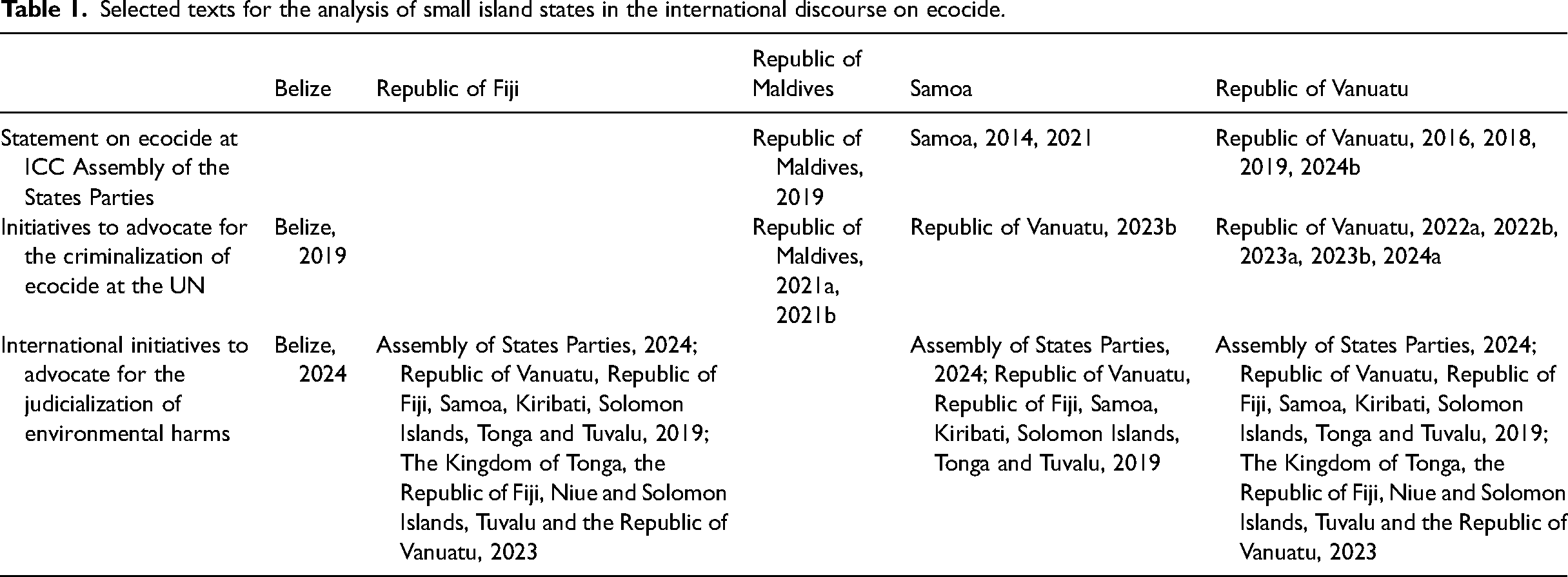
While recognizing their different socioeconomic, environmental, geographical, and cultural features, these states share important commonalities as pioneers in the ecocide debate (see Table 2). We consider that the arguments brought forward by these states help us classify their engagement in the judicialization of grave environmental harm and their norm contestation.
Characteristic features of small island states informing the judicialization of ecocide in international criminal environmental law.
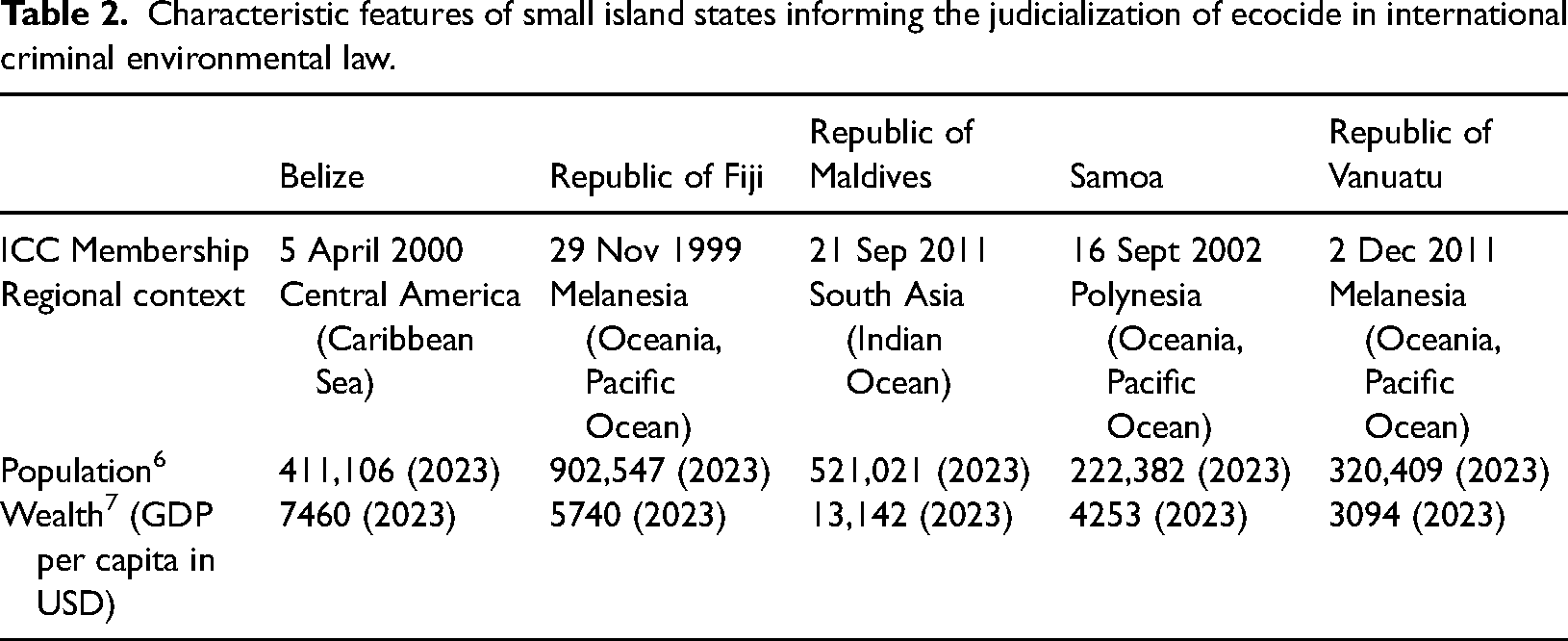
Qualitative document analysis
As contestation is defined as “the range of social practices that discursively express disapproval of norms” (Wiener, 2014: 1), it is observable in discourse, including language and speech acts (Lowinger et al., 2021: 38; Wiener, 2017a: 112). Consequently, our research primarily relies on qualitative document analysis, encompassing the scrutiny of texts such as oral and written statements, proposals, and international initiatives. Table 1 provides an overview of the public documents referring to environmental harm or ecocide that can be attributed to SIDS. They were identified and selected based on a keyword search for “environmental harm”, “ecocide”, “climate change AND crime”, “climate change AND obligations” of public speeches and statements of UN, ICC, International Court of Justice (ICJ), and other international climate change-related meetings. Due to our regional focus, we selected only documents associated with Small Island States that are also parties to the Rome Statute (see previous section).
Our analysis is theory-driven and based on the analytical distinctions developed in our conceptual framework. To answer our research question of how and to what extent Small Island States have contested prevailing norms in global environmental governance regarding the criminalization of ecocide, we have marked relevant passages referring to environmental or climate change harm, obligations, or crimes. In a second step, we have assigned them to one of the three analytical dimensions concerning ecocide. Thus, we have manually coded these texts (1) according to the respective understanding and definition of ecocide (in relation to intent, situations of peace and war time, environmental justice principles, and human rights), (2) according to the proposed level of criminal liability (national/international), and (3) according to the proposed intensity of regulation of environmental harms (voluntary instruments, procedural instruments, economic instruments, legal instruments). These dimensions also inform the overall structure of the empirical analysis in the following section. In a third step, we interpreted and coded these passages as instances of justificatory, applicatory, or situational contestation. In accordance with the typology laid out in the conceptual framework, we identified justificatory contestation where the validity of a norm itself was questioned; applicatory contestation where the focus was on whether or how the norm should be applied in a given context; and situational contestation where its relevance was debated in light of specific circumstances or exceptions. This third step leads back to our research question to determine to what extent Small Island States oppose prevailing environmental norms through their definition and specific (cf. level and intensity) claims for ecocide. Because the three types of contestation differ in their depth and scope, with justificatory contestation representing the most fundamental form of opposition, this step enables us to assess the varying degrees to which these norms are being challenged.
Our theory-driven qualitative document analysis allowed us to structure the analysis systematically while remaining attentive to the discursive complexity of the material. Additionally, our methodology extends to the examination of secondary literature, which served to contextualize our findings, support the interpretation, and strengthen the theoretical grounding of our analysis.
Findings and discussion
The island states have played a crucial role in the ICC from the outset (Bassiouni, 2015). The former Prime Minister (1986–1991) and President (1997–2003) of Trinidad and Tobago, ANR Robinson, was a key figure in the creation of the ICC. He first became involved with the idea of a permanent tribunal to prosecute people for crimes against humanity in the 1950s at Oxford University, where he and a fellow student, Robert Woetzel, decided to try to breathe new life into a concept that dated back to the League of Nations. In 1970, Robinson and Woetzel created the Foundation for the Establishment of an International Criminal Court (Bourne, 2014; Union of International Associations, 2022). Many years of campaigning followed, until in 1989, as Prime Minister of Trinidad and Tobago, ANR Robinson was able to table a motion at the UN General Assembly. As a result of his efforts, 15 Caribbean and Latin American states officially endorsed the idea of an International Criminal Court at the UN General Assembly in 1989. However, the United States and other European countries, particularly the United Kingdom and France, opposed the idea at the time (Bassiouni, 2015).
The International Law Commission, which was revived as a result of Robinson's initiative at the General Assembly in 1989, worked on a Draft Code of Crimes Against the Peace and Security of Mankind (International Law Commission, 1996) but continued to face major opposition by countries in the Global North (Bassiouni, 1993). In the beginning, severe environmental damages and ecocide were included in the list of Crimes against peace (Higgins et al., 2013: 259–260). Yet, the global debate continued and the idea of including ecocide was highly contested so that “contrary to the prevailing mood at the time, 1996 saw the crime of ecocide suddenly removed from all draft documents” (Higgins et al., 2013: 261). The ICC was eventually set up in 1998 and established in The Hague in the Netherlands in 2002. Although the ecocide notion did not make it into the Rome Statute, support for introducing an international criminal liability for environmental harms has sustained in the Small Island States.
Our findings are structured following our theoretical considerations. We first examine the legal and political debates in Small Island States revolving around the judicialization of grave environmental harm to understand how they define and justify criminal liability for ecocide. Subsequently, we analyze the political level addressed and the intensity of regulation proposed by the Small Island States. This allows us to understand to what extent this amounts to a contestation of prevailing norms in global environmental governance.
The definition of criminal liability for grave environmental harms
With accelerating climate change, Small Island States have used international debates to point out the missing international recognition of the ecocide crime. Fragile ecosystems make island states particularly vulnerable to biodiversity loss and environmental damages because they lack economic alternatives (IPCC, 2023a; UN-OHRLLS, 2023). In light of increasing environmental problems, Vanuatu, Samoa, and the Republic of Maldives have repeatedly called on the Assembly of States Parties to the Rome Statute for a recognition and criminalisation of ecocide (see Table 2). In September 2024, Vanuatu, Fiji, and Samoa even submitted a formal proposal for an amendment to the ICC Working Group on Amendments, which was discussed in December that year in The Hague (Assembly of State Parties, 2024). Directly challenging the fundamental norm of non-liability for environmental harm, this proposal can be read as a form of justificatory contestation. The draft amendment emphasizes the immediate environmental danger perceived by the Island States who suggest adding a preambular paragraph noting the concern “that the environment is daily threatened by severe destruction and deterioration, gravely endangering natural and human systems worldwide” (Assembly of State Parties, 2024: 9).
The Small Island States justify their engagement for the criminalization of ecocide because they consider it a severe harm (malum in se) threatening international peace, security, and their own survival (Belize, 2019; Republic of Vanuatu, 2024b; Samoa, 2021). This is because ecocide produces grave damage that often extends a limited geographic area or is suffered by an entire ecosystem. They have criticized persisting soft environmental norms and proposed a fundamental change towards hard environmental law. Hereby, they have argued in favour of the international criminalization of both intended and unintended (reckless) environmental harms in reference to the principle of the common heritage of mankind (Republic of Vanuatu, 2016, 2019). In 2019, they “call[ed] on the Office of the Prosecutor to ensure that climate-damaging conduct that amounts to international crimes is effectively investigated and prosecuted” (Republic of Vanuatu, 2019). Investigating and prosecuting such unlawful or wanton acts or omissions committed by one or more perpetrators would also have important implications on the rules of procedure and evidence in the ICC. It would require a clarification of the elements of crime to be considered by the ICC. For instance, while the proposed ecocide amendment to the Rome Statute would entail a mental element, it needs to be recognized that environmental damages often cannot be known or anticipated with “near certainty” (Art 30 Rome Statute). Hence, supporters of introducing the notion of ecocide in the Rome Statute note that “knowledge of substantial likelihood of severe and either widespread or long-term damage to the environment” – that correspond to national law standards such as recklessness or dolus eventualis – are sufficient conditions to determine culpable conduct (Assembly of State Parties, 2024: 11).
For Small Island States, governing environmental harms is also justified as a matter of individual human rights and climate justice (Republic of Vanuatu, 2024b). They have challenged the fundamental validity of human rights norms at the level of the UN, the ICC, and the ICJ, contesting the missing link between human rights principles and climate injustice, especially in the current climate change regime (UNFCCC). For instance, in 2022 at the UNFCCC COP27, the president of Vanuatu notes: “Clearly something is not working as emissions increase, climate finance remains wholly inadequate, the 1.5-degree limit will soon be crossed, and the resulting climate injustice is suffered daily across the planet. Fundamental human rights are being undermined […] Vanuatu is of the view that States have existing legal obligations under a range of international laws to protect the rights of present and future generations from the adverse impacts of climate change.”mpa#rdquo; (Republic of Vanuatu, 2022a)
Here, the International Court of Justice is mainly addressed by Vanuatu's initiative “to transform the legal contexts in which we all act to protect human rights from climate harm” (Republic of Vanuatu, 2022a). As an application of the precautionary principle, criminal liability for ecocide-style crimes is also expected to prevent grave future environmental harm and the loss of land and marine ecosystems in island states due to climate change.
In addition to suffering the adverse negative effects of climate change, the Caribbean region has long dealt with the risk of nuclear or chemical incidents due to the transit of vessels carrying toxic and hazardous wastes, chemicals, and radioactive materials between Japan to Europe (UNGA, 1994). Oil spills have become a matter of concern, stemming from the expansion of oil production from Trinidad and Tobago to Guyana and Suriname (Sanders, 2021). The nature of these environmental risks (malum prohibitum) is what has made island states consider them as a crime committed by transnational actors that should be judged before the ICC. Heads of states and governmental officials refer to the internationally recognized polluter-pays principle to justify their critique of the current application and implementation of current global environmental regulations but also their support for the ICC and international criminal law. For instance, at the 18th Session of the Assembly of State Parties to the Rome Statute of the ICC, it was stated: “Maldives accords highest priority to the International Criminal Court (ICC) in its efforts to put an end to impunity for perpetrators of the most heinous crimes. […] Yet, we see no serious efforts on the part of large emitting countries to save humanity from the impending climate change catastrophe. […] The ICC has the capacity to contribute to the drastic changes in behaviour that are needed to meet the Paris Agreement goals.” (Republic of Maldives, 2019)
In a similar vein, Belize has noted on behalf of AOSIS their disappointment of inadequate action by developed countries in accordance with the principle of common but differentiated responsibilities (Belize, 2019). Sanctioning ecocide is accordingly seen as a form of leadership and honouring of collective global commitments to protect those most vulnerable to climate change (Belize, 2019). In other words, they criticize that recognized mechanisms and principles are not adequately applied. These critiques reflect applicatory contestation, targeting the insufficient implementation of established norms.
To summarize, Small Island States have pushed for a criminal liability of perpetrators of severe environmental harms justifying their engagement with internationally recognized environmental justice principles, including precautionary principle, the polluter-pays principle, the principle of common but differentiated responsibilities, and the principle of the common heritage of mankind. They consider a hard ecocide norm necessary not only because current instruments in environmental governance are not effectively applied (applicatory contestation) but also because the current normative framework inadequately links human rights to increasing environmental threats (justificatory contestation).
Level of criminal liability for grave environmental harms
While several countries have criminalized or are about to criminalize ecocide-style harms in their domestic penal codes (Stop Ecocide Foundation, 2023) or in regional directives (EU, 2024), the domestic laws in the Small Island States often do not include specific ecocide provisions. Even if they have adopted laws to protect the environment, public agencies often lack the resources and political support to effectively implement these laws and ensure monitoring. For instance, in the Republic of the Maldives, indigenous groups, human rights activists, and environmental civil society organizations have criticized that the government failed to enact environmental safeguards and thereby contributed to ecocide. They argue that the government promoted harmful tourism and business to build an airport and hotel resorts, which has destroyed an important part of the island's mangroves, reefs, and wetland (Human Rights Watch, 2023). At the international level, the Republic of the Maldives emphasizes, at the same time, that the country “is determined to not passively wait on the climate front” (Republic of Maldives, 2021a) and noted already in 2019 at the ICC: “Countries at the frontline of climate change, such as the Maldives, do not have the luxury of time to negotiate for another international legal instrument to fight against environmental crimes. We believe the time is ripe to consider an amendment to the Rome Statute that would criminalise acts that amount to Ecocide.” (Republic of Maldives, 2019)
The environmentally harmful actions of the government at the national level can be seen as an inconsistency with the Maldives’ international advocacy to criminalize environmental harms. However, the Small Island States justify their international focus for the prosecution of environmental crimes with the principle of common but differentiated responsibilities in global environmental governance. They see themselves as the victims of environmental damage with little political and economic capacity to hold perpetrators from developed countries as well as wealthy and powerful transnational companies accountable. Consequently, their critique is directed primarily at the non-liability for environmental harm at the international level, rather than in national or local contexts. The Prime Minister of Samoa noted accordingly at the 20th Session of the Assembly of States Parties to the Rome Statute of the ICC: “When we look around our world today there are even more and more ‘innocent victims’, in particular victims of acts causing severe widespread or long-term damage to the environment, including the global climate system. We believe, respectfully, that the International Criminal Court has a necessary and critical role to play. In our estimation there is substantive and rightful international demand for ecocidal and gross environmental acts to be carefully examined in terms of the structure and principles of the Rome Statute; and that the historical moment has come [as] the scientific evidence and assessments on gross environmental damage are out there in abundance.” (Samoa, 2021)
In this statement, climate science – highlighting the global interconnectedness of environmental problems and their urgency – is cited by Samoa to emphasize their claims for an international ecocide crime. Similarly, several island states have argued for an international criminal liability for ecocide, and the responsibility of industrialized countries not only to support an amendment of the Rome Statute, but also to engage in restorative justice for environmental harms, e.g., through addressing the Loss and Damage Fund within the UNFCCC or the Green Climate Fund and the Commonwealth Climate Finance Access Hub (Republic of Maldives, 2021b). For that purpose, Vanuatu and Samoa have also supported the international ecocide debate at the ICC by co-hosting official side-events in 2021 (Stop Ecocide International, 2021) and by repeatedly providing statements at international events. For instance, a very explicit statement in line with the aforementioned applicatory critique of developed countries was made by Belize on behalf of AOSIS in December 2019: “We are disappointed by inadequate action by developed countries in accordance with the principle of common but differentiated responsibilities and outraged by the dithering and retreat of one of the most culpable polluters from the Paris Agreement. Retreat and inaction are not hallmarks of leadership. In the midst of a climate emergency, they are tantamount to sanction ecocide. They reflect profound failure to honour collective global commitment to protect the most vulnerable.” (Belize, 2019)
The statements highlight the global nature of ecocide with the crimes committed by someone in one place, but the consequences suffered by others at a different place, including especially in the small islands. Belize hereby not only criticizes the failure to apply environmental norms in the particular context of the most vulnerable countries such as the Small Island States (situational contestation). Rather, the critique also extends to the application of the principle of common but differentiated responsibilities more generally (applicatory contestation) and the failure to establish a norm that allows sanctioning ecocide internationally (justificatory contestation).
Against this background, Small Island States consider the International Criminal Court as an avenue to address “widespread, long-term and severe damage to the environment” (Republic of Vanuatu et al., 2019: para. 8). They are aware that this will require engagement from all state parties of the Rome Statute. The Republic of Vanuatu noted accordingly at the 23rd Session of the Assembly of States Parties to the Rome Statute: “To adequately protect the environment, upon which all human rights ultimately depend, enforceable standards are required, as well as meaningful international cooperation through domestic, regional and international spheres. The Rome Statute, as well as the fora provided by the International Criminal Court more generally, offer legitimate tools for ensuring effective collective action in this regard. While Vanuatu appreciates that this discussion is not one to approach lightly, we nonetheless warmly invite all States Parties to engage positively with our proposal [to include an independent crime of ecocide], in the understanding that new tools may be required to face new challenges” (Republic of Vanuatu, 2024b)
The statement is important because it also indicates a shift moving from the primary international responsibility to deal with environmental crimes towards a recognition that different political levels are involved and need to work together. This has also been confirmed by the Kingdom of Tonga, the Republic of Fiji, Niue, the Solomon Islands, Tuvalu, and the Republic of Vanuatu in the Port Vila Call for a Just Transition to a Fossil Fuel Free Pacific (The Kingdom of Tonga et al., 2023).
The statement above also shows that the Small Island States are looking for broad international support for their initiative and international cooperation that is grounded in the engagement of the international community for human rights. As noted by Ourbak and Magnan (2018), “despite their heterogeneity, they [SIDS] succeeded in building a common diplomatic discourse and influencing strategy, and mobilized political leaders as well as talented negotiators and advisors” (Ourbak and Magnan, 2018: 2201). Accordingly, to introduce ecocide as a fifth international crime, the Port Vila Plan of Action encourages member states to build a coalition among island states and other groups, such as the Least Developed Countries (Republic of Vanuatu et al., 2019). In September 2022, the President of the Republic of Vanuatu raised the issue of a criminalization of ecocide to a broader international public beyond the ICC members or the COP to the UNFCCC that were mainly addressed before, i.e., to the global membership of the 77th United Nations General Assembly (Republic of Vanuatu, 2022b).
Intensity of regulation for environmental harms
Island states have elaborated recommendations for the development of international environmental and international criminal law, and how to combine both, organizing international workshops (e.g., the 2019 Biodiversity in Oceania Intergovernmental Science-Policy Platform on Biodiversity and Ecosystems Services Workshop) or ICC side events (cf. Stop Ecocide International, 2021). Due to their exposure to the adverse effects of global environmental damages for which they are largely not responsible, they have also supported the UNFCCC from the beginning and contributed to international environmental agreements, such as the Kyoto or Paris Agreement (Ashe et al., 1999; Betzold, 2010). They have also engaged in resolutions, e.g., of the UN Human Rights Council, and asked for support at G20 meetings (Marinescu, 2021). Yet, as the cited statements have shown, they highlight that international standards and voluntary commitments are not enough to support environmental justice because they are mostly not applied. The international non-liability for environmental crimes is therefore considered a major problem of the current climate regime.
To obtain clarity on the intensity of environmental regulation and state obligations under international treaties and general international law in regard to climate change, Vanuatu has gathered a remarkable international coalition calling for an ICJ Advisory Opinion on Climate Change. The resolution for the UN General Assembly was drafted and put on the agenda by a group of countries under leadership of Vanuatu (including the following Small Island States: Antigua and Barbuda, Federated States of Micronesia, and Samoa) and successfully adopted by consensus with 132 co-sponsoring states (Republic of Vanuatu, 2023b). More specifically, the ICJ has been asked to clarify: “(1) What are the obligations of States under international law to ensure the protection of the climate system and other parts of the environment from anthropogenic emissions of greenhouse gases for States and for present and future generations; (2) What are the legal consequences under these obligations for States where they, by their acts and omissions, have caused significant harm to the climate system and other parts of the environment […]?” (Republic of Vanuatu, 2023b)
With regard to the second question, the resolution not only refers to peoples, individuals of the present and future generations, or states, but also to SIDS in particular, “which due to their geographical circumstances and level of development, are injured or specially affected by or are particularly vulnerable to the adverse effects of climate change” (Republic of Vanuatu, 2023b).
Finally, to support their claims, island states have engaged in diverse other activities, such as symbolic action and international naming and shaming. For instance, with Tuvalu's foreign minister holding a speech for the 2021 United Nations climate conference in Glasgow standing knee-deep in seawater, the country has vividly demonstrated the urgency for major social-environmental transformation, supported by adequate international standards and laws. Furthermore, Small Island States have been leading calls for an index that truly recognizes ecological and economic vulnerability. The United Nations has therefore worked with SIDS on a Multidimensional Vulnerability Index (MVI) that allows to capture their situation, gain access to concessional financing, and sign up to insurance and compensation schemes (MVI, 2023).
It can be stated that the Small Island States have questioned the primary national responsibility for environmental protection and the criminal prosecution of environmental harms with their initiative for introducing the international crime of ecocide. According to them, this is justified due to global inequalities and power relations hindering effective environmental protection among the victims and the most vulnerable countries of climate change and environmental disasters – but also due to the more general lack of effective application of existing international environmental agreements or voluntary standards. They emphasize that cooperation and engagement across all levels of governance and among a broad coalition of developed and developing countries is necessary to advance their initiative for criminal liability of environmental harms.
Conclusion
Scrutinizing the international engagement of Belize, the Republic of Fiji, the Republic of Maldives, Samoa, and the Republic of Vanuatu in the judicialization of ecocide has revealed that Small Island States have played a significant role in this development. These actors have contested the once-dominating norm of non-liability for severe environmental harm. In our analysis, we found evidence for all three types of contestation – justificatory, in challenging the absence of an enforceable ecocide norm; applicatory, in criticizing unequal implementation of existing obligations; and situational, in highlighting the disproportionate impact on the most vulnerable. The Small Island States have justified their contestation in reference to recognized and internationally established environmental justice principles – namely the precautionary principle, the polluter-pays principle, the principle of common but differentiated responsibilities, and the principle of the common heritage of mankind. The particular vulnerability of Small Island States to climate change and environmental disasters is emphasized to provide credibility and legitimacy to the arguments in favor of criminal liability for environmental harms which are raised.
Based on our findings, we argue that these actors who were formerly perceived as mere ‘norm takers’ – especially the Republic of Vanuatu, Samoa, and the Republic of Maldives – have become norm entrepreneurs by actively contesting the hitherto widely recognized norm of non-liability for environmental harm. Belize, the Republic of Fiji, the Republic of Maldives, Samoa, and the Republic of Vanuatu can be considered unlikely pioneers that demonstrate a remarkable agency in environmental governance. On the one hand, this seems surprising and unexpected considering their limited resources and capacities compared to other international actors in climate and environmental politics, such as the United States, Europe, or China. On the other hand, our findings can relate to the few previous studies that highlight their influence in international environmental politics (Baues and Wiese, 2025; Betzold, 2010; de Águeda Corneloup and Mol, 2014; Klöck, 2020; Rasheed, 2019). This realization extends to non-state actors and other small or marginalized states, including those that may not be formal members of influential norm-setting organizations (Wiener, 2018: 10–11). By examining the role of Small Island States, our paper, like these earlier studies, engages with the widely neglected “agency of the governed” (Wiener, 2017b), aligning with Amitav Acharya's call for a “Global IR” perspective exploring “alternative forms of agency” from the Global South (Acharya, 2014: 651).
Here lies a central connection with the push towards judicialization: Processes that increasingly expand the role of courts and judges in political arenas not only accentuate the courts’ authority. Rather, judicialization can also empower previously marginalized or newly emerging actors (Alter et al., 2019: 458). It can be a means to facilitate the capacity of states – especially those with limited resources – to act as norm entrepreneurs in international relations. By strategically invoking judicial processes and demanding the amendment and extension of legal frameworks, so-called ‘weaker’ states can amplify their influence by challenging more powerful actors and shaping the discourse on critical issues. They are doing so by contesting prevailing global norms. In this light, judicialization emerges as both a practical strategy for states seeking leverage and a dynamic force reshaping norm-making processes.
Our findings gain additional relevance in the context of norm change. While this paper does not offer an exhaustive analysis of the broader global discourse on ecocide and cannot account for the actual effects of the Small Island States’ agency, our study nevertheless opens important avenues for future research. Given that norms are “value-based, intersubjectively shared expectations of proper conduct” (Finnemore and Sikkink, 1998: 891; Wagner et al., 2001: 74), the contestation examined in this paper shows that discursive boundaries in environmental governance have been moving and that these expectations of proper conduct are no longer universally shared. Here, the adoption of a nuanced typology of norm contestation proves fruitful: Our analysis demonstrates that Small Island States have not only challenged the application of existing international norms. Instead, they have also disputed the validity per se of the established norm of non-liability for severe environmental harm. As such justificatory contestation can lead to the weakening of previously dominant norms (Deitelhoff and Zimmermann, 2013: 5;14) and can result in the emergence of redefined norms, our analysis provides a solid rationale for further examining potential norm change in global environmental governance triggered by this contestation by Small Island States.
While recent debates and developments indicate that the contestation of criminal non-liability for environmental offences has been increasingly influential, this success is not all-encompassing. On the one hand, Russia's attack on the Kakhovka Dam and its destruction in June 2023 as part of the invasion of Ukraine has brought great attention to the campaign to make ecocide an international crime (Hosa, 2023). Furthermore, several actors such as Belgium, Brazil, France, Italy, Mexico, or Peru are currently in the process of codifying ecocide – albeit in varying degrees – in their national law (Kaminski, 2023) or have recently done so; the EU has recently introduced ‘ecocide-style’ language in its environmental criminal law (EU, 2024). Most recently, the ICJ advisory opinion, called for under the leadership of Vanuatu and issued on 23 July 2025, confirms that states are legally bound under both treaty and customary international law to prevent significant harm to the climate system, to cooperate in limiting global warming, and to uphold the right to a clean, healthy, and sustainable environment as an essential human right. Moreover, by formally recognizing that breaches – through acts or omissions – engage international responsibility, the ICJ underscores that states may be obliged to cease harmful conduct, provide guarantees of non-repetition, and offer full reparations to countries affected by climate change such as Small Island States (ICJ, 2025: para. 457). The ICJ advisory opinion, albeit not legally binding and not directly referring to criminal law, is a significant success for the Small Island States. It affirms their central legal arguments, strengthens the normative basis for holding major emitters accountable, and recognizes their heightened vulnerability to climate change.
On the other hand, we are currently witnessing a shifting global order with climate change mitigation and adaptation as well as concerns for environmental protection increasingly taking a back seat. Geopolitical tensions, economic uncertainty, pressing security issues, or the rejection of scientific findings are drawing the attention of the international community away from environmental priorities. President Donald Trump's announcement that the United States will once again withdraw from the Paris Climate Agreement is just the most prominent case in point. Thus, even though the demand for criminal liability for environmental harm seems to enjoy more and more support, the norm of ecocide is still in flux. How far exactly this criminal liability should extend, and at what level this should be codified, will continue to be contested. According to the Small Island States, amending international criminal law rather than national law is necessary due to global inequalities hampering environmental protection among the most vulnerable countries of climate change that do not have the resources or capacities to effectively regulate powerful governmental or business actors. They consider themselves the victims of environmental harms and climate change. Hence, the Small Island States justify a new international ecocide crime with the failure of current environmental governance norms that are generally not effectively applied, with particularly harmful consequences for the situation of small islands. However, among the ICC members, support for a new ecocide crime under the Court's jurisdiction remains a minority position. This assessment is based on our review of the official records and statements made by ICC member states in the context of relevant discussions. To date, only a few states – notably several Small Island States – have actively voiced support for amending the Rome Statute to include ecocide. The majority of member states have either remained silent or have not taken a clear stance on this issue.
Furthermore, as the authority and judgement of the ICC continues to be questioned at the international level, including by its member states, introducing a new ecocide norm does not appear as a priority to many state parties today. A substantive amendment of the Rome Statute – like the integration of ecocide in Article 5 – requires a broad coalition of developed and developing countries. In a second step, the amendment needs to be ratified to become binding (Article 121). Otherwise, the ICC cannot exercise its jurisdiction on ecocide committed by that member's nationals or on its territory.
Future research could, for instance, focus on more powerful actors, examine their discourse on ecocide, and analyze changes in national law alongside their positions on codifying ecocide in international law. Building on our study, such work could help determine whether discursive boundaries continue to shift. As Small Island States still face a long road ahead in their struggle for environmental justice, the judicialization of ecocide will remain a crucial arena for examining – and bearing witness to – the agency of the governed.
Highlights
The article analyzes the judicialization of ecocide in global environmental governance.
Small Island States have emerged as key norm entrepreneurs advocating for international criminal liability for severe environmental harm.
Through justificatory, applicatory, and situational contestation, Small Island States challenge the norm of non-liability in environmental governance.
The study demonstrates how contestation and mobilization of law enables marginalized actors to shape international norms despite structural power asymmetries.
The new debate on ecocide reflects shifting dynamics in the international politics of environmental justice.
Footnotes
Declaration of conflicting interests
The author(s) declared no potential conflicts of interest with respect to the research, authorship, and/or publication of this article.
Funding
The authors received no financial support for the research, authorship, and/or publication of this article.
