




Abstract
The article explores the concept of “place” through Deep Time using fossil discoveries from the Burgess Shale, a 508-million-year-old fossil site which preserves some of the earliest lifeforms on Earth. I apply a performative analysis of semi-structured in-depth interviews and to ethnographic data collected on hikes to the shale; at museum exhibits, paleontological symposia, and conferences; and at two major North American paleontological collections. A performative analysis of place uncovers how places are always made and remade in actions upon and through materializing bodies and nonhuman entities. The present article addresses doings and makings of place through Deep Time, or vast passages of time that are unintelligibly long to humans. Place is not just a spatial and cultural concept, but also a temporal one, and the timeline is nonlinear. I argue that fossils contribute to the relativity, contested nature, and multi-synchronicity of place. With a focus on “place-making,” I argue that the shale is a process which never attains a fixity or finality to its meaning, but is rather negotiated and often, a site of struggle. As time-travellers from Deep Time, fossils are strictly traces of ancient critters and environments, so their meaning is contingent upon social, cultural, historical, and political conditions under which they are interpreted. Fossils are therefore sources of resistance on a changing and maybe-dying planet.
Introduction: Theoretical outcrop
Most natural history lovers want to know: Where can I find fossils? I have gotten many actionable answers from books, online sources, paleontology clubs, and those “in the know.” I’ve been on fossil hunts with the Vancouver Paleontological Society and found lots of cool buchia (bivalves), belemnites (squid-like cephalopods), ammonites (spiral-shelled cephalopods), and even an ancient lobster called Linuparis vancouverensis. I have stumbled upon fossils near where I live in British Columbia, Canada, such as in landscaping rock in my backyard, on the banks of the Chilliwack River where I found a crinoid (commonly called sea lilies), and on White Rock beach where I found petrified wood. I’ve explored museums, rock and gem shows, and friends’ personal collections. Fossils are everywhere. Notwithstanding, a central argument established in this article is: where anything is – a fossil, you, Jupiter – is relative and contested, and therefore always subject to change. According to Relph in Place and Placelessness (preface to reprint [1976], 2008), the recognition of what might be called the boundlessness of place is, I think, the most important recent contribution to understanding place… Place has the potential to serve as a pragmatic foundation for addressing the profound local and global challenges, such as megacity growth, climate change, and economic disparity, that are emerging in the present century. Indeed, effective resolution of these challenges may be possible only through a firm grasp of their simultaneously grounded yet boundless characteristics, which is the very quintessence of understanding place. (p. vii)
Where Relph is addressing contemporary “local and global challenges” associated with human activity “in the past century,” here I expand the insights and arguments to Deep Time; Earth is over 4 billion years old, so there is a lot of potential. “Deep Time” (coined by McPhee, 1980 in Basin and Range) is a corollary concept to Deep Space. Unimaginably vast distances of the universe must be operationalized in astronomy; to understand Earth's places, so must unimaginably long passages of time (see Ludvigsen, 1996).
The questions pursued in this article are: How does Deep Time produce contemporary and contested meanings, explanations, and materializations of place? What does Deep Time mean for persistent and complex global-scale challenges? To explore these questions, I focus on the Burgess Shale. This a 508-million-year-old fossil site in the Canadian Rocky Mountains on the slopes of Mount Wapta near the village of Field, British Columbia (Royal Ontario Museum, 2023) and in the ancestral territories of the Ktunaxa and Secwepemc First Nations (The Burgess Shale Geoscience Foundation, 2025) which, for many reasons, is widely considered to be one of the most significant, poignant, and exciting paleontological sites in the world (see Gould, 1989; Morton, 2012). For one thing, the fossils recall all manner of weird and wacky critters which are aptly named. For instance, Anomalocaris is thought to have been the top predator of the Burgess Shale, its disk-like mouth described by Royal Ontario Museum (ROM) invertebrate curator Jean-Bernard Caron as like a pencil sharpener 1 fed by prey it caught with two wicked-looking, jagged frontal appendages supported by undulating body flaps that made it fast (indeed, anomalous). As if imagined in a fever dream, Hallucigenia was a worm-like creature with many legs and many spikes. For a long time, it was depicted upside down, walking upon its spikes, because paleontologists were not sure which way was its up (Ramsköld, 1992). Opabinia (see Figure 1), my favourite, had a segmented body, fan tail, head with a pincer-trunk appendage used to grab and put food in its mouth, and five eyes on stalks.

Reconstruction of Opabina regalis, by Junnn11 under Creative Commons Attribution-Share Alike license https://commons.wikimedia.org/wiki/File:20191108_Opabinia_regalis.png.
How do we know about these eyes? Fossils almost always only preserve hard body parts such as bones, teeth, and shells, but the Burgess taphonomy (process of fossilization) was unique in that organisms were buried quickly yet gently in anoxic clay (Coppold and Powell, 2006) which led to rare remarkable soft-tissue preservation (Bottjer et al., 2002). One can see “skin” or body coverings, delicate appendages, mouth parts, digestive tracts, muscle tissue, nerve tissue, bristles, eyes, stains of decomposition fluid… you can examine a more than 500-million-year-old dinner that was arrested of its digestion when you gaze upon the best specimens collected from the Burgess Shale over the past 100-plus years.
Therefore, we know quite a lot about how these animals were, in many ways, very different than those in existence today, some having body plans – or the layout of an organism's body that scientists use to group them together – that are not represented in any living animals. When these animals lived, plants did not yet exist; terrestrial critters would only emerge some 83 million years later, and flying critters 150 million years later; Earth was warm with no polar ice caps; there were supercontinents of barren landscapes, and shallow seas everywhere; and the first known chordate, Pikaia, was wiggling the Burgess sea so long ago that having a backbone was literally a groundbreaking new feature.
The Burgess fossils are old, and their survival in rock form is remarkable because in 508 million years on Earth, a lot of destructive things can happen. Once living in a shallow sea near the equator, the Burgess Shale fossils moved northward and upward to present day Canada and surviving the building of the Rocky Mountains, one of the most massive mountain ranges in the world created from powerful compressional forces of plate tectonic collision. Millions of years of erosion and glaciation then carved peaks, valleys, and glacial lakes, such as the famous Lake Louise.
Discoveries at the Burgess Shale are not only beautiful, fascinating, and unlikely; they also spurred a shift in theorizing evolution. They provide direct evidence for a posited event called the “Cambrian Explosion,” most famously explored in the best-selling Stephen J. Gould (1989) book, Wonderful Life: The Burgess Shale and the Nature of History, as the sudden emergence of wide animal diversity. The Cambrian Explosion suggests that evolution can occur in rapid bursts of diversification, consistent with the idea of punctuated equilibrium (Gould, 2009), rather than in a Darwinian slow and consistent march of incremental change. The incredible fossils of the Burgess Shale are therefore collected, claimed, studied, and protected by many. As I describe, they are in particular claimed as Canadian, Albertan, and British Columbian; as a UNESCO World Heritage Site; and in vast Burgess collections owned by the Royal Ontario Museum in Toronto and the Smithsonian National Museum of Natural History in Washington, DC.
This article interprets data collected over five years of ethnographic and autoethnographic study with paleontologists (see Wylie, 2015), observing how they produce knowledge through practices, interactions, and environments. Two hikes to the shale, six fossil hunting field trips with paleontology clubs, visits to several museum exhibits, 2 a trip to Drumheller, “dinosaur capital of the world” (Visitor Information Centre, 2023), attendance at several paleontological symposia, talks, and conferences, and observational study at two major North American paleontological collections comprised the field work. Illustrative excerpts used here come from semi-structured in-depth interviews I conducted with 16 participants. 3 I also reflect on historical and contemporary paleontological literature and archival material. Finally, I spent a lot of time with the fossils themselves, deep in collections where they are stored.
Analyzing the data I collected, I find that (1) the Burgess Shale's ties to British Columbia, Alberta, and Canada make it powerful; (2) the Burgess Shale is at once “in” and “not in” British Columbia, Alberta, and/or Canada; and (3) the Burgess Shale has been “not in” these places for almost all its existence. I show that seeming contradictions reveal a broader theoretical outcrop in studies of place: place has not only spatial and cultural dimensions, but temporal ones which are nonlinear, multi-synchronous, and often Deep (very, very long). Using the portmanteau-assisted theory-building approach associated with science studies scholars like Donna Haraway (e.g., “natureculture” 2013) and Karen Barad (e.g., “ethico-onto-epistemology” 2007) I develop a notion of “Deep Geological Spacetime,” theorizing how fossil sites like the Burgess Shale are palimpsests, gathering scientific, cultural, and political significances that shift across layers of time, space, and rock in ways that diminish certainty that “Deep,” “Geologic,” “Space,” and “Time” are distinct from each other. I develop a performative analysis with a focus on “place-making,” arguing that, rather than just a layer of interesting rocks, a place in BC, Canada, or a fossil site, the shale is a process which never attains a fixity or finality to its meaning. It is negotiated and often, a site of struggle. As time-travellers from Deep Time, fossils are strictly traces of ancient critters and environments, so their meaning is contingent upon social, cultural, historical, and political conditions under which they are interpreted. I argue that fossils contribute to the promise of the “boundlessness of place” – its relativity, its contested nature, its multi-synchronicity. Fossils are therefore counter-hegemonic: by resisting final closure on their significance they can be sources of resistance on a changing and maybe-dying planet.
Performative places and Deep Geologic Spacetime
In social theory, the “performative turn” refers to a broad base of theorization across multiple disciplines that addresses how meanings are made through actions rather than essential to entities. Though performativity is most famously the non-essentialist understanding of gender theorized by Butler (1990), in science studies literature, Barad describes the focus on “matters of practices or doings or actions” (2007: 28) and how, for instance, scientific concepts materialize the very phenomena they are purported to describe. As science and technology studies scholars have argued, scientific “facts” are constructed through situated practices (Barad, 2007; Fox Keller, 2002; Franklin, 1995; Kuhn, 1962; Latour and Woolgar, 1979). Fossils have life histories or “natural histories” as organisms but also biographies as specimens. Currie (2019, 2018) and Wylie (2015) have shown that fossils are epistemic objects shaped by practices in contexts of powerful institutions. For instance, Brysse's (2008) analysis of the history of Burgess Shale taxonomic reclassifications shows how scientific “facts” are not revealed by fossils but are constructed through historically situated methodologies. They detail the shift from Walcott's original classifications that placed the Burgess animals into extant taxa, to Stephen J. Gould's (1989) “weird wonders” characterization made famous in the best-selling Wonderful Life: The Burgess Shale and the Nature of History, to the contemporary cladistic framework that diagrams earliest common ancestors of even morphologically-dissimilar creatures. Each “phase” produced different “truths” about the same specimens, many of which have been housed in the same collections for sometimes more than one hundred years. While paleontology is often presented as an objective account of evolutionary history that happened before humans even existed, data I collected is consistent with this literature in revealing the contingent nature of scientific knowledge, including ideas like Deep Time and Spacetime and, with this article, Deep Geologic Spacetime. As a sociologist, woman, white settler based in British Columbia, and an amateur participant in paleontological communities, this work reflects many overlapping insider-outsider positionalities, intersecting identities, and multiple loci of privilege and oppression that I reflect upon in this article, resonating with my attention to the political, contingent, and performative nature of knowledge and places. I realize that with the article, I am as much “making” the Burgess Shale as any paleontologist, though likely with significantly less power than many of them.
Performative analyses are established in studies of “places” (see Benson and Jackson, 2013; Creswell, 2015; Duggan, 2017; Seamon, 2018; Westphal, 2011) in two main insights. First, there are contested meanings for all spaces. While “place” invokes spatiality in its common use or as defined by technologies such as GIS and digital data (Pavlovskaya, 2016) or maps (Duggan, 2017), place also refers to perceptions of a space. For instance, Najafi and Shariff write of the affective dimensions: “‘place,’ as opposed to space, expresses a strong affective bond between a person and a particular setting” (2011: 187). Similarly, Rapoport argues that “people react to environments globally and affectively before they analyze them and evaluate them” (1990: 14). A place can be a conflict or in conflict, such as the Gaza Strip (see Abreek-Zubiedat and Avermaete, 2022), 4 or metonymically represent conflict, such as a demilitarized zone (see Hunter, 2015) (which does so ironically). 5 If the meaning of a place is contested, conflict theory addresses broader competition among social groups for limited spatial and material resources. When and where a place seemingly has a circumscribed meaning, we may explore what powers and exclusions have created this closure. Unceded traditional Indigenous territories of Turtle Island 6 are some of the same space as Canada, but Canada's sovereignty is hegemonic. Places such as Tiananmen Square (see Hershkovitz, 1993) 7 may mean something to those proximal to them, but other things to those far away. Likewise, we could address “the politics of place,” or how power makes places available to certain groups while marginalizing others (e.g., park-goers permitted and rough sleepers criminalized (see Parsell and Phillips, 2014)), or how places become political symbols and sites of resistance, such as the Plaza de Mayo in Argentina (see Bosco, 2001). 8 The existence of contemporaneous, competing meanings of place is one part of how places resist closure to a singular, final, or hegemonic significance. Performative analyses therefore identify with resistance.
Second, meanings of places shift through time. “Prior” significance may be iteratively integrated into contemporary meanings, such as through historical emblems, like statues; yet prior meanings might also be resisted, forgotten, or purposively erased, like statues (Platt, 2020). Traces of former meanings may be remembered or recovered, inevitably shaped by present perspectives. For example, amateur archeologist “mudlarkers” find “artifacts” from the foreshore that tell a story of the River Thames in London, England as a centuries-long garbage dump and sewer (Sandy and Stevens, 2021). Today, the Thames is “an Environment Agency controlled waterway” (UK Environment Agency, 2022: para 1), monitored through policing and surveillance. Mudlarkers require permits to collect Thames “artifacts” (Port of London Authority, 2025), which were once unwanted garbage. As such, the Thames's past as a cesspool shapes its current meaning as both a leisure site and a controlled space. Westphal offers the concept of “geocriticism” for this kind of analysis: a geo-critical analysis locates places in a temporal depth in order to uncover multilayered identities, and it highlights the temporal variability of heterogenous spaces. Spatial analysis reveals that present is asynchronic (2011: xiv)
Integrating these two insights, as with Butler's “doing gender,” in this article I address “doing place” (Jayne et al., 2012) or “place-making”/“making-place,” where a “place” is verb or process. Places are always made and remade in actions (see Benson and Jackson, 2013) upon and through materializing bodies and nonhuman entities (Barad, 2003). Constant activity to maintain hegemonic significance and physical conditions of a place is required; as Benson and Jackson write, “it is therefore through the practice of everyday life that space is remade and place re-inscribed” (2013: para 16). “Re-inscription” is not only symbolic or semiotic; matter actually shifts, or we might say that meaning materializes. For instance, culturally specific notions of femininity often encourage aesthetic cosmetic use (“makeup”), but cosmetics may intentionally or accidentally contain heavy metals like cadmium which can damage the body (Borowska and Brzóska, 2015). A performative argument posits that heavy metals are a gender problem, and gender is a heavy metal problem; heavy metals materialize as and through gender. When applying this to place, we can think about how a space materializes depending on how it is represented. When places are called “conservation lands” (Ministry of Forests, 2025), they materialize very differently than if they are called “agricultural land reserves” based on what we do with and to them (Provincial Agricultural Land Commission, 2022).
Both will still always have weeds. The power to shape the matter of such spaces lies not only with humans. The destructive pine beetle infestations of North American forests, or varroa mites of honeybee colonies worldwide, have been extremely detrimental to natural resources valued by humans. However, they tell that materialization of meaning is not a one-way street, with humans controlling the outcomes, but an intra-action (Barad, 2007) where, for instance, in the case of the pine beetles, their ecological expansion and success is supported by climate warming (Carroll et al., 2003) of anthropogenic cause. In the case of bees, “the bee [is] a non-human informant, an actor in its own right” (Moore and Kosut, 2014: para 7; Blok et al., 2020) that can dance with symbolism and language (Crist, 2004), yet whose actions are also already simultaneously intra-active with humans. Honeybees are livestock where I live, after all, and in most other places too. They therefore require a beekeeper to survive, even as they will actively defend against the loving intent of that keeper – to the death, in fact, when they sting. 9 Power, anthropocentric or hegemonic, is revealed by the appearance or acceptance that a “made-place” is just “a place,” but genealogical and non-human centric research reveals places as made-places, as sites of struggle, and is therefore radical.
Thus, the performative turn is not about strong social constructionist takes on representations and semiotics; instead, performativity addresses the materialization of meaning, how meaning materializes through matter (Barad, 2007), and how these processes occur, recur, change, or get erased or suppressed through time. When we think of the mudlarkers, the statues, the Plaza de Mayo, or any other similarly complex spaces, we know that the timeline is non-linear, and all histories will be incomplete. The present article addresses the doings and makings of the Burgess Shale, wherein history and time are understood Deeply and with taking seriously the fossils as actors in their own rights.
“Primitive living things preparing a complex future” 10
The shale was deposited during the Cambrian epoch. An epoch is a unit of time on the geologic timescale (Geological Society of America, 2022), a standardized chart or representation of Deep Time on Earth as told by geological and paleontological interpretation of rock and fossil “records.” Stratigraphy, the study of rock “records” or more specifically, rock layers, highlights relationships between the fossil record and geologic time. Five general principles (see Levin, 1996) are assumed: lower layers of rocks are older (superimposition); particles settle horizontally under the influence of gravity (original horizontality); rock layers extend in every direction laterally until thinning or ending with a barrier (original lateral continuity); a rock that cuts into or across another body of rock must be younger than the one it cuts into (cross-cutting relationships); and finally, traces of life in rock layers – fossils – tell a chronological sequence of Earth's biological history (biologic succession). Adam Segwick, a geologist at Cambridge University, named the Cambrian system in the 1830s while working on a deformed and poorly fossiliferous layer of rock in northwestern Wales. According to Levin, the rocks of Cambrian System take their name from Cambria, the Latin name for Wales. Exposures of strata in Wales provide a standard section with which rocks elsewhere in Europe and on other continents can be correlated. The standard section in Wales is named Cambrian by definition. All other sections deposited during the same time as the rocks in Wales are recognized as Cambrian by comparison. (1996: 19 emphasis in original)
Although defined in time with reference to a place in present-day Wales, when laid down more than 500 million years ago the Burgess Shale was proximal to Earth's equator, more than 6000 kilometres from and 2300 metres lower than where it is now, and lining the continent “Laurentia.”
It was not always thought possible that continents could shift like this; before the emergence of modern geology, European scientists and theologians (which often were the same people) believed that Earth's forms were the result of divine catastrophes, such as the flood associated with the biblical Noah. In the 18th and 19th centuries, European scientists like James Hutton and Charles Lyell advocated “uniformitarianism,” such that “the history of the Earth may be deciphered in terms of present observations on the assumption that natural laws are invariant with time” (Levin, 1996: 10). This epistemological commitment remains central to geology today; thus, according to contemporary, colonial mapping of the land that some Indigenous people call and recall as Turtle Island, the Burgess Shale is located high atop the Rocky Mountains in Yoho National Park in British Columbia, Canada, and is what is left of what was once a tropical seafloor which “formed all the rocks that we see across the Kicking Horse, Emerald, and Yoho Valleys” (Coppold and Powell, 2006: 14). Over the course of two million years, mudstone filled the space in front of a very tall underwater cliff called the Cathedral escarpment, which was eventually lithified into shale: wind-driven oceanic currents moved the muds parallel to the front of the escarpment, where they were deposited as a wedge… Periodically, these muds slumped downslope as a result of instabilities created by loading or triggering by earthquakes… Any creatures living on the sea floor were swept along, suffocated and deposited with the turbid mud flows. (Coppold and Powell, 2006: 28)
In 1884 the building of the Canadian Pacific Railway reached Kicking Horse Pass in the Rocky Mountains. With the rail came the Geological Survey of Canada and geologist R.C. McConnell who, as the story goes, went for a hike on Mount Stephen per advice of a “carpenter helping to build a railway hotel” (Collins, 2009: para 2) and found fossils. Paleontologist Desmond Collins argues that “the finding of the Burgess Shale fossils in Yoho National Park, British Columbia, was inevitable once the Canadian Pacific Railway ran its track through Kicking Horse Valley” (2009: 2). The first Prime Minister of Canada, John A. Macdonald, had vowed to build a railroad to the Pacific Ocean to realize a coast-to-coast British nation in North America, obstructing American expansion and colonizing vast lands. Yet in 1871, “neither John A. Macdonald nor his surveyors had any idea where they were headed… the indentations in the mainland were uncharted, the valleys were unexplored, the passes were unsurveyed” (Berton, 1970: 6).
While white settler colonialism drove the vision, blueprints, and national imaginary of a new country, racialized labour drove the rail spikes. Chinese labourers built the most dangerous segments of the rail in BC for half or less of the wage of white workers, doing the most perilous tasks (Ministry of International Trade, 2025). The BC Government now recognizes the injustices: although Chinese Canadian workers faced and overcame great obstacles to help build the CPR, they were left out of the national celebration surrounding its completion. In the iconic historic photograph of CPR Director Donald Alexander Smith driving the ceremonial “last spike”… all of the Chinese Canadian workers were cleared from view… even though Chinese Canadian labourers suffered, toiled and died building the railway that has come to symbolize the unity of Canada from coast to coast. (Ministry of International Trade, 2025: para 4)
Here, we understand that who “built” Canada, who enjoys/ed it, and who were/are considered “Canadians” can be very different things; Van Herk, however, writes that the trilobites were the first true Albertans, mobile and prolific. They didn’t know they were Albertans, and being small and singularly happy organisms, they did not even care they were trilobites, but there they were, primitive living things preparing a complex future (Van Herk, 2001).
This is a Canada in which trilobites might be understood to be more Albertan than the Chinese migrant workers who built the rail between BC and Alberta.
In the late nineteenth century, word of fossils attracted the attention then-Secretary of the Smithsonian Charles Doolittle Walcott, who was fully equipped with the know-how, connections, resources, and privilege to formally “discover” and excavate them from 1910–1924, despite whether any interesting rocks had already been known, collected, and interpreted by Ktunaxa and Secwepemc First Nations people in their ancestral territories in which the shale is located. This was an era of burgeoning science and paleontology in American History, subsequent the so-called “Bone Wars” of 1877–1892 during which fossil discovery was hugely competitive and characterized by an intensive, unscrupulous, destructive, and masculinist rivalry between Edward Drinker Cope and Othniel Charles Marsh, as well as by the burgeoning commercialization of fossils (Jaffe, 2000; Rieppel, 2015).
With little formal education, Walcott worked his way up from working for the US Geological Survey, including as its Director, to become Secretary of the Smithsonian Institution and a true big-wig in Washington, DC. His daily diary that I examined, deposited with the Smithsonian Archives, records many friends, meetings, and dealings with high-ranking, high-power individuals, including American Presidents Teddy Roosevelt, Woodrow Wilson, Calvin Coolidge, and William Howard Taft, as well as diplomats, judges, cabinet members, businessmen, and industrialists, such as Andrew Carnegie. He was President of the American Association for the Advancement of Science, the Geological Society of America, and the Philosophical Society of Washington; a member of the American Academy of Arts and Sciences, the National Academy of Science, the National Research Council, and the National Advisory Committee for Aeronautics, through which he contributed to war efforts of WWI; and a founder of the Carnegie Institution of Washington. Gould called him “the most powerful scientific administrator in America” during that time (Gould, 1991: 242). Walcott's interest drew the Burgess Shale into visibility and under the control of many powerful American institutions.
The likes of the fossils he uncovered had not been seen before. You can look directly into the soft eyes of some of these creatures, as I did holding an incredible Opabinia specimen at the Smithsonian National Museum of Natural History and just as Walcott may have when he scribed “compound eye” directly onto the rock [Figure 2]. Gould writes, without hesitation or ambiguity… I state that the invertebrates of the Burgess Shale, found high in the Canadian Rockies in Yoho National Park, on the eastern border of British Columbia, are the world's most important fossils. (1989: 23)
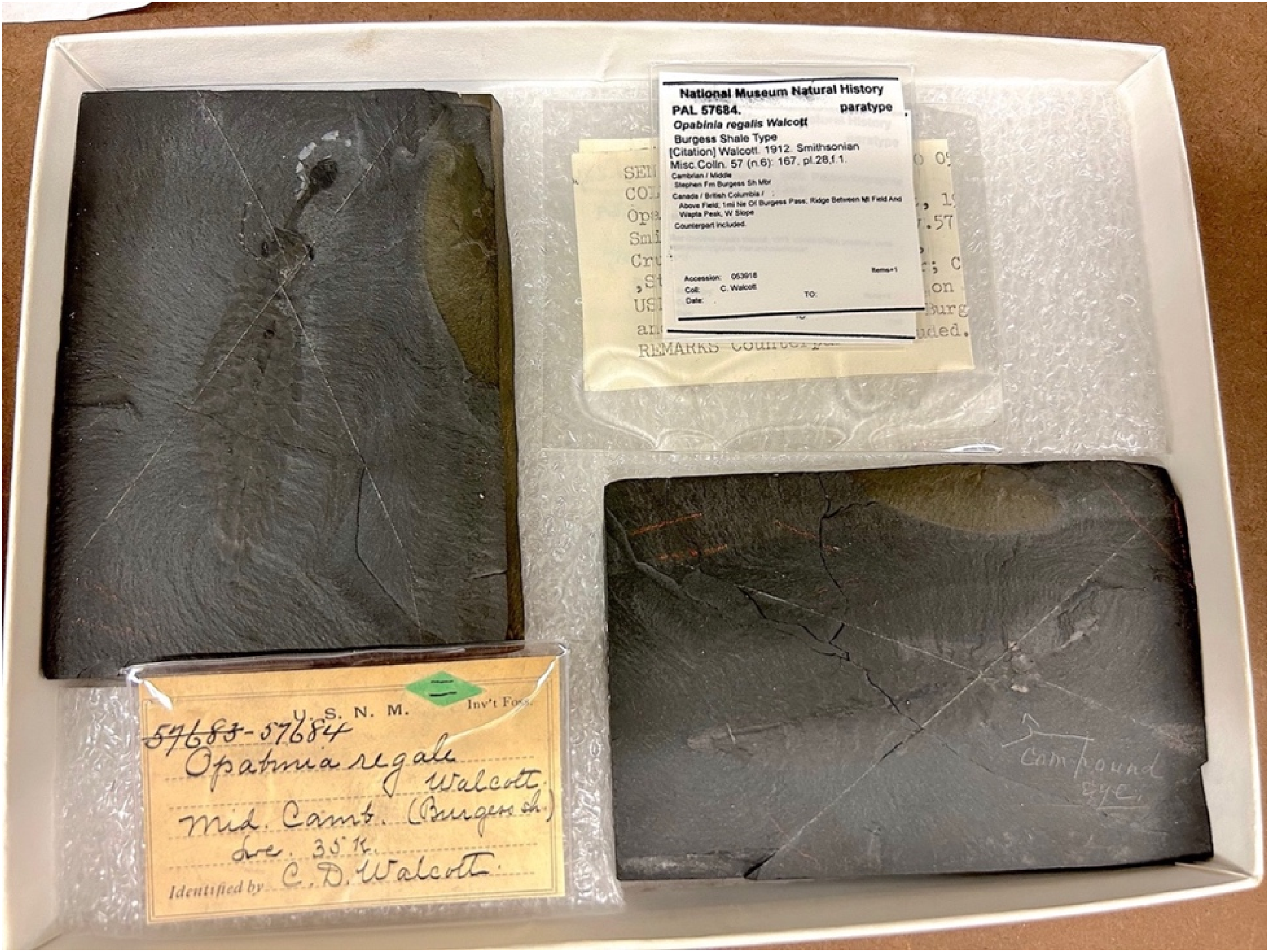
Opabinia regalis Walcott specimen, part and counterpart, catalogued as PAL 57684, in its storage tray and including its original Walcott documentation along with its former and current catalogue information. “Compound eye” and an arrow are scribed on the specimen; the other whiteish lines are natural fractures in the rock (2025 Copyright by Rebecca Yoshizawa).
The Cambrian rock layers in Wales were deformed and not very impressive in terms of their fossils; however, later-discovered Cambrian strata, like at the Burgess Shale or in China's Chengjiang site in Yunnan province (Zhao et al., 2024), were anything but unimpressive. It really can’t be overstated that these fossils are amazing.
The Cambrian epoch is now famously known for the so-called “Cambrian explosion,” or posited massive diversification of life on Earth the likes of which, it is observed and theorized, has not been seen again (see Conway Morris, 2006). Gould (1989) recounts the stunning Burgess fossils: Burgess organisms do not belong to familiar groups… the creatures from this single quarry in British Columbia probably exceed, in anatomical range, the entire spectrum of invertebrate life in today's oceans… The Burgess Shale also contains some twenty to thirty kinds of arthropods that cannot be placed in any modern group. Consider the magnitude of this difference: taxonomists have described almost a million species of arthropods, and all fit into four major groups; one quarry in British Columbia, representing the first explosion of multicellular life, reveals more than twenty additional arthropod designs! (1989: 25)
The Cambrian fossils make it seem like nature tried everything, yet life seems to have also de-diversified since then. Unique body plans went extinct, never to re-emerge; no new body plans have emerged since then either, hence the visual of “explosion.” The nature and significance of the Cambrian explosion are debated, with key questions predominantly centering on whether there was truly a sudden burst of biological diversity, or whether the fossil record is merely incomplete; whether the organisms were genuinely as strange as they appear; whether the event was global or regionally variable; whether unique mechanisms of evolution can be expressed in only some eras and not others; and whether evolutions are chance-driven events that would not repeat if history was replayed (called contingency) (Conway Morris, 1998, 2006; Gould, 1989; Turner, 2011). To find a place that confounds basic elements of evolutionary theory set out by Charles Darwin is rather unusual. Indeed, the Burgess Shale is not only a “Canadian” or “American” place but designated as a UNESCO World Heritage Site, having “outstanding universal value”: the Burgess Shale is one of the most significant fossil areas in the world… Originating soon after the rapid unfolding of animal life about 540 million years ago, the Burgess Shale fossils provide key evidence of the history and early evolution of most animal groups known today. (UNESCO World Heritage Centre, 2023: para 4)
Getting to the burgess shale
For some paleontologists, going to the Walcott Quarry is like a pilgrimage because of its importance to the discipline and to themselves. A participant recounted: P9: You get people who have dreamed about stepping in on that ledge their whole life, you have people... for whom this is a major bucket list thing… It's transformational, it's religious, it's spiritual… For these people, there is just a sense of accomplishment, that sense of joy, this connection to something they’ve been thinking about all their lives.
Yet there is more to this feeling of pilgrimage than the paleontological significance of the site itself. It is not easy to get there. For one thing, it is very far; it is far from almost everywhere in the world, or simply “remote.” The village of Field, the closest town to the shale, is in the centre of Yoho National Park, itself inside the Rocky Mountain cordillera. Starting the journey from my home in Surrey, BC, I went to the Abbotsford airport, and flew to Calgary, Alberta (maybe an hour and half) because, whereas a visitor website suggests I could have simply got “to Field by heading east [from the lower mainland of BC] on the Trans-Canada Highway” (Fresh Front Media, n.d., para. 1), I didn’t want to incorporate a very long (over 9 hours without stopping) road trip through rugged mountains. I rented a car to get from Calgary to Field, which takes just over two hours going by way of Banff National Park. It may be necessary to point out, for those not familiar with the geography of Canada, this this means I travelled east, only to backtrack west, to get to the shale, feeling like a yoyo.
Though they are neighboring provinces, BC and Alberta are strikingly different in terms of geography, economy, culture, and politics. BC's coastlines, mountains and temperate rainforests contrast with the plains and prairies of Alberta. BC's milder weather in its most populous parts starkly contrasts with cold winters and dry summers of Alberta. BC's economy favours tech, film, tourism, and shipping, while Alberta's economy rests on oil and gas. BC more frequently elects “liberal” governments and Alberta, conservative. It is the Rocky Mountains that is between yet shared among them, and which therefore connect them. A drive through the Rocky Mountains feels like a journey of liminality and transition. I asked a participant (P11) who lived in the region if there was a sense among inhabitants that it was in BC, or in Alberta, and they explained “It's an intersection. It's much more connected… to the Rockies as its own kind of region.” Liminal spaces will proffer some uncanny experiences. Close enough geographically, economically, and culturally, Field, BC is on Alberta time: the Mountain Time Zone.
Field promises “small town charm, big mountain thrills” (Fresh Front Media, n.d.) with a story of its residents: Field has developed into a tight-knit family community of fewer than 200 people from all corners of Canada, many of whom arrived in the area with skis in tow and couldn't bring themselves to leave. (Fresh Front Media, n.d., para. 2)
But, one cannot simply just… not leave. If one is to stop whatsoever for any reason in a National Park, the vehicle requires an entry pass (“Understanding The Parks Canada Entry Fees | BanffandBeyond,” 2023) valid for between one day and one year, which if you’re driving to get to the Burgess Shale from Calgary, you buy at Banff entry gates in Alberta. This pass is associated with a vehicle, since it is the case that accessing Banff and Yoho National Parks is possible only by road; there is no airport. As national parks, Yoho and Banff are controlled by Parks Canada, an agency of the federal Government of Canada. Their mandate describes: On behalf of the people of Canada, we protect and present nationally significant examples of Canada's natural and cultural heritage, and foster public understanding, appreciation and enjoyment in ways that ensure the ecological and commemorative integrity of these places for present and future generations. (Parks Canada Agency, 2022: para 1)
This heritage is protected for reasons of tourism. Indeed, Field is a place dominated by tourism in its infrastructural senses. You cannot own property in Field, such as a house, or generally live there, unless your primary employment is in the park (Canada National Parks Act, 1991) or in closely associated activities.
From Field to get to the actual shale, due to the UNESCO status you will have needed to previously book a hike with a licenced guide (Burgess Shale Geoscience Foundation, 2025; Parks Canada Agency, 2025). A sign staked just before the Burgess Shale, posted by Parks Canada, reads, “NOTICE OF CLOSED AREA… To protect fossils from damage or theft, entry to the fossil beds is strictly prohibited. It is unlawful to remove fossils.” The place is highly controlled and patrolled as a praxis of “protection”: Canada, as steward of the Rocky Mountain World Heritage Parks, has obligations to UNESCO for their protection. Thus access to the Burgess Shale is restricted to those accompanied by a qualified, licensed guide, and collection of fossils is prohibited. (Coppold and Powell, 2006: 2)
With the guide and ten or so others joining you, you’ve got to hike up Mount Wapta on foot. It is well-known among Burgess people that only those of highest importance can get to the Burgess Shale by helicopter, Sir David Attenborough being the only I am familiar with having done so (Caron, 2013). Our guide said that even if you break your leg, you’re still going to have to get out on foot (maybe on others’ feet, being carried. He recounted returning to Field once to fetch a wheelbarrow for carrying an injured hiker out – maybe a joke? But illustrative nonetheless). You hike up, up the whole time, for a good seven hours, in thinned mountain air more than 2000 metres from sea level, across heterogenous, rugged, terrain (The Burgess Shale Geoscience Foundation, 2023) that can be muddy, dusty, boggy, slippery, icy – you name it, all in the same day. Sometimes there are long stretches of winding hairpin switchbacks. Sometimes there are unstable, rocky flats. Sometimes you’re clinging from mountainous cliffs. Sometimes you climb up tree root “steps.” Always, there is a view.
I am no seasoned hiker, but I am a 40-something year old woman who regularly exercises. I brought top-rated hiking boots, poles, wool layers, a sun hat, and 2 litres of water. Good gear only helps so much; this is a very, very difficult hike, and “not for everyone” (Parks Canada Agency, 2019, sec. “What every hiker should know”). Then, there is the hike back. Stopping risks never starting again; hour after hour, step after step, through relentless fatigue. My last step into the car marked the end of the most grueling 12 h of my life (and I’ve given birth twice). I think my body is forever changed by this hike, my most recently recorded brink of personal extinction being those last steps. The absolutely gruelling nature of the hike was matched only by the exhilarated feeling I had gazing upon fossil after fossil after fossil when we finally made it to the shale. Once you get to the Burgess Shale, you can sit down, turn over rocks all around your vicinity, and find fossils over 500 million years old. Even though it has been quarried many times, the shear density of fossils is mind-blowing, never mind how ancient and weird the fossils are. High atop a remote mountain, one can’t help but feel the transcendent presence of a yet-fleeting earth.
The density of fossils may prompt a tempting thought to take just one, but without a permit, this is illegal and subject to fine (see The Canadian Press, 2022). Similar in size to a tennis court, cameras survey the entirety of the Walcott Quarry (Parks Canada Agency, 2018), our guide describing the cameras’ capacity to zoom on to any area of the shale as small as the eraser of a pencil and refusing to tell where, how, when and by whom the cameras are monitored.
There is something rather “Canadian” about such an experience with the protected, preserved, and challenging outdoors. According to Wright, “North of the 49th parallel, there is the idea that Canada is a nation of nature and wilderness and that this is central to Canadian identity” (2014: 13). The marketing and promotion of national parks connects “wilderness” to Canadianness, and the history of park promotion follows shifting ideals for parks and people's relationships to them, from “Canada's playgrounds,” to “quiet places and museums of nature” (Saari, 2015: 438), to “healthy and unimpaired for future generations” (Parks Canada Agency, 2018: para 1). Here, “wilderness” is a colonial construct, national parks a colonial displacement, and “nature” a settler-colonial narrative (see Youdelis et al., 2020).
If unable to make this trek, one will be hard-pressed to find specimens from the Burgess Shale in BC. The closest, most accessible ones are probably in Drumheller at the Royal Tyrrell Museum, which refers to the Burgess fossils as “Canadian Icons,” and which “gratefully acknowledge[s] the Royal Ontario Museum for loaning Burgess Shale specimens” for their exhibit, and Parks Canada stewarding these globally significant fossil resources.” The Yoho National Park Visitor Centre has a small set, as one participant recounted: P11: We had fossils in the Info Center in a cabinet… A park staff supervisor would come out with their keys and open up this filing cabinet type thing… We’d get some of these paleontology nerds coming in and we’d be like, oh do you want to see some fossils?
A participant also shared that Capilano University in Vancouver may have Burgess specimens: P7: At Capilano University… I was never able to spend any time with the Burgess Shale fossils. Because the Biology Department keeps them under lock and key.
In August 2023, the Fundy Geological Museum in Nova Scotia, Canada, posted ‘#whatsinourdrawers’ on Facebook showing 30 Burgess specimens; many museums likely hold similar “teaching” collections. These collections usually feature species for which there are many specimens, which are missing context information, or which are of lesser quality. On a January 2024 tour of the Vancouver Geological Survey of Canada collection in Vancouver, the guide noted “it's hard to believe that the geological history of Canada is stored in the basement of the Scotia Tower.” This, however, does not include the Burgess Shale: “too far away.” The most obvious place one might expect to find Burgess fossils is at the Royal BC Museum in Victoria on Vancouver Island. At a “behind the scenes” tour of the Royal BC Museum I took in 2023, I learned that the museum has some pieces in a drawer that were donated by the ROM as “teaching specimens,” but no systematic collection, and none are on display. In fact, the Royal BC Museum exhibits do not acknowledge the Burgess Shale. One participant recounted the reasons: P5: Historically, [the Royal BC Museum researchers] weren’t really leading what most people would view as like paleontological expeditions or collecting… And so [they] just weren’t the institution doing Burgess Shale [collecting, and] because other institutions are doing Burges Shale collecting, it would be kind of rude… You wouldn’t set up like a competing Research Program, right?
Burgess Shale fossils are not accessible for the public to see in British Columbia, unless one goes to the Burgess Shale itself. Instead, the meaning of the place the Burgess Shale is tied up in materials and research work done in far-flung places, mainly the Royal Ontario Museum in Toronto and the Smithsonian in Washington DC, which have by far the largest collections, with 150,000 (Royal Ontario Museum, 2025a) and 65,000 respectively (Smithsonian National Museum of Natural History, 2025).
In 2022 I entered the workstream of such a research program when I joined researchers who had only two weeks before returned from a 2-month long expedition at the Burgess Shale, in search of new specimens, new critters, and new scientific insights. I was there to help, sort of and clumsily, unpack the finds. I observed that the fossils were wrapped in pages from the Canmore, Alberta newspaper. One expedition member explained that during a supply and rest stop in Canmore, which is about an hour east of Field, they gathered as much newsprint as they could find to use as practical and frugal way to pack the delicate fossils for transport. 597 slabs were retrieved, each with one or more specimens. In the field they had already been pulled into the logic of the collection especially through the use of a fieldnote book which is a handwritten log of each of these slabs. The slabs were labeled with a number in order of when they were found, and the fieldnote book collected the information: what is the critter, if known? Where was it found? How many pieces? And since the specimens are in shale, which lays flat and can be split horizontally, are there parts and counterparts, or only one side? It also recorded the bag number the specimen is placed in, and the bucket number. Once the expedition was over, back in the collection the field book was digitized and then sorted for what we were looking for: “research sensitive” worm-like critters called polychaetes that they were just about to publish. Of 71 total, the first one they found in the field had to have been on day one, as it is listed as 2022–3 in bucket number 1. We found the bag at the bottom of the bucket with 13 other specimens, all of which were wrapped in the local Canmore newspaper. “One down, 70 more to go,” I thought.
Once we got them all, the pieces were moved on a trolley into another area set up as a makeshift unpacking station and then moved one by one on a brown lunch tray I know they took from the museum cafeteria. The specimens were still in the Canmore newspaper which was carefully checked for little chips that might have flaked off on their long journey by helicopter and ground transport and musuem cafeteria tray. We prepared a bucket of warm soapy water, a new toothbrush, and gloves. One by one, they were washed, catalogued, and placed in some foam, in a box, in a drawer, in a cabinet, in a collection, behind lock and key, behind more locked doors, and behind the public front face of the museum. It may take minutes or decades for a paleontologist to come study them, and the same to revise that study.
For instance, the specimen USNM 83935 I found at the Smithsonian had 8 pieces of paper stored with it, each recounting its journey that started in 1911 in the shale atop the mountain and moving southeastward to the drawers of the collection, as well as tensions that come with and remain in trying to figure this critter out. Walcott had called it Canadia sparsa, because he thought it was in the same genus as another he found and named, Canadia spinosa. His original catalogue slip is with the specimen, handwritten in fine penmanship, and labeled as “holotype,” or the single specimen upon which a description and name of a species is based. With new cataloguing systems came new slips, done on typewriter, with new bits of information added or corrected. But with new slips, the old were never removed. In the early 70 s, Conway Morris was assigned Cambrian worms for graduate studies and, after using a small dental-like tool to remove some rock, quickly realized C. sparsa wasn’t at all related to C. spinosa, deciding to rename it Hallucigenia (Conway Morris, 1998). Layers of intellectual and material history remain in the drawer and signal the absent presence of C. sparsa: the fine chisel marks that simultaneously evaporated it and excavated Hallucigenia. Hallucigenia wasn’t done being difficult; Conway Morris described it walking on pointed spines with dorsal tentacles; it wasn’t until 1992 that it was realized, after yet a little more chiseling, that our “wandering of the mind” Hallucigenia was being depicted upside-down with its supposed “head” rather likely being a seepage of body fluids (Royal Ontario Museum, 2025b).
The Burgess Shale was fossil-bearing rock layers for over 500 million years before Walcott discovered it was there, which itself was about a hundred years before a Canmore concert series, the $795,000 “South Canmore 3 bed 3 bath beautiful open concept” house for sale, and the Western Family toilet paper for sale under “Darrell's Deals” 11 I learned about from that reused newsprint. The beauty and transcendence of the Burgess Shale may feel timeless, an unmoving and statuesque durable rock. But really, we can say that the Burgess Shale is actually dynamically “timefull” of both past and future, the meanings of which are disputed. As I have shown above, the shale exists in BC, Alberta, Canada, and the United States simultaneously while also simultaneously recalling hundreds of millions of years spent nowhere near these places. There are many ways to answer the question, “How does Deep Time produce contemporary and contested meanings, explanations, and materializations of place?”, or the simpler one, “Where is the Burgess Shale?” While “located in” BC, Field is on Alberta time, but the shale knows equatorial seasons as much as it knows thin mountain air or dusty, old oak collection cabinets in Toronto or DC.
Defiant rocks
These fossils are involved in boundary work of making BC, Alberta, and Canada, such as in the claim that trilobites are the first Albertans. Irvine writes of the geologic timescale, “while the time of geological formation is independent of our representations of it, what are the consequences of universalizing the product of a particular (historically and culturally located) encounter with this process – of seeing Wales, Devon, and the coal measures writ large across the world?” (Irvine, 2020: 123). For one thing, we can see colonial logic in rock systems and in the universalization of time as a global, linearized chart. Curley and Smith argue that contra Indigenous understandings, “time scales of ‘epochs’” (2024: 167) bind “time and space while generating linear narratives about the past and present. They impose abstract and singular timescales on diverse places, overwriting variegated experiences and temporalities” (2024: 169). For instance, when exploring the Rockies, Walcott took the liberty to re-name a bunch of places which had themselves already been re-named from any Indigenous place names that had been in use. He wrote, of the names previously used and printed on the Wheeler map of 1912, I thought it might be well to change [them, such as] Rearguard to Iyatunga (black rock) Mountain… [The new names] are mostly derived from the language of the Assiniboine Indians. (1913: 331–332)
However, the area of the Burgess Shale is not traditional Assiniboine territory, which instead covers plains of Saskatchewan, Montana, and North Dakota. I am not sure what his motivation was, but I want to be clear that it doesn’t appear that Walcott had favourable attitudes about Indigenous people. In his retirement speech as President of the American Association for the Advancement of Science, Walcott said, the story of the onward march of scientific research in quest of truth is not unlike that of the white race in the conquest of America. A few fearless souls penetrated the wilderness and blazed the trails that others might follow; some fell martyrs to their zeal, but more came after; facts determined, laws, established, which in time contributed to the welfare of the race. (1924: 1–2)
The Burgess Shale is not just proof of and an icon for explosive shifts in scientific thought on evolution. It is also comprised of rocks that have been made to materialize race in a colonized and globalizing world.
Power underpins claims to Burgess fossils. This does not mean, however, that merely social constructions. Fossils are now a technology of knowledge-making about the past, but the affordances of fossils were set by the conditions and contours of ancient life, long before humans existed. As Gould writes, Burgess Shale animals “are grubby little creatures” and “we greet them with awe because they are the Old Ones, and they are trying to tell us something” (Gould, 1989: 52). The relativism of Deep Geologic Spacetime doesn’t refer to social constructionist approaches to place; instead, places exist without a human knower to perceive them, but knowledge is always co-produced. Where BC and British Columbians, Canada and Canadians, or Alberta and Albertans proudly claim the Burgess Shale as their place, the irony emerges: these rocks are so much older than a country or a province or a citizen, it starts to sound silly. A participant shared: P9: The time thing is so difficult. I’ve been doing this all my life, and I don’t get it. We are unable to intuitively… just feel that length of time. It's just ridiculous. It doesn’t make any sense. We cannot relate to it in any way … Half a billion years makes no sense.
The Burgess Shale cannot be defined as a place without placement in time, but the timeline is nonlinear and Deep, and the locale is contested. A language for temporal and spatial confluences of the Burgess Shale is spacetime, as in physics where space and time are fused dimensionally as “spacetime” to express relativism of observers’ perceptions of where and when events happen that is especially apparent when space is Deep. The “geologic time scale” (Geological Society of America, 2022) integrates matter in continuity with time, as dynamisms of rock layers and time are hybridized in a time-telling chart. The Burgess Shale, as a site of both extinction and preservation, exemplifies this complexity of a “meeting halfway” (Barad, 2007) between human actors and nonhuman “actants.” I argue, with hope, that rocks do tell a story that is more than just what humans make of it. I argue that Deep Geologic Spacetime, revealed through the present research, renders the Burgess Shale as contemporary as it is Cambrian. The tenuous story of our ancient past is thus also the story of our current moment, and therefore our futurity on a changing planet.
I presented Deep Geologic Spacetime at the 2023 British Columbian Paleontological Symposium. 12 Reception was varied; some attendees excitedly asked to participate in my study. Other participants challenged my claim that space and time collapse in paleontological understandings of Earth. Spacetime, they said, erases paleontology's three core and separate tasks: discerning geology and age, and discerning biology in fossils, and then seeking triangulation in the geologic timescale. In 2025, I returned to the same symposium attended by many of the same people and again met an acquaintance who had told me I was wrong about space and time in paleontology. They recalled, “when I saw you speak two years ago I thought, ‘this girl doesn’t know what she's talking about.’” I argue that such reactions attest to my main argument about Deep Geologic Spacetime: paleontologists are working with hybridity and are conducting intensive “boundary work” (Leigh Star, 2010) in their socially and historically situated, value-laden practices that comprise the work of paleontology. The resistance is consistent with challenges that portmanteau and collapsed concepts like spacetime and geologic time present for positivistic science. All sciences face and use these challenging boundary objects, concepts (see Leigh Star, 2010), and people – like me – and all sciences conduct ample boundary work (see Gieryn, 1983) in order to produce the effect of authority in their claims about scientific “facts.”
Irvine writes in An Anthropology of Deep Time, “the material conditions of human existence can be understood only as the product of processes occurring over deep time” (Irvine, 2020: 2). For Irvine, misunderstanding or erasing the “deep history of the resources on which we rely” (2020: 188), such as fossil fuels, means we cannot address the impacts of their extraction and use. The urgency of Deep Time is apparent when we consider the speed and hastening of climate crisis caused by burning fossil fuels: that is, a climate emergency (UNEP, 2021). This old, old place, high atop a lonely mountain, is urgent and important enough to be kept under constant surveillance, if only so it can be “preserved” from our destructiveness; yet it will also remind us that Earth has survived many a catastrophe, even if the critters it has harboured have not. This Deep Time perspective reminds us that life has continually found ways to adapt to catastrophic events. Mass extinctions and subsequent radiations of new life forms are testament to the enduring tenacity of life, which will yet never be the same. Turmoil is normative.
I do find this takeaway pretty scary. Deep Time The Royal Tyrrell’s website fossil fuels as a natural outcome of Earth's history. Hu conducted an ethnographic study of West Texas oil fields writing, “I observe that it is via the exercise of a specifically historical science that the Company addresses the Earth at its slave” (2025: 356). Coen writes that “the coming of the fossil fuel economy went hand in hand with a new science of the deep past. Geologists made coal into the key protagonist of national progress” (2022). The Burgess Shale's designation as a UNESCO site and its surveillance infrastructure show how fossils are used to assert control associated with settler colonial narratives of the “Canadian wilderness” and state sovereignty over nature. While Indigenous land defenders resist fossil fuel pipeline construction in their traditional territories (see Spiegel, 2021), paleontology as a profession is intricately intertwined with the industries most responsible for climate change and environmental destruction, including oil and gas (see Berry, 1999; Hays, 2007), which provide funding and jobs to paleontologists and opportunities for fossil discoveries from their resource extraction activities. For instance, the Royal Tyrrell Museum in Drumheller, Alberta, has a famous and exceptionally-preserved ankylosaur Borealopelta markmitchelli which, “waited 110 million years until one fateful day, when a miner in Alberta came across a miraculous find and Borealopelta's mysteries were unearthed” (Duggan, 2023: para 24). The Royal Tyrrell's website explained its very large exhibit, “Grounds for Discovery”: Grounds for Discovery introduces visitors to some of the incredible fossils that have been found through industry, and the workers who found them. Thousands of cubic metres of soil, gravel, and bedrock are excavated in Alberta every year. When fossils are exposed through industrial activities, palaeontologists work with companies to excavate and preserve scientifically-important specimens. (Royal Tyrrell Museum, 2023: para 1)
As John McPhee writes, perhaps melancholically, in Basin and Range, those interested in charismatic rocks such as fossils “are fortunate to live in a period of great road building” (1980: 11).
Earth's historical contingency can be misunderstood and misused. Concomitant with a post-truth (Sismondo, 2017) and “alternative facts” era characterized by the currency and cogency of bullshit, the notion that our Earth is relative and contested is a source of anxiety for those concerned about climate change, environmental destruction, social and political conflict, and the futurity of marginalized communities. Bruno Latour had worried about this, writing, I myself have spent some time in the past trying to show ‘the lack of scientific certainty’ inherent in the construction of facts,… that there is no such thing as natural, unmediated, unbiased access to truth, that we are always prisoners of language, that we always speak from a particular standpoint, and so on, while dangerous extremists are using the very same argument of social construction to destroy hard-won evidence that could save our lives. (2004: 227)
However, like Shotwell, I want to ask about how to have simultaneously an account of radical historical contingency of the conditions under which we take ethical and political action, critical practices for accounting for our own situatedness in histories that have shaped the conditions of possibility for our actions, and a no-nonsense commitment to the kind of real, possible world [that]… is partially shared, offers finite freedom, adequate abundance, modest meaning, and limited happiness. (2016: 5)
We can mobilize the understanding, for instance, that a city is a process, or that climate change is both normal as a “grounded” planetary phenomenon as well as something “boundless” to be profoundly distressed over, to come to a shared commitment to modest meaning and limited happiness. In Deep Time Reckoning (2020), Ialenti frames Deep Time as an ethical and cultural practice of “deep time learning,” responding to the breakdown of human meaning-making when confronted with temporal scales that are disconnected from how time is experienced in everyday life. “Deep time reckoners,” they write, “are skilled at toggling back and for between visions of human, ecological, and geological pasts (near and distant) and human, ecological, and geological futures (near and distant). Learning to better perform these intellectual gymnastics… [is] a key Anthropocene talent” (2020: 96).
The Cambrian is contemporarily ancient in the place of the Burgess Shale. For Yusoff, “life in the fossil archives is like waiting for promotion in geologic time, hanging around for a rift to fracture temporality” (2024: 194). Extinction seems to indicate an irreversible end, but in the fossil record extinct species persist materially and therefore fold the past into the present. Fossils are Deep Time palimpsests, telling layered stories of normative planetary turmoil. They are the hopeful monsters that somehow managed to go extinct yet simultaneously survive as rocks, as stories, and as archives. However, as Currie writes, “unlucky historical scientists must deal with ambiguous, degraded signals from the past” (2018: 5); or geology, as Bubandt writes, “brings spirits into being,” where spirits are necropolitical “signs of metaphysical indeterminacy rather than certainty” (2017: G125). The Burgess Shale is so very old, and is in so many places, I am not even sure it has “boundaries” and every time I think I locate one, I find in the same instance conditions for its disavowal. Governments, disciplines, companies, and others may employ fossils to fix meanings and significances of many powerful places. However, fossils are and will always be between rocks and hard places. How exciting to live near and circa such a defiant layer of rock.
Highlights
Discoveries at the Burgess Shale reshaped evolutionary theory, offering direct evidence for the “Cambrian Explosion,” the sudden emergence of wide animal diversity. The Burgess Shale is claimed by Canada, Alberta, and British Columbia, yet exists beyond these boundaries. Fossils link spatial, cultural, and temporal dimensions, defying fixed meanings through their Deep Time origins. Fossils resist singular interpretations, materializing counter-hegemony The Burgess Shale represents ongoing place-making, not static location, reflecting struggles over meaning on a changing planet.
Footnotes
Acknowledgments
Student research Assistants Julie Diels-Neufeld, Naaz Sidhu, and Kamla Brown supported this research by transcribing interviews, collecting data, and/or compiling lists of relevant literature.
Data availability statement
Not applicable.
Declaration of conflicting interests
The author declared no potential conflicts of interest with respect to the research, authorship, and/or publication of this article.
Ethical approval and informed consent statements
Approved by KPU REB #2019-08: “The protocol describing the above-named project has been reviewed by the Kwantlen Polytechnic University Research Ethics Board and found to be acceptable on ethical grounds for research involving human subjects.” Written consent was obtained from all participants.
Funding
The author disclosed receipt of the following financial support for the research, authorship, and/or publication of this article: This research was funded by: KPU Educational Leave, KPU 0.6% Fund, KPU Professional Development Funds.