



Abstract
The mounting social, ecological and animal welfare issues associated with animal agriculture have inspired research and development on novel protein technologies that promise pathways towards less harmful futures. Protein transitions advocates envision significant changes to food production, including the potential removal of millions of animals from food production systems. This future is not at all guaranteed and dependent upon the complex and uncertain processes through which alternatives emerge and come to negotiate place-based socio-technical regimes. In this paper we extend the multi-level perspective used within the sustainability transitions literature by integrating it with Bruno Latour’s concept of propositions as a way of analysing how places shape and are shaped by emerging niche industries, in this case the plant-based meat industry in Australia. Through interviews, workshops and desk-based analysis we focus on six key elements shaping the plant-based meat proposition: matters of concern, networks, practices, ontologies, recalcitrance, and omissions. The analysis reveals a plant-based meat infrastructure emerging in the shadow of the animal meat industry and a realm of innovative strategies oriented at boosting acceptance, such as hosting conferences, writing reports, and infiltrating animal meat aisles in supermarkets. We identify the many challenges the industry is experiencing, including ontological differences over how it represents itself, the difficulty of enlisting new actors, such as governments and consumers, and the ever-present self-censoring shadow of animal agriculture industries. We also discuss omissions, such as the silences around the impacts on animal farmers, that may ultimately weaken what is being proposed. The paper concludes by reflecting on the worlds actually coming into being in the Australian context, as opposed to worlds being promised, and the need to broaden and diversify engagement with the proposition if it is to move beyond product substitution and engage with the immense challenges of food systems transition.
One of the greatest challenges for those interested in sustainable and ethical food systems is how to shift societies away from the over-consumption of animal meat. FAO's Livestock's Long Shadow report (FAO, 2006) observed that animal industries were one of the top two to three drivers of every major environmental issue (with the exception of ozone depletion) at every scale – a conclusion that has been supported by major scientific studies since (e.g., Springmann et al., 2018; Stehfest et al., 2009; Willett et al., 2019). Animal agriculture is responsible for approximately 14.5% of greenhouse gas emissions, and more if its role driving deforestation (FAO, 2021; IPCC, 2019; Wedderburn-Bisshop, 2024) and preventing reforestation is taken into account. Its contribution to land use change has led to significant biodiversity loss, land degradation, and pollution of air and water (FAO, 2006). While animal-based foods are nutritionally significant in some food insecure communities, the overconsumption of animal products in affluent populations has been linked to obesity, heart disease and cancer (Willett et al., 2019). The associated scale of suffering of animals caught within these food systems is hard to imagine, with over a billion terrestrial animals slaughtered each week and many more aquatic animals caught in nets or raised intensively in fish farms where, like their land-based equivalents, they live short, limited, disastrous lives (Wadiwel, 2015; Weis, 2013).
Growing recognition of these issues has led to calls for a reduction of animal meat consumption in those areas that can source nutritional alternatives that cause less environmental, human and non-human harm (Willett et al., 2019). While vegetarians and vegans (henceforth veg*ns) have been calling for similar things for years, their concerns are garnering increasing support in the scientific community and are being advocated for by global bodies including the IPCC and the FAO. The concept of protein transitions has become popular, focusing on the substitution of non-animal proteins for animal proteins in consumer diets (cf. Emel and Hawkins, 2010). Much of the protein transitions literature focuses on novel or alternative proteins, notably plant-based meats, cultivated meat and precision fermentation dairy (e.g., Hurst and Pant, 2025; Morris et al., 2018, 2021), which have gained momentum through venture capital, scientific research and entrepreneurial startups (Dickson and Clay, 2024; Sexton and Goodman, 2022). The particular marketisation of various forms of alternative protein has produced interesting questions about the ontologies of ‘meat’ and other alternative proteins in terms of their materialities and their changing relationalities to eaters and the surrounding worlds of food and farming (e.g., Broad, 2020; Mouat and Prince, 2018; Stephens and Ruivenkamp, 2016).
This paper discusses how novel proteins can contribute to protein transitions through a case study of plant-based meat in Australia. It examines how plant-based meat is being assembled as a potential solution to the problems of animal agriculture and associated opportunities and challenges. We are interested in the work that goes into proposing solutions and the implications for people and places as those solutions are generated. We do this by drawing upon the sustainability transitions literature, particularly the multi-level perspective, alongside Bruno Latour's (2004a, 2004b) concept of propositions. Rather than focusing on the pathways through which a niche technology can come to disrupt incumbent animal meat regimes (as much sustainability transitions work does), here we are interested in the social and material interactions between niche technologies and the places and spaces in which they emerge. We develop a propositional lens grounded in Latourian concepts—matters of concern, networks, practices, ontologies, recalcitrance, and omissions—to better understand the worlds that new technologies are bringing into being. What emerges are the foundations for a transition that challenges and diversifies meat production by generating new experiences, opportunities, ontologies, and relations. Yet, social and material resistance has stalled this transition, revealing a need for reconfiguration.
Analysing the composition and implications of propositions designed to address the problems of animal agriculture is vital, given their potential to be hugely disruptive in varied ways: threatening the livelihoods of thousands of farmers; impacting supply chains and export markets; reshaping rural landscapes, communities and economies; alleviating the suffering of millions of animals; and creating openings for massive land use changes including the rewilding and repair of degraded land. However, as a “transition-in-the-making”, strongly influenced by normative concerns, there is no guarantee of any substantial disruptions (Elzen et al., 2011). Research suggests that many novel agricultural and food technologies either never come to fruition or only trigger incremental changes (Klerkx and Rose, 2020). Goldstein (2018) has suggested that this is structural, with the venture capital underpinning novel technologies more interested in “non-disruptive disruptions” that avoid challenging the actual drivers they are meant to address, such as the systematic issues (e.g., corporatisation) perpetuating food insecurity and environmental degradation (Clay et al., 2020; see also Feola 2020). The extent of change, whether radical or incremental, will depend on the strategies and practices coming together around novel proteins as well as the contexts in which they are assembled.
In what follows we first draw upon concepts from the sustainability transitions literature as a means of approaching food systems transitions. We then introduce Latour's concept of propositions, exploring how it focuses attention on the ways in which niche technologies interact with people and places. This is followed by an introduction to the Australian context as it relates to animal and plant-based meats and an outline of our multi-methods approach. We then analyse the various components of the proposition, focusing on matters of concern, networks, practices, ontologies, recalcitrance, and omissions, to develop insights into the worlds being created through these new industries. We end with a discussion of the difficulties, implications and opportunities for pursuing food systems transitions in places and systems that bear the imprint of well-established animal meat regimes.
A proposition for sustainability transitions
The field of sustainability transitions has experienced rapid and accelerating interest over the past two decades. It is not our intention to survey this literature here, instead we outline some basic aspects of the multi-level perspective (MLP), how it has been applied to novel proteins, some geographic critiques, and how Latour's concept of propositions can help address those critiques. The MLP was popularised by Geels (2002) as a heuristic to help conceptualise how sectors or industries transition into more sustainable forms. Geels (2011, 25) explains “the core analytical puzzle is to understand how environmental innovations emerge and how these can replace, transform or reconfigure existing systems.” The MLP analyses change through three levels: the niche level where new technologies are nurtured and developed and where experiments and innovations evolve; the socio-technical regime level composed of technologies, structures, economies, policies and cultures that lock in and stabilise incumbent industries; and the landscape level which refers to seemingly external environments, such as shifts in economic growth, emigration, war and climate change, that can provide openings or obstacles for niches and regimes. MLP researchers primarily focus upon the transition from one sociotechnical regime to another, emphasising the importance of niches and broader landscapes in contributing to regime change (see Köhler et al., 2019; Geels, 2011).
The MLP helps to explain why some niche technologies come to restructure whole industries whilst others fail to make a mark and fade away. A core insight is that it is not just the qualities of the technology that matters, but the development and timing of the technology in relation to shifts in conditions at regime and landscape levels. Geels and Schot (2007), for example, outline four different transition pathways that variously reflect different types of landscape pressures, the degree of niche-innovation development, and the structure and stability of the regime. The general argument is that landscape level changes put pressure on incumbent regimes to create openings for niche innovations that arise from inside or outside the regime (Geels 2011; Geels and Schot 2007). Most MLP work focuses upon the development of niches as spaces and networks where experimentation with alternative processes and products take place, and how those niches interact with, transform, or are suppressed by dominant socio-technical regimes.
The sustainability transitions framework has only been sparingly applied to food systems, but it provides a useful way of thinking about protein transitions. Dueñas-Ocampo et al. (2023) use the sustainability transitions lens to review work on plant-based and cellular meat industries, finding a growing body of work focusing on niche dynamics and much less on regime and landscape-level analysis. Research on niches has explored the funding and support networks that have enabled novel proteins to develop, the shifting visions and expectations of novel protein proponents, and forms of learning and cooperation, as well as competition and intellectual protectionism, within the sector. Studies of niche-regime interactions are less common but often utilise Smith and Raven's (2012) conceptualization that niches either “stretch-and-transform” regimes by undermining and restructuring them, or “fit-and-conform” by fitting in with regime norms and structures. Lonkila and Kaljonen (2022), for example, found plant-based meat producers in Finland were pursuing a “fit-and-conform” approach, seeking incremental regime change by mimicking the cultural meanings, materialities and experiences of animal meat. In contrast, Mylan et al. (2019) found that plant-based milk companies worked alongside civil society organisations in the UK to “rage against the regime” by illuminating animal welfare, health and environmental issues, whilst also pursuing product substitution, suggesting a hybrid “rage-and-conform” approach.
Despite or perhaps because of its popularity, the sustainability transitions literature has attracted plenty of critique, which has been received constructively and incorporated into the field's evolution (e.g., Geels 2011). From a geographical perspective one of the common critiques is that the focus on developing a model of change has resulted in insufficient attention to the diversities of place (Hansen and Coenen, 2015). Lawhon and Murphy (2012), for example, argue that the focus on niche technological artifacts has overshadowed research on the broader social contexts that have enabled those new technologies to be developed. They encourage more research on the place-based power relations influencing technological development in different contexts. This encourages: more explicit engagement with discursive questions about who and what shapes how problems are defined and the solutions proposed; a shift away from technological experts and entrepreneurs to a more inclusive focus on the broader communities driving, responding to, and being impacted by transitions; and the role of power and politics in shaping transitions. Like others (Binz et al., 2020; Dueñas-Ocampo et al., 2023), they call for more case studies and place-specificity, emphasising the importance of how context shapes transitions, and how transitions shape places, stressing that what happens in one place will not necessarily be replicated in others.
Here we build on these critiques and offer a propositional approach as a means of engaging them. We share concerns that the MLP framework focuses attention primarily upon the dynamics of regime change more than the spaces and places created by and shaping niche technologies (Binz et al., 2020; Hansen and Coenen 2015; Lawhon and Murphy 2012). Transitions research tends to analyse how niches can be nurtured and developed to challenge existing regimes, rather than studying the emerging place-based socio-spatial implications of niche innovations, which in turn, go on to shape how the niche evolves. A shift from animal-based meat to plant-based meat, for example, is not merely a change in technology (Chaput and Paulsson, 2023), but also a change in how meat is produced and understood - requiring shifts in equipment, expertise, ethics, relationships, identities, policies, meanings, places and ontologies to bring to market. Understanding the types of worlds that technologies are bringing into being is an important first step in assessing the implications of a transition, imagining what a future regime may look like, and thinking through ways to minimise harms and incorporate diverse perspectives. Just as importantly, it provides insights into how transition technologies are already shaping places, and how those places are affecting niches, irrespective of broader regime change.
To better understand the relationships between places and niche technologies we believe transitions research can benefit from engaging with Latour's concept of propositions. Propositions were introduced by Latour (Latour, 2004b, 2004a) as part of his broader agenda to encourage people to recognise the networks of human and non-human actants that collectively create worlds (Latour, 2005). Whereas statements are true or false and delineate a singular reality, Latour (2004a, 2005) is interested in the multiple realities experienced and proposed by different associations of actants, shifting from the search for ‘matters of fact’ to the study of ‘matters of concern’. In practice this means moving from studies that strive to establish the facts about new technologies, such as the life cycle assessments often used to legitimise new technologies, to studying the qualities of the worlds being proposed. Scientific facts may be produced and enlisted by a proposition, however the proposition is much more than the facts. A proposition is an emergent assemblage of human and non-human things that forms in response to shared matters of concern. However, as emergent assemblages, propositions are in their infancy – and are thus susceptible to sudden changes that can mean that rather than growing and expanding, they lose support and wither away.
At any one time, there are multiple propositions circulating as alternative ways of addressing shared matters of concern. The better a proposition is articulated the more likely it will enlist supporters and expand its presence and influence. Well-articulated propositions are coherent and dynamic, made up of diverse agencies such as institutions, practices, data, evidence, materials, spaces, and infrastructure. They speak to the lives and livelihoods affected by new technologies, the policy settings required to maximise social benefits and minimize harm, and the creative destruction that will necessarily accompany any transition (Geels et al., 2014). In contrast, poorly articulated propositions are not as rigorous, may have bigger gaps in knowledge and understanding, and fewer, less-connected institutions and actors that are still figuring out how to converse and align. Both contribute to what Latour refers to as more diverse and animated ‘multiverses’, bringing new things, arguments, networks and possibilities to light, as opposed to a deadened universe composed of discoverable facts. The better a proposition addresses matters of concern, the more likely it will be adopted in the ongoing process of assembling common worlds. Matters of concern thus coalesce differing propositions that can simultaneously assert business-as-usual knowledge and practices as well as genuinely different alternatives.
Research on propositions differ from that on promissory narratives about novel proteins (e.g., Cusworth et al., 2021; Jönsson, 2020; Mouat and Prince, 2018; Sexton et al., 2019; Stephens et al., 2018). Whereas promissory narratives focus on the messages being promoted by stakeholders to encourage protein transitions, propositions include promissory narratives as one component of a broader assemblage pushing for change. Narratives are important, but so are the material, technological, institutional, social, and cultural dimensions of transitions. Guthman and Biltekoff (2021) have shown how novel protein narratives tend towards de-materialisation, promising improvements on the processes of animal agriculture but obscuring the material worlds they are creating, making their promises impossible to meaningfully assess. Similarly, Lonkila and Kaljonen (2021, 636) write, “beyond the promissory narratives attached to [alternative proteins], it is crucially important that social scientific research explores the material realities of the future of food that scaling up would generate for the alternatives.” Narratives will not be taken seriously unless they have material infrastructures, networks and technologies underpinning them, yet these dimensions are chronically understudied in the protein transitions space (ibid.). Propositional approaches, in contrast, position socio-material relationships at the center of analysis.
We believe propositional approaches can complement and extend sustainability transitions research by focusing not only on how niches challenge sociotechnical regimes but also how niche technologies interact with the places from which they originated (Lawhon and Murphy, 2012). Attention shifts from how to protect and nurture novel technologies in the face of incumbent regimes towards understanding the spaces, norms, values, rules and practices that are being influenced by and go on to influence how niche technologies evolve. These entanglements provide insights into the places and spaces already being created through niche experimentation, as well as the likely socio-material challenges inherent in upscaling should regime-level transitions occur. We are suggesting that propositional analysis can broaden sustainability transitions research from its current focus on nurturing niches and examining niche-regime interactions to enable a more thorough consideration of the socio-spatial implications of the technologies being developed in niches and the place-based challenges they face. This is especially important when the desired transition is as wide and deep as the shift from meat-based to plant-based diets and agricultural systems is. Bringing in a focus on the propositional work involved in any sustainability transition helps illuminate the practical effects of the transition, critically evaluate the broader desirability of what is bring proposed (Shove and Walker, 2007) and identify the challenges that need to be resolved if the transition to succeed. In what follows we apply these ideas to the Australian plant-based meat proposition.
Researching the Australian plant-based meat proposition
Australian food systems are dominated by a sociotechnical regime formed around the production and consumption of animal meats. Despite the presence of long-established Aboriginal food systems based on caring for and becoming with Country, there has been little effort to recognise and integrate Aboriginal knowledges and foods into contemporary settler-colonial food systems (Yandarra et al., 2022). Instead, sprawling cattle and sheep stations have been a key driver of colonial violence and ongoing dispossession. Australia has one of the world's highest per capita rates of animal meat consumption in the world and is a major exporter of live animals and chilled meats. Over 50% of land is devoted to extensive livestock production, primarily cattle and sheep, while other parts of the continent house large intensive production systems, primarily producing chickens and pigs. Livestock production is a key employer within rural communities, including Aboriginal workers and station owners, and attracts bipartisan support from governments despite mounting social and environmental challenges. Influential representative organisations like Meat and Livestock Australia (MLA) and the National Farmers Federation, as well the National Party (a political party that represents rural areas) are all well-funded, high-profile advocates of the sector.
Despite the hegemony of the animal meat regime in Australia, global concerns about the healthiness, climate change impacts and animal welfare dimensions of animal meat have entered public arenas and triggered interest in flexitarianism, vegetarianism and veganism (Malek and Umberger, 2021; Morgan, 2016). There is a growing market for plant-based restaurants and fast food outlets (McGregor et al., 2024) and an expanding range of plant-based meats and plant-based meat companies, which receive research, networking and advocacy support from the privately-funded novel proteins think tank Food Frontier (Kalocsay et al., 2024). The animal meat industry has responded by declaring the sector will become carbon neutral by 2030 (Meat & Livestock Australia, 2020), attracting large government grants for research into animal methane-suppressing technologies at the expense of competing bids for research on alternative proteins. This is despite a long history of failed attempts to develop such technologies (McGregor et al., 2021), disappointing trials (Ridoutt et al., 2022), and evidence that shifting to plant-based diets will have much greater climate change benefits (IPCC, 2019; Springmann et al., 2018). It is in this difficult socio-cultural and political environment that the plant-based meat proposition is starting to emerge.
We explored the plant-based meat proposition from 2021–2024 with ethical approval from the lead author's Human Research Ethics Committee. It involved attending industry conferences and webinars, running a backcasting workshop with industry representatives, and conducting analyses of industry documents and company websites. We also visited two manufacturing facilities and conducted interviews with 10 key informants, including nine plant-based protein businesses and one plant-breeder, particularly in the western Victoria region around Horsham where there is a lot of innovation in plant-based proteins. The research methods explored novel protein networks, developments, challenges, and perspectives on protein transitions. All interviews were transcribed and coded according to key themes relating to the challenges, opportunities and socio-material dimensions of protein transitions.
The propositional analysis that follows is informed by some of the key concepts Latour uses when discussing propositions (for a similar approach see McGregor and Houston (2018)). We first address the two key matters of concern around which the proposition has formed. In keeping with Latour (2004c), this is distinct from trying to discover the facts about the qualities of plant-based meats in terms of carbon emissions or health impacts and instead explores the concerns shaping niche development. Second, we identify and outline the more-than-human networks that are assembling to address the matters of concern (Latour 2005). Third, we are interested in the practices of these networks, as propositions are much more than just words or ideas, but are articulated through actions, bodies and things (Latour 2004a). Fourth, we explore the ontologies embedded within these networks and the shifting ideas of meat and protein that accompany them. Fifth, we work with Latour's (2004a) concept of recalcitrance, which can be human or non-human opposition that also shapes the proposition. Recalcitrance can emerge from incumbent regimes, or from within the niche, where actants refuse to conform or fit as proponents would like, affecting how the proposition becomes articulated. Finally, we draw from some of the critiques of the technological focus of sustainability transitions to ask what or who has been omitted in the formation of the proposition (Shove and Walker 2007). We follow this with a discussion on the value of incorporating propositional analysis into sustainability transitions and the ramifications of our analysis for the future directions of the alternative protein industry.
Assembling the plant-based meat proposition
A recent report by Food Frontier (Kalocsay et al. 2024) perpetuates a common view within the plant-based meat industry that the challenge is largely technical and financial: once plant-based meat can successfully replicate the taste, texture, and price of animal meat, it will move beyond its niche and begin to challenge the dominance of conventional meat. For this reason, the “industry has universally adopted the mantra of ‘price, taste and texture’” (ibid., 46). However, in an associated webinar also hosted by Food Frontier in 2024, a much broader array of issues was raised. The speakers suggested that it is not only the technical challenge of making plant-based ingredients taste like animal-based meats that is holding the sector back, but a combination of factors such as: previous poor tasting experiences among consumers; entrenched culture and habits; the training of chefs and their familiarity with the product; the absence of supermarket sustainability rankings like those in Europe that are intended to encourage stocking of low-emissions products; supplier indifference; the placement of the product in supermarkets and on menus; and a range of other considerations. Taste, texture and price are vitally important, but chefs and consumers are not just going to switch to plant-based meats for these reasons. It is the composition and quality of the overall plant-based meat proposition that matters, and it is this broader proposition we outline below. We approach the proposition as unfixed and unstable, continually evolving and containing a range of divergent perspectives and practices, some radical and some much more conformist, which collectively compose the whole.
Matters of concern
But if I said to you that you could get a plant-based steak that was just as healthy as meat, in fact healthier because it's fortified and got less fats and saturated fat levels and stuff. So, it's got all the essentials of meat but it's got extra stuff as well and it costs you half the price of meat or a tenth of the price of meat. And it tastes – you wouldn’t even know it wasn’t meat, yeah, well why would you ever buy meat? (interview Plant Based Meat (PBM) business 1)
There are two matters of concern underpinning the plant-based meat proposition. The first draws on landscape level concerns about the social and environmental impacts of animal agriculture. Plant-based meat is narrated as superior to animal-based meat primarily on environmental, health and food security grounds, often through recourse to facts generated through lifecycle analysis. Food Frontier's Alternative Proteins and Australian Food Systems Transformation report (Redmond et al., no date) captures these concerns well. It laments the environmental impacts of animal production in terms of land, biodiversity loss and emissions, claiming that “per kilo, rice, wheat and soymilk, which are some of the highest average emitting plant proteins, still have lower emissions than the lowest average emitting farmed animal protein, farmed fish”. It also expresses concern that high rates of meat consumption, which greatly exceed national dietary guidelines, are linked to the 47% of Australians living with non-communicable diseases. Finally, the report expresses concern about food security in Australia due to a changing climate. The key government-funded science organisation CSIRO also stresses the importance of novel proteins for global food security in its analysis of future protein (CSIRO, 2022). These concerns, which position novel proteins as the solution to multiple social and environmental challenges, are ubiquitous in the international novel proteins space (Fairbairn et al., 2022; Sexton et al., 2019).
The second matter of concern focuses on consumers. It aims to ensure that a transition towards alternative proteins preserves the visceral enjoyment of eating animal meat. As one company writes, “you can have your “meat” and eat it too, with satisfaction in every sense – no compromise” (MEET, 2021). Another goes further claiming “We exist for one reason: To satisfy your (and our) primal urge to smash juicy flame-grilled meaty-feasts chock-full of scrumptious texture and unbelievable taste. Because like you, we’re carnivores of life” (All G Foods, 2021). Plant-based meat makers are concerned that a protein transition should maintain people's enjoyment of meaty flavours, textures and experiences. Niche experimentation has resulted in some plant-based burgers ‘bleeding’ like animal meats and particular ingredients like heme have been developed through precision fermentation to provide the same mouthfeel and sense of satisfaction as animal meat. Proponents are concerned that there is no personal sacrifice or additional costs in choosing new products. Combined, these two narratives of pursuing sustainability, health and food security goals without sacrificing taste or experience seeks to make the transition away from animal meats a much more ‘palatable’, convenient and desirable disruption than otherwise (Clay et al., 2020).
Key networks
Three types of more-than-human networks interact to produce plant-based meat. The most important are those typically at the centre of niche MLP analysis: the materials, equipment, and companies that have emerged to manufacture plant-based meat. In 2024 Food Frontier listed 22 plant-based meat manufacturers, most of whom are startups, with a few other larger more established businesses diversifying into or upgrading their plant-based meat range (Kalocsay et al., 2024). Despite some success in attracting government funding for specific projects or events, there was limited government buy in, although the Victorian state government has shown more support and investment than others (see below). Nor were there any obvious links to non-industry civil society organisations concerned about environmental, animal or health issues (compare Mylan et al. 2019, Tziva et al. 2020). Australian animal meat businesses have also shown relatively little interest in the sector when compared to global trends (Howard et al. 2021). Instead the plant-based meat niche in Australia is quite narrow, comprised primarily of plant-based meat businesses, their investors, and their products. The material ingredients differ from product to product and business to business but generally involve protein extracted from legumes like pea or soy, or from cereals like wheat but can also include lupins, lentils and fungi; plant oils like coconut or canola oil; a vegan binding agent such as modified starch or soy protein isolate; and a range of flavourings particular to the product. The network also involves the energy and machines required to transport, combine and process the ingredients, converting them into final packaged products. Most companies are engaged in research and development, sometimes in partnership with government or university scientists, employing food scientists, engineers, labs, and equipment, as well as the computers, accountants, marketers, salespeople, factory workers, managers and executives who oversee the production and sale of the final product. Venture capitalists are a vital and influential part of the assemblage given competition for funding. There is also competition for a small pool of qualified food technicians and engineers, many of whom have been recruited from outside Australia, who are needed for their skills in mimicking the textures and tastes of animal-based meats. These networks are all part of the new high tech food worlds the plant-based meat proposition is creating.
Outside this niche is a second network made up of actors from existing agricultural regimes. It involves the farmers, seeds, soils, machines, pesticides, herbicides, pollinators, silos, policies, strategies, and specialist pulse advisors and weather patterns that grow, harvest and store crops. This regime is shifting in response to landscape level disruptions as the drying of Australia's climate means that some areas once too wet to crop are now converting from grazing to cropping as farmers seek higher profits. While grain organisations have called for more investment in the sector to expand opportunities for farmers, few growers have contracts to supply plant-based protein manufacturers, instead selling to commodity markets dominated by existing regimes, including grain for animal feed. To support the plant-based protein market, however, the Victorian government is working with industry to invest in plant breeding programs to develop high protein, climate-resilient legumes. Most manufacturers are hopeful that farmers will shift to crops better suited to the plant-based market when conditions are right: “Farmers are willing to [change] if the return on investment makes sense… farmers are quite agile I’ve found to move from certain types of crops … but the climate supported to do it, is the big question mark” (interview PBM2).
Located close to growing areas are six businesses that specialise in processing crops into plant-based proteins (Food Frontier 2025). Three are of commercial scale, having attracted funding from capital raising rounds, government grants and parent businesses. While industry experts argue that Australia needs at least another ten processing facilities to support the growth of the industry it is hard to attract investment: “It's still quite small, the market. It doesn’t justify business cases to invest hundreds of millions which is what's now required to take from the Australian industry from an import, assemble, sell, to a local make, a local manufacturer and export” (interview PBM2).
The limited processing capacity inhibits the articulation of the proposition, with most manufacturers reliant upon imported plant-based protein ingredients from regions with more advanced processing facilities, including North America and China (Food Frontier 2025). Manufacturers would prefer good quality traceable Australian ingredients but processors are struggling to produce them in the required formats and volumes and at competitive prices (ibid.).
A third key network utilises existing food distribution and marketing networks to bring products to consumers. This includes the roads, seaports, trucks, trains, boats, planes, fuel and transport grids through which products move, as well as the packers, processors, brokers, traders, marketers, exporters, warehouses, industry associations such as Pulse Australia and regulators that help ingredients circulate and combine. It also includes the restaurants, chefs, menus, supermarkets, and other retail outlets that display, serve, trade and sell products, and with whom consumers interact. Chefs, restauranteurs, retailers and supermarket managers have a disproportionate impact upon the visibility and viability of the proposition through the crucial role in buying, positioning and promoting over 300 plant-based meat products (Redmond et al., no date). Despite these actors being financially reliant on the animal meat regime, progress is occurring. Supermarkets have generally been receptive to the growing product category and have actively invested in their own brands whilst also stocking independent labels. However, the two supermarkets that dominate the Australian retail landscape have remarkable influence, as one manufacturer reflected: “We’ve come up with some tremendous products here at the research labs and they don’t get past the supermarkets. The supermarkets say, “No, we don’t think people are ready of that. Or if we do launch something, if our sales don’t exceed a particular level of profitability for the supermarket our product just gets delisted” (interview PBM3).
Food Frontier has made some progress in encouraging supermarkets to stock plant-based meat within the animal meat aisles, a tactic that has been associated with greater sales in other places (Coucke et al., 2022). As one manufacturer noted, “I think we all know that plant-based section in a supermarket, it's not just meat. You’ve got tofu, tofurkey, there's veggie things and that really scares a lot of mainstream consumers because they look at that and go: ‘That's weird stuff.’” (interview PBM2).
Specific training in the preparation of plant-based meats and foods has only recently been introduced as a subject within chef training colleges in Australia, suggesting it may become more common in menus and food service, however it will take time to embed.
These three more-than-human networks are vital for the plant-based meat industry to grow and expand. The three networks currently underpin an incremental “fit-and-conform” approach to change, rather than building a more overtly political network of actors oriented at “stretching-and-transforming” the animal protein regime, as has occurred elsewhere (e.g., Mylan et al. 2019; Tziva et al. 2020; see Smith and Raven 2012). The latter strategy is riven with risk given Australia's meat culture, however growing links with the sub-national governments suggests there is value in broadening and diversifying who participates in the proposition.
Practicing the proposition
The material practices of growing and assembling the products on farms and in factories, along with the practices of sales, transport and retailing, are essential components of the proposition. This involves an array of skills and equipment, including ongoing programs of experimentation involving animated ingredients. One manufacturer explained products are continually evolving through daily experiments: “Every single day [we work] to improve our version… if I look back at my recipe now, the versions probably changed about four times. Because we are constantly playing with the texture, improve the smell, improve the taste, improve the mouth feel. So it's an industry where you don’t stop learning” (interview PBM4).
Another participant explained “We do trials every week, results get sent out, then we formulate the report. And we’re running trials all the time and working on all sorts of things. Finetunes our engineering. Finetunes a query from a product” (interview PBM5).
This continual experimentation is driven by the core matter of concern that consumers should retain the visceral enjoyment of eating animal-based meats. Nurturing and enabling niche experimentation is a key strategy and focus within the MLP framework reflecting local skills, capacities and policy settings.
Another set of practices less commonly considered within MLP is associated with making plant-based meat visible. Food Frontier hosts a high-profile Alt Protein conference each year, as well as annual updates and industry and government-oriented reports detailing the state of the industry. These reports become go-to documents for media reports and when businesses seek to raise capital. Food Frontier and most businesses also host social media accounts and websites that variously emphasise the core narratives that plant-based meat is superior to animal meat on environmental, health, and food security grounds, while providing a similarly satisfying visceral experience. Visibility is also raised through negotiating the position of plant-based products within supermarkets, on menus, at festivals and events, and in reports. For example, the Victorian Government celebrates the growth of the plant-based protein market in its public 2022 Climate-Related Risk Disclosure Statement, presenting consumer interest in plant-based meats as an opportunity for Victorian primary producers and as part of the Government's strategy for responsibly managing climate change risks (Government, 2022). All of these activities help raise the profile of the proposition, making the proposition visible and more viable for broader publics.
Perhaps the most important practice, however, is the cooking and eating of plant-based meat. It is in this encounter, again outside most MLP studies, where people are most likely to become supporters or opponents of the proposition. Several participants lamented the impact that poor quality products can have on consumers, with one bad culinary experience creating long term opposition to the industry. In contrast, a good meal is crucial in rallying support, with makers seeking to enlist people through a visceral politics based on taste. To encourage positive experiences companies provide cooking videos, demonstrations, recipe suggestions, tasting events and BBQs, ready-made meals, and enlist celebrity chefs to promote products and industry. These activities do not try to retrain taste buds (Hayes-Conroy and Hayes-Conroy, 2013) to bring about food systems change, but instead aim to retrain plants, cooks and consumers to accept plant-based meat as a satisfying substitute for animal-based meat. These everyday activities are essential to the success of the proposition, challenging norms about meat and bringing about interesting ontological challenges.
Ontologies of plant-based meat
There are two ontological challenges embedded within the proposition. The first, strongly supported by those in the plant-based meat industry, is that meat is defined by composition, taste, smell and culinary experience rather than source of origin. Adopting a substance ontology, proponents argue that meat is a combination of fats, proteins, minerals, acids that can come from animal or plant sources. According to this argument, if it looks, tastes, smells, and feels like meat, then it is meat, irrespective of origin. Hedging their bets, proponents simultaneously adopt a relational ontology to position plant-based meat relative to animal-based meat. Here, they promote plant-based meat as superior to animal-based meat due to its lower environmental impacts, better health outcomes and ability to address food insecurity (Struthers Montford, 2022). This ontological shift opens the door for the introduction of plant-based meats to the spaces traditionally occupied by animal-based meats, such as BBQs, kitchens, fast food outlets and meat aisles in supermarkets. However, it has also attracted opposition from animal-meat industries as discussed below.
There is less consensus within the industry about a second ontological challenge, which is that plant-based meat is variously referred to as an alternative protein or a complementary protein. The first positions plant-based meat as an alternative to animal-meat and in direct competition with it. In contrast, the term complementary proteins, prioritises the growing global demand for protein, particularly in Asia. Under this ontological framing, plant-based meats do not compete with animal-based meats but are partners with the animal meat regime, striving to fill market gaps that the current regime cannot reach (e.g., CSIRO 2022). Sexton and Goodman (2022) refer to this increasingly popular strategy as one of ‘additionalism’ whereby plant-based meats become a part of additional and parallel markets with the consumption of animal-derived proteins and plant-based meats existing—and expanding—side by side. It accords with the ‘fit-and-conform’ observation of Lonkila and Kaljonen (2022) where Finnish plant-based companies sought to be recognised as part of the regime, rather than competing with it. This is a fundamental shift in the ontological status of the industry – a shift from seeking to replace animal meats, to forming a partnership with animal meat industries, reflecting the powerful influence of the incumbent regime.
Recalcitrance
And obviously you’d be aware of the Senate enquiry going on at the moment into plant-based meat and which is, for all intents and purposes, a result of lobbying by the meat industry to try and kibosh this industry in it's this infancy before it can become a threat. Because nobody but nobody in the meat industry could seriously stand up and say that plant-based meat is a threat to Australia's established beef livestock, fishing industry right now. The reality is that the plant-based meat is a fraction of one percent of total sales right now, but it's interesting. I think what you can read from that is the industry is seeing the potential for this to become a threat in the future. (Interview PBM6)
The plant-based meat proposition is battling many recalcitrant actors who refuse to recognise or disagree with the matters of concern at the heart of the industry. Most Australian governments at Federal and State levels have been recalcitrant by not fully embracing the industry. While some facilities have been supported by government grants, others have been requested and rejected or planned but abandoned after a change of government. Despite CSIRO developing a Protein Roadmap (CSIRO, 2022) that adopts the complementary protein ontology, the national government is yet to adopt a strategy of its own. This contrasts with countries like Singapore, Canada and Denmark who have all developed plans to support alternative proteins. In Denmark, for example, the government has developed a national action plan for plant-based foods including funding for plant-based food start-ups in reponse to growing international and domestic debates about food and climate (Aschemann-Witzel et al., 2023; MFAFD, 2023). Instead, the Australian government was seen as obstructionist when it launched a Senate Inquiry into “Definitions of meat and other animal products” that contests substance ontological claims about meat with a more traditional, essentialist view of meat as animal flesh (for details see Johnson et al. (2023)). The Inquiry resulted in industry guidelines about the labelling of plant-based products including restrictions on the use of animal images and how terms like ‘beef’ or ‘chicken’ are used, as well as a more positive acknowledgement about the potential value of alternative proteins.
Government hesitancy in supporting nascent industries that are otherwise in line with broader manufacturing and environmental goals reflects the strong influence of the existing animal meat regime. The animal meat industry in Australia has been recalcitrant by contesting the core claims that plant-based meat is healthier and more sustainable than animal-based meats, or equally tasty. Instead, meat industries have promoted the sustainability and health qualities of their own products in a range of ways including: social media; interactive websites; well-funded national advertising campaigns; media releases; industry-sponsored cookbooks; lesson plans and learning kits provided free to schools; and through research funding. Very little academic research on the sustainability of animal meat industries is conducted without meat industry funding (McGregor et al. 2024). Plant-based meats are portrayed as unnatural and ultra-processed in contrast to animal meat, detracting from the health claims of the new products. Animal meat industries also lobby retailers: “….there's challenges there from retailers, you’re changing their views but also, you’re just fighting it again with the lobbying from the meat industry because they start to see these products appearing in the meat counter, the meat shelves… they’re going to start kicking up a stink” (interview PBM6).
These niche-regime interactions challenge the core narratives on which the plant-based proposition is assembled, creating barriers for the industry.
Further recalcitrance is evident in the plants themselves, which refuse to taste and feel the same as animal-meats despite the huge investment in research and development. They do not quietly acquiesce to the machinery used to process them, requiring time, money and expertise to force them into new shapes and combinations. This is reflected in continued recalcitrance amongst consumers. People aren’t buying the products at the rate the industry expected, slowing growth and putting businesses under pressure, weakening interest from investors (Kalocsay et al., 2024). Despite all the efforts described above, the proposition has yet to attract enough consumers to compete, in any meaningful way, as an alternative to animal meat. It currently comprises a very small portion of the market and for some manufacturers this is enough, or all that could be hoped for. As one participant involved in a start-up reflected, “I was very clear that I’m not going to join an organisation that positions itself as the alternative to meat; “We’re here to replace meat.” It's like, “Good on you mate, like good luck to you” (interview PBM2).
Rather than contributing to food systems transition, as some researchers have hoped for (e.g., Sebo, 2018), the goals of many manufacturers are much less ambitious, instead seeking to capture a small section of the animal meat market to sustain their businesses.
While recalcitrant actors are difficult, Latour (2004a) suggests that engaging with recalcitrance is important for strengthening and expanding propositions. The incumbent regime, which includes animal industries, governments and consumers, are testing out the plant-based meat proposition, forcing it to develop better products, build new relations, and reimagine where it fits into society. It is this pushback that is spurring innovation in products and strategy. It may destroy the industry, if the proposition is insufficiently responsive, or make it more agile and stronger.
Omissions
Propositions are necessarily articulated through the production of certain narratives and material realities that obscure other possibilities. They sensitise people to some alternatives while omitting others. Five omissions are noted here, two based at the niche level, one at the niche-regime interface, and two at the regime level. First is the role of capital, competition and intellectual property within the industry. While those involved share some values and ambitions around transforming at least part of the food system, the companies are competing for what remains a relatively small market. Competition between brands and the associated intellectual property protections are rarely visible but clearly work against a collective approach to food systems transitions and broader sustainability goals. While businesses did assist one another, even mentoring new entrants, there were limits to this communal approach, with an expectation that the industry would eventually consolidate around a few brands. Some start-ups, for example, had visions of becoming unicorn companies worth over a billion dollars, with the public-facing consumer image being very different to the profit-oriented image promoted to investors. The plant-based meat future being proposed relies on capitalist logics and is not so different in terms of corporatisation and concentration of power to current agri-food systems (Clay et al., 2020; Feola, 2020; Guthman et al., 2022; Mouat et al., 2019; Sexton et al., 2022).
A second substantial omission at the niche level is the environmental impact of plant-based meat production. While the environmental costs of cropping versus livestock production depend on the specific management practices, physical environment, scale and measurements, cropping is often worse for biodiversity. Contributing to this is frequently high use of synthetic chemicals, notably herbicides including Glyphosate. In Victoria, where much of the plant-based protein is being developed in Australia, cropping generally uses low- or no-till methods which conserve soil moisture but rely on heavy herbicide use for weed management (McRoberts and Rickards, 2010). However, as many farm animals are also fed grains and generally require more cropland to create feed than an equivalent plant-based meat product, this omission is perhaps more justified.
At the niche-regime interface is an omission about the impacts on the people and places dependent on the animal meat industry. While Food Frontier is strong on data in terms of new jobs and opportunities there is very little discussion about how a shift towards plant-based meat may impact animal farmers and rural communities reliant on those industries (Helliwell and Burton, 2021). Some niche companies were purposively using the same processing and packing facilities as the incumbent animal meat regime, showing how it may be relatively easy for some workers and businesses to incorporate the new industry. The common refrain from animal meat industries, however, is that the majority (but not all) of the land used for grazing animals cannot be used for crop production, threatening farmer livelihoods and income. Beyond this are the large financial investments farmers and business have made into animal production.
Moving to the regime level where plant-based meat proposition is trying to fit in, a fourth omission is discussion of already existing, similar, but less processed products, such as soybeans, chickpeas or lentils in less processed forms, which are likely to be more sustainable, cheaper, healthier and require less capital or corporatisation than plant-based meats. Such foods are broadly supported by veg*ns and raise questions about whether meat, even in its plant-based form, is needed at all, rejecting the core narrative that food systems transitions require plants to taste like animals. Plant-based meat proponents counter that plant-based meat is a necessary step towards those futures, helping people transition away from animal meat by providing an option that feels familiar.
Fifth, the proposition is oddly silent on animal welfare (contrast Fairbairn et al., 2022). Plant-based meat is articulated as being more sustainable and healthier but relatively little is said about the current widespread suffering and slaughter of farm animals, despite the clear advantages plant-based meat has in this area (see also Evans and Johnson, 2021). There are a few possible reasons for this. One is that the novel industry does not want to further antagonise the powerful animal-meat regime by emphasising what may be its most vulnerable point. Two, it is likely that plant-based meat makers want to attract meat consumers rather than criticise and ostracise them. If the proposition is to grow, it needs to bring meat eaters on board and entice flexitarians. They may be attracted to sustainability arguments but feel threatened by more ethical arguments (Lonkila and Kaljonen, 2022). The broader socio-cultural landscape in Australia has not been kind to animal activists, with politicians implementing ag-gag laws and criticising animal activists as ‘vegan terrorists’ (Rutledge-Prior, 2024). Omitting animal welfare arguments appears to be a tactical decision to attract mainstream consumers and thus incrementally shift the established regime.
Discussion and conclusion: towards plant-based worlds?
In this paper, we have drawn on a propositional framework and the MLP heuristic to show that even non-disruptive disruptions like the proposed substitution of plant-based meat for animal-based meats involve the work of assembling diverse matters of concern, more-than-human networks, practices, and ontologies, into a convincing proposition. It involves building new socio-material worlds around an ambition or idea, marshalling resources, responding to recalcitrant regimes and excluding unhelpful aspects of the world to try to make that idea a reality. An overview of the plant-based meat proposition discussed in this paper is provided in Figure 1.
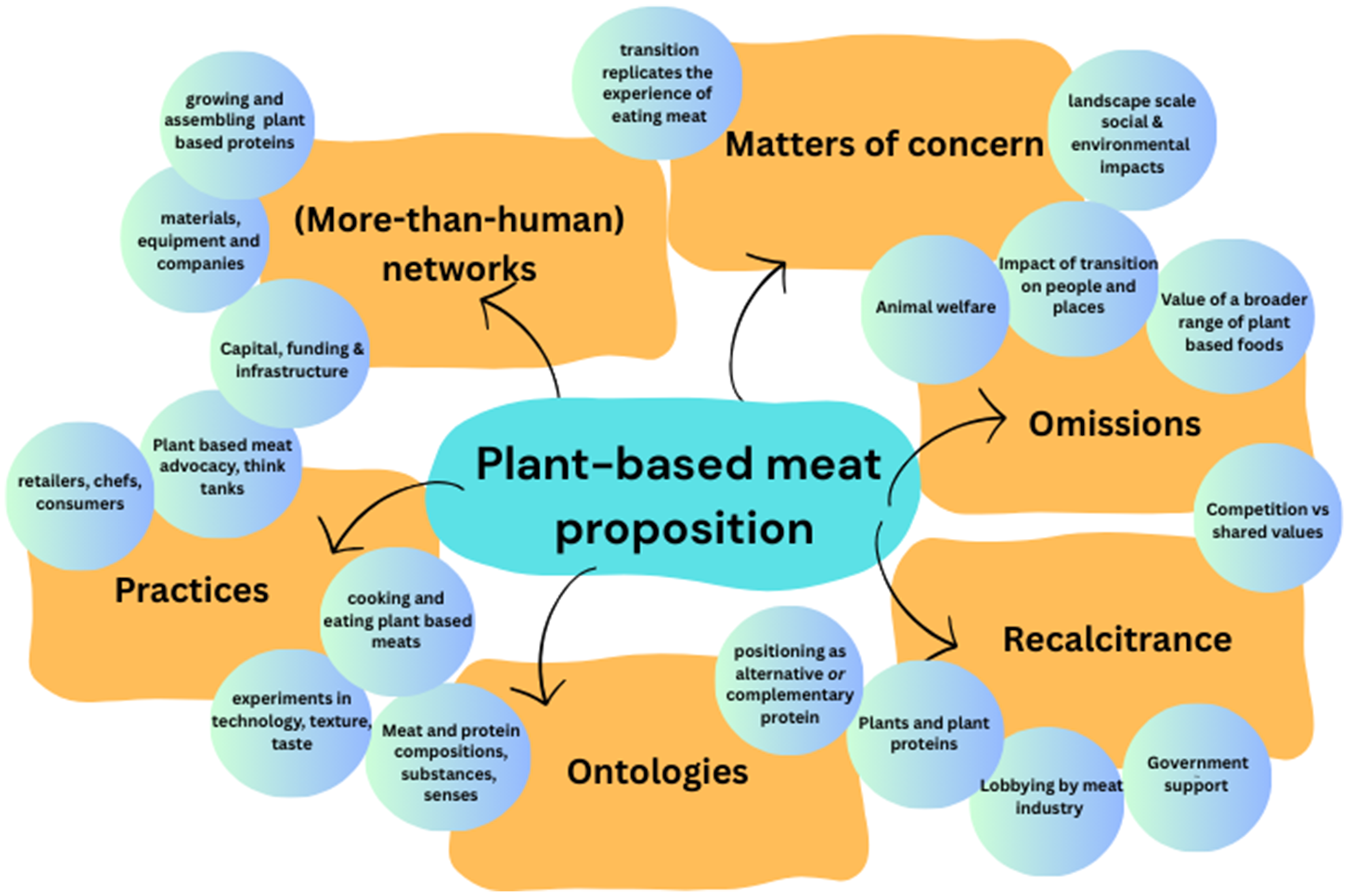
Overview of Australia's plant-based meat proposition.
The success of niche initiatives such as plant-based meat depends on how well the proposition becomes articulated in terms of its cohesion, its social and material components, and the responses of incumbent regimes including recalcitrance of the sort evident in Australia. The technologies at the centre of niche innovations are important, but so too are the particular networks, practices and strategies that surround the technology, including training chefs, breeding high protein legumes, recruiting international food scientists, convincing supermarkets, and hosting conferences oriented at venture capitalists, which help manifest the product, give the proposition substance, and make it influential. Even a great tasting, cheap, plant-based meat, of which there are plenty already, will not change worlds unless it is part of a broader well-conceived and convincing proposition that can provide a compelling challenge to the existing socio-technical regime in a given setting.
The analytical approach we have used offers sustainability transitions research a way to examine the context-specific socio-material dimensions of transitions that goes beyond the discursive focus of promissory narratives research and incorporates issues of power, influence, materialities, practices, assemblages and ontologies. The MLP provides a useful framework for conceptualising different levels of activity and influence, while the concept of propositions helps illuminate how human and non-human networks are laboriously assembled, arranged and negotiated to try to produce a given change in the world. MLP helps to analytically order the work of assembling propositions into different levels of endeavour, from the detailed work of nurturing a niche technological innovation complete with specific supply chains and contracts, to the ongoing work of fitting and shifting elements of the existing regime, and responding to landscape level forces such as global markets and climate change. This combination of analytical frames can usefully inform examination of other “transitions-in-the-making” (Elzen et al., 2011) and how they may or may not come to have a significant influence on society.
The Australian plant-based meat proposition is not there yet. It promises a new world in which animal agriculture and the social and environmental concerns associated with it are reduced with minimal disruption for the consumer. However, progress is slow. The spatial extent and scale of animal agriculture has yet to be affected by the growth of plant-based meat. Part of the problem is ontological, as recalcitrance from the incumbent regime contests the matters of concern at the centre of the plant-based meat proposition. The additionalist narrative is an example of this, referring to plant-based meat as complementary rather than as an alternative to animal meat. The concession is seen as a strategy to avoid antagonising animal meat industries further while enabling government investment for ‘food innovation’ (see also Tziva et al., 2020). However, it risks redefining the problem from one where too much animal meat is the problem, to one where too little animal meat is the problem, and plant-based meat is merely a useful compensatory measure. The goal of sustainable food transitions in Australia is replaced by the apparent need to address food security and growing protein demands in Asia. For many businesses in the plant-based niche this is an acceptable concession as their priority is sales and survival in a difficult market, with any broader ambition to transform food systems a very distant second. Yet it makes the proposition less clear about the sort of disruption, if any, it is proposing.
That said, worlds are changing as the niche slowly expands. There are new factories, companies, brands, technologies, tastes, skills, knowledges, jobs, people, imaginaries, opportunities and experiences. If plant breeding schemes are successful there will be new crops with higher protein content spreading across rural landscapes. Supermarkets are changing as plant-based meats slowly migrate into the animal-meat aisles, something was unheard of in Australia only a few years ago. Plant-based meats are finding their way into fast food outlets, restaurants, domestic kitchens, BBQs, and cooking shows, often alongside the animal-meats they are trying to mimic. Some fast-food outlets, cafes, bars and restaurants only serve plant-based dishes, adopting a prefigurative politics aligned with the plant-based meat proposition (McGregor et al., 2024). The changes are incremental rather than sudden and dramatic. They are laying a foundation where plant-based meats, as part of a broader array of technologies being developed for food and agriculture (Klerkx and Rose, 2020), may eventually contribute to a slow transition away from animal agriculture.
If plant-based meat is to play a role in a protein transition, the proposition needs to continue to evolve and improve. This requires not only finding ways of accelerating niche experimentation focused on taste, texture and price, but also by openly addressing omissions, responding to recalcitrance, continuing to creatively diversify practices, clarifying ontologies, and building useful context-specific political relationships and networks. All these activities can help strengthen how the proposition is articulated and enlist new actors and activities. Through the propositional lens we have shown that there are very real material, political and economic constraints, including ingredients, equipment, and manufacturing capacity, as well as cultural constraints in terms of acceptability, cultural norms, identities, habits, diets and preferences that have been shaped by animal meat regimes (Fairbairn et al., 2022). Until these barriers are overcome, the worlds created by plant-based meat will only be incrementally different to worlds without plant-based meat. What is not happening, yet, and is unlikely to happen until the plant-based meat proposition attracts many more advocates, is any change to the landscape level issues like climate change, food security or public health, that are the matters of concern upon which the proposition was formed. In other words, there is a significant gap between what is being articulated in narratives and what is currently feasible in terms of infrastructure and culture, weakening the cohesiveness and attraction of the proposition.
Our analysis suggests that addressing animal-meat production and consumption requires broadening support and participation, rather than relying only economic and material innovation. In the language of sustainability transitions, the current proposition favours “fit-and-conform” strategies to build commercial viability while more ambitious “stretch-and-transform” goals are needed if regime and landscape scale changes are to be realised (see Smith and Raven (2012)). Perhaps the proposition is hampered by its anchoring within capitalist institutions and logics (Feola 2020; Goldstein 2018) and it could look at attracting non-governmental organisations lobbying for broader food systems change as has occurred in Europe (Mylan et al., 2019; Tziva et al., 2020). Such connections may provide a route into challenging Australia's animal meat culture and providing openings for public discussions on alternatives, including engagement with non-capitalist food networks. Dueñas-Ocampo et al. (2023) similarly suggests that alternative protein assemblages are likely to be more influential when they become more inclusive, given currently absent voices, such as animal farmers, may have valuable perspectives (e.g., Bojovic and McGregor, 2025; Klerkx and Rose, 2020). The next step for the Australian plant-based meat proposition would seem to involve attracting and enlisting a broader and wider array of actors from outside niche manufacturing circles to bolster the challenge to the regime. Continuing to broaden the proposition so that it is not just about product substitution but includes more diverse perspectives and place-based concerns may yet provide fertile ground for pursuing a more just transition away from animal agriculture.
Highlights
The multi-level perspective from the sustainability transitions literature is informed by a Latourian framework based on propositions
The growth of plant-based meat is analysed by exploring matters of concern, networks, practices, ontologies, recalcitrance and omissions.
The plant-based meat industry is engaging in diverse context-specific strategies that are influenced by the incumbent animal meat regime
Places and people are changing incrementally to incorporate plant-based meat, providing an alternative infrastructure to animal meat.
There are opportunities for plant-based meat to enrol a broader array of stakeholders to increase impact.
Footnotes
Acknowledgments
We would like to acknowledge the research assistance provided by Milena Bojovic early on in this project as well as the Safety Net funding scheme provided by Macquarie University that funded the research. We also acknowledge the time and knowledge shared by all our participants. We acknowledge that this research took place on unceded lands of Aboriginal peoples in different parts of Australia, including the lands of the Darug, Wotjobaluk, Jaadwa, Jadawadjali, Wergaia, Jupagik, Wurundjeri Woi Wurrung, and Bunurong Boon Wurrung peoples. Finally we thank the referees and editors for their very insightful and constructive comments that helped us strengthen the paper.
Data availability
We do not have consent from the participants to share the data.
Declaration of conflicting interest
The authors declared no potential conflicts of interest with respect to the research, authorship, and/or publication of this article.
Ethical considerations
The research was approved by Macquarie University's Human Research Ethics Committee, Project ID 9074. All participants were provided with a written project information sheet and consent form and were required to sign this form to participate. As per our ethics approval we have protected their identities and they are non-identifiable in the manuscript.
Funding
The authors disclosed receipt of the following financial support for the research, authorship, and/or publication of this article: This work was supported by the Macquarie University Safety Net Scheme (reference number: 136682855).
