




Abstract
This paper contributes to the study of other-than-humans in environmental conflicts. In light of the increasing number of environmental conflicts arising from multiple intensifying societal and ecological crises, scholars are calling for nature, or more specifically other-than-humans, to be seen as relevant forces in conflicts. To broaden the anthropocentric understanding of environmental conflicts as social conflicts about nature, we elaborate a conceptual approach to social-ecological conflicts with nature by bringing other-than-humans into the analysis. We propose social-ecological conflict analysis as a conceptual approach for recognising the interlinked emancipatory potential that unfolds in conflicts for both marginalised people and other-than-humans. We conceptualise social-ecological conflicts as spatiotemporal encounters between two or more coalitions, each consisting of both societal and other-than-human conflict parties. These encounters emerge from incompatible societal relations to nature expressed by the different coalitions, such as the capitalist appropriation of nature versus the sustainable coexistence of society and nature. While rejecting an a priori ontological separation of society and nature, we analytically differentiate between humans, living and non-living other-than-humans to reveal the reinforcing or competing relations that emerge between them in conflicts. We have elaborated analytical terms, such as social-ecological coalitions, conflict parties, effects and impulses that are applicable to humans and to other-than-humans. The development of the conceptual approach is based on an extensive literature review of studies on the role of other-than-humans in environmental conflicts. After a stepwise construction of key definitions and terms, we substantiate our concept empirically with the case of groundwater conflicts in the Júcar River Basin, Spain. To further strengthen social-ecological conflict analysis, we propose the application of the conceptual approach to empirical cases for further conceptual and methodological developments, as well as a discussion of the potentials for conflict interventions with social-ecological conflicts analysis in which conflicts are productive forces for emancipatory aspirations.
Keywords
Introduction
In recent years, reports on environmental conflicts have been increasing in frequency (Martínez-Alier, 2023). In most environmental conflicts, the destructive capitalist appropriation of nature often executed by large corporations in alliance with governments in the name of development is contested by marginalised groups (Martínez-Alier, 2023; Scheidel et al., 2020). The diverse forms of capitalist appropriation of nature, such as resource exploitation, industrial and infrastructural uses, waste disposal and tourism are identified as main drivers of the multiple and interacting societal and ecological crises such as climate change, biodiversity loss, and degradation of soils (IPBES, 2019; IPCC, 2023; United Nations Convention to Combat Desertification, 2022).
The capitalist appropriation of nature builds on the hierarchical nature-culture divide and the colonisation of nature and people. The capitalist appropriation of nature not only means the exploitation and marginalisation of nature, but also of people, such as indigenous people, people of colour, gendered people and poor people (Alimonda, 2011; Escobar, 2008; Plumwood, 1993). Against this background, Büscher (2022), Hoppe and Lemke (2021) welcome the push of the material turn to decentre the human in social science, but criticise influential authors (Barad, Bennett, Braidotti, Haraway, Latour) for missing the fundamental role of capitalist relations of exploitation, power and “[…] how capitalism structurally diminishes both humans and nonhumans […]” (Büscher, 2022: 11). In our work, we build on Hoppe and Lemke's (2021) postulate to address conflicts between alternative forms of world becoming to accomplish more just and egalitarian relations. In environmental conflict analysis, the role of marginalised people in contesting capitalist appropriation of nature is an important research interest (Martínez-Alier, 2023; Navas et al., 2018; Scheidel et al., 2020; Svampa, 2019). However, the nature-culture divide still shapes most scientific analyses of environmental conflicts by obscuring the role of other-than-humans 1 in such conflicts. Therefore, we advocate for broadening the anthropocentric understanding of environmental conflicts from social conflicts about nature (Scheidel et al., 2020) to social-ecological conflicts 2 with nature by bringing other-than-humans into the analysis as relevant force, as postulated by Dietz and Engels (2014), Flemmer et al. (2024), Kuřík (2022) and Scheidel et al. (2022).
Honneth (2017) describes social conflicts as emancipatory processes by marginalised people to denaturalise societal structures, power relations and interests through the reinterpretation of societal norms. In this sense, social-ecological conflicts cannot only enable the emancipation of marginalised people, but also of exploited other-than-humans, aiming at a sustainable coexistence of society and nature (Jahn et al., 2020). For a better diagnosis of social-ecological conflicts and their emancipatory potential for both society and nature, we see the need to develop analytical tools that explicitly consider humans and other-than-humans as conflict parties.
As Kuhn et al. (2023) demonstrated, several scholars from peace and conflict studies, policy analysis and governance studies, political ecology, (ecological) economics and social-ecological research started to research empirically how other-than-humans shape environmental conflicts. However, there are only few attempts to explicitly conceptualise the relationship between humans and other-than-humans in conflicts. We argue, however, that such a conceptualisation is necessary in order to systematically capture the wide range of how other-than-humans can matter in conflicts. As we will discuss in the next section, some literature shows how other-than-humans trigger conflicts as supposedly scarce resources while other articles assign other-than-humans agentive capacities with their own goals and behaviours. This, however, risks negating or not fully addressing the emancipatory potential for other-than-humans in conflicts. We hence argue that the diagnosis of intensifying social-ecological conflicts that uphold emancipatory potentials for both humans and other-than-humans needs a novel conceptual approach. Such a concept is required to capture diverse roles of other-than-humans in conflicts while facilitating empirical research that is open for diverse ontological and epistemological assumptions made by human conflict researchers.
We suggest a conceptual approach for analysing humans and other-than-humans as parties in conflicts. Kohn (2013) argues that new analytical terms, which are applicable to both humans and other-than-humans, are needed to enable an analysis challenging the nature-culture divide. Therefore, an important element of our conceptual approach is the elaboration of analytical terms which can be used for both. This includes the introduction of the terms social-ecological coalitions, other-than-human conflict parties, effects and impulses to aid explaining how other-than-humans exert influence. Furthermore, in our conceptual approach, we elaborate on important analytical dimensions in environmental conflict research such as latent and manifest conflicts, conflict drivers, courses and outcomes.
We ground our conceptual approach to social-ecological conflicts in Social Ecology, and expand it with insights from Political Ecology, Gender Studies, Anthropology of Nature and Political Ontology. Social Ecology is partly rooted in early Critical Theory, which characterises modernity as the increasing will of humans to master nature, while nature reacts with a certain degree of uncontrollability (Görg, 2003; Horkheimer and Adorno, 2016 [1944]). The uncontrollability of nature opens up the possibility to consider emancipatory processes not only for marginalised people (Honneth, 2017; Horkheimer, 2021 [1937]), but also for other-than-humans. Building on Critical Theory, Social Ecology is designed as an emancipatory project. Social Ecology understands society and nature as co-constitutive (Becker and Jahn, 2003; Hummel et al., 2023), however, the resulting societal relations to nature (SRN) to satisfy human basic needs have become crisis-ridden (Becker and Jahn, 2006; Hummel et al., 2023). The crisis-ridden dominant capitalist SRN are contested (Brand and Görg, 2003; Görg et al., 2017). We build on authors from Political Ecology and Gender Studies to emphasise that SRN are not power-neutral, but hierarchical and exploitative towards people and other-than-humans (Alimonda, 2011; Escobar, 2008; Plumwood, 1993). This aspect is recognised by Social Ecology, but not further developed. Recently, Social Ecology is seeking to decentre the human subject (Hummel et al., 2023). However, it remains critical of conceptually blurring any differentiation between humans and other-than-humans and emphasizes the efficacious distinction between society and nature that has been constructed by modern society, and above all, by modern science (Becker and Jahn, 2006). To date, Social Ecology is however missing a conceptualisation of other-than-humans. Kohn (2013), a representative of the Anthropology of Nature, offers a differentiation between humans, living and non-living other-than-humans, building on the absence of a nature-culture divide in many indigenous societies (Descola, 2013). He differentiates the non-living from the living by the ability of living other-than-humans and humans to interpret events and to react to them. Humans and living other-than-humans are differentiated by language. The differentiation of living and non-living other-than humans is backed by natural science studies on plants and animals (Birch et al., 2020; Simard et al., 1997) but is challenged by indigenous ontologies and their different definitions of the non-living and the living (Atwood et al., 2024; Campion et al., 2024; La Cadena, 2014). Here, Political Ontology (Atwood et al., 2024; Blaser, 2013a, 2013b; Campion et al., 2024) offers a conceptual approach to show how conflicts emerge from different ontologies and to pluralise sets of differentiations. In this line, sensory perceptions of other-than-humans can lead to conflicts (Ball et al., 2022).
Our conceptual approach to social-ecological conflicts is based on an extensive literature review of English-language scientific articles. The selected articles offer an implicit or explicit conceptualisation of other-than-humans in environmental conflicts (Kuhn et al., 2023). The article search consulted Web of Science, Google Scholar, ResearchGate and Academia using a combination of one conflict keyword and one environmental keyword and was complemented by suggestions of the co-authors of Kuhn et al. (2023). The final data corpus consisted of 84 scientific publications. The literature review was conducted in 2021 and included all publications up to this point. To illustrate our conceptual approach, we use the example of the conflict over agro-industrial soy cultivation in Argentina. The conflict arose between farmers, transgenic soy plants and pesticides on the one hand, and local residents, environmental NGOs, herbicide-resistant weeds and soybean diseases on the other. The references to the case are based on prior empirical research of the lead author and published analyses (Beilin and Suryanarayanan, 2017; Benbrook, 2005; Binimelis et al., 2009; Lapegna, 2016; Oreja et al., 2024; Rauchecker, 2017, 2019, 2021). This illustration aims to support the comprehensibility in the step-wise development of our concept by providing for each component and their relations a precise and scientifically backed example. Besides this supportive illustration throughout the paper, we used the example of contested groundwater use in the Júcar River Basin for a first application and critical reflection to identitfy potentials and limits of the overall concept. After introducing the case, we will show how a social-ecological conflict analysis reveals the multi-faceted and active roles of the aquifer itself, the Júcar River and large hydraulic water infrastructure in the dynamics of the conflict. The empirical material used for this application consists of qualitative interviews with humans and scientific publications about hydrological dynamics. The analysis of the material was conducted in an iterative coding process using MAXQDA.
The article is divided into four steps. First, we discuss existing approaches to other-than-humans in environmental conflicts and argue for a conceptual approach that is open to the various roles other-than-humans can assume in conflicts. Second, this is followed by an extensive and stepwise construction of our conceptual approach of social-ecological conflicts that includes the introduction of key conceptual elements such as social-ecological coalitions, human and other-than-human conflict parties, their effects and impulses, conflict drivers, outcomes and the framing of social-ecological conflicts within the crises of SRN. Third, we substantiate our conceptual approach empirically with the case of groundwater conflicts in the Júcar River Basin in Spain. Fourth, we close this paper by discussing potentials and limitations of our conceptual approach to social-ecological conflicts. In this last part, we also outline a research programme for social-ecological conflict analysis.
Other-than-humans in environmental conflict analysis
In recent years, scholars have been looking more closely at the role of the environment itself in environmental conflicts. In order to grasp more systematically the active role of other-than-humans in conflict research, some scholars offer conceptual developments (Dietz and Engels, 2014; Flemmer et al., 2024; Kuřík, 2022; Scheidel et al., 2022).
By merging insights from political ecology and conflict sociology, Dietz and Engels (2014) suggest an understanding of environmental conflicts in which the contested societal construction of other-than-humans goes hand in hand with the contested construction of society. In a similar vein, Flemmer et al. (2024) argue for an interpretation of conflicts as ontological struggles about what nature is and what society is and how they are related. Scheidel et al. (2022) reviewed numerous societal protest movements to distil how “ecological endowments” (p. 2) facilitate or restrict possibilities for contentious action and politics. Situated in Political Anthropology, Kuřík (2022) outlines foundations for a “concept of resistance to include the agency of nonhumans and their capacity to make social and political changes, fight back, form coalitions and co-produce rebelliously charged effects, meanings and interpretations” (p. 55). These contributions provide important starting points for developing a conceptual approach that includes other-than-humans into environmental conflict analysis. They all emphasise the importance of conceptualising humans and other-than-humans as interrelated in order to capture the ways in which they directly influence each other. In addition, a relational perspective on how other-than-humans become active in contested dynamics is suggested to prevent a reversion to dualistic thinking. Dualistic thinking might assume, for example, that other-than-humans per se resist human practices. Dietz and Engels (2014) and Scheidel et al. (2022), in particular, propose interdisciplinary approaches for capturing the various roles of other-than-humans in conflict or social movement studies. However, in both attempts to reformulate environmental conflicts, humans remain in the privileged position of being conflict parties while other-than-humans are not assigned agentive capacities. Also, Flemmer et al. (2024) focus rather on conflicting ontologies of different societal groups, mainly indigenous and modern, and not on other-than-humans as independent conflicts parties. In contrast, Kuřík (2022) argues that human and other-than-human agency are mutually constitutive, hence conflict parties are always more than human. While providing important foundations, the work of Kuřík (2022) and that of Scheidel et al. (2022) are not directly applicable to the study of social-ecological conflicts. The former conceptually focuses on resistance and the latter on contentious politics, which both lead to an analytical prioritisation of the discontented actors over other conflict parties.
We therefore identified the need to develop a conceptual approach to other-than-humans in environmental conflicts. This approach needs to be applicable to empirical cases of different conflict fields in different world regions, and open for qualitative, quantitative and experimental methods from the social and natural sciences.
In our literature review, we found that other-than-humans and their influence in conflicts are usually conceptualised as either a resource, environmental change, space or an actor. When being researched as a contested resource, other-than-humans usually constitute the object of conflict that is appropriated, used, distributed or changed by humans. The research cases in question involved timber, diamonds, water and forests, among others (Dresse et al., 2016; Escobar, 2006; Gómez-Baggethun et al., 2013; Link et al., 2016; Rodríguez-Labajos and Martínez-Alier, 2015; Weiss, 2015; Zeitoun et al., 2020; Zipper et al., 2017). In these articles, the identified effect of other-than-humans on the conflict is rather indirect due to the frequently assumed scarcity of natural resources, which can trigger or intensify societal conflicts. Similar effects on conflicts are attributed to natural hazards and environmental processes such as droughts, floods, pollution of air and water, soil degradation or the collapse of ecosystems (Homer-Dixon, 1994; Spillmann and Baechler, 1996). In this conceptualisation, environmental changes can cause or exacerbate existing cleavages by leading to resource scarcity, increased health risks and the destruction of environmental and cultural assets, or by making traditional ways of life and practices impossible (Hellin et al., 2018; Ingalls and Mansfield, 2017; Jaggernath, 2014; Link et al., 2016). Research focusing on the relation between space and conflicts reveals a mutual shaping. The material-discursive composition of space shapes the likelihood of conflictive actions in certain regions (Blomley, 2008; Buhaug and Gates, 2002; Raleigh, 2010): For example, shifting shorelines can trigger conflict (Blomley, 2008; Ivars et al., 2021). Conversely, space itself is shaped by conflicts (Björkdahl and Buckley-Zistel, 2016; Zúñiga-Upegui et al., 2019).
As these articles show, conceptualising other-than-humans as resource, environmental change or space reveals various forms of their potential influence on environmental conflicts between humans. They can cause, intensify and structure conflicts due to biophysical or chemical characteristics and processes, along with specific material-discursive constellations within which conflicts take place. The privileged role as conflict parties, however, remains with humans. Here, other research strands go a step further towards assigning other-than-humans agentive capacities.
Studies on human-wildlife conflicts conceptualise animals as actors in conflicts (Boonman-Berson et al., 2016; Doubleday and Adams, 2020; Evans and Adams, 2018; Gibbs, 2021; Ojalammi and Blomley, 2015; Pozo et al., 2017; Silva and Srinivasan, 2019). Research often focuses on large wild animals such as elephants, wolves or bears, whose behaviours can lead to the injury or killing of people or damage to human property and infrastructure. Animals are thus ascribed an active, independent role, with their own goals, behaviours and interests, and are consequently identified by some authors as proper actors in the political arena (Margulies and Karanth, 2018; Sepúlveda-Luque, 2018). In research that builds upon actor-network theory (Bennett, 2018) or the assemblage approach (Margulies and Karanth, 2018; Mustafa and Tillotson, 2019; Pütz and Schlottmann, 2020), agentive capacity is extended towards plants, mountains and ecosystems. From these perspectives, other-than-humans—like humans—do not exist a priori but rather become something or someone in processes of conflictual negotiation (Bennett, 2018; Pütz and Schlottmann, 2020).
Assigning agentive capacity to other-than-humans appears promising for challenging the hierarchical nature-culture divide and for unlocking emancipatory potential for other-than-humans in conflicts. However, we recognise barriers when trying to translate this into a conceptual approach to social-ecological conflicts. Firstly, assemblage, new materialist or actor-network approaches (Bennett, 2018; Margulies and Karanth, 2018; Mustafa and Tillotson, 2019; Pütz and Schlottmann, 2020) usually operate with an omnipresent state of contestations between and among other-than-humans and humans and hence do not assign conflicts a privileged conceptual-analytical status. In contrast, environmental conflict analysis assumes that, in conflicts, fundamental and powerful structures and processes such as the capitalist appropriation of nature are renegotiated. Hence, the emancipatory potential in specific conflicts is underlined here. Secondly, only assigning agentive capacity to other-than-humans is not enough to unlock the emancipatory potential of conflicts but it is necessary to address capitalist relations of exploitation and power as well as emancipatory practices (Büscher, 2022; Hoppe and Lemke, 2021). Thirdly, conceptually assigning agency to other-than-humans risks anthropomorphising them by extending analytical terms originally developed for humans to other-than humans (Kohn, 2013), such as interests, motivations, strategies, intentions, norms and values.
In summary, our literature review reveals a large empirical and conceptual spectrum of how other-than-humans can influence conflicts. On one side of the spectrum, the impact of other-than-humans is indirect and contextual, and so the analytical potential remains anthropocentric. The stronger the assigned influence, however, the greater the methodological challenges for empirically researching the agentive roles of other-than-humans. Nevertheless, we perceive our study corpus as a new research field emerging from environmental conflict studies, which differs from the latter by assigning an active role to other-than-humans and by conceptualising conflicts beyond the social dimension. We term this new emerging research field social-ecological conflict analysis. Within this field, we see potential for developing a conceptual approach that does not ontologically distinguish between humans and other-than-humans, but focuses on the relations that emerge between them in conflicts.
Social-ecological conflicts: an emancipatory conceptual approach
In this section, we elaborate our conceptual approach for social-ecological conflict analysis step by step. In Section 3.1, we define social-ecological conflicts as emerging from the crises of societal relations to nature. Social-ecological coalitions consisting of human and other-than-human conflict parties fight over contradicting societal relations to nature. In Section 3.2, we define the terms conflict parties, effects and impulses, which constitute the basic elements of our concept. To facilitate their empirical application, we offer two heuristics in Section 3.3: the conflict parties heuristic and the social-ecological conflict heuristic. In order to sharpen the distinction between latent and manifest conflicts in Section 3.4, we turn to spatiotemporal encounters between social-ecological coalitions. In Section 3.5, we reflect on the trajectories of social-ecological conflicts and their potential outcomes.
Defining social-ecological conflicts
Societal relations to nature (SRN) is a key concept of Social Ecology, which we further develop as the conceptual basis of our approach. SRN are the historically evolved economic, political, cultural and scientific-technical patterns in which societies shape their relations to nature. While society and nature are not considered opposite poles, Social Ecology suggests the analytical differentiation between society and nature in order to research the particular social relations to nature that shape the existence of humans, animals, plants and other being and things on this planet. This distinction is not ontologically fixed but contingent and power-laden, and hence contested (Becker and Jahn, 2006; Brand and Görg, 2003; Hummel et al., 2023). We expand this analytical differentiation between society and nature using the more fine-grained differentiation of Kohn (2013). This differentiation between humans, living and non-living other-than-humans is based on their semiotic complexity and enables us to pluralise the SRN to relationships between them. The epistemic differentiation between humans and living and non-living other-than-humans has an ontological basis, because what is understood as living and non-living can differ between human groups. For example, mountains and rivers are categorised as abiotic nature by Western natural scientists, but as living by certain indigenous groups (Atwood et al., 2024).
Specific SRN entail the organisation of the satisfaction of basic human needs (Hummel et al., 2017) and are influenced by economic, political and gendered power structures (Becker and Jahn, 2006; Hummel et al., 2023), which we extend to other-than-humans. While basic needs can obviously be recorded for biotic nature, it is complicated to identify them for abiotic nature and artefacts. We translate societal power structures into uneven, hierarchical, power-laden relationships within the group of humans and within the group of other-than-humans as well as between humans and other-than-humans (García-Frapolli et al., 2018; Hovorka, 2019; Margulies and Karanth, 2018; Spengler and Tischleder, 2019).
Crises are constitutive of SRN in the understanding of Social Ecology. The crises of SRN consist in the exploitative relations between humans and other-than-humans, eventually leading to the destruction of nature and society (Hummel et al., 2023). This understanding is similar to the notion of unsustainable patterns of capitalist appropriation of nature. A key feature of social-ecological conflicts is that they emerge from crisis-prone SRN and can therefore be described neither as purely ecological causalities nor as purely social conflicts (Fickel and Hummel, 2019). We embed social-ecological conflicts within the crises of SRN to narrow down the corpus of possible social-ecological conflicts to relevant conflicts emphasising the problem-oriented research of Social Ecology (Becker and Jahn, 2006). We define social-ecological conflicts as follows:
Social-ecological conflicts are spatiotemporal encounters between two or more coalitions consisting of humans and other-than-humans and contributing to incompatible societal relations to nature.
As visualised in Figure 1, those shaping SRN in social-ecological conflicts are, however, not only humans but coalitions of humans and other-than-humans. We define social-ecological coalitions as alignments of humans and other-than-humans. Coalitions develop when the effects on SRN in a particular spatiotemporal context unfolding with humans and other-than-humans reinforce each other. With effects we refer to any type of influence on SRN and subsequently on social-ecological conflicts from humans and other-than-humans in a certain space at a certain time. This involves physical action, discursive interventions and chemical or biological processes. We understand reinforcing effects by humans and other-than-humans as effect bundles, which are constitutive of social-ecological coalitions.
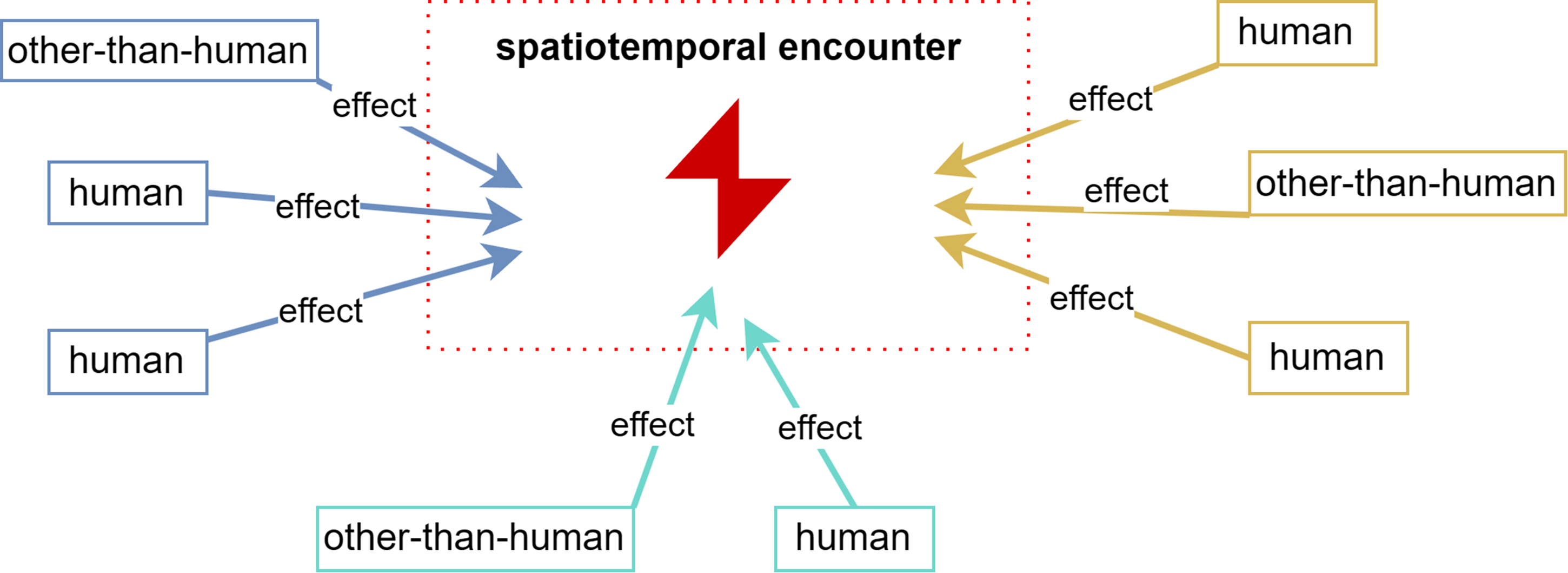
Social-ecological conflicts as spatiotemporal encounters between two or more coalitions consisting of humans and other-than-humans.
Based on our literature review we argue that, in most empirical cases, social-ecological conflicts unfold alongside the main cleavage between two incompatible ideal-typical SRN: the capitalist appropriation of nature aiming at the mastery of nature and leading to the destruction of nature (Alimonda, 2011; Escobar, 2008), which is then confronted with the aspiration of facilitating coexistence of society and nature fostering health, good living conditions and habitats (Jahn et al., 2020). As per our understanding, the sustainable coexistence of society and nature, including the recognition of other-than-humans, is the normative goal to be reached through social-ecological conflicts understood as emancipatory processes.
The contestation of marginalising, exploitative and hierarchical structures and processes by marginalised people and exploited other-than-humans in social-ecological conflicts opens up the possibility of reinterpreting and reshaping these structures and processes in an emancipatory manner towards a sustainable coexistence between society and nature (based on Honneth, 2017).
To illustrate the conceptual developments described in this section, we use the conflict over agro-industrial soy cultivation in Argentina. This conflict emerged between two social-ecological coalitions. First, the coalition of agro-industrial soy cultivation consists of transgenic soybeans, the farmers planting them in monocultures, and pesticides applied by the farmers. The anti-soy coalition is comprised of local residents, environmental NGOs, herbicide-resistant weeds such as amaranth and Johnsongrass and soybean diseases such as soybean rust. The two coalitions represent the following incompatible SRN. The coalition of agro-industrial soy cultivation generates huge economic benefits backed by an hegemonic narrative of efficient agriculture but destroys ecosystems and endangers human health, which is an adequate manifestation of the crisis of agroindustry. In contrast, the anti-soy coalition contributes to more balanced ecological processes by collectively countering agro-industrial soy cultivation with lawsuits and protests to restrict pesticide use near urban areas as well as with the removal of water, nutrients and space from soy plants on the fields to limit soy cultivation and give that space to more sustainable agriculture. The power relations between the two coalitions are multifaceted. The coalition of agro-industrial soy cultivation holds vastly more political and economic power than the anti-soy coalition. The contestation of agro-industrial soy cultivation partially altered power relations locally and led to municipal laws restricting pesticide use near urban areas, protecting human health and biodiversity, although only on a small scale in comparison to the extension of soy cultivation (Beilin and Suryanarayanan, 2017; Rauchecker, 2017, 2019, 2021). Herbicide-resistant weeds and soybean diseases are stronger than soy plants and therefore the soy plants need pesticides to thrive (AAPRESID, 2025; Oreja et al., 2024).
Human and other-than-human conflict parties, their effects and impulses
The analysis of conflict parties, their actions and motivations is key to understanding how environmental conflicts develop (Rauchecker, 2019). Bringing other-than-humans into environmental conflict analysis requires the development of common analytical terms for humans and other-than-humans (Kohn, 2013). We suggest the term conflict party instead of actor to identify all humans or other-than-humans that exert a relevant influence in social-ecological conflicts. To capture any type of relevant influence of these different conflict parties, we suggest the term effect instead of action. With impulse we refer to what would be motivation for humans, hence the reason that leads to a certain effect.
Conflict parties in environmental conflict research are usually defined as individual or collective human actors (neighbourhood initiatives, NGOs, companies, etc.) that form a coalition or are in conflict with each other. For social-ecological conflict analysis, however, we broaden the scope to other-than-humans. Therefore, a conflict party is every human and every living or non-living other-than-human influencing a conflict, which can be an individual or a collective. In environmental conflicts, conflict parties act in coalitions by contributing to the same goal without the necessity of coordinated action (Rauchecker, 2019). Extending this definition to social-ecological coalitions by including other-than-humans, we focus on the contribution of the conflict parties’ effects to the same goal in a conflict, reinforcing each other's effects. By not assuming a coordinated action, which would require a communicated agreement between the conflict parties, this definition is open to including other-than-humans in coalitions. For example, activists and amaranth both contribute to halting the expansion of agro-industrial soy cultivation in Argentina (Beilin and Suryanarayanan, 2017). In a modern ontology, which is prevalent in the case of the conflict over agro-industrial soy cultivation in Argentina, an agreement between activists and amaranth is not thinkable.
Conflict parties’ actions, such as protests, petitions and lawsuits, drive conflicts and their development over time (Scheidel et al., 2020). However, the term action presupposes intentionality, which is irrelevant for analysing how other-than-humans alter the course of a conflict. Therefore, we use the term effect in the sense of an influence on the SRN and subsequently on the conflict, which is applicable for human and other-than-human conflict parties. As already explained in Section 3.1, effects, which reinforce each other, form effect bundles. Such effect bundles are constitutive of social-ecological coalitions. Activists and amaranth use different means against agro-industrial soy cultivation in Argentina. Activists protest, initiate petitions, press for new laws etc., while amaranth competes with soy plants for water, light and space in fields (Beilin and Suryanarayanan, 2017). The different effects resulted in halting the expansion of agro-industrial soy cultivation.
Motivations of parties in environmental conflicts such as values, interests and basic needs are key to understanding the background of their actions and their goals (Martínez-Alier, 2023). Understanding these motivations is also important for conflict transformation (Wittmer et al., 2006). Instead of the term motivation, which is not applicable to all other-than-humans due to epistemological barriers, we use the term impulse, referring to the origin of an effect. For living other-than-humans (biotic nature), we can record basic needs and for human-made artefacts, at least the intended function. However, for abiotic nature, it is complicated to detect impulses in the way environmental conflict research does. In indigenous ontologies (Atwood et al., 2024; Campion et al., 2024) some abiotic nature is categorised as living and therefore can be granted a motivation. Building on the (il)legibility of society and nature by the state (Scott, 1998) and the non-identity of nature (Görg, 2003), we answer the question of researchers’ comprehensibility with different degrees of legibility of humans and also living and non-living other-than-humans. The degree of legibility depends on the ontology of the researchers. To give an example of impulses, human activists against agro-industrial soy cultivation and amaranth plants both aim to protect their health and reproduction, which are endangered by the expansion of agro-industrial soy cultivation and the subsequent increase in pesticide contamination (Beilin and Suryanarayanan, 2017; Rauchecker, 2019).
Analytical tools
To facilitate social-ecological conflict analysis, we propose the conflict parties heuristic (see Figure 2) and the social-ecological conflict heuristic (see Figure 1 and 3). The heuristics can be used in two consecutive steps to first identify and cluster human and other-than-human conflict parties, and second, to highlight the effects and subsequently the social-ecological coalitions arising from effect bundles.
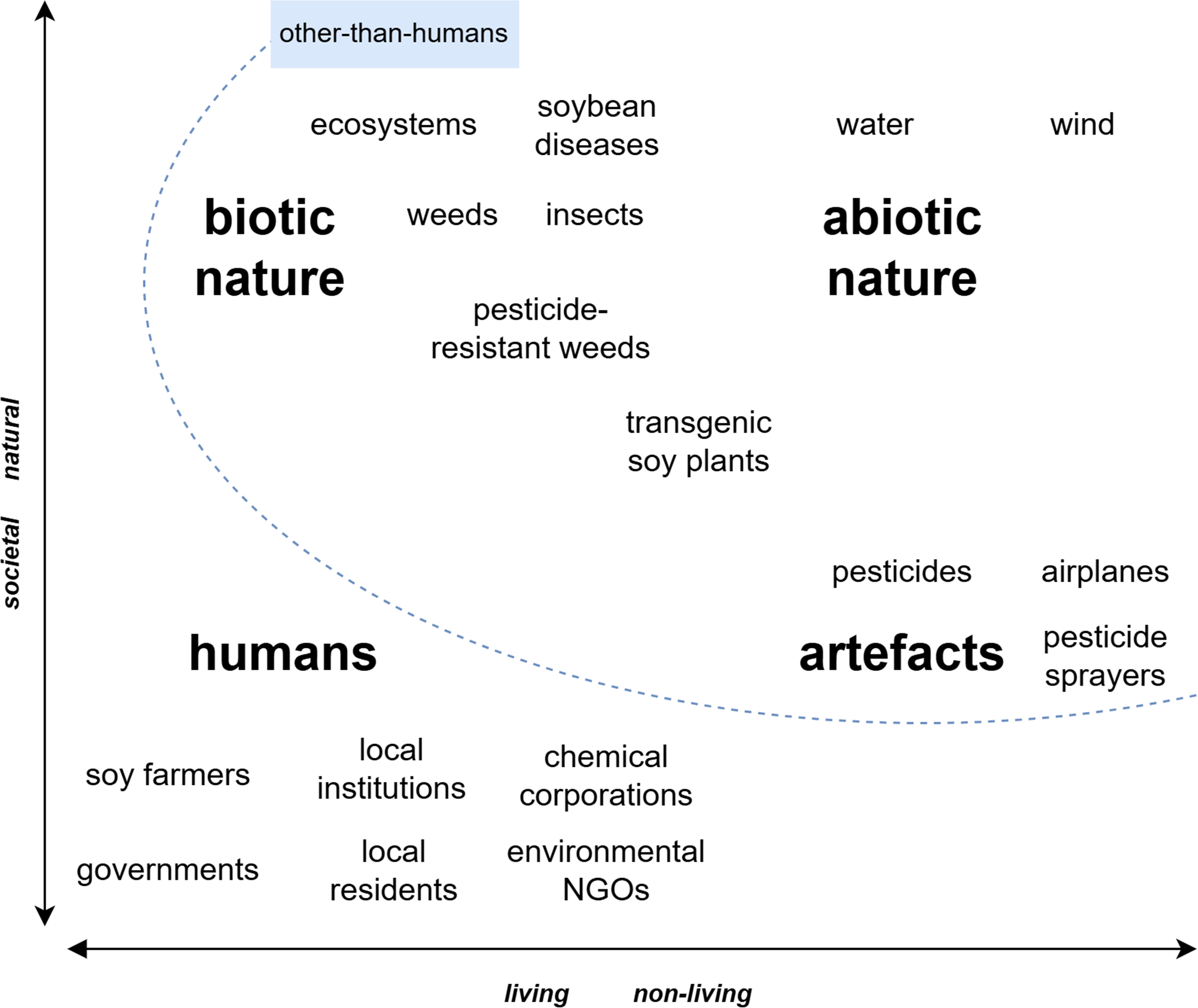
Conflict parties heuristic: human and other-than-human conflict parties on two axes between societal and natural as well as the living and non-living adapted to the conflict over agro-industrial soy cultivation in Argentina.
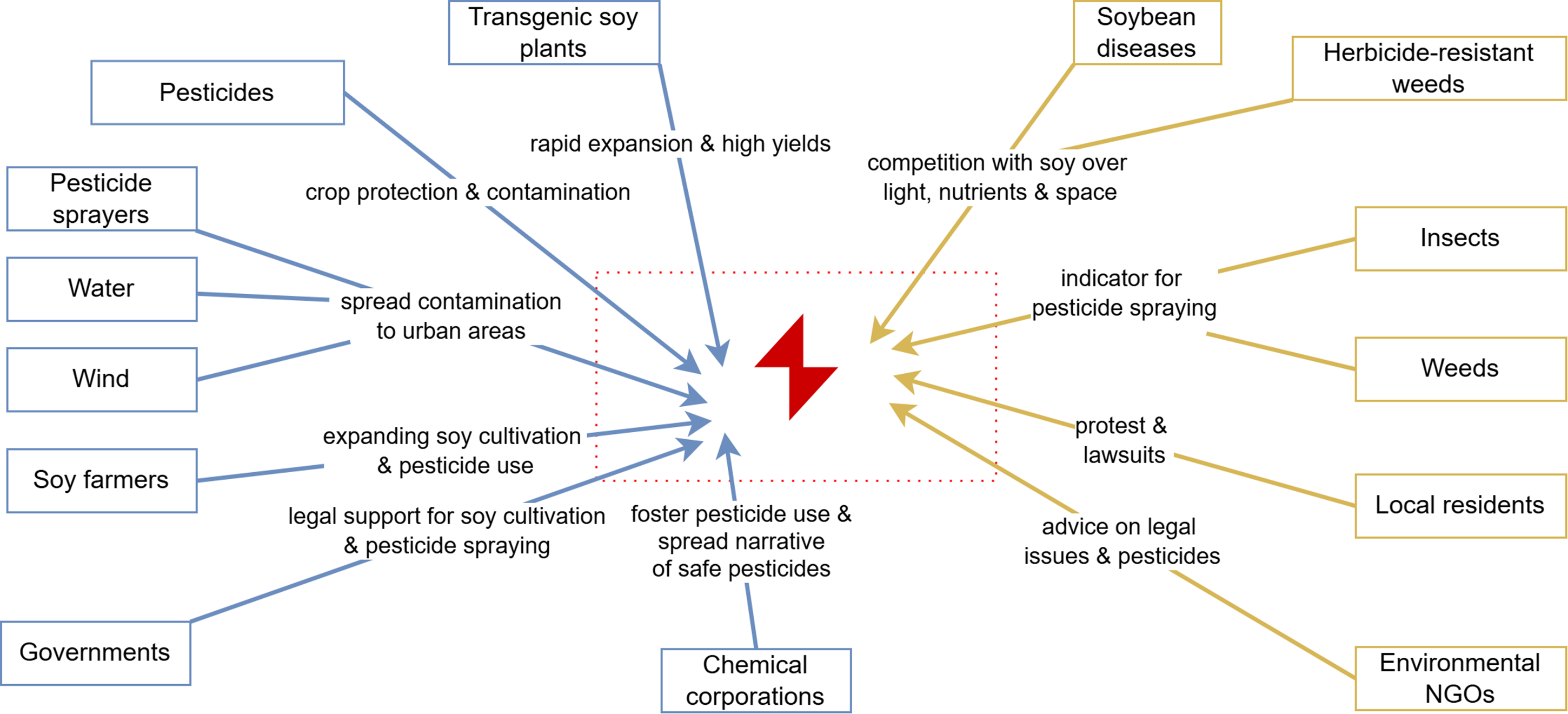
Social-ecological conflict heuristic: spatiotemporal encounter between two coalitions consisting of human and other-than-human conflict parties and their effect bundles, adapted to the conflict over agro-industrial soy cultivation in Argentina (agro-industrial soy coalition on the left and anti-soy coalition on the right).
Conflict parties heuristic
The conflict parties heuristic categorises conflict parties using the axes societal and natural as well as living and non-living. Applying the heuristic from a modern ontology, we analytically differentiate between humans, biotic nature, abiotic nature and artefacts (see Figure 2). Such a differentiation appears to be analytically and methodologically supportive within a modern ontology, as the established analytical terms and methods to investigate these parties are fundamentally different. Researchers rooted in non-modern ontologies such as indigenous ones might use different axes and conflict party types. Furthermore, they might sort humans and other-than-humans in a different manner, e.g., mountains and rivers as living and part of society. The conflict parties heuristic can help to make differentiations and clustering of conflict parties explicit. Gaps in the heuristic can trigger the identification of unrecognised conflict parties.
In the following, we will describe each conflict party type (humans, artefacts, biotic and abiotic nature) and their effects and impulses:
For humans and their institutions, effects in conflicts are usually exercised through intentional practices such as petitions, campaigns, lawsuits, protests, blockades, and sabotage (Scheidel et al., 2020). These effects are based in human impulses such as beliefs, interests, knowledge and basic needs such as nutrition. Here we can build upon the rich body of literature that tries to understand the human actions, including institutions, in conflicts (Martínez-Alier, 2023).
Artefacts are mostly societally shaped but non-living entities such as technology and infrastructure, and are therefore grouped under other-than-humans. They are assigned specific cultural, historical or political meanings. Artefacts can also be made by other-than-humans for a certain purpose, for example beaver dams and bird nests. Artefacts can have societally intended effects—e.g., a fence to hinder livestock mobility—but also societally unintended side-effects, e.g., a fence that also hinders wildlife mobility. Artefacts’ impulses are the societal intentions during their creation or reshaping as well as their physical or chemical capacities beyond human control. Artefacts play a key role in transmitting societally developed epistemological approaches into new spaces or times (Blok et al., 2016; Kuřík, 2022).
Biotic nature is defined as natural but living entities and is characterised by cell activity. Animals, plants, fungi and bacteria fall into this category. Their effects take the form of, for example, physical mobility, growth, nutrition, reproduction and spatial propagation. Impulses of natural and living entities are the satisfaction of basic needs such as nutrition, reproducing, securing their own territory and/or avoiding harm to their bodies, their family or group members. Knowledge in the form of learned routines shapes their effects (IPBES secretariat, 2024).
Abiotic nature encompasses geological formations such as mountains but also metals, acids, temperature and rainfall. Although inanimate, they exercise their effects due to and through chemical and physical processes, for example erosion or oxidation. Their effects often unfold in a broad range of temporal and spatial dimensions that exceed those of the other conflict parties (IPBES secretariat, 2024). Similar to artefacts, the impulses of abiotic nature are its physical and chemical capacities. Some authors grant abiotic nature the right to integrity (Vargas-Chaves et al., 2019). In indigenous ontologies, some elements of abiotic nature are categorised as living beings, with the same attributes as such (Atwood et al., 2024; Gill, 2016).
Humans, artefacts, and biotic and abiotic nature are components of more complex systems such as ecosystems and societies. Ecosystems are located at the border between biotic and abiotic nature because they consist of manifold and complex relations between the two, which interplay to produce certain unique functions (IPBES secretariat, 2024). Societies are built up from humans and societally shaped artefacts. The interrelations of all these components produce system functions. As described above, we understand society and nature, and hence ecosystems, as co-constitutive.
In Figure 2, we illustrate the conflict parties heuristic with the example of the conflict around agro-industrial soy cultivation in Argentina. In this exercise, we identified unrecognised conflict parties such as soybean diseases which tackle the expansion of soy cultivation, as well as airplanes that spray pesticides, pesticide sprayers, wind and water, which spread pesticide contamination into urban areas. The categories of the heuristic have no clear boundaries. For example, we locate transgenic soy plants between biotic nature and artefacts.
Social-ecological conflict heuristic
Following the initial identification of the relevant human and other-than-human conflict parties according to the conflict parties heuristic, a subsequent step entails the clustering of conflict parties in social-ecological coalitions using the social-ecological conflict heuristic (see Figures 1 and 3). For this, the notion of spatiotemporal encounter must be clarified. Then the conflict parties’ effects on the conflict are grouped in bundles of reinforcing effects. In order to group the effects into bundles, it is useful to identify the SRN to which the effects contribute. In most cases, the SRN are incompatible and therefore the effect bundles contradict each other. The resulting effect bundles delimit the social-ecological coalitions.
In Figure 3, we apply the social-ecological conflict heuristic to the empirical example of the conflict over agro-industrial soy cultivation in Argentina. The main spatiotemporal encounter occurred in the soy fields, where the soy plants and herbicide-resistant weeds competed since 2002, and in the areas adjacent to them, where local residents who opposed soy cultivation since 2001 lived. We identified two bundles of reinforcing effects. First, farmers have vastly expanded soy cultivation, facilitated by transgenic soy plants and pesticides. Pesticides protected the soy plants, but contaminated the environment and urban areas through pesticide sprayers, water and wind. Chemical corporations and governments supported soy cultivation and pesticide spraying. Second, herbicide-resistant weeds and soybean diseases competed with soy plants reducing yields. Local residents advised by environmental NGOs protested and filed lawsuits to restrict pesticide-spraying. They detected pesticide spraying by observing the death of insects and weeds (Beilin and Suryanarayanan, 2017; Rauchecker, 2019). We differentiated the agro-industrial soy coalition and the anti-soy coalition by the human and other-than-human conflict parties’ effects supporting or tackling the expansion of unsustainable soy cultivation and pesticide contamination.
From crises of societal relations to nature, to latent and then to manifest social-ecological conflicts
Building on the identification of the elements of a social-ecological conflict and their interrelations through the conflict parties heuristic and the social-ecological conflict heuristic, the analysis of how conflicts actually evolve is a key interest in environmental conflict research. In the following, we elaborate on the implications of our concept for researching the development of latent conflicts into manifest conflicts.
As elaborated in Section 3.1, our understanding of social-ecological conflicts is grounded in the crises of SRN. The coalitions pushing forward the capitalist appropriation of nature, such as agro-industrial soy cultivation, create adverse effects for certain other-than-humans and humans. Weeds and insects are killed or harmed by pesticides and (poor) local residents and smallholder farmers are harmed by pesticides or stripped of their land and livelihoods through the expansion of soy cultivation (Beilin and Suryanarayanan, 2017; Rauchecker, 2019, 2021). The coalition in favour of the capitalist appropriation of nature is formed based on reinforcing effects and is often pre-existent to the conflict. Soy farmers team up with chemical corporations, national, regional and local governments and local institutions, because transgenic soy cultivation generates economic resources and political influence, which are used to perpetuate and expand the model of biotechnological agriculture. Often, the marginalised people and other-than-humans affected by the capitalist appropriation of nature might not be able to react in a direct manner against the adverse effects. Therefore, competing and reinforcing effects can be in a latent state in which conflict parties are disconnected and passive towards the cleavages between them. The latent state of a conflict can continue for a long time, and competing and reinforcing effects can sediment into structures. In the case of agro-industrial soy cultivation in Argentina, the described latent conflicts do not become manifest because of the power relations in favour of the agro-industrial soy coalition, which nurture a hegemonic belief system supporting soy cultivation (Rauchecker, 2019, 2021).
To turn from a latent to a manifest conflict, the competing effects have to collide in an active encounter between human and other-than-human parties. An encounter can be understood as a collision that renders the competing effects visible and tangible for the conflict parties. The experience of visibility and tangibility pushes the conflict parties into a direct relationship or changes an existing relationship between them into a predominantly conflictive one. Such an encounter forms uneven, hierarchical, power-laden relationships within the group of humans, between humans and other-than-humans and within the group of other-than-humans, as explained in Section 3.1. For an active encounter to happen, humans and other-than-humans must be present in the same space at a certain point in time or within a period of time (Margulies and Karanth, 2018; Ojalammi and Blomley, 2015). The formation and activation of social-ecological coalitions based on reinforcing effects also require a spatiotemporal encounter, and further, concrete activities, although an intentional or planned entanglement of effects is not necessary (Beilin and Suryanarayanan, 2017; Sepúlveda-Luque, 2018). In the Argentine case, only some of the numerous latent conflicts became manifest when local residents became active by protesting against pesticide spraying in 2001, and when herbicide-resistant weeds such as Johnsongrass and soybean diseases such as soybean rust appeared in Argentina in 2002 provoking reactions from farmers and soybeans (Benbrook, 2005; Binimelis et al., 2009; Rauchecker, 2019). The local contestations of agro-industrial soy cultivation have continued to grow since forming an anti-soy coalition.
Conflict drivers, courses and outcomes
We now place emphasis on the possible trajectories of manifest conflicts addressed in environmental conflict research by focusing on conflict drivers, fluctuation of the manifest conflict and its possible outcomes.
With regard to driving factors, environmental conflict analysis points, among other things, to contradicting worldviews, values, interests, knowledge and the basic needs of humans. We extend this to other-than-humans using contradicting differentiations of the world by other-than-humans as well as contradicting impulses such as the competition for water, nutrients and space of soy plants and herbicide-resistant weeds. Because of the spatiotemporal dimension of the aforementioned encounter, the spatiality and temporality of humans and other-than-humans (mobility, seasonality, growth phases, etc.), formed by societal and ecological structures and processes, represent key conflict drivers (Andriamahefazafy and Kull, 2019; Camargo, 2017; Ivars et al., 2021; Margulies and Karanth, 2018; Ojalammi and Blomley, 2015; Scheidel et al., 2022). Visibility and invisibility of societal and other-than-human conflict parties influence the probability of encounters (Scheidel et al., 2022). Illegibility and uncontrollability of other-than-humans by humans can generate uncertainty and fear relevant for encounters (Ojalammi and Blomley, 2015; Rauchecker, 2021) and can lead to erroneous interpretations of nature in setting up economic projects, which in turn can cause conflicts (Gill, 2016). For example, soy fields where pesticides are applied may border housing areas. Furthermore, pesticides are applied at certain moments of the growing season and adapted to the growth periods of weeds and insects, temporarily causing more health issues for local residents, who subsequently protest (Beilin and Suryanarayanan, 2017; Rauchecker, 2019).
The course of a conflict is also structured by the vulnerability and resilience of actors and other-than-humans, the resources available to them and the connectivity between them (Scheidel et al., 2022). Several resilient conflict parties with high availability of resources and high connectivity enable an intensive, long-lasting and spatially extended conflict, while a few resilient and several vulnerable conflict parties with vastly different resources and connectivity might lead to a short and spatially limited conflict development. The conflict dynamics are also rooted in the volatility of societal and other-than-human conflict parties in space and time (Andriamahefazafy and Kull, 2019; Camargo, 2017; Ivars et al., 2021; Scheidel et al., 2022). Our understanding of conflicts as webs of competing but also reinforcing relationships places emphasis on the dynamic and relational aspects, such as interactions and interdependencies, in the course of a conflict. Changing relationships also imply a change of a conflict over time. A conflict can be expanded, intensified, reduced or de-escalated. Consequently, the conflict intensity can alternate between hot and cold phases, increasing with more active conflict parties and a higher frequency of activity on their part (Cusack et al., 2021). According to Zimmermann et al. (2020), threats to the conflict parties’ basic needs and conflict recurrence increase conflict intensity. However, the absence of violence and threats to basic needs along with a long conflict history lower the intensity. In the case of Argentina, the local residents were successful when they introduced more parties in local conflicts, and rollbacks happened when activity decreased. The human and other-than-human conflict parties fought over basic needs such as health, reproduction and economic activity, therefore the debates were often heated (Rauchecker, 2019).
From a normative perspective, social-ecological conflicts can result in emancipatory, regressive or mixed outcomes (Scheidel et al., 2020). Emancipatory outcomes in terms of the sustainable coexistence of society and nature encompass the production of case-specific knowledge, increased participation in decision-making by marginalised humans and also other-than-humans, negotiation of alternative ecologically, socially sustainable and just solutions, the cancellation of unsustainable projects, the implementation of sustainability-friendly norms (including court decisions, for example the recognition of other-than-humans as legal persons) and environmental improvements. Regressive outcomes perpetuating hierarchical and exploitative relationships include top-down norm setting and implementation (including court decisions, for example lowering the bar for resource exploitation), displacement of marginalised humans and other-than-humans, violence against humans and other-than-humans, killings and environmental destruction. The outcomes of the conflict over agro-industrial soy cultivation in Argentina are mixed. In more than 300 cases municipal laws were issued limiting pesticide spraying and introducing buffer zones for urban areas. Several court decisions restricted pesticide spraying and sentenced actors participating in illegal pesticide spraying. However, the numbers of municipal laws and court decisions in favour of the anti-soy coalition are relatively low compared to the vast extent of soy cultivation in Argentina (Rauchecker, 2019). Furthermore, in some cases, the municipal laws were rolled back and protests were supressed (Lapegna, 2016). In contrast, herbicide-resistant weeds and soybean diseases became widespread, reducing the expansion of agro-industrial soy cultivation (AAPRESID, 2025; Oreja et al., 2024).
Case study example: conflicts with groundwater in the Júcar River Basin, Spain
Introduction to the case
In this section we empirically substantiate our conceptual approach of social-ecological conflicts with the case of groundwater conflicts in the Júcar River Basin in Spain. After a short case description, we show how the situation can be analysed from an anthropocentric environmental conflict studies perspective as a societal conflict about groundwater. We then apply our concept of social-ecological conflicts to the case and argue how a social-ecological conflict perspective supports the analysis of the case as a conflict with groundwater, infrastructure and further other-than-humans. Such a perspective, in turn, underlines emancipatory potential for both humans and other-than-humans inherent to the case.
The Mancha Oriental aquifer (MOA) extends over 7000 km2 in south-eastern Spain, making it one of the largest aquifers in southern Europe. It comprises multiple karstic layers and an impermeable bottom layer consisting of marls, clays and gypsum (Sanz et al., 2009). The aquifer is hydrologically assigned to the Júcar River Basin and belongs to the administrative river basin district of the same name. The Júcar River Basin District (JRBD) covers the eastern parts of the political-administrative region of the Autonomous Region of Castilla-La Mancha (Spanish: Comunidad Autónoma) in central Spain as well as most of the territory of the Autonomous Region of Valencia in the coastal areas of south-eastern Spain (Sanz et al., 2009). The aquifer's annual recharge is estimated at 238 to 334 million m3 (Pulido-Velazquez et al., 2015; Sanz et al., 2009; Sanz et al., 2019) due to rainfall, percolation by surface streams and potential flows between MOA and other aquifers such as the Mancha Occidental system (Sanz et al., 2009). The MOA partly discharges into the Júcar River and contributes fundamentally to its flow volume. The surface area of the MOA is characterised by a flat highland with a semiarid climate and strong seasonal variations in precipitation and temperature (Sanz et al., 2009). For most climate change scenarios, models project a decline in the recharge of the MOA (Pulido-Velazquez et al., 2015).
Contested groundwater from an anthropocentric environmental conflict perspective
From an anthropocentric research perspective that understands other-than-humans as a scarce resource, the case of contested groundwater use in the Júcar River Basin could be portrayed as a societal conflict about groundwater. In this view, the relevant conflict parties consist of upstream and downstream irrigators, along with environmental groups, that mobilise discursive, regulatory and infrastructural strategies to materialise their values, interests and knowledge about what the MOA is and how its water should be distributed.
Since the 1970s, intensive groundwater abstraction for irrigating wheat, vegetables and nuts in the Mancha Oriental region has been placing enormous pressure on the aquifer. In order to irrigate areas of around 1000 km2, it is estimated that in some years groundwater extraction exceeded recharge by more than 100 million m3 (Sanz et al., 2019). In the 1990s, this pressure caused the groundwater table to sink by up to 80 metres, which in turn led to a lower aquifer discharge into the Júcar River, eventually resulting in lower water volumes transported towards Valencia (Sanz et al., 2009). Hence, farmers’ unions in Valencia using Júcar water for irrigation protested against the intensifying groundwater use in Mancha Oriental and called for restrictions. Upstream farmers in Mancha Oriental, together with the regional government of Castilla-La Mancha, argued for the socioeconomic necessity of extracting groundwater for the development of a region that feels left behind. Farmers in Valencia, however, express that groundwater use in Mancha Oriental negatively impacts their centuries-old agricultural system of relying on surface water from the Júcar River. As a third conflict party, environmental groups and think tanks call for a fundamental paradigm shift in water policy and water use in Mancha Oriental and in Spain as a whole.
To pre-empt restrictive policies from being introduced by the State, farmers in Mancha Oriental founded an irrigator's union (Junta Central de Regantes de la Mancha Oriental, JCRMO), distributing and controlling abstraction volumes among individual farmers and collectives. With satellite images, technicians from the JCRMO check on a daily basis whether individual farmers are complying with the type and area of cultivation indicated in their annual cultivation plan approved by the union. This way, the groundwater volume extracted for irrigation can be estimated, given that different plants need different amounts of water. Furthermore, the Tagus-Segura long-distance water transfer (LDWT) is used as infrastructure for transporting water from the Júcar River stored in the Alarcón Reservoir to Mancha Oriental in order to substitute groundwater use with surface water (Sanz et al., 2019). With these approaches, groundwater levels have stabilised since the 2000s. However, local ecological groups and Valencian farmers remain sceptical regarding the long-term sustainability of the agricultural system in Mancha Oriental, pointing at undocumented abstractions or new crops such as almond and pistachios, with exponentially higher water demands (interviews USUJ, Ecologistas).
Such a perspective centred on human agency around supposedly scarce resources helps detect important cleavages between different human conflict parties and shows how conflicting dynamics are influenced by, for example, hydrological properties. We argue, however, that it is unable to capture the various active and potentially emancipatory roles that other-than-humans hold in this case beyond their instrumental use by humans.
Contested groundwater from a social-ecological conflict analysis perspective
Applying our social-ecological conflict approach elaborated above, we define contested groundwater use in the Júcar River Basin as the encounter of three social-ecological coalitions, each consisting of humans and other-than-humans, with their respective effects (see Figure 4). The encounters occur spatially where the MOA connects with the Júcar River and in participatory processes within the Júcar River District Authority. They developed since the 1990s, with peaks in dry and hot summers and during development phases of new five-year River Basin Management Plans, according to the EU Water Framework Directive. These encounters reflect incompatible patterns of groundwater use and regulation pursued by the different coalitions.
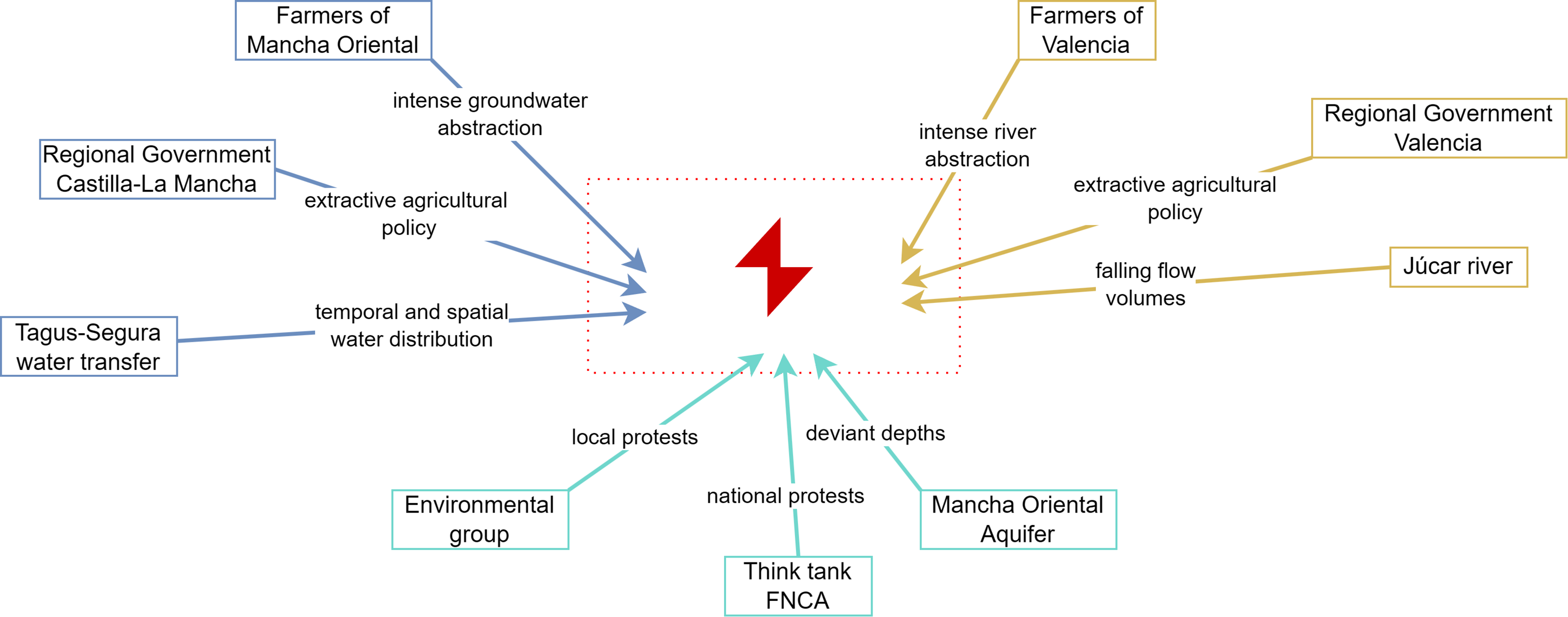
Identified coalitions each consisting of humans and other-than-humans in the case of contested groundwater in Mancha Oriental, Spain (developers coalition on the left, paradigm-shifters coalition in the middle and traditionalists coalition on the right).
Social-ecological coalitions, conflict parties, their effects and impulses
We name the first social-ecological coalition developers; it comprises farmers of Mancha Oriental, the regional government of Castilla-La Mancha and the Tagus-Segura LDWT. The impulses—identified here as the values and interests—of the farmers stem from their wish to continue with large-scale irrigation for cultivating profitable products for export. Together with a strong regional identification, this leads to several effects over space and time: Public statements and involvement in political, scientific and societal dialogues contribute to the idea of groundwater use as a socioeconomic necessity (interviews JCRMO, CLM). Also, infrastructural strategies involving the transfer of upstream Júcar water via the Alarcón Reservoir and Tagus-Segura LDWT frame continuous irrigation as hydrologically possible and manageable. The impulses of the regional government of Castilla-La Mancha lead to comparable effects. Due to their authority in agricultural policy, they can mobilise EU funds along with regulatory frameworks supporting the farmers in Mancha Oriental (interview CLM). These effects unfolding with humans are supported by effects of other-than-humans, namely large-scale hydraulic infrastructures. The Alarcón Reservoir was built in the 1950s by Valencian farmers with the intention of damming the Júcar River in winter to increase the volume transported towards Valencia in summer. The Tagus-Segura LDWT was built in the 1960s with the intention of increasing the irrigation capacity of farmers in the Murcia region, using the Alarcón Reservoir as a stopover. Today, however, both artefacts exceed their original purpose assigned by farmers in Valencia and Murcia, and support with various effects the irrigation practices in Mancha Oriental. Firstly, with these large-scale hydraulic infrastructures, an additional hydrological connection between Júcar and Mancha Oriental developed. Due to the LDWT's physical capacity to transport water of certain volumes at certain times to specific places—which corresponds with the term impulses of our concept—they impose controlling effects on groundwater use in Mancha Oriental: The Mancha Oriental farmers can claim that, with the partial substitution of groundwater with Júcar surface water stored in the Alarcón Reservoir and transported via the Tajo-Segura LDWT, intensive irrigation practices in Mancha Oriental can continue without adversely affecting the quantitative state of the MOA and its discharge into the Júcar River. Hence, the effects of reservoir and transfer allow the developers coalition to expand supply-side solutions and claim balanced uses by suggesting a controllability of the situation.
We label the second social-ecological coalition of farmers in Valencia, the Valencian regional government and the Júcar River as traditionalists. The impulses of the farmers and politicians in Valencia stem from the conviction that their centuries-long use of the Júcar water for irrigation constitutes a right of no deterioration of their water volumes by the new irrigation practices in Mancha Oriental (interviews USUJ, CLM). Analogue to the developers-coalition, this is supported by the regional government of Valencia and leads to discursive effects as well as technological-infrastructural strategies, such as the large-scale modernisation of irrigation systems, to increase their efficiency. Here, the Júcar contributes with numerous hydrogeological effects. While decreasing groundwater levels are often not directly visible, changes in water flow of the Júcar indicate changes in levels of the MOA due to their hydrological connection. For the first part of its course, the riverbed of the Júcar is above the groundwater table of the MOA. In this part, the river discharges into the aquifer. At a certain point north of the city of Albacete, the tables turn and the river enters a canyon and lies below the groundwater table. From this point, the MOA discharges into the Júcar. Due to intensive groundwater abstractions, this turning point moved several kilometres downstream over the past decades. The volume transported by the Júcar towards Valencia can be analysed as an effect that makes visible groundwater abstraction practices and thus contributes to the coalition of Valencian farmers and politicians criticising the irrigation regime in Mancha Oriental.
A local environmental group called Ecologistas en Acción, the think tank Fundación Nueva Cultura del Agua (FNCA) and the Mancha Oriental Aquifer constitute together a third social-ecological coalition that could be called paradigm-shifters. This coalition articulates how irrigation practices in Mancha Oriental as well as Valencia are unsustainable due to rebound effects on groundwater quantity but also qualitative deterioration by fertilisers (interview Ecologistas, FNCA). They call for a paradigm shift in water policy that reduces the absolute volumes of water used for irrigation in Spain and promote a stronger valuation of groundwater and surface water as complex ecosystems, vital not only for humans but also for forests, animals and wetlands such as the Albufera de Valencia (interviews Ecologistas, FNCA). The effect arising from the varying or even deviant depths of groundwater (its impulse) reinforces discursive effects on the part of the environmental groups. The groundwater table of the MOA varies from unit to unit and does not necessarily follow surface topography. This complicates the extraction of groundwater, given that farmers can: a) never be absolutely certain at which depths to find groundwater; b) that these depths are constantly changing due to varying trajectories of recharge and discharge; and c) the deeper the groundwater, the more energy is needed to pump it to the surface. The latter effect in particular has limited groundwater use during periods of high energy costs, for example due to the Russian war on Ukraine since 2022 (interview JCRMO). Together, these effects can make groundwater abstraction technologically and economically uncertain, highlighting the shakiness of large-scale, intensive, long-enduring groundwater abstraction in Mancha Oriental as a development model. Furthermore, with deviant depths or invisibilities, the aquifer withdraws from an absolute control and use by irrigators. This can be understood as if groundwater together with environmental groups questions such a socioeconomic model that seeks to appropriate nature for the benefit of some people.
Latent social-ecological conflict since the 1970s
The opposed effect bundles of the three coalitions reveal a latent social-ecological conflict that has been looming since the 1970s. The coalitions represent contradicting societal relations to groundwater. The developers and traditionalists see water as a key resource for the nation's and their regions’ progress through agricultural productivity. This understanding of water as an exploitable resource is dominant in Spain for over 100 years (Swyngedouw, 2015). In contrast, the core of the paradigm-shifters’ SRN is the intrinsic value of nature and water. This reflects conflictive ontologies between the paradigm-shifters and the other two coalitions. Despite their similar approach to water, the effect-bundles of developers and traditionalists are competing. They seek to realise similar patterns competing for the same water under huge economic and climatic pressures. However, from the 1970s until the 1990s, there was no spatiotemporal encounter between the effect-bundles of the coalitions given that the large MOA was able to feed irrigation in both regions for a long time. Also, the time delays inherent to subterranean water flows hid the consequences of intense extraction for years.
Manifest social-ecological conflict since the 1990s: courses, drivers and outcomes
The latent social-ecological conflict with groundwater in the Júcar River Basin became manifest for the first time in the 1990s, when the traditionalists coalition expressed an incompatibility between their effect bundles and the effects unfolding within the developers coalition. To a certain extent, the shift of the intersection point between riverbed and groundwater table presents a spatiotemporal encounter of the coalitions. With the foundation of the JCRMO, the development of a joint model for groundwater-river interaction, the introduction of annual cultivation plans and a contract between Valencian and Manchegan farmers about the partial substitution of groundwater using the Alarcón Reservoir and the infrastructure of Tajo-Segura LDWT, the conflict intensity decreased and the conflict is now in a cold phase. The intersection point did not move further downstream but instead stabilised, indicating in turn a stabilisation of the MOA groundwater tables. However, environmental groups perceive the conflict not as solved but adjourned, pointing to the right of farmers in Mancha Oriental to re-substitute surface water with groundwater in times of low Júcar water levels (interview CLM). Here, several conflict drivers might intensify the situation in the future. Due to changing precipitation patterns, reservoirs supposed to ensure water availability in summer are increasingly reporting low filling levels across Spain (Copernicus EU, 2024). Also, a drought in California led to increasing global trading prices for almond and pistachio and thus a tremendous expansion of plantations of these water-intensive trees in Mancha Oriental (interview JCRMO).
Potentials of a social-ecological conflict analysis of groundwater use in the Júcar River Basin
We now compare the schematic application of an anthropocentric environmental conflict perspective in Section 4.2 with the social-ecological conflict analysis in Section 4.3 to show the potentials of the latter.
Applying the anthropocentric perspective, there is a risk of being trapped in dominant assumptions regarding environmental conflicts. For example, portraying groundwater and river water as scarce canalises the analysis towards distributional, quantitative questions while other dimensions such as ecological aspects and water quality might fall back.
Understanding groundwater as a conflict party from a social-ecological conflict perspective renders visible the effects of groundwater in conflicts beyond being seen only as a resource. This offers a more detailed conflict analysis but also shows the emancipatory dynamics of conflicts.
With a social-ecological conflict perspective, emergence, course and current outcome of the conflict can be assigned to various effects of other-than-humans. The discharge of the MOA into the Júcar River made a long-lasting overuse of groundwater visible and stimulated a call for action. In our emancipatory understanding, the monitoring of the intersection point between MOA and Júcar River can be described as a participation of MOA and Júcar River in decision-making processes, which triggered structural changes of water use and a reduction of the abstraction of groundwater from MOA. Here, the artefacts Alarcón Reservoir and Tagus-Segura LDWT exceeded their initial purpose and offered an alternative to groundwater abstraction for farmers in Mancha Oriental without reducing the area of irrigation. However, the contingent effects of both groundwater and LDWT, together with the effects of further other-than-humans such as almonds and pistachios, may lead to a hot phase of the conflict in the future.
By assigning groundwater the role of a conflict party, the paradigm-shifter coalition receives arguably more attention than in anthropocentric conflict analyses. Most research on the groundwater conflict in the Júcar River basin focuses on the conflict between Valencian farmers and Manchegan farmers (Pulido-Velazquez et al., 2015; Sanz et al., 2019). This reflects the portrayal of environmental groups as not very dominant in the societal and scientific discourses about the Mancha Oriental aquifer (interviews Ecologistas, JCRMO). Understanding groundwater as a conflict party in itself, with distinct effects and impulses, underlines the potentially significant influence of the paradigm-shifter coalition given the high dependence of farmers in both Valencia and Mancha Oriental on the hydrogeological characteristics and developments of the aquifer.
Discussion and conclusion
In this paper we suggest a conceptual approach for the emerging field of social-ecological conflict analysis to facilitate a more sensitive and nuanced analysis of the interrelated emancipatory potential for both humans and other-than-humans lying dormant in environmental conflict studies. This is in line with various critical analyses of the Anthropocene emphasising the entanglement of domination over humans and domination over nature (Brand and Wissen, 2017). To evaluate to what extent our conceptual approach can reveal the emancipatory potential for other-than-humans in social-ecological conflicts, we look at the contribution of our conceptual approach to environmental conflict research in the fields of Social Ecology, Political Ecology and Political Ontology. Furthermore, we discuss the risk of conceptual stretching and the empirical applicability of our conceptual approach. We conclude with a research programme for social-ecological conflict analysis.
While we built upon fields that are by definition concerned with the relation of society and nature and are opening up to New Materialist concepts, we suggest that our conceptual approach of social-ecological conflict analysis goes a step further in this endeavour. We expand the conceptual terms of Social Ecology, such as crises and patterns of SRN, which we used as a basis for our conceptual approach, with several new conceptual terms such as social-ecological coalitions, effects and impulses, which can be used to grasp both humans and other-than-humans. These conceptual terms can facilitate a discussion about other-than-humans in Social Ecology. Furthermore, social-ecological conflict analysis aims to embed the conflict perspective in Social Ecology. Environmental conflict research from a Political Ecology perspective has already begun to incorporate other-than-humans in the analysis of several studies. Therefore, in Section 3, we demonstrate how we take a further step from environmental conflict research by also making its concepts such as conflict parties, power and conflict drivers applicable to other-than-humans. With our conflict parties heuristic and the social-ecological conflict heuristic, we offer tools for environmental conflict researchers to incorporate other-than-humans in their analysis. Building on Political Ecology's understanding of conflicts as an emancipatory project tackling the exploitation of people and resources, social-ecological conflict analysis can render visible the emancipatory potential of conflicts for both humans and other-than-humans. Because our conceptual approach on social-ecological conflict analysis is open to different ontologies, it can also grasp ontological conflicts researched in Political Ontology. However, we proceed a step further by showing ontological differences in conflicts between moderns and not only between moderns and indigenous communities. In social-ecological conflict analysis, the effects of other-than-humans in conflicts are the analytical focus and become relevant not only through indigenous ontologies.
Conceptual stretching (Kuřík, 2022) describes the development of definitions and terms as too broad and thereby endangering their analytical significance. Understanding social-ecological conflicts as competing and reinforcing relationships between humans and other-than-humans opens up an extremely wide array of possible conflicts. Therefore, we embed our approach within the crises of SRN. As per our understanding, not all possible encounters between competing conflict parties and coalitions form a social-ecological conflict, only those that are manifestations of and contribute to the multiple crises of SRN. Furthermore, extending analytical terms developed for humans to other-than-humans (Kohn, 2013) risks a resurgence of anthropocentric analyses. Assigning values, behaviour or interests to animals, plants or even geological formations can involuntarily imply the re-establishment of humans as the benchmark and suggest the absolute legibility and control of nature for human analyses (Görg, 2003; Kuřík, 2022). Therefore, we decided to elaborate analytical terms that take into account differences between humans, biotic nature, abiotic nature and artefacts without arranging them hierarchically (Kohn, 2013).
Our empirical demonstration with contested groundwater in the Júcar River Basin in Spain provided an example of how our analytical terms and conceptual approach can be applied to empirical material. Abstraction practices by farmers, hydrological flows steered by long-distance water transfers, or the aquifer-river connection could all be subsumed under effects based on various impulses that build competing effect bundles within social-ecological coalitions. By contrasting our concept with an anthropocentric environmental conflict analysis, we were able to show how an analysis of the active role of other-than-humans in conflicts reveals additional analytical layers of conflict drivers, courses and outcomes. Instead of romanticising the idea that other-than-humans can assume a categorical resistance towards capitalist appropriation of nature, our empirical case suggests that other-than-humans such as groundwater do not per se oppose it. Instead, different other-than-humans can contribute to the formation of various coalitions that compete with each other (Kuřík, 2022). In the case of Alarcón Reservoir and the long-distance water transfer Tagus-Segura, our analysis showed how their role changed over the course of time and exceeded the intentions of the humans who built them. Due to particular effects that these infrastructures had on and in Mancha Oriental, they formed a coalition with farmers in Mancha Oriental by providing them with discursive and technological tools for keeping up their irrigation volumes.
Social-ecological conflict analysis is an emerging research field that requires conceptual and methodological development. With our approach we intended to make a theoretically and empirically informed contribution to the conjoint study of other-than-humans and humans in conflicts. In considering a research programme for social-ecological conflict analysis, we recommend several lines for further enquiry: First, the robustness of the conceptual approach should be tested and enhanced by applying it to empirical cases. Second, researching humans and other-than-humans in social-ecological conflicts is not only a conceptual but also a methodological challenge. Humans can be covered using social science methods well established in environmental conflict analysis, such as interviews and document analysis. Other-than-humans can be investigated via natural science methods focusing, for example, on animal and plant behaviour. The latter should be further integrated into social-ecological conflict analysis. Inter- and transdisciplinary approaches, participatory and action research and artistic and experimental methodologies seem most promising for recognising other-than-humans’ articulations in conflicts. Third, an enhanced diagnosis of social-ecological conflicts could be tested regarding its potential for active conflict interventions to bring about sustainable coexistence and cohabitation of humans and other-than-humans (Boonman-Berson et al., 2016; Toncheva and Fletcher, 2021). Fourth, our proposed definition of social-ecological conflicts as potentially emancipatory processes for marginalised humans and other-than-humans can be linked to an understanding of conflicts as productive forces triggering societal progress (Kühne, 2020; Skrimizea et al., 2020).
Footnotes
Highlights
Acknowledgements
The authors express grateful appreciation for the support they received from their colleagues Anna Brietzke, Dženeta Hodžić, Florian D. Schneider, Tatiana Molano, Naomi Bi and Sofie Sämann during the process of developing this paper. We are also grateful for the participation of the interviewees in our study, which was essential to elaborate the empirical case. We also thank the reviewers for their comments.
Author's contributions
Substantial contributions to the conception of the paper: Markus Rauchecker, David Kuhn, Diana Hummel, Thomas Fickel
Substantial contributions to the development of the concept (chapter 3): Markus Rauchecker, David Kuhn, Diana Hummel
Substantial contributions to the empirical case (chapter 4): David Kuhn
Substantial contributions to the analysis or interpretation of data for the work: all authors
Drafting the work: Markus Rauchecker, David Kuhn, Diana Hummel
Reviewing the work: all authors
Ethical approval and informed consent statements
The authors obtained written informed consent by the interviewees to use and publish information extracted from all interviews used in this article. The empirical research was approved by the ethics committee of the Institute for Social-Ecological Research (ISOE) on December 23rd 2021.
Funding
The contributions of the authors Fanny Frick-Trzebitzky and David Kuhn were done within the project “regulate – Regulation of Groundwater in Telecoupled Social-Ecological Systems”, which is funded by The Federal Ministry of Education and Research (BMBF) within the framework of the “Research for Sustainability” strategy (FONA) ( ) as part of its Social-Ecological Research funding priority, grant number 01UU2003A. Responsibility for the content of this publication lies with the authors.
Notes
Annex: List of interviews
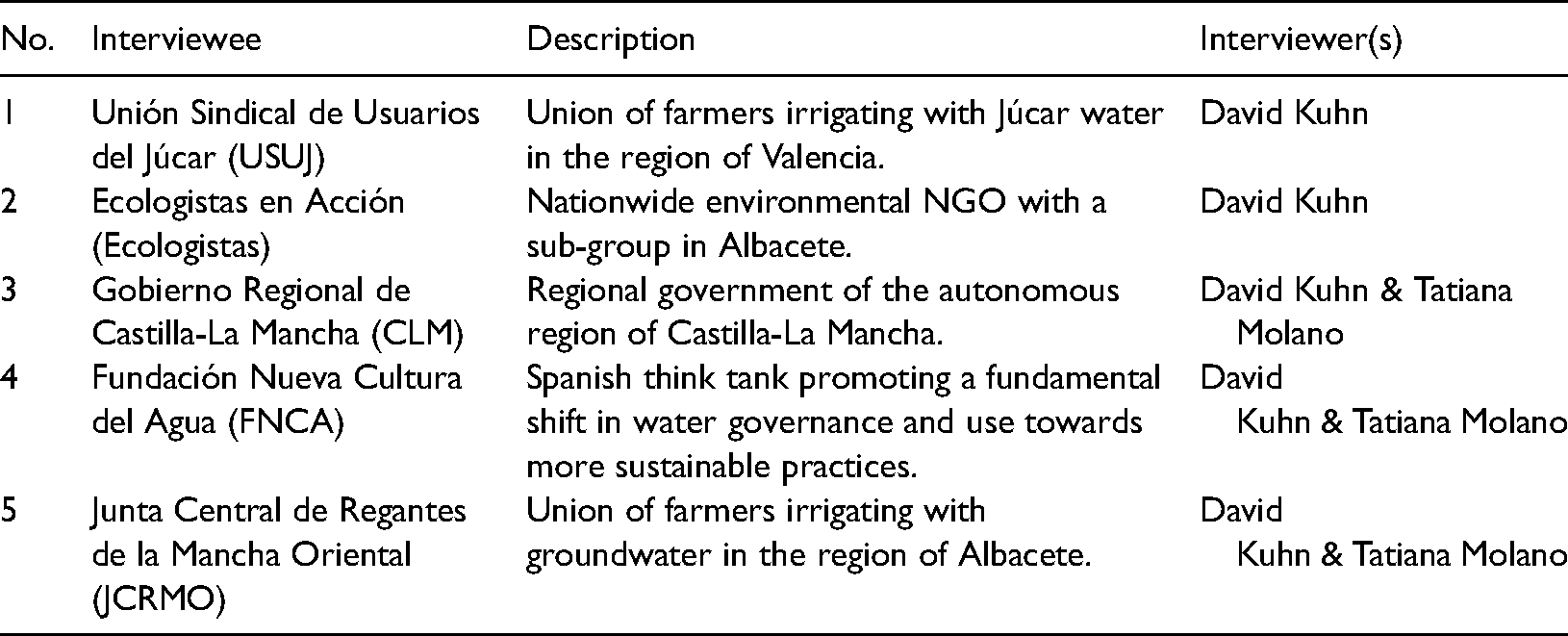
| No. | Interviewee | Description | Interviewer(s) |
|---|---|---|---|
| 1 | Unión Sindical de Usuarios del Júcar (USUJ) | Union of farmers irrigating with Júcar water in the region of Valencia. | David Kuhn |
| 2 | Ecologistas en Acción (Ecologistas) | Nationwide environmental NGO with a sub-group in Albacete. | David Kuhn |
| 3 | Gobierno Regional de Castilla-La Mancha (CLM) | Regional government of the autonomous region of Castilla-La Mancha. | David Kuhn & Tatiana Molano |
| 4 | Fundación Nueva Cultura del Agua (FNCA) | Spanish think tank promoting a fundamental shift in water governance and use towards more sustainable practices. | David Kuhn & Tatiana Molano |
| 5 | Junta Central de Regantes de la Mancha Oriental (JCRMO) | Union of farmers irrigating with groundwater in the region of Albacete. | David Kuhn & Tatiana Molano |