




Abstract
How can we think and live with vegetal life in uneven urban environments? The paper traces vegetal relations in the streetscapes of Coimbatore, a city that was undergoing urban change through the growth paradigms of smart datafication and beautification. Interviews with street vendors in the beautified streets of the smart city program of Coimbatore pointed to protracted caring relations with avenue trees. By rethinking and bringing together the notion of ‘bare life’ that has been variously used to denote the lack of political existence of plants and marginalized humans, the paper contends that ruderal involutions alter such understandings. A radical socio-vegetal potentiality is enacted by the fusing of spatial and arboreal politics in the city, where planting and caring for street trees becomes an enactment of more-than-human justice. Advancing the notion of ruderal involutions points us towards a politics that is qualitatively different from solely focusing on the ontic violence imposed on plants. Rather than ‘decentering the human’ as an antidote to violent relations between and across species divides, what emerges in these narratives is a reclamation of people/plant involutions that further planetary well-being. More-than-human survival benefits from an enlistment in radical ways of organizing, co-conspiring, and solidarity building, as much as their mobilizations reify oppressive and exclusionary regimes of dispossession in the city.
Vegetal geographies in uneven urban environments
How can we think and live with vegetal life in uneven urban environments? The paper proposes to expand our analytical thinking about the making and remaking of urban spaces through the capacities of and entanglements with the plant kingdom, thus contributing to the literature on vegetal geographies. Vegetal geographies, a sub-set of more-than-human geographies, is increasingly gaining traction in unpacking human-plant relations (Barua, 2023b; Cloke and Jones, 2002; Ernwein et al., 2021; Head and Atchison, 2009; Head et al., 2015; Lawrence, 2022). Outside of a few notable exceptions (Gandy and Jasper, 2020; Rosengren, 2022), vegetal geographies have not dealt with questions of urban space and governance. The paper adopts vegetality as a ‘central analytical cut’ (Head and Atchison, 2009: 237) to illustrate how this changes the way we think about urban politics and informality. It traces vegetal relations in the streetscapes of Coimbatore, a city that is undergoing urban change through growth paradigms of datafication and beautification.
Urban natures in South Asia have largely been analysed through the frameworks provided by urban political ecology (UPE), that explicates how the capacities of and outputs from nature “are socially mobilised to serve particular purposes” corresponding to the “geometries of social power” (Swyngedouw and Heynen, 2003: 902). An urban politics of aesthetics prevails, wherein middle-class dwellers aspire to live in a civilized, ‘world-class' city free from the squalor and nuisance caused by the presence of the poor, thus pushing out the marginalized from accessing basic rights and services in the city (Coelho and Raman, 2010; Ellis, 2011; Ghertner, 2015; Ranganathan and Balazs, 2015; Roy, 2009a). This imagination and grasp of the urban is further extended to explicate relations with the other-than-human, for instance through the ordering of ‘stray' cattle in the city (Baviskar, 2003, 2020). However, an understanding of how the other-than-human forms part of the urban social fabric and has bearing on its politics (Barua, 2023a; Hinchliffe and Whatmore, 2017) opens up newer sets of conversations between UPE and more-than-human geography (Barua, 2019; Brice, 2021; Gandy, 2022). The paper explores how paying attention to socio-vegetal relations and orderings can bring forth such imaginations.
Most of my dissertation fieldwork traced a traveling model of greening, namely the Miyawaki method of afforestation 1 that rendered trees as ‘artifacts’ and ‘indices’ (Elkin, 2022). Other-than-humans are increasingly rendered as infrastructures, deployed for a range of causes such as in rewilding experiments (Lorimer, 2020), urban sewage management (De Bondt and Jaffe, 2022), and in keeping turbulent futures at bay (Barua, 2020). Cognizant, however, of the livingness of these arrangements, Acosta and Ley aptly theorize bio-infrastructures as “an evolving set of multispecies and material relations” (2023: 02). This raises the question: how do we think about vegetal life in uneven urban environments? Is there merit in thinking about ecological relations in starkly divided cities beyond dispossession? And conversely, what does tracing plant life tell us about urban inequalities? As I tussled with these questions through the course of my fieldwork in Coimbatore city in India, chancing upon radical socio-vegetal relations offered a serendipitous answer to an “ethnographic hunch” (Pink, 2021). By tracing the affective and mundane relations between street vendors and trees, I outline how a radical socio-vegetal potentiality, a “ruderal involution”, is realized through the fusing of a spatial and arboreal politics. In the following section, I merge two strands of literature on ‘bare life’- a notion that has been variously used to denote plant and marginalized humans – to explicate a ‘ruderal involution’ that can supplement both sets of theorizations.
Bare lives – of precarity and photosynthesis
Aristotle's scala naturae has hitherto set the stage for ‘decentering the human’ (Hall, 2011; Head et al., 2015; Marder, 2013) by signifying the epitome of Western rationality and ordering vegetal beings at the very bottom of the hierarchy of bios. Thinking on plants has been prevalently limited to nominalism, such as the integration of plants into schemas of taxonomic classification, or Hegelian conceptualism, where the living flower is a only but a fleeting mediator from the organic to the inorganic (Marder, 2013). It is thus argued that an attention to vegetal agency would correct past neglect and reverse the ‘ontic violence’ imposed on plants. For Marder, plant life presents an opportunity, as it signifies “life in its an-archic bareness, inferred from the fact that it persists in the absence of the signature features of animal vivacity, and it is a source of meaning, which is similarly bare, non-anthropocentric, and yet ontologically vibrant. In a word, life as survival” (Marder, 2013: 22). In this reading, bareness is to be celebrated for it presents an opportunity for decentering the human. It would help us undo the Aristotelian ordering of plants that evaluated them through an anthropocentric lens, or in terms of animal capacities of motion and cognition and reduced them to a lack. Plants occupy greater ethical and ontic distances from humans, but for Marder, that presents a strength to redeem life from its animality.
Let us now move to the second set of characterization of bare life. For Agamben too, bare life signifies a lack; it refers to human lives that are denied a political existence and become the subject of governance (Agamben, 1998). Drawing on the Aristotelian distinction between bios (political existence) versus zoes (bare life), the concept has been transported to the third spaces occupied by informal and migrant workers who are governed in a space of ‘rightlessness’ (Kamete, 2017; Kitiarsa, 2014). Contrary to Marder's conceptualization, bare life is far from emancipatory here. However, as pointed out pertinently in ‘Habeas Viscus’ by Weheliye (2014), Agamben's bare life inscribes an “absolute biopolitical substance” prior to race (2014: 13) instead of a socio-political process of differentiations and heirarchizations that form racializing assemblages. Similarly, work in geography and development studies have pointed to how informality and precarity is not an empty signifier, but a result of the stripping of basic legal and social protections of the state, an outgrowth of casteist and gendered regulations of social organization, and of capitalist modes of economic production (Chen and Carré, 2020; Harriss-White, 2023; Roy, 2009b; Skinner and Watson, 2020). Variously, the production of urban space by street workers has been studied through the lens of informality (Gill, 2009; Harriss-White, 2014), labor (Bhattacharya, 2014), or social infrastructures (Gidwani and Maringanti, 2016; Simone, 2004). Street vending, operating in a liminal, informal space, offers a means of staking claims to urban space and reproducing key services in the city - processes termed as occupancy urbanism (Benjamin, 2008) or infra-power (Blom Hansen and Verkaaik, 2009).
‘Ruderal involution’, in this context, offers an analytic to disrupt the notion of ‘bare life’ and unpack the material and political collaboration of the urban poor and plant life subsisting in hostile spaces of the smart city. The term ‘ruderal’, meaning rubble, offered a new way of studying composition of urban natures emerging in marginal spaces, in unseeming spots or rubble-like conditions in post-war Berlin (Gandy, 2013, 2022; Lachmund, 2003). However, what distinguishes Stoetzer's (2022) use of the term in ‘Ruderal City’ is that the unintended ecologies themselves do not serve as a window for cosmopolitan hope (p. 5). Instead by centering marginalized (and particularly, racialized) entanglements with greenery, what emerges is a conjoined politics of racial and environmental justice. I probe how the lens of ruderality – which troubles the established order of desirable, favorable, or intended more-than-human relationships and flourishes amidst hostility and relocation (Stoetzer, 2022: 4–5) – holds in liminal spaces that subsist within intensified regimes of concretization and ordering in modernist cities. In this context, ruderal points to an ‘urban otherwise’ – to forms of earth traversal charting out alternate forms of land and property relations outside of capitalist urbanization (Bathla, 2024b).
Involutionary momentum is defined as an affectively charged encounter, a push and pull amongst bodies, “the affinities, ruptures, enmeshments, and repulsions among organisms constantly inventing new ways to live with and alongside one another” (Hustak and Myers, 2012: 97). Drawing from affect theory which deals with materials, movements, textures, and intensities as they work through bodies (rather than a direct signification of meaning) (Stewart, 2007), trans-corporeality points us towards the connections in the body as intra-acted upon by social power and geographical agencies (Alaimo, 2010). Bodies, including those of plants in these accounts, are not mechanical actors but they enchant and articulate (Myers, 2015). As a result, shade is not an ‘innate’ quality of avenue trees, not only a ‘civic resource’ (Bloch, 2019), but a precariously produced form of metabolic and affective labor (Atchison, 2021); a material outcome of a tree's lively growth and its rootedness. Writing about itinerant banana vendors and macaques, Barua writes how it is the more-than-human proximities of affects and attunements that provide the bedrock of such ‘affective economies’ in urban fringes (Barua, 2023a). By pooling these vocabularies from more-than-human geographies and affect theory, I talk about an affective, embodied, and marginal plant-people relation, a “ruderal involution”, that works to combine analyses of environmental concerns and the politics of urban poverty.
Method and case
Most of the qualitative materials presented in this paper were collected from the central areas of Coimbatore city, especially around the Race Course neighborhood (hereafter simply ‘Race Course’). Coimbatore is the second largest urban agglomeration in the province of Tamil Nadu in India – it is surrounded by the Western Ghat mountain ranges on three sides and is thus located in an ecologically sensitive region. Surrounding the city is the river Noyyal and its catchment systems consisting of lakes, wetlands, and canals that have degraded due to construction activities. The city's industrial past, rapidly growing population, and ongoing expansion along the major radial roads make it an important hub of commercial development in Tamil Nadu. It was also selected by the Indian Government for the Smart City Mission, to develop its visions to become a ‘vibrant economy’ and a ‘clean and green’ city. Interventions under this scheme include inner city redevelopment, biodiversity protection, and regeneration of lakes and water bodies. In reality, smart-ification entailed the concretization and beautification of lake beds for revenue generation, through the issue of tendered contracts to ‘reputed’ food vendors to step up stalls in the lake bed or the launching of tourist boat rides in the lake. The award-winning lake development project entailed eviction and relocation of informal settlements around the water bodies (The Hindu Bureau, 2023; The Times of India, 2019b).
Race Course was a planned British neighborhood in the center of the city constructed to house colonial officers’ bungalows and administrative buildings, built in and around a ring road. Today, the ‘iconic’ neighborhood comprises of old, new, and transplanted trees, institutions, restaurants and cafes, shopping opportunities, and gated apartments. The ring road is bustling with folks – old and young, lovers, friends, vendors, housemaids, walkers, and joggers, circling the 2.25 km footpath (Figure 1). Race Course was also a ‘model road’ site beautified under the Smart City mission. The corporation and the highway authorities evict street vendors around central areas on a recursive basis and hope to identify designated spots where vendors can set up stalls and push-carts (The Hindu Bureau, 2024). These sanitation drives gain momentum during city upliftment drives such as the Smart City program (The Times of India, 2019a).
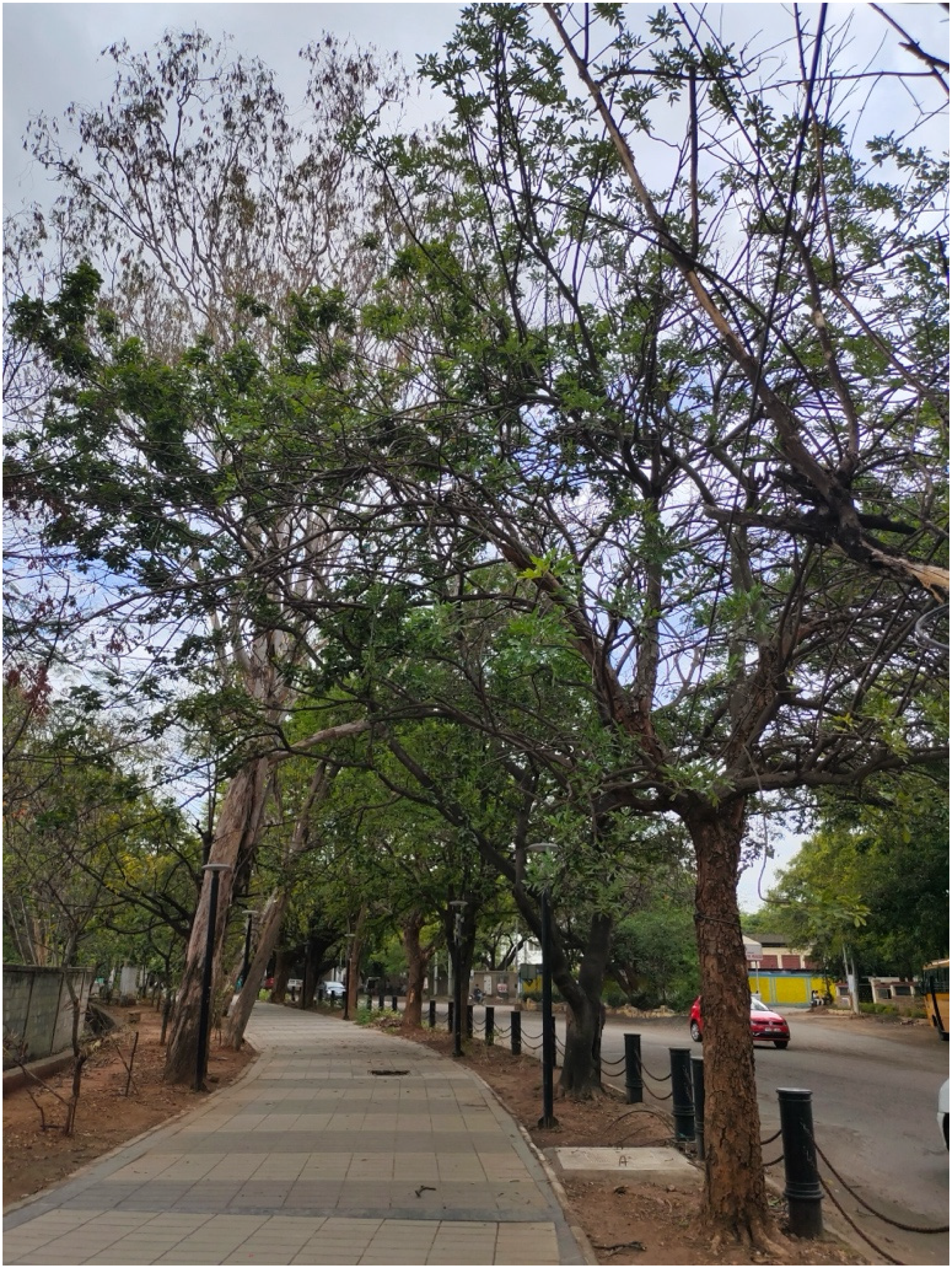
Tree lined walk-way in Race Course, Coimbatore.
With concrete walkways and installations being set up, Race Course is now “attracting a good crowd”, a resident shared during their evening walk. Many old trees were cut to make way for road widening and infrastructural installations. Farhan, an environmental activist, noted that the COVID lockdowns provided a ripe opportunity for such “anti-environmental work” of tree felling across the city. Residents lamented how tree felling is routinely carried out for road expansion in the major arterial roads of the city. Not only were trees chosen in government planting programs based on their ability to grow faster and requiring less maintenance (such as the Gulmohar tree or Delonix regia), but also they were rendered as interchangeable ‘things’ through the governance frameworks of compensatory afforestation and transplantation (Figure 2). Compensatory afforestation is an outgrowth of environmental legislations such as the National Forest Policy 1988, offering a number-based approach to greening of the state: In 2014, the Madras High Court ruled that the National Highways Authority of India needs to replace every cut tree by planting ten trees (The Times of India, 2014). Transplantation emerges in this policy context as a pragmatic conservation tool to replant and transfer tree stumps affected by road widening to peripheral locations. Overall, a tightened role and ambit for environmental organizations in urban governance was witnessed, with the city's mayor passing a municipal resolution criminalizing protests against tree felling as an obstruction to the development of the city (The Hindu, 2012).
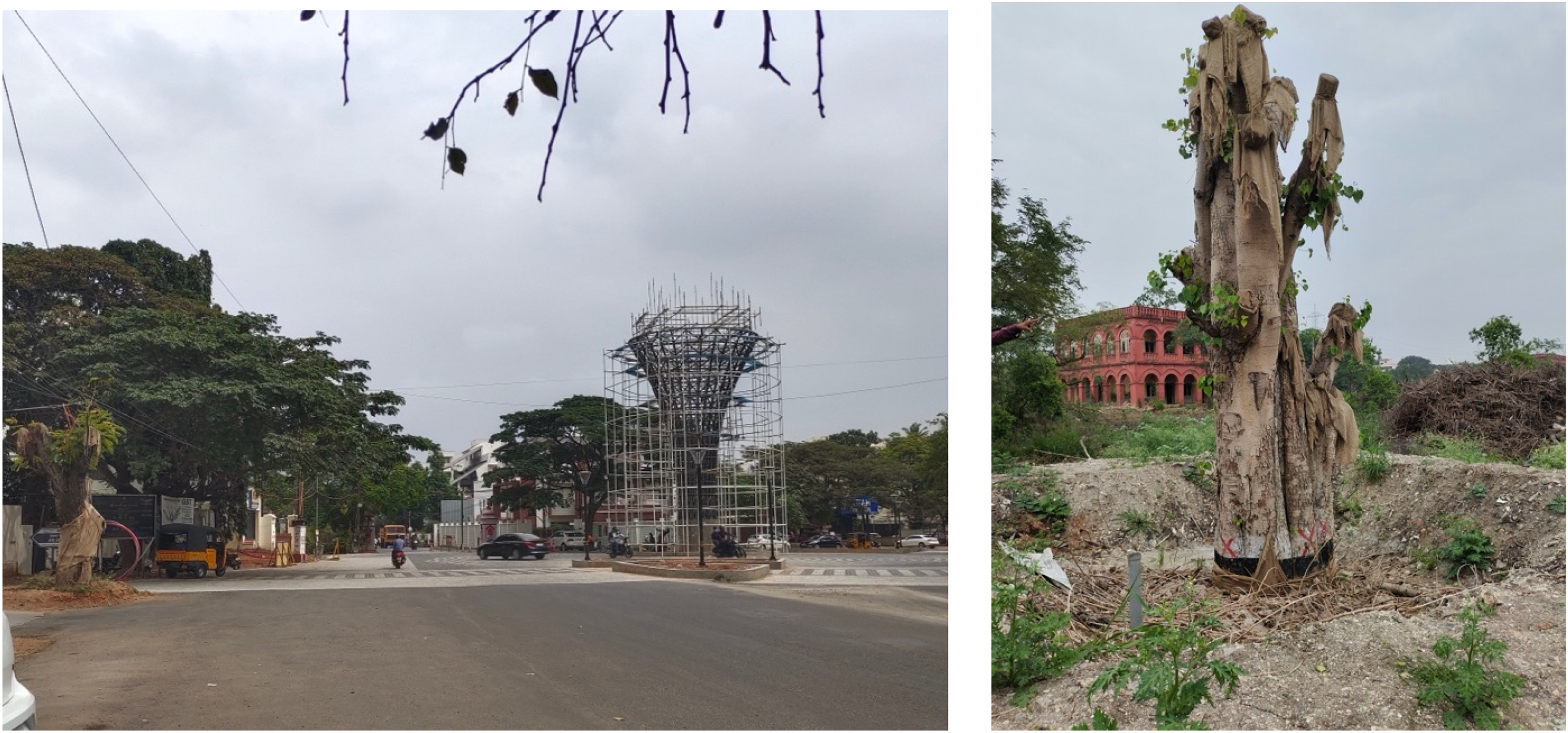
From left to right: (a) Smart city installation which resulted in a tree transplantation (on the left of the image). (b) Transplanted tree stump from one of the main roads of the city to an institutional premises.
This research forms part of a dissertation project with a total fieldwork period of about nine months. Materials presented in this paper were collected between June 2022 to January 2023 and a follow-up visit from November 2024 to January 2025. To spot and sketch the varied relations between people and plants in the city, I walked through the city's streetscapes conducting unsystematic plant watches in my early visits. Walking allows the researcher to trace the multi-sensory experiences offered by an urban landscape from the silhouettes of trees to the thermal relief provided by shade (Bathla, 2024a) and leads us towards “the biographies of encounter”(Mathews, 2023: 40) between trees, people, and other beings. In this case, sensory walking enabled observations on dying, coppiced, and transplanted trees,avenue tree stumps with lopsided canopies chopped to make way for overhead electricity cables (Figure 3), stationing practices near well-established canopies, and freshly planted saplings next to food stalls (Figure 4). Such a method does not advance an ‘ocularcentrism’ (Chao, 2022) as seen in modernist cartographies and geo-spatial techniques of measuring greenery through the reflectance of earth's surfaces, but can be read as an embodied and sensory method that seeks out photosynthetic potentiality. The paper thus also depicts and draws from the photographs from my fieldwork, where ethically permissible.
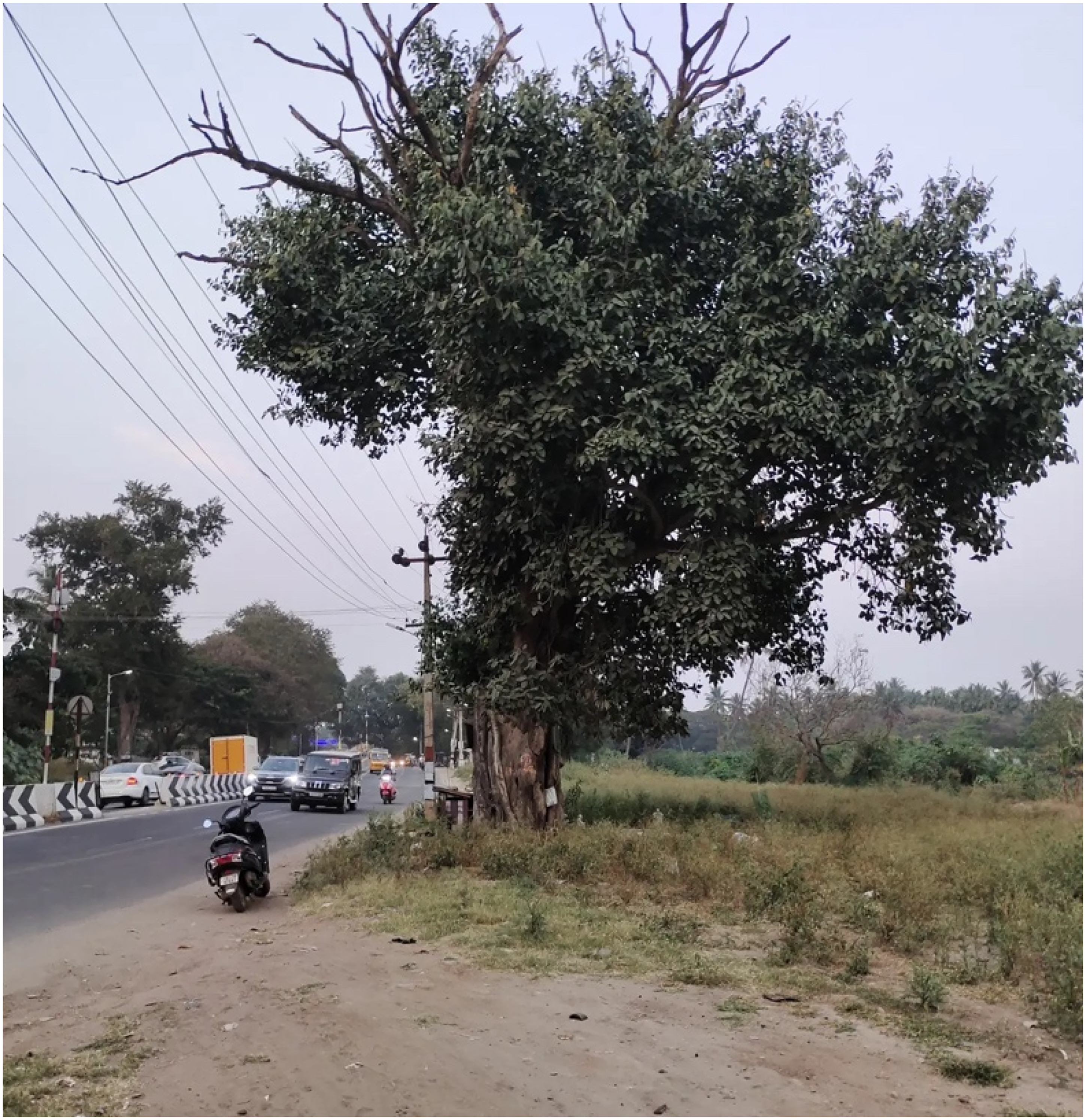
A streetside banyan tree (Ficus benghalensis) heavily trimmed to make space for overhead electic cables.
Semi-structured interviews were conducted through the day, especially around morning and afternoon hours. Interlocutors included highway engineers, who were involved with the governance of avenue trees (n = 2), house-maids, contract workers, and municipal street sweepers who cleared up leafy wastes (n = 5), street vendors (n = 24) in the central neighborhoods of the city, and the leader of the street vendor association. Following the initial round of interviews conducted with street vendors in 2022–23, I conducted follow-up interviews and observations in 2024. Most of the respondents spoke the regional language and hence, interviews were held in Tamil. Hindi was used to converse with two male, migrant street vendors, which meant a slightly diminished engagement since I possess limited working proficiency in the language. Street vendors belonged to a heterogenous religious and caste group, claimed the association leader, although most of them hailed from the lower status caste groups, such as the backward caste group of Konars or scheduled caste groups such as Parayars. In addition, in-depth conversations with environmentalists and residents of Coimbatore city informed my analysis. I also compiled news clippings in Tamil and English, government reports on smart city projects, field notes of participant observations during the annual city festival (Kovai Vizha 2022 and 2024), and social media discussions surrounding neighborhood redevelopment by civic clubs.
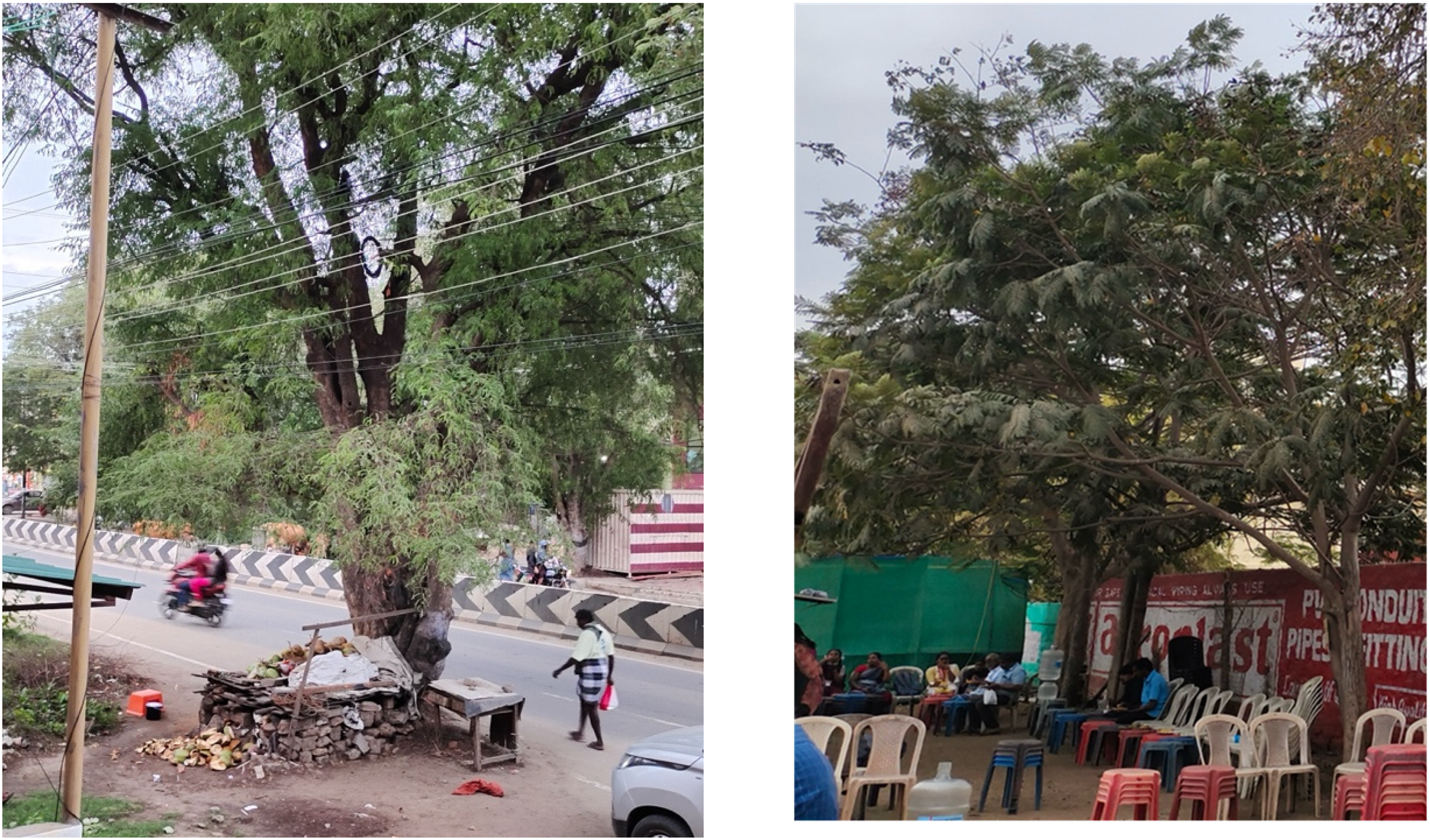
Stationing as a trans-corporeal practice, as seen in old and new vegetal growth.
Ruderal plant / people involutions – An opening for photosynthetic politics
On the very walk-ways concretized by the smart city, I spotted Nimmi foraging for left-over tamarind. The tree-lined ring road is littered with leafy wastes all year, and one can spot the occasional dark brown, sticky pulp trodden on by walkers and joggers. Tamarindus indica is a familiar tree for Tamils, with the fruit pulp being widely used for making several culinary staples. Tamarind pulp is a ‘minor’ forest produce, also referred to as non-timber forest product – a category that includes a vast variety of plant products, and may be sub-contracted for collection as a way of supplementing government revenues. Seeds do not behave in the order of smart design and the tamarind trees of Race Course were not contracted for pulp collection 2 . This presented a ruderal opening: an unruly potential for relating with vegetal beings in the smart city. Nimmi told me: “I like the tamarind trees here! It gives tamarind (pulp). I pick up one or two times as I find something and use it for cooking.. especially when I do not have enough tomatoes for sambar. 3 But today this is all I got” (she showed the single seedpod she had collected that noon). However, Nimmi's entanglements exposed her to a risk of admonition by her employer, who resides in a high-rise apartment in the neighborhood: “If madam sees me picking up tamarind pulp from Race Course, she would fire me” she said, motioning me to walk away faster from the walk-way before continuing our conversation. A contractor for an agency that manages street sweepers echoed this sentiment: “the tamarind here goes to waste, as the people who walk here are very hi-fi 4 people. So no one picks it up.. only people like us pick it up”. It is happenstance meetings like those with Nimmi that led me to the path of looking out for ‘ruderal involutions’ in the vegetal geographies of Coimbatore.
Nostalgia for a greener and cooler Coimbatore prevailed in many of my fieldwork encounters. Coimbatore's residents took pride in its ‘salubrious’ weather conditions, especially in comparison to hot and humid urban life in other cities of Tamil Nadu. However, the salubrious climate of Coimbatore did not liberate street vendors from the want of an escape from the scorching sun. Afternoons during the summer months in the city can average around 37 degree Celsius, with figures rising annually 5 . Embodiments of urban metabolisms unravel in uneven ways (Doshi, 2017; Gay-Antaki, 2023; Truelove, 2011). Unsurprisingly then, street vendors in central Coimbatore were often stationed under avenue trees, for their working bodies embroiled with everyday matters of thermal regulation. Many of the city's street food vendors mentioned how essential arboreal shade was; it was one of the decisive factors in choosing a spot. Other factors may comprise finding a convenient parking for the cart, safety for women workers, and proximity to the desired customer base, such as for instance, lunch stalls for office workers or snack carts near schools.
The Tamil word Veyil is not the same as the rays of the sun or sunshine, as it descends as an over-bearing thermal envelope over the body and spirit. Here, I use Tamil lexicon in order to speak to climate imaginaries and vocabularies in urban South Asia (Rehman et al., 2023) and to retain a sense of irritation in the usage of the word, an ordinary affect evoked by the weather. Kamala, a tender coconut vendor told me, “We need shade for setting up the cart, right? How long can I stand in veyil? At the most, let's say for an hour. Or for a day I could do it. Can that happen on a daily basis? Definitely not.. How long can a person stand in veyil? If not for the tree, I cannot even fathom being here. We are eking out a living here also because of this tree.” The tree not only helped soothe one's own sweltering body but also mediated other social relations. A chaat (snack) vendor under a jamun (Syzygium cumini) tree mentioned: “Seeking a tree's shade, a sizeable crowd would conglomerate around it. If there is motta veyil (blazing sun with no cover), no one would be here”. A migrant vendor was working under an expansive banyan tree and selling sweet lime juice. The tree's crown and the shade offered by its canopy spilled onto the street corner from a high-walled private premises inside which the tree was planted. With my broken Hindi, we conversed: “The police keep chasing me to move my cart.. I stand here because people take a pause and stop under the tree when there is dhup (veyil). They might have a juice or two in the meantime, and the profit is ours to take”.
Literature on street vendors showcases how vendors negotiate and contest the use of space vis-a-vis a Janus-faced state, which is in itself is a heterogenous entity composed of ambivalent social policies, street governance mechanisms, and labor regulations (Batréau and Bonnet, 2016; Hansen, 2004; Palat Narayanan, 2022). Even as stationing practices may be produced through local socio-economic networks and street level bureaucracy, I contend that these relations are also mediated by the more-than-human, affective, and corporeal negotiations pertaining to micro-climate regulation in an increasingly concretized city. Ruderal plant / people involutions enable the researcher to look at how not all kinds of greenery serve bourgeoisie visions; it affords the vendors an ethical-political agency in continuing to inhabit and relate to trees in the smart city without casting their lives as ‘bare lives’.
A young idli 6 vendor recounted her sensory entanglements of ‘breathing with’ the vaagai (Albizia saman) tree she was stationed under: “It is a different kind of feeling when I stand under this tree and a breeze hits. When I breathe under this tree, the burdens of my heart goes away”. If only she had her own house with space, she would plant a lot of trees. A drink stall 7 worker collected the flowers of a palaasu (Butea monosperma) tree under which he was stationed and would sell it to other itinerant buyers, who were procuring it for manufacturing herbal medicines, as a means of supplementing his income. But he did not only commodify the flower; he also saved some of its bright, big, and beautiful orange flowers for adorning his Tamil daily calendar with the picture of Lord Murugan (a beloved God for Hindus in Tamil Nadu) and the digital payment scanner card that enables quick payments in return for sherbet (Figure 5). Beauty and play lend itself well with involutionary momentum, where plants contrive with pollinators who are enthralled with the fleeting phase of bloom. Here, value is not solely placed in the plant's transition to inorganic commodity, reducing its life to an ‘economy of parts’ (Elkin, 2022). In the corner of a buzzling intersection in the city, Jayakumar, an elderly tender coconut vendor worships the street tree on which he bolsters his vending cart (Figure 6). A part of the tree bark started to grow and take shape resembling the form of a popular Hindu God, Vinayagar: “Look at it (tree stem) ma 8 .. It is like God himself. I bring flowers that the priest from the Murugan 9 temple gives me every morning. Then I wash the tree, apply turmeric, holy ash, and vermillion..The place we stay must always be respected”.
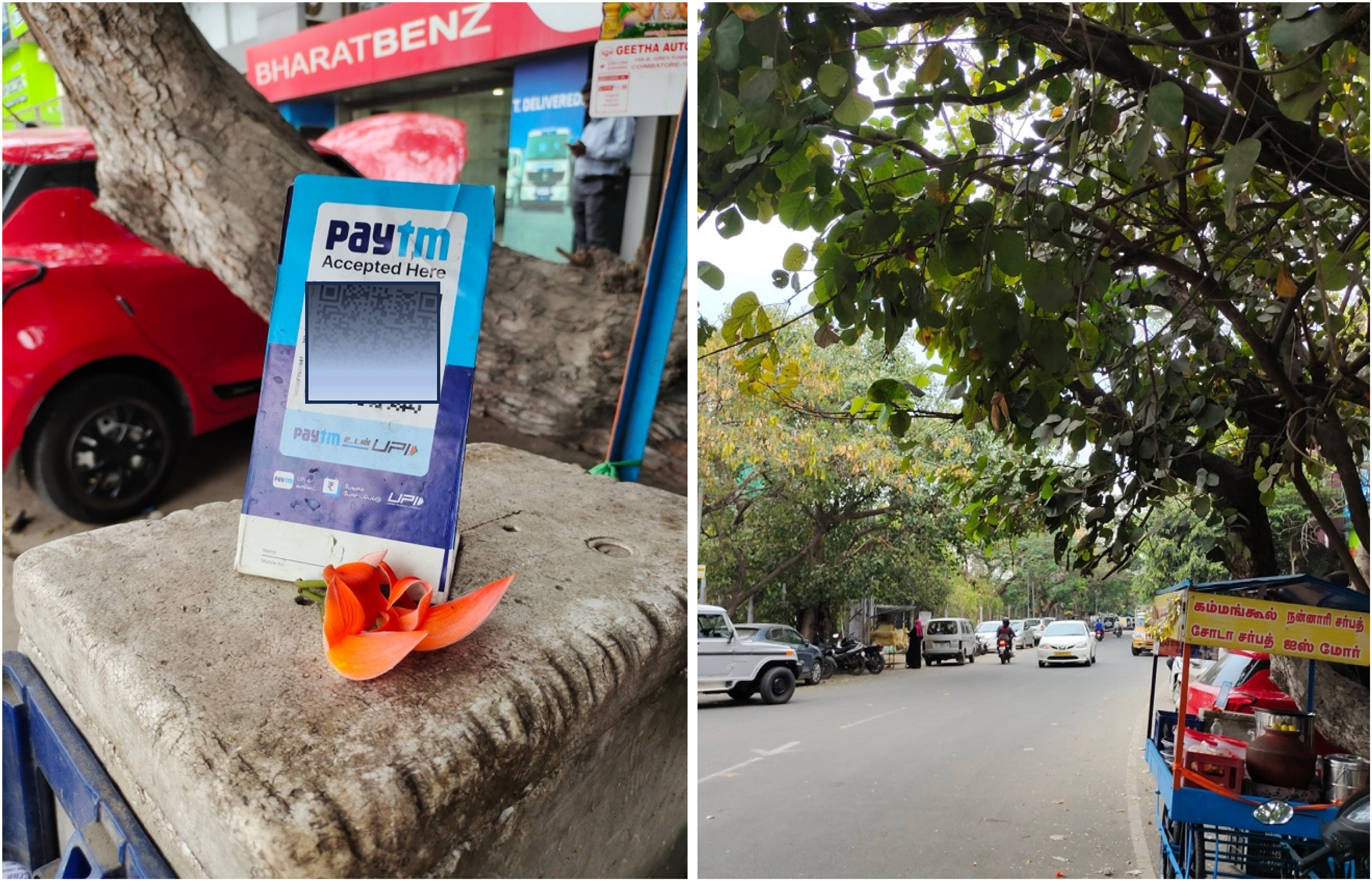
The uses of Palaasu in a sherbet stall.
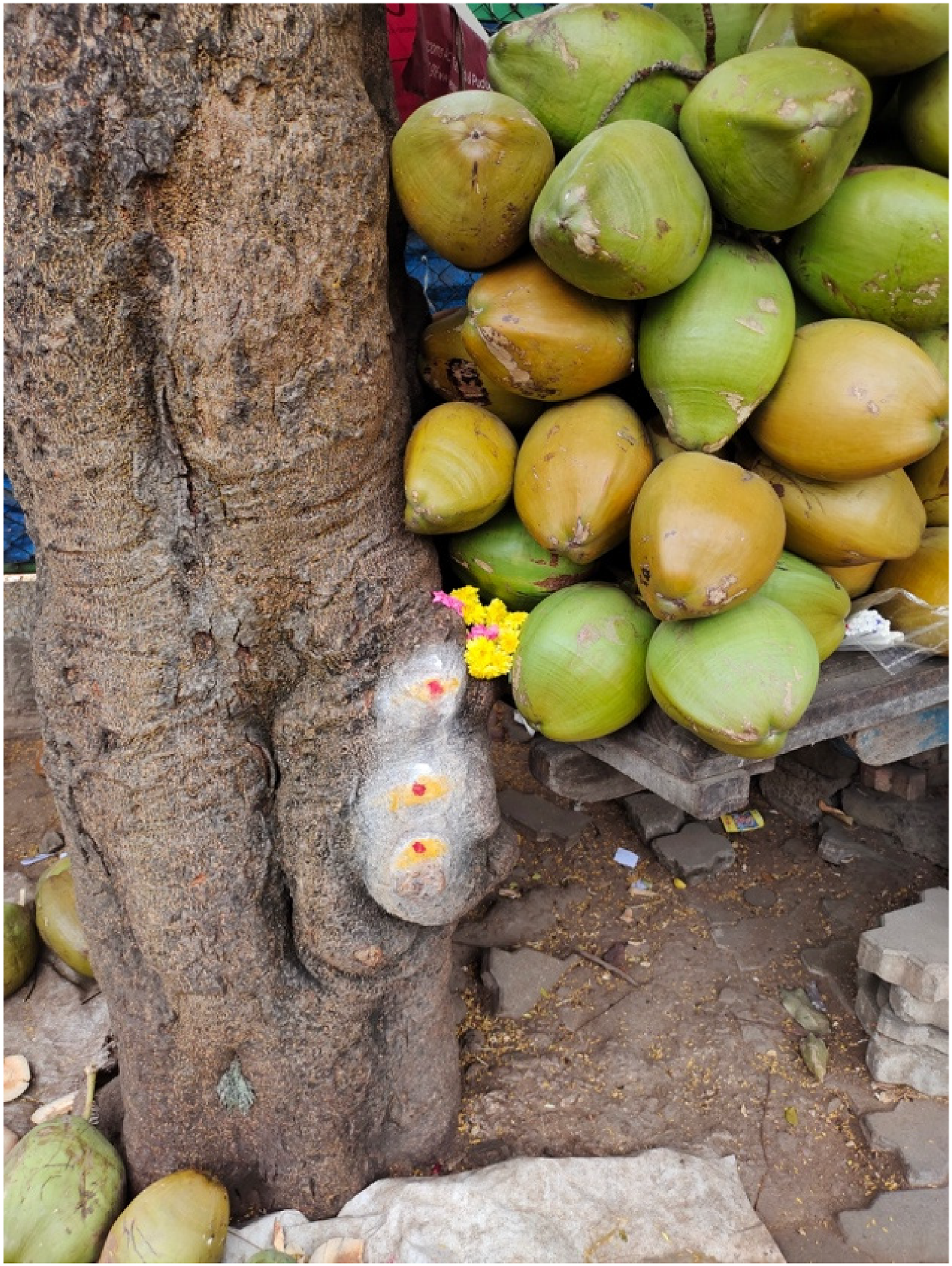
Divine bark: a sacred staging of socio-vegetal relations.
In these vignettes, we learn how even the streets of a concretized and beautified smart city can become “a well-tended garden” – “a stage for plants and people to perform their entangled powers” (Myers, 2017: 297). Involutions forged long-term memories with trees marking the landscape; vendors affectively engaged with trees as spiritual forces, place-markers, or micro-climate providers. Beyond scientific categorizations or economic valuation of trees as commodities, vegetal vitality was appreciated and embraced, even if it was not always convenient. For instance, for nearly a decade, Nirmala, a sugarcane juice vendor, fetched buckets of water to care for the two mayil-kondrai (Caesalpinia pulcherrima) trees that were planted in the next street but were not maintained by the government. Kumaran's chaat clientele gathered force in the evening hours but he tolerated the veyil till six in the evening; enough was enough. He found some badam (Terminalia catappa) saplings on the street and planted four trees next to his cart. However, human-plant stewardship is not a one-time affair. Since water facilities were not available on the street, Kumaran fetched water every day from a tank nearby to water the saplings. Siva too planted a tree five years after setting up his trade. The tree is now thirteen years old and every day, he waters his tree before returning home. Recently, he installed a water pipe near his stall by circumventing extant water connections, but until then it meant carrying pails of water from across the street. Pavitra reminisced about the time she planted two trees with her husband, and her children used to play under the crown: “my child was studying in LKG (lower kindergarten) when I planted this tree, now she goes to seventh standard (high school)”.
Trees not only convened humans and non-human beings through matters of metabolic transfusions, thermal regulation, and aesthetic entanglements, but they facilitated disengagements or exclusions (Giraud, 2019). They provided a legal buffer from road expansions and street vendor evictions. Being stationed under trees also saves vendors from being accused of blocking road traffic. Siva mentioned how the tree adds an “additional layer of safety” by being a hindrance for unchecked road expansion. In Indian cities, the street vendors who were termed as ‘illegal’ and ‘informal' had lesser legal protection from street-level bureaucracy for removal. On the other hand, removing trees presents a bureaucratic hurdle, because felling trees must be compensated with afforestation. As a result, all road expansions included seeking permissions for deforestation which delayed road expansion. Likewise, when the corporation planned to chop trees off, vendors attempted to save the trees that they have been tending for. “I struggled and raised those sakkaraipalam (Muntingia calabura) trees like my children. I told them not to cut it down”, Nirmala lamented about an axed tree in an adjacent road for road widening. Pavitra's testimony confirms such a collaboration: “We (herself and a neighboring sugarcane juice vendor) planted all the trees on this road, so that the shops can be set up right next to it and the police will not chase us out. Look, this tree has died during COVID (lockdown) times without our care”.
Myers writes on staging conspiratorial relations between people and plants to better each other's chances of survival (Myers, 2017): I describe such a co-conspiratorial praxis. However, stories of survival and loss unraveled in uneven ways. When trees were marked with an ‘X’ sign by the roadways department, it indicated that the trees were slated for a death sentence in order to make space for road expansion. While this has been a recurring and sobering story for environmental activism in most Indian cities, it has been largely missed out that the street vendors were simultaneously readying to relocate along with the trees. For instance, when trees were transplanted for smart city's road widening measures and for setting up of spectacular installations on the street, street vendors were affected along with the trees and had to find new companion beings. Kamala found a new spot under a tamarind tree where she and her husband are now stationed, about half a kilometer away. She pointed to where the transplanted tree now stands - a thick trunk covered with jute rugs, and chopped off at the forked base from where an expansive crown once spread out from. A bunch of yellowish-green vegetal growth sprouted from one of the two trimmed branches, but whether the tree would flourish in its newly designated spot was dubious. “It is all up to them.. The tree has now been lifted and moved to this corner” she said.
Not all vegetal relations are benevolent in my account of Coimbatore's vegetal geographies. In an asbestos stall built between a forked tamarind tree (Figure 7), Punitha noted: “It is God that is keeping me safe till now. You know what our ancestors have warned us about -there are ghosts under the tamarind tree”. The tamarind tree in Indian mythology is associated with the abode of unholy nocturnal ghosts, and it is commonly said to release ‘hot’ air unlike the neem tree that has cooling properties. Such arboreal myths and local cosmologies in cities (as documented by Nagendra and Mundoli, 2019) play a key role in affective engagements with particular tree species. After a moment of eerie silence and my instant regret of conducting interviews in the evenings, we changed the subject to talk about other immanent threats - such as Punitha's impending relocation as the highway officers had informed her of road widening. Unlike Kamala, Punitha could not relocate anywhere closeby, as a developer was building a large residential project in the area.
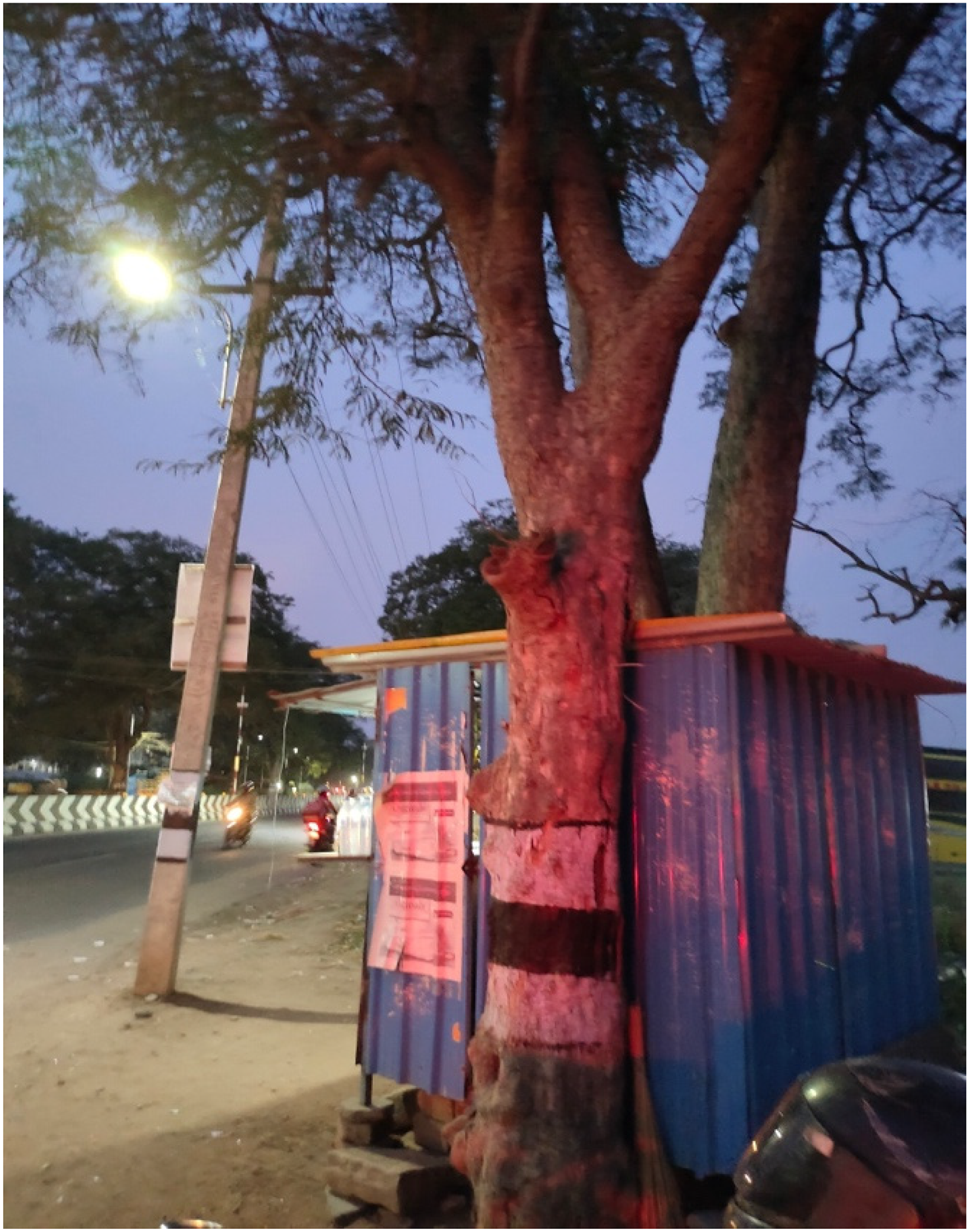
Ghostly presences in the tamarind tree.
Discussion: From bare lives to bio-infrastructural becomings
In a bid to undo ontological violence, some of the posthumanist literature points to overturning anthropocentrism and human superiority by highlighting vegetal agency and the bare survival of plants as sources of meaning. Marder's bareness, even as it seeks to redeem vegetal life, ends up reducing it to a being without depth and history, devoid of relations with other beings and matter, and absent in the politics of urban space. Ontic critiques of bareness do not speak to ‘arbori-cultures’ (Cloke and Jones, 2002) – or the cultural practices of relating to plants emerging from cosmologies, media narratives, politics, ethics, scientific and historical classifications, and capitalist means of exploitation that shape relations with plants. In this paper, rather than characterizing the agency of bio-infrastructures, such as avenue trees, as the unruly spillages of the plant kingdom onto infrastructural assemblages in cities (Acosta and Ley, 2023), I have illustrated how ruderal involutions are at the very crux of the formation and maintenance of bio-infrastructural meshworks. Relations of foragers, street vendors, and city dwellers to avenue trees and plants pointed to an urban becoming that transcends state-led greening discourses and sustainability fixes.
Acosta (2023) speculates that bio-infrastructures will transcend its instrumentalization to further more-than-human justice. While the paper points us in this direction, I remain cautious of a close-ended and quick celebration of the bio-infrastructural potential to achieve just socio-vegetal transformations. As my ethnographic vignettes illustrate, not only vegetal life remains prone to being understood and treated as things- for example, as ordering devices for regulating human activity (Braverman, 2008) or as street furniture (Braverman, 2014) - but also a stark unevenness is seen in the intra-human hierarchies at the juncture of infra-political enmeshments, as pointed out by recent work in more-than-human geographies
(Chao et al., 2022; Crowley, 2024; Ranganathan, 2022). Coimbatore's street vendors point us to the unevenness of bodily harm and recurrent cycles of dispossession brought forth by urban accumulations at the cost of the marginalized. Thus, these human-plant relations are conditioned by intra-human structures of oppressions such as class and caste inequality, as shown in the case of relations with pigs in informal settlements (Gutgatia, 2020; Narayanan, 2023). In the case of Coimbatore's model roads and smart projects, socio-vegetal relations are further fashioned by the modalities of urban governance and its recurrent cycles of dispossession by characterizing some economic activities and spatial uses as illegal and informal.
Yet, we see how the agency of street vendors cannot be reduced to a bare living in this ethnography of streetscapes. Ordering practices can be impure and messy (Hinchliffe and Bingham, 2008), thus requiring the need to empirically examine a contingent politics. The biopolitical ordering of street vendors and trees within entrepreneurial urban regimes trouble the Aristotelian scala naturae and showcase how certain human subjects are afforded equal or even lesser biopolitical guardianship in the streetscape as trees. However, dispossession of street vendors in the uncivil city need not evidence unfavorable arboreal relations between them. Instead, we see how, despite their differential appeals as objects of middle-class activism, street vendors and trees share a mundane involution. Vendors endured hostile spaces through caring relations with trees, while suspended in a space coded by precarity. Set against policy framings that value the number of trees planted more than their long-term flourishing and bureaucratic organizations that undervalue vegetal maintenance (as pointed out by Shcheglovitova, 2020), such an affective ecology charts out a bio-politics that goes beyond planting programs and counting schemes that render plant life and labor disposable for the salvation of urban perils (Atchison, 2021) and obliterate any form of vegetal collaboration (Elkin, 2022). A radical socio-vegetal potentiality is at work in such relations, as the vendors mobilize the differential orderings of beings in space and photosynthesis as a means of laying claims in an uncivil city. Even as gravity and photosynthesis may be “discursively, politically, and economically mobilized, and socially appropriated to produce environments that embody and reflect positions of social power” (Swyngedouw and Heynen, 2003: 902), they may also be appropriated to reverse and contest geometries of power.
In this vein, we learn how plants and marginalized workers inhabit and shape a lively city, and not passing through life barely. A radical socio-vegetal potentiality is enacted by the fusing of spatial and arboreal politics in the city, where planting and caring for street trees becomes an enactment of more-than-human justice. In breaking open diametrical narratives on bourgeoisie environmental visions and pro-poor development measures, these more-than-human relations point to means of laying claims to an uneven urban space. Rather than ‘decentering the human’ as an antidote to the violent relations across species divides, what emerges in these narratives is a reclamation of people/plant involutions that further planetary well-being. Ruderal involutions point us towards a politics that is qualitatively different from solely focusing on the ontic violence imposed on plants. It points to care relations that redeem the damage-based framings (Tuck, 2009) of ‘bare lives’ and empty bodies that exist without histories and geographies. The unequal politics of heat regulation, vegetal objectification, negotiation of space, and the regulation of informality, all needs to inform meaningful and just more-than-human placemaking in our cities.
Conclusion
As I write this paper in the summer of 2024, South Asia experienced the longest recorded heat wave lasting for twenty-four days in different parts of the sub-continent (Le Monde, 2024). This has brought to light the stark inequalities relating to matters of thermal distress. Working outdoors for an average of nearly eleven hours in a day, street vendors have been reported to lose earnings on account of heat waves (Greenpeace India and National Hawkers Federation, 2024). The report's authorship composed of a collaboration of hawkers and environmental organizations already illustrates the potentials of a trans-corporeal politics of the city, as evidenced in the paper. The differential need for and varied access to thermal regulation and bodily comfort in Coimbatore cannot be explained as a flow or exchange of matter or as a happenstantial entanglement, but only as a sticky, thermal burden of classed bodies (Anwar, 2023; Bloch, 2019). While acquiring shade is a contingent achievement for street workers (Macktoom et al., 2024), it is not only fashioned through a humanist politics but through an alternative vegetal bio-politics that goes beyond thinking the ‘shady work’ of trees as replaceable (Atchison, 2021) and the recognition of trans-corporeality in the making of more-than-human worlds (Alaimo, 2010).
I attempt to reactivate a more-than-human political coevality by tracing the convening effects of trees in otherwise ‘inhospitable’ streetscapes. By distinguishing between trees that are already-destroyed and those that participate in lively relations, one can discern the socialities that are garnered with and politics that are enacted through more-than-human relations in the city. While the paper hopes to ‘vegetalize’ narratives in urban studies, it is also cautious of the difficulty in adopting such an approach. “Plant bodies are extensive, distributed, and entangling” (Hustak and Myers, 2012: 81), thereby the work gleans a range of vegetal relations, mobilizations, and encounters. Indeed, an essay on vegetal geographies of Coimbatore presented a momentous challenge – for my respondents spanned from slum dwellers who feared that their roofs might collapse if the old trees in their colonies gave in to the wind, environmentalists who climbed on trees to resist its felling, tree cutters from marginalized groups who sold wood for a livelihood, a hustler who raised plants by watering them with sewage water, roadside temples stationed under trees, hyacinths that blocked drainage canals and exacerbated flooding, Lantana camara that was used for lake beautification, and so on. But there are some interventions in this essay, as radical socio-vegetal flows and potentials can redeem lives and livelihoods in the midst of violent dispossessions brought about by entrepreneurial urbanisms. Affective engagements with canopies forge unlikely points of alliances amongst street vendors and environmentalists, pointing to unpredictable social mobilizations of photosynthesis, renewing the political commitments of more-than-human geographies.
I contend that an inadequate politics for the present is at play when we decenter the human. While the ontological turn productively troubles ongoing regimes of categorization and violence (‘ways of knowing’), it may not necessarily serve as strong political reinforcements in our ‘ways of being’. It is not necessarily an intellectual slippage to anthropomorphize vegetal sentience as it reactivates a other-than-human coevality, as Myers (2015) poignantly notes in her work with plant scientists. But rather than congealing the alterity of other-than-humans onto socio-political faultlines, I argue for a coupling of ‘existing’ political movements and the deference of vegetal sentience for a more fruitful political opening that corresponds to our ways of being, even as this may mean a ‘recentering’ of the human. In sum, I argue that socio-vegetal relations benefit from an enlistment in radical ways of organizing, co-conspiring, and solidarity building, as much as their mobilizations reify oppressive and exclusive regimes of dispossession in the city.
Highlights
The paper traces vendor-vegetal relations in the streetscapes of Coimbatore city in India.
Coimbatore is undergoing urban change through growth paradigms of smart datafication and beautification.
Interviews with street vendors in the beautified streets of the smart city program of Coimbatore pointed to protracted caring relations with avenue trees.
Vendor's interactions in space are mediated by trans-corporeal and more-than-human relations, especially concerning matters of thermal regulation.
The essay brings together and questions the notion of ‘bare life’ that has been variously used to denote plant and marginalized humans.
Ruderal involutions point us towards a politics that is qualitatively different from solely focusing on the ontic violence imposed on plants.
More-than-human survival may benefit from an enlistment in radical ways of organizing, co-conspiring, and solidarity building.
Footnotes
Acknowledgements
I thank my interlocutors for sharing their tree stories with me. Diana Evangeline pointed out the persistent typos in the manuscript. I thank Mary Lawhon, Elisabeth Luggauer, Nitin Bathla (who identified himself as a reviewer), the other two anonymous reviewers, and the editor for generous conversations or reviews that have shaped this paper. I am grateful for the detailed feedback on earlier drafts by Uli Beisel and Maan Barua. All errors my own.
Data availability statement
For reasons of anonymity and ethical protection, data will not be shared publicly.
Declaration of conflicting interest
The author declared no potential conflicts of interest with respect to the research, authorship, and/or publication of this article
Ethical approval
An Ethics Review was conducted at the University following the risk assessment and ethical reflection guidelines of the German Anthropological Association in 2022. Respondents provided informed oral consent for participation in the research before and during the interviews. All photographs were taken by the author after taking permission of the participants for reproduction in research publications.
Funding
The authors disclosed receipt of the following financial support for the research, authorship, and/or publication of this article: The fieldwork was funded by the Chair of Uli Beisel at Freie Universität Berlin and a supplementary travel grant of the Ernst-Reuter-Gesellschaft e.V.
