




Abstract
This article examines the resurgence of Indigenous peoples’ presence and knowledge in environmental management in southeast Australia, a region with an ongoing history of settler colonial dispossession. Drawing on the concept of “survivance”, the article explores the dynamics of intercultural interactions between Indigenous organisations and settler state agencies through a focus on cultural fire management collaborations. These collaborations have grown significantly in scope and number over the past decade – notably in the aftermath of the 2019–2020 Black Summer wildfire season – with partnerships emerging at different scales and supported by different legal and financial arrangements. Based on interviews with Indigenous and non-Indigenous individuals engaged in partnerships at local, regional, and statewide scales, the article reveals the forms of pragmatism, experimentation, and affect that sustain them within a broader settler colonial context. Rather than seeing such formations as co-optative or liberating, the article argues for their crucial importance in understanding Indigenous sovereignty as an emergent practice in tension with the settler state.
Introduction
Today, the region now commonly known as southeast Australia is witnessing a resurgence of Indigenous peoples’ presence and knowledge in environmental management, as they continue to assert their sovereignty over ancestral territories or “Country.” This region of Australia was the first part of the continent impacted by European invasion, beginning at Sydney Cove on Gadigal Country in 1788, and was calamitously followed by waves of colonisation. This involved the violent dispossession of Indigenous peoples from their traditional Country as well as the severe disruption of their culture and systems of kinship. Through the 19th and 20th centuries, settler colonial governments sought to distance themselves from approaches underpinned by overt violence in favour of policies designed to paternalistically govern Indigenous peoples on reserves and missions and then, later, assimilate them into a rapidly expanding non-Indigenous population (see Moreton-Robinson, 2015). In the wake of the undeniable failure of these policies, since the 1960s, several attempts have been made by governments to support Indigenous ‘self-management’ or ‘self-determination,’ all of which have been limited by the persistence of colonial power relations.
As in other settler colonial contexts (e.g., Schneider, 2023; Sloan Morgan and Burr, 2024), Indigenous peoples in Australia have continued to insist upon their rights to sovereignty, resources, and the self-determined management of Country since colonial invasion. These efforts have had manifold outcomes including a series of negotiated forms of Indigenous land rights being inscribed in settler legal regimes, beginning in 1966 in South Australia and punctuated by the first national land rights law in 1993. The latter was forced by the landmark 1992 High Court decision Mabo v. Queensland (No.2), where the court refuted the myth that Australia was terra nullius (“nobody's land”) at the time of colonisation and affirmed that Indigenous peoples’ native title had survived in certain places to the present day. Despite the optimism surrounding the decision, later legal decisions signalled the difficulties Indigenous groups in the more populous southwest and southeast of Australia would face in satisfying the “cunning” requirements of legal recognition (Povinelli, 2002; Coulthard, 2014). Infamously, in 2002 the High Court decided that “the tides of history” had annulled the native title of Yorta Yorta peoples in the southeast state of Victoria.
In the following two decades, several groups in Australia's southeast have successfully negotiated the “compromised jurisprudence” of native title (Strelein, 2009), often through out-of-court agreements with government representatives. Over this period, many progressive state and territory governments have become more responsive to Indigenous peoples’ calls for self-determination, as evidenced by a raft of new laws, policies and practices. In Victoria, for example, this has involved the establishment of policy frameworks encoding self-determination into government departments (Victorian Aboriginal Affairs Framework 2018–2023) and new legal regimes to govern cultural heritage (Aboriginal Heritage Act 2006 (Vic)), create land rights agreements (Traditional Owner Settlement Act 2010 (Vic)), and establish a treaty-making architecture (e.g., First Peoples Assembly of Victoria). Limited as such initiatives may be, they reflect a policymaking transition from “stakeholder” to “partnership” models over the past decade, particularly in relation to environmental governance (e.g., Zurba et al., 2012; Austin et al., 2018). As internationally (Smith et al., 2024), many Indigenous organisations have responded to this transition by strategically engaging with state resourcing and policy reform.
However, despite the growth in close interactions between Indigenous and non-indigenous organisations in southeast Australia, there has been relatively little academic attention on these intercultural “contact zones” (Pratt, 1992; Dalley and Martin, 2015). Drawing upon the Anishinaabe scholar Gerald Vizenor's (1999) concept of “survivance,” or negotiated forms of Indigenous continuance, we seek to explore and analyse the dynamics of these interactions through a focus on wildfire management collaborations. 1 Such collaborations have grown significantly in scope and number over the past decade, with partnerships emerging at different scales supported by different legal and financial arrangements. Based on interviews with Indigenous and non-indigenous individuals engaged in these partnerships, this article reveals the forms of pragmatism, experimentation, and affect that sustain them within a broader settler colonial context. In contrast to theorisations of interactions between Indigenous peoples and settler states as co-optative or liberating, this paper argues for their importance in understanding Indigenous sovereignty as an emergent practice in tension with the settler state (Richland, 2021: 339).
Background and methodology
Wildfire management has been a key “contact zone” between Indigenous organisations and state agencies in southeast Australia over the past decade (Neale, 2023). Since colonisation, this region has been subject to significant natural hazards, illustrated by major landscape fires whose frequency, severity and impact are growing under the influence of changes in climate, land use and species distribution. Alongside increasing recognition that state attempts to manage these risks are highly limited, there has also been increasing popular recognition of the long history of Indigenous peoples’ judicious management of Country, including burning the land over millennia (Fletcher et al., 2021). A growing number of popular books have celebrated this history (Gammage, 2012), and argued that it should form the basis of contemporary responses (Steffensen, 2020), alongside rising policy and resourcing support by state agencies for Indigenous fire management programs (Smith et al., 2021; Freeman et al., 2021; Darug Ngurra et al., 2019). As in parts of Canada and the United States, the confluence of mounting fire risks, criticisms of state responses, and Indigenous peoples’ insistence on their enduring knowledge and rights have created opportunities for partnerships (e.g., Christianson et al., 2022; Lewis et al., 2018; Nikolakis et al., 2020).
This was illustrated following the 2019–20 Black Summer fire season, which affected vast areas of southeast Australia (see Collins et al., 2021). The landmark season was met with widespread calls for greater Indigenous involvement and several inquiries recommending greater recognition and investigation of the “benefits” of Indigenous practices (RCNNDA, 2020; IGEM, 2020). In response, in 2020, the federal government announced $2 million in grants for workshops supporting Indigenous fire management (Littleproud, 2021). 2 Subsequently, the Victorian government allocated $4 million to supporting Indigenous culture and healing as part of its wildfire recovery response in 2021, as well as $22.5 million towards Indigenous fire management in 2022, including $6.3 million in ongoing funding for Indigenous-led fire programs (Premier of Victoria, 2021). The New South Wales government, in 2021, allocated the much lower sum of $1.3 million to develop an Indigenous fire strategy and $1 million to resource Indigenous fire projects. Similarly, in March 2024, the South Australian government put $1 million towards Indigenous disaster preparedness, response and recovery projects, almost all of them centring on fire management (Premier of SA, 2024). Collectively, such investments in Indigenous fire management represent both a significant increase and a tiny fraction of state agencies’ fire management and research budgets.
These investments also illustrate the political terms on which support for Indigenous fire management is typically offered. First, it is partially offered in anticipation of benefits that Indigenous knowledge or “insights” may provide to the wider settler-majority communities and assets. Second, this support is typically actioned through “one-off” project funding (Nikolakis et al., 2024). Even where such support is substantial it remains temporary, at the discretion of non-indigenous parties, and often loaded with significant reporting requirements (Kerins, 2012). Third, and relatedly, this support therefore favours Indigenous organisations with recognised or pending land rights claims and formal incorporation. Such organisations are not only authorised to “speak for Country” or represent a place but can also meet the contracting and compliance requirements of state agencies. 3 Fourth, while partnerships and funding may emerge from land rights agreements, governing legal authority within the dominant settler legal regime typically remains with the state and private land holders. Consequently, while state agencies often frame fire management partnerships as forms of “self-determination,” these agencies retain significant power over who can manage fire on Country, and when and how they can do it (see Nikolakis et al., 2024; Marks-Block and Tripp, 2021; Martinez et al., 2023).
There are therefore substantial grounds for suspecting that these collaborations represent another front for the pervasive settler colonial domination of Indigenous peoples (Veracini, 2010). However, as Vizenor (1999) and others have argued (e.g., Lea, 2020; Richland, 2021), close attention to Indigenous peoples’ practical engagements with settler colonial systems suggest the insufficiency of such totalising critiques. Instead, such engagements can be forms of “survivance,” meaning reflective, negotiated, and situated responses in aid of Indigenous sovereignty and continuance. Survivance therefore is not simply a synonym for the survival of Indigenous peoples and their histories but rather, Vizenor (1999) argues, a term that draws attention to their active presence and resistance to domination. To date, such practical responses have been little studied in the literature on Indigenous fire management in Australia or elsewhere, with a significant body of work instead focusing on environmental outcomes (e.g., McKemey et al., 2019) or abstract conceptual models for collaboration (e.g., Nikolakis and Roberts, 2020; Nikolakis et al., 2024).
Building on our previous research (Costello et al., 2021), we sought to understand the social and political dimensions of contemporary Indigenous fire management by developing three case studies of collaborations. To address the different scales at which collaborations occur, we developed local (southeast South Australia), regional (north coast New South Wales (NSW)), and state (Victoria) case studies. In each case, participants were recruited through a snowball method, with members of the research team approaching contacts in relevant Indigenous organisations to identify key individuals engaged in cultural fire collaborations from Indigenous organisations (e.g., Traditional Owner Corporations, Indigenous NGOs), universities, state agencies, private industry, and elsewhere. These initial lists were cross-checked to generate a draft shortlist of potential participants with relevant experience and expertise, seeking to ensure a majority of participants were Indigenous and that any potential female and non-binary participants were prioritised. Participants were then invited to participate in semi-structured interviews that utilised a question schedule developed by the research team and the project's 5-member Indigenous Steering Group (ISG, see Acknowledgements) on the basis of project research questions, which related to the elevation of Indigenous voice and representation within collaborations.
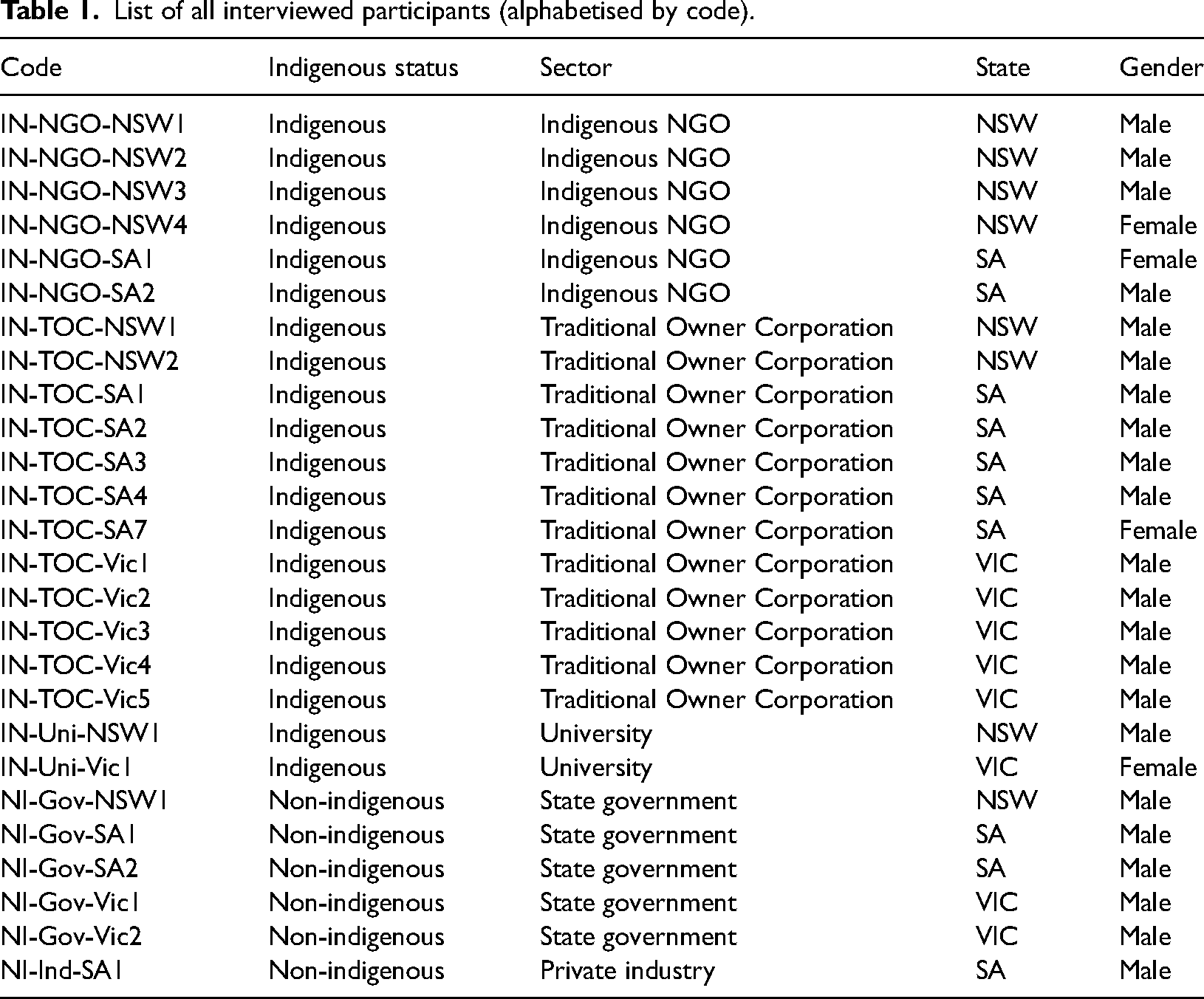
Semi-structured interviews (n = 26) were held in person and via Zoom between September and December 2023, with interviewees prompted to discuss their experiences and views about the governance of land and fire management and the challenges and opportunities for greater Indigenous inclusion, representation and power within land and fire management. Due to the sensitivity of the topics discussed and the potential risks to individuals identified through university research approvals, the data is presented pseudonymously and exact locations of the regional and local case studies are not specified. Each case study had 8–10 participants and, overall, a majority of participants were Indigenous-identifying (n = 17) and a majority were male-identifying (n = 22) (see Table 1), the latter reflecting the continuing gender bias in Australia's fire and land management sector generally (Cavanagh, 2022; Eriksen, 2014). Interviews were transcribed and analysed using thematic content analysis (Boeije, 2009), leading to draft analyses that were circulated through the authorial group and the ISG for comment. Data from the case studies was analysed together in order to identify features that are common across their respective scales rather than those that set them apart (Neale et al., 2025).
List of all interviewed participants (alphabetised by code).
These case studies, data collection, and data analysis were developed in partnership with local Indigenous research partners as well as a project's ISG, utilising principles of Indigenous research methodologies including foregrounding relationship-building, Indigenous sovereignty, and the protection of Indigenous intellectual property (see Hemming et al., 2010; Hemming et al., 2016). In the following sections, we analyse key themes from interviews before closing with a discussion of the implications for future Indigenous fire management partnerships in Australia and elsewhere.
Proceeding pragmatically
Vizenor's notion of survivance provides a pertinent lens through which to understand how Indigenous sovereignty is enacted even under conditions of settler state hegemony. As Vizenor (1999: vii) explains, “[s]urvivance is an active sense of presence, the continuance of native stories, not a mere reaction, or a survivable name.” Across the three case studies, one common expression of Indigenous survivance emerged through the practice of situated pragmatism. While recent shifts in relation to the governmental recognition of Indigenous rights to Country have been significant, these rights remain only partial or absent from many federal, state and territory laws and policies relating to environmental management. Therefore, those pursuing Indigenous fire management goals must often negotiate a complex and uneven web of regulations. In each context, participants repeatedly highlighted the limitations of these legal and policy settings, and the ways in which they pervasively shape Indigenous efforts to manage fire and Country more generally. On the north coast New South Wales, for example, participants drew attention to several outdated and inhibitive pieces of legislation, such as the Rural Fires Act 1997 (NSW) (RFA) and the Local Land Service Act 2013 (NSW) (LLSA). As in other jurisdictions, because such laws do not mention Indigenous fire practices, practitioners have to fit their work within existing categories or use omissions as “loopholes”. Reflecting on this inhibitive legal environment, one Indigenous participant explained that to “work within our Lore” or traditions: …it's hard for us to do our cultural obligation and burn Country when there's policies that are really, really grey – so it's hard to even understand where you’re going. And I think it's deliberately grey because they don’t want to have to look over our shoulders…. in the [LLSA] it states that using fire to burn land is an act of clearing so it gives us an exemption to clear land using fire basically (IN-NGO-NSW1).
Similarly, while Victorian fire regulations recognise the long history of “Indigenous burning practices,” they make no provision for utilising these practices or facilitating the participation of Indigenous community members (DELWP, 2022).
Whereas environmental laws and policies produce complexity through absence, Indigenous land rights laws produce complexity through inconsistency. In NSW, many participants pointed to manifold challenges created by the presence of two land rights laws, the state Aboriginal Land Rights Act 1983 (NSW) (ALRA) and the federal Native Title Act 1993 (Cth), based on incompatible logics of recognition. The ALRA was designed to facilitate the passage of Crown lands to local Indigenous populations through corporate entities called Local Aboriginal Land Councils, while the ostensible goal of the native title regime is to recognise the rights of specific Indigenous peoples to various types of land owned by their precolonial Indigenous ancestors. The result, as many participants explained, has been conflict and confusion regarding representation or “speaking for Country.” As one Indigenous participant explained, such inconsistencies “need to be resolved but there is no political will to resolve that,” with the result that many are “trying to navigate their way through these really complex spaces without help and on their own” (IN-Uni-NSW1). Other jurisdictions present their own inconsistencies and therefore their own challenges, as participants noted. In both South Australia and Victoria, state land rights laws accord closely with native title, meaning authority over Country is largely genealogical, but the spatial distribution of recognition remains patchy and partial. Thus, Indigenous peoples often face situations where they seek to manage landscapes within which they have recognised rights to access only small incongruent and insignificant parcels, or no recognised rights at all. Alternately, in cases of government partnership, groups may exercise rights to access Country that have not (yet) been granted in settler law (Weiner, 2011; Neale, 2023).
To navigate this difficult regulatory terrain, Indigenous groups have deployed a range of pragmatic strategies alongside continued advocacy for legal reforms. Two strategies stood out as common across the case studies. The first was alliance building, including across representative and community-controlled Indigenous organisations, as well as through relationships with key non-Indigenous “supporters.” This might include Indigenous groups regularly meeting to strategise across regions (Victoria), networking with others within a region to exchange knowledge and build capacity (southeast SA), or founding an Indigenous NGO to coordinate land management activities across groups (north coast NSW). As substantive legal changes continue to be delayed, such forms of cooperation support groups’ assertions of decision-making authority over Country in the meantime. Second, many groups made use of individuals within government agencies to effectively act as policy brokers, translating the intricacy of settler policy regimes for Indigenous parties. In southeast SA, several Indigenous participants referred to the importance of such actors, with one participant referring to one non-Indigenous public servant in these terms: Well he's our Indigenous officer in [government] type of thing – to communicate how the history is for us, talk about for us, our campaigns. That's what he's paid for at the same time like a liaison officer or whatever, but he's our main source of connection through that system. He does a bloody good job. Works out ways we can work together, operate together, under their law structure (IN-TOC-SA2).
Indigenous parties drew upon such policy brokers to a varying extent, depending on capacity and resourcing, though they were present across all case studies.
Relatedly, many participants connected the enduring impacts of colonisation and Country dispossession not only to the persistent dominance of settler legal and policy regimes, but also the ongoing challenge of resourcing Indigenous groups to negotiate (and survive) encounters with these regimes. In many cases, as participants noted, Indigenous organisations have limited or no operational funding and few assets to support operations. As one Indigenous participant pointedly reflected, while recognition of Indigenous rights and interest in policy is laudable, it often does not address “this gap and disparity between mob and whitefellas is that, so there's no intergenerational wealth, right, because we’re all dispossessed… you’re kind of already starting at a deficit” (IN-Uni-Vic1). 4 Further, as they explained, even groups with recognised land rights are “given land to manage or whatever which has got no economic potential because of the tenure arrangements… so then, you know, you’re so hamstrung by the government's decisions and funding.” As other scholars have summarised, Indigenous organisations are therefore often in the position of relying on short-term grants from different government organisations, and senior leaders of Indigenous organisations across our three case studies repeatedly spoke about the difficulties of being operationally overstretched and unnecessarily burdened by multiple government funding commitments. One larger Victorian organisation, for example, was managing the delivery and reporting for over 100 short-term funding agreements related to land management.
How to respond to this persistent inequality of resourcing? Indigenous participants often noted that it stemmed from the lack of Indigenous presence and investment within more senior levels of government. As one Indigenous executive observed: I think that's a real shame… [government executives] are happy enough to talk about [Indigenous peoples being] the oldest living culture on Earth and all this kind of stuff but yet they don’t invest any money into preservation, revitalisation and practice of that culture and I think that's something that really needs to change (IN-TOC-Vic5).
Similar views were shared by several white participants, who also emphasised the need for structural reform. As one senior white Victorian public servant reflected, even where an Indigenous group is “leading and delivering projects but they still have to come back to us to get certain things done” or approved, which is “at the edge of [or] as far as we’ll get until things like [a statewide] Treaty or bigger reforms influence the regulatory space” (NI-Gov-Vic2). Another white public servant spoke about how “rather than government being the pen holder and the lead in those sort of governance arrangements it should be you know the mob asking government to come and be part of something… It really needs to flip” (NI-Gov-Vic1). Nevertheless, while continuing to advocate for structural reforms, many Indigenous participants illustrated how they strategically leverage available grants and trusted actors to support their fire and land management priorities in the meantime. “There's a lot of good people there [in government] that have a lot of good ideas and want to see change and progress,” one Indigenous executive summarised, but their institutional setting “makes it really hard to actually do anything different” (IN-TOC-Vic1). Finding such individuals, particularly more senior figures above the street-level bureaucrats frequently delegated to interface with Indigenous organisations (Lipsky, 1980), is often vital to (re)negotiating the terms of funded programs or projects to make them useful. Without ongoing funding and consistent staffing it is difficult to alter the agency “side” of collaborations (Nikolakis et al., 2024).
As noted above, the multiscalar design of this project was prompted by a cognisance of the different levels at which fire management partnerships emerge in southeast Australia. Accordingly, participants highlighted the importance of tailoring arrangements to the particular “stage” or “capacity” of the relevant Indigenous partners. In many cases, Indigenous groups seek resourcing from government agencies for capacity building and training. As one Indigenous practitioner explained, “capacity's been the biggest thing… we’ve just had a whole new sort of work crew come on, a lot of younger ones with our rangers” (IN-TOC-Vic2). Other Indigenous participants engaged in more established fire programs spoke of the need for much larger funding focused on delivering cultural burns and other outcomes, but on their own terms and minus the onerous and coercive oversight of government agencies. However, as a white public servant stated, neither capacity-building nor bespoke resourcing come naturally to public servants, who “live in a world of performance indicators, and doing things, and getting outcomes and objectives, and that's not always allowing the time to think deeply about what is actually wanted” (NI-Gov-SA2). Government agencies, they went on, “need to be more prepared to let any group or nation just pause and reflect on what they want to do” (NI-Gov-SA2). Such issues, as one Indigenous executive reflected, go to the heart of questions of Indigenous self-determination within collaborations, noting that “self-determination… doesn’t always mean sole management. It means the self-determination to kind of define the terms in which you would see the best outcome” (IN-TOC-Vic5).
Subsequently, the mismatch in spatial scales between government and Indigenous parties was identified by many participants as a key obstacle to tailoring arrangements appropriately, cornering them into choices between pragmatic engagement or disengagement. In terms of government engagements with partnerships, as Indigenous participants noted, this is expressed in agencies’ preference to engage with Indigenous peoples at the broadest possible spatial scale, whether it be at a national, statewide, or regional level. As an Indigenous researcher reflected, drawing upon many years of experience in the sector, agencies are “comfortable I think doing it at more of a national level or a regional level but they really struggle with doing the work with the [local] groups” (IN-Uni-Vic1). In their view, this related to “an innate fear about talking to the wrong person about the wrong thing,” leading to potential conflict or blowback, and a lack of consistent cultural capability within agencies. Some white public servants were conscious of these preferences too. As one discussed: …government loves hierarchical representative bodies. There's nothing better than a state representative body. It makes our life easy. We’ve got to talk to one body and it works… [But] when you’re dealing with Traditional Owners that doesn’t work… [because] you’ll have mobs now that’ll go – “but I’m only here to talk to my Country and my people” (NI-Gov-Vic1).
In other words, agency preferences to engage at broad scales run counter to the norm amongst many Indigenous groups to represent or “speak for” defined local or regional areas independently. This is an issue that has been identified in many other studies of Indigenous representational politics in Australia (e.g., Neale, 2023) and coerce Indigenous groups to “speak” for Country in ways that may not be culturally appropriate.
Indigenous efforts to revitalise fire management face persistent challenges due to complex and inconsistent legal and policy frameworks. Despite recent progress, these frameworks often lack clarity or even recognition of Indigenous rights to Country and practice. To navigate these obstacles, Indigenous peoples’ engage in survivance—maintaining an active sense of presence and continuance—through the employment of strategies like alliance building and policy brokers within government agencies. Such strategies reflect not only endurance but also the assertion of agency within and against dominant settler structures. However, systemic issues such as under-resourcing and mismatched spatial scales between government and Indigenous parties continue to hinder progress, as Indigenous peoples and their collaborators work pragmatically with the affordances and limits of dominant policy frameworks and logics.
Working experimentally
According to Vizenor (1999: ix), survivance is not a static condition but rather an active Indigenous motion of emergent sovereignty and presence. Linked to the pragmatic strategies of “making do” discussed above, throughout the three case studies participants identified diverse and changing approaches to forming and sustaining Indigenous and settler government partnerships relating to the stewardship of Country. As Neale et al. (2019: 155–156) have argued, such approaches can be characterised as “experimental” in the sense that they involve novel formations of actors who are working together without predefined guidelines or models, attuned to “the open-ended and contingent character” of their partnership. These emergent survivance experiments necessarily involve making the dominant systems and practices of settler government a source of critical reflection for non-Indigenous peoples, revealing and challenging the inequity of the status quo in which Indigenous peoples are conventionally positioned as stakeholders with limited authority. As participants attested, defamiliarizing the normality of “settler common sense” (Rifkin, 2013) can provoke new and sometimes unexpected conceptualisations and practices of governance. Such novel experimentation is not only prompted by a lack of existing models for how collaborative environmental governance can or should be implemented, but also by a significant legacy of policies in other interconnected areas such as health (Kowal, 2015), child removal (Bringing Them Home Report), and incarceration (Anthony et al., 2021) where attempts by settler government agencies to foster “partnership” have often led to disappointment and limited gains for Indigenous peoples.
One common method of experimentation is the setting down of Indigenous laws and customs in formal policy documents. Conventionally, Indigenous culture has often been contrasted to the impersonal, generic, linear characteristics of government policy, most notably through attention to the use of oral traditions. However, as participants noted, policy formats such as multiyear strategic plans and principles frameworks can also be used to challenge the parameters of dominant government frameworks and prevailing collaborative models. Such documents can work as a “bridging tool,” as one Indigenous leader explained, as they “are not necessarily for us, they’re for government to kind of understand the concepts that we’re putting down” (IN-TOC-Vic5). In southeast SA, for example, participants drew attention to the Lartara-Wirkeri Cultural Governance Framework (Landscape SA, 2015) finalised by Indigenous representatives in 2015. Latara-Wirkeri or “three message sticks” outlines three Indigenous principles – “Ceremony and Talk,” “Hunt and Gather,” and “Song and Dance” – each of which relate to a stage of activities and commitments necessary for intercultural partnerships with settler agencies to proceed. As a key architect of Lartara-Wirkeri stated: What they’ve [government] got to understand is that our cultural governance is how we fashion ourselves to live on Country, care for Country at the same time. So we’re fashioning ourselves now to care for Country using the Westminster system and fire industry and wait a second, they should be fashioning themselves on the signs of the Country, the land itself, our Indigenous peoples’ land… we’re trying to inform the processes or the powers that be… you’ve got to follow this structure because we’re the oldest governance in the world (IN-TOC-SA2).
A document like Lartara-Wirkeri therefore is not only useful for informing such partnership arrangements, but also continuing to highlight the sovereignty and independence of Indigenous peoples within these arrangements.
In Victoria, Indigenous peoples have similarly experimented with the bureaucratic medium of “paperwork” (Kafka, 2009) to articulate their visions for the management of Country. The development of the Victorian Traditional Owner Cultural Fire Strategy (VTOCFKG, 2019) represents a watershed example in this context, the result of a range of Traditional Owners working with non-Indigenous collaborators to articulate principles and strategic priorities that would support the application of cultural fire and increase recognition to Traditional Owners’ authority to manage Country (O’Kane et al., 2019). Chief amongst these principles is a definition of cultural fire as “right fire, right time, right way and for the right (cultural reasons).” As one senior white public servant stated, central to the document's significance is not only its bureaucratic form, in that as “a strategy” it can then be cited and affirmed in government documents, but also its ability to embody Indigenous voice external to government. As they recalled, in discussing the Cultural Fire Strategy with government ministers: …it was like ‘We haven’t written this. It's been written by the Traditional Owners.’ And that changed [their] view of the document. Rather than just being a risky document for government, although it's really clear saying ‘No, we can give this forward as a really strong example of TO voice’” (NI-Gov-Vic1).
5
The outcomes of this experiment are demonstrated, in one sense, by the slew of statewide (e.g., the Victorian Traditional Owner Cultural Landscapes Strategy 2021) and local (e.g., Gunaikurnai Land and Water Aboriginal Corporation Cultural Fire Strategy 2021; Djandak Wi (Country Fire) Strategy 2024–2034) environmental management strategies that have followed in the subsequent 5 years, each of which Indigenous parties lead and government land management agencies then “support” through their own funding programs and policy statements. 6 Reflecting on the importance of these kinds of strategic documents, one Indigenous executive described them as a way of communicating to government and other audiences and “showing others that we actually have got some benefits in our leadership, not just for us as a people but for all communities” (IN-TOC-Vic1).
On the north coast of NSW, Indigenous interviewees placed less emphasis on developing formal governance documents, a difference that some attributed to a relative lack of government support for policy changes relating to cultural fire management specifically and land management more generally.
7
Instead, interviewees spoke of cultivating “in-house” skills to negotiate limited legal and policy openings, highlighting the importance of Indigenous personnel with prior experience working within partner government land and fire management agencies. Such individuals were seen as critical conduits with the personal networks, policy knowledge, and capacity to “talk government” to effectively negotiate with agencies. These individuals act as cultural “buffers” and “translators,” as one Indigenous practitioner described, allowing others to focus on “the perpetuation of cultural responsibilities and obligations and management practises, all that culture can continue because there's fellas like that that are doing a lot of that work, buffering it and translating it (IN-NGO-NSW3).” Nonetheless, like these same “buffers,” most NSW participants’ experience of government land management agencies were characterised by frustration. An example recounted by an Indigenous practitioner illustrates this situation: [A state fire agency] didn’t want to come to the party, so there were lots of delays put in… I think four months, they told us that they were going to write this burn plan for us and in the end, I went to look into, through the [legislation] under clause 5(A) it allows activities and includes cultural burns with community. So being private landowners, that was kind of a loophole I could utilise then to get in and get that work underway. Then we still gave courtesy to [the agency] of notifying them as per their kind of practices and procedures, but yeah, there was definitely a pushback. (IN-NGO-NSW4).
Frustrated with their requests for policy changes and burn permits being ignored, delayed, and indeterminately deflected between agencies, many Indigenous groups have been exploring novel partnerships with private land holders to enable cultural fire.
Consequently, across the case studies’ partnership experiments we observed a common “insistence” on Indigenous groups’ sovereign right to self-determine the parameters of their relationships with the settler state and others (Richland, 2021). As one Indigenous interviewee in Victoria explained: Rather than us continuing to supplement the Crown’s resource management objectives, they can actually support ours, but refuse to. We have been marginalised from pursuing our culutral objectives for 190 years and we’ve been invited to help them achieve their objectives and their outcomes by retrofitting our input into the very system that marginalises us. Our objectives for this Country is of this Country. They have evolved here for the intention of looking after Country over hundred of generations. We intend to do exactly that; and we invite the Crown to work with us (IN-TOC-Vic3).
Consequently, they explained their refusal to speak of “aspirations” in relation to Country, because “aspiring is wishful and you need to have permissions and endorsements and in this case we’re able to actually demonstrate, we assert.” Similar sentiments were routinely expressed in the other case study locations. Land management partnerships were “not reconciliation,” one SA Indigenous participant said, returning to the importance of the three message sticks for centring Indigenous authority and the authority of Country “which controls us… and this is how it works, with ceremony and talk” (IN-TOC-SA2). In NSW, participants insisted that government partners needed to engage Indigenous groups in decision-making, which they felt was relatively absent from current arrangements. As one Indigenous practitioner suggested, the power of Indigenous peoples in land management should be the level of a veto such that “if they don’t take the advice, that Aboriginal person who is the cultural adviser then directs them to do it” (IN-NGO-NSW2).
The varied approaches to fire management partnerships reflect an experimental and emergent process that challenge conventional power dynamics and governance models. For some, the use of formal Indigenous-led or Indigenous-owned policy documents, such as strategic plans and frameworks, serves as a crucial tool for Indigenous groups to assert their authority and communicate their perspectives to settler government institutions. These documents not only bridge cultural understanding but also represent acts of survivance, which in Vizenor's terms, emphasise assertions of active presence, self-determination, and narrative agency within collaborative arrangements. Whether or not these experiments are successful is a matter of ongoing debate amongst participants, with many non-Indigenous actors within government agencies praising signs of change and many Indigenous actors, particularly those outside government agencies, expressing concerns about the inertia of the status quo and the security of apparent gains. The open-ended character of partnerships provides both new possibilities for Indigenous insistence as well as surfacing established and well-founded doubts about settler government's transformative capacity (cf. Özden-Schilling, 2023).
Affective relations
Alongside these forms of pragmatism and experiment, interviewees identified a range of feelings based in relationships and commitments that they see as necessary for sustaining collaborative partnerships. Whereas our summary to this point gives the impression that such arrangements emerge solely from careful, creative, and “pragmatic” practices, leveraging legal and policy opportunities, we also observed the important role that embodied affects play in informing and texturing these intercultural relationships. Affects are feelings that can be named, though they may not be easily represented or explained, and influence and are influenced by peoples’ thoughts and interactions (Gregg and Seigworth, 2020). Throughout the three case studies, affective encounters, and the bounds and commitments that spring from them, were seen as crucial to sparking and maintaining the difficult work of “walking together” in a broader context of ongoing settler occupation, extractivism, and unhealthy Country (Neale et al., 2019). The presence of these less readily describable affects reminds us that, as Beggs and Dalley (2023: 9) observe, the cultural worlds of land and natural hazard management resemble “other peopled places” in that they too “entail the complex intersection and interaction of both rational and more-than-rational forces.” While Beggs and Dalley highlight the feelings of guilt and blame experienced by non-Indigenous Australian practitioners in the aftermath of significant wildfire events, the current study reveals a similarly complex yet diverse layering of affect in intercultural land and fire management settings. These affects include feelings of respect, trust, and connection to Country which, to recall Vizenor (1999: vii), elicit an active sense of Indigenous sovereign presence.
Across the three case studies, Indigenous participants consistently drew attention to the importance of both feeling “valued” and “respected” in partnership. This was sometimes articulated in terms of much-needed material and structural reforms – such that providing resourcing for Indigenous groups to engage in cultural fire might be regarded as a practice that indicates respect – though many also articulated this feeling as emerging from more intimate and interpersonal situations. In the case of the latter, for example, Indigenous participants across the case studies stressed the need for non-Indigenous people to do their “homework” and come into meetings with intended Indigenous partners prepared to contribute and collaborate equitably. As one Indigenous land manager explained: They have to be trained to understand Aboriginal cultural values. Pretty simple. They’ve got to do it… But they still think we’re Dreamtime. I mean come on, get real. Our creation stories are the real deal when it comes to science. That's what created us. The land we come from (IN-TOC-SA2).
8
A Victorian Indigenous organisation executive made a similar point regarding how respect can be sensed through practices, discussing their response to the slew of requests they receive from governmental agencies and NGOS for consultation. As they said: How about you read our Country plan or look at our webpage and find out a bit more about us and our [land rights] agreement? 99% of the time they never come back. These one percenters, when they come back they were so informed and could provide a relevant contribution to what we were doing. But they were people that could shift their values now to align with what our values were as opposed to asking of us to shift our values or focus onto helping others (IN-TOC-Vic1).
In other words, whereas Indigenous people are forced to become literate in non-Indigenous cultures and institutions, non-Indigenous people making the effort to acquire parallel forms of literacy are a sign of reciprocity and thereby respect. This was a sign of “partnerships that respect who we are and what we are” (IN-TOC-Vic3). When asked about the key to “successful” partnerships, another Victorian Indigenous organisation executive responded that: I don’t think there's a single thing [Author 2]… it's the valuing each other and it's just sort of showing some mutual respect… if [the relationship] is valued then you can work through any of the challenges and when it's not really genuinely valued then they become blockers, you know? (IN-TOC-Vic4).
Equally, other participants spoke of common situations where relationships with non-Indigenous parties felt perfunctory – “tick and flick” (NI-Ind-SA1) or “tick box” (IN-TOC-Vic2, NI-Gov-NSW1) - or even “disrespectful” and “toxic” (IN-NGO-NSW2) due to sensed lack of reciprocity. Discussing the tensions that can emerge from partnerships, one non-Indigenous public servant described how at impasses agencies “fundamentally came back to that point of saying ‘We will respect and enable however you want to be involved’” (NI-Gov-Vic1).
Relatedly, as Rawluk et al. (2023) have argued, “the importance of building trust to sustain ongoing relationships” was evident across case studies (see also Whyte, 2020), however it was generally asserted as a sense or a feeling like respect. In South Australia, a non-Indigenous public servant spoke about a recognition that: …we’ve already got a big enough trust issue with First Nations people. Very good reasons as to why they would distrust us. So, if we’re trying to build trust, then we have to be committed (NI-Gov-SA2).
Another reflected on the high importance of trust to “walking together” when “we don’t actually have signed agreements to work together, it's built on trust and ongoing relationships” (NI-Gov-SA1). Complementarily, a Victorian Indigenous interviewee similarly spoke about trust in drawing a comparison between “activism” and “relationship” approaches to advocating to settler government, noting that whereas activism might achieve results but impact “the willingness and desire for those people… to want to work with you again,” “a genuine trust relationship” can lead to “the ability to achieve a result and then be trusted again” (IN-TOC-Vic5). How trust might be detected in a given situation, though, was nonetheless difficult for participants to specify, with some referring to practices that indexed the presence of trust or its absence. This might include non-Indigenous people establishing backchannel conversations with Indigenous partners, giving them “heads up” about emerging issues and opportunities, or not taking offence when frustrations turn to confrontations (e.g., IN-TOC-NSW2, IN-TOC-Vic4). As an Indigenous land manager in NSW recalled, their efforts to revitalise cultural fire practice over more than two decades had made them “not a fan of the systems, like the government, the systems and the legislation,” having met both passive and active resistance from “firies” or settler fire agencies. However, more recently, while “every time you light a fire someone will ring the firies, there's more trust now, yeah, no, [they say] ‘them fellas always done that and they know what they're doing’ kind [of] thing” (IN-NGO-NSW3).
The third significant affect associated with sustaining collaborations related to feelings of connection to Country. As discussed by Rose (1996) and many others, Country is a common Indigenous English term with more expansive meanings than territory, in that Country is more holistic and constituted by ancestral genealogies, species, climate, and a range of other actors. The ongoing colonisation of what is now known as Australia has involved not only the dispossession of Indigenous people from their Country, and therefore their separation from places to which they are vitally connected, but also widespread harms to Country through resource extraction, invasive species, and climate change. Relatedly, Indigenous peoples often articulate practices of land management as forms of care, arising from ancestral obligations, and this was true across our case studies. However, notably a number of participants framed affective relations “on Country” or “connecting to Country” as supporting both Indigenous and non-Indigenous peoples within collaborations. A NSW Indigenous land manager explained while “every one of us are all passionate about just getting our mobs out on Country”: You can't, and this is what I say [to] landowners, you've got to be out on Country. And every landowner knows their own vegetation, their lands… But how do you know what's best for Country? When you start taking notice of certain trees, animals, grasses, and then even right down to the insects (IN-TOC-NSW2).
Similarly, a non-Indigenous land managers spoke enthusiastically about “positive experiences around culture on Country changes people's mentality” (NI-Gov-SA1) and how: Whenever you meet on Country, it's just always better… It's funny that you have to justify and advocate for that to happen… if you’re meeting on Country, in the space, and you can connect as a human to each other, it makes way more sense. You’re just there. It's tactile. You can see the importance. When Aboriginal people are on Country, talking about Country, they are just enlivened (NI-Gov-SA2).
This would seem to suggest that alongside the existing wealth of literature that links Indigenous peoples’ engagement with land management to affective connections with Country (e.g., Maclean et al., 2013; Robinson et al., 2016), researchers and others need to also attend to the affective connections to people and place that non-Indigenous peoples’ seek and sustain through land management partnerships. In short, as non-Indigenous interviewees noted, they engage in this work in part because of how it makes them feel.
Lest our representation of these case studies appear unduly positive, it is necessary to reiterate that partnership take place under conditions of settler colonial coercion and control (Moreton-Robinson, 2015). Whereas state land and fire management agencies and private land tenure arrangements are experienced by many non-Indigenous peoples as politically neutral, for many Indigenous peoples they are innately colonial institutions which are characteristically hostile to Indigenous rights and presence. Ideally, as interviewees noted, Indigenous peoples would not need to work with the state or private landholders to exercise their sovereignty and engage with Country. Nonetheless, where partnerships are occurring, embodied feelings of respect, trust, and connection to Country play vital roles for a range of actors. They support a sense of Indigenous sovereignty as active and present (Vizenor 1999) and are underappreciated within extant policy frameworks (see Smith et al., 2021).
Conclusion
To illustrate both the patchiness and inequality of present arrangements, consider the state of Victoria, the one state government in Australia with a published Indigenous fire strategy and generally held by interviewees as the most progressive in its partnership arrangements. In 2022–23, the state government spent approximately AU$141 million on “fuel management” including prescribed burns, other fuel reduction treatments (e.g., fuel breaks), and cultural burns in partnership with Indigenous groups. Whereas, within this considerable budget, its land management agencies were resourced to deliver over 1800 prescribed burns across over 90,000 hectares of “public land,” it supported 23 cultural burns across 372 hectares of Country, the majority of which were in one region (DEECA, 2023). 9 This broke a historical record for its support of cultural burns, set the previous year, when the state spent $151 million on fuel management and delivered 435 prescribed burns and supported the delivery of 14 cultural burns (DEECA, 2022). Unfortunately, figures are not published in either New South Wales or South Australia that would enable a clear comparison (see Williamson, 2021), though we learned from interviewees that state land management in both states allot far less resources to even fewer cultural burns. Cultural burning is also practiced by Indigenous groups on private land, and the delivery of burns is only one possible indicator of change, however the above data present clear evidence of both continuing coloniality and the significant but patchy shifts in settler hegemony.
Our research on three contemporary case studies of Indigenous fire management partnerships highlights the complex dynamics at play in the growing number of such collaborative “contact zones” in settler colonial contexts. At local, regional, and state-wide scales, these case studies all enact forms of Indigenous “survivance” (Vizenor, 1999) or active and negotiated continuance which are not easily summarised or thematized in terms of co-optation or liberation, the two conceptual poles of critical literature on Indigenous engagements with settler government and parties to settler colonial dominance. Despite persistent colonial legacies and systemic challenges, Indigenous groups are strategically navigating coercive settler legal and policy frameworks, employing pragmatic and experimental approaches to engage in collaborative land stewardship while insisting on their sovereignty. These partnerships are fragile, inequitable, and sustained by feelings of respect, trust, and a shared connection to Country, demonstrating the resilience and agency of Indigenous peoples in revitalizing their traditional practices and knowledge. While widely celebrated, including by non-Indigenous partners, our empirical examination of the lived realities of partnership demonstrate that progress is geographically and temporally patchy. Progress at a local level does not guarantee progress at another spatial scale, and vice versa, just as gains made at one time are not assured to last.
Seeking to enact an anticolonial politics of repatriating life and Country to Indigenous peoples, we contend that this research has implications for other researchers and policymakers seeking to support Indigenous land management generally and fire management specifically. First, reading across the case studies, there is evident merit in pursuing both significant legal and policy reforms and also pragmatically and creatively “making do” in the meantime. Policy changes and partners can both be sources of hope and disappointment, and future studies should be careful not to ignore the significance of informal exchanges and temporary arrangements in enacting Indigenous sovereignty. Second, future studies should similarly be cautioned against occluding the role of intermediaries in enacting partnerships. Previous studies of such interactions have been prone to occluding their intercultural character or of only studying the Indigenous “side” of colonial relations (Lea, 2012; Dalley and Martin, 2015), whereas both Indigenous and non-Indigenous interviewees in this project attested to the practical and affective value of trusted Indigenous and non-Indigenous individuals able to bridge Indigenous and state institutions.
Consequently, third, this research suggests there is a significant opportunity for researchers and policymakers alike to explore the qualities and affects of collaborative relationships and thereby the causes of trust and mistrust. If state agencies seek to partner with Indigenous groups, as interviewees suggested, they need to both demonstrate trust and be worthy of trust. Fourth, alongside other studies (Lake and Christianson, 2019), our interviewees statements and the diversity of our case studies illustrate that Indigenous fire management is not defined by an essential set of practices or governance arrangements but by its being Indigenous-led. Policymakers should work to ensure the contemporary expression of Indigenous sovereignty is not limited by prescriptive concepts of Indigenous culture. Collaborative fire management initiatives highlight Indigenous peoples’ ongoing insistence on their enduring knowledge and rights and the complex and varied pathways through which Country and resources are repossessed under conditions of settler colonial occupation.
Positionality statement
The authors of this article include a range of non-Indigenous and Indigenous researchers who have worked together over a number of years in the common pursuit of supporting Indigenous sovereignty over Country. Lachlan Beggs is a settler-descendant anthropologist born on Noongar Country in Western Australia and now based on the unceded lands of the Wadawurrung and Wurundjeri peoples in Victoria, Australia. Timothy Neale is a pakeha (non-Indigenous) anthropologist born in Aotearoa New Zealand who also now lives and works on the lands of Wurundjeri and Wadawurrung peoples. Oliver Costello is a Bundjalung man from the northern rivers of New South Wales living on Bundjalung Country. Andrea Rawluk is a non-Indigenous environmental sociologist, born in Treaty 13, Canada, and now lives and works on the unceded Country of the Wurundjeri peoples in Victoria, Australia. Jack Pascoe is a Yuin man living on Gadabanut Country. Teagan Shields is an Arabana descent living on Whadjuk Country. Collectively, we acknowledge Indigenous Australians as the Traditional Custodians of Country, wherever we respectively live and work. We pay respect to their Elders, lores, customs and creation spirits. We recognise that these lands and waters have always been places of teaching, research and learning.
Highlights
This article examines the resurgence of Indigenous peoples’ presence and knowledge in environmental management in southeast Australia.
Explores intercultural interactions between Indigenous organisations and state agencies through a focus on cultural fire management collaborations.
Recently growing in scope and number, these collaborations emerge at different scales through varying legal and financial arrangements.
Based on interviews with Indigenous and non-Indigenous individuals, the article reveals forms of pragmatism, experimentation, and affect that sustain collaborations.
These intercultural collaborations are significant in understanding Indigenous sovereignty as an emergent practice in tension with the settler state.
Footnotes
Acknowledgements
Our thanks to the individuals and communities who participated in this research, generously donating their time and energy to exploring future pathways for cultural fire management. We would also like to thank the project's Indigenous Steering Group of Matthew Shanks, Vikki Parsley, Daniel Miller, Jack Pascoe, and Tegan Shields, as well as industry partners Kat Haynes, Adam Leavesley, Simone Blair, David Windsor, and Aidan Galpin, and Blythe McLennan and colleagues at Natural Hazards Research Australia for supporting this work.
Data availability statement
Data not available. The participants of this study did not give written consent for their data to be shared publicly, so due to the sensitive nature of the research supporting data is not available.
Ethical approval and informed consent statements
This research was conducted with the approval of the Deakin University Human Research Ethics Committee (ref: 2022-288). Informed consent was given by all participants prior to participation.
Funding
This research was funded and supported by Natural Hazards Research Australia
(grant number T1A4).
