



Abstract
Upholding Tribal sovereignty in land use decision making is an ongoing challenge, in part because Tribal sacred sites, cultural heritage sites, and other cultural resources exist in areas outside of Tribal jurisdiction. In 2014, California Assembly Bill 52 (AB 52) amended the California Environmental Quality Act to mandate Tribal consultation as part of environmental reviews. AB 52 creates a mechanism for Tribal consultation on a per-project basis and gives Tribes decision making authority where Tribal Cultural Resources (TCRs) are concerned, even when TCRs are located off-reservation. This study offers the first statewide evaluation of AB 52 consultation from Tribal and agency perspectives. Using two surveys, one with Tribal respondents (n = 46) and one with agency respondents (n = 56), we assessed the ongoing processes of Tribal consultation between Tribal and local governments around cannabis permitting. Focusing on AB 52 in cannabis permitting provides a lens for evaluating Tribal consultation and TCR protection more generally. Our study shows that AB 52 is not consistently applied in land use decision making and that it faces several barriers to implementation. We discuss these findings and suggest how environmental policies and agency processes can be strengthened in support of Tribal sovereignty.
Keywords
Introduction
Despite histories of land dispossession, removal, and genocide, Native nations within what is now the United States and Canada continue to care for and protect their aboriginal lands and territories—whether or not they own or reside on them—as a means of sustaining kinship obligations and cultural survivance (Baldy, 2013; Clark et al., 2021; Vizenor, 2008). Under federal Indian law and treaty rights, Tribes 1 have jurisdiction over their reservation lands. However, these lands may represent only a small fraction of their ancestral territory or may not coincide with ancestral territories at all, as is more typically the case with Tribes east of the Mississippi, which were displaced by the Indian Removal Act of 1830. Beyond reservation boundaries, however, lack of jurisdiction over sacred sites, cultural heritage sites, and traditional use areas poses critical resource access and management challenges, while making culturally sensitive areas vulnerable to public and private development.
This situation is partially remedied by a growing number of natural and cultural resource laws, which afford Tribes limited jurisdiction via consultation over ancestral lands and resources that are off-reservation. In principle, government-to-government consultation between Tribes and public agencies puts them on equal standing to jointly participate in land use decision making. Yet in practice, bad faith actors within public agencies and weaknesses in the consultation process compel Tribes to exercise their sovereignty 2 outside of official channels, as testified by protest movements such as #NoDAPL and #IdleNoMore and the direct actions of land defenders (Estes 2024; Gilio-Whitaker, 2019).
Common problems within natural and cultural resource laws and Tribal consultation are well-documented in the literature. While Tribes have been consulting with federal agencies for decades under the National Historic Preservation Act (NHPA, 1966) and National Environmental Protection Act (NEPA, 1969), factors undermining meaningful consultation can appear systemic and entrenched. At the federal level, only Tribes recognized through the Bureau of Indian Affairs (BIA) are eligible to consult on federal projects and only when projects meet specific qualifying criteria (Hinds, 2017). These requirements leave out hundreds of federally non-recognized Tribes nationwide, some of which have been petitioning for decades to receive federal status. Another common complaint is that these laws “lack teeth,” which is to say they lack adequate language and enforcement mechanisms (Hinds, 2017; Middleton, 2013). Other factors undermining Tribal consultation are power asymmetries between Tribal and U.S. governments, weak or non-existent relationships, poor resources and capacity within Tribal and agency offices, and the exclusion of Tribal knowledge and expertise (Arsenault et al., 2019; Bathke, 2014; Blumm and Pennock, 2022; Dongoske et al., 2015; Dongoske et al., 2000; Youdelis, 2016). In general, Tribal experiences within consultation have been one of constant frustration, which has led some critics to reject consultation in favor of other processes and mechanisms of accountability (Bevan 2020; Searle 2016; Stolte, 2023).
Frustrations with this poor track record notwithstanding, it remains to be seen whether at least some of these recurring problems are a function of scale and whether Tribal consultation at the subnational level can strengthen Tribal sovereignty in land use decision making where Tribes otherwise lack jurisdiction. In this regard, state-level cultural resource laws hold out initial promise for building long-term relationships and incorporating traditional ecological knowledge into local land use decision making. In California, Senate Bill 18 (SB 18, 2004) was the first law in the U.S. to mandate Tribal consultation at the local level (Middleton, 2013) and Assembly Bill 52 (AB 52, 2014) was the first law to mandate local-level consultation on a per-project basis. In this way, California is a case study of what happens when Tribal consultation is institutionalized at the local level.
This article examines Tribal sovereignty in land use decision making through processes of local-level consultation in cannabis permitting. In 2016, one year after AB 52 went into effect, California voters endorsed Proposition 64, which legalized the commercial cultivation and sale of recreational cannabis for adult use. 3 The first step for cannabis operators who wished to obtain state licensure was to apply for a land use permit from their city or county jurisdiction. Local governments (primarily county planning offices) were tasked with processing thousands of permit applications, each one potentially impacting Tribal cultural resources. Thus, California's legalization of cannabis was a stress test for AB 52, and the resulting strain on Tribal and agency offices generated important lessons about the challenges and opportunities of Tribal consultation at the local level. To capture these lessons, this article draws on two surveys, one with Tribal representatives (n = 46) and one with agency representatives (n = 56), all of whom were involved in regular AB 52 consultation.
Empirical studies of cultural resource law implementation are rare in the literature and almost non-existent at the subnational level (cf. Newcomb and Sisti, 2022). This article is the first to evaluate AB 52 implementation with respect to how well it upholds Tribal sovereignty and protects Tribal cultural resources. The first section provides background context on Tribal sovereignty and consultation in California and uses the only scholarly article on AB 52 (Dadashi, 2021) to offer considerations that our survey tests. The next section presents our survey methods and results, and the last section draws out the lessons of the study for subnational and local-level consultations and cultural resource protection.
We found that the experience of consultation varies under AB 52. While the statute increases the frequency of consultation at the county level, some counties and the majority of cities are not notifying Tribes or engaging in consultation. Public agencies may be circumventing CEQA entirely or applying CEQA but violating AB 52. This highlights how agency discretion and a lack of enforcement mechanisms prevent the ability of cultural resource laws to create conditions for meaningful consultation. These challenges are compounded by cross-cultural differences in institutional norms and practices. Drawing on qualitative survey data and the literature on Tribal cultural resource management, we recommend strengthening shared decision making through “structural” changes in the law to ensure Tribal discretion, early consultation, and enforcement, and the “soft” or “intangible” infrastructure of consultation, such as expanding GIS mapping capabilities, funding for increased capacity, and ongoing relationship-building. AB 52 consultation reproduces common weaknesses in Tribal cultural resource policy and practice, and it also points the way toward promising solutions at the subnational level.
Tribal sovereignty in California land use decision making
Overview of indigenous land sovereignty in California
The history and experiences of Native American peoples in what is now the state of California are unique in many ways. The cultural and linguistic diversity of Native peoples in this region is unparalleled in North America, and it was also one of the most densely populated areas north of Mexico (Akins and Bauer, 2021; Golla, 2011; Lightfoot and Parrish, 2009). Native American peoples in California experienced successive waves of colonization by Spanish, Mexican, Russian, and Americans, each bringing with them a unique brand of colonialism that resulted in a variety of responses, outcomes, and statuses for Tribal nations entering the 20th and 21st centuries (Lightfoot, 2005; Lightfoot et al., 2021; Schneider, 2010). Cannabis has been characterized as a “green rush,” the latest wave of Indigenous land dispossession in a series of “rushes” throughout California's colonial history (Reed, 2023).
While many Tribes outside of California experienced the impacts of colonialism long before colonizers reached the coast of California, these Tribes were also afforded treaties with the United States government, establishing their sovereign status, land base, and other rights (Blackhawk, 2023). By contrast, Congress never ratified the treaties drafted in California between 1851 and 1852 during early statehood (Anderson, 1978), which had a dramatic impact on the land base of California Tribes (Akins and Bauer, 2021). Through successive and ongoing court battles, Tribes in California have been able to acquire some land, albeit a small fraction compared to what was originally drawn up in the treaties (Akins and Bauer, 2021; Shipek, 1989). Many Tribes in California faced additional challenges through termination in the mid-20th century. Although the federal status of many Tribes has been restored through judicial process beginning with Tillie Hardwick v. the United States in 1979 (Akins and Bauer, 2021), 12 of the originally terminated groups remain unrestored and many have yet to receive federal support to re-establish their governments (Goldberg and Champagne, 1996).
In California, the creation of the Native American Heritage Commission in 1976 and gaming compacts in 1999 (after fierce opposition from private interests and State government, leading to unsatisfactory terms for Tribes) significantly increased Tribal political and economic power (Cattelino, 2005). This set the stage for Tribes to legally challenge development projects during the late 1990s and early 2000s and eventually to pass cultural resource protection laws, beginning with SB 18 in 2004 (Laura Miranda, Pechanga, Technical Advisor to Assemblyman Gatto on AB 52). However, until the passage of AB 52 in 2014, California law did not recognize Tribes with a consistent and formal role in land use decisions (Dadashi, 2021). As of this writing there are 109 federally-recognized Tribes in California. Yet, this number does not include several dozen other Tribes that the state of California recognizes. 4 Tribal consultation on the subnational level is an essential part of ensuring the sovereignty of all Tribes over cultural and natural resources in their aboriginal territories.
Tribal consultation in California
In 2014, California Tribes' ability to exercise their sovereignty in land use areas over which they do not otherwise have jurisdiction received a boost through the passage of Assembly Bill 52. AB 52 builds on Senate Bill 18 (2004), which was landmark legislation in its own right for granting all California Tribes (and not just federally-recognized Tribes) the right to consult with state and local agencies on general and specific plan amendments, including zoning changes. However, plan amendments can be irregular, limiting opportunities for Tribes to provide input and for Tribes and agencies to establish strong working relationships. SB 18, moreover, only refers to “Tribal cultural places,” excluding a range of landscape features about which Tribes may want to consult, and it only “encourages” agencies to mitigate impacts—permissive language that often upends meaningful consultation. AB 52—which applies on a per project basis, increases the scope of areas eligible for consultation to “Tribal cultural resources,” and requires agencies to adopt feasible mitigation measures for significant impacts—offers a stronger level of protection than SB 18. 5
AB 52 amends the California Environmental Quality Act (CEQA), the 1970 statute that requires the study and public disclosure of potential adverse environmental impacts of agency discretionary actions. Including AB 52 within CEQA effectively incorporates “Tribal cultural resources” (TCRs) among environmental features that can be impacted. AB 52 defines TCRs as “sites, features, places, cultural landscapes, sacred places, and objects with cultural value to a Tribe” that are either listed or eligible for listing in local, state, and national registers of historical resources (PRC § 21,074). This capacious definition can include ceremonial and hunting grounds, burial sites, landscape features, and other areas of contemporary and active use and/or traditional cultural significance to Tribes, in addition to objects of archaeological and scientific value.
Procedurally, AB 52 applies whenever CEQA applies. The agency leading the permitting process for a CEQA-eligible project must provide early notification to all relevant Tribes, which it should determine by consulting the NAHC's Sacred Lands File (SLF) as well as the California Historical Resources Information System (CHRIS), an archaeological database. Tribes then have a 30-day window to respond with the request to consult in which case the lead agency is required to engage in a “good faith” consultation to identify Tribal cultural resources and mitigate impacts to them (PRC § 21,080.3.2(b)(1)-(2)).
Legal scholar Dadashi (2021), in the only peer-reviewed study of AB 52 to date, assessed the statute's strengths and its substantive and procedural limitations. Dadashi commends AB 52 for affirming Tribal sovereignty in environmental decision making. In particular, AB 52 gives Tribes legal standing to engage in consultation separate from the public comment period by which members of the public can provide input on the CEQA process. Consultation symbolically positions Tribes on equal footing with state and local governments and honors their expertise (rather than that of archaeologists) within their geographic areas. Dadashi also notes that AB 52 expands the scope of legal protections for Tribal assets and strengthens consultation requirements. Finally, Dadashi argues that AB 52 is important because it creates a formal mechanism by which traditional ecological knowledge (TEK) can enter into agency determinations.
In substance and in practice, however, Dadashi finds AB 52 to be lacking. One significant shortcoming, common among cultural resource laws, is agency discretion with regard to whether the resource in question is significant. Agencies might adopt an inquisitive attitude toward Tribal concerns and take a collaborative approach to TCR protections. Yet, there is little that can stop an agency from imposing an unreasonably high threshold of significance and that discards evidence that Tribes present. Underscoring this potential for variability across agencies, the California Office of Planning and Research (OPR) offered only minimal guidance regarding how to conduct AB 52 consultation and Tribes have little recourse when agencies fail to meet consultation requirements. As Dadashi observes, Neither AB 52 nor any subsequently issued guidance documents offer instruction on how it [the substantial evidence standard] applies where an agency's position differs from that of a Tribe and how a Tribe may effectively contest an agency's unfavorable or harmful determination, given the high degree of deference accorded to agencies by courts. Additionally, because AB 52 is a relatively new law, there is little to no clarifying guidance by way of case law. (Dadashi, 2021: 16)
Agency discretion essentially creates a deferential standard that gives agencies wide latitude when interpreting statutory requirements. Moreover, this discretion can have cascading effects on other aspects of cultural resource management, such as overreliance on archaeological values, which are not the same as Indigenous values, the dismissal of Tribal expertise, and a general lack of cultural awareness (Dadashi, 2021). Hence, where agencies reserve discretion, we might expect high variability in the application of AB 52, possibly with less favorable outcomes for other dimensions of cultural resource protection.
Among other impediments to meaningful consultation and cultural resource protection under AB 52, Dadashi also cites distrust among consulting parties and cross-cultural differences. Distrust, which has its roots in the historic and ongoing experience of colonialism, is reinforced through signs of disrespect such as when agency representatives second guess Tribal knowledge and fail to treat Tribal representatives as experts. Likewise, cultural differences are problematic insofar as agencies privilege archaeological, biological, and other scientific data over traditional ecological knowledge, forcing Tribes to conform to Western scientific frameworks that do not correspond to Indigenous knowledge systems (Dadashi, 2021). Lack of respect for Tribal expertise and TEK further damages intergovernmental relationships, eroding meaningful consultation and cultural resource protection.
Dadashi's legal analysis of strengths and weaknesses of AB 52 offers considerations that we can test empirically. The implementation of AB 52 should lead to a higher total frequency of consultation at the subnational level with stronger protections for TCRs as well as better agency awareness of Tribal concerns. On the other hand, agency discretion means that there is likely to be variability across the state with respect to consultation practices and, consequently, with respect to outcomes for TCRs. In cases where agencies use their discretionary authority to render consultation as a box-ticking exercise, we can expect that protections for cultural resources and agency knowledge will not increase significantly. As mentioned, the cannabis permitting process is a useful lens to test these hypotheses due to the high volume of permit applications for cannabis cultivation over the past decade, which aligned with the passage of AB52. Additionally, research has shown that there is an unusually high coincidence of cannabis cultivation sites and TCRs, especially in high-yield cannabis regions such as Humboldt County, due to the ideal conditions guiding site selection in each case (Sorgen et al., 2025).
A survey of AB 52 consultation practitioners
Survey design and dissemination
To examine Tribal sovereignty in land use decisions and the efficacy of AB 52 consultation in California, our research team designed a survey for California agency and Tribal representatives involved in intergovernmental consultation around Tribal cultural resource management. We surveyed planning directors, their staff, Tribal liaisons, 6 Tribal Historic Preservation Officers (THPOs), cultural resource specialists, and Tribal chairs. We recruited a seven member Tribal Advisory Committee (AC), including Tribal Historic Preservation Officers (THPOs), a cultural resource specialist, and a Tribal chair to guide the research. Using participatory methodologies, we co-created the research questions, interpreted results, and co-authored deliverables together (Chambers, 1994; Wilmsen et al., 2008).
After securing approval from the university IRB (#2021-11-14791) and the California Rural Indian Health Board (#2020-003), we held meetings with the AC to discuss cannabis impacts on TCRs, and permitting challenges. Based on these conversations, we developed two surveys using Qualtrics: one for agencies and one for Tribes featuring a Likert-scale and short answer questions on consultation and permitting improvements.
The Tribal surveys were distributed to 244 email addresses from the NAHC Tribal leaders contact list and through additional networks. This yielded 37 responses from the first method (a 7% response rate) and 9 additional responses from the snowball method.
For the agency survey, we emailed city and county planners and officials that permit cannabis cultivation 7 and state officials involved in cannabis permitting or regulation. 8 At the time of the survey (1 July 2022), 28 of 58 counties and 136 cities allowed cannabis cultivation, including cities within counties that prohibit cultivation. In total, the survey was sent to 158 planners and program officers at the city, county, and state levels, occasionally to multiple people in the same office or department. This included all county planning departments that allow cannabis cultivation (28), cities that allow cannabis cultivation in the counties that prohibit cultivation (39), and a subset (about half) of all cities that allow cannabis cultivation in counties that also permit cultivation (48).
We received 56 responses (35% response rate), 22 from cities, 25 from counties, and 5 from the state (Figure 1).
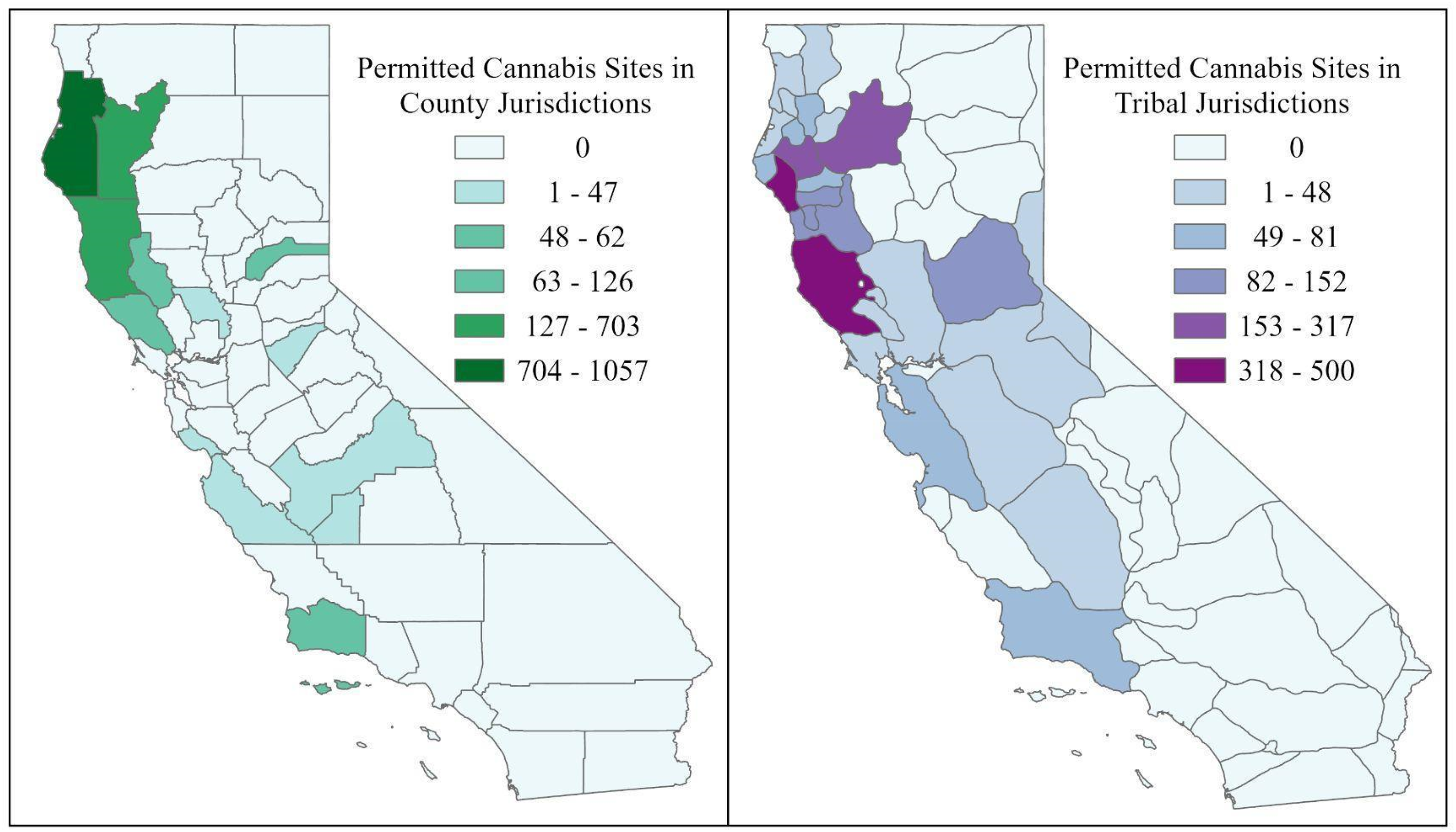
Side by side comparison of permitted cannabis in county versus Tribal jurisdictions. The map on the right uses an ethnolinguistic map of Native American peoples in California, which does not perfectly represent Native ancestral territories or contemporary claims.
We shared and co-interpreted preliminary findings with the AC, with THPOs at the CalTHPO monthly virtual meeting, with county planners at the Cannabis Program Forum, and with county commissioners at the California County Commissioners Conference.
Survey limitations
Varying Tribal governance structures and protocols of engagement, inadequate resources, staff turnover, reasonable mistrust of university researchers, shortcomings of the NAHC contact list, and complexities of Tribal affiliation are among factors that may limit the degree to which data is representative. Identifying the appropriate agency contact responsible for cannabis programs also proved challenging. Despite receiving responses from 22 distinct counties (79%) and 39 distinct Tribes (21%), there are insufficient total numbers of responses to draw accurate statistical inferences. And although there are dozens of Tribes in California currently seeking federal recognition, many are not included in the NAHC list of 110 federally recognized Tribes, resulting in only 9 of the 44 Tribal respondents (20%) representing a non-recognized Tribe.
Given that AB 52 generates a novel regulatory environment and some survey questions had legal bearing, we suspect that counties may have over-reported on matters of compliance. Despite these limitations, we believe that the data give a strong indication of the strengths and weaknesses of AB 52 consultation.
Survey results
Characteristics of survey respondents
Out of 44 Tribal respondents, 39 (89%) worked for a Native American Tribe in California of which the majority worked for a federally-recognized Tribe (79%) and the rest for a non-federally recognized Tribe (21%), the latter of which is slightly less representative than the overall percentage of non-recognized Tribes in the state (>33%). The remainder did not work for a Tribe (Cannabis Impacts on Tribal Sovereignty, Tribes Survey, August 2022, henceforth CITS, TS). 9
Of the 52 agency respondents, the majority represented counties (48%, 25) 10 and cities (42%, 22) (see Figure 2). There were fewer state-level responses (10%, 5) since cannabis permitting and associated consultation is generally handled at the local level in California. Agency respondents indicated multiple roles in cannabis permitting, including permit and document review (43), policy implementation (39), planning (38), outreach to applicants (36), permit approvals (34), policy formation (28), site evaluation (28), outreach to Tribes (23), and GIS and mapping (11) (Cannabis Impacts on Tribal Sovereignty, Agency Survey, August 2022, henceforth CITS, AS).
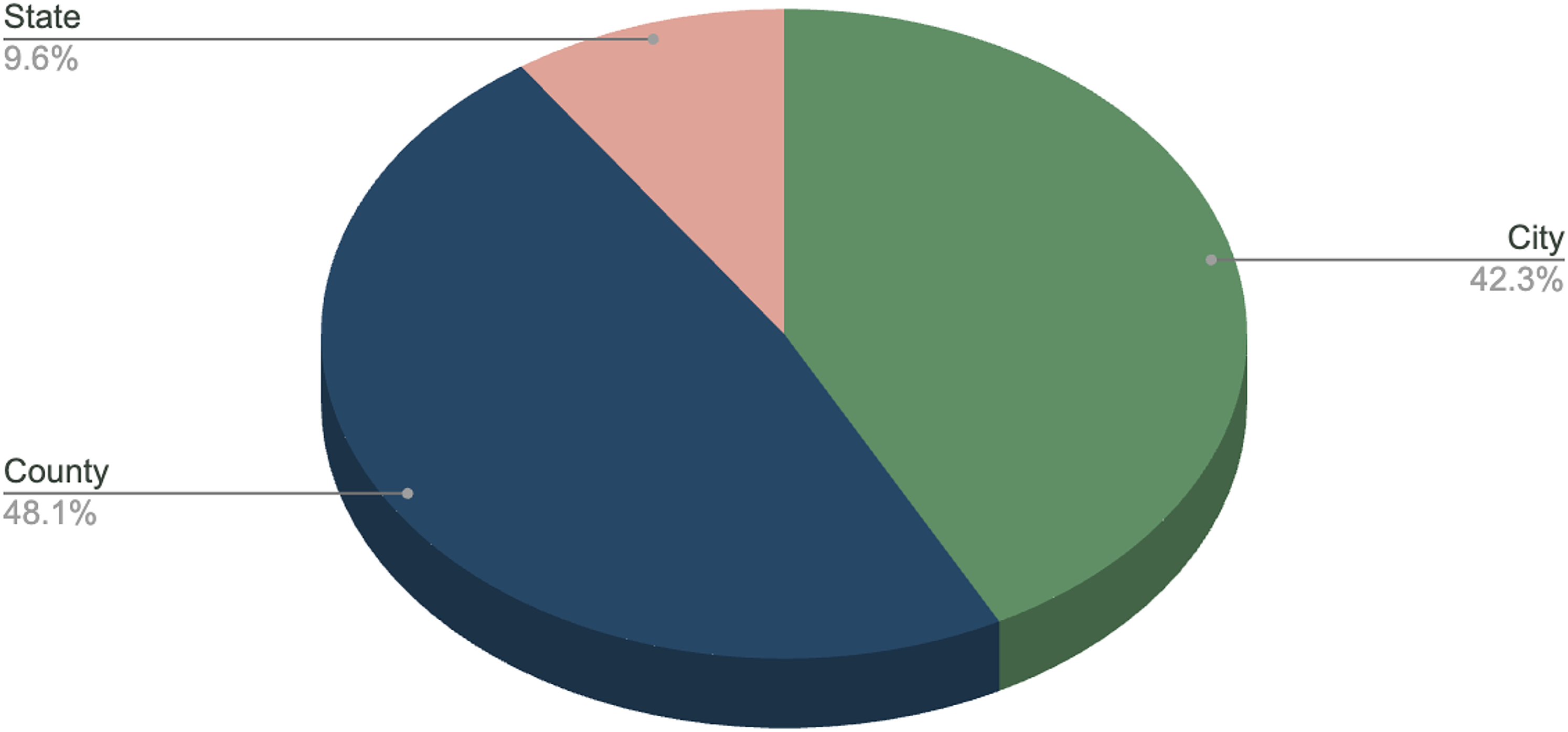
Agency respondent jurisdictions (CITS, AS, August 2022).
Tribal concerns about cannabis impacts
In results published elsewhere (Sorgen et al., 2025), we asked Tribal and agency respondents to indicate their understanding of Tribal concerns about cannabis impacts on social, economic, and environmental factors. In Table 1, Tribal respondents expressed a high level of concern, whereas government agency staff at the local level exhibited low levels of awareness about Tribal concerns regarding cannabis impacts. Tribal respondents reported either “strong” or “moderate impacts” to Tribal cultural resources (81%), ecosystems and wildlife (82%), water access and availability (81%), and water quality (82%), with one respondent pointing out that some Tribes consider watersheds, ecosystems, and wildlife to be part of their Tribal cultural resources. While impacts were reported at a slightly lower rate with respect to housing and cost of living (71%), community health (79%), and economic opportunities (76%), we found those numbers to still be notable (CITS, TS, August 2022).
Tribal concerns about cannabis impacts (CITS, TS, August 2022).

Meanwhile, city representatives were the least aware of Tribal concerns regarding cannabis impacts to Tribal cultural resources and other environmental indicators, with 100% reporting no awareness. Only 33% of county representatives reported any awareness of Tribal concerns and 60% of state representatives reported some awareness (see Table 1). One city respondent explained that they only consult with Tribes when there is an initial study or Environmental Impact Report (CITS, AS, August 2022). These results suggest that state agencies may have a better awareness of Tribal concerns because they have consulted with Tribes under California law for longer and with more frequency than county and city agencies, whereas city agencies still do not frequently engage in Tribal consultation, at least with respect to cannabis permitting. The survey results give a clear indication of knowledge gaps across state, county, and city agents regarding Tribal priorities and concerns.
Assessing cannabis impacts
According to agency respondents (see Figure 3), the two most common methods for assessing impacts to TCRs are Tribal consultation and hiring a consulting firm that specializes in archaeology and cultural resource management. Five respondents (24%) reported they use a database or other GIS software in that process. 11 At the county level, out of 21 respondents, only 14 (67%) reported that they consult with Tribes and 11 (52%) hire a private consulting firm to create a land survey report or require the permit applicant to do so. The majority of respondents use two or more of these methods in combination to assess impacts. Three county respondents reported that they do not assess impacts, two reported that impacts are assessed by another department, and one reported being unsure whether and how impacts are assessed. One county respondent explained in a textual response that their county did an initial programmatic EIR for all county permitting and believes that Tribes were consulted at that point. These widely varying responses indicate that Tribal consultation is not taking place in a systematic way as required under the law (CITS, AS, August 2022).
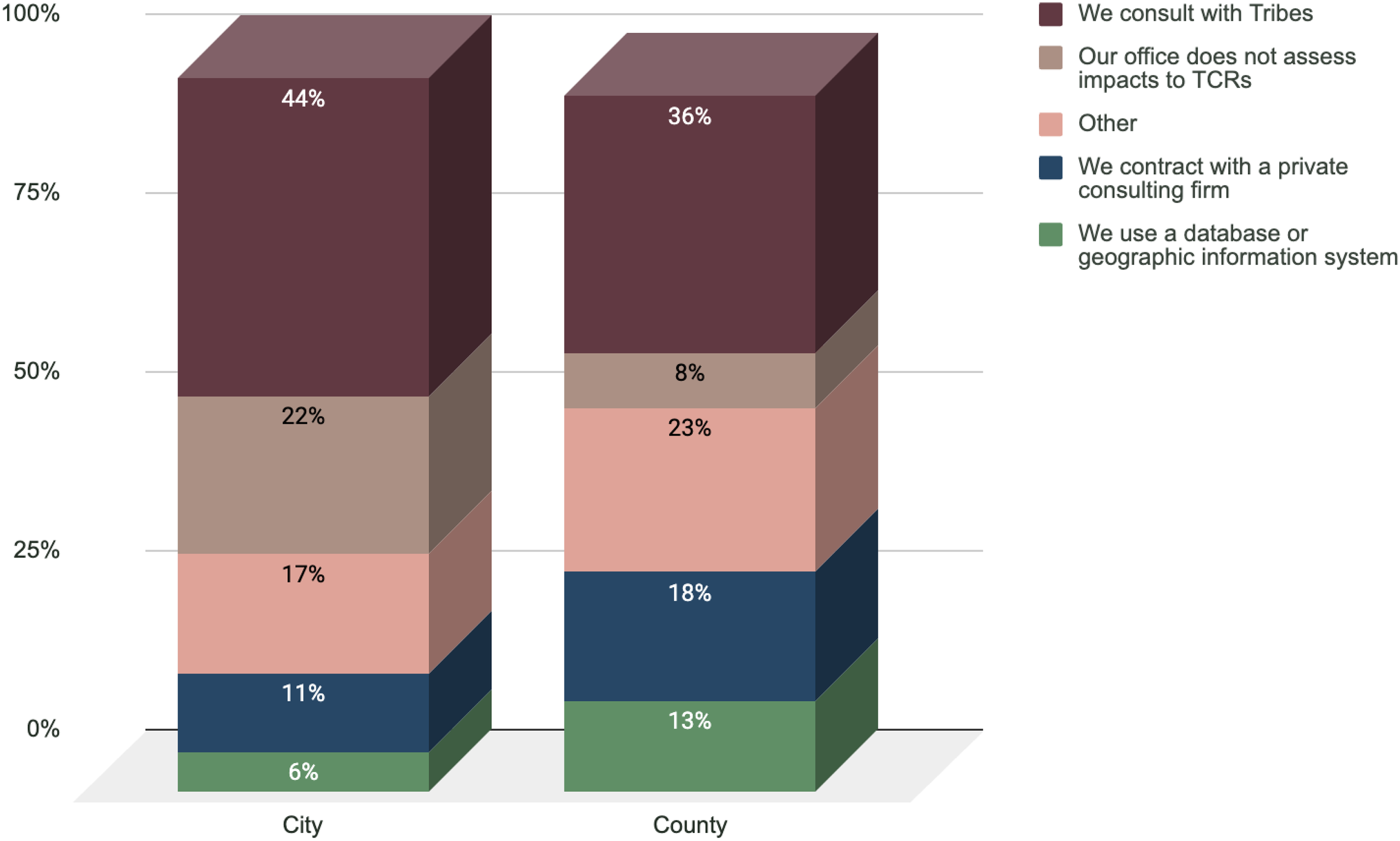
How does your agency assess impacts to TCRs? (CITS, AS, August 2022).
Even fewer city respondents, nine out of 17 (53%), reported that impacts to TCRs are assessed by consulting with Tribes. Notably, four (24%) reported that their office does not assess impacts to TCRs and two reported being unsure whether and how their office assesses impacts. Several city respondents stated that cannabis permitting in their jurisdiction is for indoor cultivation only and therefore not subject to CEQA. One respondent further explained that indoor cultivation “does not have the potential to impact Tribal cultural resources” and another wrote that “There are no Tribal lands within our city limits.” It is worth noting that there appear to be contradictory responses among city personnel to similar questions throughout the survey. For example, whereas 47% responded affirmatively to assessing impacts to TCRs through Tribal consultation, less than 5% reported their office works with Tribes, and only 7% reported that their office consulted with Tribes during the cannabis permitting process. In addition to consultation, 12% of city respondents reported using a private consulting firm, and one uses a database or other GIS software to assess impacts to TCRs (CITS, AS, August 2022).
We also asked agency respondents whether Tribes were consulted when drafting the cannabis ordinance. Since a cannabis ordinance is a specific plan, cities and counties would be mandated under Senate Bill 18 to consult with Tribes. Out of 22 county respondents, nine (41%)) reported that their agency consulted with Tribes, three (14%) reported that they did not, and an additional 10 (45%) were unsure. Of 16 city respondents, only one reported that their office consulted with Tribes when drafting the cannabis ordinance, while nine (56%) reported that their office did not and six (38%) were unsure (CITS, AS, August 2022).
We asked agencies and Tribes what personnel they have on staff to ensure meaningful consultation. Although 52% of counties and 12% of cities report using an archeological survey to assess impacts to TCRs, none of the 37 county and city respondents reported having an archeologist on staff. Thus, it is unclear who in these city offices has the professional qualifications (required by the secretary of the interior) to properly evaluate cultural impact reports and maintain confidential and sensitive information on Tribal cultural resources. Additionally, few local planning offices reported having a designated Tribal liaison for permitting purposes. Out of 22 county respondents, six (27%) reported that their office has a Tribal liaison, while 13 (59%) reported that their office does not and surprisingly 3 (14%) were unsure. Out of 17 city respondents, four (24%) have a liaison, 12 (71%) do not, and one was unsure (CITS, AS, August 2022). Finally, we asked Tribal respondents whether they had legal representation for TCR-related matters. Out of 36 respondents, 20 (56%) said that they do, seven (19%) said they do not, and nine (25%) were unsure. Of non-federally recognized respondents, half (3 of 6) said they have legal representation and the other half said they do not. The absence of Tribal liaisons suggests that Tribal consultation, when it is being carried out, is often conducted by staff without proper training and credentials. Tribes' lack of legal representation, meanwhile, suggests that many are unable to pursue legal recourse when cultural resource laws are violated (CITS, TS, August 2022).
Tribal-agency coordination, collaboration, and consultation
The survey inquired into Tribal-agency interactions around cultural resource protection at various stages of the consultation process, from initial notification through impact mitigation. Tribal respondents were noticeably split on each issue, with some respondents clearly having a better experience than others. Positive ratings also steadily declined as our questions progressed from initial notification and consultation to agencies' responsiveness to Tribal concerns and mitigating impacts. Out of 37 Tribal respondents, 13 (35%) “strongly agree” and eight (22%) “strongly disagree” that they are being notified, and out of 39 respondents, 14 (36%) “strongly agree” and 11 (28%) “strongly disagree” that they are being consulted (see Table 2) (CITS, TS, August 2022). 12
Comparison of Tribal and agency responses (CITS, TS/AS, August 2022).
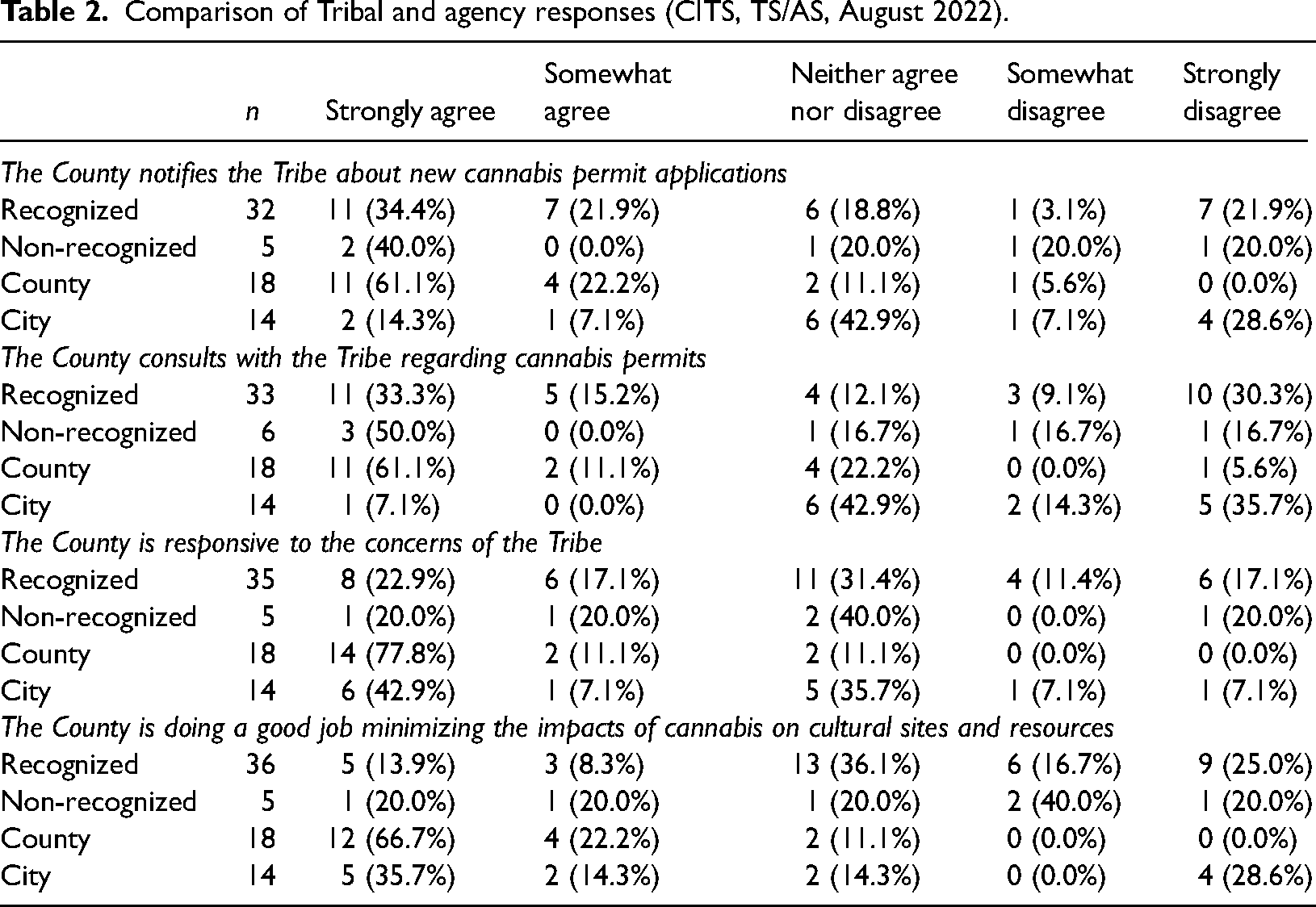
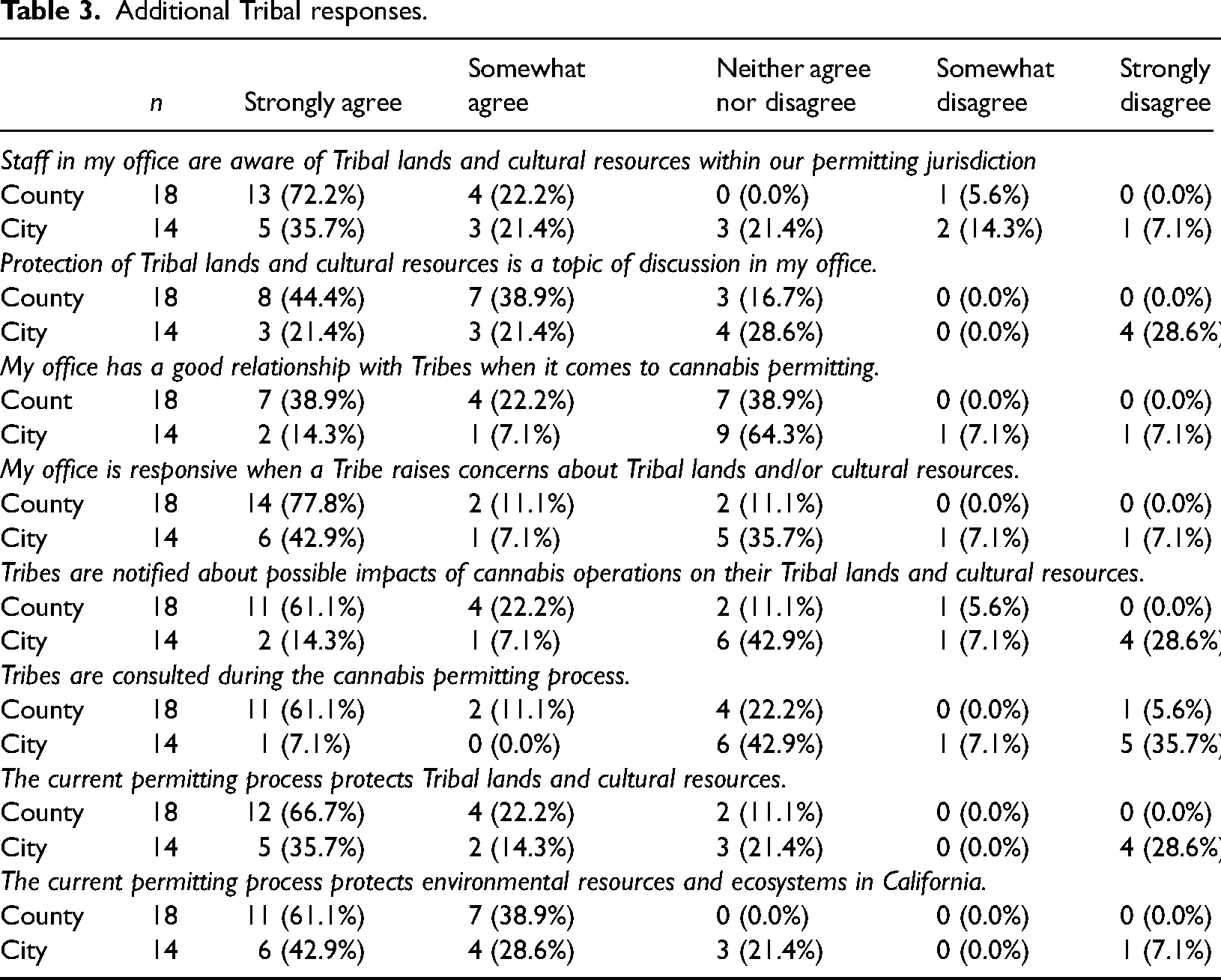
With regard to county responsiveness to Tribal concerns and whether the county resolves Tribal concerns in an appropriate and timely way, the highest ranking category was “neither agree nor disagree,” possibly suggesting a decline in satisfaction for Tribes that consult and an inability to answer the question for Tribes that do not. When it comes to whether county and state agencies are minimizing impacts to TCRs, those questions received the lowest ratings among federally recognized Tribal respondents. Out of 41 respondents, 18 (44%) disagreed that the county is doing a good job minimizing the impacts of cannabis on cultural sites and resources (see Table 2) and 21 (51%) disagreed that the state is doing a good job (see Table 3). Survey respondents were more ambivalent with regard to archaeologists' responsiveness to Tribes when working in cannabis permitting. Out of 43 respondents, 22 (51%) “neither agreed nor disagreed” that archaeologists involved in cannabis permitting are responsive to Tribal concerns (CITS, TS, August 2022).
Additional Tribal responses.
Agency respondents, by contrast, ranked themselves higher than Tribes with regard to Tribal consultation and resource protection processes, with counties asserting more communication and familiarity with Tribal engagement than cities. To capture interaction broadly, we asked county and city respondents whether their office works with Tribes on permitting cannabis cultivation (see Figure 4). Out of 25 county respondents, 15 (60%) reported working with Tribes, nine (36%) reported they do not work with Tribes, and one respondent was unsure. Of those, nine reported sending notifications and corresponding with Tribes monthly, weekly or rarely, and nine reported engaging in actual consultations for cannabis permitting monthly, weekly, or rarely. Eight reported mediating between Tribes and applicants monthly, weekly, rarely and never. The broad range of notification or consultation frequency may be due to the varying amounts of permit applications. For example, several respondents noted that the frequency of correspondence with Tribes typically occurs on an as needed or per-application basis, when warranted by a phase I study. One explained that they send site plans and applications for the Tribe to review. Out of 21 city agency respondents, 17 (81%) reported that they do not work with Tribes and three (16%) reported being unsure. Only one reported working with Tribes but noted that their office provides notifications, corresponds, consults, and mediates “rarely” (CITS, AS, August 2022).
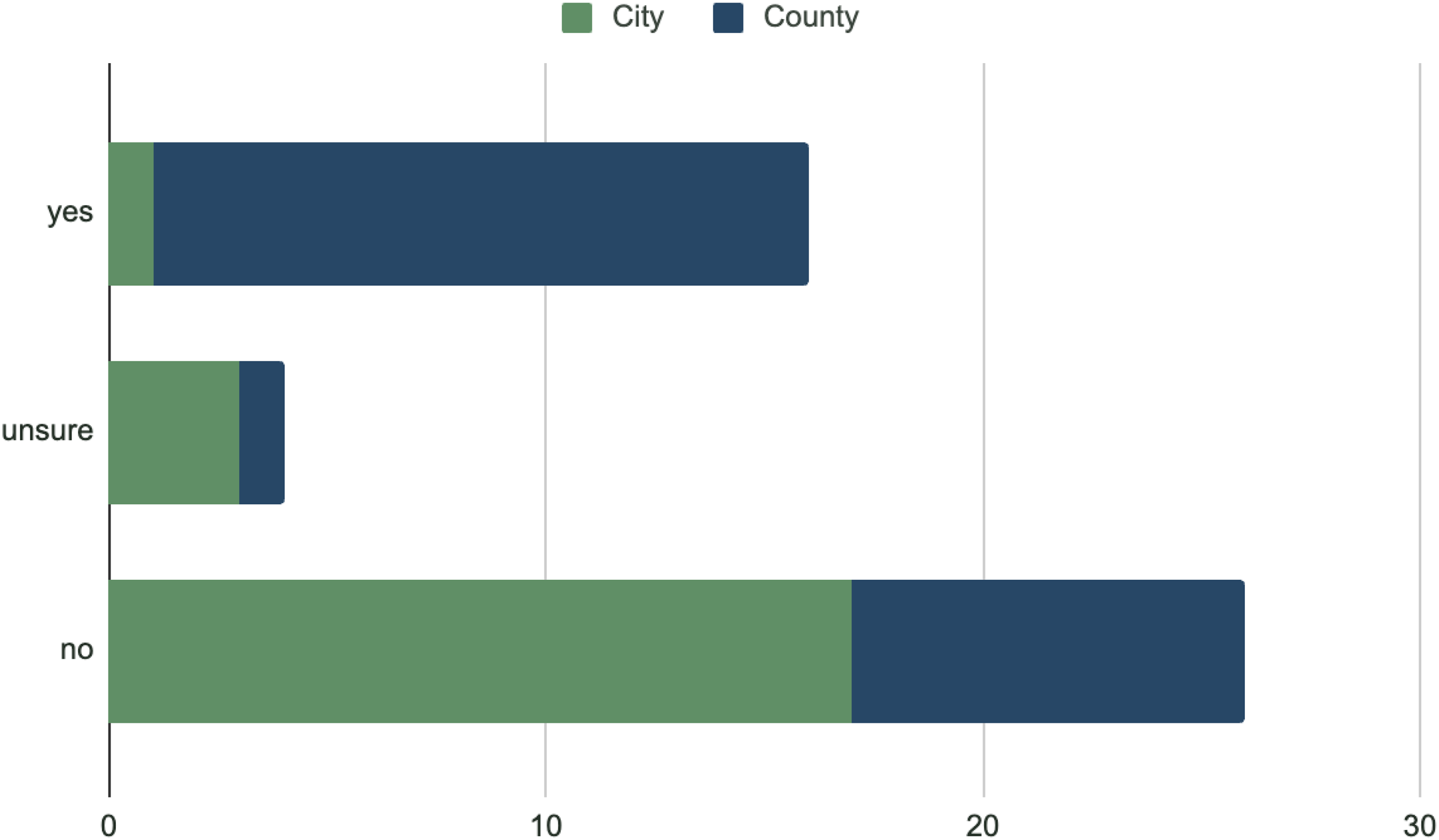
Do you work with Tribes? (CITS, AS, August 2022).
A majority of county respondents “agreed” that staff in their office is aware of Tribal lands and cultural resources within their permitting jurisdiction and that TCR protection is a topic of discussion in their office. County respondents reported that they have good relationships with Tribes when it comes to cannabis permitting and that their office is responsive to Tribal concerns. County respondents were also likely to report that Tribes are notified about possible impacts and consulted during the permitting process. Overall, they found that the cannabis permitting process protects Tribal lands and cultural resources, ecosystems, and environmental resources (see Table 2) (CITS, AS, August 2022).
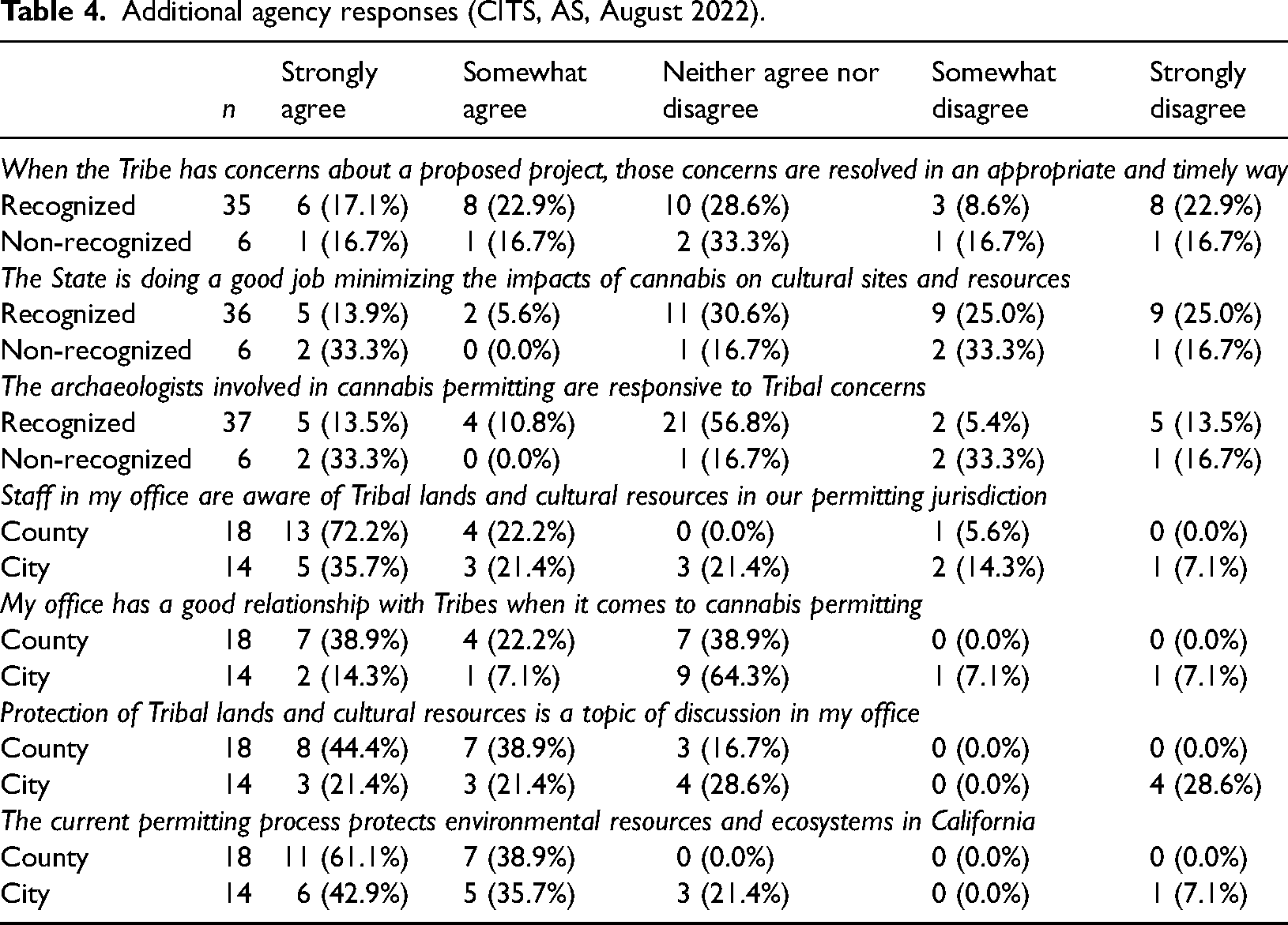
City respondents ranked themselves lower in each category. Out of 14 city respondents, only slightly over 50% reported that staff in their office is aware of Tribal lands and cultural resources and slightly less than 50% reported that TCRs are a topic of discussion in their office. Very few (21%) reported that they have good relationships with Tribes, although 50% reported that their office is responsive to Tribal concerns. Very few agreed that Tribes are notified about possible impacts and even fewer are consulted. Overall, however, 50% of city respondents agreed that the cannabis permitting process protects Tribal lands and cultural resources and 79% agreed that it protects ecosystems and environmental resources (CITS, AS, August 2022). Poorer understanding of Tribal cultural resources and Tribal concerns among city agencies highlights the challenges of Tribes in, especially, urban areas where Tribes may not have as strong a presence due to deeper histories of development and displacement. There may also be fewer opportunities to consult under AB 52, which occurs when CEQA goes into effect, although city agencies should be consulting under SB 18 when they make updates to their general and specific plans (Table 4).
Additional agency responses (CITS, AS, August 2022).
Finally, agencies were asked about barriers to stronger Tribal participation in cannabis permitting (see Table 5). Both agency and Tribal resources and capacity were cited as key barriers at all jurisdictional levels, however most city respondents suggested that this question was “not applicable,” perhaps because they do virtually no Tribal consultation. City and state agency respondents reported they experienced no barriers associated with lack of staff training, lack of government to government coordination, and inadequate internal policies. County respondents tended to experience the widest array of barriers, with the largest number (9, >50%) experiencing complexity in the permitting process as a barrier to Tribal engagement. This barrier suggests a need for more streamlined and better coordination (CITS, AS, August 2022).
Barriers to Tribal participation in cannabis permitting.

Improving cannabis permitting and government to government consultation
The survey asked both Tribal and agency respondents to write short answers about the strengths and challenges of intergovernmental consultation and policy changes or additional resources that would help guide environmental decision making. Among the 21 Tribal responses, 38% (8) referenced consultation in some way with three respondents emphasizing the importance of early consultation, two advocating for Tribes to have more decision making authority, and one recommending additional funding to support consultation. Short answer responses also showed variation in the capacity of different Tribal offices, with some Tribes unknowledgeable about the permitting process (“It is hard to know what to improve if we do not know the permitting process.”) and other Tribes unable to fully participate due to lack of funding (“Provide funding for Tribes to be able to adequately assess impacts to TCR; TCP; and CR to minimize impacts to prehistoric resources. Funding for Tribes to assess impacts to fish, wildlife, water quality, viewshed, etc. to have a comprehensive view of impacts on a per-project basis.) With regard to the latter, one Tribal respondent suggested a cannabis tax that could accrue to Tribes to help with the costs of consultation: “A cannabis tax policy that provides the Tribe with funds for the extra duties involved in protecting our lands and supporting Tribal staff to deal with cannabis issues.”
Four respondents brought forward concerns about the lack of enforcement mechanisms around unlicensed grows. As one explained at length: “The bulk of ancestral territory lies in areas where cannabis grows are illegal. The main issue is illegal grow operations, lack of County resources to effectively deal with them, and lack of process to notify/consult with Tribes about the illegal facility and impacts to TCRs as a result of its removal.” This statement suggests that the removal of illegal grows is hazardous to TCRs, although there does not currently exist a process for including Tribes in consultation about these removals. Additionally, two respondents recommended funding for Tribal staff to conduct cultural and environmental assessments, two respondents noted that the permitting process is opaque, and three respondents recommended increasing funding and efforts for enforcement.
Finally, 24% (5) noted the inability of Tribes to participate in the legal state cannabis market, with several respondents mentioning barriers at the federal level and one emphasizing that the state should allow for permitting on Native lands. Most responses of this kind were framed as an issue of Tribal sovereignty and self-determination (CITS, TS, August 2022).
Agency respondents across all three jurisdictional levels provided additional details through short answer responses about challenges of government to government consultation surrounding cannabis permitting. Many respondents, however, interpreted the question or else took the opportunity to discuss dysfunction and incoordination across agencies at multiple levels of jurisdiction. Out of 24 total respondents, eleven (46%) mentioned policy challenges, seven of which (29%) referenced policy and regulatory differences across agencies that make processes duplicative and inconsistent. For example, one respondent noted that “Each jurisdiction (city, county, federal, Tribal) has unique rules. Impacts such as odors cross jurisdiction lines, so identifying the appropriate agency to respond takes time,” while another simply mentioned that “The actual government-to-government coordination can be overly redundant and often has too many cooks in the kitchen.”
With regard to Tribal interactions specifically, two agency respondents noted that the scope of protections are too limited, one noting the inadequacy of buffer zones around cannabis grows, currently set by the state to 600 feet, and the other noting the widespread use of CEQA exemptions. Six respondents (25%) noted that communication and coordination continues to be a challenge. Four respondents (17%) cited a lack of Tribal and agency staff resources and capacity. Three (13%) cited information challenges, with two noting that the lack of data on Tribal lands for front-end processing is a challenge and one saying that sharing information with external agencies requires labor intensive MOUs. One respondent cited a lack of respect for TCRs and two cited project delays as a challenge. City and county agencies were most likely to highlight the challenge of aligning policies across regulatory agencies or mention inconsistent and duplicative processes, especially around CEQA compliance and drafting initial studies. State agents were most likely to cite TCR protection as a challenge. It is easy to imagine how different challenges feed into each other, how for example lack of staff capacity relates to communication breakdowns and poor information. One important takeaway from the short answers is that local agencies appear more frustrated about working with the state on CEQA compliance, which may be an additional strain on their resources, which could have downstream effects on their ability to conduct rigorous Tribal consultation (CITS, AS, August 2022).
GIS and other tools that could strengthen consultation
Tribal and agency respondents were asked to identify information, tools, and resources to support consultation around permitting and environmental decision making. Out of 19 Tribal respondents, nine (47%) mentioned GIS layers for cannabis grows, with specific layers for permit data and environmental conditions. One respondent wrote: “GIS data—e.g., robust geodatabases with various layers (e.g., land ownership, cultural resources, active grows, hydrogeological, wildlife, soil, vegetation, etc.), basemaps, and useful metadata.” Several respondents added that they would need dedicated staff, funding, training, and equipment to incorporate mapping resources into their workflow. Additionally, one respondent recommended each of the following: education for Tribes; cultural awareness training for agencies; interstate collaboration; a dedicated Tribal liaison and bi-annual meetings between Tribes and agencies; and stronger cultural monitoring at construction sites (CITS, TS, August 2022).
When asked a similar question, city respondents, as before, were most likely to say that Tribal consultation does not apply to their jurisdiction and county respondents were most likely to recommend improving databases and maps. Out of 16 total agency respondents, seven (44%) mentioned databases, maps, or GIS, with five of those recommending increased access to data and one recommending that Tribes have access to cannabis permitting data. Other responses centered around the need for increased capacity and coordination among Tribes and agencies responsible for consultation. Two mentioned a desire for consultation training resources, as well as examples and/or a “best practices” guide. Additionally, one respondent recommended increased [investment in] staffing for Tribes and agencies; a well monitoring program [to monitor water quality impacts of cannabis grows] ; a single point-person for CEQA coordination; and outreach material for Tribes to better understand the permitting process and opportunities for Tribal participation (CITS, AS, August 2022).
Evaluating and strengthening Tribal consultation and cultural resource protections
According to Dadashi's legal analysis, we should expect California Assembly Bill 52 to generate a higher frequency of Tribal consultation that results in better agency awareness of Tribal concerns and stronger protections for TCRs. However, we should also expect agency discretion, distrust, and cross-cultural differences to lead to variability in agency policies and practices with differential consequences for impacts to TCRs. The following section discusses the survey results with additional insights gathered from interviews with Tribal Chairs, THPOs, cultural resource specialists, agency planners, archeologists, and presentations of the survey at several professional meetings.
Evaluating the implementation of California Assembly Bill 52
Does AB 52 support meaningful consultation and cultural resource protection from the impacts of cannabis cultivation in California? Indeed, experiences vary. Survey results show that the statute is leading to a fair amount of consultation at the local level. This alone is remarkable since, prior to AB 52, consultation at the local level occurred less frequently, granting fewer opportunities for Tribes and agencies to incorporate Tribal priorities into land use decision making and to build long-term relationships. The number of Tribal representatives that reported receiving notifications (56%) and engaging in consultation (48%) indicates a strong baseline for developing intergovernmental relations (CITS, TS, August 2022). On the agency side, 4 of 15 (27%) county representatives who wrote textual responses about the strengths and challenges of government to government consultation mentioned improved communication and 5 of 15 (33%) observed that consultation was leading to better outcomes for TCRs. Three other respondents reported shared learning and knowledge, two noted a more streamlined permitting process, and two observed a better net result (CITS, AS, August 2022).
However, around a third of Tribal respondents reported that they are not receiving notification requests or engaging in consultation. The survey results show that not all counties are consulting with Tribes on cannabis permits and virtually no city jurisdictions are consulting. There may be several reasons for this. First, some counties may be evading their obligations to consult or may be consulting with only some Tribes and not others in their jurisdiction. We heard from one representative of a non-federally recognized Tribe that the County was only reaching out to the federally recognized Tribe in its jurisdiction and not to non-federally recognized Tribes, even if the site in question was within a non-recognized Tribe's area of concern (CITS, Interview #44, 6/7/22).
A second reason agencies may not consult is if projects are CEQA-exempt, for example in city jurisdictions that only permit indoor cannabis cultivation (CITS, Interview #2, 7/11/22). An unfortunate consequence of making AB 52 a component of CEQA is that AB 52 only applies when CEQA applies. Projects that are exempt from CEQA (e.g., subject to ministerial approval), however, may still be projects on which Tribes want to consult. From interviews with agency planners and THPOs, we learned that some counties also circumvented environmental review for specific projects by conducting a programmatic EIR for the entire county or granting provisional and interim permits that allowed cannabis cultivators to start operating before conducting environmental review (CITS, Interviews #9, 5/20/22 and #34, 4/19/22). 13 This fast-track approach undermines Tribal sovereignty by suspending AB 52 and foreclosing the opportunity to consult.
The ability to avoid AB 52 by circumventing CEQA and approve permits without Tribal consent points to two principal shortcomings of cultural resource law: the inability to enforce compliance and agency discretion. The survey results also showed that 14% of county respondents and 56% of city respondents did not consult with Tribes when designing their cannabis ordinance (many other respondents were unsure), which violates SB 18. A throughline from SB 18 to AB 52, then, is that there are few consequences for agencies that fail to fulfill their obligation to consult (CITS, Interview #59, 9/20/22). In the absence of adequate enforcement mechanisms and in the face of the competing pressure of powerful financial interests, agencies are incentivized toward non-compliance with cultural resource laws.
Agency discretion, meanwhile, upholds subjective standards about what counts as a TCR and what counts as a substantial effect. Native American studies scholar Beth Rose Middleton, in discussion of SB 18, argues that agency discretion relegates Tribes to “stakeholder status” and disempowers them as decision makers (2013). 14 By making agencies the final arbiters of when and how cultural resource laws apply, agency discretion makes consultation into a box-ticking exercise, reinforcing the colonial paternalism of public agencies and Tribes as their “domestic, dependent nations” (Smith 2004). 15 As Dadashi notes, case law will eventually clarify some of these legal issues, but it can take years for lawsuits to wind their way through the courts and, furthermore, “Native Americans are sometimes hesitant to seek judicial remedy in the first place because the judicial system has not only been unhelpful in securing Tribal interests in the past but has in fact hurt Native American communities on many occasions by setting harmful precedent” (Dadashi, 2021, 243). In short, the non-enforcement of non-compliance and agency discretion to determine how the law applies undermine meaningful consultation and Tribal sovereignty.
Agency discretion and non-enforcement of cultural resource law have cascading effects that imperil other dimensions of consultation. Beyond the split in Tribal experiences with agency counterparts, we also found that satisfaction decreases among Tribal representatives as they move from the notification and consultation stage of permitting toward agency responsiveness to Tribal concerns and actions to mitigate impacts to cultural sites and resources. This negative trajectory suggests that agencies may be fulfilling the minimum requirements under the law, but not always consulting in good faith or incorporating Tribal concerns into environmental decision making.
County respondents, meanwhile, ranked themselves much more favorably with regard to interactions with Tribal governments. As compared to Tribal respondents, nearly twice as many county respondents “strongly agreed” that they send notifications and engage in consultation and this margin widens when it comes to more subjective categories such as agency responsiveness to Tribal concerns and protection of Tribal lands and resources. We believe that this discrepancy may be due in part to 1) counties over-reporting on their efforts under AB 52 and 2) differences in understanding between Tribes and counties regarding what counts as notifications, consultations, responsiveness, and TCRs. For example, agency respondents may believe they are minimizing impacts to TCRs simply because of their narrow definition of “Tribal cultural resource” which excludes water, ecosystems, and wildlife, while many Tribes use the more capacious definition. At the same time, agencies may contend that sending an email or making a phone call as notification or consultation is sufficient, whereas Tribal respondents may define these actions more substantively. The discrepancy between Tribes and agencies may thus reflect different perceptions and understandings of what is meant by and how to operationalize these critical terms.
In summary, the survey metes out Dadashi's hypothesis that AB 52 is generating a higher frequency of consultation, but we also found that experiences of consultation are uneven across the landscape and lowest in cities. Poor experiences can be attributed in part to agency discretion, which makes it possible for an agency to consider but ultimately disregard a Tribe's request to stop or modify a project, leaving the Tribe little recourse but to file a lawsuit that may be time-consuming, costly, and difficult to win. Even if we can expect more frequent consultation to strengthen intergovernmental relations over time, divergences between Tribal and agency experiences with AB 52 consultation may also suggest that cross-cultural differences around operating definitions of “consultation” and “TCRs” continue to erode trust and lead to less optimal outcomes for TCRs. Beyond demonstrating empirical evidence that grounds Dadashi's analysis at the sub-national level, this study also suggests that a lack of adequate enforcement mechanisms incentivizes agencies to circumvent consultation when it suits them. Collectively, the deficiencies of AB 52 consultation point in a positive sense toward opportunities to strengthen cultural resource policy and practice.
Strengthening consultation and resource protection in California
As one Tribal representative observed, “AB 52 has good bones but no teeth” (CITS, Interview #37, 7/8/22). Elaborating on this sentiment, another respondent expressed frustration with the laissez-faire approach that predominates in Tribal cultural resource law and Tribal consultation: There are court mandated requirements for Consultation in addition to State Consultation guidelines, all of which a [Tribal cultural resource] rep will already have in hand or else request from local government as needed. The permitting agency already provides the needed information for the decision making process. However, the permitting agency fails to share decision making authority with Tribes and always takes a scientific approach to data collection as opposed to allowing Tribes to decide which resources are important. Without shared decision making authority, it's just manipulation. (CITS, TS, August 2022)
To uphold Tribal sovereignty and self-determination through authentic intergovernmental consultation, policies should grant Tribes discretionary authority over permitting. As one respondent wrote, “Tribes should be able to give recommendations that require or cause mitigation to be initiated by the county” (CITS, TS, August 2022). Our research team encountered one model of Tribal discretion in Humboldt County, in which county agency representatives consulted with Tribes on their land use ordinance and agreed to include language that empowers Tribes to determine when a landscape feature is a TCR and when a project would have a substantial effect on that TCR. This effectively gives Tribes the ability to stop or modify a project and to impose culturally appropriate mitigation measures within their aboriginal jurisdiction. A senior planner said that Tribes have been judicious in their exercise of the discretionary authority that they are able to exercise under the Humboldt County land use ordinance (CITS, Interviews #22, 5/29/22 and #58, 6/15/22). 16
A broader application of Tribal discretionary authority in land use decision making would prevent agencies from treating consultation as a box-checking exercise. If Tribes have the authority to stop a project that will damage cultural resources, agencies will be compelled to engage in good faith consultation and in a manner that is appropriate and timely. As AB 52 affirms, Tribes should be considered the experts in evaluating the presence and integrity of TCRs and determining their eligibility for official listings (§1b4). But the state should go further than recognizing Tribal expertise. As the law is currently written, culturally appropriate mitigation and avoidance of impacts are still only considered rather than required within the CEQA process, which leaves mitigation actions to the discretion of the decision making body of the lead agency (§1b5). Tribal discretion entails not only opportunities to provide input and feedback on the decision making process, but also entails control over outcomes. Hence, Tribes should reserve discretion at each phase of permitting and development, from determining potential impacts to TCRs to determining appropriate mitigation measures. The most holistic application of Tribal discretion would be to involve Tribes as equals in the co-design and co-creation of cultural resource policies and consultation protocols to assure that the process works optimally for all parties.
Correlative to Tribal discretionary authority in sharing decision making power are “early consultation” and enforcement mechanisms that include Tribes as early as possible in land use governance and backstop this inclusion. Tribes want to be consulted “early and often,” but they frequently find that they are brought in late after critical decisions have already been made and developers have already invested substantial time, finances, and energy. Beyond the initial phase, projects get “locked in,” deliberation becomes costly, and plan alterations become more difficult. Effective enforcement and formal mechanisms when disagreement leads to an impasse, such as neutral arbitration, are also essential to ensure that agencies do not disregard or circumvent the law with impunity. Effective enforcement is what gives the law its “teeth.”
Beyond improvements to the legal structure of Tribal consultation and TCR protection, both Tribal and agency respondents identified soft or intangible infrastructural preconditions of meaningful consultation. GIS was widely cited as an important aid to informed decision making and coordination, although a clear divergence between Tribal and agency responses is revealing. Agency respondents requested Tribal data on TCR locations, which some seemed to imagine would remove the need for consultation. A state respondent, for example, wrote: (1) Give state and local agencies access to more expansive geo-referenced screening data (for some Tribes, this is a sensitive and potentially controversial suggestion) to better identify proposed cannabis cultivation operations that could affect cultural resources and ancestral lands, thus improving the agencies' abilities to ensure appropriate protections are in place, (2) Develop and distribute to Tribes outreach materials explaining the licensing/permitting process(es) and opportunities for Tribal participation beyond the formal AB 52 consultation process, (3) Provide Tribes access to an integrated, geo-referenced statewide database of license/permit applications and approvals (incorporation of county data would likely be problematic). (CITS, AS, August 2022)
While recommendations (2) and (3) would enhance Tribal efforts to meaningfully engage in the permitting process, recommendation (1) is a non-starter for most Tribes (the respondent gestures to this possibility). Given histories of land dispossession and site desecration through looting and vandalism, it is essential for Tribes to keep the location of certain areas confidential. Tribes have been reluctant to share sensitive information with state agencies, which is a major reason why the NAHC and other agencies do not have complete information on TCR locations. Tribal responses therefore favored (3) giving State cannabis data to Tribes, but they also noted a need for funding and training for “using the GIS layers, any needed software, potentially we would need upgrades to a few computers, and online storage” (CITS, TS, August 2022). The central importance of data privacy and sovereignty means that no database can replace direct consultation as the best way to determine potential impacts to TCRs and appropriate mitigation measures.
Funding also surfaced as part of the essential infrastructure of meaningful consultation. Funding is necessary for every element of cultural resource protection, including staff time for project reviews, cultural and environmental assessments, monitoring and enforcement, and for consultation itself. When cultural resource laws are an unfunded mandate, a lack of capacity among agencies and Tribes undermines meaningful consultation (CITS, TS, August 2022).
Finally, among the essential infrastructure of consultation are relationships of trust and mutuality, institutional knowledge, cultural awareness, and communication skills. These features of good consultation cannot be legislated (although strong legislation helps), but must be built over time through familiarity, respect, and good will. Every Tribe is a distinct nation, thus Tribal cultural resources are different for each. The finding that some Tribes consider ecosystems and wildlife to be part of their cultural resources shows that there is no one-size-fits-all solution for defining, respecting, and mitigating impacts to these resources. This cross-cultural understanding must emerge through consultation and can only be refined through years of respectful and mutual interaction.
Strong relationships, moreover, can supplement weaknesses in the law. To take Humboldt as an example once more, the County jointly developed its protocol with Tribes such that Tribes are notified about projects even when CEQA does not apply (since AB 52 is part of CEQA, there is currently no state mandate to consult with Tribes on projects that do not trigger CEQA). It is because of relationships (and past painful experiences) that the County now consults in excess of state statutory requirements, clearly demonstrating “good faith” efforts (CITS, Interview #22, 5/29/22). 17 One upshot of AB 52 is that more frequent consultation may help to build the relationships and other intangible infrastructure of meaningful consultation. Through AB 52 consultation, some agencies are gaining familiarity with local Tribes for the first time, and this itself advances conditions of mutual understanding, accountability, and respect.
Future research
Future studies might delve further into the qualitative dimensions of Tribal consultation and intergovernmental relations and might expand our scope to all counties by looking at other agriculture and natural resource sectors, such as forestry and water. A different study might also evaluate the degree to which TEK is incorporated into land use decision making through AB 52 consultation, co-management agreements, and other forms of Tribal jurisdiction and land tenure, and with what results. In cannabis research, future studies should look at Tribal participation in the legal cannabis market and barriers to participation as well as issues related to illicit cannabis in California, including impacts to TCRs and effective mitigation measures.
Conclusion
As the case of cannabis permitting shows, AB 52 consultation gives Tribes legal standing in local land use planning and decision making and is helping to protect Tribal cultural resources. However, meaningful consultation is not happening consistently across places and projects. According to our survey results, this is due to CEQA's limited scope, agency discretion, poor enforcement mechanisms, as well as a lack of capacity and resources in both Tribal and agency offices, including inadequate funding, staff shortages, and poor information. Tribal-agency communication and coordination is further impeded by the complexity of land use permitting and inconsistent policies across jurisdictions. While AB 52 itself can be expected to cultivate the infrastructure of consultation over time, some problems are structural in nature. Key recommendations from our survey are to enable (1) shared decision making authority through Tribal discretion, which can be maximally interpreted as co-designing cultural resource management and consultation processes with Tribes and giving Tribes the right to define TCRs, substantial effects, and mitigation measures; (2) provide high quality information on land use permits to Tribes so that consultation can be well-informed; (3) provide funding and training alongside consultation mandates to enhance capacity of both Tribes and agencies to meaningfully and equitably engage in the consultation process (this may be in support of hiring staff, purchasing equipment, and using GIS effectively); and (4) cultivate relationships between agencies and Tribal offices, which can lessen problems stemming from cross-cultural differences and lack of trust.
Introducing Tribal consultation into environmental review at the subnational level holds potential to enhance the role of Tribes in land use decision making so that they can protect Tribal cultural resources that lie beyond trust and reservation lands. Local level consultation may also strengthen relationships that can mitigate systemic problems of Tribal consultation and help to bring understanding of TEK into agency planning. AB 52 is piloting this promise in California, but must be understood as just another step in codifying Tribal sovereignty over Native ancestral lands. Future statutes, including those in other states, will reveal the promise of local level consultation to protect Tribal cultural resources, which extend beyond cultural sites to include considerations for watersheds, landscapes, and much of what mainstream culture calls “the environment.”
Highlights
First on-the-ground study of subnational consultation between Tribes and public agencies under Assembly Bill 52 (AB 52) of the California Environmental Quality Act (CEQA). Tribal-agency consultation at the local level may help to build long-term partnerships, supporting Tribal sovereignty and introducing Traditional Ecological Knowledge (TEK) into land use decision making. Experiences in consultation vary, with some county jurisdictions consulting more than others and most city jurisdictions failing to consult. Failure to consult may be due to legal loopholes or non-compliance, indicating that cultural resource laws “lack teeth,” i.e., adequate language and enforcement mechanisms. Tribal satisfaction declines with regard to later-stage aspects of consultation, indicating that agencies may interpret “consultation” reductively.
Footnotes
Acknowledgments
The authors would like to acknowledge the California Department of Cannabis Control for supporting this research and the tribal and agency representatives who offered their time and expertise.
Funding
The authors disclosed receipt of the following financial support for the research, authorship, and/or publication of this article: This work was supported by the California Department of Cannabis Control, (grant number 65304).
