




Abstract
Used clothing has long constituted a cherished consumer good and crucial source of livelihoods in Tunisia. Yet a marked deterioration in the quality of used garment imports, as well as the proliferation of homogenous fast-fashion stocks, has diminished opportunities for value retrieval. This article sets out from this qualitative decline on the markets of North Africa's largest current importer and re-exporter of used clothing to challenge framings of the global used clothing trade as a circular economy. Circularity, which is primarily premised on possibilities of reuse in the clothing value chain, has been promoted as an economically viable solution to the apparel industry's surplus production and the catastrophic environmental impact of ever-faster cycles of production, consumption and discard. However, images of illicit textile waste dumps in the Global South have exposed how the global used garment trade shifts a disposal problem to countries with weaker regulatory frameworks. This article extends such critiques of circularity by shifting attention from the dumpsite to the economic processes by which diverse actors actually enable reuse. An ethnographic study of what the article terms valuation work sheds light on the labour-intensive, material practices that enable circularity, but that are also prone to rupture or breakdown. This in turn elucidates how qualitative changes on the global used clothing market erode profit margins and devalue labour at a particular back end of the value chain. Unpacking the contingent and site-specific processes that show how the circular economy works in practice not only exposes the social and environmental injustices the framing obfuscates; it also points to alternative forms of knowledge production that might reorient critical debates about what circularity is and can be in the future.
Going towards the northernmost Tunisian city Bizerte on the potholed road that runs parallel to the motorway and lines the shore of Bizerte Lake, a row of walled factories frames the right side of the road. If the gaze isn’t distracted by the lake views, one can make out colourful piles of an unidentifiable material towering behind the glistening metal roofs of the factory halls. Turning off the main road to follow a dirt path between the factory walls, one approaches what look like uncanny sculptures of over 5 metres height. Upon closer inspection, the piles reveal themselves as stacked bundles of discarded clothing. The faded colours of the cloth point to its exposure to the scorching Tunisian sun the previous summer, and recent rain fall has compressed the bundles, causing them to sink into one another and colouring the large puddles on the ground as parts of the material seep into the soil. The empty field, originally part of the swamplands between the lake and the Mediterranean Sea that were first drained by French colonisers, has turned into an illicit disposal site of the used clothing sorting factories that are located nearby. Much of what is discarded as valueless amongst the container loads of imported second-hand clothing that are sorted in the factories finds its way to this or similar dumping grounds, often in open nature because Tunisia's official landfills are saturated (Bouhlel and Furniss, 2023).
Photos taken behind the Tunisian used clothes sorting factories of the Bizerte Lake bear resemblance to the ever-more mediatised and spectacular imagery of clothing waste piling up on the ocean shores in the Ghanaian capital city Accra, or of discarded textiles colouring the dry grounds of the Atacama Desert in Chile (Choat, 2023; Verges, 2023). While the disposal of clothing waste in Tunisia is more geographically dispersed and thus remains largely hidden from public view, the country's status as North Africa's largest current importer and re-exporter of used clothing 1 means that tons of unusable leftovers find their way to such illicit dumpsites. These images of second-hand clothing turning into toxic waste stand in stark contrast to dominant policy and development discourses that portray the Global Used Clothes Trade (UCT) as a robust circular economy. The notion of circularity has long allowed for framing the transnational trade in used garments as a viable economic solution to the catastrophic environmental effects of the ever-increasing surplus production of the global garment industry. Circularity suggests that value can be retrieved from clothing discarded by first-time consumers, either through reuse or recycling, providing a source of economic profit in secondary markets. The charities and development organisations involved in the collection and export of used clothing in the Global North thus promote ‘second-hand fashion’ as an environmentally sustainable consumer practice that not only ‘extends the lives of clothes’ but also offers ‘job opportunities’ for the unwaged poor in the Global South (Oxfam, 2023). The idea of circularity hence encourages clothing donation practices in the Global North, spurring on and legitimising new cycles of consumption that guarantee unabated demand for new apparel. Due to the large quantities of donated used garments in Europe and limited local demand, only 10% are sold locally, while the rest is exported to be traded on an exponentially growing global used clothing market (Minter, 2019).
This article offers a critique of the assumption of ‘circularity’ in the transnational used clothes trade by offering an in-depth engagement with the context-specific economic processes that actually allow used garments to recirculate on secondary markets. It thus centres on an ethnographic study of valuation work, understood as the contingent and labour-intensive processes through which value is retrieved in the used clothing economy. The central argument is that the possibility of reuse – which lies at the basis of assumptions of circularity – cannot be taken for granted. On the contrary, the article shows how a marked devaluation in the quality of clothing circulating on the global used clothing market increasingly undermines the fundamental premise of circularity, namely that exported used clothing can be returned to its ‘commodity situation’ (Appadurai, 1986: 13). An engagement with micro-level material practices and work processes is thus here advanced as a crucial form of critical knowledge production on the circular economy. From female sorting factory workers, to wholesale traders, to women accomplishing everyday repair work in their private homes; the experiences and perceptions of those whose livelihoods are entangled with and dependent on used clothing valuation is here considered central. This elucidates how a qualitative deterioration of the used garments arriving in Tunisia, but also the growing proportion of new fast-fashion stocks among the imports declared as ‘used clothing’, affect valuation work. The article thus shows how circularity reaches a dead end when skilled practices of valuation are eroded in the face of a transformation of fripe 2 – the term for used clothing employed in Tunisia since the Second World War – to plastic waste (zibla plastique).
This article proceeds in three sections. The first sets out the core contribution to critical debates on the ‘circular economy’, from the particular perspective of a rapidly growing reuse economy. It explicates how, in differentiation to discard economies where circularity primarily hinges on the retrieval of value through recycling, valuation work in the used clothing economy depends on context-specific processes of separation, grading, trading and consumption. The second section builds upon this notion of valuation work to analyse the spatial and social division of labour that has structured value retrieval from used clothing in Tunisia. It then traces the deterioration in the quality of used clothing imports to Tunisia over the past decade that has begun to erode the fripe's status as a mainstream consumer good and as a secure source of livelihoods. The third section turns to three actors involved in used clothing valuation in contemporary Tunis, drawing out how the devaluation in the materials they handle, trade or repair undermines their everyday work practices and professional identities. This article is based on 21 months of ethnographic research in Tunisia's used clothing economy between 2017 and 2022, with a near two-year, pandemic-related interruption between doctoral and postdoctoral research (2020–2022). Recurrent ethnographic interactions with the same interlocutors over the period of five years are central to the critique of circularity put forward, as they capture how contingencies in situated practices of valuation change over time (Figure 1).
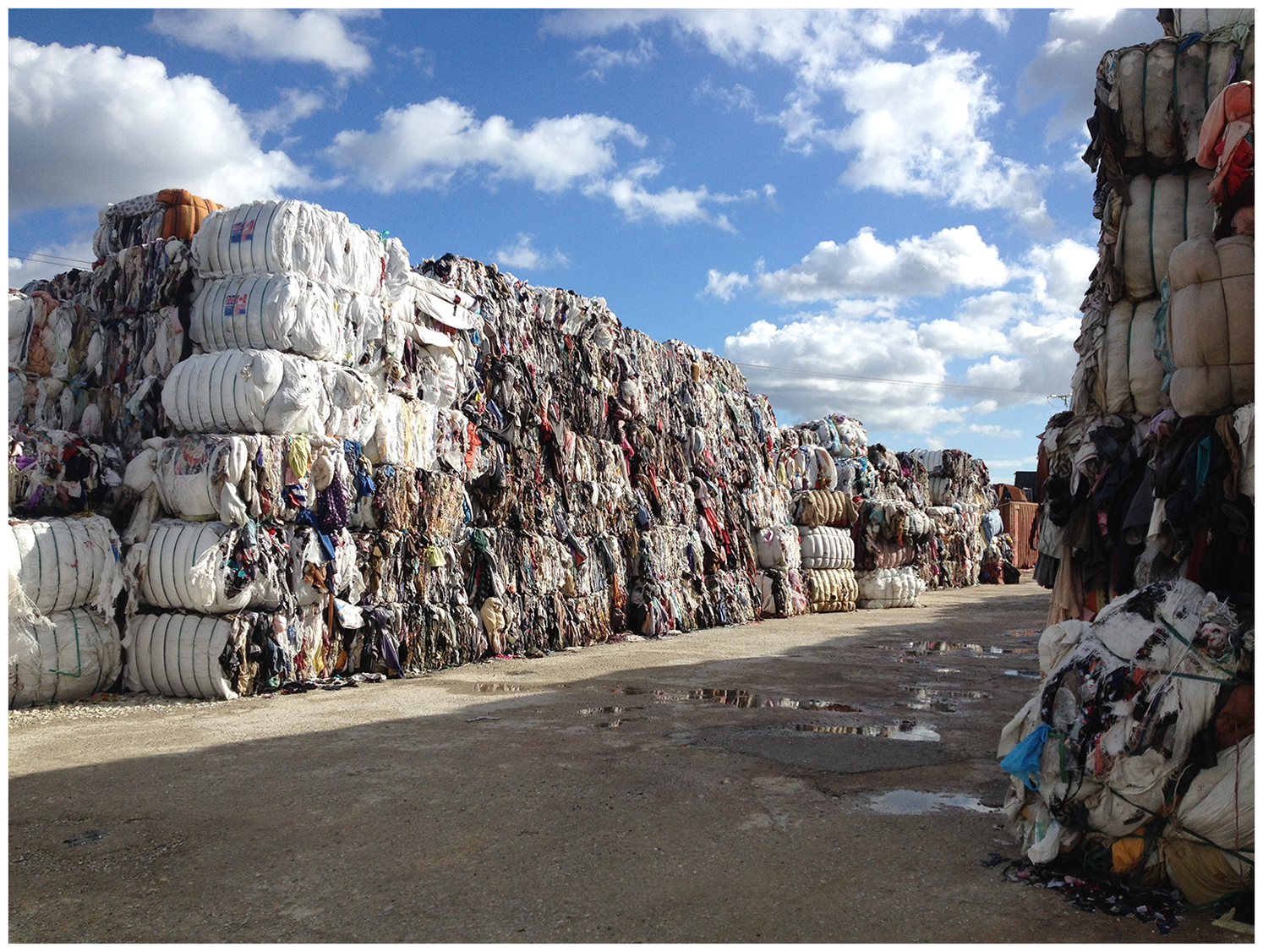
Used clothing disqualified from reuse piling up behind a Tunis sorting factory © 2019.
Valuation work as an invisible premise of circularity
The surplus problem on global clothing markets first emerged with the increasing mechanisation of garment production in Europe in the 19th century, drastically reducing the price of new clothing and thus diminishing demand for used clothing (Lemire, 2012: 61). This was exacerbated through war-time surplus production, prompting the first large-scale exports of used clothing to countries in colonial dependency at the end of the First and Second World War to protect the US and European domestic markets (Hansen, 2000: 63). Ever since, rapidly growing export volumes of used clothing from the Global North to the Global South have presented the key solution to a quantitative surplus problem generated by ever-faster clothing production and consumption cycles. During the 1970s and 1980s, an exponential increase in clothing production and consumption in the Global North was in part absorbed by the professionalisation of used clothing collection and export through charity organisations, indirectly subsidised through tax deductions (Bigsten and Wicks, 1996: 379). This resulted in a six-fold growth of used garments traded on the global market between the mid-1980s and the mid-1990s, turning it into a lucrative economy of scale that was portrayed to the public in the Global North as ‘charity’ and ‘humanitarian assistance’ (Hansen, 2000: 115).
With the rise of fast-fashion during the second half of the 1990s – often credited to the pioneering Spanish conglomerate Inditex/Zara (Crofton and Dopico, 2007) – the catastrophic environmental footprint of the apparel industry became increasingly apparent. From the carbon footprint of synthetic fibre and clothing production; to water usage and pollution; to the proliferation of pre- and post-consumption textile waste; the ‘negative environmental externalities’ of the global garment industry attracted increasing public attention by the turn of the 21st century (Morlet et al., 2017). Discourses on circularity were posed as a solution to these environmental problems, suggesting that a transformation of the ‘linear garment value chain to a circular economy’ could ‘tackle the adverse environmental effects of the fashion industry’ (Chen et al., 2021: 12). In theory, ‘circularity’ in the garment value chain is based on the triple premise reduce, reuse, recycle. In practice, however, focus lay from the outset on ‘extending product lifetime’ by ‘redistributing textiles to secondary markets’, almost all of which are located in the Global South (ibid). Similar to other market-based solutions for environmental problems, the circular economy promises to mitigate the perverse environmental effects of over-production and consumption by opening yet untapped economic opportunities. Taken up euphorically by charity and development organisations involved in used clothing collection and export in the Global North, the concept of the circular economy is prominently employed to highlight synergies between environmental sustainability and human development (Ellen Macarthur Foundation, 2023; Oxfam, 2023). The used clothing trade is thus promoted as both a tool for ‘reducing waste and harmful environmental effects of the textile industry to combat climate change’, and as a mechanism for ‘building sustainable and diversified economies in developing countries’ (Feyertag, 2024: 5). The promise of ‘green jobs’ and ‘female empowerment’ in secondary markets moreover underlines the positive social transformation that can be achieved through a country's insertion in the used garment value chain (Schröder et al., 2019). In the same vein, recent predictions that the second-hand market will outpace the growth of fast-fashion market by 2025 are celebrated as a sign of the robustness of the ‘circularity approaches’ that are reshaping the global fashion industry (ThredUp, 2020).
Most critiques of such circular economy discourses in the clothing industry have focused on the environmental injustice that results from shifting an end disposal problem to the Global South. Wealthy countries with high collection rates have thus been exposed as effectively circumventing the ever-stricter regulatory and environmental frameworks for textile waste disposal in the Global North (Watson et al., 2016). Investigative reporting has uncovered the ecological damage caused by the export of ever-larger quantities of clothing, challenging the premise of circularity by shedding light on the ugly endings of the garment value chain (Changing Markets, 2023; EcoWatch, 2023; Tony Blair Institute for Global Change, 2021). This article extends and complements such critiques of the circular economy by shifting attention to the contingent processes of value retrieval that underpin possibilities of reuse. It sets out from the observation that while circularity hinges on labour-intensive processes of valuation that largely take place in export markets in the Global South, these economic processes tend to find little consideration in critical debates on circularity. An ethnographic engagement with the situated material practices that requalify used clothing for circulation on secondary markets thus provides a crucial alternative form of knowledge production on the circular economy. This perspective is indispensable to comprehending how circularity is actually enabled and enacted, but also why it is prone to breakdown.
The complex work of valuation and its vulnerability to changes in clothing supply
To understand how value is produced from imported used clothing, this article proposes a study of valuation work, meaning the differentiated practices and processes by which diverse actors in Tunisia retrieve value from the fripe. Focus lies on comprehending how qualitative changes in the supply of used clothing to Tunisia currently diminish opportunities for value production, eroding livelihoods and cutting short circuits of reuse.
In its study of valuation work, the article builds upon the distinct contribution of academic literature on used garment economies to a wider field of discard studies. In differentiation to waste economies in which value retrieval occurs through disassembly of discard materials (Herod et al., 2014) or through ‘things coming-apart’ (Gregson et al., 2010: 853); or in which ‘re-assemblage and repair work’ expose the mutability of materials (Corwin, 2018: 22); valuation in the used clothing economy mostly leaves the garments physically unchanged. While the transformation of used clothing through processing does at times constitute an element of value creation – for instance documented in the shoddy blanket industry for the humanitarian aid sector (Norris, 2010) – reuse typically remains more lucrative than recycling. Therefore, valuation work in different used clothing economies mainly occurs ‘without industrial labour through a process of translation’ (Tsing, 2013: 23), that often takes the form of subtle processes of sorting, grading, re-packaging or re-labelling (Gregson and Crang, 2015: 166). This is all the more important because used clothing, as a heterogeneous and continuously evolving import category, carries no standardised or stable value. Accordingly, the commodity status of individual used garments needs to be critically reassessed or restored to qualify them for renewed circuits of exchange, transaction and use. Valuation thus represents a necessarily contingent and relational process, in which imported used clothing is transformed through ‘cultural processes of value definition and performance’ (Guyer, 2004: 21). Ethnographic studies of used clothing economies have identified labour-intensive, manual sorting practices as a central mechanism of valuation. Such processes of separation, in which distinctions are drawn between the valuable and the valueless, require situated knowledge, skill and expertise and are often feminised (Ayimpam, 2016; Hansen, 2000; Botticello, 2012). In addition, the establishment of new categories of value among the heterogeneous clothing demands a nuanced understanding of codes of dress, style and brand value that differ from one context to another and that can change rapidly over time (Abimbola, 2012; Brooks, 2015). Therefore, while the majority of jobs in global used clothing markets are informal, often precarious (Brooks, 2012; Durand, 2023) and even illicit if cross-border trade is involved (Hernandez and Loureiro, 2017; Milgram, 2008); valuation work is also tied up with situated socio-professional hierarchies, identities and skill.
This article adds to such research on valuation as contingent and unorthodox production process in the used clothing economy by examining the impact of supply side changes on possibilities for value retrieval. For this purpose, it offers an in-depth engagement with some of the actors and material practices involved in requalifying imported used clothing for commodity circulation – from the sorting factory, to the wholesale warehouse, and to the private home. This advances an expansive conception of ‘work’ that blurs typical differentiations between formal wage labour and informal work; production and reproduction; or income-earning activities and private provisioning. Following Hansen's finding that even consumers of used clothing are enrolled in ‘hard work, a kind of invisible production’ that ‘does not constitute the end point of the economic process but helps fuel new beginnings’ (Hansen, 2000: 184), this article intentionally zooms in on sorting and separation processes at diverse stages of the local value chain (Crang et al., 2013). Engaging with factory employees, wholesale traders and informal collectors of market leftovers highlights how qualitative changes in the available used clothing affect their valuation work in different ways. For some, the loss of diversity through the sale of large volumes of unsold stocks on the Tunisian used clothing market subverts the very basis of value production through skilled sorting. For others, the proliferation of low-quality polyester fabrics amongst the used clothing compromises material possibilities for reuse, repair or reinvention (Smelik, 2023). While the durability of polyester was once considered its central asset, plasticity has become a problem as the materials cannot easily be transformed without industrial equipment (Stanes and Gibson, 2017: 28). As the article highlights, the adverse effects of such qualitative changes on people's livelihoods and professional identities are gendered (Maclean, 2014), as used clothes sorting is a feminised task (Grüneisl, 2023) and is often inextricably tied to unwaged activities of provisioning and social reproduction that are largely accomplished by women (Narotzky, 2005).
This study of valuation work is based on multi-sited ethnography with diverse actors handling used clothing in Tunis. Repeated interviews and observations, but also the shadowing of work routines and go-alongs (Kusenbach, 2003), inform the analysis presented in what follows. While trade in the Tunisian used clothing economy is heavily male-dominated, my positionality as a female researcher favoured an engagement with less visible, feminised processes of valuation, from the sorting factory to private homes. This foregrounds a gendered understanding of diminishing possibilities for value extraction, connecting a reduction in profit margins to the increasing ‘depletion through reproductive work’ that women are disproportionately exposed to (Rai et al., 2014). In addition, my ‘study of what people do with objects’ (Miller, 1998: 19) was complemented by active participation in manual practices of sorting, re-packaging or selling used clothing. The possibility to imitate people's gestures and to learn to recognise – yet of course never master – their craft proved essential to comprehending the unorthodox production processes that create value in the sorting factories, wholesale warehouses or the used clothing shop in which I assisted the female owner over a period of three months.
The next section outlines why Tunisia constitutes a privileged vantage point for examining qualitative changes in global used clothing circulations and their effects on possibilities for value retrieval, and thus reuse. In doing so, it explicates Tunisia's changing position on an expanding global used clothing market from the 1990s to the present, and shows how this translates into new contingencies for valuation at the micro-scale.
From fripe to plastic waste: new contingencies to used clothes valuation
To comprehend the complex structure of the local value chain for used clothing in Tunisia, it is necessary to analyse the country's role as not only an end destination of second-hand garments from the Global North; but as a major sorting and redistribution location for imported used clothing to neighbouring Algeria, West Africa and, to a lesser extent, back to Europe. This prominence of Tunisia on the global used clothing market favoured the emergence of a local consumer culture that transformed the fripe into a mainstream consumer good from the early 2000s. Yet as this section sets out, structural changes in the global used clothing trade, combined with an exacerbating socio-economic crisis in Tunisia and supply chain disruptions during the COVID-19 pandemic, have affected the kinds of used clothing that arrive on the Tunisian market. Recurrent encounters with the fripe as non-reusable plastic waste capture new uncertainties in the valuation work upon which innumerable livelihoods depend.
As was the case in most African countries, large-scale fripe shipments to Tunisia began with the export of war-time surplus materials by the Allied Forces of the Second World War (Hansen, 2000: 10). In Tunisia, this military fripe (fripe militaire) was centrally administered by the French colonial authorities and while the used clothes were officially reserved for charitable distribution, they rapidly began to be traded as commercial goods on a flourishing black market. 3 After independence, Tunisia's first president Habib Bourguiba encouraged the import of civilian used garment surplus from the USA. The French colonial policies had exacerbated import dependency and had left Tunisia's textile industry in shambles, resulting in widespread clothing scarcity (Croisier and Granger, 1951: 2). A single private company imported fripe to the Tunisian port city Sousse in the early 1960s and distribution was centrally organised (Van Groen and Lozer, 1976: 118). The intentional conflation of these imports with American aid (musa’adat amrikaniya) tied the fripe symbolically to the system of provisioning of Bourguiba's ‘developmentalist post-independence state’ (656) and thus to ‘an implicit contract focused on paternalistic redistribution’ (Desrues and Gobe, 2023: 656).
From the mid-1980s, the professionalisation of charitable used garment collection in the Global North (Mangieri, 2008: 15) prompted Tunisian migrants in Europe to join the flourishing second-hand business, building on pre-existing trans-Mediterranean networks to ship European used clothing to Tunisia. Pioneering Tunisian entrepreneurs like Habib Guerrida, founder of the transnational used clothing distribution business Guerrisol, was one of the first to recognise the profit-making margin that lay in the relocation of labour-intensive used clothing sorting processes to Tunisia (Boubakri, 2002: 8). Capitalising on Tunisia's positioning as strategic stopover and sorting location for second-hand clothes between Europe and Sub-Saharan Africa, the world's single largest export market (Brooks, 2015: 145), the Ben Ali regime then exempted used clothing from import taxes, 4 rendering the transnational business even more profitable. According to a legal framework adopted in 1995, this tax-free import regime was conditioned upon the possession of a sorting factory (m’amal al-farz), where at least 30% of used clothing had to be sorted and packaged for re-export and another 20% had to be recycled. However, as sector stakeholders and government officials affirm, such conditionalities – as well as the quota that officially limits annual fripe imports to Tunisia to 10,500 tons – were never respected in practice and most recycling machinery lay idle. Instead, the 1995 law became a tool for positioning cronies of the Ben Ali regime and members of the Trabelsi family in the lucrative transnational used clothing trade. Consequently, the number of sorting factories for second-hand clothes in Tunisia grew from 12 to 50 between 1995 and 1999, and the fripe sector was subsequently closed to further investments. This effectively established a stable oligopoly position for licensed importers, who were able to increase trading volumes unchecked.
Tunisia's transformation into a used clothing sorting and re-export hub favoured a differentiation of the fripe's local value chain. First, it accelerated the professionalisation of sorting and led to its reorganisation as formal factory wage labour, translating into the feminisation of this initial stage of valuation work (Grüneisl, 2023). Second, the availability of greater quantities of separately packaged product categories of used clothing favoured the expansion of the wholesale business. In Tunis, this translated into the emergence of a specialised warehouse district for fripe storage and redistribution in the working-class neighbourhood Zahrouni on the capital's Western outskirts. The wholesale traders not only distributed fripe from the capital to the rest of the country, they also began to supply the vast consumer market in neighbouring Algeria, especially after a ban of used clothing imports to the country. 5 Third, the availability of neatly graded used clothing spurred on the specialisation of retail spaces and favoured the emergence of new second-hand consumer cultures. While, as Stamatopoulou-Robbins retraces in the case of Palestine, used clothing consumption was long associated with shame (ayb) (2019: 64), it now came to evoke not only ‘relations of need’ but also ‘of desire’ (ibid, 2019: 81). In Tunisia, so-called luxury fripe (fripe de luxe), the best quality used clothing selected in the sorting factories, were now sold in high-end boutiques and markets that targeted a new urban upper middle-class clientele.
The diminishing quality of the fripe on the Tunisian market
Today, over 80% of Tunis residents buy regularly from the fripe 6 and used clothing markets and boutiques are ubiquitous all across Tunisia. Used clothing consumption is closely linked to an appreciation of brand authenticity, as well as to the superior quality associated with European clothing that has proven its durability during previous use cycles. This valuation of used garments is often set in contrast with the new clothing available as a mainstream consumer choice in Tunisia. As original brand imports from Europe or North America are unaffordable to most Tunisians, the only viable alternative to fripe are counterfeit imports from Asia or Turkey, which tend to be referred to indiscriminately as made-in-China (Chinwa) products. This merchandise is associated with smuggling (tahrib), as it is often illicitly imported from Libya or Algeria to circumvent taxation (Doron, 2017; Meddeb, 2012). Moreover, it is considered to be of substandard quality as it tends to be made of synthetic fibres and is thus associated with other plastic materials that have inundated the Tunisian market since the 1990s.
However, a marked decrease in both the quality and diversity of the used clothing arriving in Tunisia has unsettled such distinctions between the valuable and the valueless. Some go as far as stating that the fripe – as a cherished and affordable Tunisian consumer good – is disappearing altogether. The time frame, as well as the causalities established to explain such material changes, remain disputed amongst Tunis used clothing traders and customers. Most agree that the revolution (a-thawra) and the pandemic (la pandemie) accelerated a creeping process of qualitative deterioration. The 2011 Revolution is primarily evoked as a moment of political upheaval that reshuffled power relations in the local used clothing value chain, allowing new, unlicensed wholesalers to enter the market. These wholesalers directly imported fripe containers, either through the semi-legal practice of renting licences from authorised importers or in total circumvention of the official import rules. This not only led to an unprecedented surge in used clothing imports to Tunisia between 2015 and 2018 (OEC, 2019), reaching an estimated 150,000 tons annually. 7 It also meant that the imports often bypassed the sorting factories – and thus customs controls stationed there – flooding the market with increasing amounts of new, unsold fast-fashion stocks, officially banned from import to Tunisia. 8 The increasing presence of cheaply manufactured, synthetic fast-fashion stocks on the ‘used garment market’ is in fact a global phenomenon (Le Borgne, 2021; Cobbing et al., 2022), adding unknown quantities of new clothing to the estimated 4 million tons of used clothing traded annually (Minter, 2019: 134).
In addition, the revolution is evoked as the onset of a prolonged period of economic decline, which was exacerbated by the COVID-19 pandemic. Both the depreciation of the Tunisian Dinar between 2011 and 2019, and acute price inflation on the domestic market (Diwan et al., 2024) had adverse effects on the fripe economy. As used clothing imports are paid for in foreign currency, consumer prices increased sharply while the purchasing power of average Tunisians kept shrinking. Moreover, giant used clothes sorting facilities in Eastern Europe; but also the more recent re-channelling of European exports to sorting factories in Morocco or the United Arab Emirates, meant that new intermediaries entered into direct competition with Tunisian importers. 9 Simultaneously, expanding demand for high-end vintage in Europe and the US mean that part of the high-quality clothing was now syphoned off by consumer markets in the Global North. As a prominent Tunisian importer put it, ‘we no longer get the collections from Switzerland because our Tunisian and Algerian clients can’t pay the market prices, so all we can import are second- and third-class collections from Naples or Marseille’. 10 The supply chain disruptions caused by the COVID-19 pandemic then accelerated the decline in quality on the local fripe market: several sorting factories in Tunisia closed down; unregulated imports of new fast-fashion stocks increased further; and ultra-cheap plastic clothing produced by online retailers like Bohoo or Shein first found their way onto the Tunisian fripe market.
These qualitative changes have unsettled the fripe's association with durability, authenticity and quality; and have multiplied encounters in which used clothing becomes an uncertain ‘boundary object’ (Star and Griesemeier, 1989) that oscillates between desirable commodity and valueless surplus. As the next section examines in detail, the fripe's increasing transformation into plastic waste, as well as the loss of diversity in used clothing imports, have produced new contingencies in the valuation work accomplished by diverse actors in Tunis.
Experiencing the breakdown of valuation work
Three encounters with actors handling imported fripe items at different stages of the valuation process structure this engagement with the empirical realities of the so-called ‘circular economy’. A close-up, ethnographic analysis of their valuation work brings to the fore how qualitative changes in used clothing imports undermine attempts to enact circularity. As possibilities for value retrieval are compromised or break down in the Tunis fripe market, so does the idea that an environmental problem caused by overproduction can be solved through economies of reuse. The ever-more precarious livelihoods of those whose income and work routines, but also social status and professional identities, depend on the valuation of used clothing render apparent the interconnected social and environmental injustices that underpin contemporary discourses of circularity in the global garment value chain.
Fast-fashion instead of crème: changes to fripe sorting in a Tunis factory
The air flickers over the tarmac in front of the SOMUFRIP factory 11 in the last heatwave of the year. The young man operating the forklift has to use a small blue towel dangling over his shoulder to dry the sweat stinging in his eyes. He lifts newly arrived fripe merchandise off a shipping container, dropping it at the entrance of the factory hall in what resembles a giant heap of trash. Women workers, dressed in light blue uniforms, approach the assemblage of plastic, cloth and unidentifiable objects, while the fork lift continues to stack more merchandise on top of the pile. Most of the women wear gloves and masks despite the heat, as they bend down to separate the materials one by one. Frequent injuries with sharp objects hidden in the piles, but also direct contact with heavily stained garments and trash amongst the donated textiles make such protection materials indispensable. The workers tear open the plastic bags in which donations have been thrown into clothing bins in Europe and North America, or cut open the packages in which the new excess garment stocks arrive. What can be identified as waste is immediately discarded in large metal containers. Meanwhile, what is assessed as potentially fit for reuse is sorted in coloured plastic containers: shoes, clothing, household textiles are separated and once the containers fill up, they are wheeled across the factory floor to specialised sorting tables (Figure 2).
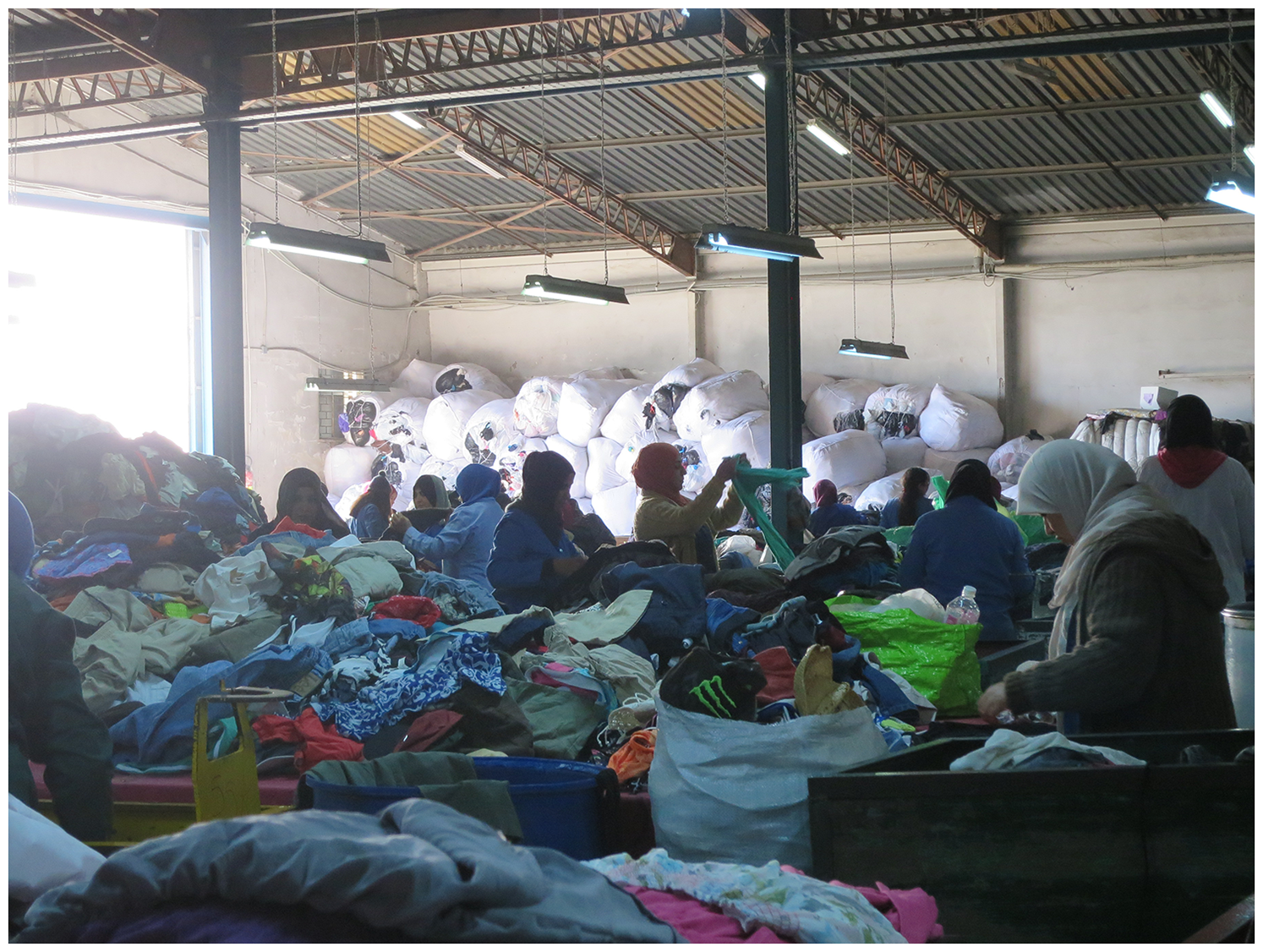
Women at work in a used clothes sorting factory © 2017.
Meriem is visibly older than the women separating the newly arrived merchandise at the factory entrance and her white overall and straight posture give her an air of authority. The women speed up their hand movements and interrupt their chatter as she moves past. Meriem started work in SOMUFRIP more than 10 years ago, and has since risen in the ranks to exercise the role of a supervisor. She performs quality checks on the different sorting tables where specific product groups – such as ‘women's jeans’ or ‘baby clothes’ – are graded into separate value categories. Since the overall number of workers has dropped to just under 100 in the aftermath of the pandemic, Meriem is also responsible for ‘checking the merchandise that enters the factory’. While she looks dissatisfied with the quality of the newly arrived merchandise, Meriem bitterly remarks that, ‘at least we got real fripe today’. She explains that just the previous day, they had received almost an entire container load of unworn, identical apparel products from the fast-fashion retailer Primark. Pointing at the clothing in the coloured plastic containers, Meriem says: ‘at least there is some diversity (tanawa’a) today so the women have work’. Meriam recounts that SOMUFRIP closed twice during the COVID-19 pandemic and that she didn’t receive her salary and had no idea when she would go back to work. About a third of the workers – mainly junior sorters – never returned, but the rest of the sorters have been back to regular working hours since summer 2021. However, the sorting they accomplish has changed, as increasing amounts of identical fast-fashion stocks undermine the basic premise of producing value through subtle processes of dissociation and re-association. ‘We were trained in the factory to learn how to make packages of comparable value’, Meriem stresses, ‘but now we just get heaps of the same shirts, I mean what do you want us sorters to do with that?’
Not only ever-larger quantities of unused clothing stocks, also an overall decline in quality has compromised ‘l-farz’ (sorting) as knowledge work. Before her current position, Meriem had worked in ‘beit el-krema’ (the room of the cream), as the workers refer to the factory section in which high-end fripe merchandise (crème) is separately graded, weighed and packaged. Alongside seven senior colleagues, Meriem was thus responsible for assembling the most expensive fripe category. The women's sorting decisions ‘strip away one category of value and replace it with another’, as ‘the factory label overwrites the individual labels subsumed under it’ (Botticello, 2013: 41). Sorting work in the luxury section was hence central to building SOMUFRIP's reputation. According to Meriem, this work required expertise (khibra) and a capacity to rapidly identify the varying cuts, styles and brands in demand. As a considerable proportion of the high-end fripe merchandise was re-exported to vintage shops in Europe, seemingly banal sorting decisions were in fact imbued with a nuanced understanding of evolving consumer tastes in different contexts. Yet as Meriem walks over to beit el-krema today, its shelves are largely empty and two female workers sit on the central sorting table, dangling their feet as they crack sunflower seeds. These sole remaining workers recount that they often don’t have work and thus fear for their jobs. ‘We always used to be busy’, Meriem sighs, and we first thought it was just a temporary problem because of the pandemic. But then we realised that we no longer receive the good stuff, and the factory management tells us there is nothing they can do about it, prices have gone up too much.
In addition to the price hikes, the breakdown of international client relationships during the pandemic-related disruptions further diminished work in the luxury section. ‘Before, I managed the selection for re-export to several vintage shops in France’, Meriem recounts with a tone of pride in her voice, ‘but we have lost these clients, I imagine they get their crème clothing directly in Europe these days’.
Despite having been dispersed across the factory, Meriem and her former colleagues from the luxury section still congregate for shared lunch breaks. To escape the heat under the metal roof, they often gather on a wooden beam in the shade of the back wall of the factory. The colleagues often reminisce about their working routines in beit el-krema, and most of their stories revolve around the surprising finds – from original fur coats to exquisite accessories – that used to keep their work entertaining. They agree that sorting has become more monotonous since the diversity of produce has decreased and since they are forced to work on ‘the normal sorting tables’. As Meriem takes a piece of tajine from her lunch box, she ponders: ‘our work was special, it required real skill. But now you can get any girl straight out of secondary school to do our job’. The deterioration in the quality of the fripe has thus translated into a sense of dispensability amongst the senior sorters, and has compromised relations to ‘the factory’ as a site where ‘workers become skilful’ and can develop ‘a profession or occupation’ (Carr, 2017: 644). When Meriem now poignantly refers to her workplace as a waste sorting factory (ma’mal farz a-zibla), she expresses a sense of diminished self-worth that is directly entangled with the ever-larger quantities of garments that are disqualified for reuse and find temporary rest behind the factory walls. As the women's daily routines consist increasingly of handling such substandard merchandise, the open-ended relations of ‘care for the material world’ that provide the impetus to ‘valuate’ and ‘to enact anew’ (Ureta, 2016: 1535) are gradually eroded.
To ruin a wholesaler's reputation: devaluation in the Zahrouni warehouses
Some of the trucks loaded with merchandise at SOMUFRIP only take a short ride to Zahrouni. Until the late 1990s, the main street of the informally built-up, working-class neighbourhood was dominated by car garages and repair shops. Today however, white pick-up trucks block Zahrouni's main street on any weekday morning, and continuous honking and insults shouted from car windows form the typical soundscape of what has become the capital city's undisputed fripe wholesale centre. Young men unload the bright green, red and blue tarpaulin bales in which the used clothing is packaged from the pick-ups and pile them up inside and in front of the warehouses that line the main street. In the meantime, the wholesale traders note down their purchases or pay transporters behind their wooden desks, pocket calculators and inventory notebooks in hand. By 11 am, the wholesalers have completed their major transactions, mostly with clients buying in bulk to deliver to other governorates or across the border to Algeria (Figure 3).
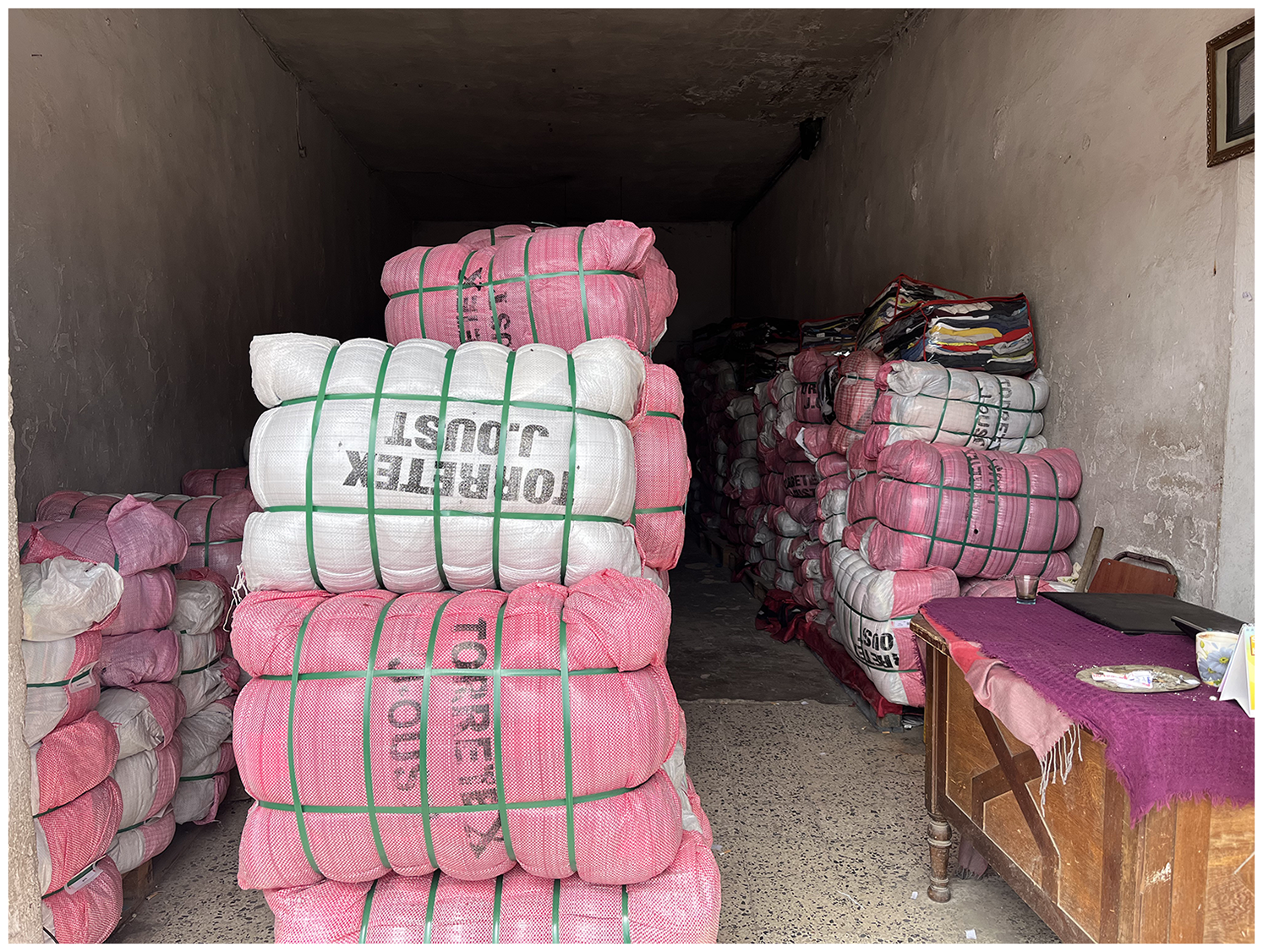
A Zahrouni warehouse filled with used clothing bales © 2022.
Ibrahim, one of the wholesalers with a ‘show room’ in the main road, has left his shop assistant to deal with the smaller retail clients, as he joins other wholesalers for the usual gathering in Qahwat al-Nakhil (the Palm Café). During these all-male get-togethers, animated by strong black coffee, cigarettes and sandwiches from a nearby cart, the men discuss sales and prices; problems with the customs authorities; and sorting factories not to be trusted. Yet on this clear autumn morning, the conversation revolves around a single topic: the wholesale districts’ inundation with substandard apparel products. A young man recounts how his enraged client returned an entire truckload of merchandise just the other day, accusing him of knowingly selling new merchandise (sila’a jdida) rather than ‘real fripe’. Others denounce particular sorting factory labels for having distributed bales containing low-quality fast-fashion stocks.
The risk of ‘buying bales blind’ (Brooks, 2012: 231) has always been part of the wholesale business, as the content and value of the closed fripe bales remains unknowable at the time of purchase. The Tunisian saying, ‘tishri qatous fil-shkara’ (you buy a cat in the bag), is thus prominently employed amongst the fripe wholesalers, capturing the speculative nature of their business. As Ibrahim explains, the uncertain value of the fripe merchandise turns the closed bales into what Østbø Haugen calls ‘entangled objects’, meaning things that ‘can only be known through the actors accompanying them’ (2018: 9). Therefore, what distinguishes a wholesaler with experience (khibra) like Ibrahim are the multiple strategies of risk mitigation through long-standing business relations that improve ‘knowability’ in transactions (Carrier and Elliott et al., 2018: 10). Experience with particular sorting factories can increase predictability, ‘at least to calculate approximate spend and gains’, as Ibrahim puts it. Now however, the wildly fluctuating prices and changing material composition of the fripe imports have created an unprecedented sense of disorientation amongst the wholesalers. ‘We’ve come to work in the stock exchange (waleina nikhdamou fil boursa)’, one of the younger wholesalers with a chubby face in Qahwat al-Nakhil exclaims, ‘all we can do is speculate, and we rarely win, we often lose’.
What preoccupies Ibrahim is not merely the increased economic risk incurred by the purchase of substandard merchandise. Rather, he fears for his hard-earned reputation as one of the few wholesalers specialising in high-end crème merchandise. Just earlier in the morning, Ibrahim negotiated with a long-standing client, Alaa, who runs several luxury fripe (fripe de luxe) shops in the Tunis suburb Aouina. As Ibrahim opens zipper bags to let Alaa skim the merchandise, he reminds him that ‘normally, the rule is we don’t open and you buy the bulk’. Alaa only shrugs his shoulders and retorts, ‘nothing is normal these days, because normally, at these prices I wouldn’t consider buying’. He holds up a Hilfiger shirt and exclaims, I have to sell this at 60 dinar (appr. 18 €) and will barely make a margin. This country is in crisis, people can’t afford to get chicken on the table, who is supposed to spend this amount on clothes?
Ibrahim frowns, unwilling to respond, and instead mechanically rearranges the merchandise. As Alaa continues his search, he is appalled to find numerous bags filled with new clothing, as the original Zara labels are clearly visible through the see-through plastic. He complains loudly in Ibrahim's direction: ‘you seriously sell this as crème, brother?’ Ibrahim remains silent until Alaa has settled on three bags of merchandise and refuses to renegotiate the price, begging Alaa to believe him that he is already selling at a loss. Such interactions have recurred over the preceding week, and they clearly take a toll on Ibrahim who has lost his usual taste for lengthy negotiations. In his point of view, ‘al-ism’ (the name) – here employed in the sense of ‘reputation’ – is the single most important element in running a successful wholesale business. He thus perceives his warehouse's inundation with low-quality merchandise as a professional downgrading that causes him embarrassment and has grown apprehensive of facing clients, especially the most long-standing ones who expect to find top quality. Pulling down the metal shutters of the warehouse that day, Ibrahim pauses for a moment and says, ‘I will soon be selling the same stuff as the “Chinwa” (made-in-China) traders in the souk’.
What Ibrahim experiences as a crisis in the luxury segment in fact reflects a broader feeling of precarity amongst the small- and mid-sized wholesalers and transporters working in and around Zahrouni. Blame is often attributed to unlicensed wholesalers, who are referred to as kabbara (from the Arabic word ‘kabir’ for ‘big’) in the jargon of the fripe as they rapidly amassed considerable wealth and market power. Ibrahim's nephew Hassan, who has worked as a transporter since young age, explains how the kabbara bypass what he calls ‘the official route’ through licensed importers, sorting factories and the customs. ‘It's a mafia from Kairouan’, Hassan laughs as he lights a new cigarette with the still-burning butt of the last, ‘they are all connected to Ennahda (the Islamic Ennahda Movement Party) and entered the business through connections to the customs and the national guard’. Grinning, he adds: ‘how else do you think they could have stolen our border business?’ Hassan here refers to the illicit cross-border trade with used clothing to neighbouring Algeria, which used to make up a large part of the transactions in Zahrouni. Yet not only competition from unlicensed wholesalers, also the prolonged border closures with Algeria during the COVID-19 pandemic adversely affected the business of Zahrouni traders. As Ibrahim explains, this forced many smaller wholesalers out of business or into debt, while the kabbara exploited the crisis to expand market control and to artificially inflate prices.
Back in Qahwat al-Nakhil, the wholesalers debate what the Tunis fripe market will look like once they are crowded out of the market completely. Their business, the traders underline, is one of personalised trust and reputation, governed by tacit yet socially enforceable rules that hold wholesale and retail traders mutually accountable. ‘We are the guardians of quality in the fripe market’, one of the elderly traders insists, alluding to the fact that the Zahrouni wholesalers adhere to strict quality standards that influence what is put on sale on the domestic market. A complete demise of their intermediary role in the value chain, the traders agree, will only accelerate the current devaluation of the merchandise on offer, as any checks and balances will be removed and as retailers will lose access to hand-picked bales from trusted wholesalers.
The impossibility of repair: precarious valuation with synthetic fibres
The first, heavy November rains have left large puddles on the muddy grounds of the Friday market (souk al-joma’a) of Chotrana, and the green plastic cords holding together the fripe bales float on the water surface. It is past midday and the fripe traders are busy folding up unsold merchandise, tying them back together into bundles and wrapping them in plastic tarpaulin. Others are disassembling their market stalls, and the rattling of the iron bars announces the end of the market day. On the market's fringes, where the traders’ pick-up trucks are parked, a group of women has gathered. Some of them have climbed onto the loading area of the truck, sifting through a large pile of fripe merchandise. Others sort heaps of garments and shoes spread out on tarpaulin sheets on the ground and on the bonnet of another truck (Figure 4).
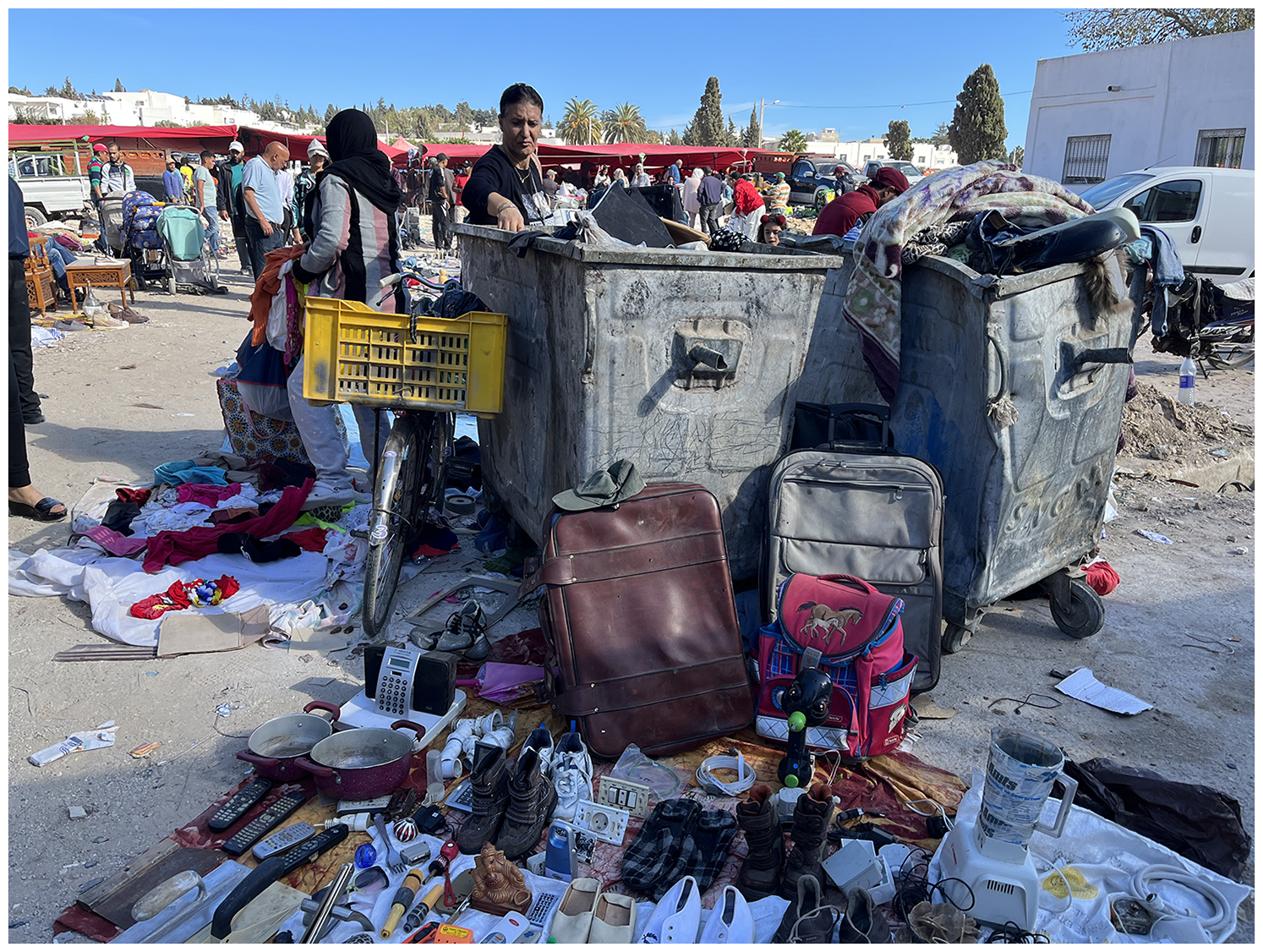
A woman sorts through the leftovers of a Tunis used clothing market © 2022.
Ibtissem is one of the women searching through the leftovers, next to an elderly Tunisian woman and a group of young girls from Côte d’Ivoire. Ibtissem's hand movements are faster than those of the other women, and she rapidly stores away her finds in a hand trolley that she has parked right behind her. When a male fripe vendor arrives with a wheelbarrow filled with leftover merchandise, she immediately interrupts her search and pulls her trolley across to be the first to inspect the garments. Other women rush over and Ibtissem has to make use of her elbows to defend her position. ‘These are all new clothes’, the woman next to Ibtissem exclaims as she holds up a dress from which dangles a Shein price tag in British Pound. Unimpressed, Ibtissem continues her concentrated sorting, lifting up the entire pile of garments and turning it, as if to see whether a different type of merchandise is hidden underneath. Visibly disappointed, Ibtissem cedes her sorting position to the other women and leaves the market fringes, pulling her trolley towards the large roundabout beside the souk.
As Ibtissem joins the large crowd of people waiting for the next microbus on the muddy roadside, she explains that ‘rainy days used to be the best for sorting (l-farz) in the market, because traders don’t like to take the wet merchandise back to their storages and are more generous with the leftovers’. She remembers how only two years ago, she would pull back ‘two of those trolleys, filled to the brim’, whereas now, as she remarks while pointing to her half-full trolley, ‘what I have in here will barely pay for my transport’. Squeezed against the window of the bus going northwards, Ibtissem recounts that Chotrana used to be one of her favourite markets, because there was little competition for leftovers compared to inner-city fripe markets, where she first started working as an informal sorter (faraza). In recent years, however, rapid inflation and the erosion of purchasing power have rendered more and more people dependent on the fripe markets’ leftovers. ‘Most of those who come to collect the rests aren’t professional sorters (ferezet)’, Ibtissem explains, ‘just poor women from Sidi Salah (the local neighbourhood), both Tunisian and African, 12 who can no longer afford to buy clothes for their families’. Ibtissem here differentiates between ‘self-employed resellers’ like herself for whom the fripe marketplaces constitute ‘work sites’ (Ayres, 2019: 123); and those who frequent the markets for private provisioning.
Back in her house in Raoued, a rapidly growing neighbourhood on the shores of the laguna (sebkha) on Tunis's North-Eastern periphery, Ibtissem has refitted parts of her two daughters’ bedroom as a workstation. Her sewing machine is squeezed into a corner, and she uses a board she places over the bed for ironing. The shelf that her husband has built on one of the walls is filled with clothing, fabrics and working material – from scissors and needles to different yarns and wools, zippers, buttons and frills. Ibtissem spreads out the collected garments on one of the beds, touching them probingly to see how humid they are but also to reassess their quality. ‘You know, for my work I need good materials. Fabric I can repair or rework, or at least buttons or particular pieces of embroidery or zippers that I can reuse’. As she holds up one of the dresses she has found, with the original H&M label and price tag, she says: ‘this is new, unworn, and with some luck I can resell it. But you touch it and know it's something you buy and throw (tishri wa tayyish)’ Ibtissem sighs as she follows the seam of the dress with her fingers and adds, ‘this isn’t even sewn properly, I can already tell where it will break’. As she pulls more clothes from the bottom of her trolley, she explains that direct agreements with several fripe vendors in different Tunis marketplaces allow her ‘to keep going in these difficult times’, as they reserve the best leftovers for her. Yet still, she says, most of the fripe she gets ‘isn’t worth repairing now, as my clients here in the neighbourhood won’t pay enough for it to even make up for my work time’.
As Ibtissem prepares dinner for her two daughters and husband, she confides that she would choose to stop her work in the fripe markets if their financial situation as a family allowed. ‘You know I always liked working on my sewing machine, and I enjoy turning old clothes into something new’. Ibtissem highlights that she used to take pride in working ‘with the rest of the rests and to still offer my clients something original every time’, and laughs shyly when mentioning that this earned her the nickname ‘fanana’ (artist) in the neighbourhood. She pauses as she mixes finely chopped parsley and onions with her fingers and then says silently: ‘but now the work in the marketplaces feels horrible, there is more and more competition and I hate the feel of the cheap plastic clothes’. She explains how she stopped to take her daughters along to the markets during the weekend because she feels, ‘they shouldn’t see their mother sorting through the trash (a-zibla)’. Both the general deterioration of quality in the fripe and the scarcity of leftovers have thus radically reduced Ibtissem's capacity to transform rests into reusable clothing. Beyond the adverse effect on the family income, Ibtissem recounts how she and other women now worry about the often-feminised tasks of ‘everyday provisioning’ (Narotzky, 2005: 78). ‘We took for granted to dress well, and to find good value clothing for our families’, she asserts, ‘but now we struggle to provide the minimum, to raise our children and guarantee a life in dignity (karama)’.
Conclusion
Diminished capacities for retrieving value from the fripe mean that increasing amounts of the imported used clothing find their way to official and unofficial disposal sites, marking diverse end points of imagined circularity. An estimated 40% of European used clothing exports are directly discarded in countries with looser regulatory frameworks and institutional oversight (Tony Blair Institute, 2021), and the increasing arrival of low-quality, synthetic fast-fashion stocks – from Europe, North America, but also increasingly China – exacerbate ecologically destructive dumping. In Tunis, imported used garments that cannot be requalified as fripe in the sorting factories are discarded directly besides factory premises or are disposed of once they have been exposed to humidity or insect infestation in wholesale warehouses or marketplaces. On the shores of the Sijoumi lake (sebkha) in proximity of the Zahrouni wholesale quarter, or on the fringes of weekly fripe markets; the micro-fibres of discarded clothing seep into soil and water, or waste burning releases the materials into the air in the form of thick black smoke. Such images transform the fripe from a cherished consumer good into an inundating materiality, thus bringing it into the remit of waste (zibla) and turning it into an increasingly tangible aspect of ‘waste colonialism’ (Liboiron, 2018). This coincides with the increasing politicisation of hidden waste transfers from Europe to Tunisia (Delpuech, 2021), and with protest movements 13 that denounce insufficient waste management as a material proof of elite disdain (hogra) and state corruption (fasad) (Marzouki, 2021: 157).
This article has proposed a critique of the circular economy as an economic solution to the ecological crisis caused by garment over-production. It has done so through an empirical examination of the economic processes that contingently requalify donations, discard and unsold leftovers for commodity circulation at one particular back end of the global clothing value chain. The ethnographic study of valuation work brings to light how qualitative changes on the used garment market diminish possibilities for value retrieval and reuse, thus adding to the quantitative end disposal problem of textile waste that typically dominates critiques of the circular economy. While the environmental implications of clothing surplus production are now increasingly tangible, especially in export destinations across the Global South; the implications of qualitative changes in the supply of clothing can only be elucidated through the study of situated, material practices. Yet as is the case in knowledge production on the economy more broadly, quantifiable indicators and statistics, rather than a close-up investigation of the processes that bring the economy into effect (Çalışkan and Callon, 2009), dominate our perspective on the circular economy.
This article thus advocates for a new research agenda that unpacks the multiple, contingent processes that enact – always partial – forms of circularity in global value chains. This implies an in-depth engagement with the empirical realities of those who labour specifically to retrieve value from leftovers, and a recognition of their work as a form of ‘infrastructural labour’ (Gidwani and Maringanti, 2016: 113). Ruptures in intricate valuation processes render apparent the social injustice that makes those at the back end of the value chain particularly vulnerable to shifts on the global market, upending capacities ‘to project life into the future’ (Narotzky and Besnier, 2014: 10). Simultaneously, their incapacity to retrieve value from used clothing exacerbates the environmental injustice that exposes human bodies and ecosystems to waste materials that ‘linger long beyond a garment's fashionable lifespan’ (Stanes and Gibson, 2017: 28). This examination of how the circular economy works in practice demonstrates its vulnerability to breakdown and exposes the inequalities it reproduces. It also reveals how the circular economy's ecological promises not only fail to materialise, but can be used to discursively obfuscate and thus to exacerbate ecological harm on people and places perceived to lie beyond one's bounds of responsibility. Yet engaging with the empirical realities of circular economies can also provide fruitful grounds for their radical reimagination. The craft and inventiveness enabling valuation work with used clothing in Tunisia could thus become an excellent starting point but to rethink how value production in the global garment industry would have to be reorganised to maximise social benefit and minimise ecological harm.
Footnotes
Acknowledgements
My thanks go to Michael Mason and Umut Kuruüzüm for organising the excellent workshop ‘Ecologies of Fragile Landscapes’ at the LSE for which I first developed this paper. I also want to thank the three anonymous reviewers for their close and sympathetic reading of the first iteration of this paper, which helped to greatly improve it. Finally, I am profoundly grateful to the valuation workers in the Tunis fripe for welcoming me (back) and making time for my difficult questions despite the anxiety and hardship that characterise the present moment.
Declaration of conflicting interests
The author declared no potential conflicts of interest with respect to the research, authorship, and/or publication of this article.
Ethical approval and informed consent statements
Ethical approval for this research was obtained through the Ethics Committee of Durham University (UK) for doctoral research (2017–2021) and this included the approval of informed consent forms that were used to obtain verbal consent to participate in the research.
Funding
The first part of the research on which this article is based was supported by an Economic and Social Research Council (ESRC) PhD studentship (2017–2021) and the second part of the research was funded through a postdoctoral fellowship at the École des Hautes Études en Sciences Sociales (EHESS) Paris (2022–2023).
