




Abstract
As the consequences of climate change become more severe and widespread, efforts to understand and address the emotional dimensions of the climate crisis are increasingly necessary. The aim of this study was to explore and describe the lived experiences of climate emotions in remote, rural, and small communities across Canada. Data were collected through semi-structured interviews and a letter writing process with 27 participants representing diversity in terms of geography, climate vulnerability, and socio-demographic characteristics. Thematic network analysis resulted in three global themes: (1) complex, intense, and interconnected climate emotions, (2) factors shaping climate emotions, and (3) consequences of climate emotions. The findings demonstrate that the lived experiences of climate emotions involve a wide array of complex, interconnected, and embodied emotions characterized by affective dilemmas and tensions. For most, climate emotions are challenging and experienced in isolation resulting in consequences for wellbeing, life decisions, and action. Importantly, the data illustrate the influence of intersecting identities, social factors, perceived responsibilities, and place in terms of giving rise and shape to climate emotions. The findings also emphasize that the lived experiences of climate emotions may be particularly impactful in remote, rural, and small communities that are commonly marginalized and disempowered, where people tend to have close connections to the natural world, and where a socialized silencing around climate change and climate emotions is pervasive. Taken together, the findings highlight the imperative of supporting collective coping through place-specific and intersectional processes that recognize the tensions and challenges that characterize climate emotions as well as the diversity of factors that give rise and shape to climate emotions.
Introduction
An irrefutable body of evidence exists illustrating the wide-ranging impacts of human-caused climate change on social-ecological systems, equity, and health (IPCC, 2023). Experiencing, witnessing, and learning about the impacts of climate change, the inequities associated with climate change, and the insufficient action from those in positions of power contribute to myriad emotional responses and impacts (Hickman et al., 2021; Palinkas and Wong, 2020). Emerging research illustrates that the emotional dimensions of climate change are essential to consider in terms of climate communication (Salama and Aboukoura, 2018), climate change education (Jones and Davison, 2021), climate action (Bouman et al., 2020; Brosch, 2021), policy support (Wang et al., 2018), and impacts on health and wellbeing (Hayes et al., 2018; Palinkas and Wong, 2020). As the consequences of climate change become more frequent and severe and the likelihood of meeting the Paris Agreement goals rapidly declines, efforts to understand and address the emotional dimensions of the climate crisis are increasingly imperative.
Over the past two decades, novel concepts have been developed to understand, assess, and monitor the mental and emotional dimensions of climate change including, but not limited to, climate anxiety (Clayton and Karazsia, 2020; Pihkala, 2020), ecological grief (Cunsolo and Ellis, 2018), and solastalgia (Albrecht, 2005). As these are relatively new concepts, there remains conceptual confounding along with numerous knowledge and practice gaps in the existing research (Ojala et al., 2021; Pihkala, 2022; Zaremba et al., 2024). Although there is no consistently agreed-upon definition of climate anxiety, it is commonly understood as heightened distress related to climate change characterized by a constellation of strong and interconnected emotions such as worry, fear, sadness, anger, and powerlessness (Clayton et al., 2017; Galway and Field, 2023; Hickman et al., 2021; Pihkala, 2020). “Climate anxiety is future-oriented, shaped by the complex, inequitable, and uncertain nature of the climate crisis, and connected to individual and collective (in)action” (Galway and Field, 2023). Ecological grief is generally conceptualized as an emotional response to loss associated with climate and environmental change, defined by Cunsolo and Ellis (2018) as “the grief felt in relation to experienced or anticipated ecological losses, including the loss of species, ecosystems and meaningful landscapes due to acute or chronic environmental change” (Cunsolo and Ellis, 2018: 11). Solastalgia, originally theorized and articulated by Albrecht (2005), is broadly understood as the “distress caused by the transformation and degradation of one's home environment.” Notably, place is a defining element of solastalgic experiences (Galway et al., 2019).
Much of existing research on the emotional dimensions of climate change has focused on climate anxiety leading to limited understanding of the array of diverse climate emotions and nuances of lived experiences (Pihkala, 2022). The focus of this study is climate emotions, understood broadly as feelings, emotions, and affects related to climate change and climate injustices (Galway and Beery, 2022; Pihkala, 2022). Because the field of research on climate emotions is relatively new, empirical research focused on describing and understanding the lived experiences of climate emotions through diverse methods is needed to advance the field (Ojala et al., 2021; Pihkala, 2022; Zaremba et al., 2024) (see Galway and Beery (2022) and Pihkala (2022) for a more fulsome description of the history and key characteristics of climate emotions research). Specifically, more research is needed to better understand where, for whom, why, and under which conditions climate emotions are experienced (Galway and Beery, 2022). Qualitative research is particularly important to understand the nuanced experiences climate emotions and to advance knowledge on the potential consequences of climate emotions (Coffey et al., 2021)
The aim of this study was to explore and describe the lived experiences of climate emotions in remote, rural, and small communities across Canada, a context that is commonly overlooked when it comes to climate change research, policy, and action. Recognizing that climate change impacts, vulnerability, and experiences are distinct in remote, rural, and small communities compared to large urban centers underscores the importance of research informed by and rooted in this context (Drolet and Sampson, 2017; Vodden and Cunsolo, 2021). Common characteristics across remote, rural, and small communities that have important links to climate change and climate emotions include political and economic marginalization (and therefore a real and perceived powerlessness), geographic isolation, close ties to nature and the land (and therefore particularly impactful observations and experiences of climate impacts), and identifies, histories, and economies tied to resource extraction (including oil and gas development) (Maru et al., 2014; Race et al., 2023; Vodden and Cunsolo, 2021; Walmsley and Kading, 2018). This paper reports on findings from data collected through interviews and asynchronous letter writing. The data were analyzed using the method of thematic network analysis (Attride-Stirling, 2001) and findings are discussed in relation to relevant literature. In the conclusion, key contributions that advance the field of climate emotions research and specific insights relevant to remote, rural, and small communities are summarized.
Methodology
Study setting and context
The study setting for this research includes remote, rural, and small communities across Canada. It is important to note that there are no consistently agreed-upon definitions or categorizations of remote, rural, and small communities generally nor in Canada specifically (Morris et al., 2020; Walmsley and Kading, 2018). Remoteness, rurality, and smallness are characteristically difficult to define and vary across national settings. Moreover, the concepts of remoteness, rurality, and smallness are geographic and social constructs (Bell and Jayne, 2009; Haugen et al., 2024). In the Canadian context, it is generative and helpful to understand remote, rural, and small communities as those that exist “beyond the big city” (Esses and Carter, 2019: 1) or “beyond the metropolis” (Bell and Jayne, 2006). As Bell and Jayne (2006: 4–5) argue, smallness is in part about relative size but is as much about reach, influence, and marginalization. As Walmsley and Kading (2018) emphasize in their work exploring unique challenges of smaller cities in Canada, these communities, particularly those situated in remote contexts, are very much “bound by rural history and traditions” and face social and environmental issues that align with small towns and rural settings more so than large urban centers in important ways.
Although there is certainly heterogeneity among remote, rural, and small communities across Canada, they share common socio-economic characteristics compared to large urban centers such as lower levels of racial diversity, aging populations, small tax bases to fund infrastructure, limited social services, marginalization, resource-dependent economies and livelihoods, higher unemployment, lower levels of education, and lower socio-economic status (Canadian Rural Revitalization Foundation, 2024; Haugen et al., 2024; Walmsley and Kading, 2018). These shared characteristics connect to climate impacts, vulnerability, and injustice in important ways. Rural and remote settings (Canadian Rural Revitalization Foundation, 2024) and small towns and remote cities (Walmsley and Kading, 2018) across Canada are also under-researched in terms of policy and community development and have experienced consistent under-funding and support from provincial and federal governments since the 1980s due to neoliberal governance.
In this study, I aimed to explore the lived experiences of climate emotions beyond the big cities, in communities across Canada that have smaller populations, are distant from urban areas, experience political and economic marginalization, and have identities, economies, and cultures shaped by rurality, remoteness, close ties to nature, and resource extraction. To contextualize the study setting and for inclusion/exclusion during recruitment, remote, rural, and small communities include those with a population of less than 10,000 people and at least 75 km from a large urban center and small cities and towns with a population between 10,000 and 150,000 people that are remote from large urban center (Canadian Rural Revitalization Foundation, 2024; Esses and Carter, 2019; Garrett-Petts and Dubinsky, 2005).
It is also important to briefly position the research in relation to climate change in Canada. Current and projected climate impacts in Canada include increasing average temperatures, growing season shifts, shorter snow and ice cover seasons, thawing permafrost, sea level rise, and increased frequency of extreme events (Bush and Lemmen, 2019; Warren et al., 2021). While many parts of Canada have and are increasingly experiencing severe climate impacts, Canada's climate policy and action are not aligned with calls for greenhouse gas reductions (GHG). Canada submitted a Nationally Determined Contribution commitment in 2021 to reduce GHG emissions by at least 40–45% below 2005 levels by 2030, bringing Canada's rating from “highly insufficient” to “almost sufficient” (Climate Action Tracker, 2023). Canadians contribute among the highest per capita carbon emissions worldwide (Ritchie and Roser, 2024). Climate impacts in remote, rural, and small communities vary across the country but tend to include extreme weather events like flooding and wildfire, consequences on livelihood, impacts on already limited and underfunded infrastructure, increased risk of infectious disease, and impacts on physical, mental, and emotional health (Race et al., 2023; Vodden and Cunsolo, 2021). Overall, exposure to myriad climate change-related hazards, unique susceptibilities, and limited climate action planning and policy lead to unique vulnerability to climate change in remote, rural, and small communities as compared to large urban centers. Also noteworthy, remote, rural, and small communities in Canada can display resilience in the face of climate change due to strong connections to the natural environment and high levels of social cohesion (Gislason et al., 2021; Vodden and Cunsolo, 2021).
Data collection and analysis
Participants were recruited using purposive and snowball sampling. Recruitment emails and social media posts were distributed via local, regional, and national organizations, listservs, and networks aligned with climate change. For snowball sampling, participants provided referrals to possible additional interviewees. All participants met the following inclusion criteria: (1) older than 16 years of age; (2) self-identified as experiencing emotional or mental health impacts related to climate change; and (3) living in a remote, rural, or small community in Canada (as described above).
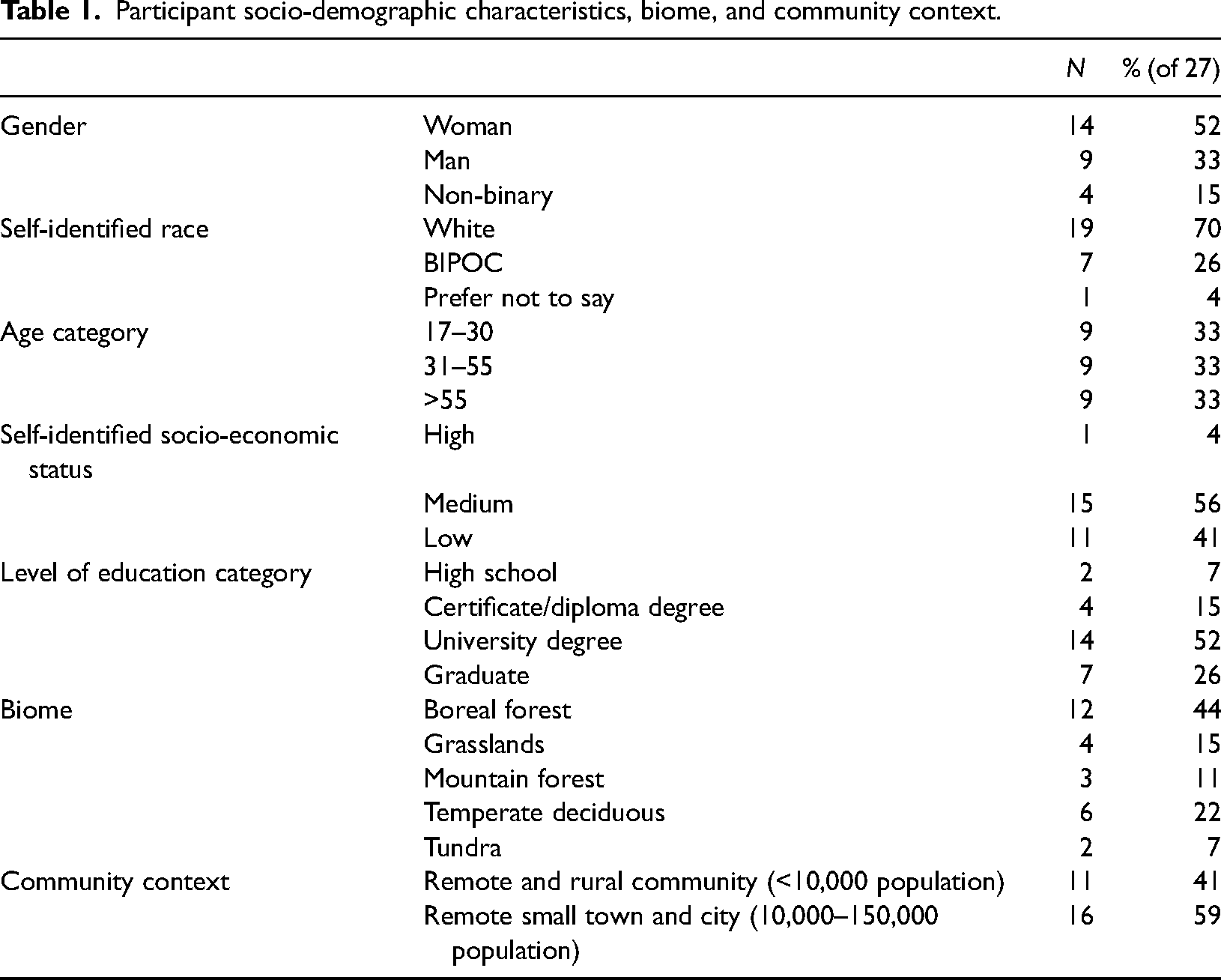
To ensure that the interviews captured a diversity of experiences in relation to diverse landscapes and climate vulnerability, participants were specifically recruited to represent Canada's five major biomes: (1) tundra, (2) mountain forest, (3) grasslands, (4) temperate deciduous, and (5) boreal forest. A biome is a large geographical region characterized by a distinct climate, ecosystem, and biotic and abiotic features. A set of socio-demographic questions were also included in the interview guide to ensure that diverse population sub-groups were included in the sample. Recruitment and data collection were stopped after representation across those factors outlined in Table 1 and data saturation were met. Data saturation here refers to a point in data collection where the researcher determined that no new data was emerging from interviews that significantly addressed the research aim (Rahimi and Khatooni, 2024). Therefore, the final sample size was deemed large enough to capture diversity across those factors outlined in Table 1 along with reaching saturation. A total of 27 individuals participated in an interview and 23 of these participants also shared experiences through the letter writing process.
Participant socio-demographic characteristics, biome, and community context.
Semi-structured interviews were conducted by the author and a trained graduate assistant (with experience in climate emotions research) using open-ended questions and carried out in a conversational manner allowing for rich description, in-depth responses, and the emergence of unexpected ideas. The interview guide was piloted by conducting three pilot interviews with volunteer graduate students, to improve clarity and flow (see Supplemental materials for interview guide). The interviews lasted between 45 and 90 minutes and were conducted over the phone or virtually using video conferencing between June and December 2022. Interviews were audio or video-recorded with permission (n = 27) and transcribed verbatim by a transcription service. Participants were given the opportunity to review transcripts.
Asynchronous letter writing was also used in this study. Although letter writing as a method of qualitative data collection is less common than interviews or focus groups, it is increasingly used and valued (Harris, 2002). Recent studies suggest that research connected to emotions is particularly well-suited to letter writing (Burtt, 2020) and for eliciting meaningful responses to complex and politicized topic areas (Pithouse-Morgan et al., 2012). Elizabeth (2008) argues that data collected through letter writing is able to “… capture the intangible dimensions of our lives – our emotions, imagination and memories” (p. 16). Letter writing has been used, though not at all widely, in relation to climate emotions (Duggan et al., 2021). Given its value with other emotional and politicized topic areas, it was identified as potentially useful in relation to climate emotions. In this study, individuals who participated in the interviews were sent an email (one week after the interview) with instructions and the following prompt: “Write a letter in relation to your feelings about climate change. Your the letter could be self-reflective, simple, poetic, a call to action, or an opportunity to give voice to the Earth or another species. Your letter can be long or short. Feel free to be creative in your letter writing. Address your letter to whomever or whatever you would like in the past or in the future.” Participants were given the choice of returning a letter via electronic (n = 21) or postal mail (n = 2). Letters were addressed in various ways including to future self, past self, planet earth, a child, and future generations broadly. Handwritten letters via post were typed and all letters were included at the end of interview transcripts for analysis.
Interview and letter data were entered into Dedoose software to support organization and analysis. An initial descriptive analysis was conducted by the author and a trained research assistant whereby the interview data were coded based on interview guide questions. A descriptive report summarizing the interviews was created and shared with participants and supported the important step of getting to know the data. Subsequently, an inductive analysis of the interviews and letters was conducted using thematic network analysis (Attride-Stirling, 2001). Thematic network analysis “seeks to unearth significant themes in a text at different levels whilst simultaneously providing structure and allowing for an interpretation of the data” (Mano, 2017: 42). Following the iterative and multi-step thematic network analysis process, basic themes, organizing themes, and global themes were generated (Attride-Stirling, 2001) (see Table 2).
Overview of global, organizing, and basic themes. a
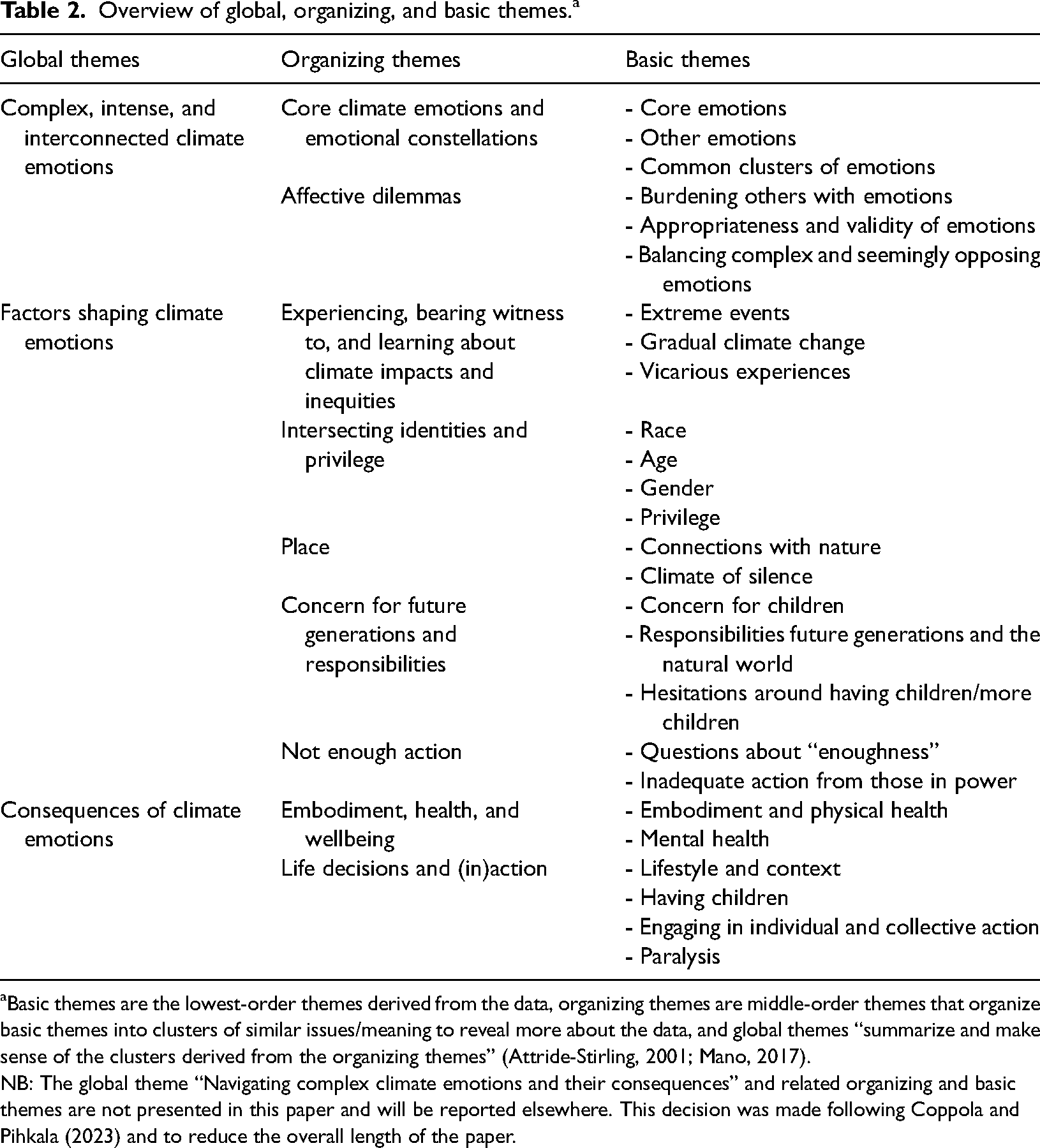
Basic themes are the lowest-order themes derived from the data, organizing themes are middle-order themes that organize basic themes into clusters of similar issues/meaning to reveal more about the data, and global themes “summarize and make sense of the clusters derived from the organizing themes” (Attride-Stirling, 2001; Mano, 2017).
NB: The global theme “Navigating complex climate emotions and their consequences” and related organizing and basic themes are not presented in this paper and will be reported elsewhere. This decision was made following Coppola and Pihkala (2023) and to reduce the overall length of the paper.
The author also used a reflexive journal throughout the interviews and the data analysis process to enhance credibility and trustworthiness. The organizing themes were also examined across socio-demographic factors using several analytical tools in Dedoose software.
Strengths and limitations
Three core strengths and three limitations should be considered when interpreting the study findings. The first strength is the explicit and in-depth exploration of climate emotions, an under-researched area, with a focus on a population group that is often overlooked and marginalized. A second strength is the use of two methods of data collection: interviews and letters. This is an innovative and rarely used approach that proved particularly useful for creating meaning and in-depth and rigorous knowledge on the lived experiences of climate emotions. Notably, using letters as a follow-up to interviews was a strength as the letters offered a distillation of core ideas and experiences and helped to understand texture and nuance related to complex emotional responses and impacts. Moreover, it appears the letters offered a helpful space and process for the participants as expressed by several of the participants in their letters. The third notable strength was recruitment across diverse communities and identities. The sample was adequately diverse in terms of self-identified gender, age, level of education, as well as biomes and community context. Although this sample was diverse across climate change experiences and several important socio-demographic factors, it was likely not fully representative of populations in remote, rural, and small communities across Canada. There were only three participants who self-identified as Indigenous. Also, findings will not be generalizable to individuals in highly urbanized setting or those who do not believe in or care about climate change. Finally, although there are a range of common characteristics across communities in rural and remote contexts and small and remote cities, there may also be differences that impacted the lived experiences of climate emotions. That said, during the analytical process, emerging themes were explored across community categories. No key differences were identified suggesting the need re-consider the grouping of rural and remote and remote small towns and cities.
Findings and discussion
This study explored the lived experiences of climate emotions from the perspective of 27 Canadians living in remote, rural, and small communities. A total of 26 basic themes, 13 organizing themes, and four global themes emerged (Table 2). Due to the richness of the data, and the desire to describe this richness with detail, a decision was made to report on three of the four global themes here. The global theme Navigating complex climate emotions and their consequences, which centers on coping practices and needs, will be reported in a separate manuscript. The three other global themes and associated organizing themes structure the presentation of this section. Findings are supported using quotes throughout. Pseudonyms are used when presenting quotes and quotes from letters are indicated specifically.
Complex, intense, and interconnected climate emotions
The interviews and letters were rich in their descriptions of complex, intense, and interconnected climate emotions and are described through two organizing themes: (1) core climate emotions and emotional constellations and (2) affective dilemmas.
Core climate emotions and emotional constellations
Overall, the data illustrated that climate emotions are wide-ranging, interconnected, and often strong. The challenging nature of climate emotions was palpable in most interviews. For nearly half of the participants, climate emotions were described as experienced consistently, with words like “lingering” and “always there.” The dynamic nature of climate emotions also emerged, exemplified clearly by Mariah who described her experience of climate emotions as a “story arc that often starts with anxiety, moving through frustration and then to sadness.” Notably, most conversations illustrated a sense of feeling alone or isolated; participants do not realize that other people are also experiencing intense, complex, and challenging emotions related to the climate crisis in other words.
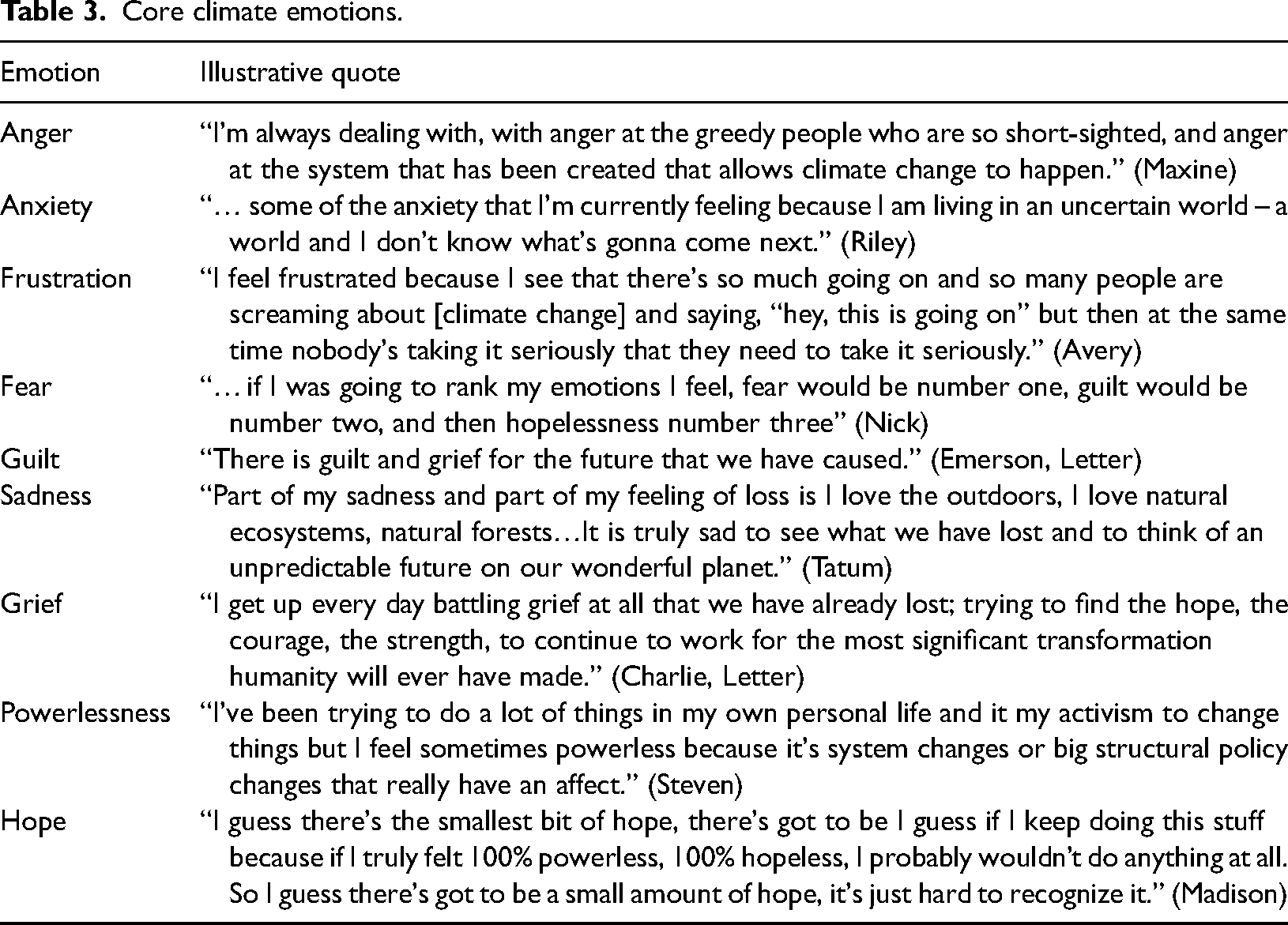
All participants expressed an array of emotions related to climate change broadly and related to climate impacts, action, and injustices specifically. The most commonly expressed emotions were anger, anxiousness, frustration, fear, sadness, guilt, grief, powerlessness, and hope. Table 3 provides a summary of these core climate emotions. These core emotions illustrate strong alignment with the lived experience of climate emotions in the existing literature in similar rural, remote, or small city settings (du Bray et al., 2017, 2019; Iniguez-Gallardo et al., 2021; Kemkes and Akerman, 2019; Norgaard, 2006; Tschakert et al., 2024). Notably, although hope was discussed and described frequently, for many participants it was discussed as lacking overall (“smallest bit of hope” or “only glimmering”) while others spoke of an absence of hope (“yearning to feel hopeful” or “… need to learn how to cultivate hope”).
Core climate emotions.
Less commonly expressed, but still relevant, climate emotions included dread, overwhelm, hopelessness, gratitude, indignation, loneliness, regret, vulnerability, disappointment, devastation, confusion, conflicted, love, joy, despair, discouraged, shame, compassion, surprise, and care. Although much of the existing research to date has focused largely on core climate emotions, anxiety, anger, sadness, and fear in particular, scholars have called for increased attention to the breadth and diversity of possible emotions related to climate change and climate injustices (Pihkala, 2022; Zaremba et al., 2024) and to embrace the full “range of emotions, however subdued they might appear” (Tschakert et al., 2024: 189).
In the interviews, a set of prompts were asked in which participants shared the first thought that came to mind and then to elaborate (i.e. “When you think about the inequities associated with climate change, this makes you feel…”). These prompts helped to elucidate that anxiety, worry, and fear are particularly connected to climate impacts and future-oriented concerns, that frustration, powerlessness, and hope intersect closely with climate (in)action, while sadness, anger, guilt, and grief are particularly connected to the causes of climate change and injustices associated with climate change. It is also noteworthy that the specific emotions of guilt, grief, sadness, and love featured prominently in the letters highlighting the value of diverse and creative data collection methodologies for understanding the full range of climate emotions (Klassen and Galway, 2023). The study of Tschakert et al. (2024) is an example of using a novel and creative method called “walking journeys” to explore the emotional dimensions of climate change.
The data also revealed what I call emotional constellations: clusters of emotions frequently discussed and described together. The most common constellations included anxiety-fear-sadness, anxiety-powerlessness-frustration, fear-guilt-powerlessness, and anxiety-anger-guilt. The notion of constellations is used here to explicitly convey the interconnected and context-specific nature of entangled emotions related to climate change and climate injustice. Other scholars have used similar concepts to explicitly highlight the centrality of interconnectedness including “webs” (Jones and Davison, 2021), “complex palette” (Marczak et al., 2021), “emotional tapestry” (Tschakert et al., 2024), and “emotional biodiversity”(Hickman, 2024). Although some existing research has specifically identified and reported on the question of which climate emotions tend to cluster together and why, this remains an area for further exploration (Jones and Davison, 2021; Marczak et al., 2021; Pihkala, 2022; Zaremba et al., 2022). Also noteworthy, the emotional constellations identified in this study illustrate alignment with emerging definitions of climate anxiety (Zaremba et al., 2024). Although there is, to date, no consistently agreed-upon definition of climate anxiety in the literature, this study lends support for conceptualizing climate anxiety as characterized by future-oriented constellations of strong and interconnected (Coffey et al., 2021; Pihkala, 2020).
Affective dilemmas
Descriptions and experiences of climate emotions also illustrated what Mosquera and Jylhä (2022) call “affective dilemmas”—tensions that arise from various emotions elicited by climate change and other related social phenomena. Three specific affective dilemmas emerged: (1) not wanting to burden others with emotions yet wanting to talk about climate emotions, (2) uncertainty about the appropriateness and validity of climate emotions, and (3) balancing complex and seemingly opposing emotions. These dilemmas add to the complex, challenging, and consequential nature of the lived experiences of climate emotions.
Not wanting to burden others with climate emotions was discussed in many interviews, mostly in relation to children and young people. Cecelia shared that she chooses not to talk to her daughter about how she is feeling and went on to explain “I’d rather my daughter just stay happy right now. Because it's not like she can do anything about climate change, so there's not a lot of point in her carrying that burden.” Spencer wrestled with talking/not talking to his friends about climate change and related emotional experiences sharing: “But it's hard to talk with friends about it because you don’t want to bum your friends out either… So I try not to, even though you kind of want to because it's on your mind all the time”. Despite not wanting to burden others with emotions, the data also illustrate that nearly all participants do, in fact, want to talk about their climate emotions resulting in a very real tension between wanting/not wanting to share, talk, and process climate emotions with others and for many, a resulting sense of isolation. Interestingly, a 2022 survey with 3091 Germans showed an association between climate anxiety and higher levels of perceived social isolation (Hajek and König, 2022). Several participants made this dilemma clear through their participation in the research as they struggled to share and speak about challenging and complex aspects of their emotional experiences while also explicitly sharing their appreciation of the opportunity to share their emotions.
A second prominent affective dilemma that emerged from the interviews and letters was a questioning around the appropriateness of climate emotions, expressed by Noah quite simply as “I don’t know how I am supposed to feel.” Emerson expressed their questioning of several emotions throughout the interview including grief and anxiety: “grief is a valid feeling to still feel… Right?” and questioning whether their anxiety was a response to climate change: We are told all the time that anxiety is irrational, it's our body's response to things that no longer are a danger to us, you know, like fight or flight. But it's like this thing [climate change] is something that is very real. And so it's kind of like, this anxiety… is it rational? You know, like in this case, it's rational, I think. (Emerson)
Practitioners increasingly emphasize the appropriateness and validity of multiple, strong, and seemingly opposing emotions related to climate change and climate anxiety specifically (Charlson et al., 2022; Cunsolo et al., 2020; Hickman, 2024; Whitmarsh et al., 2022). This, I argue, is particularly important moving forward: it is essential that we (individually and collectively) recognize that climate emotions are appropriate, and perhaps as Cunsolo et al. (2020: 1) have argued, “the start of a healthy response to climate change.” However, in the absence of collective supports and facilitated discussions around experiences of climate emotions, many are left questioning what they can and should feel rather than recognizing, communicating working with, and processing the emotions they are experiencing.
Though less common, three participants also questioned the validity of their emotional responses noting concerns that their emotions were purposefully manufactured by those in positions of power. For example, Jamie struggled with the validity and appropriateness of his emotional experiences referring to them as “a success of the oil and gas industry and some of these big industries putting that onus on the people.” It is likely that within remote, rural, and small communities across Canada, where resource extraction is deeply entangled with life and livelihoods, affective dilemmas are particularly relevant.
The final affective dilemma was the challenge of balancing complex and seemingly opposing emotions. Specific examples included frustration and hope, powerlessness and hope, anger and love, gratitude and guilt, and gratitude and grief; conversations reflected tensions between these seemingly opposing emotions. Mosquera & Jylhä (2022: 364) describe this balancing as a perceived conflict between two or more seemingly incompatible emotional responses “where there does not seem to be an obvious solution as to how one ought to feel overall in the face of it.” Tschakert et al. (2024: 17) also identified what they describe as tensions “across the emotional spectrum” using walking interviews in Western Australia and emphasize the “emotional labour of resisting the temptation to resolve the tension between grief and hope when wrestling with the climate crisis.” Head (2016) in their book Grief and Hope in the Anthropocene emphasize that “hope is a risky and complex process of possibility that carries painful emotions.” Although more work is needed to understand and explore these affective dilemmas, it may be that tensions and contradictions are fertile ground for inspiring and promoting meaningful conversations around experiences of climate emotions.
Finally, although there is growing consensus in the literature to move away from dichotomous thinking (i.e. positive/negative, good/bad) in relation to the emotional dimensions of climate change (Galway and Beery, 2022; Pihkala, 2018; Tschakert et al., 2024), many participants used positive/negative, good/bad language when describing their emotions. Although emotions like frustration, anger, sadness, and powerlessness may indeed be challenging to bear and process, positioning these climate emotions as “negative” likely encourages people and communities to turn away from, ignore, or silence their emotional experiences rather than engage, share, and process them in constructive and activating ways. Therefore, those of us who engage in research, policy, and practice related to climate emotions must purposefully move beyond dichotomies and instead, cultivate language, concepts, frameworks, and work that emphasizes the appropriateness of diverse and interconnected emotions and recognize the related tensions that arise as we navigate complex and multilayered emotional experiences.
Factors shaping climate emotions
Five organizing themes reflect those factors that emerged as most relevant in terms of giving rise and shape to the lived experiences of climate emotions among participants: (1) Experiencing, bearing witness to, and learning about climate impacts (2) Intersecting identities and privilege, (3) Place, (4) Concern for future generations and responsibilities, and (5) Not enough action.
Experiencing, bearing witness to, and learning about climate impacts
The interviews and letters clearly illustrated that climate emotions are influenced by experiencing, witnessing, and learning about climate impacts. Extreme events including wildfires, floods, extreme storms, drought, and heatwaves were discussed in relation to anxiety, fear, frustration, and powerlessness and often in relation to local or regional context. Nick, a prairie famer, shared: “we're on the prairies – my fear is not being able to live where we live and exist on the farm as we exist right now… We've had lots of heat waves, in those moments where I'm really seeing it, I feel, I wouldn't say depressed but close, on the way there.”
Experiencing and witnessing gradual changes associated with climate change such as temperature change, loss of ice and snow, changes in lake levels, impacts on growing season length, and impacts on wildlife were also discussed. The emotions shared in relation to gradual changes were not as strong and often discussed in more abstract terms: “I’d say what scares me and concerns me the most is just that everything that I love and know is going to be destroyed, thinking of the animals and plants, we’re losing so many species” (Madison).
Both extreme events and gradual changes were, at times, discussed as vicarious experiences aligning with other research emphasizing that direct and vicarious experiences play a role in shaping climate emotions (Léger-Goodes et al., 2022; Pihkala, 2020). Specific examples of vicarious experiences included seeing evidence of climate change and related events in the news media, social media, or learning about climate change in schools. These vicarious experiences were commonly connected to anxiousness, as exemplified by Emerson: “… just like hearing the news out of British Columbia about the floods recently triggering [for anxiety].”
Learning about climate change, in both formal (i.e. school) and informal (i.e. social media) spaces, is increasingly recognized as a cognitive and affective experience (Jones and Davison, 2021). More research is needed to better understand the complex affective dimensions associated with learning about climate change, climate impacts, and climate injustices and to inform pedagogies and approaches that engage with affective dilemmas and support constructive and collective coping. Although it is clear that young people want the formal education system to focus more on the social and emotional dimensions of climate change, schools and educators have limited guidance on how best to do so (Galway and Field, 2023). As a start, climate change education with young people must recognize the complex interactions among facts, feelings, intersectionality, and place. Additionally, given that social media has become the main medium through which people learn about and get information about climate change, specific attention to the emotive language, framing, and narratives often used within social media merits greater attention (Myers et al., 2023).
Intersecting identities and privilege
This study is consistent with other research illustrating that shared and intersecting identities shape emotions related to climate change and injustices (Davidson and Kecinski, 2022; Tschakert et al., 2017) and supports Ahmed's (2014) argument that emotions “…are bound up with how we inhabit the world ‘with’ others” and Kaijser and Kronsell's (2014) calls for intersectional analyses of climate change-related experiences.
Specifically, these data illustrate that race, age, gender, and privilege intersect and influence the lived experiences of climate emotions in the context of remote, rural, and small communities in Canada. As Cameron noted, when it comes to climate change and climate emotions she is “… very aware of [her] age, gender, and race.” Riley, a middle-aged Black woman living in a small and remote city in the boreal region, described how experiences of climate emotions are shaped by “… who you are and where you live in the world.” She also shared detailed thoughts about race and privilege as they intersect with and shape her personal emotions and climate emotions broadly in her letter: As a person of color, Black, and of African origin… I have also pondered over why the climate anxiety discourse is being dominated by White people, and why people most affected by the Anthropocene and the less privileged do not often participate in these conversations or do not articulate these tensions. Could it be that climate disasters are happening to us in different ways? Or could it be that there are different ways of adapting or settling into the climate crisis, with differences marked by race, income, class, or culture? Or could it just be that the most affected and less privileged cannot place the emotions because they are belied by other struggles? I could relate to the latter because, reflecting retrospectively, when I was in Africa, I had bouts of anger and depression…I didn’t identify these feelings for what they were as climate anxiety or as related to the climate crisis specifically. And this is because I did not see anyone reflecting or sharing these feelings around me in a way that connects them to the changing climate. All that seems to be changing gradually though; now that people are slowly getting sensitized to emotions of the climate crisis. (Riley, Letter)
Notably, grief was described and exemplified in distinct ways across younger and older age groups. When older participants described feelings of grief, they more commonly described tangible losses that they have witnessed and/or experienced while younger participants often discussed future-oriented and intangible losses reflecting anticipatory grief (Varutti, 2024). Tatum, a 72-year-old man living in a small and remote city in the temperate deciduous biome, wrote about grief and described various ecological losses in depth in his letter: “Forests are burning, rivers are flooding, shorelines are eroding… Sadly, one amazing species, the Monarch Butterfly, has just been put on the endangered species list. Like it, so many migratory birds and insects are lost every year” (Tatum, Letter).
The following quotes from, Sawyer and Emerson, both young people living in rural New Brunswick, express intangible losses: It's a loss of predictability for the generation to come …grieving about what we could have. I had to grieve for my future children. (Sawyer) …you know when mom was younger, she had, you know, a good sense of how things were going to be. You know, she’d have this predictable route… But so I think there's grief for that. That prescribed life plan. And I grieve the comfort, I guess, will be lost. And then I realize that I'm very privileged to be able to say that I have this comfort because people right now are living very uncomfortably all the time. (Emerson)
Though participants who self-identified as men, women, or non-binary all spoke to and described many common areas around the lived experiences of climate emotions, the data also reveal subtle gendered experiences. For example, participants that self-identified as women more commonly used strong emotions such as despair and dread in describing their experiences while men discussed feeling frustrated more than women. Other research using qualitative (du Bray et al., 2019) and quantitative data (Clayton et al., 2023; Closson et al., 2022; Galway and Beery, 2022) has shown that experiences of climate emotions are gendered. However, consensus and clarity on the specific trends and patterns in relation to the gendered nature of climate emotions is lacking, likely because gender intersects and interacts with other influential factors (i.e. age, race, privilege, climate vulnerability, place, culture) in complex ways.
Privilege, in relation to social position and living in Canada, was also discussed by nearly half of the study participants. Most commonly privilege was discussed in relation to grief, anger, and guilt. Ivey expressed the entanglement of grief, guilt, and privilege: “I am so guilty of thinking of my grief from where I … I feel like I really do have to think globally when I think about those feelings. Because it is really presumptuous and pretentious to be really sad, and I have a roof over my head, I have all the things that I have” (Ivey).
Overall, the findings within this organizing theme align with several emerging trend in the climate emotions literature oriented to exploring and understanding the influence of shared identities, social position, and power on climate emotions. These findings also support the growing calls for the application of intersectional approaches in climate emotions research and practice (Davidson and Kecinski, 2022; Kaijser and Kronsell, 2014). Intersectionality (Crenshaw, 1989) an influential conceptual lens and approach that aims to look beyond the effects of any one identity or social factor and toward the intersecting social identities that simultaneously generate privilege, power imbalances, and lived experiences has advanced the field of climate justice in important ways in the last decade. Intersectionality “recognizes complex, horizontal (inter-community) and vertical (national, regional, local) interactions while acknowledging context-specific mechanisms of exclusion and marginalization” (Djoudi et al., 2016: 248). The explicit application of intersectionality in relation to climate emotions research and policy is an important direction for future research.
Place
The remote, rural, and small community context also plays an important role in giving rise and shape to climate emotions. The data reveal that this manifests primarily through two dimensions. First, connectedness with the natural world (which is particularly strong and relevant in remote, rural, and small communities (Gifford and Nilsson, 2014)). Second, a socialized silencing around climate change and climate emotions which participants described in relation to their community context. We are reminded here that place matter when it comes to climate change while also pointing to the utility of the concept of emotional geographies in relation the role and impact of “emotion and affect in people's place-specific everyday lives” (du Bray et al., 2017: 285).
All participants, both implicitly and explicitly, illustrated that connectedness with nature plays a central role in shaping emotional experiences related to climate change. Nature herein is used to capture the various concepts participants used including: “land,” “bush,” “environment,” “ecosystems,” and “natural world.” Anna described the centrality of nature: “I think nature ties into all these emotions.” As many participants discussed, because they have a deep and meaningful connection with nature, they “pay attention to climate change,” “take notice of impacts,” and “care about climate change” and are therefore more likely to experience emotions like anxiety, loss, sadness, grief, and anger due to ongoing and anticipated consequences of climate change. The following quotes illustrate intersections between connectedness to nature, experiences of climate change, and climate emotions: You can't have this beautiful connection to [Lake] Superior or to the lakes that I go to, or like to fishing while also not giving a shit about climate change. (Noah) I think it's a combination of [emotions] because I love being out on the land.you know for me I really do come back going ‘Oh my God that was so amazing’ but I also come back feeling sad that – what are we doing to the earth! (Maxine)
The remote, rural, and small community context also shapes the lived experiences of climate emotions through a socialized silence around climate change and climate emotions. Figure 1 illustrates a range of quotes, across identities and contexts, speaking to this climate of silence.
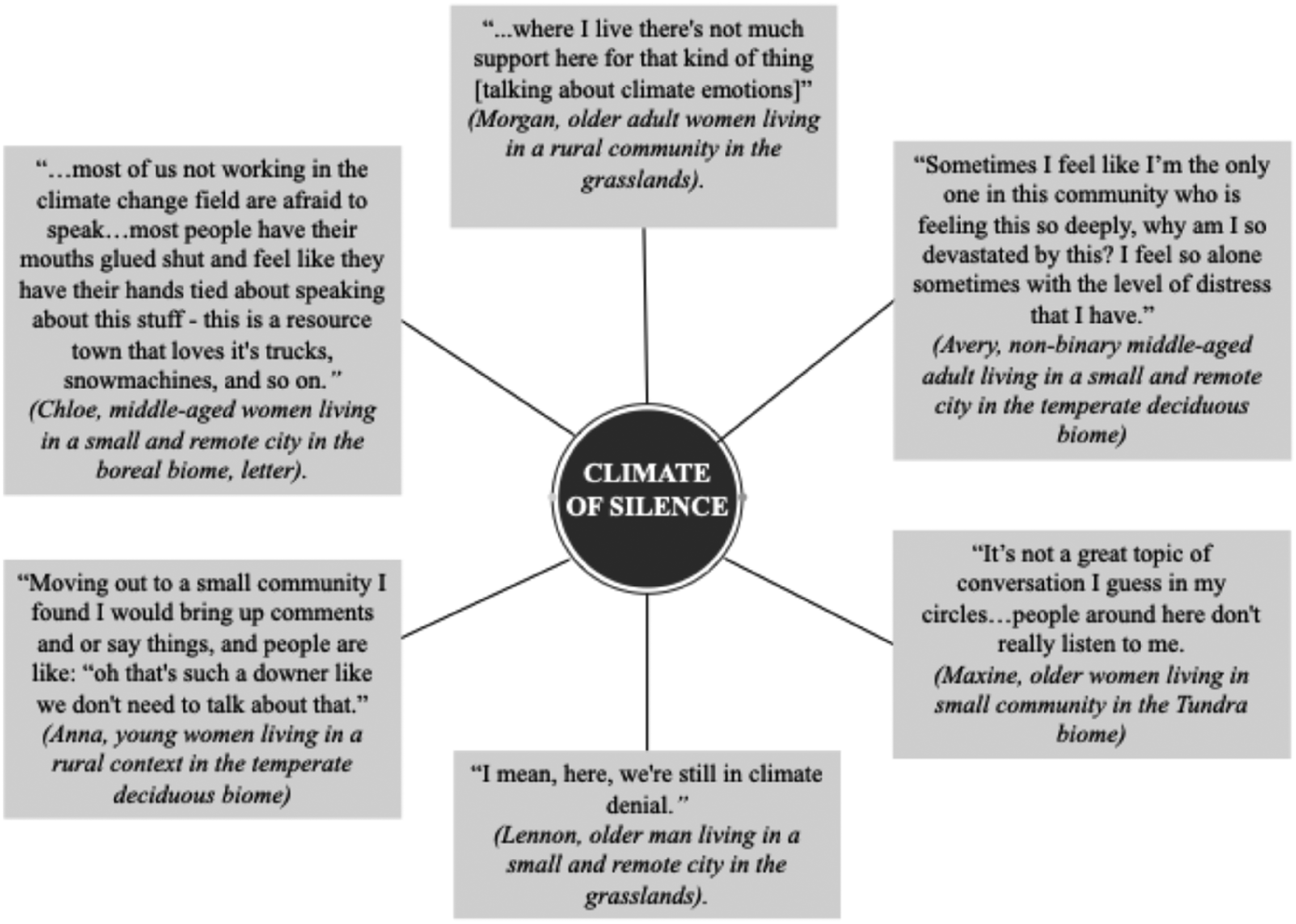
Quotes illustrating climate of silence.
This study highlights that a socially constructed climate of silence exists around climate change and climate emotions, a silence which is very likely most prevalent and problematic outside of large urban settings (Jones and Davison, 2021; Kemkes and Akerman, 2019). The data highlight, in particular, a silencing of what is often perceived and socialized as “negative” emotions reflecting what Head (2016) describes as a deeply engrained social pressure to avoid being a “doom and gloom merchant” (p. 2). Kemkes and Akerman (2019), drawing on interviews in small and rural communities in Northern Wisconsin (USA), also identified challenges in voicing and expressing so-called negative emotions associated with climate change calling for a purposeful movement away from silence and toward “more public discussion amid feelings of isolation” (2019: 6). With particular focus on loss, mourning, and grief related to climatic and environmental change, Ranjan (2024) argues that “grief is capacious and takes a terrestrial form – making it seen, whether within popular portrayal or political mobilisation, enables grief to become a generative force”. Relatedly, Varutti (2024: 552) asks: “why are we not grieving more publicly.” The data presented here underscore the imperative of making grief visible and public within remote, rural, and small communities specifically. These threads, of course, intersect with the discussion above around affective dilemmas and further supports the imperative of acknowledging, validating, and sharing complex and entangled climate emotions.
Finally, unlike other participants, Noah expressed in his letter that he has found peers in his small and remote city with whom he can share his concerns and feelings about the climate crisis, rooted in a shared love for nature in his community and region: It's a really great feeling to know that when I (or we) feel certain things, even existential things, things that might threaten this place up here that we love, good old Northwestern Ontario, that there is someone with whom I (we) can not only express that, to relieve some stress, but actually helps to take action on it. It's one thing to become at peace with emotions about climate change, but it's a whole other level when you feel empowered to act by a sense of community, whether that's one person or a whole group. (Noah, Letter)
Concern for future generations and responsibilities
All participants spoke to their children/grandchildren, potential future children/grandchildren, or to future generations broadly in relation to their climate change concerns and climate emotions. Concerns around future impacts are entangled with responsibilities as related to the causes of climate change, future impacts, and uncertainty about the future. Sense of responsibility was also a central theme related to complex climate emotions identified by Coppola and Pihkala (2023) who conducted interviews with young adults in the US and Finland and Malena-Chan (2019) who used interviews and a narrative approach to interpret the meaning of climate change among community leaders in a small city in Canada.
Charlie, a 74-year-old woman, discussed the feeling of guilt as related to future generations and responsibilities: “I feel terribly guilty that we're leaving them, children, our grandchildren, in this mess. I think the baby boom has really failed… we're passing on a mess.” Ivey shared that her sense of responsibility to young people evokes emotions like worry, sadness, and fear while also noting that “I am going to do my very best for all of the kids. I always think that. I think that is my responsibility.” The following quote form Steven illustrates how guilt and shame intersect with sense of responsibility for future generations and the natural world: …the children to me are a window into the future and so to think that we're borrowing this land or the environment from them that's where I feel this profound sense of guilt and shame. I am handing over to them something that is going to be worse than what I got to live through so that's really difficult for me to take. (Steven)
Climate emotions, concerns for future generations, and sense of responsibility also intersected with inspiration for engaging in individual and collective action throughout the interviews and letters as exemplified by these quotes: It's time we stop destroying the environment. It's time to act right for the sake of our future generations, for the sake of those who'll come after us. (Zoe, letter) I’m sad for the young people for sure, I’m sad for the loss of the natural world although I’m almost past that stage. I’m really focused on my daughter, not on myself. I’m super mom focused and my concern and action is largely for her. (Cecelia) Sometimes it feels hopeless like, what's the point of doing anything anymore cause we're in trouble but then it's you are reminded– like it's not a yes or no, it's about how bad does it get? So, we still gotta continue to fight, and I do – like my kids motivate me, my students motivate me, my children motivate me to keep fighting. I'm fighting because I want your future and my children's future to be a good one and I want you to have a livable planet, as you grow. (Nick)
These findings bring to light important considerations in relation to individual and collective sense of responsibilities and individual and collective action. In neoliberal societies like Canada, where individual responsibility is promoted over collective responsibility and where individuals (rather than systems) are made to feel responsible for causing climate change, we must interrogate the underlying and pervasive narratives of individual responsibility and bring forward narratives of collective responsibilities (Kałwak and Weihgold, 2022).
A final basic theme related to concern for future generations and responsibilities was a hesitation around bringing children/more children into a world characterized by climate change and questioning whether doing so is irresponsible to the future children and climate change.
Not enough action
The final organizing theme illustrating those factors shaping climate emotions was the notion of not enough climate action. This included questions of “enoughness” at the individual level as well as the inadequate climate action from those in positions of power. For example, Nick and Parker articulated this questioning around enoughness in relation to their engagement with climate action and resulting feelings of guilt and grief: …I always have this feeling of like is it enough? Am I doing enough? Am I pushing enough? (Nick) And I think at one point at some point and I know which point it is I suddenly realized that it [individual action in response to climate change] wasn’t enough, and then that's when I think the grief became really intense. I think before then it felt more like an arduous job you know, like this is going to be a lot of work to change, but we can work on this, we can change this. And then at some point it was like uh, forget it we’re not going to change it. It's over and that's when the intense grief started. (Parker)
Nearly all participants also shared strong feelings of frustration, anger, and/or powerlessness in relation to the current scale of climate (in)action taken by governments. Madison and Lennon emphasized their feeling of frustration as follows: “Definitely a lot of frustration at the government's inaction” and “I'm frustrated with governments that fail to take leadership because they’re afraid they won't get elected in the next election.”
Several other studies have also identified similar trends related to inaction by those in positions of power and specific emotions of frustration, anger, and powerlessness as well as climate anxiety (Soutar and Wand, 2022). These dynamics may be particularly prevalent and/or strong in the context of small, rural, and remote communities given the perceived and very real marginalization in these settings as compared to urban centers where power is consolidated, held, and enacted.
Consequences of climate emotions
The third and final global theme illustrates the real and relevant consequences of climate emotions. These consequences are described and discussed through two organizing themes: (1) embodiment, health, and wellbeing and (2) life decisions and (in)action.
Embodiment, health, and wellbeing
Nearly two-thirds of the participants spoke to the ways in which climate emotions manifest in their bodies (i.e. the embodiment of climate emotions), often in relation to consequences for physical wellbeing. For Jasper when asked at the outset of the interview, “what is the first thing word or sentence that comes to mind when you think about climate change,” he simply answered “Breathing. I can’t breathe.” Others described feeling a heavy weight, inability to concentrate, impacts on sleep, impacts on eating, pain in their heart, and tensions in their bodies. Other scholars have expressed the embodied experience of ecological grief specifically (Varutti, 2024), but limited research to date has documented and explored this embodiment across of climate emotions broadly.
More than half of the participants described significant impacts on physical and/or mental health such as depression, often speaking to the scale, frequency, and lingering nature of climate emotions specifically. Table 4 includes several illustrative quotes reflecting embodiment, health, and wellbeing.
Illustrative quotes for embodiment, health, and wellbeing.
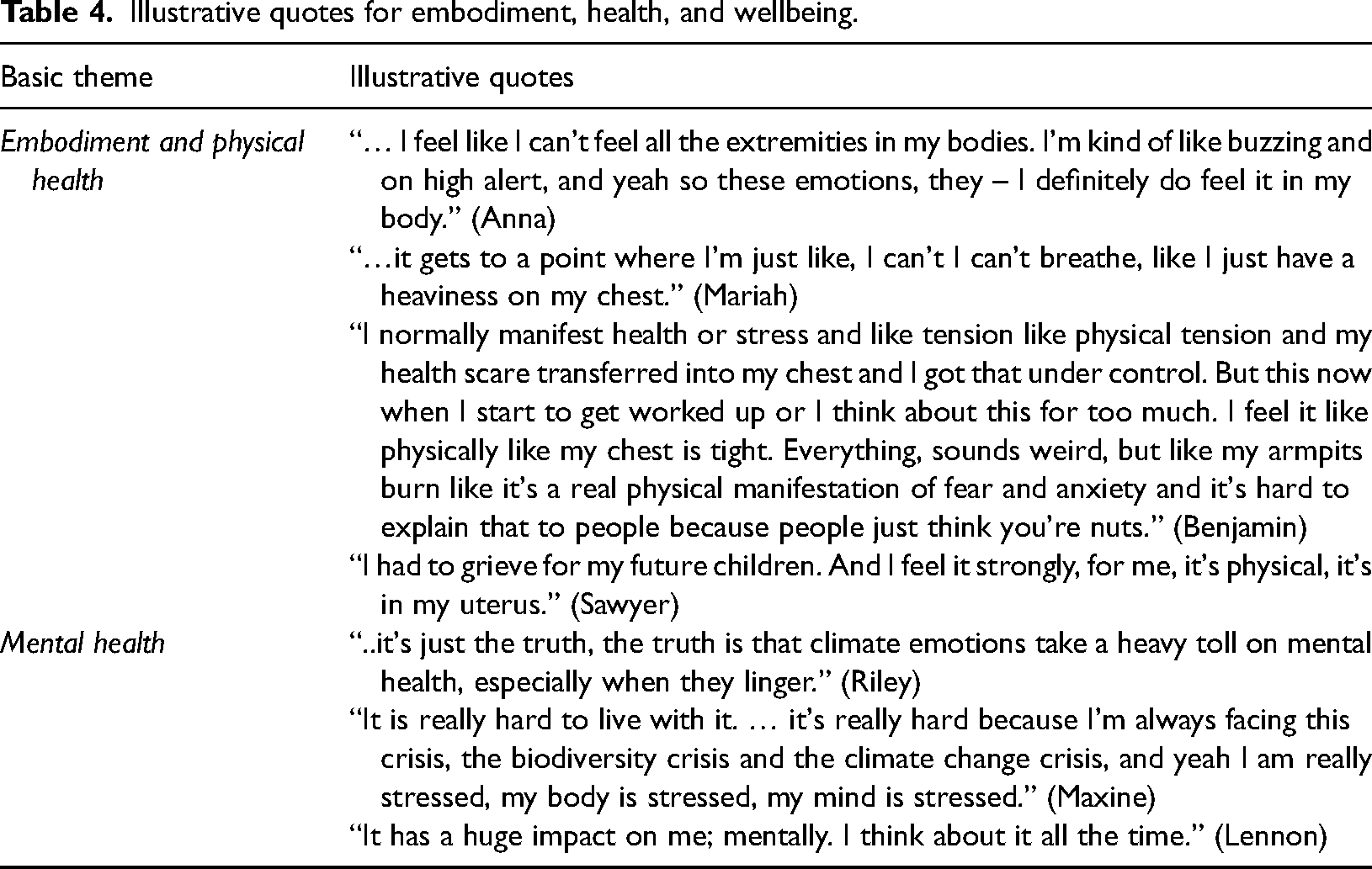
As outlined above, although there is general movement in both literature and practice toward recognizing that climate emotions are valid and appropriate, there is also a growing body of research pointing to potential harms and pathologies in some contexts and for some people and populations (Ogunbode et al., 2021). The large majority of this research has been focusing on the more specific concept and experience of climate anxiety, as opposed to climate emotions more broadly. Consequences on physical and mental health may, in large part, manifest due the fact that many people experience their complex, intense, and interconnected climate emotions alone and in the context of cultures and communities that tend to silence and delegitimize emotions related to the climate crisis. Although this will be described elsewhere, participants did speak to and call for diverse practices, processes, and supports related to coping with challenging and complex emotions which is certainly relevant when considering how to prevent consequences on health and wellbeing.
Life decisions and action
Climate emotions are also impacting life decisions and inspiring action for most participants of this study. Examples of impacts on life decisions included moving, decisions not to have children, seeking jobs or education related to climate solutions, lifestyle choices, and relationship decisions. For example, Emerson described moving from a large urban center to the rural small community to enable taking more action and to address their feelings of guilt: So I moved to the Maritimes from [a large urban center] about five years ago, and one of the main reasons for that was that I was feeling not like apocalyptic, but, you know, I was like, I need to get out of the city before things go to shit, basically I moved out of the city, so I had more control over my direct environment so I could decide, like, you know, how I want to compost and I want to have a garden and, you know, and I, you know, I can eat locally as much as possible and like all that kind of stuff. So anyway, those kinds of things that take away some of the guilt. (Emerson) Because when I had my first daughter that's really the point to where I got scared for the next generation. Because I had now a daughter that would maybe someday become a mother and that's the time that I wanted to save and do everything. And after that I was really scared and anxious and all of it. So me and my husband decided not to have other children because of climate change. (Sawyer) If I do end up feeling anxious about the way things are headed. Or hearing some of these like stories in the news. I think OK I'm not just going to wallow in that depression or anxiety there are thing I can dos, so to think of aspects of my life where I'm taking action. (Jamie) But I absolutely value and cherish anxiety. Like it's – well, you know, it's like the nerve endings in my fingers, when I stick my fingers on the stove it hurts and I can think, ‘Oh I should do something about that’, and I do. (Jasper)
As Harth (2021) writes, it has become clear that “affects and emotions are essential motivational drivers for actions related to climate change at the individual and group level” (p. 142). Although the research exploring the connections between climate emotions and both individual and collection action has grown over the last several years, many unanswered questions remain as to which specific core emotions or constellations of climate emotions are most generative, for which population groups, and why.
Concluding thoughts
This study aimed to advance our collective understanding of the lived experiences of climate emotions with a focus on remote, rural, and small communities in Canada. Based on semi-structured interviews and letters from diverse participants, this research advances the growing body of research on climate emotions in several important ways. First, the study highlights that climate emotions are characteristically complex and interconnected and, for many people, intense, challenging, and consequential. Given the complex, urgent, inequitable, and accelerating nature of the climate crisis itself, it is not at all surprisingly that emotions related to climate change are complex, dynamic, interconnected, and overwhelming at times. The identification and description of both core climate emotions and emotional constellations (i.e. clusters of emotions that are frequently experiences and discussed together) is a novel contribution that is helpful for understanding nuances of climate emotions. Second, the characterization of three affective dilemmas related to climate emotions including not wanting to burden others with emotions yet wanting to talk about them, questioning around the appropriateness of climate emotions, and the challenge of balancing complex and seemingly opposing emotions is a unique and timely contribution toward advancing our collective understanding around the tensions and contradictions that are entangled with the lived experiences of climate emotions. These affective dilemmas are particularly important for informing collective and constructive coping practices and processes (e.g. climate cafes). Third, this research emphasizes that identities and privilege intersect to give rise and shape to climate emotions while also emphasizing the role of place in shaping the lived experiences of climate emotions. This points to the importance and potential value of place-based and intersectional approaches in future climate emotions research. Fourth, the analysis of interviews and letters clearly emphasizes that climate emotions result in consequences beyond impacts on mental and emotional health (the focus of much of the existing research in this realm). Notably, climate emotions also impact physical health and life decisions. Taken together, the rich descriptions of core climate emotions, emotional constellations, and evidence of affective dilemmas along with the documented consequences of climate emotions on people's lives underscores the continued need for more research. Innovative data collection and analysis methods that are well-suited to engaging with, supporting the processing of, and eliciting rich description about emotional, often intangible, and politicized topics will be important to continue to advance this field of research. Moreover, this study points to the imperative of supporting collective coping through place-specific and intersectional practices that recognize the tensions and challenges that characterize climate emotions as well as the diversity of factors that give rise and shape to climate emotions. Finally, although many of the findings presented here align with existing research around climate emotions generally, they also emphasize that the lived experiences of climate emotions may be particularly impactful in remote, rural, and small communities that are all too often marginalized and disempowered, where people tend to have close connections to the natural world, and where the silencing around climate change and the emotional dimensions of climate change is particular powerful. The affective dilemmas and the consequences of a “climate of silence” are likely aspects of experiencing climate emotions that are particularly relevant beyond the big city in Canada and globally.
Highlights
People living in remote, rural, and small communities representing diverse geographies and vulnerabilities experience complex, challenging, and consequential climate emotions.
Experiences of climate emotion are shaped by numerous intersecting factors and characterized by core emotions, emotional constellations, and affective dilemmas.
Combining interviews with an asynchronous letter writing process is a useful data collection method for exploring emotional experiences.
It is imperative to acknowledge, validate, and share climate emotions, to move beyond silencing and isolation in support of collective coping.
Supplemental Material
sj-docx-1-ene-10.1177_25148486241313355 - Supplemental material for Climate emotions in remote, rural, and small communities across Canada: Exploring lived experiences through interviews and letters
Supplemental material, sj-docx-1-ene-10.1177_25148486241313355 for Climate emotions in remote, rural, and small communities across Canada: Exploring lived experiences through interviews and letters by Lindsay P. Galway in Environment and Planning E: Nature and Space
Footnotes
Acknowledgements
Thank you to the research participants who shared their wisdom and experiences. Thank you to Aynsley Klassen and Sydney Hunt for their support as research assistants.
Consent to participate
Prior to data collection, participants were informed of the potential risks and benefits and their rights as a research participant, and written consent was obtained. Given the sensitive nature of climate emotions, participants were given information about mental health support in the event they experienced distress during or after data collection.
Ethical approval and informed consent
The Lakehead University Research Ethics Board approved prior to participant recruitment and data collection activities. Written consent was obtained.
Funding
The authors disclosed receipt of the following financial support for the research, authorship, and/or publication of this article: This work was supported by the Social Science and Humanities Research Council and the Canada Research Chair program.

Supplemental material
Supplemental material for this article is available online.
References
Supplementary Material
Please find the following supplemental material available below.
For Open Access articles published under a Creative Commons License, all supplemental material carries the same license as the article it is associated with.
For non-Open Access articles published, all supplemental material carries a non-exclusive license, and permission requests for re-use of supplemental material or any part of supplemental material shall be sent directly to the copyright owner as specified in the copyright notice associated with the article.
