




Abstract
Using case studies from Namibia and Mozambique, we examine how regulations against hunting impact person–place relationships and affect multidimensional wellbeing in conservation spaces. We combine Amartya Sen's capability approach with theories of place, using Chris de Wet's concept of disemplacement to investigate the ways conservation efforts affect rural quality of life. We find conservation and place-making become incompatible if people are prevented from adapting lifestyles and livelihoods to accommodate changing circumstances. By tracing distinct dimensions of the disemplacement process, we demonstrate the adverse and compounding effects of wildlife regulations associated with nature tourism. Disruptions to economic livelihoods and physical security destabilize person–place bonds that enhance wellbeing. Material losses and economic hardship are accompanied by institutional disruptions that contribute to marginalization and social exclusion. We provide a detailed illustration of how conservation regulations constrain agency and contribute to a growing sense of powerlessness by decreasing local control over wildlife, which consequently weakens place attachment and diminishes wellbeing. Our study demonstrates how people become more multidimensionally impoverished as conservation initiatives change the places they value while simultaneously limiting their capabilities to maintain place attachment.
Introduction
An aspirational movement in biological conservation advocates dedicating half of Earth's land for nonhuman species (Locke, 2013; Wilson, 2016). Such targets are deemed essential to restore the planet's natural cycles and decelerate biodiversity loss (Maron et al., 2018). Yet questions abound: Why half? and, Which places? (Ellis and Mehrabi, 2019). Globally, protected areas (PAs) are rapidly expanding. The World Database on Protected Areas reports that, since 2010, globally designated terrestrial parks and PAs have increased by over 21 million km2, which is more than twice the size of the United States (UNEP-WCMC and IUCN, 2021). However, realizing conservation goals without diminishing human wellbeing remains a challenge as the habitats most critical to protecting biodiversity are rarely unpopulated (Fletcher, 2023; Roe et al., 2013).
Some estimates suggest that achieving the Half-Earth conservation strategy requires displacing up to one billion people, with especially negative outcomes for indigenous populations (Garnett et al., 2018; Schleicher et al., 2019). In this way, the strategy presents a troubling tradeoff. The Half-Earth proposal involves top-down governance systems with limited opportunities for affected populations to voice concerns or to participate in environmental governance (De Bruin et al., 2023). If implemented as described (cf. Ellis and Mehrabi, 2019), the Half-Earth approach reflects a resurgence of Fortress Conservation (Sarkki et al., 2023) and settler colonialism despite the growing momentum to decolonize conservation (Corbera et al., 2021).
Local communities understandably resist global conservation efforts that alienate them from the places and lifestyles they value (Duffy et al., 2019; Lunstrum et al., 2021; Massé, 2020; Otsuki, 2021; Ramutsindela et al., 2022; Sullivan, 2017, 2019; Thakholi, 2021). To successfully address the biodiversity crisis, society must do so in a way that deals fairly with all parties, humans and nonhumans alike. Thus, we ask, how can conservation be pursued equitably in places where people have long histories of coexisting with nature that predate the current biodiversity crisis?
Pivotal work within human geography shows that people develop strong connections to places they value (Entrikin, 1990; Massey and Jess, 1995; McDowell, 2016; Smith, 2017; Tuan, 1977) and where they interact with their environments in complex ways (Anderson, 2021; Cresswell, 1996; Holloway and Hubbard, 2001; Tuan, 1974, 1975). Scholarship demonstrates that individuals can express significant place attachment to physical landscapes, even if this is sometimes experienced through a mixture of pain and loss (cf. Gururani, 2002). Although physical displacement of human communities receives greater attention, economic and social displacement occurs more frequently in conservation spaces, causes considerable distress, and is less likely to result in compensation (Barua et al., 2013; Brockington and Igoe, 2006; Holmes and Cavanagh, 2016). There exists a need to critically examine the less visible losses of conservation given their potential to alienate rural communities, increase resistance, and undermine voluntary compliance with wildlife regulations (Silva, 2020; Silva et al., 2018; Strong and Silva, 2020, 2021).
In this article, we analyze the various ways conservation-related impacts on human wellbeing are experienced and mediated through their effects on place within different cultural, political, historical, and ecological contexts. We employ Amartya Sen's (1980, 1985, 1987, 1999, 2005, 2009) capability approach, an evaluative theory of development, that measures progress in terms of the expansion or reduction in capabilities—what Sen (2003) refers to as the real freedoms and opportunities an individual has to do things that they have reason to value. For development scholars concerned with social justice, the capability approach has appeal because it accommodates a pluralistic conceptualization of valuable states of being and draws attention to the diversity of human wants and needs (Alkire, 2002, 2005; Clark et al., 2019). Within human–environment studies, the capability approach has been used to gain insight into the interrelated dynamics influencing human wellbeing in conservation contexts (Balasubramanian and Sangha, 2021; Beauchamp et al., 2018; Hansen et al., 2015; Llopis et al., 2020, 2022; Woodhouse and McCabe, 2018).
The capability approach has been developed in several ways since first proposed by Sen. One difference between versions of the approach involves determining which capabilities we should consider, and thus measure, in evaluating individual wellbeing and development. Some theorists advocate for a short list of valuable capabilities that apply to everyone. In line with this view, Martha Nussbaum (2000, 2003, 2011) argues for a universal list of 10 central capabilities that include life; bodily health; bodily integrity; affiliation, including “being able to live with and toward others…” and “having the social bases of self-respect and nonhumiliation”; and control over one's environment (Nussbaum, 2011: 33–34). Sen (2004), however, rejects the notion that one fixed list or hierarchy of valuable capabilities can adequately capture the diversity of human needs, desires, and cultural identities. From this perspective, lists of valued capabilities will differ across societies because what matters in one context may not be relevant in another. Following Sen, we focus on a select set of contextually relevant capabilities for investigating rural development and wellbeing in African conservation spaces. We examine whether people's changing situations over time involve any sort of improvement or deterioration by considering which capabilities have been gained or enhanced and which have been lost or restricted as a result of wildlife regulations and their enforcement.
We integrate Chris de Wet's (2008) concept of disemplacement—the social, economic, and political disruptions that erode personally meaningful connections to place—with the capability approach in order to (1) identify the diverse range of place-making capabilities affected by conservation, (2) examine how capability enhancement and diminishment influence experiences of place, and (3) trace the temporal sequence of events and causal mechanisms that link conservation efforts to territorial alienation. Using 435 in-depth interviews drawn from a larger, longitudinal study of rural development in Namibian and Mozambican villages located near PAs, we situate the economic hardship rural populations experience within the broader dynamics of social and environmental change. These interview data represent one point in time; however, our analysis and interpretation of the findings are informed by nearly two decades of research in the case study areas, beginning with their initial experiences of PA management.
Our study illustrates how local perceptions of and support for conservation initiatives change in response to ongoing regulatory enforcement. We enumerate the processes by which prohibitions against hunting restrict valued capabilities and reduce place attachment. We find that disemplacement has three distinct dimensions, each of which offers insight into the importance of maintaining place attachment for human wellbeing. We conclude with some recommendations for promoting more socially just conservation. Given the rapid growth of PAs across sub-Saharan Africa, our findings have the potential to inform conservation policy across the region as more communities experience similar disruptions in the future.
Conceptual framework
Linking place to human wellbeing
Place is a location with an associated set of meanings, memories, and attachments (Cresswell, 2004). Social actors construct places to mirror society's economic, cultural, and political structures (Harvey, 1973; Lefebvre, 1991). Over time, places evolve in ways that reflect social change (Lippard, 1997) and shifts in global and local dynamics (Massey, 1994). Attachment to important places follows an individual from one location or time to another (Bachelard, 1957) as it intersects with their experiences and memories of other places (Casey, 1987).
Person–place bonds influence multiple aspects of wellbeing. The development of place attachment—the deep connection and bonds people form to places (Altman and Low, 1992; Lewicka, 2011)—mitigates anxiety (Casey, 2009), enhances one's sense of safety (Billig, 2006), increases happiness and life satisfaction (Brehm et al., 2004), and reduces feelings of injustice (Brown et al., 2003). Higher levels of place attachment are associated with higher levels of wellbeing in communities living in or near PAs (Jones et al., 2020). Scannell and Gifford (2010) propose that place attachment arises in locales that increase a sense of security, achievement, and belonging. This scholarship suggests that places become critical to human wellbeing explicitly because of the important actions individuals perform within them.
Some scholars, including De Wet (2008), use the term emplacement to describe the process of forming and maintaining place attachment. By engaging in these practices, individuals gain a “kind of local citizenship or enfranchisement” (De Wet, 2008: 116) that not only connects them to the place they inhabit but also establishes a sense of agency. Ongoing emplacement requires the ability to engage in activities that permit continued pursuit and fulfillment of goals (Scannell and Gifford, 2010), especially as places undergo change. Restrictions on agency, therefore, have the ability to disrupt place attachment, and when severe enough, precipitate disemplacement.
Using disemplacement to identify conservation's impacts on place
Empirical research demonstrates that individuals actively mourn the loss of treasured environments (Cunsolo and Ellis, 2018; Larter et al., 2019; Scannell and Gifford, 2017), which can even manifest as a pathology (Stolfi, 2015). Deep emotional bonds to place are not readily broken (Relph, 1976), which helps explain why individuals remain living in areas repeatedly devastated by extreme weather (Chamlee-Wright and Storr, 2009). The territorial alienation that often accompanies socioeconomic change for marginalized populations (Wacquant, 1996) has the potential to diminish multiple dimensions of wellbeing, including the material, psychological, and social.
For De Wet (2008), disemplacement gradually arises as “the area where people live or with which they associate is no longer able to support or sustain them…They are thus no longer able to remain emplaced, and increasingly become uprooted, unsettled, ‘disemplaced’” (De Wet, 2008: 115). Research by De Wet (2008) indicates that people may lose their connections to a place long before they decide to leave it. Previous empirical work suggests that particularly strong drivers of disemplacement in rural Africa involve losses of cultural heritage, historical affiliation, and tangible connections to the physical landscape (Strong, 2017; Strong and Silva, 2020).
As a theoretical construct, disemplacement focuses attention on the process by which individuals lose their deep emotional connections to the place they inhabit and highlights how intangible aspects of wellbeing, like place attachment, are altered as physical and social landscapes undergo change (De Wet, 2008; Hemer, 2015). It also frames the agency people have to actively maintain place attachment as a critical human right and valued capability. What the scholarship on disemplacement lacks, though, is a clear understanding as to how this process unfolds over time. De Wet (2008) emphasizes a suite of processes that act on residents to undermine their ability to thrive in treasured locales. However, he offers no discussion of the temporality or intersectionality of these processes.
While the most extreme case, displacement or forced relocation, is easily visible, the emotional impact of severed connections with place often remains difficult to observe and qualify (Roche et al., 2019). By articulating the psychological benefits that lead people to develop place attachment, Scannell and Gifford's (2010, 2017) work illuminates three primary ways positive person–place bonds contribute to wellbeing: (1) providing a sense of safety and security, (2) promoting goal support, and (3) fostering a sense of belonging and cultural continuity. These benefits align well with what de Wet describes as lost during disemplacement. We use Scannell and Gifford's (2010) schematic to operationalize place attachment within the capability approach and identify how capability enhancement and diminishment influence these core benefits.
Methods
Case study sites
The Namibian and Mozambican governments both identify nature tourism in PAs as a key component to economic growth and rural poverty alleviation. Namibia has one of the most mature and successful nature tourism sectors in Africa. Mozambique more recently embarked on the promotion of nature tourism and has modeled its approach on the Namibian example. In both countries, the government and private sector donors jointly promote conservation efforts and the use of regulatory enforcement to increase the viability and economic potential of nature tourism (Silva and Khatiwada, 2014), though how they do this differs. Namibia allows communities to establish conservancies on traditional lands to incentivize compliance with environmental regulations while Mozambique establishes national parks surrounded by buffer zones in which park officials enforce conservation-focused policies. Each country restricts human activities and land uses in and around PAs, including strictly enforced bans against unlicensed hunting.
Our analysis examines three case studies drawn from a larger longitudinal study of southern Africa: (1) Gorongosa National Park, Sofala Province, Mozambique; (2) Limpopo National Park, Gaza Province, Mozambique; and (3) Bwabwata and Mamili national parks in Zambezi Region, Namibia. In each site—hereafter referred to as Sofala, Gaza, and Zambezi, respectively—we conducted research with communities located near a PA (see Figure 1). Other criteria for site selection included (1) presence of nature tourism arrivals and infrastructure (even if minimal) in the area, (2) predominance of agricultural livelihoods and heavy reliance on natural resources, (3) strict enforcement of conservation regulations, and (4) community willingness to participate in a multiyear research project.
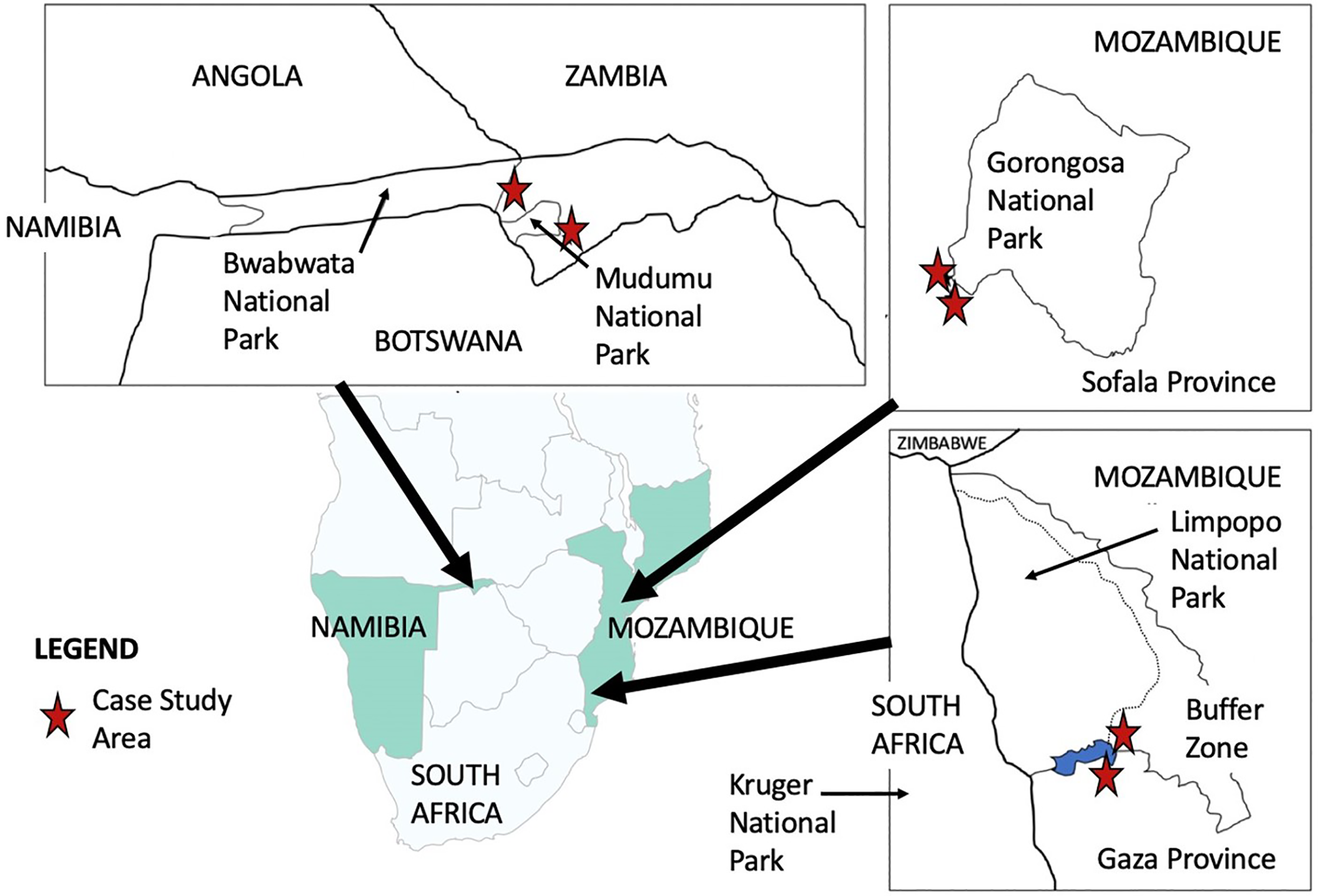
Map of case study locations and neighboring protected areas (PAs). To preserve respondents’ confidentiality, we omit the specific village names. The map was created with Mapchart.net using park boundaries from Google Earth imagery.
Using high-resolution satellite imagery printed on canvas posters, we determined the study site boundaries in consultation with local leaders and area residents. In Sofala, multiple villages comprise a single area presided over by a traditional leader. In Zambezi, each community consisted of a single village with its own traditional leader and local governing council. Communities in Gaza were similarly defined, though one community included a much smaller satellite village linked through kinship ties and marriage customs. All our communities had long histories in their present sites. Efforts to resettle some communities living inside PAs were underway in these regions, but the state had not targeted any of our case study communities—none of which are located within a park boundary—for resettlement.
Though antihunting regulations have existed since the colonial period, residents from all three sites have a long history of hunting wildlife in areas near villages. In both Namibia and Mozambique, current hunting regulations can be traced to discriminatory colonial-era laws with onerous licensing requirements for local people. Beginning in the early 2000s, each site experienced an increase in the enforcement of regulations, such as prohibitions against bushmeat hunting, that the state had previously overlooked (Strong and Silva, 2020). Particularly in Mozambique, enforcement was essential to the successful reintroduction of large mammal species that were decimated during the country's civil war (Daskin and Pringle, 2018). All case study sites exhibited similar metrics for socioeconomic development and were characterized by high levels of multidimensional poverty, physical isolation, and human–wildlife conflict (HWC). Bushmeat hunting played a significant role in household food security as many households did not own livestock and lacked the resources to purchase meat. For a more detailed analysis of community characteristics, see Silva and Mosimane (2013, 2014), Silva and Khatiwada (2014), and Silva et al. (2018).
Data collection
With the assistance of community members, a team of researchers from the USA, Namibia, and Mozambique first drew maps of household locations and relevant landmarks for each case study community. We then held group meetings with local community leaders and key informants to examine these hand-drawn maps alongside high-resolution imagery of the case study area to ensure all households were included and that the household heads were correctly named. Once the locations and resident names were verified, all mapped households were given a unique number and listed on a registry in order of their geographic location (Cahyat et al., 2007). In Sofala and Zambezi, we drew our survey sample by systematically selecting every nth household from the registry, with n being determined by the size of each case study population. In our sparsely populated Gaza sites, we conducted a socioeconomic census of all households located in the study areas. Our final sample included 1182 households, representing approximately 40%, 43%, and 89% of all households in the Zambezi, Sofala, and Gaza case study sites, respectively. Data collection in 2009 involved conducting household surveys with our entire sample to gauge consumption patterns, household wealth, demographic characteristics, livelihood strategies, and economic losses attributed to HWC.
In 2011–2012, we conducted 435 in-depth, follow-up interviews in Zambezi (n = 127), Gaza (n = 141), and Sofala (n = 167) with a random sample of original survey respondents, both male and female. This resulted in interviews with approximately 45% of the original sample in Gaza, and approximately 35% in the more densely populated sites of Zambezi and Sofala. Students and faculty from the University of Namibia, Universidade Save (Mozambique), and Universidade Licungo (Mozambique) conducted interviews, averaging between 1 and 2 hours, in the respondent's home using their preferred language.
Interviews included open-ended questions to elicit information on livelihood strategies, natural resource use, interactions with park management, and life and lifestyle changes over time. We collected data on people's perceptions of wildlife conservation regulations and how enforcement of those regulations had impacted different dimensions of their wellbeing. Initial analyses of these data revealed the common use of place descriptions to illustrate quality of life changes and explain local experiences with conservation regulations. These data provide a valuable record of how people in rural communities experience changes attributed to PA management, thereby allowing us to examine and illuminate the ways conservation efforts influence place attachment over time as regulatory enforcement begins and intensifies.
Data analysis
Mozambican and Namibian research assistants, fluent in both English and local languages, transcribed and translated the 435 interviews to ensure idioms and expressions retained their original intent. Research assistants had familiarity with the study sites, which allowed them to understand the nuances associated with place-based references, historical and recent events, and daily livelihood practices. Translated documents were uploaded into Nvivo, a software program that permits researchers to link qualitative data to research codes and themes (Nvivo, 2022).
Drawing upon Sen (1987, 1999), Narayan et al. (2000), and Alkire (2002), we drafted an a priori set of analytical codes, which we applied to the relevant text of interview transcripts using deductive reasoning (Bernard, 2006). Sen (2004) positions the research participants as the experts best-suited to identify what matters in their daily lives and why. Therefore, we also inductively developed a set of emergent codes that were grounded in the interview data, allowing us to analyze themes and capabilities repeatedly discussed by respondents but not included on our original list. We conducted a second iteration of coding to apply the emergent codes. We also developed nested codes during our second round of analysis (Miles and Huberman, 1994). For example, prior to analysis, we had anticipated the ability to farm successfully would be a valued capability for our respondents given the local context. After iterative readings, we constructed an emergent code, the ability to control animals, which intersected our farming code throughout the interviews. However, to clarify when respondents meant wildlife versus livestock, we created nested codes to differentiate the text. In the third iteration of coding, we identified and categorized textual segments that related to one or more of the three motivations for place attachment described by Scannell and Gifford (2010): physical safety, goal support, and feelings of belonging. Figure 2 contains an overview of the coding process with sample text.
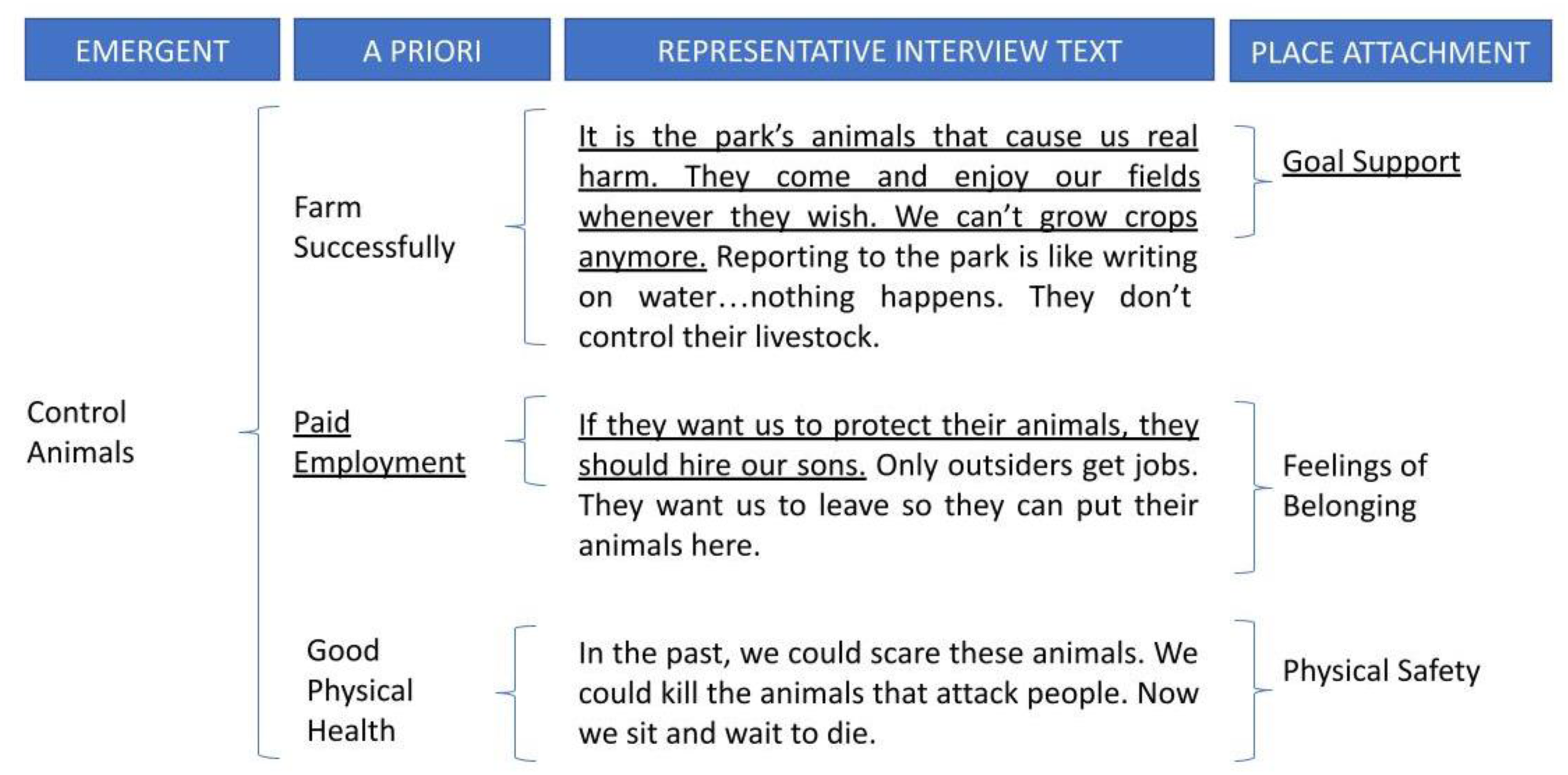
The figure demonstrates how three iterations of coding interview transcripts allowed us to examine the intersection of place, capabilities, and wellbeing. On the left side of the text, we illustrate how emergent and a priori codes for valued capabilities often overlap. On the right side of the text, we provide examples of how we used our three place attachment codes. In cases where only portions of a text segment intersect between multiple categories, we underline the relevant text and relevant category. For example, in the first segment of text, only the underlined portion represents lost goal support but all the text in this segment was coded as relating to the capabilities to farm successfully and control animals.
After completing the iterative coding, we analyzed the interview text to identify and examine the intersection of place-based discussions and accounts of capability enhancement or diminishment. Content analysis revealed common themes and patterns in coded interview data through the analysis of both manifest and latent content, allowing us to explore similarities and differences across individuals and groups (Bernard, 2006). Within each study site, respondents described ways in which the loss of capabilities, specifically the ability to hunt wild animals, disrupted their person–place bonds and reduced the agency they previously had to pursue activities they valued within the local environment. Seeing this, we then employed process tracing to investigate the causal dynamics between hunting restrictions and experiences of place, following the steps outlined by Ricks and Liu (2018).
Process tracing is a method for examining causal relationships using case studies (Beach, 2017). It involves paying close attention to the temporal sequence of described events in interview narratives to determine the direction of causality (Collier, 2011; Beach and Pedersen, 2013). We examined respondents’ descriptions of what they could do or be in their communities before and after the enforcement of conservation regulations and how this was reflected in their assessments of the places in which they live. We also analyzed how respondents described their history of experiences with conservation initiatives to identify shifts in perceptions of and support for PAs. The concept of disemplacement (De Wet, 2008) served as the analytical lens through which we teased out the process unfolding in the study sites, allowing us to trace the trajectory of lived experiences with conservation and examine their implications for place attachment and wellbeing. We also calculated descriptive statistics of socioeconomic data from our 2009 household survey to help contextualize our qualitative findings.
Our presentation of results utilize respondents’ own words, as encouraged by the capability approach, to illustrate how hunting regulations impact different dimensions of wellbeing. We selected quotes based on their clarity, impact, and representativeness in order to highlight concerns shared by our respondents and illustrate commonly expressed themes. In keeping with established methodologies that caution against reducing qualitative data to statistics (Creswell, 2013; Emerson et al., 2011; Miles and Huberman, 1994; Quinn, 2005), we do not provide quantitative assessments of the interview data, including the percentage of respondents who discuss specific themes. Doing so would risk undercounting respondents who would have expressed similar experiences or views if directly asked, but who never introduced the idea themselves in response to the open-ended question. All quotes include the gender and age of respondents to demonstrate that the quotations we selected reflect respondent diversity. The M or N at the beginning of the unique identification code (used to anonymize data) signifies the respondent was from Mozambique or Namibia, respectively; however, to protect respondents, we do not provide information on the specific community in which they live.
Narratives of disemplacement
Respondents consistently identified bans on unlicensed hunting as a negative consequence of state-sponsored conservation efforts with direct and serious effects on their quality of life. People provided three dominant reasons for valuing the capability to hunt. These included (1) the acquisition of bushmeat for home consumption or sale and (2) in our Gaza site, the income earned from commercial poaching. However, the most widespread and commonly expressed complaint was (3) the inability to hunt as a means of lethal control, a traditional wildlife management strategy to prevent or deter wildlife from crop raiding and livestock predation.
Many of the challenges and concerns shared by respondents relate to the three ways Scannell and Gifford (2010, 2017) link place attachment to wellbeing. Evidence for disemplacement was present in respondent accounts of feeling as if they were no longer welcome in areas where they had long histories of communal land use rights, as state authorities allowed wildlife to regularly access the spaces in which local populations live and farm. This led respondents to conclude they could not successfully support their livelihood goals or maintain their physical security. They spoke of facing an uncertain future in once familiar places.
Lost sense of belonging
In every study site, people described the continuity of place as under attack. Women and men, young and old alike, recounted experiences of marginalization and social exclusion occurring since the renewed focus on conservation in spaces located near their communities. Though feeling as if they no longer belonged there manifested in several ways, in the most extreme cases individuals reported fearing eviction as punishment for illegal hunting. We are afraid that in the future the park will chase us away from this area…because we are killing their animals. If they say so, we will leave. What can we do? Those people [park authorities] are like God here. (female, 24, M201)
Another widely shared belief was that conservation managers purposefully ignored residents’ problems with HWC because they wanted residents to leave the area at their own expense. They [park authorities] wanted to force us to move from here using those animals so that they don’t have to pay anything to get us to go to the place where they want us to go. They wanted us to leave here and go to other places to avoid the lions and elephants. But unfortunately for them, we are not leaving this place because we say that it is better for the animals to kill us here with our livestock. (male, 53, M101)
Respondents said discriminatory treatment created an environment in which wildlife flourished at the expense of local people. “Wild animals are now more important than people,” explained one respondent, who continued with “I was once attacked by one of the wild animals but I was never compensated. But should you try to kill that wild animal, you are in danger [of arrest]” (female, 43, N101). Respondents frequently contrasted their own negative experiences with the more favorable situation for wildlife, using the comparisons to emphasize and protest their marginalization. “People matter more [than animals], but the park tends to give more consideration to animals than they do people” (male, 68, M204). The injustice of conservation authorities prioritizing animals’ wellbeing over peoples’ lives emerged as a dominant theme across all study sites and was a frequent refrain within interviews.
Respondents cited nature tourism as an underlying force driving park regulations with marginalizing outcomes, such as prohibiting lethal control of problem animals, “because animals represent money. They can be bought by tourists” (male, 30, N102). Respondents were aware that foreign visitors came to PAs in order to hunt or photograph wildlife and linked the presence of tourists to crop and livestock losses because: in the past, when they [residents] would see that an elephant had eaten [crops] in the field, they would follow its trail until they found it to kill it. But these days, wild animals are very much protected; there is no killing, and even no shooting into the air [to scare them]. Now, they [tourists] have brought a big problem to us. They have contributed to bringing them [wild animals] closer to people who must live with them, and people don’t even know what to do. (male, 43, N103)
Despite hardships attributed to conservation, strong feelings of place attachment also led to some support for PAs. In Sofala, a respondent expressed pride in Gorongosa National Park because “Each area needs beauty, and our area is now well-known because of it [the park]” (male, 32, M212). In Zambezi, often reported as a conservation success story (Jones et al., 2013), respondents said that closing nearby parks or ending participation in conservation initiatives would reflect poorly on the communities and their commitment to the land (Silva and Mosimane, 2014).
Fractured goal support
In our study, content analysis underscored the central role farming played in residents’ goals. Crop farming was the most commonly shared experience of rural life. Respondents emphasized the importance of farming, mainly for food security and income, but also for maintaining cultural traditions. The capability to farm successfully had instrumental value in allowing people to attain other valued goals, including basic capabilities to be adequately nourished and to earn the income needed to educate their children or access healthcare. People consistently described wanting to continue living in areas that had successfully supported agriculture in the past. Even in famine and other kinds of calamities, we manage to eat…When it is a famine period, we manage to hunt wild animals for food. This is the reason why we like this area. This area has fertile soils that permit us to get good harvests of maize when it rains, so that is the reason why. (male, 35, M103)
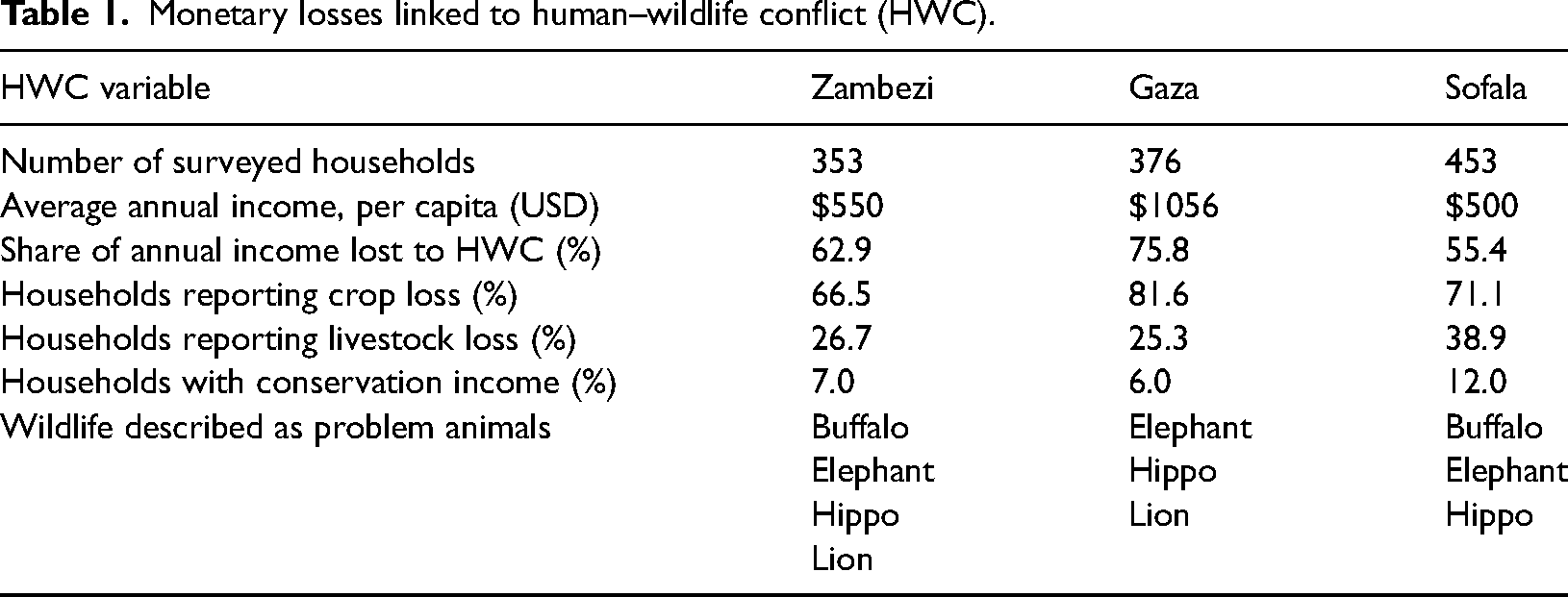
Respondents described current farming conditions very unfavorably, something they directly attributed to conservation efforts, as newly enforced regulations made agricultural livelihoods more uncertain and left them unable to fulfill their farming goals. Two main challenges were crop raiding and livestock predation, described as both economically impoverishing and psychologically distressing. Most households reported HWC-related crop and livestock losses, the magnitude of which was often quite large (Table 1). Moreover, few households had a member with an alternative income, either through formal employment in the tourism or conservation industries or through self-employment in a related small-scale enterprise.
Monetary losses linked to human–wildlife conflict (HWC).
Respondents attributed heavy losses primarily to prohibitions on killing problem animals. “If they are not shot, the wild animals will never leave our fields alone… People these days get fewer harvests because of crop damage due to wildlife. The people in the past used to kill the animals” (female, 44, N104). In sharing memories of life before the enforcement of antihunting laws, residents credited lethal control with the ability to mitigate crop raiding and described farming without the strategy as impossible. Residents asserted that killing problem animals would cause other animals to avoid their fields, although conservation managers disputed this claim. Importantly, residents also noted that people had coexisted with wildlife for centuries prior to the renewed focus on conservation: “We are tired of their rule because before [the park] we were cultivating our food and the animals were there too. We were sharing the same land with the animals. The animals did not suffer” (male, 45, M205). The perception among respondents was that lethal control could be sustainable, despite contrary claims by conservation authorities.
Exacerbating matters was the general absence of off-farm jobs or financial compensation for crop damage and injured livestock. The formal employment opportunities that residents had expected in the nature tourism sector or park management had failed to materialize. “How are we supposed to survive?” (male, 37, M209), and other similar questions were voiced time and again by men and women in all our study sites. Respondents expressed anger that the sacrifices they made to comply with conservation policies were not recognized or rewarded by state authorities or park management. As one respondent explained, The park should employ our sons. We tell our sons that we should not hunt their animals in the park. But most of the people who get jobs in the park are from long distances away, like Beira city or Quelimane province. But our sons don’t get work. (male, 88, M206) They [park authorities] promise to help us but we simply feel like a fish out of water. They do nothing while their animals are destroying our crops… They come and list all the owners who lost crops and promise to pay compensation, but you will never see their faces again. (male, 29, M207)
Increasing incidents of crop raiding coupled with the lack of adequate compensation resulted in anger and frustration, typically directed at conservation managers. It is only they [wildlife] that are eating. Us…we are not eating. Nothing. [For us], it is only loss. We just watch them. We cannot kill them so we just chase them away. We are not allowed [to kill them]. (male, 71, N105) We are not refusing that there should be protection for the animals. Protection should be there, but at the same time they [park authorities] should protect us too. We agreed that we want the conservancy, so there should be protection. The fields should be protected. (male, 58, N106)
Declining physical safety
The loss of hunting rights diminished physical safety in communities located near PAs, according to respondents. The capability to feel safe and secure meant not just the ability to protect their livelihoods from animal attacks but also to protect their actual lives. Residents described uncontrolled wildlife as a physical threat to themselves and their families. “Since we were born, we have grown up knowing that these animals kill” (male, 48, M210). Another respondent explained that they fear elephants “because they are killers” (male, 60, M215). We heard multiple stories of elephant aggression against people, some incidents so severe that they resulted in death or dismemberment. Two poignant stories detailed by residents included: Did you not hear about the man who was nearly killed by the elephant in the other village? He was hitting the drum [to scare wildlife away from his field] and the elephant grabbed him and his leg was cut off. I heard that he was in the hospital but I don’t know if he survived. I’m scared of using the drum now. Animals can go to any place they please regardless of the distance…What can I do if they [animals] are not allowed to be killed? (female, 61, N107) Last year in [village name redacted] a man who was going to cut palm trees was chased by elephants and he was killed. And then the park was informed and they came with their helicopter to take elephants back to the park but that person died…The person died and that elephant was not killed. There were people who wanted to kill the animal but they [park authorities] forbade it. (male, 55, M211)
Growing physical insecurity represents a new experience for residents living near national parks where conservation goals include an emphasis on protecting, and even expanding, wildlife populations. In the past, community members would “kill [the] animals so that they would be scared of people” (male, 58, N106), but they lamented that this was no longer an option because “now it is all about protection for the animals” (ibid.). Losing this capability meant that “the wild animals are no longer afraid of people…because wild animals are now protected in the sense that you cannot [even] fire a shot into the air with a gun just to chase them away without them [park authorities] coming to lock you up” (male, 28, N108). Respondents indicated they had few options to provoke a flight response. Instead, they recounted how conservation managers suggested using drums or vuvuzela horns to frighten animals away with loud noise. Not a single respondent said the method worked and even wildlife managers admitted, during key informant interviews, to the limited success of these techniques.
Although elephant attacks occurred infrequently, news of such incidents circulated widely and respondents feared they could happen at any time. “There are lots of animals in the park that escape the area that belongs to the park and come here. Our children are studying and we are afraid that one day our children will be attacked by these animals” (male, 32, M212). As with crop and livestock losses, people expected incidents of animal attacks to worsen over time: “In the future, I think we will be facing serious problems because they [park authorities] are bringing new species that move around. This can be dangerous for the local people” (female, 27, M213). Another respondent articulated, “The thing is that we are afraid of these big animals that eat people. We always think that maybe one day we will be face-to-face with one of them” (male, 52, M214). Encroaching wildlife, and their increasing boldness when confronted by humans, prompted deep concern over the long-term safety of residents.
Fear of retribution from park officials also contributed to a more dangerous and uncertain future. According to respondents, attempts to protect your crops, livestock, or even your life using lethal control would result in beatings, imprisonment, and forced labor. “When they [park authorities] find you have mistreated animals, they strike you, and then they severely punish you” (male, 29, M207). People living in the area believed park authorities could and would employ any means necessary to curtail violations of the hunting prohibitions. One respondent stated, “There are a lot of park supervisors here and if they catch you, you will really suffer” (male, 38, M208). As these statements highlight, respondents felt that park authorities, in their efforts to protect animals known to attract tourists, had no qualms with compromising the physical safety of residents, and thus represented another real threat to their physical wellbeing. The violent enforcement tactics recounted by our respondents, although not officially sanctioned by international and state conservation authorities, comport with those described in previous research (cf. Lunstrum and Ybarra, 2018; Massé, 2020).
Diminishments to agency
Regulations against hunting contributed to a sense of diminished agency and growing despair in all study sites. “Wild animals are destroying fields, attacking and killing people…We lost the freedom that we had to kill these animals” (male, 36, N109). Residents considered losing the capability to hunt as tantamount to losing the freedom to (1) protect themselves, their families, and their property; (2) construct and maintain livelihoods; and, perhaps most importantly, (3) manage their own affairs.
In the context of limited livelihood alternatives, accounts of rhino poaching and its consequences in Gaza also revealed the hardships and emotional pain associated with constrained agency. I see that some [young men] go to South Africa and are killed because of rhinos. It's because jobs are not available here. When a man wakes up in the dawn and sees his wife and family, he asks himself how he will support them. Most of them think that if they go into South Africa life can be easy when in fact they are going to die… No one says that they did it [a dangerous thing] purposely because we know that there are no jobs and we say what else could they do. (female, 43, M104) For those of us who don’t have work, life doesn’t change because there is no way of helping ourselves. At least if there were jobs we would try and make this place better and beautiful. But it is difficult because there are no jobs. So, how are we going to improve this place? (male, 62, M102)
Some respondents spoke of illegal wildlife hunting as a way people retaliated against park authorities for their failure to control HWC, compensate for losses, or provide alternative employment. “They [illegal hunters] say they hunt because of poverty. They are not employed… It is like revenge, a tooth for a tooth and an eye for an eye” (male 58, M216). Those not engaged in resistance tactics often spoke with despair with their inability to mitigate the negative consequences of wildlife conservation. Indeed, HWC had escalated to the point where people spoke openly about abandoning farming: “Old people are giving up… Like I have given up” (male, 37, N110). Alternatively, as another respondent summarized, residents had regrettably resigned themselves to “just suffer…there isn’t any other way” (male, 51, M105). Accounts of suffering functioned as a common refrain when residents spoke about current constraints on human agency and their expectations for a less free future because of regulations intended to support conservation.
Tracing the dimensions of disemplacement
We find that the loss of hunting capabilities and consequent conflicts with wildlife featured prominently in residents’ accounts of lost place attachment and diminished wellbeing. People perceived antihunting enforcement as a structural constraint on rural livelihoods and lifestyles imposed by conservation authorities as they transform communal residential and agricultural areas into spaces for wildlife and tourists. This transition from human places to animal spaces undermines individuals’ ability to maintain place attachment. Experiences with HWC, the circumstances leading to it, and the reasons why it persists, appeared as dominant factors residents cited when unfavorably comparing the present or the future with the past. Given wildlife's mobility, this occurred not only in the formally protected spaces but also in nearby residential and agricultural areas. People described increasing marginalization in decision making over land use, natural resource management, livelihood options, and local governance issues. Our results here comport with those of Llopis et al. (2020, 2022) who, when examining how PA establishment impacts multidimensional wellbeing in Madagascar, find that human capabilities are interconnected and that the enhancement or diminishment of one can have a positive or negative impact on a range of others.
The shared ways people in different communities linked conservation to altered wellbeing indicates an accumulation of disruptions to economic, social, and institutional relationships that slowly but steadily undermine place attachment over time. We find that the disemplacement process, when it occurs in response to conservation, has three identifiable dimensions. The first dimension consists of economic ruptures and decreased security resulting from problematic experiences with wildlife and the inability to respond with lethal control. The second dimension involves growing resentment, loss of trust, and institutional ruptures as HWC remains insufficiently addressed by authorities. The third dimension is characterized by despair and diminished agency which itself acts as an additional barrier to forming or maintaining person–place relationships.
Economic ruptures and decreased security
Research on the relationship between conservation and poverty generates conflicting results (Chambers et al., 2020; Hajjar et al., 2021; Kandel et al., 2022) and the impact of conservation on human wellbeing remains an active debate (Naidoo et al., 2019). Some studies find higher levels of wellbeing in communities living near PAs as measured by objective indicators (Pullin et al., 2013) and subjective self-assessments (Jones et al., 2020). However, we find that local resentment with conservation policies starts with economic struggle as conservation efforts, over time, undermine rural wellbeing.
Narratives of disemplacement began with respondent accounts of economic ruptures and material hardship. Respondents attributed the increasing and persistent problems they faced with crop raiding and livestock predation to the loss of an important wildlife management strategy, lethal control. Articulating the material costs associated with pervasive HWC permitted respondents to provide detailed accounts of suffering and illustrate the magnitude of the problem. In surveys and interviews, respondents characterized crop and livestock losses as economically impoverishing and contributing to periods of malnutrition and hunger. These disruptions are ongoing with no sign of lessening in the future. The economic consequences of HWC greatly restrict people's ability to achieve important goals such as food security and poverty alleviation. These diminishments were a frequent theme when respondents discussed feeling pushed out of familiar places and excluded from conservation-related development.
Alongside economic hardships, perceptions of declining physical security destabilize another aspect of place attachment that contributes to enhanced wellbeing. Hunting prohibitions restrict the population's ability to use available agricultural land effectively and in a manner consistent with past experiences. Hunting prohibitions create unfamiliar situations and HWC acts as a source of cognitive dissonance because people maintain they could farm successfully before the enforcement of hunting regulations. Yet, despite the negative impacts of HWC for goal support, case study residents continue to exhibit a deep level of place attachment, largely sustained through positive memories. Although material disruptions continue, residents resist abandoning a site they believe could once again be capable of supporting their farming goals were the prohibitions lifted.
Resentment and institutional ruptures
Trust between conservation officials and community members is considered fundamental for successfully reversing declines in biodiversity (Turner et al., 2016). However, the second dimension of disemplacement involves growing distrust of officials who enforce wildlife regulations. Like Saif et al. (2022), we find that negative experiences with PAs can foster distrust in state institutions, undermine the legitimacy of conservation efforts, and produce resentment toward park authorities. Residents experience increasing disenfranchisement as state and local governance structures fail to address the persistent economic costs and physical insecurity associated with conservation. In postindependence Africa, tourist-attracting wildlife acquires state patronage in the context of ongoing (and unfulfilled) expectations of international support and government assistance. Despite widespread multidimensional poverty, respondents expressed a higher level of distress and outrage with HWC-related hardships than with other experiences of deprivation. A common theme emerging alongside accounts of conservation's economic costs was the notion that animals now thrive while humans are made to suffer. Moreover, this happens despite regular, routine sacrifices made by local communities to comply with conservation regulations. Resentment toward the state in this context is unsurprising and has serious implications for future compliance.
In addition to exacerbating existing material deprivation, we find that HWC introduces new forms of multidimensional poverty. Respondents perceive hunting bans and HWC-related economic losses as an outcome of conservation policy and its efforts to make PAs and adjacent areas havens for wildlife. Disallowing all forms of hunting without a license and refusing to allow any form of lethal control, particularly when wildlife encroach on human settlements, disproportionately burdens rural residents who widely described the prohibitions as unfair. Respondents also pointed to their personal experiences with park authorities and government officials to further illustrate how they are unjustly discriminated against. People described disrespectful, dismissive treatment when they attempted to report problem animals, attacks on humans, or HWC-related losses. Moreover, they received little to no institutional support to address incidences of HWC, compensate for financial losses, or establish new economic livelihoods. Perceptions of unjust and unfair treatment provoked some respondents to object to conservation even when they acknowledged the environmental benefits of such efforts.
Similarly to Hemer (2015), we find institutional ruptures—breakdowns within the structures, rules, and procedures that govern a society—act to disenfranchize rural residents. Social norms are undermined as locally licit actions, such as killing problem animals, are punished for being violations of the law. Respondents offered accounts of extremely harsh punishment for illegal hunting, particularly rhino poaching, as evidence that wildlife now matter more than people. Their stories comport with other research that documents the harsh policing and green militarization of conservation spaces (Lunstrum, 2014; Massé, 2020). The enforcement of hunting prohibitions also illustrates one way in which the postindependence state actively impoverishes its most vulnerable citizens (Silva et al., 2018; Strong and Silva 2020). PAs make the state's capacity for action visible, albeit for the benefit of wildlife and, by extension, foreign tourists. This contrasts sharply with local experiences of passive state neglect, including the lack of infrastructure and provisions for even basic education and healthcare.
Conservation efforts also disenfranchize people by limiting opportunities for local governance. For example, village councils can no longer arbitrate grievances regarding natural resource access since these issues now fall under the jurisdiction of conservation managers. This compounds feelings of injustice and unfairness among residents who must deal with economic disruptions and state indifference while simultaneously losing local political representation in natural resource management and community self-governance. These findings suggest that institutional ruptures linked to wildlife conservation further impoverish rural residents in ways that exacerbate discontent with existing material deprivation. When residents lose the political autonomy and authority to make decisions, it becomes even more challenging for them to maintain place attachment and thus disemplacement becomes more pronounced over time.
Despair and diminished agency
Studies of environmental managers emphasize the importance of personal agency in motivating sustainable behavior and support for conservation policy (Park et al., 2020). We find the combined experience of economic and institutional ruptures leads to resignation, despair, and diminished agency. As described by our respondents, the detrimental impacts of conservation cannot be prevented or resolved while remaining compliant with regulations. People often spoke of being powerless to confront conservation authorities and assert their rights to live and farm in traditional communal areas. Efforts to resolve conflicts or negotiate with conservation managers had generally proved fruitless. Although residents said they initially had hoped they would benefit from conservation initiatives, they had become deeply disillusioned and spoke of their situation with varying levels of despair. Moreover, people expressed the belief that the situation will continue to worsen as wildlife populations increase and the material costs of HWC accumulate. Demoralization hinders the ability to plan and construct alternative livelihoods using existing capabilities that would allow residents to remain and flourish in place (Silva et al., 2018; Strong and Silva 2020). In this way, conservation acts as a constraint on agency.
Our findings underscore the importance of human agency for both remaining emplaced and improving rural quality of life. When people speak, with resignation, of giving up, they illustrate how conservation-related diminishments of agency constrain their ability to adapt to changing social, economic, and environmental landscapes. The old way of life is no longer possible, but residents are unable to re-establish a connection to place in different ways. Off-farm income sources and new forms of institutional relationships would help, but little evidence of either emerges from the interviews. Respondents expressed a widespread desire for wage employment (for themselves or their children) but jobs related to tourism, or conservation more broadly, have yet to materialize. This leaves residents struggling to develop a viable livelihood. Like Lubilo (2018), we find disillusionment and lost autonomy can give rise to resistance and protest, particularly in communities characterized by high attachment to place. In our case studies, persistent illegal wildlife hunting can be viewed as a form of resistance to conservation policy (Lunstrum et al., 2021; Witter, 2021), but one that unfortunately further alienates communities from state governance structures and the international conservation community, which are the two main sources of rural development initiatives in PAs.
An uncertain future
Sen (1999) asserts that improvement is more meaningful when the people who experience it have an active role in bringing it about. Conversely, our findings indicate that hardship is more pronounced and painful when people are prevented from undertaking agentic pursuits to address it. Wellbeing is correlated with the degree of agency people are able to exercise and can vary across comparably resource-poor individuals if agency freedom differs (Sen, 1985; Victor et al., 2013). We find that expressions of anger and frustration with HWC-related costs are more severe than with comparable losses caused by other factors, suggesting that the financial cost of HWC is exacerbated by residents’ loss of control over problem animals. The inability to exercise agency influences experiences of change, making difficult lives harder still by undermining the sense of self-determination. This suggests that, given the constraints on agency imposed by hunting regulations, resentment with conservation will likely worsen over time.
Our findings indicate that diminished agency in conservation spaces has severe and cascading outcomes for wellbeing that result in widespread multidimensional hardship long before people are induced to relocate. According to De Wet (2008), the disemplacement process, if unaddressed, ultimately drives rural people out of conservation spaces. Other studies of national parks in southern Africa also find evidence of induced volition (Milgroom and Spierenburg, 2008; Witter, 2013) and “voluntary” acceptance of relocation (Lunstrum, 2016). In all three of our case study sites, respondents expressed a strong unwillingness to move. Regardless, the situation people described seems untenable over the longer term. While nothing in our analysis precludes the possibility that residents might eventually feel compelled to move away, another potential outcome could be broader resistance to conservation policy and wildlife regulations. Our evidence, like that of Lubilo (2018), suggests this may involve an increase in illegal wildlife hunting.
According to Ingold (2005), nature conservation undermines the value and meanings that places hold for people. Ultimately, the protection of nature and the protection of place are incompatible because the former entails enclosure, and enclosure destroys place…enclosure blocks movement, converting the places that people inhabit into containers in which they are imprisoned. (Ingold, 2005: 507)
Conclusion and recommendations
Using the capability approach to examine disemplacement, we advance understandings of less visible forms of dispossession as conservation disrupts rural lifestyles and livelihoods. We also outline a process by which environmental regulations destabilize aspects of place attachment that contribute to wellbeing. In this way, our analysis presents one means to evaluate declines in agency and wellbeing long before individuals may exhibit external signs of displacement. In addition, we identify reduced agency as a key mechanism by which a specific conservation regulation—namely the enforcement of hunting prohibitions—weakens place attachment and consequently diminishes multidimensional wellbeing.
Our results provide empirical evidence for conservation's potential to induce the deep anxiety that arises as individuals lose their connections to place. In particular, we show that these losses undermine the ability to maintain positive person–place bonds—a core human need—that, in turn, introduces novel forms of disadvantage. Our study illustrates how people become more impoverished as conservation initiatives change the places they value while simultaneously limiting their capabilities to maintain place attachment or form new person–place bonds.
In disemplacement, the loss of place is a lengthy and dynamic process. As our results illustrate, the losses compound as they move from material deprivation to institutional ruptures to diminished agency. We find that the dimensions of the disemplacement process operate in a similar manner in multiple communities where place and conservation space overlap. In our case study sites, the economic and institutional ruptures are externally induced via HWC and the inadequate responses of conservation managers. However, as disemplacement proceeds, externally induced losses produce internal constraints to place attachment as people begin to lose hope. Given the importance of hope for poverty alleviation (see Lybbert and Wydick, 2018), conservation's influence on people's ability to pursue a life they have reason to value merits more attention.
Taken together, our results lead us to offer some uncomfortable, and likely unpopular, recommendations. First, the international conservation community should consider abandoning conservation efforts in spaces where community resistance has become entrenched. Once disemplacement proceeds to the second dimension, resentment with or resistance to conservation may be too pronounced to reverse. Advancing social justice in these cases requires conservation efforts to cease so that people can re-establish their positive connections to valued places and, consequently, improve their wellbeing. Conservationists could then later rebuild conservation efforts to be locally responsive using community-led initiatives that protect both biodiversity and the conditions that facilitate place attachment.
Fortunately, newly created PAs need not make the same mistakes as those in the past and our second set of recommendations speaks to this. Since our evidence strongly suggests that disemplacement begins with economic losses and declines in physical safety, PAs should be established only after financial reserves exist to compensate people for their early HWC-related losses. Research should be done with local communities to calculate estimates of potential crop and livestock losses and these resources must be on hand to promptly distribute to people who experience HWC. Conservation authorities, in close consultation with local communities, should also be prepared to invest in infrastructure (e.g. fencing) to protect residential areas, cropland, and grazing areas. Conservation would also be advanced by helping local populations acquire desired and marketable skills so they can diversify their livelihoods and, should they wish, reduce their reliance on crop and livestock farming in the longer term. Moreover, conservation-related impacts on local communities should be rigorously evaluated on an annual basis and assessments should begin at the very onset of conservation efforts to ensure that regulations and their enforcement do not diminish wellbeing. Finally, we advocate that these assessments also draw on flexible and pluralistic evaluative frameworks, such as Sen's capability approach, to better identify and support the freedoms and opportunities that people find meaningful in different cultural and geographical contexts. Doing so would help advance conservation outcomes in PAs that protect biodiversity without sacrificing fairness and justice to adjacent communities and the places they hold dear.
Highlights
The capability approach enables an evaluation of disemplacement that illuminates the multidimensionality of human wellbeing. Disemplacement arises in three stages: economic losses followed by institutional ruptures then barriers to place attachment. Alterations to valued places are a primary driver of multidimensional impoverishment in conservation through limiting capabilities to maintain place attachment. Conservation and place-making become incompatible if people are prevented from adapting lifestyles and livelihoods to accommodate changing circumstances. The international conservation community should consider abandoning conservation efforts in spaces where community resistance has become entrenched.
Footnotes
Acknowledgements
We thank Alfons Mosimane and Zacarias A. Ombe for their collaboration on the original project's research design and data collection process. We also thank Susana Baule, Cardoso Henriques Meque, Selma Lendelvo, and Inga Baptista for their invaluable assistance in facilitating the Namibian and Mozambican fieldwork; the Universidade Save (Mozambique), Universidade Licungo (Mozambique), and University of Namibia undergraduates who participated in the study as survey enumerators and interviewers; and all the case study site residents who graciously participated in surveys and interviews.
Data availability statement
Due to the sensitive nature of the questions asked in this study, survey respondents were assured raw qualitative data would remain confidential and would not be shared.
Funding
The authors disclosed receipt of the following financial support for the research, authorship, and/or publication of this article: This work was supported by the National Science Foundation Faculty Early Career Development (CAREER) Program (grant numbers BCS 1042888, BCS 0746528).
