




Abstract
Ecosystem restoration initiatives present natures as intervention-requiring problems. However, not all stakeholders may be able to recognise and relate to the issues that motivate restoration. Instead, they may put forward alternative understandings of natures as problematic issues in need of management and collective action. Therefore, ecosystem restoration can turn generative into new forms of publics that are brought together – and drawn apart – by distinctive configurations of nature-issues. This paper analyses such a reorganisation by focusing on three restoration projects carried out in Finland. The projects sought to engage farmers in restoring agricultural streams while proposing the practice of stream restoration as an extensive ecosystem revitalisation. In the studied cases, farmers could become attentive to the potential of stream habitats to develop into viable and rich ecosystems, while their neighbours only showed interest in improving the drainage functions of streams. The restoration initiatives generated connectedness between farmers, streams habitats and the restoration projects, but also disconnectedness between natures and publics. The possibilities of the studied projects to carry out their restoration plans rested mostly on the specification of the restoration plans as a means to manage ontological differences. The findings indicate that instead of promoting ecosystem restoration as a tightly coupled practice, it can be useful to generate space for collective action that unfolds in terms of partially different natures and nature-issues.
Introduction
As we have entered the United Nations ‘Decade of Ecosystem Restoration’ (2021–2030) and the European Union (EU) Nature Restoration Law has entered into force (European Commission, 2024), the role of ecosystem restoration initiatives as political interventions and potential sources of controversy deserves ever more attention. In cases in which the realisation of ecosystem restoration is not in the hands of a single operator but calls for collective action, the implementation of restoration initiatives can be a particularly complicated task. The actors who are to become engaged need to agree on common rules and procedures and allocate costs and responsibilities. Moreover, while negotiating the need, scale and content of restoration measures, the stakeholders are to take a stand on what exactly the common problem or nature-issue is. Issues mobilise participation (Marres, 2007; 2015), but ecosystems – as open-ended, multidimensional and diversely engaging networks – are unlikely to translate to action-provoking nature-issues straightforwardly or congruently.
Within natural resource management literature, collective action is often expected to require that the actors who are to become engaged with the joint effort acknowledge their mutual connectedness to the managed entity, such as a watershed (e.g. Pahl-Wostl, 2007; Tàbara and Pahl-Wostl, 2007). Management projects and practices are assigned the task of turning nature into a connecting object. In the domain of flood risk management, Bark and Acreman (2020; see also Acreman et al., 2018) refer to ‘wholescape thinking’, which can provide a basis for the collective ownership of a nature-issue. The material connectedness caused by poor water flow and increasing flood risk is supposed to generate social glue if only the participants can learn to trust each other and the fairness of the collaborative arrangements (Valve, 2018).
The proposition that watersheds, rivers or stream ecosystems – or any natures for that matter – can act as unambiguous drivers of collective action is nonetheless problematic (Adams, 2021; Valve, 2018). Stream ecosystems, for example, may not turn engaging and ‘sticky’ (Hodder, 2012: 94; Usher et al., 2021) reliably or evenly. This is due to two reasons. First, the landscapes to which restoration projects are introduced may be ontologically multiple from the outset. Streams are differently present in the everyday lives of the envisioned participants. In farming communities, daily practices and their technical aid generate concrete and virtual paths for sensing, moving along and caring for what lives on farms and in their surroundings (Bear, 2021; Krzywoszynska, 2016; Puig de la Bellacasa, 2015; Singleton, 2012; Valve and Salminen, 2022). Therefore, farmers perform ontological work, enacting different natures along with their diverse activities.
Second, restoration projects have the capacity to intervene in rural life in ways that shift and reorganise social–material relations. In the project settings, farmers and other landowners articulate ontological differences and perform ontological work using new tools and practices. The projects provide means to learn about what is present – or not – in ecosystems and indicate how these shortages or excesses matter and what needs to be done to remake ecosystems. At the same time, different and perhaps contrasting claims may be made about habitats as problematic nature-issues. The result is that the accommodation of a restoration initiative ‘involves much more than the addition of new knowledge and things to social life’ (Marres, 2009: 119). Instead, ecosystem restoration initiatives bring actors and natures together and draw them apart in new ways, being thus generative to novel forms of social–material connectedness and disconnectedness.
In this paper, we contribute by generating and applying analytical means to examine the reorganising capacities of ecosystem restoration initiatives. We focus on three restoration projects carried out in Finland from 2012 onwards. The projects sought to engage farmers in restoring agricultural streams while proposing a new comprehension and practice of stream restoration as an extensive ecosystem revitalisation. Through interviews with farmers, project coordinators and scientists, among others, we trace how the restoration initiatives reorganised social–material relations as the terms of collective action were negotiated. Specifically, what forms of connectedness and disconnectedness did the projects spark into being? Moreover, what mediating means allowed the projects to realise a collective ecosystem restoration in the differentiated conditions?
Studying the reorganising role of ecosystem restoration initiatives calls for focusing on the material publics (Marres and Lezaun, 2011; Marres, 2015; Usher et al., 2021), which emerge as a response to the initiatives. One type of public may gain shape as actors – in our case, farmers – are moved and brought together by a shared restoration-requiring nature. This is likely to be the public that a restoration initiative seeks to generate. However, not all farmers may be able to recognise and relate to the issue that motivates the restoration initiative. This does not need to mean that they would downright oppose ecosystem restoration but rather that the farmers may find themselves as ‘outsiders who are too entangled in issues for their indifference to these issues to be unproblematic, yet they are strangers to the current settings, languages and networks of issue formation’ (Marres, 2015: 139). These outsiders may put forward an alternative understanding of the nature-issue in need of management and collective action. Another material public gains shape, implying that disconnectedness unfolds in terms of two publics, each positioned differently in relation to the restoration initiative.
Rural Finland serves well our analysis of ecosystem restoration as a reorganiser of social–material relations. In Finland, natural resource management has created political controversies (Halla and Laine, 2022; Peltola et al., 2018; Raitio, 2013; Valve et al., 2013). Furthermore, attempts at conflict mediation have been shown to create additional disconnectedness. A particular wolf controversy is telling in this respect (Peltola et al., 2018). At the heart of the controversy was the size of the wolf population in a rural region. In the EU, the grey wolf (Canis lupus) is a protected species, but hunting can be allowed if the size of its population is estimated to justify it. It is common for hunters to argue that wolf populations have grown harmfully large. In a specific rural region, the debate between hunters, and population ecologists who calculate the size of the wolf population, became exceptionally heated. To resolve this situation, the ecologists invited the hunters to join their inventory. However, this move evoked anger in the local hunters' union, which ended up organising a protest in which the volunteer hunter-calculators were accused of disloyalty. Thus, the co-calculation of the wolves acquired unexpected disconnecting capacities. The intervention generated ‘publics not intended’ (Peltola et al., 2018: 162), dividing the hunters’ community and deepening the rift between the population ecologists and hunters (Peltola et al., 2018.)
The development of sustainable farming practices and the care of agricultural environments in Finland have also raised disagreements (Huttunen et al., 2024; Puupponen et al., 2022; Valve and Salminen, 2022). Agriculture accounts for a small part of the national economy but plays an important role in rural regions and in the maintenance of the national security of supply (Kovalainen et al., 2024). In Finland, grain production meets its northern limits, thus implying that grain production is concentrated in the southern parts, while grass cultivation and ruminant husbandry dominate in the more northern parts (Puupponen et al., 2022). There were approximately 44,000 farms in Finland in 2022, but the number of farms has decreased significantly over the past 10 years. However, as the size of the arable area has remained relatively unchanged, this means an increase in the size of individual farms (Natural Resources Institute Finland, 2023.)
Out of the approximately 2.2 million hectares of arable land in Finland, almost 90% is estimated to require drainage to remove excess water from fields (Järvenpää and Savolainen, 2015). Agricultural drainage in the boreal region is essential for managing water levels and maintaining soil health and productivity (Peltonen-Sainio et al., 2021). An agricultural drainage infrastructure consists of subsurface drainage, ditches and agricultural streams. In fields, excess water is channelled to ditches that discharge the water to the agricultural stream. The agricultural stream must have the capacity to channel water further to a river, lake or sea. However, the flow of the agricultural stream may slow down due to erosion and the takeover of stream vegetation. Collective action must then occur to restore the common stream. Today, restoration is increasingly considered a means of ecosystem revitalisation (Adams et al., 2004; EEA, 2015; Västilä et al., 2021). This mainstreaming of ‘nature-based solutions’ in managing water in farmlands is also identified as a key measure in the national climate change adaptation plan (Government of Finland, 2022). However, paradigm changes in restoration methods imply that farmers with flood-sensitive fields who still remember the digging done decades ago must reset their expectations regarding the measures that must be taken to restore an agricultural stream.
Stream restoration as ecosystem revitalisation
Governments are seeking new ways to combat biodiversity loss in conditions in which the nature–culture dichotomy that has dominated the understanding of biodiversity protection is being undermined. According to Usher (2023: 1253), the current shift to restoration is ‘not simply a change of policy but a fundamental reorientation of the collective mindset that increasingly recognizes the potentially meaningful role of humans in world-making’. Moreover, while restoration is still associated with helping recover something that has been ‘degraded, damaged or destroyed’ (SER, 2004: 3; cited by Usher, 2023), bringing back an authentic ‘natural state’ is no longer a self-evident objective (Usher, 2023). Instead, conditions are to be generated for novel ecosystems (Hobbs et al., 2009) that have more diversity than existing ones.
In the context of water management, advocates of ecosystem restoration have, for some time, argued for a paradigm change that would imply a shift from merely managing water flows towards revitalising stream and river habitats (Adams et al., 2004; EEA, 2015; Moss, 2007). However, streams and rivers continue to be treated chiefly as hydrological entities that can be used for the maximal control of water flows. As one sign of this, stream restoration in the Finnish language can refer to the mere deepening and straightening of a stream.
Treating streams as mere hydrological entities and applying conventional dredging have been argued to be environmentally harmful (Blann et al., 2009; Gramlich et al., 2018), apt to disturb material cycles and water flows and to impoverish riverine habitats. A more revitalising approach, in turn, would ensure that the water flows sufficiently while keeping the flow slow and the stream bottom irregular. These features provide favourable conditions for nutrient retention and the habitation of flora and fauna. Furthermore, the ecosystem revitalisation approach to stream restoration emphasises floodplains as buffers and biodiversity-rich habitats at the intersections of wet and terrestrial ecosystems (Powell et al., 2007; Usher, 2023; Västilä et al., 2021). These habitats are critical for pollinating insects and, thus, for agriculture.
In the water management literature and practice, the paradigm change is often described as a shift from conventional dredging to the construction of a two-stage channel, with floodplains on one or both sides of an agricultural stream (Figure 1) (Powell et al., 2007; Västilä et al., 2021). Evidence on the potential of a two-stage channel design to help minimise the harmful effects of flood prevention and enhance ecosystem revitalisation exists particularly in the United States, where several states have defined two-stage channels as the best management practice in agricultural water management (D’Ambrosio et al., 2014; DeZiel et al., 2019). Elsewhere, more research and experimentation are considered critical for assessing the potential of two-stage channels (Västilä et al., 2021). Moreover, two-stage channels are not the best restorative solution in all hydrological conditions (Sand-Jensen, 1998; Wang et al., 2015).
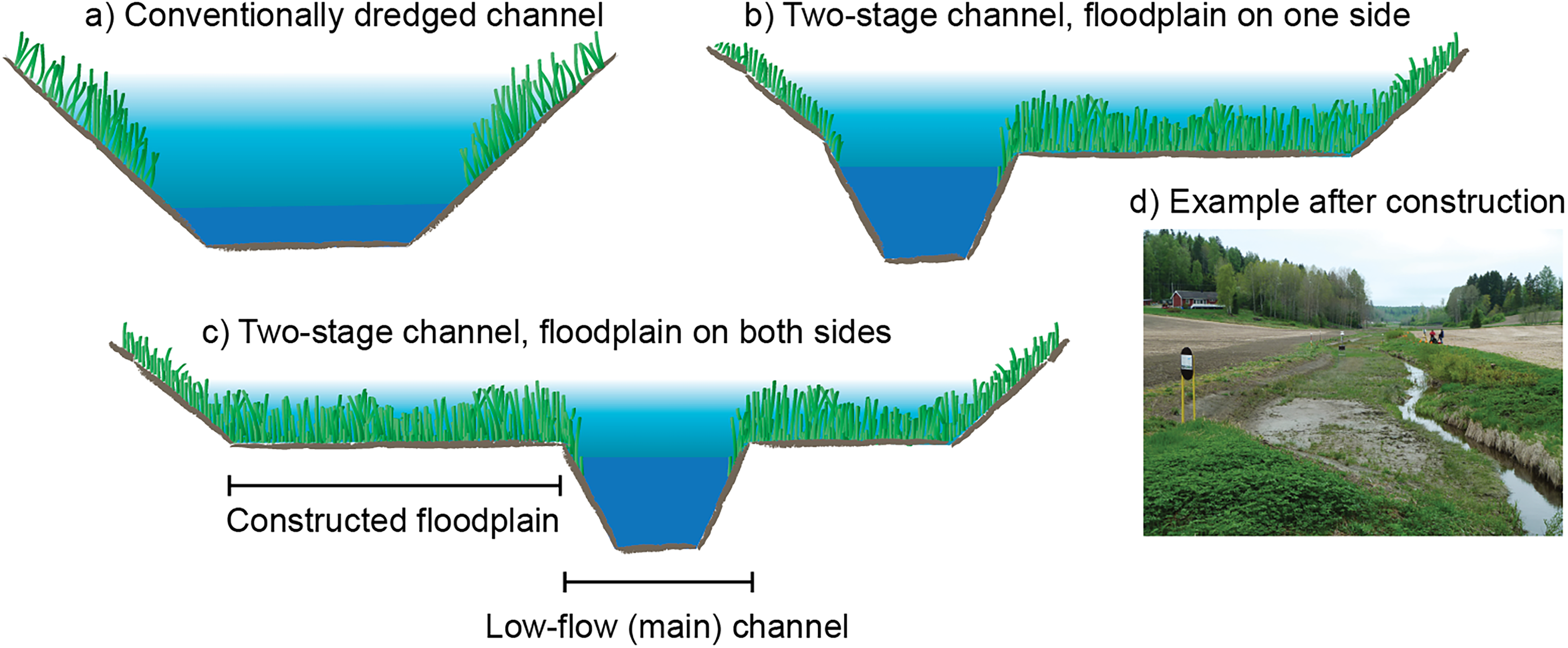
Typical (a) conventionally dredged stream, (b) and (c) a two-stage channel and (d) a two-stage channel after construction. From Västilä et al., 2021, courtesy of Kaisa Västilä.
In Finland, agricultural income rests significantly on field area-based Common Agricultural Policy support (Huuskonen et al., 2020). When a two-stage channel and a floodplain are constructed, the farmer may lose support for the arable land under the floodplain. Moreover, floodplains cannot be cultivated. The construction costs of two-stage channels are estimated to be about three to four times higher than conventional maintenance dredging due to the extensive excavation and transportation of soil that may be needed (Västilä et al., 2021). However, national public support increasingly covers additional costs. Nonetheless, it has been estimated that ‘farmers often prefer conventional drainage methods’ (Västilä et al., 2021: 16) over the two-stage channel solutions.
Resource management in contested material conditions
Scientific models and inventories help to subject natures to ecosystem restoration and flood prevention. The tools are used to indicate whether, and in what terms, ecosystems configure as problematic issues. However, the enactments may not offer room for the experiences and entanglements of those whose lives are shaped, for example, by water and its movements (Wilson and Inkster, 2018; Yates et al., 2017). Such a mismatch was experienced during the 2000s in North Yorkshire, England, where, despite severe floods, the local dwellers found no way to associate with the risk assessments and flood defence plans (Donaldson et al., 2013; Whatmore and Landström, 2011; Whatmore, 2013). However, a research project assembled a separate ‘competency group’ to generate an alternative account of flooding as a management-demanding issue. This account provided the backdrop for developing an alternative flooding model (Whatmore and Landström, 2011).
While the Yorkshire example is valuable in many respects, it may be read to indicate that resource management initiatives can gain wide-reaching engaging capacities if they rest on the co-production of management-relevant knowledge. However, as shown by the co-calculation of the wolf population (Peltola et al., 2018), even inclusive analytical designs may backfire. The solution is not to refrain from knowledge co-production but to acknowledge the uncontrollable, reorganising tendencies of all management interventions. Fragmentation does not need to be only a bad thing. The different arguments and understanding of what should be at stake in restoration may support a ‘healthy difference and debate’ (Michael, 2009: 626), perhaps helping to make restoration plans more robust. Yet counterpublics may also evolve through stark ‘identification with, and differentiation from, various other actors’ (Michael, 2009: 618). In the wolf calculation experiment, the hunters who turned into wolf calculators became, at least momentarily, outcasts of the hunter collective (Peltola et al., 2018). The possibilities for constructive dialogue were then limited.
Restoration initiatives may also generate disconnectedness along their analytical efforts. Although restoration projects embody understandings of the nature-issues they seek to address, they also operate as sites of knowledge production. The material differences that become articulated in detailed inventories and measurements may indicate that the object of intervention is so heterogeneous that the restoration measures need to vary from one location to another.
Material heterogeneity enacted in restoration projects may pave the way for solutions that allow different publics to coexist. When tailoring of measures becomes possible and even necessary, it may also turn out that a river or stream, or other objects of restoration, can gain multiple capacities at the same time. This can serve the engagement of different material publics. Such management of ontological differences qualifies as ontological cleaving (Lavau, 2013). In the Goulburn River in Australia, water flow has been managed as both farming-enabling ‘irrigation water’ and ecosystem-maintaining ‘environmental water’ (Lavau, 2013). The different waters and publics are ‘made to hang together or partially connect through the coordination and distribution of ontological difference’ (Lavau, 2013: 418). In other words, the enabling of social–material disconnectedness has allowed unproblematic co-existence of different publics.
In the United Kingdom, restoring riverine habitats has also been reported to proceed under conditions of ontological differences. While renewing restoration practices has rested on the efforts of committed environmental experts (Adams et al., 2004), these ‘restoration champions’ have been, according to their own testimony, regarded by water management engineers as ‘whimsy’ – as chaps ‘interested in the birds and the plants’ (Adams et al., 2004: 1935). In other words, the champions have shown attentiveness to more-than-humans at a width and depth that old-school flood defence professionals have regarded as strange. Consensus has been sought from win–win restoration solutions capable of ‘not only improving riparian or in-stream habitat but also increasing the flood storage capacity of the floodplain and helping prevent serious flooding downstream’ (Adams et al., 2004: 1937). The restorative approaches that were introduced resemble the solutions advocated in Finland as a means by which stream restoration could be increasingly transformed into a practice of ecosystem revitalisation.
Analysis of the restoration projects
The three restoration projects we analyse in this paper were carried out in Finland between 2012 and 2023. Figure 2 shows the locations of the agricultural streams to be revitalised in the projects. We used the multi-case approach to bring together experiences from different processes and sites. The projects qualified as case studies as ambitious agricultural stream restoration initiatives. Only a few such projects have been conducted in Finland.
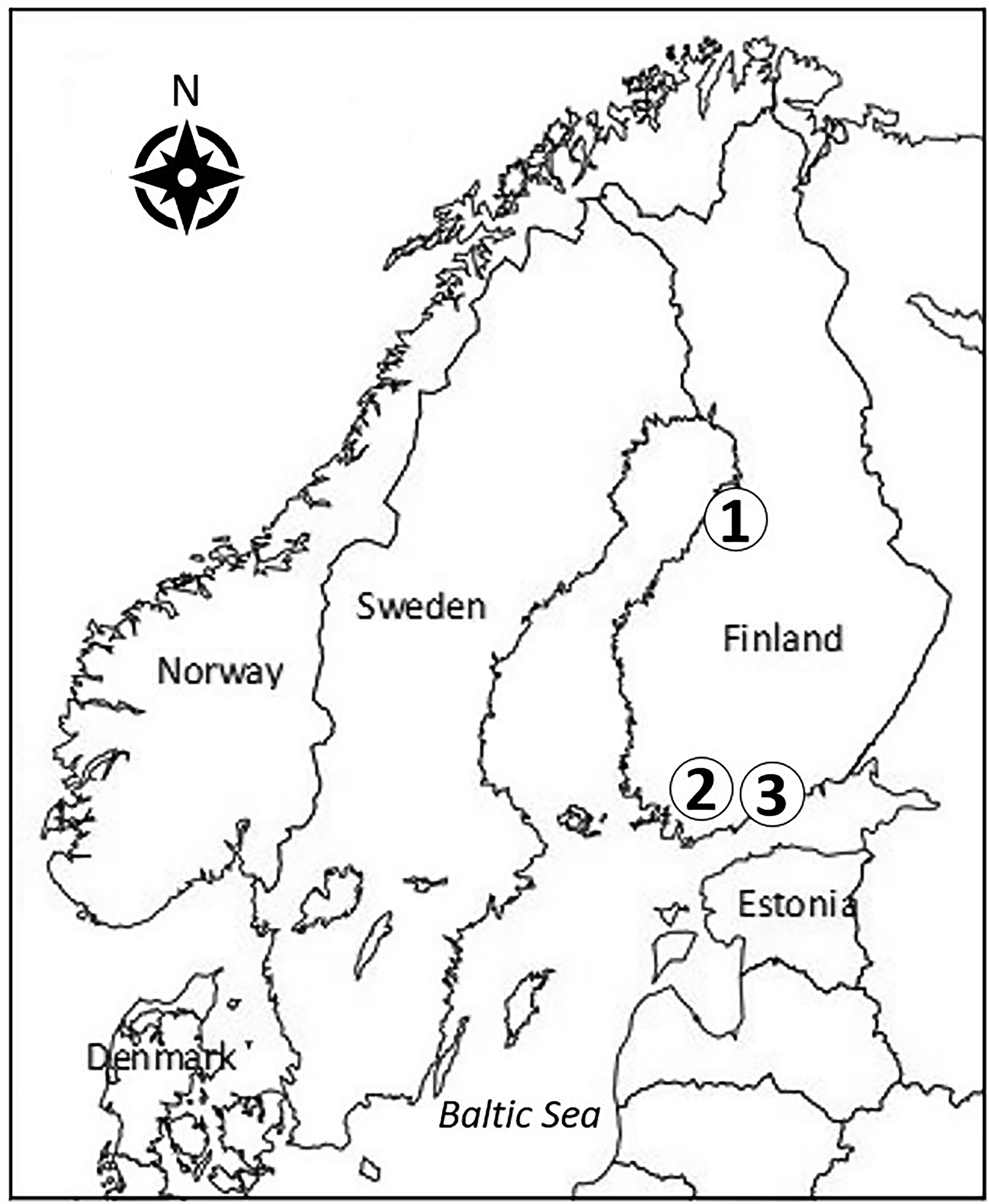
Locations of the stream restoration projects (1) Leppioja, (2) Raaseporinjoki and (3) Uuhikonoja. Map by Pasi Valkama.
The three projects that experimented with new restoration methods were introduced to rural conditions that were simultaneously evolving and at a standstill. The agricultural streams evolved as vegetation and erosion were taking over at a scale that caused the streams to lose their water-channelling and flood-preventing capacities. However, in recent years, farmers have not come together to find remedies to the situation. In this sense, little was happening. Thus, the public restoration initiatives could be expected to be highly needed. In the projects, the enrolment of the landowners – primarily farmers – was nonetheless a precondition for the stream restoration to proceed. The farmers were to pay their share of the work based on the amount of land they owned and apply state support for restoration as a single collective. The projects covered all planning costs, conducted environmental inventories and organised meetings and other events in which the restoration plan could be discussed.
We became involved in the restoration projects when the engineers and natural scientists working on the projects or studying the implications of the restoration measures invited us to analyse the shaping and operation of the restoration collectives. The ‘social side’, as our colleagues put it, had failed to gain analytical attention. This failure was considered problematic, as the ‘social side’ could become a bottleneck hindering the shift towards a more sustainable stream restoration.
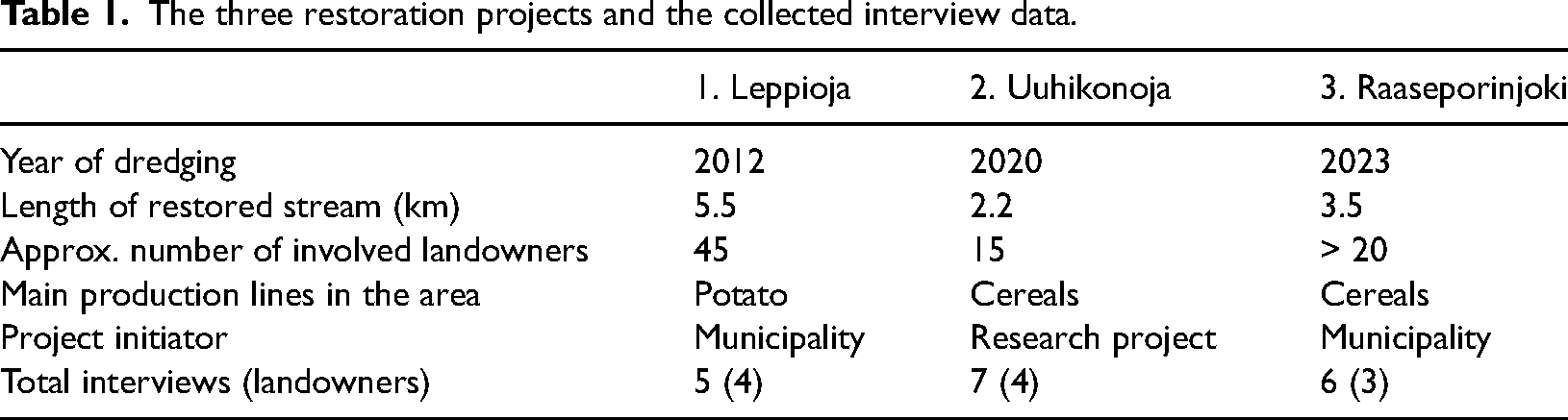
Table 1 summarises the key characteristics of the restoration projects. When we started our research, two of the projects were running, while the Leppioja project had concluded about a decade ago. However, we knew that some monitoring and maintenance activities were constantly being performed in Leppioja. In the Raasepori and Uuhikonoja projects, stream restoration was part of a larger palette of measures applied to reduce nutrient run-offs from agriculture. All the sites were vulnerable to flooding, and water regularly rose to large field areas, particularly during the spring and autumn flood periods. Topography varies widely within catchments, but the fields are mainly relatively flat. Nevertheless, there were some steeper, erosion-sensitive slope fields in the Raasepori area.
The three restoration projects and the collected interview data.
Local municipalities initiated and ran the Leppioja and Raasepori projects. Meanwhile, the Uuhikonoja stream was restored by a research project. All three projects were originally planned to last from three to four years, but if weather conditions restricted dredging, the projects were granted an extension.
The projects sought to engage the farmers by contacting them through letters, emails and newspaper advertisements that presented the restoration plans in general terms and invited the landowners and tenant farmers to joint meetings. During the projects, additional public events were arranged. In addition, project workers and supporting consultants visited many of the affected farms to study the specific conditions and restorative possibilities. In Raaseporinjoki, the project coordinator invited some volunteers to conduct ecosystem inventories and convened a Facebook page for all those interested in the progress of the restoration project to join.
As shown in Table 1, the restoration projects analysed were all carried out in regions where crop production dominates over animal husbandry. In Finland, about two-thirds of farms grow crops, such as cereals, fodder crops and potatoes, while the remainder also raise domestic animals. Crop farms in Finland vary in how dependent farmers are on agricultural income. Farmers may have additional and even more primary sources of income (Huttunen, 2019). Recently, increases in energy, fertiliser and other input prizes have decreased the profitability of agricultural production, as the increased costs cannot be transferred further in the food chain without delay.
The 18 interviews were conducted between May 2021 and October 2022. As the Leppioja restoration was conducted way back in 2012, we had no data about the responses initiated by the project during its early days; instead, we focused on the modes of (dis)contentedness identifiable at the time of the interviews. Due to COVID-19, about half the interviews were conducted through Teams or by phone. As shown in Table 1, over half of the interviewees in each case were landowners. With a few exceptions, the landowners were farmers. The number of farmers’ interviews was planned to be higher, but it turned out that the farmers were not always willing to give interviews. In the forthcoming analysis, we treat this resistance as a finding in its own right.
In addition to the interviews, we were able to engage with the projects through our colleagues, who frequently visited the restoration sites as ecosystem revitalisation experts and scientists. These colleagues provided us with reports about their visits and conducted interviews when possible. In the interviews, we asked the interviewees to describe how they became involved with the restoration projects, what they thought about the restoration initiatives and what moments and events they considered important for the shaping of the restoration collective. In the case of farmers and other landowners, we asked them to tell us about the stream histories and their restoration needs and prospects.
All the interviews were transcribed and then analysed with the NVivo software. We coded the data using broad categories, such as ‘history of the restoration project’ and ‘enrolment of landowners’. Only by carefully reading the coded texts did we become attentive to the ontological work of which the interviewees provided accounts when describing their thoughts on ecosystem restoration. This process resulted in the identification of different configurations of nature-issues and accounts of differentiating publics. Altogether, we analysed the interviews as descriptions of the coevolution of ontological work and political associations and as verbal enactments of ontological differences – that is, as occasions and means of ontological work.
Results
Material mediation of restoration in Uuhikonoja
The Uuhikonoja stream was chosen as a test site for a research project by several volunteer candidates. Landowners around Finland could offer their stream to be restored in the project by responding to a newspaper announcement. For a farmer owning a significant amount of farmland by the side of Uuhikonoja, the restoration initiative appeared intriguing because it sought to achieve something new with its emphasis on ecosystem revitalisation. Together with some neighbours, the farmer entered Uuhikonoja for competition over a test site nomination. There hasn’t been anyone who took responsibility, invited [the farmers] together and promoted [the restoration]. It was also unlikely to happen at this time had there not been this question in the ‘Countryside’ [the newspaper ‘Future of the Countryside’] about the existence of agricultural streams [in need of restoration]. I’m a bit of the kind of person who can be provoked to try out something new. Sometimes, I even think about many things differently compared to basic agriculture. So, I thought, let's see. I knew then that if it happened [that the steam becomes chosen as a test site], it would all fall on me. (Farmer 1, Uuhikonoja)
After Uuhikonoja was chosen as a test site, the research project invited the concerned farmers together to present the revitalisation plans. For the farmer cited above, the meeting proved to be a positive surprise. The farmer anticipated that the plans would face considerable opposition. After the first meeting, I thought that it had gone surprisingly well. As I had been afraid that a couple of farmers would block this [restoration initiative] straight away, it was a surprise that there were no such farmers. It was a relief. At that point, I thought that we might even reach the finish with this [restoration]. (Farmer 1, Uuhikonoja)
Another farmer from Uuhikonoja also described the first meeting as a turning point. The meeting allowed the farmers to learn about the restoration plans. According to the farmer, the meeting was worth attending ‘maybe also because it somehow increased cooperation… you could see face to face who are involved and get to know those people better’. However, the farmer emphasised that ‘the environmental impacts were more important to me than the founding of the [restoration] collective’ (Farmer 2, Uuhikonoja). The collective as an organisational form was depicted as an instrument to make the restoration happen rather than as a basis for lasting or close connectedness.
In Uuhikonoja, the restoration initiative did not organise social–material relationships in radically new ways. The scepticism aired by some farmers was regarded as normal: ‘There are always some farmers who say “no” first and others who say “yes, let's try it”, and this is how it went in this case’ (Farmer 3, Uuhikonoja). However, reorganisation occurred in the sense that the stream habitats could become more intimately connected with farm life. For example, one farmer expressed worries about the survival of the new vegetation sown in the floodplains. In addition, the restoration project articulated material differences in new ways. These differences, enacted through an analysis of the stream morphology, proved to be important sources of material mediation because they allowed contractionary aspirations to be kept apart. Let's say that for a couple of farmers, it would have been difficult… if their fields would have been where the two-stage channels were constructed, it would have been difficult to justify making it like this [as a two-stage channel]. In this sense, we had good luck that the two-stage channels were located where we had these eager farmers. (Farmer 3, Uuhikonoja)
Reorganisation of social–material relations in Raasepori
In Raasepori, the capacity of the restoration initiative to support farmers and other landowners in becoming increasingly attentive to the agricultural stream was very evident. This increased connectedness evolved side by side with new social and practical relationships. As described by one farmer, engagement with the restoration project provided the possibility of taking part in background inventories and exchanging experiences with the project personnel. At first, there were only these meetings in which I participated, and then this project manager and I became quite good friends… thus, I have been involved with these quite practical tasks. For example, we have gone to take soil samples, among other things. We have done a lot concretely… to get the run-offs into better shape… The stream has been discussed, too. During mid-summer, it is only a small ditch, but particularly at this time of year, there is an awful lot of water. It has been said that it [the stream] is totally dead. They [project employees] have done some test fishing and caught nothing, but in fact, there is everything—starting from perches and pikes. When I discussed this with Dad, who is from an older generation… [he said] they went to catch crayfish, for example, and there was this sandy beach, and so on. So, it [the stream] has fallen into bad shape. At the same time, rains have changed terribly—just over the last ten years. It seems normal now that winters are really rainy here. (Farmer 1, Raasepori)
Due to the farmers and other landowners who became engaged with the projects and ‘without whom this [the restoration] would by no means have happened’ (Landowner 1, Raasepori), the ecosystem revitalisation experiments seemed successful. As stated by the officer of a regional environmental agency, the farmers appeared to be widely engaged: We have received really positive feedback from the farmers, saying that it is really great that you have started to take this [restoration] forward. (Civil servant 1, Raasepori)
The reorganisation that took place did not, however, generate only connectedness and support for the project realisation. Along with the new forms of connectedness emerged disconnectedness. In Raasepori, the realisation of stream restoration as ecosystem revitalisation was strongly opposed. However, the views of the farmers criticising the restoration plans are poorly presented in our data. Despite several attempts, we failed to reach the farmers we suspected of questioning the construction of the two-stage channels. As these farmers were unreachable by email or phone, we contacted them during the project events. Eventually, we managed to talk to a reluctant farmer for 15 min during his fieldwork. The person expressed frustration with the encounter but was ready to articulate what he claimed to be a shared criticism of the restoration initiative: Q: Have you or others in the area had concerns or reservations regarding the functionality of the two-stage channels… regarding their drainage potentials, for example? A: Well, yes, it has been discussed a lot why it could not be a traditional one. Many have asked why these [two-stage channels] would be so good, although they have not been used so much [in stream restoration]. The assumption is that they are good, although the experiences are scarce. Q: Yes, that's right. Few such solutions [restorations based on two-stage channels] exist. A: Yes. Q: But it is good that you’ll have those built in many sections… A: Well, this is what we have been asking—that this project of ours is just a guinea pig system of some sort. (Farmer 2, Raasepori)
The farmer appeared frustrated with the experimental take on stream restoration and with us asking questions about the ongoing work. Undoubtedly, we were identified with the restoration project. Giving an interview could also be seen as becoming engaged, and engagement as a political act linking the farmer to what s/he described as a guinea pig system. The reference to the discussions that had taken place, to ‘we’ asking critical questions, suggests that in Raasepori the restoration initiative had organised dissatisfied farmers into a counterpublic. From their point of view, the restoration should focus only on effective drainage that follows the traditional restoration mode. The nature-issue, as configured by the project, was strayed. Moreover, the project turning the rural setting into a test site was seen as questionable.
Among farmers and landowners in Raasepori, the restoration initiative operated as a source of disconnectedness. The objections to the restoration plans brought together farmers who constituted a counterpublic. The members of this public questioned the rationale or the ‘guinea pig system’, and it was revealed that the shares some landowners had to pay for restoration were substantial. This caused an active landowner and ‘restoration champion’ to anticipate problems: ‘If no miracles happen, we already know that at least one major landowner will probably vote against this [revitalisation] project’ (Landowner 1, Raasepori).
As the critical voices became louder, the project team had to search for new ways to take the initiative forward: ‘You cannot get stuck with someone's resistance. That's the moment to put yourself at a bit of risk and start testing along a different route…’ (Civil servant 2, Raasepori). In the second round, the planning of the restoration measures proceeded almost metre by metre, thereby enabling farm-specific tailoring. Again, the heterogeneous morphology of the agricultural stream also afforded or even demanded specifications. However, the shift from stream-wide planning to tailored solutions not only opened avenues to make concessions for farmers’ demands and to fall back to traditional flood prevention solutions. Although the latter might have sometimes been the result, the move to more detailed planning also allowed new connectedness to evolve between the project coordinator and the farmers. Restoration was discussed less in terms of a joint project and more in terms of disconnected solutions. They [the farmers] had these ideas [for example] that ‘this could be a place for a wetland’. We immediately took that into account… When you call them and say, ‘Hi, it's me from the project. We have this settling basin [to propose to you]’, they say, ‘Okay, let's go have a look’. (Raasepori, project coordinator)
The multiplying Leppioja
In Leppioja, the stream restoration that was based on the ecosystem revitalisation approach had already taken place in 2012. Ten years later, one of our colleagues reported that some of the local farmers had no idea that they were standing on the floodplain of a two-stage channel as they talked with the scientist. The reasons for such ignorance were discussed in an interview we managed to get from a farmer in Leppioja. The farmer wanted to be very explicit in articulating the stream and its capacities. He was drawn to the restoration efforts, although the stream of the past project was not the stream to which he related then and relates now. Q: The restoration and digging of Leppioja took place ten years ago. Did you witness that? R: Yes, I was a farm owner then. Q: Okay. Can you remember those times at all? How did you hear about the restoration and the plan to carry it out in a new way? R: Well, there were discussions about it, and we allowed it to be done. No big deal. Q: Allowed it to be done? R: Yes. Q: For quite many in Leppioja, the fact that the restoration was carried out as a two-stage channel… they do not know about that now. That it was such a new solution. R: Yes, you see, for us, it is only a channel. You don’t take a second look. The main thing is that water runs. That's the main thing. (Farmer, Leppioja)
By talking in terms of ‘us’, this interviewee seemed to act as a spokesperson for the landowners who had allowed the new kind of restoration to proceed, as no other field drainage and flood prevention options were provided. However, the farmer emphasised that the allowance was given to take measures in relation to a water channel only. This sanitising move cleanses the stream from specific life-nurturing capacities. Meanwhile, the floodplains gain troubling capacities as uncustomary components of farm life. Q: Is there something you would like to say to those doubting [the feasibility of] the two-stage channel solutions? A: No, they can fully form their opinions by themselves. K: Okay. V: Well, the only bad side to these [two-stage channels] is that the amount of litter is about to increase, as sow thistles, thistles, willow trees and all those grow. Idle land is not always good from the point of view of effective farming.
By emphasising that he had just allowed action to be taken, the farmer appeared to say that, in the project setting, he was merely a spectator, not a member of the experimenting collective. In other words, he did not fully engage with the restoration efforts, although he at least paid his share of the costs. The simultaneous sanitation of the agricultural streams from ecosystem-maintaining capacities and the restoration projects from truly engaging powers provoke questions about the means that allowed the restoration activities to proceed as planned, albeit restoration issues and publics multiplied. One of these means was money. The public support allocated to planning the restoration measures made the initiative, with its ‘strayed’ nature-issue configurations, tolerable. After all, the aims overlapped in terms of the drainage potential of the restored streams. Money took centre stage because negotiations about the landowners’ engagement tended to boil down to questions about monetary costs and expected drainage benefits. Hardly any farmer can bypass these issues as insignificant. Moreover, money is a connecting register that allows discussions to proceed in relation to an apparently commensurate and absolute rural nature.
In Leppioja, we could identify altogether three enactments of the agricultural stream: the one of the project's, the second of the person standing on wide floodplain without noticing its difference from traditional narrow floodplains and, finally, the third depicted by the interviewed farmer referring to the stream as being simultaneously new and litter-generating as well as old and ‘only a channel’. All these streams, and perhaps even additional ones, no doubt met when the farmers came together in large numbers to witness the use of a mowing device suited for mowing the floodplain (Figure 3). However, we could not piggyback off the exhibition's connecting powers. The audience members unanimously declined our pleas for interviews. The reorganisation of social–material relations had evidently generated a balance between connectedness and disconnectedness between the farmers and the project, and this balance was not to be disturbed by asking farmers to stand out from their collective.
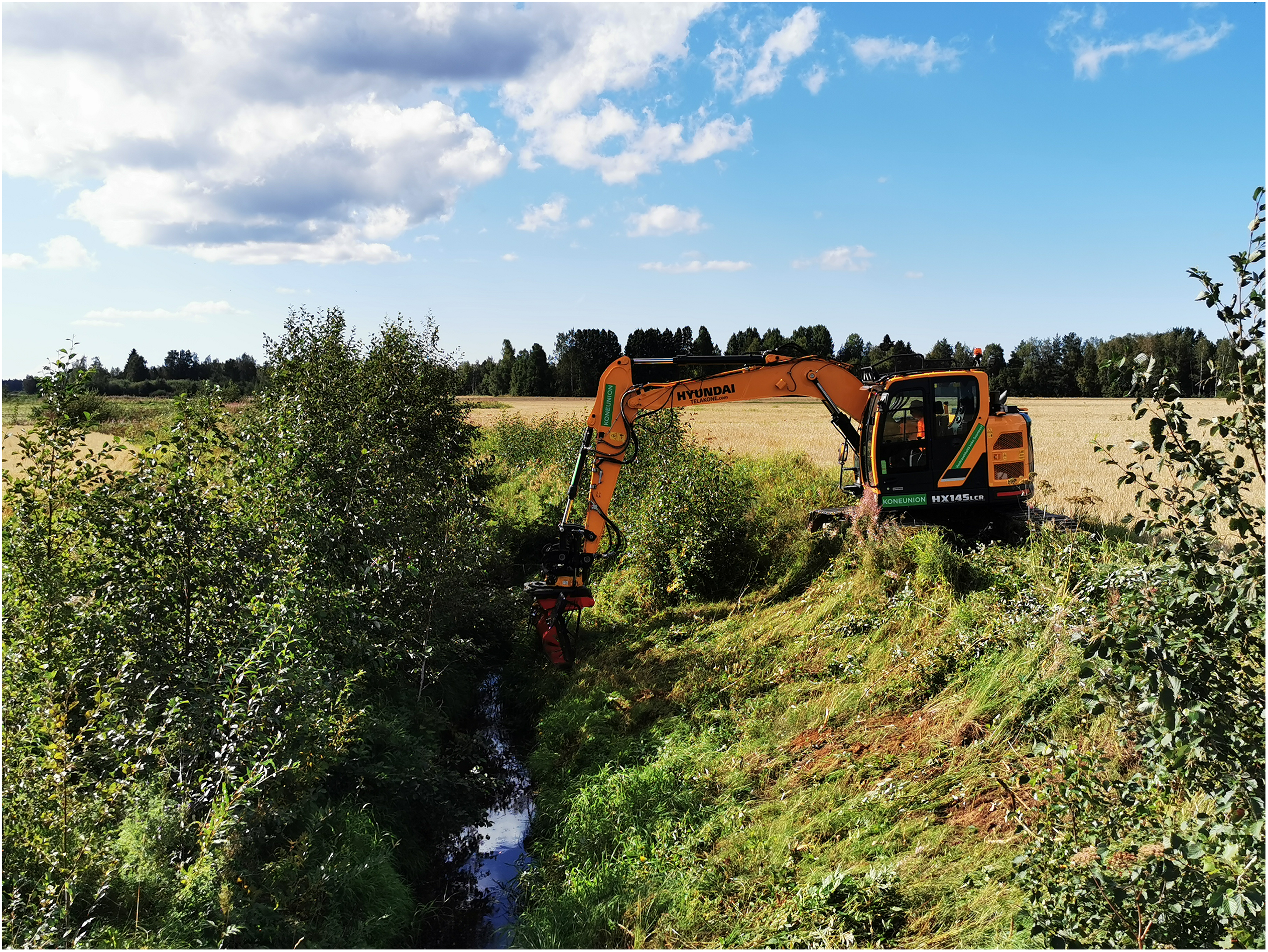
Mowing of floodplains in Leppioja, photo by Pasi Valkama.
Discussion
The three restoration projects studied in this paper intervened in rural life by seeking to engage landholders in revitalising agricultural streams and stream habitats. Those owning land by the streams were to become affected by the potential of the streams to simultaneously serve farmland drainage, biodiversity protection and even nutrient retention. To a certain extent, the projects strengthened the connectedness between farmers and agricultural streams, as the ‘restoration champions’ (Adams et al., 2004) became more attentive to the existing and potential differences in stream habitats and closely involved in the implementation of the restoration projects.
The projects also reorganised social–material relations in other and perhaps unexpected ways. The nature-issue that was supposed to bring the actors together was not as uniform and fixed as originally assumed. Therefore, instead of bringing the actors together, the restoration initiatives and their built-in problem configurations drew people apart. Some farmers expected this. Initiating collective action was anticipated to be difficult if this action challenged established understandings of the streams and their functions. The restoration projects became entwined with pre-existing diversity and perhaps even political situations (Barry, 2012) that date long back. Nonetheless, in Uuhikonoja, questioning the ecosystem revitalisation approach was considered a normal feature of the dialectic that characterises communication within the farming community.
In Raasepori and Leppioja, the restoration initiatives provoked notable disconnectedness. For us, the political associations occasioned by the projects were partly manifested through silence. The reluctance to give interviews seemed to point to a political role gained by our data collection efforts. As in the wolf controversy case, data collection proved to generate publics that were not intended (Peltola et al., 2018). In our case, these publics consisted of farmers who refused to engage in our data collection. Data collection intervened instead of acting, as we implicitly assumed, as a means to merely follow the traces left by the restoration projects.
In Leppioja, our data collection operated most vividly as space in which an alternative nature-issue and the ‘normative charge’ (Marres, 2015: 434; Usher et al., 2021) of the agricultural stream could be articulated. The agricultural stream was nothing but a water channel, even after the construction of the two-level channel solution. This articulation of the stream seemed to mark the limits in terms of which liabilities are to be carved out in management of rural natures and resources (see also Marres, 2015: 136–137; Valve et al., 2022). As a water channel, the stream obliges farmers to maintain only the channelling functions while nurturing the pollinator populations, for example, stays outside the liabilities. However, the farmer portraying floodplains as sources of weeds placed the floodplains integral to agriculture, but challenged the ideal of idle land as simply life-supportive. As a result, the nature-issue propagated by the restoration project was indicated to enact a perhaps too uncomplicated relationship between farming and the two-stage channels.
As ecosystem restoration initiatives target natures that are not as absolute as they may seem from the point of view of scientific assessments and inventories, it has been raised as important to ask ‘what nature’ is being made the object of intervention’ (Huff and Brock, 2023: 2126). Indeed, the Leppioja findings show that asking what nature is or should be made an object of intervention allows to pin down how investments in and sanitations of material capacities unfold, and do so along with the (re)definition of human responsibilities. Materiality can then be used as an analytical resource to study the shaping of collective action and its terms. Furthermore, taking the ontological work of potential participants into account helps to prevent situations in which peoples’ engagement matters only as far as it respects the terms of the a priori ontological settlement (Whatmore, 2013: 45) that is officially assumed and put forward.
The diversified stream topographies supported ontological cleaving (Lavau, 2013) in the studied cases. The ability to find ways to move forward without a uniting nature object or restoration issue was important. From this point of view, asking what nature is made an object of intervention (Huff and Brock, 2023) might not be the question that should be pushed too much in common meetings or forums. Instead, as shown in the Raasepori case, it can be useful to create alternative means and scales to become engaged while simultaneously allowing disconnectedness between publics and nature-issues. The streams can then gain mediating capacities. In Leppioja, meanwhile, the two-stage solutions coexist along with the ‘water channels only’ apparently because public support was specifically available for the two-stage channels. Financial and regulatory incentives are indeed likely to be needed to enhance the broad commitment of landowners to ecosystem revitalisation. However, transforming world-making into a mere techno-economic issue would mean that those affected by stream habitats and their potentialities, such as the restoration champions taking the restoration initiatives forward, may find little room to articulate and foster their sensibilities (cf. Lavau, 2013; Walker and Coles, 2022).
Conclusions
Agricultural streams bring farms and landowners together by coupling water flows. This connectedness cannot be easily undone. However, in this paper, we have argued that ecosystem restoration initiatives should be treated as potential reorganisers of social–material relations and that focusing on the differentiating material publics provides a useful sensibility to analyse ecosystem restoration as a site of political and ontological work. Our analysis shows that when the agricultural streams were discussed as issues requiring restoration and revitalisation, the multiplicity of rural landscapes became articulated, re-enacted and consequential. At the same time, the connecting and disconnecting capacities of ecosystem restoration became visible.
In the studied cases, Finnish farmers could become attentive to the potential of stream habitats to become viable ecosystems, while their neighbours showed only interest in the improved drainage functions of the streams. The restoration initiatives generated connectedness between farmers, streams habitats and the restoration projects but also disconnectedness between the ‘restoration champions’ and those sceptical about the proposed restoration approach. The disagreements were partly articulated explicitly as disagreements about the nature-issues that restoration should address. In addition, the experimental character of the restoration approach raised doubts. The shared concerns and issue configurations connected the counterpublics. The reluctance of farmers to give interviews indicates that also our data collection became positioned into the suspicious sphere.
The possibilities of the studied projects to carry out their stream revitalisation plans rested largely on the careful specification of the restoration plans. The specification occurred along inventories that enacted the streams as morphologically differentiated. The differences helped tailor the restoration measures. The projects connected differently with different farms and publics. In addition, the public resources allocated to the coordination and planning of restoration could help dissenting farmers tolerate the measures taken. For ecosystem restoration initiatives, navigation amidst political associations is nonetheless difficult because there is no guarantee that the natures to be restored or the money available will capacitate mediation in the way they did in the studied cases. Moreover, reorganisation – and the need for alert navigation – may not end at a specific point but continue along restorative and exploratory practices. In any case, in ecosystem restoration projects, the generation of mere connectedness may need to be replaced by more modest ambitions. When the reorganisation of social–material relations is taken as an entry point, natures cannot – and do not need to be – standardised to serve collective action. Instead, the trick is to enable ecosystem restoration to unfold in relation to partially different natures and nature-issues.
Highlights
Ecosystem restoration projects configure natures as restoration-requiring issues.
During project implementation, alternative issue configurations are offered.
Ecosystem restoration may turn into a source of disconnectedness.
The studied stream restoration projects reorganised social–material relations.
Collective action could unfold in terms of different natures and nature-issues.
Footnotes
Acknowledgements
The authors would like to thank the interviewees for their contributions and Pinja Kasvio and Samuli Pitzén for their help in data collection. The very valuable comments from Taru Peltola, Suvi Huttunen, Jani Lukkarinen and the anonymous reviewers helped us improve our paper.
Funding
The authors disclosed receipt of the following financial support for the research, authorship, and/or publication of this article: This work was supported by the Ministry of Environment and the Ministry of Agriculture and Forestry of Finland, Maa- ja vesitekniikan tuki and the Drainage Foundation (Project Valumavesi) and by the Finnish Cultural Foundation (Project Shared Waters).
