




Abstract
In response to the expansion of the mining frontier in the Ecuadorian Amazon, rural and Indigenous women are leading processes that resist mining-related violence while reconfiguring colonial power dynamics. Although women's efforts have become visible through regional grassroots organizing, public protests, marches, political manifestos, and bodily organized resistance to mining, little is written about the long-term processes, social relations, and epistemologies women use to contest power. This article illuminates “Storytelling Dreams and Life,” a Kichwa epistemology aimed at communicating and networking across colonial differences while building support networks across scales. It relies on dreams and testimonies that speak of women's relationships with the forest, including more than humans: animals, insects, and bodies of water. Women understand their bodies and livelihoods as intrinsically tied to the forest. Defense struggles are about upholding relational forest interdependences and politicizing domestic and reproductive care practices that make life possible. Women's storytelling provides us with an epistemology and a decolonial and communications methodology that requires sharing intimate accounts of mining-related violence and resistance. The sharing is emotional and vivid as it aims at bringing interlocutors as close as possible to the teller's experience. I argue women's epistemic practices enable intersubjective understandings of each other's experiences and, therefore, a way to travel into each other's worlds across bodies while furthering women's support networks across scales. Women's storytelling adds to Communitarian Feminisms and its efforts to decolonize hierarchization in organized struggles, and it adds to Body-Territory epistemology by specifying how knowledge and struggles both shaped and are shaped by forest relational worldviews.
Introduction
In my dreams… I close my eyes and start singing like a bird… [By singing] I turn into a bird, and I realize I can fly. Then… I feel super heavy, and I fall back to the ground. When I check, my wings are covered in oil, and half human, half animal Supays (her vision is blurry) try to bury me in a swamp… What have I done to be harmed like this? (Kichwa woman, Pañacocha community, September 2017, personal communication)
This is one of many dreams and testimonies that women of the Ecuadorian Upper Amazon have shared over the last six years, as a coalition of Indigenous, mestiza, and rural women gather yearly in the Amazon of Ecuador to participate in denouncing and resisting mining activities. Fredy Grefa, a Kichwa Amazonian scholar, explains that Kichwa storytelling is a socio-spatial form of producing knowledge that reflects Indigenous relations with the forest and the territory (2020). Interrelations with entities that protect and guide forest beings, known as Supay (Yela-Davalos, 2020) allow the Kichwa to understand changing livelihoods (Grefa, 2020). These changes include the encroachment of mining extraction and its conflicts. I highlight Kichwa storytelling in the communities of Tzawata and Pañacocha, where dreams and testimonies speak of contamination, violence, resistance, and survival. I illustrate how sharing these accounts facilitates understanding each other's experiences of oppression, traveling into each other's realities and worlds to foster solidarity and accountability among women.
First, I provide evidence that the emotional, material, and spiritual connection that Indigenous women foster through sharing dreams and testimonies allows an understanding of each other's lived experiences from a place of relationality. I describe women's storytelling as their ability to travel across bodies into each other's worlds, given that women argue that emotional exposure to each other's experiences enables intersubjective understanding of mining-related conflict. In turn, this travel contributes to processes of solidarity and accountability that help soften racial, gender, and epistemic tensions and differences (Lugones, 1987). Further, I suggest that honest engagement with Kichwa storytelling enables participants to identify how oppression operates across scales. This is possible because storytelling enables conversations in which the interlocutors experience mining-related oppression and conflict from each other's perspectives, complicating subjectivity, positionality, and privilege.
Kichwa storytelling fits Body-Territory Epistemology, a Latin American Indigenous and rural framework that argues there is no ontological distinction between bodies and territory since we are all interdependent for survival (Cabnal, 2010; Echeverri, 2004). As exemplified in the opening quote, women narrate how mining-related violence affects forest beings such as birds, the territory, and human bodies simultaneously, and often, women experience such a relationship through dreaming. While body-territory is effective in clarifying the gendering and racialization of space and bodies as a continuum (Altamirano Jíménez, 2021; Cruz Hernández, 2016), there is less documentation of how body-territory problematizes asymmetric relations of power and privilege between differently positioned individuals (Leinius, 2021). I suggest that Kichwa storytelling used by women contests uneven power dynamics and social differences between them and outside allies as women foster relationships of care based on mutual understanding and vulnerability.
The mining frontier expansion and women's relational counter-knowledge
We were alone when the police arrived… it was mostly the children and women. We had to act fast and we were ready. I had told the women to make our own weapons. We took plastic bottles and filled them with urine and made holes in them to attack them [the police] if they dared to enter…We stood at the entrance of the community with spears, bottles, and our children. The policemen did not dare to touch our bodies, but the policewomen tried, so we used our weapons. That day we won… we sang through the day… but the [gold mining] company continues their effort to remove us from the land. (female leader, Tzawata community, October 2013, personal communication) 1
In the last two decades, renewed extractive processes and modernizing infrastructure projects have furthered state intervention and changes in legal frameworks to allow increased state control and disciplining of territories located near primary and secondary rain forest in the Amazon (Vela Almeida, 2018). In 2010, 21% of the region was affected by oil extraction, but by the end of 2018 an estimated 51.5% was affected by extractive operations (RAISG, 2020). Affected territories experience new waves of dispossession and a reconfiguration of colonial social relations that further feminize and racialize territories around extractive logic (Garcia et al., 2020; Vallejo and Garcia, 2017; Vallejo et al., 2019). Extraction and modernization efforts include redistributing oil-related compensations, opportunities for short-term male Indigenous labor, and the cooptation of male Indigenous leaders who serve as interlocutors between communities and the state (Lu et al., 2016). These recent configurations exacerbate gender and racial intracommunity violence, given that waged labor and leaders’ ability to interact with the state and oil companies influence social mobility (Cielo and Carrión Sarzosa, 2018; Noroña, 2022).
In response, we have seen renewed grassroots organizing efforts across the Amazon, and women are leading processes that resist intracommunity violence while contesting and reconfiguring colonial power dynamics across scales in the Amazon and Latin America (Castillo, 2019; Cruz Hernández y Bayón, 2020; Leinius, 2021; Sempértegui, 2021). Indeed, the extractive frontier's encroachment cannot be understood without considering women's participation in the reconfiguration of place-based power dynamics that require building relationships and networks. Some important landmarks of women's efforts are the 2013 and 2021 Women's Mandates in Ecuador (Mandato Mujeres Amazónicas, 2013; Mandato Mujeres Unidas en la Defensa de la Vida, 2021), Waorani's efforts to suspend oil auctioning of Indigenous territory in Paztaza, Ecuador (High 2020), the Third March of Indigenous Women in Brazil (2019), and the First Women Summit from the Amazon Basin and its Mandate (2021). Although we read about these mobilizations and landmarks, little is written about the long-term processes, social relations, and epistemologies women use to contest power. I suggest Kichwa dreams and testimonies are part of women's epistemology that facilitates networking and contesting power. Women's epistemology honors domestic sites and productive and reproductive activities as political and imbued with power (Sempértegui, 2021).
Indeed, the Tzawata women, highlighted in this section's opening quote, argued that the idea of using urine-filled bottles to defend their community emerged from dreaming with Supay and collective conversations about how to stop police trying to remove them from their ancestral land to make space for gold mining (Focus group, December 2013). One dreamt of a chorongo monkey urinating on her chakra or vegetable garden; others suggested this speaks about human/monkey competition for space, “when you build close to the monkeys and others [forest beings] they might ask you to move by stealing your fruit and peeing in your chakra.” Others added that when moving or settling into a new home in the forest, it is a good practice to leave human scents like urine around so that animals know a Kichwa family will be sharing space in the forest. “The scent might keep some animals away while attracting others” (52-year-old female leader, Tzawata, October 2013, personal communication). Several others suggested that the idea is the result of urban residents’ widespread disgust for urine, “we were sure the police would be disgusted by our children's urine while we were not.” Women's discussions took place around cooking stoves and chakras over several days; their ideas were finally brought to the community during a general assembly, where other members agreed it was a smart strategy. Then, women's relational understanding of sharing the forest with other species and forest spirits informs their struggles. Moreover, resistance strategies often emerge from dream-sharing and collective discussions around domestic spaces that become political sites of resistance.
Throughout this paper, I highlight Tzawata and Pañacocha's women's dreams and testimonies that speak about mining-related violence and resistance strategies. Tzawata is located between Tena and Puyo cities, in a rural county with easy road access, allowing women to network with markets, NGOs in nearby cities, and other communities. Tzawata has resisted gold mining extraction and corporate efforts to remove the population from its ancestral territory for the last 13 years. Meanwhile, Pañacocha is located along the Napo River in the province of Sucumbíos in a territory still dominated by primary and secondary rain forests with little access to urban areas and transportation. Access to Pañacocha is available through the river: the distance between Coca City and the community is about four hours on a motorized canoe; or by arriving in Puerto Providencia using ground transportation and a two hours canoe trip. Thus, Pañacocha women have fewer opportunities to network with others. Pañacocha had agreed to oil extractive activities since the 1980s and is experiencing the consequences of oil-related conflicts resulting from recent legislation to redistribute compensations among affected communities (Noroña, 2022).
Body-territory and Kichwa dreams and testimonies
Territorial struggles in Latin America following extraction have historically been about accessing, securing, and protecting land and resources, along with ethnic rights of self-determination, to allow peoples’ material and cultural survival (Echeverri, 2004; Escobar, 2008). Derived from these understandings, the idea of “territory body-land” and “body-territory” emerged out of rural and Indigenous women's struggles to protect their land and communities from extraction and its logics that are both externally imposed and reproduced at the domestic and community levels (Cabnal, 2010; Chirix, 2014; Cruz Hernández 2016; Mandato Mujeres Amazónicas, 2013).
Kichwa scholar Grefa (2020) explains that the Kichwa understand territory as interaction with forest beings: animals, bodies of water, and trees. Through these interactions, the Kichwa build an understanding of their livelihoods as relational and deeply imbricated with those of the forest (Grefa, 2020). Dreams and testimonies have been central for families to communicate with forest spirits, to learn about human-forest interactions, and to anticipate how hunting, fishing, foraging, and other activities occur during the day (Grefa, 2020). This is because dreaming often works as a premonition to guide daily activities and to reinforce human-forest empirical observations. Sharing night dreams and personal accounts is not exclusive to the Kichwa (Muratorio, 1998); this way of communication is also present among other nations like the Zápara in Ecuador (Bihault, 2011), the Mapuche in Chile (Hirt, 2012), the Wayúu in Colombia (Ulloa, 2020), and the Anishinaabe in the United States and Canada (McPherson and Rabb, 2014). Still, this practice is rapidly disappearing as families identify Western education and cause-effect logic as important to social mobility in the Ecuadorian Amazon (Yela Davalos, 2020).
In the context of an increasingly masculinized public space involving ethnic politics mediating mining (Vallejo et al., 2019), dreams and testimonies are rendered as naïve and ahistorical by urbanites and state and corporate officials (Noroña, 2019: Ch.5). Indeed, to be taken seriously by mining companies and the state, male leaders tasked with representing communities learn cause-effect logic, linear thinking, and technical knowledge associated with territorial mining and legal frameworks (Vallejo et al., 2019). Indigenous epistemologies are increasingly relegated to the private sphere of the domestic where they become important to women's socialization (Muratorio, 1998). As illustrated throughout this paper, women speak to and feel forest spirits through dreaming in ways that blur the distinction between animals, such as the bird and the dreamer.
Women defenders of the territory, who identify as Communitarian Feminist argue that there is no ontological distinction between bodies and territories as both are entwined (Cabnal, 2010; Cruz Hernandez 2016; Gargallo Celestini, 2014; Ulloa, 2020). Waorani leader Nemonte Nenquimo (TED, 2022) explains that her nation's fight is about honoring their relationship with their teachers: forest beings like trees, animals, medicinal plants, rivers, etc. Zapotec Altamirano Jiménez (2021) explains that at the center of women's fights is the defense of their traditional forms of relating to the land while sustaining livelihoods in everyday political practices that refuse elimination. Kichwa women's continued use of dreams and testimonies in domestic spaces and during reproductive activities demonstrates a refusal to change the terms of their relationship with the forest, becoming an important body-territory epistemic practice of territorial defense in the context of mining.
Acuerpar and Collectivizar
Dreams and encounters with Supay or forest spirits, such as the chorongo monkey, are part of the relational practices through which the Kichwa learn about the responsibilities and obligations of taking from the forest and giving back to it (Grefa, 2020; Kohn, 2021). The dream of chorongo monkeys peeing on chakras, people's understanding of human and animal smells, and their function in sharing forest space are important in shaping territorial defense strategies. At the core of storytelling that blends bodies, animals, and territories, there is women's ability to “acuerpar,” understood as how women recognize and feel the territory in their body and vice versa (Cabnal, 2017). The epistemic practice of acuerpar and care for the territory is well-documented in the literature, as Amazonian women argue that defending their livelihood equates to defending and caring for the forest (Asociación Mujeres Waorani del Ecuador, 2019; Bioneers [Gualinga & Gualinga], 2022). Among the Kichwa, through acuerpar the territory can be experienced in both daily reproductive practices and dreams, as in the opening of this paper that describes how a Kichwa woman dreamt of becoming a bird. By embodying the bird she experiences and understands oil contamination.
Acuerpar also includes the practices women use to accompany and care for each other during difficult and celebratory times (Cruz Hernadez, 2016; Ulloa, 2021; Rodriguez Castro, 2021). According to Maya, women caring for each other includes cultivating products and cooking to feed families and the community, learning from medicinal plants to heal comrades, and engaging in spiritual practices to strengthen their relationships with the land and each other (Tercer Encuentro Regional para el Buen Vivir desde las Mujeres y los Pueblos, 2016). Acuerpar also implies putting bodies on the frontlines to protect their families and communities and recognizing the collective character of life struggles, given that reproduction, and survival are interconnected with the land, the forest, and each other (Cabnal, 2017; Nenquimo in TED Countdown, 2022; Sempértegui, 2021).
According to Cabnal (2017), women scale up their struggles through the relationships they foster with others as they make them matter to a collective; this is what she calls “colectivizar.” Indeed, Astrid Ulloa (2021), a scholar and activist collaborating with rural and Indigenous women, suggests terms such as acuerpar and collectivizar become incommensurable and difficult to translate (2021); still, they are key to decentering hegemonic categories that conceptualize bodies as separate from others, undermining survival's relationality. According to Cabnal (2010) and Cumes (2014), understanding and building relationships among diverse women is key to land struggles because it is the expropriation and feminization of Indigenous bodies under colonial exploitative conditions that need recognition in decolonization processes. Reflecting on how diverse bodies experience oppression materially, culturally, and spiritually allows women to claim themselves as thinking and sovereign bodies (Cabnal, 2010).
In recognizing relations between diverse positioned bodies, body-territory also recognizes the body as a first scale of habitation that exists in relation to others (Blásquez Martínez, 2021; Cabnal, 2019; Zaragocín and Caretta, 2021). Indeed, Kaqchikel intellectual Chirix explains that to overcome oppression, we must engage in relational politics beyond the hierarchization of social differences frequently found in the essentialization of bodies and identities (2014). Chirix also suggests that Indigenous, rural, and marginalized women should focus on strategies to overcome hierarchies based on their organic relations. It is important to note that few works document how Indigenous, rural, and marginalized people in Latin America practice acuerpar between unevenly positioned bodies or first territories.
One such work is that of Rodriguez Castro (2021), who describes how rural women in Colombia embody and embrace each other while building solidarity, politicizing domestic spaces, and the productive and reproductive practices that make space. Ecuadorian Waorani women Alicia Weya, and Manuela Ima, in collaboration with scholars Valdivia, Lu, and Alban (Valdivia et al., 2021) describe how the Waorani extend their social fabric to non-indigenous participants by dressing with forest elements while speaking in international arenas to spur interest in joining Waorani struggles to defend the forest.
Also, Cabnal's work with the Amismaxaj collective exemplifies through several videos how healing and spirituality are central to women's relationships and network building as they heal their bodies and the land (Tercer Encuentro Regional, 2016). Macal (2022) describes how the Guatemalan female organization 8Tijax displays public mourning events and altars in honor of the 41 girls who died after a fire in a youth shelter. In the process, mourning mothers embrace each other's pain to produce collective anger that fuels demands for state accountability. Gómez Grijalva (2014), a Quiché intellectual, describes how intellectual and caring relationships and conversations with diverse female colleagues and friends allowed her to understand her body as a politically embodied territory that somatizes memories of oppression. Sempértegui (2021) analyzes Amazonian women's use of traditional handicraft designs based on interwovenness and communitarian reproduction activities such as sharing chicha, a casava traditional drink, to allow a political organizing design and epistemology that mimics life's entanglements. Finally, Leinius (2020) documents women's efforts to connect across differences during social movement gatherings in Peru. The author illustrates how participants from different backgrounds used emotion and memories to find lived commonalities, and in the process, women generated a radical imagination that allowed them to bridge differences found among women with diverse positionalities.
As part of Tzawata and Pañacocha's women's networks, I build upon the above work and illuminate women's dreams and testimonies, referred to as “Contarnos los Sueños y la Vida” or “Storytelling Dreams and Life,” a key section in this paper that theorizes directly from women's epistemology and practice. “Storytelling Dreams and Life” provides a communications methodology that invites participants to share intimate accounts of mining-related and other oppressions. The storytelling is emotional and vivid to bring interlocutors as close as possible to the teller's experience. I suggest this practice enables intersubjective understandings of each other's experiences and, therefore, a way to travel into each other's worlds across bodies.
Methods: fieldwork, collaboration, and positionality
In 2017, Marcia Aguinda and I conducted collaborative research with Kichwa women from the Tzawata and Pañacocha communities, located in the Provinces of Napo and Sucumbíos. These areas also overlap with oil blocks 28 and 12, respectively. Our collaboration builds upon previous work in Tzawata in which I participated in documenting Tzawata struggles to defend themselves from mining extraction. As mentioned earlier, Tzawata resisted gold extraction for 13 years, while Pañacocha had agreed to extraction since the 1980s. Marcia wanted to learn about Pañacocha's struggles to access fairer compensations paid by the Ecuadorian state as part of oil extraction agreements. Indigenous communities know that Pañacocha benefited from oil-related compensations, such as the construction of a 13-block urbanization known as Millennial City, which includes a school, a health center, and a few administrative buildings (Petroamazonas, 2013). Additionally, individual families living near the areas where a major pipeline cuts across the community's territory receive cash compensations (Noroña, 2022) (Figure 1).
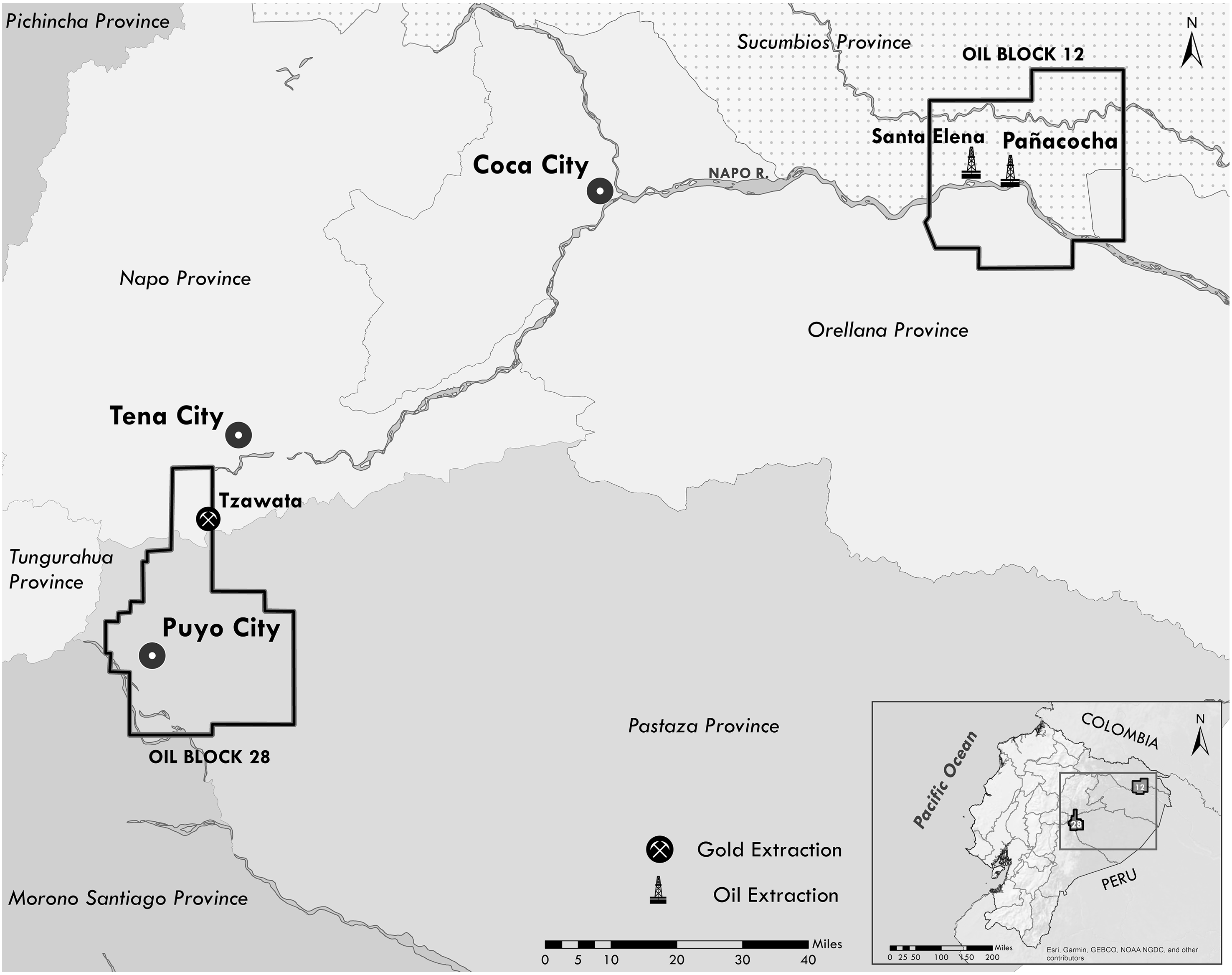
Locations of Pañacocha and Tzawata. Map by R. Theofield.
Marcia was interested in understanding women's role in the negotiations in order to share that information with other women in her community. For part of my doctoral research, I was interested in better understanding how Indigenous livelihoods were affected by oil-related negotiations. However, when Marcia and I began communicating with Kichwa women from Pañacocha, our attempt to understand the specificities of their struggles led to communications that assessed personal experiences related to mining conflicts through dreaming and encounters with forest beings or Supays. It is important to note we did not plan to engage in dream and testimony sharing as part of a planned research or analytical methodology of knowledge production. Instead, conversations developed organically as Marcia and I lived with families and joined women's domestic activities. Indeed, some of the stories shared are well-known among communities living along the Napo River basin. This is because women use storytelling to walk with each other in processes that seek to acuerpar, while warning women about mining-conflicts in the context of Kichwa-forest relations.
For about eight weeks stretched over four months, Marcia and I traveled among households scattered throughout the Pañacocha forest. We conversed with approximately 50 women who belonged to 12 households, comprising about 20% of all households in Pañacocha. We lived with some of these families while visiting almost daily with others within walking distance. Additionally, during November and December of 2017, I organized a series of conversations for collective self-reflection. These conversations were like focus groups, but the agenda and discussions were established and decided upon by all the participants. Two of them were with five and four women from Pañacocha, and in June of 2018, I returned to Coca City to hold another conversation with five women from Pañacocha and six women from Tzawata. In these self-reflections, we discussed dreams and testimonies in the context of mining realities, and I collected 19 such accounts that speak about mining-related and territorial conflicts (Figure 2).
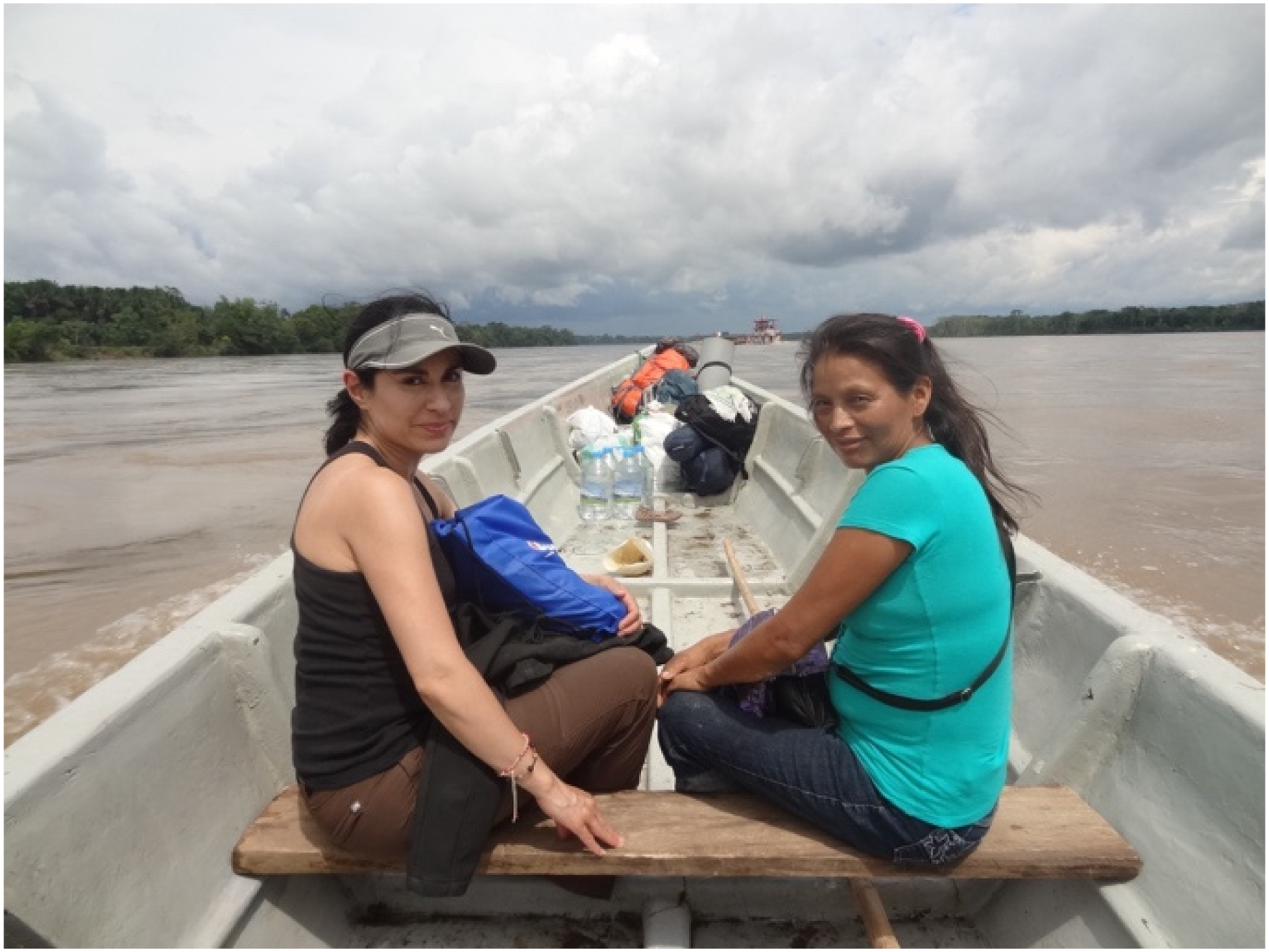
Marcia and the author, printed with permission of Marcia Aguinda and her family.
Marcia's participation in this research was key, as her presence built trust between us and Kichwa women. This rapport allowed me to join in women's daily lives and spaces that I otherwise would have been unable to access. Marcia's interest in women's participation in mining politics opened a new organic space of collaboration that responded to a need to share struggles, connect, validate emotional ways of producing knowledge, and forge solidarities. Marcia guided most conversations based on her own dreams and testimonies, and I participated by recording, note-taking, and contributing my own such experiences.
The nature of our exchanges and self-reflection fit decolonial feminist methods of producing knowledge, a grassroots process that recognizes knowledge as a collective endeavor, embodied and produced in conversation with each other (Cariño et al., 2017; Espinosa, 2014).
During collaboration, storytelling sharing occurred near stoves and chakras, spaces in which elders and children were present but did not always participate. Sometimes, conversations were held at women's homes in spaces designated to receive visitors. On those occasions, participants included male family members, but women were less outspoken when men were around. At night, Marcia and I discussed storytelling shared throughout the day, and then I followed up with interviews of women and other family members. Information was validated using women's collective self-reflection. This is a tool of analysis identified by communitarian feminist and Indigenous intellectuals who argue that self-reflexibility or “feeling-thinking,” described as thinking with our bodies (Rodriguez Castro, 2021; Ulloa, 2021), also referred to as “searching under our own skin” (Cabnal, 2010), is a process that honors the material and emotional experience of the body to produce knowledge (see also Welch, 2019). As a collaborator encouraging women to link experiences of oppression across scales, I fully participated in the self-reflection of dreams and testimonies.
I identify as a mestiza (or mixed-race woman), and as a scholar and activist. I also identify as a colonial subject who inhabits and experiences colonial contradictions. My ancestors were Ecuadorian Kichwa from the highlands whose identity was diluted through time as family members sought education, urban jobs, and miscegenation to escape the social stigma of indigeneity. My training in Western social sciences resonates with the social mobility sought by my ancestors. However, my involvement with grassroots organizations and struggles to defend communal territory in non-western terms responds to a personal need to assist processes that rebuild community and a choice to resist further colonization.
“We don’t know”: difficulties relating to each other across differences
Marcia would always make first contact, trying to connect with other Kichwa women during daily household visits. She would say: “Good morning, are you home? Come out to talk, we just want to ask your opinion about oil-related problems.” Frequently, women would hide inside their homes even when we could see them through gaps in the wooden walls and windows. Marcia would get closer to the homes and ask: “Why are you hiding? Come out; we can see you there.”
In response, women often told us their husbands did not permit them to have guests. Others said that they lacked any meaningful information to share with us and that, instead, we should talk to their husbands, fathers, or brothers. Their response usually was “we do not know about oil,” or “we lack the right thoughts [when talking oil politics].” Others would say “I do not have the time to talk about this,” indicating more pressing matters in their day. Indeed, despite an increase among Indigenous women speaking up and mobilizing against how mining exacerbates patriarchy throughout the Amazon (Vallejo and García Torres, 2017; Vallejo and Duhalde, 2019), women still experience high levels of racialized and gendered discrimination in their communities (Castillo, 2019; Valdivia, 2009; Vallejo et al., 2019).
In our conversations, Marcia argued that Pañacocha women knew more than they acknowledged. She wanted to inspire them to challenge oppression. Marcia said: In silence, like ants we are; “cariwarmi” we are [women that do men's work]… while men drink and make [political and public] decisions. We can achieve a lot by helping each other do the hard work here [in their domestic spaces].
Many women were surprised by the interactions between Marcia and me, especially when they saw me taking notes while Marcia led conversations. Women frequently asked Marcia about our relationship: “why is this engineer walking with you?” and “is the engineer paying you?” Because many male civil and oil engineers have visited and worked in Pañacocha, people refer to outsiders like myself using the word “engineer” to indicate a person with specialized knowledge and the power to speak with state officials and oil personnel. Indeed, my communications with Kichwa women are complicated by my access to higher education, my work with NGOs, and my ability to live in urban areas—all of which render me whiter and more masculine within the colonial gaze (see Valdivia, 2009). It was easier for me to talk to male leaders experienced in dealing with journalists, researchers, state officials, and oil personnel. Men felt comfortable talking with me, unlike women who were shy around me.
Bolivian intellectual Rivera Cusicanqui (2010) explains how subaltern communities have experienced colonization as cyclical extractive waves that reconfigure colonial hierarchies and actualize patriarchy, racializing social relations while disciplining populations (see also García Torres et al., 2020). Indeed, Cielo and Carrion Sarzosa (2018) show how oil extraction, redistribution of oil compensations, oil profit investment in urban centers, and productive activities in the northern Ecuadorian Amazon aim to replace a relational social fabric with a productive one. Such an approach undermines forest subsistence, its epistemologies, and women's reproductive activities to favor wage labor, for-profit production, and Western health and education (Cielo and Carrion Sarzosa, 2018). As described by Tzawata and Pañacocha women in the rest of the paper, these changes subordinate women and children to patriarchal extractive logics that further feminize body-territory relations, deepening racial, gender, and epistemic oppression.
Chirix explains that to internalize oppression for Indigenous women like herself means to accept their lowest position in the colonial hierarchy and the feeling of inferiority in relation to those better-positioned, often silencing them (2014). Indeed, the tensions and shyness between Marcia, Pañacocha women, and I illustrate perceived differences among the Kichwa and differences between Indigenous women and those who, like me, hold privilege and power invested in mestizaje through miscegenation, access to Western education, and urban livelihoods. These hierarchies and differences structure social relations between Indigenous communities, the nation-state, extractive industries, NGOs, and even allies working with communities in emancipatory projects.
For example, Cariño et al. (2017) and Barrios (In Viezzer, 2014) denounce how Indigenous and rural women, respectively, are usually portrayed as disciples and students of activists and academics, undermining their knowledge and agency, while academics and activists are portrayed as benevolent helpers or as assisting Indigenous and marginalized agendas. Similarly, Latin American decolonial feminists argue that even when trying to decolonize collaborations, colonial structures provide mestiza and white women with political platforms to speak, access to funds, and information reproducing inequality and reinforcing epistemic, racial, gender, and class hierarchies on both sides (Espinosa, 2014; Leinius, 2021; Lozano, 2014; Barboza and Zaragocín, 2021). According to feminist philosopher Lugones (1987), the normalization of social differences is reinforced by assuming that oppression affects the other and not ourselves; this inability to see oneself in the other leads us to oppression's justification.
Thus, there is an urgent need to engage with epistemologies and ways of being that could help work through tensions as we collaborate across differences. Indigenous intellectuals such as Aura Cumes argue that decolonial epistemology and practice emerge in militant collectives and communities that use other ways of analysis to decenter the privileges of whiteness and masculinity found in current social relations (Cariño et al., 2017). And Chirix (2014) and Cabnal (2010) argue that such analysis is possible through honest dialog and reflection based on affective relations centering on diverse women's experiences with oppression and the need for recognition. Cumes (2014) argues for social relations that avoid the hierarchization of oppression and instead dwell on how oppressions overlap and merge between women recognizing themselves as different, such as Indigenous and Mestizas. In what follows, Tzawata and Pañacocha women provide us with an epistemic political practice that enables us to acknowledge how different oppressions are related while being critical of social differences and hierarchies.
Storytelling dreams and life: traveling across worlds
During the time Marcia and I spent with families, participating in cooking, gardening, fishing, and cleaning forest pathways, Marcia shared intimate dreams and testimonies that spoke about land struggles and gold mining in Tzawata. Women replied using their own dreams and testimonies. Marcia said: After the police tried to enter Tzawata [to evict the community], I started to have the same dream. I am wrapped in sheets, and someone is trying to immobilize and suffocate me. When I try to see who is doing this, I see two individuals who are part human, part monkey. They try to kill me, but I struggle for my life. . . In the fight, I can pull one arm out of the sheets, and after a further struggle, I introduce my arm through his mouth far enough to grab his heart and pull it out of his body. I am scared and furious, so I scream at them: why are you doing this? Is this what you want…? Sometimes, I defeat them but sometimes I wake up… Recently I do not have the force to free myself from the sheets and that is when they can kill me.
Marcia tells the men/monkey story at 5 a.m. as we help two sisters make “guayusa,” and “chucula,” a plantain-based breakfast drink. One of the sisters asked about how Marcia and the women confronted the police, so Marcia explained how women and children blocked the community's entrance with the urine-filled bottles. When the policewomen tried to push them away, the women used their weapons. Eventually, the police left, and the women and children felt victorious.
One of the sisters asks, in your dreams “do the men/monkeys suffocate you, or do you always manage to breathe?” Marcia answers “it depends on my strength, sometimes I survive and other times I do not… strength comes from inside me and shows as anger… anger helps me fight…” Then, one of the sisters shares a similar dreamt encounter with Supays: After that last oil spill, all died around here… In my dreams, I can see a bunch of people that are walking toward me. They are looking for something and they approach me slowly. I keep walking and suddenly I realize they are chasing me… I want to run but the forest is dense, and it is difficult to open a path to run. I close my eyes and start singing like a bird… [By singing] I turn into a bird and realize I can fly. I take off and see them from above… I feel super heavy, and I fall back to the ground. When I check, my wings are covered in oil, and half human, half animal Supays (her vision is blurry) try to bury me in a swamp. What have I done to be harmed like this? (Pañacocha community, November 2017) nothing, the leaders went to Lago Agrio (nearby city) to denounce it, but the oil company hired our own men to clean it… leaders stopped complaining after receiving wages to pay for the cleaning … still after the black mud is out, it cannot be cleaned, it is everywhere… it is in the water, the fish, and your clothes, it will not come out and it stinks… we do not see the payments the company said we would receive; the leaders take everything for themselves and leave us with nothing (Pañacocha community, November 2017).
Indeed, Pañacocha has undergone many social fractures. Since extractive oil operations started, the community has been fragmented between supporters and opposers of extraction and delivery of oil-related compensations (Noroña, 2022). Pañacocha first experienced oil extraction in the 1980s when the Occidental Petroleum Company (OXY) found oil in this block. After OXY's contract expired in 2006, Petroamazonas, now Petroecuador, a state-based oil company, took control of oil operations and promised Kichwa communities they would receive compensations for their support, both in cash and in support for infrastructure (Noroña, 2022). Still, according to many families, oil-related compensation, including the construction of the 13-block urbanization known as Millennial City, has deepened internal divides and patriarchal relations where women and elders are further marginalized from participating in decision-making processes and benefiting from compensations (Noroña, 2022; Vallejo et al., 2019).
Marcia used the men/monkey dream repeatedly to spur conversations, encourage collective embodied emotions, and highlight community struggles against gold and oil extraction. Women involved in the conversations described their experiences in detail and full of emotion. They get frustrated, angry, and even cry together, especially if the narratives include the death of children and loved ones. While narrating and re-narrating, the listeners identify with and appropriate the teller's experience as women acuerpan each other's stories (see also Muratorio, 1998; Warren Carney, 2020; and Kohn, 2021). Kichwa scholar Grefa (2020) explains that the vivid telling of dreams and testimonies allows others to experience the forest: “it (storytelling) becomes a powerful process to continue valuing the forest in all its configurations and expressions…storytelling allows it to become our own experience, to be shared and later to be appropriated.” Thus, storytelling facilitates relationality with the forest while enabling an intersubjective understanding of mining-related oppression among participants. According to Grefa (2020), Kichwa women have a particular ability to tell and retell stories: “compared to men, it is women who feel these stories more intensely and they bring them to life” (Interview, December 2022).
Kichwa women denounce multiple oppressions through collective, shared experiences of mining-related violence. Socializing their embodied experience between kin and other families produces shared experience and knowledge of the territory (see also Indigenous testimonies in Ulloa, 2020). I suggest that Marcia's efforts to connect with other women using dreams and testimonies respond to her need to extend Tzawata struggles to defend ancestral land from mining. In doing so, Marcia weaves her storytelling with those of other women in Pañacocha. In the process, she fuels common embodied anger and indignation to encourage organized and collective action to protect territory and Kichwa livelihoods. As a site of shared struggles and emotions, embodied experiences are important among marginalized and Indigenous women's efforts to organize and resist oppression. Particularly, Chirix (2014) and Reinoso (2017) argue that by reviving these feelings and stories, women can move from passivity to action.
According to Marcia, women share dreams and testimonies so they can speak truth through feelings, “telling others about how I have lived both sad and happy help to understand … how can my comrade know my sadness if she does not feel herself… only that way can women seek truth behind the struggle.” (Interview, December 7, 2022). The ability to understand each other's realities across differences is what Lugones (1987) calls the ability to travel across worlds. Lugones (1987) suggests that social differences and hierarchies could be challenged and even dismantled if we could connect and see ourselves in the other. Thus, I suggest that in sharing lived experiences in Kichwa terms, women revive each other's stories as their own; they dwell on their body's histories of oppression and walk into each other's bodies and experiences as the first territory of habitation, enabling an inter-subjective formation process in which women find commonalities and an axis around which to organize.
Identifying oppression across scales
Storytelling dreams and life depart from commonalities found in embodied experiences, yet these narratives are contextualized within participants’ sociopolitical and economic realities; in this case, mining-related conflicts. Although this occurs naturally in conversations, as dreams and testimonies explain each other, I participated fully by encouraging women and others to link their experiences across scales and note how similar oppressive logics overlap between bodies. In addition to the organic conversations held with Marcia and women, analyses occurred during four encounters for collective self-reflection or focus groups.
Women's storytelling allows us to access others’ perspectives based on our own embodied experiences, and it helps us converse about its spatiality. For example, although Marcia recognized that the fury and fear she experiences in the men/monkey dream are directly associated with her resisting forced removal from the land, those emotions are also comparable to how she feels every time her husband disciplines her and her children: “in those moments I wish I had the same force I have in the dream to stop him.” Another leader, Dolores, not only identified with Marcia's reality but recognized a link to how similar oppressions affect her life.
Dolores is currently the president of the Santa Elena community located next to Pañacocha. Santa Elena used to be part of the Pañacocha community. Her household and those of her extended family sit near one of the oil platforms in oil block 12. In 2001, she decided to separate the territory her extended family occupied in Pañacocha to avoid becoming involved in oil politics dominated by leaders coopted by the national oil company. According to Dolores, fracturing the land allows her extended family to receive direct compensation for the nearby oil platform. Before, when her land was part of Pañacocha, some of the oil-related compensations were paid to Pañacocha leaders and her family did not get a fair share. This is the most common conflict experienced by Pañacocha families, who argue that leaders mismanage the redistribution of oil compensations (Noroña, 2022). During collective self-reflection, and echoing Marcia's story of resisting the mining company and her own husband, Dolores linked struggles for land, fair compensation, and domestic abuse: to fight the Pañacocha leaders, first I fought against my husband who always humiliated and hit me. He did not want me to be a leader… he hit me if I participated in community assemblies… I am one of few Kichwa women that have confronted male leaders… I found my strength when I grabbed a rock and hit him and since that day he never touched me again… with a similar force, I told my children I was going to organize our own territory and separate from Pañacocha… (November, 2017).
Building networks with non-indigenous participants
In my effort to participate in these women's conversations, I did not try to rationalize storytelling because women expected me to feel and experience them during our discussions. I also avoided asking questions that involved linearity and cause-effect unless women willingly wanted to discuss stories in these contexts. My participation was allowed only if I shared my own experiences and dreams vividly, so that women could reciprocate by accessing my reality at the emotional level. Indeed, the few times I asked linear questions, such as when or where a specific event or encounter with Supay happened, women either ignored the question or just stopped sharing. Thus, I learned quickly what the terms of the exchange were and how to be a respectful participant. Women's conversations were focused on emotional experiences and memories, forcing me to search for ways in which race, gender, and epistemic differences were present and affected me and my environment. Such exercise requires thinking critically about our privilege and social differences while being vulnerable and accountable to others.
For example, the following male elder attested to epistemic power dynamics affecting Kichwa decision-making processes while Marcia and I visited households around Tereré in Pañacocha. I contributed to the conversation using a dream/testimony of similar struggles. This information allowed conversations about the hierarchical nature of knowledge during a later collective discussion. Here is the male elder: One day after going hunting… a Supay followed me… home… instead of punishing me for hunting it warned me about noise coming to Pañacocha and told me the animals were walking away… I did not pay attention to that warning… Days later, engineers came to explain about all the good things and benefits of the millennial city, but I did not really understand what it meant… I wrote some of the words they mentioned to look them up, but still, I did not understand… Yes, we agreed to the construction [of Millennial City] because they said it would help us have property, still, we did not understand what it meant… the engineers tricked us using words we do not know… (Pañacocha, December 2017).
Even when people understand what the word “property” means, they do not comprehend what having property entails, and this decreases the population's ability to participate in decision-making processes.
Following the elder's intervention, I spoke about nightmares in which I struggle to fully think and write in English. In the dream, I am with a group of people that walk in a maze. They run and leave me behind, but I cannot scream for help since I do not have a mouth. I feel lost, desperate, and silenced. After explaining my struggles to fully engage in academia due to not completely understanding academic English, family members participating in the conversation were able to identify how our struggles were simultaneously similar yet different. While the Kichwa struggle to understand Spanish to better negotiate with the oil company, others who are better positioned (like me) experience similar struggles to have a participatory voice in power dynamics affecting our lives. Still, our struggles did not fully overlap since my survival was not at stake, whereas not understanding Spanish could limit Kichwa's participation in decision-making that affected their survival and that of their territory.
During collective self-reflection, we revisited this narrative, and a young woman asked, “What happens if you never understand English well?” I answered that it could affect the kind of job I could get and the territory/community I would live with, but I would be okay. This clarified that although similar oppressions affected us, I was privileged compared to my comrades.
From relative privilege to solidarity and accountability
Uneven positionalities and social differences were also evident when discussing the paradoxically similar and different realities experienced by Tzawata and Pañacocha, as well as other communities that have gradually joined yearly women's gatherings to discuss mining-related violence. Because Tzawata is close to urban areas, enforcing Indigenous rights has been more conducive than it has been for Pañacocha. Frequently, storytelling described how new ailments brought by oil extraction affected children in Pañacocha. For example, one of the women discussed how she could not feed maternal milk to her baby, “every time I try to feed him, he gets sick.” Women participating in the conversation asked why that would be, and she answered that shamans [traditional healers] might be involved, as they can communicate directly with Supays and could command them to poison her milk, “there are ants in my breast… that is why I cannot feed my baby… the doctor [sent by the oil company] tells me I am an ignorant woman and does not believe me… every time I feed him, he gets sick.”
Marcia and I asked why shamans would like to hurt her, and she explained that Kichwa leaders who support oil operations and benefit from compensations punish families that complain about and resist modernization programs such as Millennial City and the introducing of coffee and cacao productive projects. Other women spoke of increased alcoholism among families and suggested that some children's sudden deaths might be associated with increased violence at home. Similarly, Marcia had spoken to two young girls who told her that “they were scared of staying at home after dawn as evil Supays inhabit their chakras.” Marcia and other women immediately recognized such a story as a sign of sexual abuse at home.
Knowing that these abuses would not be resolved by Pañacocha county authorities or by customary Kichwa law, Marcia suggested women go to the Pañacocha police and explain the situation as she would do in her community. Still, one of the women responded “what can they do? They [two policemen stationed at Pañacocha] are there to pretend the place is a city with all services, but it is all a trick for the tourists and the television… here the children die, and no one says anything, what do you know?” She was suggesting that Marcia and I did not understand the reality of the community and should not meddle in such situations. Indeed, Storytelling Dreams and Life was not always smooth, and tensions often arose as Marcia and I grew alarmed by the situation of women and children.
During our conversations, we encountered plenty of moments of refusal; some women welcomed and spent time with us, but not all of them. Many questioned our presence and opinions as out of place and useless. Still, others felt cared for during our stay. This is because storytelling was not only about the stories, but about caring for the well-being of women and families. Marcia, who knows about medicinal plants, would always have them with her to cook beverages to treat bodily and spiritual ailments. When a baby cried overnight while staying with one family, Marcia diagnosed he had “mal de aire” described as a “bad current of air hitting the baby,” and she cleaned the baby with peppermint and rue, after which he fell asleep. I was constantly volunteering to decipher legal documents sent by the oil company, to help family members write letters for state officials, and to help students with homework at home. Marcia's Storytelling Dreams and Life, was not an easy task and was full of imperfections. Still, I see this as a necessary political project based on care relations that allowed women to share struggles on their own terms while furthering their support networks.
Women discussed how storytelling is not respected by state officials, oil personnel, and general society. One said: “that is why our husbands do not want us to participate in oil-related assemblies. They are ashamed of us.” Another described how police members laughed at her when she denounced the death of children through encounters with forest spirits. In general, women agreed there was a general lack of care for Indigenous lives in extractive contexts. Still, communities like Pañacocha and neighboring ones were disadvantaged compared to Tzawata, given its location and access to Western education, providing women with appropriate language for denunciation.
Indeed, proximity to urban areas allowed Tzawata community members and Marcia to build alliances and networks that support Tzawata when the community or Indigenous lives are threatened. Tzawata's proximity to cities has allowed the community to enforce ethnic rights over territory and spur public condemnation when the territory is threatened (Noroña, 2020). It is precisely the acknowledgment of the relative privilege Tzawata has in comparison to Pañacocha that drives solidarity among women, which includes myself. This kind of accountability does not emerge from the benevolence of a better-positioned subject, but rather accountability emerges from a sense of closeness and responsibility for each other. I suggest that sharing dreams and testimonies vividly in ways that engage others emotionally, as Marcia and the Pañacocha women do, is important for weaving Kichwa sociality in ways that extend social kinship between us. This requires turning our relative privileges into accountability and solidarity.
Indeed, despite the distance, lack of transportation, and poor phone coverage between Pañacocha and Tzawata, women have kept in contact. Reunions continued in 2018 to discuss strategies to address mining-related violence, and Kichwa storytelling played a key role in assessing knowledge of the types of violence affecting families. The 2018 meeting gave rise to the formation of a women's committee involved in the organization of the 2022 and 2023 gatherings that included the participation of Sani and El Edén communities located near Pañacocha and that were also affected by oil extraction, as well as rural mestizo communities living near Tzawata, such as Mariscal. Not to mention rural women from the community of Pintag outside Quito, along with activists from La Cantata Feminista and the Pachaysana Foundation, in which I do most of my militant work. The three and four-day gatherings of the last two years have allowed us to share resistance strategies based on dreams and testimonies. And women have added healing ceremonies to connect with the territory and each other. In 2022, women organized a healing ritual at the Misahualli River to recognize water's properties in healing the stress women experience. Gatherings have also sought to share Western information about legal frameworks ruling the distribution of mining compensations and Indigenous rights, not to mention fundraising to address immediate women's concerns. The gatherings have indeed extended Tzawata and Pañacocha networks, and better-positioned women like me have contributed by finding safe places and funds to make meetings possible.
Conclusions
This paper presents Storytelling Dreams and Life as a Kichwa epistemology that enables women to care for, walk with, and understand each other's experiences of oppression across differences in the context of mining. Storytelling fits Body-Territory epistemology, arguing that there is no ontological distinction between bodies and territories as we are all interdependent for survival. While Body-Territory has effectively described how community members feel the territory in the body while identifying their livelihoods in the territory, there needs to be more documentation of how unevenly positioned human bodies relate to each other across social differences and colonial hierarchies. I suggest that Storytelling Dreams and Life as practiced by Kichwa women fills this gap.
By illuminating women's dreams and testimonies, this paper argues that women denounce and discuss multiple oppressions through collective, shared experiences of mining-related violence. This produces intersubjective understandings of the territory and each other's lived experiences. In the process, women tell and re-tell their stories vividly as they seek interlocutors to engage with the narratives emotionally, enabling them to travel into each other's worlds. Such an understanding departs from the idea that body-territory not only identifies the relationality between the human and more than human, but also recognizes the body as the first territory of habitation. In the context of mining extraction, storytelling allows differently positioned women to access each other's experiences across different bodies. The way Kichwa women share such accounts permits them to analyze mining oppression, linking oppressions across scales that join minds, bodies, and territories, while also recognizing how hierarchies and privileges can be turned into accountability and solidarity
Highlights
Storytelling of dreams and encounters with forest beings is a socio-spatial form of producing knowledge among the Amazonian Kichwa.
Storytelling is particularly practiced by Kichwa women in the context of mining conflicts, resistance struggles, and networking.
Storytelling contributes to the Body-Territory literature by enabling intersubjective understandings of mining violence while forging communication across differences.
Serious engagement with Kicha epistemologies, as practiced by women, enables conversation participants to identify how oppression operates across scales.
Footnotes
Acknowledgements
This article is written in memory of Marcia Aguinda, leader of the Tzawata community. Marcia Aguinda and Dolores Aviléz provided invaluable knowledge in the making of this article.
Consent to participate
Under 45 CFR 46.117 (c), (2), consent documentation was waived to allow a verbal consent process.
Consent to publish
Rural and Indigenous women mentioned by their first names consented and requested their information be included in this article as part of their political struggles to defend livelihoods and territories. Other participants’ information remains anonymous.
Declaration of conflicting interests
The author declared no potential conflicts of interest with respect to the research, authorship, and/or publication of this article.
Ethical considerations
The University of Oregon's ethics review committee approved IRB protocol 12142016.023 on 20 February 2017.
Funding
The author disclosed receipt of the following financial support for the research, authorship, and/or publication of this article: This work was supported by the Fulbright Association (grant number P022A160066 - 2017).
